© 2016, IRJET | Impact Factor value: 4.45 | ISO 9001:2008 Certified Journal | Page 2764
Fire Detection Using Image Processing Based onColorAnalysis
ShadabDastgeer
1, Imranullah Khan
2, Shailendra K. Singh
3,Irshad Ali
41,4 M.Tech. Scholar, 2,3Junior Associate Professor, Department of Electronics and Communication Engineering,Integral
University, Lucknow, India
Abstract -The paper presents a fire/flame detection method based on color analysis of fire image. Afire video clip was analyzed under the proposed algorithm to detect the fire region. First the image is converted into HSI color model and then the color mask is created and applied on the original image to detect the fire/flame regions. To remove the spurious noise, image difference method is used and further images are transformed into gray scale and average filter is applied on images to eliminate weaken spurious fire regions. Thresholding is performed to remove the spurious fire completely. Finally, the burning degree is calculated using a simple method that is based on white pixel ratio. The proposed approach is tested on a video of fire and the results obtained are positive. On an Intel i3 processor with 3GB RAM, fire signal was received within three seconds.
Key Words: Color analysis, color masking, image difference, flame detection, HSI
1. INTRODUCTION
Fire is a serious issue as it is related to people’s safety. It is essential to detect fire at the early stage before it becomes violent and unrelenting. Conventional fire detection methods are based on sensors, like optical sensing, ionization current sensing, thermocouple etc. They use smoke, photo sensitive characteristics, and temperature etc. But these systems are sluggish and suffer from several problems like the alarm cannot be issued unless the particles reach sensors to activate them, they are not always reliable, and they may also provide false alarms. All these methods do not provide additional information about fire like flame location, size, burning degree, etc. Moreover, these systems are also not applicable in large regions or in outdoor environment [1]. On the other hand, the image based systems can detect the fire at early stage before it
becomes unrelenting. Wherever the unnecessary firebreaks out, CCTV camera can be available at the fire scene and hence the flame properties such as color, height and so on can be determined from images after analyzing the video sequence. Thus video based fire detection system is useful in order to correctly detect the fire by processing the digital images. The advantage of using video based fire detection is the ability to cover large and open spaces.
To be applicable in practical use, image-based fire detection system requires to provide user with the fire alarm as quick as possible, and also the degree of fire on screen. The system therefore must work in real time. In this paper, a technique is developed to meet the above requirements. To describe the flame features from fire images, the HSI color model is chosen. The color separation method is used for color segmentation and fire mask is applied on original images. Then, the image difference method is applied to remove spurious fire regions and further after gray scaling of images again the image subtraction is performed. Image thresholding is applied to completely eliminate the spurious noise. Finally, we have estimated the burning degree of fire to provide the user with the alarm signifying small, medium or big fire. The proposed method is tested on fire video clip on an i3 Intel processor with 3 GB RAM and the alarm was obtained within three seconds that is almost real time.
© 2016, IRJET | Impact Factor value: 4.45 | ISO 9001:2008 Certified Journal | Page 2765 in this paper and section IV provides the
experimental results.
2. RELATED WORK
Number of researchers worked on video based fire detection methods and provided different techniques based on color detection, motiondetection, edge detection etc. The methods have their own pros and cons. Healy et al. [2] developed a fire detection system based on color video input for a pre-allocated view on some ideal conditions. Noda and Ueda [3] used gray scale images acquired from infrared camera to detect the fire in tunnels. Yamagishiand Yamaguchi [4] proposed a fire detection method for color images based on HSV color space and neural networks.A computer vision based method for real timr fire and flame detection was developed by B. UgarToreyin, YigithanDedeoglu, UgurGudukbay, A. Enis Cetin [5]. They proposed a novel method to detect flame/fire in real time by processing the video data generated by an ordinary camera monitoring a scene. It makes use of temporal and spatial wavelet transform. Phillips et al. [6] presented a sophisticated method for flame recognition in color video. The method does not consider the temporal variation of flames and the approach is too complicated to be applicable in real time. An HSI color model based real-time flame detection method was developed by Wen-Bing Horng, Jian-Wen Peng, and Chih-Yuan Chen [7]. A neural network based fire detection method was developed by Cheng Caixia, Sun Fuchun, and Zhou Xinquan [8]. The method uses detection information for temperature, smoke density, and CO concentration to determine the probability of three descriptive fire conditions.
3. PROPOSED APPROCH FOR FIRE DETECTION
The proposed approach method can be divided into following major phases: (1) Segmentation of fire region using color masking, and thus creating a fire
mask, (2) Removal of spurious fire regions, (3) Estimating the burning degree.
3.1Segmentation of Image
The RGB image is converted into HSI color model. HSI color model is represented as a triple (h, s, i):
h1≤h≤h2, s1≤s≤s2, and i1≤i≤i2, in which first one is the
range of hue followed by the ranges of saturation and intensity respectively [9].
Beginning with normalizing the RGB values,
r = 𝑹
𝑹+𝑮+𝑩 (1)
g = 𝑮
𝑹+𝑮+𝑩 (2)
b = 𝑩
𝑹+𝑮+𝑩 (3)
i=𝟏
𝟑 (r+g+b) (4)
s=1- 𝟑
(𝒓+𝒈+𝒃) [min(r,g,b)] (5)
h= { Ѳ 𝒊𝒇 𝒃 ≤ 𝒈
𝟑𝟔𝟎 − Ѳ 𝒊𝒇 𝒃 > 𝑔 (6)
Ѳ= cos-1{ 𝟎.𝟓[ 𝒓−𝒈 + 𝒓−𝒃 ]
[ 𝒓−𝒈 𝟐+(𝒓−𝒃)(𝒈−𝒃)]𝟏𝟐} (7)
For the convenience, the range of hue, saturation, and intensity components of the HSI color model are normalized within the range: 0o≤h≤360o, 0≤s≤100,
and 0≤i≤25 [4].
© 2016, IRJET | Impact Factor value: 4.45 | ISO 9001:2008 Certified Journal | Page 2766 If f(x,y) be the input image, Cfbe the fire/flame color
set, then the result image g(x,y) can be defined as [4]: g(x,y) = { 𝒃𝒍𝒂𝒄𝒌 𝐢𝐟 𝒇 𝒙, 𝒚 ∉ 𝑪𝒇
𝒇 𝒙, 𝒚 , 𝐨𝐭𝐡𝐞𝐫𝐰𝐢𝐬𝐞 (8)
After applying the color mask, the equation (8) is modified as [7],
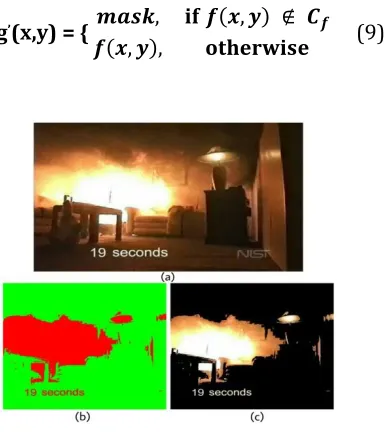
g’(x,y) = { 𝒎𝒂𝒔𝒌, 𝐢𝐟 𝒇 𝒙, 𝒚 ∉ 𝑪𝒇
𝒇 𝒙, 𝒚 , 𝐨𝐭𝐡𝐞𝐫𝐰𝐢𝐬𝐞 (9)
Fig. 1(a) is the fire scene, (b) shows the fire mask, (c) image after applying fire-mask
3.2Removal of Spurious Fire regions
After applying the fire mask on the image, only the colors that belong to fire are remained and the rest background color becomes black. But still their remains some spurious fire regions that do not belong to fire, like due to reflections of fire flame, hue of few object can be changed and thus it may result in spurious fire-like regions [7].
To remove the spurious fire like region image difference method is applied. After performing the image difference, still there exist some spurious fire-like regions. If gi(x,y)and gj(x,y) are two images
[image:3.612.38.230.206.423.2]obtained after image color masking then the resulting difference image h(x,y) is given by [7]:
h(x,y)=|gi(x,y)-gj(x,y)|
=
|𝒓 𝒈𝒊 𝒙, 𝒚 − 𝒓 𝒈𝒋 𝒙, 𝒚 |
|𝒈 𝒈𝒊 𝒙, 𝒚 − 𝒈 𝒈𝒋 𝒙, 𝒚 |
|𝒃 𝒈𝒊 𝒙, 𝒚 − 𝒃 𝒈𝒋 𝒙, 𝒚 |
(10)
The image difference when modified according to color masking, it gives:
h’(x,y)=|g’i(x,y)-g’j(x,y)| (11)
Where | . | represents the absolute function, and r(), g(),and b() are the functions to select red, green, and blue color components.Butfor the color images, if we simply perform image subtraction we can face problems, for example if we take the difference of two reddish colors, it will result in dark cyan color [7]. A way to cope with this problem is to convert the image into gray-scale image.So, further the image is converted into gray-scale image for easy detection. Further the image difference is applied on gray-scaled image to remove as much possible spurious regions.
Different filters are available to perform the operation of filtering like Gaussian filter, average or mean filter, Sobel filter and so on but the average filter is used because it is simple and easy to implement. The amount of intensity variation between adjacent pixels isreduced with this filter. After filtering the image, the thresholding is performed to completely remove the spurious fire-like region.
4.
ESTIMATING THE BURNING DEGREE
After performing the color masking, the contours
of flame enclose the image boundary. As the fire
increases, the shape of contour changes more
rapidly and hence the variation in flame contour
can be used for approximation of the burning
degree. The corresponding binary image
b(x,y)
of
the contour image
h’(x,y)
is given by [7]:
© 2016, IRJET | Impact Factor value: 4.45 | ISO 9001:2008 Certified Journal | Page 2767
This is the binary contour image that converts all
the remaining fire colors into white. Now,
further, the contour difference images are
obtained, these images can be represented as,
d(x,y)=|b
i(x,y)-b
j(x,y)|
=
{
𝒃𝒍𝒂𝒄𝒌,
𝒊𝒇 𝒃
𝒊𝒙, 𝒚 = 𝒃
𝒋(𝒙, 𝒚)
𝒘𝒉𝒊𝒕𝒆,
𝒐𝒕𝒉𝒆𝒓𝒘𝒊𝒔𝒆
(13)
The number of white pixels on the contour
difference image can be used to estimate the
burning degree of the flame. White pixel ratio,
r
w,
of a difference image contour is given by:
r
w=
𝒏𝒘𝒏
(14)
n
wis the number of white pixels and
n
is the total
number of pixel in contour image. Higher the
white pixel ratio, bigger the fire. A small
fractions=0.03(say),which is used as a threshold
value is given by the user according to the
situation of input video.
If
r
w=
0, no fire is detected.
If 0<
r
w≤s,
small fire is detected.
If s<
r
w≤2s,
medium fire is detected
If
r
w>2s,
the system detects big fire.
5.
RESULTS
The proposed approach is tested on video clip of
fire breaking out and the result obtained were
satisfactory. The images with detected fire
region are obtained and shown in figures below.
We have considered four random frames of the
video. Best results can be expected by processing
consecutive frames.
Fig.2Four randomly selected frames from video
Fig.3 Images after applying the fire-mask
© 2016, IRJET | Impact Factor value: 4.45 | ISO 9001:2008 Certified Journal | Page 2768 Fig.5
Image difference to remove spurious noise 5(a), 5(b), and 5(c) are the difference of images 4(b) and 4(a), 4(c) and 4(b), and 4(d) and 4(c)
Fig.6 (a), (b), and (c) are the images 5(a), 5(b), and 5(c) after filtering and thresholding
Fig.7 Results after the final masks obtained in figure(6) are applied on the original difference images
Fig.8 Contour images obtained by taking the difference of images of 7(a), 7(b), and 7(c)
Fig.9 (a) final contour image (b) binary contour image
After obtaining the binary contour image that consists of black and white pixels only, the white pixel ratio is calculated that decides the burning degree of fire. Applied on Intel i3 processor with 3GB RAM, the fire was detected within three second and thus the result was encouraging enough.
6. CONCLUSION
© 2016, IRJET | Impact Factor value: 4.45 | ISO 9001:2008 Certified Journal | Page 2769 fire images are free from noise and also free from
spurious fire regions.
REFERENCES
[1] Tian Qui, Yong Yan, Gang Lu, “An Autoadaptive Edge –Detection Algorithm for Flame and Fire Image Processing”, IEEE transaction on Instrumentation and Measurement, Vol.61, NO. 5, May 2012
[2] G. Healy, D. Slater, T. Lin, B.Drda, A.D. Goedeke, “A system for real-time fire detection”, in proc. Conf. Computer Vision and Pattern Recognition, 1994, pp. 605-606. [3] S. Noda, K. Ueda, “Fire detection in tunnels
using iamge processing method”, in proc. Conf. Vehicle Navigation and Information System, 1994, pp. 57-62.
[4] H. Yamagushi and J. Yamaguchi, “Fire flame detection algorithm using a color camera”, in
proc. Int. Symp. Micromechatronics and Human Science, 1999, pp. 255-260.
[5] B. UgarToreyin, YigithanDedeoglu,
UgurGudukbay, A. Enis Cetin, “Computer Vision based method for Real-Time Fire and Flame Detection”, Pattern Recognition Letters, 27, 49-58, 2006
[7] Wen-Bing Horng, Jian-Wen Peng, and Chih-Yuan Chen, “A New Image-Based Real-Time Flame Detection Method Using Color Analysis”, IEEE International Conference on Networking, Sensing and Control, Tucson, Arizona, USA, March 19-22, 2005
[8] Cheng Caixia, Sun Fuchun, and Zhou Xinquan, “one Fire Detection Method using Neural Networks”, Tsinghua Science and Technology ISSN 1007-0214 05/17 pp31-35 Volume 16, Number 1, February 2011
[9] R.C. Gonzales and R.E. Woods, Digital Image Processing, 2nd ed., Prentice-Hall, 2002, Ch. 6.
BIOGRAPHIES
ShadabDastgeer is an M. Tech scholar at Integral University, Lucknow, India. His area of interest are digital image
processing and biomedical
instrumentation.
Imranullah Khan is junior associate professor at Integral University, Lucknow. His area of specialization are Dgital electronics, Image processing,
Data Communication Network,
Microprocessor & its applications
Shailendra K. Singh is junior associate professor at Integral University, Lucknow. His area of ineterst are VLSI testing, Digital Image Processing