National Louis University
Digital Commons@NLU
Dissertations4-2019
An Evaluation Of The In-School Suspension
Program At One High School
Monique Griffin-Gay National Louis University
Follow this and additional works at:https://digitalcommons.nl.edu/diss
Part of theEducational Leadership Commons
This Dissertation - Public Access is brought to you for free and open access by Digital Commons@NLU. It has been accepted for inclusion in Dissertations by an authorized administrator of Digital Commons@NLU. For more information, please [email protected].
Recommended Citation
Griffin-Gay, Monique, "An Evaluation Of The In-School Suspension Program At One High School" (2019).Dissertations. 351. https://digitalcommons.nl.edu/diss/351
AN EVALUATION OF THE IN-SCHOOL SUSPENSION PROGRAM AT ONE HIGH SCHOOL
Monique Griffin-Gay
Educational Leadership Doctoral Program
Submitted in partial fulfillment of the requirements of
Doctor of Education
in the Foster G. McGaw Graduate School
National College of Education National Louis University
A DISSERTATION
AN EVALUATION OF THE IN-SCHOOL SUSPENSION PROGRAM AT ONE HIGH SCHOOL
Monique Griffin-Gay
Copyright by Monique Griffin-Gay, 2019 All rights reserved
NLU Digital Commons Document Origination Statement
This document was created for the dissertation requirement of the National Louis University (NLU) Educational Leadership (EDL) Doctoral Program. The National Louis Educational Leadership EdD is a professional practice degree program (Shulman et al., 2006). For the dissertation requirement, doctoral candidates are required to plan, research, and
implement a major project within their school or district that relates to professional practice. The three foci of the project are:
• Program Evaluation • Change Leadership • Policy Advocacy
For the Program Evaluation focus, candidates are required to identify and evaluate a program or practice within their school or district. The “program” can be a current initiative; a grant project; a common practice; or a movement. Focused on utilization, the evaluation can be formative, summative, or developmental (Patton, 2008). The candidate must demonstrate how the evaluation directly relates to student learning.
In the Change Leadership focus, candidates develop a plan that considers organizational possibilities for renewal. The plan for organizational change may be at the building or district level. It must be related to an area in need of improvement, and have a clear target in mind. The candidate must be able to identify noticeable and feasible differences that should exist as a result of the change plan (Wagner et al., 2006).
In the Policy Advocacy focus, candidates develop and advocate for a policy at the local, state or national level using reflective practice and research as a means for supporting and promoting reforms in education. Policy advocacy dissertations use critical theory to address moral and ethical issues of policy formation and administrative decision making (i.e., what ought to be). The purpose is to develop reflective, humane and social critics, moral leaders, and competent
professionals, guided by a critical practical rational model (Browder, 1995). Works Cited
Browder, L.H. (1995). An alternative to the doctoral dissertation: The policy advocacy concept and the policy document. Journal of School Leadership, 5, 40-69.
Patton, M. Q. (2008). Utilization-focused evaluation (4th ed.). Thousand Oaks, CA: Sage.
Shulman, L.S., Golde, C.M., Bueschel, A.C., & Garabedian, K.J. (2006). Reclaiming education’s doctorates: A critique and a proposal. Educational Researcher, 35(3), 25-32.
Wagner, T., et al. (2006). Change leadership: A practical guide to transforming our schools. San Francisco: Jossey-Bass.
i ABSTRACT
In this program evaluation, I examined the effectiveness of in school suspension (ISS) program at one high school. The literature reviewed argues although ISS is a necessity in the current climate of education, ineffective ISS programs can interrupt academic progress. Often used in isolation and as a holding area for code of conduct violations, ISS can yield results such as increased recidivism, increased hostility and decreased academic progress. The methods used within this study included surveys and interviews from key stakeholders. The results revealed some things were working well, and some things were not. In conclusion, Eminence High should incorporate specific actions and strategies to ensure that ISS is effective for all participants.
ii PREFACE
In my five short years as an educator at Eminence High School, I have seen hundreds of students each year participate in the in school suspension program. Some students are scared straight from the embarrassment and exclusion of the experience, while others are frequent visitors repeating the same offences repeatedly. As an
educational leader and professional, I began to contemplate if the status quo was actually a benefit for our student population.
When the time arose to select a dissertation topic, I felt this was the perfect time to evaluate the effectiveness of the current ISS program at Eminence High. My goal was to utilize the finding from the evaluation along with research to provide administration at the school and district level with strategies, action steps, and policies that would allow the current program to become effective for all participants. This aspect of the evaluation made this project significant not only to me, but also to all the stakeholders at Eminence High and Millbrook School District.
The leadership lessons that I have learned throughout this program evaluation have been applicable, appropriate and apt. I have learned that as an educational leader affecting the lives of students every day, it is our responsibility to teach the whole child. Academic education is why students come to school, however the social and character development is the hidden curriculum that school leaders impart on every student who enters the building. This curriculum is woven into school code of conduct and classroom norms and rules.
The development of an innovative school culture is another leadership lesson that I garnered from this program evaluation. From this study, it is now my belief that the
iii
hidden curriculum has to be just as important as the core academic subject areas. As leaders in school buildings across the district, we hold an obligation to assess each
student, by what unique prescription is needed for their overall success, not just academic success.
I am committed to further enhancing and developing in school suspension at Eminence High school. I understand the challenges that both teachers and students face when students are assigned ISS as a consequence. As a school leader, I now consider the ramifications of assigning ISS to a student. I take the time to speak with the student about the offence and help them to process next steps as they return to their classroom
environment. In addition, I visit the ISS classroom more often, and provide support and resources to the facilitator in an effort to support the hidden curriculum that exists within the ISS classroom and the school culture. ISS participants are still our students and just because they made a mistake does not mean that we stop educating them. Actually, this is the time to pour more love, attention, and affirmation into this exceptional population of students.
iv
ACKNOWLEDGEMENTS
At times, I felt as though I would not make it through this three-year journey. However, with the support of Dr. Carol A. Burg, I was able to tackle this enormous task and preserve until the end. She has been a mentor and coach to so many students over the years, however, her unwavering support, encouragement, and motivation for me was unprecedented. Thank You for your compassion, constructive criticism, and extensive knowledge and guidance. I am forever grateful!
To each of my professors (Dr. Buckman, Dr. Cornwell, Dr. McKee, Dr. Minnis, Dr. D. Moxely, Dr. S. Moxley, & Dr. Schott), I say THANK YOU. Your
professionalism, motivation, insightful suggestions and recommendations, made this program a valuable experience. I believe it was because of your collective experiences and genuine belief in education (a field that births every other profession); that the TA005 cohort was able to grow and flourish as professionals and as students.
To my TA005 cohort family, words cannot express the gratitude I have for this group of dynamic and forceful individuals. The love and support that derived from this group of enterprising people is unmatched. Each of you have poured into me in more ways than you know. I cherish the fact that we grew to be more than colleagues and classmates, but rather friends invested in the success of one another.
I extend my sincere thanks to the faculty, staff, and administration of Eminence High, who participated, supported, encouraged and provided feedback for me during this program evaluation process.
v
Thank you to my family and friends for all of your time, support, words of
encouragement, sacrifices and prayers on my behalf. I am forever indebted to making you proud.
Last, but definitely not least, thank you GOD, whose grace and mercy has carried me through every moment of this journey and has sustained me for such a time as this.
vi
DEDICATION
I am dedicating this dissertation to my son, Dontrell Duane Early, Jr. May the diligence you have witnessed me put into all seven of my degrees earned, be the example and encouragement for you to always apply yourself and develop a work ethic that leaves a legacy and reputation that proceeds you!
vii TABLE OF CONTENTS ABSTRACT ... i PREFACE ... ii ACKNOWLEDGEMENTS ... iv DEDICATION ... vi List of Tables ...x
List of Figures ... xii
SECTION ONE: INTRODUCTION ...1
Introduction ...1
Purpose of the Evaluation ...2
Rationale ...7
Goals of the Program Evaluation ...10
Exploratory Questions ...11
Conclusion ...13
SECTION TWO: REVIEW OF LITERATURE ...15
Introduction ...15
Developing a Teacher–Student Relationship ...17
Being Male in School Today ...19
Exceptional Student Education and Discipline ...21
Parental and Community Involvement ...22
Conclusion ...24
SECTION THREE: METHODOLOGY...26
Research Design Overview ...26
Participants ...28
Data Gathering Techniques ...28
Surveys ... 29
Individual Interviews ... 30
Student Data ... 30
Data Analysis Techniques...31
Surveys ... 32
viii
Ethical Considerations ...33
Conclusion ...35
SECTION FOUR: RESULTS...36
Findings...36
Teacher Surveys ... 37
Administrator Surveys ... 60
Face to Face Interviews ... 80
Student Discipline Data ... 91
Student Achievement Data ... 92
Organizational Changes ...95 Context ... 98 Culture ... 100 Conditions ... 101 Competencies ... 103 Interpretation ...105 Judgments ...107 Recommendations ...111
SECTION FIVE: TO-BE FRAMEWORK ...114
Introduction ...114
Review of Literature Related to Change ...115
Discipline in Schools ... 115
Education for All ... 117
Consistency Across the District ... 118
Technology Connecting the Dots ... 120
Envisioning the Success TO-BE ...122
Contexts ... 122
Culture ... 123
Conditions ... 124
Competencies ... 124
Conclusion ... 124
ix
Introduction ...126
Strategies and Actions...126
Conclusion ...130
SECTION SEVEN: IMPLICATIONS AND POLICY RECOMMENDATIONS ...132
Introduction ...132 Policy Statement ...133 Analysis of Needs ...135 Educational Analysis ... 136 Economic Analysis ... 137 Social Analysis ... 138 Political Analysis ... 139 Legal Analysis ... 140
Moral and Ethical Analysis ... 141
Implications for Staff and Community Relationships ...143
Conclusion ...146
SECTION EIGHT: CONCLUSION ...148
Introduction ...148
Discussion ...148
Leadership Lessons ...151
Conclusion ...153
References ...156
Appendix A: Informed Consent, Adult Participant Survey ...161
Appendix B: Teacher Survey ...163
Appendix C: Administrator Survey ...166
Appendix D: Informed Consent, Adult Participant Interview ...169
Appendix E: Interview Questions, Faculty, Staff, & Administrators ...171
Appendix F: Baseline AS IS 4 C’s Analysis ...173
Appendix G: Baseline TO BE 4 C’s Analysis ...174
x List of Tables
Table 1. Q19: What is working well with the ISS program in your school? ...55
Table 2. Q20: What is NOT working well with the ISS program in your school? ...56
Table 3. Q21: What are the challenges with the current ISS program in your school? ...57
Table 4. Q22: How can we address these challenges?...58
Table 5. Q23: Please provide three things that you would like to see change about the current ISS program. ...59
Table 6. Q24: What are your views regarding students being able to complete their missing work while in ISS? ...60
Table 7. Q19: What is working well with the ISS program in your school? ...76
Table 8. Q20: What is not working well with the ISS program in your school? ...77
Table 9. Q21: What are the challenges with the current ISS program in your school? ...78
Table 10. Q22: How can we address these challenges?...79
Table 11. Q23: Please provide three things that you would like to see change about the current ISS program. ...79
Table 12. Q24: What are your views regarding students being able to complete their missing work while in ISS? ...80
Table 13. Q1: What is your job role at this school: Faculty, Staff, or Administrator? ...81
Table 14. Q2: What do you perceive as working well with the current in school suspension program at your high school? ...82
Table 15. Q3: What do you perceive as not working well with the current in school suspension program at your high school? ...83
Table 16. Q4: What do you perceive as the biggest challenge with the current in school suspension program at your high school? ...84
Table 17. Q5: What would you suggest a way to improve the in school suspension program currently at your high school? ...85
Table 18. Q6: Has in school suspension improved school wide behavior in your opinion? ...86
Table 19. Q7: What procedures are in place to ensure students who receive ISS are given the missing work from your understanding? ...87
xi
Table 21. Q9: In your opinion, how does the use of ISS directly impact its participants? 88 Table 22. Q10: In your opinion, how does ISS directly impact the student body as a
whole? ...89
Table 23. Q11: How effective has our ISS program been in achieving its goal? ...90
Table 24. Q12: How can ISS become more effective in your opinion? ...91
Table 25. Student in school suspension data for the 2017-2018 school year. ...92
Table 26. Student Achievement Data: Current GPA’s of students who frequented in school suspension three of more times during the 2017-2018 school year. ...94
xii List of Figures
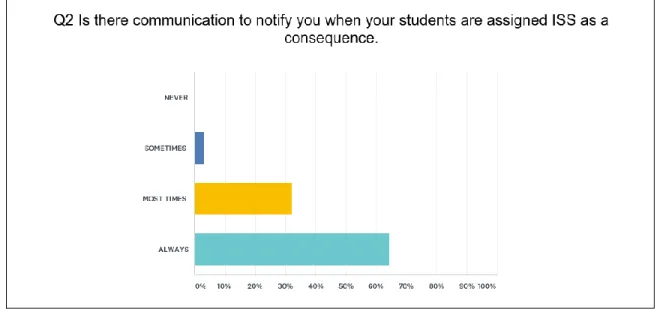
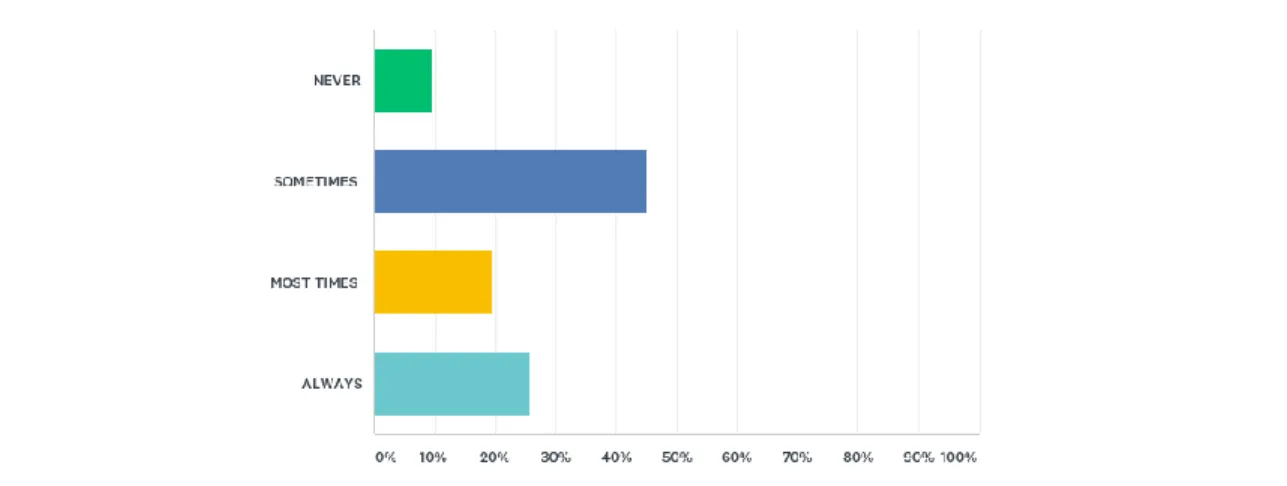
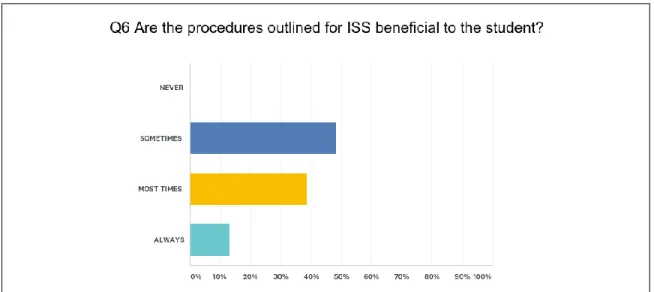
Figure 1. Do discipline referrals result in the student receiving ISS? ...37 Figure 2. Is there communication to notify when students are assigned ISS? ...38 Figure 3. As the teacher of record, do you visit ISS to provide instruction to your student? ...39 Figure 4. Are missing assignments and materials provided to students while in ISS? ...40 Figure 5. Are teachers aware of rules for makeup work and getting caught up for students assigned to ISS? ...41 Figure 6. Are procedures outlined for ISS beneficial to the student? ...42 Figure 7. Are procedures outlined for ISS beneficial for the teacher? ...44 Figure 8. Do students assigned to ISS in the past get re-assigned to ISS within 30 days of
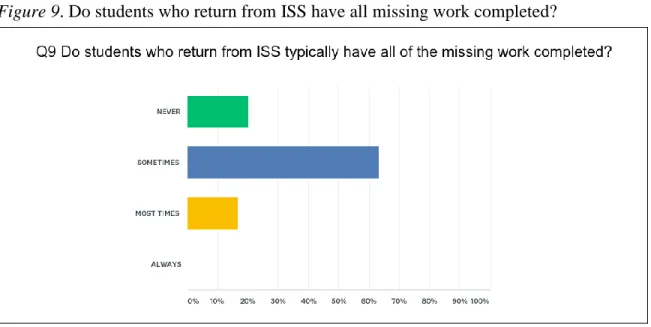
being dismissed? ...45 Figure 9. Do students who return from ISS have all missing work completed? ...46 Figure 10. The use of ISS for student discipline allows students to remain connected to
the content material learned in the classroom. ...47 Figure 11. Although student behavior violations are assigned ISS, inappropriate student
behavior has not decreased. ...48 Figure 12. Teachers perceive ISS as an effective behavioral intervention. ...49 Figure 13. Students should serve out of school suspension rather than in school
suspension. ...50 Figure 14. Repeat offenders/participants of the ISS program are the greatest challenge of
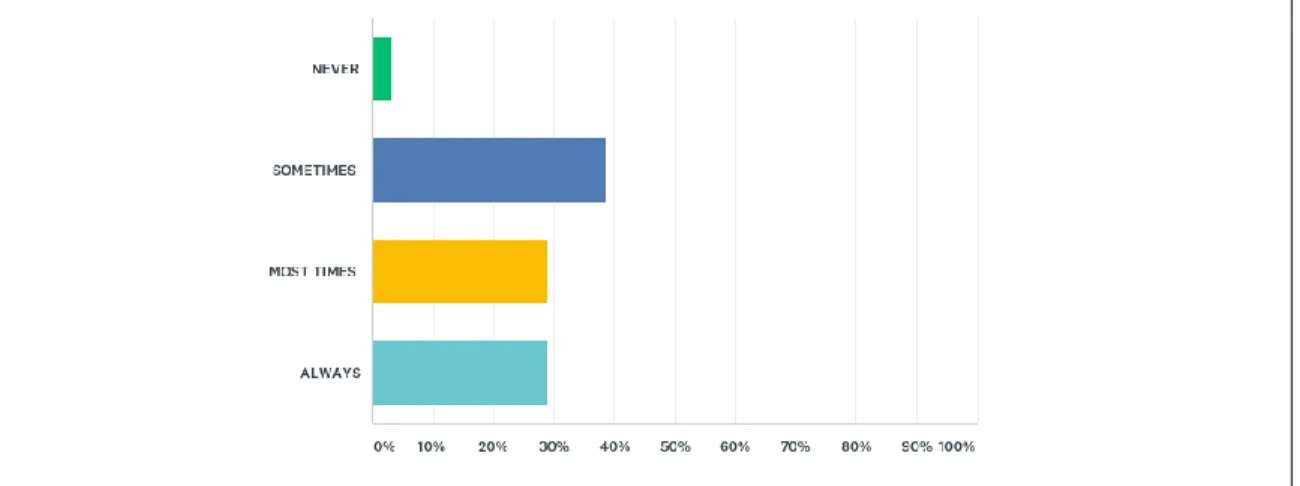
the program. ...51 Figure 15. Classroom teachers and the ISS facilitation teacher collaborate in an effort to
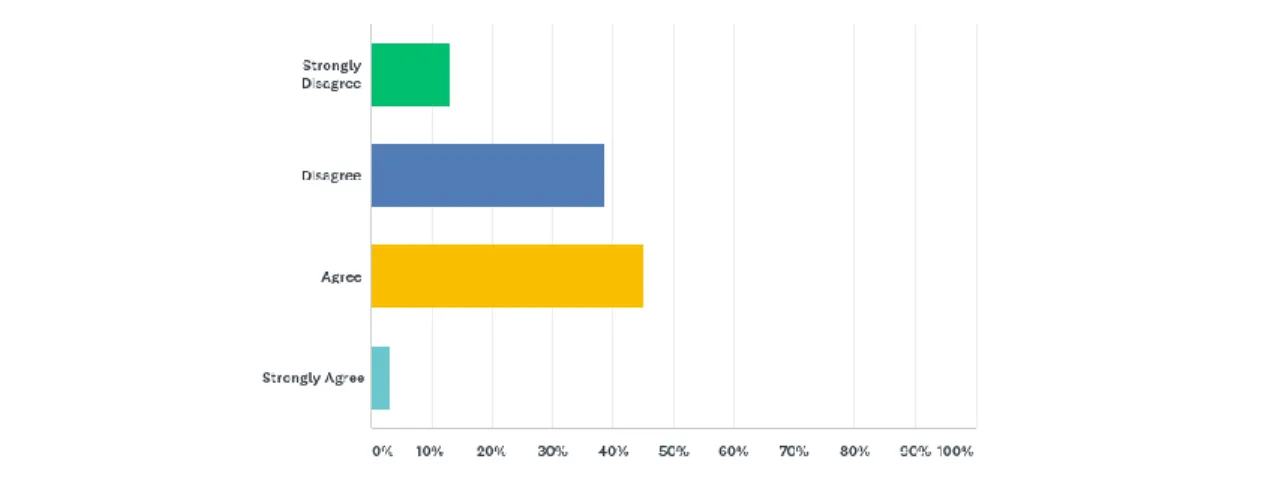
benefit the students in the ISS program. ...51 Figure 16. The use of the ISS program has improved school behavior school wide. ...52 Figure 17. The current ISS program at my school should be discontinued. ...53 Figure 18. I notice an immediate positive behavior change from students who return to
class from ISS. ...54 Figure 19. Is communication to notify teachers of when students are assigned to ISS is
consistent? ...61 Figure 20. Do you as the administrator visit the ISS room to see the students? ...62
xiii
Figure 21. Do students who are assigned ISS in the past get re-assigned to ISS within 30
days of being dismissed? ...63
Figure 22. I notice an immediate positive behavior change from students who return to class from ISS. ...64
Figure 23. Students who return to ISS typically have all missing work completed. ...65
Figure 24. The use of ISS for student discipline allows student to remain connected to the material learned in the classroom. ...65
Figure 25. Although student behavior violations are assigned ISS, inappropriate student behavior has not decreased. ...66
Figure 26. Teachers perceive ISS as an effective behavioral intervention. ...67
Figure 27. Students who misbehave should serve out of school suspension rather than in school suspension...68
Figure 28. Repeat offenders/participants of ISS program are the greatest challenge of this program. ...69
Figure 29. Classroom teachers and the ISS facilitation teacher collaborate to benefit students in the ISS program. ...70
Figure 30. Have you ever assigned a student to ISS at your current school? ...70
Figure 31. Is there an expectation that missing assignments and materials will be provided to the student while in ISS? ...71
Figure 32. Would you say that the teachers of the students assigned to ISS understand the procedure for make-up and missing assignments from students in ISS?...72
Figure 33. Are the procedures outlined for ISS beneficial to the student? ...73
Figure 34. Are the procedures outlined for ISS beneficial to the teacher? ...74
Figure 35. The use of the ISS program has improved school behavior school wide. ...75
1
SECTION ONE: INTRODUCTION Introduction
In school suspension (ISS) is a discipline method used across many school districts around the country. The premise surrounding ISS is that students can be disciplined for minor code of conduct infractions, alleviating the need for frequent outside of school suspensions. Supporters of ISS as a discipline method feel that ISS provides a method for students to continue to receive their education while being
disciplined for the code of conduct infraction that they violated. Antagonists feel that this method of discipline is not effective, arguing that students will miss direct instruction from their teachers. They believe that, for most of the time, in school suspension does not have any significant reduction in recidivism rates among students.
Many schools within the Millbrook (pseudonym) school district do not operate with an in school suspension program. They simply rely specifically on out of school suspension as their method of discipline. Due to the enormous attendance issues, along with the constant discipline referrals received within our school, we retained ISS as a viable option as one of our methods of discipline. District policy within the student code of conduct states that on the first occurrence of out of school suspension (OSS), the student is allowed to make up the missing work. However, for any subsequent infractions that leads to out of school suspension, the teacher is not obligated to allow the student to make up the work. However, with the ISS program, regardless of how many times a student is given ISS as a consequence, the student is allowed to make up the missing work for credit for each class missed.
2
According to the accountability report published by the Florida Department of Education, Eminence High School (pseudonym) received a school grade of C for the 2014-2015 school year. Eminence has a population that is approximately 46% minority students and 38% economically disadvantaged students. By March of the 2015-2016 schoolyear, Eminence High’s ISS program had served two hundred and ninety students in ISS. Without the use of ISS in our school, hundreds of students who do not necessarily have the academic fortitude would be destined to fail their courses by the second
infraction that resulted in out of school suspension.
Purpose of the Evaluation
As I explained previously, not all schools within the district operate with an ISS program. In my opinion, this may be attributed to the amount of teacher staff allocations provided to schools each year. The problem context and the reason I chose to evaluate in school suspension was because of the program’s necessity on our campus, but I feel the impact of the program has yet to be revealed. With each passing school year,
instructional teacher allocation positions become fewer and fewer, and the demand to ensure student safety continues to increase. I believe that ISS worked for our school because of the array of discipline issues that arose within our school in a given year. Eminence High School followed a strict procedure with every ISS incident. Once a student was deemed to be in violation of a code of conduct rule (i.e., dress code, skipping, excessive tardiness, etc.), a referral is generated and an administrator or dean meets with the student regarding the infraction. From there, the student was told how many days he or she would serve in ISS, a parent was contacted to inform them of the in school suspension, and the student was provided with paperwork documenting the
3
consequence. The paperwork was duplicated, the student received a copy, and a copy was placed in the student’s discipline file. The school discipline secretary alerted all of the students’ teachers of the days he or she will serve in ISS. The expectation is that the teachers would provide work to the student in ISS by the following school day. The work was sent directly to the ISS facilitator, who then disbursed the work to the student. The facilitator collected the completed work and returned it to the teacher of record. If for some reason the student did not receive anything from any teacher, the ISS facilitator ensured assignments were given from the Leaps Lessons program, which focused on character building and behavior modification lessons. This is in an effort to ensure that the students would always have something to work on with the intent of not having to return to the classroom with various missing assignments.
From a statistical standpoint, at Eminence High in the 2015-16 school year, 240 ninth and tenth graders received out of school suspension as a consequence. In that same school year, 232 in school suspension offences occurred. In the 2016-17 school year, there were reportedly 266 out of school suspension offences and 268 in school
suspension offenses among ninth and tenth grade students. In the 2017-2018 school year, I acquired data for all four grade levels. There were 672 out of school offenses and 894 in school offenses. Without in school suspension, there is absolutely no way the students of Eminence High who participated in ISS would have been able to remain connected to their classroom materials and make academic progress.
By the end of each school year, building administrators were waiting to hear about how many allocations they would be provided for the upcoming school year. Because of this, each year there was a discussion as to whether or not the ISS program
4
was necessary, considering the demands of instructional personnel needed in the
classroom superseded the need for a certified teacher in the ISS classroom. Although not required, teacher certification is definitely a strong preference in an ISS facilitator. Students assigned in school suspensions were required to complete missing classwork in an effort to remain connected to the content material and not fall behind their peers. To make this experience advantageous to students, it would be beneficial if the ISS
facilitator possessed teacher certifications in either English or math. These two areas are critical to the success of at risk students and are typically the area in which most students struggle.
Decreased instructional allocations means an increase in the probability of hiring personnel not qualified enough to facilitate ISS. Since most of the students who
participate in the ISS program are there because of behavioral infractions, it is imperative that the facilitator have training and experience in classroom management, exceptional student education skills, and behavior modification skills. Therefore, decreasing
instructional personnel allocations made it more likely that the ISS facilitator would lack experience working with exceptional students, which is vital to any ISS program.
ISS within our school was modified several times since the 2012-13 school year to fit the needs of the program. Since its most recent modification, the program appeared to be running smoothly. The ISS program relocated this past year from its original location in building three, due to the room not being big enough to accommodate more than twelve students at a time. In the 2014-2015 school year, students were scheduled a week in advance for their ISS consequence due to the lack of space in the ISS classroom. During the 2015-2016 school year, the ISS program moved to a larger classroom that
5
could hold 25-30 students comfortably without having students sitting on top of one another.
However, the constant “packed house” of rule breakers led to the notion that ISS may not be as effective as intended in deterring students from making offenses against student code of conduct rules. “Although ISS programs are a desirable alternative to OSSs, poorly conceived ISS programs are little more than “holding tanks” and may function as brief stops on the way to OSS” (Dupper, Theriot, & Craun, 2009, p. 10).Of the two hundred and ninety students who served in ISS from August to March of 2015-2016, one hundred and three of them served more than once in ISS. This rate of
recidivism indicated that the program may not have had the intended impact on deterring inappropriate and unwanted behaviors, which is the purpose of ISS. Similarly, in
comparing OSS for ninth and tenth graders only, their statistics continued to rise even with the implementation of ISS. In the 2015-16 school year, there were 35 ninth and tenth grade students participating in OSS. In the 2016-17 school year, there were 55 ninth and tenth grade students participating in OSS. In addition, in the 2017-18 school year, there were 67 ninth and tenth grade students participating in OSS. Therefore, even with the recidivism rate of ISS participants increasing, so are the rate of OSS participants.
The purpose of this study was to assess the effectiveness of the ISS program at Eminence High School in terms of fidelity to its original goal, which was to provide a consequence while maintaining the academic experience. “In School Suspension is a disciplinary measure that costs time, money, and student seat time,” as it relates to students missing direct instruction from instructors (Rahynes, 2015 p. 5). With this research, my goal was that the data would reveal the true effectiveness of the ISS
6
program and whether or not the program was meeting the goals, expectations, and intent of the program. It is important to note that the current in school suspension program was not a listed item on the current school year’s school improvement plan. More
significantly to note was that in my five years of employment at Eminence High, I do not recall ever seeing a goal item addressing in school suspension. Furthermore, many of the school improvement plan goals created either a cause or effect on our in school
suspension program, directly or indirectly.
Although ISS was not a goal that we would want to encourage students to participate in, components of ISS were addressed in the School Improvement Plan through section two, which addressed the needs assessment and analysis. The number of student infractions per student was assessed in this area. The data from this section was a great place to generate a goal to monitor students and record how the intervention was working in relation to academic achievement. One example of a goal for ISS was by using the early warning systems data in place, students at Eminence High would increase engaged behaviors in order to maintain a safe and supportive culture for all students. “Rather than isolating and punishing students, it has been suggested that ISS programs emphasize modifying students’ misbehavior by including counseling components and conflict resolution strategies” (Ingersoll & LeBoeuf, 1997, p. 6). The strategies to accomplish this goal would be the consistent use of Leaps Lessons for all students and restorative practices within the ISS classroom to assist students with identifying acceptable classroom and school behavior, while teaching critical problem solving and conflict resolution skills.
7 Rationale
In school suspension is a program utilized within many schools around the country. When an ISS program is structured and organized properly, it could be a huge benefit for all stakeholders involved. The Consistency Management and Cooperative Discipline (CMCD) program, utilized primarily in Texas, has shown significant strides with helping to reduce behavior problems with African American and Latino students. CMCD focuses on “creating classrooms where teachers and students work
collaboratively to set rules for classroom management and transforms teacher-centered classrooms into person-centered classrooms” (Dupper, Theriot, & Craun, 2009, p. 10). Today, teachers are evaluated by the academic gains that students assigned to their classes make throughout the year. Since the shift in teacher evaluations emerged, many lawsuits have also arisen. Plaintiffs in these lawsuits “have argued that Value Added Models (VAM) often fall far short of their intention to create fair, apples-to-apples comparisons of teachers’ effectiveness because their statistical models cannot account for the subtle ways in which groups of students differ from one year to the next” (Close & Amrein-Beardsley, 2018 p. 16). If a teacher has a large population of students who are suspended throughout the year and those students are never afforded the opportunity to learn the course content material and make up the work, then this not only impacts the student’s grade but also the teacher’s evaluation rating. Ultimately, over time, if this cycle continues it can impact the school grade as well. When administrators have large numbers of students who are continuously suspended and missing classroom instruction and testing requirements, eventually this will cause serious ramifications for
8
administration as school grade and testing requirements also offer pressure on school leaders and cause district leaders to intervene.
Out of school suspensions impact all stakeholders, but most notably it affects the individual student suspended from school. Students who spend significant amounts of time away from direct instruction and classroom interactions with teachers and students within a learning environment tend to lose necessary academic skills learned in school. This can lead to academic, and often social, regression. Kearney (2008) explained how “the prevalence of unexcused absences from school exceeds that of major childhood behavior disorders and is a key risk factor for violence, injury, substance use, psychiatric disorders, and economic deprivation” (p. 451). A crucial aspect of schooling is the development of character traits and value systems that are woven into the curriculum through interactions and experiences between students, peers, and teachers. These
experiences are important to the social development of all students. In addition, students’ critical thinking and problem-solving skills can be impaired by a lack of stimulus and application when they are always written up and suspended. In the end, out of school suspensions impact the entire academic community, but more importantly, the individual student missing the opportunity to be in school and progress fully.
The impact of student absenteeism and being unsuccessful in school affects various stakeholders such as school districts and administrators, police departments, juvenile court system, probation officers, and the community. “Research has
demonstrated that youth who are not in school and not in the labor force are at high risk of delinquency and crime” (Ingersoll, & LeBoeuf, 1997, p. 2). Conversely, “children who are not educated will more than likely lack adequate skills to secure employment and
9
become self-sufficient adults” (Ingersoll, & LeBoeuf, 1997, p. 1). This scenario quickly becomes an epidemic and a vicious never-ending cycle, which begins with a student’s inability to assimilate and matriculate successfully in the school setting. When the
connection issevered, the community, the school district, and the student face permanent effects that are extremely hard to reverse.
An effective ISS program offers a solution to a problem that has multilevel systemic ramifications. In school suspension affords the opportunity for the students to reconnect with course material missed while serving their punishment for the infraction committed. Additionally, it allows the classroom teacher the ability to connect to students in a different way outside of the classroom. Often the individualized attention received out of the classroom while in ISS makes a world of difference between the student and classroom teacher when the student is allowed to return to the classroom. While in ISS, students are usually exposed to Leaps Lessons. “Leaps is a comprehensive, online program and resource for educators who are creating learning environments built upon resources that provide both evidence of benefit and content for delivery” (SEL For Schools, n.d.). Leaps is a behavior modification curriculum typically used in conjunction with positive behavior modification programs (like PBIS) within the school. Leaps is scenario based and allows students to work through life situations while building their conflict resolution and problem solving skills. In school suspension affords the teacher time to reflect, regroup, and implement new strategies and interventions in the classroom once the student returns.
I was especially intrigued by the effectiveness of in school suspension because, from a counselor’s perspective, I understand the need for in school suspension but often
10
wonder about the social stigma and possible segregation that may be covertly occur by using in school suspension as a means to remove students from the classroom
environment. Hancock, Lawrence, Shepherd, Mitrou, and Zubrick (2017) suggested that “policies aiming to extend the time spent at school, either through reducing absences or extending the school calendar, would have a larger impact on low-achieving students and therefore help to reduce achievement inequality” (p. 416). If this suggestion is true, then by utilizing ISS more often than OSS, the students at Eminence high should perform academically and behaviorally just as well as their non-suspended counterparts. However, it takes more than just simply being present in school. The recidivism rate in which some students return to ISS is alarming. I often wondered what else was being used to avoid the in school and/or out of school suspension from occurring in the first place. Systems such as Positive Behavior Support (PBS) is a “school-wide proactive, data driven set of problem solving strategies designed to minimize or prevent problematic student
behaviors and use suspension as a last resort” (Dupper, et. al., 2009, p. 11) were used in most schools within the Millbrook school district. However, the recidivism rates
continued to increase. Either way, in school or out, the student was the one not in class and not receiving direct instruction from the content area teacher.
Goals of the Program Evaluation
The goal of this evaluation was to assess the effectiveness of the ISS program at Eminence High School in terms of fidelity to its original goal of keeping students connected to their instructional content from the classroom, while providing
consequences for code of conduct violations. Ingersoll and LeBoeuf (1997) determined that the goal of an in school suspension program was to redirect students from exhibiting
11
inappropriate and disruptive behavior, which caused them to receive ISS as a
consequence. “In school suspension programs provide an interpersonal training program to develop coping and communication skills; and conflict resolution and law-related education programs” (Ingersoll, & LeBoeuf, 1997, p. 6). In school suspension, if used appropriately,can also reinforce character and citizenship behaviors appropriate for school. By addressing the goal of ISS and evaluating the effectiveness of the ISS program, I evaluated student learning of interpersonal skills that should prevent repeat visits to in school suspension. The rate of recidivism, as found in ISS suspension data, was evidence of whether or not ISS made the impact intended. As I identified how ISS affected student behavior, I recognized its impact on the student body as a whole and on the perception of stakeholders. Additionally, it was interesting to notice how (ISS) participants also affected student learning in the classrooms they were absent from. With teacher surveys, I asked teachers to elaborate on how the classroom environment and dynamic was impacted when ISS participants were absent or present in class.
Exploratory Questions
I had several questions that I explored within my study. My primary questions were:
1. What do the participants (Teachers, ISS Facilitators, and school-based Administrators) perceive as working well in with the current in school suspension program at Eminence High School?
2. What do the participants (Teachers, ISS Facilitators, and school-based Administrators) perceive as not working well with the current in school suspension program at Eminence High School?
12
3. What do the participants (Teachers, ISS Facilitators, and school-based Administrators) perceive as the biggest challenge with the current ISS Program at Eminence High School?
4. What do the participants (Teachers, ISS Facilitators, and school-based Administrators) suggest as ways to improve the ISS program at Eminence High School?
5. According to the participants (Teachers, ISS Facilitators, and school-based Administrators), how effective is ISS at deterring code of conduct violations? 6. According to the participants (Teachers, ISS Facilitators, and school-based
Administrators), what benefit, if any, do students who have been ISS participants seem to gain from ISS?
My secondary exploratory questions included:
1. What perceptions do the participants (Teachers, ISS Facilitators, and school-based Administrators) have regarding any impact the ISS program has had on school wide behavior among students?
2. What perceptions do the participants (Teachers, ISS Facilitators, and school-based Administrators) have regarding any impact the ISS program has had on the behavior of student participants of the ISS program?
3. What perceptions do the participants (Teachers, ISS Facilitators, and school-based Administrators) have regarding student participants of ISS being given the opportunity to receive missing work from the teacher of record?
4. What do stakeholders report as the influence of ISS on the student body? 5. What do stakeholders report as the influence of ISS on students who
13
Through surveying and interviewing participants, I revealed perceptions and hidden beliefs about the in school suspension program. My objective was to also assist in identifying some of the systematic flaws that may be affecting the program from
becoming as effective as it could be.
Conclusion
My expectation of this program evaluation was to determine if the current program was viable and to provide an effective behavior modification intervention for the student body as evidenced through the collected surveys, interviews, and the suspension data. The survey and interview data will provided evidence of benefit or non-benefit to the student population and to faculty and staff. It was my desire, through this program evaluation to gather evidence that would assist school
administrators as well as district personnel to consider, use, and develop district wide standard operating procedures for in school suspension, making the program
practicable and relevant as a viable behavior intervention strategy and not an isolation chamber for at risk students.
By using survey and face-to-face interview questions to collect data on student suspensions over the years, I showed school administration and district personnel whether ISS was a viable intervention resource and strategy. The results from the interview and survey data addressed what was working well and not working well with the current in school suspension program. My data also revealed what participants acknowledged as the biggest challenge, ways improvements could be made to the program to make a more effective experience for individuals who work the system daily. Lastly, the results garnered from data identified whether or not the current in
14
school suspension program was a deterrent for the student body and identified if benefits for its participants existed.
15
SECTION TWO: REVIEW OF LITERATURE Introduction
In today’s classroom setting, student behavior disrupts the learning environment at an alarming rate. Many students who are not proficient and lack the necessary
academic skills within the classroom resort to inappropriate and unwanted behaviors during instructional time, in an attempt to disrupt and distract from actual learning. “Discipline in America’s schools has been characterized as a major concern of the general public for the last three decades” (Garibaldi, Blanchard, & Brooks, 1996, p 408). The behaviors often become divergent from what is actually occurring with the student. The embarrassment of either unprepared, unequipped, or unmotivated learners causes distractions that can turn any classroom into disarray. Many teachers avoid confronting these students and correcting the classroom environment, which causes continuous discipline issuesthat take over theinstructional time deemed for learning and
collaborating. Therefore, their classrooms become chaotic and problematic and, in turn, learning cannot occur as it should.
This has become so much of a problem that it consumes an enormous amount of teachers’ and administrators’ daily functions. Vanderslice (1999) expounded on the enormous task that administrators and teachers face daily in attempting to manage inappropriate behaviors that interrupt and distract from direct instruction. This persistent interference prevents building administrators from effectively being instructional leaders and providing needed support to teachers.
To that end, many students find themselves sitting in a principal’s or assistant principal’s office facing the inevitable: suspension. Garibaldi, Blanchard, and Brooks
16
(1996) explained how the practice of suspending students from school originally was meant to allow a cooling off period for students, while simultaneously allowing the teacher to dismiss inappropriate behaviors from the learning environment for a period of time. However, times have changed. Payne and Welch (2013) made reference to the zero tolerance initiatives that impacted school discipline methods across the country. This article highlighted how punishment within schools has increased and schools have incorporated “juvenile justice and criminal justice systems” (Payne & Welch, 2013, p. 542) into their policy and procedures regarding issuing out discipline consequences. Wadhwa explained it even further in her body of work, highlighting how zero tolerance initiatives in schools are “designed to mimic that of the drug enforcement policies
derived in the 1980’s, back when the goal was to prevent drug cartels from expanding by punishing harshly” for all offences regardless of severity (Wadhwa, 2015, p. 5). Today, zero tolerance within schools means students are no longer given opportunities to mess up. There is not any corrective or rehabilitative action occurring to assist students with new behavior modification skills. Rather, there are strict guidelines as to how and when you will be punished for conduct infractions.
In school suspension emerged as an alternative, eliminating the need for the student to be out of school while simultaneously allowing the student to serve a consequence for the infraction committed. The use of in school suspension is typically issued prior to any out of school suspension. In school suspension should serve as an intervention and or deterrent for additional unwanted classroom behaviors. The purpose of using ISS instead of OSS is to afford students the opportunity to correct and adjust inappropriate behaviors from re-occurring, while continuity of educational services
17
continues. The hope is that the student will learn why the behavior is inappropriate in a classroom and or school setting, while being allowed to make up missing work.
The continuity of educational services is where some may feel the confusion can develop. School is supposed to be the place where learning occurs. School is supposed to be a place where shared knowledge and the love of learning come together and is
nurtured. However, there are some minds of thought that presume that in school suspension is nothing more than an isolation chamber that does not deter unwanted behavior. Many believe that learning is not and cannot occur within the confines of in school suspension merely because of the fact that direct instruction is not occurring. Some critics of the program feel that the instruction needed can only come from the teacher of record.
Developing a Teacher–Student Relationship
McDermott (1997) explained how the relationship between student and teacher impacts student learning and behavior. He expounded on the social interaction that occurs within the classroom setting, causing a teacher and a student to develop a common
language and a communication regimen that, if done properly, can be beautifully orchestrated. However, McDermott also pointed out that when personal biases and covert racism exist; the opposite can and will occur. Many students can become very aware of the dislike and antipathy that their teachers may feel for them. When teachers demonstrate abhorrence toward student misbehavior, the result is usually an increase in discipline referrals sent to the administrator in charge of discipline. Fabelo, Thompson, Plotkin, Carmichael, Marchbanks, and Booth (2011), described how students with one or more discipline referral were 10% more likely to have criminal offenses proceed the
18
discipline referral in school within one year. When teachers continuously relied on discipline referrals and administration to correct classroom behavior, the message of odium became clear to the student. It is a message that says: because of your actions, you are now unwanted and unwelcomed in this class. This belief system among teachers can cause resentment and animosity between the teacher and the student, further disrupting the learning environment and the student’s ability to learn.
Another barrier to academic learning within the confines of ISS that I have personally noted is that teachers will not provide the work to the student who is absent from the classroom. Often, teachers are reluctant to let their classroom assignments and lessons leave their grasp. Teachers reported that students assigned to ISS often times never return to class with the assigned work completed. Teachers may feel that students blatantly refuse to do the work. Some stated that students in ISS aren’t held accountable for work completion while in ISS. If the teacher refuses to send work to the student in ISS, this may lead to the student feeling as if the teacher does not want them to succeed, and the animosity and bitterness between student and teacher continues to grow.
When the relationship between student and teacher is broken, it is hard to repair without significant effort by both parties. Educators who recognize this divide can implement intercessions quickly in an attempt to save the working relationship. This can lead educators to search for alternative methods of discipline, such as Restorative
Practices, to increase academic and social connections. Aboluwodi referred to a
“disciplined student environment” (2015, p. 134) in which the learning environment was controlled and both the teacher and the students circulated knowledge. Aboluwodi expounded on how a learning environment that is disruptive in nature typically resulted
19
in punitive sanctions for the disruptive student. However, Aboluwodi’s argument was that, aside from the punishment, the student still does not learn any new skills to prevent future misbehavior. Rather, this study highlighted the benefits of retributive discipline, which can either be used as a preventative measure or included as a part of the ISS program to further increase academic connectedness and decrease recidivism.
As a stakeholder, be it parent, teacher, facilitator, administrator, or district personnel, we have to determine whether or not the learning environment of ISS is conducive for learning and if students within ISS are being afforded the needed
assistance to learn, along with being held accountable for work completion while in ISS. Being Male in School Today
Research showed that male students, specifically African American males, seem to have a higher attendance rate in ISS compared to their female counterpart who may also attend ISS. “In virtually, every study presenting school disciplinary data by gender, boys are referred to the office and receive a range of disciplinary consequence at a significantly greater rate than girls” (Skiba, Michael, & Nardo, 2000, p. 8). A study by Townsend (2000) revealed that “African American males composed 43% of the school age population, but received 65% of the school districts suspensions” (p. 382). At Eminence High School, in the 2017-2018 school year, African American students made up 29.2% of the school’s population; however, African American students made up 48.8% of total suspensions. During this same school year, 301 total students participated in in school suspension. Among those students, seventy-eight students (26%) involved were African American males, with African American females following closely behind their male counterparts with sixty-seven students, or 22%.
20
This increase in male attendance in ISS was so prevalent across school districts throughout the country that it poses the question that this may be part of a larger, more complex issue. “One gender difference that refuses to go away: boys are languishing academically while girls are soaring” (Sommers, 2013, p. 2). As a whole, school aged males are struggling in school. As a school counselor for over five years, each year I was astonished as I searched for the top African American male in the respective senior class. This search typically left me searching through at least thirty to forty students from the top of the class, usually passing two or more African American girls, before reaching an African American male.
Parallel to their female counterparts, African American males, specifically from a lower socioeconomic status, are experiencing far more distress in school socially and academically. Compared to the behavior and academic advancement of school-aged females, boys have definitely fallen behind. In a Louisiana urban school system where “87% of the 86,000 students were African American, it was founded that African
American males accounted for 58% of the non-promotions, 65% of the suspensions, 80% of the expulsions, and 45% of the dropouts - even though these young men represented only 43% of the school population. It was also very discomforting to find that more than 800 of the 1,470 non-promotions in the first grade and more than 1,600 of the almost 2,800 non-promotions in the sixth through eighth grades were African American males” (Garibaldi, 1992, p. 5). There is a serious unease as to why African American males are doing so poorly in school when compared to their all other students.
Varlas (2005) expressed concern that American male student receive a significantly higher rate of disciplinary suspensions and expulsions than their female
21
counterparts. The article further outlined how African American males spend more time in special education programs and spend less time in honors and college prep courses while in K-12 schools. Special education classes, also referred to as ESE classes, are packed with males, specifically African American and Hispanic males (Kunjufu, 1990). “Taylor and Foster (1986) reported a consistent ordering in the likelihood of suspension from most to least: black males, white males, black females, white females” (Skiba, Michael, & Nardo, 2000, p. 8). This may explain why minority males are more
susceptible to receive punitive discipline. This also reflects the significant increase in the number of suspensions and expulsions for African American males.
Exceptional Student Education and Discipline
In a 2015 executive summary of California’s growing discipline gap, Losen, Hodson, Keith, Morrison, and Belway revealed how gender and racial disparities among students with disabilities were pivotal in increasing the discipline gap. In this study, it is documented that males with disabilities have the highest rate of suspension compared to their female counterparts. Specifically, African American males with disabilities had the highest percentage of suspensions, and Hispanic males with disabilities followed closely behind. What was also interesting to note in this study was that African American females with disabilities exhibited higher percentage rates of suspension than that of white males with disabilities.
In school suspension has become essential to the discipline and correction of students within the Exceptional Student Education program (ESE). ISS is often used as an alternative to out of school suspension for special education students, otherwise known as ESE students. Federal law states that a student enrolled in the Exceptional
22
Student Education program is entitled to a free and appropriate public education. The law further explains that a student enrolled in an ESE program within a public school is limited to ten suspension days per school year. Since these students are limited to the amount of out of school days they can receive within a school year, the use of in school suspension as a measure of consequence becomes vital. If the building administrator consistently uses OSS as a consequence for ESE students, then the ten-day maximum will likely be depleted before the midyear mark and discipline for that student for the
remainder of the year becomes more difficult. I found that many administrators make deals with ESE students and become very creative with using OSS and ISS in
combination for one discipline infraction. For example, student A curses at the teacher and slams a book on the floor. When the general education student would have received 3-5 days of OSS for this inappropriate behavior, plausible punishment for an ESE student may be one day OSS followed by 3 days ISS to allow a significant amount of cooling down time for both the student and the classroom teacher. This reality of the consequence disparity may leave the classroom teacher feeling helpless, since this student will not have to experience the level of consequence that a general education student would. Understandably, this is why within the confines of ISS, rehabilitative and corrective action skills are necessary and crucial to behavior modification. My hope is that the qualitative survey data will demonstrate this need.
Parental and Community Involvement
For many parents, school and academia are a daunting task. In my current school experience, I discovered that many parents were not model students themselves and have personal reservations in response to school and school policies. This discord between
23
school, parents, and community can affect student behavior and the respect that students exhibit toward school authorities and school rules. Discord that can further invite
inappropriate and disruptive behaviors to occur within the learning environment, when allowed to propagate and develop into feelings of resentment and lack of trust.
Sheldon and Epstein (2002) emphasized how important home environment and neighborhood environment directly affect student behavior in school. Students who are repeat offenders of code of conduct infractions and receive in school suspension as well as out of school suspension usually do not have consistent parental support and guidance as it relates to school. Sheldon and Epstein also focus on how schools can use the
community and the parent connection to positively impact classroom behavior. They suggest formulating mentoring groups and community safety patrols and allowing neighborhood businesses to have direct access to students and their academic environments.
Thorbahn (1995) discussed how essential parental and community involvement are to the success of a school. Additionally, his body of work illustrated how involvement and support from parents, community, and businesses directly influenced the success and commitment of students who attend the school. When students know that they have the support of home and external partners, they tend to rise to the expectation of success imposed onto the student by their external support system.
Today, the school rules and policies are not necessarily a shared vision with parents. In my experience, I revealed that parents often disagree with the rules that are currently in schools today. School rules are intentionally created to keep students safe. Across the country, there has been a strict initiative to increase student safety, commonly
24
referred to as “zero tolerance.” Zero tolerance refers to a list of infractions that, if broken, will result in immediate out of school or in school suspension as a method of discipline. Mendez and Knoff (2003) revealed that “most out of school suspensions across the country are for minor infractions of school rules rather than for dangerous or violent acts” (p. 32). Depending upon whether or not the student is ESE also makes a huge
determination in whether or not the student receives ISS versus OSS. It is because of these nuances that parents have a hard time supporting school authorities when discipline methods are enforced. Parents who have a hard time supporting the discipline measures used and proposed within schools often have a hard time encouraging their students to follow the rules while they are in school.
Conclusion
In concluding the review of literature addressing in school suspension, I found that what originated as a time out or cooling off period for inappropriate behavior in the classroom has transformed to a zero tolerance culture that often lacks humanity and does not allow children to mess up and learn from their mistakes. The policies and procedures in place within schools today do not purportedly protect the well-behaved students. “Students no longer see school officials making the learning environment safe and orderly. They see school officials acting punitively toward their friends, family, and peers” (Black, 2018 p. 15). The school discipline matrix provides an anticipation that students will behave inappropriately, and there is a long list of consequences for said behaviors should they arise. Conversely, interventions and rehabilitative services are not mentioned in the discipline matrix. The students are only expected to serve a
25
to correct the inappropriate behavior, that the institution put in place to assist them. M. Griffin-Gay (personal communication, July 9, 2018) asserted that “school is supposed to be a place where shared knowledge and the love of learning come together”. Section three of this study will address my research design and the steps I took to gather data to support my research.
26
SECTION THREE: METHODOLOGY Research Design Overview
The evaluation of any program is the practice of analytically examining said program. It involves gathering and studying information about a program's activities, characteristics, and outcomes. “Its purpose is to make judgments about a program, to improve its effectiveness, and/or to inform programming decisions” (Patton, 1987).It is my goal in evaluating the in-school suspension program at Eminence High School to use the findings to make recommendations to improve the effectiveness of the program and/or apprise programming decisions.
While providing a comprehensive overview of Eminence High School’s ISS program evaluation, my intention in gathering data for this study was to investigate the relationship between student discipline data and student participation in the in school suspension program. Ultimately, my goal was to see how the data impacted student learning. I collected and analyzed student discipline records for Eminence High School. I retrieved a list of students who had been active participants in the in school suspension program for the 2015-2016 and the 2016-2017 school years. The data was obtained from the school’s electronic information and data warehouse and through the former ISS facilitator and dean of student discipline. I collected the data and formulated a list of survey and interview questions for further data collection. Face to face interview
questions were asked of a former ISS facilitator still working at the school in an alternate capacity. I was able to interview current teachers at Eminence High as well.
I attempted to administer surveys to all faculty and staff members present on the day of the survey data collection. I distributed surveys concealed in colored envelopes to
27
teachers, administrators, the dean and campus monitor. Included with each envelope was a release of information, study participation form, and purpose of study for all
participants to ensure full disclosure was apparent.
I created a list of questions for each of the parties interviewed: administrators, dean, past and present ISS facilitators, campus monitor, and teachers. I provided faculty, administration, dean, and campus monitor with a release of information and study participant form. This allowed the information collected and gathered to be included in this study.
I collected student discipline records, student behavior data, and student
achievement data. Simultaneously along with the previous data, I interviewed a former ISS facilitator, the current building administrators, current dean, and current teachers. The information I gathered was revealed through written explanation within the study.
Patton (2008) highlights the argument of Scriven (2006), where he argued that the purpose of program evaluation is to determine the effects of the program, if any, and judge the program’s merit, worth, or significance. The text also stated that it is not the task of the evaluator to explain these effects, other than to show that there are effects of the program. It was my goal in conducting this research to reveal through comprehensive description how my research methodology answers my primary research questions. I garnered the perceptions and thoughts of those individuals who work daily with the program and have firsthand experience of its benefit or ramification influencing their day-to-day operations, to explain and answer both primary and secondary questions.
28 Participants
I engaged participation from the following participants in this study: the school’s current building administrators, which includes one principal and four assistant
principals. The administration ranged between the ages of 25 and 70, both male and female. I also engaged participation from 31 teachers between the ages of 18 and 70, both male and female. Lastly, I engaged participation from the school’s dean and campus monitor, and these individuals were between the ages of 18 and 70, and both are male. All participants chosen had an affiliation and connection to the school and were between the ages of 18 and 70, both male and female. These participants were encouraged to participate in the voluntary anonymous survey as well as the face-to-face interview portion. These individuals were chosen because they have direct access to the students who may have participated in in school suspension for the school years reviewed. Some of these individuals may have also initiated or processed discipline referrals on the in school suspension participants as well.
Data Gathering Techniques
To begin the process of gathering my data, I first scheduled a meeting with the principal of Eminence High School. During this meeting, I presented the principal with an informed consent form titled Adult Participant Survey (Appendix A). This form explained the purpose of the study and the role any participants would play in the study. The form also informed participants that their participation is voluntary and that they can rescind consent at any time. During this meeting, I also notified the principal that I would be collecting data and evaluating the in school suspension program currently in place at Eminence High for a program evaluation project I am completing towards my doctoral
29
degree. Next, I orchestrated the best time to address and explain the purpose of the survey to the entire faculty. It was determined during that meeting with the principal that the best time to obtain informed consent and distribute the surveys would be during a faculty meeting, as this would be the time that I would have the majority of the faculty and staff present. I gathered the data from voluntary surveys and voluntary interview sessions with willing participants who agreed at the time of explanation that they wished to participate. I chose to use this method to protect the anonymity of the participants and to preserve their confidentiality.
Surveys
In an effort to maximize participation and collect data efficiently, I chose to administer paper surveys to my participants. I asked 24 questions on the voluntary survey for teachers (Appendix B) and administrators (Appendix C), with questions surrounded around teacher opinion and experience with the current in school suspension program. During a fall 2017 faculty meeting, I explained the purpose of the survey and explained the informed consent process. I handed each person in the faculty meeting two envelopes. I explained that the manila envelope contained two copies of the informed consent form. I asked that if a participant chose to participate that they remove the informed consent forms, and sign one of them and return it to the manila envelope and seal it. I also explained that in the white envelope is a copy of the actual survey. Those individuals present were encouraged to participate in the survey and return the forms to the while envelope and seal it. Lastly, I explained that whether participating or not, upon exiting the faculty meeting, I asked that all individuals place their envelopes in the two respective bins located at the rear of the room. I continuously communicated that
30
participation was voluntary and that confidentiality will be maintained throughout this process. I collected and analyzed the data from the distributed surveys to identify and reveal relationship patterns among participants to answer my primary and secondary exploratory questions outlined in this study. I used the voluntary participant responses to generate answers to my primary and secondary exploratory questions. Additionally, I used the data to determine what procedural strategies, interventions, and modification recommendations should be made to make in school suspension at Eminence High more effective.
Individual Interviews
In an effort to delve deeper into the survey responses and get more experience and perception data from the survey participants I chose to administer face-to-face interviews. I asked twelve interview questions of the voluntary participants who took the survey and later agreed to an additional interview. The participants indicated on the survey that they would like to participate in a face-to-face interview after submitting the survey. I later contacted the participants by the email address they provided on the completed survey. I scheduled a time and date to conduct the interview outside of their contract hours. The data I collected from the interviews was transcribed and evaluated for themes, patterns, and trends. I used this information to identify and reveal relationship patterns among participants to answer my primary and secondary exploratory questions outlined in this study.
Student Data
I also collected discipline data for the students who participated in ISS from the 2015-2016 school year through the 2017-2018 school years. I obtained data through