Generating Coherent Event Schemas at Scale
Niranjan Balasubramanian, Stephen Soderland, Mausam, Oren Etzioni
Computer Science & Engineering University of Washington
Seattle, WA 98195, USA
{niranjan,ssoderlan, mausam, etzioni}@cs.washington.edu
Abstract
Chambers and Jurafsky (2009) demonstrated that event schemas can be automatically in-duced from text corpora. However, our analy-sis of their schemas identifies several weak-nesses, e.g., some schemas lack a common topic and distinct roles are incorrectly mixed into a single actor. It is due in part to their pair-wise representation that treats subject-verb independently from subject-verb-object. This of-ten leads to subject-verb-object triples that are not meaningful in the real-world.
We present a novel approach to inducing open-domain event schemas that overcomes these limitations. Our approach uses co-occurrence statistics of semantically typed re-lational triples, which we call Rel-grams (re-lational n-grams). In a human evaluation, our schemas outperform Chambers’s schemas by wide margins on several evaluation criteria. Both Rel-grams and event schemas are freely available to the research community.
1 Introduction
Event schemas (also known as templates or frames) have been widely used in information extraction. An event schema is a set of actors (also known as slots) that play different roles in an event, such as the perpetrator, victim, and instrument in a bomb-ing event. They provide essential guidance in ex-tracting information related to events from free text (Patwardhan and Riloff, 2009), and can also aid in other NLP tasks, such as coreference (Irwin et al., 2011), summarization (Owczarzak and Dang, 2010), and inference about temporal ordering and causality.
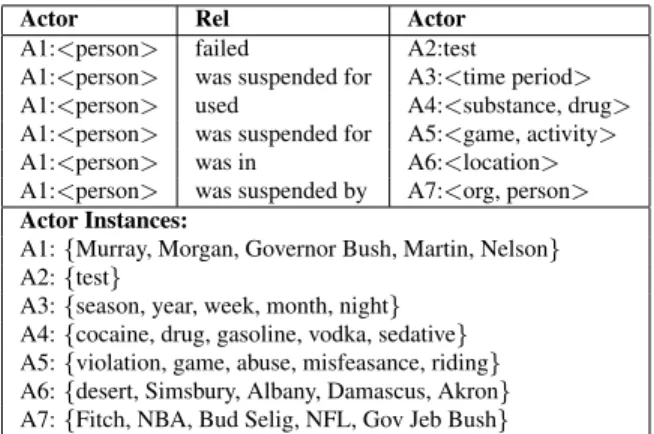
Actor Rel Actor
A1:<person> failed A2:test
A1:<person> was suspended for A3:<time period>
A1:<person> used A4:<substance, drug>
A1:<person> was suspended for A5:<game, activity>
A1:<person> was in A6:<location>
A1:<person> was suspended by A7:<org, person>
Actor Instances:
A1:{Murray, Morgan, Governor Bush, Martin, Nelson} A2:{test}
A3:{season, year, week, month, night} A4:{cocaine, drug, gasoline, vodka, sedative} A5:{violation, game, abuse, misfeasance, riding} A6:{desert, Simsbury, Albany, Damascus, Akron} A7:{Fitch, NBA, Bud Selig, NFL, Gov Jeb Bush}
Table 1: An event schema produced by our system, rep-resented as a set of(Actor, Rel, Actor)triples, and a set of instances for each actorA1,A2, etc. For clarity we show unstemmed verbs.
Until recently, all event schemas in use in NLP were hand-engineered,e.g., the MUC templates and ACE event relations (ARPA, 1991; ARPA, 1998; Doddington et al., 2004). This led to technology that could only focus on specific domains of interest and has not been applicable more broadly.
The seminal work of Chambers and Jurafsky (2009) showed that event schemas can also be in-duced automatically from text corpora. Instead of labeled roles these schemas have a set of relations and actors that serve as arguments.1 Their system is fully automatic, domain-independent, and scales to large text corpora.
However, we identify several limitations in the schemas produced by their system.2 Their schemas 1In the rest of this paper we use event schemas to refer to
these automatically induced schemas with actors and relations.
2Available at http://www.usna.edu/Users/cs/
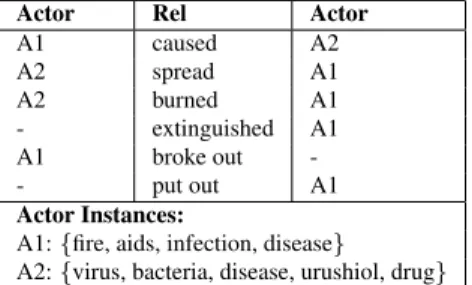
Actor Rel Actor A1 caused A2 A2 spread A1 A2 burned A1 - extinguished A1 A1 broke out -- put out A1 Actor Instances:
A1:{fire, aids, infection, disease}
A2:{virus, bacteria, disease, urushiol, drug}
Table 2: An event schema from Chambers’ system that mixes the events of fire spreading and disease spreading. often lack coherence: mixing unrelated events and having actors whose entities do not play the same role in the schema. Table 2 shows an event schema from Chambers that mixes the events of fire spread-ing and disease spreadspread-ing.
Much of the incoherence of Chambers’ schemas can be traced to their representation that usespairs of elements from an assertion, thus, treating subject-verb and subject-verb-object separately. This often leads to subject-verb-object triples that do not make sense in the real world. For example, the assertions “fire caused virus” and “bacteria burned AIDS” are im-plicit in Table 2.
Another limitation in schemas Chambers released is that they restrict schemas to two actors, which can result in combining different actors. Table 4 shows an example of combining perpeterators and victims into a single actor.
1.1 Contributions
We present an event schema induction algorithm that overcomes these weaknesses. Our basic represen-tation istriplesof the form (Arg1, Relation, Arg2), extracted from a text corpus using Open Information Extraction (Mausam et al., 2012). The use of triples aids in agreement between subject and object of a relation. The use of Open IE leads to more expres-sive relation phrases (e.g., with prepositions). We also assign semantic types to arguments, both to al-leviate data sparsity and to produce coherent actors for our schemas.
Table 1 shows an event schema generated by our system. It has six relations and seven actors. The schema makes several related assertions about a per-son using a drug, failing a test, and getting sus-pended. The main actors in the schema include the person who failed the test, the drug used, and the agent that suspended the person.
Our first step in creating event schemas is to tab-ulate co-occurrence of tuples in a database that we call Rel-grams (relational n-grams) (Sections 3, 5.1). We then perform analysis on a graph induced from the Rel-grams database and use this to create event schemas (Section 4).
We compared our event schemas with those of Chambers on several metrics including whether the schema pertains to a coherent topic or event and whether the actors play a coherent role in that event (Section 5.2). Amazon Mechanical Turk workers judged that our schemas have significantly better co-herence – 92% versus 82% have coherent topic and 81% versus 59% have coherent actors.
We release our open domain event schemas and the Rel-grams database3 for further use by the NLP community.
2 System Overview
Our approach to schema generation is based on the idea that frequently co-occurring relations in text capture relatedness of assertions about real-world events. We begin by extracting a set of relational tu-ples from a large text corpus and tabulate occurrence of pairs of tuples in a database.
We then construct a graph from this database and identify high-connectivity nodes (relational tuples) in this graph as a starting point for constructing event schemas. We use graph analysis to rank the tu-ples and merge arguments to form the actors in the schema.
3 Modeling Relational Co-occurrence
In order to tabulate pairwise occurences of relational tuples we need a suitable relation-based represen-tation. We now describe the extraction and rep-resentation of relations, a database for storing co-occurrence information, and our probabilistic model for the co-occurrence. We call this model Rel-grams, as it can be seen as a relational analog to the n-grams language model.
3.1 Relations Extraction and Representation
We extract relational triples from each sentence in a large corpus using the OLLIE Open IE system
3
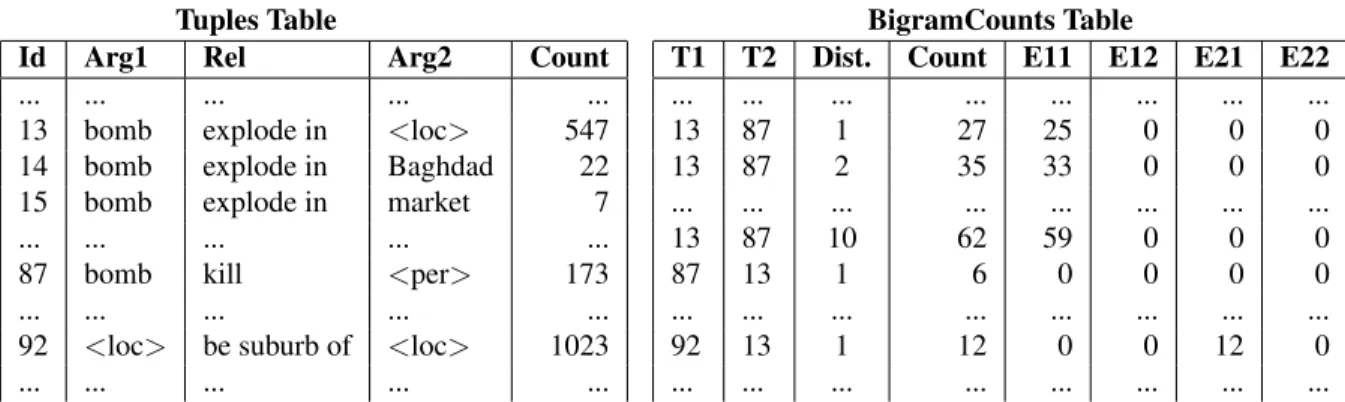
Tuples Table
Id Arg1 Rel Arg2 Count
... ... ... ... ...
13 bomb explode in <loc> 547
14 bomb explode in Baghdad 22
15 bomb explode in market 7
... ... ... ... ...
87 bomb kill <per> 173
... ... ... ... ...
92 <loc> be suburb of <loc> 1023
... ... ... ... ...
BigramCounts Table
T1 T2 Dist. Count E11 E12 E21 E22
... ... ... ... ... ... ... ... 13 87 1 27 25 0 0 0 13 87 2 35 33 0 0 0 ... ... ... ... ... ... ... ... 13 87 10 62 59 0 0 0 87 13 1 6 0 0 0 0 ... ... ... ... ... ... ... ... 92 13 1 12 0 0 12 0 ... ... ... ... ... ... ... ...
Figure 1: Tables in the Rel-grams Database: Tuples maps tuples to unique identifiers,BigramCountsprovides the co-occurrence counts (Count) within various distances (Dist.), and four types of argument equality counts (E11-E22). E11 is the number of times when T1.Arg1 = T2.Arg1, E12 is when T1.Arg1 = T2.Arg2 and so on.
(Mausam et al., 2012).4 This provides relational tu-ples in the format (Arg1, Relation, Arg2) where each tuple element is a phrase from the sentence. The sentence “He cited a new study that was released by UCLA in 2008.” produces three tuples:
1. (He, cited, a new study)
2. (a new study, was released by, UCLA) 3. (a new study, was released in, 2008)
Relational triples provide a more specific repre-sentation which is less ambiguous when compared to (subj, verb) or (verb, obj) pairs. However, using relational triples also increases sparsity. To reduce sparsity and to improve generalization, we represent the relation phrase by its stemmed head verb plus any prepositions. The relation phrase may include embedded nouns, in which case these are stemmed as well. Moreover, tuple arguments are represented as stemmed head nouns, and we also record seman-tic types of the arguments.
We selected 29 semantic types from WordNet, ex-amining the set of instances on a small development set to ensure that the types are useful, but not overly specific. The set of types are: person, organization, location, time unit, number, amount, group, busi-ness, executive, leader, effect, activity, game, sport, device, equipment, structure, building, substance, nutrient, drug, illness, organ, animal, bird, fish, art, book, and publication.
To assign types to arguments, we apply Stanford Named Entity Recognizer (Finkel et al., 2005)5, and also look up the argument in WordNet 2.1 and record
4
Available at: http://knowitall.github.io/ ollie/
5
We used the system downloaded from: http://nlp. stanford.edu/software/CRF-NER.shtml and used the seven class CRF model distributed with it.
the first three senses if they map to our target se-mantic types. We use regular expressions to recog-nize dates and numeric expressions, and map per-sonal pronouns to<person>. We associate all types found by this mechanism with each argument. The tuples in the example above are normalized to the following:
1. (He, cite, study) 2. (He, cite,<activity>) 3. (<person>, cite, study) 4. (<person>, cite,<activity>) 5. (study, be release by, UCLA)
6. (study, be release by,<organization>) 7. (study, be release in, 2008)
8. (study, be release in,<time unit>) 9. (<activity>, be release by, UCLA) ...
In our preliminary experiments, we found that us-ing normalized relation strus-ings and semantic classes for arguments results in a ten-fold increase in the number of Rel-grams with a minimum support.
3.2 Co-occurrence Tabulation
We construct a database to hold co-occurrence statistics for pairs of tuples found in each document. Figure 1 shows examples for the types of statistics contained in the database. The database consists of two tables: 1) Tuples – Maps each tuple to a unique identifier and tabulates tuple counts. 2) Bi-gramCounts– Stores the directional co-occurrence frequency, a count for tupleT followed byT0 at a distance ofk, and tabulates the number of times the same argument was present in the pair of tuples.
Equality Constraints: Along with the co-occurrence counts, we record the equality of argu-ments in Rel-grams pairs. We assert an argument
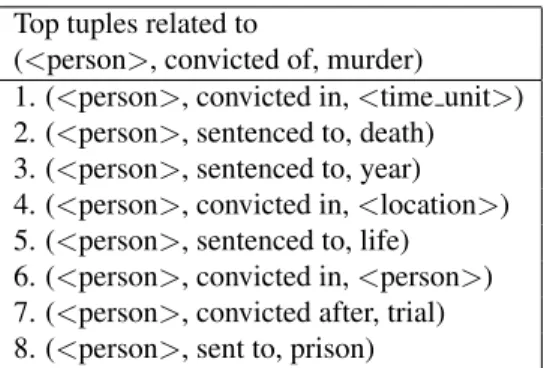
Table 3: Given a source tuple, the Rel-grams language model estimates the probability of encountering other re-lational tuples in a document. For clarity, we show the unstemmed version.
Top tuples related to
(<person>, convicted of, murder) 1. (<person>, convicted in,<time unit>) 2. (<person>, sentenced to, death) 3. (<person>, sentenced to, year) 4. (<person>, convicted in,<location>) 5. (<person>, sentenced to, life) 6. (<person>, convicted in,<person>) 7. (<person>, convicted after, trial) 8. (<person>, sent to, prison)
pair is equal if they are from the same token se-quence in the source sentence or one argument is a co-referent mention of the other. We use the Stan-ford Co-reference system (Lee et al., 2013)6 to de-tect co-referring mentions. There are four possible equalities depending on the specific pair of argu-ments in the tuples are the same, shown as E11, E12, E21 and E22 in Figure 1. For example, the E21 col-umn has counts for the number of times the Arg2 of T1 was determined to be the same as the Arg1 of T2.
Implementation and Query Language: We pop-ulated the Rel-grams database using OLLIE extrac-tions from a set of 1.8 Million New York Times arti-cles drawn from the Gigaword corpus. The database consisted of approximately 320K tuples that have frequency≥3 and 1.1M entries in the bigram table. The Rel-grams database allows for powerful querying using SQL. For example, Table 3 shows the most frequent rel-grams associated with the query tuple (<person>, convicted of, murder).
3.3 Rel-grams Language Model
From the tabulated co-occurrence statistics, we esti-mate bi-gram conditional probabilities of tuples that occur within a window ofktuples from each other. Formally, we usePk(T0|T)to denote the conditional
probability thatT0 followsT within a window ofk tuples. To discount estimates from low-frequency tuples, we use aδ-smoothed estimate:
6Available for download at: http://nlp.stanford.
edu/software/dcoref.shtml Pk(T0|T) = #(T, T0, k) +δ P T00∈V #(T, T00, k) +δ· |V| (1)
where, #(T, T0, k) is the number of timesT0 fol-lowsT within a window of k tuples. k = 1 in-dicates adjacent tuples in the document. |V|is the number of unique tuples in the corpus. For experi-ments in this paper, we setδto 0.05.
Co-occurrence within a small window is usu-ally more reliable but is also sparse, whereas co-occurrence within larger windows addresses sparsity but may lead to topic drift. To leverage the bene-fits of different window sizes, we also define a met-ric with a weighted average of window sizes from 1 to 10, where the weight decays as window size in-creases. For example, withα set to 0.5 in equation 2, a window ofk+1has half the weight of a window ofk. P(T0|T) = P10 k=1αkPk(T0|T) P10 k=1αk (2) We believe that Rel-grams is a valuable source of common-sense knowledge and may be useful for several downstream tasks such as improving infor-mation extractors, inference of implicit inforinfor-mation, etc. We assess its usefulness in the context of gener-ating event schemas.
4 Schema Generation
We now use Rel-grams to identify relations and ac-tors pertaining to a particular event. Our schema generation consists of three steps. First, we build a relation graph of tuples (G) using connections iden-tified by Rel-grams. Second, we identify a set of seed tuples as starting points for schemas. We use graph analysis to find the tuples most related to each seed. Finally, we merge the arguments in these tu-ples to create actors and output the final schema. Next we describe each of these steps in detail.
4.1 Rel-graph construction
We define a Rel-graph as an undirected weighted graphG = (V, E), whose vertices (V) are relation tuples with edges (E), where an edge between ver-ticesT andT0is weighted by the symmetric condi-tional probabilitySCP(T, T0)defined as
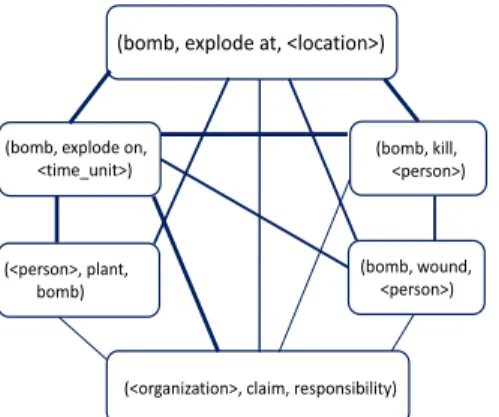
SCP(T, T0) =P(T|T0)×P(T0|T) (3) Both conditional probabilities are computed in Equation 2. Figure 2 shows a portion of a Rel-graph where the thickness of the edge indicates symmetric conditional probability.
(bomb, explode at, <location>)
(bomb, explode on, <time_unit>) (bomb, kill, <person>) (bomb, wound, <person>) (<person>, plant, bomb)
(<organization>, claim, responsibility)
Figure 2: Part of a Rel-graph showing tuples strongly associated with(bomb, explode at,<location>). Undi-rected edges are weighted by symmetric conditional probability with line thickness indicating weight.
4.2 Finding Related Tuples
Our goal is to find closely related tuples that per-tain to an event or topic. First, we locate high-connectivity nodes in the Rel-graph to use as seeds. We sort nodes by the sum of their top 25 edge weights7 and take the top portion of this list after filtering out redundant views of the same relation.
For each seed (Q), we find related tuples by ex-tracting the sub-graph (GQ) from Q’s neighbors
(within two hops from Q) in the Rel-graph. Graph analysis can detect the strongly connected nodes within this sub-graph, representing tuples that fre-quently co-occur in the context of the seed tuple.
Page rank is a well-known graph analysis algo-rithm that uses graph connectivity to identify impor-tant nodes within a graph (Brin and Page, 1998). We are interested in connectivity within a subgraph with respect to a designated query node (the seed). Con-nection to a query node can help minimize concept drift and ensure that the selected tuples are closely related to the main topic of the sub-graph.
7
Limiting to the top 25 edges avoids overly general tuples that occur in many topics, which tend to have a large number of weak edges.
In this work, we adapt the Personalized PageR-ank algorithm (Haveliwala, 2002). The personalized version of PageRank returns ranks of various nodes with respect to a given query node and hence is more appropriate for our task than the basic PageRank al-gorithm. Within the subgraphGQ for a given seed
Q, we compute a solution to the following set of PageRank Equations: P RQ(T) = (1−d) +dX T0 SCP(T, T0)P RQ(T0) ifT =Q = dX T0 SCP(T, T0)P RQ(T0) otherwise
HereP RQ(T)denotes the page rank of a tupleT
personalized for the query tuple Q. It is a sum of all its neighbors’ page ranks, weighted by the edge weights;dis the damping probability, which we set to be 0.85 in our implementation.
The solution is computed iteratively by initializ-ing the page rank ofQto 1 and all others to 0, then recomputing page rank values until they converge to within a small. This computation remains scalable, since we restrict it to subgraphs a small number of hops away from the query node. This is a standard practice to handle large graphs (Agirre and Soroa, 2009; Mausam et al., 2010).
4.3 Creating Actors and Relations
We take the top n tuples from GQ according to
their Page rank scores. From each tuple T :
(Arg1, Rel, Arg2) in GQ, we record two actors
(A1,A2) corresponding toArg1andArg2, and add Relto the list of relations that they participate in.
Then, we merge actors in two steps. First, we col-lect the equality constraints for the tuples inGQ. If
the arguments corresponding to any pair of actors have a non-zero equality constraint then we merge them. Second, we merge actors that perform simi-lar actions. A1 andA2 are merged if they are con-nected to the same actorA3 through the same rela-tion. For example, A1 and A2 in (A1:lawsuit, file by, A3:company) and (A2:suit, file by, A3:company), will be merged into a single actor. To avoid merging distinct actors, we use a small list of rules that spec-ify the semantic type pairs that cannot be merged (e.g., location-date). Also, we do not merge two ac-tors, if it can result in a relation where the same actor
System A1 Rel A2
Relgrams {bomb, missile, grenade, device} explode in {city, Bubqua, neighborhood}
{bomb, missile, grenade, device} explode kill {people, civilian, lawmaker, owner, soldier} {bomb, missile, grenade, device} explode on {Feb., Fri., Tues., Sun., Sept.}
{bomb, missile, grenade, device} explode wound {civilian, person, people, soldier, officer} {bomb, missile, grenade, device} explode in {Feb., Beirut Monday, Sept., Aug.} {bomb, missile, grenade, device} explode injure {woman, people, immigrant, policeman} Chambers {bomb, explosion, blast,bomber, mine} explode {soldier, child, civilian, bomber, palestinian}
{soldier,child,civilian, bomber, palestinian} set off {bomb, explosion, blast,bomber, mine, bombing} {bomb, explosion, blast, bomber, mine} kill {soldier, child, civilian, bomber, palestinian} {soldier,child,civilian, bomber, palestinian} detonate {bomb, explosion, blast,bomber, mine, bombing} {bomb, explosion, blast, bomber, mine} injure {soldier, child, civilian, bomber, palestinian} {soldier,child,civilian, bomber, palestinian} plant {bomb, explosion, blast,bomber, mine,bombing} Relgrams {Carey, John Anthony Volpe, Chavez, She} veto {legislation, bill, law, measure, version}
{legislation, bill, law, measure, version} be sign by {Carey, John Anthony Volpe, Chavez, She}
{legislation, bill, law, measure, version} be pass by {State Senate, State Assembly, House, Senate, Parliament} {Carey, John Anthony Volpe, Chavez, She} sign into {law}
{Carey, John Anthony Volpe, Chavez, She} to sign {bill}
{Carey, John Anthony Volpe, Chavez, She} be governor of {Massachusetts, state, South Carolina, Texas, California} Chambers {clinton, bush,bill, president, house} oppose {bill, measure, legislation, plan, law}
{clinton, bush,bill, president,house} sign {bill, measure, legislation, plan, law} {clinton, bush,bill, president, house} approve {bill, measure, legislation, plan, law} {clinton, bush,bill, president,house veto {bill, measure, legislation, plan, law} {clinton, bush,bill, president, house} support {bill, measure, legislation, plan, law} {clinton,bush,bill,president, house} pass {bill, measure, legislation, plan, law}
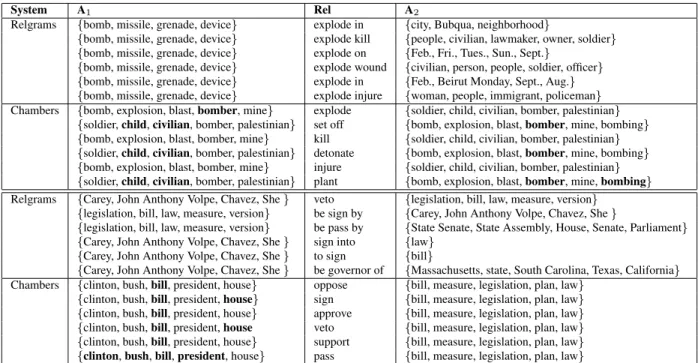
Table 4: “Bombing” and “legislation” schema examples from Rel-grams and Chambers represented as a set of
(A1, Rel, A2)tuples, where the schema provides a set of instances for each actorA1andA2. Relations and
argu-ments are in the stemmed form, e.g., ‘explode kill’ refers to ‘exploded killing’. Instances in bold produce tuples that are not valid in the real world.
is both the Arg1 and Arg2.
Finally, we generate an ordered list of tuples using the final set of actors and their relations. The out-put tuples are sorted by the average page rank of the original tuples, thereby reflecting their importance within the sub-graphGQ.
5 Evaluation
We present experiments to explore two main ques-tions: How well do Rel-grams capture real world knowledge, and what is the quality of event schemas built using Rel-grams.
5.1 Evaluating Rel-grams
What sort of common-sense knowledge is encap-sulated in Rel-grams? How often does it indicate an implication between a pair of statements, and how often does it indicate a common real-world event or topic? To answer these questions, we con-ducted an experiment to identify a subset of our Rel-grams database with high precision for two forms of common-sense knowledge:
• Implication: The Rel-grams express an im-plication from T to T’ or from T’ to T, a
bi-directional form of the Recognizing Tex-tual Entailment (RTE) guidelines (Dagan et al., 2005).
• Common Topic: Is there an underlying com-mon topic or event to which both T and T’ are relevant?
We also evaluated whether both T and T’ arevalid tuplesthat are well-formed and make sense in the real world, a necessary pre-condition for either im-plication or common topic.
We are particularly interested in the highest pre-cision portion of our Rel-grams database. The database has 1.1M entries with support of at least three instances for each tuple. To find the highest precision subset of these, we identified tuples that have at least 25 Rel-grams, giving us 12,600 seed tuples with a total of over 280K Rel-grams. Finally, we sorted this subset by the total symmetrical con-ditional probability of the top 25 Rel-grams for each seed tuple.
We tagged a sample of this 280K set of Rel-grams for valid tuples, implication between T and T’, and common topic. We found that in the top 10% of this set, 87% of the seed tuples were valid and 74% of the Rel-grams had both tuples valid. Of the Rel-grams
System Id A1 Rel A2 Relgrams R1 bomb explode in city
bomb explode kill people bomb explode on Fri.
... ... ...
Chambers C1 blast explode child child detonate blast
child plant bomb
... ... ...
Table 5: A grounded instantiation of the schemas from Table 4, where each actor is represented as a randomly selected instance.
with both tuples valid, 83% expressed an implication between the tuples, and 90% had a common topic.
There were several reasons for invalid tuples – parsing errors; binary projections of inherently n-ary relations, for example (<person>, put,<person>); head-noun only representation omitting essential in-formation; and incorrect semantic types, primarily due to NER tagging errors.
While the Rel-grams suffer from noise in the tu-ple validity, there is clearly strong signal in the data about common topic and implication between tuples in the Rel-grams. As we demonstrate in the follow-ing section, an end task can use graph analysis tech-niques to amplify this strong signal, producing high-quality relational schemas.
5.2 Schemas Evaluation
In our schema evaluation, we are interested in assessing how well the schemas correspond to common-sense knowledge about real world events. To this end, we focus on three measures,topical co-herence,tuple validity, andactor coherence.
A good schema must be topically coherent, i.e., the relations and actors should relate to some real world topic or event. The tuples that comprise a schema should be valid assertions that make sense in the real world. Finally, each actor in the schema should belong to a cohesive set that plays a consis-tent role in the relations. Since there are no good automated ways to make such judgments, we per-form a human evaluation using workers from Ama-zon’s Mechanical Turk (AMT).
We compare Rel-grams schemas against the state-of-the-art narrative schemas released by Cham-bers (ChamCham-bers and Jurafsky, 2009).8 Chambers’
8
Available at http://www.usna.edu/Users/cs/
System Id A1 Rel A2
Relgrams R11 bomb explode in city missile explode in city grenade explode in city
... ... ...
Relgrams R21 missile explode in city missile explode in neighborhood missile explode in front
... ... ...
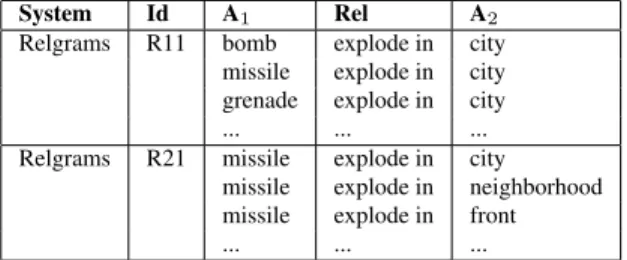
Table 6: A schema instantiation used to test for actor co-herence. Each of the top instances forA1orA2is
pre-sented, holding the relation and the other actor fixed.
schemas are less expressive than ours – they do not associate types with actors and each schema has a constant pre-specified number of relations. For a fair comparison we use a similarly expressive ver-sion of our schemas that strips off argument types and has the same number of relations per schema (six) as their highest quality output set.
5.2.1 Evaluation Design
We created two tasks for AMT annotators. The first task tests the coherence and validity of rela-tions in a schema and the second does the same for the schema actors. In order to make the tasks understandable to unskilled AMT workers, we fol-lowed the accepted practice of presenting them with grounded instances of the schemas (Wang et al., 2013), e.g., instantiating a schema with a specific ar-gument instead of showing the various possibilities for an actor.
First, we collect the information in schemas as a set of tuples:S={T1, T2,· · · , Tn}, where each
tu-ple is of the formT : (X, Rel, Y), which conveys a relationship Rel between actorsX and Y. Each actor is represented by its highest frequency exam-ples (instances). Table 4 shows examexam-ples of schemas from Chambers and Rel-grams represented in this format. Then, we create grounded tuples by ran-domly sampling from top instances for each actor.
Task I: Topical CoherenceTo test whether the re-lations in a schema form a coherent topic or event, we presented the AMT annotators with a schema as a set of grounded tuples, showing each relation in the schema, but randomly selecting one of the top 5 instances from each actor. We generated five such nchamber/data/schemas/acl09
Figure 3: (a) Has Topic: Percentage of schema instanti-ations with a coherent topic. (b) Valid Tuples: Percent-age of grounded statements that assert valid real-world relations. (c) Valid + On Topic: Percentage of grounded statements where 1) the instantiation has a coherent topic, 2) the tuple is valid and 3) the relation belongs to the common topic. All differences are statistically significant with ap-value<0.01.
instantiations for each schema. An example instan-tiation is shown in Table 5.
We ask three kinds of questions on each grounded schema: (1) is each of the grounded tuples valid (i.e. meaningful in the real world); (2) do the majority of relations form a coherent topic; and (3) does each tuple belong to the common topic. Similar to pre-vious AMT studies we get judgments from multiple (five) annotators on each task and use the majority labels (Snow et al., 2008).
Our instructions specified that the annotators should ignore grammar and focus on whether a tuple may be interpreted as a real world statement. For ex-ample, the first tuple in R1 in Table 5 is a valid state-ment – “a bomb exploded in a city”, but the tuples in C1 “a blast exploded a child”, “a child detonated a blast”, and “a child planted a blast” don’t make sense.
Task II: Actor Coherence To test whether the in-stances of an actor form a coherent set, we held the relation and one actor fixed and presented the AMT annotators with the top 5 instances for the other ac-tor. The first example R11 in Table 6 holds the relation “explode in” fixed, and A2 is grounded to the randomly selected instance “city”. We present grounded tuples by varying A1 and ask annotators to judge whether these instances form a coherent topic and whether each instance belongs to that common topic. As with Task I, we create five random instan-tiations for each schema.
Figure 4: Actor Coherence: Has Rolebars compare the percentage of tuples where the tested actors have a co-herent role. Fits Role compares the percentage of top instances that fit the specified role for the tested actors. All differences are statistically significant with ap-value
<0.01.
5.2.2 Results
We obtained a test set of 100 schemas per system by randomly sampling from the top 500 schemas from each system. We evaluate this test set using Task I and II as described above. For both tasks we obtained ratings from five turkers and use the major-ity labels as the final annotation.
Does the schema belong to a single topic? The Has Topicbars in Figure 3 show results for schema coherence. Rel-grams has a higher proportion of schemas with a coherent topic, 91% compared to 82% for Chambers’. This is a 53% reduction in in-coherent schemas.
Do tuples assert valid real-world relations? The Valid Tuplesbars in Figure 3 compare the percent-age of valid grounded tuples in the schema instan-tiations. A tuple was labeledvalid if a majority of the annotators labeled it to be meaningful in the real world. Here we see a dramatic difference – Rel-grams have 92% valid tuples, compared with Cham-bers’ 61%.
What proportion of tuples belong? The Valid + On Topicbars in Figure 3 compare the percentage of tuples that are both validand on topic, i.e., fits the main topic of the schema. Tuples from schema instantiations that did not have a coherent topic were labeled incorrect.
Rel-grams have a higher proportion of valid tu-ples belonging to a common topic, 82% compared to
58% for Chambers’ schemas, a 56% error reduction. This is the strictest of the experiments described thus far – 1) the schema must have a topic, 2) the tuple must be valid, and 3) the tuple must belong to the topic.
Do actors represent a coherent set of argu-ments? We evaluated schema actors from the top 25 schemas in Chambers’ and Rel-grams schemas, using grounded instances such as those in Table 6. Figure 4 compares the percentage of tuples where the actors play a coherent role (Has Role), and the percentage of instances that fit that role for the actor (Fits Role). Rel-grams has much higher actor co-herence than Chambers’, with 97% judged to have a topic compared to 81%, and 81% of instances fitting the common role compared with Chambers’ 59%.
5.2.3 Error Analysis
The errors in both our schemas and those of Chambers are primarily due to mismatched actors and from extraction errors, although Chambers’ schemas have a larger number of actor mismatch er-rors and the cause of the erer-rors is different for each system.
Examining the data published by Chambers, the main source of invalid tuples are mismatch of sub-ject and obsub-ject for a given relation, which accounts for 80% of the invalid tuples. We hypothesize that this is due to the pair-wise representation that treats subject-verb and verb-object separately, causing in-consistent s-v-o tuples. An example is (boiler, light, candle) where (boiler, light) and (light, candle) are well-formed, yet the entire tuple is not. In addition, 43% of the invalid tuples seem to be from errors by the dependency parser.
Our schemas also suffer from mismatched actors, despite the semantic typing of the actors – we found a mismatch in 56% of the invalid tuples (5% of all tuples). A general type such as <person> or <organization>may still have an instance that does not play the same role as other instances. For exam-ple a relation (A1, graduated from, A2) has A2 that is mostly school names, but also includes “church” which leads to an invalid tuple.
Extraction errors account for 47% of the invalid tuples in our schemas, primarily errors that truncate an n-ary relation as a binary tuple. For example, the sentence “Mr. Diehl spends more time ... than the
commissioner” is misanalysed by the Open IE ex-tractor as (Mr. Diehl, spend than, commissioner). 6 Related Work
Prior work by Chambers and Jurafsky (2008; 2009; 2010) showed that event sequences (narrative chains) mined from text can be used to induce event schemas in a domain-independent fashion. How-ever, our manual evaluation of their output showed key limitations which may limit applicability.
As pointed out earlier, a major weakness in Chambers’ approach is the pair-wise representation of subject-verb and verb-object. Also, their released a set of schemas are limited to two actors, although this number can be increased by setting a chain split-ting parameter.
Chambers and Jurafsky (2011) extended schema generation to learn domain-specific event templates and associated extractors. In work parallel to ours, Cheung et al. (2013), developed a probabilistic so-lution for template generation. However, their ap-proach requires performing joint probability estima-tion using EM, which can limit scaling to large cor-pora.
In this work we developed an Open IE based solution to generate schemas. Following prior work (Balasubramanian et al., 2012), we use Open IE triples for modeling relation co-occurrence. We extend the triple representation with semantic types for arguments to alleviate sparisty and to improve coherence. We developed a page rank based schema induction algorithm which results in more coherent schemas with several actors. Unlike Chambers’ ap-proach this method does not require explicit param-eter tuning for controlling the number of actors.
While our event schemas are close to being tem-plates (because of associated types, and actor clus-tering), they do not have associated extractors. Our future work will focus on building extractors for these. It will also be interesting to compare with Cheung’s system on smaller focused corpora.
Defining representations for events is a topic of active interest (Fokkens et al., 2013). In this work, we use a simpler representation, defining event schemas as a set of actors with associated types and a set of roles they play.
7 Conclusions
We present a system for inducing event schemas from text corpora based on Rel-grams, a language model derived from co-occurrence statistics of re-lational triples (Arg1, Relation, Arg2) extracted by a state-of-the-art Open IE system. By using triples rather than a pair-wise representation of subject-verb and verb-object, we achieve more coherent schemas than Chambers and Jurafsky (2009). In particular, our schemas have higher topic coherence (92% com-pared to Chambers’ 82%; make a higher percentage of valid assertions (94% compared with 61%); and have greater actor coherence (81% compared with 59%).
Our schemas are also more expressive than those published by Chambers – we have semantic typing for the actors, we are not limited to two actors per schema, and our relation phrases include preposi-tions and are thus more precise and have higher cov-erage of actors involved in the event.
Our future plans are to build upon our event schemas to create an open-domain event extractor. This will extend each induced schema to have asso-ciated extractors. These extractors will operate on a document and instantiate an instance of the schema. We have created a Rel-grams database with 1.1M entries and a set of over 2K event schemas from a corpus of 1.8M New York Times articles. Both are freely available to the research community9and may prove useful for a wide range of NLP applications. Acknowledgments
We thank the anonymous reviewers, Tony Fader, and Janara Christensen for their valuable feedback. This paper was supported by Office of Naval Research (ONR) grant number N00014-11-1-0294, Army Re-search Office (ARO) grant number W911NF-13-1-0246, Intelligence Advanced Research Projects Activity (IARPA) via Air Force Research Lab-oratory (AFRL) contract number FA8650-10-C-7058, and Defense Advanced Research Projects Agency (DARPA) via AFRL contract number AFRL FA8750-13-2-0019. The U.S. Government is autho-rized to reproduce and distribute reprints for Gov-ernmental purposes notwithstanding any copyright annotation thereon. The views and conclusions con-tained herein are those of the authors and should
9
available athttp://relgrams.cs.washington.edu
not be interpreted as necessarily representing the of-ficial policies or endorsements, either expressed or implied, of ONR, ARO, IARPA, AFRL, or the U.S. Government.
References
Eneko Agirre and Aitor Soroa. 2009. Personalizing pagerank for word sense disambiguation. In12th Con-ference of the European Chapter of the Association for Computational Linguistics (EACL), pages 33–41. ARPA. 1991. Proc. 3rd Message Understanding Conf.
Morgan Kaufmann.
ARPA. 1998. Proc. 7th Message Understanding Conf.
Morgan Kaufmann.
Niranjan Balasubramanian, Stephen Soderland, Oren Et-zioni, et al. 2012. Rel-grams: a probabilistic model of relations in text. InProceedings of the Joint Work-shop on Automatic Knowledge Base Construction and Web-scale Knowledge Extraction, pages 101–105. As-sociation for Computational Linguistics.
Sergey Brin and Lawrence Page. 1998. The anatomy of a large-scale hypertextual web search engine.Computer Networks, 30(1-7):107–117.
N. Chambers and D. Jurafsky. 2008. Unsupervised learning of narrative event chains. InProceedings of ACL-08: HLT.
N. Chambers and D. Jurafsky. 2009. Unsupervised learning of narrative schemas and their participants. In
Proceedings of ACL.
N. Chambers and D. Jurafsky. 2010. A database of nar-rative schemas. InProceedings of LREC.
N. Chambers and D. Jurafsky. 2011. Template-based information extraction without the templates. In Pro-ceedings of ACL.
J. Cheung, H. Poon, and L. Vandervende. 2013. Prob-abilistic frame induction. In Proceedings of NAACL HLT.
I. Dagan, O. Glickman, and B. Magnini. 2005. The PASCAL Recognising Textual Entailment Challenge.
Proceedings of the PASCAL Challenges Workshop on Recognising Textual Entailment, pages 1–8.
G. Doddington, A. Mitchell, M. Przybocki, L. Ramshaw, S. Strassel, , and R. Weischedel. 2004. The auto-matic content extraction (ACE) program-tasks, data, and evaluation. InProcs. of LREC.
Jenny Rose Finkel, Trond Grenager, and Christopher Manning. 2005. Incorporating non-local information into information extraction systems by gibbs sampling. InProceedings of the 43rd Annual Meeting on Associ-ation for ComputAssoci-ational Linguistics, pages 363–370. Association for Computational Linguistics.
Antske Fokkens, Marieke van Erp, Piek Vossen, Sara Tonelli, Willem Robert van Hage, BV SynerScope, Luciano Serafini, Rachele Sprugnoli, and Jesper Hoek-sema. 2013. Gaf: A grounded annotation framework for events. NAACL HLT 2013, page 11.
Taher H. Haveliwala. 2002. Topic-sensitive pagerank. In
WWW, pages 517–526.
Joseph Irwin, Mamoru Komachi, and Yuji Matsumoto. 2011. Narrative schema as world knowledge for coreference resolution. In Proceedings of the Fif-teenth Conference on Computational Natural Lan-guage Learning: Shared Task, pages 86–92. Associ-ation for ComputAssoci-ational Linguistics.
Heeyoung Lee, Angel Chang, Yves Peirsman, Nathanael Chambers, Mihai Surdeanu, and Dan Jurafsky. 2013. Deterministic coreference resolution based on entity-centric, precision-ranked rules. Computational Lin-guistics, (Just Accepted):1–54.
Mausam, Stephen Soderland, Oren Etzioni, Daniel Weld, Kobi Reiter, Michael Skinner, Marcus Sammer, and Jeff Bilmes. 2010. Panlingual lexical translation via probabilistic inference. Artificial Intelligence Journal (AIJ).
Mausam, Michael Schmitz, Robert Bart, Stephen Soder-land, and Oren Etzioni. 2012. Open language learning for information extraction. InProceedings of EMNLP. K. Owczarzak and H.T. Dang. 2010. Overview of the tac
2010 summarization track.
S. Patwardhan and E. Riloff. 2009. A unified model of phrasal and sentential evidence for information extrac-tion. InProceedings of EMNLP 2009.
Rion Snow, Brendan O’Connor, Daniel Jurafsky, and An-drew Y Ng. 2008. Cheap and fast—but is it good?: evaluating non-expert annotations for natural language tasks. InProceedings of the conference on empirical methods in natural language processing, pages 254– 263. Association for Computational Linguistics. A. Wang, C.D.V. Hoang, and M-Y. Kan. 2013.
Perspec-tives on crowdsourcing annotations for Natural Lan-guage Processing. Language Resources and Evalua-tion, 47:9–31.