Developing and Validating a Measure of
Self-Efficacy in Teaching using Science
Inquiry Skills
Syakima Ilyana binti Ibrahim
Submitted in accordance with the requirements for the degree
of Doctor of Philosophy
The University of Leeds
School of Education
The candidate confirms that the work submitted is her own and that appropriate credit has been given where reference has been made to the work of others.
This copy has been supplied on the understanding that it is copyright material and that no quotation from this thesis may be published without proper acknowledgement.
The right of Syakima Ilyana binti Ibrahim to be identified as Author of this work has been asserted by her in accordance with the Copyright, Design and Patten Act 1988.
Acknowledgements
In the name of Allah the Most Gracious and the Most MercifulAlhamdulillah, all praises to Allah for all His blessing in this PhD journey and for giving me strengths to complete this thesis. This journey is made possible through the endless support and encouragement from many people. To them goes my greatest thanks.
First, I would like to thank my main supervisor, Dr Matt Homer, for his tremendous support and guidance in every possible way throughout the journey. His insight, words of encouragement and willingness to share his expertise and time made the
completion of this thesis possible. I would also like to extend my thanks to my co-supervisor, Professor Jim Ryder, for his valuable guidance and constructive feed backs for the improvement of this thesis. I have been very fortunate to work with such a great team.
My sincere thanks also goes to the Ministry of Education, Malaysia for the opportunity and financial assistance throughout this PhD endeavour. I would like to thank all my friends at Institute of Teacher Education, who assist me during the field works and to all the participants, who participated in the study. Without their co-cooperation it would not be possible to conduct this study.
Most importantly, my sincere appreciation goes to my beloved husband, Mohd Hafiz bin Baharuddin for his love, patience and endless support as well as his sacrifices throughout this journey. Thank you to all my children; Auni, Amir and Azwa for being my source of strength throughout this roller coaster journey. Thank you for the understanding and never ending love. Finally, I would like to dedicate these years of hard work to my loving mother, Azizah binti Abdul for her unconditional love,
encouragement and endless prayers in my entire life. To all my friends here in Leeds and in Malaysia thank you for your support and help.
Abstract
From 2011 teacher education curricula in Malaysia have been required to emphasise the teaching of science using science inquiry skills. However, the performance of science pre-service teachers using these skills is an under-researched area. It is acknowledged in the teacher development literature that personal beliefs mediate the knowledge and practice of pre-service teachers in their classroom. This study explores how the self-efficacy beliefs of science pre-service teachers in Malaysia relate to teaching performance using science inquiry skills.
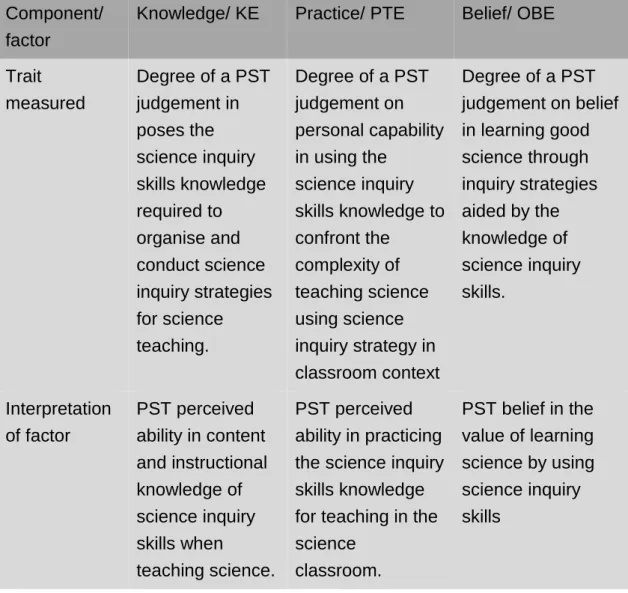
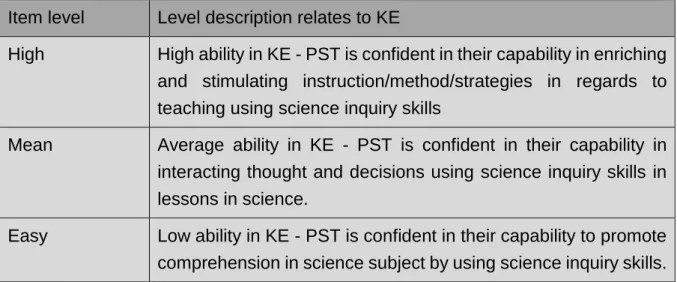
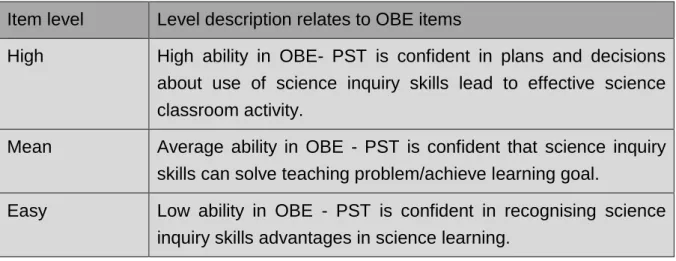
This thesis presents the development and validation of a measure of teacher’s self-efficacy: Self-efficacy in Teaching using Science Inquiry Skills (SETSIS). The conceptual framework used in this study consists of three factors: knowledge efficacy (KE), personal teaching efficacy (PTE) and outcomes belief expectancy (OBE). Using a multi-methods research approach the study developed the SETSIS instrument comprising 72 items using a five-point rating scale. The SETSIS
instrument was piloted using a cross-sectional survey of 325 pre-service teachers at 13 Institutes of Teacher Education across Malaysia. Factor analysis confirmed the contribution of the three factors with high reliabilities (α>0.9). The SETSIS also met the Rasch rating scale model requirement in terms of reliability, dimensionality, difficulty and item discrimination but, needs to include more difficult to affirm items to distinguish the high self-efficacy level. A concurrent validation using a separate knowledge test and teaching practice assessment confirms weak associations but were able to establish the models to infer knowledge and teaching practice
performance among the samples.
Overall, the findings confirm new conceptualisations of teacher self-efficacy among pre-service teachers using the three factors proposed in the SETSIS. The empirical evidence supports the utilisation of the factors of the SETSIS in assessing the belief component of pre-service teachers in teacher education. However, the study
suggests different utilisation of the factors to infer pre-service teachers’ performance in content knowledge and teaching practice.
Table of Contents
Acknowledgements ... iii
Abstract ... iv
Chapter 1 Introduction ... 1
1.1 Introduction ... 1
1.2 The study background ... 1
1.2.1 Science curriculum reform in Malaysia ... 1
1.2.2 Defining science inquiry skills in the classroom ... 2
1.2.3 The role of science inquiry skills in promoting scientific literacy in learning ... 4
1.3 Teacher education curriculum in Malaysia ... 5
1.3.1 Science inquiry skills in teacher education ... 8
1.4 Problem statement ... 9
1.5 Focus of the study ... 10
Chapter 2 Literature Review ... 12
2.1 Introduction ... 12
2.2 Theoretical and empirical review of teacher’s self-efficacy (TSE) .. 12
2.2.1 Bandura’s Self-efficacy Theory ... 12
2.2.2 Conceptual perspectives on the underpinning teacher self-efficacy (TSE) measure development ... 16
2.2.2.1 TSE measure development in teaching science ... 18
2.2.3 Empirical evidence of TSE role in teaching practice ... 19
2.2.3.1 Impact of TSE on student learning ... 19
2.2.3.2 Impact of TSE on teacher’s performance ... 20
2.2.4 Summary ... 21
2.3 Theoretical and conceptual framework of my study ... 22
2.3.1 Theoretical review of teacher knowledge ... 22
2.3.1.1 Pedagogical teacher knowledge to measure teaching practice ... 23
2.3.2 The integrated model of TSE ... 24
2.3.2.1 The role of knowledge in the TSE belief measure ... 26
2.3.3 Summary ... 28
2.4 Study construct and conceptual model ... 29
2.4.1 Knowledge Efficacy (KE) ... 29
2.4.3 Outcome Belief Efficacy (OBE) ... 31 2.5 Summary ... 32 Chapter 3 Methodology ... 36 3.1 Introduction ... 36 3.2 Research objectives ... 36 3.2.1 Research questions ... 37 3.3 Research Design ... 39
3.3.1 Development and validation process ... 42
3.3.1.1 Building block I - Construct mapping ... 42
3.3.1.2 Building block II - Item design ... 44
3.3.1.3 Building block III - Outcome space ... 45
3.3.1.4 Building block IV - Measurement model ... 45
3.4 Research methods ... 46
3.4.1 Literature review ... 47
3.4.2 Expert validation ... 47
3.4.2.1 Fuzzy Delphi Method (FDM) ... 48
3.4.3 Factor analysis ... 49
3.4.4 Rasch Model ... 50
3.4.5 Correlation and Regression OLS ... 51
3.5 The instruments ... 52
3.5.1 Self-Efficacy in Teaching using Science Inquiry Skills Instruments (SETSIS) ... 53
3.5.2 Test of Integrated Science Process Skills (TISP) ... 53
3.6 Data collection and the sample ... 55
3.6.1 Face and content validation ... 55
3.6.2 Pre-test ... 56
3.6.3 Main research ... 56
3.6.4 Score for teaching practice assessment ... 57
3.7 Ethics ... 57
3.7.1 Main ethical issues ... 58
3.7.2 Managing data protection ... 59
3.7.3 Informed consent ... 59
3.7.4 Anonymity ... 60
Chapter 4 Constructing the SETSIS ... 61
4.2 Constructing Factors of the SETSIS ... 61
4.2.1 Definition of factors ... 62
4.2.1.1 Definition of Knowledge Efficacy (KE) ... 63
4.2.1.2 Definition of Personal Teaching Efficacy (PTE) ... 64
4.2.1.3 Definition of Outcome Belief Efficacy (OBE) ... 65
4.3 The Construct ... 66
4.3.1 The Construct Map ... 68
4.4 Item design ... 70
4.4.1 Development of items hierarchy ... 72
4.4.2 Response to Items... 76
4.5 Items Construction ... 77
4.5.1 Generating items ... 77
4.5.1.1 Sources of items ... 78
4.6 Content and Format Validation ... 79
4.6.1 Expert Review ... 79
4.6.1.1 Results and Analysis of the Item Content Survey ... 81
4.6.1.2 Knowledge Efficacy (KE) ... 82
4.6.1.3 Personal Teaching Efficacy (PTE) ... 83
4.6.1.4 Outcomes Belief Efficacy (OBE) ... 84
4.6.1.5 Items Revision ... 85
4.6.2 Pre-Test Survey Result ... 87
4.6.2.1 Descriptive Statistics ... 87
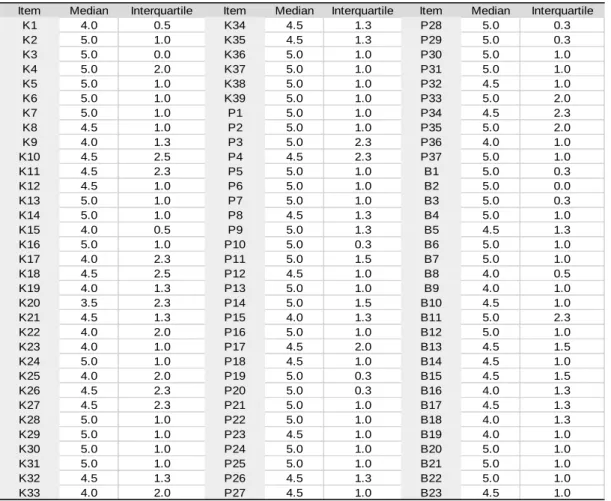
4.6.2.2 Result of the Pre-Test Survey Responses ... 88
4.7 Summary of Chapter Findings ... 92
Chapter 5 Developing the SETSIS measure ... 93
5.1 Introduction ... 93
5.2 The respondents ... 94
5.2.1 Who are the respondents? ... 94
5.3 Analysis of responses ... 95
5.3.1 Descriptive statistics ... 95
5.3.2 Outliers ... 96
5.3.3 Reliability and normality of the responses data ... 98
5.3.4 Responses according to subscales ... 99
5.3.5 Inferential statistics ... 104
5.3.5.2 Interaction between groups of factors ... 108
5.4 The SETSIS - Analysis of structure ... 111
5.4.1 Factor structure ... 112
5.4.2 Factor rotation ... 113
5.4.3 Factor Interpretation ... 114
5.4.4 Summated scale ... 115
5.5 Summary of findings ... 117
Chapter 6 Validating the Model of SETSIS ... 119
6.1 Properties of measure ... 119
6.1.1 Item measure ... 119
6.1.1.1 Item measure in KE subscale ... 121
6.1.1.2 Item measure in PTE subscale ... 122
6.1.1.3 Item measures in OBE subscale ... 124
6.1.2 Person measure ... 125
6.1.3 Dimensionality of the model ... 127
6.1.3.1 The model variance ... 128
6.1.3.2 Correlation of person measures in the model ... 132
6.1.4 Summary ... 133
6.2 The Model Structure ... 134
6.2.1 Mapping person-item relationships ... 135
6.2.1.1 Characteristic of item hierarchy ... 139
6.2.2 Category measure for rating scale... 144
6.2.2.1 Category functionality in the measure ... 144
6.2.2.2 Category measure to inform estimate responses ... 145
6.2.3 Summary ... 152
Chapter 7 Evaluation of the SETSIS ... 153
7.1 Association of the SETSIS and the content knowledge ... 153
7.1.1 Test of Integrated Science Process Skills (TISP) ... 153
7.1.1.1 Fit analysis using Rasch ... 157
7.1.2 Correlation between the SETSIS and the TISP ... 158
7.1.3 Predictive model to infer content knowledge performance . 160 7.1.4 Applying the predictive model ... 162
7.2 Association of the SETSIS and science teaching practice ... 163
7.2.2 Correlation between the SETSIS and teaching practice assessment 166
7.2.3 Predictive model to infer practice performance ... 167
7.2.4 Applying the predictive model ... 168
7.3 Summary findings of the chapter ... 170
Chapter 8 Discussion and conclusion ... 172
8.1 Introduction ... 172
8.2 Contribution of my study ... 172
8.2.1 Overview on contribution of the findings ... 172
8.2.2 Objective one: To define and conceptualise the SETSIS construct based on the concept of TSE in a PST education context .. 173
8.2.3 Objective two: To determine the psychometric qualities of a measure of self-efficacy in teaching science using science inquiry skills ... 174
8.2.4 Objective three: To operationalised and develop a psychometrically defensible measurement model of the SETSIS ... 176
8.2.5 Objective four: To infer PSTs development using the measurement model of the SETSIS ... 177
8.3 The study implications ... 181
8.3.1 Implication for teacher educators ... 181
8.3.2 Implication for policy-makers in PST education ... 183
8.4 Limitations of my study ... 184
8.4.1 Limitations and future suggestions of the study ... 184
8.4.2 Future suggestions ... 185
8.5 Concluding thoughts ... 185
List of References ... 188
Appendix A Experts Information Sheet ……… 200
Appendix B Ethics Approval………..204
Appendix C Participant Consent Form and Information Sheet………205
Appendix D Instrument the SETSIS ...208
Appendix E Experts Survey of the SETSIS...214
Appendix F 72 items of the SETSIS... 234
Appendix GFactor Loading using Promax Rotation ………...235
List of Tables
Table 1 Definition of Science Process Skills (Malaysia Ministry of Education
2003) ... 3
Table 2 The components in core courses for BoTP specialising in primary science education ... 7
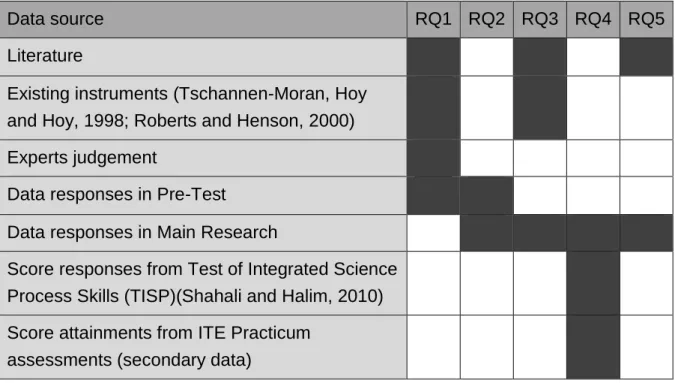
Table 3 Data sources for every research question mention ... 38
Table 4 Summary of research design of the study... 43
Table 5 Fuzzy spectrum for five-point Likert scale ... 48
Table 6 Domains of the TISP ... 55
Table 7 Enrolment of science PSTs in ITE campuses all over Malaysia57 Table 8 Summary of the three factors in the construct ... 63
Table 9 Level description of item hierarchy of KE ... 73
Table 10 Level description of item hierarchy of PTE ... 73
Table 11 Level description of item hierarchy of OBE ... 74
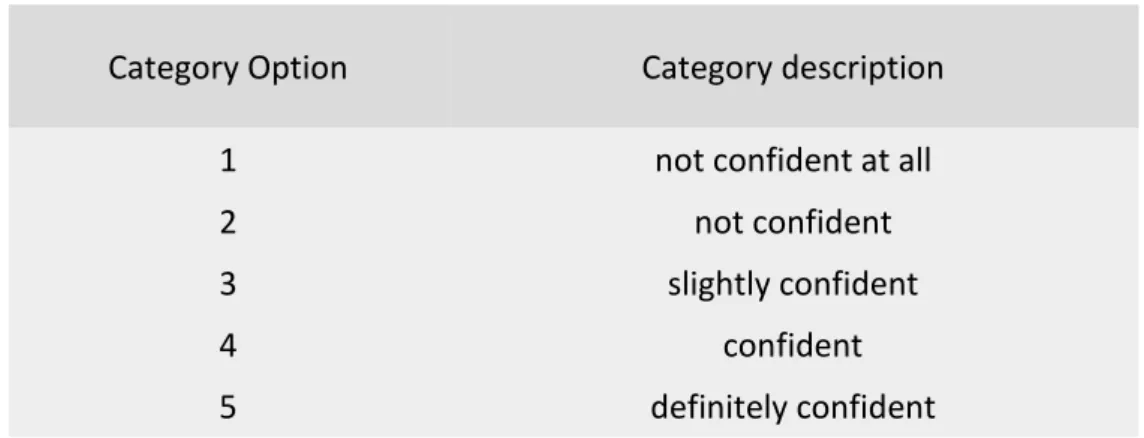
Table 12 Intensity and direction of categories of responses present in five-point rating scale ... 77
Table 13 Sources of items pool... 78
Table 14 Expert panel list ... 80
Table 15 Response statistics for the items reviewed by the expert panel in the Expert Survey ... 82
Table 16 Analysis result of item panelling for KE ... 83
Table 17 Analysis result of item panelling for PTE ... 84
Table 18 Analysis result of item panelling for OBE... 85
Table 19 Item revised for 75% less expected consensus. ... 86
Table 20 Items before and after the content validity process ... 86
Table 21 Demographic information ... 87
Table 22 Person Reliability for the SETSIS ... 89
Table 23 Fit statistic for items with unpredictable responses ... 90
Table 24 Fit statistics for removed items ... 90
Table 25 Items construction of two phases ... 92
Table 26 Background information of the respondents...94
Table 27 Summary statistics of responses in the SETSIS measure ... 95
Table 28 Univariate, bivariate and multivariate potential outliers profile97 Table 29 Reliability and normality test of the SETSIS data ... 98
Table 30 Mean and range of responses’ score in KE, PTE and OBE .. 101
Table 31 Profiling of relationship between subscales: values below the diagonal are bivariate correlations, with corresponding scatterplot above the diagonal. Diagonal portrays the distribution of each subscale ... 103
Table 32 Result for mean differences analysis ... 105
Table 33 Univariate test results for factor of semester ... 106
Table 34 Post-hoc contrast result in groups of semesters ... 107
Table 35 Multivariate test for interaction of group of semesters with other factors ... 109
Table 36 Result of univariate ANOVA analysis for significant interaction between factors group of semester and groups of ethnicity ... 110
Table 37 Correlation matrix for three factors in the EFA with Promax oblique rotation ... 113
Table 38 Removed items according to factor loading interpretation . 114 Table 39 Exploratory Factor Analysis (EFA) ... 115
Table 40 Three factors solution interpreted into three subscales ... 116
Table 41 A summary of findings in Chapter 5 ... 118
Table 42 Summary of the SETSIS Analysis Result – 66 items (n=324)120 Table 43 Item measure of KE sub-scale ... 121
Table 44 Item of PTE sub-scale ... 123
Table 45 Items of OBE sub-scale ... 125
Table 46 Summary of the SETSIS Analysis Result – Persons (n=324) 125 Table 47 Summary of model estimation measure without misfit cases (N=290) ... 126
Table 48 Dominant items in first added group (Cluster 1) ... 130
Table 49 Dominated items in the middle variance... 131
Table 50 Person measure relationship between the three clusters .... 132
Table 51 Table of 11 redundancy items ... 138
Table 52 Items associated with high item hierarchy ... 141
Table 53 Nine out of 42 items associated with mean item level ... 142
Table 54 Items associate with low difficulty ... 143
Table 55 Category frequency and average measure for five rating scale of the SETSIS ... 145
Table 56 Result of five well-functioning categories in the SETSIS ... 146
Table 57 Response probability at five levels of ability ... 147
Table 59 Calibration of measure rank using the predicted score in complete measures of the SETSIS ... 150 Table 60 Descriptive statistics for score performance in the TISP across
cohorts ... 154 Table 61 Descriptive statistics for score performance in the TISP ... 155 Table 62 Summary of fit statistics for 25 items of the TISP ... 157 Table 63 Correlation between subscales across the TISP and the SETSIS
... 159 Table 64 Relationship of performances in the TISP with factors in the
SETSIS ... 160 Table 65 Results of regression model summary to infer content knowledge
performance ... 160 Table 66 Multiple regression predictors of the working model to infer
content knowledge performance ... 161 Table 67 Descriptive table for Practicum II and Internship ... 165 Table 68 Descriptive analysis of Professional Practice score ... 166 Table 69 Correlation of Professional Practice with the SETSIS model166 Table 70 Results of regression model summary to infer Professional
Practice ... 167 Table 71 Multiple regression predictors of the working model to infer
List of Figures
Figure 1 Social cognitive theory emphasising reciprocal influences of behavioural, environment and personal factor in cognitive judgement ... 13 Figure 2 Relation between self-efficacy and outcome expectancy (Bandura,
1998). Self-efficacy may vary in terms level, strength and generality while outcomes expectancy may become positive or negative incentives. ... 14 Figure 3 Interaction of teachers’ cognitive process which results in
teachers’ efficacy judgments (source: Tschannen-Moran, Hoy and Hoy (1998)) ... 26 Figure 4 Conceptual framework for the study ... 34 Figure 5 Overview of the study phases in development and validation of the
SETSIS ... 41 Figure 6 Construct map for the SETSIS development ... 68 Figure 7 Wright map: distribution of person ability (left) and item difficulty
(right) ... 91 Figure 8 (Left) Histogram of the SETSIS responses and (right) a box and
whisker plot ... 96 Figure 9 Q-Q plot for overall the SETSIS (upper left), KE (upper right), PTE
(lower left) and OBE (lower right) ... 99 Figure 10 Frequency (in percentage) of responses in category across the
subscales KE (top) PTE (middle) and OBE (bottom) ... 100 Figure 11 Error bar graph score for KE, PTE and OBE with 95% confidence
interval (CI) ... 104 Figure 12 Mean score for KE, PTE and OBE across groups of semesters
... 108 Figure 13 Interaction between group of semesters and ethnicity groups109 Figure 14 Eigenvalue plot for scree test criterion ... 112 Figure 15 Standardised variance parameter component scree plot ... 128 Figure 16 Standard Residual Plot with three dominated cluster groups129 Figure 17 Wright map (Winsteps 4.0) ... 136 Figure 18 Frequency of responses to items (in percentage) according to
category ... 140 Figure 19 Category probability curve ... 147 Figure 20 Test Characteristic Curve for the complete SETSIS measure152
Figure 21 True score ranking for group of semesters ... 151
Figure 22 Frequency distribution of the TISP achievement ... 154
Figure 23 TISP score distribution across the group of semesters ... 156
Figure 24 Scores across group of semesters between the TISP and the SETSIS ... 159
Figure 25 Model prediction of SIS knowledge for semester 5 ... 162
Figure 26 Model prediction of SIS knowledge for semester 8 ... 163
Figure 27 Frequency of score of Professional Practices for Practicum phase II (above) and Internship (below) ... 164
Figure 28 Performance in Professional Practice ... 165
Figure 29 Model prediction in Practicum II (semester 6) ... 169
List of Abbreviations
ANOVA - Analysis of variance
BoTP- Bachelor of Teacher Programme EFA - exploratory factor analysis
EFA - Exploratory Factor Analysis FDM - Fuzzy Delphi Method GTE - General teaching efficacy ITE - Institute of Teacher Education KE - Knowledge efficacy
MOE - Malaysia Ministry of Education OBE - Outcomes Belief Efficacy
PCAR - Principle Component Analysis Residual PCK - pedagogical content knowledge
PTE - Personal Teaching Efficacy PST - Pre-service teacher
RSM - Rating Scale Model SD - Standard deviation
SETSIS- Self-efficacy in Teaching using Science Inquiry Skills TCC -Test characteristic curve
TISP - Test of Integrated Science Process Skills TSE - Teacher self-efficacy
Chapter 1 Introduction
1.1
Introduction
This thesis presents a study in the development and validation of an instrument to measure self-efficacy in teaching using science inquiry skills called the SETSIS. The development of the SETSIS to measure belief was inspired by the transformation in
education policy in Malaysia. The new policy of the Malaysian Ministry of Education (MOE) aspires to increase the participation of students in the science classroom through a skills-based approach. The introduction of a new primary science curriculum to include the process of science instead of only science content outcomes through learning requires a significant shift in classroom teaching approach and practices. The study of the
development of the SETSIS aims to measure belief development in implementing the practice changes focusing on pre-service teachers (PSTs). This chapter introduces the background context towards this study, its rationale and its objectives.
1.2
The study background
1.2.1 Science curriculum reform in Malaysia
The current science curriculum in Malaysia is largely shaped by a combination of internal and external global factors (Turiman et al. 2012). Compared to other subjects in the curriculum, changes in the science curriculum generally occur at a much faster pace due to the significant impact created by science and technology advancement in human civilisation (Adey 2001;Smith et al. 2012). The new
Malaysian primary science curriculum has emphasised the acquisition of scientific skills (process and manipulative skills) and thinking skills as well as understanding the basic principles of science with scientific attitudes and values., According to policy-makers and researchers, there is an urgent sense today that a science skill-based approach is more important than acquiring content for science literacy at school (Malaysia Blue Print 2013; Wicht 2016).
In 2011, a new curriculum for primary schools, the standards-based Primary School Standard Curriculum (KSSR), was launched to restructure the old integrated
curriculum, Integrated Curriculum for Primary School (KBSR). The transformation into KSSR aims to upgrade scientific literacy in school children for better
development of scientific understanding. The new primary science curriculum asks teachers to change their instruction-oriented approach to be more process-oriented. Teachers are asked to facilitate student understanding of the concept by using
science inquiry skills rather than via a concept explanation by the teacher. To date, science inquiry skills have become an important component in the new science curriculum and have become one of the new approaches to teaching science in a more effective and meaningful way (Malaysia Ministry of Education 2014).
The new curriculum (i.e. KSSR) has been designed using a modular curriculum that stresses content and learning standards, rather than merely outcomes as in the old curriculum (i.e. KBSR). With the implementation of KSSR, science teachers must be well equipped with the necessary knowledge and skills so that what is outlined in the curriculum is being realised in the classroom. Although teachers are expected to stress the process of science rather than the science concepts as outcomes in science classrooms, there is no explicitly stated expectation for teachers to meet these standards. This issue creates a challenge for teacher educators and PSTs to make changes in practice, appropriate to this newly reformed curriculum.
There has been lots of research that defines the work in teacher knowledge within the science content-based approach. In Malaysia, the primary curriculum has emphasised the acquisition of scientific skills (process and manipulative skills) and thinking skills as well as understanding the basic principles of science with scientific attitudes and values.
1.2.2 Defining science inquiry skills in the classroom
This study defined science inquiry skills as collective of science process skills by these skills are implemented during inquiry for the instructional setting in science classrooms. The transferability of the science process skills in the classroom depends on the learning context. In a science inquiry instructional setting, science process skills are the skills that always specifically frame what students should learn in the particular context of a science pedagogical setting (Millar & Driver 1987). Science inquiry skills are the courses of action science researchers use in scientific explorations, the mental mode of acquiring science concepts, and the didactic processes in lecture rooms (Millar, 1987). They are also known as science process skills, a set of broadly transferable abilities, applicable to many scientific disciplines and reflective of the works of scientists (AAAS, 1967). In the new Malaysian primary science curriculum context, science process skills are defined as skills that enable students to become involved in science learning more effectively. These skills are assessed by the standards based on the ability of students to perform the skills during science activities. The definitions of science process skills in the Malaysian primary science curriculum are given in Table 1 (Malaysia Ministry of Education 2003).
No SPS Definition
1 Observing
Using the sense of hearing, touch, smell, taste and sight to collect information about an object or a phenomenon.
2 Classifying Using observations to group objects or events according to similarities or differences.
3 Measuring and using numbers
Making quantitative observations using numbers and tools with standardised units. Measuring makes observation more accurate.
4 Inferring Using past experiences or previously collected data to draw conclusions and explain events.
5 Predicting
Stating the outcome of a future event based on prior knowledge gained through experiences or collected data.
6 Communicating
Using words or graphic symbols such as tables, graphs, figures or models to describe an action, object or event.
7 Using space-time relationship
Describing changes in parameter with time. Examples of parameters are location, direction, shape, size, volume, weight and mass.
8 Interpreting data Giving rational explanations about an object, event or pattern derived from collected data.
9 Defining operationally Defining concepts by describing what must be done and what should be observed.
10 Controlling variables
Identifying the fixed variables, manipulated variable, and responding variable in an investigation. The manipulated variable is changed to observe its relationship with the responding variable. At the same time, the fixed variables are kept constant.
11 Hypothesising
Making a general statement about the relationship between a manipulated variable and a responding variable in order to explain an event or
observation. This statement can be tested to determine its validity.
12 Experimenting
Planning and conducting activities to test a certain hypothesis. These activities include collecting, analysing and interpreting data and making conclusions.
Osman (2012) in her view of the early science curriculum in Malaysia, states that the current science curriculum reform efforts have re-focused on the necessity of
teaching students to make use of scientific knowledge to solve problems. Science teachers are challenged to use inquiry skills as their pedagogical approach to facilitate the development of cognitive development in the context of science learning. Therefore, the generic components of these skills are defined by science process skills and teachers can implement the skills in their inquiry teaching
instruction for organising a more systematic approach to science in the primary level. Implementing a skill-based approach to science instruction need to emphasise what children are able to do. Science process skills are defined as a set of broadly
transferable abilities, appropriate to many science disciplines and reflective of the behaviour of scientists. These skills are grouped into two types: basic and integrated. The basic process skills are observing, inferring, measuring and using numbers, communicating, classifying, predicting and using the space/time relationship, while the integrated process skills are controlling variables, defining operationally,
hypothesis and interpreting data. The basic (simpler) process skills provide a foundation for learning the integrated (more complex) skills.
In the empirical evidence presented in Smith et al. (2012), science teachers in a primary school in America agreed that scientific literacy in classroom practice can be viewed through how children learn to ‘taking apart issues; analysing; sorting;
reconstructing; defining; explaining; redefining ideas; …….; categorizing; using deeper thinking strategies; and making connections’ (Smith et al. 2012, p.145). The compilation of all these skills is what we call science process skills, which are always associated with science inquiry (Chiapetta and Koballa 2006). Thus, in the context of primary science classrooms in Malaysia, science process skills listed in Table 1 are used to frame the features of science inquiry skills of this study.
1.2.3 The role of science inquiry skills in promoting scientific literacy in learning
Scientific literacy means being able to make informed and balanced judgements about how science impacts on students’ lives and how to use scientific knowledge to solve problems (American Association for Advancement of Science, 1993). The major goal of science curricula is to promote scientific literacy to enable people to understand reports and discussion about science in the media (Millar and Osborne, 1998; DeBoer, 2000). Further, it is believed that the fundamental sense of scientific literacy is more than the ability to read and write about science, thus suggesting that the science curriculum should focus on the skills and applications that flow from science (Shortland, 1988).
In his systematic review, Ryder (2001) shows that, besides subject matter knowledge, individuals need knowledge about science to critically engage with everyday scientific issues. Further, Ryder indicates the significance of learning scientific skills including assessing the quality of data, interpreting data and the validity of scientific interpretation. These arguments suggest that the development of process skills in science education are important because of their role in the
development and pursuit of scientific knowledge and not just because they are valuable skills in their own right. Supporting this view, Huppert, Lomask, and Lazarowitz (2002) argue that learning scientific skills, known as science process skills, is a major goal of science education, since those skills are not only needed by scientists but by every citizen in order to become a scientifically literate person who can function in a global society.
In the empirical study to investigate how the cognitive domain is affected by scientific skills among primary students in Turkey, Özgelen (2012) found that scientific skills are related to cognitive development in providing support in students’ thinking, reasoning, inquiry, evaluation and problem-solving skills, as well as their creative thinking. This finding supports Adey’s research (2001) which found that teaching scientific skills are necessary in the primary school because of the important role of the scientific method in accelerating the cognitive development to a higher level of science learning.
The section pointed to the role of science inquiry skills in reforming science literacy, especially in the science curriculum in Malaysia. It seems that teacher education has a major role in providing PSTs with essential training in order to support curriculum reform. The next section will look into the context of teacher education in Malaysia.
1.3
Teacher education curriculum in Malaysia
One of the MOE policies detailed in the Malaysia Education Blueprint (2013-2025) is to enhance the teaching profession by improving the quality of teachers. The
Institute of Teacher Education Malaysia (ITE) has been given the responsibility to conduct the Bachelor of Teaching Programme (BoTP). Through this programme, the MOE wishes to reform the teaching profession in Malaysia as this programme was raised in status from a diploma to a bachelor degree qualification for primary teachers. The aim of this programme is to produce high quality primary school teachers with the knowledge, skills, and competencies to become effective teachers (Faridah et al. 2012).
The programme was started in 2007 as a four-year teacher education degree programme with one year of the foundation specialised in various primary subject
areas (e.g. primary science education, primary mathematics education, primary English language education, primary special education). The programme is run by ITE throughout 27 campuses all over Malaysia. The aim of the BoTP is mainly to produce quality primary teachers that have specialised in their subjects together with the knowledge of general teachers. The curriculum design in BoTP is parallel with the concept of teacher knowledge (Shulman 1986, 1987) that is widely used in the teacher education area (Grossman, 1990; Ben-Peretz, 2011). Details on the concept of teacher knowledge can be viewed in Chapter 2.
The BoTP curriculum is structured into three components which are core courses (65 percent of the total 133 credits), elective courses (18 percent) and compulsory
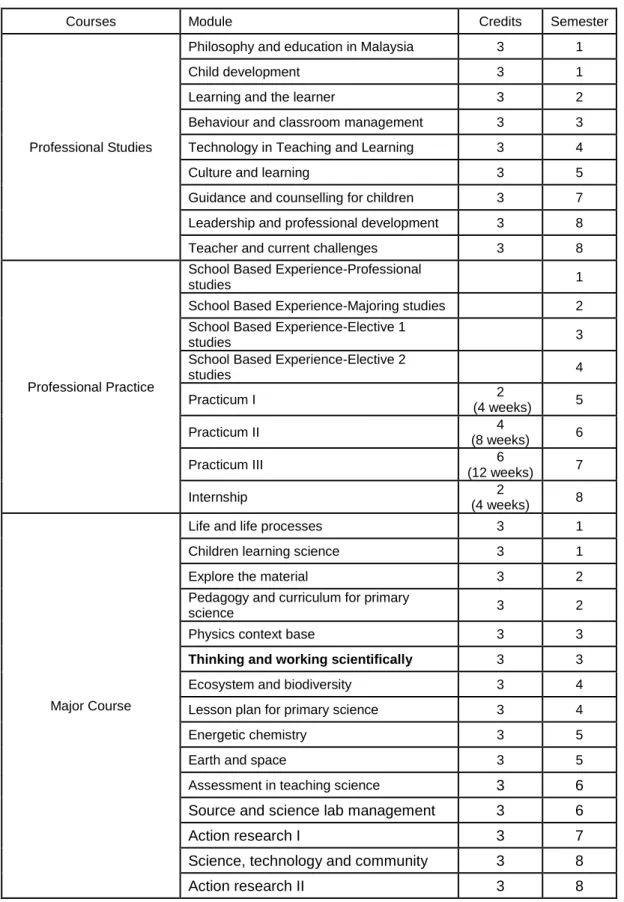
courses (17 percent). The curriculum design for core courses includes professional studies, professional practice and major subject courses, which are the essential teacher knowledge to be used and developed by the PSTs in their professional teaching practice (Moore, 2014). Table 2 below shows the components in core courses for BoTP specialising in primary science education.
PSTs are required to complete all the core courses within eight semesters of study. Professional studies provide exposure in basic teacher knowledge (i.e. general instructional and pedagogical knowledge) with a total of 27 credits. Major courses are offered to provide students with science content knowledge up to degree level and pedagogical content knowledge (PCK) in the context of teaching science in primary school. The major courses allocate a total of 45 credits, with one course named Thinking and Working Scientifically offering the module specifically on implementing science process skills.
The professional practice provides the ‘in-site exposure’ for PSTs to turn the
knowledge analysis into action in real school situations based on the professional teaching standards. Professional practice provides 14 credits, in which students are required to undergo a 32-week of professional practice which is implemented
through three forms: namely,
• School-based Experience (PBS) is carried out for four weeks (4W) without credit through courses in professional, major and elective studies.
• Teaching Practical at school (Practicum) is carried out for 24 weeks, distributed in three phases.
Table 2 The components in core courses for BoTP specialising in primary science education
Courses Module Credits Semester
Professional Studies
Philosophy and education in Malaysia 3 1
Child development 3 1
Learning and the learner 3 2 Behaviour and classroom management 3 3 Technology in Teaching and Learning 3 4
Culture and learning 3 5
Guidance and counselling for children 3 7 Leadership and professional development 3 8 Teacher and current challenges 3 8
Professional Practice
School Based Experience-Professional
studies 1
School Based Experience-Majoring studies 2 School Based Experience-Elective 1
studies 3
School Based Experience-Elective 2
studies 4 Practicum I 2 (4 weeks) 5 Practicum II 4 (8 weeks) 6 Practicum III 6 (12 weeks) 7 Internship 2 (4 weeks) 8 Major Course
Life and life processes 3 1 Children learning science 3 1
Explore the material 3 2
Pedagogy and curriculum for primary
science 3 2
Physics context base 3 3
Thinking and working scientifically 3 3 Ecosystem and biodiversity 3 4 Lesson plan for primary science 3 4
Energetic chemistry 3 5
Earth and space 3 5
Assessment in teaching science 3 6
Source and science lab management 3 6
Action research I 3 7
Science, technology and community 3 8
The BoTP curriculum has been designed to give the opportunities for teacher candidates to practice the theoretical grounded tools systematically (Grossman, Smagorinsky and Valencia, 1999). These experiences are educative and productive for PSTs to analyse, apply and reflect on the connection of subject matter and teaching outcomes, so that they will learn to be flexible and meet the specific teaching contexts (Ball and Bass 2000). However, Hairah and Keong (2011) found that PSTs on BoTP were not doing well in application and reflection in their teaching outcomes, especially in the context of teaching SPS during their professional
practice. Although the teacher training programme may inspire teaching practices, there are other factors beyond the cognitive performance that influence the practice of PSTs.
1.3.1 Science inquiry skills in teacher education
New pre-service science teachers came into the first semester of BoTP training with various perceptions of their potential ability in the specific tasks of teaching using science inquiry skills. They came with perceived expectations in science teaching approaches observed during their school experiences. Considering the nature of changes in the national science primary curriculum from KBSR to KSSR, preparing PSTs for the shift from content-based learning into skill-based teaching is important to teacher education.
Tan (1996) has reviewed the level of achievement in integrated science process skills among science trainees at two teaching colleges in Penang. He reported that the achievement of integrated science process skills among trainees is low compared with the achievements of students in similar studies conducted in the United States using the same testing instrument (Burns, Okey and Wise, 1985). This may be true, as analysis by Hairiah and Chin (2011) shows that trainees recorded the science process skills in the teaching plan but did not execute this plan in the classroom. Surprisingly, their reflection notes never mention this problem because they had not given attention to the importance of process skills, even though the need of the skills was stressed during teacher training.
In summary, it can be argued that a common approach to science teacher education offers a mix of content, pedagogy and contexts but without explicitly stating what knowledge novices are supposed to construct or how to utilise this knowledge. With attention to the BoTP for primary science major courses, the courses offered
certainly emphasised the content and pedagogical knowledge of teaching using science inquiry skills in the curriculum, but the PSTs are poorly utilising the skills in their classroom practices or worse not even noticing it during classroom teaching practices. Perhaps, with the identification of PSTs’ personal belief in using the skills
during classroom teaching practices, teacher educators can offer strategies with an explicit mechanism to affirm the teaching using science inquiry skills.
1.4
Problem statement
The latest primary science curriculum in Malaysia has emphasised the acquisition of scientific process skills as well as the understanding of basic principles of scientific concepts. This transformation attempts to upgrade the scientific literacy in schools to enable students to develop better scientific inquiry skills (Norris and Phillips 2003; Osman 2012). This reform explicitly asks teachers to change their teaching
strategies by shifting from direct instruction to facilitating learning through inquiry instructions.
However, these changes have not yet been sufficiently reflected in the teacher education curriculum. PSTs have not reflected sufficient knowledge to surface their teaching using science inquiry skills explicitly during their practice (Balfakih, 2010; Mbewe, Chabalengula and Mumba, 2010; Chabalengula, Mumba and Mbewe, 2012). Whilst they were unable to provide a correct definition, conceptually, of the skills, they exhibited relatively good performance involving the skills in novel situations. It seems that the contexts exhibited within teaching and learning situations help teachers and PSTs to show better competency in science inquiry skills.
Competency of PSTs in the specific application of science inquiry skills but not in the content of conceptual knowledge can partially be explained by their teacher
knowledge. Teacher knowledge describes teachers’ professional knowledge derived from teaching practice as well as from schooling activities. Pre –service teachers translate their conceptual knowledge of science inquiry skills into the performance of science inquiry skills through their personal experience, which is highly
contextualised and influenced by teaching interactions and experiences (Van Driel, De Jong and Verloop, 2002). How PSTs think and translate their knowledge to use in classroom teaching practices seems to be a consequence of the way they develop their belief in the possessed teacher knowledge.
Many researchers agree that successful teachers draw on specialised knowledge in their instructional work (i.e. teacher knowledge) with students, but specifying and measuring this knowledge has proven elusive in the teacher education programme (Pajares 1992; Abd-el-khalick et al. 1997;Cochran-Smith 2004; Ravindran et al. 2005). Although it is important to have the intellectual ability and capability to analyse their experiences in classrooms during teacher training, it shows that there are other factors that influence the transformation of the cognitive performances (i.e.
knowledge of teaching received in training) into action (i.e. practice of teaching). It seems that, the practice experiences for PSTs that obtained from the theoretical training (e.g. teaching courses, micro teaching, teaching courses’ presentation and teaching courses’ assignments) are not reflected in practice of teaching in
classrooms within the real school environment (Hairiah and Keong 2011; Rauf et al. 2013) .
Previously, studies show that multi-perspective experiences and belief (i.e. school experiences, epistemological belief and teaching experiences) have an effect in PSTs’ practice (Hutner and Markman 2016; Lebak 2015; Duit and Treagust 2003; Kane et al. 2002; Van Driel et al. 2001). Thus, this current study explores self-belief factors that influence the transformation of theory learned into practice in the context of teaching using science inquiry skills. This study was conducted among the pre-service science teachers in the Institute of Teacher Education (ITE) in Malaysia.
1.5
Focus of the study
In teacher education, development of PSTs is assessed using two main components of teacher knowledge. The first component is the cognitive test, where PSTs are tested using their knowledge attainment, and the second component is teaching practice performances (Park, 2011; Veal, 2012). However, it suggests that when PSTs are expected to depend on and be accountable for their own learning process during teaching practice, their belief plays a major role in the decision about
curriculum and teaching tasks (Pajares, 1992).
This study intends to assess the beliefs of PSTs in implementing a skill-based approach in primary science instruction. Using the concept of self-efficacy, the study explores three elements of teacher development through the application of
educational measurement techniques. The aims of this study are to
i) Develop and validate a self-efficacy instrument that includes knowledge efficacy, practice efficacy and belief in the context of teaching SPS among prospective science teachers in Malaysia
ii) Identify and understand whether self-efficacy traits (i.e. self-efficacy in knowledge, self-efficacy in personal practice and outcome expectancy) can infer teacher knowledge development in the component of knowledge and practice in PST education.
The study of development in the SETSIS reflects the model of teacher’s self-efficacy in the specific task of teaching using science inquiry skills. As Germann (1994) claims, through inquiry experiences, teachers help students not only to learn about
science but also to think logically, ask reasonable questions, seek appropriate answers, and solve daily problems. The measure from the instrument is assumed to indicate the characteristics for successful implementation of teaching with science inquiry instruction in classroom for prospective science teachers as intended in the reformed primary science curriculum of Malaysia.
Teacher education may provide sufficient knowledge and opportunities for pre-service teachers to practice teaching according to KSSR needs. However, to what extent these PSTs will persistently continue practicing the policy in future science classroom depend on their perceived beliefs in their own capability of teaching. The SETSIS is able to provide individual information about the perceived beliefs of teaching using science inquiry skills. The information can help teacher educators to identify the beliefs of individual PSTs in the implementation of the reform policy. This information can provide early intervention to strengthen PSTs’ perceive beliefs in the capability of teaching using science inquiry skills. The beliefs can play a major role in affecting personal persistence in teaching using science inquiry skills in the science classroom in Malaysia, as expected in the reform policy of KSSR. The next chapter describes the importance of self-efficacy in teaching using science inquiry skills in the existing literature.
Chapter 2 Literature Review
2.1
Introduction
In this chapter I present a review of the literature to explore the argument that the underlying construct, self-efficacy in teaching using science inquiry skills has a role in improving science teaching practice in PST education. This chapter begins with a review of the prominent theory of self-efficacy, followed by tracing the teachers’ self-efficacy (TSE) measure development and empirical evidence to provide the significant influence of TSE measures in student and teacher performance. Next, I trace the development of the teachers’ efficacy assessment concept from its emergence up to the present to clarify its conceptualisation with the critiques on the existing factors of TSE belief, in which I also suggest current developments in the TSE measure concept literature. Then I conceptualise my study framework based on prior teacher efficacy definitions,
conceptualisations and theorisation, incorporating the elements of best practices in teacher efficacy assessment for PSTs. Finally, I define the framework within self-efficacy in teaching using science inquiry skills and present justification for the need to develop a new self-efficacy tool aligned to the principle of teacher education development.
2.2
Theoretical and empirical review of teacher’s self-efficacy
(TSE)
A role of self-efficacy in a teacher’s teaching practice needs to be theoretically and empirically reviewed to provide strong evidence of contributions to teachers’ self-efficacy, especially in quality of the PSTs’ teaching practice. The strength of the theories of self-efficacy that align with the empirical evidence will be discussed later. 2.2.1 Bandura’s Self-efficacy Theory
Self-efficacy defines as ‘a person’s belief that they can be successful when carrying out the particular task’ (dictionary.cambridge.org). A perceived self-efficacy refers to people's beliefs abouttheir capabilitytoexercise controlover their own activities. Albert Bandura defines self-efficacy as personal judgement of ‘one's capabilities to organize and execute the courses of action required to manage prospective
situations’ (Bandura 1997, p.2). He conceptualise the role of self-efficacy to infer future behaviour in general.
Bandura’s definition is rooted in the social cognitive theory view on human agency, which suggests that individuals are responsibly engaged with their own
development, within reciprocal causation relationships between environment, behaviour and personal factors. The driven action that can make things happen from the cognitive interaction of the three factors (Bandura 1986) was clarified in a model of triadic reciprocal determinism. The model used in Woods and Bandura (1989) is adapted into Figure 1 to explains the cognitive interaction between the three elements in determining human behaviours or performance in certain task.
The model in Figure 1 shows the possibility to determine human behaviours through cognitive judgement of the three factors. Strategies for increasing performance in a task can be aimed at improving the three factors indicated. For example, in order to improve the practice of teaching among teachers, the trainer can work to improve teachers’ self-efficacy in teaching (behavioural factors), improve their knowledge and attitudes towards teaching (personal factors) and/ or improve the expectation of the social community (environmental factor). This triadic reciprocal model interaction creates cognitive judgement for changes in behaviour.
Bandura has advanced the concept in self-efficacy theory. Self-efficacy, which is a component of social cognitive theory refers to people’s belief about their capabilities to execute a specific task within a given context. The cognitive judgement
contributed to the predictive power of certain levels of behaviour, which arose from personal factors and environment factors (i.e. outcome expectancy) (Bandura 1977, 1998). The relationship of Bandura’s self-efficacy theory is portrayed in Figure 2. In Figure 2, while self-efficacy is a cognitive judgement about one’s capability of doing a task based on personal factors (i.e. self-reflection of personal competency) within the environmental sources, it also holds on to the relationship with outcome
Behavioural Factors (e.g. skills, practice, self-efficacy)
Personal Factors
(e.g. knowledge, expectation, attitudes)
Environmental Factors
(e.g. social norms, access in community, influence to others) Figure 1 Social cognitive theory emphasising reciprocal influences of
expectancy as a basis in predicting the capability of a person to perform a certain level of behaviour in future.
Outcome expectancy is distinguished from self-efficacy because self-efficacy
indicates the perceived intensity in the ability to do a behaviour in completing a task, while outcome expectancy is a judgement about the likelihood of outcomes from the behaviour. Given an example of self-efficacy ‘I believe that I can cheer up the class by telling jokes’, self-efficacy is about perceived belief of the capability of telling jokes (i.e. to do a behaviour) in order to cheer the class (i.e a task). The likelihood of
outcomes expectancy is about the belief that the behaviour (i.e. telling jokes) can be lead to positive or negative outcomes in physical, social or self-evaluative incentives (e.g. I believe that students do not like their teachers to tell jokes during lesson). According to Bandura’s theory, self-efficacy causally influences outcome
expectancy, but not vice versa: “People’s judgement about how well they will perform largely determine what outcomes they expect their action to produce” (Bandura 1998, p.53). This belief judgement is based on the perceived capability to coordinate and orchestrate the skills and capabilities in the context of competing for specific demands and impediments. People’s perceptions of whether they are capable of successfully performing certain behaviours through the expectancy distinguish self-efficacy from general self-belief. Perseverance can produce the desired results, and this success then increases self-efficacy judgements.
The relation between self-efficacy and outcome expectancy explains self-efficacy as a belief that is goal-directed for specific tasks and domains, distinguishes it from
Figure 2 Relation between self-efficacy and outcome expectancy (Bandura, 1998). Self-efficacy may vary in terms level, strength and generality while outcomes expectancy may become
positive or negative incentives.
Person Factor Behaviour Outcome Outcome expectancy Self-efficacy
general self-belief that only involves the willingness to carry out certain behaviour (Bandura 1997). With the expectancy on the outcome factors, people with high self-efficacy are more likely to believe they can overcome the challenges, recover from setbacks and disappointments, and do well in prospective tasks. While people with low self-efficacy tend to have low belief in doing well in the prospective challenges, which leads to avoiding the tasks.
This theorised relationship, in Figure 2, has been widely accepted in the area of self-efficacy measures (Maddux, Norton and Stoltenberg 1986; Tschannen-Moran and Hoy 2001; Siwatu 2007). However, numbers of empirical studies have demonstrated that outcome expectancy influences self-efficacy ratings, then called into the
question of validity of the self-efficacy theory (Kirsch 1982, 1985, 1986, 1995; Teasdale 1978; Wolpe 1978 in Williams 2010). Bandura countered this critique with evidence involving correlational studies showing that self-efficacy is predictive of behaviour even when the effects of outcome expectancy were statistically controlled (Bandura 1984 in Williams 2010). He asserted that self-efficacy judgements are valid but can still be influenced by outcome expectations.
Development in self-efficacy judgement contributed from four sources that postulated self-efficacy and outcome expectancy factors (Bandura 1997). Mastery experiences, vicarious experiences, verbal persuasion and physiological arousal were stated as the main sources of the expectation. The mastery experiences develop a strong sense of efficacy through previous success in dealing with a particular challenge. The experiences of repeated success performance can build a resilient sense of efficacy from similar situations and contribute to a powerful sense of self-efficacy. Contradictory to success experiences that contribute to an increase in self-efficacy, failure in past experiences can contribute to decreased levels of self-efficacy. On the other hand, people with little previous experiences develop a sense of efficacy with the observation of successful behaviour of model performance or vicarious experiences. Vicarious experiences encourage the belief that people are able to imitate the success of the model performance, especially when there is a similarity to the model. Observation of behaviour on certain tasks can affect levels of self-efficacy, in which seeing success or failure of the model in the tasks can
contribute to the level of self-efficacy.
Moreover, verbal persuasion can have a built-in sense of efficacy when people are told about their capability to handle certain situations. Social persuasion received from other persons can manifest positive or negative encouragement. ‘People who are persuaded verbally that they possess the capability to master given tasks are likely to mobilise greater effort and sustain it…’ (Bandura 1997, p. 101). In the
context of teacher practice, social persuasion usually comes from social interaction, especially from teacher trainers and peers.
Lastly, physiological arousal can lead to the development of self-efficacy. People’s perception with their physical function can influence their belief. Lack of physiology perception (e.g. having speech problem or excessive body mass), which might be interpreted as inability by a person can feed negative responses reflected in low levels of self-efficacy rather than the normal perception of physiology that feeds perfectly positive responses for high levels of self-efficacy. In teacher training, these sources interacted within teachers’ professional knowledge, which then can be seen in teachers’ behaviour in classroom teaching. The model of self-efficacy that explains reciprocal interaction of cognitive judgement between the personal and
environmental factors can be used to preliminarily assess competency in the teaching profession. The following is discussed as to how Bandura’s self-efficacy theory has connected in self-efficacy concept measures for teachers.
2.2.2 Conceptual perspectives on the underpinning teacher self-efficacy (TSE) measure development
Teacher self-efficacy (TSE) belief was first introduced by Research ANd
Development (RAND) Corporation. RAND’s researchers introduced two items that measure the internal factors and external factors influencing a teacher’s ability to teach (Armor et al. 1976). It was conceptualised using an internal-external scale inspired by Rotter’s theory of social learning (1966). The internal scale in RAND’s project indicates teacher’s belief in accomplishing teaching activities in difficult contexts within classroom teaching. The external scale measures a teacher’s belief in the environmental factors that overshadow teaching ability and inhibit learning. The combination of these two factors yielded the teacher efficacy construct. This study asserted that the internal factor belief has a greater impact than the belief in external factors.
Later, Gibson and Dembo (1984) developed a 30-item instrument, that measured teacher efficacy more extensively and reliably, called the Teacher Efficacy Scale. The study of the Teacher Efficacy Scale was motivated by RAND’s factors (Armor et al. 1976) that corresponded with the concept of self-efficacy theory (Bandura 1977). Factor analysis confirmed that there were two factors: the internal factor called personal teaching efficacy (PTE) and the external factor called general teaching efficacy (GTE), which both show high reliability.
In the Teacher Efficacy Scale, PTE corresponds to specific items (e.g. “If I really try, I can get through to even the most difficult and unmotivated students” (p.573)) that represent a teacher’s sense of personal responsibility in student learning. GTE corresponds to items (e.g. “ When it comes right down to it, a teacher really can't do much because most of a student's motivation and performance depends on his or her home environment”(p.574)) that reflect a teacher’s belief about the general relationship between teaching and learning. Gibson and Dembo argue that these two respective factors emerged corresponding with self-efficacy and outcome
expectancy, as suggested by Bandura (1977). As a result, the self-efficacy factor is widely known as PTE and outcome expectancy is widely known as GTE in TSE belief measures.
Although the Teacher Efficacy Scale has been used often as a teacher efficacy instrument, there is the issue of inconsistency in the meaning and instability in factor structure of PTE and GTE (Henson 2001; Tschannen-Moran an Hoy 2001; Williams, 2010). Hoy and Woolfork (1993) employed their short version of Teacher Efficacy Scale with a 10-item measure and found reliabilities in five PTE items and five GTE items, which were within the range of the longer version of the measure. The measure predicts that teachers with higher scores in PTE and GTE would persist in teaching tasks longer, give a greater academic focus in the classroom and would be active and assured in their responses to the students. Indeed, Allinder (1994) in her study of the relationship between teacher’s self-efficacy and instructional practices found that PTE relates to instructional experimentation while GTE refers more to clarity and enthusiasm in teaching.
Researchers inadvertently combined PTE with other factors, which lead to instability of the factor structure in self-efficacy measures. Using the 16-item version of
Teacher Efficacy Scale, Soodak and Podell (1993) found that one GTE item was loaded onto the PTE factor, and that another item did not have a strong enough loading on either factor to be included. In another study, four school factors were found to be significantly associated with teacher efficacy: receiving positive feedback on teacher performance, collaboration with other teachers, parental involvement in the school, and schoolwide coordination of student behaviour (Rosenholtz 1989). These results empirically questioned the validity of Bandura’s theory of two
distinctive factors of self-efficacy (i.e. PTE) and outcome expectancy (i.e. GTE) as stated in 2.2.1.
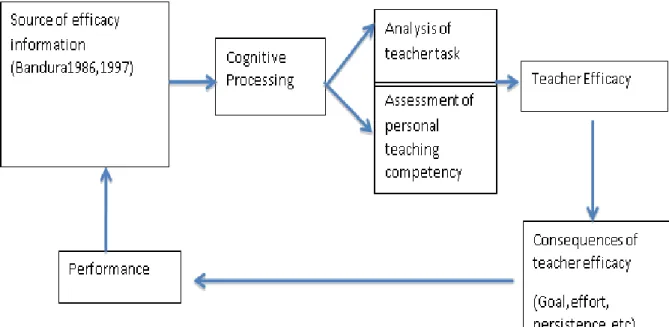
Addressing these issues, Tschannen-Moran et al. (1998) have extended the two-dimensional concept of Bandura in their integrated model of teacher efficacy. This teacher efficacy model integrates sources of information in a specific setting with the
cognitive process in order to make efficacy judgements. The efficacy judgements are made based on two corresponding factors, GTE and PTE, that are embedded in the analysis of teaching tasks and the assessment of personal teaching competence. This model is explained in detail later in section 1.3.1.
2.2.2.1 TSE measure development in teaching science
TSE is believed to be context and subject-matter specific (Pajares 1992; Roberts and Henson 2000; Meinhardt et al. 2014). The Teacher Efficacy Scale measure for general teaching behaviours may overlook the specific content of teaching. In the attempt to address this issue, Riggs and Enochs (1990) developed the Science Teaching Efficacy Belief Instrument (STEBI) for teachers (STEBI-A) and STEBI-B for PSTs. These science-specific items were modelled after two scales that have been used in Gibson and Dembo (1984) in regards of science teaching and the learning was believed too general for a context of in-service and PSTs. Studies in STEBI-A and STEBI-B have found two unrelated factors that were consistent with the factors concept of PTE and GTE (Riggs and Enochs 1990).
In extended studies of STEBI-A and STEBI-B, teachers with high scores of PTE reported were more likely to spend time teaching to develop the science concept being considered and were related to higher science teaching performance (Riggs and Jesunathadas 1993; Riggs et al. 1994). The studies on the second factor related to the quality of teaching science but Riggs (1995) found that GTE will improve only with those whose belief was weak to begin with.
Other research has questioned the elusive measure of outcome expectancy factor in STEBI-B (Tschannen-Moran and Hoy 2001; Bleicher 2004) because of the instability in factor structure. Roberts and Henson (2000) proposed an alternative instrument, called Self-Efficacy Teaching and Knowledge Instrument Science Teachers
(SETAKIST), to measure science teachers’ self-efficacy to address these concerns. The development of SETAKIST used Gibson and Dambo’s measure as a starting point, retained the PTE items (rewording them into a science teaching context) but introduced knowledge efficacy (KE) to assess another teacher efficacy dimension. The idea of knowledge efficacy construct was based largely on the concept of Pedagogical Content Knowledge (PCK) (Shulman, 1986). However, in a revised version of SETAKIST in item wording and scaling (SETAKIST-R), Pruski et al. (2013) revealed that the person-item separation indices (reliability) were low because of poor item wording. Thus, the study suggested SETAKIST’s items needed
development before further usage.
To conclude, the development in TSE belief measures, especially in quantitative measures, still needs to be improved. The review of the theoretical aspect of
self-efficacy belief has been a foundation in TSE belief measures and have shown a significant role in measuring teaching behaviour for teachers and PSTs. It has also been further shown the role of knowledge factor in measuring TSE belief. The next section will discuss the empirical evidence that suggests the important influences of TSE measures in teaching science.
2.2.3 Empirical evidence of TSE role in teaching practice
Self-efficacy is a belief that someone can successfully perform a behaviour and has attracted much empirical research. It asserts that self-efficacy has a powerful
influence on behaviour and performance changes. A range of research studies highlighted the important role of teachers’ self-efficacy in students’ learning and teaching practice.
2.2.3.1 Impact of TSE on student learning
Self-efficacy has emerged as a highly effective predictor of students’ motivation and learning. As a performance-based measure of perceived capability, self-efficacy beliefs have been found to be sensitive to subtle changes in the students’
performance context, to interact with self-regulated learning processes, and to mediate students’ academic achievements (Zimmerman 2000).
Since the TSE belief measure concept was promoted by the RAND Corporation (Armor et al. 1976; Berman, McLaughlin, Bass, Pauly, and Zellman 1977) and the subsequent research into the TSE measure, a number of studies have pointed to the influence of TSE beliefs on children's cognitive achievements and success at school (Moore and Esselman 1992, 1994; Muijs and Reynolds 2001; Ross 1992, 1998). TSE beliefs may influence a student's achievement in several ways. Teachers with high efficacy beliefs are more likely than teachers with a low sense of self-efficacy to implement didactic innovations in the classroom and to use classroom management approaches and adequate teaching methods that encourage students' autonomy and reduce custodial control (Cousins and Walker 1995a, 1995b; Guskey 1988), to take responsibility for students with special learning needs (Allinder 1994; Jordan, Krcaali-Iftar, and Diamond 1993), to manage classroom problems (Chacon 2005; Korevaar 1990), and to keep students on task (Podell and Soodak 1993). Furthermore, teachers’ perceived self-efficacy has been found to be associated with enhanced student motivation (Ashton and Webb 1986; Roeser, Arbreton, and
Anderman 1993), increased self-esteem (Borton 1991), strong self-direction (Rose and Medway 1981), ease in managing school transitions (Midgley, Feldlaufer and Eccles 1989), and more positive attitudes toward school (Miskel, McDonald, and
Bloom 1983). The teacher's self-efficacy may also contribute to promoting a student's sense of efficacy, fostering their involvement in class activities and their efforts in facing difficulties (Ross 1998; Ross, Hogaboam-Gray, and Hannay 2001). In addition, other findings suggest a reciprocal effect between a teacher's perceived efficacy and a student's achievement, showing that teacher's perceived self-efficacy is particularly high in schools with high-achieving and well-behaved students (Raudenbush, Rowan, and Cheong 1992; Ross 1998). As teachers of talented and disciplined students are more likely to be successful in their activities and tasks than teachers of students who present learning or disciplinary problems, the repeated experiences of success with students may enrich their experience and contribute to their robust sense of efficacy.
2.2.3.2 Impact of TSE on teacher’s performance
With regard to teaching practice, the evidence suggests that teachers’ behaviour in classrooms is highly influenced by their perceptions about own ability to teach (self-efficacy) and the belief that their teaching strategies would be effective (outcomes expectancy). Although a person’s beliefs about their capabilities are not the same as their actual ability, they are closely related. Teacher's self-efficacy beliefs do not, of course, operate in isolation from other psychosocial determinants that affect their motivation and performance such as their professional aspirations, the recognition and respect they perceive to be accorded and, ultimately, the satisfaction they draw from their profession.
Previous findings support the critical influence of a teacher's self-efficacy beliefs on their performance and motivation (Bandura 1997; Ross 1998; Tschannen-Moran, and Woolfolk Hoy, 2001; Tschannen-Moran, Woolfolk Hoy and Hoy 1998; Woolfolk and Hoy, 1990; Woolfolk, Rosoff and Hoy, 1990; Woolfolk Hoy and Davis, 2006). It also shows that teachers’ behaviours, such as willingness to take a risk, persistence in tasks and the use of innovation are related to the degree of self-efficacy in
individual teachers Compared to teachers who doubt their efficacy, teachers with a good sense of self-efficacy are more inclined to appreciate other school constituents' contributions to the functioning of the school, to view the principal, colleagues, staff, students and parents as behaving in accordance with their obligations, and to perceive the whole school as a system capable of pursuing its mission (Goddard et al. 2004; Takashi 2011).
Previous research has also found that teachers' sense of efficacy is related to their satisfaction with their choice of profession and their competence as rated by school superintendents (Trentham, Silvern, and Brogdon 1985). A strong sense of teacher's self-efficacy promotes a firm commitment to the profession and collaborative