Demonstrating the
Value of Certification:
A Roadmap to Conducting
Meaningful Research
About the Knapp Certification Re-Think Tank
™
Founded in 2009, the Knapp Certification Re-Think Tank™ is an elite group of industry influencers gathered together to re-think, re-define and completely re-shape the business of certification. These innovative minds convene monthly to challenge and question every aspect of how the certification industry does business. Through their collective knowledge, experience and ingenuity, this group of leaders is working to craft a blueprint for transforming certification organizations.
This publication was created by the 2011-2012 Knapp Certification Re-Think Tank™ panel:
Liz Burns Juniper Networks Jill C. Burroughs CompTIA Sierra Hampton Citrix
Kevin R. Keller, CAE
Certified Financial Planner Board of Standards
Philip Koneman, PhD
Autodesk
Chuck Kunce, PhD
National Institute for
Automotive Service Excellence
Cary List, CA, CFP
Financial Planning Standards Council
Liberty J. Munson, PhD
Microsoft Learning
Michael Niederpruem, MS, CAE
American Health Information Management Association
Mary E. Power, CAE, CMP
HR Certification Institute
Thomas R. Robinson, CFA, CFP®
CFA Institute
Facilitators:
Joan E. Knapp, PhD
Knapp & Associates International, Inc.
Lenora G. Knapp, PhD
Knapp & Associates International, Inc.
Interested in re-thinking certification? Read more about what the Knapp Certification Re-Think Tank™ has been discussing at our blog: www.knapprethinktank.blogspot.com and join the conversation at the Re-Think Certification LinkedIn group sponsored by the Knapp Certification Re-Think Tank™.
About Knapp & Associates International, Inc.
Established in 1989, Knapp is a consulting firm which specializes in the conceptualization, development, implementation and revitalization of professional credentialing programs. The mission of Knapp is to serve as a partner to our clients in ensuring the development and maintenance of programs that are technically sound and which succeed in the business of credentialing. Further information about Knapp and its services can be found at www.knappinternational.com.
Why Conduct Research on the Value of Certification?
Our answer to this question is, “Why not?”
nFulfill your responsibilities to stakeholders. Stakeholder needs are at the heart of many certification program missions. We believe that certifiers have an obligation to demonstrate the value of their certifications to stakeholders (a sort of “truth in advertising”).
nObtain data to inform continuous
improvement. Your research may reveal areas for improvement which, if addressed, could enable you to more effectively meet stakeholder needs.
nGain a better understanding of how
stakeholders perceive certification and why they do (or don’t) seek or support certification. Such insights can help to inform the development of marketing and business strategies and highlight new opportunities. The research data also may establish whether there is sufficient stakeholder interest and support to justify the continuation of the certification program. Thus, value research plays a role in validating the relevancy of your program.
nDocument the return on investment (ROI) for stakeholders. In what measurable ways have stakeholders benefited from their investment in certification and are the benefits received greater than the costs incurred? Return on investment data provide the bottom line answer to the question, “What’s in it for me?” Documenting ROI for internal stakeholders/customers is important as well, as this may serve to justify your organization’s resource commitment to the certification program.
nObtain data which can be used in promoting the certification to stakeholders. Demonstrating the value of certification to stakeholders may spur greater participation and support.
nSupport your organization’s goals regarding recognition by governmental bodies. Whether your organization is actively seeking government recognition or trying to forestall regulation of the occupation/profession, it can benefit from data demonstrating that certified individuals do indeed demonstrate the expected knowledge/skills on the job or perform better than non-certified individuals.
Certifiers devote substantial resources to evaluating their assessments. It makes sense to put the same level of effort into evaluating the value of the certification process itself.
If your certification program is very successful, you may believe that the success of the program is sufficient to demonstrate the value of certification and that no research is required. Keep in mind that even successful programs may eventually slow down, plateau, or begin to decline. And the reasons for your success may not be what you think. Understanding the true value of certification will help you to lay a solid foundation for the future of your program, no matter how successful it may already be.
Roadmap to Conducting Value of Certification Research
Identify which stakeholder groups should be included in the research.
Determine how each targeted stakeholder group judges the value of certification.
Use the certification value research taxonomy to guide you in selecting the type of
research needed.
Identify the type of information most likely to persuade your stakeholders.
Select the
measures you will use to demonstrate value.
Select one or more methodologies for conducting the research.
Evaluate whether it would be feasible to partner with a stakeholder.
Publish the research findings in an easy-to- consume format. Leverage the study data.
1
2
3
4
5
6
7
8
9
START
FINISH
Roadmap to Conducting Value of Certification Research
1. Identify which stakeholder groups should be included in the research. There are a variety of stake- holders associated with professional certification. The most common of these are: candidates, certificants, employers, academic institutions and training companies, resellers/channel partners
(for certifications sponsored by a company which sells products or services related to the scope of the credential), trade and professional associations representing the industry or field, governmental bodies, regulators, and the public.
It may not be feasible or necessary to include all stakeholder groups in your research. If this is the case, target those which are the most critical to the success of your certification business and/or to accomplishing the program’s mission.
In some cases you may want to include stakeholders who have not pursued or supported certification, as well as those who have. This approach may provide you with a more comprehensive picture of perceptions regarding the value of certification.
Once the stakeholder groups are identified, it is advisable to further define the targets within these groups. For example, if you want to conduct research with “employers,” will your research participants include C-suite executives, supervisors, or human resource professionals? And what type of employers should be included in the research
(e.g., large vs. small).
2. Determine how each targeted stakeholder group judges the value of certification. Don’t assume you know what stakeholders expect from certification or the factors they weigh when determining its value. Ask your stakeholders what would prove that your certification does indeed have value for them. Identify what factors they consider when determining value and how they weight these factors in their evaluation.
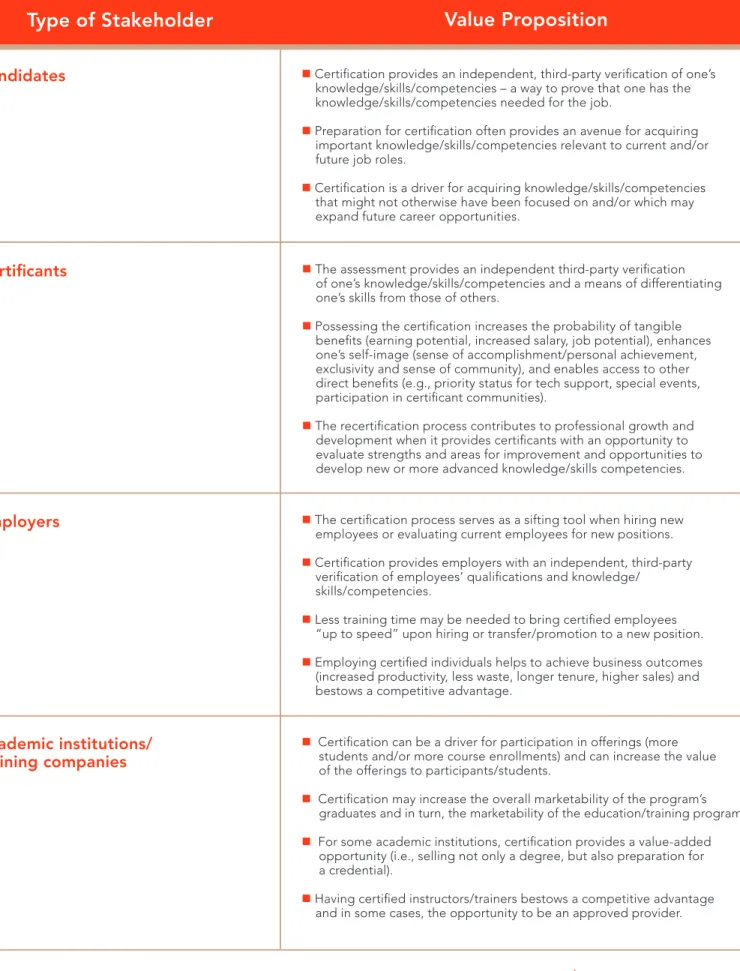
Collecting this information will enable you to align your research with what stakeholders find most meaningful. To get you started on the process, we have provided an overview of the most typical value propositions for various external certification stake- holder groups (see Table 1).
Keep in mind that these value propositions should be customized to your own stakeholders and the type of certification you are offering. For example, if you were identifying the value proposition for roofing
contractors who hire individuals with a safety-related certification, you might find that what these employers would value from certification is a lower injury/accident rate and reduced insurance premiums. These are the specific business outcomes that this type of employer (roofing contractor) would expect from their
investment in this type of certification (safety-related).
3. Use the certification value research taxonomy to guide you in selecting the type of research needed. The taxonomy (shown in Table 2) categorizes
different types of value research, identifies the primary focus of each research category, and provides
examples of the type of information which can be obtained. Select the type(s) of value research that will be most convincing to the stakeholder groups you are targeting.
4. Identify the type of information most likely to persuade your stakeholders. For some groups, case studies providing an in-depth, “real life” description of how others like them have benefited from certification can be very compelling. Other groups will only be persuaded by quantitative data obtained from a large sample. Your research will have greater impact if you demonstrate the value of certification in a manner which your stakeholders will appreciate.
Roadmap to Conducting Value of Certification Research
5. Select the measures you will use to demonstrate value. Keep in mind that there may be a variety of certification value propositions for each type of stakeholder (Table 1). Be careful about “putting all your eggs in one basket” and focusing on just a single variable (e.g., certificant compensation, productivity, customer satisfaction).
6. Select one or more methodologies for
conducting the research. The methodologies you select should be informed by your understanding of how stakeholders judge the value of certification and the type of information which they find most compelling and meaningful.
When selecting the research methodology, also consider whether an unbiased, third party (e.g., market research firm, academic institution) should conduct the research. Will stakeholders see the research findings as less credible if you conduct your own research?
7. Evaluate whether it would be feasible to partner with a stakeholder. Some stakeholders may have as much interest in the research questions as you do. Do you have an enthusiastic stakeholder, such as a large employer, which would be willing to be the subject of an in-depth, case study? Perhaps some of your stakeholders have already conducted their own certification value research and would permit you to use their research data for your own purposes.
8. Publish the research findings in an easy-to- consume format. This format will help your
stakeholders to better comprehend the implications of the research and also will facilitate the
dissemination of the information. Customizing the message and data for each stakeholder group also helps to make the findings more “consumable.”
9. Leverage the study data. You can do more than simply publish the research findings. Think about creative ways in which you can leverage this information. For example, you could post videos of influential stakeholders sharing their “real life” examples of how they have experienced the value identified in the research study. Or, you could host a stakeholder summit to discuss the research and identify ways in which to increase the value of certification.
Don’t treat your value of certification research as a one-off event that is over once the findings have been published. Instead, develop a plan for integrating the findings into your communication and marketing efforts on an on-going basis.
Table 1. Examples of Typical Value Propositions for External Certification Stakeholders
Candidates n Certification provides an independent, third-party verification of one’s knowledge/skills/competencies – a way to prove that one has the knowledge/skills/competencies needed for the job.
n Preparation for certification often provides an avenue for acquiring important knowledge/skills/competencies relevant to current and/or future job roles.
n Certification is a driver for acquiring knowledge/skills/competencies that might not otherwise have been focused on and/or which may expand future career opportunities.
Certificants n The assessment provides an independent third-party verification of one’s knowledge/skills/competencies and a means of differentiating one’s skills from those of others.
n Possessing the certification increases the probability of tangible benefits (earning potential, increased salary, job potential), enhances one’s self-image (sense of accomplishment/personal achievement, exclusivity and sense of community), and enables access to other direct benefits (e.g., priority status for tech support, special events, participation in certificant communities).
n The recertification process contributes to professional growth and development when it provides certificants with an opportunity to evaluate strengths and areas for improvement and opportunities to develop new or more advanced knowledge/skills competencies.
Employers n The certification process serves as a sifting tool when hiring new employees or evaluating current employees for new positions.
n Certification provides employers with an independent, third-party verification of employees’ qualifications and knowledge/
skills/competencies.
n Less training time may be needed to bring certified employees “up to speed” upon hiring or transfer/promotion to a new position.
n Employing certified individuals helps to achieve business outcomes (increased productivity, less waste, longer tenure, higher sales) and bestows a competitive advantage.
Academic institutions/ training companies
n Certification can be a driver for participation in offerings (more students and/or more course enrollments) and can increase the value of the offerings to participants/students.
n Certification may increase the overall marketability of the program’s graduates and in turn, the marketability of the education/training program.
n For some academic institutions, certification provides a value-added opportunity (i.e., selling not only a degree, but also preparation for a credential).
n Having certified instructors/trainers bestows a competitive advantage and in some cases, the opportunity to be an approved provider.
Resellers/channel partners n Having certified employees bestows a competitive advantage and opportunity to achieve higher tiers in reseller/channel programs.
Governmental bodies n A qualified source (the certifier) identifies occupational/professional qualifications and standards, thus eliminating the need for the government body to conduct such activities.
n Standards developed by the field/industry may be better received and have greater uptake by the field/industry than those developed and promulgated by a government body.
Trade/professional associations n Certification and/or sales of certification-related products (e.g., study guides, reference materials, continuing education programs) can be a source of nondues revenue.
n Certification may increase the association’s visibility and attract new members.
n Certification may elevate the stature of the occupation/profession represented by the association and thus, contribute to the future growth and success of the field and the association.
n Certification helps to support the viability of the industry/field by providing a means of identifying qualified individuals.
n Certification supports the association’s goals related to government recognition (i.e., either obtaining recognition or avoiding regulation).
Regulators n The certification assessment (or entire certification process) can streamline operations of licensing bodies by serving to fulfill one or more of the licensing requirements.
n Certification provides an efficient way to identify individuals qualified to perform certain functions/roles (as defined in regulations).
n When a quality certification process is available for a targeted job role, regulators may be able to forgo licensing the role and thus, can allocate their limited resources elsewhere.
Type of Stakeholder
Value Proposition
Public n The certification process provides a convenient way to identify individuals whose knowledge/skills/competencies have been confirmed by an independent, third party.
n Certification provides some measure of protection from harm by unqualified individuals.
Table 2. Taxonomy for Value of Certification Research
Type A – Perceived Value
n Do stakeholders believe they have benefited from certification (and to what degree)?
n How important/valuable do stakeholders believe certification to be?
n Do stakeholders believe that certification has resulted in X (and to what degree)?
Type of Research
Answers the Question …
“Do stakeholders perceive certification to have value (and to what degree)?
Topics Explored
Type B – Influence on
Stakeholder Behavior
n Is the stakeholder more likely to do XYZ because of certification (e.g., is the public more likely to select a certified professional, are employers more likely to hire/promote certified individuals)?
n To what degree does certification influence stakeholder behavior/decision making (i.e., do they take it into consideration or actually require it)?
“Does certification influence stakeholder behavior/decision making?”
Type C –
Demonstration of Expected Knowledge/ Behavior on the Job*
n To what extent do certified individuals demonstrate the expected knowledge/ competencies on the job?” (“Expected” knowledge/competencies are those targeted by the certification program)
n To what extent do certified individuals
demonstrate behaviors linked to the knowledge/ competencies targeted by the certification (e.g., do the patients of board-certified neurosurgeons have better outcomes)?
“Do certified individuals exhibit/ demonstrate the expected knowledge behavior on the job?”
Type D – Behavioral
Differences Exhibited by Certificants*
n Are certified individuals more/less likely to do XYZ as compared to non-certified individuals?
n In what ways/situations do certified
individuals function/respond differently than non-certified individuals?
“Do certified individuals behave/ perform differently from non-certified individuals?”
Type of Research
Answers the Question …
Topics Explored
Type E –Demonstrable Impact on Business (or Other) Goals
n Are certified individuals more likely to achieve/ attain/accomplish/receive XYZ than non-certified individuals (e.g., can certified management consultants command higher hourly rates than non-certified consultants)?
n In what measurable ways do certified individuals perform better than non-certified individuals with respect to achieving business goals (e.g., fewer errors, greater productivity)?
n Are organizations which employ a higher
proportion of certified individuals more successful in accomplishing their business goals than those employing a smaller proportion of
certified individuals?
n What proportion of certified employees is sufficient to impact business (or other goals)?
“Has certification positively impacted stakeholders’ ability to accomplish their business (or other) goals?”
Type F – Return on Investment (ROI)
n What are the monetary benefits (e.g., increased revenue, decreased costs) associated with the documented behavioral differences between certified and non-certified individuals?
n If certification positively impacts stakeholders’ achievement of business outcomes, what are the monetary benefits of the outcomes achieved?
n Do the monetary benefits stakeholders receive from certification exceed the costs they incur? “How do stakeholders benefit monetarily