Translation Technology
and its Teaching
Edited by
Anthony Pym, Alexander Perekrestenko & Bram Starink
Intercultural Studies Group Universitat Rovira i Virgili
Translation Technology and its Teaching
(with much mention of localization)Translation Technology and its Teaching
(with much mention of localization)Edited by
Anthony Pym, Alexander Perekrestenko & Bram Starink
Intercultural Studies Group Universitat Rovira i Virgili
Tarragona, 2006
Title: Translation Technology and its Teaching
Editors: Anthony Pym, Alexander Perekrestenko, and Bram Starink © for texts, individual authors 2006
© for compilation, Intercultural Studies Group 2006
Coordination: Intercultural Studies Group. Plaça Imperial Tàrraco, 1. 43005 Tarragona, Spain. http://isg.urv.es/
Publisher: Servei de Publicacions. Carrer de l’Escorxador s/n. 43003 Tarragona, Spain. Tel. 34.977 558 252. [email protected]
Printer: Gràfiques Darc SL. Polígon Industrial. Carrer Curtidors s/n. 43800 Valls, Spain. Tel. 34 977 605661. [email protected]
ISBN-13: 978-84-611-1132-9 ISBN-10: 84-611-1132-X
Funded in part from project BFF-2002-03050, Ministerio de Ciencia y Tecnología, Madrid, and FEDER. La publicació d’aquesta obra ha estat possible gràcies a un ajut de la Diputació de Tarragona.
Al rights reserved. No part of this publication may be reproduced or transmitted in any form or by any means without prior written permission from the publisher.
Foreword ... 1 Acknowledgements ... 2
The Background of Translation Technology
Technology and translation (a pedagogical overview) ... 5
José Ramón Biau Gil & Anthony Pym
The Evolution of Localization... 21
Bert Esselink
The localization job market in academe ... 31
Tim Altanero
Localization and Translator Training (an online conference)
Training for localization (replies to a questionnaire)... 39
Minako O’Hagan
Training for localization (replies to a questionnaire)... 45
Bob Clark, Jo Drugan, Tony Hartley, Daming Wu
Training for localization (replies to a questionnaire)... 49
Patrick Drouin
Summary of discussion on Localization and Translator Training ... 55
Conceição Bravo & Vanessa Enríquez
Summary of discussion on Is localization just technology? ... 59
Kristina Mullamaa & Olga Núñez Piñeiro
Summary of discussion on Finding Qualified Trainers ... 63
Sandra Poupaud
Summary of discussion on What is XML and how do we teach it? ... 65
Olga Núñez Piñeiro
Technology and Translation
Training translators to localize ... 69
Frank Austermühl
Introducing IT in translator training: Experiences from the COLC project ... 83
Hannu Jaatinen & Riitta Jääskeläinen
Teaching electronic tools for translators online... 89
José Ramón Biau Gil
Translators on translation memories: a blessing or a curse?... 97
Ignacio García
Voice-over-Internet Protocols: a new dimension for translation interaction ... 107
Andrés Salter Iglesias
Asymmetries in the teaching of translation technology... 113
More people than ever are being trained to translate. However, the most dynamic sector of the labor market requires more than mere translation. The demand is increasingly for professional competence in a range of new technologies. Translators now need professional competence in the use of programs for translation memories, terminology management, sometimes content management, and increasingly the integration of various forms of automatic or semi-automatic translation. At the same time, the use of these technologies is being associated, rightly or wrongly, with the development of what is known as the “localization industry”. Faced with these new technologies, and with the new terms, many of the institutions that traditionally train translators are asking how, and to what extent, the existing curricula need be changed.
The papers brought together in this volume seek to address this question in various ways. All have been drawn from various activities organized by the Intercultural Studies Group in recent years.
The first papers seek to give a general background to the recent devel-opments in translation technology. The paper on “Technology and Transla-tion”, by José Ramón Biau Gil and Anthony Pym, was first written as a chapter of a university-level coursebook in translation, to be published in Italy. Its aim is not only to introduce the range of new tools available, but to encourage critical thought about the use of electronic technologies. The second paper in this introductory section, Bert Esselink’s “The Evolution of Localization”, was first published in 2003 and has been updated for this volume. It tells a similar story of technology, but this time from within the industry. Esselink traces the expansion of the localization industry from a narrow concern with software to a major way of thinking about the marketing of products across borders.
Section two of this volume is drawn from the online conference on Localization and Translator Training, which took place on the ITIT list (Innovations in Translator Training) from 19 to 29 November 2003, with about 530 participants. The conference was based on number of position papers written by representatives of some of the main translator-training institutions. In most cases, those papers were responses to a brief question-naire designed to explore the relations between the terms “translation” and “localization” with specific reference to training needs. The replies reproduced here are by Minako O’Hagan from Dublin City University in Ireland, Bob Clark, Jo Drugan, Tony Hartley and Daming Wu from the University of Leeds, UK, and Patrick Drouin from the University of Montreal. The online discussions that followed those papers can be seen on the ITIT list (http://groups.yahoo.com/group/itit/). What we present here are summaries of some of the main topics, written up by students in the Tarragona PhD program
2
in Translation and Intercultural Studies: “Localization and Translator training”, “Is localization just technology?”, “Finding qualified trainers”, and “What is XML and how do we teach it?”. In most cases those discussions produce answers, as well as interesting questions.
The third section of this volume mainly comprises papers from the symposium Technology and Translation, which took place in Tarragona on 28 and 29 November 2003. The symposium was designed to complement the online conference, extending the issue of new technologies in several directions. Frank Austermühl’s paper “Training Translators to Localize” explains in some detail the rationale behind the various types and levels of training that he used at the School of Applied Linguistics and Cultural Studies at Germersheim (University of Mainz) in Germany (Austermühl has since moved to the University of Auckland in New Zealand). Hannu Jaatinen and Riitta Jääskeläinen report on the project Computing for Language Careers, carried out at the Savonlinna School of Translation Studies in Finland. José Ramón Biau Gil reports on the teaching electronic tools for translators in a 100% online training environment, based on his experience in the online courses organized in Tarragona. Ignacio García, from the University of Western Sydney in Australia, looks at the way translators assess translation-memory programs on one of the profession’s main discussion lists. Andrés Salter Iglesias, of the Universidad de Vigo, Spain, considers the development of Internet telephony and the way it has helped change the translation profession. The final paper in the volume is a consideration of some of the more practical problems encountered in the teaching situation.
Acknowledgements
The work on this book has been done by many different hands. Our special thanks go to the PhD students who pre-edited most of the texts, produced abstracts, and summarized the discussions: Anna Loguinova, Carlo Marzocchi, Conceição Bravo, Esther Torres, Graciela Calderón, Isabel Chumbo, Kristina Mullamaa, Lung-Jan Chan, Marta Rosas, Natasa Pavlovic, Olga Núñez Piñeiro, Sandra Poupaud and Vanessa Enríquez.
Our thanks also go to the Diputació de Tarragona, which helped fund the symposium on Translation and Technology.
Part of the publication costs are also covered by the research project “Evaluación de medios de aprendizaje a distancia en la formación avanzada de traductores” (BFF-2002-03050, Ministerio de Ciencia y Tecnología, Madrid).
JOSÉ RAMÓN BIAU GIL & ANTHONY PYM
Intercultural Studies Group Universitat Rovira i Virgli Tarragona, Spain
Technology and translation (pedagogical overview)
Abstract. Recent decades have seen the work of translators shift into several new dimensions, mainly due to technological advances and the process of globalization. The dramatic increase in the information to be translated, along with the availability of translation-memory tools, has led to changes both in the translator’s work processes and in relations with clients. This text presents an overview of these developments, looking at the principles of translation memories, the non-linearity of the informa-tion objects translators work on, the corresponding concept of “content”, the rise of content management, the use of localization tools, and the role of machine translation. While it is agreed that translation technologies may increase consistency and allow translators to focus their best efforts where they are most needed, the many possible disadvantages include high costs in terms of financial outlay and learning curves, the deepening of divisions within the labor market, and the conceptual restriction of translation to narrow text-replacement activities It is concluded that the solution to these problems lies in developing greater control over tech-nology.*
Technology extends human capacities. The monkey uses a stick to get a banana, and that stick is technology, in this case a simple tool. More general technologies are collections of tools. Some of them affect our communica-tions, and thus translation.
The use of books rather than scrolls, for example, made it easier to retrieve and cross-reference texts. Concordances were written for complex texts like the Bible, and translations thus had to render the whole text, not just isolated phrases so that the references would work. Similarly, the move from parchment to paper, which was generally cheaper and more transport-able, meant that more written copies were made, revised and distributed.
* This paper was written within the frame of the research project “Evaluación de
medios de aprendizaje a distancia en la formación avanzada de traductores” (BFF-2002-03050), Ministerio de Ciencia y Tecnología, Madrid.
6 Technology and translation (pedagogical overview)
And since written culture was more easily re-written, translations were commonly re-translated. Not by chance, the use of paper coincided with the translation schools in Baghdad in the ninth century and Toledo in the thirteenth. Or again, the use of print technology from the fifteenth century supported the ideal of the definitive text, hence the definitive translation, and thus notions of equivalence as a relation between stable, fixed texts.
What might we say now that our key technologies are electronic? Texts on the web are constantly being updated, as is our software. We are sometimes called on to render no more than the updates or adaptations. Our translations might thus be expected to move away from the ideal of equivalence between fixed texts, becoming more like one set of revisions among many. In the fields of electronic technologies, translators are less commonly employed to translate whole texts, as one did for the books with concordances. Translation, like general text production, becomes more like work with databases, glossaries, and a set of electronic tools, rather than on complete definitive source texts.
Here we shall be looking at a series of electronic tools that extend human capacities in certain ways. These tools fundamentally affect 1) communication (the ways translators communicate with clients, authors, and other translators), 2) memory (how much information we can retrieve, and how fast), and 3) texts (how texts now become temporary arrangements of content). Of all the tools, the ones specifically designed to assist translators are undoubtedly those concerning memory. But we shall see that electronic technologies affect all aspects of the translator’s work.
Translator-client communications
In our digital age, electronic formats concern not just our texts, but also our communications with clients and other translators. Thanks to the Internet, professionals from all over the world can be in regular contact by email or various forms of instant messaging. Work can be sent and received electronically, across national and cultural borders. This has several consequences.
First, in theory, you can work for clients anywhere in the world. The market for translations need not be your city or your country. A source text received at 5 pm in Tarragona can be sent to a translator in New Zealand, who will return the translation before 9 am the following morning, Tarragona time. Time zones can thus be used creatively, and work can thus come from companies that are very far away. All you have to do is list your name, language combinations and areas of specialization on one of the many web sites that aim to put translators and clients in touch with each other. One would expect this process to lead to a situation where the fees paid for translations will become virtually the same all over the world, in keeping with theories of a global market. This, however, is very far from happening.
Translation is still a service that depends on a high degree of trust between the translator and the client. Little constant high-paid work will come from unseen clients; the fees paid in different countries still vary widely; the best contacts are probably still the ones made face-to-face and by word of mouth.
A second consequence of electronic communications is the increased security risk. Translators quite often work on material that is not in the public domain, and this is indeed one of the reasons why relations of trust are so important. When sending and receiving files, you will have to learn various forms of zipping, secure FTP, or other company-specific forms of encoding, with all their corresponding passwords.
A third consequence is that electronic communications make it rela-tively easy to distribute very large translation jobs between various intermediaries. The client may want to market their product in 15 European languages. They hire a marketing company, which hires a language-service provider, which hires a series of brokers for each language, who give the work to a series of translation companies, who pass the texts on to translators, often freelancers. In this kind of system, the client may be paying as much as four times what the actual translators are receiving per translated page. But each link in the chain is revising, coordinating and producing the various translation products, adding value as they go. This means the text the translator produces is commonly not the same text as the one actually used, and there can thus be little question of copyright over the translator’s work. It also means that translators are sometimes very far removed from the end client and the overall context of the texts they work on. Translators in projects like software localization quite often see no more than lists of phrases, along with glossaries that are to be respected. The resulting work can be quite isolating and dehumanizing.
Electronic communications have also been used to enhance communica-tion between translators, especially through Internet forums for professional translators. These are usually classified by topics and/or language pairs. Some may be open, in others participation is restricted to registered members. The traffic (number of emails) in each group varies from a few emails a month to hundreds a day. In these forums translators are very willing to exchange advice, give tips, and generally discuss their work. Simply by reading the posted messages, students and novice translators can learn about translation and see the kind of support that professionals give each other. Discussion lists for professionals usually have their own communication guidelines, and so new participants see a specific way of interacting among professionals. For example, when asking about terminology, professional translators usually send a short message in which they give the term, some context, suggested translations and the consulted sources. This model gives valuable hints about terminology mining and teamwork skills. Or again, by reading messages about a specific computer tool, novice translators often discover that the program is in constant
8 Technology and translation (pedagogical overview)
evolution and has functions they would have otherwise overlooked. These forums thus build a valuable bridge between students and the professional world. They also put paid to the stereotype of the professional translator somehow isolated behind a wall of dusty dictionaries.
Translation memories
Translation memories (TMs) are programs that create databases of source-text and target-source-text segments in such a way that the paired segments can be re-used. These tools are invaluable aids for the translation of any text that has a high degree of repeated terms and phrases, as is the case with user manuals, computer products and versions of the same document (website updates). In some sectors, the use of translation memories tools has speeded up the translation process and cheapened costs, and this has led to greater demands for translation services. The memories do not put translators out of work; they ideally do the boring routine parts of translation for us.
Translation memory tools re-use previous translations by dividing the source text (made up of one or several files in electronic format) into segments, which translators translate one-by-one in the traditional way. These segments (usually sentences or even phrases) are then sent to a built-in database. When there is a new source segment equal or similar to one already translated, the memory retrieves the previous translation from the database.
An example of the Trados Workbench translation memory suite can be seen in Figure 1. Here we are translating the segment “Restart your notebook” (highlighted in gray); the memory has proposed “Apague su ordenador portátil” as a translation, based on the translation of a previous segment (in fact the one translated just three segments earlier). But “apague” means “turn off”, and here we need “restart”. This is where translators either type a new target sentence or modify the result from the memory database. In this case, we would accept the suggested phrase but change “apague” to “reinicie” (restart). We do not have to rewrite the rest of the phrase.
At the top of the screenshot we see that Trados Workbench has high-lighted the differences between each segment and reminds us about the language combination with a flag system. With Trados, we can translate Word documents using the Word itself, but files with other formats need to be translated using specific built-in translation environments.
The platform used by most other translation memory suites (DéjàVu, SDLX, Star Transit) is quite different. Figure 2 shows the user interface of DéjàVu X. Here we have the source text in the left column and the translation in the right one. The suggestions made by the translation memory are in the bottom right corner of the screen. In this system we do not see the document layout, since all the formatting is represented by the bracketed
numbers. Formatting is thus protected. This means that translators cannot alter it by mistake. It also means they cannot edit it consciously.
Translation memories change the way translators work. If you are provided with a memory database, you are usually expected to follow the terminology and phraseology of the segment pairs included in that database, rather than write the text using your own terminological decisions and style. Further, translation memories enable several translators and revisers to participate in the production of the same translation. While this is needed to meet industry deadlines, it may lead to a translation with no cohesive style, made up of a set of sentences put together. The result can read like a “sentence salad” (cf. Bédard 2000).
10 Technology and translation (pedagogical overview)
The possibility of re-using previous translations means that clients ask translators to work with TM systems and then reduce the translator’s fees. The more exact and fuzzy matches there are (equal and similar segments already translated and included in the database), the less they pay. This encourages translators to work fast and often uncritically with the previously translated segments, with a corresponding decline in quality. When higher-quality work is required, special emphasis must be put on revising the outputs of translation-memory tools.
An associated complication of translation memory software is the ownership of the databases. If you sell your translation, should you also sell the database of matching segments that you have created while doing the translation? Should you sell that for an added fee? Then again, if you have used the work of previous translators by importing a database (or receiving one from your client), can we say that the translation is really all yours to sell? These are ethical questions that escape the parameters of traditional copyright agreements. The possible legal frameworks vary from country to country (cf. Megale 2004). In practice, however, translators receive and deliver databases without paying or charging fees, thus according effective ownership to the clients or language-service providers they work with. At the same time, most translators are used to keeping copies of the databases, or integrating them into their own. To our knowledge, no law has yet been used against them.
This practice, though, will almost certainly die out with the use of the online memories. This system is highly appreciated by clients, since their texts and memory databases remain on a secure server rather than being copied and scattered to translators’ personal computers all over the world. Moreover, the owner of the database server (the client or language vendor, never the freelance translator) is the only owner of the memory, as there are no other copies. This means that when these technologies become widespread, translators will not have access to their own previous translations, and project managers will be the only masters of the reference materials translators have access to.
The industrial applications of translation memory tools are based on the idea that translation is a word-replacement activity. On the other hand, translation theories since the 1980s have tended to see translators as communicators whose duties go beyond the replacement of source-text words; translators are employed to provide meaningful communication. Translation memories make this difficult. Indeed, they move translators back to the linguistic equivalence paradigms of the 1960s. Worse, now that texts commonly comprise not only written words but also images, videos and layout (think of any website), translation requires a division of labor. Thanks to our tools, translators are commonly only expected to deal with written words; they are invited to forget about the other elements configuring the text. This division of labor may not always create satisfying long-term employment.
Texts without ends
The way translators work is also being affected by the nature of the texts we work on. We are all familiar with texts that have automated cross-references (links) to other documents, which enable the reader to jump from one text to another. The most common examples are the links in websites. The use of these links means that there is now no clear beginning or end to texts, and that readings are no longer expected to be linear. Indeed, we now talk about “users” rather than “readers”. While this is nothing fundamentally new (concordancing is an ancient activity), digital support has radically extended the role of this kind of text.
A major extension can be seen in content management systems. These are computer programs designed to manage databases comprising “information chunks” (generically known as “content”), usually no longer than a couple of paragraphs, which are combined and updated to create several customized texts according to the user’s needs. The information chunks are regularly updated and re-labeled. This means that there is no final text, but a constant flow of updated, rearranged, re-sized and user-adapted provisional texts based on a large database of content in constant change. Think, for example, of a company that produces a series of improved
12 Technology and translation (pedagogical overview)
versions of their products, be it software programs or cars, or adapts the products to a series of particular markets. They are not going to rewrite all their user manuals from scratch with each new version. They will logically re-use their existing texts, putting them together and modifying them on each occasion.
XML (eXtensible Markup Language) is a technology standard used to exchange content. It is a way of tagging information so that it can be retrieved later. Take the following example of an XML text:
<item>
<title>Pride and Prejudice</title> was written by <author>Jane Austen</author> in <year>1813</year>.
</item> <item>
<title>Alice in Wonderland</title> was written by <author>Lewis Carroll</author> in <year>1866</year>. </item>
By tagging texts as we see above, we can later retrieve information that talks only about authors, for instance, to create a coursebook on literature (in which case we would get both information items). We can also retrieve information based on dates, to create a chronology of publications between 1800 and 1850 (in which case the second item would not appear). With the use of XML in this way, the text production process is anything but linear.
Translating this kind of information cannot be linear either. The updated texts are not translated from scratch, but pre-translated with a translation-memory tool. The translator’s duty is to translate only the segments that have been modified, since the non-modified sentences have been retrieved from the memory database. On other occasions, the translator may receive a series of small chunks to translate, usually in a non-problematic format like RTF. These will look like phrases and paragraphs that have no connection with anything. They all have their number or code; they must all respect the established glossaries; they give the translator no indication of how they should fit together. In such cases, translators are obliged to “fly blind”, rendering phrases without having any idea of the communicative context.
The development of these work practices has changed the very words used to describe what translators do. Once upon a time, translators worked on source texts, perhaps with the aid of a dictionary. Then, when the importance of contexts and clients was recognized, we talked about “translation projects”, involving a lot of background information about specific communicative situations, including specialized glossaries and detailed instructions. In the days of content management, however, it is more exact to refer to “translation programs”, on the model of the “maintenance programs” that keep things working day after day, year after year. In the world of content management, translators may be employed on programs that have cycles, rather than on texts that have ends.
Localization, its terms and its tools
These changes have also brought about a series of new terms for the language industry itself. Most prominently, from the 1980s the need to translate and adapt software to new markets led to common use of the term “localization” rather than “translation”. This term has been defined by LISA (the Localization Industry Standards Association) as follows:
Localization involves taking a product and making it linguistically and culturally appropriate to the target locale (country/region and language) where it will be used and sold. (cit. Esselink 2000: 3)
The word “localization” is associated with “locale”, a term to define a specific target market. Locales are often smaller than countries or languages. Localizing a word processor developed in the United States so that it can be sold in the Spanish market involves translating into Spanish the menus, the dialogue boxes and other user-visible messages, translating the online Help files, the publicity and the printed reference material, and adapting any cultural references along the way. But it also involves implementing the word processor with a spellchecker for the variety of Spanish used in the target locale, adapting the “insert date” option so that the text inserted appears as Day/Month/Year, and not Month/Day/Year, including pre-set page settings that match Spanish standards for paper and envelopes, and changing functions so that letter combinations make sense to a Spanish user (the hotkey combination ‘Alt + E’ opens the Edit menu in the English version of Microsoft Word, but the same menu opens with ‘Alt + M’ in the Spanish version, referring to the Spanish word Modificar). All that can be called “localization”. It involves more than just translation.
The complexities of localization can be reduced by foreseeing the difficulties and preparing for them in the first version of the product. When this is done, companies save time and money, and may offer better-quality products. This process is called “internationalization”:
Internationalization is the process of generalizing a product so that it can handle multiple languages and cultural conventions without the need for re-design. (LISA definition, cit. Esselink 2000: 2)
Internationalizing a computer product means designing to handle demands such as the accented characters that will be needed in the localized versions. For example, by designing “Cancel” buttons that are actually much longer than the English word “Cancel”, they allow for longer translations in other languages (Annular in Spanish), so that there is no need to resize the button to display the Spanish translation.
14 Technology and translation (pedagogical overview)
The term “globalization” is sometimes used instead of “internationaliza-tion”, notably by Microsoft. For LISA, however, “globalization” involves a specific reference to the way companies are organized:
Globalization addresses the business issues associated with taking a product global. In the globalization of high-tech products this involves integrating localization throughout a company, after proper internationali-zation and product design, as well as marketing, sales, and support in the world market. (LISA definition, cit. Esselink 2000: 4)
We might thus say that globalization is a mode of organization that uses internationalization in order to prepare for localization.
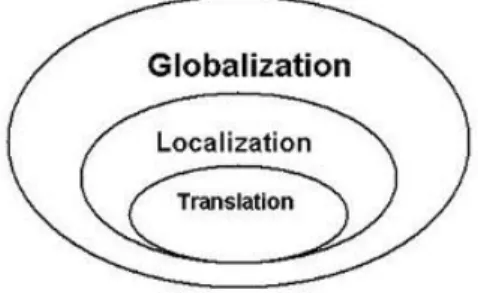
So, is translation part of localization, or vice versa?
The answer really depends on whom you ask. Software developers argue that translation is only one of the many modifications a program has to go through in order to be localized. Translation scholars, on the other hand, might argue that localization is only a fancy name for the act of adapting a text for a specific target readership, which is something translators have been doing for millennia.
Another answer might be found in the electronic tools that have been developed especially for localization. Apart from text editors, spellcheckers, translation memories and terminology management systems, which are common in translation programs, professional localization tools include functions to resize dialogue boxes, assign and check hotkeys to menus, edit and check programming code, manage non-textual resources (such as icons or sound files), calculate the complexity of a project, and replace program-ming code to make the program work on another platform. The result might still be a translation, but the work process clearly goes beyond traditional translating.
Software localization requires those specific tools. Without them, we would have something like Figure 3, which shows the programming code for a dialogue box. Translating in this format is extremely dangerous and time-consuming, since you can easily delete or modify code (instructions for the computer) by mistake. Before working in this way, you would need to learn to discriminate natural-language strings from code. Moreover, there are no spellcheckers or advanced text-editing tools available.
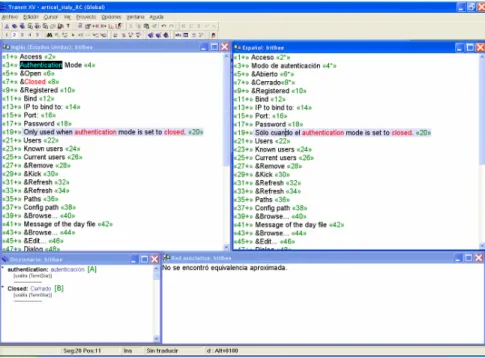
Are translation-memory tools any better? Figure 4 shows a screenshot of the Transit translation memory suite. Here we have the same file being translated, with source and target text, dictionary and memory database. Translators working with this environment cannot see or edit the code, so their duty is to translate text. Even if they have the ampersand symbol, which stands in front of the hotkey letter, it is the localization engineer who should test the allocation of hotkeys and perform all the tasks related to layout and function.
Figure 3. Translation of a resource file with NotePad
16 Technology and translation (pedagogical overview)
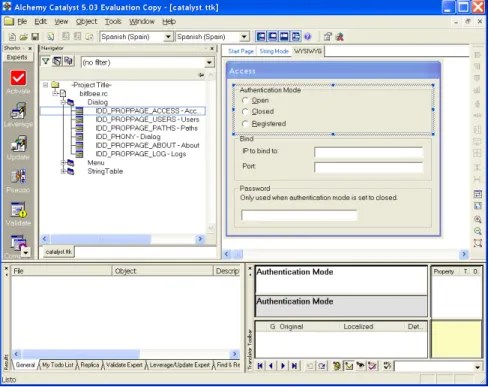
So what are the tools developed for localizing software? In Figure 5 we can see the same file being translated with Catalyst, which is specifically designed for this kind of work. This is perhaps like the translation memory, except that here we can see what the dialogue box looks like; we have its visual context. And just below the dialogue box we have the active segment (“Authentication Mode”) where we can type our translations and see immediately if the target text fits into the box. We can assign unique hotkey combinations to each function and resize the dialogues if we need to allocate more space for our translation.
Tasks become considerably easier when you get the right tool for the job.
Machine Translation
Machine translation (MT) is probably the translation technology with the most sway over the popular imagination. The first serious attempts to create MT systems date from the late 1940s, when United States and the USSR both funded projects to move rocket technology out of German, and then to spy on each other. It is often said that the initial expectations were very naïve, which would be why when the early projects were almost completely abandoned in the US following the negative ALPAC report in 1966.
However, the early approaches were based on quite sophisticated concepts of code-breaking, and there is little evidence that the aim was to produce high-quality output that would be of immediate use. Indeed, the main limitations of the day were on the capacity to store and retrieve huge amounts of lexical, morphological, syntactic and semantic information. The funding evaporated when the Cold War went through a relative thaw.
Several generations later, MT is readily available and relatively func-tional. The transfer-based Systran system can be used for free on several websites. Its many unhappy matches and almost complete inability to handle proper nouns can result in hours of fun for bored linguists or enthusiastic revision classes. However, the system is extremely useful for gist translations from languages you know nothing about. It allows users to identify the texts or fragments of interest, which they can then have translated by other means.
In other circumstances, MT systems produce high quality translations in very restricted contexts. This can be done by limiting the lexical and grammatical structures of the source text (controlled language) and fine-tuning the system to work only with a specific text type. A classic case is French-English weather reports in Canada, for which an MT system has been in continuous use since 1984. In other circumstances, a company may develop a highly standardized central language and fixed document templates, enabling MT to be used successfully in conjunction with controlled writing of content (in fact a form of internationalization) and careful revising of MT output (cf. Lockwood 2000, on the heavy machinery producer Caterpillar, where content is written in “Caterpillar English”). The Translation Service of the European Commission similarly uses its own version of Systran to give acceptable results on formulaic texts between cognate languages (especially from French to Italian or Spanish).
There are important technical differences between these examples. The Canadian weather reports and the use of EU Systran are based on correspondences between language pairs (a “transfer” architecture), whereas the use of controlled writing (as at Caterpillar) enables MT to go from one language to many languages at the same time (thanks to an “interlingua” architecture). From the translator’s perspective, however, the consequences are the same.
Machine translation systems are not replacing human mediators. This is first because the prime use of MT is only to locate the texts and fragments requiring human translation. Second, if MT output is to be used profession-ally, it requires human revision. And third, the future development of quality MT output requires serious attention to controlling writing of the input, which is an area that some translators may want to move into. Indeed, the better MT systems work (and current statistical models seem able to offer a better future), the more texts will be processed, and the more work will be created for human translators.
18 Technology and translation (pedagogical overview)
Whatever happens, do not let a client tell you that you have been re-placed by a machine. If they say that a text has already been translated automatically and you only have to correct the errors, look for another client. It will usually take you less time to translate from scratch rather than identity and correct the errors. And your quality will be higher.
Advantages and Disadvantages for Translators
Technology is not an option in today’s professional world; it is a necessity. Years ago one talked about Computer-Aided Translation (CAT). That now seems a redundancy. Virtually all translating is aided by computers. Further, the most revolutionary tools are quite probably the everyday ones that are not specific to translation: Internet search engines, spell checkers, search and replace functions, and revision tools have had a huge impact on all forms of written communication. On countless levels, the advantages presented by technology are so great that they cannot be refused. Translation memories perform the most repetitive tasks so that translators can concentrate on the most creative aspects of translation. The intelligent use of machine translation should mean that our best human efforts are focused where they are most needed. However, technology is not perfect, and translators must be very aware of those imperfections. Here, in closing, we offer a list of those aspects where critical awareness seems most needed.
Each new technology requires new investment, not just in purchasing tools but also in learning how to use them. In all cases, the investment you put in should be less than the benefits you expect to gain. This means, for example, that the kind of text corpora that linguists use in order to study language are generally not cost-beneficial tools when applied to professional translation. They address problems that are more easily solved with a quick web search, and the kinds of quantitative data bases they use have little to do with those developed by translation memory tools. Or again, there is little need to take a course in a particular translation-memory suite if you already know how to use a rival brand. All the products are similar in their underlying technology, and you should be able to find your own way from one to the other. As a general rule, inform yourself before buying anything or signing up for courses. Demonstration versions of all tools are usually available on the web for free, many of them with online tutorials, and translators’ forums can give you numerous pointers about the relative advantages and drawbacks of each tool.
Investment in a certain technology can be essential if you are to move from one segment of the translation market to another. The jump is usually made when a client or intermediary offers you work requiring knowledge of a certain tool. You then have to learn very fast, but you are at least sure that you have the right tool for the available job.
Even within large projects, the cost of technology tends to form a set of internal barriers. For example, in a localization project, the project managers (responsible for the overall organization) usually have very powerful, expensive tools with advanced project-management options. The language project managers (responsible for a specific version of the product) have tools that allow them to perform advanced processing, such as automatic terminology checking and the preparation of the packages they send to translators. At the end of the line, the translators have the cheapest and most restricted versions of the software, sometimes called “light” versions, with which they can only replace language strings and perform some basic editing and proofreading tasks. Since code is protected, only the people with the original source files and the powerful tools are able to edit the layout or the content of the source text. By limiting the functions of the tools assigned to each member of the workflow chain, technology has become one way to control the actions and responsibilities of translators.
All these barriers can, of course, be overcome. Translators can and do move into high-tech sectors; some do become project managers, marketing experts, or owners of companies. In general, the way to advance within the profession usually involves more conceptual control over technology, not less. Too often, the dominant industry workflows impose their own specific technologies and processes. Only when translators are critically aware of the available tools can they hope to be in control of their work.
References
Bédard, C. 2000. “Translation memory seeks sentence-oriented translator...”. Traduire 186. http://www.terminotix.com/eng/info/mem_1.htm. Visited 7 September 2005.
Esselink, Bert. 2000. A Practical Guide to Localization. Amsterdam and Philadelphia: John Benjamins.
Lockwood, Rose. 2000 “Machine Translation and Controlled Authoring at Caterpillar”. In Translating into Success. Cutting-edge strategies for going multilingual in a global age. Robert C. Sprung (ed.),
Amsterdam/Philadelphia: John Benjamins. 187-202.
Megale, Fabrizio. 2004. Diritto d’autore del traduttore. Napoli: Editoriale Scientifica.
BERT ESSELINK
Solution Architect, Lionbridge
Abstract. The evolution of the localization industry since the 1980s has been marked by a move from in-house localization to internationalization, along with marked changes in the nature of the tools used. However, the turn of the century has introduced a new view. The distinction between content and software is no longer clear, and typical software localization projects are being supplanted by new types of localization projects, focusing on programming and publishing. At the same time, open stan-dards allow translation vendors to focus on translation. Core translation skills and domain expertise thus now seem to be newly appreciated. This could bring together two worlds: software localization, with a strong focus on technical complexity for translators, and content localization, with a strong focus on technical simplicity for translators. The localiza-tion industry may now have to face new challenges in the future, and rapidly adapt its processes, quality standards and resourcing approach.*
Introduction
It seems like ancient history to me sometimes, but I entered the world of localization just over ten years ago. In 1993 I joined International Software Products in Amsterdam, a small and specialized localization vendor that still exists under the same name. I had recently graduated as a technical translator, using an article on the launch of Windows 3.1 as my thesis subject. The seemingly incompatible marriage of language and technology has intrigued me ever since. Still, this is the core characteristic of what today we have come to know as “localization”.
In a nutshell, localization revolves around combining language and technology to produce a product that can cross cultural and language barriers. No more, no less.
In this article, I will explore the fundamentals of localization: what it is, where it started, how it progressed, what it is today and what it may be
* A first version of this paper was first published in theGuide to Localization edited
by Multilingual Computing and Technology (2003). It is reproduced here with the kind permission of the author.
22 The Evolution of Localization
tomorrow. Against this historical background I will discuss developments in the localization services business, translation technology and general trends.
Where It All Started: The 1980s
Desktop computers were introduced in the 1980s, and computer technology slowly started to make its way to users who did not necessarily have a background in computer programming or engineering. The early 1980s also saw the first international ventures of US-based computer hardware and software firms. Sun Microsystems, for example, began operations in Europe in 1983, expanding to Asia and Australia in 1986. Microsoft had started international operations earlier, opening its first overseas sales office in Tokyo in November 1978 and beginning its expansion into Europe in 1979.
The shift of computer hardware and software use away from corporate or academic computing departments to “normal” users’ desks called for a shift in product features and functionality. Not only did desktop computer users now need software that would enable them to do their work more efficiently, but the software also had to reflect business processes in tune with local standards and habits, including local language. Word processors, for example, needed to support the input, processing and output of character sets in other languages, language-specific features such as hyphenation and spelling, and a user interface in the user’s local language. The same expectations applied to hardware. For example, in 1985 the Spanish government decreed that all computer keyboards sold in Spain should have the ñ key.
Internationalize to localize?
The international expansion of software and hardware developers automatically triggered the need to localize the products for international markets. Initially, software vendors dealt with this new challenge in many different ways. Some established in-house teams of translators and language engineers to build international support into their products. Others simply charged their international offices or distributors with the task of localizing the products. In both cases, the localization effort remained separated from the development of the original products. Development groups simply handed off the software code and source files for supporting documentation to those responsible for localization.
This separation of development and localization proved troublesome in many respects. Microsoft, for example, asked its then-distributor ASCII in Japan to localize Multiplan (predecessor of Excel) into Japanese. According to a Microsoft director responsible for localization at that time, “we’d finish the product, ship it in the United States, and then turn over the source code library to the folks in Japan, wish them luck and go on vacation”.
Not only was locating the translatable text embedded in the software source code quite difficult, but the requirement for additional language versions of the code made update and version management increasingly complex. Moreover, the localizers often had to return the products to the development teams to first build in support for localization or international computing standards. With these requests, the concept of internationalization was born.
Internationalization refers to the adaptation of products to support or enable localization for international markets. Key features of internationali-zation have always been the support of international natural language character sets, separation of locale-specific features such as translatable strings from the software code base and the addition of functionality or features specific to foreign markets. Without internationalization, localizing a product can be very challenging.
Outsourcing localization
Initially, many software publishers, such as Microsoft and Oracle, established in-house localization teams who had to adapt the products for key international markets. A large portion of this effort was obviously the translation of the software product itself and supporting documentation. US companies often decided to place the localization teams in their European headquarters, many of which were based in Ireland.
Even though it seems that localization vendors are now moving activi-ties to many locations across the globe, Ireland established itself as the leader in the localization industry during the 1990s. Over the past 10 to 20 years, the Industrial Development Authority (IDA), a semi-governmental body, had the mandate to move Ireland forward industrially by attracting foreign investment. In the 1980s, a high concentration of manufacturing companies started in Ireland, including some high-tech companies. The Irish government provided what it called turnkey factories, where a large multinational was offered a certain amount of government subsidy per employee, plus facilities, grants and a corporate tax rate of 10% as an incentive to invest in Ireland.
After some failed investments and the increased competition from manufacturing in cheap labor markets, the Irish government switched its focus to research and development and the high-tech, blue-chip companies, that is, a more long-term strategy. Most large software and Web companies now have a presence in Ireland, with the bulk of their localization being managed from there, including Microsoft, Oracle, Lotus Development, Visio International, Sun Microsystems, Siebel and FileNET.
The key benefits they offered these companies included a certain amount of money per employee, a 10% corporate tax rate and exemption from value-added tax (VAT). All products, including software, exported to
24 The Evolution of Localization
Europe are exempt from VAT in Ireland. In addition, competitive labor costs, with social costs at approximately 12% to 15% per employee, mean that it is cheaper to employ people in Ireland than in many of the European Union countries. Compared to the United States, development costs are still lower in Ireland. And Ireland offered a young, well-educated, motivated work force. Approximately 50% of the population was under 25 at the beginning of the 1990s.
The Irish government has invested a great deal of subsidy in education. There now is a strong push to offer additional computer courses to cope with the growing demand for IT and localization staff. This, combined with the fact that Ireland is an English-speaking nation on the edge of Europe that serves as a gateway to Europe and the Euro zone, made many US-based companies decide to base their European headquarters or distribution centers in Dublin.
Translators, localization engineers and project managers were recruited from all over Europe to be trained and employed as localizers in Ireland. For most translators, it was their first introduction not only to computers, but also to the concepts of software localization.
Although Dublin in the late 1980s and early 1990s was a very attractive place for localization experts, with many job opportunities and a strong social network, software publishers began to doubt the validity of the in-house localization model. Not only did new recruits face a steep training curve, but the rapid growth of products sold internationally and the content explosion also created large localization departments that were difficult to sustain. Business fluctuations—very busy just before new product releases, very quiet after—contributed to this problem, as did the difficulty of keeping translators in another country for a long time because localization really wasn’t very exciting (imagine two months of translating on-line help files) and not always well paid.
Software publishers increasingly realized that localization was not part of their core business and should ideally be outsourced to external service providers.
One of the first companies to realize there was a service offering to be built around this need was INK, a European translation services network established in 1980. INK became one of the first companies in the world to offer outsourced localization services. In addition to translation into all languages required by software publishers, this service included localization engineering and desktop publishing and, most importantly, the project management of these multilingual localization projects.
Translation technology
INK was also one of the first companies to create desktop translation support tools, called the INK TextTools, the first technology commercially
developed to support translators. As a historical note, the present company Lionbridge was “spun off from Stream International, which itself had emerged from R.R. Donnelley’s acquisition of INK,” said Lionbridge CEO Rory Cowan in 1997.
In 1987, a German translation company called TRADOS was reselling the INK TextTools and a year later released TED, the Translation Editor plug-in for TextTools. Shortly thereafter, TRADOS released the first version of its Translator’s Workbench translation memory (TM) product. TRADOS continued to establish itself as the industry leader in TM technology throughout the 1990s, boosted by Microsoft taking a 20% stake in 1997.
Initially, TM technology could only deal with text files. Hardly any technology was commercially available for the localization of software user interfaces. Most software publishers built proprietary tools, which were tailored to their own source code format and standards and used by their internal teams. Development of these tools was often quite ad hoc and unstructured. As a result, early generations of software localization tools were usually quite buggy and unreliable.
1990s: An Industry Established
Throughout the 1990s, a large number of localization service providers were born, many of which were little more than rebranded translation firms. For the IT industry, the sky was the limit, the globe was its marketplace, and the localization industry followed closely in its footsteps.
After the initial pioneering efforts of translation companies adapting to the new paradigm of localization, the 1990s clearly saw the establishment of a true localization services industry. Software and hardware publishers increasingly outsourced translation and localization tasks to focus on their core competencies. The need for outsourced full-service localization suppliers was growing rapidly.
Within a localization services company, localization teams would typically be coordinated by a project manager overseeing schedules and budgets, a linguist to monitor any linguistic issues, an engineer to compile and test localized software and on-line help and a desktop publisher to produce translated printed or on-line manuals. A typical localization project consisted—and often still consists—of a software component, an on-line help component and some printed materials such as a getting started guide.
To localize a software application, localization engineers receive a copy of the software build environment, extract the resource files with translatable text, prepare translation kits and support the translators during their work. Post-translation, the engineers merge the translated files with the build environments and compile localized copies of the software application. This always requires some level of bug-fixing, user interface resizing and testing. A similar approach is taken to produce localized versions of on-line help
26 The Evolution of Localization
systems. The source files, mostly RTF or HTML documents, are translated, and a compilation and testing phase follows. Most on-line help systems and printed documents contain screen captures of the software, so including pictures of the localized software application can only be done once the application has been fully translated, built and tested. These dependencies and many others have always made the management of localization projects quite a challenge.
Consolidation and outsourcing
One of the developments that characterized the localization industry throughout the 1990s was consolidation. Localization service providers merged with others in order to “eat the competition” or to add service offerings, to reach a wider geographical spread—or they could merge simply because they had some money to burn. The list of companies that were acquired seems endless. From at least a dozen large multilanguage vendors in localization, we are currently down to a handful, with the main players being Bowne Global Solutions, Lionbridge and SDL International.
Consolidation also manifested itself in the emergence of a relatively standard production outsourcing framework. The larger multilanguage vendors (MLVs) took on multilanguage, multiservice projects, outsourcing the core translation services to single-language vendors (SLVs), one in each target country. SLVs normally work into one target language only, from one or more source languages, and either work with on-site translators or contractors.
Throughout the 1990s the localization industry further professionalized, including industry organizations, conferences, publications, academic interest and generally increased visibility. Obviously, the increasing number of companies jumping on the localization bandwagon resulted in fierce competition and increased pressure on pricing. As a direct result, benefits and cost savings from the use of TMs, for example, quickly shifted from the translator’s desk to the localization vendor and eventually to the customer. Today, no localization quote is sent out without a detailed breakdown of full matches, fuzzy matches and repetition discounts through the use of TM database technology.
From TM to GMS
TM technology plays a dominant role in localization for various reasons. First of all, most software companies aim for “simship” (simultaneous release) of all language versions of their products. This means that translation of the software product and supporting on-line documentation has to start while the English product is still under development. Translating subsequent development updates of a product is then greatly simplified by
the use of TM technology. Moreover, after general release, most software products are updated at least once a year. These updates usually just add features onto a stable base platform, making it all the more important to be able to reuse—or leverage—previously produced content and translations.
Another type of translation technology commonly used in localization projects is software user interface localization tools. These tools are used to translate software resource files or even binary files and enable the localizer to not only translate but also resize and test the user interface. Examples of localization tools are Alchemy’s CATALYST and PASS Engineering’s PASSOLO.
By the end of the 1990s the Internet had changed many things in local-ization, such as the introduction of globalization management systems (GMS). Riding the dot-com wave, various companies offered revolutionary new ways of managing translation and localization projects, storing and publishing multilingual content and fully automating localization processes. Although this new technology had some impact on existing outsourcing models and processes in the localization industry, it became rapidly clear that although a GMS could be useful for content globalization programs (for example multilingual Web sites), the world of software localization still required a lot of “traditional” expertise and dedicated teamwork.
With Web sites containing more and more software functionality and software applications increasingly deploying a Web interface, we can no longer make a clear distinction between software and content when we discuss localization. The traditional definition in which localization only refers to software applications and supporting content is no longer valid. Today, even producing a multilingual version of an on-line support system, e-business portal or knowledge base could be defined as a localization project.
In other words, the turn of the century also introduced a new view towards localization and translation.
What Lies Ahead
So, what is so different now in localization compared to what we got used to during the 1990s?
Not as much as you might expect. After all, many localization projects fit the profile that we have grown accustomed to over the past years: Windows-based desktop software products with some translatable resource files, basic engineering and compilation requirements, HTML files to use for the online help and possibly some product collateral or manuals to be printed or published in PDF format.
Even though these typical software localization projects may still be the bulk of the work for many localization service providers, they are quickly being supplanted by new types of localization projects where the focus is on
28 The Evolution of Localization
programming and publishing environments such as XML, Java and .NET. Also, content translation projects are now often considered as localization projects simply because of the complex environments in which the content is authored, managed, stored and published. Most of today’s Web sites contain so much scripting and software functionality that Web localization requires a wide range of engineering skills. For Web sites based on content manage-ment systems (CMSs), the story gets even more complex: when content is continuously updated and published in multiple languages, the translation process must be truly integrated with the overall content lifecycle.
Apart from a renewed focus on content localization, we have also seen various other important developments over the past few years, such as the growing importance of open standards. Examples of open standards in the localization industry are Translation Memory eXchange (TMX) and XML Localization Interchange File Format (XLIFF). Many TM tools support TMX for the exchange of TM databases between different tools, and XLIFF is being adopted by companies such as Sun Microsystems and Oracle. A Sun Microsystems manager recently said, “XLIFF allows our interaction with translation vendors to be much more efficient. There is less need for translators to become engineering experts in the many different source file formats that are currently being used—SGML, HTML, MIF, RTF and the numerous software message file formats. Instead, XLIFF allows translation vendors to concentrate on their core competency: translation of words.” Back to basics?
Does the popularity of XLIFF signal a trend? Throughout the 1990s, the localization industry tried to turn translators into semi-engineers. Is it now expecting them to just translate again? It certainly looks that way. For the past decades, content authors and translators may simply have been “distracted” by the possibilities and the features the new technologies had to offer—all those file formats, all those compilers, all these new tools, all the output formats, all those cool graphics and layout features! If content management fulfills all its promises, content creators may in a few years be writing text in a browser template with fields predefined by the CMS, and translators may all be working in a TM tool interface that only shows them long lists of translatable segments, possibly partly pretranslated. We have come full circle: authors author and translators translate.
Is this a bad thing? Not necessarily. Throughout the 1990s, one of the biggest “linguistic” challenges was to maintain consistency with “the Microsoft glossaries,” but today we see a new appreciation of all the core translation skills and domain expertise that we often considered no longer critical in localization. A localization service provider translating an ERP software package or an SAP support document had better make sure to use translators who know these domains inside out and should not rely on
translators just looking at some glossaries. Localization companies now need to face these new challenges and higher customer demands.
New Kids on the Block
The year 2002 included one of the largest mergers in the history of localization, as Bowne Global Solutions acquired Berlitz GlobalNET to become the largest localization service provider. Various new localization organizations were launched. And on the technology side, the main developments can be seen in server-based TM systems. TRADOS, for example, recently released its TM Server product, a new technology that offers centralized TM for client server environments. Telelingua also introduced T-Remote Memory, a distributed computing architecture using Web services.
Software user interface localization tools now all offer support for Microsoft’s .NET programming environment. According to a white paper released by Alchemy Software, “while fundamental approaches to application design remain somewhat consistent with the approach traditionally chosen by desktop application developers, the localization service provider community faces a daunting challenge of upskilling and retooling their localization teams while embracing this new Microsoft technology. Coming to grips with the new open standards and learning the nuances of translating NET technology will present both a financial and an educational challenge.”
Based on this comment and other signals from experts in the field, it looks likely that while translators will be able and expected to increasingly focus on their linguistic tasks in localization, the bar of technical complexity will be raised considerably as well. This applies not just to software localization, but also to the wider context of content localization.
So the question remains, what have we learned over the past 20 years of localization and do the lessons that we have learned still apply to today’s new realities of content localization? It almost seems like two worlds are now colliding: software localization with a strong focus on technical skills and technical complexity for translators on the one hand, and content localization with a strong focus on linguistic skills and technical simplicity for translators on the other. With the Internet increasingly merging platform and content, the localization industry will have to rapidly adapt its processes, quality standards and resourcing approach to these new requirements.
TIM ALTANERO
Department of Foreign Languages, Austin Community College, Texas, United States
Abstract. There are now many academic institutions, particularly in North America and Europe, offering programs and courses on localiza-tion. All of them are housed in centers for translation in which the faculty is shared with traditional departments. This situation can be beneficial, as it creates new research opportunities in localization and offers custom-ized training and services to the industry. Conversely, demands from industry may also affect the make-up of the curricula, and more candi-dates are now being sought to teach for the profession or business. This, however, entails a number of problems: a lack of publication outlets for localization scholars, the need to establish formalized departments of localization, and inadequate academic openings in the field.
Slowly but surely, academia is catching on to localization. From practically no programs in 1995, there are now many institutions offering courses on localization, primarily in North America and Europe. As with any new type of course or program, finding a home in the academy is difficult, especially for subjects that cross the rigid disciplinary lines that are the hallmark of colleges and universities. This article examines some of the ways in which localization is entering the academy as a field of study and career option.
The University of Leeds in the United Kingdom offers a Master of Arts in Applied Translation Studies, housed in a Centre for Translation. In Ohio, on the other side of the Atlantic, Kent State University has a similar structure. Its Institute of Applied Linguistics offers a Master of Arts program in Spanish, German or French, with a concentration in translation. Several courses in that program also deal with localization. At New York University, a graduate-level course called Terminology: Theory and Practice is housed in the Center for Foreign Languages and Translation and “explores […] computer-based systems for terminology management”. Students at this university can earn a Master of Science in Translation.
These post-graduate level programs, found in “centers” or “institutes” of Translation or Applied Linguistics, are a relatively new species in higher education. New fields, especially interdisciplinary ones, are often housed in centers where academics from various departments share teaching duties. Fields such as Area and Ethnic Studies and Translation, representing a broad