www.elsevier.com / locate / cogsys
Predicting the effects of cellular-phone dialing on driver
performance
Action editors: Wayne Gray and Christian Schunn
a ,
*
bDario D. Salvucci
, Kristen L. Macuga
aDepartment of Mathematics and Computer Science, Drexel University, 3141 Chestnut Street, Philadelphia, PA 19104, USA b
University of California, Santa Barbara, CA, USA Received 1 March 2001; accepted 1 September 2001
Abstract
Legislators, journalists, and researchers alike have recently directed a great deal of attention to the effects of cellular telephone (‘cell phone’) use on driver behavior and performance. This paper demonstrates how cognitive modeling can aid in understanding these effects by predicting the impact of cell-phone dialing in a naturalistic driving task. We developed models of four methods of cell-phone dialing and integrated these models with an existing driver model of steering and speed control. By running this integrated model, we generated a priori predictions for how each dialing method affects the accuracy of steering and speed control with respect to an accelerating and braking lead vehicle. The model predicted that the largest effects on driver performance arose for dialing methods with high visual demand rather than methods with long dialing times. We validated several of the model’s predictions with an empirical study in a fixed-based driving simulator.
2002 Elsevier Science B.V. All rights reserved.
Keywords: Driving; Cellular phones; Cognitive modeling; Cognitive architectures
1. Introduction support (e.g. navigation aids) and ‘infotainment’ (e.g. news and email). In particular, cellular telephones (or Driving is a highly complex skill that requires the ‘cell phones’) have received a great deal of attention continual integration of interdependent perceptual, related to the potentially distracting effects of cell-motor, and cognitive processes. Nevertheless, driving phone use while driving (e.g. Alm & Nilsson, 1995; becomes routine enough for many of us that we can McKnight & McKnight, 1993; Reed & Green, 1999; comfortably perform minor secondary tasks while Serafin, Wen, Paelke, & Green, 1993). While it may driving — for instance, turning on headlights or be convenient to have devices such as cell phones adjusting the defogger. However, technological ad- available for driver use, safety is clearly the primary vances now enable the incorporation of increasingly concern, and thus it is essential that we understand sophisticated devices in the vehicle for both driver the impact that in-car devices may have on driver
behavior and performance.
This paper demonstrates how cognitive modeling *Corresponding author. Tel.:11-215-895-2674.
E-mail address: [email protected] (D.D. Salvucci). can aid in this effort by predicting the effects of 1389-0417 / 02 / $ – see front matter 2002 Elsevier Science B.V. All rights reserved.
96 D.D. Salvucci, K.L. Macuga / Cognitive Systems Research 3 (2002) 95 –102
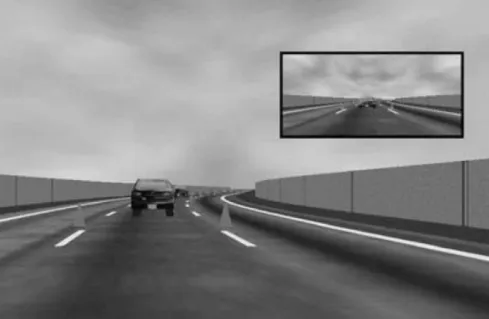
secondary devices on driver performance. In par- and the driving would be as realistic and natural as ticular, we focus on the task of cell-phone dialing possible. However, for the driving task, potential and the impact that dialing has on driving. To this safety concerns as well as legal restrictions due to end, we utilize an integrated modeling approach that driver distraction precluded the use of an actual centers on combining cognitive models of the pri- vehicle on real roadways. Thus, we chose a task in mary and secondary tasks into a single integrated which drivers navigated a naturalistic roadway in our model (Salvucci, 2001; see also Aasman, 1995). We medium fidelity driving simulator (Beusmans & begin with a task analysis of cell-phone dialing for Rensink, 1995). The simulated environment was a four distinct dialing methods and describe straight- three-lane highway in a construction zone with forward models for these methods implemented in driving restricted to the center lane, as shown in Fig. the ACT-R cognitive architecture (Anderson & 1. The road alternated between segments of straight Lebiere, 1998). We then combine the dialing models roadway and segments of various curvatures, all of with an existing ACT-R model of driver behavior which could be negotiated comfortably at highway (Salvucci, Boer, & Liu, in press), producing an speeds without braking. The driver followed three integrated model that can interleave dialing and cars and was tailed by another car, which was visible driving. Finally, we run the integrated model to in the simulated rear-view mirror. The speed of the generate behavioral protocols, which in turn embody lead car varied from 5 to 35 m / s (11–78 mph) a priori predictions about the effects of the dialing on according to a sum of three sinusoids that resulted in driving (and vice-versa). an apparently random pattern. The rear car followed This study improves and extends an initial model- at distance of 9–21 m (29–68 ft) also varying as the ing study of cell-phone dialing and driving (Salvucci, sum of three sinusoids. Cones on either side of the 2001) in two important ways. First, the previous center lane prevented drivers from passing other cars study used a simplified cell-phone interface with a and emphasized the need for maintaining a central non-functional phone keypad and examined four lane position. Thus, the cell-phone dialing scenario invented dialing methods based on this interface. In could be thought of in terms of the driver being contrast, this study uses a commercially available caught up in a construction zone and needing to call cell phone and examines four dialing methods built several people to notify them of a delay.
into this phone. Second, the previous study involved For the dialing task, we employed a commercially a simpler task in which drivers dialed the phone available cell phone (Samsung SCH-3500 with
while steering down a single-lane straight road at a Sprint PCS ), shown in Fig. 2. This phone (like constant speed. In contrast, this study involves a many similar phones) allows for multiple methods of more complex and naturalistic environment in which dialing. In order to examine differential effects of drivers dial while navigating down a curvy lane in a various dialing methods, we chose four of the construction zone and following lead cars at highly phone’s built-in methods, which can be described as varying speeds. These two aspects of the new study follows:
provide increased realism and allow us to predict and • Manual: dial the phone number and press Talk
examine the effects of dialing not only on driver • Speed: dial the party’s single-digit ‘speed number’
steering but also on driver speed control during car and press Talk
following in a naturalistic task. We should note that • Menu: press the up arrow to access menu, scroll
while conversation on cell phones may also impact down to the desired party with the down arrow, driver behavior, this study focuses specifically on the and press Talk
dialing component of cell-phone use. • Voice: press and hold Talk, say the party’s name
when prompted, and wait for confirmation Table 1 shows examples of using each of these 2. The driving and dialing task dialing methods to make a call. Note that two of the methods, speed and menu dialing, require that num-In studying the effects of cell-phone dialing on bers be added to an internal phone book and driving, we desired a task in which both the dialing associated with a unique ‘speed number’. The four
Fig. 1. Driving task environment, shown as a sample scene from the driving simulator with construction cones, lead cars, and rear-view mirror.
implemented the models in the ACT-R cognitive architecture (Anderson & Lebiere, 1998). ACT-R is a production system architecture based on condition– action rules that execute the specified actions when the specified conditions are met. Like most cognitive architectures, ACT-R provides a rigorous framework for cognitive models as well as a set of built-in parameters and constraints on cognition and per-ceptual–motor behavior (when using ACT-R / PM: Byrne & Anderson, 1998); the parameters facilitate a priori predictions about behavior, while the con-straints facilitate more psychologically (and neurally) plausible models. In addition, the architecture allows Fig. 2. Cell phone and keypad.
for straightforward integration of models of multiple tasks: generally speaking, the modeler can combine methods thus serve well to illustrate our modeling the models’ rule sets and modify the rules to approach for comparing effects of different dialing interleave the multiple tasks (see Salvucci, 2001). All methods on driver performance. these qualities of the architecture are essential to our ability to integrate models of dialing and driving to predict the effects of each task on the other. 3. The integrated dialing-driving model
3.1. Dialing models The prediction of effects of dialing on driving
centers on an integrated cognitive model that com- We first consider the development of the cognitive bines individual models for each task. To facilitate models for dialing the cell phone using each of the the development and integration of these models, we four methods. To this end we employed a
straight-98 D.D. Salvucci, K.L. Macuga / Cognitive Systems Research 3 (2002) 95 –102 Table 1
Cell-phone dialing methods with examples and task models
Method Manual Speed Menu Voice
Sample Press 8, 6, 7, 5, 3, 0, 9 Press 3 Pressm(display menu Press and hold Talk call Press Talk Press Talk with first item selected) Hear prompt
Press.,.(scroll down Say ‘Jenny’ to third item) Hear ‘Jenny’ Press Talk Hear ‘Connecting . . . ’ Model Recall phone number Recall speed number Recall speed number Move hand to phone⇑ outline Move hand to phone⇑ Move hand to phone⇑ Move hand to phone⇑ Attend to phone
Attend to phone Attend to phone Attend to phone Press Talk⇑ Recall number block Press speed number⇑ Pressm⇑ Move hand to wheel⇑ Press digit Attend to phone Attend to phone Confirm prompt (repeat until last digit) Press Talk⇑ Press. Say name⇑ Press last digit⇑ Move hand to wheel⇑ (repeat until speed Confirm name⇑ (repeat until last block) number is reached)⇑ Confirm connection⇑
Attend to phone Attend to phone
Press Talk⇑ Press Talk⇑
Move hand to wheel⇑ Move hand to wheel⇑
Sample calls are based on calling ‘Jenny’ at the number 867-5309 with speed number 3. The model outlines include sequences of steps in which each step is implemented in the model as an ACT-R production rule. Steps marked with⇑indicate that the model cedes control to the driving task after executing the step.
forward task analysis and implemented a simple, type by feel without looking. However, these models minimal model for each method based on this nicely represent drivers who are familiar with using analysis. The procedure required by the cell phone cell phones but are beginners or intermediates at highly constrains the model in that it specifies the using the phone while driving.
sequence of keypresses needed to dial. However, the model must also incorporate the cognitive and
perceptual processes needed to execute the proce- 3.2. Driving model dure.
Table 1 includes an outline of the dialing models To model driver behavior, we employed an exist-for each method. We employed a few simple rules to ing ACT-R model that drives in naturalistic simu-augment the basic procedures with cognitive and lated highway environments, including multi-lane perceptual processes. First, we assumed that drivers highways with other vehicle traffic (Salvucci et al., look at the phone to guide their keypresses and that in press). In essence, this model controls steering and they group these keypresses in small blocks to speed based on two salient visual features of the minimize the time during which the eyes are off the roadway: the ‘near point’ centered immediately in road. Second, we assumed that for the manual front of the vehicle, which guides lane positioning; condition, drivers chunk their keying of the seven- and the ‘far point’ — either a distant roadway point digit number as a sequence of three, two, and two or a lead vehicle — which guides prediction and digits, for the purposes of keeping working memory response to the upcoming road. These features are load low in addition to minimizing off-road gaze encoded and control is updated through an aug-time. Third, we assume that drivers move their right mented version of ACT-R’s perceptual–motor mech-hand to the phone just before the first keypress and anisms (ACT-R / PM: Byrne & Anderson, 1998). The move back to the steering wheel just after the final model in the initial study (Salvucci, 2001) included keypress. Of course, these assumptions may not hold and tested only the steering component of the model; for all drivers; for instance, drivers very familiar this study includes and tests both the steering and with dialing on this particular phone may be able to speed control components of the model, allowing us
to examine for similar and / or parallel effects across for a prompt — should cede control to the driver
modalities. model. The exception to this rule arises in the
Although space constraints here preclude a full perceptual processes: because the dialing models are description of the driver model, we should note two required to look at the phone during keypresses (by important aspects of the model that are critical to this assumption), they must wait for the eyes to reach the study. First, because of its implementation in the phone and then execute a short block of keypresses ACT-R architecture, the model has very limited before ceding control. The determination of these parallelism (in its perceptual–motor modules) and blocks was performed by task analysis; for instance, thus must encode the visual scene and update control for menu dialing, we assumed that drivers press the in a sequential fashion. When the model performs down arrow quickly in succession to scroll down to secondary tasks, its processing for these tasks takes the desired party, and that they maintain their gaze away from processing of the primary driving task, on the phone for both keypresses and monitoring the and thus the model cannot update control as fre- phone display. The steps after which the dialing quently. Second, the model generates time-stamped models cede control to driving are indicated in Table behavioral protocols through its perceptual–motor 1 with the symbol ⇑.
modules, including both vehicle control and eye- One final concern for the integrated model is the movement data. This aspect facilitates straightfor- setting of parameter values. Almost all parameter ward comparison between model and human be- values in the integrated model were ported directly havior for effects of cell-phone dialing on driving from the integrated model in the initial study (Sal-using the same standard metrics, as discussed in the vucci, 2001). We changed the value of one
parame-next section. ter, the desired following time headway, from 1 to 2
s to better represent how drivers fall back from a
3.3. Integrated model lead car when they expect a high workload (i.e.
dialing the phone). We also assumed a 1-s duration As mentioned earlier, the integration of the dialing for the speech signal representing the dialed party’s and driver models is accomplished by combining the name for the voice dialing method.
rule sets and modifying them slightly such that the integrated model interleaves both tasks. The
inte-grated model in this study was formed in this 4. Model simulation and validation straightforward manner, just as the integrated model
in the initial study (Salvucci, 2001). Briefly, the Given the integrated model, we generated be-driver model decides on each control cycle whether havioral protocols and examined the model’s a priori it can safely perform a secondary task for a short predictions about the effects of dialing on driving. In time; this decision depends on several aspects of the addition, we collected analogous protocols from environment, such as stability of the near and far human drivers performing the dialing–driving task in points, lane position, and time headway. If the model a fixed-base driving simulator. This section describes determines that the car is stable, it passes control to the collection of these data and the comparison and the dialing model. After some incremental process- validation of the model’s predictions to the human ing (described below), the dialing model passes data.
control back to driving and the driver model again
handles the primary task. 4.1. Model simulations
The primary difficulty of integration arises in
determining when the dialing model should cede The model was given the simulator driving task control back to the driver model. As in the initial (see Fig. 1) starting behind the lead car at a full stop. study, we determined these points through task After 1 min of driving to accelerate to highway analysis and a simple heuristic: any step that would speed, the model was made to dial the cell phone block and wait for some process to complete — for using one of the four methods. When dialing was instance, moving the hand to the phone or listening completed, the model drove normally for 20 s until
100 D.D. Salvucci, K.L. Macuga / Cognitive Systems Research 3 (2002) 95 –102
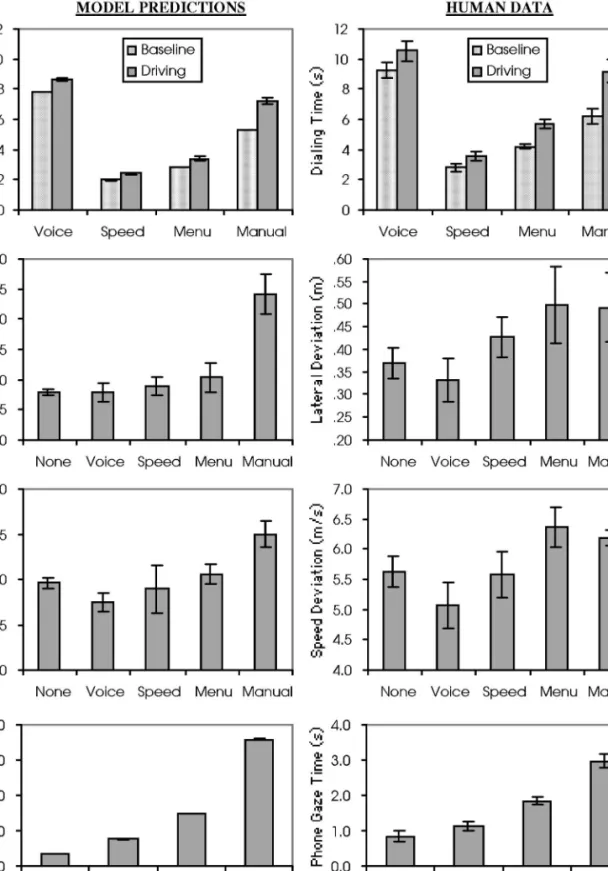
again made to dial the phone. This continued at 20-s that voice and manual dialing require the most time intervals until the model had dialed 8 times using while speed and menu dialing require the least. each of the four dialing methods for a total of 32 Dialing times increase approximately half a second trials in a driving session. We ran a total of 8 model to 3 s while driving. These predictions, which arise sessions. Separately, we ran another 8 sessions in primarily from ACT-R’s perceptual–motor parame-which the model simply dialed the phone without ters and the specification of the models from task driving, thus giving us baseline data on the model’s analysis, correspond very well to the human data,
dialing times. R.0.99.
The predictions for lateral deviation and speed 4.2. Empirical study deviation indicate the effects of dialing on driver performance. The model predicts increasing devia-Seven licensed subjects between the ages of 18– tions for the methods in the order of voice, speed, 40 with at least 2 years of driving experience menu, and manual dialing. For both measures, participated in the experiment. Subjects each per- manual dialing results in deviations much greater formed one session of the driving task in the Nissan than any of the other methods. Compared to the Cambridge Basic Research driving simulator (Beus- human data, we see a similar overall pattern with mans & Rensink, 1995). The phone (with headset) lower deviations for voice and speed dialing and was mounted on the center console positioned just to higher deviations for manual dialing. However, the right of the steering wheel, so that the subject human drivers exhibited similar deviations for menu could dial without holding the phone. Before driving, and manual dialing. We suspect that the cognitive subjects listed four regularly-dialed phone numbers time required for human drivers to retrieve the speed and practiced dialing these numbers with each of the number as needed for menu and speed dialing was four methods. Subjects then completed a driving larger than the model predicted, and thus the model session completely analogous to that for the model: underpredicted the performance effects in these after an initial one minute, the experimenter asked conditions. In addition, the magnitudes of the model the subject to dial the phone using a particular predictions are approximately half those for the method (in a blocked manner, such that all calls human drivers (note the different graph scales); using one method occurred consecutively). The data however, it should be noted that effects in driving thus comprised 32 dialing trials (8 trials per method) simulators are commonly larger than those in real-per subject. Collected data included vehicle control world field studies (Reed & Green, 1999). In any data as well as eye-movement data using an IScan case, the model seems to capture the basic rank-order (Burlington, MA) head-mounted eye tracker. In effects of the various dialing methods, R50.65 for addition, prior to and following the driving session, lateral deviation, R50.75 for speed deviation. baseline dialing time data were collected with sub- The model also predicts the mean total time of jects dialing without driving. gazes to the phone per dialing trial. While these predictions are related to our task analysis in
de-4.3. Results termining the frequency of phone gazes, they do
incorporate emergent predictions of gaze durations Fig. 3 shows the results for both the model and illustrate how the dialing methods differ with simulation and the human drivers. The results in- respect to visual demands. The model and human clude analysis along four measures: dialing time, or data correspond well, R.0.99.
time to complete dialing either with driving or Taken together, the model predictions suggest that without driving (‘baseline’); lateral deviation, or total dialing time does not seem to be a good RMS error of the vehicle’s lane position with respect indicator of the effects of a given dialing method on to the lane center; speed deviation, or RMS error of driver performance (as measured by lateral and speed the vehicle’s speed with respect to the speed of the deviations): although voice dialing required the most lead vehicle; and gazes to the phone. time, it produced the smallest deviations, while two The model’s predictions for dialing time indicate faster methods, speed and menu dialing, produced
Fig. 3. Results for the model simulations (left) and human drivers (right) for the four analyzed measures: dialing time, lateral (lane) deviation, speed deviation, and gaze time at phone per dialing trial. Error bars for the human data represent standard errors of subject means; bars for the model predictions represent standard errors over simulation run means. Note that some adjacent graphs are plotted on different scales to best display the overall patterns.
102 D.D. Salvucci, K.L. Macuga / Cognitive Systems Research 3 (2002) 95 –102 larger deviations. Instead, visual demand as mea- References
sured by phone gazes does seem to be a good
indicator of the effects of a method on driver Aasman, J. (1995). Modelling driver behaviour in Soar.
Leidschendam, The Netherlands: KPN Research. performance: the methods with the least visual
Alm, H., & & Nilsson, L. (1995). The effects of a mobile demand resulted in the smallest deviations and
vice-telephone task on driver behaviour in a car following situation. versa. These predictions are confirmed by the empiri- Accident Analysis& Prevention, 27, 707–715.
cal data. Of course, this does not mean that visual Anderson, J. R., & Lebiere, C. (1998). The atomic components of demand is the only contributor to driver distraction thought. Hillsdale, NJ: Lawrence Erlbaum.
Beusmans, J., & Rensink, R. (Eds.), (1995). Cambridge Basic — for instance, conversation and conversation-like
Research1995 annual report, Technical report no. CBR-TR-tasks seem also to affect driver behavior (see Serafin
95-7. Cambridge, MA: Nissan CBR.
et al., 1993, for a review). Byrne, M. D., & Anderson, J. R. (1998). Perception and action. In Anderson, J. R., & Lebiere, C. (Eds.), The atomic components
of thought. Hillsdale, NJ: Lawrence Erlbaum, pp. 167–200.
Card, S., Moran, T., & Newell, A. (1983). The psychology of
5. Conclusions
human –computer interaction. Hillsdale, NJ: Lawrence
Er-lbaum.
We have demonstrated that the integrated model McKnight, A. J., & & McKnight, A. S. (1993). The effect of approach helps to predict and evaluate the effects of cellular phone use upon driver attention. Accident Analysis& cell-phone dialing on driver performance. However, Prevention,25, 259–265.
Reed, M. P., & & Green, P. A. (1999). Comparison of driving the approach can be generalized to assess arbitrary
performance on-road and in a low-cost simulator using a on-board interfaces such as navigation devices,
cli-concurrent telephone dialing task. Ergonomics,42, 1015–1037. mate controls, and ‘infotainment’ systems. Given an Salvucci, D. D. (2001). Predicting the effects of in-car interfaces arbitrary interface, a straightforward task analysis on driver behavior using a cognitive architecture. In Human can be performed to develop new models of behavior factors in computing systems: CHI 2001 conference
proceed-ings. New York: ACM Press, pp. 120–127.
for the interface, as is common with modeling
Salvucci, D. D., Boer, E. R., & Liu, A. (2001). Toward an frameworks such as GOMS (Card, Moran, &
integrated model of driver behavior in a cognitive architecture. Newell, 1983). By integrating these models with the Transportation Research Record (pp. 120–127).
driver model, developers can predict and compare Serafin, C., Wen, C., Paelke, G., & Green, P. (1993). Development the effects of different interfaces and narrow down and human factors tests of car phones (UMTRI-93-17). Ann
Arbor, MI: UMTRI. the number of interfaces to analyze more rigorously
through prototyping and field testing. We hope that the integrated model approach can thus facilitate the development and testing of safer, less distracting on-board systems and devices.
Acknowledgements
This work was done primarily at Nissan Cam-bridge Basic Research in CamCam-bridge, MA.