Formulary and Prescribing Guidelines
1.1 Introduction
This guidance should be considered as part of a stepped care approach in the management of depressive disorders. Antidepressants are not routinely recommended for persistent sub-threshold depressive symptoms or mild depression but can be considered in these categories where there is a past history of moderate or severe depression, initial presentation of sub-threshold depressive symptoms for at least 2 years, and persistence of either mild or sub-threshold depression after other interventions1 have failed. The most current NICE guidance should be consulted wherever possible to obtain the most up to date information.
For individuals with moderate or severe depression, a combination of antidepressant medication and a high intensity psychological intervention (CBT or IPT) is recommended. When depression is accompanied by symptoms of anxiety, usually treat the depression first. If the person has an anxiety disorder and co-morbid depression or depressive symptoms, consider treating the anxiety first. Also consider offering advice on sleep hygiene, by way of establishing regular sleep and wake times; avoiding excess eating, avoiding smoking and drinking alcohol before sleep; and taking regular physical exercise if possible.
Detailed information on the treatment of depression in children and adolescents can be
found in section 12. Further guidance on prescribing for older adults and for
antenatal/postnatal service users can be found in section 11 and section 20, respectively.
1.2 Approved Drugs for the treatment of Depression in Adults
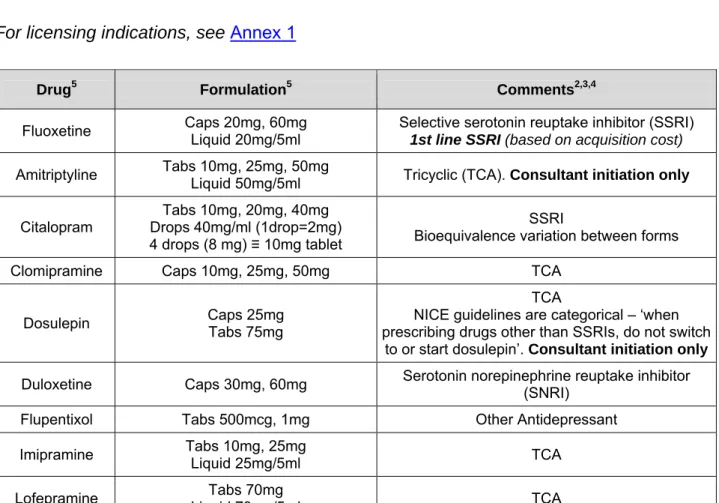
For licensing indications, see Annex 1
Drug5 Formulation5 Comments2,3,4
Fluoxetine Caps 20mg, 60mg Liquid 20mg/5ml Selective serotonin reuptake inhibitor (SSRI)
1st line SSRI (based on acquisition cost)
Amitriptyline Tabs 10mg, 25mg, 50mg Liquid 50mg/5ml Tricyclic (TCA). Consultant initiation only Citalopram
Tabs 10mg, 20mg, 40mg Drops 40mg/ml (1drop=2mg) 4 drops (8 mg) ≡ 10mg tablet
SSRI
Bioequivalence variation between forms Clomipramine Caps 10mg, 25mg, 50mg TCA
Dosulepin Caps 25mg Tabs 75mg
TCA
NICE guidelines are categorical – ‘when prescribing drugs other than SSRIs, do not switch
to or start dosulepin’. Consultant initiation only Duloxetine Caps 30mg, 60mg Serotonin norepinephrine reuptake inhibitor (SNRI) Flupentixol Tabs 500mcg, 1mg Other Antidepressant
Imipramine Tabs 10mg, 25mg Liquid 25mg/5ml TCA Lofepramine Liquid 70mg/5ml Tabs 70mg TCA
Drug5 Formulation5 Comments2,3,4
Mirtazapine Dispersible Tabs 15mg, 30mg, 45mg Tabs 15mg, 30mg, 45mg Liquid 15mg/ml
Noradrenaline and specific serotonin antidepressant (NaSSa) Moclobemide Tabs 150mg, 300mg Reversible MAOI.
Consultant initiation only Paroxetine Tabs 20mg, 30mg Liquid 10mg/5ml SSRI
Phenelzine Tabs 15mg Irreversible Monoamine-oxidase inhibitor (MAOI). Consultant initiation only
Sertraline Tabs 50mg, 100mg SSRI Trazodone Caps 50mg, 100mg Tabs 150mg
Liquid 50mg/5ml Tricyclic-related Antidepressant Venlafaxine
(300 mg+/day) M/R Caps 75mg, 150mg Tabs 37.5mg, 75mg
SNRI
≥300mg/day should only be prescribed under the supervision or advice of a Consultant
Escitalopram and Reboxetine remain non-formulary.
Agomelatine is non formulary based on the guidance provided by NICE in relation to the
termination of TA 231, July 2011 (due to the lack of evidence to support use).
1.2 NICE Clinical Guidelines
NICE CG 90 and CG 91, October 2009. Depression: Treatment & management of depression in adults, including adults with a chronic physical health problem4
1.2.1 Choice of antidepressant
Consider using a baseline assessment for severity of depression and
regularly review symptoms both clinically and using standard severity rating scales. Initially, normally choose a generic SSRI whilst taking the following into account:
o Fluoxetine, fluvoxamine and paroxetine have a higher propensity for
drug interactions (see current BNF). It may be appropriate to consider
sertraline and citalopram in patients who have chronic health problems, as these have a lower propensity for interactions with medications for physical health problems (see table below)
o Paroxetine has a higher incidence of discontinuation symptoms
(consider half lives). See section 1.3
o SSRIs are associated with an increased risk of bleeding – consider
prescribing a gastro-protective drug (e.g. omeprazole) in older adults who are taking NSAIDs and/or aspirin
Discuss choice of antidepressant, covering:
o Patient choice - the patient’s perception of the efficacy and tolerability4
o Existing co-morbid psychiatric disorders such as obsessive
compulsive disorder, anxiety spectrum disorder etc., through accurate history taking (Annex 1)
o Anticipated adverse events – for example, agitation, nausea and
vomiting (with SSRI antidepressants), and discontinuation symptoms (seeAnnex 2Annex 2)
o Potential interactions with concomitant medication or physical illness
(there is currently no evidence to support using specific antidepressants in particular physical health problems)
Medication for physical
health problem Recommended antidepressant(s)
4
NSAIDs (non-steroidal anti-inflammatory drugs)
Do not normally offer SSRIs – but if no suitable alternatives can be identified, offer gastro-protective medicines (for example, proton pump inhibitors) together with the SSRI. Consider mirtazapine, moclobemide or trazodone
Warfarin or heparin Do not normally offer SSRIs. Consider mirtazapine. Theophylline, clozapine,
or methadone
Do not normally offer fluvoxamine – offer sertraline or citalopram
‘Triptan’ drugs for migraine
Do not offer SSRIs – offer mirtazapine or trazodone. Aspirin Use SSRIs with caution – if no suitable alternatives can
be identified, offer gastro-protective medicines together with the SSRI. Consider trazodone when aspirin is used as a single agent. Alternatively, consider mirtazapine. Monamine oxidase B
inhibitors (for example, selegiline or rasagiline)
Do not normally offer SSRIs – offer mirtazapine or trazodone.
Flecainide or propafenone Offer sertraline as the preferred antidepressant – mirtazapine or moclobemide may also be used.
When prescribing antidepressants for older adults (see section 11 for further information)
o Prescribe at an age-appropriate dose taking into account physical
health, and existing medication (see table above)
o Monitor carefully for side-effects (seeAnnex 2Annex 2)
o The increased likelihood of the person stopping treatment because of
side effects, and the consequent need to increase the dose gradually, as for example with venlafaxine and tricyclic antidepressants (TCAs)
o That dosulepin should not be prescribed
o That irreversible MAOIs (such as phenelzine) should only normally be
prescribed by a Consultant Psychiatrist
Take into account toxicity in overdose for people at significant risk of suicide. When initiating antidepressants, especially SSRIs, actively monitor suicidal ideations, self-harming thoughts and changes in both. If changes are noticed, increase review frequency. Be aware that:
o Compared with other equally effective antidepressants recommended
in primary care (such as SSRIs), venlafaxine is associated with a greater risk of death from overdose, but the greatest risk in overdose is with TCAs, except for lofepramine
o For people who are not considered to be at increased risk of suicide,
normally review after 2 weeks, then regularly every 2–4 weeks in the first 3 months for example, and then at longer intervals if response is good
o For people who are considered to be at increased risk of suicide or are
younger than 30 years, normally see them after 1 week and then frequently until the risk is no longer clinically significant, particularly if they have been commenced on a SSRI. Review periods should be based on individual assessments
Do not prescribe or advise use of St John’s Wort for depression
o Explain the different potencies of the preparations available and the
potential serious interactions of St John’s Wort with other drugs (including oral contraceptives, anticoagulants and anticonvulsants)
o Explore any concerns that the person may have about taking an
antidepressant and provide information about:
o The gradual development of the full antidepressant effect
o The importance of taking the medication as prescribed and the need to
continue beyond remission
o Potential side effects and drug interactions and strategies for
minimisation
o The risk and nature of discontinuation symptoms (particularly with
drugs with a shorter half-life, such as paroxetine and venlafaxine)
o The fact that addiction does not occur
Patients receiving ECT can be prescribed antidepressants simultaneously
are used. Treatment with antidepressants for mild depression is not routinely recommended
In every instance, choice of antidepressant should be based on the circumstances of the individual being treated and their individual preferences. If after consultation a range of choices are available taking into consideration safety and concordance profiles, the drug of lowest acquisition cost should be selected.
1.2.2 Early treatment with an antidepressant4
If increased anxiety or agitation develops early in treatment with an SSRI, a short period of concomitant therapy (usually no longer than 2 weeks) with a benzodiazepine may be considered4. (This consideration does not apply to patients with chronic anxiety and benzodiazepines should only be used with caution in patients at risk of falls4.) The patient should be informed that this is usually a transient effect and should last no longer than a few weeks. If the anxiety or agitation is unacceptable to the patient, consider changing to a different antidepressant (see Annex 3).
1.2.3 Lack of response to initial antidepressant4
If improvement is not reported within 2-4 weeks, check that the drug has been taken as prescribed and enquire about side-effects experienced (see
Annex 2 for side effect profile).
If response is absent or minimal after 3–4 weeks of treatment with a
therapeutic dose of an antidepressant, increase support and consider increasing the dose in line with the summary of product characteristics (SPC) if there are no significant side effects. If there are side effects or if the patient prefers, consider switching to another antidepressant. (Information relating to stopping/switching can be found in Annex 3)
If there is some improvement by week 4, continue treatment for another 2-4 weeks at an increased dose. Consider switching to another antidepressant if response is still not adequate; there are side effects; or if the patient prefers to change medication
If considering switching antidepressant, consider a different SSRI
Subsequently, if the second SSRI is not effective/well-tolerated, consider switching to one of the better tolerated newer generation
antidepressants such as mirtazapine considering the various factor
mentioned above
Subsequently, consider substituting with an antidepressant of a
different class that may be less well tolerated (such as venlafaxine, or a
reversible MAOI, such as moclobemide, or a TCA)
1.2.4 Guidance for Prescribing Venlafaxine:
Do not prescribe venlafaxine for patients with:
o Uncontrolled hypertension
o High risk of cardiac arrhythmia
Monitor BP at initiation and regularly during treatment (particularly during dose titration)
Monitor for signs and symptoms of cardiac dysfunction
Doses of 300 mg daily or more should only be prescribed under the
supervision or advice of a specialist mental health practitioner
1.2.5 Guidance for prescribing Tricyclic Antidepressants:
Tricyclic antidepressants are cardiotoxic (defined as causing a 25% increase in baseline QTc interval) – even at therapeutic doses. Therefore, it is advisable to perform an ECG and to monitor BP prior to initiating treatment. NICE does specify that people who start on low dose TCAs, and have a clear clinical response can be maintained on that dose with careful monitoring. Dosulepin is the most cardiotoxic, and NICE specifies ‘Do not switch or start, dosulepin’.
Do not routinely augment an antidepressant with:
o A benzodiazepine for more than 2 weeks
o Buspirone, carbamazepine, lamotrigine, valproate or thyroid
hormones.
If a person’s depression has not responded to either pharmacological or
psychological interventions, consider combining antidepressants with CBT.
1.2.4 Pharmacological management of depression with psychotic symptoms4
For individuals with depression who have psychotic symptoms consider augmenting their treatment plan with an antipsychotic medication.
Should augmentation (with lithium, an antipsychotic such as quetiapine, or another antidepressant such as mirtazapine) be considered necessary, then advice from a Consultant Psychiatrist should be sought; especially if the patient is based in primary care. (see sections 2 and 3 for further information relating to monitoring required for these drugs)
When prescribing Lithium (for augmentation of the primary antidepressant) – monitor:
o Renal and thyroid function before treatment and every 6 months
during treatment (more often if there is evidence of renal impairment)
o Consider ECG monitoring in people at high risk of cardiovascular
disease
o Monitor serum Lithium levels 1 week after treatment starts and after
every dose change, and then every 3 months (see section 3 for full details)
When prescribing an antipsychotic, monitor weight, fasting lipid and glucose levels, and other relevant side effects (see section 2 for full monitoring requirements of antipsychotics)
1.2.5 Maintenance treatment with antidepressents4
Patients who have responded to antidepressants should continue on said
medication for at least 6 months after remission of a single episode. Thereafter, the need to continue should be discussed with the patient taking into consideration such factors as residual symptoms and concurrent physical health and psychosocial problems. Patients with 2 prior episodes and functional impairment should be treated for at least 2 years.
People who have had multiple episodes of depression and who have a good
response to augmentation should remain on this treatment. If one medication is stopped, it should be the augmenting agent.
1.3 Tolerance, Craving & Antidepressant Discontinuation Syndrome1
Inform all patients prescribed an antidepressant that these drugs do not cause tolerance and craving, but they can cause withdrawal symptoms on stopping, missing doses or occasionally on reducing the dose. The symptoms are usually mild and self-limiting but occasionally severe, particularly if the drug is stopped abruptly. This is more common in drugs with a short half-life such as Paroxetine and Venlafaxine.
Withdrawal symptoms usually occur within 5 days of stopping treatment, or occasionally during taper or after missed doses (short half-life drugs). The perception of symptom severity may be worse if the patient is not warned of the possibility in advance. Some symptoms are more likely with particular drugs.
1.3.1 Antidepressant Discontinuation Symptoms
Patients prescribed short half-life drugs (e.g. paroxetine); patients who have taken an antidepressant for more than 8 weeks; patients who developed anxiety at the start of antidepressant therapy (particularly SSRI’s); patients taking other centrally acting drugs (e.g. antihypertensives, antihistamines, antipsychotics); children and adolescents; patients who have experienced discontinuation symptoms before1 are most at risk of developing discontinuation symptoms.
Discontinuation symptoms can be avoided by reducing long-term antidepressant doses over four weeks (not necessary with fluoxetine). This is more important with short half-life drugs (e.g. paroxetine or venlafaxine). MAOI’s (especially Tranylcypromine) may need longer.1 (See Annex 3)
1.3.2 How to treat?
Mild symptoms – reassure patient, and monitor symptoms.
Severe symptoms – reintroduce the original drug at the effective dose, or prescribe a drug in the same class with a longer half-life (e.g. if patient was using paroxetine, introduce fluoxetine), withdraw slowly and monitor.1
MAOI’s TCA’s SSRI’s & related
Symptoms
Common:
Agitation, irritability, ataxia, movement disorders, insomnia, somnolence, vivid dreams, cognitive impairment, slowed speech, pressured speech.
Occasionally: Hallucinations, paranoid
delusions.
Common: Flu-like symptoms (chills, fever, sweating, headache,
nausea), insomnia, vivid dreams.
Occasionally: Movement disorders, mania, cardiac arrhythmia.
Common: Flu-like symptoms, ‘shock-like’ sensations, dizziness,
insomnia, vivid dreams, irritability, crying spells.
Occasionally: Movement disorders, impaired concentration and memory. Drugs most often associated with dis-continuation symptoms All (Tranylcypromine is partly metabolised to amphetamine and is associated with a true ‘withdrawal syndrome’)
Amitriptyline Imipramine
Paroxetine (all SSRIs have the propensity to cause discontinuation syndrome)
Venlafaxine (↑ risk of NMS)
References
1. South London & Maudsley NHS Foundation Trust Prescribing Guidelines 10th edition, Informa Healthcare, 2010
2. Psychotropic Drug Directory 2010, Bazire S., Fivepin Ltd
3. Summary of Product Characteristics for Individual Drugs [accessed Jan. 2011]
http://www.medicines.org.uk/EMC/default.aspx
4. NICE CG 90 and 91, October 2009. Depression: Treatment and management of
depression in adults, including adults with a chronic physical health problem
http://guidance.nice.org.uk/CG90
Annex 1 Licensed indication(s) for antidepressants
Drug Depression Anxiety OCD Disorder Panic Anxiety Social PTSD GAD Bulimia -Nervosa PMDD Amitriptyline Citalopram Clomipramine Dosulepin Duloxetine Fluoxetine Flupentixol Imipramine Lofepramine MAOI’s Mianserin Mirtazapine Moclobemide Paroxetine Sertraline Trazodone Venlafaxine § §
Indications correct as of January 2011 – check for changes in the latest SPC. Abbreviations
OCD = Obsessive Compulsive Disorder PTSD = Post Traumatic Stress Disorder GAD = Generalised Anxiety Disorder PMDD = Pre-Menstrual Dysphoric Disorder
§ Only the XL formulation of Venlafaxine is licensed for these indications
References
1. Summary of Product Characteristics for Individual Drugs [accessed Jan. 2011]
Annex 2 Summary of Drug Particulars (relative side effect profile)
Drug1 Max Daily Dose (mg) Adult (Licensed) Max Daily Dose (mg) Elderly (Licensed)
Relative Side Effects at Average Doses (mostly dose-related)
Anti-cholinergic Cardiac Nausea Sedation
Over-dose Toxicity Pro-convul sant Sexual Dysfunct ion Tricyclics (TCAs) Amitriptyline 200 75 +++ +++ ++ +++ +++ ++ ++ Clomipramine 250 75 +++ ++ ++ ++ + ++ +++ Dosulepin 150 75 ++ ++ 0 +++ +++ ++ ++
Imipramine 200 (Outpt) 300 (Hosp) 50 ++ ++ ++ + +++ ++ ++
Lofepramine 210 <Ad ++ + + + 0 0 ++ SSRIs Citalopram2 40 20 0 ++ +++ 0 + 0 ++ Fluoxetine 60 60 0 0 ++ 0 0 0 ++ Paroxetine 50(depression) 60 (others) 40 0 0 ++ 0 0 0 +++ Sertraline 200 200 0 0 ++ 0 0 0 ++ Tricyclic-Related Mianserin 200 (usually30-90) <Ad + 0 0 +++ 0 0 +
Trazodone 300 (Outpt) 600 (Hosp) 300 + + +++ ++ + 0 ++
MAOIs Isocarboxazid 60 (4-6weeks) then 40 10 ++ ++ ++ 0 ++ 0 + Phenelzine 90 (90) + + ++ + +++ 0 + Tranylcy- promine 30 (30) + + ++ + +++ 0 + SNRIs Duloxetine 120 Caution 0 0 ++ + ? ? ++ Venlafaxine 375 (tabs) 225 (SR caps) 375 (tabs) 225 (SR caps) 0 ++ ++ + ++ + ++ Others Flupentixol 3 1.5 ++ 0 0 + + ? + Mirtazapine 45 45 0 0 0 ++ 0 ++ ++ Moclobemide 600 600 + 0 + 0 0 ? + Key
+++ = Marked effect ++ = Moderate effect + = Mild effect 0 = Little effect ? = Unknown <Ad = Less than Adult dose NR = Not Recommended
References
1. Psychotropic Drug Directory 2010, Bazire S., Fivepin Ltd 2. MHRA Drug Safety Update, Volume 5, No 5, December 2011
TO: EscitalopramCitalopram/ Duloxetine Fluoxetine MAOI -
Phenelzine Mirtazapine Moclobemide Paroxetine Reboxetine Sertraline Tricyclics Trazodone Venlafaxine
FROM: Citalopram/ Escitalopram Withdraw - start at 60mg Withdraw - Start fluoxetine at 10mg Withdraw. Wait
1 week Cross-taper Withdraw. Wait 2 weeks
Withdraw. Start paroxetine at 10mg Cross-taper Withdraw. Start sertraline at 25 mg Cross-taper Withdraw before starting titration Withdraw. Start at 37.5mg/day. Increase slowly
Duloxetine Withdraw and start Withdraw and start Withdraw. Wait 1 week Withdraw and start Withdraw. Wait 1 week Withdraw and start Cross-taper Withdraw and start Cross-taper starting titration Withdraw start venlafaxine Withdraw then
Fluoxetine
Withdraw. Wait for 4 – 7 days. Start citalopram
Stop. Wait for 4 – 7 days. Start duloxetine Withdraw. Wait 5 - 6 weeks Withdraw. Wait for 4 – 7 days. Start mirtazapine Withdraw. Wait 5 weeks Withdraw. Wait for 7 days. Start paroxetine Withdraw. Start reboxetine 2mg b.d. Withdraw. Wait for 4 – 7 days. Start sertraline 25mg Withdraw. Wait for 4 – 7 days. Start Withdraw. Wait for 4 – 7 days. Start low dose
Withdraw. Wait 4 - 7 days then start at 37.5mg/ day. Increase. slowly MAOI - Phenelzine Withdraw. Wait
for 2 weeks Withdraw. Wait for 2 weeks Withdraw. Wait for 2 weeks Withdraw. Wait for 2 weeks Withdraw. Wait for 2 weeks Withdraw. Wait for 2 weeks Withdraw. Wait for 2 weeks Withdraw. Wait for 2 weeks Withdraw. Wait for 2 weeks Withdraw. Wait for 2 weeks Withdraw. Wait for 2 weeks
Mirtazapine Withdraw and start Withdraw and start at 60 mg Withdraw and start Withdraw. Wait 1 week Withdraw. Wait 1 week Withdraw and start Withdraw. Wait for 24 hours Withdraw and start Withdraw and start Withdraw and start start venlafaxine Withdraw then
Moclobemide Withdraw. Wait for 24 hours Withdraw. Wait for 24 hours Withdraw. Wait for 24 hours Withdraw. Wait for 24 hours Withdraw. Wait for 24 hours
Withdraw. Wait
for 24 hours Withdraw. Wait for 24 hours Withdraw. Wait for 24 hours Withdraw. Wait for 24 hours Withdraw. Wait for 24 hours Withdraw. Wait for 24 hours
Paroxetine Withdraw and start Withdraw and start at 60mg Withdraw and start Withdraw. Wait for 2 weeks Cross-taper Withdraw. Wait for 2 weeks Cross-taper Withdraw and start Cross-taper starting titration Withdraw Withdraw. Start at 37.5mg/day. Increase slowly
Reboxetine Cross-taper Cross-taper Withdraw. Wait for 1 week Withdraw. Wait for 1 week Cross-taper Withdraw. Wait for 1 week Withdraw. Wait for 1 week
Cross-taper Cross-taper Cross-taper
Cross-taper cautiously
Sertraline Withdraw and start Withdraw and start at 60mg Withdraw and start Withdraw. Wait for 2 weeks Cross-taper Withdraw. Wait for 2 weeks Withdraw and start Cross-taper
Cross-taper Withdraw starting titration Withdraw. Start venlafaxine at 37.5mg/day. Tricyclics
halve dose and start citalopram
then slow withdrawal
Cross-taper
halve dose and start fluoxetine
then slow withdrawal
Withdraw. Wait
for 1 week Cross-taper Withdraw. Wait for 1 week
halve dose and start paroxetine
then slow withdrawal
Cross-taper
halve dose and start sertraline
then slow withdrawal
halve dose and start trazadone then slow withdrawal Cross-taper cautiously. Start venlafaxine at 37.5mg/day
Trazodone Withdraw and start Withdraw and start at 60mg Withdraw and start Withdraw. Wait for 1 week Cross-taper Withdraw. Wait for 1 week Withdraw and start Reboxetine 2mg Withdraw. Start b.d. Withdraw and start Cross-taper Withdraw. Start venlafaxine at 37.5mg/day. Venlafaxine Cross-taper cautiously. Start at 10mg/day Withdraw. Start at 60mg on alternate days. Increase slowly Cross-taper cautiously. Start at 20mg on alternate days Withdraw. Wait
at least 1 week Cross-taper cautiously Withdraw. Wait at least 1 week
Cross-taper cautiously. Start at 10mg/day Cross-taper cautiously Cross-taper cautiously. Start at 25mg/day Cross-taper cautiously. Start at very low dose
Cross-taper cautiously
References