Congestion Control in Wireless Communication
Network Using Fuzzy Logic and Machine
Learning Techniques
Abhishak Sawhney1, Ritu Bhatia2, Payal Mahajan3
M.Tech Student,Dept of ECE, Maharishi Ved Vyas Engineering College, Yamuna Nagar, Haryana, India1
Assistant Professor, Dept of ECE, Maharishi Ved Vyas Engineering College, Yamuna Nagar, Haryana, India2
M.Tech ,Dept of ECE, Guru Nanak Dev University, Amritsar, Punjab, India3
ABSTRACT
:
Nowadays wireless networks are the most popular way of communication. For example, internetservices in companies, cafes, e-markets and in homes. Therefore, it must be protected against the spiteful users who try to harm the privacy, genuineness and privacy of it. Also there is need of traffic control of information sent over these wireless networks. In this research paper, a technique for controlling the congestion over the wireless networks is shown and to implement it, fuzzy logic and machine learning tools are used. Some of the parameters which are necessary to be considered for congestion control decision mechanism are:Transmission energy, queue size, distance from receiver, transmission rate, cost assigned. On evaluating these parameters using fuzzy logic, a desired output for congestion control can be determined and its efficiency is evaluated using machine learning tools.
KEYWORDS: wireless networks, congestion, fuzzy logic, machine learning tools.
I. INTRODUCTION
a) Introduction to wireless Networks:
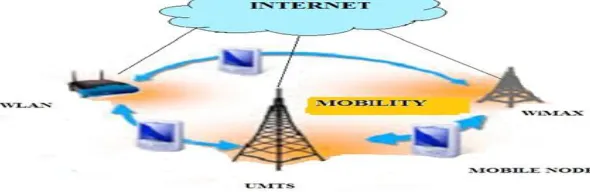
Wireless Overlay Networks – a hierarchical structure of room-sizeand wide area data networks, solve the difficulty of providing network connectivity to a huge number of mobile users in anproficient and scalable way [1].With the expansion of wireless communication technology, various wireless networks have been set up. Diverse networks will be dominant in the succeedinggeneration wireless networks [2].Typical examples of wireless networks are WLAN and 3G(wireless local area network). An important issue is to assimilate these heterogeneous networks and achieve the mobile nodes while moving across heterogeneous networks with continuity, low latency between networks based on diverse technologies and minimum packet loss [3]. A typical example of wireless network is shown in figure1:
Fig 1: Wireless Communication among different networks
traffic. This challenge has inspired the researchers over the last decade to grow a number of congestion control protocols and mechanisms that ensemble the traffic and provides fair repairs for both unicast and multicast communications [4]
b). Introduction to tools used:
1. Fuzzy Logic:Fuzzy logic (FL) is a type of many-valued logic that has been used in networks and has subsidised to
developments in network efficiency. FL compacts with reasoning that is inaccurate rather than fixed and precise. Professor LotfiZadeh introduced the concept of FL in the mid 1960’s. [5], [6] and [7]. Fuzzy logic has introduced many methods for in place of and deducing from uncertain or incomplete knowledge. Fuzzy concepts cannot be demonstrated
by a simple set inclusion operator ∈, but there is a degree of membership. In other words, while Boolean logic has just
two values, true (always presented numerically as 1) or YES, and false (always presented numerically as 0), or NO, Fuzzy Logic extends these two values to values between 0 and 1 using the concept of degrees of membership [10].Fuzzy Logic makes use of Fuzzy Inference tool as shown in figure 2.
Figure 2: Fuzzy Inference System
2. Weka tool:Weka tool, [8] has been used for training and testing of ML algorithms. This tool is a gathering of large
number of ML algorithms, out of which five mostly used ML algorithms have been employed in this research work and performance of these ML algorithms has been compared on the basis of different parameters.Weka (Waikato Environment for Knowledge Analysis) is a popular suite of machine learning software written in Java, developed at the University of Waikato, New Zealand. Weka is free software available under the GNU General Public License as shown in figure 3.
II. PROPOSED APPROACH
In this research work, a manual data set of 2084 values is created using fuzzy logic. The use of fuzzy tool is as shown in figure 4.
Fig 4: Fuzzy Logic system in Matlab
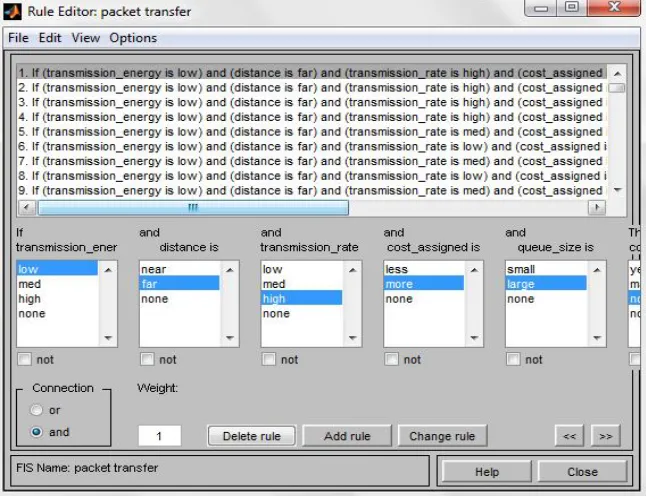
In the figure shown above, five input parameters are taken as: Transmission energy, queue size, distance from receiver, transmission rate, cost assigned and output is congestion control.Using fuzzy logic, a rule set of 400 values is created which is shown below in figure 5:
Rule Viewer shown in figure 6: The rule viewer shows the various rules according to parameters and their effect on the output.
Fig 6: Rule Viewer
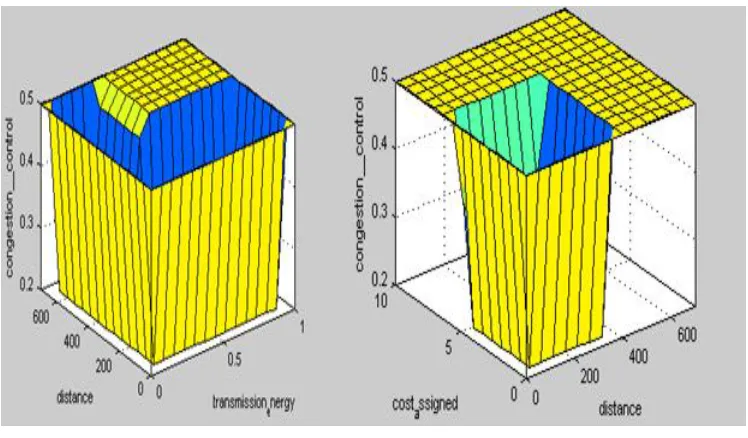
Surface Viewer shows the autocorrelation between the parameters chosen and is shown in figure 7.
Fig7: Surface Viewer
Table 1: Validation Table
The membership functions of various input parameters are given as follows:
1. Transmission energy: This energy is readily used to transmit packets over a wireless link in WSN. The main key
observation is that the energy required to transmit a packet can be significantly reduced and this parameter is lowering the transmission power and transmitting the packet over a longer period of time. “Transmission energy” represents the energy needed to transmit a data packet from node one to another node. Lower value of transmission energy leads to lower congestion.
Figure 8: Membership function for Transmission energy
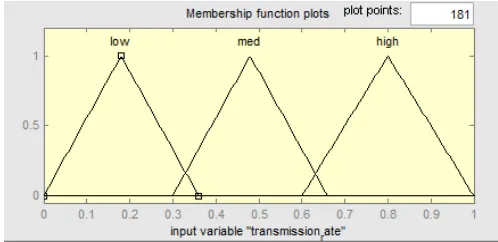
2.Data Transmission Rate:When transmit and receive stations have been interconnected by a call, a training sequence
for the modem is executed and, also, a test signal transmission sequence is affected to set up a data transmission rate before delivery of information. Training on the transmission rates which a modem can use is executed satisfying a predetermined protocol and without increasing the protocol time. Data transmission rate should be fast so that delivery of packets at the destination will be received on time. Fast data transmission rate are assigned as lower link cost.
3. Distance between transmitter and receiver:The fuzzy input variable “Distance between transmitter and receiver”, enables selection of routes with minimum hops. Nodes nearer to the gateway are thus assigned lower link cost. Minimum number of hops provides an efficient way for transmission of packets at destination and it also reduces the complexity of sensor networks.
Fig 10: Membership function for distance
4. Queue size:The input fuzzy variable “queue size” indicates the buffer capacity at any node. This parameter helps avoid packet drops due to congestion at the receiver. Congestion leads to great trouble for efficient transmission of data packets at receiver end in networks. This queue size of packets should be small so that there will be less waiting time for execution.
Fig 11: Membership function for queue size
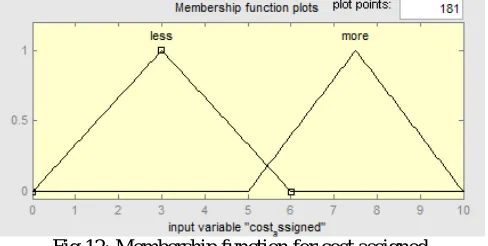
5.Cost assigned to each path: Each sensor node is assigned a dynamic weight depending upon its current status. An
in-active node that is neither sensing nor relaying is assigned a highest value whereas a node that is performing both these tasks is assigned a least weight. This parameter helps in selecting nodes which are either inactive or are only in the sensing state. Thus, a high value of weight makes the node favourable for next-hop, resulting in a lower value of link cost.
Fig 12: Membership function for cost assigned
Fig 13: Membership function for output
a) Use of Weka Tool for implementation
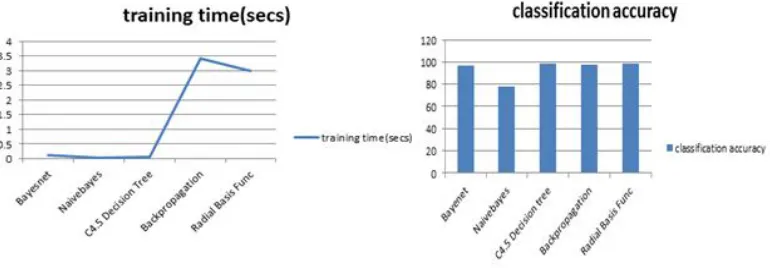
Five machine learning tools are used i.e. Backpropagation, Radial Basis Function, C4.5 Decision tree, Naïve Bayes, Bayesnet. Weka Tool is used for finding the classification accuracy and training time of these tools to find the best among them. Among 2084 rules, 1784 are used for training data and 300 are used for testing the data.
Table 2: Table showing the performance of the five neural tools.
b) Graphs showing the comparison between the Five neural tools:
Using the training and testing data, graphs showing the comparison between the training time and classification accuracy of the tools are drawn.
Graph: Graph for training time and classification accuracy of neural tools taken
III. CONCLUSION
REFERENCES
[1] Mark Stemm and Randy H. Katz, “Vertical handoffs in wireless overlay networks”,Mobile Networks and Applications 3,335–350, 1998. [2] Manoj Sharma, Dr. R.K.Khola,“Fuzzy logic based handoverdecision system”, International Journal of Ad hoc, Sensor & Ubiquitous Computing
(IJASUC) Vol.3, No.4, August 2012.
[3] Ali Murtaza, Mansoor Ahmed, “Decision algorithm and procedure for fast handover between 3G and WLAN”,Master’s Thesis in Computer Network Engineering, School of Information Science, Computer and Electrical Engineering, Halmstad University
[4] CagataySonmez, OzlemDurmazIncel, Sinan Isik, Mehmet YunusDonmez and CemErsoy, “Fuzzy-based congestion control for wirelessmultimedia sensor networks”,Sonmez et al. EURASIP Journal on Wireless Communications and Networking 2014.
[5] L.A. Zadeh, “Fuzzy Sets”, Information and Control, vol. 8, issue. 3, pp.338-353, 1965. [6] L.A. Zadeh, “Fuzzy Algorithms”, Information and Control, vol. 12, issue. 2, pp. 94-102,1968.
[7] L.A. Zadeh, Outline of a New Approach to the Analysis of Complex systems and DecisionProcesses, IEEE Transaction on Systems, Man, and Cybernetics, vol. 3, issue. 1,1973.
[8] Remco R. Bouckaert, “Bayesian Network Classifiers in Weka” September 1, 2004.
[9] S Misra, M Reisslein, G Xue, A survey of multimedia streaming in wirelesssensor networks. IEEE Commun. Surv. Tutorials. 10(4), 18–39 (2008).