Adaptive and Constrained Algorithms for Inverse Compositional
Active Appearance Model Fitting
George Papandreou and Petros Maragos
School of E.C.E., National Technical University of Athens, Greece
http://cvsp.cs.ntua.gr∗Abstract
Parametric models of shape and texture such as Ac-tive Appearance Models (AAMs) are diverse tools for de-formable object appearance modeling and have found im-portant applications in both image synthesis and analy-sis problems. Among the numerous algorithms that have been proposed for AAM fitting, those based on the inverse-compositional image alignment technique have recently re-ceived considerable attention due to their potential for high efficiency. However, existing fitting algorithms perform poorly when used in conjunction with models exhibiting significant appearance variation, such as AAMs trained on multiple-subject human face images. We introduce two enhancements to inverse-compositional AAM matching al-gorithms in order to overcome this limitation. First, we propose fitting algorithmadaptation, by means of (a) fit-ting matrix adjustment and (b) AAM mean template up-date. Second, we show how prior information can be in-corporated and constrain the AAM fitting process. The inverse-compositional nature of the algorithm allows effi-cient implementation of these enhancements. Both tech-niques substantially improve AAM fitting performance, as demonstrated with experiments on publicly available multi-person face datasets.
1. Introduction
Parametric models of shape and texture, such as Ac-tive Appearance Models [8], AcAc-tive Blobs [25], Morphable Models [18], and other related approaches [5, 11, 16] are widely used techniques for object appearance modeling. Employing a number of parameters controlling shape and texture variation, these models bring a target image into reg-istration with a reference template, even in cases that the target image is a deformed version of the template; imaging ∗This work was supported in part by grantΠENE∆-2003-E∆865
[co-financed by E.U.-European Social Fund (75%) and the Greek Ministry of Development-GSRT (25%)] and in part by the European Community projects ASPI, MUSCLE, and HIWIRE.
conditions such as camera position and object illumination can also differ significantly between the template and the target image. Active Appearance Models can additionaly represent appearance variability in a whole class of objects, such as faces or cars, after learning it from examples during a training phase. Such parametric models can be applied to both image synthesis and analysis problems. Representative applications are object tracking in video [25], face recogni-tion [6], face synthesis [18], and image stitching [26].
An important issue with AAMs concerns matching them to images by finding the parameters that minimize the dis-crepancy between observed and synthesized object appear-ances, possibly also including a prior penalty on the pa-rameter values. This is a difficult non-linear optimization task and general-purpose optimization procedures can be inneficient. Most existing AAM fitting algorithms solve the matching problem by iteratively updating the model pa-rameters, assuming that there is a fixedAAM fitting matrix
which maps the synthesis error image to model parameter increments; this matrix is learned in a precomputation phase and is subsequently used unaltered, resulting in a very ef-ficient class of algorithms, reviewed in Section 2. How-ever, the fixed mapping approach reaches its limits when one works with models allowing considerable appearance deviation from the mean template, such as AAMs built on large multi-person face datasets [3, 10].
As has been highlighted in [2], in performing incremen-tal image registration one can choose between (a) updat-ing the warp parameters either additively or composition-ally and (b) calculating incremental warps and image gra-dients either forwardly on the target image or inversely on the model template. In our work, similarly to [2, 12, 22], we use theinverse compositionalcombination because it facil-itates efficient calculations, since manipulating the model template instead of the target image allows precomputing useful quantities and thus accelerates image fitting.
Our first main contribution is that we introduce two complementary adaptation mechanisms in inverse com-positional AAM fitting. The first adaptation mechanism amounts toAAM fitting matrix adjustmentand compensates
for the deviation of the model’s synthetic texture from the mean texture. A desirable characteristic of our algorithm is that it features a tunable order parameter which adjusts the adaptation accuracy vs. computational load trade-off, allowing a variety of choices to the user. We show that previously presented algorithms such as the fast (but pos-sibly inaccurate) project-out method of [19] and the more accurate (but slow) simultaneous method of [15] are just the zero-order and maximum-order, respectively, extremes of plausible choices. Our analysis sheds new light in their properties and their shortcomings. As a second complemen-tary adaptation mechanism, we propose a computationally cheapmean template updateprocedure, particularly suited for object tracking in videos, which can be applied period-ically and adapt the mean texture of the model’s template, considerably improving the accuracy of the fast (low-order) algorithms we present. Both adaptation techniques are pre-sented in Section 3.
Our second main contribution is that we show howprior constraintson model parameters can be properly incorpo-rated into inverse compositional AAM fitting algorithms. Such prior information, typically in the form of dynamic constraints within a tracking system or static constraints induced during the PCA-based AAM training phase, can significantly improve AAM fitting robustness as has been demonstrated within the conventional forwards additive pa-rameter update framework [9]. However, utilizing them within the compositional warp update mechanism is not straightforward, as one needs to compute the Jacobian ma-trix of the compositional-to-additive warp update, which had only been done before for the simple case of global affine transformation [1]. We show in Section 4 how this Ja-cobian matrix can be efficiently calculated for the more flex-ible warps often utilized in conjunction with AAMs, such as thin-plate spline warps. We present in Section 5 exper-imental results on face matching and tracking with AAMs built on multi-person datasets which demonstrate that incor-porating adaptation mechanisms and prior constraints sub-stantially improves AAM fitting performance.
2. Active Appearance Models
Active Appearance Models are generative models which use a compact set of parameters to describe the shape and texture variation of objects in images.
2.1. Object Appearance Representation
Typically the shape of the object is sampled atL land-marks, whose coordinates constitute a shape vector s of length2Lin the 2-D case. Active Appearance Models allow a particular instance of the shapespdeviate from a mean shapes0by lettingsp−s0lie in a linear subspace spanned
byneigenshapessi, yielding sp=s0+ n X i=1 pisi. (1)
The modes of shape variationsi can be either statistically learned using a training set [8], or computed by modal anal-ysis of the shape mesh [25], or selected a-priori to allow modeling certain distortions [14]. Often these modes delib-erately do not model scale and translation, in which case an explicit 4 d.o.f. similarity transformSt, defined asSt(x) =
1+t1 −t2 t2 1+t1 x+ t3 t4
,makes the model scale and transla-tion invariant. The enhanced shape parameter vectorp˜ = [t1:4,p1:n]T with length 4 +nimplicitly defines a dense
continuous deformation field W(x,p˜) = St W(x,p),
namely deformation followed by similarity, which maps ev-ery pointxin the model template to its corresponding im-age point as follows: The deformationW(x,p), typically a thin-plate spline or a piecewise affine mapping, is deter-mined by requiring that it maps each landmark in the refer-ence shapes0to its corresponding landmark insp.
The texture part of the appearance refers to the intensity or color (other information channels can also be added) of the object in a shape-normalized frame, after registering it with the model template. Similarly to shape, allowable tex-ture samples Aλ(x)are generated linearly, using a mean
textureA0(x)and a set ofmeigentexturesAi(x):
Aλ=A0+ m X
i=1
λiAi, (2)
where we have used vector notation for textures; e.g. A0
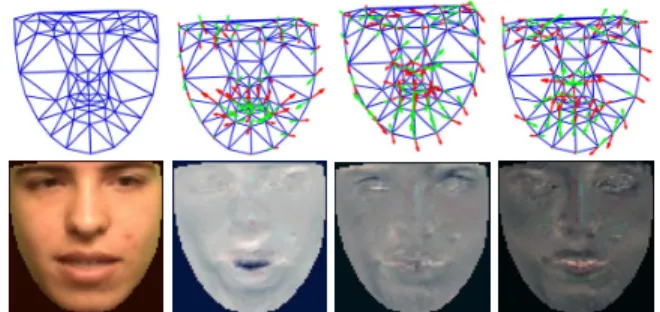
denotes the mean texture image raster-scanned into a vec-tor with N entries, as many as the texture samples of the reference object. The eigentexture images compensate il-lumination changes [16] and model texture variability be-tween different objects of the same class (e.g. faces) [8, 18]. For example, Figure 1 shows the leading eigenshapes and eigentextures obtained by AAM training on a person’s face. Camera gain and offset are usually accounted for sepa-rately by a global affine texture transformation Tu(I) = (u1+ 1)I+u2. We gather all texture parameters in an
en-hanced texture vectorλ˜ = [u1:2,λ1:m]T with length2 +m.
Figure 1.Upper row: Mean shapes0and the first eigenshapessi. Bottom row: Mean textureA0and the first eigentexturesAi.
2.2. Model Fitting
A central issue with parametric appearance models is de-signing algorithms that efficiently and accurately fit them to a novel target imageI,i.e. find the concatenated shape and texture parameter vector q = [˜pT,λ˜T]T with length
n+m + 6 that minimizes the discrepancy between the warped-back normalized image textureTu(I(W(˜p)))and the synthesized textureAλ. The error imageE(q)is:
E(q) =Tu(I(W(˜p)))−Aλ =Tu(I(W(˜p)))−(A0+ m X i=1 λiAi). (3)
The mismatch is usually quantified by the Euclidean norm
1
σ2kE(q)k22(sum of square differences) of the error image,
whereσ2is the variance of the model noise; robust norms
are advantageous when handling occlusion [5]. Minimiz-ing this mis-match is a non-linear least-squares problem on a high-dimensional space and general-purpose optimization techniques such as stochastic gradient descent [18] can be slow. Most efficient techniques to solve the problem require as input a good starting guess for the unknown parameter vectorqand then iteratively update it until a (local) mini-mum of the mismatch norm is reached. Building an image pyramid and matching in a coarse-to-fine fashion typically improves the robustness of such incremental methods [4].
A standard general technique for improving the param-eter estimate uses a first-order Taylor expansion E(q +
dq) ≈ E(q) + ∂E
∂qdq and then applies a Gauss-Newton type algorithm to compute an additive increment bydq =
K(q)E(q), whereK(q) =−(∂E ∂q T ∂E ∂q) −1∂E ∂q T . However this is computationally expensive, since image gradients ∂I∂x and warp Jacobians ∂∂Wp need to be recomputed at every step [2]. AlthoughK(q)changes in general, a number of authors still utilize a fixedAAM fitting matrixKfromE(q) to dq which is computed by multivariate analysis on the training set [8, 13, 14, 25]. An interesting recent extension of this approach allows the fixed mapping to be non-linear, and learns it on the training set via boosting [23]. Utilizing a fixed linear or non-linear mapping to compute parame-ter updates leads to very efficient algorithms which often demonstrate good accuracy. However, it has been demon-strated that adapting the mappingK(q)to the target image
Ican lead to notable performance improvements, especially in dealing with target images whose texture substantially departs from the mean model texture [3, 10].
As Baker and Matthews have highlighted [2, 19], the so-calledforwards additiveclass of algorithms just described is not the only viable parameter update strategy. They unified previous work onforwards compositional[24] andinverse additive[16] parameter update strategies in iterative image alignment algorithms and introduced theinverse
composi-tionalparameter update technique, where a warp parameter updatedp˜is combined with the current estimatep˜ inverse-compositionally:
W(x,p˜)←W(x,p˜)◦W−1(x, dp˜)≡W(W−1(x, dp˜),p˜).
(4) They showed that, although the compositional parameter update (4) is obviously more costly than the simple additive updatep˜ ← p˜ +dp˜, each full step of the IC algorithm is overall cheaper than in any alternative approach when tex-ture variation is allowed, because it turns out that most of the quantities involved do not change during the fitting pro-cedure and thus can be precomputed, as will be made clear in the sequel. See [2] for further details and [22] for an application of the inverse compositional approach to 3-D morphable model fitting.
Exploiting its advantageous properties, Bakeret al. have introduced two algorithms that fall into the inverse com-positional framework. On the one hand, their project-out
algorithm [19] avoids updates to the texture parameters λ
and matrix inversions every step and is thus extremely ef-ficient; however it performs very poorly when the texture variability in the object class is big and the authors have not precisely identified the reasons of this failure [15]. On the other hand, theirsimultaneousalgorithm [15] is more accu-rate but also fairly slow. The adaptation mechanisms which we introduce in Section 3 shed new light and move beyond the project-out and simultaneous algorithms. Moreover, in-cluding prior information in the fitting process as described in Section 4 clearly improves further the accuracy and ro-bustness of the inverse compositional family of algorithms.
3. Adaptive Inverse Compositional AAMs
In this section we discuss two adaptation strategies for Inverse Compositional AAMs. The first is an efficient variable-order algorithm which adjusts the AAM fitting ma-trix, adapting to the target image texture. The second is a mean template update strategy which periodically modifies the mean texture vector and significantly improves the ac-curacy of our low-order inverse compositional algorithms.
3.1. Fitting Matrix Adjustment
We work in the inverse compositional framework re-viewed in Section 2 and use similar notation to [15, 19]. In each fitting step we look for a parameter update vector
dq = [dp˜T, dλ˜T]T that minimizes the normkE(q, dq)k2
of the error image with respect todq. From Eq. (3), the error at an arbitrary pointxin the reference patch after the inverse-compositional update is applied is given by
E(x;q, dq) =Tu I(W(x; ˜p)) − Tdu Aλ+dλ(W(x;dp˜)) (5)
Making a first-order Taylor expansion around zerodq, ignoring second-order terms and applying the chain-rule to compute derivatives of composite functions, yields:
E(x;q, dq) =E(x;q)−∂T(Aλ(x)) ∂u du− ∂Aλ(x) ∂x ∂W(x) ∂p˜ p˜=0dp˜−[A1(x). . . Am(x)]dλ. (6)
The images multiplying the parameter updates, called steep-est descent(s.d.) images in [19], give the change in texture caused by updating the corresponding parameter. These steepest descent images in our case are: 1) brightness cor-rection s.d. images ∂T(Aλ(x))
∂u = [Aλ(x) 1]corresponding todu, 2) texture variation s.d. images[A1(x). . . Am(x)]
corresponding to dλ, and 3) shape warp s.d. images, also
calledmotion templatesin [16],Mλ(x) = ∂A
λ(x)
∂x
∂W(x) ∂p˜ ,
corresponding to the2 +nshape parameters indp˜. We make two observations. First, by reparameterizing the texture increment vector as
dλ′
=dλ−u1λ (7)
and defining its corresponding enhanced version dλ˜′ =
[du1:2, dλ ′
1:m]T, yields the image-independent merged
brightness correction and texture variation s.d. images
A(x) = [A0(x) 1A1(x). . . Am(x)]corresponding todλ˜ ′
. Second, note that the warp Jacobian∂W∂p˜(x)=∂S
∂t,
∂W(x) ∂p
is evaluated for zerop˜; thus, as expected from the inverse compositional strategy we have adopted, it remains fixed. However the motion templates Mλ(x)do depend on the
current texture estimate λ through the template gradient
term ∂Aλ(x)
∂x and can be written as:
Mλ=M0+ m X i=1 λiMi, (8) whereMi(x) = ∂A∂ix(x)∂W∂p˜(x)
˜p=0. HereM0gathers the
unadapted motion templates corresponding to the model’s mean texture A0, while eachMi, for i = 1, . . . , m, is a fixedN ×(n+ 4)matrix isolating the contribution of the
Aieigen-texture to the motion templates. The effect of such
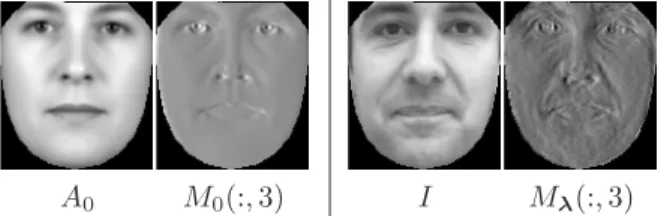
an adaptation on the motion template corresponding tox -translation (parametert3) is illustrated on Fig. 2. Adapting
the motion templates with Eq. (8) thus compensates for tex-ture variation within the inverse compositional framework. Resorting back to vector notation for images, we can re-write compactly the least squares problem to be solved as
min 1
2σ2kE(q)−Hλdq ′
k22, (9)
whereE(q)is the current texture error given by Eq. (3);
Hλ=Mλ Ais theN×(m+n+6)compound matrix of
A0 M0(:,3) I Mλ(:,3)
Figure 2. Left: Mean textureA0 andx-tranlation mean motion template (third column ofM0).Right: Target imageIand corre-sponding adapted motion template (third column ofMλ).
steepest descent images; anddq′
=
dp˜
dλ˜′
is the vector of the shape and reparameterized texture parameters. Invoking the normal equations yields, respectively, the least-squares estimate and corresponding covariance matrix
dq′ =σ−2ΣqHT λE(q) (10a) Σq=σ2(HT λHλ) −1=σ2 MT λMλ MλTA ATMλ ATA −1 . (10b)
Similarly to [16], we can consider Eq. (10) in partitioned form, separating the shape and texture components of the solution. This yields the shape parameter update
dp˜= (M′T λ M ′ λ) −1MT λP E(q), (11)
where we have defined (a) the projection matrix P =
I − A(ATA)−1AT (it projects vectors to the comple-ment of the subspace spanned by the columns of A = [A01N×1A1. . . Am]) and (b) the project-outN×(4 +n)
motion template matrixM′
λ =P Mλ, whose columns
con-tain the motion template images after being projected by
P. Note that if we similarly define the fixed matrices
M′
i =P Mi, then from Eq. (8) we obtain
M′ λ=M ′ 0+ m X i=1 λiM ′ i. (12)
After computingdp˜ using (11), the texture parameter up-date can be computed by
dλ˜′= (ATA)−1AT(E(q)−M
λdp˜). (13)
Note that(ATA)−1AT is also a non-changing(2 +m)×N
matrix and thus can be precomputed.
After dλ˜′ has been computed, we rectify the original
texture parameterization by inverting (7), setting dλ =
dλ′
+u1λ, which yields the final inverse-compositional
es-timates for dλ˜ = [duT, dλT]T anddq = [dp˜T, dλ˜T]T;
note that recovering the original texture parameterization does not affect the covariance matrixΣqof Eq. (10b). We subsequently update the model parameters using the newly computed increments, as follows: (a) Themeigen-texture
parametersλare updated additively,λ←λ+dλ. (b) The
2 gain/offset correction parameters uare updated inverse-compositionally,Tu←Tu◦T
−1
du (simple closed form solu-tion). (c) The4 +nwarp parametersp˜are updated inverse-compositionally according to Eq. (4) – a practical algorithm to achieve this is given in [19], while in Sec. 4.1 we provide an alternative approach through computation of the inverse-compositional to forwards-additive Jacobian matrixJp, in˜
which case we havep˜←p˜+Jp˜dp˜.
In the approach we have described so far, the parame-ter incrementsdq′
are computed from the current synthesis error imageE(q)using the mappingK(q) = σ−2ΣqHT
λ
(see Eq. (10a)) whichadaptsas the search progresses, de-pending to the current estimate of the texture parameterλ.
Actually the parameter updates given in Eq. (10a) are iden-tical to those of the accurate simultaneous algorithm of [15]. However, our derivation lends itself to a more efficient im-plementation, since using our partitioned formulas of (11) and (13) is preferable to directly solving (10a) for the com-bined shape and texture vectordq′
as is done in [15]. Moreover, the very efficient project-out algorithm of [19] can actually be derived if we use theunadaptedmotion tem-platesM0which correspond to the mean texture imageA0
instead of the properMλ,i.e. settingMλ′ =M ′
0in Eq. (11).
Our derivation thus makes clear why the project-out algo-rithm fails in the case of images with substantial texture variability such as the generic-face AAM studied in [15], where the previous approximation can be very crude. As we expect, the adapted motion templates for textures very dif-ferent from the mean texture can significantly diverge from their unadapted versions.
Are there any algorithms that lie somewhere in-between the simultaneous and project-out algorithms, both in terms of computational cost and performance? The answer is pos-itive: we can in general onlypartially adaptthe motion tem-plates by retainingr,0≤r≤mout of themconstituents of the fully-adapted motion templates of Eqs. (8) and (12),
i.e. make the approximations
Mλ≈M0+ r X i=1 λiMi, M ′ λ≈M ′ 0+ r X i=1 λiM ′ i (14)
We callrtheorderof our algorithm. One can actually quan-tify the error incurred by this approximation to the least-squares solution using matrix perturbation analysis tech-niques from the numerical linear algebra literature [17], showing, for example, that the approximation causes non-zero steady-state matching error, but this is beyond the scope of the present paper. Note that the fully-adapted si-multaneous algorithm corresponds tor=m, while the un-adapted project-out tor = 0. Also note that, since only theλ1:r part ofλis needed in Eq. (14) for computing the
approximate motion templates, we need compute only the firstr+ 2elements ofdλ˜′in Eq. (13). Hence, in computing
E(q)by Eq. (3) the sum needs only extend from1tor. The computational cost of the variable-order inverse compositional algorithm will be analyzed now. For solv-ing Eqs. (11) and (13), we must first computeE(q),Mλ,
andM′T λ M
′
λ; all other terms remain fixed and can be
pre-computed. RegardingE(q), the needed firstrterms in the sum of Eq. (3) can be computed, with cost O(rN). The approximate motion templatesMλcan be computed using
Eq. (14) with costO(rN). The cost of computingM′T λ M
′ λ
straightforwardly, as is done in [15], isO(N n2). Signifi-cant savings can be obtained if we precompute the correla-tionmatricesRij =Rji =Mi′TM ′ j+M ′T j M ′ i, fori6=j, andRii=Mi′TM ′ i, wherei, j= 0, . . . , m, similarly to [3];
note that each of theRijis a(n+4)×(n+4)matrix. Then:
M′T λ M ′ λ≈R00+ r X i=1 λi Ri0+ i X j=1 λjRij (15)
This means that M′T λ M
′
λ can be computed in O(r 2n2)
cost, which usually is much better than the O(N n2) of
the straightforward approach. For the adapted algorithms (r > 0), the system matrixM′T
λ M ′
λchanges and thus we
should add the O(n3) cost of matrix inversion. Taking
all contributions into account, the cost per iteration of the adapted rank-rprocedure isO r2n2+ (n+r)N +n3
; note that for the unadapted project-out algorithm (r = 0) the matrix inverse can be precomputed and thus the cost per iteration isO n2+nN
.
3.2. Adaptation Through Mean Template Update
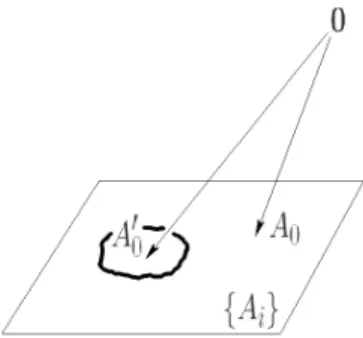
Adapting the AAM fitting matrix through the motion template adjustment technique just described compensates for the departure of the target image texture from the model’s mean texture. With the order-r algorithm we are allowed utilizing the first r eigen-textures to decrease the mismatch. An alternative approach we pursue here is bring-ing the mean template textureA0itself nearer to the targetimages, as illustrated in Fig. 3.
By observing Eqs. (14) and (15) one realizes that the er-ror of the order-ralgorithm will be negligible if all param-etersλi fori > rcan get sufficiently small. In particular,
if all neglected coefficients are zero, then the algorithm is exact. This implies that for our order-ralgorithm replacing the original mean texture vectorA0with its adapted version
A′ 0=A0+ m X i=r+1 λiAi (16)
completely eliminates the approximation error. In case that we pre-compute the correlation matrices Rij, we need to
update those of them that depend on the mean texture A′ 0
Figure 3. By updating the mean template texture fromA0toA′0, whereA′
0is nearer to the target images but still lying in the orig-inal affine space A0 + span{Ai}, the model’s representational
power remains the same. The benefit is that the motion template mismatch of the order-ralgorithm can be reduced.
Procedure Complexity
Fitting iteration O r2n2+ (n+r)N+n3
Template update O m(m−r)n2
Table 1. Computational cost for a single fitting iteration and the mean template update for varying adaptation orderr. N: number of texture samples;n/m: number of eigenshapes/eigentextures.
and are involved in the order-rapproximation (15):
R′ i0=Ri0+ m X j=r+1 λjRij, i= 1, . . . , r R′ 00=R00+ m X i=r+1 λi Ri0+ i X j=r+1 λjRij (17)
The cost of the template update procedure is thusO m(m−
r)n2
. Note that this cost decreases asrgets bigger and gets zero for the simultaneous algorithm (r=m), for which the template update has no effect. This is exactly the oppo-site trend to the fitting cost we studied previously, which increases with the order of the algorithm. We summarize our complexity results in Table 1.
Note that our approach should not be confused with gen-eral parametric model adaptation algorithms such as the one presented in [20]; there the goal is to change the mean tex-ture vectorA0and eigentexturesAiso that the texture space
spanned by the model changes, adapting to the objects seen after the training phase of the model. In contrast, the mean texture update procedure we propose is just a technique that makes model fitting accurate when using low-rank algo-rithms, but otherwise leaves the representational power of the model unchanged.
4. Incorporating Prior Information
Active Appearance Models exhibiting considerable vari-ability are often used in applications. For example, track-ing previously unseen faces requires buildtrack-ing generic face
AAMs trained on big multi-person face datasets. These models are necessarily very diverse, comprising a large number of shape and particularly texture modes. In fitting such non-specific AAMs to images, minimizing the norm of the error image is typically inadequate, and incorporating additional prior information is crucial for regularizing the solution and improving the robustness of the method. This prior information is typically either provided by the system dynamic equation in the context of object tracking appli-cations, or induced as a static PCA prior parameter model learnt from the training set.
Introducing prior constraints, the penalized error func-tional which needs to be minimized becomes
f(q) = 1
2σ2kE(q)k 2
2+Q(q), (18)
where the error imageE(q)is given by Eq. (3) andQ(q) =
1
2(q−q0) TΣ−1
q,0(q−q0)is a quadratic penalty
correspond-ing to Gaussian prior with meanq0and covariance matrix
Σq,0, respectively. In incremental image matching, we
it-eratively improvef(q). This is straightforward for the for-wards additive parameter update strategy, where one mini-mizesf(q+dq)over theforwards-additiveparameter up-date vectordq[9]. In the inverse compositional case, we minimizef(q+Jqdq)over theinverse-compositional pa-rameter update vector dq, where the Jacobian matrixJq converts the inverse compositional parameter update to its forwards additive first-order equivalent. The parameter up-date formula for the maximum aposterioriqM AP is: qM AP ←Σq,M AP Σ−1 q,0q0+(JqΣqJqT) −1(q M AP+Jqdq) (19a) Σ−1 q,M AP = Σ −1 q,0+ (JqΣqJqT) −1, (19b)
where the least-squares parameter update estimatedqand the corresponding covariance matrix Σq are the inverse-compositional domain quantities computed in Section 3.2.
4.1. Including Priors into Flexible Warp-based
In-verse Compositional Algorithms
To utilize the constrained parameter update Eq. (19b), we need to compute the parameter JacobianJq. Concen-trating on the shape parametersp˜(since the texture param-eters λ are updated additively), we need to compute the
(4+n)×(4+n)Jacobian matrixJp˜which maps the
inverse-compositional incrementdp˜to its additive first-order equiv-alentJ˜pdp˜. While [1] has addressed that for the simple case of globally affine warps, computing it for the more flexible warps used in AAM has not been reported before.
We start from the approximate relationshipW(x; ˜p+
J˜pdp˜)≈W W(x;−dp˜); ˜p, which holds for all pointsx in the image plane to first order indp˜[1, 19]. Differientia-tion w.r.t.dp˜yields ∂W ∂p˜ (x;˜p)Jp˜ =− ∂W ∂x (x;˜p) ∂W ∂p˜ (x;˜p=0). (20)
If we apply Eq. (20) for each landmark xl,l = 1, . . . , L,
and then solve forJp, we obtain the least-squares estimate˜
Jp˜ =− ∂W ∂p˜ T (x1:L;˜p) ∂W ∂p˜ (x 1:L;˜p) −1 ∂W ∂x (x1:L;˜p) ⊙∂W ∂p˜ (x1:L;0) , (21) where ∂∂W˜p (x 1:L;˜p)
is the(2L)×(4 +n)matrix stacking the derivatives evaluated on theLlandmark positions in the base shape for shape parametersp˜, and⊙denotes an ap-propriate stacked block-by-block matrix product. Compu-tation of∂∂Wp˜ on the landmark points is straightforward. For the ∂∂Wx terms, it can be shown that for the often used thin-plate spline warps [7] most of the cost can be moved to a pre-computation stage. Overall, computation of the Jaco-bianJp˜ is quite efficient, dominated by the formation and
inversion of the system matrix in Eq. (21) with complex-ityO n2L+n3
. Further details are given in the paper’s online Appendix available from the authors’ web page.
5. Experiments
To evaluate the proposed approach, we have carried out face matching experiments on both static images and video sequences using AAMs trained on multi-person datasets.
Our first set of face matching experiments on static im-ages utilizes the frontal image sets of the XM2VTS database [21]. This dataset contains frontal images of 295 subjects; each of the subjects was photographed during 4 different sessions at approximately 1 month intervals, with 2 im-ages acquired per session, for a total of 2360 shots. Our second set of experiments on face tracking in video se-quences utilizes a 5000 frame long video of a single talking person, publicly available from the FGnet project (http: //www-prima.imag.fr/FGnet). All images are in color and at 720x576 pixels resolution. Markup of 68 facial landmarks on all images of both the XM2VTS (manual) and talking face datasets (semi-automatic), also publicly avail-able from FGnet, facilitates evaluating the matching perfor-mance of the different fitting algorithms.
For AAM fitting on static images, we have trained a model on 150 faces (those without facial hair/glasses) in XM2VTS’s first session. We use a color AAM sampled at 3000 points, resulting inN = 9000texture samples in the finest scale. Performing PCA analyses and retaining 80% of the shape variance and 95% of the texture vari-ance has yieldedn = 11 andm = 87shape and texture modes, respectively. During fitting, 3 scales of a gaussian pyramid are used, stopping at each scale after a maximum of 10 parameter updates or when the maximum shape dis-placement between consequtive iterations gets less than 1 pixel. We test the performance of the different algorithms on 166 images of the second session (those without facial
Use Adaptation Pt-Pt Conv. Mean Fit Prior Orderr Error Freq. # Iter Speed
(pix.) (%) (fps) no 0 10.30 66.8 5.20 4.5 m/2 9.12 71.6 4.79 2.6 m 8.58 74.1 4.79 1.7 yes 0 4.84 97.2 4.05 3.0 m/2 4.61 98.9 3.08 2.5 m 4.56 98.9 3.12 1.8
Table 2. XM2VTS face matching results.
hair/glasses). Following [10], we systematically displace the model’s mean shape from the ground-truth position by [−20,−10,0,10,20] pixels in the x−direction and simi-larly in they−direction (25 displacements for each of the 166 images, totaling 25×166 = 4150runs for each of the algorithms). We report the mean point-to-point error (in pixels) of each landmark of the converged shape from its ground-truth position (averaged over the L landmarks and all runs), the frequency of convergence, defined as the proportion of searches with error less than 10 pixels, the mean number of fine-scale iterations before convergence, and the speed of the search (in frames/sec). Timings refer to our Matlab implementation on a 2.2 GHz laptop com-puter. Some critical sub-routines have been implemented as MEX files; most notably, since AAM fitting necessitates repeated image resampling,i.e. computingI(W(x,p))for each iteration of the algorithm, this has been implemented using OpenGL and is GPU-accelerated. We conducted the experiment once without using a prior constraint, and once with a PCA-based prior on the shape and texture param-eters. Three values for the adaptation order-r have been used, namely r = 0(project-out),r = m/2, andr = m
(simultaneous). The results are summarized in Table 2. We see that on this challenging dataset using a prior constraint vastly improves the AAM fitting robustness, raising the fre-quency of search convergence from around 70% to nearly 99%. Increasing the order-rof motion template adaptation also improves performance, but to a smaller extent. It is also notable that constrained models also converge in fewer iterations. Regarding the efficiency of the algorithms, the computational overhead of using a prior model is milder than that of increasing the adaptation order-r.
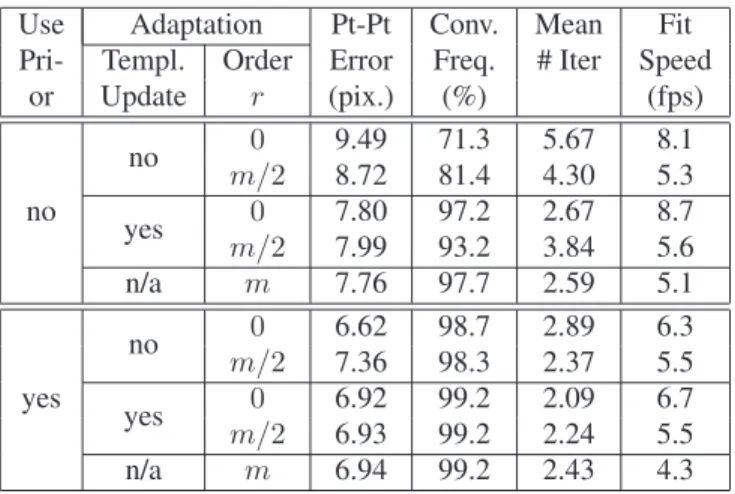
The same XM2VTS-trained AAM model described above was also utilized for face tracking on the talking face sequence. At the first frame and also whenever the search diverged (mean point-to-point error more than 10 pixels) the model was (re-)initialized with the ground truth shape, otherwise the result on the previous frame was used as ini-tial condition. Only the finest resolution AAM model was utilized. For this experiment, we evaluate the performance of ther = 0, m/2 models both with and without the tem-plate update adaptation technique. When temtem-plate updating
Use Adaptation Pt-Pt Conv. Mean Fit Pri- Templ. Order Error Freq. # Iter Speed
or Update r (pix.) (%) (fps) no no 0 9.49 71.3 5.67 8.1 m/2 8.72 81.4 4.30 5.3 yes 0 7.80 97.2 2.67 8.7 m/2 7.99 93.2 3.84 5.6 n/a m 7.76 97.7 2.59 5.1 yes no 0 6.62 98.7 2.89 6.3 m/2 7.36 98.3 2.37 5.5 yes 0 6.92 99.2 2.09 6.7 m/2 6.93 99.2 2.24 5.5 n/a m 6.94 99.2 2.43 4.3
Table 3. Talking person face tracking results.
is enabled, we fit with the fully adaptedr=mmodel every 20 frames, and then update the template using this reliable fit result (we found that updating the template after fitting with the reduced rank model gives significantly worse re-sults). We report in Table 3 the same summary statistics as in the previous experiment. The efficiency of the template update strategy is impressive: ther= 0model in conjunc-tion with the update strategy is almost indistinguishable in performance from the fully adapted modelr = m, while being significantly faster than it. Moreover, since the up-datedr= 0model also converges much more rapidly than its non-updated counterpart, it is also faster than it on av-erage, more than amortizing the overhead of the template update step. This suggests that the combination of the very efficientr = 0model with the template update strategy is particularly well-suited for real-time object tracking.
6. Conclusion
We have proposed two enhancements to inverse-compositional AAM fitting algorithms, which significantly improve the fitting performance of models exhibiting sig-nificant appearance variation, such as AAMs trained on multi-subject human face images. Especially for tracking in video, the proposed algorithms give clearly better results than previous approaches, while still being very efficient.
References
[1] S. Baker, R. Gross, and I. Matthews. Lucas-Kanade 20 years on: A unifying framework - Part 4. Technical Report CMU-RI-TR-04-14, Robotics Institute, CMU, 2004.
[2] S. Baker and I. Matthews. Equivalence and efficiency of im-age alignment algorithms. InProc. CVPR, volume 1, pages 1090–1097, 2001.
[3] A. Batur and M. Hayes. Adaptive active appearance models.
IEEE Tr. on Image Proc., 14(11):1707–1721, 2005. [4] J. R. Bergen, P. Anandan, K. J. Hanna, and R. Hingorani.
Hi-erarchical model-based motion estimation. InProc. Europ. Conf. on Comp. Vision, pages 237–252, 1992.
[5] M. J. Black and A. D. Jepson. Eigentracking: Robust match-ing and trackmatch-ing of articulated objects usmatch-ing a view-based representation.Int. J. of Comp. Vision, 26(1):63–84, 1998. [6] V. T. Blanz and T. Vetter. Face recognition based on fitting a
3D morphable model.IEEE Tr. on PAMI, 25(9):1063–1074, 2003.
[7] F. L. Bookstein. Principal warps: Thin-plate splines and the decomposition of deformations. IEEE Tr. on PAMI, 11(6):567–585, 1989.
[8] T. F. Cootes, G. J. Edwards, and C. J. Taylor. Active appear-ance models.IEEE Tr. on PAMI, 23(6):681–685, 2001. [9] T. F. Cootes and C. J. Taylor. Constrained active appearance
models. InProc. ICCV, volume 1, pages 748–754, 2001. [10] T. F. Cootes and C. J. Taylor. An algorithm for tuning an
active appearance model to new data. InProc. BMVC, 2006. [11] D. DeCarlo and D. Metaxas. Optical flow constraints on de-formable models with applications to face tracking.Int. J. of Comp. Vision, 38(2):99–127, 2000.
[12] F. Dellaert and R. Collins. Fast image-based tracking by selective pixel integration. InProc. of ICCV Workshop on Frame-Rate Vision, 1999.
[13] R. Donner, M. Reiter, G. Langs, P. Peloschek, and H. Bischof. Fast active appearance model search us-ing canonical correlation analysis. IEEE Tr. on PAMI, 28(10):1690–1694, 2006.
[14] M. Gleicher. Projective registration with difference decom-position. InProc. CVPR, pages 331–337, 1997.
[15] R. Gross, I. Matthews, and S. Baker. Generic vs. person specific active appearance models.Image and Vision Comp., 23:1080–1093, 2005.
[16] G. Hager and P. Belhumeur. Efficient region tracking with parametric models of geometry and illumination. IEEE Tr. on PAMI, 20(10):1025–1039, 1998.
[17] N. J. Higham. Accuracy and Stability of Numerical Algo-rithms. SIAM, 2 edition, 2002.
[18] M. J. Jones and T. Poggio. Multidimensional morphable models: A framework for representing and matching object classes.Int. J. of Comp. Vision, 22(2):107–131, 1998. [19] I. Matthews and S. Baker. Active appearance models
revis-ited.Int. J. of Comp. Vision, 60(2):135–164, 2004.
[20] I. Matthews, T. Ishikawa, and S. Baker. The template update problem.IEEE Tr. on PAMI, 26(6):810–815, 2004. [21] K. Messer, J. Matas, J. Kittler, J. Luettin, and G. Maitre.
Xm2vtsdb: The extended m2vts database. InAVBPA, 1999. [22] S. Romdhani and T. Vetter. Efficient, robust and accurate
fitting of a 3D morphable model. InProc. ICCV, pages 59– 66, 2003.
[23] J. Saragih and R. Goecke. A nonlinear discriminative ap-proach to AAM fitting. InProc. ICCV, 2007.
[24] H.-Y. Schum and R. Szeliski. Construction of panoramic image mosaics with global and local alignment. Int. J. of Comp. Vision, 16(1):63–84, 2000.
[25] S. Sclaroff and J. Isidoro. Active blobs: region-based, de-formable appearance models. Comput. Vis. Image Underst., 89:197–225, 2003.
[26] R. Szeliski. Image alignment and stitching: A tutorial.
Found. and Trends in Comp. Graphics and Vision, 2(1):1– 104, 2006.