Improving Libraries
for Learners
How good are we at supporting learning
and meeting learning needs?
Improving Libraries for Learners
supporting learning and meeting learning needs
1. Introduction
2
2. Self-evaluation for improvement
4
3. Self-evaluation questions and templates with signposts to eff ective practice 5
Appendices
I. Putting the continuous cycle of improvement into practice 13
II. Online resources 15
III. Acknowledgements 16
1. Introduction
This guide to self-evaluation and improvement builds upon the advice given in the publications Taking a Closer Look at the School Library Resource Centre (1999)1 and
Libraries Supporting Learners (2005)2. It has been
produced in consultation with colleagues from Her Majesty’s Inspectorate of Education, who welcome its positive messages about the important role of school library resource centres and staff in helping children and young people develop the four capacities of Curriculum for Excellence.
The guide can help teaching and library resource centre staff in schools and central library support services to self-evaluate and improve learning. It is intended for use by all who teach, support and improve the learning experiences of children and young people in schools. It seeks to help all staff to recognise How good are we now? and identify what needs to be done to decide How good can we be?
A wide range of reading materials, learning resources and information helps to support the development of successful learners and confi dent individuals. Promoting independent learning skills supports lifelong learning and encourages children and young people to grow as responsible citizens and make an eff ective contribution to society. In the school library resource centre , children and young people have the opportunity to exercise their entitlement to access information and to develop literacies in a supportive environment.
The nature of school library resource centre provision varies across Scotland, depending on the local authority; however, libraries are part of a wider resource-sharing, information and support network. In addition to book collections and libraries in educational establishments, there are 554 community libraries and 81 mobile libraries, some of which make visits direct to primary schools. 87% of secondary schools and 67% of primary schools are within a fi ve minute journey of a public library3. The network of libraries supporting learners
includes colleges and higher education establishments. The National Library of Scotland also off ers support through their education programmes.
In early years’ establishments, there might be a book corner whilst almost all secondary schools are staff ed by professional librarians. Primary and special schools do not usually have a full-time, dedicated member of staff managing and promoting the school library
resource centre. These educational establishments are often heavily reliant on learning assistants, volunteers and support provided centrally by local authorities. The professional and practical help available from central support services has an important contribution to make to the quality improvement processes outlined in this document.
school. Beginning with the development of literacy and numeracy through Bookstart, libraries in communities help to build confi dence, skills and a lifelong love of reading. Children progress to applying newly acquired writing, reading and numeracy skills, gaining confi dence and motivation. From small book corners in classrooms to the school library resource centre, all contribute to exposing learners to a wide range of ideas, information and writing styles which inspire and share knowledge. Literacy and numeracy are at the centre of the new cur-riculum and libraries support reading for pleasure and reading for information to support classwork, projects and homework.
Curriculum for Excellence provides excellent opportunities for cross-curricular projects. The developing nature of these projects means that resources often have to be drawn from varied sources. Well-planned collaboration allows teaching and school library resource centre staff to empower young people to develop research skills and encourages them to develop into lifelong learners. Successful libraries generate a vibrancy that can help meet the needs of all learners, and encourage imagination, creativity, independent study and personalised learning. The specifi c contribution of the school library resource centre includes:
• providing a unique and stimulating learning environment;
• promoting the eff ective use of a wide range of good quality information;
• developing information literacy skills and ethical use of information;
• using technologies well in learning and teaching; • developing literacy skills;
• promoting the enjoyment of reading, for learning and life.
Signposts to eff ective practice have been included in the document. These demonstrate how children and young people are introduced to the joys of reading for enjoyment, fi nd and use information, and develop their abilities to learn independently and in groups. Through skills development and access to creative and
stimulating resources, teaching and school library resource centre staff across schools help children and young people to nurture the aptitude to pursue lifelong learning and personal interests. Information literacy skills underpin purposeful use of technologies and the development of these skills should be facilitated from the earliest stages.
The document outlines how quality indicators can be used by school and local authority staff to illustrate the impact of eff ective practice on learning and teaching and raising attainment. This in turn will enable eff ective planning for improvement.
Curriculum for Excellence:
How school libraries support the development of the four capacities
Supporting successful learners through:
• exploring the structure and sequence of stories
• fi nding out about how words work: the pattern and shape, rhythm and sound of words
• developing listening and talking skills • acquiring analytical skills
• making critical personal responses to texts • choosing and reading more demanding texts
• developing presentation skills to engage others with their ideas
• learning how to use a school library resource centre well
• understanding and developing information literacy • using websites constructively for research
• learning how to prepare a detailed bibliography
Encouraging responsible citizens through:
• learning to care about and share books
• developing a greater understanding of other people, beliefs and cultures
• developing sensitivity to the needs, feelings and interests of others through engagement with texts and respecting others in the school library resource centre environment
• being involved in school library resource centre developments
• using careers information eff ectively to infl uence learning and life choices
• being involved in school library resource centre activities supporting citizenship initiatives • taking part in cultural events
• developing informed and ethical viewpoints • researching projects and appropriately
acknowledging sources of information and ideas • developing good personal judgement by
understanding and recognising persuasion, opinion and bias
• using ICT responsibly
Developing confi dent individuals through:
• applying library skills across other contexts
• experiencing a range of feelings in response to texts in a safe environment
• building on familiar patterns to predict outcomes in texts and understand the power of reading
• trusting personal preferences when choosing texts • learning independently, in pairs and groups to carry out research and presentation tasks
• eff ectively skimming, scanning and note-making to support learning
• using resources well for a range of purposes and audiences
• planning research, with no or little support
• carrying out peer and self-evaluation as part of school library resource centre activities
Creating eff ective contributors through:
• sharing experiences, stories and opinions with other children, young people and adults
• developing the ability to ask appropriate questions about texts
• using resources well to develop knowledge and understanding, and critical thinking
• helping with school library resource centre or literacy activities which develop leadership skills
• taking part in activities which develop and sustain arguments, opinions and debate
• being part of a team through opportunities provided in and by the school library resource centre
2. Self-evaluation for improvement:
• encourages staff at all levels to refl ect upon practice and identify the strengths and areas for improvement; • recognises the work staff are doing which is already having a positive eff ect on the lives of children and young people;
• identifi es where improvement is needed; and
• informs children, young people, staff , parents and others about the quality of the school library resource centre. When we self-evaluate, we look honestly but critically at our practice and at the services we provide with a view to improvement. Put simply, self-evaluation for improvement broadly focuses on answering two questions about our practice:
How good are we now?
This helps us to identify our strengths and development needs in key aspects of our work and the impact our work has on children and young peoples’ learning and support for staff .
How good can we be?
We ask this question to help us set priorities for improvement.
Self-evaluation, to be meaningful, has to focus on on-going improvement to practice. It is not a one-off activity which is done for its own sake. It is a dynamic process which goes on throughout the year. Self-evaluation establishes a baseline from which to plan improved outcomes for children, young people and staff . It supports partnerships with our stakeholders to set priorities and change. After we have taken planned action, on-going self-evaluation helps us to monitor our progress and determine impact.
For more information on self-evaluation and how to use this guide, go to www.slainte.org.uk.
In the context of the school library resource centre, the most relevant quality indicators within the HGIOS4
framework are:
2.1 Learners’ experiences 5.3 Meeting learning needs
5.9 Improvement through self-evaluation
Other quality indicators may also be useful within individual circumstances.
While the process of self-evaluation is important, the priority is the quality of the outcomes for children and young people.
In the context of the school library resource centre, the most relevant quality indicators within the HGIOS framework are:
2.1 Learners’ experiences 5.3 Meeting learning needs
5.9 Improvement through self-evaluation
Other quality indicators may also be useful within individual circumstances.
While the process of self-evaluation is important, the priority is the quality of the outcomes for children and young people.
3. Self-evaluation questions and templates with
signposts to eff ective practice
The following pages contain selected indicators from How good is our school?(Part 3) with key questions which we use to evaluate the quality of supporting learning and meeting learning needs. Each page sets out some questions and signposts to eff ective practice in relation to the quality indicator. There is an example of a template in Appendix I that can be used when recording strengths and areas for development and it is important that we prioritise the key aspects that need to be developed. These, and the actions taken to realise them, will form our action plan for improvement.
There is a key question that we should consider in relation to supporting learning and meeting learning needs. The table can be used to record a summary of the overall evaluation for each quality indicator and the proposed actions.
Quality Indicator
2.1 Learners’ experiences
5.3 Meeting learning needs
5.9 Improvement through self-evaluation
Key Questions
How well are children and young people motivated and actively involved in their own learning and
development, showing increasing skills as learners? What evidence is there that tasks, activities and
resources provide appropriate support and challenge to enable all to achieve?
What evidence is there that the self-evaluation resulted in measurable and
observable improvements in the quality of the service, and has made a positive impact on the achievements and experiences of children and young people?
Evaluation 1-6 Priorities for Action Priorities for Action
Quality Indicator 2.1 Learners’ experiences
Themes
• The extent to which learners are motivated and actively involved in their own learning and development
Signposts to eff ective practice
Children and young people are motivated and actively involved in their learning and development because they: • enjoy using the school library resource centre and do so eff ectively;
• are developing as keen, confi dent readers;
• increasingly select appropriate learning resources with confi dence;
• are confi dent in challenging what they read, view and hear and feel able to express their views; • increasingly take responsibility for their own learning and personal development;
• refl ect eff ectively on their learning experiences;
• use their skills constructively while taking part in dynamic, interdisciplinary learning opportunities; • are progressing as confi dent, responsible, independent learners.
Primary School
The school’s aim is to enhance children’s learning experiences. Library stock selection guidelines are used well to match materials to the age and abilities of children. Children are involved in choosing new books. The use of the book corner is integral to planned learning activities. It has become a stimulating and challenging area, which provides appropriate opportunities for children to be actively involved in learning through reading and sharing stories. The book corner is available at all times and children are encouraged to use it independently.
Staff use imaginative and appropriate methods to ask children about their reading choices and act upon their views and interests. Children are fully engaged, highly motivated and interact well during activities. They exercise choice and take increasing responsibility for their own learning. Children are increasingly able to co-operate with other children and take turns during shared reading activities. The reading activities and choices sustain children’s interest, help them make decisions, solve problems and develop independence. Children actively plan and initiate their learning experiences, with support from school library resource centre staff . Children are regularly consulted on book corner development and this has encouraged a sense of ownership, which is refl ected in active use of the
book corner.
Key question
How well are children and young people motivated and actively involved in their own learning and development, showing increasing skills as learners?
Sources of evidence
Own and others’ observation of and refl ection on engagement in learning
Focus groups and individual conversations
Analysis of feedback from questionnaires and discussions Plans and timetables
Children’s and young people’s work Written evaluations
Forrester High School, City of Edinburgh Council
Using digital storytelling techniques, young people were invited to create a multimedia project from their own imagination in the Animation Club run by the librarian at lunchtimes. They wrote and designed their own storyboards which were fi lmed using digital video, photographed or animated. A variety of learning methods were used and young people experienced in-house workshops on multimedia techniques. Each group had access to a separate camera, computer, software and lighting as needed for them to fi lm eff ectively and effi ciently. The collaborative approach utilised staff skills more successfully and made use of in-house expertise across the school. In terms of
Curriculum for Excellence, the Animation Club delivered against all the four capacities, especially becoming eff ective contributors. This included the young people relating to others and managing themselves, assessing risk and making informed decisions, evaluating technological issues and developing informed ethical views of complex issues.
Castlemilk High School, Glasgow City Council
Working with school staff and external partners, the school librarian has taken part in a literacy project created by the school’s Support for learning department which aims to encourage parents to help children with their homework and encourage literacy in the home. The project used research which shows that children and young people who take part in family literacy projects are likely to improve their own literacy levels. Most of the children involved have been identifi ed as having additional needs, and are already working closely with the support for learning department within the school.
The project builds on the tools of reading strand in Curriculum for Excellence. It aims to contribute to raising attainment in reading, and improve the reading ages of those children taking part.
Parents are trained in how to use the paired reading programme by the Support for learning department, and the librarian assists pupils in choosing their books for home paired reading, ensuring children are being challenged while reading at an appropriate level. The librarian also supports the paired reading programme on a day-to-day basis.
Queensferry High School, City of Edinburgh Council
Our Planet - a Thoughtful Approach, was chosen as a topical interdisciplinary theme to draw departments together under an umbrella project. The project was part of a pilot for L T Scotland (Sustainable Development), and addressed the capacities of Curriculum for Excellence, allowing young people to gain confi dence through independent
learning, citizenship, and leadership. The school library resource centre co-ordinator had a key role in co-ordinating the project, managing information about activities and providing appropriate resources.
Young people were invited to explore confl icting theories about climate change currently in the media, and make their own assessment. Departments addressed the issue in many diff erent ways and it provided an opportunity to support and extend inter-departmental working. Projects included dramas, essay competitions, debates,
construction of models, raps, artwork, indoor cycling competitions, posters and website development. An ‘Our Planet’ day was held to highlight and showcase work done by departments, and to have special events on or around that date. The topic proved a useful vehicle for the school to demonstrate experiential learning linked to Curriculum for Excellence: engagement in interdisciplinary, whole school issues and action research by staff .
Lochend Community High School, Glasgow City Council
Within the context of the NHS Glasgow and Glasgow City Council report Consultation with Glasgow Young People on Sexual Health and Relationships the school librarian and Health Development Offi cer collaborated on an initiative to support the new Sexual Health Relationships Education curriculum to ensure that young people have access to appropriate and thought-provoking resources. A list of recommended books and other resources have been sourced from a variety of local SHRE services. Young people in the school’s Health Summit Group secured funding to buy the identifi ed resources, information holders and display boards from YouthBank, an organisation which encourages young people to apply for funding for projects that will help them/their community. A location close to the entrance of the school library resource centre has been chosen as a suitable high visibility area in which to display the SHRE in-formation. The materials on display are changed on a regular basis to complement current delivery of the lessons in the SHRE curriculum. The school librarian and the Health Development Offi cer provide support, help and guidance to the group but the pupils are increasingly showing leadership and taking ownership of the Health Promotion Area.
Quality Indicator 5.3 Meeting learning needs
Themes
• Tasks, activities and resources • Identifi cation of learning needs
• The roles of teachers and specialist staff
• Meeting and implementing the requirements of legislation
Signposts to eff ective practice
Those responsible for the school library resource centre contribute to meeting learning needs by: • identifying and designing high quality learning experiences to promote creativity and active learning; • building appropriate collections to support a wide range of reading interests and learning needs; • supporting the eff ective use of current, specialised and global information and resources; • helping children and young people develop positive attitudes to reading;
• encouraging young people to develop good information literacy skills and confi dence to use these in a range of situations;
• making appropriate provision, suited to children and young people with additional support needs; • making support and guidance available related to children and young people’s developmental needs; • encouraging and facilitating independent learning in all children and young people;
• working together with staff and partners to embed skills for literacy, learning and life.
Key question
What evidence is there that tasks, activities and resources provide appropriate support and challenge to enable all to achieve?
Sources of evidence
Own and others’ observation of and refl ection on learning and teaching
Sampling of children’s and young people’s work Focus groups and individual conversations
Results from working and planning with staff and other partners
Joint evaluation of learning outcomes Minutes of working groups
Individualised learning plans and reading plans
Feedback from children, young people, staff and partners Examples of specialist provision to meet identifi ed needs
Perth Grammar School, Perth and Kinross Council
The school library resource centre is at the forefront of the school’s Eco-Schools Scotland projects, which are a crucial aspect of the delivery of Curriculum for Excellence, promoting all four capacities by involvement in a range of eco-projects. The school library resource centre assistant is a key member of the Eco Committee and a
committed group of young people meet in the school library resource centre regularly to plan the projects they are involved in. The school recognises that this work helps meet diverse learning needs by providing young people with diff erent ways to learn, achieve success and contribute.
School library resource centre staff help to co-ordinate curricular involvement of departments in Eco- Schools work: supporting teachers to engage in classwork directly linked to eco-issues; collating information; directing staff to appropriate contacts and resources, supporting young people. This approach enables teachers to incorporate eco issues into the curriculum and has resulted in a number of awards, including the Green Flag Award. The school library resource centre staff are enthusiastic about the eco themes and their motivation has led to wider school library resource centre participation in the local authority’s Literacy transition project, which involves cluster primaries and secondary schools, based on an eco-theme. Working with the school’s pupil support department in developing an alternative curriculum for those with signifi cant learning needs, the librarians are helping transform a courtyard in the school into a biodiverse environmental garden. This project is particularly important in the development of the four capacities by young people with additional support needs. Next steps include the school library resource centre taking part in the school’s international link project with Bangladesh, Connecting Classrooms working with
departments to build further on classwork on eco-themes for sharing with new partner schools.
Beeslack High School, Midlothian Council
Curriculum for Excellence’s Literacy Across Learning: Principles and Practice clearly recognises the role of staff across the school in supporting children and young people to develop literacy skills. Working with the head of
English, the school librarian has carried out a literacy audit using the question ‘How am I meeting the literacy needs of the learners in front of me?’ Together, the head of English and the school librarian carefully have mapped the tasks in S1 Read for the Future and S2 PLUS and COOL library programmes to talking and listening, reading and writ-ing outcomes. This clearly shows the ways in which the learnwrit-ing activities delivered in the school library resource centre contribute to meeting learning outcomes. Introducing the school library: Choosing and reading fi ction books
meets these specifi c outcomes:
• ‘Using what I know about the features of diff erent types of texts, I can fi nd, select and sort information from a vari-ety of sources and use this for diff erent purposes’;
• ‘By considering the sort of text I am creating, I can independently select ideas and appropriate information for diff erent purposes, organise essential information or ideas and any supporting detail in logical order. I can use suitable vocabulary to communicate eff ectively to my audience.’
As a result of the audit, school library resource centre programmes and activities have been redesigned to improve the contribution they make to the outcomes. These have been widely promoted in the school.
The Elgin High School, The Moray Council
Seeking support for a whole-school approach to ‘Information Skills’, the librarian started by giving a presentation at an in-service day emphasising the importance of a whole-school approach, highlighting some strategies to put the principles into action. Following up with interested staff , a workshop explored ideas and attracted support from primary schools. An Inter Departmental Information Skills Working Group met to sustain enthusiasm and build up this approach and it was agreed that core skills be taught in S1 by the librarian during an existing research project. Working with the Modern Studies Department as a key partner, young people learnt the main steps in research through an adaptation of the PLUS model and to become more critical of internet resources through CAR (Current? Accurate? Relevant?) To help extend the teaching of these skills across the school, an information skills pack has been developed for all staff . These packs contain posters explaining the core skills of PLUS and CAR which staff are encouraged to display in all classrooms, a copy of the Library/Modern Studies research programme to help staff be aware of the existing knowledge of young people and a set of seven simple recommendations to help foster a shared approach. Young people are given an A5 version of the PLUS model in their homework planners. The project has been built up over 2 years and already feedback is positive. Confi dence and competence amongst young people using information skills is growing and increasing numbers of staff are opting into the initiative.
Gracemount High School, City of Edinburgh Council
The school librarian took the lead in a Shared Reading Pilot for the Royal Mail Book Awards5 within a learning
community. Working with S2 classes, which included some reluctant readers, she initially trained them in the
techniques of sharing picture books with younger readers in an associated primary and a nearby special school. Once confi dent, these young people led shared reading sessions in these schools. Skills were cascaded to the young people in the special school and both groups then worked together in delivering sessions to younger children. The impact of this initiative on the young people, especially boys, has been to raise self-esteem, develop confi dence in reading and improve their inter-personal skills. All of the children and young people related well to the S2 group and their interest in reading for enjoyment increased. All involved felt valued members of their wider learning community.
Lourdes Secondary, Glasgow City Council
Although staff from across the school had in the past brought classes to the school library resource centre for specifi c activities, recently they have become aware of how each of these visits contributes to the development of a set of higher order skills for learners. The school library resource centre is used for a variety of activities linked to
Curriculum for Excellence and the development of independent learning skills. English classes in S1/2 combine work on Reading for Pleasure, Reading for Information and core ICT skills when preparing critical essays on books they have read and argumentative essays. All year groups use the school library resource centre to allow young people to work on their problem-solving skills in Mathematics. This involves a range of approaches, including teaching a topic in class before carrying out complementary work using the school library resource centre’s ICT suite, or giving young people access to a selection of ‘hands-on’ puzzles.
Work that began with using Taskmaster software has developed to the point where young people can access a wide selection of software linked to an extensive ‘bank’ of lesson plans prepared by Modern Languages teachers. The Social Subjects staff have joined in by using the school library resource centre for picture research activities and set-ting up a series of topic-based exercises that are started in class and then completed or extended by returning to the school library resource centre outwith class times. Support for Learning staff contribute to these activities directly by advising on the provision of diff erentiated learning materials. These have helped to make resources more
accessible and resulted in a stock that combines graphic novels, comics, picture books and basic literacy titles to support a variety of additional support needs. These various approaches to active and independent learning are helping young people to develop as successful learners, confi dent individuals, responsible citizens and eff ective contributors.
Quality Indicator 5.9 Improvement through self-evaluation
Themes
• Commitment to self-evaluation • Management of self-evaluation • School improvement
Signposts to eff ective practice
Staff in the school library resource centre use self evaluation for improvement:
• focusing on improving outcomes and impact on children’s and young people’s learning; • working as a team to develop robust quality processes;
• carrying out widespread consultation using a variety of approaches which inform improvements; • communicating well with colleagues about the work and impact of the school library resource centre; • encouraging children, young people and colleagues to participate in evaluating the school library resource centre’s eff ectiveness;
• making very good use of the library management system to analyse and act on statistics and reports; • taking into account departmental and whole school improvement plans;
• being involved in peer evaluation and support; • implementing change leading to improvement;
• thinking creatively about funding sources and using funds eff ectively to meet the needs of all; • collaborating with colleagues and using technologies to share best practice.
Key question
What evidence is there that the self-evaluation resulted in measurable and observable improvements in the quality of the service, and has made a positive impact on the achievements and experiences of children and young people?
Sources of evidence
Self-evaluation documents relating to the impact of service delivery
School library resource centre improvement plan(s) and progress reports
School improvement plan Consultation documents Questionnaires
Peer evaluations (school colleagues/critical friends; external colleagues)
Children’s and young people’s feedback Feedback from other stakeholders
Photographic/video/blog evidence of improved experiences
Secondary School
The librarian has reviewed the current provision, identifying strengths and areas for improvement, because of concerns relating to low use of the school library resource centre by young people and departments. A new vision has been agreed by the school library resource centre development group. This included staff and young people from across the school community to develop the school library resource centre further as a whole school resource. This development underpins cross-curricular working and facilitates diff erent ways of learning at all levels.
The physical appearance has been identifi ed as one of the main areas for improvement to make a better environment for learning. Funding has been found to redecorate, put in new shelving and furniture. The formal layout did not facilitate use, so changes have been made to incorporate a reading corner and to encompass an open plan arrangement with clearly defi ned areas for technology, study and teaching. This has resulted in improved use of the teaching space, an increase in study skills provision and new reading opportunities and initiatives.
Levels of use have greatly increased and staff have noted that young people are now reading more widely, cross-referencing accurately as a result of skills programmes and are confi dent in their use of all the school library resource centre has to off er them. Independent learning and group discussion are integrated into planned library activities. The feedback from the young people and staff shows that the transformation of the school library resource centre has had a positive impact on learning experiences and their attitude to the school library resource centre. The school library resource centre development group continue their role in evaluating impact and subsequent
development work. The school library resource centre is now most defi nitely at the heart of the school.
Secondary School
After considering the impact which the school library resource centre had on learning and teaching, the school librarian has comprehensively self-evaluated and used this process to refl ect on current practice and to help her future planning. She has identifi ed emerging and linked developments, leading to a clear plan to address areas for improvement and ways in which to develop. The need for improved planning and monitoring was clear. The qual-ity of school library resource centre provision has improved and a number of new initiatives have been introduced, including an Information Literacy Skills course, an inter-generation reading group and online study support resource. Take-up of the Information Literacy Skills course has been good and departments can ask for specifi c modules when required, such as citation and referencing, note-making or internet searching. Children and young people in the reading group read and discuss the same novels with older members of their local community, each benefi ting from a wider perspective. The school librarian has created an online resource to assist with study support, skills
development, homework and research. Plans for monitoring and evaluation have been implemented. This is a good example of the school librarian being involved in a whole school issue and actively contributing to a solution.
Appendix I:
Putting the continuous cycle of improvement into practice
City of Edinburgh Council
Desmond Spiers at Craigroyston High School provided this example.
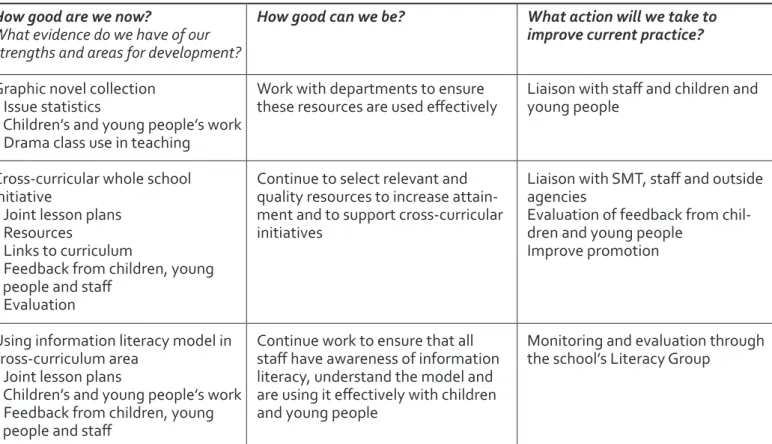
During the development of this framework, some schools used the early draft to prepare for inspection. Keeping in mind the impact on learning, they used a simple, 3 step approach:
• What are we doing? • How good can we be?
• What action will we take to improve current practice?
Quality Indicator 2.1 Learners’ experiences
How good are we now?
What evidence do we have of our strengths and areas for development? Graphic novel collection
• Issue statistics
• Children’s and young people’s work • Drama class use in teaching
Cross-curricular whole school initiative
• Joint lesson plans • Resources
• Links to curriculum
• Feedback from children, young people and staff
• Evaluation
Using information literacy model in cross-curriculum area
• Joint lesson plans
• Children’s and young people’s work • Feedback from children, young people and staff
How good can we be?
Work with departments to ensure these resources are used eff ectively
Continue to select relevant and quality resources to increase attain-ment and to support cross-curricular initiatives
Continue work to ensure that all staff have awareness of information literacy, understand the model and are using it eff ectively with children and young people
What action will we take to improve current practice?
Liaison with staff and children and young people
Liaison with SMT, staff and outside agencies
Evaluation of feedback from chil-dren and young people
Improve promotion
Monitoring and evaluation through the school’s Literacy Group
How good are we now?
What evidence do we have of our strengths and areas for development? Producing regular improvement plan and carrying out on-going self-evaluation
• Self-evaluation documents • Improvement plan
• Progress reports
Evaluating cross-curricular projects • Children’s and young people’s work • Feedback from children and young people, staff and SMT
Receiving regular Performance Development and Review • Action notes
How good can we be?
Produce improvement plan linked to school aims and learning outcomes for children and young people
Ensure feedback from children, young people and staff is acted on to strengthen working partnerships and lead to improvements in learn-ing experiences
Continue to prepare thoroughly and implement the outcomes of
assessments as this will lead to improvements in performance and job satisfaction
job satisfaction
What action will we take to improve current practice?
Continue to be aware of school aims and learning needs
Liaison with Senior Management Team and staff
Create questionnaire for children, young people and staff , which can be added to annual school survey
Liaison with line manager
Continuing awareness of learning outcomes
How good are we now?
What evidence do we have of our strengths and areas for development? Subscription to online databases • Issues statistics
• Web links
• Information skills lesson plan Selecting relevant up to date and attractive resources for curricular and recreational use
• Lists of new resources • Requests
Promoting reading for pleasure • Book reviews
• Children and young peoples’ work
How good can we be?
Encourage use of resources by children, young people and staff to enable and enhance learning Ensure access to resources suited to the learning needs of all children and young people and to support all interests
Motivate children and young people to take part in reading promotions leading to an improvement in reading
What action will we take to improve current practice?
Promote use
Parents’ evening demonstration Monitoring and evaluation
Formalise system of feedback from staff about curricular needs
Continue to encourage use of suggestion slips
Liaison with English and ASL staff Liaison with external agencies
Quality Indicator 5.3 Meeting learning needs
Appendix II:
Online resources
Things to think about
www.slainte.org.uk
The six point evaluation scale
www.hmie.gov.uk
Glossary
www.slainte.org.uk
Professional library support for Curriculum for Excellence
www.slainte.org.uk
Curriculum for Excellence
www.ltscotland.org.uk/curriculumforexcellence/
Scottish Library and Information Council
www.slainte.org.uk/slic/schoollibs/index.htm
HM Inspectorate of Education
www.hmie.gov.uk
The Journey to Excellence
www.hmie.gov.uk/generic/journeytoexcellence
Examples: Curriculum for Excellence and using the school library resource centre eff ectively
www.slainte.org.uk
• City of Edinburgh Council - Curriculum for Excellence and school libraries: the Edinburgh experience www.slideshare.net/scottishlibraries
• Beeslack High School - Curriculum for Excellence in practice II: using the Literacy Experience and Outcomes Framework to evaluate and promote school libraries
www.slideshare.net/scottishlibraries
• Alford Academy – Curriculum for Excellence at Alford Academy www.slideshare.net/scottishlibraries
• Caldervale High School - Geography Department worked with the school library resource centre manager to create a new group-oriented initiative based on co-operative learning principles.
www.ltscotland.org.uk/curriculumforexcellence/sharingpractice/secondary/georgraphyresearch/introduction.asp • Abronhill High School - created the Enriched Readers Programme through a partnership between the School Library Resource Centre (LRC) manager, the transition teacher and the English Department.
www.ltscotland.org.uk/curriculumforexcellence/sharingpractice/secondary/enrichingreaders/introduction.asp • Pitchlochry High School – Radio Heartland
Appendix III: Acknowledgements
Members of the Scottish Library and Information Council Working Group
Marilyn Milligan, Falkirk Council (Chair) Helen Adair, The Moray Council
Rhona Arthur, Scottish Library and Information Council Cleo Jones, City of Edinburgh Council
Frances Walker, Glasgow City Council
Participants in Consultation events
School library resource centre staff in local authorities: Edinburgh, Falkirk and Glasgow
The Moray Council for the work developed by Helen Adair, Quality Improvement Offi cers and school staff HMIe
The Working Group would like to acknowledge the support of HMIe and thank them for their contribution
Curriculum for Excellence examples
Ian McCracken, CILIPS representative on School Library Association All staff who contributed
Scottish Library and Information Council 1st Floor, Building C Brandon Gate Leechlee Road Hamilton ML3 6AU