Realizing co-creation
Master thesis Strategic Management
Faculty of Economics and Business Administration
Tilburg University
Company supervisors:
Drs. M. Sfirtsis
Drs. Ir. T.J.P Goossens PDEng.
University supervisor:
Drs. T.J.G. Peeters
Number of words: 14.048
Lindsay Pluijm
425560
August 3
rd2010
Management summary
The traditional view of the firm as an automonous creator and extractor of value is increasingly redundant. Consumers want to be involved, connected, empowered and active. The joint creation of value by the firm and the consumer through types of consumer-company interaction, which is called co-creation, will have a major impact on businesses in the forthcoming years. While the principles of the process are widely understood, little attempt has been made to identify and distinguish the associated capabilities and managerial implications for organizations. An understanding of the most essential capabilities a firm must deploy in order to co-create successfully and the ways in which managers can shape these conditions specific to their companies would answer a large number of questions co-creation raises for managers.
Within this research project, which was carried out for Van Spaendonck Management Consultants, the literature on co-creation, capabilities and the relation between these two concepts is reviewed. The R = G and N = 1 framework is selected as the most appropriate capabilities classification system in relation to co-creation and the objective of this research. This model’s key principles, R = G and N = 1, define a world in which firms should focus on one customer experience at a time (N = 1) and on access to, instead of ownership of, resources (R) from multiple vendors and often from around the globe (G). Ten managers of well-known co-creating organizations and two experts in the field of co-creation were interviewed to test the applicability of the R = G and N = 1 framework and further enhance our insights into the capabilities question in relation to co-creation.
Between the results of the semi-structured interviews a clear connection was detected. A vast majority of the interviewees repeatedly referred to one of the following themes: leadership, trust, empathy, cultural change, community, flexibility, learning, feedback and mentality. Each of these themes is related to the realization of DART: dialogue, access, risk assessment and transparency. The conclusions imply that organizations are applying the co-creation concept by means of projects without actually learning from it in order to develop the capability to add or subtract appropriate resources to the whole supply network, improve continuously and develop new insights, either for operational improvement or for strategic redirection. This lack of learning during the co-creation process means organizations are not deploying dynamic capabilities, since learning is an essential part of the dynamic capabilities view.
Foreword
This thesis has been written to finish my master’s in Strategic Management at Tilburg University. For executing this research project, I was largely dependent on the willingness of several organizations and experts to participate in an interview. I am very grateful ten managers and two experts in the field of co-creation took the time and effort to participate and would like to thank them for their openness and cooperation. Furthermore, I would like to thank Drs. Thijs Peeters from Tilburg University for his feedback and support during the writing of this thesis.
A special thank you goes to Toni Sfirtsis and Tibor Goossens, my company supervisors, for their feedback, support and enthusiasm during this project. Without their input, this thesis would not be as it is now. Finally, thanks to my ‘colleagues’ at Van Spaendonck Management Consultants, for their keen interest in this research.
Lindsay Pluijm Tilburg, August 2010
Table of contents
Management summary 2 Foreword 3 Chapter 1. Introduction 6 1.1Problem indication 6 1.2Problem statement 7 1.3Research questions 8 1.4Research design 81.5Structure of the thesis 8
Chapter 2. The meaning of co-creation and its most critical dimensions 10
2.1Co-creation: a new concept? 10
2.2The historical roots of an alternative way of value creation 10
2.3Key principles and successful co-creation 13
2.4Styles and types 14
2.5The most critical dimensions in the realization of co-creation 15
2.5.1 Customer participation 15
2.5.2 Organizational design 19
2.6Conclusion 21
Chapter 3. The appropriate capabilities classification and the capabilities needed to realize co-creation 22
3.1Focus on capabilities 22
3.2The dynamic capabilities view 22
3.3Opening the “black box” 24
3.4Filling the gap 24
3.5Capabilities to realize co-creation 27
3.6Conclusion 28
Chapter 4. Research methodology 29
4.1Purpose of the research 29
4.2Semi-structured interview 30
4.3Measurement 31
4.4Interviewing competence 32
4.5Analysis 32
Chapter 5. Results 34
5.1 Customer participation and organizational design 34
5.2 Visibility to processes and data; Transparency, granularity, accuracy, consistency, timeliness 35
5.3Real-time configuration of resources; Capacity, capability, cost 36
5.4Focus on individual choice; Individual’s preferences, skills 37
5.5Capacity to co-create with customers; Willingness, skills, time, community 38
5.6Anticipation of demand and resource needs / customer evolution pathways;
Consumer behaviors, expectations 39
5.7Insights; Continuous improvement, strategic redirection 40
5.8Social architecture 40
5.9Remaining results 41
5.10 Conclusion 42
Chapter 6. Discussion and conclusions 43
6.1Conclusions 43
6.2Managerial recommendation 47
6.3Limitations and implications for future research 47
References 49
Appendix 1: Well-known co-creating organizations 54
Appendix 2: Sample of organizations and experts 55
Appendix 3: General list of interview questions 58
Appendix 4: Checklist 59
Appendix 5: Difficult interview participants 60
Chapter 1. Introduction
This chapter will sketch the symptoms of the problem which is researched. Furthermore, the problem statement and research questions of this project will be presented, followed by a section which shortly explains the design of this research. Finally, the structure of this thesis will be explained.
1.1 Problem indication
A perspective of the firm as an autonomous creator and extractor of value is increasingly redundant. Informed, connected, empowered and active customers challenge the traditional ways of sensing, thinking, and doing (Prahalad & Ramaswamy, 2002). By involving customers at just about any stage of the value chain, value is co-created by the customer and the firm and interaction becomes the locus of value creation (see figure 1.1). Co-creation is one of those concepts that will have a major impact on businesses in the forthcoming years. According to Prahalad and Ramaswamy (2004), the future belongs to companies that can constantly generate new knowledge of customer experiences and identify and enable experience co-creation to support compelling experience environments.
Fig. 1.1. The emerging concept of the market according to Prahalad and Ramaswamy (2004)
Organizations are continuously evolving. They want to change their direction, improve their performance or adapt to their changing external environment. Van Spaendonck Management Consultants helps organizations operating in dynamic business environments in a pragmatic and focused way at which the concept of co-creation is being increasingly
applied. While the principles of this process are widely understood, little attempt has been made to identify and distinguish the associated managerial implications for organizations. Although, in the emerging creation environment, the role of leadership in managing the co-creation process is very essential (Kambil, Friesen, & Sundaram, 1999; Payne, Storbacka, & Frow, 2008; Prahalad & Ramaswamy, 2000). An understanding of the most essential capabilities a firm must deploy in order to co-create successfully and the ways in which managers can shape these conditions specific to their companies would answer a large number of questions co-creation raises for managers. Consequently, these insights would contribute to the quality of the consulting services provided by Van Spaendonck Management Consultants.
1.2 Problem statement
What (type of) capabilities does a firm need to realize co-creation?
The central and dependent variable in this research, co-creation, is best broadly explained as a form of value creation in which value is created jointly by the firm and the customer through (types of) customer-company interaction (Prahalad & Ramaswamy, 2000, 2002, 2004). Although the protagonists in the co-creation process can also be suppliers, experts or other stakeholders who can be considered relevant in relation to the co-creating firm, in this research the concept of co-creation is limited to this definition. Lawer (2006) identified eight different styles of customer-company co-creation, each one requiring different capabilities for strategy, learning and marketing. In this research the focus will be especially on the capabilities containing strategic importance and on the overlap between the co-creation styles. Capabilities are defined by Sanchez (2004) as “repeatable patterns of action in the use of assets to create, produce and/or offer products to a market” (p. 519) and contain the independent variable in this research. From the perspective of co-creation, a special focus on dynamic capabilities will be most appropriate, as will be explained in the theoretical overview of this thesis. Dynamic capabilities relate to a firm’s “processes that use resources — specifically the processes to integrate, reconfigure, gain and release resources — to match and even create market change” (Eisenhardt & Martin, 2000, p.1107). They thus are the organizational and strategic routines by which firms achieve new resource configurations as markets emerge, collide, split, evolve, and die.
1.3 Research questions
1 a) What does the concept of (successful) co-creation mean?
b) Which dimensions are most critical in the realization of co-creation?
2 What type of capabilities classifications is most appropriate when taking the co-creation perspective?
3 Which necessary capabilities required for the realization of co-creation can be identified?
4 What are the managerial implications of realizing co-creation by deploying the earlier identified capabilities?
1.4 Research design
The type of research conducted is mainly exploratory and for a smaller part descriptive in nature. A goal of the study is to contribute theoretically and empirically to the research stream of the relation between a successful co-creation process and dynamic capabilities and to the associated managerial implications. The research strategies employed are a literature review and, more importantly, a multiple case study, as it involves “a strategy for doing research which involves an empirical investigation of a particular contemporary phenomenon within its real life context using multiple sources of evidence” (Robson, 2002, p.178).
To get a good insight into the topic existing academic publications on co-creation
were reviewed. Furthermore, an important part of the investigation consisted of a number of face-to-face semi-structured interviews with managers of businesses that are already engaged in the process of creation and have experience with the implementation of a successful co-creation environment. Besides these managers, two experts in the field of co-co-creation were also interviewed.
1.5Structure of the thesis
This thesis starts with a theoretical framework, which is covered in two chapters. Chapter 2 deals with the meaning of the co-creation concept and identifies the most critical dimensions in its realization, whereas chapter 3 focuses on the most appropriate capabilities classification in relation to the co-creation process and forms the basis of the answer to which capabilities are needed to realize co-creation. Chapter 4 provides the methodology of this research project, which is followed by the results and analyses of the empirical research in chapter 5. Chapter 6 consists of the conclusions and recommendations of this research, which further answers research question three – which necessary capabilities required for the
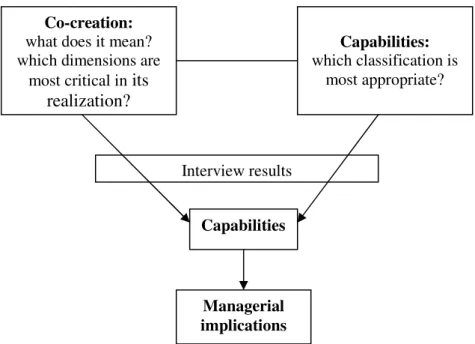
realization of co-creation can be identified? – and provides the managerial implications associated with co-creation. Figure 1.2 summarizes the structure of this thesis.
Fig. 1.2. Structure of the thesis
Co-creation:
what does it mean? which dimensions are
most critical in its realization? Capabilities: which classification is most appropriate? Interview results Capabilities Managerial implications
Chapter 2. The meaning of co-creation and its most critical dimensions
In this chapter and chapter 3, the most important and relevant results of the literature study will be presented. The results of this literature study provide insights into the capabilities question in relation to co-creation. This chapter focuses on the meaning of the co-creation process and the identification of the most critical dimensions in its realization.
2.1 Co-creation: a new concept?
Although co-creation is perceived by many as a relatively new concept, fact is that the principle of active involvement in the creation of a personalized product, service or experience exists for many decades. For example, for as long as there have been consultants who meet up with their clients to discuss a certain problem and come to a specific solution, we can speak of the co-creation of value. However, it was only beyond 2000 that customers were actually transforming into active players who were becoming part of an enhanced network. In the traditional system of markets and value creation, customers were seen as a passive audience and value creation occurred inside the firm, without any active customer engagement. Although, from the beginning of this century, forged by major business discontinuities such as deregulation, globalization, and the rapid evolution of the internet, this system is being challenged by the emergence of connected, informed and empowered customers who are becoming active players; co-creators of value (Prahalad & Ramaswamy, 2000).
2.2 The historical roots of an alternative way of value creation
When tracing the origins of the concept of co-creation, one must be careful to not only relate it to the seminal work of Prahalad, who explicitly introduced it as a nomological theme in 2004. This would falsely lead to the reference to the influential management theory “core competence” as the origin of the co-creation concept, while in fact its real basis is formed many decades earlier. The core competence model of Prahalad and Hamel (1990) is a corporate strategy model that starts the strategy process by thinking about the core strengths of an organization. Realizing core competence requires “communication, involvement, and a deep commitment to working across organizational boundaries. It involves many levels of people and all functions” (Prahalad & Hamel, 1990, p. 82) and therefore we can state that the basis of the co-creation process is embedded in the core competence construct.
However, loosening the link between co-creation and Prahalad and focusing on the
principle of facilitating the customer as an active participant in the process of value creation takes us back even to works that were published already in the nineteenth century. For example, Storch (1823, as cited in Ramírez, 1999) recognized that services require cooperation between producer and consumer and Bastiat (1851, as cited in Ramírez, 1999) determined that all economic agents are “middlemen towards each other” and took value “to be the result of a many-sided exchange of services” (p. 67-68), emphasizing the importance of interfaces and dialogue in economic activity.
Besides these authors who already performed a key role with respect to the basis of the concept of co-creation more than 150 years ago, we can identify a number of highly contributing works of the twentieth century, especially in relation to service industries. Fuchs (1965) elaborates on Storch’s (1823, as cited in Ramírez, 1999) work by considering the consumer as a cooperating factor in the production process and stating that productivity in many service industries is dependent in part on the knowledge, experience, and motivation of the consumer. A few decades later, we see the emergence of the “customizing” consumer – the consumer who takes elements of market offerings and creates a customized consumption experience for him- or herself (Firat, Dholakia, & Venkatesh, 1995). The underlying thoughts of this concept establish the basis for the value profit chain concept. The core message of this framework is that the best performing organizations are those capable of developing long term relationships with committed customers, employees, and investors by focusing on providing what these three groups value most (Heskett, Sasser, & Schlesinger, 2002). In 1995, Schneider and Bowen suggest that firms should use customer talents to deliver superior service, which is supported by Lengnick-Hall (1996), who urges firms to examine the roles that customers can and do play in the service production process. Bitner, Faranda, Hubbert, and Zeithaml (1997) extend these ideas by actually defining the vital roles customers can play in creating quality and productivity in service experiences. They refer to service experiences as “the outcomes between organizations, related systems/processes, service employees and customers” (p. 193), a concept of which Pine and Gilmore (1999) state it includes the central elements of a new economic era: the era of the experience economy. According to these authors, customers demand more than a product; businesses must orchestrate memorable events for their customers – “experiences” – by involving them in a way they will always remember.
“What can we do for you?” to “What can you do with us?” (Wind & Rangaswamy, 2001). The meaning of value and the process of value creation concerning the firm-customer relationship are rapidly shifting from a product- and firm-centric view to personalized customer experiences. The interaction between the firm and the customer is becoming the locus of value creation and value captation. According to Prahalad and Ramaswamy (2004), a new paradigm is emerging to which they refer as Experience Co-Creation (ECC). The contrast between the traditional innovation process and the experience co-creation innovation process is well depicted in figure 2.1. However, it must be noted that innovation is just one of the key benefits (experience) co-creation can bring along. Increasing customer loyalty or reducing market research costs are other examples of drivers for companies to engage in the process of co-creation (Nambisan, 2002; Payne et al., 2008). In all cases, the central thought is transforming the customer in an active participant to be able to deliver him/her maximum value.
To be able to realize an environment in which customer-company interaction is the locus of value creation, companies need to concentrate on the total co-creation experience, as well as the process of co-creation through its key principles: dialogue, access, risk assessment, and transparency, to which is referred by the acronym DART (Prahalad & Ramaswamy, 2004).
Fig. 2.1. The traditional innovation process (at the top) vs. the experience co-creation innovation process (Symnetics, 2009)
2.3 Key principles and successful co-creation
At this point, we can state that the concept of co-creation is not new, that the dynamics of the active roles of customers and the changing relationship between the customer and the firm find its origins many decades ago and that the emerging pattern of interactions between them lies at the heart of this change. We will now turn to the dimensions, or key principles, which are inextricably bound up with the design of co-creation experiences.
Dialogue is a crucial element in the co-creation view. According to Levine, Locke, Searls, and Weinberger (2001), markets can be viewed as a set of conversations between the customer and the firm, which companies should not control but should actually encourage. Prahalad and Ramaswamy (2004) underline that dialogue encourages not just knowledge sharing but, even more important, “qualitatively new levels of understanding between companies and consumers” (p. 31).
In order to realize a meaningful dialogue between the parties mentioned above, both access and transparency are critical factors. Access to knowledge, tools, and expertise enables customers to experience value in another way than through ownership, while transparency of information is necessary to create trust between all participating parties (Prahalad & Ramaswamy, 2004).
The final principle which facilitates co-creation experiences refers to the probability of customer risk. Risk assessment assumes that a consequence of customers who become co-creators of value with companies will be that they will demand more information about potential risks of goods and services and therefore may bear more responsibility for dealing with those risks (Prahalad & Ramaswamy, 2004).
DART must be enabled by technical and social infrastructure and platforms that enable customers to co-construct experiences they value and enable companies to generate business value (Prahalad & Krishnan, 2008). The key challenge for managers lies in attending to the quality of these infrastructures for interactions between companies and customers, with a special focus on the capacity to create a variety of personalized experiences. Successfully grabbing this challenge will lead to the successful realization of co-creation. However, to achieve this and to be able to compete effectively, managers will be required to gain access to new and necessary capabilities (Eisenhardt & Martin, 2000; Kambil et al., 1999; Manyika, Roberts, & Sprague, 2008; Prahalad & Krishnan, 2008; Prahalad & Ramaswamy, 2004; Teece, Pisano, & Shuen, 1997; Zollo & Winter, 2002). The identification of these capabilities will be clarified and made more understandable by first classifying the concept of co-creation
2.4 Styles and types
In the existing literature on co-creation, authors are lacking the identification and distinction of different styles or types of co-creation that companies are currently pursuing. In 2006, Lawer did perform this task with the intention to help firms determine which style is right for their particular context. He refers to eight different styles of customer-company co-creation: product “finishing”, new product design and development (lead user), existing product adaptation (customer feedback), mass customization, open community ideation and product design and development, new service design, real-time marketing & service adaptation, and personalized experience value and knowledge co-creation. Conclusions drawn by Lawer (2006) include that each style requires different capabilities for strategy, learning and marketing, that some of the co-creation styles overlap and that a company may combine the different styles to realize different forms of product, service and experience value.
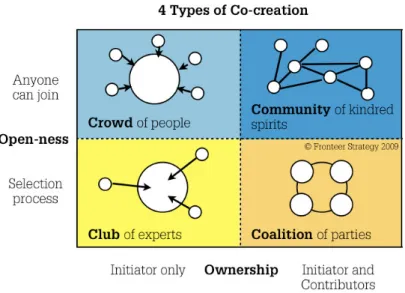
A second classification of the co-creation concept has been made by Fronteer Strategy (2009). This consulting firm defines four types of co-creation, based on two central dimensions, as depicted in figure 2.2. The first dimension – open-ness – is related to the number and types of participants in the process, while the second dimension – ownership – refers to the persons by whom the outcome and challenges are owned.
Fig. 2.2. The four main types of co-creation according to Fronteer Strategy (2009)
A final example of a classification system can be addressed to the innovation firm SunIdee. This system distinguishes five types of co-creation: co-creation workshops, crowdsourcing, open source, mass customization, and user-generated content. These types
mainly differ on three aspects, which are the number and type of persons that may join the process, the role of the participants and the perceived goal of the co-creation process.
A closer look at the above three classifications of the co-creation concept leads to three important clarifying conclusions. First of all, the dimensions used to distinguish the different co-creation styles and types are strongly comparable. In all three cases, the number and types of participants involved is an important distinguishing factor, as well as the intensity of firm-customer interaction and firm-customer involvement. Besides, two of the three classification systems also emphasize the different roles of customers in the value-creation process (Lawer, 2006; SunIdee) and the question by whom the benefits resulting from the co-creation process are owned (Fronteer Strategy, 2009; Lawer, 2006). A second conclusion that can be drawn is that with respect to the above mentioned dimensions, it is not necessary to distinguish between the different activities within the value chain at which the concept of co-creation can be applied, such as product development, services or marketing/communication, since these dimensions would apply within all value-generating activities. The final and most important conclusion is that the classification systems just discussed do not actually identify or distinguish different types or styles of co-creation but do show three different perspectives on the co-creation concept: an objective oriented perspective, a process design oriented perspective and an implementation oriented perspective, respectively.
At this point, the resulting key question is: “which dimensions are most critical in the realization of creation and lead to its classification into a number of general applicable co-creation types?” For this research a classification system is needed which, unlike the existing classifications just discussed, also highlights the managerial implications associated with co-creation. The resulting dimensions will form the basis of the identification of a set of necessary capabilities that are required for the realization of the different types of co-creation.
2.5 The most critical dimensions in the realization of co-creation
In the previous section, three different classifications of, or perspectives on, the concept of co-creation have been discussed. When studying these classifications in combination with the available literature on co-creation and companies that have successfully applied the concept of co-creation within their business (e.g., LEGO; Apple; Sara Lee; Ikea), some interesting relationships can be identified. Naturally, these relationships should clearly underline the importance of the managerial implications of co-creation.
2.5.1 Customer participation
When reviewing the literature on co-creation discussed so far, a clear link with the concept of customer participation can immediately be detected. As can be derived from a previous section, this construct is not new. Supermarkets, which can be seen as models of co-creation with customers selecting, carting, and transporting groceries, date to the 1930s and in the doctor’s office the productivity of the doctor has always been partly dependent on the quality of the medical history the patient gives. An examination of the relevant literature on customer participation in the production of goods and services reveals two important themes. First, the early work in the area focused largely on the firm, emphasizing why customers should engage in the production process. The benefits of such customer participation to the firm were defined in productivity gains, with customer labor substituting for employee labor (e.g., Fitzsimmons, 1985; Lovelock & Young, 1979; Mills & Morris, 1986).
The second theme concerns managing customers as partial employees and the applications and limits of traditional employee management models (e.g., Kelley, Donnelly, & Skinner, 1990; Lengnick-Hall, 1996; Mills & Moberg, 1982). Research in this theme has focused on identifying when customers may be motivated to participate in production as partial employees.
A broader perspective of co-creation can be found in the work of Firat et al. (1995). According to these researchers a fundamental characteristic of the postmodern age is that customers are asking for a greater and more active role in the production of goods and services. They argue that “the consumer may be finding the potential to become a participant in the customization of his/her world” (p. 50) instead of leaving this privileged role to the producer.
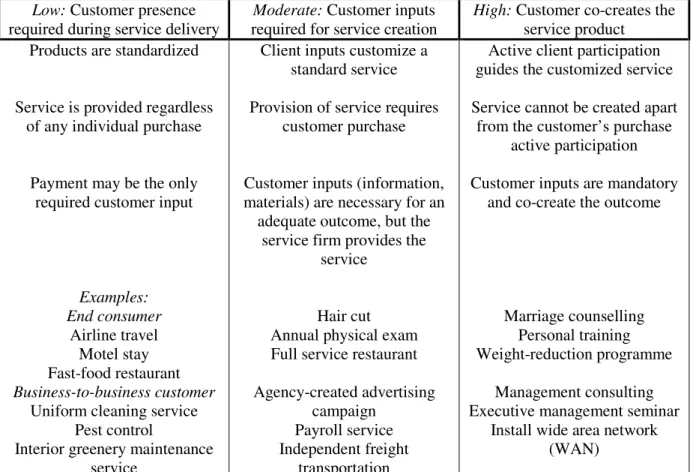
Based on customer participation, three types of production can be distinguished: firm production, joint production, and customer production (Meuter & Bitner, 1998, as cited in Bendapudi & Leone, 2003). In relation to the process of co-creation, only joint production is perceived relevant since this concerns a situation in which both the customer and the firm interact and participate in the production of a good or service. Therefore, we do not consider the other two types of production. Besides these types, also different levels of customer participation can be identified, which are referred to as low, moderate and high, as described in table 2.1 (Hubbert, 1995, as cited in Bitner et al., 1997). These levels are actually connected with service delivery but can also be applied to the production of goods. We speak of a high level of participation when customers are actually involved in the co-creation of a good or service and have essential production roles, as in the case of YouTube. However, this
does not imply that both the other levels can be considered irrelevant in relation to the concept of co-creation. For example, in the case of an annual physical exam (moderate level of customer participation), the patient is an active participant in the value creation process. Moreover, the creation and captation of value will be impossible without the patient’s input in the form of information and effort. In other cases, all that is required is the customer’s physical presence (low level of customer participation), as in the case of a symphony concert, and it can be stated with absolute confidence that this kind of value creation can not be categorized under the denominator of co-creation. Therefore, when is referred to participation in the process of co-creation, what is meant is the joint production of outcomes with a moderate or high level of customer involvement.
Low: Customer presence required during service delivery
Moderate: Customer inputs required for service creation
High: Customer co-creates the service product
Products are standardized
Service is provided regardless of any individual purchase
Payment may be the only required customer input
Examples: End consumer Airline travel Motel stay Fast-food restaurant Business-to-business customer
Uniform cleaning service Pest control
Interior greenery maintenance service
Client inputs customize a standard service Provision of service requires
customer purchase
Customer inputs (information, materials) are necessary for an
adequate outcome, but the service firm provides the
service
Hair cut Annual physical exam Full service restaurant Agency-created advertising
campaign Payroll service Independent freight
transportation
Active client participation guides the customized service Service cannot be created apart
from the customer’s purchase active participation Customer inputs are mandatory
and co-create the outcome
Marriage counselling Personal training Weight-reduction programme
Management consulting Executive management seminar
Install wide area network (WAN)
Table 2.1. Levels of customer participation across different services From: Bitner et al. (1997)
Within the levels of participation just discussed, customers can play a variety of roles of which three – not mutually exclusive – are considered most contributing: the customer as productive resource, the customer as contributor to quality, satisfaction, and value and the customer as competitor to the organization (Bitner et al., 1997). A closer look at these three roles leads to the conclusion that the role of potential competitor can not be considered
relevant within the scope of this research. This role refers to the decision faced by customers whether to produce services for themselves (internal exchange) versus have someone provide the service for them (external exchange) (Lusch, Brown, & Brunswick, 1992), while firm-customer interaction and joint value creation are the central elements of the co-creation concept. Therefore, the roles customers can play in the co-creation process can all be grouped under the other two mentioned roles. The role as a productive resource emphasizes the goal of increasing the productivity of the organization through customer participation while customers as contributors to quality, satisfaction and value mainly care about maximizing their own satisfaction and the ultimate quality of the goods and services they receive (Mills, Chase, & Margulies, 1983).
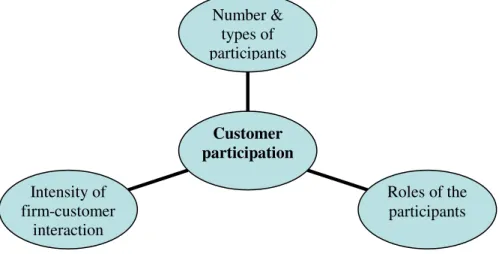
Relating the presented findings in this section to the previously discussed literature on co-creation leads to the conclusion that one of the most critical dimensions in the realization of co-creation is definitely represented by the concept of customer participation. This concept contains almost all key distinguishing dimensions that were identified in the three classification systems addressed before, as depicted in figure 2.3. Besides, empirical case studies of the deployment of co-creation (e.g., LEGO) underline the importance of decisions dealing with the types and levels of customer participation and the roles customers can play. The DART principles, as discussed before, can be helpful in designing co-creation. Choices concerning this design should be controlled by the aspired level of organizational impact. One of the most essential dimensions associated with this concept is the extent to which the co-creation process will impact the current business processes and way of working and thus the number and importance of managerial implications required.
Fig. 2.3. Key dimensions of the concept of customer participation Intensity of firm-customer interaction Roles of the participants Number & types of participants Customer participation
2.5.2 Organizational design
In the previous section, it was pointed out that a great deal of concepts that are often brought in relation to the process of co-creation can actually be grouped under one dimension: active customer participation. However, little research has been done when it comes to the way in which the co-creation process can be organized – either organization-wide or separated from the daily business (e.g., as an organizational unit or project) – while this truly affects the impact it has on the entire organization and thus forms a critical factor on which the firm has to make a decision when planning to apply the concept of co-creation (Sanders, 2009; Staal, 2009).
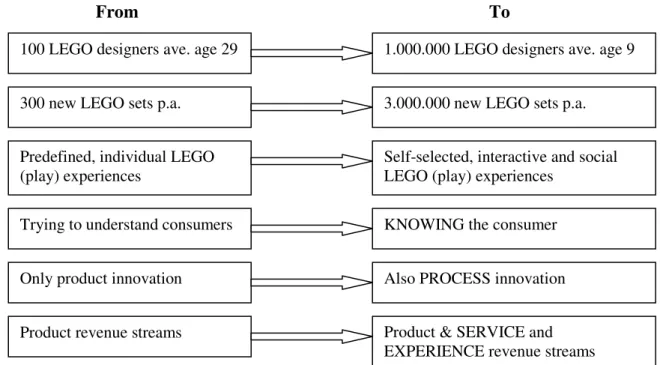
LEGO is a good example of a traditional firm that has, in a relatively short period of time, acquired the process of co-creation. The company transformed from a producer of 300 new LEGO sets per year, to a co-creation model providing three million LEGO sets each year (see figure 2.4). At the moment, co-creation is an essential part of the LEGO Company at which a gigantic community of more than 2.5 million members plays a key role. The company wishes to have close contact with its customers throughout the world and therefore engages in many initiatives to strengthen ties between these groups of people and the company itself (e.g.; LEGO.com; LEGO Club; www.LEGOfactory.com). For example, the LEGO Factory provides consumers the opportunity to design and build LEGO models they think are lacking from the official LEGO range and the LEGO Club consists of 2.7 million children who can show each other pictures of their favourite building work and draw inspiration for future play (Corporate Communications, 2009). Clearly, at this company, firm-customer interaction is the locus of value creation and the co-creation idea is embedded in each part of the company. Therefore, LEGO is a perfect example of a firm that has decided to realize the process of co-creation at a scope that contains and impacts the entire organization.
From To
Fig. 2.4. The paradigm shift for LEGO From: Derksen (2008)
At the opposite of the organization-wide appliance of the co-creation concept, we can identify examples of firms who have also realized co-creation, but in a way that has impacted the whole organization to a much lesser extent; separated from the firm’s primary business processes. When considering the Nokia Pilots and Nokia Beta Labs, this different way of organizing co-creation, when compared to LEGO, can be perceived. In essence, Nokia Pilots is a program that helps get Nokia users around the world involved in the company’s creative development process. The program acts as a channel for users to share their ideas and suggest improvements that the firm can put into action as they create their products and services. A few selected participants are given the chance to participate in real product development by matching the Nokia Pilot candidates’ interests to the different projects Nokia is working on. Beta Labs has been around for a longer while; early on making public the efforts of small innovative teams at Nokia and since last year enabling the share of applications, content and services for trial usage to hundreds of thousands of users in an open platform (Mikko, 2008). Both these programs show the realization of co-creation separated from the daily business. The outcomes can be highly significant to the organizing company, but the organizational impact and thus the associated managerial implications can be considered as limited. While the participants in the programs are working with the concept of co-creation continuously, the
100 LEGO designers ave. age 29 1.000.000 LEGO designers ave. age 9
300 new LEGO sets p.a. 3.000.000 new LEGO sets p.a.
Predefined, individual LEGO (play) experiences
Self-selected, interactive and social LEGO (play) experiences
Trying to understand consumers KNOWING the consumer
Only product innovation Also PROCESS innovation
Product revenue streams Product & SERVICE and
largest part of Nokia’s employees and departments are not connected to it in any way (Nokia Corporation, 2009).
2.6 Conclusion
Based on the previously discussed literature and findings, particularly on customer participation and organizational design in relation to the process of co-creation, it can be concluded that the first two concepts represent critical dimensions in the latter’s realization. Concerning the concept of customer participation, we can even say it will be the key driver for each co-creating firm. The importance of the relationship between the way in which firms organize the co-creation process and the process of co-creation itself is less supported by existing literature. However, taking into account the managerial implications of co-creation, logical reasoning departing from the concept of customer participation in relation to the DART principles and studying existing examples of firms that are already co-creating does provide evidence that organizational design also represents one of the most critical dimensions in the realization of co-creation. In order to validate the here presented findings managers of co-creating organizations will be interviewed.
Fig. 2.5. The most critical dimensions in the realization of co-creation
Each organization planning to apply the concept of co-creation has to decide which
position it aims to take in the above depicted figure. Naturally, the consequences of this decision imply a set of necessary capabilities which are required for the realization of the particular co-creation type. The identification of these capabilities represents the next step in this research.
Customer participation Organizational design
Chapter 3. The appropriate capabilities classification and the capabilities
needed to realize co-creation
First, this part of the theoretical framework deals with the question of what type of capabilities classification is most appropriate when taking the co-creation perspective. Secondly, it will provide the basis of the answer to which capabilities are required for the realization of co-creation.
3.1 Focus on capabilities
The role of firm-internal factors – resources and capabilities – has frequently been discussed by a great number of researchers, mostly in relation to strategic management (e.g., Hofer & Schendel, 1978; Kotler, 1988; Penrose, 1959; Wernerfelt, 1984). Over time, three research streams have emerged which specifically focus on the role of resources and capabilities in the development of sustainable competitive advantage: the resource-based view (RBV), the dynamic capability view (DCV) and the knowledge-based view (KBV) of the firm. These approaches are neither contradictory nor mutually exclusive (Tuominen, Rajala, Möller, & Anttila, 2003). They can best be referred to as a theoretical continuum, DCV and KBV being an extension of RBV (Barney, 2001; Grant, 1996; Priem & Butler, 2001).
In much of the empirical work, researchers refer to the concepts of resources and capabilities interchangeably. Although with the coming of the DCV, the distinction has strengthened (Amit & Schoemaker, 1993; Grant, 1998; Teece et al., 1997; Wang & Ahmed, 2007). The focus of this research is on capabilities. This concept can be defined as organizational resource-bundling processes that are developed and used with the ultimate aim of distinguishing the firm along the dimensions that bring value to its customers and/or create market or industry change (Amit & Schoemaker, 1993; Eisenhardt & Martin, 2000; Grewal & Tansuhaj, 2001; King & Zeithaml, 2001; Teece et al., 1997). They are often complex and difficult to change over time, and are more likely to produce sustainable competitive advantage than other company assets (Hitt, Ireland, Camp, & Sexton, 2001; Hunt & Morgan, 1995). The answer to the question concerning which research stream can best be linked to the concept of co-creation will be given and explained in the next section.
3.2 The dynamic capabilities view
In order to decide which approach fits best within the scope of this research we have to consider their main assumptions. First of all, according to the resource-based view a firm is a
bundle of heterogeneous resources that are partly immobile and sustainable competitive advantage is derived from the possession of valuable, rare, inimitable, non-substitutable resources (Barney, 2001; Conner, 1991; Peteraf, 1993; Wernerfelt, 1984). Taking this a step further, while including the interaction with the continuously evolving market, leads us to reason that firms need to develop competences sooner, more inventively or more fortuitously than the competition, which is one of the main assumptions of the dynamic-capability view (Amit & Schoemaker, 1993; Eisenhardt & Martin, 2000; Nelson & Winter, 1982; Prahalad & Hamel, 1990). Secondly, the learning mechanism associated with knowledge creation, the central function of the firm according to the knowledge-based view, can be perceived as a consequence of the firm’s evolutionary outcome of its experiences, its capability base (Grant, 1996; Nonaka, 1994; Spender, 1996). However, we can perceive knowledge as one of the forms in which value resulting from a co-creation process can become manifest (Nambisan, 2002; Payne et al., 2008; Prahalad & Ramaswamy, 2004; Wind & Rangaswamy, 2001). Finally, the dynamic capabilities view refers to the antecedent organizational and strategic routines by which managers alter their resource base to generate new value creating strategies (Eisenhardt & Martin, 2000; Grant, 1996; Pisano, 1994). Since the basis of the co-creation process flows from the shift from the traditional “manufacturer-centric model” to a completely new way of creating value which includes interacting with different customers with different opinions, wants, and needs, co-creating firms are confronted with integrating, reconfiguring, renewing, and recreating its resources and capabilities and, most importantly, upgrading and reconstructing its core capabilities in response to the changing environment on a regularly basis (Wang & Ahmed, 2007). Besides, we can state that within this last view the evolutionary thought is embedded most. These statements lead to the adoption of the dynamic-capability-based view when taking the co-creation perspective.
The concept of dynamic capabilities has been defined in different ways by different authors. Although, one definition covers most of them: “the firm’s processes that use resources – specifically the processes to integrate, reconfigure, gain and release resources – to match and even create market change” (Eisenhardt & Martin, 2000, p. 1107; Teece et al., 1997).
Having thus far defined dynamic capabilities at a conceptual level, the next relevant and necessary step is classifying the concept into a number of identifiable and measurable factors.
3.3 Opening the “black box”
Despite the widespread interest in dynamic capabilities by a great number of authors, many scholars remain sceptical about the concept’s nature and role (Winter, 2003). Moreover, dynamic capabilities have often been criticized for being tautological, vague (e.g., Mosakowski & McKelvey, 1997; Priem & Butler, 2001; Williamson, 1999), and nonoperational (Williamson, 1999). Protogerou, Caloghirou, and Lioukas (2005) refer to a “black box” of dynamic capabilities which they attempt to open using a multidimensional, higher-order model. More specifically, these authors conceive dynamic capabilities as a broader latent construct encompassing three underlying, highly interrelated dimensions: coordination capability, learning capability and reconfiguration capability.
Coordination capability describes the firm’s ability to assess the value of existing resources and integrate them to shape new competences (Amit & Schoemaker, 1993; Iansiti & Clark, 1994). They are often related to new product development, where teams belonging to different firm departments, or, in the case of co-creation, firm and customer, work together combining their varied skills and backgrounds in order to design and develop the specific product (e.g., Dougherty, 1992; Helfat & Raubitschek, 2000).
Organizational learning is strongly related to strategic renewal, as it requires that organizations explore and learn new ways while at the same time exploit what they have already learned (March, 1991). The process of learning can lead to the better and quicker resolution of specific problems and at the same time enable firms to identify new production opportunities (Teece et al., 1997).
The third factor refers to the ability to sense the need to reconfigure certain firm-specific competences in order to net let them turn into core rigidities and to carry out the required internal and external transformation, which is a costly and difficult process but also highly important (Teece et al., 1997).
Although this model does succeed in capturing dynamic capabilities, it is questionable whether this classification system best suits the co-creation concept. With respect to the three interrelated factors it can be stated that they represent relatively easily applicable processes. Taking into account the objective of this research, a more evolutionary classification system would be more appropriate since this would better represent the impact on the organization.
3.4 Filling the gap
As concluded before, the origins of the co-creation process can be found many decades before it was popularized in the beginning of this century. However, it was not until recently
that researchers attempted to address the gap concerning the link between co-creation and the concept of capabilities. Prahalad and Krishnan (2008) are the firsts who attempted to fill this gap by focusing on building organizational capabilities that allow a firm to create the capacity for continuous innovation. According to these researchers, there are new principles of value creation as well as new capabilities that need to be build in order to compete. The two critical principles, R = G and N = 1, define a world which is the exact opposite of where we started a hundred years ago: firms should focus on one customer experience at a time (N = 1) and on access to, instead of ownership of, resources (R) from multiple vendors and often from around the globe (G). As we move towards this world, different capabilities become critical sources of advantage. The success of the co-creation process will depend on a firm’s “ability to develop flexible, transparent, and granular business processes that allow for continuous reconfiguration of resources (R = G) to serve the interests of N = 1” (Prahalad & Krishnan, 2008, p. 42).
The term business process has been defined in different ways by industry experts and academics, dependent on the orientations of the authors. Prahalad and Krishnan (2008) identify business processes as “the enabler of an innovative culture through their impact on both social and technical architecture” (p. 81), where the social architecture refers to organization structure, performance measurement, training, skills, and values of the organization and the technical architecture to the firm’s information technology backbone. This definition can be considered relevant within this research since it clearly emphasizes the link with overcoming internal resistance to change. Prahalad and Krishnan (2008) state that the quality of business processes determines the capability of firms to compete effectively.
Building blocks of R = G capabilities
Fig. 3.1. Building blocks of N = 1 capabilities Adjusted from Prahalad and Krishnan (2008)
3.5 Capabilities to realize co-creation
The depicted figures on the previous page show the building blocks of R = G and N = 1 capabilities. The one at the top tells us that visibility to processes and data within global supply chains (R = G) is crucial for building the multiple layers of capabilities that are critical for dynamic reconfiguration of resources. To be able to manage the complex web of product and information flows, visibility in the supply chain is almost a prerequisite. Large companies which are operating supply chains without full visibility are faced with obvious consequences as they expose their chain to unknown global sources. Ideally, firms do exactly know who is buying what from whom and provide complete visibility to the end customer on every single product or service. As can be perceived in figure 3.1, this visibility creates the learning capability for firms to reconfigure resources in real time. This can start with a simple trend analysis of the key metrics across different markets and product categories but should be expanded to a capacity for rapid response to changes in either external market demand or internal process capabilities available at a given point in time. A combination of full visibility and the capability to reconfigure resources globally will help managers anticipate customer behaviors such that they can add or subtract appropriate resources to the whole supply network. In this process, new insights can also be derived, either for operational improvement or for strategic redirection (Prahalad & Krishnan, 2008).
When focusing on the building blocks of N = 1 capabilities, and thus on the capacity to serve individual customers – that is, personalization and co-creation of value – capabilities to work with customers to anticipate and predict their preferences on a continuous basis are essential. A system is needed which focuses on individual customers and their individual preferences and skills, as customers base their choices on their skill levels as much as their desires. The building block that flows out of this focusing, as depicted in figure 3.1, represents a firm’s capacity to co-create with customers, depending in turn on individual customers’ willingness to engage as well as their skill levels. Communities consisting of individual customers who share a common interest are also inextricably bound up with co-creation. The intimate engagement with these individual customers in the co-creation process allows managers to anticipate patterns of customer evolution pathways. “What will they want next?”, “What do they value?” and “How do they want to engage with us in co-creation” are types of questions firms should be focusing on and can result in new insights (Prahalad & Krishnan, 2008).
3.6 Conclusion
In this chapter, we reviewed the R = G and N = 1 framework for thinking about capabilities in relation to co-creation. The justification for this is provided by the evolutionary nature of this model originally developed by Prahalad and Krishnan (2008), which clearly reflects the impact of the deployment of different dynamic capabilities on the organization. This in turn is directly related to the organizational design of co-creation and the associated managerial implications, which represents the objective of this research. The further an organization gets to the outer bound of the figures depicted in 3.1, the higher the impact on the organization and the higher the number and importance of the associated managerial implications. The adoption of the dynamic capabilities view when taking the co-creation perspective logically follows from the dynamic circumstances within which co-creation processes take place. Co-creating organizations constantly need to upgrade and reconstruct their business processes in response to the changing environment (Wang & Ahmed, 2007). The move to R = G and N = 1, a world defined by the capability to leverage global resources and to serve individual customers, demands new levels of visibility and agility in managing the supply chain, dynamic real-time reconfiguration of resources, and capabilities to work with customers to anticipate and predict their preferences on a continuous basis. Successfully deploying these capabilities will lead to the generation of new insights, either for operational improvement or for strategic redirection (Prahalad & Krishnan, 2008).
To further enhance our insight of the R = G and N = 1 framework, the next step in this research implies interviewing managers of organizations which have already applied the concept of co-creation.
Chapter 4. Research methodology
Within this chapter, the methodology and methods used in relation to the qualitative data will be described and justified. Methods here are defined as the techniques and procedures used to obtain and analyze data (Saunders, Lewis, & Thornhill, 2007).
4.1Purpose of the research
To identify which capabilities a firm needs to realize co-creation, an exploratory study had to be carried out. This kind of study is a valuable means of finding out “what is happening; to seek new insights; to ask questions and to assess phenomena in a new light” (Robson, 2002, p.59). Its great advantage is that it is flexible and adaptable to new obtained insights. Literature provides three principal ways of conducting exploratory research of which two are used in this research: a review of the literature, resulting in a theoretical framework as presented in the preceding chapters and interviewing “experts” in the subject (Saunders et al., 2007). Focus group interviews are not conducted because these do not allow you to develop an individual level of rapport with each participant (compared to a one-to-one interview) and there are many potential difficulties of using group interviews. For example, a high level of skill is required to in order to encourage involvement by all group members and to maintain the interview’s exploratory purpose (Carson, Gilmore, Perry, & Grønhaug, 2001).
As stated before, the objective of this study is to contribute theoretically and empirically to the research stream concerning the relation between successful co-creation and dynamic capabilities and in particular to the associated managerial implications. This goal requires an empirical investigation of the co-creation process within its real life context using multiple sources of evidence, which makes the multiple case study the most appropriate research strategy. This strategy can be a very worthwhile way of exploring the applicability of existing theory, such as the framework developed by Prahalad and Krishnan (2008), as depicted in figure 3.1, and gaining a rich understanding of the context of the research and the process being enacted (Morris & Wood, 1991; Yin, 2003).
The data collection techniques employed to conduct a case study may include, for example, interviews, observation, documentary analysis and questionnaires (Saunders et al., 2007). In this research, semi-structured interviews are used and conducted over a short period of time. The choice for this method and the way it was employed will be elaborated below.
4.2Semi-structured interview
The empirical analysis in this thesis is based on primary data gathered from Dutch managers from organizations who are engaged in or have experience with the process of co-creation with consumers. Due to the exploratory character of this research, this engagement has been defined as broadly as possible to ascertain the inclusion of different well-known organizations applying different types or styles of co-creation and thus positioning themselves on a different spot in figure 2.5 depicted in chapter 2. This way the concept of co-creation in relation to consumers is studied from a higher aggregation level, in contrast with the majority of existing research in the subject (e.g., Brabham, 2008; Kotha, 1995; Nambisan, 2002), which focuses on the instrumental fulfilling of the co-creation process (e.g., crowdsourcing, user-generated content). Based on desk research, a list was created including all organizations which are best known for applying the concept of co-creation (see appendix 1). All of them were contacted, resulting in ten interviewees. These participants are managers at TomTom, Air France KLM, Dell, Sara Lee, Heinz, Procter & Gamble, DSM, Achmea, Robeco and Philips. All cases differ either on the type of products or services provided or on the type or style of co-creation applied, as can be read in appendix 2. Besides ten managers, two experts on the creation concept were also interviewed to gain better insights in the appliance of co-creation in the real world and to get inspiration with regard to appropriate questions for the managers. To motivate participation, the experts and managers were promised a report of the research findings.
The method used to collect the primary data is the face-to-face semi-structured interview. This is often referred to as a qualitative research interview and is an efficient way to obtain information on the issues of interest (Sekaran, 2003). Since existing literature clearly lacks on the relation between the two main variables in this research – co-creation and dynamic capabilities – flexibility in terms of adapting questions in response to earlier gathered information was a prerequisite to obtain the most useful data. The semi-structured interview provides this advantage as questions can be adapted, adopted and changed as is proceeded with the interviews (Sekaran, 2003). Secondly, this method allows you to use concepts or ideas in a particular way, and the opportunity to explicate these meanings will add significance and depth to the data obtained. It may also lead the discussion into areas that were not previously considered but which are significant for the understanding, and which help to address the research questions and objectives. The interviewees also get the opportunity to hear themselves ‘thinking aloud’ about things they may not have previously thought about (Saunders et al., 2007). Finally, according to literature, a semi-structured
interview will undoubtedly be the most advantageous approach to attempt to obtain data when the questions are either complex or open-ended and/or when the order and logic of questioning may need to be varied (Easterby-Smith, Thorpe, & Lowe, 2002; Jankowicz, 2005). All of these aspects should result in the collection of a rich and detailed set of data.
4.3 Measurement
The problem statement of this research questions which capabilities firms need to realize co-creation. The issue at hand is therefore measuring the relationship between the deployment of certain dynamic capabilities and the success of a co-creation process. Operationally defining these two concepts to render them measurable is done by looking at their dimensions, facets or properties and translating these into measurable elements (Sekaran, 2003).
The theoretical framework, as build in the previous chapters, first reduces the level of abstraction of the co-creation concept by identifying its two most critical dimensions: customer participation and organizational design. Customer participation is further operationalized into the number and types of participants, the roles of the participants and the intensity of firm-customer interaction. Organizational design is operationalized into the level of impact of the co-creation process on the organization and the number and importance of the associated managerial implications. With help of these elements a distinction can be made concerning firms applying the co-creation concept between those enabling a high level of customer participation and those enabling a lower level and between firms which have integrated the process in the entire organization and firms which have separated it from the daily business. This way, better insights into the required competences and managerial implications associated with the appliance of the co-creation concept on different levels can be obtained.
The second main concept in this research, dynamic capabilities, has been classified into building blocks of R = G and N = 1 capabilities (Prahalad & Krishnan, 2008), as depicted in figure 3.1. The applicability of this framework, after slightly being adjusted, is tested by asking the interviewees for critical success factors of the co-creation process and recommendations to inexperienced managers on the subject.
4.4 Interviewing competence
There are several areas where it is needed to develop and demonstrate competence in relation to the conduct of semi-structured interviews (Saunders et al., 2007). Most of these are related to overcoming interviewer and interviewee bias and are therefore highly important.
During the planning process of the interviews concerning how to demonstrate credibility and obtain the confidence of the interviewees, a checklist was used to ascertain preparation on all the associated issues. This checklist can be found in appendix 4.
Besides competences addressing biases, approaches to questioning, recognizing and dealing with difficult participants and recording information were used. First of all, during the interview, open questions were used to encourage the interviewee to provide an extensive and developmental answer and probing questions to explore responses significant to the research topic. Secondly, the most prevalent difficulties concerning participants along with suggestions regarding how to address them, as stated by King (2004), have been studied before conducting each interview (see appendix 5). Finally, all interviews have been audio-recorded, which, besides acting as a means to control bias and to produce reliable data for analysis, has several other advantages. For example, it enables the interviewer to concentrate more fully and listen attentively to what is being said and the non-verbal cues the interviewee is giving when responding (Easterby-Smith et al., 2002). However, during the interviews notes were also taken to provide a back-up if the audio-recording did not work and to provide a way to show true interest in the participant’s responses (Ghauri & Grønhaug, 2005).
4.5Analysis
In order to prepare the qualitative data for analysis, each interview was transcribed after undertaken, that is, reproduced as a written word-processed account using the actual words (Saunders et al., 2007). Since there is no standardised approach to the analysis of qualitative data and there exist many strategies to deal with the data collected (e.g., Dey, 1993; Tesch, 1990), the R = G and N = 1 framework, adjusted from Prahalad and Krishnan (2008), was used to organise the mass of data into meaningful and related categories. The technical architecture has been excluded for analysis since the firm’s information technology backbone is out of the scope of this research. The R = G and N = 1 framework was well suitable for the data categorisation process since “categories must have two aspects, an internal aspect – they must be meaningful in relation to the data – and an external aspect – they must be meaningful in relation to the other categories” (Dey, 1993, p.96).
The next activity of the analytical process consisted of attaching relevant ‘units’ of data to the appropriate category or categories of the R = G and N = 1 framework. Engaging in this selective process, guided by the purpose of this research, had the effect of reducing and rearranging the collected data into a more manageable and comprehensible form.
Once reorganized according to the R = G and N = 1 categories, key themes and patterns or relationships could be identified with the help of within-case analysis and cross-case search for patterns, which gives the researcher a rich familiarity with each case and implies the search for within-group similarities coupled with intergroup differences, respectively (Eisenhardt, 1989). As a way of refining the analysis, this may lead to the subdivision or integration of categories (Miles & Huberman, 1994). However, to be able to test the applicability of the R = G and N = 1 framework, as adjusted from Prahalad and Krishnan (2008), no categories were revised in this stage of the research process.
The final step of the data analysis implies the development of valid and well-grounded conclusions. This important part of the analysis is considered in the following chapters of this thesis.