A Delphi technique approach of identifying and validating
subsidised low-income housing satisfaction indicators
Clinton Aigbavboa*
Department of Construction Management and Quantity Surveying, University of Johannesburg, Johannesburg, 2028, South Africa Abstract
This paper reports on the practical experience of the researchers on the adoption of the inductive approach to knowledge diffusion through the use of the Delphi technique approach. The Delphi method is an essential technique of reaching consensus by experts on issues that cannot be resolved in a once off discussion. The research commenced with an extensive review of existing literature in order to identify the core and sub-variables which depicts housing satisfaction, to develop a Delphi questionnaire that was used in the Delphi study. A three iterative round Delphi technique was conducted to attain consensus of the identified housing satisfaction indicators. The experts used for this study were identified from different sources. The sources included the South African institutions of higher learning faculties, research institutes, the South Africa Department of Human Settlement, conference keynote speakers related to housing and human settlement issues in workshops, and individuals who have committed their lives working on the area of sustainable human settlement and housing related issues in South Africa. After three iterative Delphi rounds, consensus was achieved on the identified core-and sub-indicators identified from the literature and other added variables as suggested by the experts during the Delphi process. This study encourage the use of the Delphi technique as a method to achieve consensus in areas where consensus has not been reached such as in housing satisfaction studies to identify indicators for subsidised housing development in South Africa. The author argues that the Delphi method is a comprehensive method of attaining consensus on challenging issues of housing satisfaction; however, the technique requires proper communication management in order to achieve the required results.
Keywords: Delphi technique, experience, housing, housing satisfaction, indicators; inductive approach; methodology, qualitative,
1. Introduction
The common types of research questions being asked in housing satisfaction study’s mostly seek to establish the current status quo. For most housing or residential satisfaction studies, the end result is an ordinary report of what determines and brings about satisfaction with the hope that solutions will be found for the stated reasons that determines housing satisfaction. However, since the study of housing satisfaction and human behaviour is progressive, there is now an increasing need to conduct housing satisfaction studies that offer a clarification on the core and sub-variables which determines housing satisfaction particularly in the low-income housing setting. Therefore the former requires that a different type of questions be asked and methodological approaches been used in order to obtain solutions for the problems which brings about dissatisfaction to low-income housing occupants. One such question that seeks a solution in housing satisfaction studies is one that asks the ‘what-can-happen-if’ a particular determinant influences housing satisfaction? Unfortunately, most housing satisfaction research questions are asking the ‘what-are’ type of questions which brings about residential
* Corresponding author. Tel.: +27-11-559-6398; fax: +27-11-559-6630.
satisfaction. Such type of questions only reports on the current status and determinants of housing satisfaction which are shallow in nature and does not respond to the need of the society to implement any programme(s) or changes to alleviate the problems of housing dissatisfaction.
One of the research methods ideal to generate a “what-can-happen-if” type of question is the Delphi technique. Logically, it is presume that the “what-can-happen-if” types of questions are difficult to measure except through experimental methods. Hence, most research does not ask such types of questions because experimental surveys in the human settlement psychological research domain are not realistic most of the time and are usually not appropriate. Moreover, there is no time for experimentation in the human settlement psychological research about housing occupants’ dissatisfaction with their housing stocks. Therefore, this paper reports on the practical experience of the researchers on the adoption of the inductive approach to knowledge diffusion through the use of the Delphi technique approach. The Delphi method is an essential technique of reaching consensus by experts on issues that cannot be resolved in a once off discussion. The Delphi method will be discuss elaborately in the subsequent section of the paper and how it was applied to determine the core and sub-attributes that determines housing satisfaction.
2. Methodology
It was apparent from the literature review that the study of the determinants of residential satisfaction are a debatable subject in the human settlement psychological research domain as there are variants of determinants which are considered to influence satisfaction and others are less treated. Besides, residential satisfaction indicators (core and sub-attributes) differs from study to study. Hence, a research method that could generate and encourage the discussion of different opinions, in the attempt to ensure that all relevant indicators are validated, identified and explored was promoted for this study. Hence, this ruled out a one-off survey questionnaire method; and thus, favoured a method that could elicit experts’ opinions. Hence, the Delphi method was preferred for the first phase of the research project. This perfectly aligned with the requirements of the research study, as one of the ideology of the study was to provoke debate and assist in reaching consensus on various indicators of housing satisfaction in the low-income housing sector.
The Delphi technique according to de Villiers et al. (2005) is derived from the constructivist approach to knowledge and it overlaps between quantitative and qualitative methods of data collection and analysis. These characteristics according to Stewart (2001) allows the research results and conclusions to represent a shared meaning based on interactive process drawn from a pool of experts. In addition, the Delphi method is considered to be a robust method for a rigorous query of experts. Unlike ordinary survey research, the Delphi’s strength also lies in the iterative process (rounds of questioning) used which provide an opportunity for initial feedback, collation of feedback, and distribution of collated feedback to participants for further review. This unique process requiring group communication is central to the strength of the Delphi (Stitt-Gohdes & Crews, 2004). Hence, a Delphi Study was conducted to determine and solicit expert’s views on the influence (probability) and impact of residential satisfaction attributes on low-income housing beneficiaries, thus, identifying the determinant attributes (core and sub-) that bring about residential satisfaction in the South Africa low-income housing context. Three rounds of the Delphi process were conducted before experts could reach consensus on the questions that were posed to them.
3. Conducting the Delphi Study
The variance amongst the various group techniques and the definition of the Delphi Method as complied by various scholars and cognizance of the various criticisms forms the epistemological foundation for defining the approach towards a typical Delphi Study design. This is done by assuring that all expert feedback is anonymous.
According to Scheele (2002), the concreteness of the framework of the Delphi Design is vital in researching the overall objective of the study. The basic premises of the Delphi research design towards the identification and validation of residential satisfaction attributes for the low-income groups in South Africa; is entrenched in some form of general agreement and consensus regarding the core ingredients and components of the subsequent framework. Given the current status of low-income housing in South Africa and the absence of a general agreed upon residential satisfaction attributes, the search for consensus and a point of departure in attributes that determine residential satisfaction in other low-income housing issues is therefore justified. Hence, the objective of the Delphi Design was to obtain the most reliable consensus of opinion of a group of experts in the field being studied. Therefore, given the nature of the current research, it was evident that the Delphi Technique was well-suited to obtain credible inputs from experts in industry, academics, government and NGOs to serve as key input in the identification and validation of residential satisfaction attributes for low-income housing. The next section provides an overview of how the Delphi Technique was used in this study.
3.1 Designing, Constructing and Executing the Delphi Study
Given the rationale behind the Delphi Technique and the main features explained above, the design, construction and execution of the Delphi Study for the current research followed a sequential process as suggested by Loo (2002). According to Loo (2002), four vital planning and execution activities should be followed, which are:
Problem definition;
Panel selection;
Determining the panel size; and
Conduction the Delphi iterations.
Supporting Loo’s (2002) approach, Delbecq et al. (1975) suggested a basic Delphi Methodology that includes distinct stages such as, Delphi Question Development (objective), expert panel selection, sample size, first questionnaire, first questionnaire analysis and follow-up questionnaires. This methodology forms the basis of the current Delphi research study and is explained in the subsequent sections.
3.2 Phase 1 – Delphi Question Development
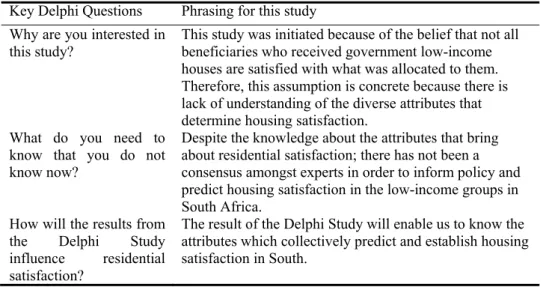
The formulation of the Delphi question is vital to the whole process. It is paramount that the panel of experts understands the broad context within which the questionnaire is designed, especially with the current research where the concept of what determines housing satisfaction has different connotations; hence the concept had to be broadly clarified. For the Delphi Study to achieve the objectives, key questions were asked. The basis of constructing the questions for this current study was based on the guidelines given in Table 1, with corresponding wording and phrasing given for this study.
3.3 Phase 2 – Delphi Expert Panel Selection / Determining the panel size
A critical part of conducting a Delphi interview technique is selecting the right experts (also known as panellists, participants or respondents) and their role is crucial to the success of the research (Hasson et al., 2000). Experts to be selected must be sufficiently interested and involved in the subject being examined to ensure a high commitment response rate. According to Hasson et al. (2000), controversial debate occurs when a professional becomes an ‘expert’. The claim that one group represents valid expert opinion has been criticized as scientifically untenable and overstated (Hasson et al., 2000).
For the purpose of this research McKenna’s (1994) definition of ‘expert’ as being a panel of informed individuals (otherwise called experts hereafter is used). McKenna’s (1994) definition was further supported by Goodman (1987) stating that the Delphi technique “tends
not to advocate a random sample of panellist … instead the use of experts or at least of informed advocates is recommended”. Likewise, Helmer (1977) argues that since a “Delphi inquiry is not an opinion poll, relying on drawing a random sample from the population of experts is not the best approach, rather, once a set of experts has been selected (regardless of how – but following a predetermined qualifying criteria), it provides a communicative device for them that uses the conductor of the exercise as a filter in order to preserve anonymity of responses’, which is the core of the Delphi Technique. Therefore, Linstone & Turoff (2002) states that the most significant danger in selecting the panel of experts lies in the path of ‘least resistance’ through the selection of a group of cosy friends and / or like-minded individuals, which thus negates the strength of the process.
Table 1. Delphi question formulation
Since panellists form the cornerstone of the Delphi technique, clear inclusion criteria was applied and outlined as a means of evaluating the results and establishing the study’s potential relevance to other settings and populations. The selection of panellists for the study was based on criterion sampling. Panellists were selected for a purpose to apply their knowledge to the concept raised in the objective based on the criteria that was developed. This was necessitated because the technique does not depend on a statistical sample that attempts to be representative of any population. It is a group decision mechanism requiring qualified experts who have deep understanding of the issues (Okoli and Pawlowski, 2004). Hence, one of the most critical requirements is the selection of qualified experts as it is the most important step in the entire Delphi process because it directly relates to the quality of the results generated (Hsu and Sandford, 2007). The careful selection of the panel of experts is a keystone to a successful Delphi study.
In choosing panellists for this study, each expert were required to meet at least five of the following minimum criteria of: 1) residency- have lived or is living in one of the South Africa Metropolitan or District Municipalities cities; 2) has knowledge of the low-income housing situation in South Africa; 3) academic Qualification, has been presented an earned degree; 4) experience related to the low-income or other sustainable development or human settlement context; 5) employment in a professional or voluntary capacity; 6) influence and Recognition; 7) authorship of peer-reviewed publications in the field of housing with emphasis on South Africa; 8) research, has received research funds that support housing development studies for the low-income group or other human settlement related issues; 9) teaching, has served as an individual or as a collaborative instructor in the teaching of one or more college or university courses focusing on the sustainable development or related field; 10) membership of a professional body so that their opinions may be adaptable or transferable to the population and k) willingness to fully participate in the entire Delphi studies.
Key Delphi Questions Phrasing for this study Why are you interested in
this study? This study was initiated because of the belief that not all beneficiaries who received government low-income houses are satisfied with what was allocated to them. Therefore, this assumption is concrete because there is lack of understanding of the diverse attributes that determine housing satisfaction.
What do you need to know that you do not know now?
Despite the knowledge about the attributes that bring about residential satisfaction; there has not been a consensus amongst experts in order to inform policy and predict housing satisfaction in the low-income groups in South Africa.
How will the results from the Delphi Study influence residential satisfaction?
The result of the Delphi Study will enable us to know the attributes which collectively predict and establish housing satisfaction in South.
The adoption of five criteria was considered more robust than the suggested number of at least two criteria by Rodgers and Lopez (2002). The five minimum criteria were framed after the four recommendations made by Adler and Ziglio (1996), with the inclusion of experts’ residency status, which was considered to be compulsory for all selected experts. This was considered significant because experts were required to have a wide-ranging understanding of the low-income housing context in South Africa. Also, a minimum number of five criteria were set because the technique may be undermined if panellists are recruited who lack specialist knowledge, qualifications and proven track records in their respective field (Keeney et al., 2001) amongst others.
Panel members were identified from four sources. The first source was from the South Africa institutions of higher learning faculties, departments, research institutes amongst others. The second source was the Department of Human Settlement. This is because they are the entity vested with the responsibility for the initiation and development of subsidised low-income housing in the country. Hence their involvement in the Delphi process was a key consideration. The third source was from various conference proceedings such as the annually held Built Environment Research Conference hosted by the Association of Construction Schools of Southern African, Construction Industry Development Board biannual post graduate research conference amongst others. Individuals who had frequently appeared as authors or key speakers related to housing and human settlement issues in these proceedings were identified as potential experts on the study. The fourth source was references of individuals who had committed their lives working in the area of sustainable human settlement and housing related issues in Southern Africa.
With regard to the recruitment process, panellists were recruited via e-mail, with a brief overview of the study objective. Thereafter, those that consented to the preliminary invitation were sent a detailed description of the Delphi study; and were requested to send their curriculum vitae in order to confirm their areas of expertise and to ascertain whether they met the qualifying criteria. Hence all experts selected for the current study met a minimum of five criteria’s set for the study.
From all the sources mentioned above, 55 invitations were sent out. Out of 55 invitations, 17 responded to the invitation; 17 completed the first round and 15 were retained throughout the study as one panellist could not meet with the demand of the study while the other was deceased during the course of the study, but had sent through his opinions for the first round. Therefore, the Delphi study retained 15 active members during the iterative round. This number of panellists was considered adequate based on literature recommendations from scholars which have employed the technique previously (Okoli and Pawlowski, 2004; Hallowell and Gambatese, 2010). Based on the above and the fact that the Delphi method does not depend on the statistical power, but rather on group dynamics for arriving at consensus among experts, the panel of 15 experts was considered adequate.
3.4 Phase 4 – Conducting the Delphi iterations Data collection through Delphi
Sequences of questionnaire rounds are used to obtain iterative responses to issues in a Delphi Study. For instance, Woudenberg (1991) proposes two or ten rounds as appropriate numbers of rounds supporting that accuracy is expected to increase over rounds, because of the repetition of judgment and group pressure for conformity. Likewise, Critcher and Gladstone (1998) suggest between two and five rounds. The Delphi method used in this study involved three rounds of iterative process, with the view of achieving consensus between the panel members on the determinants of residential satisfaction of low-income housing. A Delphi questionnaire was sent out electronically to all panel members who were then asked to take the time and respond to the questions, according to their ability and expertise. The Delphi Questionnaire was developed based on the findings from the literature review and was specifically designed to address and achieve the Delphi specific objectives defined for the study.
On average, each round took about a month to complete. A questionnaire was designed for each round based on the responses to the previous one. The Round One Questionnaire was designed, based on a summary of the comprehensive review of literature highlighting sets of attributes and sub attributes that are potentially relevant to residential satisfaction decisions by the occupants of low-income housing. Round One of the Delphi Study was intended to be a brainstorming exercise used to produce a list of empirical attributes that determine residential satisfaction in South Africa. Closed and Open-ended questions were used in this round. Thereafter, these were analysed and formed the basis of Round Two and Round Three of the study respectively. Frequencies were obtained to measure the degree of consensus reached amongst participants regarding the attributes that determine residential satisfaction in South African low-income housing. Also, a content analysis methodology was adopted to analyse responses to the open-ended questions to “minimize redundancy” (Rubin et al., 1998).
The purpose of the second round of the study was to allow experts to review and comment on the attributes that determine residential satisfaction and other issues relating to low-income housing in South Africa, which were proposed by the expert participants in Round One. Closed questions were used in this round to investigate participant comments expressing agreement, disagreement or clarification concerning proposed attributes that determine residential satisfaction in South Africa. The specific nature of the closed-ended questions stimulated participants’ reactions. Frequencies were likewise obtained to measure the degree of consensus reached amongst participants regarding the attributes that determine residential satisfaction and for other related questions. Also, a content analysis approach was adopted to analyse responses to the open-ended questions.
The Round Three Questionnaire was designed based on the findings of content analysis and measures of frequency responses to the questionnaire of Round Two. The final Round Three, was specifically aimed at:
informing the experts of the findings of the analysis of responses to the questionnaire of Round Two; and
requesting their final affirmation / comments on attributes and issues that did not receive any consensus in Round Two.
Upon receipt of responses from the first round, group medians were computed for each question. In the second round, the same questionnaire is sent back to panellists individually with their own responses from the first round with the group median responses included so that responses in the second round could be made taking into account the group median. In the second round expert panel members are asked to either maintain their original responses made in the first round, or they could change their initial response to either be in agreement with the group median or make a new rating altogether. The panellists, who have ratings of two units either above or below the group median on any one particular question, are requested to state the reasons for their dissenting opinion if at all they opted to stick to their rating. The stated reasons are sent to all panellists so that together with the calculated group medians in the second round, panellists could take cognisance of those comments in making their new ratings in the third round. Panellists are specifically requested to consider reasons from the outliers made in the second round in making their decisions in the third round.
After the third round, group medians and the absolute deviations are again computed for the third round. If calculations for the third round of the Delphi process indicate the desired level of consensus, then there is no need to proceed to the fourth round as there is no further value that could possibly be added to the degree of consensus that has been attained. Throughout the Delphi process, anonymity of panel members was maintained to avoid undue influence on other members. The aspect of anonymity is crucial to the credibility of the Delphi process.
Over the three round Delphi Survey, consensus was reached regarding most of the attributes that determine residential satisfaction in South Africa. Based on the findings of the analyses of responses to the Delphi rounds, a list of attributes that determine residential satisfaction was prepared, which informs the conceptual framework for another broader study. The Delphi Survey was conducted via electronic mail, and follow-up emails were used to encourage prompt responses to the questionnaires. Using email provides a free and faster means of communication.
Computation of Data from Delphi Study
Computation of data from the Delphi Study was conducted using Microsoft Office Excel, a spreadsheet software programme. The first stage involved analysis to determine consensus on responses to the predetermined criteria. This involved determining the group median responses for each question. After the third round of the Delphi, absolute deviations of the group medians of each rating for the relevant questions as pre-determined.
A computation of each and every question element was completed for the likelihood and impact of the attributes in predicting residents’ satisfaction South Africa low-income housing. Additionally, for every round of responses from the experts, besides the group median value computation, their respective interquartile deviation (IQD) were also computed as a measure of the central tendencies to determine consensus. The median value was adopted as a measure of central tendency because of its effect to minimize the effects of potentially biased individuals. While the IQD scores were used to summarize the variability in the data. The IQD helped to identify which measure were most appropriate to influence residents’ satisfaction. Also, through the use of the IQD, a clearer picture of the overall dataset was provided as the IQD removes / ignores outlying values. The inter-quartile range is a measure that indicates the extent to which the central 50% of values within the dataset are dispersed.
Determination of Consensus from the Delphi Process
It is a general notion that consensus forming is the quintessence of the Delphi technique.Unlike questionnaire surveys which requests for the opinion of non-experts on a matter, the Delphi technique seeks to establish the opinion of experts on a particular matter. Hence it is imperative in a Delphi study that consensus is reached on all questions asked. However, measuring or determining consensus is a highly contended subject in literature. Consensus is difficulty to measure in Delphi Studies. The foregoing has been established from literature, that actually there is no consensus on how to determine consensus regarding a set of opinions. Holey et al. (2007) suggested that consensus is the same as agreement and that agreement can be determined by the following: the aggregate of judgments; a move to a subjective level of central tendency; or alternatively by confirming stability in responses with the consistency of answers between successive rounds of the study.
Other researchers have used frequency distribution to assess agreement and the criterion of at least 51% responding to any given response category being used to determine consensus (McKenna, 1994). Other studies, such as the study of Rayens and Hahn (2000), have used means and standard deviations with a decrease in standard deviations between rounds indicating an increase in agreement. Likewise, inter-quartile deviation (IQD) has also been used to determine consensus (Rayens & Hahn, 2000), which was also adopted for the present study. Furthermore, Holey et al. (2007) used the following criteria to determine consensus: percentage response; percentages for each level of agreement for each question to compensate for varying response rates; computation of median, standard deviation and their associated group rankings; computation of the means, standard deviation and their associated group rankings using the importance ratings; and computation of the Weighted Kappa (k) values to compare the chance eliminated agreement between rounds.
According to Holey et al. (2007), consensus is reached when the following is present: an increase in percentage agreements; convergence of importance rakings; increase in Kappa values; a decrease in comments as rounds progressed; a smaller range of responses; and smaller values of standard deviations. The studies above suggest that there is little agreement on how to measure consensus in a Delphi Study. It is however agreeable that for consensus to have been achieved, there has to be a convergence of ideas and reasoning towards a subjective central tendency measure. Hence, in the current study, consensus was determined to have been reached if the following was achieved: more than 60% of responses are generally positive or negative with certain questions; the average of the absolute deviation was not more than one unit; the absolute deviation is calculated; the IQD was less than 1.00., meaning that items with IQD = 0.00 were considered to have reflected high consensus. Therefore the scales of consensus adapted for this research are:
Strong consensus - median 9-10, mean 8-10, interquartile deviation (IQD) ≤1 and ≥80% (8-10);
Good consensus - median 7-8.99, mean 6-7.99, IQD≥1.1≤2 and ≥60%≤79% (6-7.99); and
Weak consensus - median ≤ 6.99, mean ≤5.99 and IQD≥2.1≤3 and ≤ 59% (5.99).
4. Findings- experience on conducting the study
In the study presented in this paper, the Delphi Technique formed the initial stage of the study whose objective was to develop a residential satisfaction models for subsidised low-income group in South Africa. The Delphi study was therefore useful in developing the conceptual models which were later validated using structural equation modelling through the EQS software.
The Delphi technique was found to be an invaluable tool to validate what literature offered in formulating a theory. It was also found to be a necessary step in conducting a rigorous investigation to human settlement psychosomatic issues.
Though, conducting a Delphi study requires a careful administration of both the received data and the panel members. Hence, the Delphi study is demanding for the researcher compared to other methods of primary data collection such as the questionnaire survey. For instance, in the survey questionnaire, data is only input once while for the Delphi data may be input at least three times. Depending on the number of rounds scheduled for the study. Likewise, the analysis is also undertaken at least three times. Together with the above, a careful scrutiny of comments by the experts must be undertaken. With the enormous amount of data and communication, it is possible to mix up the email communication resulting in sending emails to panellists who were not intended to receive them; hence, the process is can be ruined if not well managed.
Regardless of the difficulties and demands on both the researcher and the experts, the research found the Delphi study to be an essential tool in seeking solutions to the problems that the human settlement body of knowledge faces in the study of issues where there has been no consensus. It is not enough to simply report on the determinants of housing satisfaction, but what is required is to objectively determine the causative of the construct being studied as was found in this study. It was also found that the researcher must spend a considerable amount of time communicating with the participants and keeping them motivated to continue with the study. This is however not an easy task. But, in this study, out of the 55 invitations sent out, 17 experts responded. These 17 experts completed the first round; but 15 were retained for the study as one panellist could not meet with the demand of the study while the other was deceased during the course of the study, but had sent through his opinions for the first round. Therefore, the Delphi study retained 15 active members during the iterative rounds.
5. Conclusion
The study investigated the practical experience of the researchers on the adoption of the inductive approach to knowledge diffusion through the use of the Delphi technique approach. The study found that the criteria set for identifying the experts for the study was successful as out of the 55 experts invited to participate, the 15 experts who finally complete the study qualified as experts for the study. The Delphi method also proved to be a success despite the challenges and time consuming aspect of the technique as the experts responded on time with their opinions. It was also found in this study that the criteria set for reaching consensus using multiple parameters to decide on consensus is vital as only one or two parameters could be flawed and not giving the correct results. Also the choice of the experts and the topic of discussion was a success, this is revealed through the high consensus rate achieved for the study bearing in mind that the study adopted three successive rounds of Delphi.
Based on the challenges encountered by the research during the course of this study, the following suggestion are thus recommended: researchers proposing to use the Delphi
technique should be predetermine the approach they would like to adopt in the first round; either an open ended or closed-ended structured questionnaire as this will dictate and determine the output from the study. Also, researchers should be mindful of the feedback process and the type of questions to be asked in the subsequent iterative rounds before the commencement of the Delphi study. Also, the instructions of the questionnaire to be sent to the experts should be concisely stated and be specific without any ambiguity in order to achieve the desire results. Furthermore, in order to improve on the response rate from the experts, it is recommended that constant reminder to the experts shortly before the closing date and after the closing date of returning the questionnaire responses should be done. Also, the experts should be allowed some extra time if the experts are not able to respond on the proposed date of return of the questionnaire. In conclusion, this study encourage the use of the Delphi technique as a method to achieve consensus in areas where consensus has not been reached such as in housing satisfaction studies to identify indicators for subsidised housing development.
Acknowledgements
Special appreciation goes to the South Africa National Research Foundation, the University of Johannesburg (University Research Committee and the Faculty of Engineering and the Built Environment).
References
De Villiers, R.M., De Villiers, J.T.P., & Kent, P.A. (2005), The Delphi technique in health sciences education, Research, Medical Teacher, 27,(7), 639-643.
Stewart, J. (2001), Is Delphi method a qualitative method? Medical Education, 35, (10), 922-923
Stitt-Gohdes, W.L. & Crews, T.B. (2004). The Delphi technique: A research strategy for career and technical education. Journal of career and technical education, 20(2):55-67.
Scheele, D.S. (2002). Reality construction as a product of Delphi interaction: The Delphi method: Techniques and applications.
Loo, R. (2002). The Delphi method: A powerful tool for strategic management, policing. An international journal of police strategies and management, 25(4):762-769.
Delbecq, A.L., Van de Ven, A.H. & Gustafson, D.H. (1975). Group Techniques for Program Planning: A Guide to Nominal Group and Delphi Processes. Glenview, IL: Scott, Foresman & Company.
Hasson, F., Keeney, S. & McKenna, H. (2000). Research guidelines for the Delphi survey technique. Journal of advanced nursing, 32(4):1008-15.
McKenna, H. (1994). The Delphi technique: A worthwhile research approach for nursing? Journal of advanced nursing, 19(6):1221-1225.
Goodman, C.M. (1987). The Delphi technique: A critique. Journal of advanced nursing, 12:729-734.
Helmer, O. (1977). Problems in futures research: Delphi and causal cross-impact analysis. Future, 9(1):25-52. Linstone, H.A. & Turoff, M. (2002). The Delphi method: techniques and applications. Available from: from
www.is.njit.edu/pubs.php. (Accessed 12 December 2011).
Okoli, C. & Pawlowski, S. (2004). The Delphi method as a research tool: An example, design considerations and applications. Information Management, 42:15-29.
Hsu, C.C. & Sandford, B.A. (2007). The Delphi technique: Making sense of consensus. Practical assessment, research and evaluation, 12(10):1-8.
Rogers, M.R. & Lopez, E.C. (2002). Identifying critical cross-cultural school psychology competencies. Journal of school psychology, 40(2):115-141.
Adler, M. & Ziglio, E. (1996). Gazing into the Oracle: The Delphi method and its application to social policy and public health. London: Kingsley Publishers.
Keeney, S., Hasson, F. & McKenna, H.P. (2001). A critical review of the Delphi technique as a research methodology for nursing. International journal of nursing studies, 38(2):195-200.
Hallowell, M. & Gambatese, J. (2010). Qualitative research: Application of the Delphi method to CEM research. Journal of construction engineering and management, 136 (Special Issue: Research Methodologies in Construction Engineering and Management):99-107.
Critcher, C. & Gladstone, B. (1998). Utilizing the Delphi technique in policy discussion: A case study of a privatized utility in Britain. Public administration, 76(3):431-49.
Rubin, S., Brian, T., Fong, C. & Brian, K. (1998). Research directions related to rehabilitation practice: A Delphi study. Journal of rehabilitation, 64(1):19-26.
Holey, E.A., Feeley, J.L., Dixon, J. & Whittaker, V.J. (2007). An exploration of the use of simple statistics to measure consensus and stability in Delphi studies. BMC medical research methodology, 7(52):1-10. Rayens, M.K. & Hahn, E.J. (2000). Building consensus using the policy Delphi method. Policy politics nursing