HAL Id: hal-02165571
https://hal-mines-albi.archives-ouvertes.fr/hal-02165571
Submitted on 26 Jun 2019
HAL
is a multi-disciplinary open access
archive for the deposit and dissemination of
sci-entific research documents, whether they are
pub-lished or not. The documents may come from
teaching and research institutions in France or
abroad, or from public or private research centers.
L’archive ouverte pluridisciplinaire
HAL, est
destinée au dépôt et à la diffusion de documents
scientifiques de niveau recherche, publiés ou non,
émanant des établissements d’enseignement et de
recherche français ou étrangers, des laboratoires
publics ou privés.
A non-linear business process management maturity
framework to apprehend future challenges
Manon Froger, Frederick Benaben, Sébastien Truptil, Nicolas Boissel-Dallier
To cite this version:
Manon Froger, Frederick Benaben, Sébastien Truptil, Nicolas Boissel-Dallier. A non-linear business
process management maturity framework to apprehend future challenges. International Journal of
Information Management, Elsevier, 2019, 49, pp.290-300. �10.1016/j.ijinfomgt.2019.05.013�.
�hal-02165571�
A non-linear business process management maturity framework to
apprehend future challenges
Manon Froger
a,b,⁎, Frederick Bénaben
b, Sébastien Truptil
b, Nicolas Boissel-Dallier
a aIterop, 1B rue Antoine Lavoisier, Colomiers, 31770, FrancebDept of Industrial Engineering, Mines Albi Carmaux University, Allée des Sciences, Albi, 81000, France
Keywords:
Business process management Maturity framework Non-linear framework 3D maturity framework Organization Continuous improvement Maturity evaluation A B S T R A C T
In a context where enterprises and organizations aim to optimise their behaviour, obtain certifications and labels, and benefit from the smart use of information systems and technology, two considerations drive this research: (1) the weak maturity level of worldwide Business Process Management (BPM), which exposes the need to reconcile academic theories with industrial contexts, and (2) the need for upcoming software func-tionalities that prioritize removing the barriers frequently encountered by industrialists when trying to imple-ment the method. To reach such goals, this research work has developed a conceptual framework to represent the BPM implementation state. It is built along three axes: the BPM Cycle (Design, Enact, Maintain), the Field (Culture, Business, IT) and the Abstraction Level (Data, Jobs, Behaviour). An organization’s overall BPM ma-turity can thus be evaluated by positioning its capabilities along the framework’s axes. It is also suggested that the framework be used to track the implementation of new procedures in an organisation. The framework is presented and detailed before being applied to a complete case study.
1. Introduction
Businesses structure their operations to satisfy objectives and goals. These particular ways of working constitute their own business pro-cesses (Vernadat, 1999). Since the 1980s, myriads of methodologies (van der Aalst, 2013) have emerged to manage and improve business processes. The term Business Process Management (BPM) wasfirst used in 2002 and suggests a lifecycle method to continuously improve and manage processes (vom Brocke & Rosemann, 2015). According toter Hofstede and Weske (2003), and as shown inFig. 1, BPM is a set of methods, techniques and software to (i) design and configure, (ii) execute, (iii) control and (iv) diagnose processes. In other words, BPM is made of multiple cycles which consist in (i) formalizing the way operations are conducted in the business (Design and Configuration), (ii) playing out processes as they were designed (Execution), (iii) col-lecting data and monitoring KPIs (Control) and (iv) deducing process weaknesses, which are then compensated for in the next cycle of the approach (Diagnosis).
BPM methodologies have been conceived by academics for in-dustrialists. Since the 1980s, methodologies to manage business pro-cesses have been taught in universities as strategies to improve many aspects (van der Aalst, 2013) such as agility, productivity, or risk & compliance management. The method has shown satisfying results for
large organizations like Ford Motor Co. and Wal-Mart (Al-Mashari & Zairi, 1999). But still, the weak worldwide level of BPM maturity in 2016 (Harmon & Wolf, 2016) is evidence that BPM still does not con-stitute a suitable strategy for the majority of companies that are of smaller size.Imanipour, Talebi, and Rezazadeh, (2012)revealed that between 60% and 80% of attempts to implement BPM failed in 2012, revealing the need to reconcile theoretical approaches with industrial implementation methods (Indulska, Recker, Rosemann, & Green, 2009). New academic strategies should be based on industrial cap-abilities and should consider the reality of enterprise ecosystems.
BPM methods have existed since the end of the last century, a time when Information Systems (IS) were neither equipped nor thought to support the orchestration of processes in organizations (IS were mainly dedicated to managing databases and, at best, to connecting a hetero-geneous set of software tools). In this context, modelling approaches were not designed to integrate computer systems, data sources and software tools that nowadays could (and maybe should) be involved in the facilitation andfluidity of the organization’s behaviour. Approaches to modelling business processes and, more generally, the behaviour of organizations must incorporate this shift from a mode where the pro-cesses were modelled to be operationally managed by the human actors of the company to a mode where they are supported by modern IS. BPM methodologies should integrate this new aspect to prevent the expected
⁎Corresponding author at: Iterop, 1B rue Antoine Lavoisier, Colomiers, 31770, France. E-mail address:[email protected](M. Froger).
decline in enthusiasm for them (Harmon, 2018).
BPM methodologies need to be more successful more often, and it is becoming urgent to conduct a thorough investigation of practical BPM implementations so as to identify the main difficulties faced by in-dustrialists and to help them in bridging these gaps. On a societal level, this research generally aims to provide guidance in the design of new BPM implementation methods to ensure industrial success (theSocial Challenge).
Maturity is defined as “the state of being complete, perfect, or ready” and the “fullness or perfection of growth or development” (Oxford University Press, 2012). In terms of evaluating BPM Maturity, two different aspects of an organization’s maturity are important: En-terprise Maturity (a company’s BPM capabilities) and Process Maturity (the condition of processes in general or distinct process types). For both aspects, BPM Maturity models are conceptual models provided to evaluate maturity through several desired or logical stages - the ma-turity levels - from an initial state to a more mature state (Gottschalk, 2009). To conceive better implementation methods (theSocial Chal-lenge), we shouldfirst be able to confront existing methods with fre-quent industrial failures and classify them. To reach such a goal, we should be able to characterize an enterprise’s BPM maturity depending on what has already been implemented by the organization, meaning that wefirst need to identify what criteria can characterize BPM ma-turity (Scientific Question 1). Such a framework should be able to characterize an organization’s overall maturity in terms of BPM im-plementation and should indicate the achievements required to reach a higher maturity level (Scientific Question 2).
The next section builds a literature review that primarily describes the research supporting and answering the questions raised and de-scribed above (the Social ChallengeandScientific Questions 1and2). Section3gives the big picture of the framework and is mostly based on the results of the literature review. Section4details each position in the framework in term of achievements. Section5presents a case study to demonstrate how the framework can be used in an industrial context where the goal is to obtain ISO certification. Section6gives evaluations and discusses the limitations of the framework while Section7raises perspectives for its usability.
2. Literature review
This literature review is divided into four subsections. Subsection
2.1 gives some more detailed arguments supporting the need to re-concile academics and industrialists regarding the topic of BPM im-plementation. Subsection 2.2 defines BPM maturity and describes a sample of BPM maturity frameworks. Subsection 2.3 identifies im-portant Business domains that our BPM Maturity framework should consider. Finally, subsection2.4explains why we chose ISO 9001:2015 (ISO, 2015) as a reference in terms of BPM maturity for our case study.
2.1. A gap between academic theories and industrial practices
An organization’s success depends on its ability to remain compe-titive. Business Process Management (BPM) were quickly recognised as a common practice by both academics and industrials to increase one’s Return On Investment (ROI) by optimising its internal operations (Frolick & Ariyachandra, 2006). The BPM lifecycle approach aims at managing business processes from their design to their analysis and improvement. With the growing number of companies having a full BPM strategy since the 1990′s, process designing naturally became a core research subject for academics. Industrial applications evolved accordingly with the emergence of Business Process Management Suites (BPMS). BPMS are software systems driven by process designs to enact and manage operational business processes. BPMS developed rapidly during the 2000′s to meet the demands of industrialists looking for a way to computerize the method (Ko, Lee, & Wah Lee, 2009). Among others, these suites include Appian, AuraPortal, Bizagi, Bonitasoft, Flokzu, Iterop, Kissflow, Process Street, ProcessMaker, Signavio and WorkflowGen. More and more organizations are adopting these BPMS, also known as Process-Aware Information Systems (PAIS), to manage and execute their processes (Yongsiriwit, 2017).
Progress made in Information technologies (IT) during the past few years has led to some new concepts with positive impacts on BPMS (Ahmad, Francis, & Zairi, 2007;Almajali & Dahalin, 2011; Benaben, 2012), such as process deduction (Bidoux, 2016;Montarnal, 2015) or cognitive BPM (Hull & Nezhad, 2016), also known as Machine Learning and Artificial Intelligence applied to BPM. But, 15 years later, some theorical concepts are still not integrated to BPMS. For instance, (Meidan, García-García, Escalona, & Ramos, 2017) Key Performance Indicators (KPI) still cannot be integrated into process models, neither can they be linked to services, and BPMS still do not commonly provide process documentation generation features, despite this being a re-quirement to obtain certifications (SEI, 2002). Academical theories are progressively outpacing industrial implementation.
According toKlun, Mendling, and Trkman (2016), the lack of suc-cess of BPM programmes is not due to insufficient human skill or
de-ficiencies in methodologies, but rather to the lack of a theoretical un-derpinning of each step of the BPM implementation cycle, from achievements to rewards. Moreover, according toBenaben (2012), the lack of actual assimilation of BPMS by enterprises is mainly due to the time shift between the emergence of BPM (during the 1990′s) and the emergence of BPMS (during the 2010′s): deploying an entire business process cartography was just too complicated and too intricate to suc-ceed without the support of BPMS. Enterprises learned that it was not possible; and that belief was deeply rooted by the time BPMS started to reach the maturity level that would make them the solution. Enterprises need to move beyond this belief and BPMS must demonstrate their value. Therefore, companies desperately need progress in bridging the gap separating operations from concepts (Møller, Maack, & Tan, 2007).
2.2. BPM maturity
More than a hundred maturity models have been developed in various domains. They can be classed as (i) descriptivei.e.for the as-sessment of an organization’s current state, (ii) prescriptive, providing suggestions for improvement actions or (iii) comparative, to confront other organizations’level of maturity (De Bruin, Freeze, Kulkarni, & Rosemann, 2005). Very few maturity models are prescriptive, whereas descriptive and comparative models are much more commonly in-vestigated (Pöppelbuß & Röglinger, 2011). For the last 15 years, nu-merous researchers have conducted surveys to identify success and failure factors for BPM implementation (Ahadi, 2004;Buh, Kovačič, & IndiharŠtemberger, 2015; Chong, 2007; Škrinjar & Trkman, 2013), thus highlighting the numerous domains involved in the BPM method such as Management, Strategic alignment, Employees, Communication, IT, Culture or Governance.van Steenbergen, Bos, Brinkkemper, van de
Fig. 1.Business Process Management (BPM) according tovan der Aalst, Netjes, and Reijers (2007).
Weerd, and Bekkers (2013)explain that most existing maturity models regrettably focus on only one dimension, even though business process performance not only relies on individual process characteristics but also on enterprise capabilities such as culture and expertise.
This paragraph aims to study the state of the art of existing BPM Maturity frameworks, with the results summarized inTable 1. To obtain a homogeneous and usable benchmark, we decided to focus on fra-meworks (1) that are not dedicated only to specific business domains (supply chain management, software development, etc.) and (2) taking multiple domains into account (business, knowledge, and information technology management). These frameworks are then compared to the proposed framework in Section6. Identified frameworks are presented along with the domains they consider as relevant to assess BPM Ma-turity.
These frameworks all claim to evaluate the same characteristic: how advanced a company is in terms of BPM. Yet some frameworks base their evaluation on unique concepts that are not shared by other fra-meworks, such as Accountability, Performers or Governance for in-stance. To create our BPM Maturity framework, we need to identify the domains we consider as critical for BPM maturity measurement. In the next paragraph we select the relevant domains to build our own BPM Maturity assessment framework.
2.3. Critical domains involved in the evaluation of BPM Maturity
Despite their differences, the frameworks presented inTable 1all share a common idea: the BPM Maturity of any company should at least be evaluated in the context of the step in the BPM Cycle that has been reached. This research already shares this idea by considering theBPM cycle as the first dimension of the framework, and the following paragraphs aim to define other critical domains.
2.3.1. Fields (Culture, Business, IT)
Buh et al. (2015)highlight the need to consider the different stages of BPM adoption independently of each other. BPM adoption is defined as the implementation in a structure of any BPM concepts, and it ap-pears necessary to differentiatefive states of BPM adoption, going from the initial concepts to full integration in the business: Awareness and
understanding of BPM, Desire to adopt BPM, BPM projects, BPM pro-gram, and Productization of BPM. Previously cited authors (Table 1) have also concluded that BPM adoption covers at least twoFields: the organization’s Culture and its Business. Alonso, Verdún, and Caro (2017)further insist on the need to bridge the gap that exists between these twofields.
Grau and Moormann (2014)point out that any process initiative is tightly bound up with the company’s culture and that this psychological aspect has been widely neglected. With the development of technology, each business concept now has a digital counterpart, leadingRahimi, Møller, and Hvam (2016)to define a Business Process as the link be-tween IT capabilities and business strategy. IT constitutes a critical
Field,just as much asCulture(seeTable 1andCutura, 2013;Sherwin, 2011) andBusiness.Kruger and Johnson (2010)underline the necessity to distinguish communication technology from both information man-agement and knowledge manman-agement, but also to define the border existing between these threefields.
Over the years, a multitude of scientists (Bai & Sarkis, 2013;Buh et al., 2015;Grau & Moormann, 2014;Santos, Alves, Santos, & Santana, 2015;Trkman, 2010) and industrialists (Burlton, 2011;Cutura, 2013;
Dyer et al., 2012;PRIME BPM, 2017;Sherwin, 2011) have conducted surveys to build lists of success and failure factors for BPM im-plementation in industrial contexts.Table 2summarizes them and as-sociates them to previously identifiedFields.
2.3.2. Abstraction level (data, jobs, behaviour)
On another level,Benaben and Vernadat (2017)define an organi-zation as a set of functions providing capabilities, fed by information as inputs and organized according to processes describing the behaviour of the organization. These authors also discuss the counterparts of these concepts for theITLevel; Functions may be offered by software Ap-plications, Information may be any piece of computerized Data used by the organization and Computerized Processes are called Workflows. They conceptualize threeAbstraction Levels describing two Fields
(BusinessandIT)that interlock with each other. The three interlocking
Abstraction Levelsand the concepts resulting from their intersection withBusinessandITlevels are summarized inFig. 2.
Hu, Chang, and Hsu (2017) explain how Information is the
Table 1
State of the Art of existing BPM Maturity Frameworks.
Framework Name Reference Criteria to measure advancement along BPM cycle Other criteria to measure BPM Maturity BPM Maturity Model
(BPMMM)
Rosemann, De Bruin, and
Power (2006),Rosemann
and De Bruin (2005)
Perspectives: Align, Design, Execute, Control, Improve Factors: IT/IS, Culture, Accountability, Methodology,
Performance Process Performance Index
(PPI) Fisher (2004) States of MaturityProcess Driven, Optimized Enterprise, Intelligent: Siloed, Tactically Integrated, Operating Network
Five levers of change:Strategy, Controls, Process,
People, IT Process and Enterprise
Maturity Model (PEMM)
Power (2007) Enablers of Maturity: Design (purpose, context, and
documentation), Performers (knowledge, skills, and behaviour of people doing the work of the process), Owner (identity, activities, and authority), Infrastructure (information systems and human resources), Metrics (definition and uses).
Enterprise capabilities: Leadership (Awareness,
Alignment, Behaviour, Style), Culture (Teamwork, Customer focus, Responsibility, Attitude toward change), Expertise (People, Methodology), Governance (Process Model, Accountability, Integration). Process Management
Maturity Assessment
Rohloff(2009) Program management: Set goals, Analyse, Define,
Realize, Review
Categories: Process Portfolio & Target Setting System, Process Documentation, Process Performance Controlling, Process Optimization, Methods & Tools, Process Management Organization, Program Management, Qualification, Communication, Data Management, IT-Architecture
Process Management Maturity Model
Cronemyr and Danielsson (2013)
Maturity Level: Awareness, Established, Improved,
Adapted
Categories: Management of the Organisation,
Documentation, Way of Working, Layout of the process, Management of the Process, Users of the Process, Measurements, Improvements
Model for Business Process Maturity Assessment
Moradi-Moghadam, Safari, and Maleki (2013)
Index: Initial, managed, defined, quantitatively
managed, optimising
Criteria: Design (Purpose, content, Documentation),
Performers (knowledge, Skills, Behaviour), Owner (Identity, Activities, Authority) Infrastructure (IS, HR), Measurement (Def, use)
foundation of the Businessfield. This is the idea depicted inFig. 2, since each circle represents the core of a bigger circle: Information is at the core of Functions, and Functions are at the core of Processes, and to-gether they describe the Business. In line with this representation, the ITfield is depicted as a transversalfield across the organization and is built using the same structure, so as to facilitate diffusion of Informa-tion through the Business Layer. Data, ApplicaInforma-tions and Workflows respectively are the IT equivalents of Information, Functions and Pro-cesses (Bénaben, Boissel-Dallier, Pingaud, & Lorre, 2013). These three abstraction levels of the ITfield can be interwoven following the same logic: Data is the foundation of Applications, and Applications are the foundation of Workflows.
2.4. A reference base to assess reaching a higher maturity level
In order to validate our framework, we need to compare it with existing references in terms of BPM Maturity. As a reference we chose ISO 9001:2015 (ISO, 2015), which is a non-specific standard defining
the foundations of a quality management system. Created during the 90′s, the requirements are recognised worldwide as enabling certified organizations to be more efficient and improve customer satisfaction. To obtain the certification, an organization must receive a third party into its physical structure to audit its practices against the requirements of the norm. ISO 9001:2015 is based on the principles of continuous improvement. Since it obliges organizations (1) to control internal de-velopment and growth, (2) to maintain processes in continuous ac-cordance with client requirements, and (3) to preserve customer and employee satisfaction constantly, the ISO 9001:2015 certification is a guarantee of BPM maturity.
3. Our BPM maturity framework
The structure of the framework presented in this section is based on the conclusions of Paragraph 2. This section aims to set the fundamental definitions for the chosen axes and their labels.Fig. 3depicts the re-sulting framework. As stated in the previous section, our framework is built along three axes of development; (1) the BPM Cycle, (2) the
Fieldsand (3) theAbstraction Level.
If the (1) cycle of the BPM approach is considered as one dimension (seeFig. 1), it is possible to differentiate businesses progressing along the BPM lifecycle. By doing so, the framework would result in different maturity levels for businesses that have only created models compared to businesses that have designed and are also using models. However, it has been decided to group together the two steps of Control and Di-agnosis under the name of Maintain, in order to keep similar granu-larity levels between steps. This axis, theBPM level, then consists of three labels: Design (building models), Enact (using models) and
Maintain(diagnosing indicator results).
The consideration of (2) differentFieldsenables our model to reveal different maturity levels for organizations that have integrated concepts in their culture, compared to those that also apply them in their work, or those who have implemented them in their information system. The
Business Fieldaxis is made up of three labels:Culture(psychology and knowledge), Business (projects and programme within the business structure) andIT(computerized concepts). As stated in Section2.1, we think that the emergence of new technologies, such as Artificial in-telligence or process mining, could change the way BPM is im-plemented in organizations. Therefore, we particularly emphasise the need for our framework to represent theBusiness Fieldaxis.
The last axis, (3) Abstraction Level allows the differentiation of organizations conducting improvements in their processes from those also improving their activities, and again from those doing this on the data they use. This lastAbstraction Levelaxis is composed of three levels: Data (material used within Jobs), Jobs (Indivisible activity usually expected to produce outputs from inputs) and Behaviour
Table 2
Critical Factors identified when implementing a BPM strategy.
Field Critical Factors for BPM
implementation
Social & Cultural Communication
Culture for organizational change Empowerment
Organizational resistance People involvement Information withholding Rewards and motivation systems Leadership
Championship and sponsorship Management of risks & Quality management system Business Organization, Structure, Project
planning & Management
Adequate job integration BPR effectiveness
Job definitions and responsibilities allocation
Teamwork and quality culture Aligning BPR strategy with corporate strategy Adequatefinancial support Goals and measures Unrealistic expectations Consulting
Previous experiences IT Infrastructure Aligning IT infrastructure with
corporate strategy
SOA architecture, interoperability IT investment and sourcing decisions
Modelling tools, data mining, BAM, detecting tools
IS integration Lack of BPM knowledge
Fig. 2.Abstraction Levels across Business and IT Levels according toBenaben and Vernadat (2017).
(sequencing of Jobs). Our project likes to define an organization by how its data and skills interact with each other. This vision is fully in line with the way the Abstraction Level axis breaks down the Culture, Business and IT Fields. Therefore, we decided to use this axis in our framework, despite its originality and its novelty among the frame-works cited in Section2.
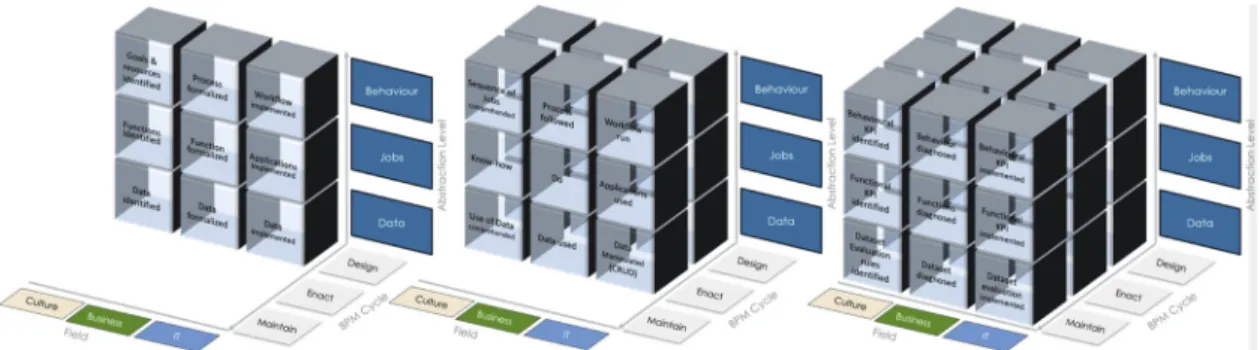
In the next figures we will represent the framework as a cube composed of 27 positions. With a cube representation, we can see that each position has several neighbouring positions and that transitions from one position to another might represent a challenge. Using three axes to evaluate BPM Maturity prevents the framework from being linear, meaning that the positions are not ordered. However, it does not mean that reaching a particular position will not have any impact on the future positions obtainable. But before talking about difficulties and facilitators, we need to define the meaning of each position in the framework.
4. Detailed description of the BPM maturity framework
This section aims to define the 27 positions resulting from the fra-mework presented in Section3. Each position is the result of the in-tersection of three layers. To articulate the presentation, we havefirst chosen to detail, in Section4.1, the intersection betweenField Layers
andAbstraction Levelsby building a plane between these two axes. We then explain, in the three following paragraphs, the meaning of the 9 positions resulting from the intersection of each BPM Cyclelayer with the plan previously detailed. The articulation of the paragraphs is illustrated inFig. 4. We have chosen to present the framework positions along theBPM Cyclethat has already been explained in Section1, but the 27 positions are also presented along the two other axes in Ap-pendix A. and ApAp-pendix B in Supplementary materials.
4.1. Intersection of abstraction levels andfields
In line with the results described in paragraph 2.3, concepts re-sulting from the intersection of the threeAbstraction Levelswith the
FieldsBusinessandIThave already been defined. As a reminder, a “Businessis set offunctionsproviding capabilities, fed byinformationas inputs and organized according toprocessesdescribing theBehaviourof the organization”. The implemented (IT) counterparts of these three concepts are respectively Applications, Computerized Data and
Workflows. For the Culture level it makes sense to use the word
Knowledgeto representDataand to useSkillforJobs. The last concept (Intersection of CulturewithBehaviour) represents the awareness of the existence of sequences between Jobs and the acceptance of the need to monitor them. For this concept we have chosen the wordMonitor. A recap of concepts resulting from the intersection ofAbstraction Levels
andFieldsis presented inTable 3.
The following three paragraphs define the concepts resulting from
the intersection between the plane presented inTable 3and each level of theBPM Cycleaxis.
4.2. Intersection of abstraction levels withfields within the design layer
The DesignLayer corresponds to theimplementation (forIT), the
formalization(forBusiness) and theidentification(forCulture) of models within the organization. In theAbstraction Level,Datagathers every
materialused within the organization,Jobsare equivalent tofunctions
andBehaviourrespectively refers to a sequence ofgoals and resources
(forCulture), to aprocess(forBusiness) and to aWorkflow (forIT).
Table 4sums up the different intersections ofFieldsandAbstraction Levelswithin theDesignLevel of theBPM Cycleaxis.
4.3. Intersection of abstraction levels withfields within the enact layer
TheEnactLayer corresponds to the act of using business concepts in an organization. Here,Culturestands for thecomprehensionof concepts,
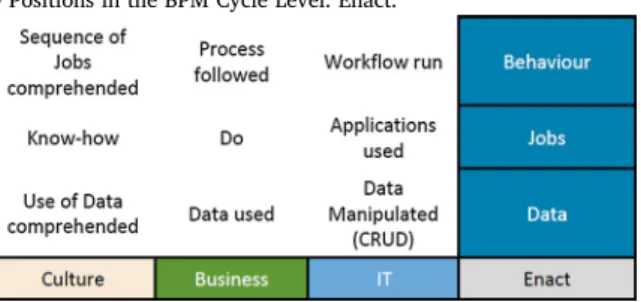
Businessis for the mainworkof the organization andITfor theuseof previous implementation. Following that definition, we can easily identify positions for expertise and experience; the knowledge (and so theculture) ofenactmentwould be the expertise, baptised here“ know-how”; thebusinessapplication ofenactmentwould be the experience, here represented by“do”. Table 5summarizes the different intersec-tions ofFieldswithAbstraction Levelswithin theEnactLevel of the
BPM Cycleaxis.
Fig. 4.Articulation of paragraphs in Section4.
Table 3
Concepts resulting from the intersection of Axes Fields and Abstraction Level.
Table 4
4.4. Intersection of abstraction levels withfields within the maintain layer
TheMaintainLayer is the combination of Control and Diagnosis. This Layer is mainly aboutKey Performance Indicators(KPIs), defined as measurable values (e.g. gathered using embedded sensors) representing how effectively a company is achieving key business objectives. They may reveal potential dysfunctions in the models and contribute to the appropriate management of organizations. In an industrial environ-ment, Control is made possible thanks to the measurement of these KPIs and their comparison with targetfigures. Diagnosis corresponds to the analysis of malfunctions or of improvements to integrate into future models. KPIs can bebehavioural(forBehaviour) orfunctional(forJobs) and can also be set to evaluate the consistency, the lack of redundancy and the security of the Dataset. Table 6 sums up the different inter-sections ofFieldsandAbstraction Levelswithin theMaintainLevel of theBPM Cycleaxis.
4.5. Representation of the framework with its 27 achievements
Fig. 5summarizes the 27 positions in our framework layer by layer, in terms of achievements. The next section develops the idea of con-straints existing in the framework, and this concept is then further developed in the Perspectives section.
4.6. Structuring constraints existing in the framework
Now that resulting concepts have been precisely defined, we can validate the interlocking of the threeAbstraction levelsdescribed in paragraph 2.3. It indeed does not make any sense to implement a workflow without having implemented applications or a database. We can therefore conclude that some prerequisite constraints might exist along the Abstraction Level axis, meaning that no positions of the
Behaviour layer can be reached if the position directly below (Jobs
Abstraction Level,sameField, sameBPM Cyclelevel) has not been reached yet.
We could argue that the same kind of prerequisite constraints exists along the BPM Cycle axis because it does not make any sense to
maintaina concept we neverenacted.But since it is possible toenacta concept that has not previously beendesigned, we can only conclude that themaintainlayer cannot exist without theenactlayer, meaning that no positions of theMaintainlayer can be reached if the position
right behind it (EnactBPM Cycle Level,sameField, sameAbstraction Level) has not been reached yet. As regards theFields, since all levels can exist independently, there cannot be any prerequisite constraints along that last axis. The prerequisite constraints are represented in
Fig. 6.
As a conclusion to this paragraph we would like to focus on the non-related levels, meaning those with no prerequisite constraints. Since the order to reach the non-related levels is not imposed by any structuring constraint, multiple paths can lead to higher maturity levels, and some paths might be more effective than others. This idea is more deeply developed in part 7 - Conclusion and Perspectives, where it is suggested that the framework may be improved through concepts of difficult and easy transitions from one position to another.
Defined in terms of achievements, our framework could be used to (i) assess overallorganization maturity but also to (ii) track the im-plementation of new processes, jobs and data in the company. The next section is dedicated to demonstrating these two different uses.
5. Case study
Iterop is an innovative French start-up in software editing. Its pro-duct, IteropSuite, is software for process modelling, enactment and monitoring. The company also uses its own product for its daily work. In 2015, Iterop undertook the process of obtaining ISO 9001:2015 (ISO, 2015) certification as a guarantee of quality for its customers, but also to demonstrate that process-oriented development is a fast and efficient method to achieve strategic goals. In 6 months, Iterop received the certification with more than 20 key points identified (Iterop, 2017).
As explained at the end of Section 4, this paper claims that the current framework could be used to assess the overall maturity of an organization, but also to track the implementation of new processes, jobs and data in the company. The two use-cases presented respectively in sub-sections5.1and5.2are dedicated to covering both these po-tential uses of the framework.
5.1. Iterop BPM Maturity before and after obtaining the ISO 9001:2015 certification
Since Iterop uses the workflow tool the company have developed on a daily basis, all behaviour, jobs and data is computerized. For this reason, every maturity level reached within theBusinessFieldis also reached within theITField. The consequences in terms of maturity representation are that every position reached within theBusinesslayer comes with the position at its right side (IT).
For the Model layer (Table 7), Iterop already had its Data and
Functions identified,formalizedandimplementedbefore the certification. The company also had its processes formalized and implemented, whereas the identification of goals and resources was not systematic yet.
As concerns theEnactLayer (Table 8), Iterop is driven by the pro-cesses it follows. Thus, everything done by the company follows an implemented process (Workflow). Within the Culture Field, since all the formalization has been conceived by its principal users (and not by an external designer), we can consider that theyknow and comprehendthe
datathey use, thejobsthey do and thesequence of jobsthey follow. However, we keep in mind that this knowledge can be lost with time and especially if dictated by a BPM software over a long period of time. Within theMaintainLayer (Table 9),KPIforjobsanddatawere already identified and implemented but their measures had not been systematicallyanalysedyet.
This paragraph describes the positions reached (and in what order) by Iterop thanks to the ISO 9001:2015 certification. ISO 9001:2015 (ISO, 2015) requires two main points: (i) the formalization of all ex-changes with employees and clients and (ii) the analysis and im-provement of processes. As regards the 1stpoint, Iterop had to identify
content for their missing model: Goals and resources (1). Regarding the
Table 5
9 Positions in the BPM Cycle Level: Enact.
Table 6
2nd point, Iterop had to progressively identify and implement
beha-vioural KPI for each of their processes (2) and started analysing KPIs that were already implemented but not used enough (3) (Table 10).
Iterop’s BPM Maturities before (left) and after (right) are pictured in
Fig. 7.
5.2. Evolution of maturity during the implementation of new procedures required by the norm
The ISO 9001:2015 certification created the need for a new process for Iterop: that of auditing their internal processes and bringing cor-rections and improvements to models. The company had never con-ducted such audits before, and they chose to implement them using a process-oriented approach. The steps they followed are described in this paragraph and shown inFig. 8.
The audit process, and the functions and data involved, werefirst formalized (1), as detailed in the norm. A new document for the new
processcontains a formalizationof the process using a BPMN 2.0 dia-gram, where thefunctionsinvolved are described and the data (needed and produced) is all detailed (types and description). The company quickly implemented the new dataset, set up mails and connections (Applications) to the calendar and resultingworkflow(2) in their BPM software, Iterop, to (3)runthem. The orchestration of workflows forced the employees to (4) follow the process as it was first formalized. Descriptions helped the actors (and not only the designer) to correctly do the jobs they were expected to do, and data was automatically used by the workflow. After several iterations of using the process, the actors (5) acquired essential knowledge about the data they used, the jobs themselves and their sequencing. It was only after having acquired such knowledge of enactment that they could (6) identify data, functions, goals and resources that were involved in the process, and complete the documentation. This new expertise enabled them to (7) identify KPIs for processes, functions and data that were (8) implemented, allowing processes to be frequently diagnosed (9).
6. Framework evaluation and limitations 6.1. Contributions to theory
Other frameworks from the literature review show that Abstraction Levels are hardly ever investigated by existing maturity frameworks. In contrast, our framework recognizes that conducting continuous im-provement for data or jobs is indeed a progression towards achieving high BPM maturity levels, whereas other frameworks only recognize
Fig. 5.Our BPM maturity Framework: meaning of positions in terms of achievements.
Fig. 6.Prerequisite constraints existing in the framework.
Table 7
Positions in the Model Layer reached by Iterop before obtaining the certifi ca-tion.
Table 8
Positions in the Enact Layer reached by Iterop before obtaining the certification.
Table 9
Positions in the Maintain Layer reached by Iterop before obtaining the certifi -cation.
processes. Even if this rare axis will cause our framework to be less comparable with others, our position is that this vision could be useful for maturity models aiming to guide BPM implementation, since it imposes a BPM approach not only on behaviour but also on functions and data.
As far as we know, this is the first time that the notion of requisite constraints in maturity models has been expressed. A pre-requisite constraint can be seen as an axis along which a position cannot be reached without the previous one. For maturity models that are only based on one linear dimension, this notion already implicitly exists, but the absence of prerequisite constraint identification that helps guide the user in implementing their BPM approach is a shortcoming of other frameworks.
6.2. Implications for practice
An assessment of the framework is available in Appendix C in Supplementary materials. It follows the guidelines ofVan Looy, Poels, and Snoeck (2017). This first evaluation reveals that the framework provides more in-depth descriptions but may be overly-dependent on the assessors’skills. There is specifically a limitation in the culture layer achievements of the proposed framework, where the evaluation some-times relies on subjective techniques. However, we think it is important to measure the BPM culture of an organization to assess its overall BPM maturity level and so to keep this layer in the framework.
Tarhan, Turetken, and Reijers (2016) demonstrated that an in-creased maturity level, with respect to a maturity model, leads to an improved business performance, which is a goal coveted by every or-ganization. Yet, since most BPMMs display descriptive rather than prescriptive characteristics (as raised in 2.2 - BPM Maturity), organi-zation lacks guidelines to improve their maturity levels. The proposed
framework describes positions in terms of achievements, thus helping organizations to see what they need to accomplish to reach new ma-turity levels.
The non-linear structure of the framework allows every organiza-tion to place their advancement in the structure, revealing that different strategies can exist to reach a high BPM maturity level. We plan on using that theory to investigate the role of IT in enabling the acquire-ment of new business capabilities. Nowadays, technologies have so much more capabilities than in the 80 s (Artificial Intelligence, Big Data, Cloud Computing) that it has become a common intuition to think that technology would shortly enable businesses to reach higher ma-turity levels in less time than they need today. An Adequate Alignment of IT Infrastructure and BPR Strategy has always been identified ( Al-Mashari & Zairi, 1999;Indulska et al., 2009;Recker, Mendling, & Hahn, 2013) as a key success factor for implementing a BPM strategy. But despite the natural partnership that has always existed between BPM and information technology (Davenport & Short, 1990), industrial en-gineers have still not fully exploited the idea of taking better advantage of IT to implement a BPM strategy (Yongsiriwit, 2017). We think that the framework could be used to support that intuition.
Harmon (2018)points out that nowadays organizations do not im-plement BPM in the entire business, but rather focus on specific pro-cesses and“lurch from one process improvement effort to the next”. To our knowledge, this is thefirst time a maturity model has been designed for use both in the evaluation of an organization’s overallBPM maturity level and for the evaluation of a single procedure in the organization. Most maturity frameworks also contain achievements such as “ pro-cesses need to be defined”or“data needs to be identified”. We decided to consider the same achievements for single procedures. Thus, the framework can be used to follow the implementation of this new pro-cedure until it reaches the same level as other existing propro-cedures in the
Table 10
Positions in the Design and Maintain Layers reached by Iterop after obtaining the certification.
company. The difference between these two case studies resides in the positions that have been reached when starting the guidance: when implementing new procedures, no position has yet been reached, whereas guiding an organization in its entire BPM implementation re-quires determining what positions have already been reached. Due to its non-linearity, we consider this initial need to position a company within the framework as the main limitation of our work.
6.3. Limitations and avenues for future research
A first version of the framework did not consider the two steps, Control and Diagnosis, of the BPM approach as being merged, but the
Diagnoselayer appeared to be empty (composed only of achievements such as: identifyflaws). We decided to keep the framework with only three levels for the BPM Cycle axis to widen the perspective for the future use of the framework. However, although some organizations might have their own KPIs identified, implemented and measured, they may not possess the required reengineering knowledge or skills in KPI results interpretation to effectively upgrade their processes. This step of the BPM approach is rarely reached by organizations and our frame-work does not dedicate an entire layer to it.
Compared to other frameworks, our proposal does not include concepts such as Strategic Alignment, Methodology, Leadership and Communication. These missing concepts may help a new achievement, or indeed prevent it from completing, meaning that our framework could still be enriched by identifying frontiers between layers or posi-tions. We suggest that this framework could be enriched by character-izing frontiers between two positions. We would like future research to investigate those frontiers more fully. A frontier can have prerequisite constraints (like the ones identified in Section4.5) or perhaps only simple barriers (making it difficult, but not impossible, for organiza-tions to reach a new position from a previous one). On the other hand, the opposite concept may apply: frontiers may facilitateflows (meaning it would be easy for organizations to reach a new position from a po-sition already obtained). We would like our future research to in-vestigate these concepts of barriers andflows so that the framework in
its 2.0 version could then be used to demonstrate where future research should be focusing on (barriers that need to be raised orflows that can be taken advantage of) to better reconcile theories and industrial im-plementation.
In line with this idea of improving the structure with barriers and
flows, the framework could be seen as a relief map where barriers would be mountains andflows would be rivers. Thus, targeting a pre-cise maturity level, organizations would rather take the most lucrative path, meaning the shortest one, or the one with the fewest mountains and the most rivers. This perspective mightfinally prove that IT is a real enabler for the acquisition of new business capabilities, which con-stitutes our main perspective for the framework.
7. Conclusion
Our goal was to focus on how to improve industrial BPM im-plementation and we strongly believe that, despite the numerous fea-tures existing to partially guide companies, industries lack guidance to implement the overall method. In order to support organizations in implementing their entire BPM approach, our research attempts to conceive a new, comprehensive framework for BPM maturity assess-ment. With regard to our first Scientific Question (What criteria can characterize BPM maturity?),we identified three domains defining an organization’s overall BPM maturity: BPM Cycle (Model, Enact, Maintain), Field (Culture, Business, IT) and Abstraction Level (Data, Jobs, Behaviour). We described the 27 positions resulting from the in-tersections between these domains in terms of prescriptive achieve-ments. The proposed framework can be used to (i) assess an organiza-tion’s BPM maturity or (ii) help implement new procedures in the structure by indicating those achievements that need to be completed in order to reach a higher maturity level. This second use of the frame-work answers our secondScientific Question (What should an organiza-tion achieve to reach a higher maturity level?).
Depending on the organization, the order in which positions are reached can differ, meaning that our framework could reveal different strategies to reach a high maturity levels. Following this idea, we think
that our framework could be seen has a travelling map in which one should avoid difficulties and prefer following a path with facilitating
flows. Hopefully, numerous theories also complementing the BPM do-main and could thus constitute theseflows: data and process mining features,flow optimization tools, optimization of warehouse organiza-tions, simulation, (flow, workshop, production, product), Lean man-agement, business activity monitoring tools... We wish to improve our framework with these existing features to reveal easiest strategies to reach a perfect maturity level. Moreover, we think it could suggest how IT could evolve to raise remaining barriers for BPM implementation and thus constitute a guide for future research subjects.
Appendix A. Supplementary data
Supplementary material related to this article can be found, in the online version, at doi:https://doi.org/10.1016/j.ijinfomgt.2019.05. 013.
References
Ahadi, H. R. (2004). An examination of the role of organizational enablers in business process reengineering and the impact of information technology.Information Resources Management Journal (IRMJ), 17(4), 1–19.
Ahmad, H., Francis, A., & Zairi, M. (2007). Business process reengineering: Critical suc-cess factors in higher education.Business Process Management Journal, 13(3), 451–469.https://doi.org/10.1108/14637150710752344.
Almajali, D., & Dahalin, Z. (2011). Applying the triangulation approach in IT–Business strategic alignment and sustainable competitive advantage.IBIMA Business Review Journal,1–13.https://doi.org/10.5171/2011.214481.
Al-Mashari, M., & Zairi, M. (1999). BPR implementation process: An analysis of key success and failure factors.Business Process Management Journal, 5(1), 87–112. Alonso, I. A., Verdún, J. C., & Caro, E. T. (2017). Description of the structure of the IT
demand management process framework.International Journal of Information Management, 37(1), 1461–1473.
Bai, C., & Sarkis, J. (2013). A grey-based DEMATEL model for evaluating business process management critical success factors.International Journal of Production Economics, 146(1), 281–292.https://doi.org/10.1016/j.ijpe.2013.07.011.
Benaben, F. (2012).Conception de systèmes d’information de médiation pour la prise en charge de l’interopérabilité dans les collaborations d’organisations.Retrieved from Habilitation à Diriger des Recherches, INP Toulouse website:https://hal-mines-albi. archives-ouvertes.fr/tel-01206234.
Bénaben, F., Boissel-Dallier, N., Pingaud, H., & Lorre, J.-P. (2013). Semantic issues in model-driven management of information system interoperability.International Journal of Computer Integrated Manufacturing, 26(11), 1042–1053.
Benaben, F., & Vernadat, F. B. (2017). Information System agility to support collaborative organisations.Enterprise Information Systems, 11(4), 470–473.https://doi.org/10.
1080/17517575.2016.1269367.
Bidoux, L. (2016).Preference-based planning using the Multi-Attribute Utility Theory along with a Choquet integral: Application to organizations’interoperability in crisis management (Doctoral dissertation).Retrieved fromhttps://tel.archives-ouvertes.fr/tel-01823824. Buh, B., Kovačič, A., & IndiharŠtemberger, M. (2015). Critical success factors for different
stages of business process management adoption–A case study.Economic Research-Ekonomska Istraživanja, 28(1), 243–258.https://doi.org/10.1080/1331677X.2015. 1041776.
Burlton, R. (2011). BPM critical success factors: Lessons learned from successful BPM organizations.BPTrends, 12(10), 1–6.
Chong, S. (2007). Business process management for SMEs: An exploratory study of im-plementation factors for the Australian wine industry.Journal of Information Systems and Small Business, 1(1–2), 41–58.
Cronemyr, P., & Danielsson, M. (2013). Process management 1-2-3–A maturity model and diagnostics tool.Total Quality Management & Business Excellence, 24(7–8), 933–944.https://doi.org/10.1080/14783363.2013.791114.
Cutura, S. (2013).5 reasons for BPM project failure.September 30, Retrieved April 1, 2019, fromhttp://info.convedo.com/5-reasons-for-bpm-project-failure.
Davenport, T. H., & Short, J. E. (1990). The new industrial engineering: Information technology and business process redesign.Sloan Management Review, 31(4), 11–27. De Bruin, T., Freeze, R., Kulkarni, U., & Rosemann, M. (2005). Understanding the main phases of developing a maturity assessment model.16th Australasian Conference on Information Systems,8–19.
Dyer, L., Henry, F., Lehmann, I., Lipof, G., Osmani, F., Parrott, D., ... Zahn, J. (2012). Scaling BPM adoption: From project to program with IBM business process manager. Retrieved fromhttp://refhub.elsevier.com/S0268-4012(15)00098-5/sbref0075. Fisher, D. M. (2004). The business process maturity model: A practical approach for
identifying opportunities for optimization.BPTrends,1–7.
Frolick, M. N., & Ariyachandra, T. R. (2006). Business performance management: One truth.Information Systems Management, 23(1), 41–48.https://doi.org/10.1201/1078.
10580530/45769.23.1.20061201/91771.5.
Gottschalk, P. (2009). Maturity levels for interoperability in digital government. Government Information Quarterly, 26(1), 75–81.https://doi.org/10.1016/j.giq.2008. 03.003.
Grau, C., & Moormann, J. (2014). Investigating the relationship between process man-agement and organizational culture: Literature review and research agenda. Management and Organizational Studies, 1(2), 1–17.https://doi.org/10.5430/mos. v1n2p1.
Harmon, P. (2018).The state of the BPM market–2018.Retrieved fromBPTrendshttps:// www.redhat.com/cms/managed-fi les/mi-bptrends-state-of-bpm-2018-survey-analyst-paper-201803-en.pdf.
Harmon, P., & Wolf, C. (2016).The state of business process management 2014Retrieved from. BPTrends https://www.bptrends.com/bpt/wp-content/uploads/BPTrends-State-of-BPM-Survey-Report.pdf.
Hu, Y.-P., Chang, I.-C., & Hsu, W.-Y. (2017). Mediating effects of business process for international trade industry on the relationship between information capital and company performance.International Journal of Information Management, 37(5), 473–483.https://doi.org/10.1016/j.ijinfomgt.2017.04.004.
Hull, R., & Nezhad, H. R. M. (2016).Rethinking BPM in a cognitive world: Transforming how we learn and perform business processes. 14th Int. Conf. on Business Process Management, BPM 20163–19.
Imanipour, N., Talebi, K., & Rezazadeh, S. (2012).Obstacles in business process management (BPM) implementation and adoption in SMEs.Retrieved fromhttp://ssrn.com/ abstract=1990609.
Indulska, M., Recker, J., Rosemann, M., & Green, P. (2009). Business process modeling: Current issues and future challenges. In D.e.a. Hutchison (Ed.).Advanced information systems engineering(pp. 501–514). Springer.
ISO (2015).ISO 9001:2015(fr).Retrieved January 24, 2018, fromhttps://www.iso.org/ obp/ui/#iso:std:iso:9001:ed-5:v2:fr.
Iterop (2017).Iterop certifiée ISO 9001:2015!.April 25Retrieved April 1, 2019, from Iterop website:https://www.iterop.com/iterop-certifiee-iso-9001/.
Klun, M., Mendling, J., & Trkman, P. (2016). BPM explained through cognitive dis-sonance and absorptive capacity.Twenty-Second Americas Conference on Information Systems.
Ko, R. K. L., Lee, S. S. G., & Wah Lee, E. (2009). Business process management (BPM) standards: A survey.Business Process Management Journal, 15(5), 744–791.https://
doi.org/10.1108/14637150910987937.
Kruger, C. N., & Johnson, R. D. (2010). Information management as an enabler of knowledge management maturity: A South African perspective.International Journal of Information Management, 30(1), 57–67.https://doi.org/10.1016/j.ijinfomgt.2009. 06.007.
Meidan, A., García-García, J. A., Escalona, M. J., & Ramos, I. (2017). A survey on business processes management suites.Computer Standards & Interfaces, 51, 71–86. Møller, C., Maack, C., & Tan, R. (2007). What is business process management: A two
stage literature review of an emergingfield. IFIP International Federation for Information Processing, Volume 254.Research and Practical Issues of Enterprise Information Systems II, 1, 19–31.
Montarnal, A. (2015).Deduction of inter-organizational collaborative business processes within an enterprise social network (Doctoral dissertation).Retrieved fromEcole des Mines d’Albi-Carmauxhttps://tel.archives-ouvertes.fr/tel-01424117.
Moradi-Moghadam, M., Safari, H., & Maleki, M. (2013). A novel model for business process maturity assessment through combining maturity models with EFQM and ISO 9004:2009.International Journal of Business Process Integration and Management, 6(2), 167–184.https://doi.org/10.1504/IJBPIM.2013.054680.
Oxford University Press (2012).Oxford english dictionary (OED).Retrieved fromhttp://
www.oed.com/viewdictionaryentry/Entry/227050.
Pöppelbuß, J., & Röglinger, M. (2011). What makes a useful maturity model? A frame-work of general design, principles for maturity models and its demonstration in business process management.19th European Conference on Information Systems (ECIS 2011),28.
Power, B. (2007). Michael Hammer’s process and enterprise maturity model.BPTrends, 7, 1–4.
PRIME BPM (2017).5 critical success factors in business process improvement.May 19 Retrieved April 1, 2019, from PRIME BPM website:http://www.primebpm.com/ resources/5-critical-success-factors-business-process-improvement/.
Rahimi, F., Møller, C., & Hvam, L. (2016). Business process management and IT man-agement: The missing integration.International Journal of Information Management, 36(1), 142–154.https://doi.org/10.1016/j.ijinfomgt.2015.10.004.
Recker, J., Mendling, J., & Hahn, C. (2013). How collaborative technology supports cognitive processes in collaborative process modeling: A capabilities-gains-outcome model.Information Systems, 38(8), 1031–1045.
Rohloff, M. (2009). Process management maturity assessment.Proceedings of the Americas Conference on Information Systems (AMCIS),631.
Rosemann, M., & De Bruin, T. (2005). Application of a holistic model for determining BPM maturity.Proceedings of the AIM Pre-ICIS Workshop on Process Management and Information Systems,46–60.
Rosemann, M., De Bruin, T., & Power, B. (2006). A model to measure business process management maturity and improve performance. In J. Jeston, & J. Nelis (Eds.).
Business process management(pp. 299–315)..
Santos, H. M., Alves, C. F., Santos, G. V., & Santana, A. L. (2015). Strategies for managing critical success factors of BPM initiatives in Brazilian public organizations: A quali-tative empirical study.N ISys–Revista Brasileira de Sistemas de Informação, Rio de Janeiro, 8(1), 42–64.
SEI, C. (2002).Capability maturity model®integration (CMMISM), version 1.1. CMMI for systems engineering, software engineering, integrated product and process development, and supplier sourcing (CMMI-SE/SW/IPPD/SS, V1. 1).
Sherwin, G. (2011). Defining the critical success factors for business process management.
Fujitsu Insights & Opinions,125–134.
Škrinjar, R., & Trkman, P. (2013). Increasing process orientation with business process management: Critical practices.International Journal of Information Management,
33(1), 48–60.https://doi.org/10.1016/j.ijinfomgt.2012.05.011.
Tarhan, A., Turetken, O., & Reijers, H. A. (2016). Business process maturity models: A systematic literature review.Information and Software Technology, 75, 122–134. https://doi.org/10.1016/j.infsof.2016.01.010.
ter Hofstede, A. H. M., & Weske, M. (2003).Business process management: A survey. Proceedings of the 1st International Conference on Business Process Management, 2678 of LNCS1–12.
Trkman, P. (2010). The critical success factors of business process management. International Journal of Information Management, 30(2), 125–134.https://doi.org/10. 1016/j.ijinfomgt.2009.07.003.
van der Aalst, W. M., Netjes, M., & Reijers, H. A. (2007). Supporting the full BPM life-cycle using process mining and intelligent redesign. In K. Siau (Ed.).Contemporary issues in database design and information systems development(pp. 100–132). IGI Global.
van der Aalst, W. M. P. (2013). Business process management: A comprehensive survey.
ISRN Software Engineering, 2013, 1–37.https://doi.org/10.1155/2013/507984. Van Looy, A., Poels, G., & Snoeck, M. (2017). Evaluating business process maturity
models.Journal of the Association for Information Systems, 18(6), 461–486.https://doi. org/10.17705/1jais.00460.
van Steenbergen, M., Bos, R., Brinkkemper, S., van de Weerd, I., & Bekkers, W. (2013). Improving IS functions step by step: The use of focus area maturity models.
Scandinavian Journal of Information Systems, 25(2), 35–56.
Vernadat, F. (1999).Techniques de modélisation en entreprise, applications aux processus opérationnels.Paris: Economica.
vom Brocke, J., & Rosemann, M. (Eds.). (2015).Handbook on business process management 1(2nd ed.). Springerhttps://doi.org/10.1007/978-3-642-45100-3.
Yongsiriwit, K. (2017).Modeling and mining business process variants in cloud environments (Doctoral dissertation).Retrieved fromUniversité Paris Saclay https://tel.archives-ouvertes.fr/tel-01470199.