Collection Development and
Interdisciplinary Endeavors:
Collaborative Efforts for Educational
and Work Environments
Laura M. Bartolo, Don A. Wicks, and Valerie A. Phillips
Laura M. Bartolo is an associate professor of libraries and media services at Kent State University; e-mail: [email protected]. Don A. Wicks is an assistant professor at the School of Library and Information Science, Kent State University; e-mail: [email protected]. Valerie A. Phillips is a graduate student at the School of Library and Information Science, Kent State University; e-mail: [email protected].
Introduction
Libraries have often been compared to the “heart of a uni-versity” because they represent a common place on the cam-pus where intellectual ideas are collected, archived and ac-cessed to support the instructional and research mission of the University. Library collections of electronic and print resources are a “public good” as well as a visible record of universities’ instructional and research efforts. Collec-tions reach across the programmatic endeavors of univer-sities and impact undergraduates, graduate students, and faculty throughout campuses. In addition to the traditional role of providing content, library collections can also pro-vide measurement indicators about instruction and research occurring on campuses.
Interdisciplinary instruction and research are of great interest today on college campuses across the country. At
Kent State University in her October 5, 2000 State of the Union address, President Carol A. Cartwright articulated a vision that many university presidents support:
“From psychological health to economic health, many of the complex issues researchers will address in the 21st century require knowledge from several fields. In keeping with the strategic goal to support multidisciplinary teach-ing and research, Kent State mathematicians are collabo-rating with chemists; psychologists have joined forces with physicists; biologists are teaming with geographers; and fashion designers are working with computer scientists.”1
Yet while there is keen interest to support interdiscipli-nary initiatives, universities often encounter difficulties identifying and tracking these efforts. Collection develop-ment can provide some indicators by reflecting the current and emerging interdisciplinary interests of students and
faculty in academic departments for areas outside their own discipline. This paper discusses the first stage of a two-part collection development project at Kent State Univer-sity that investigated using departmental collection pro-files as an aid to identifying interdisciplinary programming and work.
The Literature
Interdisciplinary programs attract considerable interest in American university libraries. At the 1995 American Li-braries Association Conference there was a discussion of interdisciplinary scholarship and its implications for col-lection development which, while acknowledging histori-cal evidence for interdisciplinarity, also cited the more re-cent expansion of undergraduate programs such as Women’s Studies and the influence of modern technology in allowing access to collections and communications among students and scholars across disciplinary lines (Pugh 1996). The push to interdisciplinary programs, said the panelists at this forum, would require collections librarians to adopt a generalist and collaborative approach to their work.
Adams (1992) has observed that the introduction of such programs poses challenges for not only administrators and faculty, but also for academic librarians involved in collection development. The challenges include identification of core literature, and determination of appropriate levels of book and serial holdings for the new program. Identifying those levels may require new methods of collection evaluation, re-ports Adams, who then describes an approach taken at her institution to define core periodicals in an interdisciplinary field, Studies of the American South. Issues such as this re-flect the need to define the new interdisciplinary area.
Dobson et al. (1996) point out that interdisciplinary courses or programs may be found in different stages of development, and, at whatever stage, must address broad intellectual content and varied methodological approaches. The librarians face problems with weak bibliographic con-trol, users who are dispersed among a number of depart-ments, and materials which are spread over many subject classes. Keresztesi (1982) identified three stages in the pro-duction of information resources within the development of a focused discipline relating to interdisciplinary work: pioneering stage, proliferation stage, and establishment stage.
Collection data has often been used in studies of librarianship. For example, dollars spent on materials and numbers of volumes per student are figures used to “rate” college and university programs or to evaluate performance against a standard. The annual Maclean’s magazine report
on university programs in Canada, an annual survey simi-lar to USA Today’s reports in the United States, allows the library to account for up to 12 per cent of the total score a university receives and bases the library’s score on such things as size of collection, volumes per student, percent-age of the university’s budget devoted to the library, per-centage spent on updating the collection, and spending on electronic resources (Johnson 2000). Another study which illustrates the usage of collection figures is Crawford and White’s (1999) analysis of how some undergraduate pro-grams fare in relationship to the 1995 Standards for College Libraries. In this study, however, collection data is exam-ined for a different purpose, namely to illustrate interdisci-plinary activity at Kent State University.
Definitions
Similar to Keresztesi’s stages of interdisciplinary resources, three levels of interdisciplinary collection interests based upon instruction and research emerged through the col-lection development reprofiling project:
• Interdisciplinary interests for established interdisci-plinary programs;
• Interdisciplinary interests for emerging interdiscipli-nary programs; and
• Informal multidisciplinary interests for individual academic departments.
For the purpose of this paper established interdiscipli-nary programs, emerging interdiscipliinterdiscipli-nary programs, and informal multidisciplinary interests are defined in the fol-lowing manner. An established interdisciplinary program is one that is commonly found at American universities and that offers courses taught independently by the program or in conjunction with other academic departments, such as Women Studies. An emerging interdisciplinary program is a university’s efforts to respond to new interests and needs in higher education and society, and may vary in nature and organization from one university to another. An example of an emerging interdisciplinary program at Kent State Univer-sity is Information Architecture and Knowledge Management (IAKM), a recently formed graduate program designed to prepare students as information technology specialists with courses taught by faculty in Business, Communications Stud-ies, Computer Science, Journalism and Mass communications, Library and Information Science, and Visual Communication Design. Informal multidisciplinary interest by an academic department is an interest to a related discipline outside of the parent discipline. In this project the departments of Music, Geography, and Physics demonstrated strong multidisciplinary
interests with other academic departments. The first part of the two-stage collection development project focused upon the profiling activity of Women Stud-ies (an established interdisciplinary program), the IAKM program (an emerging interdisciplinary program), and the departments of Geography, Music, and Physics (multidisciplinary interests in the humanities (Music), social sciences (Geogra-phy), and sciences (Physics)) to investigate whether collection data can be used to illustrate interdisci-plinary activity at Kent State University.
Methodology
In 1997 the OhioLINK Consortium embarked on a state-wide cooperative collection building initiative encourag-ing participation from all of its member institutions. As part of that initiative, Kent State University Libraries un-dertook a major collection development project involving librarians, representatives from all the academic depart-ments, and the School of Library and Information Science to build a comprehensive approval plan for the University with Yankee Book Peddler (YBP) as the State book vendor. YBP uses the Library of Congress classification scheme as the basis of its approval profiles and this system provided an effective organizational framework for identifying disci-plinary and interdiscidisci-plinary interests among the univer-sity community. In addition to identifying the monograph collection interests for all the academic departments, the YBP approval profile for Kent State University also en-abled departments to indicate areas of instructional and research interest in common with other academic areas. The interdisciplinary collection interests of an established terdisciplinary program (Women Studies), an emerging terdisciplinary program (IAKM), and multidisciplinary in-terests in the humanities (Music), social sciences (Geogra-phy), and sciences (Physics) form the basis of the first stage of the two-stage project presented in this paper (see Table 1).
In order to identify appropriate evaluation methods for interdisciplinary collections, Dobson identified three vari-ables to describe differences among interdisciplinary fields: • Degree of independence, or relationship of an area to its parent discipline;
• Breadth, or number of related or parent disciplines; and
• Degree of establishment, or age of the interdisciplinary area.2
In the collection development profiling project, three variables were used as indicators of interdisciplinary
in-Table 1. Disciplines Studied
FIELD SUBJECT/ DISCIPLINE
Social Sciences Geography
Humanities Music
Sciences Physics
Traditional Interdisciplinary Women’s Studies Emerging Interdisciplinary Administrative Studies (Information Architecture Library & Information Science & Knowledge Management) Journalism & Mass Communication
Communication Studies Visual Communication Design
struction and research interests in the approval profiles for the Women Studies Program, the IAKM Program, Geog-raphy, Music, and Physics:
• Degree of Interest; • Collecting Activity; and • Direction of Interest.
Degree of interest was identified as “Primary Depart-ment” or “Other Interested departments”. A “Primary De-partment” assumed responsibility to initially review re-sources for selection in a particular LC Class or Subclass, demonstrating a strong interest in an area. “Other Inter-ested Departments” elected to receive notification in that LC range for resources included in the Approval Profile but not selected by the Primary Department, indicating some level of interest in an area. Collecting activity was de-fined as “Book Selection” where a department chose to have books in a particular LC Class and Subclass sent to the library for review or “Notification Slip” where a depart-ment chose to review slips describing the books. “Direc-tion of Interest” was determined as “Mutual Interest” or “Individual interest”. Mutual interest took place when the same departments selected one another’s LC Classes and Subclasses as areas of collection interest. Individual inter-est occurred when Department A chose LC class for De-partment B’s but DeDe-partment B did not indicate similar interest in Department A. “Primary Department”, “Book Selection”, and “Mutual Direction of Interest” were deter-mined to be indicators of strong interdisciplinary inter-ests levels where “Other Interested Departments”, “Notifi-cation Slips”, and “Individual Interest” were identified as moderate levels of interdisciplinary interests.
Preliminary Findings
The collection approval plan profile agreement which YBP Inc. and Kent State University Libraries established in 2000 is an eighty-one page document which identifies the LC classification ranges for which various departments are
in-terested in collecting monographs, whether the department is to receive books or announcement slips, the departmental fund to be charged, and any other departments with an in-terest in that subject range. For thirty-five subject areas with primary fund responsibility there were also other de-partments which expressed interest in the same subject area(s). For the departments selected for this study, the re-sults were as follows.
In areas where more than one department had expressed interest, Geography had primary fund responsibility in a range of the following 14 LC Subclasses:
D History DS Asian History H Social Sciences H Social Sciences H Social Sciences H Social Sciences H Social Sciences
HB Economic Theory. Demography HD Economic History & Conditions HE Transportation & Communications HF Commerce
HT Communities. Classes. Races J Political Science
JC Political Theory K Law
K Law K Law
KF United States Law KFO Ohio Law
KFX Law of Individual Cities, A-Z N Fine Arts
NA Architecture Q Science
QH Natural History R Medicine
RA Public Aspects of Medicine T Technology
TH Engineering & Civil Engineering (General) Geography was listed as an “Other Interested Depart-ment” in the following 7 LC Subclasses:
H Social Sciences H Social Sciences
HC Economic History & Conditions HT Communities. Classes. Races J Political Science
J Political Science J Political Science
J Political Science JC Political Theory
JN Political Institutions & Public Administration JQ Political Institutions & Public Administration JV Emigration & Immigration. International Migration Q Science
QK Botany
These lists show that Geography shares some interests with LC areas in the social sciences, humanities (Architec-ture), and sciences Medicine, Botany). Most of the shared interests are in the social sciences (History, Economics, Po-litical Science, Law).
In areas where other departments had expressed inter-est, Music had primary fund responsibility in a range of the following 3 LC Subclasses:
B Philosophy, Psychology, Religion BV Practical Theology, Hymnology, Music H Social Sciences
H Social Sciences (General) K Law
KF US Law, music copyright
Music was identified as an “Other Interested Depart-ment” in one other area, namely
K Law
KF US Law, intellectual property
Music shared collection interests with other humani-ties subjects (Theology, Philosophy) and the social sciences (Law).
When one or more departments expressed interest in a range of the following 3 LC Subclasses, Physics had pri-mary fund responsibility:
Q Science Q Science
Q Science (General), history QA Mathematics
T Technology
TP Chemical Technology
Physics was identified as an “Other Interested Depart-ment” in 6 other areas:
Q Science Q Science Q Science Q Science QA Mathematics QC Physics QC Chemistry
QP Physiology, animal biochemistry T Technology
T Technology
TA Engineering & Civil Engineering (General) TP Chemical Technology
Physics shared interests with other subjects in the sci-ences (Mathematics, Chemistry, Physiology, Engineering), but no social science or humanities subjects.
Women’s Studies had no primary fund responsibility in multi-department areas, but was listed as an “Other Inter-ested Department” in 7 LC Subclasses:
B Philosophy. Psychology. Religion BF Psychology
H Social Sciences H Social Sciences H Social Sciences
HD Economic History & Conditions HQ The Family. Marriage. Woman HV Social & Public Welfare L Education
LC Education of Special Classes P Language & Literature PN Literary History. Biography R Medicine
RA Public Aspects of Medicine
Women’s Studies’ collection interests covered subject areas in the social sciences (Philosophy, Religion, Econom-ics, Sociology, Education), humanities (Literature), and sci-ences (Medicine).
Five disciplines are cooperating in a new master’s pro-gram in information architecture and knowledge manage-ment. One of these, Visual Communication Design, shared no LC Classes or Subclasses with other interested depart-ments and is, therefore, not discussed in what follows. Ad-ministrative Studies, when other departments also ex-pressed interest, had primary fund responsibilities in a range of 10 LC Subclasses: H Social Sciences H Social Sciences H Social Sciences H Social Sciences HA Statistics
HD Economic History & Conditions HE Transportation & Communications HF Commerce
L Education
LB Theory & Practice of Education Q Science
Q Science
Q Science (General). Cybernetics. Information Theory, etc.
QA Computer Science T Technology T Technology T Technology
TA Engineering & Civil Engineering (General) TK Electrical Engineering
TS Manufacturers
Administrative Studies was identified as an “Other In-terested Department” in 4 other areas:
H Social Sciences H Social Sciences
HD Economic History & Conditions HE Transportation & Communications Q Science
QA Computer Science T Technology
TK Electrical Engineering
The shared collection activities of Administrative Studies covered the social sciences (Economics, Commu-nications, Education) and sciences (Computer Science, Engineering).
In areas where Library and Information Science (LIS) shared an interest with some other departments, LIS was identified as the fund responsible for a range of 4 LC Sub-classes:
K Law
KF United States Law Q Science Q Science (General) R Medicine R Computer Applications T Technology T Technology (General)
Library and Information Science was an “Other Inter-ested Department” in 9 areas:
B Philosophy. Psychology. Religion BJ Ethics
H Social Sciences H Social Sciences
HD Economic History & Conditions HE Transportation & Communications P Language & Literature
PN Literary History. Juvenile Literature Q Science
Q Science
Q Science (General) QA Computer Science T Technology
TK Telecommunication Z Library Science Z Library Science
Z Freedom of the Press. Censorship ZA Information Resources
For Library and Information Science, collection inter-ests were shared with other social science subject areas (Law, Economics, Communications), some humanities (Philoso-phy, Religion, Psychology, Literature), and the sciences (Computer applications of Medicine, Computer Science, Telecommunication, Technology).
In shared interest areas, Journalism & Mass Communi-cation had fund responsibility in a range of 7 LC Subclasses, as follows:
H Social Sciences H Social Sciences H Social Sciences H Social Sciences
HD Economic History & Conditions HE Transportation & Communications HF Commerce
HM Sociology
P Language & Literature
PN General & Universal Literary History. Broadcasting. Radio. Television. Motion Pictures. Journalism T Technology
TR Photography Z Library Science
Z Freedom of the Press. Censorship
Journalism & Mass Communication also expressed in-terest in two other areas, namely
T Technology
TK Electrical Engineering
Z Library Science ZA Information Resources
The areas in which this discipline shared collection in-terest were the social sciences (Economics, Communications, Sociology, Library science), the humanities (Literature), and science (Engineering).
Communication Studies, in shared areas, was respon-sible for a range of 5 LC Subclasses:
B Philosophy. Psychology. Religion
BF Psychology. Interpersonal Communication H Social Sciences
HM Sociology
P Language & Literature P Language & Literature
P Philology. Linguistics (General) PE English Literature
R Medicine
RA Public Aspects of Medicine
Communication Studies was an “Other Interested De-partment” in 6 other areas:
H Social Sciences H Social Sciences H Social Sciences
HD Economic History & Conditions HM Sociology
HQ The Family. Marriage. Woman P Language & Literature
P Philology. Linguistics (General) R Medicine
RA Public Aspects of Medicine Z Library Science
ZA Information Resources
Communication Studies had interests in common with other social sciences (Sociology, Library Science), the
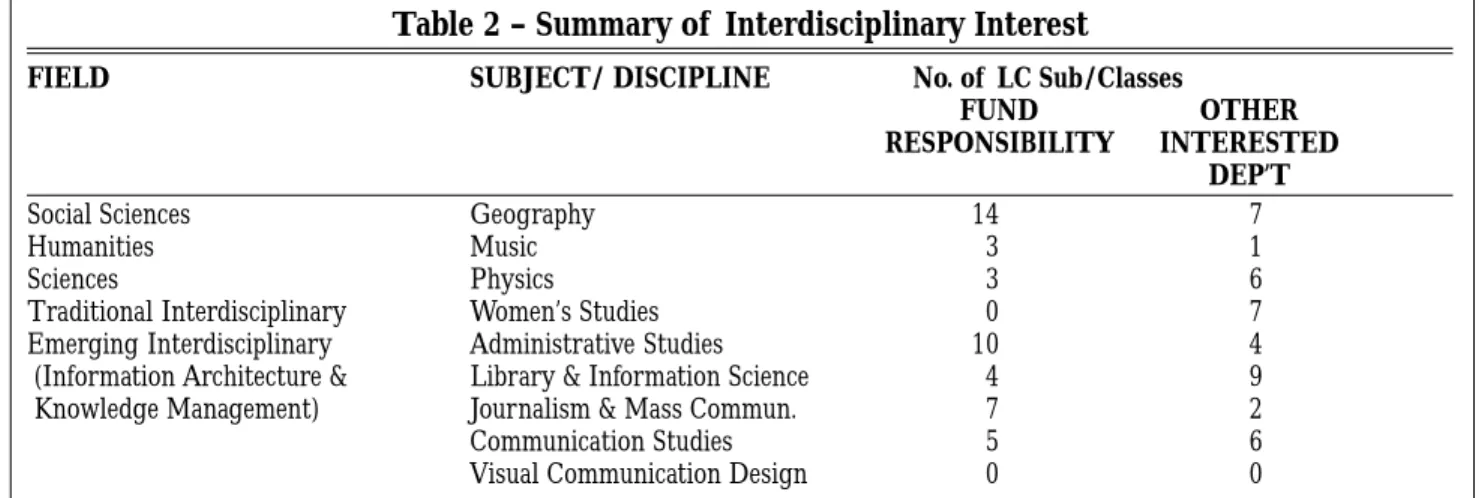
hu-Table 2 – Summary of Interdisciplinary Interest
FIELD SUBJECT/ DISCIPLINE No. of LC Sub/Classes
FUND OTHER RESPONSIBILITY INTERESTED
DEP’T
Social Sciences Geography 14 7
Humanities Music 3 1
Sciences Physics 3 6
Traditional Interdisciplinary Women’s Studies 0 7 Emerging Interdisciplinary Administrative Studies 10 4 (Information Architecture & Library & Information Science 4 9 Knowledge Management) Journalism & Mass Commun. 7 2
Communication Studies 5 6
manities (Psychology, Philology, Linguistics), and the sciences (Medi-cine).
Table 2 summarizes the totals for each of the eight disciplines re-ported above. It should be remembered that the column listing “Fund Responsibility” refers only to those LC Classes and Subclasses for
which the given department was charged, where more than one department expressed interest. Each of the departments listed had primary collection fund responsibility for cer-tain other LC Classes and Subclasses where it was the only
interested party. For example, no one but Geography ex-pressed interest in the GB (Physical Geography) range.
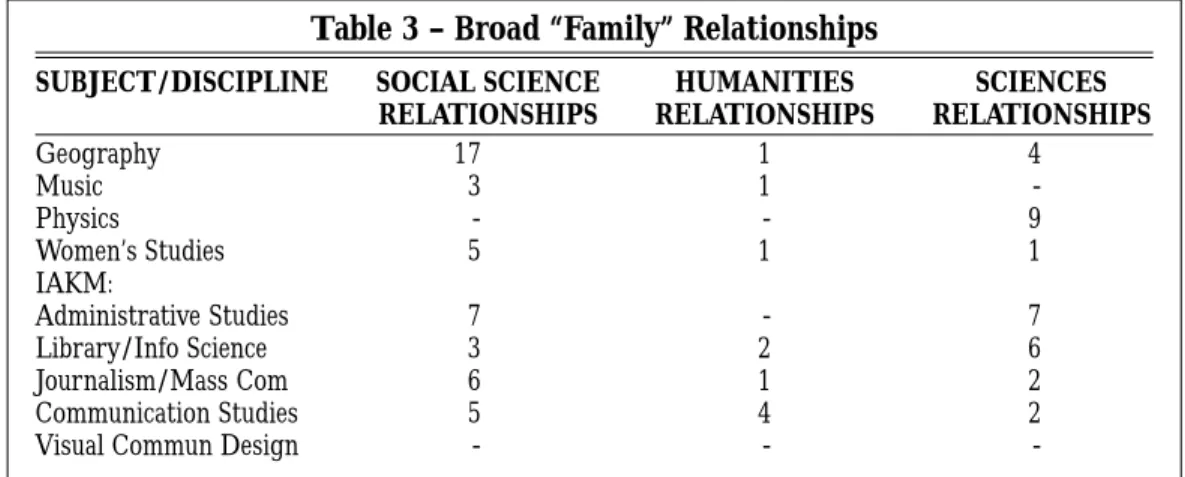
Another point worth noting is the strength of interdis-ciplinary relationships within the “family” home of each discipline. Table 3 shows the totals for these broad family relationships. The numbers represent total LC Class or Sub-class ranges identified for each discipline. The findings show that Geography has the greatest number of collection-in-terest relationships of the disciplines used for this study and Music the least (except for Visual Communication De-sign which had none). Geography’s interdisciplinary rela-tionships were mainly confined to its ownfamily (the social sciences), as were those for Physics (the sciences), Journal-ism & Mass Communications and Communication Studies (both the social sciences). Library and Information Science (social sciences) and Music (humanities) departed from their own family homes, and Administrative Studies was equally split between its own home (social sciences) and the sci-ences.
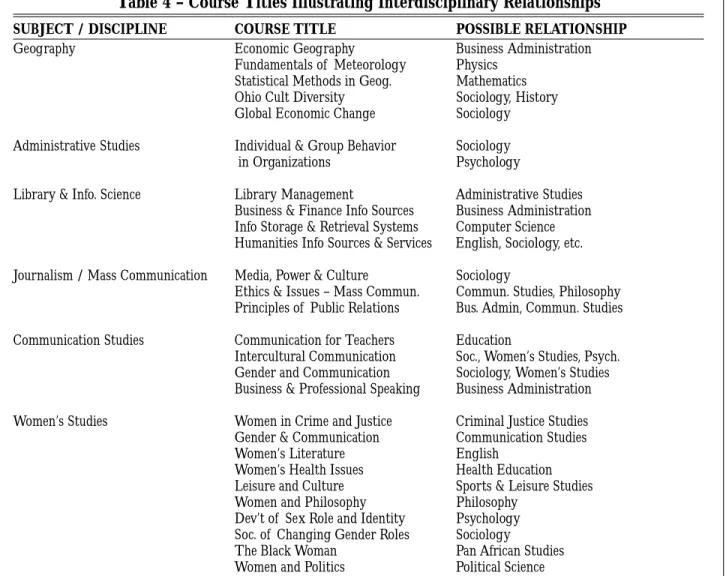
In addition to looking at funding responsibility and col-lection interests as revealed in the book profile, evidence for interdisciplinary activity on a campus can be observed in course offerings. This information can be used to verify and augment findings taken from a study of collection data. At Kent State the Geography department offers courses which appear to bear on such other disciplines as Business Admin-istration, Physics, Mathematics, Sociology, and History.
Administrative Studies, in turn, offers an organizational behavior course that relates to Sociology and Psychology. Library and Information Science teaches courses whose content might be said to correspond to Administrative
Table 3 – Broad “Family” Relationships
SUBJECT/DISCIPLINE SOCIAL SCIENCE HUMANITIES SCIENCES RELATIONSHIPS RELATIONSHIPS RELATIONSHIPS
Geography 17 1 4 Music 3 1 -Physics - - 9 Women’s Studies 5 1 1 IAKM: Administrative Studies 7 - 7 Library/Info Science 3 2 6 Journalism/Mass Com 6 1 2 Communication Studies 5 4 2
Visual Commun Design - -
-Studies, Computer Science, Language & Literature, Sociol-ogy, and others. Journalism and Mass Communications ad-dresses issues of interest to Sociology, Philosophy, Commu-nication Studies, and Administrative Studies. Communica-tion Studies courses relate to such areas as EducaCommunica-tion, Soci-ology, PsychSoci-ology, Business Administration, and Women’s Studies. Table 4 summarizes these relationships, offering suggested relationships. In the case of Women’s Studies, the departments under which the courses are listed are iden-tified in column 3. This summary is by no means an exhaus-tive list, but only a small sampling of courses offered in the Fall 2000 term. There is a considerable correspondence be-tween this data taken from course calendars and that from collection profiles which has been reported above.
Conclusions and Next Steps
Like other academic institutions in higher education, Kent State University is undergoing changes in its composition and mission. The University has hired sizeable numbers of recently graduated faculty to replace retiring faculty. The University has also reformulated its strategic mission build-ing upon its traditional strengths in instruction and research to address current and emerging local, national, and global priorities in academia. One of the major emphases in higher education is the need for multiple disciplines to join forces to solve complex issues facing society.
The preliminary findings in the first part of this two-stage collection development project suggest that collec-tion development approval profiles can provide indicacollec-tions of interdisciplinary interests in academic departments and programs. The YBP approval profile for Kent State reflected new directions in instruction and research for the academic departments and examples of three levels of interdiscipli-nary interests were observable. All three levels of interdis-ciplinary interests demonstrated strong to moderate
indi-Table 4 – Course Titles Illustrating Interdisciplinary Relationships
SUBJECT / DISCIPLINE COURSE TITLE POSSIBLE RELATIONSHIP
Geography Economic Geography Business Administration Fundamentals of Meteorology Physics
Statistical Methods in Geog. Mathematics Ohio Cult Diversity Sociology, History Global Economic Change Sociology Administrative Studies Individual & Group Behavior Sociology in Organizations Psychology
Library & Info. Science Library Management Administrative Studies Business & Finance Info Sources Business Administration Info Storage & Retrieval Systems Computer Science Humanities Info Sources & Services English, Sociology, etc. Journalism / Mass Communication Media, Power & Culture Sociology
Ethics & Issues – Mass Commun. Commun. Studies, Philosophy Principles of Public Relations Bus. Admin, Commun. Studies Communication Studies Communication for Teachers Education
Intercultural Communication Soc., Women’s Studies, Psych. Gender and Communication Sociology, Women’s Studies Business & Professional Speaking Business Administration Women’s Studies Women in Crime and Justice Criminal Justice Studies
Gender & Communication Communication Studies Women’s Literature English
Women’s Health Issues Health Education Leisure and Culture Sports & Leisure Studies Women and Philosophy Philosophy
Dev’t of Sex Role and Identity Psychology Soc. of Changing Gender Roles Sociology
The Black Woman Pan African Studies Women and Politics Political Science
cators of interdisciplinary preferences.
In stage two the study will extend the analysis of courses offered (as begun above) and compare that data with the col-lection data to see what evidence may already exist for inter-disciplinary relationships. The plan is to compare the collec-tion data with other indicators of interdisciplinarity. One such indicator is research support which faculty receive to carry out interdisciplinary projects. Such support could be either internally or externally funded. Another is qualita-tive data compiled from interviews with university adminis-trators regarding interdisciplinary interests and activity at the University. The project could be expanded further to cover other Ohio research libraries which are part of the OhioLINK cooperative collection building initiative and the III statewide online catalogue. The findings from such an expanded study will have implications for course sharing, program sharing, and distributed learning efforts in Ohio.
The study, both on a local level (as described in this paper) and potentially on a statewide level, it is anticipated, will become a valuable planning tool. Also, the project will pro-vide a visual map of current interdisciplinary activity and an ongoing means to measure the development of interdisci-plinary work at the University.
Notes
1. Carol A. Cartwright, 2000. Kent State UniversityState of the University Address. [November 1, 2000]. Available from: URL http://www.kent.edu/ksupresident/sua2000/.
2. Dobson, Cynthia, Jeffrey D. Kushowski, and Kristin H. Gerhard. 1996. Collection Evaluation for Interdisciplinary Fields.
Journal of Academic Librarianship 22: 4, 280.
References
De-velopment of a Core List of Periodicals in Southern Culture. Collection Management 16: 1, 103–16.
Cartwright, Carol A. 2000. Kent State University State of the University Address. November 1. Available from: URL
http://www.kent.edu/ksupresident/sua2000/.
Crawford, Gregory A., and Gary W. White. 1999. Liberal Arts Colleges and Standards for College Libraries: A Quan-titative Analysis. Journal of Academic Librarianship 25: 6, 439–44.
Dobson, Cynthia, Jeffrey D. Kushowski, and Kristin H. Gerhard. 1996. Collection Evaluation for Interdisciplinary Fields.
Jour-nal of Academic Librarianship 22:4, 279–84.
Johnson, Ann Dowsett. 2000. Measuring Excellence.
Maclean’s, 113: 47 (November 20): 52–110.
Keresztesi, Michael. 1982. The Science of Bibliography: Theoretical Implications for Bibliographic Instruction, in
Theories of Bibliographic Education, ed. Cerise Oberman and Katrina Strauch. New York: Bowker, 13–21.
Pugh, Stephen. 1996. When Selectors Collide: The Chal-lenge of Interdisciplinary Scholarship for Collection Development: A Panel Discussion. Library Acquisitions,