RIT Scholar Works
RIT Scholar Works
Theses5-3-2019
Internet and Tor Traffic Classification Using Machine Learning
Internet and Tor Traffic Classification Using Machine Learning
Siddharth PalsambkarFollow this and additional works at: https://scholarworks.rit.edu/theses
Recommended Citation Recommended Citation
Palsambkar, Siddharth, "Internet and Tor Traffic Classification Using Machine Learning" (2019). Thesis. Rochester Institute of Technology. Accessed from
This Thesis is brought to you for free and open access by RIT Scholar Works. It has been accepted for inclusion in Theses by an authorized administrator of RIT Scholar Works. For more information, please contact
Machine Learning
Under Supervision of:Prof. Joseph Nygate, PhD Submitted By: Siddharth Palsambkar
Thesis submitted in partial fulfillment of requirements of Degree of Master of Science in Telecommunication Engineering Technology
Department of Electrical, Computer & Telecom Engineering Technology College of Engineering Technology
Rochester Institute of Technology Rochester, NY 14623
May 3, 2019
Committee Approval
Joseph Nygate, Ph.D. Date
Associate Professor, Thesis advisor
William P. Johnson, J.D. Date
Graduate Program Director, MS Telecommunications Engineering Technology Program
Mark Indelicato Date
Firstly, I would like to express my sincere gratitude to my advisor Prof. Joseph Nygate,
Associate Professor at the Rochester Institute of Technology for the continuous support during
my graduate thesis and related research. The door to his office was always open whenever I had
questions about my research and writing. He encouraged me to work independently on my
research while regularly providing me the much-needed advice and insights.
I would also like to acknowledge Mr. Chris Brown, Systems Administrator, Laboratory
Manager and Adjunct Faculty at the Rochester Institute of Technology for providing his support
in setting up and maintaining the lab during the research.
Finally, I must express my very profound gratitude to my parents, teacher and friends for
providing me with unfailing support and encouragement throughout my graduate study. This
Privacy has always been a concern over the internet. A new wave of privacy networks
struck the world in 2002 when the TOR Project was released to the public. The core principle of
TOR, popularly known as the onion routing protocol, was developed by the ‘United States Naval
Research Laboratory’ in the mid-1990s. It was further developed by ‘Defense Advanced
Research Projects Agency’. The project that started as an attempt to create a secured
communication network for the U.S. Intelligence was soon released as a general anonymous
network. These anonymous networks are run with the help of volunteers that serve the physical
need of the network, while the software fills up the gaps using encryption algorithms.
Fundamentally, the volunteers along with the encryption algorithms are the network. Once a part
of such a network, the identity, and activity of a user is invisible. The users remain completely
anonymous over the network if they follow a few steps and rules. As of December 2017, there
are more than 3 million TOR users as per the TOR Project’s website. Today, the anonymous web
is used by people of all kinds. While, some just want to use it to make sure nobody could
possibly spy on them, others are also using it to buy and sell things. Thus, functioning as a
censorship-resistant peer-to-peer network.
Through this thesis, we propose a novel approach to identifying traffic and without
sacrificing the privacy of the Tor nodes or clients. We recorded traffic over our own Tor Exit and
Middle nodes to train Decision Tree classifiers to identify and differentiate between different
types of traffic. Our classifiers can accurately differentiate between regular internet and Tor
traffic while can also be combined together for detailed classification. These classifiers can be
used to selectively drop traffic on a Tor node, giving more control to the users while providing
Table of Contents
Introduction ... 1
Research Problem ... 1
Review of Literature and Deficiencies ... 2
Technical Background ... 4
The Tor Network... 4
Machine Learning ... 8
Measurement Instruments ... 9
Procedure ... 10
Data Analysis and Interpretation ... 10
The Setup & Experiments ... 11
Classifying Tor vs Surface-Net Traffic: ... 11
Tor TCP vs UDP Traffic: ... 13
Resolving the Location from IP addresses on Tor ... 14
Identifying Port-scan attacks on Tor node: ... 15
The Results ... 17
Classifying Tor vs Surface-Net Traffic: ... 17
Tor TCP vs UDP Traffic: ... 21
Resolving the Location from IP addresses on Tor ... 26
Identifying Port-scan attacks on Tor node: ... 28
Conclusion ... 32
List of Figures
Figure 1: Tor Architecture ... 5
Figure 2: Tor Browser Based Attack ... 6
Figure 3: Setup to Identify Hidden Servers ... 7
Figure 4: Setup for Classifying Tor vs Surface-Net Traffic ... 11
Figure 5: Tor Exit Node Statistics ... 11
Figure 6: Tor Exit Node Flags and Uptime ... 12
Figure 7: Tor Exit Node Traffic During Uptime ... 12
Figure 8: Traffic Captured Over The Node ... 13
Figure 9: Setup for TCP vs UDP Classification ... 13
Figure 10: TCP Traffic Through Exit Node ... 14
Figure 11: UDP Traffic Through Exit Node ... 14
Figure 12: Setup for Resolving Location from IP Addresses ... 14
Figure 13: Traffic Captured on the Intermediate Node ... 15
Figure 14: Setup for Identifying Port-Scan Attacks on Tor Node ... 15
Figure 15: Running ‘NMap’ Scan from A Host on the Internet ... 16
Figure 16: Running ‘NMap’ Scan from a Host on Tor Network ... 16
Figure 17: Captured Traffic on the Tor Node ... 16
Figure 18: Training Set for Classifying Tor vs Surface-Net Traffic ... 17
Figure 19: Test Set for Classifying Tor vs Surface-Net Traffic ... 17
Figure 20: Decision Tree for Classifying Tor vs Surface-Net Traffic ... 18
Figure 22: Accuracy of the Decision Tree Algorithm for Classifying Tor vs Surface-Net Traffic
... 19
Figure 23: Decision Tree for Classifying Tor vs Surface-Net Traffic (Without IP Addresses) ... 20
Figure 24: Important Rules for Classifying Tor vs Surface-Net Traffic (Without IP Addresses) 20 Figure 25: Accuracy of the Decision Tree Algorithm for Classifying Tor vs Surface-Net Traffic (Without IP Addresses) ... 20
Figure 26: Training Set for Classifying TCP vs UDP Traffic ... 21
Figure 27: Test Set for Classifying TCP vs UDP Traffic ... 22
Figure 28: Decision Tree for Classifying TCP vs UDP Traffic ... 22
Figure 29: Important Rules for Classifying TCP vs UDP Traffic ... 23
Figure 30: Accuracy of the Algorithm for Classifying TCP vs UDP Traffic ... 23
Figure 31: Decision Tree for Classifying TCP vs UDP Traffic (Without IP Addresses) ... 24
Figure 32: Important Rules for Classifying TCP vs UDP Traffic (Without IP Addresses) ... 24
Figure 33: Accuracy of the Algorithm for Classifying TCP vs UDP Traffic (Without IP Addresses) ... 24
Figure 34: E-mail from the Financial Institute of Korea ... 25
Figure 35: Captured Packets Used for Identifying Location ... 27
Figure 36: Location Details of the Source IP Addresses ... 27
Figure 37: World Map Representing the Countries with the Highest Number of Connections ... 27
Figure 38: Top Five Countries with the Highest Number of Connections to the Node ... 28
Figure 39: List of Countries with Highest Tor Users According to Tor Metrics ... 28
Figure 40: Training Set for Classifying Regular Port-Scan vs Port-Scan from a Tor Node ... 29
Figure 42: Decision Tree for Classifying Regular Port-Scan vs Port-Scan from a Tor Node ... 30
Figure 43: Important Rules for Classifying Regular Port-Scan vs Port-Scan from a Tor Node .. 30
Figure 44: Accuracy of the Algorithm for Classifying Regular Port-Scan vs Port-Scan from a Tor
Introduction
The internet that most of the general population uses is also known as ‘surface web’
which is just a part of the ‘World Wide Web (www)’. This is the visible part of the world wide web which is indexed by most of the search engines and can be accessed using a regular web
browser with basic settings. The surface web consists of all the websites we use regularly, like
google.com, facebook.com and other websites specific to different products and services. But,
there also exists a hidden internet which is known as deep web. It is known as the ‘hidden web’
because it cannot be accessed easily. It requires a special browser and special settings to be
accessed. This hidden internet is part of the anonymous networks like TOR and I2P. A user has
to be a part of such a network to be able to access the content available on such a network.
Websites hosted on these networks are known as deep web websites and are intended to keep it's
content private while keeping the identity of the user accessing it anonymously. Everything from
news, marketplace, blogs, video streaming, and social media websites exist on the deep web.
Research Problem
There also exists a part of the deep web where illicit websites are hosted. Since such
activities are carried out in the dark, this part of the deep web is known as the ‘Dark Net’. Dark Net websites are infamous for hosting all kinds of illegal contents. The websites range from
drugs, arms and ammunitions marketplaces, leaked information websites and other kinds of
illegal activities. It is getting easier for kids to purchase drugs over the darknet. Leaked
information like credit card details and Social Security information is also sold freely over the
network. One huge part of it belongs to websites hosting ‘child pornography’ websites. Since
darknet can compromise the user’s and the website owner’s identity, these transactions are most
often completed using cryptocurrencies.
Since the traffic over the nodes remains encrypted, it is difficult to censor any type of
content over the Tor network. This is especially of concern to the users hosting Exit Nodes.
These users are very likely to receive DMCA notices from BitTorrent and other traffic carrying
copyright content flowing through it. There is no system in place for a host to control the traffic
flowing to their owned node.
The research focuses on implementing a way to classify traffic without compromising the
anonymity of the nodes, users or their traffic. Most techniques used try to find weaknesses in the
Tor infrastructure to then exploit them. Through this research, we use a different approach by
using Machine Learning to try and understand how the Tor network behaves with the different
types of traffic flowing through it. This can be then compared to the activity of a node on the
regular internet to try and develop and train algorithms that can differentiate between them.
Review of Literature and Deficiencies
The Federal Bureau of Investigation posted an article on their website in 2016 explaining
Dark Net websites, what they are and what countermeasures are law enforcement authorities
taking against them. Within this article, the organization explains how an international coalition
of law enforcement agencies from five countries around the world named Five Eyes Law
Enforcement Group (FELEG) are sharing intelligence to bust Dark Net related crimes (FBI,
2016). However, a review of the literature reveals that there is much to be explored in this field.
The existing research on TOR revolves around the statistics leading to the concentration
of services. Most drugs on the Dark Net is sold in the United States of America. The greatest
in the Journal of Computer Virology and Hacking Techniques in 2015 shows how a Botnet’s Command and Control servers can be hidden in the TOR network and used to control several
thousand or even millions of bots in that botnet to execute click fraud, data mining, bitcoin
mining or perform a DDOS attack (Kang, 2015). The TOR network also has mechanisms to ban
an Exit Node if it is known to tamper information before relaying it to its subsequent node. It
does by verifying the signature of response that every TOR server creates when it replies to a
query. If the signature received is different, the TOR network automatically bans the Exit node
and thus no traffic is relayed through that node (Wagner, Wagener, State, Dulaunoy, & Engel,
2012).
There also exist research on deanonymizing traffic on the TOR network. A journal article
explains how the HSDir (Hidden Services Directory) works and how it can be harvested to find
more information about the various hidden services hosted on the TOR network (Biryukov,
Pustogarov, & Weinmann, 2013). Privacy over the TOR network is also compromised when
active plugins are active over a client machine or hidden server. Browser-based attacks can be
carried out on such clients and server using HTML, Javascript and flash to expose their identity
Technical Background
The Tor Network
A conference paper submitted to the International Symposium on Privacy Enhancing
Technologies Symposium explains the working of the TOR network. It is a kind of a mesh
network consisting of volunteers serving as nodes. These nodes function as relay networks that is
the fundamental way in which TOR functions (McCoy, Bauer, Grunwald, Kohno, & Sicker,
2008). TOR is an intelligent network that makes use of its relay nodes and incredibly complex
cryptography to make sure that the user’s identity remains anonymous.
The network is made up of three kinds of nodes: Entry Node, Intermediate Node, and the
Exit Node. When a user connects to the TOR network, the network protocol looks into its
database of available TOR nodes and assigns a combination of Entry, Intermediate and Exit
nodes for the connection (McCoy, Bauer, Grunwald, Kohno, & Sicker, 2008). These nodes can
be located several thousand miles apart across the globe. The user is connected to the Entry Node
whereas the website server or service he is trying to connect to or access is connected to the end
of the Exit Node. The TOR network also makes sure that the user’s machine carries out secure
key exchanges with all the three nodes. The key exchanges are executed in such a way that, the
host has a unique key combination with each of the nodes (Abbott, Lai, Lieberman, & Price,
2007). When the user is sending traffic to the web server, which is general inquiry for the content
they are requesting for, the host machine encrypts the data with the Exit Node’s encryption key, followed by the Intermediate Node’s key and then finally with the Entry Node’s key. Thus, the
data is now encrypted thrice with three different keys that not entirely known by any of the relay
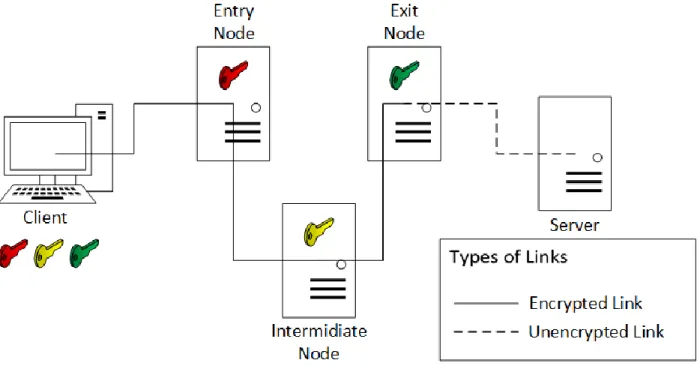
Figure 1: Tor Architecture
As can be seen above, each relay node has its own unique key which is exchanged with the host
in a way that at any point in the connection, only the host machine has access to all the three
keys. When the data that is encrypted thrice is sent over the network, it is first received by the
Entry Node, which strips its key and forwards the packet to the Intermediate node, which then
strips its key and forwards it to the exit node. The exit node on receiving the packet, strips its
own key and forwards the data to the web server it is intended for (Abbott, Lai, Lieberman, &
Price, 2007). When response data is traveling back from the web server to the host machine, the
data is first received at the Exit Node, which encrypts the data using its key and forwards it to the
Intermediate Node which encrypts the received data using its key and forwards it to the Entry
Node, which encrypts it one last time using its unique key and forwards it to the host machine.
Since the host machine has all the three keys available with it, it sequentially strips down all the
three keys to reveal the data. As can be observed in the figure and explanation above, the data is
Node and the web server occurs over an unsecured medium. This is where, the possibilities of
potential attacks on the TOR network exists (McCoy, Bauer, Grunwald, Kohno, & Sicker, 2008).
Active plugins operate in ways different than regular programs. They can run in the background
can report user activity without even the user noticing it. Most attacks on the TOR network are
carried out using active plugins. One paper published with the International Workshop on
Privacy describes a few such attacks. It mentions how to browse the internet anonymously; a
user must be using an HTTP proxy like ‘Privoxy’ so that traffic would be diverted over TOR instead of the regular internet. This is because active plugins not always use the browser’s proxy to send data (Abbott, Lai, Lieberman, & Price, 2007). The article further goes on to explain the
first attack which falls in the category of browser-based attacks. The attack is executed as
follows:
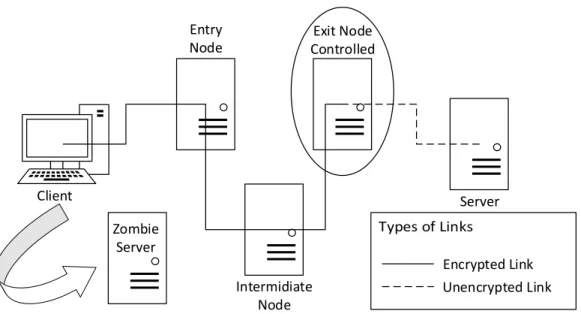
Figure 2: Tor Browser Based Attack
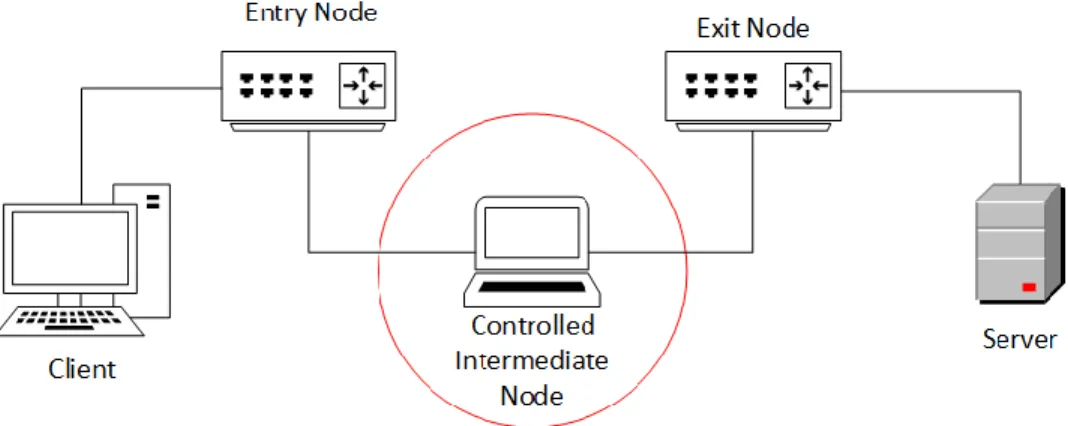
The above figure can be held as a reference for the explanation. The attacker sets up a malicious
exit node in the TOR network to modify the HTTP traffic. Since the exit node is connected to a
web server, the attacker modifies all the packets from the server to the client by adding an
Client Server Entry Node Exit Node Controlled Intermidiate Node Encrypted Link Unencrypted Link Zombie Server
invisible ‘iframe’ with a unique cookie along with a referenced to a malicious web server owned by the attacker. When this frame is rendered by the client’s browser, if the flash plugin is still
active on the browser, a flash movie starts playing in the background and the browser sends back
the cookie previously received to the malicious web server. The attacker can then identify the
user and the website visited using the combination of the unique cookie and the flash connection.
In fact, this attack would work on all users connected to a website through the attacker owned
exit node and a browser with flash enabled on it (Abbott, Lai, Lieberman, & Price, 2007).
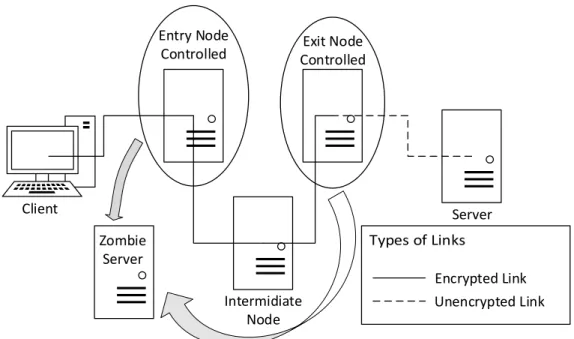
A second attack is mentioned which can identify and locate hidden servers on the
Network. The figure below can be used as a reference to better understand the attack:
Client Server
Entry Node
Controlled ControlledExit Node
Intermidiate Node Encrypted Link Unencrypted Link Zombie Server
Figure 3: Setup to Identify Hidden Servers
The attacker introduces an exit node in the TOR network along with a malicious web server.
The attacker uses his client machine to connect to the website whose location is to be identified.
Since TOR chooses a random path to create a connection, the attacker makes multiple attempts
connection between the client and the website. This can be achieved since TOR treats every new
query as a new connection and thus assigns a new path every other time. The attacker can verify
that his node is working as the exit node for the connection by using traffic analysis. Once
confirmed, the attacker can identify the location of the web server hosting the website using a
predecessor attack (Abbott, Lai, Lieberman, & Price, 2007). On carefully studying both these
attacks, we can see that both of the attacks make use of the unencrypted link and the exit node
which are the weakest links to attack considering the TOR architecture (McCoy, Bauer,
Grunwald, Kohno, & Sicker, 2008)
Machine Learning
Just like humans, machines can be trained in doing a task. Using artificial intelligence
and computing, systems can be developed that can learn from the input given to them. These
systems have the human-like the ability to improve with experience reaching a level where it can
then predict outcomes of systems. There are various kinds of algorithms that can be used for
machine learning. Which algorithm to use depends completely on what output is expected. A
term called ‘Supervised Learning’ is often used. Supervised Learning is when the training data is a set of variables and both the input and the output object are to be specified. On the other hand,
‘Unsupervised Learning’ is when we let the algorithm find a pattern in the dataset provided. Unlike supervised learning, unsupervised learning does not have any right or wrong answers, the
outcome of the algorithm is just the detection of a pattern. (Bell, 2014).
Any machine learning project has four cycles: 1) Acquisition, 2) Prepare, 3) Process and
4) Report. Data can be acquired from any source. When working with machine learning, the
more the data, the better is the outcome. The collected data then must be prepared to be analyzed
‘Machine Learning’ sounds a lot like ‘Big Data’, they are very different from each other. While Big Data is used to analyze huge chunks of data to find patterns and statistics, Machine Learning
starts with a question (Bell, 2014). The question is something that is to be investigated. It is a
more customized approach towards a topic. Thus, there is no one machine learning solution that
works for all the projects. It is not a super complex algorithm that can answer any question
thrown at it. Rather, it is an algorithm that learns an extensive amount of data for a specific
purpose and then predicts an outcome for an event. An important part of Machine Learning is
Data Processing. Which large amounts of data, the processing power needed to run that data
through the algorithm at the same time is a lot. For basic less processor intensive algorithms, a
personal computer can be used. But, for large scale operations, a single processor is not efficient.
Thus, a cluster of machines is required to process the exorbitantly high volume of data. The
machines on such a clustered are preferred to be on the same local network to avoid delays and
lags in data transfers. When machines are used in a cluster, they process the data in different
parts and then sync up their results. Thus, all the processing power is used in the most efficient
way possible. Another great way is to use ‘Cloud-Based Services’ provided by companies like Amazon and Rackspace. These services provide servers with variable processing power. They
provide an option to increase or decrease the number of machines required to process a certain
task. The only downside is that such a service might sometimes cost a lot (Bell, 2014).
Measurement Instruments
The experiment was conducted using multiple Tor nodes. Multiple instances of Exit and
Middle nodes were hosted to collect data and analyze traffic. Each node was individually
hosted with the default ‘exit policies’ while others were implemented with ‘reduced exit policies’ to reduce the amount of ‘BitTorrent’ and ‘Copyrighted’ traffic from flowing over it.
Procedure
The research was phased in two parts. In the first part, multiple nodes were set up on the
Tor network to collect data. These devices would be set up as Relay or Exit. When a node is set
up as a Relay, it is always selected as either Entry or Middle Node on the TOR network.
Majority of the devices in the cluster were set up in an Exit Mode which gives them a chance to
function as an Exit Node. Whenever one of the machines is selected as the exit node, we start
sniffing on the node to inspect the outgoing packets. On analyzing the packets, the website being
visited can be easily detected. These packets are then collected and added to a database which
also consists of regular internet traffic generated on the same node. The traffic was then labeled
to easily differentiate between them while we continue to process it before applying machine
learning to it. The same methodology was applied to the traffic recorded on the ‘Middle Nodes’ Data Analysis and Interpretation
Data collected from the Tor Nodes were initially analyzed and filtered to avoid
unnecessary information being added to the algorithm. Only the correct and required data was
used to form a data set used to form an algorithm for Machine Learning. A ‘Thematic Analysis’ approach was used to identify, pinpoint and record patterns within the collected data. A
‘Decision Tree Classifier’ was trained to differentiate traffic in each of the tested scenarios. The decision tree was then used to plot a graphical tree to easily understand how certain decisions
were obtained to solve the problem. Rules were also generated from the same tree, which could
The Setup & Experiments
Classifying Tor vs Surface-Net Traffic:
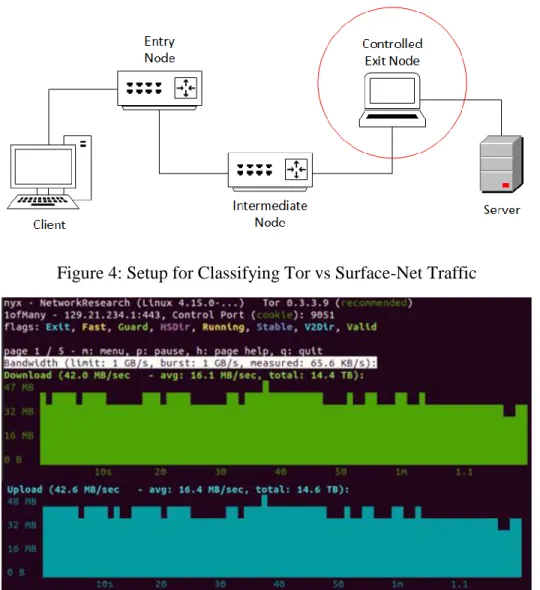
The first part of the experiment was implemented by hosting a node on the internet and
capturing traffic through it. We would further refer to ‘Internet’ as ‘Surface-Net’ to easily
separate it from the ‘Tor Network’. For the next stage, multiple instances of Tor Exit Nodes were
hosted on Ubuntu machines. Traffic from one such instance was with the default ‘Exit Policies’
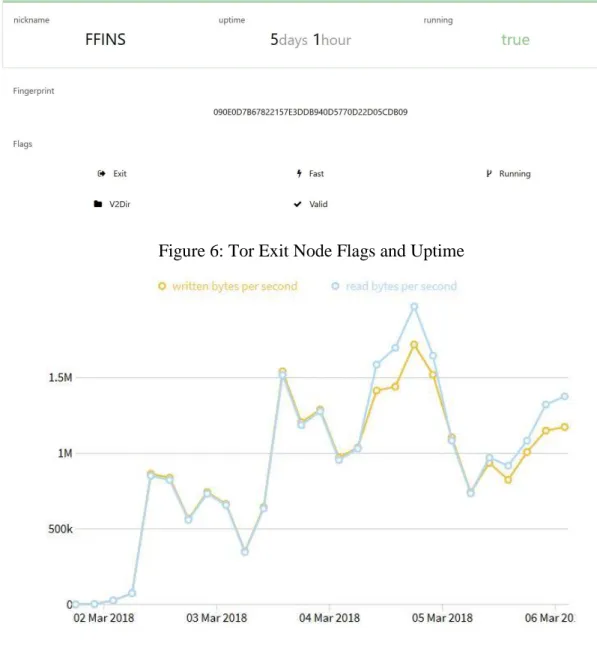
was used during the experiment. The ‘nyx’ application was used to monitor the nodes, keep track
of the flags obtained and observe the performance of the node.
Figure 4: Setup for Classifying Tor vs Surface-Net Traffic
Figure 6: Tor Exit Node Flags and Uptime
Figure 7: Tor Exit Node Traffic During Uptime
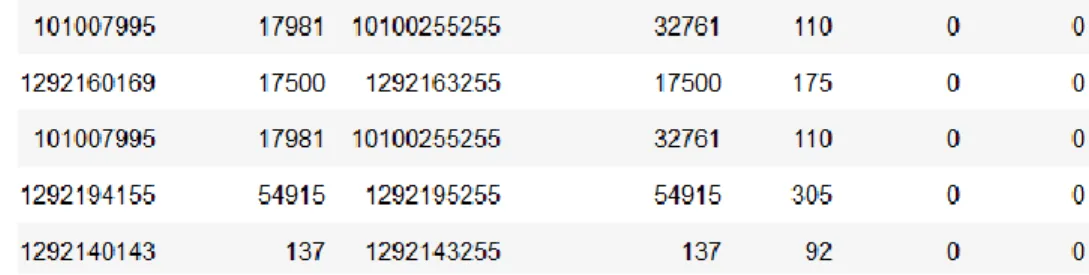
Wireshark was used to capture traffic over the nodes. The captured traffic was filtered
and used to create a ‘Training Set’ along with a ‘Test Set’. ‘Jupyter Notebook’, which is part of the ‘Anaconda’ suite was used to create Python notebooks and run scripts. The necessary
libraries were then imported and used to further process the data and create a decision tree
Figure 8: Traffic Captured Over The Node
Tor TCP vs UDP Traffic:
The same setup was used for this experiment with a different approach. The traffic
captured was only captured on the Exit Node to be categorized into TCP and UDP traffic.
Figure 9: Setup for TCP vs UDP Classification
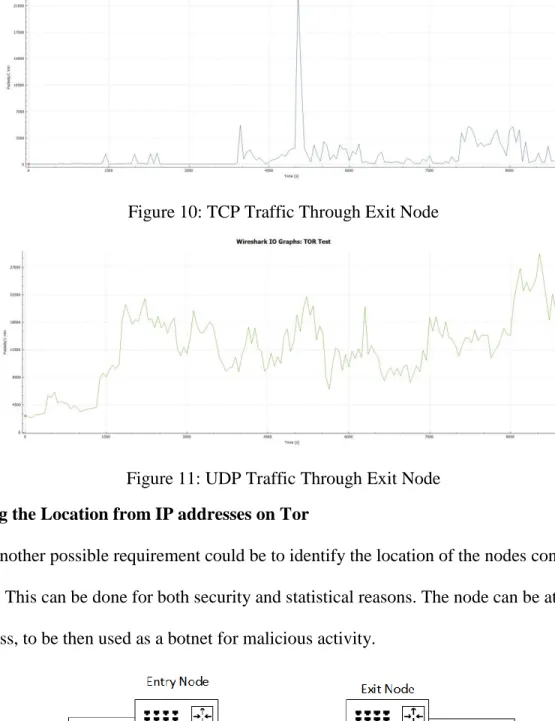
As can be seen in the following graphs, the volume of UDP traffic is significantly higher
than the TCP traffic, thus the same number of captured TCP and UDP packets were then used to
create a ‘Training Set’ and ‘Test Set’. As before, a Python notebook was used to import and
Figure 10: TCP Traffic Through Exit Node
Figure 11: UDP Traffic Through Exit Node
Resolving the Location from IP addresses on Tor
Another possible requirement could be to identify the location of the nodes connected to
our node. This can be done for both security and statistical reasons. The node can be attacked to
gain access, to be then used as a botnet for malicious activity.
The packets were captured using Wireshark and imported into a Jupyter notebook to be
processed with the help of ‘GeoIP2’ database.
Figure 13: Traffic Captured on the Intermediate Node
Identifying Port-scan attacks on Tor node:
One common form of threat to all nodes on the internet is port-scans. These are in fact the
first step in most major attack strategies. Tor nodes are also vulnerable to port scans. The
question was to identify whether a port scan was carried out by a regular host on the internet or a
node on the Tor network. The dataset was collected by capturing traffic from both a regular
internet connection and that through the Tor network. The host was first used to carry out a port
scan attack on our controlled Tor node through the internet and then the experiment was repeated
by connecting the host to the Tor network (proxy chains) to carry out the same attack.
Figure 15: Running ‘NMap’ Scan from A Host on the Internet
Figure 16: Running ‘NMap’ Scan from a Host on Tor Network
Packets were captured in both cases using Wireshark. The ‘Training Set’ and ‘Test Set’ were created by using packets from both stages of the experiment. A Python notebook was then used
to process the data and create an algorithm to classify the scans.
The Results
Classifying Tor vs Surface-Net Traffic:
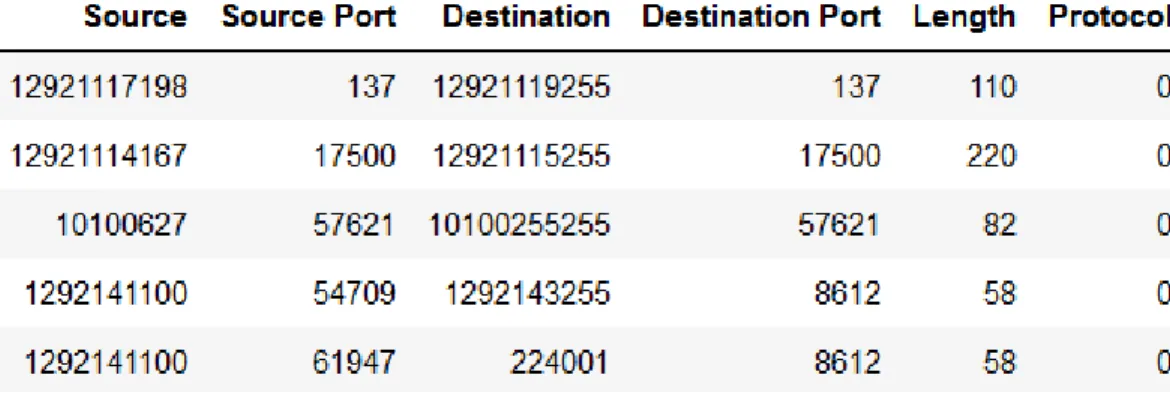
Ten thousand packets of the Tor and Surface-Net traffic were used to form the Training
Set, whereas two-thousand packets of each were used to form the Test Set. The Attributes
filtered attributes used were ‘Source IP’, ‘Source Port’, ‘Destination IP’, ‘Destination Port’,
‘Packet Length’, ‘Protocol’ and ‘Network (Surface-Net/Tor)’. For ‘Network’, 0 represents the Tor network and 1 represents Surface-Net traffic. The decimal points in the IP addresses were
removed to avoid processing errors in the algorithm. Twenty-thousand (ten-thousand each of
Surface-net and Tor) packets were used in the ‘Training-Set’, while two-thousand packets
(thousand each of Surface-net and Tor) were used in the ‘Test-Set’.
Figure 18: Training Set for Classifying Tor vs Surface-Net Traffic
The ‘pandas’ library in Python was used for the manipulation and analysis of the data set.
The ‘sklearn’ library was used for the machine learning while using the ‘DecisionTreeClassifier’ for performing binary classification on the dataset. The decision tree was converted in a
graphical form using the ‘graphviz’ library. The original tree obtained has a depth of five, but the more important rules can also be seen at much lower levels. Important rules were extracted based
on their individual classification ability.
Figure 20: Decision Tree for Classifying Tor vs Surface-Net Traffic
As can be seen below, the tree obtained for the experiment yields an accuracy of 99.85%. Out of
the 200 packets tested, 199 packets were predicted accurately.
Figure 22: Accuracy of the Decision Tree Algorithm for Classifying Tor vs Surface-Net Traffic
Top Rules Obtained:
1. When ‘Source’ <= 81364160, ‘Destination Port’ <= 48769 and Source Port <=56890, 2056 out of 2064 connections are to the ‘Surface-net’. This rule gives us an accuracy of
99.61% and applies to roughly 10 % of the dataset
2. When ‘Source’ > 995696512 and ‘Destination Port’ <= 58884.5, 5796 out of 5800 connections are to the ‘Tor network’. This rule gives us an accuracy of 99.93% and applies to roughly 29 % of the dataset
3. When 1672304640 < ‘Source’ < 1761521920 and ‘Source Port’ <= 108.5, 4779 out of 4784 connections are to the ‘Surface-net’. This rule gives us an accuracy of 99.89 and applies to roughly 24 % of the dataset
Decision Tree Without Using IP Addresses:
Since IP Addresses can change from node to node, it is also important to test the
condition where IP addresses do no matter. Using the same dataset used above, we created
another dataset without the ‘Source IP Addresses’ and the ‘Destination IP Addresses’. Doing so will give us an idea of how well a Machine Learning algorithm can classify generic information
Figure 23: Decision Tree for Classifying Tor vs Surface-Net Traffic (Without IP Addresses)
Figure 24: Important Rules for Classifying Tor vs Surface-Net Traffic (Without IP Addresses)
The Decision Tree generated is wider than the one with IP Addresses. This gives us an indication
that the tree would have fewer significant rules than before. On careful observing, we only find
two significant rules on the left side of the tree. Also, this tree has an accuracy of 86 % which is
acceptable but about 14 % less than before.
Figure 25: Accuracy of the Decision Tree Algorithm for Classifying Tor vs Surface-Net Traffic (Without IP Addresses)
Top Rules (Without Using IP Addresses):
1. When ‘Length’ <= 113.5 and ‘Destination Port’ <= 813.5 and ‘Source Port’ <= 48791, 2286 out of 2378 connections are to the ‘Tor network’. This rule gives us an accuracy of
96 % and applies to roughly 12 % of the dataset
2. When ‘Length’ > 166.5 and ‘Destination Port’ > 813.5, 3063 out of 3066 connections are to the ‘Surface-net’. This rule gives us an accuracy of 99.9 % and applies to roughly 15%
of the dataset
Tor TCP vs UDP Traffic:
The same approach could be used to check if a machine learning algorithm can identify
TCP and UDP traffic through the Tor node. Most video streaming services use UDP and creating
a rule that can identify such traffic along with a combination of other rules would be useful in
accurately identifying traffic. Though only knowing if certain traffic is TCP or UDP is not of
much use, combining the information with other information obtained using machine learning
can be advantageous.
Figure 27: Test Set for Classifying TCP vs UDP Traffic
Figure 28: Decision Tree for Classifying TCP vs UDP Traffic
As with the previous experiment, we can obtain important rules in as low as the third level of the
tree. What can be observed with both these experiments is that the lower the depth at which a
rule occurs, the more packets it applies to. Thus, if a rule occurs at depth of two would apply to
more packets than a rule at occurs at depth five. Along with creating a Decision Tree, it is also
important to evaluate rules that can be significant. Another important part of the process of
evaluating the rules by depth is to understand the effect of a rule. A rule might be able to narrow
down the result, but it is also important to consider how much the rule narrows down the result.
Thus, the tree should be carefully evaluated to only extract the most important and significant
Figure 29: Important Rules for Classifying TCP vs UDP Traffic
Our machine learning algorithm was able to attain an accuracy of 99.05%. Out of the total of
2000 packets tested, 1997 packets were correctly predicted.
Figure 30: Accuracy of the Algorithm for Classifying TCP vs UDP Traffic
Top Rules:
3. When ‘Source’ <= 1292142720 and ‘Destination’ > 23108472, 71121 out of 71156 connections use ‘TCP’. This rule gives us an accuracy of 99.9% and applies to roughly 36% of the dataset
4. When ‘Source’ > 1292142720, ‘Length’ <= 81.5 and ‘Destination’ <= 1292187648, 3038 out of 3133 connections use ‘UDP’. This rule gives us an accuracy of 96.96% and applies to roughly 1.5% of the dataset
5. When ‘Source’ > 1292142720 and ‘Length’ > 548.5, 6814 out of 6816 connections use ‘TCP’. This rule gives us an accuracy of 99.97 and applies to roughly 3.5% of the dataset Decision Tree Without Using IP Addresses:
The following Decision Tree was realized after eliminating the IP addresses from the
dataset. As discussed earlier, IP addresses can change from node to node.
Figure 31: Decision Tree for Classifying TCP vs UDP Traffic (Without IP Addresses)
Figure 32: Important Rules for Classifying TCP vs UDP Traffic (Without IP Addresses)
We also obtain an accuracy of 97 %, which is just 2% less than before. But, since there are no IP
addresses involved, it is a more generic rule than before.
Figure 33: Accuracy of the Algorithm for Classifying TCP vs UDP Traffic (Without IP Addresses)
Top Rules (Without using IP Addresses):
1. When 81.5 < ‘Length’ < 549.5 and ‘Destination Port’ <= 110.5, 45817 out of 45817
connections use ‘UDP’. This rule gives us an accuracy of 100 % and applies to roughly 23% of the dataset
2. When 81.5 < ‘Length’ < 549.5, ‘Destination Port’ > 290.5 and ‘Source Port’ < 4519,
5532 out of 5536 connections use ‘UDP’. This rule gives us an accuracy of 99.9 % and
applies to roughly 2 % of the dataset
3. When 549.5 < ‘Length’ < 1440.5, ‘Destination Port’ <= 290.5 and ‘Source Port’ < 4519,
37578 out of 37580 connections use ‘UDP’. This rule gives us an accuracy of 99.9 % and
applies to roughly 18 % of the dataset
Warnings Received While Hosting Tor Exit Node:
1. Numerous complaints from REN-ISAC (Research and Education Network, Information
Sharing and Coordination) which comprises mainly of about 2000 universities, some
not-for-profit, and public sector research labs
2. Reports of scanning/hacking attempts on the Financial Security Institute (FSI) of Korea:
3. Complaints of ‘Phone-Home’ operations of malware on other computers using the hosted Tor Exit Node to route their traffic
4. Fourteen notifications of distinct malware phone-home activity in a single day
5. Forty-eight notifications of malware phone-home activity in a week
6. About forty-three Digital Millennium Copyright Act (DMCA) violations in a week
7. Other scanning/hacking attempt reports from multiple sources including at least one
university
8. Around one-third of all the reports over a span of one and a half week involved the Exit
Node
Resolving the Location from IP addresses on Tor
Knowing where the traffic on a Tor node is coming from is always an advantage. Tor nodes are
regularly under attacks from hackers trying to convert them into a botnet. These hackers often try
using multiple machines to carry out the attack. Attacks can often originate from a certain
location in the world. In such a case, knowing the location of the origin of certain packets can be
useful in blocking attacks. If an attack is observed to be coming from a certain country, state or
city, it can be efficiently blocked while maintaining service to other parts of the world.
One way of achieving this is by using the GeoIP2 database and comparing the incoming traffic to
it. The traffic used below was captured on a Tor node using Wireshark and then imported into a
Python notebook for processing. The source IP addresses were compared to the GeoIP2 database
to find the ‘Source Continent’, ‘Source Country’, ‘Source Latitude’ and ‘Source Longitude’. These obtained attributes can also be then used to train a machine learning algorithm for a
Figure 35: Captured Packets Used for Identifying Location
Figure 36: Location Details of the Source IP Addresses
Figure 37: World Map Representing the Countries with the Highest Number of Connections
The figure above shows a world map with the countries with the highest number of connections
to the node. The highest number of connections to the node is from Germany followed by the
above map because of the text being larger than the size of the country represented on the map.
Below is the list of the top five countries with the highest connections to the node.
Country Count Germany 53860 United States 25880 Ukraine 13073 Netherlands 1711 France 1487
Figure 38: Top Five Countries with the Highest Number of Connections to the Node
The above can be compared with the list of countries with the highest number of Tor users
published on the Tor Metrics website. We can see that all the countries in our list are also on the
list of the top-ten countries published by Tor Metrics.
Figure 39: List of Countries with Highest Tor Users According to Tor Metrics
Identifying Port-scan attacks on Tor node:
Port scan attacks are generally the first steps in any attack strategy. A port scan attempt
on a system should never be ignored and always be taken seriously. Generally, the IP addresses
of the machines from which the port scans are attempted can be blacklisted for security. To avoid
this, modern attacks methodologies initiate port scan attacks over the Tor network. This also
focused on identifying a Nmap scan originating from the Tor network and comparing it to one
originating from the internet. Machine learning was used in this case to identify and differentiate
between the two. A Nmap attack originating from the Tor network would require special
attention since in most cases, it is an attempt to take control over the node and turn it into a
‘zombie node’ or use it in the form of a ‘botnet’.
For this experiment, we eliminated the ‘Source IP Address’ and ‘Destination IP Address’
attributes to since the attack can potentially originate from any IP address, but would be intended
towards our controlled node. The used attributes were ‘Packet Length’, ‘Source Port’, ‘Destination Port’, ‘Flags’ and ‘Stream Index’.
Figure 40: Training Set for Classifying Regular Port-Scan vs Port-Scan from a Tor Node
Figure 42: Decision Tree for Classifying Regular Port-Scan vs Port-Scan from a Tor Node
The above figure is the Decision Tree generated with a depth of five. As we can see, the tree
spreads wide, but the important rules are close to the root. The figure below shows two important
rules occurring at a depth of two and three. We can also clearly see that the decision tree is quite
literally dividing traffic into two parts with more rules for ‘NmapOnTor’ on the left and regular
‘Nmap’ on the right.
Figure 43: Important Rules for Classifying Regular Port-Scan vs Port-Scan from a Tor Node
Figure 44: Accuracy of the Algorithm for Classifying Regular Port-Scan vs Port-Scan from a Tor Node
Top Rules:
1. When ‘Stream Index’ <= 4.5 and ‘Source Port’ <= 52672, 1286 out of 1312 connections are NMap scans from a ‘Tor node’. This rule gives us an accuracy of 98 % and applies to roughly 33 % of the dataset
2. When ‘Stream Index’ > 34.5, 1200 out of 1200 connections are NMap scan from a machine on the ‘Surface-net’. This rule gives us an accuracy of 100 % and applies to roughly 30 % of the dataset
Conclusion
Identifying traffic over the Internet has been part of network security practices for a long
time. Tor, which focuses on a client’s privacy is tricky to deal with. Identification of the type of traffic is important though if we want to maintain the security of our systems. Tor is now not
only used as a tool of privacy but also to successfully carry out complicated attacks while
maintaining anonymity. Another requirement of knowing the type of traffic is applicable to
individuals that want to support the Tor Project and hosting ‘Exit Nodes’ on the network. As can
be seen from our experiments, a Tor exit node is highly susceptible to getting DMCA notices,
unknowingly getting involved in a hacking attempt, or warnings for other illicit traffic being
relayed through their node. Though Tor is completely legal, and the individual is not liable for
the traffic relayed through the node, it might be difficult to prove that the traffic was only relayed
through the node and did not originate there.
A solution was proposed where multiple Tor nodes were hosted and the traffic flowing
through them was compared to regular internet activity using Machine Learning. The aim of the
experiments conducted was to check if Machine Learning can identify and differentiate between
activities over the internet to that on the Tor network. We found that it was possible to
implement Decision Trees to classify different types of traffic efficiently. In all our experiment,
we were successfully able to classify traffic with an accuracy of more than ninety-five percent.
Though these rules can be implemented individually, they become more powerful when
combined with each other. An algorithm with all the rules that we generated can be used to
identify four parameters of a packet at the same time. Thus, we can not only identify certain
packets to be originating from the Tor network but also know that it is part of a TCP, which is an
rules in such a way would allow us to customize our filter to segregate traffic efficiently.
Firewalls can be created using these rules to block certain type of Tor traffic while allowing
uninterrupted service to other users. All this can be done without sacrificing the privacy of users
over the network. More importantly, we concluded that Machine Learning can be an efficient
tool for security over the Tor network and more such stackable algorithms can be created to
Annotated Bibliography
Abbott, T. G., Lai, K. J., Lieberman, M. R., & Price, E. C. (2007). Browser-Based Attacks on
Tor. International Workshop on Privacy Enhancing Technologies, 184-199.
This paper explains the traditional ways to attack the TOR network and discusses the
various loopholes that can be used to compromise identity over the Dark Net
Bell, J. (2014). Machine Learning: Hands-On for Developers and Technical Professionals.
Wiley.
This book is one of the best resources available to start with machine learning. It starts
with a brief introduction to machine learning and then goes into deeper concepts right
from data collection to complex algorithm.
Biryukov, A., Pustogarov, I., & Weinmann, R.-P. (2013). Trawling for Tor Hidden Services:
Detection, Measurement, Deanonymization. Security and Privacy (SP), 2013 IEEE
Symposium on. IEEE. Retrieved 9 14, 2017, from
http://www.tor.com/blogs/2013/03/tor-books-announces-new-dragon-age-novel-with-bioware-senior-writer-patrick-weeks
This paper was instrumental in understanding how the TOR network works from the
service point of view. It explains how the services over the TOR network process
information and gives an overview of the various mechanisms working underneath the
architecture.
Bollier, D. (2010). The Promise and Peril of Big Data. The Aspen Institute.
Chang, C.-H., Kayed, M., Girgis, M., & Shaalan, K. (2006). A Survey of Web Information
Extraction Systems. IEEE Transactions on Knowledge and Data Engineering, 18(10),
1041-4347.
Davenport, T. H., Barth, P., & Bean, R. (2012). How Big Data is Different. MIT Sloan
Management Review.
The paper was a brief introduction to the basics of Big Data, the various Big Data tools,
and procedures. It also explains how Big Data is different than other data collection
methods.
Dolliver, D. S. (2015). Evaluating drug trafficking on the TOR Network: Silk Road 2, the sequel.
International Journal of Drug Policy, 26(11), 1113-1123.
The paper discusses how Silk Road 2 was busted by the FBI. Details the mistakes that
were made by the owners of the website and the ways in which the law enforcement
agencies were able to crack them down.
FBI. (2016, 11 1). A Primer on DarkNet Marketplaces: What They are and What Law
Enforcement is Doing to Combat Them. Retrieved from FBI:
https://www.fbi.gov/news/stories/a-primer-on-darknet-marketplaces
This article on the FBI's website explains the basics of the operation of TOR and then
explains the judicial standpoint related to the illicit activities.
Kang, L. (2015). Efficient botnet herding within the TOR network. Journal of Computer
Virology and Hacking Techniques, 19-26.
This is a great resource for understanding how clusters can be formed by infecting
devices using botnets and then using their resources for various applications. Though generally
implemented for the wrong causes, it can be a great tool for collective computations.
McCoy, D., Bauer, K., Grunwald, D., Kohno, T., & Sicker, D. (2008). Shining Light in Dark
Places: Understanding the Tor Network. International Symposium on Privacy Enhancing
One of the best resources to start understanding the fundamentals of TOR and other
anonymous networks. This paper talks about the architecture and working of the various
components in the network.
Wagner, C., Wagener, G., State, R., Dulaunoy, A., & Engel, T. (2012). Breaking Tor anonymity
with game theory and data mining. Concurrency and Computation, 1052–1065.
This paper explains about research conducted over breaking the TOR network using a
game theory which is one of the more nontraditional ways of attack. It helped in