Page 89 www.ijiras.com | Email: [email protected]
Comparision Of Effectiveness Of Myo Facial Release Technique
Versus Muscle Energy Technique On Chronic Trapezitis - An
Experimental Study
Aneri Jhaveri
Final Year Student, S.B.B College of Physiotherapy, Ahmedabad, Gujarat, India
Dr. Payal Gahlot
MPT (Rehab), Lecturer & PG Guide –S.B.B College of Physiotherapy, Ahmedabad, Gujarat, India
I. INTRODUCTION
Trapezitis is defined as an inflammation of trapezius muscle. The upper trapezius is designated as postural muscle and it is highly susceptible to overuse.(1) The pain is present even during rest and is aggravated by activity; it may be referred to the other area from the site of primary inflammation. Passive range of motion may be painful and restricted due to pain and protective spasm in antagonist muscle group.(2) Low level activity of the upper trapezius is frequently found during sitting and standing which is related to head posture and is a common source of tension and neck pain in people who work at a desk and computers or who spend many hours driving.(3) The upper trapezius is often
placed in a shortened position by poor ergonomics which creates shortness in the muscle. The trapezius is also activated by stressful thoughts and feeling or abnormal breathing pattern. Neck pain is very common in the region of the upper trapezius muscle. About two thirds of people experience neck pain at some point in their lives. In middle age prevalence is highest and women are more affected than men. Neck pain prevalence varies widely in different studies, with a mean point prevalence of 13% (range 5.9% – 38.7%) and mean lifetime prevalence of 50 % (range 14.2% – 71.0 %.(4) Recent studies have hypothesized that the trapezitis pathogenesis results from the overloading and injury of muscle tissue, leading to involuntary shortening of localized fibers. The areas of stressed soft tissue receive less oxygen, glucose, and
Abstract: Background: Trapezitis is an inflammatory pain causing a severe neck spasm. Trapezius pain is classic stress pain and it is the most common musculoskeletal disorder.
Aim: The aim of the study is to compare effectiveness of myo facial release technique (MFR) and Muscle energy technique (MET) in subjects with chronic trapezitits.
Method: 40 subjects with chronic trapezitis were randomized into two groups. 20 subjects in each group were included according to the inclusion criteria. Group A received 5 to 7 repetitions of MYO FACIAL RELEASE TECHNIQUE while Group B received 3 repetitions of MUSCLE ENERGY TECHNIQUE for 7 sessions. Outcome measurements such as Visual Analogue Scale (VAS), Cervical Range of Motion (CROM), Neck Disability Index (NDI) were measured at baseline and after 7 sessions for both the groups.
Results: There was statistically significant difference (p<0.05) showing improvement in mean of VAS, CROM, NDI before and after intervention within groups and there is statistically significant difference when the post intervention means were compared between both the groups.
Conclusion: The study concluded that MUSCLE ENERGY TECHNIQUE found to be significantly more added effect than MYO FACIAL RELEASE TECHNIQUE in improving pain, cervical disability and cervical movements for subjects with chronic trapezitis.
Keywords: TRAPEZITIS, VAS, NDI, CROM, MET, MFR
Page 90 www.ijiras.com | Email: [email protected] nutrient delivery, and subsequently accumulate high levels of
metabolic waste products. The end result of this cascade of events is the creation of altered tissue status, pain, and the development of Trigger Points (TP). TPs have been associated with hyperalgesia and limited range of motion (ROM) and are therefore clinically important to identify as these possess the potential to restrict functional activities.(5)
Bad posture is frequently incrimate as the cause of trapezitis. Watching television or working on computer with an awkward posture or even use of a thick pillow can cause neck spasm. (6)
Trapezitis is mainly caused due to stress and tension, repetitive movements, head forwarded posture, sitting without back support, working with the no arm support , prolong head bending activity, using thick pillow, tight pectoral major muscle, severe neck spasm.(7)Trigger points are typically located by palpation. Simons described criteria for identification of taut band - a tender spot on the taut band, referred pain or altered sensation at least 2 cm beyond the spot, elicited by pressure held for 10 seconds; and restricted ROM in the joint, the muscle crosses.(8) MFR technique is a soft tissue mobilization technique, defined as the facilitation of mechanical neural and psychological adaptive potential as interface via the myofacial system.(9)
By MFR there is a change in the viscosity of the ground substance to a more fluid state which eliminates the fascia's excessive pressure on the pain sensitive structure and restores proper alignment. This technique acts as a catalyst in the reduction of trapezius spasm.(10)
There were treatment protocols used to reduce neck pain which includes technique like myo facial release and muscle energy technique.
II. MATERIAL AND METHODOLOGY
This was a cross sectional study. 40 subjects were conveniently randomized into 2 groups; MFR AND MET. Target population was subjects between 20 to 40 years of age both male and female, taken from physiotherapy department of V.S general hospital, Ahmedabad. Subjects with presence of unilateral or bilateral trapezius muscle spasm and those who were willing to participate, diagnosed with chronic upper trapezitis, with duration of pain more than one month were included for the study. History of cervical spine or shoulder surgery, subjects with cervical spondylosis, malignancy, history of whiplash injury, radiating pain in upper extremity were excluded. Outcome measures taken were 1) VISUAL ANALOGUE SCALE (VAS): For intensity of trapezitis pain. The VAS is a 10 cm long horizontal line with polar descriptors of „no pain‟ and „worst pain‟ possible, 2) NECK DISABILITY INDEX (NDI): The subjects were given a detailed explanation about the Neck Disability Index questionnaire. This questionnaire consists of 10 sections that are designed to enable the patient to understand how much the pain has affected their ability to everyday activities. Subjects had to choose only one that most applies each of the 10 sections scored separately and then added up. If all 10 sections were completed, simply double the patients score. 3) CERVICAL RANGE OF MOTION MEASUREMENT
(CROM): ROM was measured by using Universal goniometer. All the subjects were explained about the study and oral consent was taken. Base line data for pain, ROM and neck disability were taken for all 40 subjects.
GROUP A (MFR) - The subjects were in sitting position on an armless chair and both feet firmly planted on the floor. Gradual friction was applied to the muscle using the right thumb with left thumb reinforcing it from the top. Then myofacial release was given to the upper trapezius with using ulnar border of both palms of the therapist. At that time subject was in the position of side flexion of cervical spine to opposite side. (11)
GROUP B (MET) : The subjects lies supine, arm on the side to be treated lying along side the trunk ,head /neck side bent away from the side being treated to just short of the restriction barrier, while therapist stabilizes the shoulder with one hand and cups the ipsilateral ear / mastoid area. With other hand .with the flexed neck fully side bent and fully rotated contra laterally, the posterior fibres of upper trapezius are involved in the contraction. This will facilitate subsequent stretching of this aspect of muscle. The various contraction and subsequent stretches can be performed with therapist‟s arm crossed, hands stabilizing the mastoid area and shoulder. The effort towards the movement is important in order to introduce a contraction of the muscle from both ends simultaneously. The degree of effort should be mild and no pain should be felt. The contraction is sustained for 7 to 10 seconds and upon complete relaxation of effort , the therapist gently eases the head/ neck into an increased degree of side bending and rotation, where it is stabilized, as the shoulder is stretched caudally. As stretching is introduced, the subject can usefully assist in this phase of treatment by initiating on instruction, “the stretch of the muscle” (as you breathe out please slide your hands towards your feet). Once the muscle is in a stretched position, the subject relaxes and stretch is held for up to 30 seconds. 3 repetitions were given of MET (12)
III. STATASTICAL ANALYSIS:
The Statistical software SPSS 16.0 was used for the analysis of the data and Microsoft word 2007 and Excel 2007 was used to generate graphs and tables. Descriptive statistical analysis was carried out at 95% confidence interval. Willcoxon signed rank test as a non-parametric test was used to analyze the variables within group. Mann Whitney U test as a non parametric test was used to compare the variables between two groups.
IV. RESULTS
Page 91 www.ijiras.com | Email: [email protected] post-intervention means were compared between groups there
was statistically significant difference (p<0.05) in means of VAS, NDI and cervical ROM between the groups.
Table 1: shows demographic data of the subjects
Table 2: shows that VAS at activity, side flexion on left side, rotation of both side and NDI outcomes were significant of
MFR group (pre post analysis)
Table 3: shows VAS at activity, side flexion on left side, rotation of both the sides and NDIoutcome measures were
significant of MET GROUP (pre post analysis)
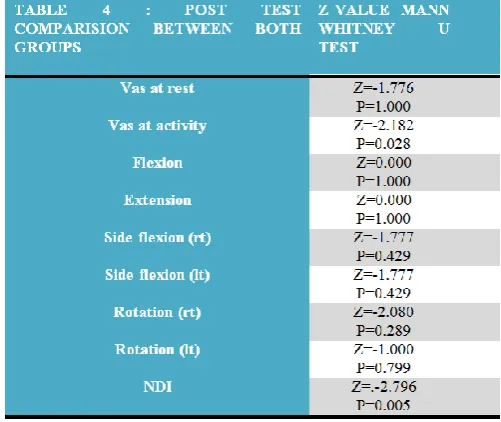
Table 4: shows except rotation on left side all outcome measures were significant post comparision between both
the groups
GRAPHS : Graph 1,2,3,4shows effectiveness of pre and post comparison of MFR and MET groups on mean of VAS at rest, VAS at activity ,cervical ROM and NDI.GRAPH 5,6,7 Shows effectiveness of post comparison of both the groups on mean difference of VAS at rest, VAS at activity, cervical ROM and NDI. Graph 8,9,10 Shows effectiveness of post comparison of both the groups on mean of VAS at rest, VAS at activity, cervical ROM and NDI
Graph 1: Comparison of means of VAS between both groups (pre and post comparative test analysis)
Page 92 www.ijiras.com | Email: [email protected] Graph 3: Comparison of mean of CROM of MET group (pre
and post test comparative test analysis)
Graph 4: Comparison of mean of NDI between both groups (pre and post test comparative analysis)
Graph 5: Comparison of mean difference of VAS between both groups
Graph 6: Comparison of mean difference of CROM between both groups
Graph 7: Comparison of mean difference of NDI between both groups
Page 93 www.ijiras.com | Email: [email protected] Graph 9: Comparison of post intervention mean of CROM
between both groups
Graph 10: Comparison of post intervention mean of NDI between both groups
V. DISSCUSION
The present study found that 7 sessions of MET have shown statistically significant greater effect in improving pain, cervical disability and cervical ROM than MFR. This is accomplished by decreasing protective muscle spasm, facial tension, joint hypo mobility, pain, and swelling and increasing circulation and strength.
The reduction in the pain following static stretching can be explained on the basis of inhibitory effects of GTO (which causes a dampening effect on the motor neuronal discharges, thereby causing relaxation of the musculotendinous unit by resetting its resting length) and Pacinian corpuscle modification. These reflexes will allow relaxation in musculotendinous unit tension and decreased pain perception.(13) The effects of MET component for increase in ROM post intervention can be explained on the basis of physiological mechanisms behind the changes in muscle extensibility - reflex relaxation, viscoelastic change, and changes to stretch tolerance. Reflex muscle relaxation following contraction that has been proposed to occur by activation of the golgi tendon organs and their inhibitory influence on the a-motor neuron pool. Combination of contractions and stretches (as used in MET) might be more effective for producing viscoelastic change than passive stretching alone, because the greater forces could produce increased viscoelastic change and passive extensibility.(14) The possible mechanism for the reduction in pain in the MET group can be attributed to the hypo analgesic effects which can be explained by the inhibitory Golgi tendon reflex, activated during the isometric contraction that leads to reflex relaxation of the muscle. Activation of muscle and joint mechano receptors leads to sympatho excitation evoked by somatic efferents and localized activation of the preaqueductal gray matter that plays a role in descending modulation of pain. The effects of MET for increase in range
of motion can be explained on the basis of physiological mechanisms behind the changes in muscle extensibility – reflex relaxation, viscoelastic change and changes to stretch changes. Combination of contractions and stretches (as used in METS) might be more effective for producing viscoelastic change than passive stretching alone, because the greater forces could produce increased viscoelastic change and passive stretching.(15) Muscle energy techniques, i.e., post isometric relaxations are commonly recommended in the management of myofacial trigger points (Lewit, 1999). Lewit and Simons (1984) found an immediate relief of pain and tenderness after treatment with post isometric relaxation in patients with musculoskeletal dysfunction. Goldenberg (1993) found decreased pain intensity in tender points in patients suffering from fibromyalgia following the application of MET. Schenk et al has proved in his study the effect of MET on CROM. (16) Graff-Radford suggested that the pathogenesis of myofascial pain likely has a central mechanism with peripheral clinical manifestations. Therefore, therapy for myofascial pain should involve enhancing the central inhibition. (17)
MFR is an alternative therapy that relaxes the contracted muscle, improving blood and lymphatic circulation, and stimulates stretch reflex in muscles.
CONCLUSION: This study provided evidence to support the use of MFR and MET in management of chronic trapezitis. MET is more effective than MFR in improving pain, cervical disability and cervical range of motion in patients with upper trapezitis because of stretching effect on muscle and stimulation of nociceptive endings connected to A-delta fibres
Limitations: The study had a small sample size and only short term effects of MET and MFR was seen.
ACKNOWLEDGEMENT
I would heartily thank the principal of SBB college of physiotherapy to give me this platform to conduct the study. All our best wishes to those valuable subjects and supporters of this study.
REFERENCES
[1] A. kumaresan G .Deepthi, Vaiyapuri Anandh, S. Prathap. Effectivness of positional release therapy in treatment of Trapezitis. International journal of pharma ceutical science and health care. 2012;1(2)71-81].
[2] Jagatheesan Alageson unnati S. Shah effect of positional release technique and tapping on unilateral upper Trapezitis tender point , interntional journal of health & pharmaceutical science .2012;17(1):2-8.
[3] Laura K. Smith, Elizabeth l. Weiss and L. Don Lehmukhi, brunnstrome”s clinical kinesiology 5th ed: f a davis company; 1996.
[4] Fejer R, Kyvik KO, Hartvigsen J, The prevalence of neck pain in the world population: A Systemic critical review of the literature, Eur Spine J 2006; 15: 834-848.
Page 94 www.ijiras.com | Email: [email protected] subjects with subacute trapezitis. Int J physiother .vol.
(2),91-99 june 2014.
[6] Shweta r. rakholiya and vaibhavi ved, effect of ischemic compression on upper trapezitis, IJCAR ISSN : 2319-6475, VOLUME 5, ISSUE 7, PD 1131-1134, JULY 2016 [7] Pooja mane, amrat kuvar pawar, trupti warade, IJSR
ISSN(online): 2319-7064, volume 6, issue 3,2017 [8] Simons DG, Muscular pain syndrome, Advances in pain
research and therapy, Vol 17, New York, Raven Press;1990:1-41.
[9] Kinser AM, sands WA, stone MH. Reliability and validity of a pressure algometer: J Strength Cond Res. 2009 Jan; 23(1):312-4.
[10] Travell JG, simons DG, myofascial pain & dysfunction; the trigger point manual, the upper extremites Baltimore, md;William & wilkins 1983-5.
[11] Hanten WP, Olson SL, Butts NL, Nowicki AL, Effectiveness of home programme of ischemic pressure followed by sustained stretch for treatment of myofacial trigger points, Phys Ther, 2000;80(10): 997-1003. [12] Leon Chaitow, MUSCLE ENERGY TECHNIQUE, third
edition, chapter no. 5 –sequential assessment and MET treatment of main postural muscles. Page no. 178-179.
[13] Frontera WR. Rehabilitation Of Sports Injuries: Scientific Basis. 1st ed. Mayfield publication; 2003:232-257. [14] Leon Chaitow. Muscle energy techniques, 2 nd. edition,
Edinburgh: Churchill Livingstone; .2006.1-187
[15] Mahajan R, Kataria C, Bansal K. Comparative effectiveness of muscle energy technique and static stretching for treatment of subacute mechanical neck pain. International journal of health and rehabilitation sciences 2012; 1(1):16-24.
[16] Rodriguez-Blanco C, Fernandez-de-las-penas C, Hernandez-Xumet JE, Pena-Algaba G. Fernandez Rabadan M, Lillo MC. Changes in active mouth opening following a single treatment of latent myofascial trigger point in the masseter muscle involving post-isometric contraction or strain counterstrain. J Bodyw Mov Ther 2006; 10:197-205.