arXiv:1405.4751v2 [math.AG] 18 Aug 2014
TORELLI LOCUS OF CURVES
XIN LU AND KANG ZUO
Abstract. Oort has conjectured that there do not exist Shimura curves con-tained generically in the Torelli locus of genus-gcurves whengis large enough. In this paper we prove the Oort conjecture for Shimura curves of Mumford type and Shimura curves parameterizing principally polarizedg-dimensional abelian varieties isogenous tog-fold self-products of elliptic curves forg >11. We also prove that there do not exist Shimura curves contained generically in the Torelli locus of hyperelliptic curves of genusg >7. As a consequence, we obtain a finiteness result regarding smooth genus-gcurves with completely decomposable Jacobians, which is related to a question of Ekedahl and Serre.
Contents
1. Introduction 2
1.1. Oort’s conjecture 2
1.2. Progress on the Oort conjecture 3
1.3. Main results 3
1.4. The main idea of proofs 5
1.5. Further perspectives 6
2. Preliminaries 7
2.1. Special subvarieties in Shimura varieties 7
2.2. Two types of Shimura curves 9
2.3. Logarithmic Higgs bundles on curves in Ag 12
2.4. Families of semi-stable curves 13
3. Family of semi-stable curves representing a curve in Tg 16
4. The strict Arakelov inequalities and proofs of the main results 18 4.1. Two types of inequalities for a family of semi-stable curves 18
4.2. The strict Arakelov inequalities 19
4.3. Proofs of the main results 22
5. Miyaoka-Yau type inequalities for a family of semi-stable curves 22 5.1. Proof of Theorems 4.1 and 4.4 based on Theorem 5.1 23
5.2. Proof of Theorem 5.1 25
6. Sharp slope inequalities fora family of semi-stable curves 30
6.1. Proof of Theorem 4.2 30
6.2. Proof of Theorem 4.3 30
6.3. Proof of Theorem 4.5 37
7. Flat part of R1f¯∗Qfor a family of hyperelliptic semi-stable curves 39
Date: August 18, 2014.
2010 Mathematics Subject Classification. Primary 11G15, 14G35, 14H40; Secondary 14D07, 14K22.
Key words and phrases. Shimura curves, Torelli locus, complex multiplication, Jacobians, families.
This work is supported by SFB/Transregio 45 Periods, Moduli Spaces and Arithmetic of Al-gebraic Varieties of the DFG (Deutsche Forschungsgemeinschaft), and partially supported by National Key Basic Research Program of China (Grant No. 2013CB834202) and NSFC.
8. Examples and miscellaneous results 43 Appendix: involutions on the universal family of curves 47
References 49
1. Introduction
This paper is devoted to the study of the conjecture of Oort on special subvari-eties of the Siegel modular variety that are contained in the Torelli locus. In this section we state the main results and explain the basic idea of the proofs.
1.1. Oort’s conjecture. We start with the conjectures of Coleman and Oort. A more thorough survey of the subject is found in the beautiful paper [48].
Fix n ≥3 an integer, we have Mg =Mg,[n] the moduli space of smooth
pro-jective curves over complex number Cof genusg≥2 with a full leveln-structure, and Ag = Ag,[n] the moduli space of g-dimensional principally polarized abelian
varieties over C with full level-n structure. In this paper we treat them as the moduli schemes overCof the corresponding moduli functors. No specific choice of the level n(≥3) is made because it is only imposed to assure the representability, which plays no essential role in our study.
Recall that the Torelli morphism
j◦: Mg−→ Ag
associates to a curve its Jacobian with its canonical principal polarization and level structure. The image of j◦, denoted as T◦
g, is a locally closed subvariety in Ag,
whose closure is denoted as Tg. Tg is called the Torelli locus (in Ag) and Tg◦ is
referred as the open Torelli locus. We also have the Torelli locus T Hg ⊆ Tg of
hyperelliptic curves corresponding to Jacobians of hyperelliptic curves.
A closed subvarietyZ⊆ Ag of positive dimension is said to becontained
gener-ically in the Torelli locus (resp. the Torelli locus of hyperelliptic curves), written as Z ⋐Tg (resp. Z ⋐ T Hg), if Z ⊆ Tg and Z ∩ T◦
g 6= ∅ (resp. Z ⊆ T Hg and
Z∩ T◦ g 6=∅).
As is explained in [25, 40, 46], the moduli scheme Ag = Ag,[n] is isomorphic
to a connected Shimura variety, namely a geometrically connected component of the Shimura variety defined by the Shimura datum (GSp2g,Hg±) associated to the
group of symplectic similitude GSp2g, using some compact open subgroupK(n)⊂
GSp2g(Af), cf. Example 2.2. In Ag there are special subvarieties and totally
geodesic subvarieties, the definitions of which are given later in Section 2.1. Special subvarieties are totally geodesic subvarieties containing CM points, cf. [46]. They are of particular interest because on the one hand they are locally symmetric in the sense of differential geometry, and on the other hand they parameterize abelian varieties with prescribed Hodge classes, cf.[12]. Special subvarieties of dimension zero are exactly CM points, i.e. points in Ag that parameterize abelian varieties
with complex multiplication.
It was conjectured by Coleman [7], that when the genus g is sufficiently large, there should be at most finitely many CM points on Ag contained in the open
Torelli locusT◦
g. Oort [55] made the following conjecture by combining Coleman’s
idea with the conjecture of Andr´e-Oort:
Conjecture 1.1 (Oort). For g large, there does not exist a special subvariety of positive dimension contained generically in the Torelli locus Tg.
The Andr´e-Oort conjecture predicts that in a Shimura variety, a closed geometri-cally irreducible subvariety is special if and only if it contains a Zariski dense subset
of CM points. It is thus immediate that the formulation of Oort is equivalent to the one by Coleman modulo Andr´e-Oort. The readers are referred to [54], [63], [71], etc. for surveys on the recent progress towards the Andr´e-Oort conjecture. 1.2. Progress on the Oort conjecture. Although Coleman made his conjecture for g ≥4, counterexamples have been found for 4≤g ≤7. However, if one aims at the non-existence of special subvarieties of a certain type with g sufficiently large, then much more evidence is available, as the concrete “type” of the special subvarieties often imposes constraints so that no universal family of curves could be produced from such special subvarieties subject to the Torelli morphism (cf. [5, 48]).
In [21], based on the properties of the mapping class groups (cf. [17]), Hain proved, under some natural technical assumptions, that a special subvariety Z of
Ag should be either a ball quotient or that its intersection with the Torelli locus
of hyperelliptic curves T Hg should be a divisor inZ. This suggests that the ball
quotients should play a special role in the study of the conjecture. Building on Hain’s method, de Jong and Zhang [27] have proved that Z cannot be a Hecke translate of a Hilbert modular subvariety ifg ≥5, which has also been proved for g= 4 by Bainbridge and M¨oller [1] using degeneration techniques and independent of properties of the mapping class groups.
In [26], de Jong and Noot have proposed an approach based on an p-adic ob-struction constructed by Dwork-Ogus [14] and they proved that base varieties of some specific universal families of curves arising from cyclic covers of P1 are not
contained generically inTg. Recently, Moonen [47] has extended de Jong and Noot’s
result and proved that there are exactly twenty families of curves coming from cyclic covers ofP1 such that the base varieties are contained generically inT
g, which
im-plies that Conjecture 1.1 holds if the corresponding special subvarieties arise from a universal cyclic cover of P1.
In [34], Kukulies proved Oort’s conjecture for rational Shimura curves param-eterizing principally polarized abelian varieties isogenous to g-fold self-product of elliptic curves forg≫0. His approach combines ideas of M¨oller, Viehweg and the second named author on the characterization of Shimura curves and the Sato-Tate conjecture for modular curves, which is of arithmetic nature.
There has been also other progress on the conjecture, cf. [8, 18, 20, 42, 44, 57, 61] and further discussions in [48].
1.3. Main results. In this paper we focus on the conjecture of Oort for Shimura curves of the following types::
I. Shimura curves parameterizing principally polarizedg-dimensional abelian varieties that are isogenous to ag-fold self-product of some elliptic curve; II. Shimura curves of Mumford type;
III. Shimura curves in the Torelli locus of hyperelliptic curves.
In this paper Shimura curves are special subvarieties of dimension one, cf. Re-mark 2.8. The precise definition of the Shimura curves of type I and II are given in Section 2.2. While Shimura curves of type I are of PEL type, Shimura curves of Mumford type constructed in [69] by generalizing Mumford’s original example in [51], are not of PEL-type except precisely two classes (see Section 2.2).
Our first main result is the following:
Theorem A. For g > 11, there does not exist a Shimura curve of types I or II contained generically in Tg.
This answers a question of Moonen and Oort [48, Question 6.7] in the one-dimensional case. The result by Kukulies [34] also studies Shimura curves of type I,
but it is more restrictive: it only deals with rational Shimura curves, and the bound for g depends on the curve in question, which is not uniform. Our approach is of differential-geometric nature. It gives an explicit lower bound, without resorting to deep number-theoretic results like the Sato-Tate conjecture.
Note that Theorem A also implies a partial answer to a question raised by Ekedahl and Serre [15], where they asked for the existence of a smooth curve of higher genus whose Jacobian is completely decomposable, i.e., isogenous to ag-fold product of elliptic curves. In fact we obtain the following corollary of finiteness: Corollary B. For each fixed integerg >11, there exist, up to isomorphism, at most finitely many smooth projective curves of genusg whose Jacobians are isogenous to g-fold self-product of a single elliptic curve with bounded isogenous degrees.
In [27] De Jong and Zhang have shown that Hecke translates of Hilbert modu-lar varieties associated to totally real fields of degree g over Qare not contained generically in the Torelli locus Tg for g ≥ 5 (which also holds for g = 4 proved
by Bainbridge-M¨oller [1]). Using the non-existence of Shimura curves of type I in the Torelli locus, we obtain an alternative approach to their result, under a slightly varied formulation with g >11:
Corollary C (real multiplication). Let F be a totally real ´etale Q-algebra of di-mension g overQ, and let Z ⊆ Ag be a Hecke translate of the generalized Hilbert
modular subvariety defined by (GF, XF)(cf. Definition 2.11). ThenZ is not
con-tained generically in Tg forg >11.
Here by totally real ´etaleQ-algebra we mean a product of finitely many totally real number fields, and the generalized Hilbert modular subvariety they define are, up to finite covering, products of usual Hilbert modular varieties (involving several totally real fields). Such Shimura data contain the subdatum (GL2,H1±) induced
by the natural embedding Q ֒→ F, hence the special subvariety Z they define contain a Shimura curve of type I. Note that the idea of [27] goes back to [21] which relies on properties of the mapping class groups studied in [17]. It only works for the usual Hilbert modular varieties associated to a totally real field of dimensiong≥5. It does not cover the case of theg-fold product of modular curves embedded in Ag, because in this case the lattice involved is essentially reducible
with low rank factors, i.e. commensurable withSL2(Z)g. Our approach focuses on
modular curves diagonally embedded in these generalized Hilbert modular varieties, which has no restriction on the dimension of the factor fields of the totally real ´etale algebra, and the proof does not involve the mapping class groups.
The following is a weaker result regarding Oort’s conjecture for Shimura curves of types I and II, already proved in our previous preprint [38, Theorem 1.2]. Theorem D. For g >4, there does not exist any one-dimensional family of semi-stable curves of genus g with strictly maximal Higgs field.
Higgs bundles and Higgs fields on curves will be among the main tools in our proofs. They are briefly recalled in the next subsection, and more details will be given in Sections 2.3 and 3. For a semi-stable family of curves with strictly maximal Higgs field, its image under the Torelli morphism is already a Shimura curve in Ag due to [69], and hence Theorem A implies Theorem D forg >11. On
the other hand, the converse is not true, namely not all Shimura curves of type I or II contained generically in Tg arise this way; see Section 3 for further discussions,
and especially Example 8.3 for g= 3.
Our last main result focuses on Shimura curves in the Torelli locus of hyperelliptic curves, which holds more generally for totally geodesic curves in Ag:
Theorem E. For g > 7, there does not exist totally geodesic curves contained generically in the Torelli locus of hyperelliptic curves T Hg.
1.4. The main idea of proofs. In this subsection we explain the main idea of the proofs.
As is mentioned earlier, we intend to exclude the existence of Shimura curves of certain type in the open Torelli locus using the natural constraints from the geometry of special subvarieties. For the three types of Shimura curves studied in this paper, the constraints mainly come from two types of inequalities:
(i). Arakelov inequalities of Higgs bundles for curves inAg, which are actually
equalities when applied to Shimura curves;
(ii). strict Arakelov inequalities of Higgs bundles for curves contained generically in the Torelli locus.
The Arakelov (in)equalities of Higgs bundles play a crucial role in the works [45, 69] characterizing the geometry of totally geodesic subvarieties in Shimura varieties. The survey [67] by Viehweg is highly recommended.
In our case, the universal family of abelian varieties h: Xg → Ag gives rise to
the Higgs bundle (E, θ) onAg, whereE=E1,0⊕E0,1is the graded quotient of the
Hodge filtration on theQ-VHS whose underlying local system isV=R1h∗QXg, and θis induced by the Gauss-Manin connection. For a smooth closed curveφ: C ֒→ Ag
with a suitable smooth compactification C by joining a finite set of cusps ∆C, by pulling-back alongφone has the universal family of abelian varietiesh: X →Cand a local systemVC :=Rh∗QX =φ∗V, which underlies a Q-VHS whose associated
Higgs bundle onCextends to a logarithmic Higgs bundle (EC, θC) onC. (EC, θC) decomposes further into a direct sum of Higgs bundles (cf. [19] or [31]):
EC1,0⊕EC0,1, θC= A1,0C ⊕A0,1C , θCA1,0 C ⊕FC1,0⊕FC0,1, 0, (1-1) where A1,0
C is an ample vector bundle, while F 1,0 C andF
0,1
C are flat vector bundles
associated to unitary local subsystemsF1,0C ⊕F 0,1 C ⊆VC.
Definition 1.2 ([68]). The Higgs bundle E1,0
C ⊕E 0,1 C , θC
is said to be with maximalHiggs field if
θCA1,0 C
: A1,0C −→A0,1C ⊗Ω1C(log ∆C)
is an isomorphism, and to be withstrictly maximalHiggs field if furthermoreFC1,0⊕
FC0,1= 0. By [68] the Higgs fieldθCis strictly maximal (resp. maximal) if and only if the followingArakelov equality holds
degEC1,0= g 2 ·deg Ω
1
C(log ∆C),
resp. degEC1,0= rankA
1,0 C 2 ·deg Ω 1 C(log ∆C) . (1-2)
The following theorem gives numerical characterizations of Shimura curves, and more generally of totally geodesic curves:
Theorem 1.3([44, 69]).LetC⊆ Agbe a smooth closed curve, and
EC1,0⊕EC0,1, θC the associated logarithmic Higgs bundle. Then
(i). C is a Shimura curve of type I or II if and only if the associated logarithmic Higgs bundle EC1,0⊕EC0,1, θChas the strictly maximal Higgs field.
(ii). C is a totally geodesic curve if and only if the associated logarithmic Higgs bundle has maximal Higgs field.
Now Theorems A and E are immediate consequences of the theorem above and the following strict Arakelov inequalities for a smooth closed curve C⋐Tg⊆ Ag.
Theorem 1.4. Let C ⊆ Ag be a smooth closed curve, and
E1,0 C ⊕E 0,1 C , θC be the associated logarithmic Higgs bundle.
(i). If C⋐Tg withg >11, then
degE1,0 C < g 2 ·deg Ω 1 C(log ∆C). (1-3)
(ii). If C⋐T Hg with g >7, then
degEC1,0<rankA 1,0 C 2 ·deg Ω 1 C(log ∆C). (1-4)
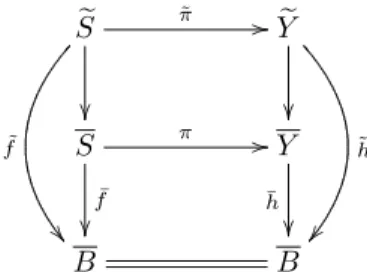
Details of the proof of the strict Arakelov inequalities are given in Section 4.2. Roughly speaking, we have the following diagram in which the central square is Cartesian: B normalization// j◦−1(C) // _ C _ ⋐ Mg j◦ / / Tg // Ag
By pulling back the universal family overMgtoB, one obtains a familyf : S→B
of curves, which can be naturally extended to a family ¯f : S → B of semi-stable curves over the smooth compactification B ⊇ B. Then Theorem 1.4 will be a combination of two types of inequalities (Miyaoka-Yau type inequality and sharp slope inequality) for a family of semi-stable curves, the proofs of which rely highly on the geometrical property of fibred surfaces.
1.5. Further perspectives. The method of the paper was stimulated by the nu-merical characterization of Shimura curves using the Arakelov equality given by M¨oller, Viehweg and the second named author [44, 69]. In [45], they generalized it to high dimension, and obtained the numerical characterization of special sub-varieties of arbitrary dimension in Ag, where the Arakelov equality plays a key
role. It suggests a new way to prove Oort’s conjecture by proving a strict Arakelov inequality for subvarieties ofAg which are contained generically inTgforg≫0.
In [21], Hain has dealt with those special subvarieties inTg containing no divisor
which is also special. It does not treat special subvarieties associated to groups like SO(n,2) and SU(n,1), which are of real rank one. However, in such special subvarieties, one can construct special curves following [32, 33]. This is the subject of our ongoing research, where we intend to exclude such special subvarieties by studying the strict Arakelov inequalities for special curves in them, cf. [?].
The paper is organized as follows. In Section 2 we collect facts about special subvarieties in Shimura varieties, logarithmic Higgs bundles, and surfaces fibred over curves with semi-stable fibers. In Section 3 we construct a family ¯f : S →B of semi-stable curves representing a smooth closed curve C ⋐Tg, and we explain
the relation between the associated logarithmic Higgs bundles over B and over C. In Section 4, We prove the strict Arakelov inequalities and the main results, based on two types of inequalities (Miyaoka-Yau type inequality and sharp slope inequality) for a family of semi-stable curves, whose proofs are given in Sections 5 and 6 respectively. An intermediate result needed in Section 4 is proved in Section 7, which focuses on the flat part of the Higgs bundle associated to a family of semi-stable hyperelliptic curves. Finally in Section 8, we present examples of Shimura curves contained generically in the Torelli locus.
2. Preliminaries
2.1. Special subvarieties in Shimura varieties. We first recall the general no-tions of Shimura data and Shimura varieties, following [11] and [40].
Definition 2.1 (Shimura data and Shimura varieties). WriteS = ResC/RGm for the Deligne torus.
(1) A Shimura datum is a pair (G, X) where
SD1. Gis a connected reductiveQ-group, such thatGadhas no compact factors defined overQ;
SD2. X is a G(R)-conjugacy class of homomorphisms ofR-groupsx:S→GR,
such that
• the composition Ad◦x:S → GR →GLR(gR) defines a pure Hodge
structure of type{(−1,1),(0,0),(1,−1)}on the Lie algebrag= LieG;
• the conjugation byx(√−1) induces a Cartan involution onGad(R).
It turns out that each connected component ofX is an Hermitian symmetric do-main. We writeG(R)+for the stabilizer inG(R) of any such connected component,
and we put G(Q)+=G(R)+∩G(Q).
(2) Let (G, X) be a Shimura datum and let K ⊆ G(Af) be a compact open subgroup. The Shimura variety associated to (G, X) at level K is an algebraic varietyMK(G, X) whoseC-points are described by the formula
MK(G, X)(C) =G(Q)\[X×G(Af)/K],
whereG(Q) acts onX×G(Af)/K diagonally. FixX+a connected component of
X, we actually have the following expression of geometrically connected components MK(C) =
a
a
ΓK(a)\X+,
where a runs through a set of representatives of the quotient G(Q)+\G(Af)/K,
and ΓK(a) =G(Q)+∩aKa−1 acts onX+ throughGad(R)+.
By [2], each ΓK(a)\X+ is a quasi-projective algebraic variety overC. Moreover
MK(G, X) admits a canonical model over some number fields (cf. [39]).
Example 2.2 (Siegel modular variety, cf. [40,§6]). Let (V =Q2g, ψ) be the
stan-dard symplectic space of dimension 2g, with symplectic basis e1, e−1,· · ·, eg, e−g
such that ψ(ei, e−j) =δij. Denote by GSp2g the connected reductive Q-group of
symplectic similitude of (V, ψ), and Hg± be the Siegel double half space of com-plex symmetric g×g matrices with definite imaginary part. Then (GSp2g,Hg±)
is a Shimura datum, because Hg± is identified with the set of homomorphisms h : S → GSp2g,R such that the composition S → GSp2g,R → GL2g,R defines a
complex structure on VR with (x, y)7→ψ(x, h(√−1)y) symmetric definite.
Letn≥3 be an integer and takeKto be the principaln-th congruence subgroup K=K(n) = Ker GSp2g(ˆZ)→GSp2g(Z/n)
.
Then MK(GSp2g,Hg±) is just Ag,[n], the moduli scheme over Q parameterizing
principally polarized abelian varieties with full level-nstructure. The set of geomet-rically connected components ofMK(GSp2g,Hg±) is in bijection with the setµnof
n-th roots of 1, each of them isomorphic to Γ(n)\Hg+, with Γ(n) = Ker(Sp2g(Z)→ Sp2g(Z/n)) the n-th principal congruence subgroup.
For simplicity we will use Ag to denote the fixed connected component indexed
by 1 ∈ µn of the Shimura variety MK(GSp2g,Hg±) described above. Ag has its
moduli scheme Ag,1,n constructed by Mumford in [50]. The whole Shimura
va-riety MK(GSp2g,Hg±) is the Q-scheme by composing Ag,1,n → SpecQ(ζn) with
SpecQ(ζn)→SpecQ, cf. [25, Chapter 6, Section 6.4].
We will mainly focus on geometrically connected components:
Definition 2.3(connected Shimura data and varieties). (1) A connected Shimura datum is a triple (G, X;X+) where (G, X) is a Shimura datum and X+ is a
con-nected component ofX.
(2) A connected Shimura variety is a quotient space of the form Z = Γ\X+,
where X+ comes from some connected Shimura datum (G, X;X+), and Γ is a
congruence subgroup of Gder(R)+ := G(R)+∩Gder(R), namely the stabilizer of
X+ inGder(R).
Remarks 2.4. (i). The definition above of connected Shimura varieties differs slightly from the one adopted in [40], where Γ is taken to be a congruence sub-group ofGad(Q)+. Since the center ofG(R)
+ acts onX+ trivially, it only differs
from our version of connected Shimura varieties by a finite covering.
(ii). Just like general Shimura varieties in the sense of Definition 2.1, connected Shimura varieties admit canonical models over suitable number fields. In this paper it suffices to treat them as complex algebraic varieties.
Definition 2.5 (special subvarieties). Let (G, X;X+) be a connected Shimura
datum, which defines a connected Shimura varietyZ= Γ\X+.
(1) A Shimura subdatum of (G, X) is a Shimura datum (G′, X′) such thatG′is
a Q-subgroup ofGandX′ is theG′(R)-orbit of someh∈X such thath(S)⊆G′ R.
Note thatX′֒→X is equivariant with respect toG′(R)֒→G(R).
A connected Shimura subdatum of (G, X;X+) is a connected Shimura datum
(G′, X′;X′+), such that (G′, X′) is a Shimura subdatum of (G, X) and X′+ is a
connected component of X′ which is contained inX+.
(2) Write uΓ for canonical projection X+ → Γ\X+, x 7→ Γx, which we call
the uniformization map of Z. Then a special subvariety of Z is of the formZ′ =
uΓ(X′+), whereX′+ comes from some subdatum (G′, X′;X′+).
Z′ is actually the image of a morphism between connected Shimura varieties
Γ′\X′+
→Γ\X for some congruence subgroup Γ′ ⊆G′der(Q)
+, and it is a closed
subvariety ofZ overC, which actually admits a model over some number field. We mention briefly the notion of Hecke translation in the setting of connected Shimura varieties.
Definition 2.6 (Hecke translation). LetZ= Γ\X+ be a connected Shimura
vari-ety defined by (G, X;X+). Fora
∈G(Q)+, the Hecke correspondence associated
to ais the following diagram
Γ\←q Γa\X+ qa →Γ\X+ where • Γa= Γ∩a−1Γa; • q(Γax) = Γxandqa(Γax) = Γax.
Both q and qa are finite morphisms of degree equal to [Γ : Γa]. For Z′ a closed
irreducible subvariety ofZ, any irreducible component ofqa(q−1Z′) is called a Hecke
translate ofZ′ bya.
This also makes sense for general cycles in Z, where we writeqa∗q∗(Z′) as
mul-tiplicities could arise, and the map qa∗q∗is called the Hecke operator associated to
Remark 2.7. It is easy to verify that the Hecke translate of a special subvariety remains special. Moreover, for any special points∈Z, the union of all the Hecke translates of s using a ∈G(Q)+ is dense in Z for the analytic topology, because
G(Q)+ is dense inG(R)+ by the real approximation of linearQ-groups.
Remark 2.8 (terminology). In [66] etc. a Shimura subvariety ofMK(G, X) is the
image of a morphism between Shimura varieties f : MK′(G′, X′) → MK(G, X) given by a morphism of Shimura data f : (G′, X′)→(G, X), using some compact
open subgroup K′ ⊂ G′(Af)∩K. In this setting we have the notion of Hecke
correspondence given by adelic points a ∈ G(Af), and special subvarieties are defined as geometrically irreducible components of the (adelic) Hecke translate of a Shimura subvariety.
It turns out that the special subvarieties thus defined are subvarieties contained in suitable connected components ofMK(G, X). Shifting between connected
com-ponents following [6, Lemma 2.13], we see that the special subvarieties in the sense of [66] are the same as ours when restricted to a connected component ofMK(G, X).
In particular, the notion of Hecke translation is not involved in our definition of special subvarieties, although it will be needed elsewhere, like the description of Shimura curves of type I.
Since we only work with connected Shimura varieties, the adjective “connected” will be often omitted if no ambiguity occurs, and our special subvarieties will be also called Shimura subvarieties, like the Shimura curves in Section 2.2.
To end the subsection, we include the notion of totally geodesic subvarieties following [46]:
Definition 2.9(totally geodesic subvarieties).LetZ = Γ\X+be a Shimura variety
defined by (G, X;X+), withu
Γ the uniformization map.
A totally geodesic subvariety ofZ is of the formuΓ(Y1+× {y2}), where for some
subdatum (H, Y;Y+)
⊆(G, X;X+) we have (Had, Yad;Yad+)
≃(H1, Y1;Y1+)×
(H2, Y2;Y2+) andy2∈Y2+. Here (Had, Yad;Yad+) is deduced from (H, Y;Y+) by
taking Yad to be the Had(R)-orbit of the composition S y
→HR→HadR using any
y ∈Y; in particular,Y+=Yad+ as the center ofH(R) acts on Y trivially.
Remark 2.10. Totally geodesic subvarieties can also be defined in terms of differ-ential geometry. However, we do not need the fine geometry of these subvarieties, except for a numerical characterization in the case of curves due to Viehweg and the second named author, cf. Theorem 1.3 and the original paper [69].
2.2. Two types of Shimura curves. We recall briefly the definition of two types of Shimura curves that will be studied later.
The first class of Shimura curves are modular curves “diagonally” embedded in Ag, and the embedding factors through a slightly generalized form of Hilbert
modular varieties, which we describe as follows
Definition 2.11 (Hilbert modular variety). (1) A totally real ´etale Q-algebra is a finite dimensional ´etaleQ-algebraF (necessarily commutative) such that the R -algebraF⊗QRis isomorphic to the direct productR-algebraRg, withg= dimQF.
It is clear thatF is isomorphic to a finite product of totally real number fieldsQ
i
Fi
withP
i
[Fi:Q] =g, andF is aQ-form of the product algebraQg.
(2) LetFbe a totally real ´etaleQ-algebra of dimensiong. ThenG:= ResF/QGL2
is a Q-form of the d-fold product GLd2, which splits after the base changeQ→R.
We thus have GR ≃QσGL2,σ, where GL2,σ stands for GL2,R indexed by one of
LetX be theG(R)-conjugacy class of the homomorphism h:S→(ResF/QGL2)R, ρexp(
√
−1θ)7→ −ρρcossinθθ ρρsincosθθ σ
using GR ≃QσGL2,σ. It is then immediate that (G, X) is a Shimura datum in
the sense of [11], with X ≃QσH1,σ± theg-fold product ofH1±.
Note that the center of Gis ResF/QGm, which is too big to be put into GSp2g
directly respecting the moduli interpretation. We thus restrict to theQ-subgroup GF :={g∈G: det(g)∈Gm,Q⊆ResF/QGm}.
In other words, we may start with an embedding ResF/QSL2 ֒→ Sp2g. This can
be done by choosing an F-linear structure on the Q-Lagrangian decomposition V = V+ ⊕V− described in Example 2.2, say identify e1,· · · , eg with a Q-basis
of F and extend this F-linear structure from V+ = g L i=1Q ei to V− = g L i=1Q e−i
respecting the symplectic form ψ. The embedding ResF/QSL2 ֒→Sp2g extends to
GF ֒→GSp2g by joining a central Q-torus isomorphic to Gm. It is then clear that
the homomorphismhmentioned above has its image inGFR, and we get a smaller Shimura datum (GF, XF =GF(R)
·h), which is a subdatum of (GSp2g,Hg±).
The moduli interpretation of Shimura subvarieties associated to (GF, XF) is
similar to the case of usual Hilbert modular varieties, namely they classify abelian varieties with endomorphism byF up to isogeny (plus suitable level structures and polarization constraints).
Definition 2.12(Shimura curves of type I). In Shimura subvarieties ofAgdefined
by the subdatum (GF, XF) in Definition 2.11(2), we have Shimura curves
embed-ded diagonally. In fact the diagonal embedding GL2.R → QσGL2,σ descends to
GL2,Q ֒→ ResF/QGL2, which has image in GF; the homomorphism h : S → GFR
used there factors through it, which gives the chain of subdata (GL2,H1±) ֒→
(GF, XF) ֒→ (GSp
2g,Hg±). Such Shimura curves are called Shimura curves of
type I.
Note that the Shimura curves given by different embeddings (GL2,H1±) ֒→
(GF, XF)֒
→(GSp2g,Hg±) only differ from each other by Hecke translation using
GSp2g(Q). For example, ifEandFare two totally real ´etaleQ-algebra of dimension
g giving rise to (GE, XE) and (GF, XF) as above, then their embeddings into (GSp2g,Hg±) are the same as the choice of E-structure (resp. F-structure) on
the Q-Lagrangian subspace of the underlying symplectic space. The restriction to (GL2,H1±) simply treats E (resp. F) as a Q-vector space of dimension g,
hence the embedding (GL2,H1±) ֒→ (GSp2g,Hg±) always factors through some
(GL, XL) withL=
Qg(direct product
Q-algebra) given by the choice of a basis for a Q-Lagrangian subspace of the symplectic space. Since different Q-Lagrangians are conjugate under GSp2g(Q), we see that these embeddings of (GL2,H1±) are
permuted to each other by Hecke translation.
We mention some facts about Shimura curves of type I:
Lemma 2.13. (1) Let A be a principally polarized abelian variety over C with End◦(A) := End(A)⊗ZQ. Then End◦(A) contains the matrix algebraMatg(Q)if
and only ifA is isogenous to a g-fold self-product of some elliptic curve.
(2)LetAbe an abelian variety as in(1). Then the pointxAonAgparameterizing
A falls in some Hecke translate of the Shimura curve defined by the diagonal em-bedding (GL2,H1±)֒→(GL, XL)֒→(GSp2g,Hg±), using the trivial realQ-algebra
Proof. (1) Ag-dimensional principally polarized abelian varietyA(overC) admits a decomposition up to isogenyA∼
r
Q
i=1
Amii where theAi’s are simple abelian varieties
non-isomorphic to each other and mi>0 are integers such that r
P
i=1
mi=g. Hence
the algebra of endomorphisms up to isogeny ofA is End◦(A)≃
r
Y
i=1
Matmi(Di),
whereDi= End◦(Ai) is a division algebra of finite dimension overQ. The maximal
semi-simple split Q-algebra (i.e. a finite product of matrix algebras Matd(Q)’s) of
End◦(A) is equal to
r
Q
i=1
Matmi(Q).
If End◦(A) contains a split simpleQ-algebra of the form Matg(Q), then one must
have r= 1 andm1 =g, which meansA is isogenous to a g-fold self-product of a
single elliptic curve. Conversely, ifAis isogenous toEgwithEsome elliptic curve,
then End◦(A) = Matg End◦(E)contains Matg(Q).
(2) Letx∈H+
g be a point giving the Hodge structureh:S→GSp2g,R→GLV,R
on V, which defines a point ¯x = Γx on Γ\H+
g for some congruence subgroup
Γ ⊂ Sp2g(Q) (say Γ = Γ(n) principal for some n). Take a ∈ GSp2g(Q)+ and
consider the Hecke correspondence Γ\H+ g q ←Γa\Hg+ qa →Γ\H+ g
then by the Definition 2.6 we see that the point Γax lies inqa(q−1{x¯}).
Applying this to the isogenyf :Eg→A, we geta=f∗:H1(Eg,Q)≃H1(A,Q).
H1(Eg) andH1(A,Q) correspond to two rational Hodge structure on theQ-vector
space V = Q2g, namely two points x
E and xA in Hg+. a = f∗ is an
isomor-phism of polarized rational Hodge structure, which gives an element in GSp2g(Q),
still denoted as a. We may choose suitable symplectic bases of H1(Eg,Q) and
H1(A,Q) such thata∈GSp2g(Q)+. The elementatransports xE toxA, namely
the conjugation of xE bya equals xA, hence ΓxA is a Hecke translate of ΓxE by
a∈GSp2g(Q)+.
The second class of Shimura curves are the Shimura curves of Mumford type constructed from corestrictions of quaternion algebras, the idea of which goes back to [51]. We recall briefly the construction given in [69].
LetF be a totally real field of degreedoverQ, withddistinct real embeddings σ1,· · · , σd, and we useσ=σ1to identifyFas a subfield ofR. LetAbe a quaternion
algebra overF, equipped with isomorphisms
ρ1:A⊗σ1R≃Mat2(R), ρi :A⊗σiR≃H, (i= 2,· · ·, d),
with HHamilton’s quaternion algebra over R. The corestriction D = CorF/QAis
a central simple algebra overQ, which is isomorphic to either
• Mat2d(Q) anddis odd; or
• Mat2d(L), for some quadratic extensionL=Q(√b) overQ;Lis imaginary
if and only ifdis even.
In both cases we have an embeddingD= CorF/QA ֒→Mat2d+ǫ(Q) forǫ∈0,1, and
we simply write it as D⊆Mat2m(Q) withm minimal.
Write A1 for the kernel of the reduced norm Nrd : A× → F×. The Q-group
G′ associated toA1is connected and semi-simple, withG′
R≃SL2,R×SU2(R)d−1.
From [69] we know that the homomorphism A× → D ֒→ Mat2m(Q) defines a
representation ofA1 which preserves a symplectic form onV =Q2m
We enlargeG′ to a connected reductive Q-groupGwhich only differs from G′
by the split center Gm,Q. It is theQ-group associated to
A∗:={a∈A: Nrd(a)∈Q×⊂F×}.
Similar to the case of the affine modular curve Y(d) discussed above, we have the Shimura datum (G, X), whereX is theG(R)-conjugacy class of the following homomorphismh:S→GR given by
z=ρexp(√−1θ)7→ ρcosθ ρsinθ
−ρsinθ ρcosθ , I2,· · · , I2 . X is isomorphic to H±
1 , and (G, X) is a subdatum of (GSp2m,H2±m−1) by the
representation ofGinduced byA→Mat2m(Q).
WriteCA for the connected Shimura curve defined by the datum (G, X) above
using suitable level structure and the component H+
1 , with η the generic point
of CA. The defining symplectic representation of G gives a universal family of
abelian varieties XA → CA, and its generic fiber Xη is an abelian variety. The
endomorphism algebra ofXηhas been classified in [69], and one of the two following
cases holds:
(1) m=d >1, dimXη= 2d−1and End(Xη)⊗ZQ=Q;
(2) m=d+ 1, dimXη= 2d, and
a. fordodd, End(Xη)⊗ZQis a totally definite quaternion algebra over Q;
b. fordeven, End(Xη)⊗ZQis a totally definite quaternion algebra over Q.
We remark that ford= 1 or 2, there are only two Shimura curves of Mumford type for the given quaternion algebraA, and both of them are of PEL type. The curve classifies abelian surfaces resp. abelian fourfolds X with End(X)⊗ZQ a totally
indefinite resp. totally definite quaternion algebra overQ.
2.3. Logarithmic Higgs bundles on curves in Ag. Let Ag =Ag,[n] (n ≥3)
be the moduli space of principal polarized abelian varieties with level-nstructure andAg⊇ Aga smooth toroidal compactification with ∆ :=Ag\ Ag. Note thatAg
carries a universal family of abelian varieties (cf. [60])
h: Xg−→ Ag.
The relative de Rham bundleH1
dR Xg/Ag, ∇
, together with a polarization and the Hodge filtrationh∗ Ω1
X0/Ag,[n]
⊆ H1
dR Xg/Ag
, forms a polarized variation of Hodge structure (PVHS).
Consider the underlying universal locally constant sheaf V=R1h∗QX0. If nis
large enough, thenVhas unipotent local monodromy around all components of the boundary ∆ by [53,§4]. We will always assume thatVhas the property.
The above PVHS has a unique extension over Ag,[n], and the extended
Gauss-Manin connection∇has logarithmic poles along ∆, cf. [59,§11.1,§11.2]. By taking the grading of the extended Hodge filtration, one obtains a logarithmic system of Hodge bundles E1,0⊕E0,1, θ, where the Higgs field
θ: E1,0
−→E0,1 ⊗Ω1
Ag(log ∆)
is an extension of the following Kodaira-Spencer map on the Hodge bundles θ: h∗ Ω1Xg/Ag−→R1h∗OXg⊗Ω
1 Ag.
Consider a (smooth) projective curve contained inAg,[n]:
φ: C ֒→ Ag,[n], with ∆C:=φ−
Then by pull-backC:=C\∆C carries a universal family of abelian varieties
h: X →C
and a PVHS with underlying local systemVC:=R1h∗ZX=φ∗V,which has
unipo-tent local monodromy around ∆C by assumption. Because of the compatibility of the Deligne’s canonical extension with pullback under a morphism, we obtain
EC1,0⊕EC0,1, θC=φ∗ E1,0⊕E0,1, θ.
In particular, for a Shimura curve C, one obtains an associated logarithmic Higgs bundle on the smooth completionC⊇C.
2.4. Families of semi-stable curves. Our main technique will be built on the theory of (one-dimensional) families of semi-stable curves. In the subsection, we would like to review some basic facts and fix the notations, which will be used freely in this paper, cf. [4, 9, 22].
Recall that a semi-stable (resp. stable) curve is a complete connected reduced nodal curve such that each rational component intersects with the other components at ≥ 2 (resp. 3) points. A semi-stable (resp. stable) family of curves is a flat projective morphism ¯f : S →Bfrom a projective surfaceSto a smooth projective curveB with connected fibres such that all the singular fibres of ¯f are semi-stable (resp. stable) curves. Moreover, ¯f is said to be
• a hyperelliptic family if a general fibre of ¯f is a hyperelliptic curve;
• isotrivial if all its smooth fibres are isomorphic to each other;
• relatively minimal if no singular fiber of ¯f has any (−1)-component. Note that if ¯f is semi-stable, then ¯f is relatively minimal. From now on, we assume that ¯f : S →Bis a semi-stable family of curves of genusg≥2 with singular fibres Υ→∆ and S is smooth.
Denote by ωS/B =ωS⊗f¯∗ω∨
B the relative canonical sheaf of ¯f. Let b=g(B),
pg=h0(S, ωS),q=h0(S,ΩS1),χ(OS) =pg−q+ 1, and χtop(·) be the topological
Euler characteristic. Consider the following relative invariants: ω2 S/B =ω 2 S−8(g−1)(b−1), δf¯=χtop(S)−4(g−1)(b−1) = X F∈Υ δ(F), deg ¯f∗ωS/B =χ(OS)−(g−1)(b−1), (2-1)
whereδ(F) is the number of nodes ofF. All the invariants in (2-1) are nonnegative and satisfy the Noether’s formula:
12 deg ¯f∗ωS/B =ω 2
S/B+δf¯. (2-2)
And deg ¯f∗ωS/B = 0 ( or equivalently,ω2
S/B = 0) if and only if ¯f is smooth and
isotrivial. Since ¯f is semi-stable, we also have ¯
f∗ωS/B= ¯f∗Ω 1
S/B(log Υ), (2-3)
where ¯f∗Ω1S/B(log Υ) is defined by the following exact sequence
By contracting all (−2)-curves contained in singular fibres, one gets a stable family ¯f#: S#→B and a commutative diagram as below:
S // ¯ f ❂ ❂ ❂ ❂ ❂ ❂ ❂ ❂ S # ¯ f# ⑦⑦⑦⑦ ⑦⑦⑦⑦ B
S#is not necessarily smooth. For every singular pointqofS#, (S#, q) is a rational double point of typeAλq (cf. [4]) with λq the number of (−2)-curves inS overq.
We are going to define invariants{δi(F)|0≤i≤[g/2]}for a singular fibreF of ¯f.
First, we say a singular pointqofF to be of typei∈[1, g/2] (resp. 0) if the partial normalization ofF atqconsists of two connected components of arithmetic genera iandg−i(resp. is connected). Then we defineδi(F) to be the number of singular
points of typeiinF. Or alternatively we defineδi(F) in terms of the stable model
F#⊆S#. Recall that a singular pointq∈F#is said to have multiplicitymifS#
around qis locally of the form xy=tm, wheret is a local coordinate ofB. Then
δi(F) is defined to be the number of singular points of type icounting multiplicity
inF#. We remark that (S#, q) is a rational double point of typeA
mq−1, ifmq >1
is the multiplicity ofq.
Denote always by Υct→∆ct(resp. Υnc,Υ\Υct→∆nc,∆\∆ct) the singular
fibres with compact (resp. non-compact) Jacobian. Defineδh(F) = [g/2]P i=2 δi(F), and δi(Υ) = X F∈Υ δi(F), δi(Υct) = X F∈Υct δi(F), δi(Υnc) = X F∈Υnc δi(F). δh(Υ) = [g/2] X i=2 δi(Υ), δh(Υct) = [g/2] X i=2 δi(Υct). (2-4) Then δ(F) = [g/2] X i=0 δi(F) =δ0(F) +δ1(F) +δh(F), δf¯= [g/2] X i=0 δi(Υ) =δ0(Υ) +δ1(Υ) +δh(Υ). (2-5)
WhenF ∈Υct, each irreducible component ofF is smooth. So one can define
li(F) = #D⊆F g(F) =i , lh(F) =
X
i≥2
li(F). (2-6)
Note that the dual graph ofF is a tree forF ∈Υct. Hence
δ0(F) = 0, X j δj(F) = X i li(F) −1, X i i·li(F) =g, ∀F ∈Υct. (2-7)
We also want to remark that these invariants δi(Υ)’s have the following moduli
meanings. Let Mg be the moduli space of complex stable curves of genus g. By
[13], the boundary Mg\ Mg is of codimension one and has [g/2] + 1 irreducible
components ∆0,∆1,· · · ,∆[g/2], which define divisor classes in Pic (Mg)⊗Q. Note
that a general point of ∆0 represents an irreducible stable curve with one node,
while a general point of ∆i (i > 0) corresponds to a stable curve consisting of
two components of arithmetic genera i and g−irespectively and intersecting at one point. There is also a natural class λ∈Pic (Mg)⊗Qcalled the Hodge class
with the following property (cf. [13]): for every non-isotrivial semi-stable family ¯
f : S→B with the associated moduli morphismϕ: B →Mg, then
degϕ∗(λ) = deg ¯f∗ωS/B, δi(Υ) = degϕ∗(∆i). (2-8)
We now assume that ¯f : S →B is a semi-stable family of hyperelliptic curves of genus g≥2 till the end of this subsection. We are going to define invariants
ξj(Υ) =
X
F∈Υ
ξj(F), ∀ 0≤j≤[(g−1)/2].
It suffices to define ξj(F) for singular fibersF of ¯f.
• First we define the index of a singular pointpof a stable (2g+ 2)-pointed nodal curve Γ of arithmetic genus zero. Note that Γ\{p} consists of two connected components Γ′ and Γ′′, which respectively contain α
1 and α2 marked points.
Clearlyα1+α2= 2g+ 2. We call min(α1, α2) to be the index ofp∈Γ.
• Next we describe singular points of a semi-stable hyperelliptic curve Fe whenFe can be viewed as an admissible doubleψ: Fe→Γ over a stable curve Γ as above (cf. [9] or [23]). Ifp∈Γ has odd index 2k+ 1, thenψ is branched atpand the unique point q∈Felying abovepis a singular point of type k. Ifp∈Γ has even index 2k+ 2, thenψ is unbranched atpand two pointsq′, q′′∈Fe lying abovep
are of type 0. Define invariants
ξ0(Fe) := 2·#{singular points in Γ of index 2},
ξj(F) := #e {singular points in Γ of index 2j+ 2}, 1≤j≤[(g−1)/2]. • Finally we define ξj(F) for any singular fiber F of ¯f. Let ˜f : Se → Be be the
semi-stable family corresponding to the base change of ¯f with respect to a finite morphism π :Be →B of degreed. Whend >>0, the pre-image Fe ofF is an admissible double cover of a stable (2g+ 2)-pointed nodal curveΓ of arithmetice genus zero. Then define
ξj(F) =ξj(
e F)
d , ∀0≤j≤[(g−1)/2].
Clearly the definition of ξj(F) is independent of the choice of π. In particular
we have δ0(F) =ξ0(F) + 2 [(g−1)/2] X j=1 ξj(F).
Let Hg ⊆ Mg (resp. Hg ⊆ Mg) be the moduli space of smooth (resp. stable)
hyperelliptic complex curves of genusg. By [9], ∆i∩ Hg is an irreducible divisor of Mg, also denoted by ∆i; ∆0∩ Hg is not irreducible, actually
∆0∩ Hg = Ξ0∪Ξ1∪ · · · ∪Ξ[(g−1)/2],
where Ξ0consists of irreducible stable hyperelliptic curves with a unique node, and
for 1≤j≤[(g−1)/2], a general point of Ξj represents a stable curve consisting of
two hyperelliptic curves intersecting at two points and respectively of generajand g−j−1. As divisors (cf. [9]),
h∗(∆0) = Ξ0+ 2
[(g−1)/2]
X
j=1
Assume that ¯f : S → B is a non-isotrivial semi-stable family of hyperelliptic curves andϕ: B→ Hg is the induced map, then
ξj(Υ) = degϕ∗(Ξj), ∀0≤j≤[(g−1)/2]; δ0(Υ) = degϕ∗(Ξ0) + 2 [(g−1)/2] X j=1 degϕ∗(Ξj); δi(Υ) = degϕ∗(∆i), ∀1≤i≤[g/2]. (2-9)
3. Family of semi-stable curves representing a curve in Tg
Given a smooth closed curveC⋐Tg with a suitable smooth compactificationC
by joining a finite set of cusps ∆C, we would like to construct a family ¯f : S→B of semi-stable curves representing C in the section. We also investigate the exact relation between the associated logarithmic Higgs bundles overB andC.
Fix an integern, letMct
g =Mctg,[n]⊇ Mg=Mg,[n] be the partial
compactifica-tion of the moduli space of smooth projective genus-gcurves with level-nstructure by adding stable curves with compact Jacobians. Whenn≥3, it carries a universal family of stable curves with compact Jacobians (cf. [60])
f: Sct
g −→ Mctg. (3-1)
The Torelli morphismjo can be naturally extended to Mct g: j: Mct g −→ Ag, withTg=j Mctg .
The morphismjois 2:1 and ramified exactly on the locus of hyperelliptic curves (cf.
[56]). However the relative dimension ofj is positive along the boundaryTg\ Tgo.
LetB be the normalization of the strict inverse imagej−1(C) ofC, and denote
by jB : B → C the induced morphism. If B is reducible, then replaceB by one
irreducible component. By pulling back the universal family f : Sct
g → Mctg toB
and resolving singularities, one gets a familyf :S →B of semi-stable curves that extends uniquely to a family ¯f : S → B of semi-stable curves over the smooth completion B⊇B.
Definition 3.1. The family ¯f : S →B is called the family of semi-stable curves representingC⊆ Tg via the Torelli morphism.
Let h: X →C be the universal family in Section 2.3. By the construction of the Torelli morphism, we obtain the following
Proposition 3.2. Let jac(f) : Jac(S/B) −→ B denote the relative Jacobian of the family f :S→B andjB: B →C the induced morphism as above. Then
jac(f) : Jac(S/B)−→B=jB∗ h:X −→C
. In particular, VB:=R1jac(f)∗QJac(S/B)=jBVC∗ .
It is well-known that the logarithmic Higgs bundle associated toVBhas the form
EB1,0⊕EB0,1, θB =f¯∗ωS/B⊕R1f¯∗OS, θB , (3-2)
and it admits a decomposition of Higgs bundles similarly to (1-1): EB1,0⊕EB0,1, θB= A1,0B ⊕A0,1B , θBA1,0 B ⊕FB1,0⊕FB0,1, 0. (3-3)
Since both B and C are smooth projective curves, the morphismjB : B → C
extends to a morphism ¯jB : B → C such that ∆nc := B\B = ¯jB−1(∆C) and
j∗ B(VC) =VB.Hence ¯j∗ B EC1,0⊕EC0,1, θC=EB1,0⊕EB0,1, θB. In particular, ¯ jB∗ EC1,0=EB1,0= ¯f∗ωS/B, ¯jB∗ A1,0C =A1,0B . (3-4) Definition 3.3. Let ¯f :S →B be any family of semi-stable curves of genusg≥2 and Υnc→∆nc the singular fibres with non-compact Jacobian. Then ¯f is said to
be with maximalHiggs field if θBA1,0
B
: A1,0B −→A0,1B ⊗Ω1B(log ∆nc)
is an isomorphism, and to be withstrictly maximalHiggs field if furthermoreF1,0
B ⊕
FB0,1= 0. By [68], ¯f has strictly maximal (resp. maximal) Higgs field if and only if
deg ¯f∗ωS/B= g 2 ·deg Ω
1
B(log ∆nc),
resp. deg ¯f∗ωS/B= rankA
1,0 B 2 ·deg Ω 1 B(log ∆nc) . (3-5)
For a smooth closed curve C ⋐Tg, we have given two definitions respectively
regarding the (strict) maximality of the Higgs fieldsθC andθB. To understand the relation between them, we start with the following:
Proposition 3.4. Let f¯:S→B be the family of semi-stable curves representing a smooth closed curve C⋐Tg⊆ Ag as above. Then rankA1,0
B = rankA 1,0 C , and
(i). if C⋐T Hg, then
deg ¯f∗ωS/B= degEC1,0, deg Ω1B(log ∆nc) = deg Ω1C(log ∆C); (3-6)
(ii). if C*T Hg, then deg ¯f∗ωS/B = 2 degE1,0 C , deg Ω 1 B(log ∆nc) = 2 deg Ω 1 C(log ∆C) +|Λ|, (3-7)
where Λis the ramification locus of the induced cover jB: B→C.
Proof. By (3-4), it is clear that rankA1,0B = rankA1,0C . Note that the Torelli mor-phism j◦ : Mg → Ag is a 2-to-1 morphism ramified exactly on the hyperelliptic
locus Hg. Hence if C ⋐ T Hg, then jB : B → C is an isomorphism, and so is
¯
jB: B→C. Thus (3-6) follows from (3-4).
Suppose C * T Hg; then j−1(C) → C is a 2-to-1 morphism. If j−1(C) is
reducible, thenB is the normalization of one of irreducible components ofj−1(C).
So B ∼= C, B ∼= C, and (3-7) follows from (3-4). If j−1(C) is irreducible, then
¯
jB : B → C is a double cover. So by (3-4), deg ¯f∗ωS/B = 2 degE 1,0
C ; and Since
∆nc= ¯j−B1(∆C), by Hurwitz formula for sheaves of logarithmic 1-forms, one has
deg Ω1B(log ∆nc) = 2 deg Ω1C(log ∆C) +|Λ|.
This completes the proof.
Corollary 3.5 (Hyperelliptic locus). If C ⋐ T Hg, then θ
C is strictly maximal
Corollary 3.6 (Non-hyperelliptic locus). SupposeC⋐Tg,[n], but C*T Hg.Then
(i). IfθB is strictly maximal(resp. maximal), thenθCis strictly maximal (resp.
maximal);
(ii). Conversely, if θC strictly maximal (resp. maximal), then deg ¯f∗ωS/B = g 2·deg Ω 1 B(log ∆nc)− g 2 · |Λ|, resp. deg ¯f∗ωS/B = rankA1,0B 2 ·deg Ω 1 B(log ∆nc)− rankA1,0B 2 · |Λ| , 4. The strict Arakelov inequalities and proofs of the main results
In the section, we study the strict Arakelov inequalities, i.e. Theorem 1.4. The main Theorems A, D and E are immediate consequences of these inequalities and the numerical characterization of Shimura curves and totally geodesic curves (cf. Theorem 1.3).
We first recall the Miyaoka-Yau type inequality and sharp slope inequality for a family of semi-stable curves in Section 4.1, from which we deduce the strict Arakelov inequalities in Section 4.2. The proofs of these two types of inequalities are postponed to Sections 5 and 6 respectively.
4.1. Two types of inequalities for a family of semi-stable curves. We state the two types of inequalities as the following theorems.
Theorem 4.1 (Miyaoka-Yau type inequality I, cf. Section 5.1). Letf¯: S →B be a non-isotrivial family of semi-stable curves of genus g≥2. Then
ωS/B2 ≤(2g−2)·deg Ω1B(log ∆nc)+ 2δ1(Υct) + 3δh(Υct). (4-1)
Moreover, if ∆nc6=∅ or∆ =∅, then the above inequality is strict.
The proof of Theorem 4.1 is based on a theorem of Miyaoka (cf. [41]) for the bound on the number of quotient singularities in a surface plus base change tech-nique. Recently Peters (cf. [57]) has informed us that he has a simplified proof by using Cheng-Yau’s theorem for a log surface instead of Miyaoka’s.
Theorem 4.2 (Moriwaki’s Sharp slope inequality, cf. [49] and Section 6.1). Let ¯
f : S→B be the same as in Theorem 4.1. Then ωS/B2 ≥ 4(g−1) g ·deg ¯f∗ωS/B+ 3g−4 g δ1(Υ) + 7g−16 g δh(Υ). (4-2) Theorem 4.3 (Sharp slope inequality I, cf. Section 6.2). Let f¯: S →B be the same as in Theorem 4.1 and qf¯ = q(S)−g(B) the relative irregularity. If f¯ is
hyperelliptic, then ωS/B2 ≥ 4(gg −1) −qf¯ ·deg ¯f∗ωS/B+ (4-3) 3g2 −(8qf¯+ 1)g+ 10qf¯−4 (g+ 1)(g−qf¯) δ1(Υ) +7g 2−(16q ¯ f+ 9)g+ 34qf¯−16 (g+ 1)(g−qf¯) δh(Υ), if ∆nc6=∅; [g/2] X i=1 4(2g+ 1 −3qf¯)i(g−i) (2g+ 1)(g−qf¯) −1 δi(Υ), if ∆nc=∅.
Moreover, if ∆nc=∅ andqf¯≥2, then [g/2] X i=qf¯ (2i+ 1)(2g+ 1−2i) g+ 1 ·δi(Υ)≥ qXf¯−1 i=1 4i(2i+ 1)·δi(Υ). (4-4)
While Theorem 4.2 is a direct consequence of Moriwaki’s theorem (cf. [49]), Theorem 4.3 is proved based on formulas given by Cornalba and Harris (cf. [9]). The observation that the smooth double cover induced by the hyperelliptic involution is fibred when qf¯>0 plays a crucial role.
To get the strict Arakelov inequality for a smooth closed curve C ⋐Tg,[n], we
need to deal with the family ¯f : S→Bof semi-stable curves representingC; in this case, the existence of the ramification locus Λ of the Torelli morphism jB:B →C
is the main difficulty and we need a modified version of the above two types of inequalities.
Theorem 4.4 (Miyaoka-Yau type inequality II, cf. Section 5.1). Letf¯: S→B be the family of semi-stable genus-gcurves representing a smooth closed curveC⋐Tg
such that C*T Hg. For anyp∈B, let Fp =f−1(p). Ifg≥7, then
ωS/B2 ≤(2g−2)·deg Ω1B(log ∆nc)+ X p∈∆ct∩Λ 3 2 lh(Fp) +l1(Fp)−1 + X p∈∆ct\Λ 3lh(Fp) + 2l1(Fp)−3. (4-5)
Moreover, if ∆nc6=∅ or∆ =∅, then the above inequality is strict.
Theorem 4.5 (Sharp slope inequality II, cf. Section 6.3). Let f¯: S →B be the same as in Theorem 4.4. Ifg≥3 andf¯∗ωS/B is a semi-stable vector bundle, then
ωS/B2 ≥ 5g−6 g deg ¯f∗ωS/B+ 2(g−2)· |Λ|+ X p∈∆ct∩Λ 2 lh(Fp) +l1(Fp)−1+ X p∈∆ct\Λ 3lh(Fp) + 2l1(Fp)−3. (4-6)
The proof of Theorem 4.4 is the same as that of Theorem 4.1, while Theorem 4.5 is proved relying on the derivative of the Torelli morphism, i.e. the second multiplication map ̺: S2f¯
∗ωS/B
→f¯∗ ωS/B⊗2 .
4.2. The strict Arakelov inequalities. In this subsection, we prove Theorem 1.4. As explained at the end of Section 1.4, the main technique is the theory of fibred surfaces. Given a smooth closed curveC⋐Tg ⊆ Ag, we have constructed a
family ¯f : S→B of semi-stable curves representingC in Section 3. We have also established in Proposition 3.4 the relation between the associated Higgs bundles over B and C, where C is a suitable smooth compactification of C by joining a finite set of cusps ∆C. Hence one can first prove a strict Arakelov inequality for
the family ¯f, and then derive the inequality onC by using Proposition 3.4. However, it turns out that the proof of (1-3) will be more complicated when the ramification locus Λ of the double coverjB : B →Cis not empty. To illustrate the
idea, we consider first the easier case Λ =∅, in which case the invariants involved onB andCare all proportional by Proposition 3.4. Hence (1-3) follows easily from the following strict Arakelov inequality for a family of semi-stable curves.
Theorem 4.6. Let f¯: S →B be a non-isotrivial family of semi-stable curves of genus g >4. Then deg ¯f∗ωS/B < g 2 ·deg Ω 1 B(log ∆nc). (4-7)
Proof. Note that 0 ≤δ1(Υct)≤δ1(Υ) and 0 ≤δh(Υct)≤δh(Υ). Hence by (4-1)
and (4-2), one gets deg ¯f∗ωS/B ≤ g 2·deg Ω 1 B(log ∆nc)− g−4 g · δ1(Υ) + 4δh(Υ) (4-8) Thus (4-7) follows if either δ1(Υ)>0 or δh(Υ) >0. Suppose δ1(Υ) =δh(Υ) = 0.
Then either ∆nc 6=∅ or ∆ = ∅. Therefore (4-8) is strict since (4-1) is so, which
implies that (4-7) also holds in this case.
Now we are going to prove the strict Arakelov inequalities in general case. The proof of (1-3) requires a strong version of Arakelov inequality for the family ¯f by taking the ramification locus Λ into account; and the proof of (1-4) relies highly on the strong slope inequality (4-3) with positive relative irregularity.
Proof of Theorem 1.4. (i). We prove (1-3) by contradiction. Suppose (1-3) does not hold. According to [16], one has the following Arakelov inequality:
degE1,0 C ≤ g 2 ·deg Ω 1 C(log ∆C). (4-9)
Hence we may assume that the equality holds in (4-9). By Corollary 3.6, in order to derive a contradiction, it is necessary and sufficient to prove the following stronger version of Arakelov inequality for the family ¯f.
deg ¯f∗ωS/B <g 2 · deg Ω1 B(log ∆nc)− |Λ| . (4-10)
The equality of (4-9) means that the associated Higgs bundleEC1,0⊕EC0,1, θC has strictly maximal Higgs field (cf. (1-2)). Hence by [69, Proposition 1.2],EC1,0is poly-stable; in particular, it is semi-stable. According to (3-4) and [35, Lemma 6.4.12],
¯
f∗ωS/Bis also semi-stable. Hence one can apply Theorems 4.4 and 4.5 to the family ¯ f, and obtains deg ¯f∗ωS/B ≤ 2(g−1)g 5g−6 · deg Ω1B(log ∆nc)− |Λ| + 2g 5g−6· |Λ|. (4-11) Since δf¯≥0, according to (2-2) and (4-6), one gets
|Λ| ≤ 7g+ 6
2(g−2)g ·deg ¯f∗ωS/B. (4-12)
Combing (4-11) with (4-12), one obtains deg ¯f∗ωS/B ≤ 2(g−1)(g−2)g 5g2−23g+ 6 · deg Ω1B(log ∆nc)− |Λ| = g 2 − (g2 −11g+ 2)g 2(5g2−23g+ 6) ·deg Ω1B(log ∆nc)− |Λ| . Since g >11, (4-10) follows. The proof is complete.
(ii). To start the proof, one needs a statement below to compare rankF1,0
B with
qf¯, whose proof is postponed to Section 7.
Theorem 4.7. Letf¯: S→B be a non-isotrivial family of semi-stable hyperelliptic curves of genus g≥2. Then after passing to a finite ´etale base change, one has
By the above theorem, we may assume qf¯= rankF1,0
B =g−rankA 1,0 B .
Com-bining (4-1) with (4-3), we obtain that if ∆nc6=∅, then
deg ¯f∗ωS/B< rankA 1,0 B 2 ·deg Ω 1 B(log ∆nc)− α1δ1(Υ) +αhδh(Υ) , (4-14) and if ∆nc=∅, then deg ¯f∗ωS/B≤ rankA 1,0 B 2 ·deg Ω 1 B(log ∆nc)− [g/2] X i=1 βiδi(Υ), (4-15) where α1 = g2−(6q ¯ f + 3)g+ 12qf¯−4 4(g+ 1)(g−1) , αh = 4g2 −(13qf¯+ 12)g+ 37qf¯−16 4(g+ 1)(g−1) , β1 = 2g+ 1−3qf¯ 2g+ 1 − 3(g−qf¯) 4(g−1) , βi = (2g+ 1−3qf¯)i(g−i) (2g+ 1)(g−1) − g−qf¯ g−1, ∀2≤i≤[g/2]. Since ¯f is hyperelliptic, one gets (cf. [9, Proposition 4.7])
δi(Υ)’s are non-negative, and one of them is positive if ∆nc=∅. (4-16)
Hence it is reasonable to imagine that the strict Arakelov inequality (1-4) holds wheng is large enough. The detailed proof is divided into the two following cases: Case I. ∆nc6=∅. We prove by contradiction in the case.
Assume that the strict Arakelov inequality (1-4) does not hold. Then by (3-6) and the classical Arakelov inequality (cf. [16]), we must have
deg ¯f∗ωS/B = degE1,0 C = rankA1,0B 2 ·deg Ω 1 B(log ∆nc) = g−qf¯ 2 ·deg Ω 1 B(log ∆nc).
Combing this with [37, Corollary 1.7] and the discussion after it, one gets that g(F) =qf¯for every fibreF over ∆nc(6=∅), whereg(F) is the geometrical genus of
F. Hence by Proposition 6.5, proved later, we obtain thatqf¯≤1, from which it
follows that the coefficientsα1andαhin (4-14) are positive sinceg >7. By (4-16),
this is a contradiction.
Case II. ∆nc =∅. First, we claim thatqf¯≤ g−21 in this case. Indeed, by [72,
Theorem 1] or Proposition 6.5, for any hyperelliptic family, one hasqf¯≤ g+12 , and
if the equality holds then ¯f is isotrivial. Hence qf¯≤g/2. However, if qf¯= g/2,
thenω2 S/B=
8(g−1)
g ·deg ¯f∗ωS/B by [72, Theorem 2(a)]. Combining this with (4-3),
one obtains that δi(Υ) = 0 for alli≥1, which contradicts (4-16).
Ifqf¯<(g−3(2g4)(2g+1)−5) , then it is easy to show thatβi> β1>0 for any 2≤i≤[g/2].
Hence (1-4) follows from (4-15) together with (4-16). Thus we may assume qf¯≥
(g−4)(2g+1)
3(2g−5) , from which it follows that β1 ≤0 and
qf¯≥2 sinceg >7. So according to (4-4) and (4-15), we obtain
deg ¯f∗ωS/B≤ rankA1,0B 2 ·deg Ω 1 B(log ∆nc)− qf−¯ 1 X i=2 ξiδi(Υ) + [g/2] X i=qf¯ ηiδi(Υ) , (4-17)
where ξi = −i(2i+ 1) 3 ·β1+βi, ∀2≤i≤qf¯−1; ηi = (2i+ 1)(2g+ 1−2i) 12(g+ 1) ·β1+βi, ∀qf¯≤i≤[g/2].
Combining (4-17) with (4-4) and (4-16), it suffices to prove that ξi’s andηi’s are
all positive.
It is easy to see that ξi >0, sinceβ1≤0, andβi ≥β2>0 for 2≤i≤qf¯−1.
Let Θ = (g−4)(2g+ 1)−3(2g−5)qf¯. Then forqf¯≤i≤[g/2], one has
ηi = 1 (g−1)(2g+ 1) · (2g+ 1−3qf¯) + Θ 12(g+ 1) ·i(g−i) −g2g−+ 1qf¯+ Θ·(2g+ 1) 48(g−1)(2g+ 1)(g+ 1) ≥ ηqf¯ = g−qf¯ 48(g−1)(g+ 1)· 4qf¯(13g−21qf¯+ 8)−50g−51 +4 (qf¯−1) + (g−2qf¯)(g−1) g−qf¯ ! ≥ 48(gg−qf¯ −1)(g+ 1)· 4qf¯(13g−21qf¯+ 8)−50g−51 . Note that for 2≤qf¯≤(g−1)/2, we have
4qf¯(13g−21qf¯+ 8)−50g−51 ≥ min 4·2·(13g−21·2 + 8), 4·g−1 2 · 13g−21·g−1 2 + 8 −50g−51 >0, sinceg >7.
Hence for qf¯≤i≤[g/2],ηi>0. This completes the proof.
4.3. Proofs of the main results. Theorems A and E are immediate consequence of Theorems 1.3 and 1.4; and Theorem D follows from the definition (cf. Definition 3.3) and Theorem 4.6. Corollary B follows from Theorem A together with Lemma 2.13.
Finally, we prove Corollary C as follows. LetZ be as in Corollary C. Note that any Hecke translate of a Shimura curve of type I is still a Shimura curve of type I. Hence by Remark 2.7 and Definition 2.12,Z contains a Shimura curveCof type I. If moreoverZ⋐Tg, then one can even assumeC⋐Tg (cf. Remark 2.7). Therefore
our corollary follows from Theorem A.
5. Miyaoka-Yau type inequalities for a family of semi-stable curves The section is aimed to prove a Miyaoka-Yau type inequality for families of semi-stable curves; as a consequence, we will complete the proofs of Theorems 4.1 and 4.4.
Theorem 5.1. Let f¯: S →B be a family of semi-stable curves of genus g ≥2. For any p∈B, letFp=f−1(p) and
Λ′ = ( p∈B
Fp is a hyperelliptic curve with compact Jacobian, and any
two irreducible irrational components of Fp do not intersect
) ; ∆ct,b =p∈∆ct\Λ′
each irreducible component ofFp is of genus0 or1 ;
Then ω2S/B ≤(2g−2)·deg Ω1B(log ∆nc)+ X p∈∆ct∩Λ′ 3 2· lh(Fp) +l1(Fp)−1 + 2g−2−g−6 1 · |∆ct,b|+ X p∈∆ct,ub 3lh(Fp) + 2l1(Fp)−3. (5-1)
Moreover, if ∆nc6=∅ or∆ =∅, then the above inequality is strict.
We first prove in Section 5.1 Theorems 4.1 and 4.4 based on Theorem 5.1, which will be proved in Section 5.2.
5.1. Proof of Theorems 4.1 and 4.4 based on Theorem 5.1. Proof of Theorem 4.1. By Theorem 5.1, it suffices to prove
3 2 · lh(Fp) +l1(Fp)−1 < 2δ1(Fp) + 3δh(Fp), ∀p∈∆ct∩Λ′; (5-2) 2g−2−g−1 6 < 2δ1(Fp) + 3δh(Fp), ∀p∈∆ct,b; (5-3) 3lh(Fp) + 2l1(Fp)−3 ≤ 2δ1(Fp) + 3δh(Fp), ∀p∈∆ct,ub. (5-4)
Actually, (5-2) follows directly from (2-7). Similarly for (5-3) if one notes l1(Fp) = g and li(Fp) = 0 for i > 1 when p ∈ ∆ct,b. In order to prove (5-4),
we first claim that for any p∈∆ct,ub, we have
lh(Fp)−1≤δh(Fp). (5-5) Indeed, let Sp= ( q∈Fp
qis a node ofFp, and each of the two connected components
ofFp\qcontains an irreducible component of genus≥2
) . Since Fp is connected, we get lh(Fp)−1 ≤ |Sp|. It is clear that |Sp| ≤ δh(Fp).
Hence (5-5) follows. Now again by (2-7), one gets for anyp∈∆ct,ub,
3lh(Fp) + 2l1(Fp)−3 = lh(Fp)−1+ 2 l1(Fp) +lh(Fp)−1 ≤δh(Fp) + 2 δ1(Fp) +δh(Fp)
= 2δ1(Fp) + 3δh(Fp).
This completes the proof.
Proof of Theorem 4.4. Let ¯f be as in Theorem 4.4. Then by the definition, it is easy to show that
2g−2−g−6 1 ≤2g−3 = 3lh(Fp) + 2l1(Fp)−3, ifp∈∆ct,bandg≥7;
3
2 · lh(Fp) +l1(Fp)−1
≤3lh(Fp) + 2l1(Fp)−3, ifp∈∆ct∩Λ′ andg≥3.
Thus by Theorem 5.1, it suffices to prove Λ⊆Λ′. For this, it is enough to prove
Lemma 5.2. For p∈ Λ, the fibre Fp is hyperelliptic; if moreover Fp is singular,