Clean and comfortable
Our computer tape is clean and error-free. We think that our supe-rior cleaning process makes it cleaner than anybody else's, but of course we're prejudiced. Point is, to be computer tape at all, it has to be clean and free from dropouts.
when we ship it
when you store it
Then, for the only sure protection in storage, we pack our tape in a unique a II-plastic ca nister. It keeps tape clean because it cannot generate contam-ination and its positive seal prevents outside dirt from getting in; comfortable because it
pro-o
o
But we don't stop at merely making clean tape; we make sure that it gets to you clean and that you can keep it clean. Here's how:
Our exclusive environmental shipper which we call the Tape-Safe keeps dust out and your tape "clean and comfortable." Clean, because the polystyrene foam won't shed like cardboard; comfortable, because it cushions the tape in transit against shock and damaging fluctu.ations of temperature and humidity. Best of all, it's free with your minimum order of Ampex tape for IBM and IBM-compatible computers.
tects against shock and humidity. This canister is even encased in an
0
airtight poly bag during shipment. From then on, it's up to you.FR EE! If you'd like a few suggestions on how to keep tape clean, write Tape-Safe, Ampex
Corpora-tion, 401 Broadway, Redwood City,
I
AM P EX
I
California 94063, for a copy of our . . TREN DS Bulletin No. 12, "Care Career opportunities? Write Box D,and Storage of Computer Tape." Redwood City, California 94064. CIRCLE 1 ON READER CA'.D
c·
SINGLE SOURCE RESPONSIBILITY FOR A
.COMPLETE MAGNETIC MEMORY SYSTEM!
Component .integration can be costly and time consuming if a memory
system is purchased piecemeal. Magne-Head engineers and technicians
form a team with the proven capability to interface with any digital data
source at the source input-output
ter-minals . • Write today for free DRUM
MEMORY SYSTEMS BULLETIN.
GENERAL
iii
INSTRUMENTMAGNE-HEAD DIVISION
13040 South Cerise Avenue / Hawthorne, California 90250 / 213 679-3377 / 772-2351 / TWX 910-325-6203
2
Buy a Sigma
5 .
real-time computer for
less than $250,000. .
o
Get a Sigma
5
general purpose computer free.
Sigma 5 is two of our best computers.
In the foreground it's a real-time computer. It has all
the hardware and software features that are important
to a systems computer. Built-in, not added-on. Very fast
reaction time; an 850ns memory with multiple ports
and buses; and up to 224 priority interrupts. A variety
of System Interface Units make it easy to adapt Sigma 5
to just about any system, and Sigma 5 uses the same
basic Sigma 7 software that's been working in the field
for a year.
In the background Sigma 5 is a general purpose
com-puter. Use it for batch processing, for data reduction,
for FORTRAN computation, to run your payroll, keep
track of your inventory, or do any other computing
tasks you need done. Sigma 5 will do its general
pur-pose computing whenever it has microseconds to spare.
It
will operate with complete protection for your
real-time memory areas and registers, even if the GP
pro-grams run unchecked. And when it's interrupted, Sigma
5 will save the registers and its place in the program,
and switch to real-time in 6 microseconds flat. (It only
takes one instruction. )
.
Sigma 5 is completely modular. You can start with
the basic $118,000 system and "add memory modules
(up to 131,072 words of 32 bits, in 4 K modules) and
peripheral units to suit your needs. Sigma 5 uses the
same powerful peripherals developed for Sigma 7,
including I/O Processors that operate independently of
the CPU at rates up to 32 Megabits per second, and
Rapid Access Data Files that take most of the waiting
out of accessing data. You can add these units whenever
you need them, now or in the future. And when you're
ready for time sharing, all you'll need is a Sigma 7 CPU.
The software and the peripherals are all compatible.
If
you place your order for a Sigma5 now, you'll get
it in about 12 months. That's prob-
C
ably not the best delivery time you
5 5
can get on a computer.
But it's the delivery time on the
best computer you can get.
Scientific Data Systems, Santa Monica, CaliforniaCIRCLE 5 ON READER CARD
4
high throughput at
loW' cO'st* makes the
PONY PRINTER
a natural Dlate
for tile PDP-8
The DI/ AN
Pony Printer,
a high-speed,
compact integrated computer printing
system gives you true low-cost
perform-ance ... low initial cost, lowest on-line
cost, lowest maintenance cost.
At 1200 lines per minute the
Pony
Printer,
meets the printout requirements
of most small, general purpose
com-puter applications . . . at
~the cost
of comparable speed full page printers.
Call or write for data sheets and
speci-fications on the fully integrated,
com-puter-interfaced
Pony Printer.
the new Oil AN
PONY PRINTER
*as low as $9,990.interfaced to PDP-8 and PDP-SIS.
DATA LOGGING, COMMUNICATIONS a COMPUTER PRINTERS
SERVING GOVERNMENT. BUSINESS ANO INOUSTRY
01/ AIV COIVTROlS, IIVC.
944 OORCHESTER AVENUE. BOSTON MASSACHUSETSS 02125
PHONE (617) 288 noD TWX 710 333 0174
CIRCLE 6 ON READER CARD
december
volume 13
Publisher Editor
1967
number 12
GARDNER F. LANDON ROBERT B. FOREST
Managing Editor & Art Director CLEVE MARIE BOUTELL
Associate Editors EDWARD K. YASAKI WILLIAM J. ROLPH
Assistant Editors
Eastern Editor Midwestern Editor European Editor Contributing Editors
Washington Reporter Editorial Adviser Technical Consultant Production Manager Director of Circulation Circulation Fulfillment
WENDY REID JANET EYLER ANGELINE PANTAGES EDITH GOODMAN CHARLES WHITE HOWARD BROMBERG ROBERT V. HEAD PHIL HIRSCH ROBERT L. PATRICK LOWELL AMDAHL MARILEE PITMAN FRANK DeCARLO ALGENE TRAINA
Eastern District Managers JAMES M. MORRIS WARREN A. TIBBETTS 35 Mason Street, Greenwich, Conn. 06830 (203) 661·5400
New England District Manager WARREN A. TIBBETTS
& Vice President 112 West Haven Rd., Manchester, N.H., 03104 (603) NAtional 5·9498
Midwest District Manager JOHN BRENNAN 205 West Wacker Drive, Chicago, III. 60606 (312)1 Financial 6·1026
Western District Manager HAMILTON S. STYRON & Senior Vice President 94 So. los Robles Ave.,
Wi!
Pasadena, CaL, 91101 (213) 795·9721 (213) 681·8486-from los Angeles
EDITORIAL OFFICES 94 So. Los Robles Ave. Pasadena, Calif. 91101
Circulation audited by
Business Publications Audit American Business Press, Inc. Member,
DATAMATION is published monthly on or about the tenth day of every month by F. D. Thompson Publications, Inc., Frank D. Thompson, Chairman; Gardner F. Landon, Pres· ident; Gilbert Thayer, Senior Vice President. Executive, Circulation and Advertising offices, 35 Mason Street, Greenwich, Conn. 06830 (203) 661·5400. Editorial offices, 94 So. Los Robles Ave., Pasadena, California 91101. Published at Chicago, III. DATAMATION is circulated without charge by name and title to certain qualified individuals who are employed by companies involved with automatic information han· dling equipment. Available to others by subscription at the rate of $15.00 annually; single issues (when available) $1.50. Reduced rate for qualified students. Foreign sub· scriptions are on a paid basis only at a rate of $25.00 annually. No subscription agency is authorized by us to solicit or take orders for subscriptions. Controlled circulation paid at Columbus, O. and Chicago, III. Form 3579 to be sent to F. D. Thompson Publications, Inc., 205 W. Wacker Dr., Chicago, III. 60606. Copyright 1967, F. D. Thompson Publications, Inc. Microfilm copies of DATAMATION may be obtained from University Microfilms, Inc., 313 No. First St., Ann Arbor, Michigan.
Printed by Beslow Associates, Inc.
This Issue 72, 111 copies
DATAMATICN
o
INPROPRIETIRY SOFTWARE
o
... IHEY'RETOPS
Now Available ..•
PDQ,
AUTOFLQW,
a'nd
f::SI.A
complete,.arrayof
proprietary :
software' systems from' Applied
D~taRese~rch,,:
'Inc.
PDQ (Program for Descriptive Query), is an Informa-'tion Retrieval system, designed by 'COMPASS, an
ADR'sub!?idiary, for use ,with IBM System/360com-puters, models 30 and ,larger. PDQ .hasbeen de-signed for use by persons. without computer back-'grounds; it will. be used fdr information retrieval in
industry, research facilities, colleges, universities, and governmental agencies."
S6m~ cif PDQ's variedapplicatlons include: retrieval of documents describing~ for example, literature, and ex'periments for sci~ntists and, engineers; retrieval of " outpatient-or' clinical' records; ret rie'va I of chemical compounds: , categorizeqaccording to. their prop-• erties; retrieval o(salesirtformation. categorized' by
product, ·interest and'geographicar area; retrieval of . mailin~Jists f()r.direct!11ailadvertising plus: retrieval
oLadvertisjn~medi~ information; 'and retrieval of securities; :·categorized .. by, type, industry and' growth
• ~()~~mi~J~ , .: ' '. . . . ' . '
,A(jyqFlOWQY,ADR's 'computer
'DocumentationSys-t~!11*, isaproprietary,. automat~d flowchart systerrt
~f1at;.accepts: fORTRAN, .. qqBOl; ',·or· As~embly' lafl~
guage:arid produces two , ~ , v 0 ' \ , ", , " , dimensionalflowcharts,.':;~. , , ' , ' " ,~' ,.,~," ' "
* patent pending
accurately,co~pfetely,
af}d effortlessly . .In use by over 120 commercial and government users;~: AUTO·FLOW IS' available 'on ,lease basiS, for IBM :Sys.' tem/360, 7090, and 1401 Series, '~nd RCA SPECTRA
70 Series. ' ,
ESI is. ADR's proprietary software prqduct. for engi. neering and scientific computation.Ap~v.J:erfut ,ioter'> active system~ ESlassists those with r,l0minalexperi-ence in' direct computer usage to obtain solutions to a wide range of engineering, economic, and research problems' involving repetitive' calculatipn~ . ES I., is avail· 'able for Digital Equipment Corporation's. PDp·5, PDP-B, PDP·B/S, and lINC-B. . , . ' While ADR isa recognized leader in prop'rh~t'lry :S()ft~ ware, ~orporate activities range from software deyel-opment'
to
managementsciences,applicatiQo pr9-gramming,and research. ' , , Contact, us today . '.' and we'll welpome the chance .to :qem<mstrate PDQ, .A.l)TOFlQW, arid;ES(.~t)ey~r~;,;"TqPS": in software," • ...,' ... ' .. , . , . . , . . .
If
you're 'career minded, and : consid~red~'TOPS" .in '.:: your·, fi~ld~ontact. u~ &'.\'~'l!. welce>ij1e: the:c;.~~n~e. tC) del1lo!"strate' ,'.\'h}'" you '~h()uld : joi n:: U~.
.
'~'
AP P LI E
~ute
2:::::-
~nceto~N::::~~~5~
H,
with offlces in Boston, Mass., Washington, D.C., Los Angeles, Calif., and New YorkRUlllENGTH TEST RESULTS
•
BRANDB
•
•
•
•
•
•
•
BRANDe
BRANDA
~~
5
10
15
20 25 30
35
40 45 50
FULL LENGTH PASSES
pici< your computer tape
6
TEST PROCEDURE
1. Equipment calibrated and adjusted, according to equip-ment manufacturer's specifi-cations, and cleaned, prior to testing each reel of tape. (No further cleaning allowed dur-ing test).
2. A new unused 2400' length of tape wh ich has been certi-fied at 800 BPI free of perma-nent errors is used for this test.
3. Write 3000 character (all bits) records in the start-stop mode at a density of 800 BPI. 4. Read while writing check-ing for all errors, in all tracks, which fall below the 50% dropout level.
5. Count all errors. No retries allowed. Error count includes temporary and permanent. 6. High speed rewind to the beginning of tape and repeat steps three and four until 50 passes (120,000 head feet) are completed.
o
The only meaningful way to evaluate computer tape performance and relia-bility is to test it, over a series of full-length passes, under actual operating conditions.o
The above graph reflects a recent performance study in which Computron's new TVP2 was compared directly with three leading. "premium" tape brands. The curves 'above illustrate typical test results in terms of total errors (bits below 50% dropout level) for all tracks, during each of 50 passes.o
Note'that Brand C showed a rapid error bui Id-upover the first few passes then leveled off at a relatively high error rate. Similarly, Brand A showed high initial error build-up, which then dropped to a somewhat lower level. Brand B had good initial error characteristics, but exhibited rapid error build-up during the remainder of the test.o
Only TVP2 demonstrated a consistently low average error rate throughout the test. This is another example of TVP2's Total Value Performance.o
Consider this the next time you select your computer tape.~
~.
CDMPUTRDN INC
CROSBY DRIVE, BEDFORD, MASSACHUSETTS 01730
GENERAL ELECTRICI BASF GROUP
CIRCLE 8 ON READER CARD
DATAMATION
~
C>
december
1967'
volume 13
number 12
automatIc
information
processIng
for business
industry
&
science
December 1967
I
®
22
COMPUTERS IN JAPAN, by .G. B.
Levine.
A summary of the com-p.uter market in Japan, covering numbers and types of installations, plus a descrip-tlan of the emergl11g Japanese computer manufacturing industry.25
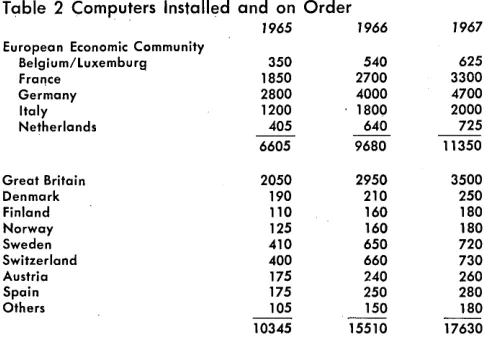
RECENT DEVELOPMENTS IN tHE EUROPEAN MARKET, by
W.
K. de Bruijn.
An account of the continuing development of the computer industry abroad as it becomes less scattered and more chauvinistic.27
EUROPEAN SOFTWARE MARKET, by
Edward K. Yasaki.
A lookat the larger software houses, the markets they serve, and the one that's still untouched: for proprietary packages.
30 SOFTWARE IN
FRANC~,by
Serge Seletsky.
A slowly developingbusiness, hindered by a general lack of knowledge and training, but aided by the government's interest.
32
PRODUCTION CONTROL IN THE U.K., by
Charles White.
As oneof the steps to help boost Britain's Gross National Product,'the Ministry of Tech-nology is analyzing present computer-aided production control systems to further
their application. .
35
AUSTRALIAN DP: THE '67 SCENE, by
Dan Kelly.
An abundance of users. .38
THE APTNESS OF APT, by H. B.
Sharman.
How suitable are the American numerical control techniques for Europe?39 THE BCl PROGRAMMING LANGUAGE,
by David HEmdry.
A description of the BCL general-purpose programming language, now in use·
for· the ICT Atlas computer at the London University Institute of Computer Sciences.
41
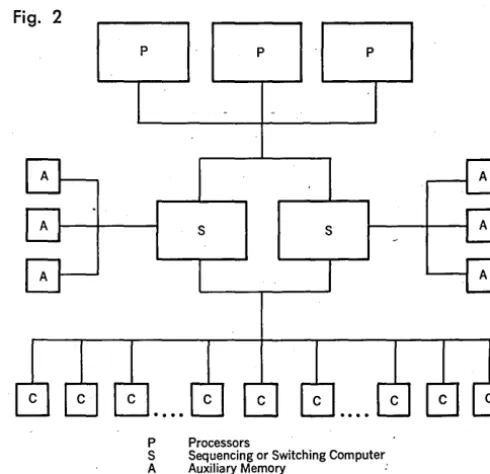
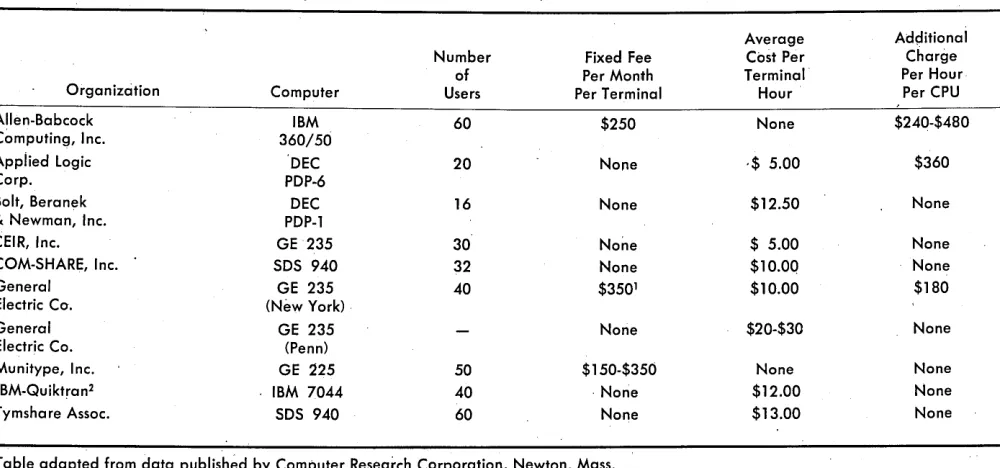
ECONOMICS OF TIME-SHARED COMPUTING SYSTEMS-PART
II, by
Walter F. Bauer and Richard
H.
Hill.
This second and concluding part discusses hardware and software costJactors of time-shared systems and considers the methods of pricing now offere by the commercial services.50 A CHRISTMAS FlOWCAROl,
by Brian Jarman.
54 CYBERNETICS CONFERENCE REPORT.
63
INTERNATIONAL MEETING ON STANDARDIZATION OF
PRO-GRAMMING lANGUAGES.
datamation departments
9
Calendar 101 New Products12
Letters to the Editor111
New Literature17
Look Ahead115
Books21
The Editor's Readout131
Datamart67
News Briefs133
People95
Washington Report137
Index to Advertisers97
World Report140
The Forumif you think the story is spectacular
wait till you see the picture
As the complexity of CRT displays increases, and as the need for user manipulation of the picture increases, it is more and more the case that the central computer cannot provide the required on-line processing - or that communication lines cannot handle the high throughput rates. The graphics I/O terminal itself must include the necessary display-processing capabilities. That's why every Adage Graphics Terminal has its ,own Ambilog 200 computer with
special arrays for high speep coordinate transformation.
Hybrid techniques exclusive with Adage provide extraordinary image-processing power and make possible dynamic 3-D displays which move with full six degrees of freedom. Objects containing over 5000 lines can be presented without flicker even with frame-to-frame dynamic changes. Ar:1d pictures are always brig,ht and clear, thanks to scope-driving circuitry that's way ahead of its time.
Starting with the AGT /10 at $60,000, standard models are available with either 2-D or 3-D capability, perspective generation, three-dimensional windowing, and intensity-modulated depth cueing. Options include dataphone interface; joystick control, analog tablet input,
hardware character generation, and photographic hard-copy output. Complete systems software is provided with every terminal for local image control, for console I/O, and for communicating with the central facility.
Now that you've read the story, don't miss the picture. A free 16mm demonstration film of the ' Adage Graphics Terminal in action is yours just by writing on your company letterhead to David Sudkin, Manager of Marketing Services, Adage, Inc., 1079 Commonwealth Avenue, Boston,
Mass. 02215
o
~
calendar
DATE Jan. 15-17 Jan. 22-26 Jan. 25-26Mar. 14-16
Mar. 18-29
Mar. 20-22
April 3-5
April 8-10
TITLE
Use of Dota Mechani-zation & Computers in Clinical Medicine
Course: Computer Oriented Circuit Design: Fee: $275
First Annual Sym-posium on Interface of Computer Science and Statistics
Sixth Annual Symposium on Biomathematics &
Computer Science
lOCATION
Waldorf Astoria New York, N.Y.
Univ. of Calif. los Angeles Miramar Hotel Santa Monica, Calif. Shamrock Hilton Houston, Texas
Course: Systematic Univ. of Calif. Methods for Computer los Angeles Aided Design of
Computers. Fee: $375
Symposium on Critical Factors in Data Mgt. Fee: $75 "
Numerical Control: Tomorrow's Tech. Today
Users'Meeting: Small IBM Computers
As Above
Philadelphia Pa.
PiCk Congress Chicago, III.
April 16-18" Second National Sym- liT Research Inst. posium on law En- Chicago, III. forcement Sci. & Tech.
April 23-25 Fourth Annual Conf. on Data Processing
April 30-May2 May 1-3 May 3-4 Spring Joint Conputer Conf. Annual Convention
Fifth Annual Nat'l. Colloquium on Info. Retrieval
December
19~7
S"heraton-Chicago Chicago, III.
Convention Ctr. Atlantic City
Ft. Worth, Tex.
Univ. of Pa. Philadelphia 19104"
SPONSOR/CONTACT
Dr. E. R. Gabrieli, Clinical Info. Ctr., SUNY at Buffalo, N.Y.
UCLA Ext.,
i0851 le Conte Ave., los Angeles 90024
los Angeles ACM, P.O. Box 90698, los Angeles 90009
Univ. of Texas, Div. of Cont. Educ., P.O. Box 20367, Houston 77025
Eng.lPhysical Sci. Ext., 6532 Boelter Hall, UCLA, los Angeles 90024
As Above
Numerical Control Society, 44 Nassau St., Princeton, N.J. 08540
COMMON/laura Austin, Admin. Div., General Motors Inst., Flint, Mich.
liT Research Inst., 10 W. 35 St., Chic"ago 60616
NRECA, 2000 Florida Ave., N.W., Wash-ington, D.C. 20009
AFIPS
Assn. for Educational Data Systems
Dr. David lefkowitz, Moore School 'Of Elec. Eng., Univ. of Pa., Philadelphia
The C-Dek will eliminate this
and the typed copy
and the punched-card copy
of the typed copy
and the multitude of opportunities
for error along the way
With our Computer Data Entry Key~ board - or C-Dek~ you can acquire data directly from the source, in com-puter-usable form. And the source-the man on the floor-will probably enjoy using it (it has all those neat little lights, you see).
1. The C-Oek conforms to existing data acquisition systems. The exact number of key columns and the keyboard format are determined by the paper forms you are already using. Thus, your personnel can begin using the C-Dek immediately, with no prior training required. It is as easy as filling out the form-but much faster.
2. Error control features preclude mis-takes. Selected keys are illuminated, aiding visual verification. Corrections before recording can be made simply by pressing the right k"ey. Fixed data are entered automatically. The keyboard is electronically locked up if the entered information fails to satisfy predeter-mined block requirements. And a host of other features assure that accuracy will be better than is humanly possible. 3. Options enable you to meet anysys-tern requirements. Card and badge reader, mag or paper tape equipment, electronic typewriter actuator, multi-plexer, and many other options fulfill the needs for block information entry, hard copy, on-line operation, multiple stations, and anything else required by your particular situation.
4. Lower costs let you exte'nd source data acquisition throughout your opera-tion. No competing equipment is as economical to own and operate and at the same time so responsive to your needs.
For complete details, drop us a line.
lL..:... _ _ _ _ _ _ _ _ _ ---''--'' 3810
COLORADO INSTRUMENTS, INC.
One Park Street, Broomfield, Colo. 80020 CIRCLE 9 ON READER CARD
KEYED TO
MOVE DATA
FAST ... AND
AUTOMATICALLY
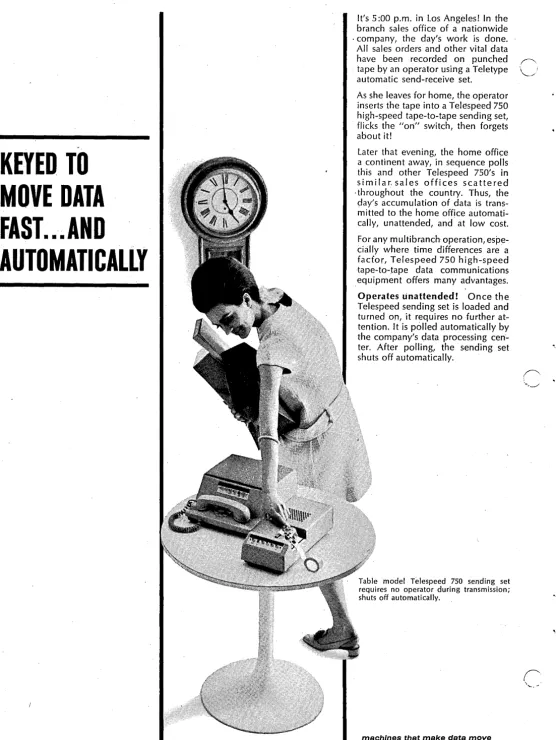
It's 5 :00 p.m. in Los Angeles! In the branch sales office of a nationwide . company, the day's work is done. All sales orders and other vital data have been recorded on punched tape by an operator using a Teletype automatic send-receive set.
As she leaves for home, the operator inserts the tape into a Telespeeq 750 high.,speed tape-to-tape sending set, flicks the "ori" switch, then forgets about it!
Later that evening, the home offi~e
a continent away, in sequence polls this and other Telespeed 750's in similar, sales offices scattered . throughout the country. Thus, the day's accumulation of data is trans-mitted to the home office automati-cally, unattended, and at low cost.
For any multibranch operation, espe-cially where time differences are a fador, Telespeed 750 high-speed
tape-to-~ape data communications equipment offers many advantages.
Operates unattended! Once the
Telespeed sending set is loaded and turned on, it requires no further at-tention. It is polled automatically by the company's data processing cen'-ter. After polling, the sending set shuts off automatically.
Table model Telespeed 750 sending set requires no operator during transmission; shuts off automatically.
[image:12.617.47.603.25.765.2]o
,.
o.
Reduces cost. By confining trans-mission to night hours, data can be sent when communication lines are less busy, more economical.
Even if transmission is done during the day, the speed and efficiency of Telespeed data communications equipment lets you take advantage of every minute of line time.
Because transmission is automatic, the operator can devote her entire working day to logging of data. Thus, she can process all orders and other data received at the branch for later transmission; no need to carryover to the next day, no delay in handling important information.
Teletype equipment is fast. The Telespeed 750 machines operate at 75 characters per second; 750 words per minute. The time required to transmit a full day's sales orders, or other data, can be reduced to a matter of minutes.
Increases accuracy; improves cus-tomer relations. A major accept-ance corporation, providing install-ment loan service for thousands of their retail outlets, uses Telespeed 750 equipment to good advantage.
Their many branch offices across the country average 300 transactions daily. Every afternoon, the process-ing center contacts the branches allowing each branch three minutes time, including the time required to make the connection. Thanks to the speed of Telespeed 750's, the trans-mission of the punched-tape data, almost 60 feet daily from each office, can be handled in 11/2 to 2 minutes.
The company's computer is. now able to update each account, de-termine collection action, and pre-pare notices daily.
Results: streamlined office proce-dures; increased accuracy in han-dling accounts; improved customer relations for the retailers! They no longer worry about payment re-minders being sent to customers who have already paid.
T E L E T Y P E
The Telespeed 750 receiving set collects all branch office data recorded on the punched tape; all automatically, all unat-tended.
CIRCLE 10 ON READER CARD
Gives you· the jump on competition. With competition ever-increasing, the company that "services" best is the one that gets the most business. Telespeed 750's, working with data processing equipment in auditing, production, inventory control, and
shipping, give any company a ~om
petitive edge.
High-speed tape-to-tape transmis-sion is but one example of the many capabilities of Teletype data com-munications equipment. Discover why Teletype equipment's versatility is the low-cost answer to your data communications needs. Read our new brochure, "H-OW TELETYPE EQUIP· MENT MOVES DATA FOR YOUR BUSINESS OR INDUSTRY." Foryourcopy contact:
Teletype Corporation, Dept. 81 M.
~
letters
a critical appraisal
Sir:
Since reading the May issue I have scanned your pages in vain for an admission that Robert V. Head's arti-cle, "Management Information Sys-tems: A Critical Appraisal" was really a parody. In an age when a million technical articles are published every year, we are all too often presented with banal "appraisals" of generalized concepts like MIS ("artificial intelli-gence" and "management science" are other favorites). Mr. Head's article reads like a brilliant parody of the worst of these, and prompts me to make a critical appraisal of my own.
It begins, as such articles invari-ably do, with the statement: "The subject of . . . has been much dis-cussed, and much maligned, by both systems professionals and manage-ment people over the past few years." I have omitted the term "MIS" to illustrate that virtually any other such abstraction may be substituted here without loss-the sentence remains equally inaccurate and tedious. Mr. Head then devotes six long pages to an unbelievably boring and thorough enunciation of the obvious, backing it up with illustrative pictures of shaded triangles ("a conceptual framework") in case we don't get it. The use of pompous phrases ("contemporary da-ta base concepts, which facilida-tate the retrieval of data elements in response to unstructured and non-predeter-mined management requests . . .") and dynamic-sounding words ("chal-lenge", "drastic", "powerful") masks the fact that nothing is actually being said. A spurious reasonableness is achieved by the liberal application of qualifiers like "possibly", "perhaps", and "it would appear". Mr. Head, whose command of cliche is total, winds up with a masterfully trite summary ("much has been accom-plished . . . much remains to be done . . . challenges to be faced are many . . . ") which leaves the reader almost ready to commit murder out of bore-dom and irritation.
This turgid article is a masterpiece of its kind, but Mr. Head really should acknowledge his satiric intent. The subject of parody has been much discussed, and much maligned, over
12
the past few years, and although much has been accomplished within this volatile field, it would appear that much remains to be done within the unstructured framework of con-temporary concepts.
DAVID M. JONES
Chelmsford, Massachusetts
sixes and sevens
Sir:
The item headed "Australia Estimates Computer Population" (Sept., p. 83) is more than a little curious. The item refers to an "IBM survey" and later to a "CDC estimate". The CDC estimate of 357 installations was hardly an
estimate. My mazazine, Data Trend,
published a list of all computer in-stallations in Australia at the end of 1965 and gave the installed figure as 357. CDC gave this figure and cited the source in evidence given before a parliamentary enquiry in April 1966. The figure of 460 orders and instal-lations quoted as coming from an
IBM survey is actually the figure for installations only given in IBM's evi-dence before the same parliamentary committee. IBM, however, stated cat-egorically that the figure was taken from federal government departIll:ents independent survey. The Federal De-partment, the Department of Labour
and Industry included Burroughs
E2000 machines as computers. Further on, the. item states that the Australian Federal government had changed from a policy of purchasing small scientific. computers to
large-scale systems. This is particularly in-teresting because the first computer purchased by the Federal government was an IBM 7090 which is hardly a small scientific computer. This pur-chase was followed by orders for CDC 3600 and 3200s and Honeywell 800 and 1800 systems. The first small scientific computer purchased by the Federal government was an IBM 1800 in late 1965.
The next comment I have to make is that the "large systems, all owned by the commonwealth government, reportedly have been successful and productive installations" appears to have been badly misreported to your correspondent. He may have missed, for example the widespread daily paper publicity given to the chaos at Dept. of Defence: one task having
taken 5~~ years from commencement
until now and still uncompleted. This task is for the control of the Air Force's spare parts. With only some 200 aircraft to look after, with the greatest charity one could hardly de-scribe this installation as successful. This installation is also the largest computer complex in the country with systems installed for Navy, Army and Air Force in close proximity. Again your correspondent apparently doesn't co'nsider a CDC 6400 (Adel-aide Univ.), IBM 360/50 (Univ. of NSW, Australian National Univer-sity) large-scale computers.
In the interests of accuracy may I now tell you that as at 10/23/1967 there are 582 digital computers in-stalled in Australia and 149 undeliv-ered orders.
F. X. LINTON-SIMPKINS
Editor
Data Trend Magazine
Sydney, Australia
dp and the government
Sir:
The thoughtful, affirmative expres-sions (Oct., p. 21) concerning my efforts in the field of government management of data processing are very deeply appreciated. Perhaps the most gratifying aspect of our recent hearing was that we now have
o
-0
o
How to improve your
memory: Part
II
December 1967
BUFFER·
,
3D core; 1.6 fLsec. access; 1 K x 8 bits to 4K x 24 bits;
10¢ to 50¢ per bit
Brand X
Mixed
Ie
and discrete logicand sensing
Over 6,000 solder joints per stack
Parallel data liD
Random or sequential access (excl usively)
All integrated circuit logic and sensing
Continuously strung stack with less than
500 solder joints
Parallel or serial data liD
Randoml sequential access
Available from others
Available
r-only from
' - - - ~
CIRCLE lION READER CARD
...
·
For complete details on • MISER return this coupon to : Fairchild Memory Products2525 Charleston Road •
Mountain View, Calif. 94040 :
Name Title
·
Company
•
Address
•
_ _ _ _ _ _ Zip _ _ :
...
e
IT'S TAKEN
150YEARS
But Now There's A New
Way To Convert Energy
PARAMETRIC
POWER
The New Discovery
byWANLASS
See What It Means!
Ferro-resonant Trans- Trans- Para-former former former™ Electrical
Isolation excellent excellent excellent Voltage
Transformation excellent excellent excellent Voltage
Regulation none good excellent Noise
Rejection none poor excellent Bilateral
Operation yes no yes
For information: write, wire or call today.
WANLASS ELECTRIC CO.
A subsidiary of American Bosch Arma Corporation 2175 South Grand Avenue, Santa Ana, California
Phone: (714) 546·8990
CIRCLE 12 ON READER CARD 14
letters
petent data processing management officials in the Executive Branch to whom we can address "solid, tough questions."
But effective management of data processing, as important as it may be, is not an end in itself. Our primary consideration is optimum usage of these fantastic techniques to improve the efficiency and the responsiveness of government generally.
JACK BROOKS
Chairman
Government Activities. Subcommittee of the
Committee on Government Opera-tions
Washington, D.C.
the myth separators
Sir:
The article, "Marketing the Com-'puter," by Lawrence Schwartz and
George Heilborn (Oct., p. 22) was a most informative explanation of the marketing aspects of the computer industry.
The authors have effectively sepa-rated the myths of the industry, as propagated by one manufacturer, from salient marketing consideration. T. G. TERZAKIS
Mountain View; California
os for olrt
Sir:
The article "Operating Systems for OLRT" by Leon Davidson (Oct., p. 27), comments on executives for computers such as 5/360. These executive programs are for "dedi-cated" on-line real-time communica-tions-oriented systems such as bank-ing, airline reservation systems, etc.
A computer with an operating sys-tem similar to what the author de-scribed is the Univac 418. In a sys-tem at the NASA Manned Space Craft Center, a 418 with a FASTRAND drum and 44K of core memory operates a remote terminal communications and an inventory control system in on-line real-time fashion.
The FASTRAND drum contains the inventory of a tape library with about 40K tapes, the computer executive, utility programs, and the communica-tions systems program.
. The 418 can also run assemblies
while the inventory system and com-munications programs are running. This can be done because the 418 has an executive priority routine. The ex-ecutive routine takes a relatively small portion of the 418 memory. Programs running in the 418 can also be rolled in and out of the computer onto the FASTRAND drum as needed. As a matter of interest, the tape library inventory operates through mod 35 ASR Teletypes remote to the 418.
The communications system oper-ates through Univac 1004's as the remote terminals, which submit jobs to two Univac 1108's connected to the 418. The tape library inventory system and the communications sys-tem were developed in-house at NASA-MSS to run in conjunction with the 418 real-time executive.
ROLFE POPE
San Diego, California
Mr. Davidson replies: The 418 is a good example of a computer designed specifically for on·line real.time use (communications switching and control). By providing separate hardware loca· tions to receive the interrupts from the various I/O devices and channels, and by other thought-ful provisions in hardware to minimize software needs, the designers of the 418 were able to use an Exec routine which occupies only a small portion of the memory (which is small enough to begin with, and only 18·bit words at that).
By contrast, when one tries to put the Option 4 version of 05/360 into a mod 50, for OlRT functions, there is precious little core space left over for the application programs in a 256K (byte) core. One must expand to 512K to get any work done. As I said in my article, 5/360 is recommended for OlRT projects which don't have to worry about size and costs. Admittedly, the 418 is a communications "front end" to the 1108's, in Mr. Pope's installation, and is not in the same size or cost range as a 360/50. How· , ever, the functional design of the 418 as a real· time computer is better than the catch·all design of 5/360, v.:hich simply was not designed to do
real-time well, and hence suffers from very in· efficient software in 05/360.
•
Datamation welcomes your correspondence concerning articles or items appearing in this magazine. letters should be double spaced . . . and, the briefer the better. We re-serve the right to edit letters submitted to us.
,0
o
SYSTEMS SOFTWARE
Let the facts speak for themselves. Within the last year, we've won 6 out of 10 competitive bids on total software architecture. Produced dozens of integrated program packages for manufacturers and users. Batch monitors, realtime operating systems with symbolic, on-line debugging, compilers, and meta-assemblers. All IDC software is modularly constructed, easy to use, readily adapted to changing needs. Designed to get more action in time sharing, batch, background-foreground realtime and third-generation environments. Ever wonder how IDC delivers so many performance-packed features, with complete doc-umentation, on time or ahead of schedule and priced so very low? You'll be pleasantly surprised when you find out. Just write or call IDC and we'll tell you our secret. IDC, 1621 East Seventh Street, Santa Ana, California. Phone: (714) 547-8861. Offices in Boston, San Francisco, London.
INFORMATION
DEVELOPMENT
COMPANY
SOFTWARE PERSPECTIVES
Please don't call EMR's 6130 Computer
16
If you think the ADVANCE 6130
computer from EMR is just another "little" computer, take a closer look. You could be fooledObyOthe price-low enough to compete with any small machine-or by the 16-bit word length, characteristic of small-scale systems. But that's where the comparison ends.
Analyze the 6130 and you'll realize it's the most productive system avail-able. The instruction repertoire and internal architecture put it in a class by itself.
SMALL SCALE
To the potential buyer of a small-scale computer, there are a number of capable machines which ar.e available to "do the job." However, aren't you looking for a system that can "do the job-plus"? The plus being able to expand to accommo-date your next requirement. Many of the small-scale computers (under $35,000) that are being sold cannot provide the user with any realistic approach to expansion.
The 6130 is in a different class, it is designed for expansion. With the 6130 you can add a second proces-sor easily, with no operational soft-ware problems. This additional pro-cessing power is relatively inex-pensive when compared to installing larger systems.
This built-in capability for growth insures that you won't be looking for another new system next year and have to. face the reO-programming problem.
HIGH PRODUCTIVITY
Next, how about the buyer who has a problem that actually requires a large-scale machine, but does not
have the funds? The 6130 has a capability that stretches into this high-productivity market.
Historically in the computer field, the user's main problem is to justify a large financial investment to his management. Once the computer is installed, and the user can demon-strate to management what can be accomplished, he can build a good argument for expansion. The expan-sion is normally in the way of adding more peripheral equipment and ad-ditional core memory. This is further indicative that, with the large-scale approach, the user has started out with more "computer-power" than needed-and is paying for features that he cannot use or can do with-out. As the load increases, a point is reached where he has all of the op-tions that use the software to the limit, but by that time, he runs out of "computer-power."
In the case of the ADVANCE 6130,
the high-productivity user may run out of computer-power sooner but would i:>e in a position to add an-other 6130 processor to immedi-ately increase his computer power at a small financial addition. One 6130 can handle background pro-cessing while the second handles preprocessing and input/output. If this would not be an acceptable approach, a more powerful proces-sor could be added and the 6130 retained as a satellite.
The 6130oalone can successfully offer this approach as competitive
small computers are just not power-ful enough to handle the general purpose requirements.
ADVANCE 6130 FEATURES
• 16-bit clata word with parity check and memory protect.
• 750 nanosecond memory cycle time as standard.
• Exceptionally large repertoire of more than 100 instructions. • Three hardware index registers
with indirect address.
• Relocation register with double indexing allowed is standard. • 128 interrupt priority levels. • Hardware mUltiply and divide a
standard feature.
• Up to 128 external interrupts. • Single instruction interrupt with
both individual and group enable/ disable allowed.
• FORTRAN, real time FORTRAN and macro assembler available. • Interlaced multiplexed I/O
chan-nel allows up to 16 devices to be connected to single channel. If your application fits in either cate-gory,we urge you to contact EM R Computer Division immediately. The address is: 8001 Bloomington Free-way, Minneapolis, Minnesota 55420. Or call our Manager of Marketing collect, 612-888-9581.
We want to tell you about our not-so-small 6130.
. A,11
COMPUTER DIVISION
e
mp
-
0
---
I
-
;
-
i
I
-
I
-
;
I
I
I
--~~~.!
lity the
1---.... ---,
I
J
'
J
m
a
6
a
R
CI)
E ~
z:
c. N
o
~oOk~ahead
-0
o
360 SOFTWARE
LEADS TO THREATS
IBM 360/67 users, after a brief experience with
release 1 of TSS, are happy they have it at last,
think it's a great improvement over early versions,
but don't feel that's saying much.
One problem area
is remote terminal support.
Right now a 5l2K system
handles 4-8 terminals efficiently, according to
reports. One user says it must handle 15-20 remotes
by June '68, or "we'll start looking elsewhere."
Another is sure that their aim of 30 units on-line to
a single-cpu 67 will require an additional 256K.
Other complaints are that Fortran and assembler under
TSS are not compatible with OS counterparts, and PL/I
and Cobol are not even offered.
Time before crash
for this release is said to be 1-5 hours, not great,
but a far cry from the 5 or 6 minutes between
failures of early test versions.
So far, TSS
happiness is the Fortran compiler.
A Share meeting in
Los Angeles this month should net more data on planned
improvements for releases 1 and 2, due out next June.
SOFTWARE HOUSES FORM
GROUP, ELECT OFFICERs
Provisional by-laws and an organization have been
established for a new association of software firms,
the result of a meeting in Los Angeles Nov. 14.
Bill Wolf, president of Wolf Research, was named
president, and Walt Bauer of Informatics first (and
western) vp. Easternvp is Charlie Adams,
w~believe.
There will be two classes of membership: companies
with over $10 million annual gross will pay $3000
per year and get two votes;
co~panieswith less than
that will pay $1500 and get one' vote.
THE GROWTH PATTERN
AT COMPUTER SCIENCES
The growth of 8-year-old Computer Sciences Corp.,
expecting a $50-million gross this
year~has Wall
Streeters scrambling to get in.
CSC executives are
moving too, but in the opposite direction: out.
The
pressure to retain or accelerate this growth rate has
caused the departure, while they still have their
sanity, of such brass as Jack Strong, Bob Dee, and
Bob Head.
Now Wes Niemond and Chris Chrysler have
left to' form a software firm under Marshall
Industries called Marshall Information Sciences.
And ex-CSCer Joe Hootman is rumored to be starting
a new company.
One of the few on the input stream is Norm
Carter, who joins CSC as vp-general manager of a new
division focussing on the educational market.
They'll develop educational systems, hold seminars
and courses, and get into research with sponsoring
companies.
'
A slackening of the once-prevalent pressure, we
hear, is being felt by the group developing the
Computicket system.
Instead of rushing to get an
operating system on the air, this group reportedly
Data Careers in the
'~CTION
ATNIOSPHERE
99of McDonnell DATADROMES
TMComputer technology is being applied to diverse
business, government and industrial problems, on
an around-the-clock basis, in the Datadromes of the
McDonnell Automation Company. Here, in the
"Action Atmosphere" of our data service
organiza-tion, new applications, new techniques and new
services develop daily.
On a combination of cross-discipline data service,
advanced computer application development, and
nationwide facility expansion, the McDonnell
Automation Company has grown to a leading position
in our industry.
Our specially prepared data facilities, which we
call Datadromes, have served more than 800 clients
throughout the nation and overseas. Datadromes
are currently operating in St. Louis, Houston,
Denver, Falls Church, Va., and East Orange, N.J.
And new ones are planned.
Opportunities for creative people are growing at
a leadership pace. If you are a creative,
degree-holding data specialist, come and grow with us. Send
your resume to P. L. Papin, Professional Employment,
McDonnell Automation Company, Box 516,
St. Louis, Missouri 63166.
Consulting • Systems Design • Programming • Data Processing and Computing
c
MCDONNEL.L. AUTOMATION COMPANY
A DIVISION OF ItIfCDONNEL.L. DOUGL.AS
An Equal Opportunity Employer in a Young Expanding Industry
18 CIRCLE 332 ON READER CARD DATAMATION
We know you want. Datamation to follow you. If you're changing your business address, please fill out the card at the right and mail it to us now. Besides your new address, we need your old address, just as it's printed on the mailing label. (Be sure to paste the whole label on the card to facilitate handling.)
r
1 1
1 Name_ 1
1 Title _ _
I
Compan)1
Address-City _ _
NEW AI
Name_ Title _ _
~m~anl
I
Address_1
City _ _I
What is I1 Your Sig
,
,---DATAMA
INFORMAT]
Whatever your work in
inform~ADP Glossary.
Itgives you con
daily EDP use.
Itcovers the ha:
tronics, communications, syster
This glossary has provided va
students as a reference to sup
familiarity with the specialized
venience for customer, prospec
preparing or evaluating proposa
P
lease use the attached coupon
,,-~----. 62,,-~----.pages ·,,-~----.cross-referenced
$l°~ac~
J
DJ
':1
1 35 Mas
1
1 Please ~ 1
1 Name_
75c
in lOts
ofl
o
to
49 copies
1:1
Address'I I
City_:1
I
,50c
in
l()ttio/50ormorecopies
C)
o
look ahead
BANKS MOVE TOWARD
~KSOX-NETWORKGE SHIFTS MEDINET PLAN
zSTARTS BIG
REORGANIZAT'f5N
December 1967
---~---has been sidetracked onto a related, ancillary
project.
"Just spinning wheels," one member
describes it. This has caused speculation that the
system is up for sale, maybe explaining Computicket
Corp.'s move to New York City from Los Angeles.
But
a spokesman explains it as an attempt to counter the
marketing of competitive ticket reservation systems.
Computicket, he says, will be on the air next June.
Meanwhile, CSC pushes lawsuits against recently
acquired Politz Research and alumnus Dave Ferguson.
For years business firms have been getting their
accounts receivable payments from regional banks,
using them as collection points--the lockbox idea. But
companies are in a hurry to know which bills are paid
so that credit can be extended, shipments released.
To cater to this market is a pilot program sponsored
by Manufacturers National
Ba~,Detroit, the start of
a national network of bank data gatherers.
The bank has been joined by banks in 15 cities
nationwide in getting compatible communications
devices:
stand-alone tape systems (Mohawk 1103 or
NCR 735, made by Mohawk) and Dataphone 202C.
Direct
dial-up will provide fast tape-to-tape access to data
for business customers.
The idea, says MNB, is not to carve out any
marketing advantage, but to set the course for all
interested banks in data transmission, standardizing
on such things as message format and account number.
Banks in the initial 16 cities will have their
own gear installed by the end of January.
They can
then offer a compatible, off-line mag tape network to
any company.
The subscriber need only lease the same
gear (tape system is $225/month, Dataphone about $45/
month depending on the state) to enable it to get
daily reporting over direct dial long-distance phone
lines.
The network is designed so that no switching
centers or control factors are involved.
GE says the reorganization at Medinet does not mean
abandonment of plans for an on-line time-sharing
service network for hospitals.
The dozen hospitals
participating as experimental users have been assured
that conversational services will come, but about a
year late since the economics required a shift from
the 485 t-s system being developed for the last 20
months to a
non~product-linet-s system in the 600
series, to be announced as available to other GE
service bureaus 1st quarter 1968.
It means that
Medinet programming effort can be applied to the
firm's lucrative t-s services.
Jordan Baruch, director of Medinet, has gone
back to BB&N, though he'll remain as a Medinet
consultant, and a successor has not been named at
writing.
And some t-s programmers are leaving the
fold.
For the immediate future GE has shifted
Medinet emphasis to applications programming and
batch and remote batch processing--services mQre
readily lucrative and easier to program.
Observers
guess that some products developed by the. Baruch
group will be converted to 600 series use, such as
a high-level interpretive language and a typewriter
terminal that interfaces with a carousel-type
projector and a large-core-stores CRT such as
Tektronix.recentlyannounced.
GE says the 485
won't be abandoned.
(Continued on page 119)
Does thIS
gra
C)
·0
o
editor's
read'~/
ut
+FOR TALLY CIRCLE 29 ON READER CARD
December 1967
ARE WE FOR REAL?
During one of those rare quiet moments at the most recent computer conference, we got talking to a friend about conference sites. He hadn't been to Atlantic City, which seemed to us to offer an old-fashioned, otherworld movie-set atmosphere . . . an unlikely backdrop for the gathering of forward-thinking technologists. It had seemed to us unreal, and our friend had commented that it was for that same reason that he preferred Las Vegas as a convention setting. The complete artificiality of that desert gambler's mecca seemed to him particularly appropriate as a setting for the discussion of computers.
Anaheim is something else.
From our hotel, we could look out on a miniature Matterhorn topped by a huge, revolving Christmas star. The symbolism escapes us. The rest of the view was equally inspiring: the fake elegance of the Disneyland Hotel, the tremendously confusing pastiche of restaurants and motels and their' garish signs, the constant haze and/or smog, and . . . crowded off in one corner, what was left of an orange grove, hard by the screaming roar of the freeway.
In the hotel room, preparing to leave for the opening day's activities, we heard the TV tell about the return of three prisoners freed by North Viet Nam, listened to the statements of four deserters proclaiming disagreement with this country's action in Viet Nam. We wondered if Shirley Temple Black would be allowed to reJoin her old movie buddy, George Murphy, in Washington, D.C. On the way out of the parking lot, we were nearly rammed by a car coming out of a blind alley alongside the hotel.
We had spotted the huge clam-like structure of the Anaheim Convention Center from our hotel and headed for it, only to discover that a few thousand cars had beat us to it. Parking a half-mile away, we trudged toward the exhibit hall across a huge lot devoid of markers. Inside long lines of people waited to register. The exhibits were handsome, the aisles wide. The industry's marketeers (exhibitionists?) had put their best foot forward, and if there was little new in
the way of equipment, it was presented with style. .
. The sessions offered the usual range of good, bad, technical, general, meaningful and meaningless. The conference luncheon represented an unusual double bill: the "micro-keynote speech" of Sam Alexander, industry pioneer and recipient of this year's Harry Goode Award . . . and outsider Ray Bradbury, science-fiction author, playwright and poet. Alexander told us we "ain't seen nothing yet," and Bradbury told us we are esthetically bankrupt.
Meanwhile, the exhibits and the sessions droned on.
We wondered if there were not something especially significant about the setting of this latest gathering of the technological clan.
Inside the convention hall, men of above-average intelligence discussed, watched and touched the machine. Outside was a wondrous accumulation of evidence that man is careless, greedy and stupid. Given the marvelous benefits of the machine, what will he do with it?
COMPUTERS
IN JAPAN
by G. B. LEVINE
D
In 1961 I first visited Japan to discusssemi-conductor licenses; at that time the total num-ber of computers operating in Japan was less than 100. Today there are more than 3,000 computers installed there, slightly fewer than in Germany, but more than any other country except the U.S.
the market
In the twelve months prior to April 1, 1967, a total of 845 digital computers were installed in Japan. Their value was $186 million.
The Japanese break computer systems into four size cate-gories-according to the actual price of the specific installa-tion. Thus, an IBM 1401 system may be classified as large, medium or small.
Category large medium small super-small
A verage System Price over $700,000 $110,000-$700,000 $28,000-$110,000. under $28,000
Monthly Rental
($17,500/mo.) . ($2,750-17,500/mo.) ($700-2,750/mo.) (under $700/mo.)
Large Size. Last year, the category of large computer
systems was second in installed value. New installations ac-countd for $55 million, or 29.6% of the total. The 53 systems installed were almost double the year-earlier figure, while value was up 64%.
Large systems usually include:
IBM: 360-40, 360-50, 1440
Nippon Electric Co. (NEC): NEAC 2200-500·
Hitachi: HITAC 4010,5020, 8400, 8500
Fujitsu: FACOM 230-50
Medium Size. For a number of years there have been
more medium-size systems sold than any other category. Medium computers accounted for 37.5% of the units, and 52.5% of the value of all installations in Japan's fiscal 1966. (Year ending March 31, 1967)
By the Japanese definition, medium computers include:
IBM: 360-30
IBM: 360-20
NEC: NEAC 2200-200, 300, 400
HitachI: HITAC 3010, 8200, 8210, 8300
Fujitsu: F ACOM 230-20, 230-30
Small Size. The small computers installed last year were
approximately equal in quantity to the medium-size sys-tems, but naturally were valued at a much lower amount-$21 million or 11% of the total.
These systems include:
NEC: NEAC 2200-100
Hitachi: . HITAC 201, 8100
Fujitsu: FA COM 230-10
Super-Small Size. Computers called super~small were first reported on for the year ending March, 1962. Last
22
coming along
year, sales totalled 167 systems, valued at $3.2 million, or 17% of total value.
These include: NEC-1200 series
In each of the last five years, the number of new computer installations has increased substantially over the preceding year (Table 1). These increases have ranged from a 113% jump'in 1964 to 13% in 1966. The fiscal year ending March 30; 1967, showed installations up 33% from .1966, and predictions are for ininimum annual increases of
20% in the next several years.
computer usage
Rental and Purchase. Approximately 80% of
Japanese-made computers are now acquired on rental. This per-centage has been increasing steadily since 1960, when rental arrangements were first made available, and were utilized for 5% of that year's installation value. Cumula-tively, 67.8% of the value of Japanese-made computers, through March 1967, have been rented.
"Foreign" computers (Table 2) meaning mainly IBM units assembled in Japan, have been heavily on a rental basis since the first installations in 1958. The rental ratio has fluctuated from year to year, between 60% and '90%, with the cumulative total at 71.5%.
Most non-IBM equipment imported into Japan has been for direct sale rather than rental. ,
Last year the problem of "returns" of obsolescent computers became significant in Japan. One maker is estimated to have accepted returns equal to 7% of sales.
User Industries. Computer usage is widespread in
Japan, with retail and distributive organizations leading with 301 installations.
Electrical and electronic equipment manufacturers have
Mr. Levine is president of Men-tor International and has had
over 15 years' experience in marketing and other aspects
of international electronics:
Be-fore founding Mentor he was director of international oper-ations at Fairchild Semicon-ductor and previously
electron-ics program manager, long
range planning, for Stanford Research Institute. He is a grad-uate of MIT.
DRTRMRTION