Procedia Computer Science 78 ( 2016 ) 132 – 138
1877-0509 © 2016 The Authors. Published by Elsevier B.V. This is an open access article under the CC BY-NC-ND license (http://creativecommons.org/licenses/by-nc-nd/4.0/).
Peer-review under responsibility of organizing committee of the ICISP2015 doi: 10.1016/j.procs.2016.02.022
ScienceDirect
International Conference on Information Security & Privacy (ICISP2015), 11-12 December 2015,
Nagpur, INDIA
A Critical Analysis of Energy Efficient Virtual Machine Placement
Techniques and its Optimization in a Cloud Computing
Environment
Ankita Choudhary
a,Shilpa Rana
b, K.J. Matahai
c,a*
a,bPG Scholar,Departmnet of CEA, NITTTR, Bhopal 462002, India
c
Associate Professor, Department of CEA, NITTTR, Bhopal 462002,India
Abstract
Infrastructure-as-a-service cloud computing providers with on-demand infrastructures have become a promising alternative to the rising cost of ownership for computing infrastructures in many enterprises. Many of the touted gains in the cloud model come from resource multiplexing through virtualization technology that allows cloud-scale datacenters to improve resource utilization and energy efficiency. This paper provides a critical analysis on the basis of literature review of the state-of-the-art research on energy efficient dynamic allocation of virtual machines to hosts in a datacenter as per variable workload demands of different application running on the virtual machines and literature review suggests that further optimization of the virtual machine placement can be done using live migration. So, this paper proposes a technique for optimizing virtual machine placement by live migration using dynamic threshold values ensuring a deadlock free resource allocation focusing on multidimensional resources. The goal is to improve the overall utilization of computing resources thus reducing the energy consumption of datacenter. © 2016 The Authors. Published by Elsevier B.V.
Peer-review under responsibility of organizing committee of the ICISP2015.
Keywords: Energy efficiency, Virtualization, Dynamic consolidation, Virtual Machine Placement, Live Migration
1. Introduction
Cloud computing is a distributed computing paradigm in which a pool of computing resources such as virtualized physical machines which host applications, shared storage devices like NFS (Network File Storage), backup servers
* Corresponding author. E-mail address: [email protected]
© 2016 The Authors. Published by Elsevier B.V. This is an open access article under the CC BY-NC-ND license (http://creativecommons.org/licenses/by-nc-nd/4.0/).
etc. are available to users via Internet. Prevalent use of cloud computing has resulted advancement in the number of hosting datacenters which have brought forth many concerns, including the cost of electrical energy, cooling, peak power dissipation and carbon emission. As the workload on the applications differs from time to time, it results in different resource requirements and hence dynamic efficient use of these shared resources is one of the crucial technical problems. The issue of tackling high energy use can be addressed by removing improficiencies and waste which occurs in the way computing resources get involved to serve application workloads and also how the electricity is carried to computing resources,. This can be done by improving both the physical infrastructure of data centers, and the resource allocation and management algorithms.
Researchers have shown many of the touted gains in the cloud model come from resource multiplexing through virtualization technology which offers a means to decouple the application activities from the physical resources required. Such decoupling of resources is facilitated by the concept of a ‘virtual machine’ which encapsulates an application with a speci¿c set of functionalities. Virtual Machine associated features such as adaptable resource provisioning and migration have increased efficiency of resource usage and dynamic resource provisioning capabilities.
In a virtualized environment, Server Consolidation and Load balancing are some of those techniques which have gained premier importance for on-the-Ày resource management. In a virtualized environment, many applications run on a virtual machine (VM) and one or more VMs are mapped onto each physical machine (PM) of the datacenter. Due to the capacity to host various applications onto same PM while also being able to migrate them seamlessly across different PMs, various challenges cropped up. The challenges involve balancing load amongst all PMs, determining which VMs to place on which PMs and managing unexpected escalation in resource demands and so the focus is on the problem of energy- efficient VM placement and resource management in Cloud datacenter, by ensuring that computing resources are efficiently utilized to serve application workloads to minimize energy consumption.
2. Background
Energy efficient utilization of data center resources can be carried out in two steps. The first step is efficient placement of VMs and second is the optimization of the resources allocated in first step using live migration as the resource demand changes.
2.1. Virtual Machine Placement
Placement goal can be maximizing the usage of available resources or it can be saving of power. Based on placement goal, Anjana Shankar [23] in her research broadly classified VM Placement algorithms as follows:
Virtual Machine Placement
Power Based Application QoS Based
Migration involved No Migration Migration involved No Migration (dynamic) (static) (dynamic) (static)
Constraint Programming Constraint Programming Constraint Programming Bin Packing Bin Packing Bin Packing
Stochastic Integer Stochastic Integer Stochastic Integer Programming Programming Programming
Genetic Algorithm Simulated Annealing Others Power Expand Algorithm MinMax Algorithm
2.2 Live Virtual Machine Migration for VM Placement Optimization
Live VM migration transfers the memory state of a VM from one PM to other facilitating uninterrupted services to the running applications. Any live VM migration incurs migration downtime during which the services running on that VM gets affected, hence the lower the better.
Anwesha Das[24] in her research describes that all the algorithms which try to effciently allocate resources on-demand through live migration answers four questions - (1) determining when a host is considered as overloaded; (2) determining when a host is considered as under-loaded;(3) selection of VMs that should be migrated from an overloaded host; and (4) ¿nding a new placement of the VMs selected for migration from the overloaded and underloaded hosts. Following table describes them succinctly and summarizes the high-level goals while answering these questions for each of the desired goals:
Table 1.Heuristics for Resource Management using Migration.
Goals Server Consolidation Load Balancing Hotspot Mitigation When to Migrate? Cold spots on PMs Load Imbalance on PMs Hotspots on PMs Which VM to
Migrate?
VMs from Lightly Loaded PMs
VMs from overloaded PMs Bunch of VMs from hotspot-PM Where to
Migrate?
Higher loaded PMs Lightly loaded PMs PM which has enough resources to house
3. Related Work
3.1 Need for Energy Efficiency in Cloud Data Centers
Massoud Pedram [1] in the year 2012 identifies sources of energy inefficiencies in datacenters and provides a review in perspective of important issues related to the design and management of energy efficient datacenters and introduces a general framework for resource management problem formulations, accounting for power dissipation and thermal issues as well as performance constraints. A sample of some important approaches for addressing the aforesaid problems is summarized with the aim to present the key problems along with some representative approaches.
Rajkumar Buyya et al. in the year 2010 work to increase data centers energy efficiency and performance and aims for the development of dynamic resource allocation algorithms that accounts the alliance between infrastructures of multiple data center and homogeneously work to boost data center performance and energy efficiency [2]. Whereas Anton Beloglazov et al. in the year 2011 integrate and categorize the research on power and energy-efficient design and analyze sources and problems of high power/energy consumption and then presents taxonomy of energy efficient design of computing systems including the hardware, operating system, virtualization at data center levels [3].
In the year 2015, Mehiar Dabbagh et al. highlights key resource allocation problems, and presents some possible solutions to minimize cloud data center energy consumption. To save energy remarkable focus is provided to power management techniques that utilize the virtualization technology and it is summarized that great energy savings can be achieved by turning more servers into lower power states and by increasing the utilization of the already active ones. Three different, but complementary approaches to achieve the energy savings are discussed in the article: workload prediction, VM placement, workload consolidation, and resource over commitment. The key challenges faced by the techniques are highlighted, and some potential solutions that address these challenges by exploiting virtualization are also described with an ultimate aim of making cloud data centers more energy efficient [4].
3.2 Energy Efficient VM Placement Techniques
Following power based algorithms have been used in the literature to solve the VM placement problem as our goal is energy efficiency:
3.2.1 VM Placement using Stochastic Integer Programming
Mohammad Fozul Haque Bhuiyan et al. in the year 2014 [5] proposed an integer programming formulation of VM scheduling model that considers capability-level heterogeneities and to reduce the computational complexity, a meta heuristic algorithm that provides a fast near-optimal solution is proposed. The idea is to assign a VM to the most efficient PM that satisfy the capacity and capability requirements and minimize the energy consumption while maximizing the resource utilization. The proposed mechanism improves datacenter’s energy-efficiency while satisfying VMs timing and performance requirement.
Sivadon Chaisiri et al. in the year 2009[6] introduce an optimal VM placement algorithm which plan for hosting VM based on future demands and price uncertainty with the aim to minimize the cost spending in each plan. OVMP algorithm is used which makes a decision based on the optimal solution of SIP to rent resources from cloud providers. The performance of OVMP algorithm is evaluated using numerical analysis and also by simulation which shows that the proposed algorithm can be applied for resource provisioning in cloud computing environments and minimize users budget.
3.2.2 VM Placement using Genetic Algorithm
In 2013 Ajith Singh. N et al. examined VM placement problem focusing on maximizing utilization of the multidimensional resources and energy reduction. VM placement problem is solved using the Honey Bee algorithm with hierarchical clustering to reduce energy consumption in servers. The use of clustering technique in VM placement makes it easy to search for available resource and helps in reducing migration response time which is performed on detecting overload on a host to mitigate hotspot [7].
N. Janani et al. in the year 2014 presented an idea which treats the available pool of physical resources as each knapsack, which are solved using genetic algorithm, to get an optimal placement. Starting with this aspect, solution is enhanced by considering multiple and multidimensional parameters in the VM request, so that the migration of the VM will be reduced and hence power-saving [8].
3.2.3 VM Placement using Bin Packing
Ching-Chi Lin et al. in the year 2011 proposed two new algorithms named Dynamic Round-Robin (DRR) and Hybrid, for energy aware VM scheduling and consolidation. Hybrid combines First-Fit and DRR and an accurate power model to estimate the power consumption resulted from each algorithm is proposed [9].
Weijia Song et al. in year 2014 present an approach for dynamic allocation of data center resources based on application demands and optimize the number of active servers and thus support green computing. Placement is performed as a variant of relaxed on-line bin packing algorithm and an ef¿cient algorithm termed as VISVP is evolved that works well in a real environment by adjusting the resources available to each VM within physical servers [10].
3.2.4 VM Placement using Constraint Programming
Li Xu et al. in the year 2012 studies the issue of operating data center in an energy efficient way while guaranteeing specified performance and formulate the problem as a multi-constrained multi-objective optimization problem which is then solved by one of the most principal evolutionary multi-objective optimization algorithm NSGA-II [11].
Hadi Goudarzi et al. in the year 2012 consider VM placement problem to minimize the total energy consumption in a decision epoch while servicing all VMs in cloud computing system. Multiple copies of VMs are generated by
the approach without sacrificing the QoS. The algorithm is designed using dynamic programming and local search to evaluate the number of copies of VM, and then place these copies on the servers with the aim of minimizing the total energy cost in the cloud computing system [12].
3.1. Live VM Migration for VM Placement Optimization
Anton Beloglazov and Rajkumar Buyya[13] in the year 2011 propose novel adaptive heuristics for dynamic consolidation of VMs based on an analysis of historical data from the resource usage by VMs which are characterized by a single parameter, the CPU performance that can signi¿cantly reduce energy consumption. The VM placement is performed using power aware best fit decreasing algorithm. First, all the overloaded hosts are found using the selected overload detection algorithm, and the VMs selected for migration are allocated to the destination hosts. Then, the system ¿nds the minimum utilization host among all hosts, and then tries to place the VMs from this host to other hosts preventing them from overload. If all the VMs from the source host cannot be placed on other hosts, the host is kept active otherwise the host is switched off to save energy.
Zhen Xiao et al. in the year 2013 introduces the concept of skewness to measure the unevenness in the multi-dimensional resource utilization of a server and by minimizing skewness, tries to combine different types of workloads and improve the overall utilization of server resources. The algorithm achieves both overload avoidance and green computing for systems with multi-resource constraints. Bin packing algorithm is used for VM placement[14].
In the year 2010 Anton Beloglazov et al. introduces a new technique which ensures a high level meeting of the Service Level Agreements (SLA) while the energy efficient dynamic consolidation of VMs based on adaptive utilization thresholds. MBFD algorithm is used for VM placement and flexible threshold values are used to determine host overload and underload based on CPU utilization and initiate migration of VMs and energy savings are achieved by consolidating servers[15] . Similarly in the year 2011 authors Richa Sinha et al.identified that most of the power is wasted because of underutilization and ideality of resources at data centers and so propose method which performs dynamic threshold-based consolidation of VMs with auto-adjustment of the threshold values The technique meets energy efficiency requirement ensuring quality of service to the user by minimizing the Service Level Agreement violation[16].
In 2013 Ajith Singh. N et al. focus on deadlock avoidance using banker algorithm by checking the system state to avoid high chances of deadlock while multidimensional resource allocation in combination with various overload detection and VM selection algorithms to optimize the VM placement and achieve energy efficiency dealing with by hotspot mitigation and load balancing. The technique used makes sure that the energy is minimized [17]. In the year 2014 authors used Stochastic Integer Programming with banker so that in future deadlock or resource shortage should not occur while considering the cost [18].
Damien Borgetto et al. in the year 2014 investigate the VM allocation and reallocation inside a cloud in order to save energy by switching off unused servers considering CPU as resource and suggests to potentially consolidate virtual machines with a perspective of handling the reallocation, migration and host management problems. Constraint based VM placement is used for allocation and reallocation of VMs [19].
LI Hongyou et al. in the year 2013 propose two algorithms for energy aware scheduling using constraint based approach and energy aware live migration to reduce energy consumption in cloud data centers by consolidating unused servers. Both algorithms investigate the problem of consolidating heterogeneous workloads considering multidimensional resources. The results demonstrate that both algorithms effectively utilize the resources providing a good balanced utilization of the multidimensional resources in cloud data centers [20].
Authors Supriya Kinger and Keffy Goyal[21] in 2013 propose an algorithm which is based on different stages virtual machine migration. Migration is done on the basis of %CPU utilization, power consumption and current working temperature of hosts and tries to conserve power in green computing by server consolidation and a constraint based approach for VM placement. The results obtained show that the technique of VM’s migration and switching off the idle host’s brings substantial energy saving and save system from failure which are near their critical temperature.
Zehra Bagheri and Kamran Zamanifar in the year 2014 propose a technique where VMs are distributed among the hosts under an energy-aware VM allocation policy which attempts to minimize the number of active hosts.
Using migration, the optimizer provides the required resource (CPU) to scale VMs up to a point where they meet their deadlines. The proposed algorithm significantly reduces energy consumption, and guarantees the timing constraints of tasks in an effective manner [22].
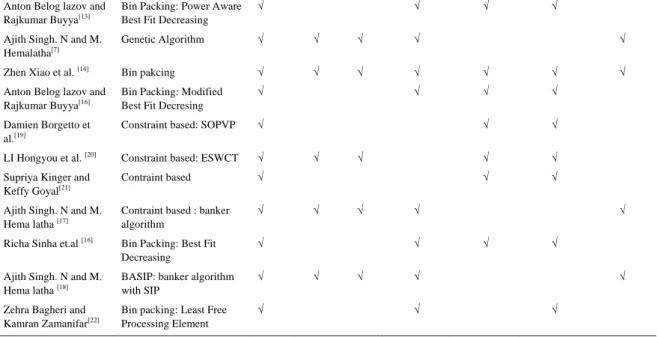
Table 2. Critical Analysis of Energy Efficient Virtual Machine Placement Optimization Techniques. Authors Heuristic for VM
Placement
Resourcces When to Migrate Goals of VM Migration CPU Memory Band
width Host Overload Host Underload Server consolidation Hotspot Mitigation Anton Belog lazov and
Rajkumar Buyya[13]
Bin Packing: Power Aware Best Fit Decreasing
¥ ¥ ¥ ¥
Ajith Singh. N and M. Hemalatha[7]
Genetic Algorithm ¥ ¥ ¥ ¥ ¥
Zhen Xiao et al. [14]
Bin pakcing ¥ ¥ ¥ ¥ ¥ ¥ ¥
Anton Belog lazov and Rajkumar Buyya[16]
Bin Packing: Modified Best Fit Decresing
¥ ¥ ¥ ¥
Damien Borgetto et al.[19]
Constraint based: SOPVP ¥ ¥ ¥
LI Hongyou et al. [20]
Constraint based: ESWCT ¥ ¥ ¥ ¥ ¥
Supriya Kinger and Keffy Goyal[21]
Contraint based ¥ ¥ ¥
Ajith Singh. N and M. Hema latha [17]
Contraint based : banker algorithm
¥ ¥ ¥ ¥ ¥
Richa Sinha et.al [16]
Bin Packing: Best Fit Decreasing
¥ ¥ ¥ ¥
Ajith Singh. N and M. Hema latha [18]
BASIP: banker algorithm with SIP
¥ ¥ ¥ ¥ ¥
Zehra Bagheri and Kamran Zamanifar[22]
Bin packing: Least Free Processing Element
¥ ¥ ¥
4. Scope for Improvement
The technical survey above presents a critical analysis of the state-of-the-art research adopted in literature to address the problem of VM placement and its optimization to achieve energy-efficiency at datacenter level. However the author feels that energy efficiency can be achieved by a VM placement plan that considers the availability of multidimensional resources while ensuring a deadlock free resource allocation and also by minimizing the number of VM migrations required for further optimization. Ajith Singh N. and M. Hemalatha [17] tried to do the same using banker algorithm for VM placement with various overload detection and VM selection algorithms in combinations with each other to determine when the migration is to be initiated and which machines to migrate. However, no technique is incorporated to detect system overload based on utilization thresholds values so that system can automatically adjust its behavior depending on the workload patterns exhibited by the applications.
So the author proposes use of dynamic utilization thresholds to detect the condition of overload of a system as it is expected to provide with better results. Also, it is difficult to decide which VM to migrate because if a large VM is selected, it will increase the total migration time and if smallest VM is selected then number of VMs will be migrated hence the author proposes a VM selection algorithm that provides a trade-off between the total migration time and number of migrations. Energy efficiency can be increased by minimizing the number of migrations required to balance the system.
4. Conclusion
This paper presents a survey of recent research on energy efficiency by VM placement and its optimization using Live VM Migration in Cloud data centers. Various papers have been reviewed with their policies to minimize energy consumption. The proposed approaches can be highly efficient in resource utilization of a datacenter, as it will incorporate availability of multidimensional resources and can bring substantial energy savings by minimization of number of migrations required.
References
1. Massoud Pedram. Energy-Ef¿cient Datacenters In: IEEE Transactions on Computer-Aided Design of Integrated Circuits and Systems;October 2012, vol. 31, No. 10.
2. Rajkumar Buyya, Anton Beloglazov, Jemal Abawajy. Energy-Efficient Management of Data Center Resources for Cloud Computing: A Vision, Architectural Elements, and Open Challenges;2010.
3. Anton Beloglazov, Rajkumar Buyya, Young Choon Lee, Albert Zomaya. A Taxonomy and Survey of Energy-Efficient Data Centers and Cloud Computing Systems In: Advances in Computers, Elsevier ;2011, vol. 82.
4. Mehiar Dabbagh, Bechir Hamdaoui, Mohsen Guizani, Ammar Rayes. Toward Energy-Efficient Cloud Computing: Prediction, Consolidation, and Overcommitment In: IEEE Network;March/April(2015).
5. Mohammad Fozul Haque Bhuiyan and Chun Wang. Capability-Aware Energy-Efficient Virtual Machine Scheduling in Heterogeneous Datacenters In: IEEE International Conference on Systems, Man and Cybernatics;October 2014.
6. Sivadon Chaisiri, Bu-Sung Lee, Dusit Niyato. Optimal virtual machine placement across multiple cloud providers In: Services Computing Conference, APSCC, IEEE;2009.
7. Ajith Singh. N and M. Hemalatha. Cluster based Bee Algorithm for virtual Machine Placement in Cloud Data Center In: Journal of Theoretical and Applied Information Technology, vol. 57, No.3;November 2013.
8. N. Janani, R.D. Shiva Jegan, P. Prakash. Optimization of Virtual Machine Placement in Cloud Environment Using Genetic Algorithm In: Research Journal of Applied Sciences, Engineering and Technology;May 2015.
9. Ching-Chi Lin, Pangfeng Liu, Jan-Jan Wu. Energy-ef¿cient Virtual Machine Provision Algorithms for Cloud Systems In: Fourth IEEE International Conference on Utility and Cloud Computing;2011.
10. Weijia Song, Zhen Xiao, Qi Chen, Haipeng Luo. Adaptive Resource Provisioning for the Cloud Using Online Bin Packing In: IEEE transactions on Computers, vol. 63, NO. 11,;November 2014.
11. Li Xu, Zhibin Zeng, Xiucai Ye. Multi-objective Optimization Based Virtual Resource Allocation Strategy for Cloud Computing In:
IEEE/ACIS 11th International Conference on Computer and Information Science;2012.
12. Hadi Goudarzi and Massoud Pedram . Energy-Efficient Virtual Machine Replication and Placement in a Cloud Computing System In: IEEE Fifth International Conference on Cloud Computing;2012.
13. Anton Beloglazov Rajkumar Buyya. Optimal Online Deterministic Algorithms and Adaptive Heuristics for Energy and Performance Efficient Dynamic Consolidation of Virtual Machines in Cloud Data Centers In: Wiley InterScience, September 2011.
14. Zhen Xiao, Weijia Song, Qi Chen. Dynamic Resource Allocation using Virtual Machines for Cloud Computing Environment In: IEEE Transaction on Parallel and Distributed Systems;2013 vol. 24 , No. 6.
15. Anton Beloglazov Rajkumar Buyya. Adaptive Threshold based Approach for Energy- Efficient Consolidation of Virtual Machines in Cloud Data Centers In: ACM ;December 2010. .
16. Richa Sinha, Nidhi Purohit, Hitesh Diwanji. Power Aware Live Migration for Data Centers in Cloud using Dynamic Threshold In: International Journal of Computer Technology and Applications;December 2011, vol.2.
17. Ajith Singh. N, M. Hemalatha. Energy Efficient Virtual Machine Placement Technique using Banker Algorithm in Cloud Data Centre In:
International Conference on Advanced Computing and Communication Systems;December 2013.
18. Ajith Singh. N, M. Hemalatha. BASIP A Virtual Machine Placement Technique to Reduce Energy Consumption in Cloud Data Centre In:
Journal of Theoretical and Applied Information Technology;January (2014), Vol. 59, No. 2.
19. Damien Borgetto, Patrica Stolf. An Energy Efficient Approach to Virtual Machines Management in Cloud Computing In: IEEE 3rd International Conference on Cloud Networking ;2014.
20. Li Hongyou, Wang Jiangyong, Peng Jian, Wang Junfeng, Liu Tang. Energy-Aware Scheduling Scheme Using Workload-Aware Consolidation Technique in Cloud Data Centers In: IEEE 2013.
21. Supriya Kinger, Keffy Goyal. Energy- Efficient CPU Utilization based Virtual Machine Scheduling in Green Clouds;2013.
22. Zehra Bagheri and Kamran Zamanifar. Enhancing Energy Efficiency in Resource Allocation for Real-Time Cloud Services In: IEEE ;2014. 23. Anjana Shankar dissertation on Virtual Machine Placement in Computing Clouds;2010.
24. Anwesha Das project dissertation on A Comparative Study of Server Consolidation Algorithms on a Software Framework in a Virtualized Environment;2012.