SimAlign: High Quality Word Alignments without Parallel Training Data
using Static and Contextualized Embeddings
Masoud Jalili Sabet∗, Philipp Dufter∗, Hinrich Sch ¨utze
Center for Information and Language Processing (CIS), LMU Munich, Germany
{masoud,philipp}@cis.lmu.de
Abstract
Word alignments are useful for tasks like sta-tistical and neural machine translation (NMT) and annotation projection. Statistical word aligners perform well, as do methods that ex-tract alignments jointly with translations in NMT. However, most approaches require par-allel training data and quality decreases as less training data is available. We propose word alignment methods that require no par-allel data.The key idea is to leverage multilin-gual word embeddings – both static and con-textualized – for word alignment. Our multi-lingual embeddings are created from monolin-gual data only without relying on any parallel data or dictionaries. We find that alignments created from embeddings are competitive and mostly superior to traditional statistical align-ers – even in scenarios with abundant parallel data. For example, for a set of 100k parallel sentences, contextualized embeddings achieve a word alignmentF1for English-German that is more than 5% higher (absolute) than eflo-mal, a high quality alignment model.
1 Introduction
Word alignments are essential for statistical ma-chine translation and useful in NMT, e.g., for im-posing priors on attention matrices (Liu et al.,2016;
Alkhouli and Ney, 2017; Alkhouli et al., 2018) or for decoding (Alkhouli et al.,2016;Press and Smith,2018). Further, word alignments have been successfully used in a range of tasks such as ty-pological analysis (Lewis and Xia,2008;Ostling¨ ,
2015b), annotation projection (Yarowsky et al.,
2001;Hwa et al.,2002;Pad´o and Lapata, 2009) and creating multilingual embeddings (Guo et al.,
2016;Ammar et al.,2016;Dufter et al.,2018). Statistical word aligners such as the IBM models (Brown et al.,1993) and their implementations fast-align (Dyer et al.,2013), GIZA++ (Och and Ney,
∗
Equal contribution - random order.
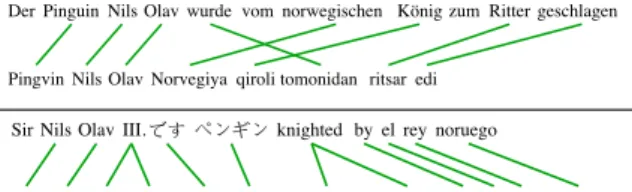
Figure 1: Algorithms that do not rely on parallel train-ing data can align distant language pairs (e.g., German-Uzbek in top) or even mixed sentences (bottom). Align-ments are created with our IterMax algorithm.
2003), as well as newer models such as eflomal (Ostling and Tiedemann¨ ,2016) are widely used for alignment. With the rise of NMT (Bahdanau et al.,
2014), attempts have been made to interpret atten-tion matrices as soft word alignments (Koehn and Knowles,2017;Ghader and Monz,2017). Several methods create alignments from attention matrices (Peter et al.,2017;Li et al., 2018; Zenkel et al.,
2019) or pursue a multitask approach for alignment and translation (Chen et al.,2016;Garg et al.,2019). However, most systems require parallel data (a suf-ficient amount to train high quality NMT systems) and their performance deteriorates when parallel text is scarce (Tables 1–2 in (Och and Ney,2003)).
Recent unsupervised multilingual embedding al-gorithms that use only non-parallel data provide high quality static (Artetxe et al.,2018a;Conneau et al.,2018) and contextualized embeddings ( De-vlin et al., 2019;Liu et al.,2019). Our key idea is to leverage these embeddings for word align-ments – without relying on parallel data. Requir-ing no or little parallel data is advantageous, e.g., in the low-resource case and in domain-specific settings without parallel data. A lack of parallel data cannot be easily remedied: mining parallel sentences is possible (Schwenk et al., 2019) but assumes that monolingual corpora contain paral-lel sentences. We extract word alignments from
similarity matrices induced from pretrained mul-tilingual word embeddings. Overall we find the quality of these alignments to be competitive with the state of the art.
Contributions: (1) We introduce three new alignment methods based on the matrix of em-bedding similarities. (2) We propose two post-processing algorithms that handle null words and integrate positional information. (3) We show that word alignments obtained from multilingual pretrained language models have comparable and mostly superior performance to strong statistical word aligners like eflomal. (4) We provide ev-idence that subword processing is beneficial for aligning rare words. We bundle the source code of our methods in a tool called SimAlign, which is available online.1An interactive online demo is available.2
2 Methods
2.1 Alignments from Similarity Matrices
We propose three methods to obtain alignments from similarity matrices. ArgMax is a simple base-line, IterMax a novel iterative algorithm, and Match a graph-theoretical method based on identifying matchings in a bipartite graph.
Consider parallel sentences s(e), s(f), with lengthsle, lf in languagese, f. Assume we have
access to some embedding functionEthat assigns each word in a sentence ad-dimensional vector, i.e.,E(s(k))∈Rlk×dfork∈ {e, f}. LetE(s(k))
i
denote the vector of the i-th word in sentence s(k). We define thesimilarity matrixas the matrix S ∈[0,1]le×lf induced by the embeddings where Sij := sim E(s(e))i,E(s(f))j
is some normal-ized measure of similarity, e.g., cosine-similarity normalized to be between 0 and1. We now de-scribe our methods for extracting alignments from S, i.e., obtaining a binary matrixA∈ {0,1}le×lf. Argmax. A simple baseline is to align each word in sentences(e)with the most similar word ins(f)and vice versa. That is, we setAij = 1if
(i= arg max
l Sl,j)∧(j= arg maxl Si,l)
andAij = 0else. In case of ties, which are
un-likely in similarity matrices, we choose the smaller index. If all entries in a rowior columnjare 0
1
https://github.com/masoudjs/simalign
2http://simalign.cis.lmu.de/
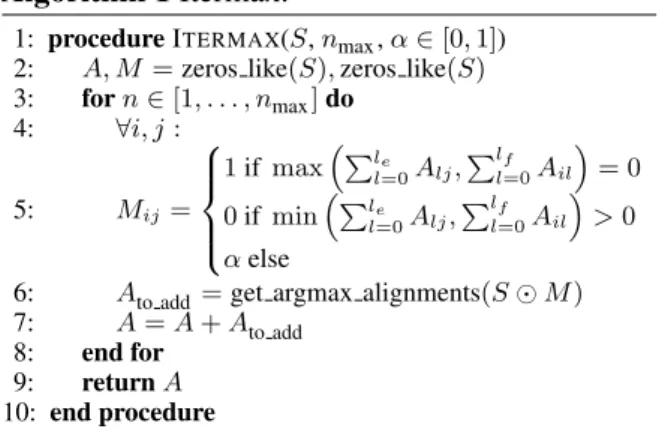
Algorithm 1Itermax.
1: procedureITERMAX(S,nmax,α∈[0,1])
2: A, M=zeros like(S),zeros like(S) 3: forn∈[1, . . . , nmax]do 4: ∀i, j: 5: Mij= 1if maxPle l=0Alj, Plf l=0Ail = 0 0if min Ple l=0Alj, Plf l=0Ail >0 αelse
6: Ato add =get argmax alignments(SM) 7: A=A+Ato add
8: end for
9: returnA
10: end procedure
Figure 2: Description of the Itermax algorithm. ze-ros likeyields a matrix with zeros and with same shape as the input,get argmax alignmentsreturns alignments obtained from the Argmax Method,is elementwise multiplication.
we set Aij = 0. Similar methods have been
ap-plied to Dice coefficients (Och and Ney,2003) and attention matrices (Garg et al.,2019).
Itermax. Argmax identifies only few alignment edges for many sentences because mutual argmaxes can be rare. As a remedy we propose to apply Argmax iteratively. To this end, we modify the sim-ilarity matrix conditioned on the alignment edges found in a previous iteration: if two wordsiand jhavebothbeen aligned, we zero out the similar-ity. Similarly ifneither is aligned, we leave the similarity unchanged. In case only one of them is aligned, we multiply the similarity with a discount factorα ∈ [0,1]. Intuitively, this encourages the model to focus on unaligned word pairs. However, if the similarity with an already aligned word is ex-ceptionally high, the model can add an additional edge. Note that this explicitly allows one word to be aligned to multiple other words. For details on the algorithm see Figure2.
Match.Argmax finds a local, not a global opti-mum and Itermax is a greedy algorithm. To find global optima, we frame alignment as an assign-ment problem: we search for a maximum-weight maximal matching (Ramshaw and Tarjan,2012) in the bipartite weighted graph which is induced by the similarity matrix. This optimization problem is given by A∗ = arg max A∈{0,1}le×lf le X i=1 lf X j=1 AijSij
subject toAbeing a matching (i.e., each node has at most one edge) that is maximal (i.e., no additional edges can be added). There are known algorithms to solve the above problem in polynomial time (Kuhn,1955).
Note that alignments generated with the match-ing method are inherently bidirectional and do not require any symmetrization as post-processing.
2.2 Post-Processing Alignments
Distortion Correction [Dist].Distortion, as intro-duced in IBM Model 2, is essential for alignments based on non-contextualized embeddings since the similarity of two words is solely based on their surface form, independent of position. To penalize high distortion, we multiply the similarity matrix Scomponentwise with
Pi,j = 1−κ(i/le−j/lf)2,
whereκis a hyperparameter to scale the distortion matrixP between[(1−κ),1]. We useκ = 0.5. See §4.1 for different values. We can interpret this as imposing a locality-preserving prior: given a choice, a word should be aligned to a word with a similar relative position ((i/le−j/lf)2
close to 0) rather than a more distant word (large (i/le−j/lf)2).
Null. Null words model untranslated words and are an important part of alignment models (al-though questioned bySchulz et al.(2016)). Given an alignment matrixA, we remove alignment edges when the normalized entropy of the similarity dis-tribution is above a thresholdτ, a hyperparameter. We consider normalized entropy (i.e., entropy di-vided by the log of sentence length) to account for different sentence lengths. Intuitively, if a word is not particularly similar to any of the words in the target sentence, we do not align it. That is, we set Aij = 0if min(− Ple k=1SikhlogSikh logle ,− Plf k=1Skjv logSkjv loglf )>τ, where Sikh := Sik/Pjle=1Sij, and Skjv := Skj/ Plf
i=1Sij. As the ideal value ofτ depends on the actual similarity scores we setτ to a per-centile of the entropy values of similarity distribu-tions in all aligned edges. We investigate different percentiles in§4.1.
2.3 Embedding Learning
Static. We train monolingual embeddings with fastText (Bojanowski et al.,2017). Subsequently we use VecMap (Artetxe et al., 2018b) to map the embeddings into a common multilingual space. Note that this algorithm works without any crosslin-gual supervision (e.g., multilincrosslin-gual dictionaries). We use the same procedure for word and subword levels. We use the labelfastTextto refer to these embeddings as well as to the word alignments in-duced by them.
Contextualized.We use the multilingual BERT model (mBERT).3It is pretrained on the 104 largest Wikipedia languages. This model only provides embeddings on the subword level. To obtain a word embedding, we simply average the vectors of its subwords. We consider word representations from all 12 layers as well as the concatenation of all layers. Note that the model is not finetuned. We denote this method as mBERT[i] (when using embeddings from thei-th layer, where0means us-ing the non-contextualized initial embeddus-ing layer) and mBERT[conc] (for concatenation).
In addition, we use XLM-RoBERTa base ( Con-neau et al.,2019), which is pretrained on 100 lan-guages on CommonCrawl data. We denote align-ments obtained using the embeddings from thei-th layer by XLM-R[i], analogously to mBERT.
2.4 Word and Subword Alignments
We investigate both alignments between subwords such as BPE/wordpiece (Sennrich et al., 2016) (which are widely used for contextualized language models) and words. For theword level, we use NLTK tokenizer (Bird et al.,2009) (e.g., for tok-enizing Wikipedia in order to train fastText). For thesubwordlevel, we generally use multilingual BERT’s vocabulary3and BERT’s tokenizer.4Only for XLM-R we use the XLM-R vocabulary.
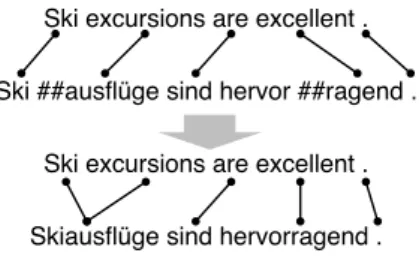
As gold standards are all word-level, we can only evaluate on the word level. Each gold standard comes with a gold tokenization, thus no additional tokenization is necessary. To convert subword to word alignments for evaluation we apply the rule: “two words are aligned if any of their subwords are aligned” (see Figure3). Thus a single word can be aligned with multiple other words.
3
https://github.com/google-research/ bert/blob/master/multilingual.md
4https://github.com/google-research/
Ski excursions are excellent . Ski ##ausflüge sind hervor ##ragend .
Ski excursions are excellent . Skiausflüge sind hervorragend .
Figure 3: Subword alignments are converted to word alignments for evaluation.
2.5 Baselines
We compare to three popular statistical alignment models that all require parallel training data. fast-align(Dyer et al.,2013) is an implementation of an alignment algorithm based on IBM Model 2. It is popular because of its speed and high qual-ity. eflomal5 (based on efmaral by Ostling and¨ Tiedemann(2016)), a Bayesian model with Markov Chain Monte Carlo inference, is claimed to outper-form fast-align on speed and quality (Ostling and¨ Tiedemann,2016). Further we use the widely used software packageGIZA++(Och and Ney,2003), which combines IBM Alignment Models. We use its standard settings: 5 iterations each for the HMM model, IBM Model 1, 3 and 4 withp0 = 0.98.
Symmetrization. Traditional word alignment models create forward and backward alignments and then symmetrize them (Koehn, 2010). We compared the symmetrization methods grow-diag-final-and (GDFA) and intersection and found them to perform comparably. See Table7in the appendix for a comparison. We use GDFA throughout the paper.
3 Experiments
3.1 Data
We work with a diverse set of 7 languages. As
test data we use three language pairs from the WPT2005 shared task:6 Hindi, English-French (Och and Ney, 2000), and English-Romanian (Mihalcea and Pedersen, 2003). In addition, we use Europarl gold alignments7 for English-German, gold alignments byTavakoli and Faili(2014) for English-Persian, and byBojar and Prokopov´a(2006) for English-Czech. Note that
5 https://github.com/robertostling/ eflomal 6 http://web.eecs.umich.edu/˜mihalcea/ wpt05/ 7www-i6.informatik.rwth-aachen.de/ goldAlignment/
the Persian gold standard is lowercased. FAS, CES and RON contain only sure edges and no possible edges.
For models requiring parallel training data we select additional paralleltraining datathat is con-sistent with the target domain where available. See Table1for an overview of the used data as well as the corresponding size. Unless indicated otherwise we use the whole parallel training data for training of eflomal, fast-align and GIZA++. We show the effect of adding more or less training data in Fig-ure7. Since mBERT is pretrained on Wikipedia, we train fastText embeddings on Wikipedia as well. For hyperparameters of all models see Table8in the appendix.
3.2 Evaluation Measures
Given a set of predicted alignment edgesAand a set of sure (possible) gold standard edgesS (P), we use the following evaluation measures:
prec.= |A∩P| |A| rec.= |A∩S| |S| F1 = 2prec. rec. prec.+rec. AER= 1−|A∩S|+|A∩P| |A|+|S| ,
where | · |denotes the cardinality of a set. This is the standard way of evaluating alignments (Och and Ney,2003).
4 Results
Given the large amount of possible experiments when considering 6 language pairs we do not have space to present all numbers for all languages. If we show results only for one pair, we choose ENG-DEU as it is an established and well-known dataset (EuroParl). If we show results for more languages we fall back to DEU, CES and HIN, to show effects on a mid-resource morphologically rich language (CES) and a low-resource language written in a different script (HIN).
4.1 Hyperparameter Investigation
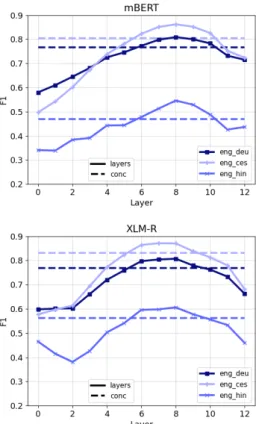
Layers. Figure4shows a parabolic trend across layers of mBERT as well as of XLM-R with layer 8 yielding the best performance. This is consistent with other work (Voita et al.,2019;Tenney et al.,
Gold Gold St. Parallel Parallel Wikipedia
Lang. Standard Size Data Data Size Size
ENG-CES (Bojar and Prokopov´a,2006) 2501 EuroParl (Koehn,2005) 646K 8M
ENG-DEU EuroParla 508 EuroParl (Koehn,2005) 1920K 48M
ENG-FAS (Tavakoli and Faili,2014) 400 TEP (Pilevar et al.,2011) 600K 5M ENG-FRA WPT2005, (Och and Ney,2000), 447 Hansardsb(Germann,2001) 1130K 32M
ENG-HIN WPT2005c 90 Emille (McEnery et al.,2000) 3K 1M
ENG-RON WPT2005, (Mihalcea and Pedersen,2003) 203 Constitution, Newspaperd 50K 3M awww-i6.informatik.rwth-aachen.de/goldAlignment/
bhttps://www.isi.edu/natural-language/download/hansard/index.html chttp://web.eecs.umich.edu/ mihalcea/wpt05/
dhttp://web.eecs.umich.edu/ mihalcea/wpt05/
Table 1: Overview of datasets. “Size” refers to the number of sentences. “Parallel Data Size” refers to the number of parallel sentences in addition to the gold alignments. Our sentence tokenized version of the English Wikipedia has 105M sentences.
Figure 4: Word alignment performance across layers of mBERT (top) and XLM-R (bottom). Results areF1 on subword level with Argmax and no post-processing applied.
too weak for high-quality alignments while the last layers are too specialized on the pretraining task (masked language modeling).
Itermax. Table2shows results for Argmax (i.e., 1 Iteration) as well as Itermax (i.e., 2 or more it-erations of Argmax). As expected, with more iter-ations precision drops in favor of recall. Overall Itermax achieves higherF1scores for the three lan-guage pairs (equal for ENG-CES). For Hindi the performance increase is the highest. We hypoth-esize that for more distant languages Itermax is
ENG-DEU ENG-CES ENG-HIN
Emb. Iter. α Prec. Rec.F1AER Prec. Rec.F1AER Prec. Rec.F1AER
mBERT[8] 1 - .92 .69 .79 .21 .95 .80 .87 .13 .84 .39 .53 .47 2 .90 .85 .77 .81 .19 .87 .86 .87 .14 .75 .46 .57 .43 .95 .83 .80 .81 .19 .85 .89 .87 .13 .73 .48 .58 .42 1 .77 .79 .78 .22 .80 .86 .83 .17 .63 .46 .53 .47 3 .90 .81 .80 .80 .20 .83 .88 .85 .15 .70 .49 .57 .43 .95 .78 .83 .81 .20 .81 .91 .86 .15 .68 .52 .59 .41 1 .73 .83 .77 .23 .76 .91 .82 .18 .58 .51 .54 .46 fastText 1 - .81 .48 .60 .40 .86 .59 .70 .30 .75 .35 .48 .52 2 .90 .69 .56 .62 .38 .74 .69 .71 .29 .63 .42 .50 .50 .95 .66 .56 .61 .39 .71 .69 .70 .30 .59 .41 .48 .52 1 .59 .55 .57 .43 .62 .65 .63 .37 .53 .39 .45 .55 3 .90 .63 .59 .61 .39 .67 .72 .70 .31 .57 .43 .49 .51 .95 .59 .59 .59 .41 .63 .73 .68 .33 .53 .44 .48 .52 1 .53 .58 .55 .45 .55 .70 .62 .39 .48 .43 .45 .55
Table 2: Itermax with different number of iterations as well as differentα. Results are on word level.
more beneficial as similarity between wordpieces may be generally lower, thus exhibiting fewer mu-tual argmaxes. For the rest of the paper we use for Itermax 2 Iterations withα= 0.9as it exhibits best performance (5 out of 6 wins in Table2).
Hyperparametersκandτ.In Figure5we plot the performance for different values ofκ. We ob-serve that introducing distortion indeed helps (i.e., κ > 0) but the actual value is not decisive for performance. This is rather intuitive, as a small ad-justment to the similarities is sufficient while larger adjustments do not necessarily hurt or change the Argmax or the optimal point in the Matching Algo-rithm. We chooseκ= 0.5.
Forτ in null-word post-processing, we plot pre-cision, recall andF1 in Figure6when assigning τ different percentile values. Recall that values for τ depend on the similarity distribution of all aligned edges. As expected, when using the 100 percentile no edges are removed and thus the per-formance is not changed compared to not having a null-word post-processing. With decreasing the value ofτ the precision increases and recall goes down, whileF1remains fairly stable. We assignτ
Figure 5: F1 for ENG-DEU with fastText (Argmax) on word level for different values ofκ.
Figure 6: Performance for ENG-DEU with mBERT[8] (Match) on word level when setting the value ofτto dif-ferent percentiles. τ can be used for trading precision against recall. F1remains stable although it decreases slightly when assigning τ the value of a smaller per-centile (e.g., 80)
the 95th percentile from now on.
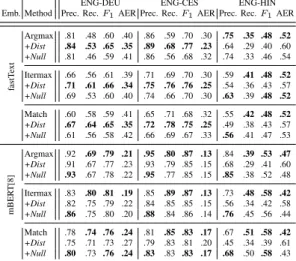
Table 3 compares alignment and post-processing methods. Argmax and Itermax generally have higher precision whereas Match has higher recall. Adding Null almost always increases precision, but at the cost of recall, resulting mostly in a lower F1 score. Adding a distortion prior boosts performance for static embeddings, e.g., from .70 to .77 for ENG-CES Argmax F1. However, for Hindi a distortion prior is harmful. Further Dist has little and sometimes harmful effects on mBERT indicating that mBERT’s contextualized representations already match well across languages.
To summarize: Itermax exhibits the best and most stable performance, for high precision align-ments one should use Argmax, for high recall Match is recommended. A distortion prior is rec-ommended for static embeddings (except for HIN). Null should be applied when one wants to push
pre-ENG-DEU ENG-CES ENG-HIN
Emb. Method Prec. Rec.F1AER Prec. Rec.F1AER Prec. Rec.F1AER
fastT ext Argmax .81 .48 .60 .40 .86 .59 .70 .30 .75 .35 .48 .52 +Dist .84 .53 .65 .35 .89 .68 .77 .23 .64 .29 .40 .60 +Null .81 .46 .59 .41 .86 .56 .68 .32 .74 .33 .46 .54 Itermax .66 .56 .61 .39 .71 .69 .70 .30 .59 .41 .48 .52 +Dist .71 .61 .66 .34 .75 .76 .76 .25 .54 .36 .43 .57 +Null .69 .53 .60 .40 .74 .66 .70 .30 .63 .39 .48 .52 Match .60 .58 .59 .41 .65 .71 .68 .32 .55 .42 .48 .52 +Dist .67 .64 .65 .35 .72 .78 .75 .25 .49 .38 .43 .57 +Null .61 .56 .58 .42 .66 .69 .67 .33 .56 .41 .47 .53 mBER T[8] Argmax .92 .69 .79 .21 .95 .80 .87 .13 .84 .39 .53 .47 +Dist .91 .67 .77 .23 .93 .79 .85 .15 .68 .29 .41 .60 +Null .93 .67 .78 .22 .95 .77 .85 .15 .85 .38 .52 .48 Itermax .83 .80 .81 .19 .85 .89 .87 .13 .73 .48 .58 .42 +Dist .82 .75 .79 .22 .84 .85 .85 .15 .56 .34 .42 .58 +Null .86 .75 .80 .20 .88 .84 .86 .14 .76 .45 .56 .44 Match .78 .74 .76 .24 .81 .85 .83 .17 .67 .51 .58 .42 +Dist .75 .71 .73 .27 .79 .83 .81 .20 .45 .34 .39 .61 +Null .80 .73 .76 .24 .83 .83 .83 .17 .68 .50 .58 .43
Table 3: Comparison of methods for inducing align-ments from similarity matrices. All results are word-level. Best result per embedding type and method across columns in bold.
cision even higher (e.g., for annotation projection).
4.2 Comparison with SoTA
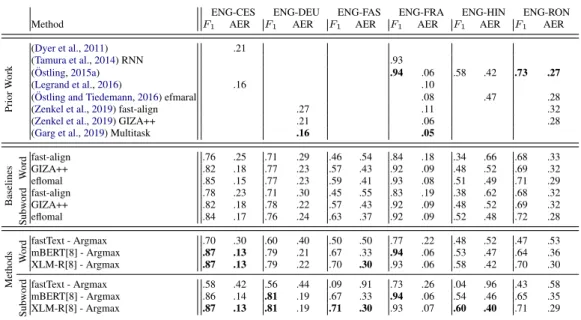
Overall. Table4 shows that mBERT and XLM-R consistently perform well. Our three baselines, eflomal, fast-align and GIZA++, are mostly outper-formed (except for RON). XLM-R yields mostly higher values than mBERT. In comparison with other published numbers, alignments from contex-tualized embeddings outperform them or are almost on-par.
OnlyGarg et al.(2019) has higher performance for ENG-DEU and ENG-FRA. They train a mul-titask NMT system. However, extracting align-ments from similarity matrices is a very simple and efficient method which yields surprisingly strong performance – we attribute this to the strong con-textualization in mBERT and XLM-R.
Numbers for ENG-RON are worse than eflomal and (Ostling¨ ,2015a). We will investigate the rea-son for this more closely.
Surprisingly, fastText outperforms fast-align in two languages. We consider this surprising as fast-Text did not have access to parallel data or any multilingual signal. Thus for very small parallel corpora (<10K sentences) using fastText embed-dings is an alternative to fast-align.
Parallel Data. Figure7 shows that fast-align and eflomal get better with more training data with eflomal outperforming fast-align, as expected. However, even with 1.9M parallel sentences mBERT outperforms both statistical baselines. fast-Text becomes competitive for fewer than 1000
par-ENG-CES ENG-DEU ENG-FAS ENG-FRA ENG-HIN ENG-RON
Method F1 AER F1 AER F1 AER F1 AER F1 AER F1 AER
Prior W ork (Dyer et al.,2011) .21 (Tamura et al.,2014) RNN .93 (Ostling¨ ,2015a) .94 .06 .58 .42 .73 .27 (Legrand et al.,2016) .16 .10
(Ostling and Tiedemann¨ ,2016) efmaral .08 .47 .28
(Zenkel et al.,2019) fast-align .27 .11 .32
(Zenkel et al.,2019) GIZA++ .21 .06 .28
(Garg et al.,2019) Multitask .16 .05
Baselines W ord fast-align .76 .25 .71 .29 .46 .54 .84 .18 .34 .66 .68 .33 GIZA++ .82 .18 .77 .23 .57 .43 .92 .09 .48 .52 .69 .32 eflomal .85 .15 .77 .23 .59 .41 .93 .08 .51 .49 .71 .29 Subw ordfast-align .78 .23 .71 .30 .45 .55 .83 .19 .38 .62 .68 .32 GIZA++ .82 .18 .78 .22 .57 .43 .92 .09 .48 .52 .69 .32 eflomal .84 .17 .76 .24 .63 .37 .92 .09 .52 .48 .72 .28 Methods W ord fastText - Argmax .70 .30 .60 .40 .50 .50 .77 .22 .48 .52 .47 .53 mBERT[8] - Argmax .87 .13 .79 .21 .67 .33 .94 .06 .53 .47 .64 .36 XLM-R[8] - Argmax .87 .13 .79 .22 .70 .30 .93 .06 .58 .42 .70 .30 Subw
ordfastText - Argmax .58 .42 .56 .44 .09 .91 .73 .26 .04 .96 .43 .58
mBERT[8] - Argmax .86 .14 .81 .19 .67 .33 .94 .06 .54 .46 .65 .35
XLM-R[8] - Argmax .87 .13 .81 .19 .71 .30 .93 .07 .60 .40 .71 .29
Table 4: Comparison of out methods, baselines and related work. Best overall result per column in bold.
Figure 7: Learning curves of fast-align/eflomal vs. embedding-based alignments. Results shown areF1on word and subword level for ENG-DEU.
allel sentences and outperforms fast-align even with 10K sentences. The main takeaway is that mBERT-based alignments, a method that does not need any parallel training data, are competitive with state-of-the-art aligners, even in the high re-source case.
4.3 Words and Subwords
In Table 4 subword processing yields slight im-provements over word-level processing for most methods. Only fastText is harmed by subword pro-cessing. We use VecMap to match (sub)word dis-tributions across languages. We hypothesize that it is harder to match subword than word distribu-tions – this effect is strongest for Persian and Hindi, probably due to different scripts and thus different subword distributions. Initial experiments showed that adding supervision in terms of a dictionary
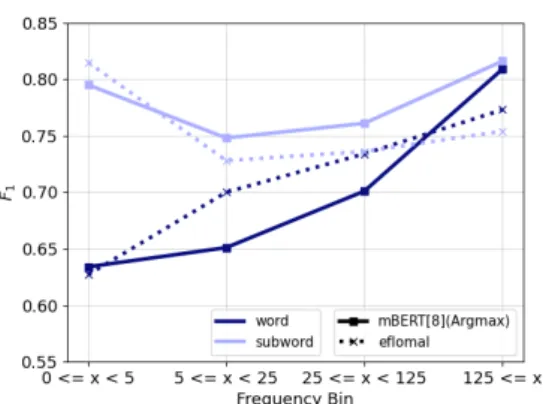
Figure 8: Results for different frequency bins. An edge inS,P, orAis attributed to exactly one bin based on the minimum frequency of the involved words (denoted byx). Eflomal is trained on 100k parallel sentences. Word frequencies are computed on this 100k parallel corpus. For a version with 1000k parallel sentences see appendix.
helps restore performance. We will investigate this more closely in future work.
We hypothesize that subword processing is ben-eficial for aligning rare words. To show this, we compute our evaluation measures for different fre-quency bins. More specifically, we only consider alignment edges for the computation where at least one of the member words has a certain frequency in a reference corpus (in our case 100k lines from the ENG-DEU EuroParl corpus). That is, we only consider the edge(i, j)inA, S orP if the mini-mum of the source and target word frequency is in [γl, γu)whereγlandγu are bin boundaries.
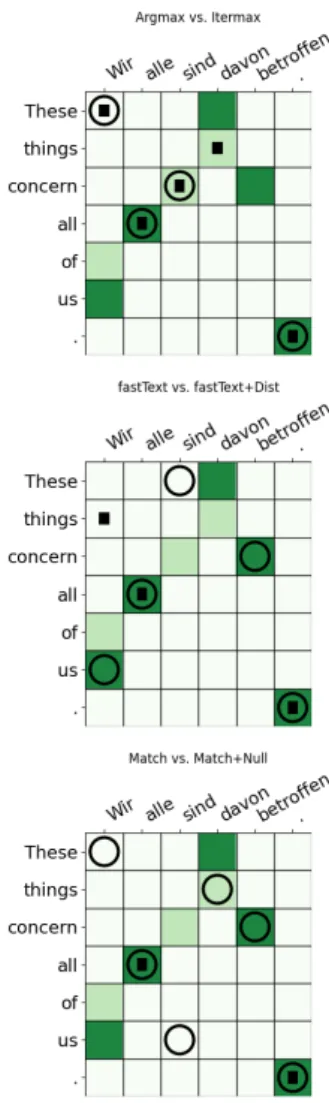
Figure 9: Comparison of some alignment systems. Dark/light green: sure/possible edges in the gold stan-dard. Circles are alignments from the first mentioned system in the headline, boxes alignemnts from the sec-ond system.
For rare words both eflomal and mBERT show a severely decreased performance on word level, but not on subword level. This provides some evidence for our hypothesis.
4.4 Alignment Examples
Figure9gives alignment examples. One can see that Itermax adds a correct alignment edge in the second iteration (Argmax vs Itermax). The distor-tion prior in fastText does not help in this example, as it is heavily distorted, but we see that the prior works as intended (fastText vs fastText+Dist). The null-alignment removes some wrong edges, but unfortunately also the correct edge between “be-troffen” and “concern” (Match vs Match+Null).
5 Related Work
Brown et al.(1993) introduced the IBM models, the best known statistical word aligners. More recent aligners, often based on IBM models, include fast-align (Dyer et al.,2013), GIZA++ (Och and Ney,
2003) and eflomal (Ostling and Tiedemann¨ ,2016). Neural network based extensions of these models have been considered as well (Ayan et al.,2005;Ho and Yvon,2019) . All of these models are trained on parallel text. Our method instead aligns based on embeddings that are induced from monolingual data only. Niehues and Vogel (2008) model the alignment matrix with a conditional random field. To train this they require a manually created gold alignment.
Prior work on using learned representations for alignment includes (Smadja et al.,1996;Och and Ney,2003) (Dice coefficient), (Sabet et al.,2016) (incorporation of embeddings into IBM models), (Legrand et al.,2016) (neural network alignment model) and (Pourdamghani et al.,2018) (embed-dings are used to encourage words to align to sim-ilar words). Tamura et al. (2014) use recurrent neural networks to learn alignments. They use noise contrastive estimation to avoid supervision. All of this work requires parallel data. Concurrent to us, Libovick´y et al.(2019) find that mBERT gives raise to good word alignments. But they do not focus on mBERT’s use as a high perfor-mance alignment tool, but rather on evaluating the “language-neutrality” of mBERT.
Attention in NMT (Bahdanau et al., 2014) is related to a notion of soft alignment, but often de-viates from conventional word alignments (Ghader and Monz,2017;Koehn and Knowles,2017). One difference is that standard attention does not have access to the target word. To address this, Pe-ter et al.(2017) tailor attention matrices to obtain higher quality alignments. Li et al. (2018)’s and
Zenkel et al.(2019)’s models perform similarly to GIZA++.Ding et al.(2019) propose better decod-ing algorithms to deduce word alignments from NMT predictions. Chen et al. (2016), Mi et al.
(2016) and Garg et al. (2019) obtain alignments and translations in a multitask setup. Garg et al.
(2019) find that operating on subword level can be beneficial for word alignment models.Li et al.
(2019) propose two methods to extract alignments from NMT models, however they do not outper-form fast-align. Stengel-Eskin et al.(2019) com-pute similarity matrices of encoder-decoder
repre-sentations that are leveraged for word alignments, together with supervised learning which requires manually annotated alignment. We find our pro-posed methods to be competitive with some of this work. Further, in contrast to our work, they all require parallel data.
6 Conclusion
We presented word aligners based on contextual-ized (resp. static) embeddings that perform better than (resp. comparably with) statistical word align-ers. Our method does not require parallel data and is particularly useful for scenarios where a low or medium number of parallel sentences need to be aligned, but no additional parallel data is available. For a set of 100k parallel sentences, contextualized embeddings achieve an alignment F1 that is 5% higher (absolute) than eflomal. In future work we plan to investigate how to leverage existing parallel data effectively in combination with our proposed methods.
We gratefully acknowledge funding through a Zentrum Digitalisierung.Bayern fellowship awarded to the second author. This work was supported by the European Research Council (# 740516). We thank Matthias Huck, Jindˇrich Li-bovick´y and Alex Fraser for interesting discussions and valuable comments. Thanks to Jindˇrich for pointing out that mBERT can align mixed-language sentences as shown in Figure1.
References
Tamer Alkhouli, Gabriel Bretschner, and Hermann Ney. 2018. On the alignment problem in multi-head attention-based neural machine translation. In Pro-ceedings of the Third Conference on Machine Trans-lation.
Tamer Alkhouli, Gabriel Bretschner, Jan-Thorsten Pe-ter, Mohammed Hethnawi, Andreas Guta, and Her-mann Ney. 2016. Alignment-based neural machine translation. InProceedings of the First Conference on Machine Translation.
Tamer Alkhouli and Hermann Ney. 2017. Biasing attention-based recurrent neural networks using ex-ternal alignment information. InProceedings of the Second Conference on Machine Translation. Waleed Ammar, George Mulcaire, Yulia Tsvetkov,
Guillaume Lample, Chris Dyer, and Noah A Smith. 2016. Massively multilingual word embeddings.
arXiv preprint arXiv:1602.01925.
Mikel Artetxe, Gorka Labaka, and Eneko Agirre. 2018a. A robust self-learning method for fully un-supervised cross-lingual mappings of word embed-dings. InProceedings of the 56th Annual Meeting of the Association for Computational Linguistics. Mikel Artetxe, Gorka Labaka, and Eneko Agirre.
2018b. A robust self-learning method for fully un-supervised cross-lingual mappings of word embed-dings. InProceedings of the 56th Annual Meeting of the Association for Computational Linguistics. Necip Fazil Ayan, Bonnie J Dorr, and Christof Monz.
2005. Neuralign: Combining word alignments us-ing neural networks. InProceedings of the confer-ence on Human Language Technology and Empiri-cal Methods in Natural Language Processing. Dzmitry Bahdanau, Kyunghyun Cho, and Yoshua
Ben-gio. 2014. Neural machine translation by jointly learning to align and translate. In Proceedings of the International Conference on Learning Represen-tations.
Steven Bird, Ewan Klein, and Edward Loper. 2009.
Natural language processing with Python: analyz-ing text with the natural language toolkit. O’Reilly Media, Inc.
Piotr Bojanowski, Edouard Grave, Armand Joulin, and Tomas Mikolov. 2017. Enriching word vectors with subword information. Transactions of the Associa-tion for ComputaAssocia-tional Linguistics, 5.
Ondrej Bojar and Magdalena Prokopov´a. 2006. Czech-english word alignment. InProceedings of the In-ternational Conference on Language Resources and Evaluation.
Peter F Brown, Vincent J Della Pietra, Stephen A Della Pietra, and Robert L Mercer. 1993. The mathemat-ics of statistical machine translation: Parameter esti-mation. Computational Linguistics, 19(2).
Wenhu Chen, Evgeny Matusov, Shahram Khadivi, and Jan-Thorsten Peter. 2016. Guided alignment training for topic-aware neural machine translation.
AMTA 2016.
Alexis Conneau, Kartikay Khandelwal, Naman Goyal, Vishrav Chaudhary, Guillaume Wenzek, Francisco Guzm´an, Edouard Grave, Myle Ott, Luke Zettle-moyer, and Veselin Stoyanov. 2019. Unsupervised cross-lingual representation learning at scale. arXiv preprint arXiv:1911.02116.
Alexis Conneau, Guillaume Lample, Marc’Aurelio Ranzato, Ludovic Denoyer, and Herv´e J´egou. 2018. Word translation without parallel data.
Jacob Devlin, Ming-Wei Chang, Kenton Lee, and Kristina Toutanova. 2019. Bert: Pre-training of deep bidirectional transformers for language understand-ing. In Proceedings of the 2019 Conference of the North American Chapter of the Association for Com-putational Linguistics: Human Language Technolo-gies.
Shuoyang Ding, Hainan Xu, and Philipp Koehn. 2019. Saliency-driven word alignment interpretation for neural machine translation. In Proceedings of the Fourth Conference on Machine Translation (Volume 1: Research Papers).
Philipp Dufter, Mengjie Zhao, Martin Schmitt, Alexan-der Fraser, and Hinrich Sch¨utze. 2018. Embedding learning through multilingual concept induction. In
Proceedings of the 56th Annual Meeting of the Asso-ciation for Computational Linguistics.
Chris Dyer, Victor Chahuneau, and Noah A Smith. 2013. A simple, fast, and effective reparameteriza-tion of IBM Model 2. In Proceedings of the 2013 Conference of the North American Chapter of the Association for Computational Linguistics: Human Language Technologies.
Chris Dyer, Jonathan Clark, Alon Lavie, and Noah A Smith. 2011. Unsupervised word alignment with ar-bitrary features. InProceedings of the 49th Annual Meeting of the Association for Computational Lin-guistics: Human Language Technologies-Volume 1. Association for Computational Linguistics.
Sarthak Garg, Stephan Peitz, Udhyakumar Nallasamy, and Matthias Paulik. 2019. Jointly learning to align and translate with transformer models. In Proceed-ings of the 2019 Conference on Empirical Methods in Natural Language Processing and the 9th Inter-national Joint Conference on Natural Language Pro-cessing.
Ulrich Germann. 2001. Aligned hansards of the 36th parliament of canada.
Hamidreza Ghader and Christof Monz. 2017. What does attention in neural machine translation pay at-tention to? In Proceedings of the Eighth Interna-tional Joint Conference on Natural Language Pro-cessing.
Jiang Guo, Wanxiang Che, David Yarowsky, Haifeng Wang, and Ting Liu. 2016. A representation learn-ing framework for multi-source transfer parslearn-ing. In
Thirtieth AAAI Conference on Artificial Intelligence. Anh Khoa Ngo Ho and Franc¸ois Yvon. 2019. Neural
baselines for word alignment.
Rebecca Hwa, Philip Resnik, Amy Weinberg, and Okan Kolak. 2002. Evaluating translational corre-spondence using annotation projection. In Proceed-ings of the 40th Annual Meeting on Association for Computational Linguistics.
Philipp Koehn. 2005. Europarl: A parallel corpus for statistical machine translation. InMachine Transla-tion Summit, volume 5.
Philipp Koehn. 2010. Statistical Machine Translation. Cambridge University Press.
Philipp Koehn and Rebecca Knowles. 2017. Six chal-lenges for neural machine translation. In Proceed-ings of the First Workshop on Neural Machine Trans-lation.
Harold W Kuhn. 1955. The hungarian method for the assignment problem. Naval research logistics quar-terly, 2(1-2).
Jo¨el Legrand, Michael Auli, and Ronan Collobert. 2016. Neural network-based word alignment through score aggregation. In Proceedings of the First Conference on Machine Translation: Volume 1, Research Papers.
William D Lewis and Fei Xia. 2008. Automatically identifying computationally relevant typological fea-tures. In Proceedings of the Third International Joint Conference on Natural Language Processing: Volume-II.
Xintong Li, Guanlin Li, Lemao Liu, Max Meng, and Shuming Shi. 2019. On the word alignment from neural machine translation. In Proceedings of the 57th Annual Meeting of the Association for Compu-tational Linguistics.
Xintong Li, Lemao Liu, Zhaopeng Tu, Shuming Shi, and Max Meng. 2018. Target foresight based atten-tion for neural machine translaatten-tion. InProceedings of the 2018 Conference of the North American Chap-ter of the Association for Computational Linguistics: Human Language Technologies.
Jindˇrich Libovick´y, Rudolf Rosa, and Alexander Fraser. 2019. How language-neutral is multilingual bert?
arXiv preprint arXiv:1911.03310.
Lemao Liu, Masao Utiyama, Andrew Finch, and Ei-ichiro Sumita. 2016. Neural machine translation with supervised attention. In Proceedings of the 26th International Conference on Computational Linguistics.
Yinhan Liu, Myle Ott, Naman Goyal, Jingfei Du, Man-dar Joshi, Danqi Chen, Omer Levy, Mike Lewis, Luke Zettlemoyer, and Veselin Stoyanov. 2019. Roberta: A robustly optimized bert pretraining ap-proach. arXiv preprint arXiv:1907.11692.
Anthony McEnery, Paul Baker, Rob Gaizauskas, and Hamish Cunningham. 2000. Emille: Building a cor-pus of south asian languages. VIVEK-BOMBAY-, 13(3).
Haitao Mi, Zhiguo Wang, and Abe Ittycheriah. 2016. Supervised attentions for neural machine translation. InProceedings of the 2016 Conference on Empirical Methods in Natural Language Processing.
Rada Mihalcea and Ted Pedersen. 2003. An evaluation exercise for word alignment. InProceedings of the HLT-NAACL 2003 Workshop on Building and using parallel texts: data driven machine translation and beyond.
Jan Niehues and Stephan Vogel. 2008. Discrimina-tive word alignment via alignment matrix modeling. In Proceedings of the Third Workshop on Statisti-cal Machine Translation. Association for Computa-tional Linguistics.
Franz Josef Och and Hermann Ney. 2000. Improved statistical alignment models. InProceedings of the 38th Annual Meeting on Association for Computa-tional Linguistics.
Franz Josef Och and Hermann Ney. 2003. A systematic comparison of various statistical alignment models.
Computational Linguistics, 29(1).
Robert ¨Ostling. 2015a. Bayesian models for multilin-gual word alignment. Ph.D. thesis, Department of Linguistics, Stockholm University.
Robert ¨Ostling. 2015b. Word order typology through multilingual word alignment. InProceedings of the 53rd Annual Meeting of the Association for Compu-tational Linguistics and the 7th International Joint Conference on Natural Language Processing. Robert ¨Ostling and J¨org Tiedemann. 2016. Efficient
word alignment with markov chain monte carlo.
The Prague Bulletin of Mathematical Linguistics, 106(1).
Sebastian Pad´o and Mirella Lapata. 2009. Cross-lingual annotation projection for semantic roles.
Journal of Artificial Intelligence Research, 36. Jan-Thorsten Peter, Arne Nix, and Hermann Ney.
2017. Generating alignments using target fore-sight in attention-based neural machine translation.
The Prague Bulletin of Mathematical Linguistics, 108(1).
Mohammad Taher Pilevar, Heshaam Faili, and Ab-dol Hamid Pilevar. 2011. TEP: Tehran English-Persian parallel corpus. InInternational Conference on Intelligent Text Processing and Computational Linguistics, pages 68–79. Springer.
Nima Pourdamghani, Marjan Ghazvininejad, and Kevin Knight. 2018. Using word vectors to improve word alignments for low resource machine transla-tion. InProceedings of the 2018 Conference of the North American Chapter of the Association for Com-putational Linguistics: Human Language Technolo-gies.
Ofir Press and Noah A Smith. 2018. You may not need attention. arXiv preprint arXiv:1810.13409. Lyle Ramshaw and Robert E Tarjan. 2012. On
minimum-cost assignments in unbalanced bipartite graphs. HP Labs, Palo Alto, CA, USA, Tech. Rep. HPL-2012-40R1.
Masoud Jalili Sabet, Heshaam Faili, and Gholamreza Haffari. 2016. Improving word alignment of rare words with word embeddings. In Proceedings of the 26th International Conference on Computational Linguistics.
Philip Schulz, Wilker Aziz, and Khalil Simaan. 2016. Word alignment without null words. InProceedings of the 54th Annual Meeting of the Association for Computational Linguistics.
Holger Schwenk, Vishrav Chaudhary, Shuo Sun, Hongyu Gong, and Francisco Guzm´an. 2019. Wiki-matrix: Mining 135m parallel sentences in 1620 language pairs from wikipedia. arXiv preprint arXiv:1907.05791.
Rico Sennrich, Barry Haddow, and Alexandra Birch. 2016. Neural machine translation of rare words with subword units. InProceedings of the 54th Annual Meeting of the Association for Computational Lin-guistics.
Frank Smadja, Kathleen R McKeown, and Vasileios Hatzivassiloglou. 1996. Translating collocations for bilingual lexicons: A statistical approach. Computa-tional linguistics, 22(1).
Elias Stengel-Eskin, Tzu-ray Su, Matt Post, and Ben-jamin Van Durme. 2019. A discriminative neural model for cross-lingual word alignment. In Proceed-ings of the 2019 Conference on Empirical Methods in Natural Language Processing and the 9th Inter-national Joint Conference on Natural Language Pro-cessing.
Akihiro Tamura, Taro Watanabe, and Eiichiro Sumita. 2014. Recurrent neural networks for word align-ment model. In Proceedings of the 52nd Annual Meeting of the Association for Computational Lin-guistics (Volume 1: Long Papers).
Leila Tavakoli and Heshaam Faili. 2014. Phrase align-ments in parallel corpus using bootstrapping ap-proach. International Journal of Information & Communication Technology Research, 6(3).
Ian Tenney, Dipanjan Das, and Ellie Pavlick. 2019. Bert rediscovers the classical nlp pipeline. In Pro-ceedings of the 57th Annual Meeting of the Associa-tion for ComputaAssocia-tional Linguistics.
Elena Voita, Rico Sennrich, and Ivan Titov. 2019. The bottom-up evolution of representations in the trans-former: A study with machine translation and lan-guage modeling objectives. InProceedings of the 2019 Conference on Empirical Methods in Natu-ral Language Processing and the 9th International Joint Conference on Natural Language Processing
(EMNLP-IJCNLP), pages 4387–4397.
David Yarowsky, Grace Ngai, and Richard Wicen-towski. 2001. Inducing multilingual text analysis tools via robust projection across aligned corpora. In
Proceedings of the first international conference on Human language technology research.
Thomas Zenkel, Joern Wuebker, and John DeNero. 2019. Adding interpretable attention to neural trans-lation models improves word alignment. arXiv preprint arXiv:1901.11359.
Figure 10: Results for different frequency bins. An edge inS,P, orAis attributed to exactly one bin based on the minimum frequency of the involved words (de-noted byx). Eflomal is trained on 1000k parallel sen-tences. Word frequencies are computed on this 1000k parallel corpus.
A Further Results
The analogous numbers from Table3on subword-level can be found in Table6. Again Distortion is essential for fastText and not necessary for mBERT. Adding Null helps especially for mBERT. Overall the takeaways are consistent with the results from subword-level.
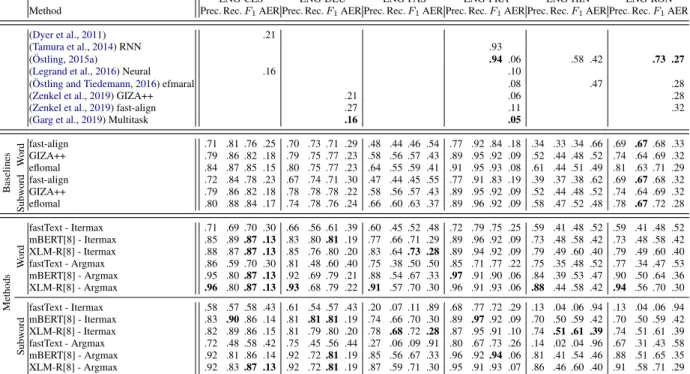
A more detailed version of Table4with preci-sion and recall can be found in Table5
Figure10shows the same as Figure8but now with a reference corpus of 1000K parallel sentences. The main takeaways are similar.
B Symmetrization
For asymmetric alignments different symmetriza-tion methods exist. (Dyer et al.,2013) provide an overview and implementation (fast-align) for these methods, which we use. We compare intersection and grow-diag-final-and (GDFA) in Table 7. In terms of F1 GDFA performs better (Intersection wins four times, GDFA eleven times, three ties). As expected, Intersection yields higher precision while GDFA yields higher recall. Thus intersection is preferable for tasks like annotation projection, whereas GDFA is typically used in statistical ma-chine translation.
C Hyperparameter Details
We provide a list of customized hyperparameters used in our computations in Table8. For remaining hyperparameters we used default values as pro-vided in the corresponding implementation (see
respective links to the code repositories).
D Examples
We show some more alignment examples in Fig-ure11, Figure12, Figure13, and Figure14.
ENG-CES ENG-DEU ENG-FAS ENG-FRA ENG-HIN ENG-RON Method Prec. Rec.F1AER Prec. Rec.F1AER Prec. Rec.F1AER Prec. Rec.F1AER Prec. Rec.F1AER Prec. Rec.F1AER
(Dyer et al.,2011) .21
(Tamura et al.,2014) RNN .93
(Ostling¨ ,2015a) .94 .06 .58 .42 .73 .27
(Legrand et al.,2016) Neural .16 .10
(Ostling and Tiedemann¨ ,2016) efmaral .08 .47 .28
(Zenkel et al.,2019) GIZA++ .21 .06 .28
(Zenkel et al.,2019) fast-align .27 .11 .32
(Garg et al.,2019) Multitask .16 .05
Baselines W ord fast-align .71 .81 .76 .25 .70 .73 .71 .29 .48 .44 .46 .54 .77 .92 .84 .18 .34 .33 .34 .66 .69 .67.68 .33 GIZA++ .79 .86 .82 .18 .79 .75 .77 .23 .58 .56 .57 .43 .89 .95 .92 .09 .52 .44 .48 .52 .74 .64 .69 .32 eflomal .84 .87 .85 .15 .80 .75 .77 .23 .64 .55 .59 .41 .91 .95 .93 .08 .61 .44 .51 .49 .81 .63 .71 .29 Subw ordfast-align .72 .84 .78 .23 .67 .74 .71 .30 .47 .44 .45 .55 .77 .91 .83 .19 .39 .37 .38 .62 .69 .67.68 .32 GIZA++ .79 .86 .82 .18 .78 .78 .78 .22 .58 .56 .57 .43 .89 .95 .92 .09 .52 .44 .48 .52 .74 .64 .69 .32 eflomal .80 .88 .84 .17 .74 .78 .76 .24 .66 .60 .63 .37 .89 .96 .92 .09 .58 .47 .52 .48 .78 .67.72 .28 Methods W ord fastText - Itermax .71 .69 .70 .30 .66 .56 .61 .39 .60 .45 .52 .48 .72 .79 .75 .25 .59 .41 .48 .52 .59 .41 .48 .52 mBERT[8] - Itermax .85 .89.87 .13 .83 .80.81 .19 .77 .66 .71 .29 .89 .96 .92 .09 .73 .48 .58 .42 .73 .48 .58 .42 XLM-R[8] - Itermax .88 .87.87 .13 .85 .76 .80 .20 .83 .64.73 .28 .89 .94 .92 .09 .79 .49 .60 .40 .79 .49 .60 .40 fastText - Argmax .86 .59 .70 .30 .81 .48 .60 .40 .75 .38 .50 .50 .85 .71 .77 .22 .75 .35 .48 .52 .77 .34 .47 .53 mBERT[8] - Argmax .95 .80.87 .13 .92 .69 .79 .21 .88 .54 .67 .33 .97 .91 .90 .06 .84 .39 .53 .47 .90 .50 .64 .36 XLM-R[8] - Argmax .96 .80.87 .13 .93 .68 .79 .22 .91 .57 .70 .30 .96 .91 .93 .06 .88 .44 .58 .42 .94 .56 .70 .30 Subw ord fastText - Itermax .58 .57 .58 .43 .61 .54 .57 .43 .20 .07 .11 .89 .68 .77 .72 .29 .13 .04 .06 .94 .13 .04 .06 .94 mBERT[8] - Itermax .83 .90.86 .14 .81 .81 .81 .19 .74 .66 .70 .30 .89 .97.92 .09 .70 .50 .59 .42 .70 .50 .59 .42 XLM-R[8] - Itermax .82 .89 .86 .15 .81 .79 .80 .20 .78 .68.72.28 .87 .95 .91 .10 .74 .51 .61 .39 .74 .51 .61 .39 fastText - Argmax .72 .48 .58 .42 .75 .45 .56 .44 .27 .06 .09 .91 .80 .67 .73 .26 .14 .02 .04 .96 .67 .31 .43 .58 mBERT[8] - Argmax .92 .81 .86 .14 .92 .72.81 .19 .85 .56 .67 .33 .96 .92.94 .06 .81 .41 .54 .46 .88 .51 .65 .35 XLM-R[8] - Argmax .92 .83.87 .13 .92 .72.81 .19 .87 .59 .71 .30 .95 .91 .93 .07 .86 .46 .60 .40 .91 .58 .71 .29
Table 5: Comparison of word and subword levels. Best overall result per column in bold.
ENG-DEU ENG-CES ENG-HIN
Emb. Method Prec. Rec.F1AER Prec. Rec.F1AER Prec. Rec.F1AER
fastT ext Argmax .75 .45 .56 .44 .72 .48 .58 .42 .14 .02 .04 .96 +Dist .79 .51 .62 .38 .77 .58 .66 .34 .16 .04 .06 .94 +Null .76 .43 .55 .45 .74 .47 .57 .42 .14 .02 .04 .96 Itermax .61 .54 .57 .43 .58 .57 .58 .43 .13 .04 .06 .94 +Dist .67 .60 .64 .36 .63 .66 .65 .36 .15 .07 .09 .91 +Null .64 .52 .57 .43 .62 .56 .59 .41 .14 .04 .07 .93 Match .51 .58 .54 .46 .44 .61 .52 .49 .10 .08 .09 .91 +Dist .59 .66 .62 .38 .54 .71 .61 .39 .10 .09 .09 .91 +Null .52 .57 .54 .46 .46 .60 .52 .48 .10 .08 .09 .91 mBER T[8] Argmax .92 .72 .81 .19 .92 .81 .86 .14 .81 .41 .54 .46 +Dist .90 .70 .79 .21 .91 .80 .85 .15 .65 .30 .41 .59 +Null .93 .70 .80 .20 .92 .78 .85 .15 .82 .40 .54 .47 Itermax .81 .81 .81 .19 .83 .90 .86 .14 .70 .50 .59 .42 +Dist .81 .77 .79 .21 .82 .87 .84 .16 .53 .35 .42 .58 +Null .85 .77 .81 .20 .84 .86 .85 .15 .72 .47 .57 .43 Match .75 .80 .78 .23 .76 .90 .82 .18 .64 .52 .58 .43 +Dist .72 .77 .75 .26 .74 .88 .80 .20 .45 .37 .40 .60 +Null .77 .78 .78 .23 .77 .88 .82 .19 .65 .51 .57 .43
Table 6: Comparison of methods for inducing align-ments from similarity matrices. All results are subword-level. Best result per embedding type across columns in bold.
ENG-CES ENG-DEU ENG-FAS ENG-FRA ENG-HIN ENG-RON Method Symm. Prec. Rec.F1AER Prec. Rec.F1AER Prec. Rec.F1AER Prec. Rec.F1AER Prec. Rec.F1AER Prec. Rec.F1AER eflomal Inters. .95 .79.86 .14 .91 .66 .76 .24 .88 .43 .58 .42 .96 .90.93 .07 .81 .37.51 .49 .91 .56 .70 .31 GDFA .84 .86.85 .15 .80 .75 .77 .23 .68 .55 .61 .39 .91 .94 .93 .08 .61 .44 .51 .49 .81 .63 .71 .29 fast-alignInters. .89 .69.78 .22 .87 .60.71 .29 .78 .43 .55 .45 .93 .84.88 .11 .55 .22 .31 .69 .89 .50 .64 .36 GDFA .71 .81.76 .25 .70 .73 .71 .29 .60 .54 .57 .43 .81 .93.86 .15 .34 .33 .34 .66 .69 .67 .68 .33 GIZA++ Inters. .95 .60 .74 .26 .92 .62 .74 .26 .89 .26 .40 .60 .97 .89.93 .06 .82 .25 .38 .62 .95 .47 .63 .37 GDFA .71 .79 .75 .26 .79 .75 .77 .23 .55 .48 .51 .49 .90 .95.92 .09 .47 .43 .45 .55 .74 .64 .69 .31
Table 7: Comparison of symmetrization methods on word level. Best result across columns per method in bold.
System Parameter Value
fastText
Version 0.9.1
Code URL https://github.com/facebookresearch/fastText/archive/v0.9.1.zip Downloaded on 11.11.2019
Embedding Dimension 300 mBERT,XLM-R Code: Huggingface Transformer Version 2.3.1
Maximum Sequence Length 128
fastalign
Code URL https://github.com/clab/fast align Git Hash 7c2bbca3d5d61ba4b0f634f098c4fcf63c1373e1
Flags -d -o -v
eflomal
Code URL https://github.com/robertostling/eflomal Git Hash 9ef1ace1929c7687a4817ec6f75f47ee684f9aff
Flags –model 3
GIZA++
Code URL http://web.archive.org/web/20100221051856/http://code.google.com/p/giza-pp
Version 1.0.3
Iterations 5 iter. HMM, 5 iter. Model 1, 5 iter. Model3, 5 iter. Model 4 (DEFAULT)
p0 0.98
Vecmap
Code URL https://github.com/artetxem/vecmap.git Git Hash b82246f6c249633039f67fa6156e51d852bd73a3 Manual Vocabulary Cutoff 500000
Figure 11: Comparison of alignment methods. Dark/light green: sure/possible edges in the gold stan-dard. Circles are alignments from the first mentioned method in the subfigure title, boxes alignments from the second method.