Ministry of Labour and Social Affairs of the Czech Republic
in Co-operation with the City of Prague
SINGLE PROGRAMMING DOCUMENT FOR
OBJECTIVE 3 OF THE NUTS 2 PRAGUE REGION
Version 8
TABLE OF CONTENTS
TABLE OF CONTENTS ... 2
1.
INTRODUCTION ... 5
1.1 Using the European Social Fund Within the Context of Objective 3 in the Region of Prague... 5
1.2 Position and Role of Prague... 7
1.2.1 Prague – Significant City of Central Europe ...7
1.2.2 Prague – the Capital and Regional Centre...7
1.2.3 Prague – the City of Its Inhabitants ...8
1.2.4 Cooperation of Prague with regions ...8
2.
ANALYSIS OF THE ECONOMIC AND SOCIAL SITUATION IN THE NUTS 2
PRAGUE REGION ... 10
2.1 Basic Characteristics of the Region... 10
2.1.1 Geographical and Administration Characteristics...10
2.1.2 Technical Utilities and Transport in the Area...11
2.1.3 Quality of the Environment ...12
2.1.4 Economic Activity in the Region ...13
2.1.5 Non-governmental Organisations...22
2.2 Human Resources... 24
2.2.1 Demographic Characteristics ...24
2.2.2 Lifelong Learning...27
2.2.3 Social Integration...36
2.2.4 The Roma Ethnic Group...39
2.2.5 Employment in the Region ...41
2.2.6 Unemployment in the Region ...42
2.2.7 Active Employment Policy ...49
2.2.8 Equal Opportunities...51
2.3 SWOT Analysis of the Human Resources Sector in the Region... 56
2.3.1 Strengths ...56
2.3.2 Weaknesses...57
2.3.3 Opportunities ...59
2.3.4 Threats ...60
2.4 Context of National Strategies and Policies, and Measures Taken in the Region ………..63
2.4.1 National Policies in the Field of Human resources Development...63
2.4.2 Regional Strategies and Policies in the Field of Human resources Development...70
2.4.3 Measures Following up National Policies...71
2.4.4 Measures Taken with International Financial Support...75
2.5 Link to EU Policies and Principles... 76
3.
STRATEGY ... 78
3.1 Global Aim... 78
3.2 SPD 3 Specific Aims... 79
3.3 European Employment Strategy and National Action Plan of Employment... 79
3.5 Environmental Impacts... 84
4.
PRIORITIES ... 85
4.1 Priority 1 – Active employment policy... 88
4.1.1 Measure 1.1: Develop the active employment policy and enhance its targeting ………..90
4.2 Priority 2 – Social integration and Equal Opportunities... 93
4.2.1 Measure 2.1: Integrate specific groups at risk of social exclusion...97
4.2.2 Measure 2.2: Reconcile family and work life ...100
4.2.3 Measure 2.3: Global Grant - Strengthening the Capacity of Social Services Providers…………. ...102
4.3 Priority 3 – Lifelong Learning... 104
4.3.1 Measure 3.1: Develop initial education as a basis for lifelong learning, with regard to the needs of the labour market and knowledge-based economy...108
4.3.2 Measure 3.2: Develop further education and training...111
4.4 Priority 4 – Adaptability and entrepreneurship... 114
4.4.1 Measure 4.1: Improve adaptability of employers and employees to the changing economic and technological environment and thus enhance their competitiveness ...117
4.4.2 Measure 4.2: Co-operation of research and development institutions with business sphere, support innovation ...119
4.4.3 Measure 4.3: Development of tourism...121
4.5 Priority 5 – Technical Assistance... 123
4.5.1 Measure 5.1: Programme management support...124
4.5.2 Measure 5.2: Technical background ...125
4.6 Information on State Aid... 126
5.
LINKS TO OTHER STRATEGIC DOCUMENTS... 127
5.1 Links Between SPD 3 Measures and the Priorities of the European Employment Strategy... 127
5.2 Links between the SPD 3 priorities, the national policies and the Prague Strategic Plan of Development... 137
5.3 Coherence with other financial instruments... 138
5.3.1 Links and coordination with the Single Programming Document Objective 2 ………138
5.3.2 Links and coordination with the Operational Programme Human Resource Development...140
5.3.3 Links and coordination with the EQUAL Community Initiative Programme...141
6.
FINANCIAL FRAMEWORK ... 142
7.
MONITORING INDICATORS AND TARGETS ... 147
8.
EX-ANTE VERIFICATION OF ADDITIONALITY FOR SPD 3 ... 161
9.
IMPLEMENTATION ARRANGEMENTS... 166
9.1 Background... 166 9.2 SPD 3 Management Bodies... 166 9.2.1 Managing Authority ...166 9.2.2 Paying Authority ...168 9.2.3 Paying Unit ...168 9.2.4 Monitoring Committee ...1699.2.5 Intermediate bodies...169
9.2.6 Project selection principles...170
9.3 SPD 3 Monitoring And Evaluation... 171
9.3.1 Monitoring process ...171
9.3.2 Annual and final implementation reports ...171
9.3.3 Programme evaluation ...172
9.4 Financial Management... 175
9.4.1 Financial Flows of the SPD 3 ...175
9.4.2 Financial Flows between the EC and the Czech Republic ...175
9.4.3 Recovery of funds to the EU budget...176
9.4.4 Financial Flows between the Paying Authority and a Final Beneficiary ...176
9.5 Financial Control... 177
9.5.1 General Provisions ...177
9.5.2 SPD 3 Internal Management and Control System...177
9.5.3 Financial Control at the Level of the Ministry of Finance...177
9.5.4 Financial Control executed by the SPD 3 Managing authority ...178
9.5.5 Control by the Supreme Control Office...178
9.5.6 Control Activities Conducted by the Commission and the European Court of Auditors ………178
9.5.7 Checks on the physical implementation of projects...179
9.5.8 Sample checks on operations and projects...179
9.5.9 Declaration at Winding up of the SPD 3 ...179
9.6 Information And Publicity... 180
10.
CONSULTATION PROCESS... 181
LIST OF ABBREVIATIONS ... 184
LIST OF TABLES ... 185
LIST OF DIAGRAMS ... 187
1. INTRODUCTION
1.1 Using the European Social Fund Within the Context of
Objective 3 in the Region of Prague
The Single Programming Document for Objective 3 of the NUTS 2 Prague region (SPD 3 hereinafter) is a reference document to be used as a basis for supporting the development of human resources in the region of Prague, using Czech national resources and those of the European Social Fund (ESF).
The SPD 3 has been prepared by the Czech Ministry of Labour and Social Affairs (MoLSA) in close co-operation with Prague City Council and other partners from the economic and social spheres. From the methodological point of view, the SPD 3 is based on the Council Regulation (EC) No 1260/1999 laying down general provisions on the Structural Funds (Regulation hereinafter), Council Regulation (EC) No 1784/1999 laying down general provisions on the European Social Fund, and other regulations (Nos. 1159/2000, 1685/2000, 438/2001, 448/2001, 2044/2002), which specify the rules for using structural funds. The SPD 3 structure respects the methodological manual for structural fund plans and programming documents "DG Regio Vademecum Structural Funds". In line with the Article 13 (3) of the Regulation1, the SPD 3 covers the territory of the Czech Republic not covered by Objective 1, which is the entire NUTS 2 Prague region.
The contents of the SPD 3 are based on the European Employment Strategy, Joint Assessment on the Employment Policy, the Memorandum on Lifelong Learning, the Czech National Plan of Employment 1999, the National Action Plan of Employment 2002, the National Program of Education Development in the Czech Republic, the Long-term Intent of Education and Development of the Educational System in the Czech Republic, and the Prague Strategic plan as approved by the Prague City Council in May 2000.
The SPD 3 includes a description and analysis of the situation in human resources in the region of Prague, depicting the links to both Czech and European strategic documents, specifying global and specific aims and objectives of the Programme and suggesting priorities and measures to achieve the objectives. Simultaneously, the SPD 3 offers the financial frame, implementation structure for the Programme and tools to monitor the achievement of stipulated objectives.
The SPD 3 will be supplemented with the detailed specifications of measures, activities, financial allocations and a publicity plan in the form of the Programme Complement. Later on, Operational Guidelines will be prepared including the project application documentation. Following up the proper programming period for structural funds in EU countries and the date of the Czech Republic's accession to the EU, the documents are prepared for the period from 2004 to 2006.
One more programme supported from structural funds will be implemented in part of the Prague region – the Single Programming Document for Objective 2 (SPD 2). Designed to support the economic and social conversion of the region facing structural problems, SPD 2 covers an area populated with 31 % of Prague inhabitants. Wherever possible and feasible, measures from both Programmes will be implemented in close interaction with each other so
as to provide for the synergetic effect of combined investments in both the infrastructure and human resources (see Chapter 6 for more details). The necessary coordination will be ensured via the Committee for SPD for Objective 2 and Objective 3 of the Prague City Council, by a consistent application of the partnership principle and by the Monitoring Committees.
With exception of the Prague region, the rest of the territory of the Czech Republic qualifies as an Objective 1 area. In this area, the Operational Programme Human Resource Development (OP HRD) supported from the ESF will be implemented. Nevertheless, the ESF spending in the framework of SPD 3 will have an additional significant impact on the area covered by OP HRD, since more than 40% of university education facilities are situated in the Prague region and the city itself represents a source of opportunities and jobs especially to the adjacent Central Bohemia region. The same Managing Authority for both programmes - Department for ESF Assistance Management where both programmes were elaborated in accordance, in order to avoid overlaps and generate synergy - ensures the necessary coordination of the implementation of OP HRD and SPD 3. Furthermore, some of the Intermediary bodies will be the same for both programmes. This way, common policies in the area of human resources development, adjusted to specific local needs, will be implemented in the whole country.
1.2 Position and Role of Prague
1.2.1 Prague – Significant City of Central Europe
Since the beginning of the nineties barriers in relations between nations, regions and cities of Eastern and Western Europe built up during past decades have been gradually eliminated. The capital Prague plays a unique role in the Czech Republic's integration into the new, geopolitical region of Europe.
Prague attracts international contacts and activities, being a central node for mediating supranational activities for the whole country. Prague is an important point in the distribution of new knowledge, playing a key role in forming and maintaining the Czech identity. The development of the capital's natural functions is of interest to the entire Czech community. Prague, however, should become more visible also in the European system of cities. Its geographical, cultural, political, scientific, and educational potentials were not always used to a sufficient extent over the past decade. Even today Prague has a good chance of winning recognition among Central European capitals. Prague needs to communicate with them to find suitable space for using its specific features and merits.
The city places its development strategy on its attractive position in the heart of Europe, on its uniqueness and beauty, on its cultural traditions, concentration of scientific and development capacities, and relatively well-educated and flexible inhabitants. Prague can offer the values, which are exceptional and unrepeatable elsewhere in Europe and the world. The unique architectonic and spiritual riches of the city and its traditions of cultural mixing open up an opportunity for Prague to succeed also in the fierce competition of the globalised world. To fully use the advantage, however, it is necessary to remove certain existing obstacles and limitations caused, for example, by the incomplete transport and technological infrastructure, the still average level of communication and information interconnection, insufficient use of the scientific and research potential and interconnection thereof with the business sphere, the lack of the people's preparedness for larger openness of the city, or the poor level and repute of certain services within Prague.
Prague plays an irreplaceable and manifold role in the European integration processes that are under way. The Czech Republic's accession to the European Union, which is being prepared, is a great opportunity not only for the Czech Republic, but also for its capital Prague. That chance, however, is limited in time and requires careful and urgent preparation. Therefore, the programmes of Prague integration into European structures have been set up as key priorities of its strategic plan of development.
Prague is a place where tens of international conferences and meetings take place each year. Prague is prepared to act as a host for even the most important international summits, which was the case of the meeting of the World Bank and International Monetary Fund or NATO summit.
1.2.2 Prague – the Capital and Regional Centre
Prague is the political, economic and social centre of the country, as well as its primary representative. The capital offers a seat and services for most central administration agencies, universities and scientific establishments, important institutions and corporations operating both nationally and internationally. Prague is prepared to create favourable conditions for the establishment of new national and international institutions and activities that can bring about effects not only for the city, but also for the entire Czech Republic.
Above all, Prague is the capital of the Czech Republic, the centre of the Prague region, and home to more than a million inhabitants. Prague is part of the Czech Republic's social, economic and settlement structure, bearing its share of responsibilities. Prague wishes to be a support for the other regions during the Czech Republic's transformation into a modern democratic country.
Prague is a natural catchments area for Central Bohemia (NUTS 2 Central Bohemia), in the centre of which the city is situated. For the surrounding region, Prague is an important economic and social background, as well as a source of jobs (110,000 people commute daily to Prague) and centre of education, science, culture, commerce and other activities.
The inner part of the Central Bohemia region, directly adjacent to Prague, has become a place of intensive development and also in the future can be expected to face pressure from the change of open spaces into built-up areas. Numerous commercial and industrial zones appeared near radial motorway interchanges outside the Prague border. In spite of high capital expenditures in the region of Central Bohemia, both those supported by the government or made by private national and, to a large extent, foreign investors, the overall economic level is still low. The very unfortunate situation persisting from the past became worse during the past decade of transformation of the Czech economy (liquidation of large metallurgical and mining facilities). The adjacent cohesion region of Central Bohemia thus features the lowest values in certain macroeconomic indicators of the entire Czech Republic, whilst the regional gross domestic product does not exceed 50 % of the average in EU countries. Therefore, when planning its development activities, Prague should also take into account the needs of the region of Central Bohemia.
1.2.3 Prague – the City of Its Inhabitants
In addition to its role of a European city, Czech capital and regional centre, Prague is also a place where more than a million inhabitants live. Prague offers them numerous opportunities in the spheres of education, culture, attractive employment, a good network of medical facilities and social services, as well as a relatively high, tangible standard of living. On the other hand, however, Prague inhabitants, especially those living in the centre of Prague, are exposed to a great deal of pressure due to the high concentration of people – presence of commuters, numerous tourists, as well as homeless people and criminals, traffic problems, noise, polluted air, and the higher cost of living. Prague suburbs with housing estates, which had been quickly built in the past without an adequate social and commercial background and, especially, without job opportunities, become depopulated during weekdays because people commute mainly to the centre to work or school.
During the past political regime, Prague had not offered disabled people a real choice in the selection of social services. Disabled people were frequently sent to sanatoriums far from the capital, sometimes situated in the border areas. Many disabled people still live in medical institutions with an average capacity of 50 clients and contact with their families is restricted due to poor transportation links.
When planning development activities, Prague authorities should take into account the aforementioned points, as well as the legitimate interests of Prague inhabitants when developing service activities both for the region and the entire Czech Republic.
1.2.4 Cooperation of Prague with regions
For coordination of SPD 3 implementation with neighbouring regions existing bodies (Association of the Czech Regions, Union of Towns and Municipalities) will be used by extending their current agenda with coordination issues in respective expert committees.
Prague is a member of the Association of the Czech Regions (according to the Decision of Prague City Assembly No. 05/09). This organisation is open and apolitical organisation, which associates all 14 regions of Czech Republic. There are 13 expert committees of the Association:
Committee for Tourism Transport Committee
Committee – Panel of the Directors of the Regional Offices Financial Committee
Committee for Informatics
Committee for Culture and Care for Monuments Social Committee
Education Committee
Committee for Regional Development Committee for Public Procurement Committee for Public Health Care Environmental Committee
Prague is also one of the founding members (1993) of the Union of Towns and Municipalities of the Czech Republic. This organisation associates 2472 municipalities representing nearly 39 % of all existing local governments in Czech Republic, but with more than 7 million inhabitants (73 % of inhabitants of the Czech Republic). The Union has 16 expert committees as follows:
Security Committee Committee for Housing Transport Committee Committee for Energetic Financial Committee Committee for Tourism Committee for IT Systems Environmental Committee
Committee for People with Disabilities Committee for Legislation and Legal Issues Committee for Property
Regional Committee Social Care Committee
Education and Training Committee Foreign Relations Committee
Relevant committees of the Association of the Czech Regions and the Union of Towns and Municipalities will be used for coordination of regional actions with Structural Funds operation in different programmes inside (OPs) and outside (SPDs) the framework of the CSF.
Intensive cooperation exists between Prague and the neighbouring Central Bohemia Region, and regular joint sessions of the executive councils are taking place. Important projects crossing the borders of Prague are always consulted with relevant bodies (e.g. railway connection between City of Kladno, Airport Ruzyně and Centre of Prague, regional integrated system of public transport out of the area of Prague, organisation of international events like NATO Summit or annual session of World Bank and International Monetary Fund etc.). Intensive cooperation is foreseen between the EU Funding Department of Prague City Hall (intermediate body for SPD 2 and SPD 3) and relevant body of the office of Central Bohemian Region (Regional Council Secretariat) in order to ensure synergy between projects in both regions.
2. ANALYSIS OF THE ECONOMIC AND SOCIAL
SITUATION IN THE NUTS 2 PRAGUE REGION
2.1 Basic Characteristics of the Region
2.1.1 Geographical and Administration Characteristics
Prague is situated not only in the geographical centre of Bohemia, but also the whole of Europe. It is surrounded evenly by the region of Central Bohemia, part of which belongs to the Prague conurbation. The region of Prague is in a good position with respect to neighbouring countries – being distant by about 120 kilometres from the borders with Germany and Poland, 150 kilometres from the border with Austria, and about 250 kilometres from the border with Slovakia.
The Prague area features a quite rugged relief – the inner town lies in the widened valley of the river Vltava, which divides the town into two parts. The outer town is situated mainly on the surrounding, elevated plane.
Prague Administration Zones as of 1st July 2001
Prague covers an area of about 496 square kilometres, which is only 0.6 % of the Czech Republic's territory. With 1.2 million inhabitants, however, Prague holds about 12 % of the country’s population.
Prague consists of 57 city quarters on the level of NUTS 5, each having its own municipal council and municipal office. Many city quarters were formed by gradually joining surrounding village type municipalities that only differed from each other in the degree of urbanisation, density of population, quality of the technical infrastructure, as well as social and economic conditions of their inhabitants' life. Only a part of Prague’s suburbs is used to a larger extent,
for example, for new housing estates or development of production or service facilities. The other parts, unless conservation or recreational areas are problematic with regard to the citywide development. The high number of city quarters adversely affects the efficiency of city administration. Nevertheless, political (elected), as well as administrative bodies on the level of the whole city managed to prepare and approve basic, citywide conceptual documents (Strategic Plan and City Master Plan), adopt citywide, non-discriminating measures in the field of legislation and management, and implement activities pursuing primarily the interests of the entire city/region. Special law on City of Prague (Act No. 131/2000) sets the competences and powers of the 57 city quarters (NUTS V level). Their role in SPD 3 implementation is envisaged as potential final beneficiaries or final recipients, who will be eligible to submit their projects. City quarters as such will be addressees of the information campaigns to be well prepared for relevant calls.
At NUTS 4 level, 22 administrative municipal areas (districts) perform functions transferred to the sub-national level from state authorities. Therefore these districts represent administrative units of territorial division without any executive bodies. It is assumed they will not be directly involved in projects implementation.
2.1.2 Technical Utilities and Transport in the Area
The technical infrastructure of Prague is not on a good level as debts for maintenance and development have accumulated over the past forty years. The obsolete, unsatisfactory and in some places still missing infrastructure is a significant cause of water and air pollution, slowing down the possible and necessary development in the region. The devastating floods in the summer of 2002 made the situation even worse and it will take many years to put right all the consequences.
Even though 95 % of households are connected to the water and sewerage networks, the conditions of the networks are not satisfactory and can be described as highly inefficient. The power demands of the city, mainly due to inefficient consumption of energies, are also excessively high. More than 70 % of households are connected to the gas network. Approximately 50 % of households are connected to central heating sources. Almost a fifth of households, however, still use solid fuels, including poor grade ones, for heating.
The infrastructure for data transmission is on a relatively high level. Specialised networks (incl. data networks), radio relay networks and GSM services of three providers are operated in Prague. Of the total number of about 900,000 fixed telephone stations, a third are used for business purposes. The switchover to digital exchanges was completed in 2002.
The transport infrastructure in Prague faces high demands that are frequently inadequate even in spite of the relatively dense transport network in the region. Prague features a relatively well functioning public transport system including the underground, trams and buses. The public transport system subsidised from the Prague budget transports about a billion people per year. The system of Prague Integrated Transport, which also includes suburban trains (up to a distance of about 35 kilometres from the Prague border), also covers a considerable part of the region of Central Bohemia (approximately 240 municipalities).
In spite of that, the whole of Prague is heavily burdened by motor-vehicle traffic, which often causes traffic jams. The streets in the centre with the highest increase in vehicle traffic intensity record up to four times the values from the early nineties.
The length of the road network in Prague including local roads is about 3400 kilometres. Of that figure, there are only eleven kilometres of motorway and 76 kilometres of expressway. It is especially the absence of bypasses around Prague and the inner city, which is an issue. Prague is an important node of both inland and international railway and air transport. The river Vltava is used for transportation of both passengers and freight. Passenger transportation is only recreational in nature, rarely being used as a means of regular city transport.
2.1.3 Quality of the Environment
From the point of view of the environment, Prague ranks among the most heavily damaged regions in the Czech Republic. According to the rate of adverse factor concentration, the situation in Prague is the worst of all. On top of this the environment will remain affected for a considerable length of time in areas hit by the floods.
The biggest and most frequent environmental problem in Prague is air pollution, although the total production of pollutants considerably decreased during the past ten years – especially due to the reduced adverse effect of industries and due to the gasification of stationary sources of pollution. However, emissions of nitrogen oxides are increasing from the ever-growing traffic levels (about 80 % of all emissions of nitrogen oxides in the city). Today, certain parts of Prague are already reporting the highest concentration of nitrogen oxides in the Czech Republic and immission limits have been exceeded on a long-term basis there. The situation is complicated by the local conditions of the Prague valley, which are most unfavourable with regard to the dispersion of pollutants, contributing to the formation of frequent smog situations.
Prague is also the most affected Czech region with regard to excessive noise. Almost 50 % of Prague inhabitants are exposed to noise burden. Health disorders due to excessive noise can be expected in 7 % of Prague inhabitants. Similarly to the quality of air, road traffic is the crucial factor, adding approximately 90 % to the total noise.
Cleanness of rivers in Prague is unsatisfactory. Therefore, their water-management, environmental, as well as recreational and esthetical significance is considerably reduced. Before the floods in August 2002, the river Vltava upstream from Prague was included in category III of the general evaluation of water quality (polluted water), downstream from Prague in category IV (heavily polluted water). The hydrological image of Prague is not improved either by the river Berounka (category IV), or smaller Prague tributaries (mostly category V).
Greenery of various quality and growth covers about a third of the city’s area but the decreasing area and uneven distribution seems to be a serious risk for both the microclimate in Prague and the environment in general. Green areas disappear relatively quickly in the city centre where their positive effects are needed the most. Forests covering 10 % of the city area are a specific component of Prague’s greenery, though 100 % of the forests are evaluated as damaged. Prague has a total of 88 small-scale protected areas and eleven natural parks covering 20 % of Prague area.
Production of waste in Prague amounted in 2000 to 3.2 million tons of waste, of which 16 % stood for household waste (including waste produced by businesses), 4 % for industrial waste, and 57 % for building waste. Production of waste keeps growing, which is documented mainly by a considerable increase in the recorded amount of household and building waste. Approximately 38 % of household waste is incinerated, and 54 % disposed of in landfills. The effectiveness of sorting is currently at about 15 %.
The quality of the urban environment in Prague is impaired by numerous poorly maintained, unused or inadequately used areas, especially in the former, traditional industrial quarters, in the outer city and suburbs. The economic transformation also resulted in vast, inadequately used or partially deserted industrial areas, which have become a serious, urbanistic, environmental, as well as operating issue in certain parts of the capital. The areas cover almost 1.5 % of the city area (all areas designed for transformation stand for 4 %). The main problem in the efficient transformation of former industrial areas consists in high capital demands due especially to the large size of such areas and the high cost of rectification of old environmental damages. Some former industrial areas have already been revitalised, for example in the quarters of Smíchov and Karlín, where new citywide centres have simultaneously been developed.
Many social, urbanistic, traffic, and environmental problems are associated with the existence of large housing estates. Prague housing estates amount to almost 38 % of the flats in the city, being home to more than 500,000 Prague inhabitants (i.e. more than 40 % of the city’s inhabitants). The basic issue is the prevailing mono-functional character of housing estates, with the residential function dominating and the sector of services mostly insufficiently dimensioned. A burning issue is the low number of job opportunities due to never implemented, originally planned production and service capacities (the South Town area), or closed down industrial areas (North Town) adjacent to housing estates. Their inhabitants have to commute to more distant quarters, especially to the centre, which considerably burdens the traffic system in the city. Anonymity, urbanistic shortages, and the social structure in large housing estates are also associated with a relatively high degree of criminality and vandalism.
In addition to the concentration of pollutants and excessive noise, the environment in the centre of Prague is also burdened with the high concentration of people due to cumulated job, commercial, and cultural opportunities, as well as tourists in the historical core of Prague (especially in the summer season).
2.1.4 Economic Activity in the Region
The region of Prague generates approximately 20 % of the gross domestic product in the Czech Republic and about a fifth of all investments in the Czech Republic are placed in Prague. The comparison with the average in EU countries indicates that although the GDP in the Czech Republic is less than two thirds of the EU average (only 60 % in 1999), the regional GDP per head generated in Prague exceeds the EU average by one fourth (124 % in 2000). In addition to the unique position of Prague as the capital, the result is probably distorted by certain factors, such as the calculation methods as stipulated by Eurostat or frequent registrations of places of business in Prague (of companies having extensive operations outside the region), or the higher price level.
Changes in national economy during the past three to five years are reflected also in the specific – highly differentiated – branch structure of Prague’s economy. The Prague economic base is characterised in the long-term by the strengthening of the service sector and decrease in production branches. The structure of individual branch outputs in Prague as compared to the national average in the period 1993 through 2000 is indicated in Table 1.
Table 1: Outputs per Branch (gross added value)
Prague Share of Outputs (in %)
Branch Share of Outputs (in %)
2000
Branch 1993 2000
in Prague in CR
Agriculture, forestry, mining 0.5 0.9 0.2 5.4
Processing industry 7.9 8.0 9.0 27.8
Generation and distribution of electricity,
heat, water 14.4 10.7 1.6 3.6
Building industry 19.6 22.0 6.3 7.1
Trade, repairs 22.0 38.5 22.5 14.4
Restaurants, hotels 37.2 49.7 3.8 1.9
Transport, communications 21.5 28.1 8.4 7.4
Banking, insurance business 39.3 57.4 10.0 4.3
Commercial services, research &
development 38.4 49.2 24.1 12.1
Public administration, schools, health services, social security, other public,
social and personal services 23.6 21.6 14.0 16.0
Source: City Development Authority, City of Prague
The tertiary spheres, which had developed mainly extensively, currently account for more than 80 % of the generated GDP and about three quarters of Prague employment. Although the branch structure begins to "copy" that which is usual in most Western European cities, Prague’s economy should promptly take measures to improve its competitiveness. To increase productivity, it is necessary to provide a safe, transparent and attractive business environment for new investments and transfer of know-how, massive development of lifelong learning focusing on the use of advanced technologies and forms of work organisation, development of sciences and research. Further strengthening of Prague’s position in innovations, new technologies etc. will create an impulse and spill over effect for the development of the rest of the country.
The sphere of industry also went through considerable transformation changes over the past decade. About 90 % of Prague industries currently belong to the private sector. Industry’s share on employment and the outputs of the Prague economy has considerably decreased. The development is also confirmed by the value added indicator, which shows that industry share decreases by one percentage point annually.
Diagram 1 below shows the development of the absolute number of all registered economic entities with their places of business in Prague and the largest group of private entrepreneurs (mostly self-employed persons). In 2001, 384,000 businesses were registered in Prague, of which number 275,000 accounted for private entrepreneurs, i.e. almost 16 % of private business entities in the entire Czech Republic, although the share of private entrepreneurs registered in Prague slightly decreased recently.
Diagram 1 D e v e lo p m e n t o f th e N u m b e r o f Ec o n o m ic En titie s R e g iste re d in Pra g u e 0 100 000 200 000 300 000 400 000 500 000 1 9 9 5 1 9 9 6 1 9 9 7 1 9 9 8 1 9 9 9 2 0 0 0 2 0 0 1
Total reg. entities O f whic h: private
The group "private entrepreneurs" includes self-employed persons running their businesses as per the Trade Act, self-employed farmers, and persons running their businesses as per special regulations (especially free-lancers).
The number of registered economic entities in the entire Czech Republic increased from 1,321,000 in 1995 up to 2,122,000 in 2001, whereas in Prague the figure increased from 235,000 up to 384,000 entities in the same period. Expressed as a percentage, the Prague share was 18.1 % in 2001, which is 2.2 % more than in the entire Czech Republic. On the other hand, in comparison with countrywide data Prague reported the number of private entrepreneurs to be 10 % lower; 71.6 % of registered economic entities were self-employed persons.
Although Prague as a whole reports good indicators of the economic level, numerous weak points can be identified, which may impair the level of its competitiveness both now and in the medium-term. It should be taken into account that the effect of decades of a non-existent private sector, almost absolute directive management, as well as inadequate and to a large extent irrational centralisation of the production and service base still survives in spite of the extraordinarily fast transformation process over the past decade.
Adaptability and Entrepreneurship
The sector of small and medium sized enterprises (SMEs hereinafter) currently contributes significantly to the generation of the GDP, employment and exports, and the significance of SMEs keeps growing.
As of 31st December 2001, SMEs in the Czech Republic employed in all sectors 59.7 % of the total number of employees. As of the same date, SMEs share of total national economy outputs was 51.4 %, of imports 47.1 %, and of exports 35.7 %.
Although Prague as a whole can boast of favourable economic performance indicators, an array of weaknesses jeopardising its competitiveness at this time and in the mid term might be identified. A large proportion of current SME owners and managers, however, lack sufficient experience and adequate management training; in their decision-making, they often use the "try and see method". Poor awareness is mainly due to insufficient internal communication inside the business sector, which in other countries is based on traditions, contacts formed over a long period and the exchange of information within the context of professional associations. SMEs must operate in an environment burdened with excessive bureaucracy, a complicated tax system, poor ability to uphold the law, unequal positions of
the debtor and creditor, poor access to financial sources, absence of tax benefits (unlike large foreign investors), non-existence of seed and start-up capital, poor access to the results of research and development and new technologies. Also, training is unavailable for many SMEs, and that is not only due to the high cost but also because of too much work being carried out by managers who cannot be released from their work duties to attend training courses.
Another serious problem consists in the disintegration of a large part of the applied research base, which had been conducted by corporations and, above all, by state institutions. SMEs especially have difficulties in finding partners in the field of innovation intentions, even from the level of acquiring very basic information up to the level of highly structured cooperation and collaboration with the research and development base. The field also suffers from a lack of financial funds as SMEs are not able to cover the cost of research and development and, later on, the cost associated with the implementation of results. Prague entrepreneurs begin to realise that it is necessary to implement new technologies not only in the form of direct investments but also in the form of cooperation with scientific facilities. SMEs are more and more in need of a complex offer of consulting and expert services (e.g. in the fields of commerce and production, human resources and social issues, environmental and legal issues). The significance of such cooperation increases with the Czech Republic's approaching accession to the European Union. Considering the high development potential of the Prague region, the synergetic effect is expected to have a considerable impact on the whole of the Czech economic base.
Despite the above mentioned problems, the last decade saw an immensely fast transformation process giving rise to a prosperous small and medium-sized business sector which came to form an important and irreplaceable part of the economic backbone of Prague.
A rapid growth in the number of registered businesses in the second half of the nineties demonstrates the wide interest there is especially in pursuing small trade and at the same time reflects the inexperience and „immaturity„ of the competitive environment. This is manifested by a higher liquidation rate of loss-making small enterprises, which, however, are being gradually replaced by more stable ones. Small and medium-sized enterprises are gaining a foothold in all branches of industry and are forming key capacities in a number of them.
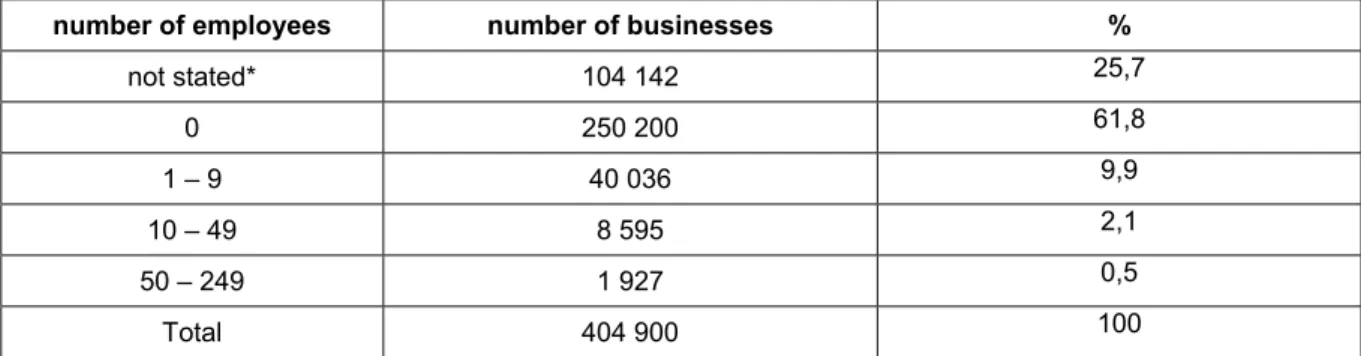
SMEs account for almost 100 per cent of companies having their head office in Prague. Currently, only 430 companies with a staff of up to 250 and more are currently registered in Prague. Yet, these large companies account for roughly 30 per cent of the total employment in Prague, i.e. the small and medium-sized sector already exceeded 2/3 of Prague’s employment.
Table 2: Division of SMEs in Prague according to the number of employees as of 30 June 2003 (in thousands)
number of employees number of businesses %
not stated* 104 142 25,7 0 250 200 61,8 1 – 9 40 036 9,9 10 – 49 8 595 2,1 50 – 249 1 927 0,5 Total 404 900 100
Note: * as a rule companies falling into the category of „micro“- companies (according to EU-classification)
It is true for the whole SME sector both in the Czech Republic and in Prague that some existence barriers and problems standing in its way can be identified. Some of those can only be sorted out through the intervention of central legislative or executive bodies (taxation, the complexity of legislation etc.) whilst territorial administrative authorities contribute to their solution only partially and indirectly. There is, however, a significant set of problems which may well be resolved at the regional level which is why they should be dealt with in projects and activities carried out with the assistance of EU structural funds.
Cooperation Between Research & Development and the Business Sphere
Prague is not only the educational and research but also economic centre of the Czech Republic. Basic preconditions exist for using this potential for quick economic development and for Prague to play a crucial role in our country in increasing the competitiveness of the Czech economy and using the results of research and development in practice. Relations between industries and research facilities should become a pillar for the development of a so-called "new economy". Evidently, research and commercial objectives are not only compatible in this case, but can supplement and strengthen each other. Research organisations subsidised from public budgets, meaning in particular Prague universities and the Czech Academy of Sciences, should play a crucial role in the economic and social development of the Prague conurbation and, consequently, of the entire Czech Republic. As mentioned above, Prague is a centre of learning. In addition to numerous primary, secondary and higher vocational schools, eight public universities, one state university, and eight non-university type private colleges existed in Prague in the academic year 2001/2002. The scientific capacity of Prague universities in combination with the large number of young scientists, students and PhD students is a very good basis for future technological development (see Chapter 2.2.2.1 for more details).
Prague universities (above all Charles University, the Czech Technical University, the Chemical and Technical University, and the Czech Agricultural University), non-state research institutions and the Czech Academy of Sciences facilities are important research centres. The centres focus especially on mathematics, informatics, and physics, Earth sciences, chemistry, material science, biology, medicine, ecology, history, economy, arts and social sciences. Specialised research institutions prepare analyses in their areas of competence and propose policies and measures for respective areas. The research sector went through considerable changes over the past years; numerous institutions were privatised. The number of institutions and their employees decreased. In spite of that, the remaining research institutes, as well as newly formed private research facilities can still constitute the important scientific potential of the capital.
The capital includes a strong economic base consisting of small and medium sized enterprises, as well as professional associations the most important of which is the Prague Economic Chamber. Also professional organisations in the field of development, innovations and technology transfer can be found in Prague (e.g. the Association of Innovative Business, Association of Research Organisations, etc.). Prague share in the innovative potential of the Czech Republic is approximately 60% and has a decreasing tendency. That means Prague plays an important role for the entire Czech Republic in the field of innovations, technology transfer and cooperation of universities, research organisations and the business sphere. Currently the innovation process in the CR is more or less occasional, without integrated coordination and the transfer of technologies is at the minimum level. The main resources of innovations are (in contrast to the situation in the EU) large enterprises. These enterprises spend for the innovations approximately 2% from their turnover. Compared with the EU average it is small amount of money. The National Innovation Strategy and the Act on Innovations are being prepared at the national level.
Due to historical development, however, up until now there has been no system for efficiently transferring the results of science and research into the practice, neither an environment motivating cooperation among scientific facilities, nor mechanisms supporting the development of human resources in that area. In this context, particularly unused is the large scientific and educational potential of Prague universities where thousands of students and PhD students taking part in research projects can become important human resources in the future for the implementation of new technologies and for the establishment and development of technologically orientated companies. Cooperation between scientific facilities and the business sphere is not yet, however, understood as a key condition for the future economic and social development.
Many university professionals realise that universities should assume responsibility for the use of research and development results in practice so as to provide for the future competitiveness of economy. The establishment of the Business and Innovation Centre at the Czech Technical University (BIC ČVUT) is a good example. The centre not only offers suitable premises for starting up innovative companies and extensive services in many fields, including industrial property protection, but cooperates also in many international projects the aim of which is to help in creating a complex system supporting new technologically orientated firms and a system of human resources development. The Prague Economic Chamber is also involved in such activities.
Transferring the results of basic research into the practice is one of the priorities of the Academy of Sciences. Its Technological Centre has been operating an incubator focused on high-tech small businesses since 1994. The activities of 21 businesses established with the support of the incubator are directly connected with the Academy of Sciences' research projects. The firms in the incubator are provided with basic business services and training for discounted prices which are subsidised by a support programme of the Czech Ministry of Industry and Trade. In 2000, the Czech Academy of Sciences launched the Programme of Support for Targeted Research financed from specially allocated funds. A publication entitled "Applied Research in the Czech Academy of Sciences" was published to inform the business sphere.
However, large scientific parks, in which innovative firms established within incubators could further develop, are missing in Prague.
Recently, attempts at deeper cooperation between universities and the Czech Academy of Sciences can be seen. It should be noted that such cooperation is more intensive in the field of preparation of new professionals rather than in the actual integration within research and development. Deeper cooperation in the field is still prevented by wrongly adjusted labour
legislation, which makes it difficult to exchange workers. The same problems also exist in the transfer of employees between universities, the Academy of Science, and industrial companies. Because of the inadequate age structure of scientists, with older persons prevailing, the institutions are not motivated to support the establishment of new technological firms just with young scientists, a fact which causes further worsening of the age structure.
The diagram below shows data about total expenditures on research and development in the Czech Republic as compared to the other countries throughout the world. The percentage share of expenditure on research and development to GDP has improved in the period 1995-1999 especially due to growing public expenditure. Nevertheless, the percentage share of total expenditure does not reach by far that amount common in developed countries, lagging behind mainly from the private sector's lack of involvement, which is down to economic reasons and lack of development capital. In comparison with other candidate countries, however, the Czech Republic's position is relatively good. Recent data, however, indicates that the increasing trend in supporting research and development from public funds stopped in the period from 2000-2002.
Diagram 2: Total Expenditure on Research and Development as a Percentage of GDP from 1995 -1999
Source of data: OECD - Main Science and Technology Indicators 2001/1
1, 01 1, 84 2, 29 2, 31 2, 98 0, 73 2, 26 1, 99 0, 69 1, 56 0, 49 1, 98 2, 50 1, 81 1, 29 2, 00 3, 19 2, 17 3, 04 0, 68 2, 44 0, 75 1, 80 1,87 2, 64 1, 85 0,00 0,50 1,00 1,50 2,00 2,50 3,00 3,50 Cze ch D enmark Finl and
France Japan Hungary
Ge rmany N e th erl ands P o land Au st ri a G reece U n ited K ingdom USA EU %GD P 1995 1996 1997 1998 1999
A total of CZK 11,035 million was spent in 2000 on science and research. The allocation from the state budget amounted to CZK 7,609 million. The support was directed to the business, state and non-profit sectors and to universities. In addition to the state budget, total expenditures were financed by recipients themselves and foreign resources. As indicated by Diagram 3, the highest proportion is spent on basic research, mainly because of high expenditures on this area in the public sector (especially the Czech Academy of Sciences). In Prague, the amount is CZK 4,244 million. Considerably fewer funds are allocated to experimental development that is closer to practical applications.
Diagram 3: Percentage of Individual Types of Research to Total Expenditures on Research and Development in Prague
Applied research 34% Basic research 39% Experimental res.. 27%
As indicated by Table 3, there are 13,940 researchers in Prague, of which 4209 are females. Most researchers are employed in the government sector, whereas the business sector and universities each employ about the same numbers of persons.
Table 3: Personnel Structure in Research and Development in Prague in 2000 Researchers
(as of 31/12) Technical and equivalent employees (as of 31/12) Auxiliary employees (as of 31/12) Sector Total Incl.
females Total Incl. females Total Incl. females
Total Incl. females
Business 3184 896 2138 845 847 421 6169 2162
Government 6176 1899 2683 1614 1787 1058 10,645 4571
Universities* 4160 1311 1205 694 749 458 6114 2463
Non-profit 421 103 79 40 14 10 5245 153
Total 13,940 4209 6105 3193 3397 1947 23,442 9349
Note: * Including some other educational facilities Source: Ministry of Education, Youth and Sports
The number of employees in the sector of science and research considerably increased in 2001, up to 36,498 of which 21,937 were researchers.
To achieve an efficient cooperation between research institutions and businesses, it is necessary to create a favourable environment. Recently, some improvements have been seen in the legal environment. The newly amended law on universities provides the universities with better opportunities of collaboration with the industrial sector: the know-how of the universities, for instance, can be used as a form of capital investment in newly established or existing businesses. The new law on research and development financing allows not only better cooperation between scientific institutions and businesses but also successful implementation of research and development outcomes in practice that is one of the key criteria when evaluating the institutions. On the other hand, an indirect support and motivation structure is missing both at the national and regional level. Implementation of new technologies is not understood as an in dispensary part of the innovation process. With some exceptions, the issue of support for the establishment and development of small and medium technology-oriented enterprises is being ignored. Capital resources for newly established enterprises (seed and start-up capital) are missing. Financing of the so-called pre-seed stage of establishing an enterprise has not yet been considered even theoretically. A uniform concept for human resources development in this sphere has not been designed yet.
The competitiveness of small and medium enterprises is crippled as a result of malfunctioning transfer of technologies and insufficient capability to introduce innovation into the manufacturing process at a large scale. This is a problem especially taking into account the fact that the Czech Republic is about to access the European Union soon. As a result of globalisation, not only manufacturing enterprises but also the city itself face stronger competition. A failure to tackle the above mentioned issue might bring about an outflow of qualified workforce from all the fields of the „city life“, leading to a gradual urban decay.
Tourism
The volume of tourism performance increased by 300 % over the past ten years, which means that tourism ranks among the branches with the highest performance dynamics. Tourism has become a significant support to the development of the city. Revenues from tourism (in gross added value) account in Prague for almost half of countrywide revenues generated by hotels and restaurants (CZK 17 billion); tourism represents 3.8 % of Prague economy’s performance.
The offer of hotel capacities or part of the material and technical base in the sector of tourism increased more than four times in the nineties. The number of permanent beds in hotel facilities (especially hotels and boarding houses) amounted to 72,000 in 2000, accounting for 15.8 % of the Czech Republic's total capacity. Besides, a further 10,000 to 15,000 (estimate) beds are offered in private houses (rented rooms, apartments, etc.). Prague exceeds Vienna, for example, in its number of beds and number of tourists staying overnight in hotels. The occupancy rate in hotels and boarding houses is above the countrywide average. In 2001, the occupancy rate was 59.2 % (50.7 % in the Czech Republic as a whole). The intensive development of new hotels and boarding houses reduced disproportions in their quality structure. Hotels and boarding houses are, however, still located unevenly and, in some cases, the level of the package of offered services does not meet international standards. The number of overnight stays in Prague per year exceeded 9 million and the average duration of stay was more than four days. Recently, the ratio of foreign visitors stabilised to 75 % (less than a half in the Czech Republic as a whole), with the dominating visitors coming from Germany, the United Kingdom, Spain, Italy, and from overseas. During the tourist season, Prague is visited on a daily basis by 50,000 up to 60,000 foreigners; in combination with domestic clients, the number of visitors totalling about 80,000.
In addition to hotels, tourism in Prague is supported by cultural and sports facilities. Whereas cultural opportunities are abundant in Prague, the number of sports centres is low if compared to the countrywide average. Prague offers 35 permanent cinemas (5 % of the Czech Republic total; the data is rather misleading as there are several multiplex cinemas in Prague which include ten or even more projection halls), 26 museums (4 % of the Czech Republic total), 93 galleries (13.4 % of the Czech Republic total), 61 theatres (28.1 % of the Czech Republic total), 24 stadiums (3 % of the Czech Republic total), and six ice hockey stadiums (2.8 % of the Czech Republic total).
Considering the intensity and contribution to the development of individual areas (city quarters), tourist activities are distributed very unevenly, being concentrated mainly in the historical core of the city.
However, the unique, attractive and exceptional localities with abundant historical monuments, as well as natural beauty spots outside the city centre, are not provided with the necessary infrastructure and suffer from a lack of marketing and coordination with activities in the region of Central Bohemia.
The field of tourism is covered mainly by small businesses (up to 20 employees). In addition to such typical economic entities, large world hotel chains also operate in Prague, such as Four Seasons, Six Continents, Accor, Radisson SAS, Marriott (about ten five-star hotels, less than 3 % of hotels in Prague or 1 % of all accommodation facilities, including private rooms, in Prague).
In the branch of tourism that is highly dependent on live work, the issue of competitiveness is not only a matter of the implementation of new technology (especially in the field of informatics and management) but also, and especially, of qualification and adaptability of workers in the field of communication with people (i.e. knowledge of languages, psychological skills, communication skills). World hotel chains operating in Prague can be expected to have no considerable problems in hiring qualified staff. In the case of other businesses involved in tourism, however, problems can be expected, generally with regard to their capital strength and position on the tourism market, which is demonstrated by the opinions of entrepreneurs in tourism on the quality of school graduates and their approach to further professional training of employees.
The competitiveness of the services and products offered in tourism is influenced by many other factors, which can hardly be controlled by entrepreneurs in tourism. Although the criminality rate in Prague is comparable with similar European capitals, that aspect still cannot be considered as positive in the field of services offered in tourism. Research conducted in 2001 and commissioned by the Prague Information Service which concerned "Tourists and Visitors to Prague" demonstrated that tourists and visitors are dissatisfied most of all with the taxi service, information services, contacts with local inhabitants, and with the overall feeling of safety. This dissatisfaction mainly applies to related services that are the responsibility of the public sector. That means there is a communication barrier of competent authorities in solving crises that may occur in places where there is a high concentration of tourists (thefts, problems with medical care in emergencies, general information, language barrier, etc.).
2.1.5 Non-governmental Organisations
Non-governmental organisations (NGO hereinafter) operate in various areas of community life, such as social services, health, education and research, culture and arts, ecology, community and housing development, protection of rights and interests, charity work, international activities, professional and labour relations, sports and recreation, etc. NGOs are a very strong complement to the government in the provision of services and public assets.
Prague is the place where more than a third of the foundations existing in the Czech Republic are registered, though most of them operate throughout the country. Various international foundations also have their offices in Prague. In addition to public administration, foundations form a further financial source for public associations, publicly beneficial institutions and churches. Endowment funds play a similar role to that of foundations. Together with foundations, however, they account for less than 5 % of the total number of registered NGOs in Prague.
In 2001, 7366 public associations, 175 publicly beneficial institutions, and 324 foundations and endowment funds existed in the region of Prague.
Specific features of Prague can be seen in the fact that Prague is also the seat of some umbrella organisations of NGOs which associate non-governmental organisations in the same branch. Service NGOs also play an important role as they provide information,
educational and consulting services that are necessary for the professional development of other non-governmental organisations throughout the Czech Republic.
In addition to other agencies, the Government Office also includes the Government Council for NGOs in which both Prague and regional NGOs are represented besides the regional and departmental officials.
NGOs positively influence the quality of the social environment in Prague as they often focus on work with groups of people at risk from social exclusion. NGOs also play an irreplaceable role in the fulfilling of the Government Programme of Environmental Education in Prague. With their activities NGOs cover the areas of social services that are only provided by the city to a limited extent or not at all. In many cases NGOs existence depends on grants from the City of Prague. In addition to such grants, NGOs use funds from grants provided by central administration authorities.
2.2 Human Resources
2.2.1 Demographic Characteristics
There are about 1,180,000 inhabitants living in Prague. A further 110,000 people commute to Prague to work, 60,000 foreigners live in Prague based on a permanent or temporary residence and work permit, more than 30,000 students live in Prague or commute to Prague to school, and more than a further 100,000 people per day stay in Prague on various grounds (foreign and Czech visitors, people on business trips, etc., including an estimated 10,000 foreigners not having residence permits). That means about 1,500,000 persons move in Prague on a daily basis.
Being the only city with more than a million inhabitants in the Czech Republic, Prague features the highest concentration of city people. Inhabitants, however, are not distributed evenly around the city. The density of population in the centre and housing estates exceeds 10,000 inhabitants per square kilometre, whereas certain quarters have maintained their suburban character and the density of population there is less than 200 persons per square kilometre.
Structure of Inhabitants
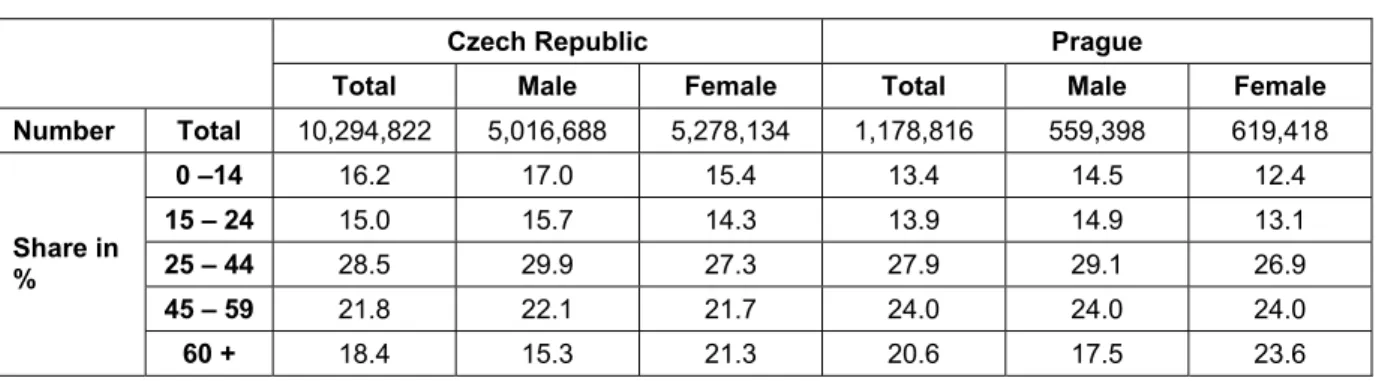
The adverse population situation in the Czech Republic is felt much more intensively in Prague. As compared to the Czech Republic average, Prague population is older, featuring a lower share of children and higher share of older inhabitants. A typical feature is the considerable share of seniors, especially women, living mostly alone. The share of inhabitants over 60 years of age is 20.6 % and the average age of 41.1 years is the highest of all regions. The number and share (13.4 %) of children in the population keeps decreasing. Women are choosing to wait until they are older to give birth. As forecasted, the trends will continue until at least 2010. The group of people above 60 years of age will be ever-increasing (by 4-5 %), whereas the number of people of an economically active age and the share of children will be decreasing.
Table 4: Structure of Inhabitants in Prague and in the Czech Republic in 2001
Czech Republic Prague
Total Male Female Total Male Female
Number Total 10,294,822 5,016,688 5,278,134 1,178,816 559,398 619,418 0 –14 16.2 17.0 15.4 13.4 14.5 12.4 15 – 24 15.0 15.7 14.3 13.9 14.9 13.1 25 – 44 28.5 29.9 27.3 27.9 29.1 26.9 45 – 59 21.8 22.1 21.7 24.0 24.0 24.0 Share in % 60 + 18.4 15.3 21.3 20.6 17.5 23.6
Source: Prague Statistical Yearbook
The uneven age structure of the inhabitants is also reflected in the structure inside Prague where a lower share of children and higher share of older people is typical for historical quarters (Prague 1, 2, 3, 6, 10).
Development of the Number of Prague Inhabitants
A decreasing trend in the number of inhabitants can be seen in the past ten years (from 1,215,000 in 1991 to 1,174,000 in 2001) that is due to the lower natural population growth and a reduction of new housing development.
Diagram 4: Number of Prague Inhabitants in 1991 through 2001 1160 1170 1180 1190 1200 1210 1220 1230 1991 1992 1993 1994 1995 1996 1997 1998 1999 2000 2001 In thousands
The number of foreigners living in Prague based on a temporary or permanent residence permit considerably increased in the past decade (60,000 persons in 2001), with nationals of the Ukraine and Russia (almost 25,000 persons), Slovakia (10,000 persons), Vietnam, China, Yugoslavia, and the United States prevailing.
From the national point of view, Prague inhabitants are quite homogeneous. According to a census in 2001, Czechs account for 92.8 %. Slovaks (1.5 %) are another important nationality. Other national groups only account for very low shares. According to expert estimates, approximately 20,000 to 25,000 Roma live in Prague.
Social integration of the Roma population is not such an issue in Prague as compared to the situation in other towns (Most, Ústí nad Labem). Large concentrations of the Roma in certain localities, however, bring tension to relations with the majority of the population.
The decreasing trend in the number of permanent residents affects most parts of the inner city, whereas certain suburbs report increases due to new development. Until 1997 the natural decrease in the number of inhabitants was made up for by people moving in. In 2000, however, the number of inhabitants moving out was 1800 greater than that of people who moved in. Not even the growing increase in the number of foreigners and migrants from other regions could stop the overall drop. The strongest former source of migration – the district of Central Bohemia – became, in recent years, the target of numerous Prague inhabitants who acquired their new homes there. The main reason is a favourable price level and sufficient supply of building lots. The largest development occurs directly behind the administrative border of Prague and in municipalities belonging to the Prague conurbation with good commuter access to Prague. In certain segments, urbanised areas of both regions merge with each other, a fact which confirms the growing intensity of mutual interconnection and, consequently, the need for a joint solution to certain problems.
Population Ageing
In last decade (1991 – 2001) the age structure of Prague’s population has substantially changed in comparison with whole country. The trends in Prague and in the rest of the country are the same - share of group of young people is decreasing while share of group of elderly people is increasing (see Diagram 5). However this process in Prague is much stronger - in 1995 the share of elderly people was higher than young people and this difference is being further deepened. In 2001 the share of elderly people was about 16 % in Prague and 14 % in CR (see Table 5).
Table 5: Development of population by age groups (in %) CZ Prague Year 0-14 65+ 0-14 65+ 1993 19,45 13,00 16,82 15,74 1994 18,85 13,13 16,17 15,85 1995 18,34 13,30 15,62 16,04 1996 17,87 13,47 15,13 16,15 1997 17,43 13,61 14,67 16,27 1998 17,02 13,72 14,29 16,34 1999 16,61 13,80 13,89 16,34 2000 16,21 13,86 13,52 16,31
Diagram 5: Development of age groups
10% 12% 14% 16% 18% 20% 22% 1993 1994 1995 1996 1997 1998 1999 2000 CZ 0-14 CZ 65+ Prague 0-14 Prague 65+
2.2.2 Lifelong Learning
2.2.2.1 Initial Education
Pre-school Education
The advantage of institutional pre-school education consists in the expert training of children and targeted formation of suitable conditions for their development and education. Institutional pre-school education is currently organised, especially in nurseries, for children mostly from three up to six years of age. Education in nurseries is not obligatory. Because 20 % of children are born in single-parent families, there is an increasing need for pre-school care for children below three years of age in specialised facilities. Prague also features a high share of children above six years of age who attend nurseries. This is due to the exceptionally high number of parents who wish to postpone obligatory school attendance for their children. Good pre-school education leads to good results; useful, for example, are "preparatory classes" for children from not very stimulating environments (especially for Roma children it is a good way to improve their chances for successful entry to basic school) or bilingual families of minorities or immigrants, which help to level up opportunities for children.
There were 295 nurseries in Prague in 2002, attended by more than 26,000 children. The average capacity of nurseries in the Czech Republic is currently 44 up to 60 children per nursery depending on the district. Because of the density of population in Prague, the capacity of Prague nurseries is 93 children per nursery. The demand for nurseries in Prague is mostly satisfied. The demand slightly increased in the category of children below three years of age, considering the decreasing number of children in relevant population years, however, no higher capacities will be needed.
Diagram 6 100 150 200 250 300 350 400 450 CZECH REPUBLIC Prague Central Bohemia South Bohemia Plzeň Karlovy Vary Ústí nad Labem Liberec Hradec Králové Pardubice Vysočina South Moravia Olomouc Zlín Moravia-Silesia
Diagram 5 AVERAGE CAPACITY OF PRIMARY SCHOOLS IN 2001 (average number of pupils per school by regions)
Primary Education
Primary education is the stage of education, which is obligatory for all children in the Czech Republic, forming a basis for lifelong learning in the whole population. Obligatory school