Microblogs.
Wang, Xinyue
The copyright of this thesis rests with the author and no quotation from it or information
derived from it may be published without the prior written consent of the author
For additional information about this publication click this link.
http://qmro.qmul.ac.uk/xmlui/handle/123456789/12951
Information about this research object was correct at the time of download; we occasionally
make corrections to records, please therefore check the published record when citing. For
more information contact [email protected]
School of Electronic Engineering and Computer Science
Real-time Content Identification for
Events and Sub-Events from Microblogs
by Xinyue Wang Feb 15, 2016
Submitted in partial fulfillment of the requirements for the degree of
I, Xinyue Wang, confirm that the research included within this thesis is my own work or that where it has been carried out in collaboration with, or supported by others, that this is duly acknowledged below and my contribution indicated. Previously published material is also acknowledged below.
I attest that I have exercised reasonable care to ensure that the work is original, and does not to the best of my knowledge break any UK law, infringe any third party’s copyright or other Intellectual Property Right, or contain any confidential material. I accept that the College has the right to use plagiarism detection software to check the electronic version of the thesis.
I confirm that this thesis has not been previously submitted for the award of a degree by this or any other university.
The copyright of this thesis rests with the author and no quotation from it or information derived from it may be published without the prior written consent of the author. Signature:Xinyue Wang
Date: February 15, 2016
ABSTRACT
Real-time Content Identification for Events and Sub-Events from Microblogs
by Xinyue Wang
In an age when people are predisposed to report real-world events through their social media accounts, many researchers value the advantages of mining such unstructured and informal data from social media. Compared with the traditional news media, online social media services, such as Twitter, can provide more comprehensive and timely information about real-world events. Existing Twitter event monitoring systems analyse partial event data and are unable to report the underlying stories or sub-events in real-time. To fill this gap, this research focuses on the automatic identification of content for events and sub-events through the analysis of Twitter streams in real-time.
To fulfil the need of real-time content identification for events and sub-events, this re-search first proposes a novel adaptive crawling model that retrieves extra event content from the Twitter Streaming API. The proposed model analyses the characteristics of hashtags and tweets collected from live Twitter streams to automate the expansion of subsequent queries. By investigating the characteristics of Twitter hashtags, this re-search then proposes three Keyword Adaptation Algorithms (KwAAs) which are based on the term frequency (TF-KwAA), the traffic pattern (TP-KwAA), and the text content of associated tweets (CS-KwAA) of the emerging hashtags. Based on the comparison between traditional keyword crawling and adaptive crawling with different KwAAs, this thesis demonstrates that the KwAAs retrieve extra event content about sub-events in real-time for both planned and unplanned events.
To examine the usefulness of extra event content for the event monitoring system, a Twitter event monitoring solution is proposed. This “Detection of Sub-events by Twit-ter Real-time Monitoring (DSTReaM)” framework concurrently runs multiple instances of a statistical-based event detection algorithm over different stream components. By evaluating the detection performance using detection accuracy and event entropy, this research demonstrates that better event detection can be achieved with a broader cov-erage of event content.
Acknowledgements viii
Author’s Publication x
1 Introduction 1
1.1 Motivation and Challenges. . . 3
1.2 Research Objectives . . . 7
1.3 Contributions and Novelty . . . 7
1.4 Thesis Structure . . . 9
2 Event Monitoring by Mining Microblogging Stream 11 2.1 Events in Social Media . . . 12
2.1.1 Events and Sub-events . . . 12
2.1.2 Event, Topic and Trend . . . 13
2.1.3 Event Categorisation. . . 14
2.2 Traditional Event Monitoring: Topic Detection and Tracking (TDT) . . . 15
2.2.1 Overview of TDT. . . 15
2.2.2 Tasks of TDT in Event Monitoring . . . 16
2.2.3 Common Evaluation Metrics . . . 17
2.3 Microblogging Text Stream . . . 18
2.3.1 Twitter as Microblogging Service . . . 19
2.3.2 Twitter Event Corpus . . . 23
2.3.3 Text Stream Mining . . . 23
2.4 TDT for Microblogging: Twitter Event Monitoring (TEM) . . . 25
2.4.1 System Pipeline and Evaluation . . . 25
2.4.2 Acquiring: Event Tweets Retrieval . . . 29
2.4.3 Detecting: Twitter Event Detection . . . 31
2.4.4 Discussion. . . 35
2.5 Summary . . . 37
3 Real-time Event Content Identification via Adaptive Microblog Crawl-ing 38 3.1 Event Content Identification: Solutions and Challenges. . . 39
3.2 Twitter Crawling Model . . . 42
3.2.1 Baseline Crawling . . . 42
3.2.2 Adaptive Crawling . . . 43
3.3 Keyword Adaptation Algorithm (KwAA) . . . 44 iii
3.3.1 Term Frequency based Approach (TF-KwAA) . . . 45
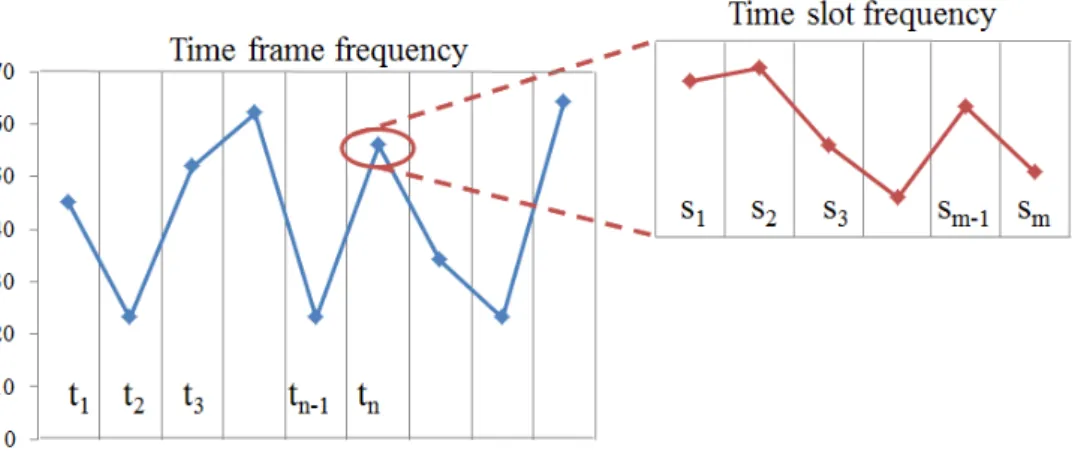
3.3.2 Traffic Pattern based Approach (TP-KwAA) . . . 48
3.3.3 Content Similarity based Approach (CS-KwAA) . . . 51
3.4 Evaluation Approaches . . . 56
3.4.1 Preliminary . . . 56
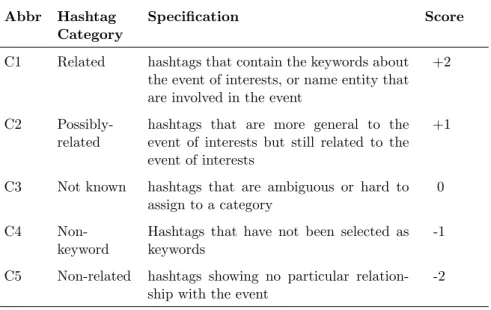
3.4.2 Hashtags Labelling . . . 57
3.4.3 Automatic Tweets Classification by Hashtags Categories . . . 58
3.5 Parameter Tuning . . . 59
3.6 Performance Evaluation Results. . . 63
3.6.1 Comparison across KwAAs . . . 63
3.6.2 Comparison over Different Events . . . 75
3.6.3 Performance Discussions . . . 83
3.7 Summary . . . 85
4 Event Detection with Adaptive Microblog Crawling 87 4.1 Detection of Sub-events by Twitter Real-time Monitoring (DSTReaM) . . 88
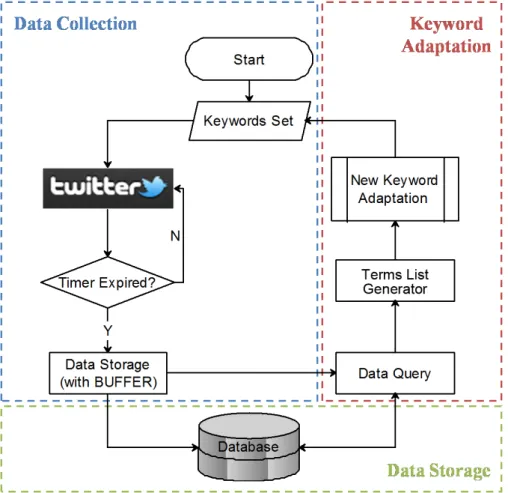
4.1.1 Adaptive Crawler. . . 90
4.1.2 Parallel Burst Detection . . . 90
4.1.3 Sub-event Formulation . . . 93
4.2 Datasets Preparation and Investigation Approaches. . . 95
4.2.1 Event Datasets . . . 95
4.2.2 Datasets preparation for Event Detection . . . 96
4.2.3 Parameter tuning. . . 99
4.2.4 Evaluation Metrics . . . 102
4.3 Investigating DSTReaM with Adaptive Datasets . . . 106
4.3.1 Experiment One: Detection Results over Raw Datasets . . . 106
4.3.2 Experiment Two: Detection Results over Filtered Datasets . . . . 114
4.3.3 Discussion. . . 117
4.4 Summary . . . 119
5 Conclusion and Future Work 121 5.1 Conclusion . . . 122
5.2 Future Work . . . 124
A Datasets Overview of Crawled Events 127
B Event Detection Results 129
1.1 Source of News by Country . . . 2
1.2 Using Social Media as the Source of News . . . 3
2.1 Examples of Event Categories . . . 15
2.2 Tweet JSON document . . . 20
2.3 Event Monitoring Pipeline under Twitter . . . 26
3.1 Tweets about a Football Competition during 2012 Olympic Games . . . . 40
3.2 Volume of Tweets Crawled by Different Keywords . . . 41
3.3 Components and System Flow of Baseline Twitter Crawling Model . . . . 42
3.4 Components and System Flow of the Adaptive Crawling Model . . . 43
3.5 Time frames and Time slots for Hashtag Frequency . . . 49
3.6 Construction Procedures of Hashtag-based TF-IDF vector . . . 53
3.7 Parameter Tuning for TP-KwAA . . . 61
3.8 Tweet Volume for 2013 Glastonbury Music Festival . . . 66
3.9 Tweet Volume for 2013 Glastonbury Music Festival (Evaluation Period) . 66 3.10 Event-relevant versus Event-irrelevant Tweets for 2013 Glastonbury Fes-tival (Evaluation Period). . . 71
3.11 Information Gain to Noise Level Ratio for 2013 Glastonbury Festival (Evaluation Period) . . . 74
3.12 Keywords Categories and Distribution of Four Evaluation Datasets . . . 79
3.13 Information Gain to Noise Level Ratio of Four Evaluation Datasets. . . . 82
4.1 Twitter Event Monitoring Solution: DSTReaM . . . 89
4.2 Detected Peak Windows of Glastonbury Festival (Raw) . . . 111
4.3 Detected Peak Windows of Sochi Olympic (Raw) . . . 112
4.4 Detected Peak Windows of Glastonbury Festival (Filtered). . . 115
4.5 Detected Peak Windows of Sochi Olympic (Filtered) . . . 115
2.1 Confusion Matrix for Information Retrieval . . . 18
2.2 Track Example for Twitter Streaming API Filter Function . . . 22
3.1 Hashtag Categorization and Grading Strategy . . . 57
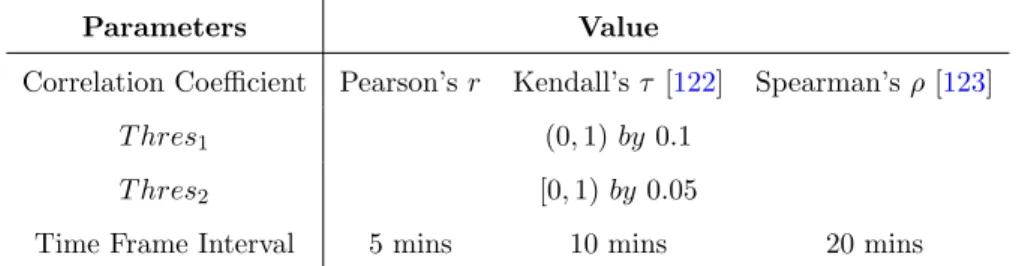
3.2 Parameters List and Testing Values for TP-KwAA . . . 59
3.3 Tweet Volume Generated by Different Crawling Approaches (Glastonbury) 64 3.4 Number of Keywords Identified by Different Crawling Approaches (Glas-tonbury) . . . 65
3.5 Hashtag Categorization and Grading Strategy . . . 67
3.6 Keyword Categories by Hashtags Labelling for 2013 Glastonbury Festival (Evaluation Period) . . . 68
3.7 Precision and Recall of Keyword Identification for 2013 Glastonbury Fes-tival (Evaluation Period). . . 69
3.8 Event Relevance of Retrieved Tweets for 2013 Glastonbury Festival (Eval-uation Period) . . . 70
3.9 Event datasets overview for Evaluation and Comparison . . . 77
4.1 Event Datasets Overview . . . 95
4.2 Tweets Volume of Evaluation Datasets . . . 97
4.3 Input Parameters of Twitinfo Algorithm . . . 99
4.4 Parameters Setting for Twitinfo Algorithm . . . 102
4.5 Detection Precision and Duplicate Rate . . . 104
4.6 Description of Sub-Events (Glastonbury Festival) . . . 108
4.7 Description for Noisy Peak Windows (Glastonbury Festival) . . . 109
4.8 Description for Noisy Peak Windows (Sochi Olympic) . . . 109
4.9 Description for Sub-Events (Sochi Olympic) . . . 110
4.10 Evaluation Metrics on Raw Datasets . . . 113
4.11 Evaluation Metrics on Filtered Datasets . . . 117
4.12 DSTReaM on Raw Datasets. . . 118
4.13 DSTReaM on Filtered Datasets . . . 118
A.1 Datasets Overview . . . 127
A.2 Datasets Overview (Continued) . . . 128
B.1 Detailed Event Detection Results (filtered BL dataset for Glastonbury) . 130
TDT Topic Detection and Tracking KwAAs Keyword Adaptation Algorithms
TF-KwAA Term Frequency based Keyword Adaptation Algorithm TP Traffic Pattern based Keyword Adaptation Algorithm CS Content Similarity based Keyword Adaptation Algorithm TT Topic Tracking
TD Topic Detection FSD First Story Detection
API Application Program Interface TEM Twitter Event Monitoring NED New Event Detection
RED Retrospective Event Detection PRF Pseudo Relevance Feedback
TF-IDF Term Frequency - Inverse Document Frequency EWMA Exponentially Weighted Moving Average MH17 Malaysia Airlines Flight 17
BL Baseline crawler/dataset AD Adaptive crawler/dataset EX Extra dataset p Precision r Recall F1 F1 score
DSTReam Detection of Sub-events by Twitter Real-time Monitoring vii
First and foremost, I would like to express my sincere gratitude to Dr. Laurissa Tokarchuk and Dr. Stefan Poslad for their supervision, advice, understanding and sup-port throughput my whole Ph.D. Laurissa’s patient guidance of research and unflagging enthusiasm towards life have inspired me a lot. Stefan always encouraged me to think from a systematic viewpoint toward my research and gave a lot of guidance on technical and logical writing. I deeply appreciate their contribution of time and work to make this research stimulating. Thank you both!
I would also like to acknowledge the financial support from School of Electronic Engi-neering and Computer Science (EECS), Queen Mary University of London (QMUL) and China Scholarship Council (CSC), who enabled this research to be conducted. I also wish to thank Dr F´elix Cuadrado for the technical support he gave.
Additionally, I am also very grateful for the support from my friends, and other members of the Network Research Group and Cognitive Science Research Group. They have brought great pleasure to light up my life and it is great to have them around.
Finally, special thanks must go to my beloved family. They are always ready to give me support and love. And also to my good friend Teng Jiang, I thank him for the tolerance and understanding of my occasional bad mood. Without his unwavering support and help, I wouldn’t be as able to survive the hard times.
• Xinyue Wang, Laurissa Tokarchuk, F´elix Cuadrado, and Stefan Poslad. Adaptive Identification of Hashtags for Real-time Event Data Collection. In: Recommen-dation and Search in Social Networks. Eds. Ulusoy, O., Tansel A.U., and Arkun, E., Lecture Notes in Social Network, 2015, 1-22
• Xinyue Wang, Laurissa Tokarchuk, and Stefan Poslad. Identifying Relevant Event Content for Real-time Event Detection. IEEE/ACM. International Conference on Advances in Social Networks Analysis and Mining (ASONAM 2014), Beijing, China, August 2014, 395 - 398
• Xinyue Wang, Laurissa Tokarchuk, Flix Cuadrado, and Stefan Poslad. Exploiting Hashtags for Adaptive Microblog Crawling. IEEE/ACM International Conference on Social Networks Analysis and Mining (ASONAM 2013), Ontario, Canada, Au-gust 2013, 311-315
• Andrea Zielinski, Stuart E. Middleton, Laurissa Tokarchuk and Xinyue Wang. Social-media Text Mining and Network Analysis to support Decision Support for Natural Crisis Management. International Conference on Information Systems for Crisis Response and Management (ISCRAM 2013)
Introduction
The desire for knowledge of both planned and unplanned events in part drives the thirst to consume news about current events. What in part drives our thirst for knowledge about unplanned events is simply to find out more information about unforeseen things. What in part drives our thirst for knowledge about planned events is the need to know about the underlying stories of the events: such as if there is a sports-event, what is the progress of specific sports players we are interested in. Since the issue of the first newspaper in 1605, traditional news media, including the printed media, broadcast media and newswires, acts as the principle channel for the general public to get knowledge about events in the world around them. With the huge explosion of different news sources about worldwide events, it can be overwhelming for readers to manually find stories of events that interest them. As a result, the Topic Detection and Tracking (TDT) project was initiated. It provides ways to automatically identify specific sets of stories that relate to newsworthy events [1]. All of these solutions rely on text retrieval and clustering techniques to detect events from a temporal-ordered structured text stream [2,3]. However, the traditional news media is characterised by “one-way” news consumption: readers are only allowed to be passively involved in the process. Since events news are packaged by media professionals, people’s knowledge of such reported events can be mis-represented, e.g. even professional news reports can be biased with personal opinions. The traditional news media tends to mask the ability of the general public to express
Figure 1.1: Source of News by Country. Proportion of news consumers that used the particular sources of news in the last week (reproduced from [8])
their own opinions, and also prevents media consumers from obtaining a comprehensive overview of events [4]. Event news is often time and location-sensitive, journalists may only have an incomplete or partial view of the event when they arrive on the scene. Moreover, the lengthy production pipeline followed by the traditional news media for generating news reports (acquiring, writing, reporting and producing) increases the re-porting latency [5]. Although the emerging new media, i.e. using online portals of news agency, alleviates some of the issues in traditional news media through a more open and easier accessed infrastructure, the perception of news is still affected by the “one-way” communication pattern and the time consuming production pipeline.
Starting with Web 1.0 that allowed anyone to publish a blog and interlink it to other information, Web 2.0 has continued to reshape the way people interact with the rest of the world and engage in events. Instead of passively consuming online news as a reader, the general public is drawn in to contribute their ideas through Web 2.0 applications [6]. As a representative type of Web 2.0 application, social media not only blurs the line between information disseminators and receivers, but also breaks the barriers be-tween news experts and amateurs [7]. This more social type of news consumption raises unprecedented challenges to traditional news media and online newswire. Nowadays, a large proportion of the population seeks to use online media for news (as shown in Figure1.1), and the amount of people who rely on social media to find news is increasing (as shown in Figure 1.2).
By encouraging the general public to report their observations and to express their opinions about real-world events, online social media provides a more open and flexible platform for sharing events information. Equipped with an increasingly influential army
Figure 1.2: Using Social Media as the Source of News. Proportion of news consumer
that used social media as the sources of news in 2013 and 2015 (reproduced from [8])
of “citizen journalists” [9] and “social sensors” [10], online social media are becoming the microphone and camera for mass events [11]. Many real-world examples can be used to illustrate the effectiveness of online social media during news events. For instance, warning messages during Virginia Tech shooting in April 2007 came primarily from stu-dents and unofficial sources via the online social media [12]; the devastating bomb blasts in Mumbai in November 2008 also relied on online social media for decision making [13]; one of the most well-known example is the “Arab Spring””: social media became the primary medium to unravel the progress of this revolution [14, 15]. Additionally, in contrast to the long latency (days, weeks or even months) of traditional news media, social media provides quicker access and more comprehensive information [16]. Moni-toring and analysing this fruitful and dynamic flow of people’s reports can yield precious information, which would not have been available from traditional media outlets [17]. Consequently, researchers today start to value the advantages of mining large scale data from social media [18,19,20].
1.1
Motivation and Challenges
Microblogging services, such as Twitter1, are becoming a prominent communication tool for news dissemination [21,22]. Twitter supports this by the concise expression of ideas and opinions via a tweet, i.e. a short text in format limited to 140 characters. Users can instantly post and access tweets about the latest local and worldwide news. Among the more than 300 million active users [23], 56% of them post tweets about current events in real-time [24]. Empirical studies demonstrate that Twitter not only reveals the broadcast events [25, 26], but also becomes the preferred medium for discovering breaking news [27,28].
Although the less strict requirement on content quality facilitates the adoption of Twit-ter, this feature also infuses its content with a great amount of noise information. People share not only their comments about events, but also about their most trivial matters of daily lives. As a result, Twitter streams contain large amounts of meaningless chats [29], advertisements [30] and even rumours [31]. In the last decade, notable research efforts have been made to try to distinguish the informative tweets about real-world events from the rest of the background noise information [32,33,34,35,36,37,38]. The main focus is to quickly identify the events from the mass Twitter stream. However, rather than the efficiency of reporting the breaking news ahead of online newswires [27], the advantages of Twitter lies in its effectiveness as follows. Twitter offers a broader cover-age of event information intertwined with additional viewpoints [39] and the capability in revealing wider aspects about the evolution of events [40]. By scrolling through the Twitter timeline and tracking live Twitter streams, it is possible to acquire information about both the events and the underlying stories (or sub-events) for a fuller picture of an event.
To monitor the finer granularities, i.e. sub-events, of an event, common practice is to analyse filtered Twitter streams using event detection approaches that are developed for conventional TDT tasks. A large proportion of these solutions detect different phases of disaster events for offering situation awareness to both general public and government
1Twitter:
authorities [41,42,43, 44]. Other research work investigates the sub-events of planned events, such as sport competitions [45,46,47,48], festival activities [49,50] and political elections [51,52,53]. However, their solutions still have the following drawbacks:
• Use pre-defined search criteria
A common assumption made by most existing research is that all sub-event events information is retrievable using pre-defined and constant keywords. Therefore, their conclusions are based on static datasets that represents the status of the event at a particular time point. However, pre-defined keywords are subjective and new topics about sub-events often arise in the midst of events [112]. It is necessary to expand the coverage of event information during the event.
• Infeasible to run in real-time
To better detect and understand sub-events, researchers upgrade the existing solu-tions by running them in multiple iterasolu-tions. This is at the cost of extra complexity and additional resources. Existing research has shown that the traditional event detection algorithms don’t scale to huge volume of high speed streaming data, such as tweets [32]. Since a main feature of Twitter is to provide instantaneous access to the event information, a solution that is capable to get timely event information with good accuracy is desired.
• Focus on single type of events
Some existing solutions are based on the assumption that the prior knowledge of the events exists [49, 50]. Although external resources can provide a priori knowledge of planned events, this is not the case for unplanned events, such as protests and crises. Unplanned events are by their nature unanticipated and hard to discover or predict. Sub-event monitoring of unplanned events are normally designed to meet the information needs during aftermath. These solutions are event specific and have strict requirements for the input data [44, 54]. Since the existing solutions tend to focus on a single type of events, hence, information analysis that can cope with both planned and unplanned events is required.
monitor-ing with information about the underlymonitor-ing stories and subsequent events. Consequently, the focus of this research is to provide a fuller picture of breaking news events by de-tecting and summarising the underlying meaningful sub-events in real-time. To achieve this research aim, some essential challenges raised by both Twitter’s characteristics and an event’s characteristics need to be solved:
• The short-length nature of tweets. Admittedly, event information from Twit-ter is easier to consume and fasTwit-ter to spread due to this feature. However, compared with conventional documents, the apparent reduction in document length of tweets can be problematic. Commonly, a text document is modelled with the probability distribution of its term, such as the bag of word model [55] or topic model [56]. Short text documents such as tweets thus can thus result in term sparsity issue and become incompatible with existing text mining techniques.
• The high arrival rate of tweets. The main reason for analysing events through Twitter streams is its ability to reveal the evolution of events in real-time. However, the velocity and volume of tweets produced in every single second is continuously growing [57]. While the existing systems are designed to deal with a reduced corpus (i.e. tweets are preprocessed with noises filtering), they are unable to scale to a large amount of tweets [58].
• Noisy tweets in Twitter events stream. Acquisition of event-relevant Twitter posts from the noisy Microblog environments can be a non-trivial task. Although the focus of this research is to discover information about sub-events from a text stream about a certain event, the background noise in the diverse and poor quality tweets still needs to be considered. This is critical if better quality information about the underlying stories needs to be provided.
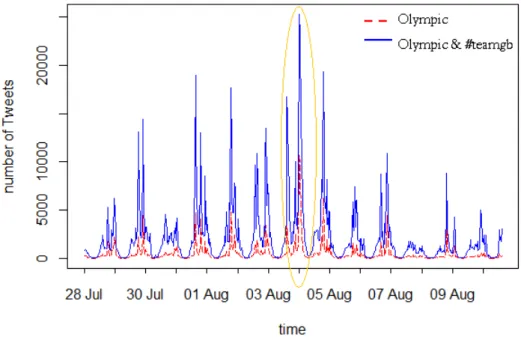
• The diversity across various types of events. Different type of events are described and discussed with a different vocabulary. Even for similar events that share common terms (e.g. FIFA World Cup2 and the Football competition of
2an international association football competition, held every four years, contested by the senior
Olympic Games), the amount of tweets traffic associated with each of them varies. In fact, the information about any two events differ significantly in content, number of messages and participants, periods, inherent structure, and causal relationships [59], thus making the idea of a one-fit-all solution, seem unlikely.
1.2
Research Objectives
In order to detect and summarise sub-events and subsequent stories of the events , this research will build on existing event detection research. By collecting, detecting and then extracting the event-relevant tweets, the final output is exploited to formulate the overview of the events. Whilst the existing research focuses on the depth of detection, i.e. on more accurate detection results with sophisticated but inefficient algorithms, the focus of this research is in achieving the same goal by increasing the coverage of the event content.
Specifically, the main objective of this research can be stated as: to provide a better event monitoring solution that identifies the newsworthy sub-events in an online manner by exploiting the expanded coverage of online social media text documents, e.g. tweets about the event of interest. This research fulfils the main objective by achieving the following three sub-objectives:
1. to explore whether there exists extra event content in addition to the datasets used by the existing solutions and to design a microblog crawling model that enables extra event-relevant content to be collected in real-time;
2. to identify features or metrics that can be used to retrieve event-relevant contents and to relate these features to the Twitter crawling model;
3. to investigate the performance of sub-event detection with a broader coverage of event content by developing a new event monitoring solution that incorporates a new Twitter crawling model.
1.3
Contributions and Novelty
This research proposes to improve the Twitter event monitoring system by automatically mining a comprehensive set of event content based on live streaming tweets. The main, novel, contributions of this thesis are as follows:
1. A novel model of real-time event content retrieval for streaming text, called adap-tive microblog crawling, or simply adaptive crawling. This model analyses the characteristics of incoming Twitter streams in real-time to expand the subsequent queries for automatically identifying event relevant terms and content.
2. Three Keyword Adaptation Algorithms (KwAAs). By exploring the relationship between event relevance of hashtags and three different features, including the adoption frequency, the traffic pattern and the tweet content similarity between different hashtags, these KwAAs are proposed and integrated with the proposed adaptive crawling model. A thorough evaluation of these against the conventional crawling model over four different type of events is then conducted.
3. A Twitter Event Monitoring solution, called “Detection of Sub-events by Twitter Real-time Monitoring (DSTReaM)”. In order to better understand the effects of a broader coverage of event information, this thesis not only explores the impact of data filtering on the sub-event detection, but also compares the detection summary with topical keywords that are identified by the proposed KwAAs.
Other contributions in accordance with the main contributions made by this thesis are:
4. A tweet events corpus that covers 11 different events of various types, includ-ing sports competition, music festival, political referendum, nature disaster, crisis protest and etc. Each event in the corpus is retrieved by at least two different methods and with a list of topical hashtags;
5. A novel way for retrieving, aggregating and constructing the vector representa-tion of a single hashtag based on the existing TF-IDF vector calcularepresenta-tion, called “Hashtag-based TF-IDF vector”.
The above contributions made by this thesis have contributed to the publications listed inAuthor’s Publication:
1.4
Thesis Structure
The remainder of this thesis is organised as follows:
Chapter 2 reviews the relevant context of exiting work on event monitoring, especially with Twitter text streams. First, this chapter gives a general overview of the Topic De-tection and Tracking(TDT) project, including the definition of events and an overview of traditional TDT tasks. Then, the characteristics of Twitter and its inherent restric-tions in getting event data are introduced. This is followed by a survey of existing event monitoring systems in terms of event tweets retrieval and Twitter event detection. This chapter finishes with a discussion of the existing literatures for bridging the research gaps between the current state-of-art methods versus the problem requirements (to be solved by this research).
Based on the research gaps defined in chapter 2, the thesis then proposes an adaptive microblog crawling model to expand the coverage of the event information, as illustrated in chapter3. The working mechanism of the proposed adaptive Twitter crawling model is to detect emerging popular event terms and to monitor them to expand the subsequent queries for retrieving highly associated data for the events of interest. Based on the characteristics of live Twitter stream, three Keyword Adaptation Algorithms (KwAA) were designed and integrated to the adaptive Twitter crawling model. With the aim of validating the working efficiency and effectiveness of the KwAAs, this research evaluates the performance of different KwAAs based on the event content they identified from various type of events. The results show that the two (both crawling model and KwAAs) working together can incur at least 20% more event relevant Twitter traffic.
Chapter 4investigates the usefulness of adaptive crawling for sub-event detection. The Twitter event monitoring solution “Detection of Sub-events by Twitter Real-time Mon-itoring (DSTReaM)” is proposed and tested with two real-time events. The aim is to
demonstrate that a better event monitoring can be achieved with a broader coverage of event content. In addition, this research also investigates the impact of data filtering on the event-detection results to identify deficiencies of existing algorithm when using the adaptive datasets.
Finally, chapter 5 gives the conclusions for the research work in the whole thesis, and then outlines some of the selective aspects of the research as the recommendation for the future work.
Event Monitoring by Mining
Microblogging Stream
The human desire for getting knowledge about both planned and unplanned events drives the evolution of the modern news media. For a long time, the traditional news media, acts as the principle channel for the general public to get knowledge about events in the world around them. With an increasing number of reports on the worldwide events from diverse news organizations, it can be overwhelming for readers to discover interesting stories from the massive amount of reports. In order to identify specific sets of stories that interest readers, researchers have proposed the Topic Detection and Tracking (TDT) framework for detecting the newsworthy events. However, this TDT framework and its solutions are designed for online newswires that only contain structured and formal news reports.
Since traditional media and online media reports are produced by a smaller number of news professionals compared to the normal public, they can be misleading or biased. User generated event descriptions on online social media, such as Microblogging services can provides more comprehensive information [60]. While some researchers have tried to adapt the existing TDT solutions to an online social media scenario, other researchers have explored new ways to undertake event and sub-event identification. This is because traditional TDT solutions are unable to scale to process the massive amount of streaming
data generated by the online social media services users.
This chapter continues with the background relating to the event detection, including the definition of event in social media (in section2.1), the fundamental concepts, techniques and evaluation metrics used in conventional TDT framework (in section2.2), as well as the challenges raised by Web 2.0 applications, i.e. social media services, in the event detection tasks (in section 2.3). Research that aims to improve event monitoring in social media environments are introduced and discussed (in section2.4). Based on the research questions and a critical analysis of current solutions, this chapter concludes with a summary of the limitations of existing solutions and highlights the motivation of this research work (in section2.5).
2.1
Events in Social Media
The term “event” is actually very abstract and can be mentioned in various specific domains, such as time series, textual news and social media. This section aims at clarifying the event-related definitions and concepts in the social media environment.
2.1.1 Events and Sub-events
In the scope of Information Retrieval (IR) research, there exists multiple efforts in defin-ing the concept of event. For example, Allan defines an event as “a specific thdefin-ing which is associated with a specific time and place along with all necessary preconditions and unavoidable consequences” [1], while Yang et al. consider events as “something that are non-trivial and happen at a certain time period” [61]. Given the above definitions, an animal that gives a birth in the wild can be regarded as an event. However, things like this normally don’t attract people’s attention and can hardly be discussed over social media. Different definitions will lead to different results. Therefore, the formal definition of event and sub-event in this thesis are given as follows:
Definition 1: aneventunder social media environment is something which happens in the real-world at a certain time period and receives constant discussion by social media
users during that time period.
Definition 2: an event stream is a set of temporal coherent text pieces which are overlapped in vocabulary. The overlapped vocabulary concerns a common event in social media. An event stream can be represented as a sequence of tuples that includes a timestamp and a set of features, or terms.
Definition 3: a sub-eventdescribes the episode of an event by the underlying story or sub-sequent story. The content of sub-events belonging to the same event made up the event stream. As a result, each sub-event can also be represented by tuples which are strongly correlated with each other by the features and coherent by the timestamps.
2.1.2 Event, Topic and Trend
To avoid potential ambiguity when describing event monitoring methods, the definitions and relationship between terms like “topic”, “trend” and “event” under the subject of event monitoring are explained in this section.
Some researchers interpret “topic” and “event” in an intuitive way, stating that events are the instances of topics [61]. Another work also recognizes this concept by defining the “topic” as “domain”, which abstracts the essence of a set of events belongs to a particular type [62]. Other researchers defines “topic” in a more specific way. A topic is regarded as “a seminal event or activity along with all directly related events and activities” [63]. Namely, a topic is a set of stories which describe the same event. These stories, also known as topically cohesive segment of news, include two or more declarative independent clauses about a single event [3].
In addition to the discussion between “topic” and “event” in the literature, Yang et al. also proposes some other insights about the relation between “trend” and “event” [61]. When they observe the time frequency sequence of a topic stream, they found that the stream always consists of bursts of documents with time gaps. Therefore, they conclude that those gaps indicate that each burst corresponds to an independent event. This observation then leads to the discussion about the concept of “trend”. In an earlier work
which reviewed the trend detection methodology for textual data, “trend” is defined as “a topic area that is growing in interest and utility over time” [64]. According to their definition, the objective of trend detection tasks over textual data can be summarised as the identification of topic areas that are previously unseen or are rapidly growing. The rapid growth can be observed by the sharp increases in some features (such as the frequency of terms or the volume of reports) in a text stream [65]. As a result, it becomes very common to use the term “burst” or “peak” to describe the rapid growth of feature in many literatures [65, 66]. As a result, researchers borrow the techniques in anomaly detection [67] or outlier detection [68] since they have the same target: to identify the previously unseen observations that don’t follow the regular pattern in a continuous stream.
2.1.3 Event Categorisation
Before monitoring events, the differences between events should be clarified. In general, events can be differ in scale, duration, content and etc. Some research work has been done on categorising events. For example, events can be classified according to their difference on subjects (for example, technology, idiom, sports, political, games, music, celebrity, movies) [69]. Some other work tries to characterise events based on their inherent features. In their classification framework, events are classified as planned or unplanned event [70], trending or non-trending event [71]. According to their definition, an event is considered as planned event only when its title and occurring time are known in advance. Events that have one or more features that are substantially unusual than expected are considered as trading events. The planned event and trending event are not mutually exclusive event type (shown in Figure2.1). For example, an event should be either planned or unplanned, but can be both planned and trending. Though an event can be characterised using different criteria, the characteristics of different types of events vary significantly. Sometime, it is also hard to classify the event reports even they are about the same type [72].
Figure 2.1: Examples of Event Categories (reproduced from [70])
2.2
Traditional Event Monitoring: Topic Detection and
Tracking (TDT)
The TDT research has long been addressed in the literature since late 1990s. The initial motivation is to provide core technology for news monitoring tools from multiple sources of traditional media (for example, printed media, broadcast media and newswire ) to keep users updated about news event developments. As the core research project for providing solutions to event monitoring over traditional media, it lays the foundation for modern event monitoring. In this part, an overview of traditional TDT research is given in section2.2.1. Their detection tasks and adopted evaluation metrics are described in section 2.2.2and 2.2.3respectively.
2.2.1 Overview of TDT
The TDT benchmark evaluation project is initiated and sponsored by Defence Advanced Research Projects Agency (DARPA) of U.S Government [73]. The TDT Pilot Study is explored and conducted by DARPA with additional three institutions, including Uni-versity of Massachusetts, Carnegie Mellon UniUni-versity and Dragon Systems [3].
With the objective to improve the automatic monitoring of topics from multiple sources of traditional media, a significant massive research efforts have been put into the TDT project. Based on the characteristic of the emergence and development of events in news streams, the TDT project mainly deals with the following five tasks [74]:
• Story Segmentation: Identify the boundaries between topics from a topically cohesive continuous stream, and then detect those topics by segment the stream precisely. This task is primarily audio-based.
• Topic Tracking (TT):formulate the storyline of a known topic by keeping track of stories similar to a set of example stories
• Topic Detection (TD):group the stories that discuss the same topic into single cluster. That is to say, each topic can be represented as a list of stories that are topically correlated.
• First Story Detection (FSD): detect if a story is the first instance of a new, unknown topic. The difference from the Topic Detection task is that the output of this system is individual story of each topic.
• Link Detection: detect whether or not two stories are related to the same event. Topics can vary differently from each other, so the system needs to adapt itself accordingly. Therefore, the difficulty of this task is to design a detection model requires no prior knowledge.
2.2.2 Tasks of TDT in Event Monitoring
Although these five tasks deal with different problems in TDT research, some of them are closely related and thus are tackled within one solution. For example, the FSD and TT tasks are closely connected with the TD task. These five tasks can be integrated to fit more generalised detection tasks [2].
This integration is based on the observation that some of the real-world topic can be discontinuous. Some topics may become trending again after a period of silence. Taking the MH370 missing plane1 for example, people mentioned this in Twitter on its one year anniversary, also some details about the missing were revealed discontinuously. Consequently, this characteristics lead to two research questions in the TDT project:
1. How to differentiate stories that belongs to the same topic? 2. How to determine whether the topic emerged previously?
1MH370 Missing Plane:
The appearance of these questions not only leads to the research on topic granularity, but also triggers the shift of research interests from topic to event. As a result, current TDT projects mainly include solutions for two tasks: New Event Detection (NED) and Retrospective Event Detection (RED). In fact, the NED task is equivalent to the FSD task while the RED task is a supplementary. The solutions of these tasks are built upon the solutions of the existing TDT tasks.
New Event Detection (NED) NED task is proposed to solve the first question. This task is very similar to the FSD. Both of them are designed to identify the very first report though the NED system also concerns whether existing report in the system also refers to the same topic.
Retrospective Event Detection (RED) The objective of RED task is to search the report retrospectively to distinguish all the events which refer to the same topic. Namely, it assists the FSD system to review the whole corpus and identify the events that correlated to the topic of interests.
2.2.3 Common Evaluation Metrics
As a research problem under the Information Retrieval subject, the evaluation metrics used in information retrieval can be adopted to assess the TDT solutions. Much of the existing TDT research tends to use one of the popular metrics “Precision and Recall”. These two metrics are designed to predict the relevance of a document. Specifically, they measure how precise and complete the retrieved documents are on all the relevant instances. In the TDT frame, they measure how precise and complete the identified events are on all the real-world (realistic) events which appears in the document stream. The definitions of these two measurements can be better elaborated with the confusion matrix, as shown in Table 2.1.
Based on the confusion matrix, thePrecision(P) is the fraction of retrieved documents that are relevant to user’s interests, while the Recall (R) is the fraction of relevant
Table 2.1: Confusion Matrix for Information Retrieval
Relevant/Realistic Irrelevant/Unrealistic Retrieved/Detected true positives (tp) false positives (fp) Non Retrieved/Not Detected false negative (fn) true negative (tn)
documents that are retrieved. As a result, in TDT evaluation, the precision is the fraction of detected events that corresponds to the realistic event, while the recall is the fraction of realistic event that are detected. They can be calculated by equation2.1and
2.2respectively.
P =P(relevant|retrieved) =P(realistic|detected) = tp
tp+f p (2.1)
R=P(retrieved|relevant) =P(detected|realistic) = tp
tp+f n (2.2) Sometimes, the researchers employ theF-measureto trade-off both precision and recall by weighted with their harmonic mean with equation 2.3
F = 1 αP1 + (1−α)R1 = (β2+ 1)P R β2P +R , where β 2= 1−α α (2.3)
However, for modern information retrieval system which got thousands of relevant doc-uments even can’t be fully identified, recall is no longer a meaningful metric. In this case, precision at k documents (P@k) becomes more useful. This metric measures the number of relevant document on the top ranked results thus requires a way to rank the retrieval results.
2.3
Microblogging Text Stream
Microblogging is characterised by the nature of allowing general public to post the short text pieces. Compared with traditional blog posts, a micropost is easier to read and faster to spread, due to its short length [75]. People use microblogging services for not only chatting and communicating, but also for sharing information and reporting news[76]. Consequently, such research tends to analyse posts from Microblogging
ser-vices as they accumulate and distribute event information from the general public. In this thesis, Twitter is used for carrying the research work, as it is one of the most pop-ular microblogging services. With a brief introduction on Twitter properties that are relevant to this research (in section2.3.1), this section then introduce the event corpus available 2.3.2. Finally, the feasibility of real-time processing with Twitter streaming are discussed (in section 2.3.3).
2.3.1 Twitter as Microblogging Service
As one of the major social media services, Twitter is a popular microblogging site having hundreds of millions of registered users. It is a simple version of blog service and allows users to post short messages (i.e. tweets) up to 140 characters. Apart from the normal web published tweets, users can also access and publish their thoughts on Twitter by the mobile phone that connected to the Internet or Short Message Service (SMS) message.
2.3.1.1 Service Overview: Characteristics
Twitter allows a kind of loose relationship: User X can follow user Y and view Y’s contents without requiring approval or a reciprocal connection from user Y. By default, all the posted messages are visible to anyone, but user can set their privacy preferences so that their updates are only available to their friends. These posted messages are displayed as stream on users’ main page in a reversed chronological order. Normally, a tweet is represented by a JSON2 document. This lightweight data format defines
the tweet attributes by its properties, e.g. the text, timestamp, URLs, hashtags, user mentions, user information and etc.. The location information will also be presented if applicable. Figure2.2 shows the structure of a typical tweet in JSON format.
2.3.1.2 Conversational Usage of Twitter Symbols
Twitter is described as “the SMS of the Internet” due to its conversational characteristic. This is supported by its well-known @ mention, RT retweet and # hashtag annotation.
2
By placing the “@” symbol before a username, Twitter user can create a mention or reply to the username this symbol linked with. This symbol can be put anywhere in the tweets when the purpose is to mention another Twitter user. However, @ must be put at the beginning of the tweet when it is a response to the mentioned user.
Twitter also allows users to forward (i.e. retweet) other’s tweet. A “RT” prefix is used, followed by the user name that creates this message. In fact, this symbol not only disseminate interesting information on Twitter but also increase the influence of the original user.
As the topic indicator on Twitter, the #hashtag annotation allows users to indicate what the message is about when they publish a tweet. By adding a “#” mark before the topic words, users can generate their own topic indicator at any moment. As designed to support grouping similar tweets, the Twitter’s user interface automatically associates a hyperlink for each hashtag to allow people to retrieve all tweets with the same hashtag by just one click.
2.3.1.3 Twitter API and Rate Limits
Twitter provides three public APIs to developers and researchers for designing and im-plementing customised data analysis tools: Search API,Representational State Transfer (REST) API andStreaming API. In the free access manner, it is not possible to retrieve all the Twitter data as rate limit is introduced to restrict the access of API 3.
The Search API and the REST API share similar rate limit. In the older version (V 1.0), an OAuth-enabled application could initiate 350 query requests. While API v1.1’s rate limiting model allows for a wider range of requests by 180 calls every time window, i.e. 15 minutes.
Twitter Streaming API is the only accessible interface that offers real-time access to Twitter’s public timeline. With the default access level (free of charge), a small propor-tion of all public tweets , i.e. 1% of whole tweets, in its core database can be retrieved
by using sample function for each normal OAuth4 enabled user.
The 1% rate limit is also applied to the filter method of Twitter Streaming API. The filtering function allows the applications to query the core database for extracting all tweets associating with some specific criteria, such as users, keywords, URL link, lan-guage, location and etc.5 However, the full access of retrieval contents is possible only when the retrieved volume is less than 1% of the total Twitter traffic. Otherwise, that 1% will spread out across keywords, only a subset of tweets will be retrieved for each individual keyword. In addition, the number of terms can be tracked is limited to a max-imum of 400 keywords for a single query when using Streaming API. However, Twitter provides the fuzzy matching of phrases rather than exact matching. For example, when using “Twitter” as keywords, the engine returns not only its lower case and upper case, but also the tweets which contain it with the quotation, #-hashtags, @-mention and URL format, as shown in Table2.2 According to the documentation of Twitter, all the
Table 2.2: Track Example for Twitter Streaming API Filter Function (reproduced from [78])
Parameter Value Will match... Will not match Twitter TWITTER, twitter, “Twitter”, twitter., #twitter, twitter, http://twitter.com TwitterTracker, #newtwitter
Twitter’s I like Twitter’s new design Someday I’d like to visit Twit-ter’s office
twitter api, twitter streaming
The Twitter API is awesome; The twitter streaming service is fast;
Twitter has a streaming API
I’m new to Twitter
rate limits in Twitter are considered on a per-user basis. In other words, if multiple applications belong to the same user account, the rate limits are distributed to each of them.
In terms of the rate limit on tracking tweets, Twitter doesn’t release the mechanism
4
an open standard for authorization, details inhttp://oauth.net/2/
5
more details about tracking in: https://dev.twitter.com/streaming/overview/
of how the sampled stream is constructed, and also prohibits third parties from reverse engineering the sampling process. Therefore, some researchers have focused on analysing how the sample stream is constructed. For example, by comparing simultaneous samples from Twitter’s Streaming API, Joseph et. al conclude that Twitter sends all connections tracking the same keywords approximately the same result, with over than 96% tweets being the same [79]. Morstatter et. al have analysed what biases are introduced by the Twitter sampling strategy. They discover biases exist in the hashtag distribution and the results from topic detection by comparing a 1% sampled Twitter stream against a random sample of Twitter stream and the entire Twitter stream [80].
2.3.2 Twitter Event Corpus
There exists multiple research efforts on building the comparable event detection corpus [84, 109, 110]. Some of them simply provide unfiltered sample stream, while others labelled the tweets with topic or event tags. For example, Sasa et al. deliver the unfiltered dataset with a list of first stories and on average 112 associated tweets, while Andrew et al. releases the relevance judgments containing more than 150,000 tweets about more than 500 events. However, when considering the number of tweets for each event, it is clear that the event resolution of all these corpuses is limit. Recently, the world’s largest event dataset is publicly available by Global Data on Events, Location, and Tone (GDELT)6. It provides the event ground truth for researchers to annotate their detection results [39].
2.3.3 Text Stream Mining
Given the real-time nature of the Twitter services, the event tweets are extracted and analysed in a continuous stream manner via the Twitter Stream API. Statistic shows that more than 500 million of tweets are sent every day, with the highest one-second peak record of 143,199 Tweets per second [57]. In this sense, the analysis of Twitter text stream is based on a set of unbounded data without priori known features. Considering
the huge volume and high velocity of Twitter text stream, it is impractical to store all the data and execute queries that consider all the past data. Processing such text stream in online manner can only be achieved using data stream algorithms [81]. As a result, it is necessary to figure out how text streaming mining related to TDT tasks and its requirements for proposing suitable solutions that work in Twitter.
2.3.3.1 Text Stream Mining and TDT
The input of TDT tasks is a stream of topically coherent materials, normally in text format. To analyse the streaming data, researchers adopt the conventional data stream mining techniques for implementing solutions for TDT tasks. For example, techniques for burst detection [66], clustering [82] of text stream mining is widely adopted for finding coherent or novel stories from a topic stream. Also, in order to reduce the computation complexity and thus improve the analysis efficiency, sketching [52] and hashing [32] which are proposed for data stream mining are employed in TDT solutions. To detect events from Microblogging services, such as Twitter, the principles for designing solutions used in traditional event monitoring problems could be borrowed.
2.3.3.2 Requirement on Streaming Data Mining
In contrast to traditional batch setting, where the training data is available as a whole, analysis on the text stream can only learn from a potentially endless flow of data which arrives in the temporal order. Compared with conventional data mining, additional requirements should be satisfied [83]:
• Process an example at a time, and inspect it only once. For rapidly arriving text stream, such as tweets, random access to the data is impossible. New tweets are expected to be processed when they arrived.
• Use a limited amount of memory. Although the distributed system can be used to alleviate the processing and storage issue, a typical streaming algorithm should only keep a minimum level of previous data.
• Work in a limited amount of time. In order to process the tweet when it arrives in real-time, the algorithm should not be too complicate. Otherwise, extra processing time risks of loss process of income data.
• Be ready to predict at any point. An ideal streaming algorithm should be able to produce the best model after any number of tweets it has observed. In practice, the model can be produced periodically to allow some updating time. However, it is desirable to minimise the waiting time.
2.4
TDT for Microblogging:
Twitter Event Monitoring
(TEM)
Although traditional news websites are still valuable resources for acquiring event in-formation, researchers start to value the user generated contents from newly emerged Microblogging services. The differences between traditional websites (i.e. news portals and blogs) and Microblogging services, such as Twitter, with respect to resource de-ployment and contents structure make the adoption of Website-oriented methods to Microblogging post quite difficult. As a result, some research attempts are aimed at finding solutions of how to automatically understand, extract and summarise the text input from massive amounts of “social sensor”. In order to review the existing work and differentiate the research contributions in this thesis from others, this section first con-siders a system pipeline related to Twitter Event Monitoring (TEM) (in section2.4.1). Based on the proposed pipeline, this section then reviews existing TEM systems with respect to event content retrieval (in section2.4.2) and event detection (in section2.4.3). Finally, a discussion of existing systems highlighting the key directions for the research reported in this thesis is undertaken (in section 2.4.4).
2.4.1 System Pipeline and Evaluation
The simplest and most straightforward approach to enable TEM is to apply the tra-ditional TDT solution directly to the Twitter stream. However, this is not desired
since the input and output of TDT tasks for traditional event monitoring is in a for-mat which is very different from tweet (in Figure 2.2). While the input and output of traditional TDT solution is structured, meaningful and event-related reports that are produced by experts (journalists or newscasters), the raw Twitter stream can only provide unstructured and informal text. The meaningless babbles [29], advertisements [30], rumours [31] and useful event information co-exists in the Twitterverse. Therefore, pre-processing and post-processing the Twitter stream become two necessary steps in order to realise the same standard of detection results as the TDT solutions produce. Consequently, a generic workflow for TEM can be observed and summarised from the existing research in this area, as shown in Figure2.3.
Figure 2.2: Event Monitoring Pipeline under Twitter
This pipeline is very similar to the production pipeline of traditional news (in chap-ter 1). However, rather than producing the news report manually (for example, by news experts), the pipeline of a TEM system emphasises the automatic identification of newsworthy events from the raw and unstructured user input. This research concludes that the production of event information in a TEM system is achieved by three individ-ual procedures: 1) acquiring event information from general public; 2) analysing the raw data for detecting ongoing events, and 3) synthesizing the detection results for
presenting event summarisation to users, as illustrated by Figure 2.3.
Acquiring event information Since Twitter streams are very dynamic and informal, it is necessary to minimise the amount of noise prior to event detection. As a result, the acquisition process aims at identifying and retrieving a comprehensive set of tweets which are relevant to the events of interests. This additional process of filtering noisy data actually is the main difference between conventional TDT framework and the TEM system. Researchers tried different ways to filter out Twitter noise. Most of them just retrieve the Twitter stream by using pre-defined and constant search criteria, such as keywords, #-hashtags, @-user mentions, URL links and geo-locations. This way of data retrieval is known as focused crawling. However, as explained in section 1.1, the pre-defined keyword strategy risks losing event information and midst event topics. In order to expand the coverage of event tweets, some of the researchers explore the techniques used in faceted search [20, 94], while others rely on additional data from external resources [49,50]. A more detailed review about this procedure will be discussed in the following section2.4.2.
Detecting ongoing events After the event content acquisition, all the event tweets are passed on to the next component of the TEM system. In this step, the event tweets are analysed, grouped and extracted for event detection. In fact, developing good event detection algorithm which is applicable to all kind of events is currently a hot topic for research. Based on the detection task, the algorithm can be used in real-time for New Event Detection (NED) [32,38], or non real-time for Retrospective Event Detection (RED) [48,52]. The NED algorithms are commonly applicable to the RED task, but the accuracy is much lower than that of RED algorithms. On the other hand, when using the RED algorithms to solve the NED problem, the calculation cost can be enormous. In order to reduce the impact of the different detection tasks, some research scopes their solution to a specific type of event (e.g. planned [49] or unplanned [54] event), or different detection granularity (i.e. whether supporting sub-event detection). By using different detection methods, the outputs of this component can be diverse. Some common output formats are groups of terms [36], clusters of tweets [34], or even time stamps pairs [43].
Although these outputs are based on a different detection method, the main target of this procedure is to detect and extract newsworthy events, abstract by Twitter symbols, from the massive amount of user input. However, existing detection algorithms are all designed for the Twitter stream that is retrieved using fixed search criteria. The survey in section 2.4.3will review existing solutions and address their limitations.
Presenting event summarisation The final important component for the TEM pipeline is the result presentation. The aim of this procedure is to synthesize and analyse the output from the event detection algorithm for generating either a visual demonstra-tion or a text summarisademonstra-tion. Some existing research presents the raw output of an event detection algorithm, without further processing, by visualising them graphically, such as charts, words clouds, traffic rivers and world maps[106]. Some others present multiple components as a mashup [105]. However, due to the noisy and dynamic nature of tweets, the extracted and abstracted outputs from the “detecting” procedure are normally very hard to interpret. As a result, the essential requirement on presenting the results of event detection is to reduce the result set in order to create a summary which retains the most important event information. Text content is the most favourable medium. This can be either a small group of key phrases or limited number of tweets.
• When describing an event by terms, the top weighted terms are commonly used for event summary, one can weight the terms based on their TF-IDF value [43], distance to the centroid of cluster [42], or auto-correlation of the wavelet signal [33]. Later, researchers tried to improve the readability of summarisation with post-processing. They use a group of terms or segments whose frequency bursts appear correlated to describe the events [36,103].
• Some researchers directly select the user input tweets for summarisation, since they found that a list of key phrases (e.g. terms, tweet segments) sometimes loses the semantic context. The most descriptive and informative tweets of an event can be select by their distance to the centroid of the cluster centroid [93], the sum of the term weights, such as the k-core number of word co-occurrence graph [47], or the normalised average TF-IDF score [48]. Recently, research on multi-post
summaries concluded that simple frequency based summarisers produce the most promising performance[108]
Although the existing Twitter event corpora offer benchmark for TED system, they are not suitable for mining event with expanding corpus, especially solution for sub-event detection. With different research scenarios and objectives, a great amount of research work exploits their own datasets and evaluation framework for assessing the performance of the event detection algorithm. As a result, there exists no universal evaluation setup for the entire detection algorithm, though their metrics are adopted from the TDT project, or even the IR system (as described in section2.2.3). The key problem in this step is how to generate the description of event ground truth for comparison. In fact, the main stream media reports [46,87] and Wikipedia7 [36, 99] are the main resource pools for this task. Based on the headline or even content of the news reports or the title of the Wikipedia page, the event ground truth is selected and described by a short summary or a list of keywords. Researchers rely on these manually identified standards for measuring the event precision and recall for all the identified events.
2.4.2 Acquiring: Event Tweets Retrieval
Twitter provides multiple APIs for developers and researchers to retrieve the most recent user posts with certain restrictions, as mentioned in section 2.3.1.3. Both the Twitter Search API and Streaming API are the preferable channels in the TEM system, but Streaming API provides better support for real-time applications.
Without any criteria or processing in the acquiring step, some of the early studies crawl random sampled data directly from the Twitter Streaming API [36, 38, 84]. Namely, their datasets are the sampled stream that contains almost every kind of tweets, includ-ing breakinclud-ing news events, advertisements or even people’s daily chats.
When the research has more specific requirements, the retrieval is achieved by querying some specific properties, i.e. keywords, timestamps and user. This kind of application
7Wikipedia:
is known as the focused crawler. Although this way of collecting event tweets loses meaningful event information, it is the most common way for event tweets acquisition. In twitter, crawling a set of online documents, relating to an event of interest can be achieved by tweet properties or Twitter symbols, such as keywords, #-hashtags, @-mentions, URL links and geo-locations.
• Keywords and Hashtags: The most common way of crawling is the keywords and hashtags searching. This approach has been widely adopted by research work on event analysis [85,86,87]. For example, Starbird and Palen collected informa-tion about the 2011 Egyptian uprising by using the terms “egypt, #egypt, #jan25” [86], Nichols et al. collected sport related tweets using “worldcup” and “wc2010” [87]. Recently, Olteanu et al. curate a list of crisis lexicon that can be used to query disaster tweets [88].
• User Mentions: On the other hand, the majority of the research work analyse the user behaviour and influence by collecting data on Twitter username [76,89], some researcher exploits the Twitter user account for event tweets fetching [90,91]. This kind of approach chooses the users that involved in or related to the event as the initial seed for collection. For example, in order to analysing the effects of Super Bowl 2012 commercials on the preference of car manufactures, the Twitter account of 11 car-related companies that are advertised during the event are selected as initial seeds. [90]. It is similar to the pre-defined keyword crawling approach as the initial seeds are fixed.
• URL links: Although URL links can hardly be used for tweets crawling, re-searchers usually explore URL in tweets when crawling event content outside the Twittersphere. Priyatam et al. used URL links in tweets for domain-specific web content searching [92]. Specifically, their system tries to identify a set of seed do-main specific URLs from a Twitter URL graph. With a set of manually generated keywords, their system queries a local Twitter corpus to extract tweets with URL links so to generate the URL graph.
crawl-ing [38, 93]. This tweet property tends to be used for tweets selection when the research concentrates on local affairs.
In order to improve the comprehensiveness of the retrieved event information, some research considers this as an application of the faceted search. For instance, Fabian et al. leverage several metrics from Twitter, such as users’ profiles, semantics meanings and metadata of tweets, to design the faceted search strategy and to generate new queries for information retrieval [94]. However, rather than to collect event tweets for real world ongoing affairs, the main focus of faceted search is to improve the user experience of interactive searching or to formulate a better ranking strategy in order to select the most informative results [95,96].
Other researchers attempt to integrate data from additional sources for identify event tweets. For example, Becker et al. examine the use of precision and recall-oriented strategies to automatically identify event features for updating previous queries to re-trieve additional event content from diverse social media sites [49]. Their approach is similar to the idea behind the relevance feedback in IR system. Unlike the traditional relevance feedback model which updates the queries by user behaviour or judgments, they rely on event announcements from Eventbrite8 and other Social Media Sites. This feature is similar to the Pseudo Relevance Feedback (PRF) as the new query is gen-erated based on the results of previous query without an extended interaction. Some researchers use the same idea of PRF but rely on Semantic Web. They associate tweets to a given event using query expansion based on the relationships defined on Semantic Web [50]. The main assumption of these solutions is that prior knowledge about the event is known.
2.4.3 Detecting: Twitter Event Detection
Based on the aspects that are listed in Figure 2.3, this section details the existing Twitter event detection solutions from: thedetection task, theevent type, thedetection granularity and thedetection method, as illustrated in Figure2.3.
2.4.3.1 Detection Tasks
As defined in the previous section 2.2.2, the main tasks that can be applied for Twitter event detection is the NED and RED. Most of the available systems identify event in an offline retrospective manner, as their objective is simply to cluster tweets which talk about different events [33,36, 38]. Later on, some researchers try to enable the online NED using distributed computing [99,100], while others tries to reduce the number of comparisons which need to be done during the detection process. For example, Petrovic et al. presents a real-time Twitter event detection algorithm based on Locality Sensitive Hashing9 [28]. By hashing the similar tweet with same hashcode, the algorithm can detect new events from Twitter stream in real-time. Similarly, Becker et al. reduce the number of comparison by comparing tweets only with the centroid of existing event clusters. [34,93].
2.4.3.2 Event Types
As described in section2.1.3, events can be categorised according to their characteristics. From a generic view, it is possible to simply classify event into planned and unplanned. Information about the planned event is easier to obtain in advance to the event, and thus becomes the main research subjects for the majority of existing solutions. For example, researchers mined the Twitter stream for analysing sport events [10,26,97], broadcasting political events [25, 51, 52], festival events [49], transportation event [98] and etc. On the other hand, some researchers focus on tailoring solutions for unplanned events [42,85, 94] that are disasters or emergent incident, such as fire, earthquake and tsunami. The main target of these work is to provide people with better situation awareness during the aftermath of emergencies. As different emergencies are distinct in terms of their characteristics, they tend to be analysed separately for Twitter event detection.
9This technique hashes input item to reduce the dimensionality of high-dimensional data by maximize
![Figure 1.2: Using Social Media as the Source of News. Proportion of news consumer that used social media as the sources of news in 2013 and 2015 (reproduced from [8])](https://thumb-us.123doks.com/thumbv2/123dok_us/10120391.2912624/15.893.171.777.143.410/figure-using-social-source-proportion-consumer-sources-reproduced.webp)
![Table 2.2: Track Example for Twitter Streaming API Filter Function (reproduced from [78])](https://thumb-us.123doks.com/thumbv2/123dok_us/10120391.2912624/33.893.206.744.635.922/table-track-example-twitter-streaming-filter-function-reproduced.webp)