MoFA: Model-based Deep Convolutional Face Autoencoder
for Unsupervised Monocular Reconstruction
Ayush Tewari
1Michael Zollh¨ofer
1Hyeongwoo Kim
1Pablo Garrido
1Florian Bernard
2Patrick P´erez
3Christian Theobalt
11
Max-Planck-Institute for Informatics
2LCSB, University of Luxembourg
3Technicolor
Our model-based deep convolutional face autoencoder enables unsupervised learning of semantic pose, shape, expression, reflectance and lighting parameters. The trained encoder predicts these parameters from a single monocular image, all at once.
Abstract
In this work we propose a novel model-based deep convo-lutional autoencoder that addresses the highly challenging problem of reconstructing a 3D human face from a single in-the-wild color image. To this end, we combine a convolu-tional encoder network with an expert-designed generative model that serves as decoder. The core innovation is our new differentiable parametric decoder that encapsulates image formation analytically based on a generative model. Our decoder takes as input a code vector with exactly defined semantic meaning that encodes detailed face pose, shape, ex-pression, skin reflectance and scene illumination. Due to this new way of combining CNN-based with model-based face reconstruction, the CNN-based encoder learns to extract semantically meaningful parameters from a single monocu-lar input image. For the first time, a CNN encoder and an expert-designed generative model can be trained end-to-end in an unsupervised manner, which renders training on very large (unlabeled) real world data feasible. The obtained re-constructions compare favorably to current state-of-the-art approaches in terms of quality and richness of representation.
1. Introduction
Detailed, dense 3D reconstruction of the human face from image data is a longstanding problem in computer vision and computer graphics. Previous approaches have tackled this challenging problem using calibrated multi-view data or uncalibrated photo collections [26,44]. Robust and
de-tailed three-dimensional face reconstruction from a single arbitrary in-the-wild image, e.g., downloaded from the Inter-net, is still an open research problem due to the high degree of variability of uncalibrated photos in terms of resolution and employed imaging device. In addition, in unconstrained photos, faces show a high variability in global pose, facial expression, and are captured under diverse and difficult light-ing. Detailed 3D face reconstruction is the foundation for a broad scope of applications, which range from robust face recognition, over emotion estimation, to complex image ma-nipulation tasks. In many applications, faces should ideally be reconstructed in terms of meaningful low-dimensional model parameters, which facilitates interpretation and ma-nipulation of reconstructions (cf. [52]).
Recent monocular reconstruction methods broadly fall into two categories: Generative and regression-based. Gen-erative approaches fit a parametric face model to image and video data, e.g., [3,2,12] by optimizing the alignment be-tween the projected model and the image [14,52,49,50,25]. State-of-the-art generative approaches capture very detailed and complete 3D face models on the basis of semantically meaningful low-dimensional parameterizations [14,52]. Un-fortunately, the fitting energies are usually highly non-convex. Good results thus require an initialization close to the global optimum, which is only possible with some level of control during image capture or additional input data, e.g., detected landmarks.
Only recently, first regression-based approaches for dense 3D face reconstruction based on deep convolutional neural networks were proposed. Richardson et al. [41] use iterative regression to obtain a high quality estimate of pose, shape
1
and expression, and finer scale surface detail [42] of a face model. The expression-invariant regression approach of Tran et al. [53] obtains high-quality estimates of shape and skin reflectance. Unfortunately, these approaches can only be trained in a supervised fashion on corpora of densely anno-tated facial images, the creation of which is a major obstacle in practice. In particular, the creation of a training corpus of photo-realistic synthetic facial images that include facial hair, parts of the upper body and a consistent background is challenging. While the refinement network of Richardson et al. [42] can be trained in an unsupervised manner, their coarse shape regression network requires synthetic ground truth data for training. Also, the quality and richness of representation (e.g. illumination and colored reflectance in addition to geometry) of these methods does not match the best generative ones. However, trained networks are effi-cient to evaluate and can be trained to achieve remarkable robustness under difficult real world conditions.
This paper contributes a new type of model-based deep convolutional autoencoder that joins forces of state-of-the-art generative and CNN-based regression approaches for dense 3D face reconstruction via a deep integration of the two on an architectural level. Our network architecture is inspired by recent progress on deep convolutional autoen-coders, which, in their original form, couple a CNN encoder and a CNN decoder through a code-layer of reduced dimen-sionality [18,33,59]. Unlike previously used CNN-based decoders, our convolutional autoencoder features a newly designed decoder. This layer implements, in closed form, an elaborate generative analytically-differentiable image for-mation model on the basis of a detailed parametric 3D face model. Some previous fully CNN-based autoencoders tried to disentangle [28,15], but could not fully guarantee the semantic meaning of code layer parameters. In our new net-work, exact semantic meaning of the code vector, i.e., the input to the decoder, is ensured by design. Moreover, our decoder is compact and does not need training of enormous sets of unintuitive CNN weights.
Unlike previous CNN regression-based approaches for face reconstruction, a single forward pass of our network estimates a much more complete face model, including pose, shape, expression, skin reflectance, and illumination, at a high quality. Our new network architecture allows, for the first time, combined end-to-end training of a sophisticated model-based (generative) decoder and a CNN encoder, with error backpropagation through all layers. It also allows, for the first time, unsupervised training of a network that reconstructs dense and semantically meaningful faces on unlabeled in-the-wild images via a novel dense photometric training loss. In consequence, our network generalizes better to real world data compared to networks trained on synthetic face data [41,42].
2. Related Work
In this section, we summarize previous works that are related to our approach. We focus on parametric model fitting and CNN approaches in the context of monocular face reconstruction. For further work on general template-based mesh tracking, please refer to [25,26,49,50,31].
Parametric Face Models Active Appearance Models (AAMs) use a linear model for jointly capturing shape and texture variation in 2D [9]. Matching an AAM to an image is a registration problem, usually tackled via energy opti-mization. A closely related approach to AAMs is the 3D morphable model of faces (3DMM) [3], which has been used for learning facial animations from 3D scans [2]. In [12], a parametric head model has been employed to modify the relative head pose and camera parameters of portrait photos.
Monocular Optimization-based Reconstruction Many monocular reconstruction approaches solve an optimization problem to fit a model to a given image. For example, the 3DMM has been used for monocular reconstruction [43] and image collection-based reconstruction [44]. In [14], high-quality 3D face rigs are obtained from monocular RGB video based on a multi-layer model. Even real-time facial reconstruction and reenactment has been achieved [52,20]. Compared to optimization-based approaches, ours differs in two main regards. First, our network efficientlyregresses model parameterswithout requiring iterative optimization. Second, given a cropped face image, our method doesnot require an initializationof the model parameters, which is a significant advantage over optimization-based techniques.
Deep Learning for Coarse Face Reconstruction The de-tection of facial landmarks in images is an active area of research [55,23]. Various approaches are based on deep learning, including convolutional neural network (CNN) cas-cades [48,61], a deep face shape model based on Restricted Boltzmann Machines [56], a recurrent network with long-short term memory [59], a recurrent encoder-decoder net-work for real-time facial landmark detection in video [38], or a two-stage convolutional part heatmap regression approach [5]. In [40], a multi-task CNN is trained to predict several face-related parameters (e.g. pose, gender, age), in addition to facial landmarks. These deep learning approaches share common limitations: They are trained in asupervised man-ner and predict only sparse information. In contrast, our approach works unsupervised and obtains adense recon-struction via regressing generative model parameters.
Deep Learning for Dense Face Reconstruction Apart from the approaches mentioned above, there exist several dense deep learning approaches. A multilayer generative
model based on deep belief networks for the generation of images under new lighting has been introduced in [51]. The face identity-preserving (FIP) descriptor has been proposed for reconstructing a face image in a canonical view [63]. The Multi-View Perceptronapproach for face recognition learns disentangled view and facial identity parameters based on a training corpus that provides annotations of these dimensions [64]. The generation of faces from attributes [30] and dense shape regression [16] have also been studied. Non-linear variants of AAMs based on Deep Boltzmann Machines have been presented in [11,39]. In [41], a CNN is trained using synthetic data for extracting the face geometry from a single image. Unsupervised refinement of these reconstructions has been proposed in [42]. [53] used photo collections to obtain the ground truth parameters from which a CNN is trained for regressing facial identity. In [29], a CNN is trained un-der controlled conditions in a supervision fashion for facial animation tasks. A framework for face hallucination from low-resolution face images has been proposed in [62]. All the discussed approaches require annotated training data. Since the annotation of a large image body is extremely ex-pensive, some approaches (e.g. [41,42]) resort to synthetic data. However, synthetic renderings usually lack realistic features (e.g. facial hair), which has a negative impact on the reconstruction accuracy. In contrast, our approach usesreal dataand does not require ground truth model parameters.
Autoencoders Autoencoders approximate the identity mapping by coupling an encoding stage with a decoding stage to learn acompact intermediate description, the so-calledcode vector. They have been used for nonlinear dimen-sionality reduction [18] and to extract biologically plausible image features [33]. An appealing characteristic is that these architectures are in generalunsupervised, i.e., no labeled data is required. Closely related are approaches that con-sider the encoding or decoding stage individually, such as inverting a generative model [35], or generating images from code vectors [60]. Autoencoders have been used to tackle a wide range of face-related tasks, including stacked pro-gressive autoencoders for face recognition [24], real-time face alignment [58], face recognition using a supervised autoencoder [13], learning of face representations with a stacked autoencoder [10], or face de-occlusion [59]. The Deep Convolutional Inverse Graphics Network(DC-IGN) learnsinterpretablegraphics codes that allow the reproduc-tion of images under different condireproduc-tions (e.g. pose and lighting) [28]. This is achieved by using mini-batches where only a single scene parameter is known to vary. The disentan-glement of code variables, such as shape and scene-related transformations has been considered in [15]. Our proposed approach stands out from existing techniques, since we con-sider thefull set of meaningful parametersand do not need to group images according to known variations.
Deep Integration of Expert Layers Inspired bySpatial Transformer Networks[21], thegvvnlibrary implements low-level geometric computer vision layers [17]. Unsupervised volumetric 3D object reconstruction from a single-view by Perspective Transformer Netshas been demonstrated in [57]. Unlike these approaches, we tackle a higher level computer vision task, namely the monocular reconstruction of semanti-cally meaningful parameters for facial geometry, expression, illumination, and camera extrinsics.
3. Overview
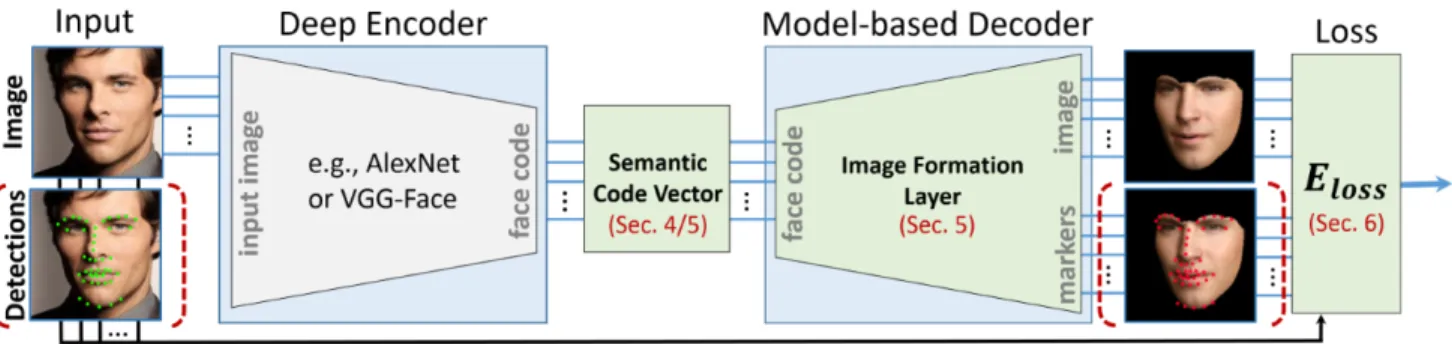
Our novel deep convolutional model-based face autoen-coder enables unsupervised end-to-end learning of meaning-ful semantic face and rendering parameters, see Fig.1. To this end, we combine convolutional encoders with a novel differentiable model-based decoder that analytically imple-ments image formation. Our novel decoder generates a realistic synthetic image of a face and enforces semantic meaning by design. Rendering is based on an image for-mation model that enforces full semantic meaning via a parametric face prior. More specifically, we independently parameterize pose, shape, expression, skin reflectance and illumination. The synthesized image is compared to the in-put image using a robust photometric lossElossthat includes
statistical regularization of the face. In combination, this enables unsupervised end-to-end training of our networks. 2D facial landmark locations can be optionally provided to add a surrogate loss for faster convergence and improved reconstructions, see Sec.6. Note, both scenarios require no supervision of the semantic parameters. After training, the encoder part of the network enables regression of a dense face model and illumination from a single monocular image, without requiring any other input, such as landmarks.
4. Semantic Code Vector
The semantic code vectorx ∈ R257 parameterizes the facial expressionδ∈R64, shapeα∈R80, skin reflectance
β ∈R80, camera rotationT∈SO(3)and translationt∈ R3, and the scene illuminationγ∈R27in a unified manner:
x= (α, δ, β | {z } face , T, t, γ | {z } scene ) . (1)
In the following, we describe the parameters that are asso-ciated with the employed face model. The parameters that govern image formation are described later on in Sec.5.
The face is represented as a manifold triangle mesh with N = 24k vertices V = {vi ∈ R3|1 ≤ i ≤ N}. The associated vertex normalsN={ni ∈R3|1≤i≤N}are computed using a local one-ring neighborhood. The spatial embeddingVis parameterized by an affine face model:
Figure 1. Our deep model-based face autoencoder enables unsupervised end-to-end learning of semantic parameters, such as pose, shape, expression, skin reflectance and illumination. An optional landmark-based surrogate loss enables faster convergence and improved reconstruction results, see Sec.6. Both scenarios require no supervision of the semantic parameters during training.
Here, the average face shapeAshas been computed based on200(100male,100female) high-quality face scans [3]. The linear PCA basesEs ∈ R3N×80 andEe ∈ R3N×64 encode the modes with the highest shape and expression variation, respectively. We obtain the expression basis by applying PCA to the combined set of blendshapes of [1] and [6], which have been re-targeted to the face topology of [3] using deformation transfer [47]. The PCA basis covers more than99%of the variance of the original blendshapes.
In addition to facial geometry, we also parameterize per-vertex skin reflectanceR={ri ∈R3|1 ≤i ≤N}based on an affine parametric model:
R= ˆR(β) =Ar+Erβ . (3) Here, the average skin reflectanceArhas been computed based on [3] and the orthogonal PCA basisEr ∈R3N×80 captures the modes of highest variation. Note, all basis vectors are already scaled with the appropriate standard de-viationsσk•such thatET•E•= diag(· · ·,[σ•k]
2,· · ·).
5. Parametric Model-based Decoder
Given a scene description in the form of a semantic code vectorx, our parametric decoder generates a realistic syn-thetic image of the corresponding face. Since our image formation model is fully analytical and differentiable, we also implement an efficient backward pass that inverts im-age formation via standard backpropagation. This enables unsupervised end-to-end training of our network. In the fol-lowing, we describe our proposed image formation model.
Perspective Camera We render realistic facial imagery using a pinhole camera model under a full perspective pro-jectionΠ :R3→
R2that maps from camera space to screen space. The position and orientation of the camera in world space is given by a rigid transformation, which we parameter-ize based on a rotationT∈SO(3)and a global translation
t∈R3. Hence, the functionsΦ
T,t(v) =T−1(v−t)and
Π◦ΦT,t(v)map an arbitrary pointvfrom world to camera
space and further to screen space.
Illumination Model We represent scene illumination us-ing Spherical Harmonics (SH) [34]. Here, we assume distant low-frequency illumination and a purelyLambertiansurface reflectance. Thus, we evaluate the radiosity at vertexviwith surface normalniand skin reflectancerias follows:
C(ri,ni,γ) =ri· B2
X
b=1
γbHb(ni) . (4)
TheHb :R3 →Rare SH basis functions and theB2= 9 coefficientsγb ∈R3(B = 3bands) parameterize colored illumination using the red, green and blue channel.
Image Formation We render realistic images of the scene using the presented camera and illumination model. To this end, in the forward passF, we compute the screen space position ui(x) and associated pixel colorci(x)for each vertexvi: Fi(x) = [ui(x),ci(x)]T ∈R5 , (5) ui(x) = Π◦ΦT,t Vˆi(α,δ) , ci(x) = C Rˆi(β),Tni(α,δ),γ .
Here,Tnitransforms the world space normals to camera space andγmodels illumination in camera space.
Backpropagation To enable training, we implement a backward pass that inverts image formation:
Bi(x) =
dFi(x)
d(α, δ, β, T, t, γ) ∈R
5×257 . (6)
This requires the computation of the gradients of the image formation model (see Eq.5) with respect to the face and scene parameters. For high efficiency during training, we evaluate the gradients in a data-parallel manner, see Sec.7.
6. Loss Layer
We propose a novel robust dense photometric loss func-tion that enables efficient end-to-end training of our networks. Our loss function combines three terms:
Eloss(x) =wlandEland(x) +wphotoEphoto(x)
| {z } data term +wregEreg(x) | {z } regularizer . (7) Here, we enforce sparse landmark alignmentEland, dense
photometric alignmentEphotoand statistical plausibilityEreg
of the modeled faces. Note,Elandis optional and implements
a surrogate loss that can be used to speed up convergence, see Sec.7. The binary weightwland ∈ {0,1}toggles this
constraint. The constant weightswphoto= 1.92andwreg=
2.9×10⁻⁵balance the contributions of the objectives.
Dense Photometric Alignment The goal of the encoder is to predict model parameters that lead to a synthetic face image that matches the provided monocular input image. To this end, we employ dense photometric alignment, similar to [52], on a per-vertex level using a robust`2,1-norm:
Ephoto(x) = 1 N X i∈V I ui(x) −ci(x) 2 . (8)
Here, I is an image of the training corpus and we iterate over the set of front facing verticesV, which we compute based on the current forward pass, for occlusion awareness.
Sparse Landmark Alignment In addition to dense pho-tometric alignment, we propose an optional surrogate loss based on detected facial landmarks [45]. We use a subset of46landmarks (out of66), see Fig.1. Given the subset L ={(sj, cj, kj)}46
j=1of detected 2D landmarkssj ∈R2, with confidencecj ∈ [0,1](1 confident) and correspond-ing model vertex index kj ∈ {1, ..., N}, we enforce the projected 3D vertices to be close to the 2D detections:
Eland(x) = 46 X j=1 cj· ukj(x)−sj 2 2 . (9)
Please note, this surrogate loss is optional. Our networks can be trained fully unsupervised without supplying these sparse constraints. After training, landmarks are never required.
Statistical Regularization During training, we further constrain the optimization problem using statistical regu-larization [3] on the model parameters:
Ereg(x) = 80 X k=1 α2k+wβ 80 X k=1 β2k+wδ 64 X k=1 δ2k . (10)
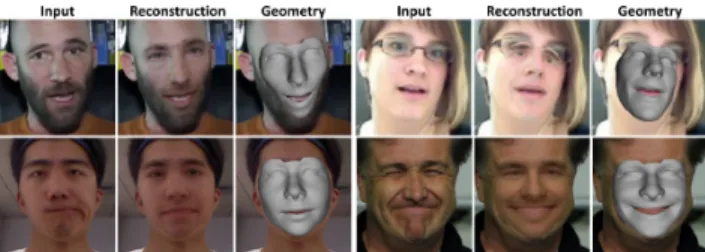
Figure 2. Our approach enables the regression of high quality pose, shape, expression, skin reflectance and illumination from just a single monocular image (images from CelebA [32]).
Figure 3. Sample images of our real world training corpus.
This constraint enforces plausible facial shapeα, expression
δand skin reflectanceβby preferring values close to the average (the basis of the linear face model is already scaled by the standard deviations). The parameterswβ = 1.7×
10−3 andw
δ = 0.8balance the importance of the terms.
Note, we do not regularize pose(T,t)and illuminationγ.
Backpropagation To enable training based on stochastic gradient descent, during backpropagation, the gradient of the robust loss is passed backward to our model-based decoder and is combined withBi(x)using thechain rule.
7. Results
We demonstrate unsupervised learning of our model-based autoencoder in the wild and also show that a surrogate loss during training improves accuracy. We test encoders based on AlexNet [27] and VGG-Face [37], where we modi-fied the last fully connected layer to output our257model parameters. The reported results have been obtained using AlexNet [27] as encoder and without the surrogate loss, un-less stated otherwise. After training, the encoder regresses pose, shape, expression, skin reflectance and illumination at once from a single image, see Fig.2. For training we use an image corpus (see Fig.3), which is a combination of four datasets: CelebA [32], LFW [19], Facewarehouse [7], and 300-VW [8,46,54]. The corpus is automatically annotated
Figure 4. Comparison to Richardson et al. [41,42] (coarse network without refinement) on 300-VW [8,46,54] (left) and LFW [19] (right). Our approach obtains higher reconstruction quality and provides estimates of colored reflectance and illumination. Note, the greyscale reflectance of [41,42] is not regressed, but obtained via optimization, we on the other hand regress all parameters at once.
Figure 5. Comparison to Tran et al. [53] on LFW [19]. Their approach targets general face recognition tasks and does not estimate the facial expression and illumination. In contrast, our approach recovers these dimensions, while obtaining similar quality for the regressed facial identity. Here, we show the full underlying face model, but training only uses the frontal part of the face (cf. Fig1, right).
using facial landmark detection (see Sec.6) and cropped to a bounding box using Haar Cascade Face Detection [4]. We prune frames with bad detections. The crops are scaled to a resolution of240×240pixels. In total, we collect147k images, which we randomize and split into142k for training and5k for evaluation. We train our network using theCaffe [22] deep learning framework. For efficiency, we implement our model-based decoder and the robust photometric loss in a single CUDA [36] layer. We train our networks using AdaDeltaand perform200k batch iterations (batch size of5). The base learning rate is0.1for all parameters, except for the Z-translation, for which we set it to0.0005. At test time, regressing all parameters using a TitanX Pascal graphics card is fast and takes only4ms (AlexNet) or14ms (VGG-Face). Training takes13hours (AlexNet) or20hours (VGG-Face). The encoder is initialized based on the provided pre-trained weights. All weights in the last fully connected layer are initialized to zero. This guarantees that the initial prediction is the average face placed in the middle of the screen and lit by ambient light, which is a good initialization. Note, the ambient coefficients of our renderer have an offset of0.7to guarantee that the scene is initially lit.
Next, we compare to state-of-the-art optimization- and learning-based monocular reconstruction approaches, and evaluate all components of our approach.
Comparison to Richardson et al. [41, 42] We com-pare our approach to the CNN-based iterative regressor of Richardson et al. [41,42]. Our results are compared quali-tatively (Fig.4) and quantitatively (Fig.14) to their coarse
regression network. Note, the refinement layer of [42] is or-thogonal to our approach. Our approach obtains higher qual-ity results. Unlike [41,42], our network is trained completely unsupervised on real images, while they use a synthetic train-ing corpus that lacks several dimensions of variation, e.g., facial hair. In contrast to [41,42], we also regress colored skin reflectance and illumination, which is critical for many applications, e.g., relighting. Note, the greyscale reflectance of [41,42] is not regressed, but obtained via optimization.
Comparison to Tran et al. [53] We compare qualitatively (Fig.5) and quantitatively (Fig.14) to the CNN-based iden-tity regression approach of Tran et al. [53]. Our reconstruc-tions are of similar or higher quality, however, we addition-ally obtain high quality estimates of the facial expression and illumination. Our approach is trained unsupervised on real images, opposed to [53], which requires a large corpus of real images with available ground truth. However, ground truth geometry, reflectance and illumination is hard to obtain.
Comparison to Thies et al. [52] We compare our ap-proach qualitatively (Fig. 6) and quantitatively (Fig. 14) to the state-of-the-art optimization-based monocular recon-struction approach of Thies et al. [52]. Our approach obtains similar or even higher quality, while being orders of magni-tude faster (4ms vs.∼500ms). Note, while [52] tracks at real-time after identity estimation, it requires half a second to fit all parameters starting from the average model. While our approach only requires face detection at test time, Thies et al. [52] require detected landmarks.
Figure 6. Comparison to the monocular reconstruction approach of [52] on CelebA [32]. Our approach obtains similar or higher quality, while being orders of magnitude faster (4ms vs.∼500ms).
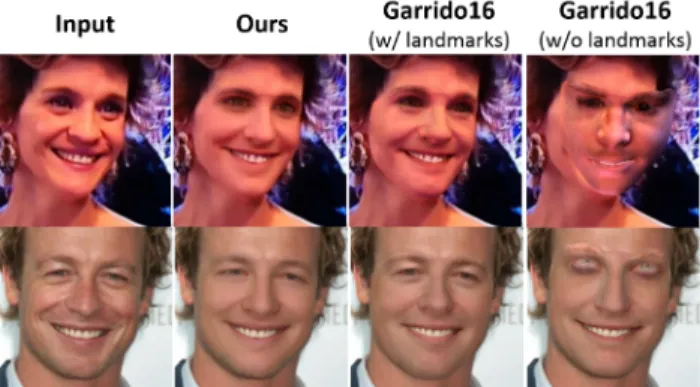
Figure 7. We compare to our implementation of the high quality off-line monocular reconstruction approach of [14]. We obtain similar quality without requiring landmarks as input. Without landmarks, [14] often gets stuck in a local minimum.
Figure 8. We evaluate different encoders in combination with our model-based decoder. In average VGG-Face [37] leads to slightly better results than AlexNet [27], but the results are comparable.
Comparison to Garrido et al. [14] We compare to our own implementation (coarse layer, photometric term + land-mark term + regularizer,50Gauss-Newton steps) of the high quality off-line monocular reconstruction approach of Gar-rido et al. [14], which requires landmark detections as input. Our approach obtains comparable quality, while requiring no landmarks, see Fig.7and Fig.14. Without these sparse constraints as input, this optimization-based approach often gets stuck in a local minimum.
Evaluation of Different Encoders We evaluate the im-pact of different encoders. VGG-Face [37] leads to slightly better results than AlexNet [27], see Fig.8. On average VGG-Face [37] has a slightly lower landmark (4.9 pixels vs. 5.3 pixels) and photometric error (0.073 vs. 0.075, color distance in RGB space, each channel in[0,1]), see Fig.9.
Figure 9. Quantitative evaluation on real data: Both landmark and photometric error are decreased during unsupervised training, even though landmark alignment is not part of the loss function.
Figure 10. Quantitative evaluation on synthetic ground truth data: Training decreases the geometric, photometric and landmark error.
Quantitative Evaluation of Unsupervised Training Un-supervised training decreases the dense photometric and landmark error (on a validation set of5k real images), even when landmark alignment is not part of the loss function, see Fig.9. The landmark error is computed based on46
detected landmarks [45]. Training with our surrogate loss improves landmark alignment (AlexNet:3.7pixels vs.5.3
pixels, VGG-Face:3.4pixels vs.4.9) and leads to a similar photometric error (AlexNet: 0.078 vs.0.075, VGG-Face:
0.078vs.0.073, color distance in RGB space, each channel in[0,1]). We also evaluate the influence of our landmark-based surrogate loss qualitatively, see Fig.11. Training with landmarks helps to improve robustness to occlusions and the quality of the predicted expressions. Note that both scenarios do not require landmarks, at test time.
Quantitative Evaluation on Synthetic Data We perform a ground truth evaluation based on5k synthetically rendered images with known parameters. Our model-based autoen-coder (AlexNet, unsupervised) is trained on a corpus of100k synthetic images with background augmentation, see Fig.10. We measure the geometric error as the point-to-point 3D dis-tance (this includes the estimated rotation, we compensate for translation and isotropic scale) between the estimate and the ground truth mesh. This error drops from21.6mm to
4.5mm. The photometric error in RGB space also decreases (0.33to0.05) and so does the landmark error (31.6pixels to
Figure 11. We evaluate the influence of the proposed surrogate task. The surrogate task leads to improved reconstruction quality and increases robustness to occlusions and strong expressions.
Figure 12. Our model-based autoencoder gives results of higher quality than convolutional autoencoders. In addition, it provides access to dense geometry, reflectance, and illumination.
Figure 13. Our model-based decoder provides higher fidelity in term of image quality than a learned convolutional decoder.
Figure 14. Quantitative evaluation on four images of Facewarehouse [7]: We obtain a low error that is comparable to optimization-based approaches. For this test, we trained our network using the intrinsics of the Kinect. Note, the approach of Tran et al. [53] is focused on face recognition and does not regress facial expressions.
Comparison to Autoencoders and Learned Decoders
We compare our model-based with a convolutional autoen-coder in Fig.12. The autoencoder uses four3×3convolution layers (64,96,128,256channels), a fully connected layer (257outputs, same as number of model parameters), and four4×4deconvolution layers (128,96,64,3channels). Our model-based approach obtains sharper reconstruction results and provides fine granular semantic parameters
allow-Figure 15. Strong occlusions or pronounced expressions outside the span of training data can lead to inaccurate regression results.
ing access to dense geometry, reflectance, and illumination, see Fig.12(middle). Explicit disentanglement [28,15] of a convolutional autoencoder requires labeled ground truth data. We also compare to image formation based on a trained decoder. To this end, we train the decoder (similar param-eters as above) based on synthetic imagery generated by our model to learn the parameter-to-image mapping. Our model-based decoder obtains renderings of higher fidelity compared to the learned decoder, see Fig.13.
8. Limitations
We have demonstrated compelling reconstructions from a single image based on a novel model-based autoencoder that is trained unsupervised. Nevertheless, some limitations still remain, see Fig.15: Similar to other learning approaches, regression works best inside the span of training data; oth-erwise, implausible reconstructions are possible. This can be alleviated by enlarging the training corpus, which is easy to achieve in our unsupervised setting. Since we employ a face model, reconstructions are limited to the modeled subspace. Currently, we can not regress facial hair, eye gaze, and accessories, but this could be alleviated by an exten-sion of the model. Strong occluexten-sions, e.g., by facial hair or external objects, cause the approach to fail. Unsupervised occlusion-aware training is an interesting open research prob-lem. Similar to related approaches, strong head rotations are challenging to handle.
9. Conclusion
We have presented the first deep convolutional model-based face autoencoder that can be trained in an unsuper-vised manner and learns meaningful semantic parameters. Semantic meaning in the code vector is enforced by a para-metric model that encodes variation along the pose, shape, expression, skin reflectance and illumination dimensions. Our model-based decoder is fully differentiable and allows end-to-end learning of our network.
We believe that the fundamental technical concepts of our approach go far beyond the context of monocular face reconstruction and will inspire future work.
Acknowledgements
We thank True-VisionSolutions Pty Ltd for kindly pro-viding the 2D face tracker. We also thank Anh Tuan Tran and colleagues for making their source code publicly avail-able, and Elad Richardson for running his approach on our images. This work was supported by the ERC Starting Grant CapReal (335545) and by Technicolor.
References
[1] O. Alexander, M. Rogers, W. Lambeth, M. Chiang, and P. De-bevec. The Digital Emily Project: photoreal facial modeling and animation. InACM SIGGRAPH Courses, pages 12:1– 12:15. ACM, 2009.4
[2] V. Blanz, C. Basso, T. Poggio, and T. Vetter. Reanimating faces in images and video. InComputer graphics forum, pages 641–650. Wiley Online Library, 2003.1,2
[3] V. Blanz and T. Vetter. A morphable model for the synthesis of 3d faces. InProc. SIGGRAPH, pages 187–194. ACM Press/Addison-Wesley Publishing Co., 1999.1,2,4,5 [4] G. Bradski. The OpenCV Library. Dr. Dobb’s Journal of
Software Tools, 2000.6
[5] A. Bulat and G. Tzimiropoulos. Two-stage convolutional part heatmap regression for the 1st 3D face alignment in the wild (3DFAW) challenge. InECCVW, 2016.2
[6] C. Cao, Y. Weng, S. Zhou, Y. Tong, and K. Zhou. Faceware-house: A 3D facial expression database for visual computing. IEEE TVCG, 20(3):413–425, 2014.4
[7] C. Cao, Y. Weng, S. Zhou, Y. Tong, and K. Zhou. Faceware-house: A 3d facial expression database for visual computing. IEEE Transactions on Visualization and Computer Graphics, 20(3):413–425, Mar. 2014.5,8
[8] G. G. Chrysos, E. Antonakos, S. Zafeiriou, and P. Snape. Offline deformable face tracking in arbitrary videos. InThe IEEE International Conference on Computer Vision (ICCV) Workshops, December 2015.5,6
[9] T. F. Cootes, G. J. Edwards, and C. J. Taylor. Active appear-ance models. IEEE Transactions on Pattern Analysis and Machine Intelligence, 23(6):681–685, June 2001.2 [10] C. Ding and D. Tao. Robust face recognition via multimodal
deep face representation.IEEE Transactions on Multimedia, 17(11):2049–2058, 2015.3
[11] C. N. Duong, K. Luu, K. G. Quach, and T. D. Bui. Deep appearance models: A deep boltzmann machine approach for face modeling. arXiv:1607.06871, July 2016.3
[12] O. Fried, E. Shechtman, D. B. Goldman, and A. Finkelstein. Perspective-aware manipulation of portrait photos. ACM Trans. Graph., 35(4), July 2016.1,2
[13] S. Gao, Y. Zhang, K. Jia, J. Lu, and Y. Zhang. Single Sam-ple Face Recognition via Learning Deep Supervised Autoen-coders. IEEE Transactions on Information Forensics and Security, 10(10):2108–2118, 2015.3
[14] P. Garrido, M. Zollh¨ofer, D. Casas, L. Valgaerts, K. Varanasi, P. P´erez, and C. Theobalt. Reconstruction of personalized 3D face rigs from monocular video. ACM Transactions on Graphics, 35(3):28:1–15, June 2016.1,2,7
[15] E. Grant, P. Kohli, and M. van Gerven. Deep disentangled representations for volumetric reconstruction. InECCVW, 2016.2,3,8
[16] R. A. G¨uler, G. Trigeorgis, E. Antonakos, P. Snape, S. Zafeiriou, and I. Kokkinos. Densereg: Fully convolu-tional dense shape regression in-the-wild. arXiv:1612.01202, Dec. 2016.3
[17] A. Handa, M. Bloesch, V. Patraucean, S. Stent, J. McCormac, and A. J. Davison. gvnn: Neural network library for geometric computer vision. InECCV, 2016.3
[18] G. E. Hinton and R. R. Salakhutdinov. Reducing the dimensionality of data with neural networks. Science, 313(5786):504–507, July 2006.2,3
[19] G. B. Huang, M. Ramesh, T. Berg, and E. Learned-Miller. La-beled faces in the wild: A database for studying face recogni-tion in unconstrained environments. Technical Report 07-49, University of Massachusetts, Amherst, October 2007.5,6 [20] P. Huber, P. Kopp, M. R¨atsch, W. Christmas, and J.
Kit-tler. 3D face tracking and texture fusion in the wild. arXiv:1605.06764, May 2016.2
[21] M. Jaderberg, K. Simonyan, A. Zisserman, and K. Kavukcuoglu. Spatial transformer networks. In NIPS, 2015.3
[22] Y. Jia, E. Shelhamer, J. Donahue, S. Karayev, J. Long, R. Gir-shick, S. Guadarrama, and T. Darrell. Caffe: Convolu-tional architecture for fast feature embedding.arXiv preprint arXiv:1408.5093, 2014.6
[23] X. Jin and X. Tan. Face alignment in-the-wild: A survey. arXiv:1608.04188, Aug. 2016.2
[24] M. Kan, S. Shan, H. Chang, and X. Chen. Stacked Progressive Auto-Encoders (SPAE) for Face Recognition Across Poses. 2014.3
[25] I. Kemelmacher-Shlizerman, A. Sankar, E. Shechtman, and S. M. Seitz. Being john malkovich. InECCV, 2010.1,2 [26] I. Kemelmacher-Shlizerman and S. M. Seitz. Face
reconstruc-tion in the wild. InICCV, 2011.1,2
[27] A. Krizhevsky, I. Sutskever, and G. E. Hinton. ImageNet classification with deep convolutional neural networks. In NIPS, 2012.5,7
[28] T. D. Kulkarni, W. Whitney, P. Kohli, and J. B. Tenenbaum. Deep convolutional inverse graphics network. InNIPS, 2015. 2,3,8
[29] S. Laine, T. Karras, T. Aila, A. Herva, and J. Lehti-nen. Facial performance capture with deep neural networks. arXiv:1609.06536, 2016.3
[30] M. Li, W. Zuo, and D. Zhang. Convolutional network for attribute-driven and identity-preserving human face genera-tion. arXiv:1608.06434, Aug. 2016.3
[31] F. Liu, D. Zeng, J. Li, and Q. Zhao. 3D face reconstruction via cascaded regression in shape space. arXiv:1509.06161, 2016.2
[32] Z. Liu, P. Luo, X. Wang, and X. Tang. Deep learning face attributes in the wild. InProceedings of International Confer-ence on Computer Vision (ICCV), 2015.5,7
[33] J. Masci, U. Meier, D. Cires¸an, and J. Schmidhuber. Stacked convolutional auto-encoders for hierarchical feature extrac-tion. InInternational Conference on Artificial Neural Net-works, 2011.2,3
[34] C. M¨uller.Spherical harmonics. Springer, 1966.4 [35] V. Nair, J. Susskind, and G. E. Hinton. Analysis-by-synthesis
by learning to invert generative black boxes. InInternational Conference on Artificial Neural Networks (ICANN), 2008.3 [36] NVIDIA.NVIDIA CUDA Programming Guide 2.0. 2008.6 [37] O. M. Parkhi, A. Vedaldi, and A. Zisserman. Deep face recognition. InBritish Machine Vision Conference, 2015.5, 7
[38] X. Peng, R. S. Feris, X. Wang, and D. N. Metaxas. A recurrent encoder-decoder network for sequential face alignment. In ECCV, 2016.2
[39] K. G. Quach, C. N. Duong, K. Luu, and T. D. Bui. Robust deep appearance models. arXiv:1607.00659, July 2016.3 [40] R. Ranjan, S. Sankaranarayanan, C. D. Castillo, and R.
Chel-lappa. An all-in-one convolutional neural network for face analysis. arXiv:1611.00851, 2016.2
[41] E. Richardson, M. Sela, and R. Kimmel. 3D face reconstruc-tion by learning from synthetic data. In3DV, 2016.1,2,3, 6
[42] E. Richardson, M. Sela, R. Or-El, and R. Kimmel. Learn-ing detailed face reconstruction from a sLearn-ingle image. arXiv:1611.05053, Nov. 2016.2,3,6
[43] S. Romdhani and T. Vetter. Estimating 3D Shape and Texture Using Pixel Intensity, Edges, Specular Highlights, Texture Constraints and a Prior.CVPR, 2005.2
[44] J. Roth, Y. Tong, and X. Liu. Adaptive 3d face reconstruction from unconstrained photo collections. December 2016.1,2 [45] J. M. Saragih, S. Lucey, and J. F. Cohn. Deformable model fitting by regularized landmark mean-shift. 91(2):200–215, 2011.5,7
[46] J. Shen, S. Zafeiriou, G. G. Chrysos, J. Kossaifi, G. Tz-imiropoulos, and M. Pantic. The first facial landmark tracking in-the-wild challenge: Benchmark and results. InICCVW, December 2015.5,6
[47] R. W. Sumner and J. Popovi´c. Deformation transfer for trian-gle meshes.ACM TOG, 23(3):399–405, 2004.4
[48] Y. Sun, X. Wang, and X. Tang. Deep Convolutional Network Cascade for Facial Point Detection. 2013.2
[49] S. Suwajanakorn, I. Kemelmacher-Shlizerman, and S. M. Seitz. Total moving face reconstruction. InECCV, 2014.1,2 [50] S. Suwajanakorn, S. M. Seitz, and I. Kemelmacher-Shlizerman. What makes tom hanks look like tom hanks. InICCV, 2015.1,2
[51] Y. Tang, R. Salakhutdinov, and G. E. Hinton. Deep lambertian networks. 2012.3
[52] J. Thies, M. Zollh¨ofer, M. Stamminger, C. Theobalt, and M. Niener. Face2Face: Real-time face capture and reenact-ment of RGB videos. InCVPR, 2016.1,2,5,6,7
[53] A. T. Tran, T. Hassner, I. Masi, and G. Medioni. Regressing Robust and Discriminative 3D Morphable Models with a very Deep Neural Network. arXiv.org:1612.04904v1, 2016.2,3, 6,8
[54] G. Tzimiropoulos. Project-out cascaded regression with an application to face alignment. InThe IEEE Conference on Computer Vision and Pattern Recognition (CVPR), June 2015. 5,6
[55] N. Wang, X. Gao, D. Tao, and X. Li. Facial Feature Point Detection: A Comprehensive Survey. arXiv:1410.1037, Oct. 2014.2
[56] Y. Wu and Q. Ji. Discriminative deep face shape model for facial point detection. International Journal of Computer Vision, 113(1):37–53, 2015.2
[57] X. Yan, J. Yang, E. Yumer, Y. Guo, and H. Lee. Perspective transformer nets: Learning single-view 3d object reconstruc-tion without 3d supervision. arXiv:1612.00814, Dec. 2016. 3
[58] J. Zhang, S. Shan, M. Kan, and X. Chen. Coarse-to-Fine Auto-Encoder Networks (CFAN) for Real-Time Face Alignment. 2014.3
[59] F. Zhao, J. Feng, J. Zhao, W. Yang, and S. Yan. Ro-bust lstm-autoencoders for face de-occlusion in the wild. arXiv:1612.08534, 2016.2,3
[60] A. Zhmoginov and M. Sandler. Inverting face embeddings with convolutional neural networks. arXiv:1606.04189, June 2016.3
[61] E. Zhou, H. Fan, Z. Cao, Y. Jiang, and Q. Yin. Extensive Facial Landmark Localization with Coarse-to-Fine Convolu-tional Network Cascade. InCVPRW, 2013.2
[62] S. Zhu, S. Liu, C. C. Loy, and X. Tang. Deep cascaded bi-network for face hallucination. arXiv:1607.05046, July 2016. 3
[63] Z. Zhu, P. Luo, X. Wang, and X. Tang. Deep Learning Identity-Preserving Face Space. 2013.3
[64] Z. Zhu, P. Luo, X. Wang, and X. Tang. Multi-view perceptron: a deep model for learning face identity and view representa-tions. 2014.3
![Figure 2. Our approach enables the regression of high quality pose, shape, expression, skin reflectance and illumination from just a single monocular image (images from CelebA [32]).](https://thumb-us.123doks.com/thumbv2/123dok_us/10057522.2905450/5.918.465.819.110.398/figure-approach-enables-regression-expression-reflectance-illumination-monocular.webp)
![Figure 4. Comparison to Richardson et al. [41, 42] (coarse network without refinement) on 300-VW [8, 46, 54] (left) and LFW [19] (right).](https://thumb-us.123doks.com/thumbv2/123dok_us/10057522.2905450/6.918.88.819.112.284/figure-comparison-richardson-coarse-network-refinement-left-right.webp)