Evolutionary algorithms for subgroup discovery in e-learning:
A practical application using Moodle data
C. Romero
a,*, P. Gonza´lez
b, S. Ventura
a, M.J. del Jesus
b, F. Herrera
caDepartment of Computer Sciences and Numerical Analysis, University of Co´rdoba, 14071 Co´rdoba, Spain bDepartment of Computer Sciences, University of Jae´n, 23071 Jae´n, Spain
c
Department of Computer Sciences and Artificial Intelligence, University of Granada, 18071 Granada, Spain
Abstract
This work describes the application of subgroup discovery using evolutionary algorithms to the usage data of the Moodle course man-agement system, a case study of the University of Cordoba, Spain. The objective is to obtain rules which describe relationships between the student’s usage of the different activities and modules provided by this e-learning system and the final marks obtained in the courses. We use an evolutionary algorithm for the induction of fuzzy rules in canonical form and disjunctive normal form. The results obtained by different algorithms for subgroup discovery are compared, showing the suitability of the evolutionary subgroup discovery to this problem.
Ó2007 Elsevier Ltd. All rights reserved.
Keywords: Web-based education; Subgroup discovery; Evolutionary algorithms; Fuzzy rules
1. Introduction
The design and implementation of web-based education systems have grown exponentially in the last years, spurred by the fact that neither students nor teachers are bound to a specific location and that this form of computer-based education is virtually independent of any specific hardware platforms. These systems accumulate a great deal of infor-mation which is very valuable in analyzing students’ behav-ior and assisting authors in the detection of possible errors, shortcomings and improvements. However, due to the vast quantities of data these systems can generate daily, it is very difficult to manage manually, and authors demand tools which assist them in this task, preferably on a contin-uous basis. The use of data mining is a promising area in
the achievement of this objective (Romero & Ventura,
2006, 2007).
In the knowledge discovery in databases (KDD) process, the data mining step consists of the automatic
extraction of implicit and interesting patterns from large data collections. A list of data mining techniques or tasks includes statistics, clustering, classification, outlier detec-tion, association rule mining, sequential pattern mining, text mining, or subgroup discovery, among others (Klo¨sgen & Zytkow, 2002).
In recent years, researchers have begun to investigate various data mining methods in order to help teachers improve e-learning systems. A review can be seen in (Romero & Ventura, 2007). These methods allow the dis-covery of new knowledge-based on students’ usage data.
Subgroup discovery is a specific method for discovering descriptive rules (Klo¨sgen, 1996; Wrobel, 1997). The objec-tive is to discover characteristics of subgroups with respect to a specific property of interest (represented in the rule consequent). It must be noted that subgroup discovery aims at discovering individual rules (or local patterns of interest), which must be represented in explicit symbolic form and which must be relatively simple in order to be recognized as actionable by potential users. Therefore, the subgroups discovered in data have an explanatory nat-ure and the interpretability for the final user of the 0957-4174/$ - see front matterÓ2007 Elsevier Ltd. All rights reserved.
doi:10.1016/j.eswa.2007.11.026
*
Corresponding author. Fax: +34 957 218630.
E-mail address:[email protected](C. Romero).
www.elsevier.com/locate/eswa
Expert Systems with Applications 36 (2009) 1632–1644
Expert Systems with Applications
extracted knowledge is a crucial aspect in this field. This task has been applied to different domains: detection of patient groups with risk for atherosclerotic coronary heart
disease (Gamberger & Lavrac, 2002b), mining UK traffic
data (Kavsek, Lavrac, & Bullas, 2002), personal web pages (Nakada & Kunifuji, 2003), identification of interesting diagnostic patterns to supplement a medical
documenta-tion and consultadocumenta-tion system (Atzmueller, Puppe, &
Buscher, 2004) or marketing problems (del Jesus, Gon-za´lez, Herrera, & Mesonero, 2007).
This work proposes the application of subgroup discov-ery to the usage data of the course management system Moodle at the University of Cordoba, Spain. Moodle is a free open source course management system designed to help educators create effective online learning communities. Moodle has a flexible array of course activities such as for-ums, chats, quizzes, resources, choices, surveys, or assign-ments. Our objective is to obtain rules which describe relationships between the student’s usage of the different activities and modules provided by this e-learning system and the final score obtained in the courses. These rules can help the teacher to discover beneficial or detrimental relationships between the use of web-based educational resources and the student’s learning.
We will focus our attention in the use of a subgroup dis-covery algorithm-based on the use of genetic algorithms (GAs) called SDIGA (Subgroup Discovery Iterative Genetic Algorithm). SDIGA is an evolutionary model for the extraction of fuzzy rules for the subgroup discovery
task. This algorithm is described in detail in (del Jesus
et al., 2007). Its main characteristics are presented in this paper.
We compare the results obtained by this algorithm with those obtained by two classical subgroup discovery
meth-ods: Apriori-SD (Kavsek & Lavrac, 2006) and CN2-SD
(Lavrac, Kavsec, Flach, & Todorovski, 2004). Further-more, we also use an algorithm for class association rule discovery such as CBA (Classification Based on Associa-tion) (Liu, Hsu, & Ma, 1998). We will present an experi-mental study where SDIGA obtains the best results for our educational mining problem.
This paper is arranged in the following way: Section 2
describes the problem of discovering rules in e-learning
and surveys some specific work in the area. Section3
intro-duces the subgroup discovery task, the type of rules and
quality measures used and the fuzzy evolutionary
approach. Section 4 describes the e-learning case study,
the experimentation carried out and the analysis of results. Finally, the conclusions and further research are outlined.
2. Rule discovery in learning management systems
Many web-based educational systems with different capabilities and approaches have been developed to deliver online education. There are different types of web-based educational systems: particular web-based courses, learn-ing management systems, and adaptive and intelligent
web-based educational systems (Romero & Ventura,
2006). This paper is mostly oriented forwards learning
management systems. Different terms are used to denomi-nate these systems: learning management systems (LMS), course management systems or learning content manage-ment systems. These systems are e-learning platforms that offer a great variety of channels and workspaces to facili-tate information sharing and communication between par-ticipants in a course, allow educators to distribute information to students, produce content material, prepare assignments and tests, engage in discussions, manage dis-tance classes and enable collaborative learning with for-ums, chats, file storage areas or news services. Some examples of commercial LMS are Blackboard, Virtual-U, WebCT, or TopClass among others and some examples
of free LMS are Moodle, Ilias, Claroline, or ATutor. (
Paul-sen, 2003). These systems normally use a relational data-base to store the large data log of the students’ activities and usage information. And although some platforms offer reporting tools, if there are a great number of students and a great amount of information, it becomes difficult for a tutor to extract useful information. Recently, some researchers propose using data mining techniques in order to help the tutor in this task.
Data mining techniques can be applied to analyzing stu-dent’s usage data in order to identify useful patterns and to evaluate web activity to get more objective feedback for instruction and more knowledge about how the students
learn on the LMS (Romero & Ventura, 2007). A data
min-ing algorithm can discover knowledge usmin-ing different repre-sentation models and techniques from two different perspectives:
– Predictive induction, whose objective is the discovery of
knowledge for classification or prediction (Michie,
Spie-gelhalter, & Taylor, 1994). Classification rule discovery (Quinlan, 1993) or clustering (Han, Kamber, & Tung,
2001) are data mining tasks under the predictive
induc-tion approach.
– Descriptive induction, whose main objective is the extraction of interesting knowledge from data In this area, attention can be drawn to the discovery of associ-ation rules following an unsupervised learning model (Agrawal, Imielinski, & Swami, 1993), subgroup
discov-ery (Klo¨sgen, 1996; Wrobel, 1997) and other approaches
to non-classificatory induction.
In the following, some of the most widely used data min-ing techniques in e-learnmin-ing are described.
Classification is a supervised process of grouping physi-cal or abstract objects into classes of similar characteristics. It belongs to predictive induction data mining methods.
The objective of classification rules (Quinlan, 1993) is to
obtain the necessary knowledge to create a classification system. The antecedents of these rules contain require-ments (in the form of conditions), which match those objects that belong to the class label identified in the
con-sequent of the rule. Classification rule mining has been applied to LMS in order to characterize the properties of a group of user profiles, similar pages or learning sessions, as can be seen in the following work.
Talavera and Gaudioso (2004)propose mining student’s data using clustering in order to discover patterns reflecting user behaviors. They propose models for collaboration management to characterize similar behavior groups in
unstructured collaboration spaces. Mor and Minguillon
(2004) extend the sequencing capabilities of the SCORM standard to include the concept of recommended itinerary, by combining educators’ expertise with learned experience acquired by system usage analysis. They use clustering
algorithms for grouping students.Castro, Vellido, Nebot,
and Minguillon (2005) detect atypical behavior in the grouping structure of the users of a virtual campus. They propose using a generative topographic mapping model and a clustering model to characterize groups of online stu-dents. The model neutralizes the negative impact of outliers on the data clustering process.
Association rule mining is one of the better-studied descriptive data mining methods. Its objective is to discover descriptive rules about relations between attributes of a set of data which overcome a user-specified confidence thresh-old (each rule must cover a minimum percentage of the data, that is the confidence threshold). Such rules associate one or more attributes of a dataset with another attribute, producing an if–then statement concerning attribute val-ues. Mining association rules between sets of items in large
databases was first proposed byAgrawal et al. (1993)and it
opened up a brand new family of algorithms. The original problem was how to perform the market basket analysis which attempted to find all the interesting relationships between products bought in a given context. Association rule mining has been applied to LMS in order to reveal which contents students tend to access together, or which combination of tools they use.
We describe below some studies of the application of
this technique to LMS. Wang (2002) develops a portfolio
analysis tool-based on associative material clusters and sequences among them. This knowledge allows educators to study the dynamic browsing structure and to identify interesting or unexpected learning patterns. To do this, Wang discovers two types of relations: association
rela-tions and sequence relarela-tions between documents.
Minaei-Bidgoli, Tan, and Punch (2004)propose mining interesting contrast rules for web-based education systems. Contrast rules help one to identify attributes characterizing patterns of performance disparity between various groups of
stu-dents. Markellou, Mousourouli, Spiros, and Tsakalidis
(2005)propose an ontology-based framework and discover association rules, using the Apriori algorithm. The role of ontology is to determine which learning materials are more
suitable to be recommended to the user. Zaı¨ane and Luo
(2001) propose the discovery of useful patterns based on restrictions, to help educators evaluate students’ activities
in web courses.Li and Zaı¨ane (2004)also use recommender
agents for e-learning systems which use association rule mining to discover associations between user actions and URLs. The agent recommends online learning activities or shortcuts in a course web site based on a learner’s access
history.Lu (2004)uses fuzzy association rules in a
person-alized e-learning material recommender system. He uses fuzzy matching rules to discover associations between
stu-dent’s requirements and a list of learning materials.
Romer-o, Ventura, and Bra (2004)propose using grammar-based genetic programming with multi-objective optimization techniques in order to provide a feedback to courseware authors. They discover interesting association rules by
ana-lyzing student’s usage information. Merceron and Yacef
(2004)use association rule and symbolic data analysis, as well as traditional SQL queries to mine student data cap-tured from a web-based tutoring tool. Their goal is to find
mistakes that often occur together.Freyberger, Heffernan,
and Ruiz (2004)use association rules to guide a search for best fitting transfer models of student learning in intelligent tutoring systems. The association rules determine which operation to perform on the transfer model that predicts a student’s success.
3. Subgroup discovery: classic approaches and evolutionary proposals
We have described some of the data mining techniques most used in e-learning, but subgroup discovery can also be applied to this task. In this section, the subgroup discov-ery task is introduced and classical and evolutionary approaches are described. First, we describe the topic of subgroup discovery and the classical approaches. Then, we analyze the use of evolutionary algorithms for rule induction. Finally, we introduce an evolutionary proposal for the subgroup discovery task.
3.1. Subgroup discovery
This section introduces the concept of subgroup discov-ery in the context of descriptive induction, describes classi-cal approaches to the subgroup discovery task, and summarizes the quality measures typically used for this task.
3.1.1. Introduction to subgroup discovery
Subgroup discovery is a descriptive machine learning area which has recently received a great deal of attention from researchers. It represents a form of supervised induc-tive learning in which, given a set of data and a property of interest to the user (target variable), an attempt is made to
locate subgroups which are statistically ‘‘most interesting”
for the user. In this sense, a subgroup is interesting if it has an unusual statistical distribution with respect to the prop-erty of interest. Descriptive machine learning methods for subgroup discovery have the objective of discovering
inter-esting properties of subgroups by obtaining simple rules
variables), which are highly significantand with high sup-port(i.e. covering many of the instances of the target class). An induced subgroup description has the form of an implication,
Cond ! Class
where the property of interest for subgroup discovery is the
class valueClassthat appears in the consequent part of the
rule, and the antecedent part of the ruleCondis a
conjunc-tion of features (attribute-value pairs) selected from the features describing the training instances.
Subgroup discovery is usually seen as being different from classification, as it addresses different goals. Classifi-cation rule learning is a predictive induction technique whose goal is to generate models consisting of sets of rules describing class characteristics of all the training examples, attempting to maximize the classification accuracy of the induced set of rules. In contrast, subgroup discovery aims to discover individual rules of interest, which must be rep-resented in explicit symbolic form and which must be rela-tively simple, in order to discover interesting population subgroups. In addition, the set of individual rules obtained by the subgroup discovery task will not necessarily describe all the examples.
The subgroup discovery task relies on the following main properties:
– The description language which specifies the subgroups must be appropriate in order to be applied effectively by the potential users. The subgroup description consists of a set of expressions. In the simplest case, each expres-sion is single-valued; however negation or internal dis-junctions are also possible.
– The quality function which measures the interest of the subgroup. A variety of quality functions have been
pro-posed, as can be seen in (Klo¨sgen, 1996), (Klo¨sgen,
2002) and (Gamberger, Lavrac, & Krstacic, 2003). The applicable set of quality functions is determined by the type of target variable, the type of rule and the problem considered. In the next subsection we will describe sev-eral quality measures used in subgroup discovery algorithms.
– The search strategy. The search strategy is very impor-tant, since the dimension of the search space has an exponential relation to the number of features (or vari-ables) and values considered.
3.1.2. Quality measures in subgroup discovery
A determining factor in the quality of any subgroup dis-covery algorithm is the quality measure to be used, both to select the rules and to evaluate the results of the process. Objective measures for descriptive induction evaluate each subgroup individually, but can be complemented by their variants in order to compute the mean of the induced set of descriptions of subgroups, thus allowing comparison between different subgroup discovery algorithms.
There have been different studies of objective quality
measures for the descriptive induction process (Klo¨sgen,
2002), (Piatetsky-Shapiro & Matheus, 1994), (Gamberger & Lavrac, 2002a) but it is difficult to reach an agreement on their use. Below, the more widely used quality measures in the specialized bibliography of subgroup discovery are described.
– Coverage for a rule Ri(Lavrac et al., 2004): measures the percentage of examples covered on average by one rule of the induced set of rules.
CovðRiÞ ¼
CovðCondi!ClassjÞ ¼pðCondiÞ
¼nðCond
iÞ ns
ð1Þ
wheren(Condi) is the number of examples which verifies
the condition Condi described in the antecedent
(inde-pendently of the class to which belongs), and ns is the
number of examples.
Theaverage coverage for the set of rulesfinally obtained is calculated using the following formula:
COV¼ 1 nr Xnr i¼1 CovðRiÞ ð 2Þ
wherenris the number of induced rules.
– Support for a rule: in descriptive induction processes the support for a rule is a standard measure which consid-ers, by means of an expression that can vary in different proposals, the number of examples satisfying both the
antecedent and the consequent parts of the rule.Lavrac
et al. (2004)compute the overall support as the percent-age of target examples (positive examples) covered by the rules. The support of a rule is therefore defi-ned as the frequency of correctly classified examples covered.
SupðCondi!ClassjÞ ¼pðClassj:CondiÞ ¼nðClassj:Cond
iÞ ns
ð3Þ
wheren(Classj.Cond i
) is the number of examples which
satisfy the conditions for the antecedent (Condi) and
also belong to the value for the target variable (Classj) indicated in the consequent part of the rule.
Thesupportfor a set of rules is computed by:
SUP¼ 1 ns Xnc j¼1 nðClassj: _ Condi!Class j CondiÞ ð4Þ
wherencis the number of values for the target variable
considered. It must be noted that in this expression the examples which belong to various rules are considered only once.
– Size (for a set of rules): the size of a set of rules is a com-plexity measure calculated as the number of induced
number of rules obtained for each class, or the mean of variables per rule.
– Significance for a rule(Klo¨sgen, 1996): indicates the sig-nificance of a finding, if measured by the likelihood ratio of a rule.
SigðCondi!ClassjÞ
¼2X
nc
j¼1
nðClassj:CondiÞ log
nðClassj:Cond i
Þ nðClassjÞ pðCondiÞ
ð5Þ
where p(Condi), computed asn(Condi)/ns, is used as a normalized factor.
It must be noted that, although each rule is for a specific class value, the significance measures the novelty in the distribution impartially, for all the class values.
The significance for a set of rules is computed as follows: SIG¼ 1 nr Xnr i¼1 SigðRiÞ ð6Þ
– Accuracy for a rule: named ‘‘confidence” in descriptive data mining references, is the percentage of positive examples of a rule.
AccðCondi!ClassjÞ ¼
nðClassj:CondiÞ
nðCondiÞ ð7Þ
The accuracy for a set of rules is computed as:
ACC¼ 1
nr
Xnr i¼1
AccðRiÞ ð8Þ
– Unusualness for a rule: is defined as theweighted relative accuracyof a rule (Lavrac, Flach, & Zupan, 1999).
WRAccðCondi!ClassjÞ
¼nðCond i Þ ns nðClassj:Cond i Þ nðCondiÞ nðClassjÞ ns ð9Þ
The weighted relative accuracy of a rule can be described as the balance between the coverage of the rule
(p(Condi)) and its accuracy gain (p(Classj.Condi)
p(Classj)).
The unusualness for a set of rules is computed as follows: WRACC¼ 1 nr Xnr i¼1 WRAccðRiÞ ð10Þ
3.1.3. Related work in subgroup discovery
In the specialized bibliography, different methods have been developed which obtain descriptions of subgroups represented in different ways and using different quality measures. Here we briefly describe some of them:
– The first approach developed for subgroup discovery
was EXPLORA (Klo¨sgen, 1996). It uses decision trees
for the extraction of rules. The rules are specified by defining a descriptive scheme and implementing a statis-tical verification method. The interest of the rules is measured using criteria such as evidence, generality, redundancy and simplicity.
– MIDOS (Wrobel, 1997) applies the EXPLORA
approach to multirelational databases. It uses optimistic estimation and minimum support pruning. The goal is to discover subgroups of the target relation (defined as first order conjunctions) which have unusual statistical distri-butions with respect to the complete population. The quality measure is a combination of unusualness and size.
– SubgroupMiner (Klo¨sgen, 2002) is an extension of
EXPLORA and MIDOS. It is an advanced subgroup discovery system which uses decision rules and interac-tive search in the space of the solutions, allowing the use of very large databases by means of the efficient inte-gration of databases, multirelational hypotheses, visual-ization based on interaction options, and the discovery of structures of causal subgroups. This algorithm uses as its standard quality function the classical binomial test to verify whether the statistical distribution of the target is significantly different in the extracted subgroup.
– SD (Gamberger & Lavrac, 2002a) is a rule induction
system guided by expert knowledge: instead of defining an optimal measure to search for and select the sub-groups automatically, the objective is to help the expert in performing flexible and effective searches on a wide range of optimal solutions.
– CN2-SD (Lavrac et al., 2004) (a modified version of the
CN2 classification rule algorithm (Clark & Niblett,
1989)) induces subgroups in the form of rules using as
quality measure the relation between true positives and false positives. CN2-SD uses a modified weighted rela-tive accuracy as the quality measure for rule selection. – RSD (Lavrac, Zelezny, & Flach, 2003),Relational
Sub-group Discovery, has the objective of obtaining popula-tion subgroups which are as large as possible, with a statistical distribution as unusual as possible with respect to the property of interest, and which are differ-ent enough to cover most of the target population. It is a recent upgrade of the CN2-SD algorithm which enables relational subgroup discovery.
– APRIORI-SD (Kavsek & Lavrac, 2006) is developed by
adapting to subgroup discovery the classification rule
learning algorithm APRIORI-C (Jovanoski & Lavrac,
2001), a modification of the original APRIORI
associa-tion rule learning algorithm (Agrawal et al., 1993).
APRIORI-SD uses weighted relative accuracy as quality measure for the induced rules and probabilistic classifi-cation of the examples. For the evaluation of the set
of rules the area under the Receiver Operating
Charac-teristic(ROC) curve is used, in conjunction with the sup-port and significance of each individual rule, and the size and accuracy of the set of rules.
– SD-Map (Atzmueller & Puppe, 2006) is an exhaustive subgroup discovery algorithm that uses the well-known FP-growth method (Han & Pei, 2000) for mining associ-ation rules with adaptassoci-ations for the subgroup discovery task. SD-Map uses a modified FP-growth step that can compute the subgroup quality directly without referring to other intermediate results. The adaptations of the algorithms-based on Apriori for subgroup discovery are also valid for the FP-growth method.
– SDIGA (del Jesus et al., 2007) is an evolutionary fuzzy
rule induction system which uses as quality measures for the subgroup discovery task adaptations of the mea-surements used in the association rules induction algo-rithms. Unlike all the other proposals, SDIGA uses linguistic rules as description language to specify the subgroups.
In this paper we will use the classical CN2-SD, APRI-ORI-SD and SDIGA to analyze and compare their results in the e-learning problem.
3.2. Evolutionary rule induction
Different proposals of Genetic Algorithms (GAs) have been developed for the extraction of rules of different types:
classification, association or functional dependencies
(Cordo´n, Herrera, Hoffmann, & Magdalena, 2001) (Ghosh & Jain, 2005).
The genetic representation of solutions is the most deter-minant aspect of any rule induction GA. In this sense, the
proposals in the specialized literature follow two
approaches in order to encode rules within a population of individuals:
– The ‘‘Chromosome=Rule” approach, in which each
individual codifies a single rule.
– The ‘‘Chromosome=Set of rules”, also called the
Pitts-burgh approach, in which each individual represents a
set of rules. (Carse, Fogarty, & Munro, 1996) and
(Wang, Hong, & Tseng, 1998) proposals use this repre-sentation model.
Within the ‘‘Chromosome = Rule” approach, three
learning proposals can be found:
– The Michigan approach in which each individual
codi-fies a single rule. Algorithms following this approach rule-based systems, which use a GA and a reinforcement component to learn rules that guide their performance in
a certain environment (Kovacs, 2004).
– The Iterative Rule Learning (IRL) approach, in which
each chromosome represents a rule, but the GA solution is the best individual obtained and the global solution is formed by the best individuals obtained when the algo-rithm is run multiple times. SLAVE (Gonza´lez & Pe´rez,
1999) and MOGUL (Cordo´n, del Jesus, Herrera, &
Loz-ano, 1999) are proposals that follow this approach.
– The ‘‘cooperative–competitive” approach, in which the
complete population or a subset of it codifies the
rule-base. REGAL (Giordana & Neri, 1995) and
LOGEN-PRO (Wong & Leung, 2002) use this type of
representation.
In the extraction of rules for the subgroup discovery
task, the ‘‘Chromosome=Rule” approach is more suited
because the objective is to find a reduced set of rules in which the quality of each rule is evaluated independently from the rest, and it is not necessary to evaluate the set of rules jointly.
3.3. SDIGA: an evolutionary algorithm for the induction of subgroup discovery rules
As we have mentioned, SDIGA is an evolutionary model for the extraction of fuzzy rules for the subgroup discovery task. This algorithm is described in detail in (del Jesus et al., 2007). Its main characteristics are pre-sented below.
In the subgroup discovery task there is a set of descrip-tive variables and a single target variable describing the subgroups. As the objective is to obtain a set of rules describing subgroups for all the values of the target vari-able, the GA of this proposal discovers fuzzy rules with the consequent prefixed to one of the possible values of the target variable. In this way, each run of SDIGA obtains a set of rules corresponding to the value specified for the target variable, and the algorithm must be run for each one of the possible values of the target variable.
Each candidate solution is coded according to the ‘‘Chromosome=Rule”approach representing only the ante-cedent of the rule in the chromosome (since all the individ-uals of the population are associated with the same value of the target variable). The algorithm can be used to extract two types of rules: canonical or disjunctive normal form (DNF) rules. For the canonical rules, the antecedent of a rule is composed of a conjunction of variable-value pairs. On the other hand, a DNF rule offers a more flexible struc-ture for the rules, allowing each variable to take more than one value, and facilitating the extraction of more general rules.
The core of SDIGA is a GA which uses a post-process-ing step based on a local search (a hill-climbpost-process-ing procedure). The hybrid GA extracts one simple and interpretable fuzzy rule. The post-processing step is applied in order to increase the generality of the extracted rule.
This hybrid GA is included in an iterative process for the extraction of a set of rules describing different parts (not necessarily apart) of the search space. A set of solu-tions generated in successive runs of the GA is obtained, corresponding with one value of the target variable.
Once the main features of the evolutionary algorithm have been outlined, the chromosome representation for the fuzzy rules, the fitness function and the hybrid model of the GA are described.
3.3.1. Fuzzy rules for descriptive data mining: chromosome representation
Interpretability is crucial in the field of data mining where knowledge should be extracted from data bases and represented in a comprehensible form, or for decision support systems where the reasoning process should be transparent to the user. In fact, the use of linguistic vari-ables and linguistic terms in a discovery process has been
explored by different authors (Ishibuchi, Nakashima, &
Nii, 2004).
The fuzzy sets corresponding to the linguistic labels are defined by the corresponding membership functions which can be specified by the user or defined by a uniform parti-tion if there is no expert knowledge available (using uni-form partitions with triangular membership functions) (Zadeh, 1975).
To describe a fuzzy rule, we consider a subgroup discov-ery problem with:
– {Xm/m= 1,..,nv}, a set of features used to describe the
subgroups, where nv is the number of features. These
variables can be categorical or numerical;
– {Classj/j= 1,. . .,nc}, a set of values for the target
vari-able, wherencis the number of values;
– fEk ¼ ðek
1;ek2;. . .;eknv;classjÞ=k¼1;. . .;nsg, a set of
examples, whereclassjis the value of the target variable for the exampleEk(i.e., the class for this example) andns is the number of examples for the descriptive induction process;
– Xm:fLL1m;LL 2
m;. . .;LL lm
mg; a set of linguistic labels for
the numerical variables. The number of linguistic labels and the definition for the corresponding fuzzy sets
depend on each variable: the variableXmhaslmdifferent
linguistic labels to describe its domain in an understand-able way.
Then, a fuzzy rule,Ri:Condi?Classj, can be expressed as:
R1:If X1is LL13 andX7 isLL17 then Classj
where LL1
7 is the linguistic label number 1 of the variable
number 7.
We can also use fuzzy rules in disjunctive normal form (DNF) as description language to specify the subgroups. DNF rules permit a disjunction for the values of any vari-able present in the antecedent part. In this case, a DNF fuzzy rule can be expressed as:
R1:If X1is LL11 orLL 3
1 andX7 isLL17 then Classj
It must be noted that any subset of the complete set of variables (with any combination of linguistic labels related to the operator OR) can take part in the rule antecedent.
In this way a subgroup is a compact and interpretable description of patterns of interest in data.
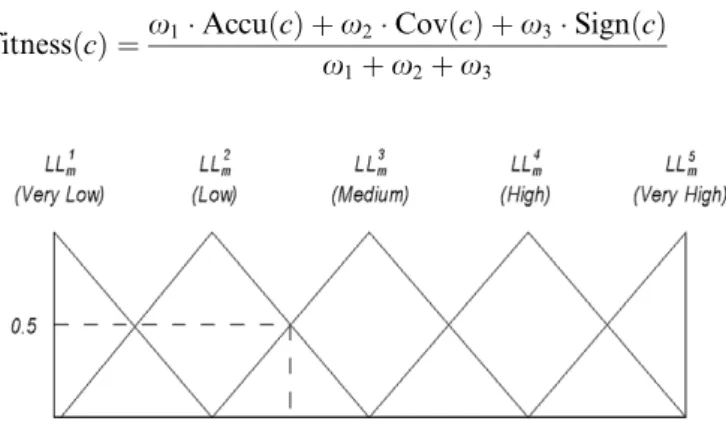
One of the main aspects when working with fuzzy rules is the definition of membership functions associated with the fuzzy sets used. The fuzzy sets corresponding to the
lin-guistic labels for a linlin-guistic variablem,ðLL1 m . . .LL
lm mÞ, are
specified by means of the corresponding membership func-tions which can be defined by the user or defined by means of a uniform partition if the expert knowledge is not
avail-able. Fig. 1 shows a variable m with five linguistic labels
using uniform partitions with triangular membership functions.
As we have mentioned previously, only the antecedent of the rule is represented in the chromosome and all the individuals are associated with the same value of the target variable.
For the canonical rules, in which the antecedent is com-posed of a conjunction of variable-value pairs, all the infor-mation relating to a rule can be contained in a fixed-length chromosome with an integer representation (the i-th posi-tion indicates the value adopted by the i-th variable). The set of possible values for the categorical features is increased with an additional value that indicates that the corresponding variable does not take part in the rule (value 0). For continuous variables the set of values is the set of linguistic terms determined heuristically or with expert information, plus the value indicating the absence of the
variable. Fig. 2 shows a chromosome which follows this
representation for the antecedent of the rule: If X1 isLL31 andX3 isLL13 then Class2
For the DNF rules, in which each variable can take more than one value, the antecedent of a rule can be sented by a fixed-length chromosome with a binary repre-sentation in which, for each feature a bit for each of the possible values of the feature is stored; in this way, if the corresponding bit contains the value 0 it indicates that the value is not used in the rule, and if the bit contains the value 1 it indicates that the corresponding value is
included.Fig. 3shows a chromosome using this
representa-tion for the antecedent of the rule: If X1 isLL11 or LL
3
1 andX3 isLL13 then Class2
3.3.2. GA fitness function
The fitness function of the GA combines, according to the following expression, three factors: accuracy, coverage and significance of the rule:
fitnessðcÞ ¼x1AccuðcÞ þx2CovðcÞ þx3SignðcÞ
x1þx2þx3
These measures are computed in the following way: – Accuracy (Accu): the percentage of positive examples,
i.e., the confidence as was defined in(7).
– Coverage (Cov): the percentage of examples (both
posi-tive and negaposi-tive) covered by the rule, as defined in(1).
– Significance (Sign): indicates the significance of a find-ing, if measured by the likelihood ratio of a rule, as defined in(5).
The overall objective of the evaluation function is to direct the search towards rules which maximize accuracy and significance, minimizing the number of negative and non-covered examples.
3.3.3. GA hybrid model
The GA uses a modified steady-state reproduction model, with the aim of increasing the diversity of the pop-ulation. In this model, the original population is modified through the substitution of the worst individuals by indi-viduals resulting from crossover and mutation. Recombi-nation is achieved by means of a two-point crossover operator and a biased random mutation operator.
Crossover is applied to the two best individuals of the population, obtaining two new individuals, who will substi-tute the two worst individuals in the population.
Mutation is carried out by means of a biased random mutation operator applied to the gene selected according to the mutation probability. This operator can be applied in two different ways: in the first the mutation causes the elimination of the variable to which the gene corresponds, and in the second the value for the variable to be muted is randomly assigned. The selection of one of the two choices is performed randomly, with the same probability. The use of this operator allows the promotion of diversity in the population.
Finally, a post-processing step is applied to the obtained rule, improving it through a hill-climbing process, modify-ing the rule in order to increase the degree of support. In order to accomplish this, in each iteration a variable is selected so that when it is eliminated, the support of the resulting rule is increased, thus obtaining more general rules. The optimized rule will substitute the original one only if it overcomes minimum confidence.
4. E-learning case study: usage data of the cordoba university moodle e-learning system
In this section we examine the Moodle case study. We first describe our specific problem and then show the exper-imental results obtained in the execution of the different subgroup discovery algorithms. Finally we analyze several rules from the point of view of the teacher with the aim of improving the e-learning courses.
4.1. Problem description
As we have mentioned previously, we have used the stu-dents’ usage data of the Moodle system, which is one of the
most widely used e-learning systems (Flate, 2003). Moodle
has a large and diverse user’s community with over 75
lan-guages in over 160 countries (Moodle, 2007).
Our main objective in using subgroup discovery in an e-learning system is to analyze what relation the usage of complementary activities of a course can have to final mark obtained. We have used the final mark as the variable to characterize.
We are going to use different subgroup discovery algo-rithms in order to evaluate the results obtained and to ana-lyze which algorithm discovers the information of highest interest/usability to the teacher of the course. Our objective is to present the results to the teacher in the form of rules in order to allow the use of this knowledge in the decision making concerning the complementary activities of the course. For example the teacher can decide to promote the use of some type of activities to obtain a high mark, or on the contrary eliminate some activities because they are associated with low marks.
The Moodle system contains a great deal of detailed information on course content, users, usage, etc., stored in a relational data base. We have applied a pre-processing step to the information, obtaining a new summary table (seeTable 1) with the most important information related to our objective.
Table 1contains a summary of the activities completed and the mark obtained by each student in an e-learning course. We have discretized the marks into classes (fail, pass, good and excellent) in order to codify them as the val-ues of the rule consequent.
We have access to information corresponding to 192 dif-ferent courses of the University of Cordoba. Among all these courses, we have however chosen only the 5 courses (with a total of 293 students) with the highest usage of the activities and resources available in Moodle.
We implemented the subgroup discovery algorithm for the KEEL data mining platform, available via the web (KEEL, 2007). We then exported all the information of the summary table to a text file using the same forma as
the KEEL platform (Alcala´ et al., 2007). This format is
similar to the Weka ARFF format (Witten & Frank,
2005) and has two different sections: the first section
con-tains the header information (the name of the relation, a
Fig. 2. Encoding model of a canonical rule.
list of the attributes and their types); the second contains the data information (the data declaration line and the actual instance lines, a row for each student in which there is a column for each attribute value). An example of the KEEL format in which we present our summary dataset
table is shown inTable 2.
4.2. Experimental results of the application of subgroup discovery algorithms
In order to verify the applicability of our proposal, we have compared the results of the SDIGA algorithm with those of other subgroup discovery algorithms:
– The classical subgroup discovery algorithms Apriori-SD (Kavsek & Lavrac, 2006) and CN2-SD (Lavrac et al., 2004).
– CBA algorithm (Liu et al., 1998), that discovers a special type of association rules (with a single predetermined target) called class association rules (CARs).
CBA, Apriori-SD and CN2-SD are deterministic algo-rithms, whereas SDIGA is nondeterministic. In order to carry out the comparison, we have followed the following procedure: for the classic deterministic algorithms we have performed a set of runs, varying one of their parameters each time. In the case of CBA and Apriori-SD, we have
used 4 minimum confidence values (0.6, 0.7, 0.8 and 0.9) with a minimum support of 0.2. In the case of the
CN2-SD, we have used thecparameter (0.9, 0.7, 0.5 and
addi-tive) with a star size of 2.
For the nondeterministic SDIGAs we have performed 5 different runs for a set of values of minimum confidence (0.6, 0.7, 0.8 and 0.9) using the following parameters:
– Population size: 100.
– Maximum number of evaluations of individuals in each GA run: 10,000.
– Crossover probability: 0.6. – Mutation probability: 0.01.
– Number of linguistic labels for the continuous variables: 5 (very high, high, medium, low, very low).
– Weights for the fitness function: 3 for accuracy, 1 for coverage and 4 for significance. This set of weights has been chosen according to the results obtained in an experimental study.
As we have mentioned before, SDIGA can be used to obtain two types of rules, DNF and non-DNF (or canon-ical) rules. We have carried out the experiments for both types of rules.
Table 3 shows the results obtained by the classic algo-rithms with their different parameter values and the aver-ages of the 5 runs of the SDIGAs (both types of rules, noted as SDIGA non-DNF and SDIGA DNF) with each value of minimum confidence. The table shows the total number of rules obtained, the number of attributes in the antecedents of the rules and the values of the quality mea-sures. These quality measures are:
– Coverage of the rule set, COV, as defined in (2).
– Significance of the rule set, SIG, as defined in(6).
– Accuracy of the rule set, ACC, as defined in(8).
Analyzing the number of rules and attributes in Table 4 we can observe that:
– SDIGA non-DNF, SDIGA DNF and Apriori-SD algo-rithms discover the lowest number of rules (with very similar values); on the other hand CN2-SD and more specially CBA discover the highest number of rules. – Regarding the number of attributes, Apriori-SD, CBA
and SDIGA non-DNF obtain a low number of attri-butes (with very similar values) followed by SDIGA DNF. Finally, CN2-SD obtains the highest number of attributes.
From our problem’s point of view we are interested in discovering a low number of rules with few attributes in order to facilitate the comprehensibility of these rules to the teacher. So the CBA and CN2-SD algorithms are not the most appropriate for our problem due to the fact that one discovers too many rules and the other discovers rules with too many attributes.
Table 1
Attributes used for each student
Name Description
Course Identification of the course
n_assignment Number of assignments completed
n_assignment_a Number of assignments passed
n_assignment_s Number of assignments failed
n_quiz Number of quizzes completed
n_quiz_a Number of quizzes passed
n_quiz_s Number of quizzes failed
n_messages Number of messages sent to the chat
n_messages_ap Number of messages sent to the teacher
n_posts Number of messages sent to the forum
n_read Number of forum messages read Mark Discretized student’s mark
Table 2
Summary dataset table in KEEL format @relation student_summarization
@attribute course {C29, C46, C88, C110, C111} @attributen_assignment integer
. . .
@attribute mark {FAIL, PASS, GOOD, EXCELLENT} @data C110,10,10,6,0,12,9,3,0, GOOD C110,9,9,0,0,11,8,3,0, PASS C110,11,11,0,0,13,5,8,0, FAIL C110,11,11,0,0,11,6,5,0, FAIL C110,13,13,7,0,0,0,0,0, EXCELLENT C110,8,8,7,0,7,6,1,0, FAIL
Analyzing the quality measures in Table 3 we can observe that:
– Accuracy (or confidence) measure indicates in our case the number of students that fulfill the rule antecedent and correspond to the associated class (the number of examples associated with the class). SDIGA DNF and non-DNF show the highest values followed by CN2-SD, CBA and Apriori-SD.
– Coverage is, like support, a measure of the generality of the rule. In our case it measures the number of students that fulfill the rule antecedent. Apriori-SD and CN2-Cd show the highest values, followed by SDIGA DNF, CBA and SDIGA non-DNF.
– Significance is a measure of the quantitative relevance and the interest of the rule. CN2-SD and SDIGA DNF show the highest values, followed by Apriori-SD, CBA, and SDIGA non-DNF.
The most desirable algorithm with regard to the values of these three quality measures would be an algorithm that simultaneously shows the highest values for all the mea-sures. As we have seen there is not a single algorithm which achieves this. Among these measures, accuracy is arguably the most important, as it represents the reliability or confi-dence of the rule. In order to make reliable decisions the teacher has to use high confidence rules. We can observe inTable 3that both versions of SDIGA discover rules with high accuracy and reasonable significance.
4.3. Using the rules obtained by SDIGA
In this section, we will describe some examples of the rules obtained and how these can be useful in course deci-sion-making. The subgroup discovery rules reveal
interest-ing information on the behavior of the students, and can help the teacher to discover beneficial or detrimental rela-tionships between the use of web-based educational resources and the student’s learning. The instructor can use the knowledge discovered by these rules to make deci-sions about Moodle course activities.
First, we describe several examples of rules discovered by the SDIGA non-DNF algorithm and analyze their meanings from a pedagogical point of view with the aim of improving the course.
IF course=C110 AND n_assignment=High AND n_posts=High
THEN mark=Good
(Accuracy: 0.9285, Significance: 6.5348, Coverage: 0.1575)
This rule shows that in the ProjectManagement (C110)
course, the students who have completed a high number of assignments and sent a lot of messages to the forum, have also obtained good marks. The teacher must continue to promote these types of activity in this course because of their effectiveness for the students in the final mark obtained.
IF course=C29 AND n_messages_ap=Very low THEN mark=Fail
(Accuracy: 0.8560, Significance: 59.1774, Coverage: 0.2520)
In theAppliedComputerScienceBasis(C29) course, most
of the students who have sent a very low number of mes-sages to the teacher have failed. Using this information, the teacher can direct more attention to these students because they have a higher probability of failing.
Table 3
Experimental results of the algorithms
Algorithm Number of rules Number of Attributes Coverage Significance Accuracy
CBA CfMin 0.6 205 1.8 0.3536 25.5559 0.6130 CBA CfMin 0.7 201 1.9 0.3665 28.9316 0.6130 CBA CfMin 0.8 142 2.2 0.2568 42.1091 0.6952 CBA CfMin 0.9 60 2.5 0.0094 35.8586 0.6778 Apriori-SD CfMin 0.6 8 1.0 0.6220 26.1321 0.6130 Apriori-SD CfMin 0.7 9 1.3 0.6685 29.5409 0.6130 Apriori-SD CfMin 0.8 6 1.5 0.3613 42.1091 0.6130 Apriori-SD CfMin 0.9 5 2.0 0.2253 36.8100 0.6312 CN2-SD (c= 0.5) 13 5.5 0.4151 44.9486 0.7157 CN2-SD (c= 0.7) 17 5.5 0.3980 48.4380 0.7191 CN2-SD (c= 0.9) 16 5.3 0.3878 50.2812 0.7294 CN2-SD (add) 32 5.7 0.5084 54.4237 0.7123
SDIGA non-DNF CfMin 0.6 7.8 2.0 0.0878 21.9924 0.8088 SDIGA non-DNF CfMin 0.7 6.2 2.1 0.0766 16.7925 0.7502 SDIGA non-DNF CfMin 0.8 6.0 2.2 0.1271 25.2460 0.7792 SDIGA non-DNF CfMin 0.9 4.8 2.0 0.1288 33.8351 0.7546 SDIGA DNF CfMin 0.6 7.8 3.1 0.3071 40.6689 0.7575 SDIGA DNF CfMin 0.7 9.4 3.6 0.2629 45.5539 0.8162 SDIGA DNF CfMin 0.8 7.4 3.2 0.2625 42.9744 0.7598 SDIGA DNF CfMin 0.9 5.4 3.0 0.1639 25.7814 0.7882
It is important to point out that we have also discovered rules that provide information which is fairly obvious to the teacher. Some examples of this type of rules are the following:
IF n_quiz_a=Very low THEN mark=Fail
(Accuracy: 0.6280, Significance: 6.500, Coverage: 0.0205)
This rule shows that if the number of quizzes passed is very low then the final mark obtained is fail. This rule is completely logical for the teacher (students who do not pass on-line quizzes are unlikely to pass a pen and pencil exam), and it does not provide any new information on how to improve the course.
IF n_quiz_a=Very high THEN mark=Excellent
(Accuracy: 0.7819, Significance: 35.7308, Coverage: 0.1280)
This is the opposite rule to the previous one and states that the students that obtain a very high score in the quiz-zes then they logically obtain excellent marks.
Below we describe some examples of rules discovered by the SDIGA DNF algorithm.
IF course=C110 OR C88
AND n_posts=High OR Very High
AND n_quiz_a=Medium OR High OR Very High THEN mark=Good
(Accuracy: 0.7382, Significance: 43.4771, Coverage: 0.2431)
This rule shows that if the students of the course Project-Management (C110) or ComputerScienceBasis (C88) have sent a high or very high number of messages to the forum, and they have also obtained a medium, high or very high score in the quizzes, then they obtain good marks.
IF course=C29 OR C110 OR C111
AND n_assignment_s=Very High OR High OR Medium
AND n_quiz_s=Very High OR High OR Medium AND n_messages_ap=Very low OR Low
THEN mark=Fail
(Accuracy: 0.8667, Significance: 61.8034, Coverage: 0.4726)
This rule shows that if the students of the course
Pro-grammingForEngineers (C29) or ProjectManagement
(C110) orComputerScienceBasis(C88) have failed in a very
high, high or medium number of assignments, have failed in a very high, high or medium number of quizzes, and have sent a very low or low number of messages to the tea-cher, then they have obtained a fail in their final marks.
These rules belonging to the set of rules discovered by SDIGA DNF present a higher coverage value than the pre-vious ones. They use more than one value per variable in the rule, allowing us to cover more examples.
5. Conclusions
In this work we have described the application of sub-group discovery to e-learning, with the case study of the Moodle course management system. We have used real usage data pickep up from students at the University of Cordoba, Spain.
We have compared the results obtained by different algorithms for subgroup discovery, showing the suitability of the evolutionary subgroup discovery to this problem. In particular, SDIGA algorithm obtains a small number of rules which are highly understandable for the teacher. It also obtains similar results in the rules’ quality measures and optimum results in the accuracy of the rules.
Our final objective is to show the discovered rules and theirs measures to the teacher, so that he can decide on course improvement. We have shown how the teacher can make decisions concerning the courses’ activities and type of students in order to improve the course using the information provided by these rules.
Acknowledgement
The authors gratefully acknowledge the financial sup-port provided by the Spanish department of Research un-der TIN2005-08386-C05-01, TIN2005-08386-C05-02 and TIN2005-08386-C05-03 Projects.
References
Agrawal, R., Imielinski, T., & Swami, A. (1993). Mining association rules between sets of items in large databases. In Proceedings of the 1993 ACM SIGMOD international conference on management of data(pp. 207–216). Washington, DC.
Alcala´, J., Sa´nchez, L., Garcı´a, S., del Jesus, M. J., Ventura, S., Garrell, J. M., et al. (2007). KEEL: A data mining software tool for assessing the performance of knowledge extraction-based on evolutionary algo-rithms.Soft computing, to appear.
Atzmueller, M., Puppe, F. & Buscher, H. P. (2004). Towards knowledge-intensive subgroup discovery. In Proceedings Lernen, Wis-sensentdeckung und Adaptivita¨t Workshop (LWA’04)(pp. 117–123). Berlin, Germany.
Atzmueller, M., & Puppe, F. (2006). SD-Map – A fast algorithm for exhaustive subgroup discovery. InProceedings of the 10th European conference on principles and practice of knowledge discovery in databases (PKDD 2006). Lecture notes in computer science (Vol. 4213, pp. 6–17). Berlin: Springer-Verlag.
Carse, B., Fogarty, T. C., & Munro, A. (1996). Evolving fuzzy rule based controllers using genetic algorithms. Fuzzy Sets and Systems, 80, 273–293.
Castro, F., Vellido, A., Nebot, A., & Minguillon, J. (2005). Detecting atypical student behaviour on an e-learning system. In I Simposio Nacional de Tecnologas de la Informacio´n y las comunicaciones en la Educacion(pp. 153–160). Granada, Spain.
Clark, P., & Niblett, T. (1989). The CN2 induction algorithm.Machine Learning, 3(4), 261–283.
Cordo´n, O., del Jesus, M. J., Herrera, F., & Lozano, M. (1999). MOGUL: A methodology to obtain genetic fuzzy rule-based systems under the iterative rule learning approach. International Journal of Intelligent Systems, 14, 1123–1153.
Cordo´n, O., Herrera, F., Hoffmann, F., & Magdalena, L. (2001). Genetic fuzzy systems: evolutionary tuning and learning of fuzzy knowledge bases. World Scientific.
del Jesus, M. J., Gonza´lez, P., Herrera, F., & Mesonero, M. (2007). Evolutionary fuzzy rule induction process for subgroup discovery: a case study in marketing.IEEE Transactions on Fuzzy Systems, 15(4), 578–592.
Flate, M. (2003). Online education and learning management systems.
Global e-learning in a Scandinavian perspective. Oslo: NKI Forlaget. Freyberger, J., Heffernan, N., & Ruiz, C. (2004). Using association rules to
guide a search for best fitting transfer models of student learning. In
Workshop on analyzing student–tutor interactions logs to improve educational outcomes at ITS conference. Maceio (pp. 1–4). Brazil. Gamberger, D. & Lavrac, N. (2002). Descriptive induction through
subgroup discovery: A case study in a medical domain. InProceedings of the 19th international conference on machine learning (ICML 2002)
(pp. 163–170). Sydney, Australia.
Gamberger, D., & Lavrac, N. (2002a). Expert-guided subgroup discovery: Methodology and application. Journal Of Artificial Intelligence Research, 17, 1–27.
Gamberger, D., Lavrac, N., & Krstacic, G. (2003). Active subgroup mining: A case study in coronary heart disease risk group detection.
Artificial Intelligence in Medicine, 28(1), 27–57.
Ghosh, A., & Jain, L. (2005).Evolutionary computation in data mining.
Studies in fuzziness and soft computing(Vol. 163). Springer.
Giordana, A., & Neri, F. (1995). Search-intensive concept induction.
Evolutionary Computation, 3(4), 375–416.
Gonza´lez, A., & Pe´rez, R. (1999). SLAVE: A genetic learning system based on an iterative approach.IEEE Transactions on Fuzzy Systems, 7(2), 176–191.
Han, J., Kamber, M., & Tung, A. K. H. (2001).Spatial clustering methods in data mining: A survey. Philadelphia: Taylor & Francis.
Han, J., & Pei, J. (2000). Mining frequent patterns by pattern-growth: Methodology and implications.ACM SIGKDD Explorations Newslet-ter, 2(2), 14–20.
Ishibuchi, H., Nakashima, T., & Nii, M. (2004). Classification and modeling with linguistic information granules. Springer-Verlag. Jovanoski, V., & Lavrac, N. (2001). Classification rule learning with
APRIORI-C. Inprogress in artificial intelligence knowledge extraction, Multi-agent systems, Logic programming, and Constraint solving: 10th Portuguese Conference on Artificial Intelligence (EPIA’01)(pp. 44–51). Porto, Portugal.
Kavsek, B., Lavrac, N., & Bullas, J. C. (2002). Rule induction for subgroup discovery: a case study in mining UK traffic accident data. In
International Multi-Conference on Information Society (IS’02) (pp. 127–130). Ljubljana, Slovenia.
Kavsek, B., & Lavrac, N. (2006). APRIORI-SD: Adapting association rule learning to subgroup discovery. Applied Artificial Intelligence, 20(7), 543–583.
KEEL (2007). Available from <http://www.keel.es>.
Klo¨sgen, W. (1996). Explora: A multipattern and multistrategy discovery assistant. In U. Fayyad, G. Piatetsky-Shapiro, P. Smyth, & R. Uthurusamy (Eds.),Advances in knowledge discovery and data mining
(pp. 249–271). Menlo Park, California: AAAI Press.
Klo¨sgen, W. (2002). Subgroup discovery. In W. Klo¨sgen & J. Zytkow (Eds.), Handbook of data mining and knowledge discovery
(pp. 354–364). NY: Oxford University Press.
Klo¨sgen, W., & Zytkow, J. (2002).Handbook of data mining and knowledge discovery. NY: Oxford University Press.
Kovacs, T. (2004). Strength or accuracy: Credit assignment in learning classifier systems. Springer-Verlag.
Lavrac, N., Flach, P., & Zupan, B. (1999). Rule evaluation measures: A unifying view. In Proceedings of the 9th international workshop on inductive logic programming (ILP’99)(pp. 174–185).
Lavrac, N., Kavsec, B., Flach, P., & Todorovski, L. (2004). Subgroup discovery with CN2-SD. Journal of Machine Learning Research, 5, 153–188.
Lavrac, N., Zelezny, F., & Flach, P. A. (2003). RSD: Relational subgroup discovery through first-order feature construction. InProceedings of the international conference on inductive logic programming. Lecture notes on artificial intelligence(2583, pp. 149–165). Sydney, Australia: Springer.
Liu, B., Hsu, W., & Ma, Y. (1998). Integrating classification and association rule mining.In Proceedings of the international conference on knowledge discovery and data ming(pp. 80–86). NY.
Li, J., & Zaı¨ane, O. (2004). Combining usage, content, and structure data to improve web site recommendation. InProceedings of the interna-tional conference on e-commerce and web technologies.Lecture notes on computer science(3182, pp. 305–315). Zaragoza, Spain: Springer. Lu, J. (2004). Personalized e-learning material recommender system. In
Proceedings of the international conference on information technology for application(pp. 374–379). London, England.
Markellou, P., Mousourouli, I., Spiros, S., & Tsakalidis, A. (2005). Using semantic web mining technologies for personalized e-learning experi-ences. In Proceedings of the web-based education (pp. 461–826). Grindelwald, Switzerland.
Merceron, A., & Yacef, K. (2004). Mining student data captured from a web-based tutoring tool: Initial exploration and results. Journal of Interactive Learning Research, 15(4), 319–346.
Michie, D., Spiegelhalter, D. J., & Taylor, C. C. (1994).Machine learning, neural and statistical classification. Ellis Horwood.
Minaei-Bidgoli, B., Tan, P., & Punch, W. (2004). Mining interesting contrast rules for a web-based educational system. InProceedings of the international conference on machine learning applications(pp. 1–8). Louisville, KY.
Moodle (2007). Available from <http://moodle.org>.
Mor, E., & Minguillon, J. (2004). E-learning personalization based on itineraries and long-term navigational behavior. InProceedings of the 13th international world wide web conference(pp. 264–265). NY. Nakada, T., & Kunifuji, S. (2003). Subgroup discovery among personal
homepages. In Proceedings of the 6th international conference on discovery science (DS 2003)(pp. 385–392). Sapporo, Japan. Paulsen, M. (2003). Online education and learning management systems.
Bekkestua: NKI Forlaget.
Piatetsky-Shapiro, G., & Matheus, C. (1994). The interestingness of deviation. In Proceedings of the AAAI workshop on knowledge discovery in databases(pp. 25–36). Seattle, Washington.
Quinlan, J. R. (1993).C4.5: Programs for machine learning. San Mateo, CA: Morgan Kaufmann.
Romero, C., & Ventura, S. (2006).Data mining in e-learning. Southamp-ton, UK: Wit Press.
Romero, C., & Ventura, S. (2007). Educational data mining: A survey from 1995 to 2005.Expert Systems with Applications, 33(1), 135–146. Romero, C., Ventura, S., & Bra, P. D. (2004). Knowledge discovery with genetic programming for providing feedback to courseware author.
User Modeling and User-Adapted Interaction: The Journal of Person-alization Research, 14(5), 425–464.
Talavera, L., & Gaudioso, E. (2004). Mining student data to characterize similar behavior groups in unstructured collaboration spaces. In
Workshop on artificial intelligence in CSCL. 16th European conference on artificial intelligence(pp. 17–23). Valencia, Spain.
Wang, F. (2002). On using data-mining technology for browsing log file analysis in asynchronous learning environment. InProceedings of the Conference on educational multimedia, hypermedia and telecommunica-tion(pp. 2005–2006). Denver, Colorado.
Wang, C. H., Hong, T. P., & Tseng, S. S. (1998). Integrating fuzzy knowledge by genetic algorithms.IEEE Transactions on Evolutionary Computation, 2, 138–149.
Witten, I. H., & Frank, E. (2005).Data mining: Practical machine learning tools and techniques. Morgan Kaufmann.
Wong, M. L., & Leung, K. S. (2002).Data mining using grammar based genetic programming and applications. Kluwer Academics Publishers. Wrobel, S. (1997). An algorithm for multi-relational discovery of
subgroups. InProceedings of conference principles of data mining and knowledge discovery(pp. 78–87). London, UK.
Zadeh, L. A. (1975). The concept of a linguistic variable and its applications to approximate reasoning, Parts I, II, III. Information Sciences, 8–9, pp. 199–249, 301–357, 43–80.
Zaı¨ane, O., & Luo, J. (2001). Web usage mining for a better web-based learning environment. In Proceedings of conference on advanced technology for education(pp. 60–64). Banff, Alberta.