UC San Diego
UC San Diego Previously Published Works
Title
Next-generation sequencing of prostate cancer: genomic and pathway alterations, potential actionability patterns, and relative rate of use of clinical-grade testing.
Permalink
https://escholarship.org/uc/item/6g93p9fc
Journal
Cancer biology & therapy, 20(2)
ISSN
1538-4047Authors
Ikeda, Sadakatsu Elkin, Sheryl K Tomson, Brett N et al.Publication Date
2019DOI
10.1080/15384047.2018.1523849 Peer reviewedeScholarship.org Powered by the California Digital Library
RESEARCH PAPER
Next-generation sequencing of prostate cancer: genomic and pathway alterations,
potential actionability patterns, and relative rate of use of clinical-grade testing
Sadakatsu Ikedaa,b, Sheryl K. Elkin c, Brett N. Tomsonc, Jennifer L. Carterc, and Razelle Kurzrocka
aCenter for Personalized Cancer Therapy, Division of Hematology/Oncology, Department of Medicine, University of California, San Diego, Moores Cancer Center, La Jolla, CA, USA;bCancer Center, Tokyo Medical and Dental University, Tokyo, Japan;cN-of-One, Inc, Lexington, MA, USA
ABSTRACT
Despite being one of the most common cancers, treatment options for prostate cancer are limited. Novel approaches for advanced disease are needed. We evaluated the relative rate of use of clinical-grade next generation sequencing (NGS) in prostate cancer, as well as genomic alterations identified and their potential actionability. Of 4864 patients from multiple institutions for whom NGS was ordered by physicians, only 67 (1.4%) had prostate cancer, representing 1/10 the ordering rate for lung cancer. Prostate cancers harbored 148 unique alterations affecting 63 distinct genes. No two patients had an identical molecular portfolio. The median number of characterized genomic alterations per patient was 3 (range, 1 to 9). Fifty-six of 67 patients (84%) had≥1 potentially actionable alteration.TMPRSS2fusions affected 28.4% of patients. Genomic aberrations were most frequently detected in TP53 (55.2% of patients),PTEN(29.9%),MYC(17.9%),PIK3CA(13.4%),APC(9.0%),BRCA2(9.0%),CCND1(9.0%), andRB1 genes (9.0%). The PI3K (52.2% of patients), WNT (13.5%), DNA repair (17.9%), cell cycle (19.4%), and MAPK (14.9%) machinery were commonly impacted. A minority of patients harboredBRAF, NTRK, ERBB2, or mismatch repair gene abnormalities, which are highly druggable in some cancers. Only ~ 10% of prostate cancer trials (clinicaltrials.gov, year 2017) applied a (non-hormone) biomarker before interven-tion. In conclusion, though use of clinical-grade NGS is relatively low and only a minority of trials deploy DNA-based biomarkers, many prostate cancer-associated molecular alterations may be pharmacologi-cally tractable with genomcially targeted therapy or, in the case of mismatch repair anomalies, with checkpoint inhibitor immunotherapy.
ARTICLE HISTORY Received 31 May 2018 Revised 5 August 2018 Accepted 26 August 2018 KEYWORDS
prostate cancer; genomic profiling; next-generation sequencing; molecular targeted therapy; mutation
Introduction
Prostate cancer is the most common cancer and a leading cause of death in American men.1Hormone therapy has been the corner-stone of treatment for decades.2 Molecular targeted therapy has been changing the treatment landscape in other malignancies, such as non-small cell lung, breast, and colorectal cancer. However, no genomically targeted therapy is approved by the Food and Drug Administration (FDA) for prostate cancer, and, historically (September 2011 through September 2014), only ~ 2.0% of prostate cancer clinical trials listed on clinicaltrials.gov utilized a non-hormone biomarker to match patients with therapy.2
Genomic profiling of cancer using next-generation sequencing (NGS) is gaining popularity in the clinical setting.3–8By sequen-cing the tumor genome, potential actionable genomic aberrations can be discovered. Mutation profile can be used as a biomarker to guide appropriate matched targeted therapy and is also emerging as a marker for immunotherapy, with specific alterations such as
PDL1 amplification, aberrant mismatch repair genes and high tumor burden being correlated with responsiveness.9
In order to better understand the landscape of prostate cancer and the utilization of genomic testing in this population, we conducted an analysis of prostate cancer tissue referred for next generation sequencing (NGS) and data interpretation to a Clinical
Laboratory Improvement Amendments (CLIA) certified labora-tory. Here, we report the comparative frequency of NGS utiliza-tion, the molecular alterations, and potential actionability in prostate cancer.
Results
Frequency of testing
A total of 4864 tissue samples were profiled and inter-preted. Table 1 demonstrates that prostate cancer was sig-nificantly less frequently profiled than other common malignancies. Indeed, while only 67 patients with prostate cancer underwent NGS, this testing was ordered in 673, 474, and 299 patients, respectively, with lung, breast and colorectal cancer. Amongst genitourinary malignancies, prostate cancer was the least frequently sequenced cancer (bladder cancer was tested in 124 cases, and kidney cancer was sequenced in 121 patients).
Genomic aberrations in prostate cancer
All 67 prostate tumors had at least one genomic aberration (variants of unknown significance (VUS) were excluded). The most common aberrations were in the following genes:
CONTACTRazelle Kurzrock [email protected] UC San Diego Moores Cancer Center, 3855 Health Sciences Drive, #0658, La Jolla, CA, USA 92093-0987 Supplementary data for this article can be found online atwww.tandfonline.com/kcbt.
2019, VOL. 20, NO. 2, 219–226
https://doi.org/10.1080/15384047.2018.1523849
© 2018 The Author(s). Published with license by Taylor & Francis Group
This is an Open Access article distributed under the terms of the Creative Commons Attribution-NonCommercial-NoDerivatives License (http://creativecommons.org/licenses/by-nc-nd/4.0/), which permits non-commercial re-use, distribution, and reproduction in any medium, provided the original work is properly cited, and is not altered, transformed, or built upon in any way.
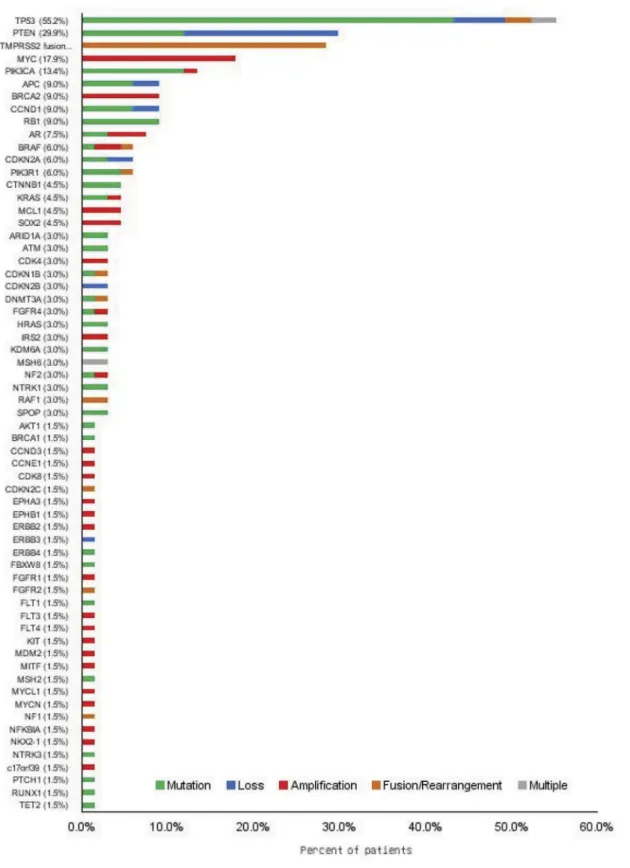
TP53(55.2% of patients), followed by PTEN(29.9%), MYC (17.9%), PIK3CA (13.4%), APC (9.0%), BRCA2 (9.0%),
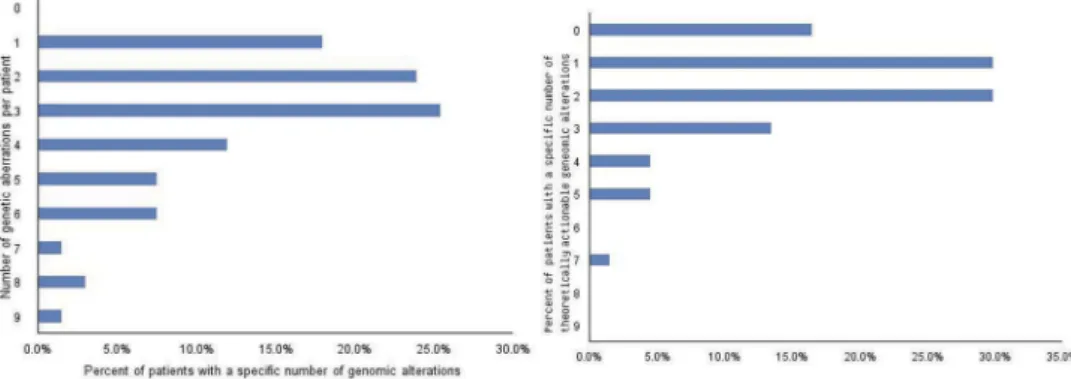
CCND1(9.0%), andRB1 (9.0%) (Figure 1). A fusion invol-vingTMPRSS2was found in 28.4% of patients. The median number of genomic alterations per patient was 3 (range, 1 to 9) (Figure 2A). Fifty-six of 67 patients (84%) had at least one potentially actionable alteration (Table 2). The median number of potentially actionable genes per patient was 2 (range, 0 to 7) (Figure 2B).
Prostate tumors have diverse and unique genomic portfolios
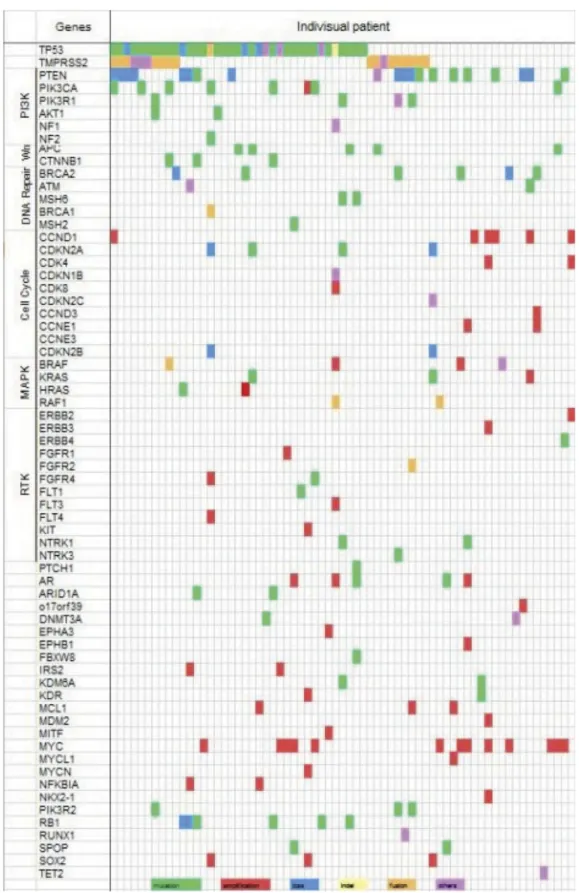
There were 63 distinct genes that harbored alterations; 73% of the altered genes (46 of 63) were found in≤3% of patients; altogether there were 148 distinct alterations.Figure 3 shows that the molecular alterations in each patient were unique. Five patients had the same genomic portfolio: two with only
TP53alterations, and three withTP53andTMPRSS2fusions. However, in each case, the precise loci altered within the genes was different. Therefore, at the molecular level, no two patients had an identical molecular portrait.
Diverse pathways are altered in prostate cancer
Signals altered in prostate cancer affected the PI3K/Akt/mTor axis, and the Wnt, DNA repair, cell cycle, and MAPK path-ways (Table 2).
PI3K pathway
The PI3K pathway regulates cell proliferation, apoptosis, growth, and longevity and is frequently altered in many malignancies10 In prostate cancer, the PI3K pathway aberra-tions (including alteraaberra-tions inPTEN, PIK3CA, PIK3R1, NF2,
AKT1, and NF1 genes) were found in 37 of 67 patients (52.2%) with metastatic prostate cancer in our dataset. Amongst patients with PI3K axis alterations, PTEN was the most frequently altered gene (29.9% of patients (20/67)), followed by PIK3CA (13.4%), PIK3R1 (6.0%), NF2 (3.0%),
AKT1 (1.5%), and NF1 (1.5%). Among PTEN aberrations, loss of PTEN was more frequent (17.9% (12/67)) compared to mutations (11.9%). Amplification was seen in a subset of
PIK3CA-altered tumors (1.5% of 67 patients).
Wnt pathway
Genomic alterations of the Wnt pathway were previously reported in 18% of metastatic castrate-resistant prostate cancer11In our study, the frequency of Wnt pathway altera-tions was 13.5%. Recurrent alteraaltera-tions inAPCwere found in 9.0% of our patient population while mutations inCTNNB1 occurred in 4.5% of our patients.
DNA repair pathway
In our series, the DNA repair pathway was aberrant in 17.9% of patients.BRCA2was the most frequently altered (9.0% of indi-viduals).ATMis known to be recruited and activated by DNA double strand breaks, and was altered in 3.0% of our patients.
BRCA1 was less frequently mutated (1.5% of patients). Interestingly, the genes that regulate microsatellite instability, such asMSH6andMSH2, were mutated in our study in a small subset of individuals (3.0% and 1.5%, respectively).
Cell cycle pathway
The loss ofRB1is a common event in prostate cancer, and 9.0% of patients were found to harbor an aberration inRB. Other genes that regulate the cell cycle also demonstrated alterations:
CCND1 (9.0% of patients), CDKN2A (6.0%), CDK4 (3.0%),
CDKN1B (1.5%), CDKN2B (3.0%), CCND3 (1.5%), CDK8 (1.5%), andCDKN2C (1.5%). These results imply the impor-tant involvement of cell cycle regulators in prostate cancer. MAPK pathway
The MAPK pathway plays a significant role in oncogenesis and alterations in this pathway are found in many malignancies12 In total, 14.9% patients with prostate cancer had aberrations in the MAPK pathway.BRAFwas the most commonly altered gene (6.0% of patients), followed byKRAS (4.5%),HRAS (3.0%), andRAF1(3.0%).
Other potentially actionable targets (Figure 1,Table 2) In addition to the pathways described above, there were other potentially targetable alterations in very small subgroups. For example, ErbB2 can be targeted by Her2-directed therapy, such as trastuzumab, and was amplified in one of our patients
Table 1.Estimated incidence and prevalence of prostate cancer and other malignancies in the United States. Incidence, prevalence, estimated death estimates are based on SEER database (http://seer.cancer.gov/statfacts), and five year survival rate for stage IV is obtained from Cancer Research UK (http://www.cancerresearchuk.org.).
Disease site
Incidence
in U.S. Prevalence in U.S. 5-year survival for Stage IV Estimated deaths in 2015 in U.S.(%)*
NGS tests performed N (%)** All Cancers 1,685,210 14,140,254 NA 595,690 4864 Lung 224,200 415,707 2% 158,080 (27%)* 673 (14%)** Breast 246,660 3,053,450 15% 40,450 (7%)* 474 (10%)** Colorectal 134,490 1,177,556 5% 49,190 (8%)* 299 (6%)** Bladder 76,960 587,426 10% 16,390 (3%)* 124 (3%)** Kidney 62,700 394,336 5% 14,240 (2%)* 121 (2%)** Prostate 180,890 2,850,139 30% 26,120(4%)* 67(1.4%)**
*Refers to percent of deaths from all cancers. Total deaths = 595,690 ** Refers to percent of tests done. Total tests done = 4864 Abbreviations: NA = not available
(1.5% of the dataset). Other receptor tyrosine kinases, such as
ERBB3, ERBB4, FGFR1, FGFR2, FGFR3, FLT3, KIT, NTRK1, NTRK3, were also abnormal, albeit often in only one patient. Although the frequency of each alteration was low, the cumu-lative frequency was significant–22.4% of patients had at least one such rare, but possibly druggable abnormality.
Biomarker driven clinical trials for prostate cancer We searched clinicaltrials.gov for all recruiting prostate cancer clinical trials noted during a one year period (starting January 1, 2017). Overall, 208 interventional protocols, of which 162 were therapeutic, were listed. Only 17 (10%) used a non-hormone biomarker for patient selecton.
Figure 1.Genomic aberrations in prostate cancer. Next-generation sequencing was performed in 67 prostate cancer patient specimens. Bar represents the frequency of genetic alterations among 67 patients.
Discussion
Analysis of genomic alterations is now clinically feasible, and many guidelines have begun to incorporate NGS analysis into clinical practice.13 Further, the FDA recently approved some NGS testing, such as the type utilized in the current study. Our analysis found that NGS was performed infrequently in prostate cancer. Comparatively, NGS was done in prostate cancer at only one tenth of the rate in lung cancer and one sixth of that in breast cancer (Table 1) This low rate of testing is striking because of the high incidence and prevalence of prostate cancer, but might be in part attributable to its more indolent nature. Relatedly, from a historic perspective, very few therapeutic clinical trials in prostate cancer used a non-hormone biomarker for patient selection (only 2% of the 357 therapeutic trials on clinicaltrials.gov in the three year period from September 2011 and September 2014, while 20% of trials included a targeted (non-hormone modulator) agent2). Our current analysis shows that only 10% of recruiting prostate cancer-directed therapeutic trials in 2017 used a non-hor-mone biomarker for selection of patients. Importantly, pre-vious meta-analyses have demonstrated that deploying targeted agents without a biomarker is associated with exceed-ingly low median response rates (about 5%) and, furthermore, that overall response rates for therapeutic clinical trials that lack biomarkers is approximately 10% (regardless of the type of agent). In contrast, median response rates in clinical trials enrolling biomarker-selected patient populations for treat-ment with targeted agents are about 30%.14–16
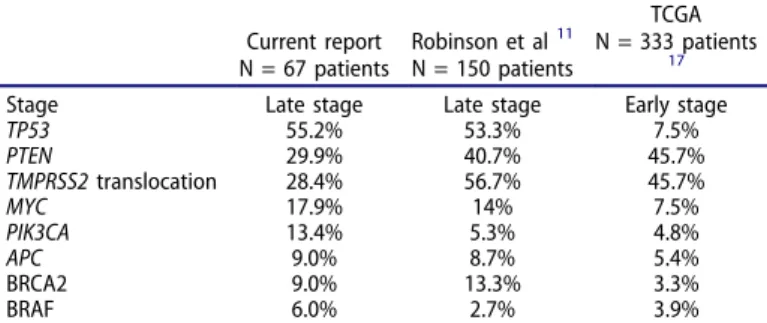
Our analysis of genomic alterations in prostate cancer confirmed that TP53 is the most frequently altered gene, followed by the PI3K pathway-associated genes11,17(Table 3) Our study and that of Robinson and colleague11 examined samples from late-stage disease and foundTP53alterations in 55.2% and 53.3% of patients, respectively, whereas TCGA analysis17 was conducted using early-stage samples, perhaps explaining why TCGA foundTP53alterations in only 7.5% of biopsies. The frequency ofTMPRSS2-fusions in our study was lower than in other studies, perhaps due to small sample size. Alterations in the PI3K/Akt/mTor pathway occurred in about half of the patients, with the most frequent abnormal-ities inPTENand inPIK3CAgenes. Templeton et al. reported that everolimus, an mTOR inhibitor, resulted in a prostate
specific antigen (PSA) response in 11% of patients with cas-trate-resistance prostate cancer (CRPC), albeit in a non-bio-marker-selected population.18 The PSA response correlated with PTEN deletion status, suggesting a biological rationale to target genetic aberrations in the PI3K pathway.18However, other studies have suggested that single-agent mTOR inhibi-tors have low rates of activity in advanced cancers, even in the presence of PI3k/Akt/mTor axis alteration,19–21while combi-nation therapy that includes these agents have significantly better activity in the presence of these aberrations.20
Recent clinical trials demonstrated that DNA-repair path-way aberrations can be a new treatment target. A phase 2 study of the PARP inhibitor olaparib in patients with CRPC harboring DNA-repair pathway abnormalities, including
BRCA2 mutation, demonstrated remarkably high response rates of 88 % in patients with CRPC.22 In our analysis and in Robinson’s data11(Table 3),BRCA2was abnormal in 9% to 13% of patients with late-stage disease.
BRAFanomalies were identified in 6% of our study popu-lation. Anti-BRAF therapy is a standard of care in melanoma, and can be effective in multiple (but not all)BRAF-mutated cancers.23,24 The utility of BRAF inhibition is unknown in prostate cancer.
Systematic treatment for prostate cancer has been focused on the androgen pathway, with nine androgen antagonists approved by the FDA for this malignancy. However, our data suggest that there are multiple other alterations that merit exploration in prostate cancer. Some of these alterations may be uncommon, but highly sensitive to targeted agents.-25,26 For example, some tumors harboring NTRK fusions respond well to larotrectinib.25
There are several limitations to the current study. They include the relatively small number of patients studied and the fact that full genomic sequencing was not performed However, part of the purpose of the study was to understand the utilization of clinical-grade NGS (rather than research-grade NGS such as that in TCGA) in the practice setting. In addition, the data was de-identified, so it is not known whether or not the ordering physicians exploited the NGS results to decide on treatment.
In conclusion, our results demonstrate that patients with advanced prostate cancer have diverse genomic alterations, many of which may be pharmacologically tractable. Important
Figure 2.The frequency of genomic alterations per patient and the frequency of actionable genetic aberrations per patient.A. The frequency of genetic alterations per patient.B. Frequency of theoretically actionable genetic alterations per patient.
pathways impacted include PI3k/Akt/mTor, MAPK, cell cycle, DNA repair and WNT. In addition, small numbers of patients harbor turmors withERBB2, BRAFandNTRKalterations, all of which are highly druggable in several other malignancies.ERBB3,
ERBB4, FGFR1, FGFR2, FGFR3, FLT3, KITaberrations were also
found in some patients and could also be tractable. Even so, there is a disproportionately low rate of genomic testing compared to other common malignancies. Further, there is a paucity of trials that match targeted agents with genomic alterations in prostate cancer, with only about 10% of current prostate cancer trials listed
Figure 3.Visualization of genomic alteration patterns in individual patient. Each color represents genomic alterations in each patient. (Green: mutation, Red: amplification, Blue: loss, Orange: fusion, Purple: structural change, Yellow: indel).
on clinicaltrials.gov using a non-hormone biomarker before inter-vention. Of interest, most of our patients had multiple genomic alterations, which differed from patient to patient. In total, there were 148 distinct abnormalities involving 63 different genes. Similar phenomena have been seen in other tumor types as well, and suggest that individualized combinations of cognate targeted drugs may be necessary to optimize treatment27-29Finally, three patients (4.5%) had an abnormal mismatch repair gene, which has been associated with high tumor mutation burden and response to checkpoint inhibitor immunotherapy in many tumors30,31Taken together, these data indicate that more genomically based studies in prostate cancer are urgently needed.
Table 2.Potentially actionable alterations and examples of targeted agents. The data of 50% inhibitory concentrations (IC50s) is available athttp://tanlab.ucdenver. edu.
Gene
alteration Frequency Examples of therapies Comments
Examples of References/ protocols PI3K axis (52.2%)* PTEN 20/67 (29.9%) Everolimus Sirolimus Sirolimus Sirolimus Sirolimus Sirolimus
Everolimus demonstrated PSA response in 11% of non-biomarker selected prostate cancer patients.
20 PIK3CA 9/67 (13.4%) PIK3R1 4/67 (6.0%) NF2 2/67 (3.0%) AKT1 1/67 (1.5%) NF1 1/67 (1.5%) WNT pathway (13.5%)* APC 6/67 (9.0%) Sulindac Celecoxib
Sulindac decreased CTNNB1 expressionin vivo. CTNNB1 3/67 (4.5%)
DNA Repair pathway (17.9%)*
BRCA2 6/67 (9.0%) Olaparib (ATM, BRCA) Cisplatin (BRCA) Carboplatin(BRCA)
Nivolumab, pembrolizumab, or atezolizumab (mismatch repair gene defects (MSH6 or MSH2))
Phase 3 study of olaparib demonstrated responses in 88% of DNA-repair pathway aberrant prostate cancer
NCT01682772 NCT02677038 ATM 2/67 (3.0%) MSH6 2/67 (3.0%) BRCA1 1/67 (1.5%) MSH2 1/67 (1.5%) Cell cycle pathway (19.4%)* CCND1 6/67 (9.0%) Palbociclib
Palbociclib Palbociclib Palbociclib
Phase 2 trial of palbociclib is in progress in biomarker-selected population. NCT02905318 CDKN2A 6/67 (9.0%) CDK4 2/67 (3.0%) CDKN1B 1/67 (1.5%) CDK8 1/67 (1.5%) Palbociclib CDKN2C 1/67 (1.5%) Palbociclib MAPK pathway (14.9%)* BRAF 4/67 (6.0%) Vemurafenib Dabrafenib Trametinib Cobimetinib
A study with vemurafenib is in progress in biomarker-selected prostate cancer population.
NCT02208583
KRAS 3/67 (4.5%) Trametinib Cobimetinib Phase 2 study with trametinib is planned in CRPC patients. NCT02881242 HRAS 2/67 (3.0%) Trametinib Cobimetinib
RAF1 2/67 (3.0%) Trametinib Cobimetinib Other actionable targets (22.4%)*
ERBB2 1/67 (1.5%) Trastuzumab Lapatinib ERBB3 1/67 (1.5%) Pertuzumab
Afatinib
Pertuzumab interferes with dimerization betweenERBB2and ERBB3
ERBB4 1/67 (1.5%)
FGFR1 1/67 (1.5%) Lenvatinib Lenvatinib Lenvatinib
Lenvatinib inhibits activity of FGFR 26
FGFR2 1/67 (1.5%) FGFR4 2/67 (3.0%) FLT1 1/67 (1.5%) Lenvatinib FLT3 1/67 (1.5%) Lenvatinib FLT4 1/67 (1.5%) Lenvatinib KIT 1/67 (1.5%) Imatinib NTRK1 2/67 (3.0%) Crizotinib LOXO-101 25 NCT02576431 NTRK3 1/67 (1.5%) PTCH1 1/67 (1.5%) Vismodegib Sonidegib
*Some patients had more than one alteration in a pathway; they were counted only once Abbreviations: CRPC = castrate-resistant prostate cancer; PSA = prostate specific antigen.
Table 3.Comparison of genomic alteration frequencies across different genomic profiling studies in prostate cancer.
Current report N = 67 patients Robinson et al11 N = 150 patients TCGA N = 333 patients 17
Stage Late stage Late stage Early stage
TP53 55.2% 53.3% 7.5% PTEN 29.9% 40.7% 45.7% TMPRSS2translocation 28.4% 56.7% 45.7% MYC 17.9% 14% 7.5% PIK3CA 13.4% 5.3% 4.8% APC 9.0% 8.7% 5.4% BRCA2 9.0% 13.3% 3.3% BRAF 6.0% 2.7% 3.9% 224 S. IKEDA ET AL.
Patients and methods
Patients
We analyzed prostate cancer specimen data submitted to Foundation Medicine Inc. (Cambridge, MA) (https://www. foundationmedicine.com/) for genomic sequencing and to N-of-One Inc. for data interpretation. The diagnosis and the origin of tissue were provided by ordering physicians from multiple institutions. The prostate cancer data was derived from a database of 4864 consecutive Foundation Medicine samples annotated by N-of-One starting in December 2011. The study was conducted in accordance with University of California San Diego Institutional Review Board guidelines for a de-identified database.
Tissue preparation, genomic sequencing, and bioinformatic analysis
Samples from formalin-fixed paraffin-embedded tissue were submitted to a CLIA-certified lab for genomic sequencing (Foundation Medicine). The details of sample requirement, DNA extraction and NGS were described previously; most samples represent advanced disease32 Targeted exons of 182 or 236 cancer-related genes and introns of 14 or 19 genes frequently rearranged in cancer were sequenced (Supplemental Table 1A and 1B) (Overall, 2974 cases were sequenced on the 182 gene panel and 1890 cases on the 236 gene panel.)
Average depth of sequencing was greater than 250x, with 100x at > 99% of exons. This method of sequencing enabled to detect copy number changes, gene rearrangement, and single nucleotide variants with 99% specificity and 99% sensitivity for base substitution, and 95% sensitivity for copy number changes. Amplification was defined as copy number increase of≥8 copies (equivocal, 6 to 7 copies). Sequencing data was analyzed with a customized analysis pipeline described previously32 Clinical interpretation of genetic alterations were provided by N-of-One (https://n-of-one.com)
Disclosure of potential conflict-of-interest
Razelle Kurzrock receives research funding from Genentech, Incyte, Merck, Serono, Pfizer, Sequenom, Foundation Medicine, and Guardant, as well as consultant fees from Loxo, X Biotech, and Actuate Therapeutics, speaker fees from Roche, and an ownership interest in Curematch Inc. Sheryl Elkin, Brett Tomson, and Jennifer Carter are employees of N-of-One, Inc. Sadakatsu Ikeda has nothing to disclose.
Funding
This work was supported in part by the Joan and Irwin Jacobs Fund philanthropic fund [no grant number is applicable–Razelle Kurzrock]; and by National Cancer Institute at the National Institutes of Health [grant P30 CA023100 (Razelle Kurzrock, [email protected])].
Ethics approval and consent to participate
Not Applicable
Consent for publication
Not Applicable
Availablity of data and material
All data generated or analyzed during this study are included in this published article [and its supplementary information files].
Authors contributions
SI, SKE, JLC, and RK designed the study. SI and SKE analyzed the data to generate the results, created the figures and tables. SI and SKE drafted the manuscript. All authors edited and approved the final manuscript.
List of abbreviations
NA = not available
CRPC = castrate-resistant prostate cancer PSA = prostate specific antigen.
ORCID
Sheryl K. Elkin http://orcid.org/0000-0002-2283-3842
References
1. Siegel RL, Miller KD, Jemal A. Cancer statistics. CA Cancer J Clin. 2015;65:5–29. doi:10.3322/caac.21254.
2. Khemlina G, Ikeda S, Kurzrock R. Molecular landscape of prostate cancer: implications for current clinical trials. Cancer Treat Rev. 2015;41:761–766. doi:10.1016/j.ctrv.2015.07.001.
3. Wheler JJ, Janku F, Naing A, Li Y, Stephen B, Zinner R, Subbiah V, Fu S, Karp D, Falchook GS, et al. Cancer therapy directed by comprehensive genomic profiling: a single center study. Cancer Res.2016;76:3690–3701. doi:10.1158/0008-5472.CAN-15-3043. 4. Tsimberidou AM, Wen S, Hong DS, Wheler JJ, Falchook GS, Fu S,
Piha-Paul S, Naing A, Janku F, Aldape K, et al. Personalized medicine for patients with advanced cancer in the phase I program at MD Anderson: validation and landmark analyses. Clin Cancer Res.2014;20:4827–4836. doi:10.1158/1078-0432.CCR-14-0603. 5. Schwaederle M, Parker BA, Schwab RB, Fanta PT, Boles SG, Daniels
GA, Bazhenova LA, Subramanian R, Coutinho AC, Ojeda-Fournier H, et al. Molecular tumor board: the University of California-San Diego Moores Cancer Center experience. Oncologist.2014;19:631– 636. doi:10.1634/theoncologist.2013-0405.
6. Tsimberidou AM, Iskander NG, Hong DS, Wheler JJ, Falchook GS, Fu S, Piha-Paul S, Naing A, Janku F, Luthra R, et al. Personalized medicine in a phase I clinical trials program: the MD Anderson Cancer Center initiative. Clin Cancer Res. 2012;18:6373–6383. doi:10.1158/1078-0432.CCR-12-1627. 7. Schwaederle M, Parker BA, Schwab RB, Daniels GA, Piccioni DE,
Kesari S, Helsten TL, Bazhenova LA, Romero J, Fanta PT, et al. Precision oncology: the UC San Diego Moores Cancer Center PREDICT experience. Mol Cancer Ther. 2016;15:743–752. doi:10.1158/1535-7163.MCT-15-0795.
8. Parker BA, Schwaederle M, Scur MD, Boles SG, Helsten T, Subramanian R, Schwab RB, Kurzrock R. Breast cancer experience of the molecular tumor board at the University of California, San Diego Moores Cancer Center. J Oncol Pract. 2015;11:442–449. doi:10.1200/JOP.2015.004127.
9. Goodman A, Patel SP, Kurzrock R. PD-1-PD-L1 immune-check-point blockade in B-cell lymphomas. Nat Rev Clin Oncol. 2016;14:203–220. doi:10.1038/nrclinonc.2016.168.
10. Millis SZ, Ikeda S, Reddy S, Gatalica Z, Kurzrock R. Landscape of Phosphatidylinositol-3-kinase pathway alterations across 19784
diverse solid tumors. JAMA Oncol. 2016;2:1565–1573. doi:10.1001/jamaoncol.2016.0891.
11. Robinson D, Van Allen EM, Wu YM, Schultz N, Lonigro RJ, Mosquera JM, Montgomery B, Taplin ME, Pritchard CC, Attard G, et al. Integrative clinical genomics of advanced prostate cancer. Cell.2015;161:1215–1228. doi:10.1016/j.cell.2015.05.001. 12. Garrido-Laguna I, Hong DS, Janku F, Nguyen LM, Falchook GS, Fu
S, Wheler JJ, Luthra R, Naing A, Wang X, et al. KRASness and PIK3CAness in patients with advanced colorectal cancer: outcome after treatment with early-phase trials with targeted pathway inhibi-tors. PLoS One.2012;7:e38033. doi:10.1371/journal.pone.0038033. 13. Ettinger DS, Wood DE, Akerley W, Bazhenova LA, Borghaei H,
Camidge DR, Cheney RT, Chirieac LR, D’Amico TA, Dilling TJ, et al. NCCN guidelines insights: non-small cell lung cancer, ver-sion 4.2016. J Natl Compr Canc Netw.2016;14:255–264. 14. Jardim DL, Schwaederle M, Wei C, Lee JJ, Hong DS, Eggermont AM,
Schilsky RL, Mendelsohn J, Lazar V, Kurzrock R. Impact of a biomar-ker-based strategy on oncology drug development: a meta-analysis of clinical trials leading to FDA approval. J Natl Cancer Inst.2015;107 (11). pii:djv253. doi:10.1093/jnci/djv253.
15. Schwaederle M, Zhao M, Lee JJ, Lazar V, Leyland-Jones B, Schilsky RL, Mendelsohn J, Kurzrock R. Association of biomarker-based treatment strategies with response rates and progression-free survi-val in refractory malignant neoplasms: a meta-analysis. JAMA Oncol.2016;2:1452–1459. doi:10.1001/jamaoncol.2016.2129. 16. Schwaederle M, Zhao M, Lee JJ, Eggermont AM, Schilsky RL,
Mendelsohn J, Lazar V, Kurzrock R. Impact of precision medicine in diverse cancers: a meta-analysis of phase II clinical trials. J Clin Oncol.2015;33:3817–3825. doi:10.1200/JCO.2015.61.5997. 17. Cancer Genome Atlas Research Network. The molecular
taxon-omy of primary prostate cancer. Cell. 2015;163:1011–1025. doi:10.1016/j.cell.2015.10.025.
18. Templeton AJ, Dutoit V, Cathomas R, Rothermundt C, Bärtschi D, Dröge C, Gautschi O, Borner M, Fechter E, Stenner F, et al. Phase 2 trial of single-agent everolimus in chemotherapy-naive patients with castration-resistant prostate cancer (SAKK 08/08). Eur Urol.2013;64:150–158. doi:10.1016/j.eururo.2013.03.040. 19. Tsimberidou AM, Kurzrock R. Precision medicine: lessons
learned from the SHIVA trial. Lancet Oncol. 2015;16:e579–580. doi:10.1016/S1470-2045(15)00397-6.
20. Janku F, Hong DS, Fu S, Piha-Paul SA, Naing A, Falchook GS, Tsimberidou AM, Stepanek VM, Moulder SL, Lee JJ, et al. Assessing PIK3CA and PTEN in early-phase trials with PI3K/ AKT/mTOR inhibitors. Cell Rep. 2014;6:377–387. doi:10.1016/j. celrep.2013.12.035.
21. Le Tourneau C, Kurzrock R. Targeted therapies: what have we learned from SHIVA? Nat Rev Clin Oncol. 2016;13:719–720. doi:10.1038/nrclinonc.2016.164.
22. Mateo J, Carreira S, Sandhu S, Miranda S, Mossop H, Perez-Lopez R, Nava Rodrigues D, Robinson D, Omlin A, Tunariu N, et al. DNA-repair defects and olaparib in metastatic prostate cancer. N Engl J Med.2015;373:1697–1708. doi:10.1056/NEJMoa1506859. 23. Turski ML, Vidwans SJ, Janku F, Garrido-Laguna I, Munoz J,
Schwab R, Subbiah V, Rodon J, Kurzrock R. Genomically driven tumors and actionability across histologies: BRAF-mutant cancers as a paradigm. Mol Cancer Ther.2016;15:533–547. doi:10.1158/ 1535-7163.MCT-15-0643.
24. Hyman DM, Puzanov I, Subbiah V, Faris JE, Chau I, Blay JY, Wolf J, Raje NS, Diamond EL, Hollebecque A, et al. Vemurafenib in multiple nonmelanoma cancers with BRAF V600 mutations. N Engl J Med.2015;373:726–736. doi:10.1056/NEJMoa1502309. 25. Drilon A, Laetsch TW, Kummar S, DuBois SG, Lassen UN,
Demetri GD, Nathenson M, Doebele RC, Farago AF, Pappo AS, et al. Efficacy of larotrectinib in TRK-fusion-positive cancers in adults and children. N Engl J Med. 2018;378:731–739. doi:10.1056/NEJMoa1714448.
26. Helsten T, Elkin S, Arthur E, Tomson BN, Carter J, Kurzrock R. The FGFR landscape in cancer: analysis of 4,853 tumors by next-generation sequencing. Clin Cancer Res. 2015;22:259–267. doi:10.1158/1078-0432.CCR-14-3212.
27. Wheler J, Lee JJ, Kurzrock R. Unique molecular landscapes in cancer: implications for individualized, curated drug combina-tions. Cancer Res. 2014;74:7181–7184. doi:10.1158/0008-5472. CAN-14-2329.
28. Kurzrock R, Giles FJ. Precision oncology for patients with advanced cancer: the challenges of malignant snowflakes. Cell Cycle.2015;14:2219–2221. doi:10.1080/15384101.2015.1041695. 29. Schwaederle M, Chattopadhyay R, Kato S, Fanta PT, Banks KC,
Choi IS, Piccioni DE, Ikeda S, Talasaz A, Lanman RB, et al. Genomic alterations in circulating tumor DNA from diverse can-cer patients identified by next-generation sequencing. Cancan-cer Res. 2017;77:5419–5427. doi:10.1158/0008-5472.CAN-17-0885. 30. Le DT, Uram JN, Wang H, Bartlett BR, Kemberling H, Eyring
AD, Skora AD, Luber BS, Azad NS, Laheru D, et al. PD-1 block-ade in tumors with mismatch-repair deficiency. N Engl J Med. 2015;372:2509–2520. doi:10.1056/NEJMoa1500596.
31. Goodman AM, Kato S, Bazhenova L, Patel SP, Frampton GM, Miller V, Stephens PJ, Daniels GA, Kurzrock R. Tumor muta-tional burden as an independent predictor of response to immu-notherapy in diverse cancers. Mol Cancer Ther. 2017;16:2598– 2608. doi:10.1158/1535-7163.MCT-17-0386.
32. Frampton GM, Fichtenholtz A, Otto GA, Wang K, Downing SR, He J, Schnall-Levin M, White J, Sanford EM, An P, et al. Development and validation of a clinical cancer genomic profiling test based on massively parallel DNA sequencing. Nat Biotechnol. 2013;31:1023–1031. doi:10.1038/nbt.2696.