Abstract: The work deals with the vegetation of maple forests of the montane belt of the Illyrian floral province in Slovenia. The Central European method was adopted, soil conditions were examined using representative soil profiles. Two associations were found: Omphalado vernae-Aceretum pseudoplatani P. Košir et Marinček 1999 with three subassociations O.-A.dentarietosum pentaphylli subass. nova, O.-A.petasitetosumalbi subass. nova and
O.-A.typicum subass. nova in the Dinaric region and Chrysanthemo macrophylli-Aceretum pseudoplatani (I. Horvat 1938) Borhidi 1965 with three subassociations C.-A.scopolietosum carniolicae subass. nova, C.-A.abietetosum albae
subass. nova and C.-A. petasitetosum hybridi in the pre-Dinaric region of the western part of the Illyrian floral province. The associations dealt with were categorized into the alliance of Illyrian noble hardwood forests
Fraxino-Acerion Fukarek 1969.
Izvleček: V delu smo obravnavnavali vegetacijo javorjevih gozdov gorskega pasu ilirske florne province v
Slo-veniji. Popisovali smo po standardni sredjeevropski metodi, talne razmere pa smo proučili s pomočjo re-prezentančnih talnih profilov. Ugotovili smo dve asociaciji: Omphalodo vernae-Aceretum pseudoplatani P. Košir et Marinček 1999 s tremi subasociacijami O.-A.dentarietosum pentaphylli subass. nova, O.-A.petasitetosum albi
subass. novain O.-A.typicum subass. nova v dinarskem območju in Chrysanthemo macrophylli-Aceretum pseudo-platani (I. Horvat 1938) Borhidi 1965 s tremi subasociacijami C.-A.scopolietosum carniolicae subass. nova, C.-A. abietetosum albae subass. nova in C.-A. petasitetosum hybridi subass. nova v preddinarskem območju zahodnega dela ilirske florne province. Obravnavane asociacije so uvrščene v zvezo ilirskih gozdov plemenitih listavcev
Fraxino-Acerion Fukarek 1969.
Key words: Slovenia, Illyrian floral province, noble hardwood forest, Fraxino-Acerion, synsystematics, forest
vegetation, Omphalodo vernae-Aceretum pseudoplatani, Chrysanthemo macrophylli-Aceretum pseudoplatani
Ključne besede: Slovenija, ilirska florna provinca, gozd plemenitih listavcev, Fraxino-Acerion, sinsistematika,
gozdna vegetacija, Omphalodo vernae-Aceretum pseudoplatani, Chrysanthemo macrophylli-Aceretum pseudoplatani
1. INTRODUCTION
In the territory of the Illyrian floral province maple forests of the montane belt used to be character-ized with a single name, most commonly with
Aceri-Fraxinetum illyricum (Tomažič 1939, M. Wraber
1960, Petračić & Anić 1952, Regula-Bevilacqua 1978), in Croatia also Aceri-Fraxinetum croaticum (I. Horvat 1938), which differentiated them from the related Central-European maple communities. In his graduation thesis, Piskernik (1954) presented
MAplE forEsTs of THE MonTAnE bElT
In THE wEsTErn pArT of THE
IllYrIAn florAl provInCE
Petra KOšIR*
* Institute of Biology, Scientific Research Centre of the Slovenian Academy of Sciences and Arts, Novi trg 2, p. b. 306, SI-1001 Ljubljana
maple stands of the montane belt together with the maple stands of the altimontane belt from the re-gion of Mt. Javornik, Mt. Snežnik and the Trnovski gozd plateau with the name of Aceri-Ulmetum. In BH, on the border region of Illyrian floral prov-ince, Fukarek (1970) described the maple forest of the montane belt in the region of Peručica virgin forest reserve as Aceri-Fraxinetum typicum.
M. Wraber (1960) included all noble hardwood forests on carbonate, from the lower to the highest altitudes, into the association Aceri-Fraxinetum
il-lyricum. With later research, other authors exclud-ed certain associations in the region of the Illyrian floral province from the above mentioned single Illyrian community of maple forests. The associa-tion Hacquetio-Fraxinetum (Marinček 1990, 1995, Poldini & Nardini 1993, P. Košir 2002, P. Košir 2004) on calcareous bedrock was thus described as a maple forest of the submontane belt, the as-sociation Lamio orvalae-Aceretum (P. Košir 2005b) as a maple forest of the altimontane belt, and on non-calcareous bedrock a maple association Dryopterido
affini-Aceretum (P. Košir 2005a) was determined. In
1999 P. Košir & Marinček described two associa-tions in the montane belt of the western part of the Illyrian floral province on carbonate, each with one relevé; Omphalodo-Aceretum in the Dinaric re-gion and Dentario polyphyllae-Aceretum (syn.:
Chry-santhemo macrophylli-Aceretum) in the pre-Dinaric
region of the Illyrian floral province. In the mon-tane belt of the sub-Mediterranean region of Slov-enia the association Corydalido ochroleucae-Aceretum (Accetto 1991) was also described as a maple for-est; after a thorough analysis and a synthetic study of Illyrian noble hardwood forests (P. Košir 2004), however, it was classified into the group of lime forests.
In this article, the two previously described as-sociations Omphalodo-Aceretum and Chrysanthemo
macrophylli-Aceretum will be thoroughly analysed
and presented with analytic tables. Ecological con-ditions will be described by means of pedological profiles.
2. METHODS
The relevés were made applying the standard Cen-tral-European method (Braun-Blanquet 1964).
The collected vegetation relevés were organised together with the already published relevé material from the territory of the Illyrian floral province, and also some relevé material of similar vegetation from Central Europe, in the TURBOVEG database (Hennekens & Schaminée 2001). To process and analyse the phytosociological relevés and their syn-taxonomic classification we used the principal co-ordinate analysis ordination method (PCoA) and hierarchical classification (Complete Linkage clus-tering) from the computer package SYN-TAX 2000
(Podani 2001). The dissimilarity coefficient was the similarity ratio.
When processing the vegetation relevés we used also the JUICE 6.1.10 (Tichý 2001) computer pro-gram to arrange the large phytosociological ta-bles. When determining the diagnostic species we applied the measure of fidelity, which has become a frequently used method (Chytrý & al. 2002). The coefficient φ was used in the JUICE (Tichý 2001) program as it allows a comparison of species fidel-ity in datasets of different size. The species with the highest fidelity values were treated as diagnos-tic.
Species which occur only once in the table and with a small cover value were excluded from the table and are mentioned in Appendix.
The names of vascular plants follow the Liste der
Gefässpflanzen Mitteleuropas (Ehrendorfer 1973),
ex-cept for the genera Stellaria and Helleborus (Martinčič & al. 1999) and ferns (Kramer 1984). For the names of mosses we used the Seznam
list-natih mahov (Bryopsida) Slovenije (Martinčič 2003).
The newly described syntaxa were named ac-cording to the Code of phytosociological nomenclature (Weber & al. 2000). The Code does not treat the syntaxa of the ranks such as geographical race, variant and subvariant, which means that there are no current rules for their denomination.
The soil conditions were studied with the rep-resentative soil profiles.
The soil profiles were described by Tomaž Prus, M.Sc., and the chemical analyses were conducted in the laboratories of the Pedology and Environ-ment Protection Centre of the Biotechnical Facul-ty in Ljubljana.
Climatic conditions in separate regions follow Ogrin (1996). General information was supple-mented with specific data on average temperatures of the coldest and the warmest months, as well as with information on average annual precipitation quantities as recorded in meteorological stations closest to our relevés in a specific phytogeographi-cal region. This information was found in “Klima-tografija Slovenije – Temperatura zraka: obdobje 1961–1990” (Climatography of Slovenia – Air tem-perature: period of 1961–1990, Mekinda-Majaron 1995) and “Klimatografija Slovenije – Količina pa-davin: obdobje 1961–1990” (Climatography of Slovenia – Precipitation quantity: period of 1961– 1990, B. Zupančič 1995).
3. RESULTS
3a. Ecological circumstances and the
study area
Figure 1: Study areas of the associations Omphalodo ver-nae-Aceretum (■) and Dentario polyphyllae-Aceretum (●) in Slovenia
Slika 1: Območja raziskovanja asociacij Omphalodo vernae-Aceretum (■) in Dentario polyphyllae-Aceretum (●) v Slov-eniji
The centre of the distribution area of the com-munity Omphalodo-Aceretum is in the montane belt of the Dinaric region of Slovenia. The community occurs in the sinkhole karstic region, above all in the area of Goteniška gora, Javorniki, the Logatec plateau, Mt. Krim and Kočevski Rog. The karstic region is very diversified in terms of relief. In gen-eral the very stony slopes are crisscrossed with sink-holes and potsink-holes. For the most part, the associa-tion does not cover larger surfaces. It occurs only fragmentarily at the bottom, at the foot or on the slopes of sinkholes, where the soil is deeper and unstable (colluvial).
The community occurs intrazonally in the dis-tribution area of the fir-beech forest
Omphalodo-Fagetum (Tregubov 1957) Marinček et al. 1993.
The community grows on shady sinkhole slopes, most commonly on northern aspects, from NE to NW, but is only rarely found on sunny aspects. The association occurs at the altitudes of 350 (400) to 1000 (900) m. It is located on moderately steep to steep exposures, from 5 ° to 45 °.
The range of stoniness is very large, from 0 to 80 %, with stoniness generally being higher than 30 %. The association Omphalodo-Aceretum there-fore commonly grows on very stony soil.
Geological bedrock is composed of Jurassic and Cretaceous limestones and dolomites (Slovenija-Geološka karta 1 : 500 000 1993).
Chromic cambisol prevails in the association
Omphalodo-Aceretum. The soil is slightly lessivaged in
certain places at the bottom of sinkholes, where it is the deepest.
The entire Dinaric region lies within the mod-erate continental climatic type of western and southern Slovenia which is characterized by the sub-Mediterranean precipitation regime with the mean annual precipitation quantity of 1300 to 2800 mm (Koprivnik near Kočevje 1485 mm, Kočevje 1526 mm, Planina (Mirna Gora) 1579 mm, Grčarice 1550 mm, Jurišče 1615 mm, Postojna 1579 mm, Leskova dolina 1922 mm, Mašun 2041 mm, Tomišelj 1501 mm, Rakitna 1687 mm, Logatec 1932 mm, Planina (Rakek) 1808 mm). Such high values result from the exposition in the region of the Alpine-Dinaric barrier, and from the fact that most of the precipitation reaches Slovenia with air masses coming from the west and southwest. Mean temperatures of the coldest month (January) are between 0 and –3 °C, and mean temperatures of the warmest month (July) between 15 and 20 °C (Rakitna –2.6°C / 16.2 °C, Planina (Rakek) – 0.9 °C / 17.9 °C, Kočevje –1.6 °C / 17.8 °C, Plani-na (MirPlani-na gora) –1.9 °C / 16.9 °C, PostojPlani-na – 0.9 °C / 17.7 °C, Mašun –3.1 °C / 14.6 °C). Mean October temperatures are higher than in April. The climate is therefore very humid, relatively mild, explicitly oceanic. The distribution of pre-cipitation throughout the year is very favourable, and relatively high values were measured in the warmest months. There is no water shortage in summer. Most precipitation occurs in autumn with November being the wettest month.
The association Chrysanthemo macrophylli-Acere-tum (syn: Dentario polyphyllae-Aceretum) occurs in the montane belt of the pre-Dinaric region of Slov-enia. It is found above all in the massif region of the pre-Dinaric world, although it grows in lower regions as well, provided that the microclimatic conditions are favourable. It occurs on colluvial slopes, in sinkholes, dales, ditches and at the bot-tom of valleys. Our relevés were made in the region of Bohor, Podsreda, Uršna Sela, the The Gorjanci hills and Konjiška gora. Konjiška gora is situated in the region of the pre-Alpine phytogeographical territory, but the vegetation on Konjiška gora indi-cates the transitional character between the pre-Di-naric and pre-Alpine phytogeographical territory. The association occurs in the wider distribution area of the pre-Dinaric beech forest Lamio
orvalae-Fagetum (I. Horvat 1938) Borhidi 1963var. geogr.
in part also of the pre-Dinaric altimontane beech forest Cardamini savensi-Fagetum Ž. Košir 1962.
The association Chrysanthemo macrophylli- Acere-tum grows exclusively on cold aspects, above all on northern and eastern (NW-E), most of them being northeastern. The association occurs mostly at the altitudes of about 700 to 1000 m, more rarely also lower (down to 400 m). It occupies moderately steep slopes from 5 ° to 25 °, rarely also steeper slopes of 30 ° to 45 ° and plateaus.
In general, the range of stoniness is rather insig-nificant (0 to 10 %) and the soil without surface stoniness prevails. Only rarely can stoniness be more significant (30 to 40 %), exceptionally even up to 60 %.
The community grows on calcareous bedrock with occasional addition of non-calcareous chert. The proportion of flint is a factor contributing to the more favourable physical structure of the soil, while the influence of chemism hardly shows at all. The influence of the calcareous bedrock is there-fore so significant that we speak of the soil on cal-careous bedrock. In the The Gorjanci region, Tri-assic bedded limestone and dolomites prevail, but also Jurassic limestone and dolomites occur. In the western part of the pre-Dinaric region (Uršna Sela) the bedrock is composed mostly of Cretaceous and Jurassic limestones and dolomites. On Konjiška gora we find dominating Triassic dolomite, lime-stone, marl and sandstone. In the Kozjansko region (Bohor, Podsreda), however, the bedrock is ex-tremely variegated. The prevailing rocks are Trias-sic dolomite, limestone, marl and sandstone, as well as triassic bedded limestone and dolomite. Al-so occurring are Triassic limestone with chert and Cretaceous claystone, marl and sandstone with tu-bers of chert (Slovenija-Geološka karta 1993).
Chromic cambisol, occasionally lessivaged, dominates in the forest community Chrysanthemo
macrophylli-Aceretum. Also occurring are humic
flu-visol and eutric cambisol on alluvial-delluvial de-posits.
The entire pre-Dinaric region is in the moder-ate continental climmoder-ate of central Slovenia, with a sub-continental precipitation regime and the mean annual precipitation quantity of 1000 to 1300 mm (Dolenjske Toplice 1345 mm, Podbočje 1210 mm, Novo mesto 1138 mm, Planina pri Sevnici 1265 mm, Podsreda 1137 mm, Slovenske Konjice 1076 mm). Characteristic for the continental precipita-tion regime is that it gets most precipitaprecipita-tion in the summer months and the least in winter. The sec-ondary rainfall peak is noticeable in autumn, which
is the result of the sub-Mediterranean influence. The annual precipitation quantity decreases to-wards the east of Slovenia. Mean October tures are higher than in April. The mean tempera-ture of the coldest month is between 0 and –3 °C (January), and of the warmest (July) between 15 and 20 °C (Podbočje –0.9 °C / 20.0 °C, Novo mes-to –1.3 °C /19.3 °C, Planina pri Sevnici –1.1 °C / 18.2 °C, Slovenske Konjice –0.8 °C / 19.0 °C). On average, the temperatures of both extremes are higher than in the Dinaric region, especially sum-mers are warmer.
3b. The syntaxonomical classification of
the associations
The studied communities are synsystematically clas-sified as follows:
Querco-Fagetea Br.-Bl. et Vlieger in Vlieger 1937 Fagetalia sylvaticae Pawłowski in Pawłowski et al. 1928
Fraxino-Acerion Fukarek 1969
Omphalodo vernae-Aceretum pseudoplatani P. Košir et Marinček 1999
Chrysanthemo macrophylli-Aceretum pseudoplatani (I. Horvat 1938) Borhidi 1965
4.
Omphalodo vernae-Aceretum
4a. Structural and floristic composition
The upper tree layer covers from 60 to 90 % of the surface, and the lower up to 40 %. Acer pseudoplata-nus dominates the tree layer, but Ulmus glabra,Fa-gus sylvatica (with a higher coverage only in the
lower tree layer), Picea abies, Abies alba, at lower alti-tudes often also Tilia platyphyllos and Acer campestre, occur as well. With its height Corylus avellana some-times reaches the lower tree layer. Fraxinus excelsior occurs only exceptionally.
The shrub layer covers between 10 and 40 (70) % of the surface and is very rich in species. The most common are Corylus avellana, Sambucus
nigra, Daphne mezereum and Lonicera xylosteum. At
lower altitudes Staphylea pinnata is detected as well.
Rhamnus fallax, Rubus fruticosus agg.,Rubus idaeus,
Sorbus aucuparia, Daphne laureola, Euonymus
euro-paea, Euonymus verrucosa and Acer campestre occur
with a very low frequency. The most common tree species in the shrub layer are Fagussylvatica, Ulmus
glabra and Acer pseudoplatanus, while the species
Abies alba, Picea abies and Tilia platyphyllos occur
on-ly occasionalon-ly.
The herb layer is very well developed. Most of-ten it covers between 80 and 100 % of the surface. These values are lower in places with a higher de-gree of rockiness, but they never fall below 50 %. Species of the alliance Fraxino-Acerion are well rep-resented. The following reach the highest frequen-cy and coverage: Arum maculatum, Actaea spicata,
Adoxa moschatellina,Urtica dioica, Stellaria montana,
Lamium orvala, Geranium robertianum, Phyllitis
scolo-pendrium, Polystichum braunii, Polystichum x
luersse-nii, Polystichum aculeatum,Circaea lutetiana and
Sco-polia carniolica. The most numerous are the species
of the order Fagetalia sylvaticae, among which the following stand out regarding their frequency and coverage: Dryopteris filix-mas, Dentaria bulbifera, Salvia glutinosa, Symphytum tuberosum, Lamiastrum flavidum, Paris quadrifolia, Corydalis cava, Dentaria
pentaphyllos, Petasites albus and Mercurialis perennis.
Also well represented are the species of the alliance
Aremonio-Fagion. The most common and with the
highest cover values are: Omphalodes verna, Dentaria
enneaphyllos, Cardamine trifolia and Geranium
nodo-sum. The species of the class Querco-Fagetea, alliance
Alno-Ulmion, class Vaccinio-Piceetea and order
Adeno-styletalia are rarer. A higher frequency among the
species of the alliance Alno-Ulmion reaches only
Chrysosplenium alternifolium, Oxalis acetosella from
the class Vaccinio-Piceetea, and Athyrium filix-femina from the order Adenostyletalia. In accordance with the rocky character of the association the species of the class Asplenietea trichomanis are relatively well represented, however, they do not reach high fre-quencies and coverage. Only the species Polypodium
vulgare and Asplenium trichomanes reach higher
fre-quencies.
The early-spring aspect of the association is for the most part poorly developed. The community reaches its optimal stage of development in late spring and summer, when ferns start growing abun-dantly. The most numerous are the species
Athyri-um filix-femina and Dryopteris filix-mas.
On account of a high degree of stoniness the moss layer is very rich and covers as much as 70 % of the entire surface. The most common is the spe-cies Ctenidium molluscum, followed with a high fre-quency by Plagiomnium undulatum, Eurhynchium striatum, Thamnobryum alopecurum, Brachythecium
ru-tabulum, Plagiochila asplenioides and Isothecium
alo-pecuroides. Twenty-eight different moss species were
determined.
4b. Diagnostic species
The differential species of the association are:
Om-phalodes verna, Geranium nodosum and Calamintha
grandiflora. All of them are characteristic for the
Il-lyrian floral province (the so called IlIl-lyrian spe-cies). The same species are also character species of the contact fir-beech forest and are syntaxonom-ically classified into the alliance of Illyrian beech forests Aremonio-Fagion.
4c. Division of the association into lower
syntaxonomical units
The association Omphalodo-Aceretum was subdivided into three subassociations:
O.-A. dentarietosum pentaphylli subass. nova hoc loco
O.-A. typicum subass. nova hoc loco
O.-A. petasitetosum albi subass. nova hoc loco
subassociation Omphalodo-Aceretum p. Košir et Marinček 1999 dentarietosum pentaphylli subass. nova hoc loco(Table 7/1–12) covers a more initial soil, which is indicated also by the differential spe-cies of the subassociation: Dentaria pentaphyllos,
Sco-polia carniolica and Mercurialis perennis. There are a
number of species which are indicative of a rocky soil and are syntaxonomically classified into the class Asplenietea trichomanis. The species with higher cover values is Phyllitis scolopendrium, but other spe-cies, such as Polypodium vulgare, Asplenium tri-chomanes, Moehringia muscosa, Cystopteris fragilis,
Gymnocarpium robertianum, Asplenium viride and
Car-daminopsis arenosa occur as well. Due to a higher
degree of rockiness mosses are better represented than in the subassociation O.-A. petasitetosum albi. In general, the subassociation occurs at lower alti-tudes, which means that the species of the class
Querco-Fagetea are better represented than in the
subassociation O.-A.petasitetosum albi.
The holotypus of the subassociation is relevé No. 2 in Table 7 hoc loco.
The variant with the species Lunaria rediviva, found in the region of Krim, and the variant typica were distinguished within the subassociation O.-A.
dentarietosum pentaphylli. Apart from Lunaria
redivi-va, the differential species of the variant with the species Lunaria rediviva, which covers rubbly slopes is also Polystichum setiferum.
The subassociation Omphalodo-Aceretum p. Košir et Marinček 1999 petasitetosum albi subass. nova hoc loco (Table 7/17–22)occurs on better developed,
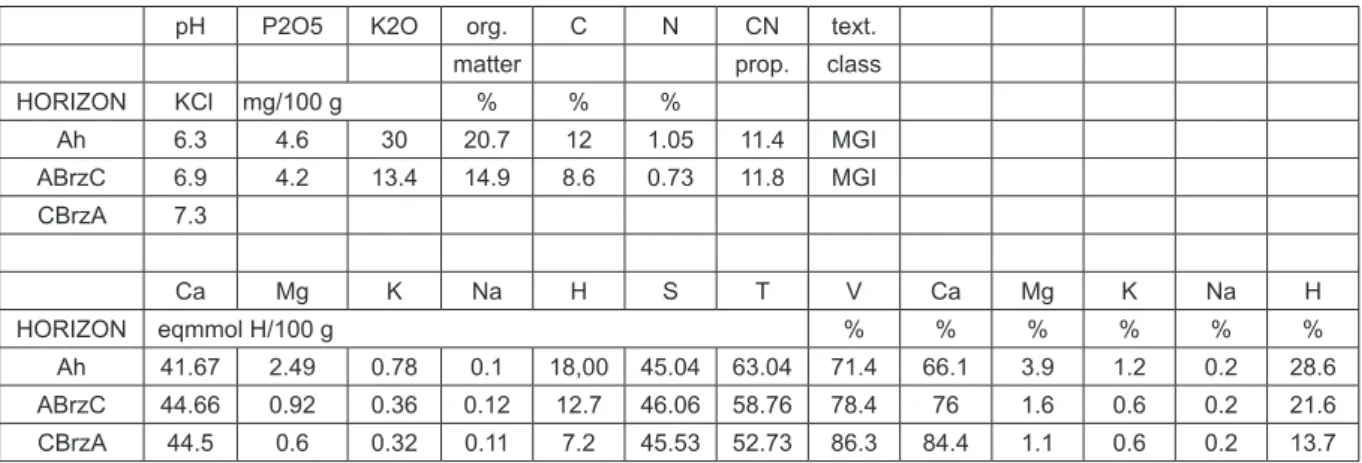
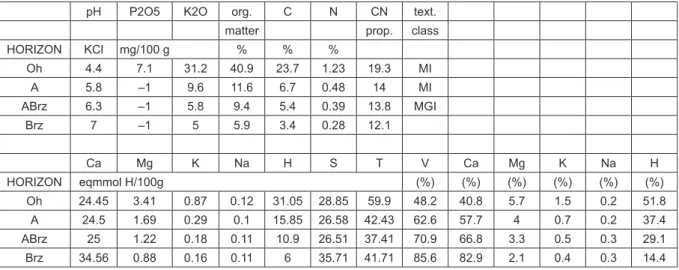
deeper soil, which is evident in the soil profiles dug within the subassociation. Colluvial Chromic cam-bisol is the prevailing soil type of the subassociation (Table 1). At the bottom of sinkholes, where the soil is the deepest, Chromic cambisol can be slighty lessivaged (Table 2).
The differential species of the subassociation
are Petasites albus, Leucojum vernum, Anthriscus nitida
and Stachys sylvatica. The above mentioned species
indicate a deeper, better developed and therefore moister soil. Species of the class Asplenietea trichoma-nis are completely absent from the subassociation. Mosses are only poorly represented.
The holotypus of the subassociation is relevé No. 18 in Table 7 hoc loco.
The variant with the species Matteuccia
struthi-opteris, which occurs on the moistest soil, and the
variant typica were distinguished within this subas-sociation.
subassociation Omphalodo-Aceretum p. Košir et Marinček 1999 typicum subass. nova hoc loco
(Ta-ble 7/13–16) is ecologically, as well as floristically, the central form of the association, and is without any of the differential species of the above- men-tioned subassociations. In terms of similarity it is closer to the subassociation O.-A.dentarietosum
pen-taphylli, as it occurs on rockier soil. Well
represent-ed are the species of the class Asplenietea
trichoma-nis. Phyllitis scolopendrium, which is characteristic of
rocky soils, reaches high frequency and coverage. Mosses are also well represented.
The holotypus of the subassociation is relevé No. 16 in Table 7 hoc loco.
figure 2 presents relevé ordination of the asso-ciation from the analytic table (Table 7). The relevés were arranged on axis 1 regarding the ston-iness or stage of development of the soil. Stands of the subassociation O.-A. dentarietosum pentaphylli therefore cover the most initial and rockiest soil, whereas the stands of the subassociation O.-A.
peta-sitetosum albi occur on deeper and better developed
soil with less surface stoniness. The subassociation
O.-A. typicum has the central ecological position in
the association.
Table 1: Soil profile description (profile1)
Tabela 1: Opis pedološkega profila (profil 1) Profile 1:
Locality: Javornik, altitude 910 m, 15°–20° incline, N exposition, foot to slope of a sinkhole, relevé No. 21 (table 7)
Bedrock: limestone
Soil type: Chromic cambisol, colluvial
Profile description:
Ol: 3–0; beech and maple foliage, herbs, ferns
Ah: 0–20 cm; 5YR2, 5/2; subangular to angular blocky structure, strong durable peds are clearly evident, loose and brittle, explicitly humose, very abundant roots, moist, with mycelium
ABrzC: 20–60 cm; 5YR3, 5/2; silty, silty-clayey-loamy, angular blocky structure, strong durable peds are clearly evident, medium density, brittle, very humose, with very abundant roots, moist, 40 % skeleton up to 150 mm
CBrzA: 60–90 cm; 7, 5YR3/2; silty-clayey-loamy, fine angular blocky structure, medium distinct peds of medium stability, medium density, brittle, with common abundance of roots, moist, 80 % skeleton and stones
note: in crevices between larger rocks
pH P2O5 K2O org. C N CN text.
matter prop. class
HORIZON KCl mg/100 g % % % Ah 6.3 4.6 30 20.7 12 1.05 11.4 MGI ABrzC 6.9 4.2 13.4 14.9 8.6 0.73 11.8 MGI CBrzA 7.3 Ca Mg K Na H S T V Ca Mg K Na H HORIZON eqmmol H/100 g % % % % % % Ah 41.67 2.49 0.78 0.1 18,00 45.04 63.04 71.4 66.1 3.9 1.2 0.2 28.6 ABrzC 44.66 0.92 0.36 0.12 12.7 46.06 58.76 78.4 76 1.6 0.6 0.2 21.6 CBrzA 44.5 0.6 0.32 0.11 7.2 45.53 52.73 86.3 84.4 1.1 0.6 0.2 13.7
Table 2: Soil profile description (profile 2)
Tabela 2: Opis pedološkega profila (profil 2) Profile 2:
Locality: Javornik, sinkhole, altitude 950 m, 10° incline, S exposition, relevé No. 17 (table 7)
Bedrock: limestone
Soil type: Chromic cambisol, slightly lessivaged
Profile description: Ol: 3–0.5
Of: 0.5–0
Ah: 0–17; 7, 5YR3/2; subangular blocky structure, strong durable peds are clearly evident, loose and brittle, humose, with very abundant roots, moist
A2: 17–37; 7, 5YR4/2; silty loamy, subangular to angular blocky structure, strong durable peds are clearly evident, medium density, brittle, humose, with very abundant roots, moist
Abrz: 38–80; 7, 5YR4/4; silty-clayey-loamy, angular blocky structure, medium distinct durable peds, medium density, brittle, medium humose, organic matter in root passages, with very abundant roots, moist
Brz: 80–100+; 7, 5YR4/4; silty-clayey loam, medium distinct peds of medium stability, angular blocky structure, dense, badly brittle, with abundant roots and individual larger stones, fresh to moist, slightly trampled
pH P2O5 K2O org. C N CN text.
matter prop. class
HORIZON KCl mg/100 g % % % Ah 5.7 –1 17.5 8.7 5 0.35 14.3 MI A2 4.7 –1 7.2 4.3 2.5 0.21 11.9 MGI ABrz 4.6 2.5 1.4 0.14 10 MGI Brz 4.7 Ca Mg K Na H S T V Ca Mg K Na H HORIZON eqmmol H/100g (%) (%) (%) (%) (%) (%) Ah 41.13 1.19 0.49 0.06 15.15 42.87 58.02 73.9 70.9 2.1 0.8 0.1 26.1 A2 6.44 0.49 0.23 0.04 17.45 7.2 24.65 29.2 26.1 2 0.9 0.2 70.8 ABrz 3.99 0.56 0.14 0.04 14.85 4.73 19.58 24.2 20.4 2.9 0.7 0.2 75.8 Brz 8.93 1.01 0.22 0.06 12.2 10.22 22.42 45.6 39.8 4.5 1 0.3 54.4
Figure 2: Relevé ordination of the association Omphalo-do-Aceretum according to the analytic Table (Table 7). Legend:■ – O.-A. dentarietosum pentaphylli, □– O.-A. petasitetosum albi, – O.-A. typicum.
Slika 2: Ordinacija popisov asociacije Omphalodo-Acere-tum po analitični tabeli (Tabela 7). Legenda: ■– O.-A. dentarietosum pentaphylli,□ – O.-A. petasitetosum albi,
5.
Chrysanthemo macrophylli-Aceretum
5a. structural and floristic composition
The upper tree layer covers between 70 and 90 (95) % of the surface, only rarely less (50, 60 %). The lower tree layer can be very well developed (covering as much as 40, 50, 70 %), but in most cases it covers only a small part of the surface (5 to 20 %) or is even missing. The tree layer is domi-nated by Acer pseudoplatanus, although the domi-nant role is occasionally assumed also by Fraxinusexcelsior, and by Ulmus glabra at higher altitudes. In
the tree layer, Abies alba was found only on Konjiška gora and Bohor, where it occurs also in the contact beech forest. In the stands the species Acer
pseudo-platanus is commonly joined by the species Acer
pla-tanoides, which indicates warmer site conditions.
Other tree species occur in the tree layer: Fagus
syl-vatica (with higher frequency in the lower tree
lay-er), Tilia platyphyllos (at lower altitudes), Prunus
avium, Sorbus aucuparia, Carpinus betulus (only
ex-ceptionally and at lower altitudes), Acer campestre,
Picea abies and Salix caprea. Among the shrub
spe-cies Sambucus nigra and Corylus avellana also reach the height of the lower tree layer.
The shrub layer covers from 5 to 70 % of the surface, but coverage higher than 30 % is rare. The shrub layer can even be missing altogether. By far the most common and with highest cover values is
Sambucus nigra, but the following shrub species
were also found in the stands: Corylus avellana, Daphne mezereum, Euonymus latifolia, Lonicera alpige-na, Lonicera xylosteum, Ribes uva-crispa, Rubus
frutico-sus agg., Rubus idaeus and Sambucus racemosa. The
shrub layer is composed of the above mentioned tree species as well.
The herb layer is well developed and in most cases covers 100 % of the surface, only rarely less than 90 to 70 %. The association is characterized by optimal, lush development of the herb layer from early spring on (the April aspect with lush flowering of geophytes) to late summer. Relevés of the late spring aspect (May, June) were arranged in the Table. This way our relevés included most of the species occurring in different seasons on the site of the studied association. Here are three ex-amples of the early spring aspect:
Bohor, relevé No. 5 (Table 9), 20.4.1999:
Leuco-jum vernum 4, Corydalis cava 3, Acer pseudoplatanus 1,
Adoxa moschatellina 1, Allium ursinum 1, Dentaria
polyphylla 1, Dentaria trifolia 1, Arum maculatum +,
Chrysosplenium alternifolium +, Corydalis solida +,
Den-taria enneaphyllos +, Eranthis hyemalis +, Gagea lutea +,
Galanthus nivalis r, Isopyrum thalictroides +, Lunaria
rediviva +, Scilla bifolia +, Symphytum tuberosum +,
Ur-tica dioica +.
Konjiška gora, relevé No. 20 (Table 9), 2.4.1999:
Allium ursinum 5, Leucojum vernum 3, Corydalis cava
1, Petasites albus 1, Arum maculatum +, Chrysosplenium
alternifolium +, Glechoma hirsuta +, Isopyrum
thalic-troides +, Oxalisacetosella +, Pulmonaria officinalis +,
Urtica dioica +.
The Gorjanci, relevé No. 7 (Table 8), 26.4.1999:
Scopolia carniolica 4, Corydalis cava 2, Acer
pseudopla-tanus 1, Arummaculatum 1, Dentaria bulbifera 1,
Den-taria trifolia 1, Leucojum vernum 1, Adoxa
moschatelli-na +, Anemone nemorosa +, Chrysosplenium
alternifo-lium +, Dentaria enneaphyllos +, Dentaria polyphylla +,
Glechomahirsuta +, Impatiens noli-tangere (germs) +,
Isopyrum thalictroides +, Phyllitis scolopendrium +,
Pul-monariaofficinalis +, Urtica dioica +.
A large number of geophytes occur. The high-est frequency and cover values among them within the alliance Fraxino-Acerion are found in the species
Arum maculatum, Adoxa moschatellina and Isopyrum
thalictroides, within the alliance Aremonio-Fagion the
species Dentaria polyphylla, Dentaria enneaphyllos and
Dentaria trifolia, and within the order Fagetalia
syl-vaticae the species Corydalis cava, Dentaria bulbifera,
Leucojum vernum, Symphytum tuberosum, Corydalis
solida, Paris quadrifolia and Allium ursinum. In early
spring, the species Scopolia carniolica (alliance
Frax-ino-Acerion) germinates and also dominates in this
aspect; the same species composes also the later late spring-summer aspect. Other species that are not geophytes also occur in early spring, such as for example Chrysosplenium alternifolium, which occurs with high frequency.
In spring, as seen in the relevé from Konjiška gora (relevé No. 20, Table 9), Allium ursinum is the most dominant species in individual stands of this association in terms of coverage. Also to be consid-ered in this respect is the species Eranthis hyemalis, found only on Bohor.
At this time of year, trees at these altitudes have not yet developed leaves, and ferns are not devel-oped yet either. When summer is approaching, geophytes are slowly disappearing and the tree spe-cies building the (late spring)-summer aspect take over the dominant role. Those are the mesophil-ous species and ferns. The species which have the highest frequency and cover values are: Lunaria
re-diviva, Circaea lutetiana, Geranium robertianum,
Gle-choma hirsuta, Urtica dioica, Actaea spicata, Stellaria
Lami-astrum montanum and Galium odoratum (Fagetalia
sylvaticae), Impatiens noli-tangere (Alno-Ulmion),
Anth-riscus nitida (Adenostyletalia), in part also Scopolia
carniolica and some other species of the early spring
aspect that keep until the beginning or the middle of summer. Ferns occur as well. Dryopteris filix-mas
and Athyrium filix-femina are the species with the
highest frequency. Ferns, such as Phyllitis
scolopen-drium, Polystichum setiferum and the hybrid
Polys-tichum x bicknelli are represented with high
fre-quency and cover values only within the subassocia-tion C.-A.scopolietosum carniolici.
The moss layer is poorly represented, which is in accordance with the small proportion of surface rockiness in the relevé plots. For the most part, mosses cover only about 5 % of the surface or none at all, or they are found only on organic matter. It is only within the subassociation C.-A.scopolietosum
carniolici, which covers a more initial and rockier
soil, that mosses cover also a larger surface of the soil (from 10 to 30 %, exceptionally even up to 50 %). We detected as many as 29 moss species, but most of them occur with very low frequency. The species with the highest frequency is Brachythecium
rutabulum (even on organic matter within the
sub-association C.-A. abietetosum albae, which is almost without mosses), followed by Thamnobryum
alopecu-rum, whereas other species are rare.
5b. Diagnostic species
The following species were classified as the differ-ential species of the association: Dentaria polyphylla,
Dentaria trifolia, Impatiens noli-tangere and Tanacetum
macrophyllum.
Dentaria polyphylla, Dentaria trifolia and
Tanace-tum macrophyllum are the so called Illyrian species,
the first two from the alliance Aremonio-Fagion, and the last from the alliance Fraxino-Acerion. These species are very indicative of the geographi-cal position of the association in the pre-Dinaric region of the Illyrian floral province. Tanacetum
macrophyllum (= Chrysanthemum macrophyllum)
oc-curs only in the stands of this association in Croatia. Impatiens noli-tangere is the species of the alliance Alno-Ulmion and indicates a higher degree of moisture in the soil of the stands of this associa-tion (on account of the generally deeper soil) com-pared to the other syntaxa of Illyrian maple forests of the montane belt.
5c. Division of the association into lower
syntaxonomical units
The community Chrysanthemo
macrophylli-Acere-tum pseudoplatani was subdivided into three
subas-sociations:
• C.-A. scopolietosum carniolicae subass. nova hoc
loco
• C.-A.abietetosum albae subass. nova hoc loco
• C.-A. petasitetosum hybridi subass. nova hoc loco
subassociation Chrysanthemo macrophylli-Acere-tum pseudoplatani (I. Horvat 1938) borhidi 1965 sco-polietosum carniolicae subass. nova hoc loco (Table 8/1–29) occurs on a moist and more initial soil. The differential species of the subassociation are Phyllitis
scolopendrium, Polystichum setiferum, Polystichum x
bick-nellii, Scopolia carniolica, Dentaria enneaphyllos and
Geranium robertianum. This subassociation is rockier
compared to the other two subassociations.
The representative soil profile represents the most developed soil within the described subassociation.
The holotypus is relevé No. 6 in Table 8 hoc loco.
Three variants were established within this sub-association; the variant with the species Asarum
eu-ropaeum, thevariant with the species Polystichum
ac-uleatum and the variant typica. The variant with
Asarum europaeum covers lower regions, which is
in-dicated by the following differential species: Asarum europaeum, Hacquetia epipactis, Helleborus odorus,
Hel-leborus atrorubens. The variant with Polystichum
ac-uleatum covers steep and moist slopes in the wider
area of the community Arunco-Fagetum Ž. Košir 1962. The differential species of the variant are:
Polystichum aculeatum, Polystichum x illyricum,
Lon-icera xylosteum and Aruncus dioicus.
The subassociation Chrysanthemo macrophylli-Ac-eretum pseudoplatani (I. Horvat 1938) borhidi 1965 abietetosum albae subass. nova hoc loco (Table 9/1– 22) is found on a deep and better developed soil (Table 4, 5). There is hardly any or no surface ston-iness, which is reflected in the smaller number of mosses (mostly only on organic matter) and in the absence of the species from the class Asplenietea
tri-chomanis. The subassociation is distributed on
Bo-hor and Konjiška gora, at generally higher alti-tudes. The differential species of the subassociation are: Leucojum vernum, Stellaria montana, Gagealutea,
Peta-sites albus. Leucojum vernum, Petasites albus,Stellaria
montana, Gagealutea indicate deep and moist soils.
Eranthis hyemalis, whichwas found on Bohor, grows
in the eastern part of Slovenia. Abies alba has the highest frequency in this subassociation as it grows in the wider region of the so far only vaguely deter-mined fir-beech forest treated by Ž. Košir (1979) on Bohor as a specific form of the community
Car-damine savensi-Fagetum. Brown calcareous soil is
mixed with a higher or smaller proportion of Wer-fen sandstones. This makes the soil moister, more acid and colder (Ž. Košir 1979), which are favour-able conditions for the development of fir. A stronger presence of Ulmus glabra indicates the montane character of the subassociation.
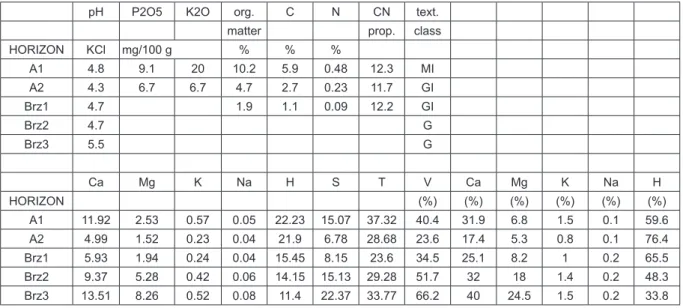
The soil profile dug on Bohor (Table 4) is rath-er diffrath-erent from those in the srath-eries of the soil pro-files from the forest community Dentario
polyphyllae-Aceretum. On account of mixed
calcareous-noncal-careous bedrock the soil is very deep and more acid in comparison with other soil profiles (from 4,3 to 5,5 pH in KCl), with signs of initial draining
(base transfer). Another cause of soil acidity can be an occasionally higher proportion of the noncal-careous component.
The holotypus of the subassociation is relevé No. 12 in Table 9 hoc loco.
Three variants were established within this sub-association – the variant with the species Scopolia
carniolica, the variant with the species Petasites albus
and the variant typica. The variant with Scopolia
car-niolica is differentiated by the species Scopolia
car-niolica, Geranium robertianum and Polystichum
aculea-tum, which indicate a more initial soil. The variant
with Petasites albus is characterized by high cover values of this species, which is the consequence of a moister soil.
Within the variant with the species Scopolia
car-niolica and the variant with the species Petasites
al-bus we established also two subvariants with the spe-cies Fraxinus excelsior, whose tree layer is dominated by the the above-mentioned tree species.
subassociation Chrysanthemo macrophylli-Acere-tum pseudoplatani (I. Horvat 1938) borhidi 1965
Table 3: Soil profile description (profile 3)
Tabela 3: Opis pedološkega profila (profil 3) Profile 3:
Locality: Podsreda castle, altitude 440 m, incline 30°, NNE exposition, slope of a ditch, relevé No. 22 (table 8)
Bedrock: limestone
Soil type: Chromic cambisol, colluvial
Profile description: Ol: 3–0
A: 0–11; 7, 5YR3/2; silty-clayey-loamy, strong durable peds are clearly evident, subangular blocky structure, very loose and brittle, explicitly humose, with abundant roots, moist, 3–5 % skeleton up to 10 mm
Abrz: 11–37 cm; 10YR3/3; silty-clayey-loamy, strong durable peds are clearly evident, angular blocky structure, dense, badly brittle, humose, with very abundant roots, moist, 5 % skeleton up to 30 mm
AbrzC: 37–65; 10YR4/3; silty-clayey-loamy, strong durable peds are clearly evident, angular blocky structure, badly brittle, dense, medium humose, with abundant roots, moist, 30 % skeleton up to 30 mm
C/R: CBrz 65+ marl, 97 % skeleton, few roots
pH P2O5 K2O org. C N CN text.
matter prop. class
HORIZON KCl mg/100 g % % % A 6.9 1.5 21.1 12.1 7 0.57 12.3 MGI ABrz 7 –1 10.3 7.9 4.6 0.44 10.5 MGI ABrzC 7.4 3.6 2.1 0.18 11.7 MGI Ca Mg K Na H S T V Ca Mg K Na H HORIZON eqmmol H/100g (%) (%) (%) (%) (%) (%) A 24.83 10.29 0.58 0.06 5.35 35.76 41.11 87 60.4 25 1.4 0.1 13 ABrz 22.08 9.08 0.31 0.07 6.4 31.54 37.94 83.1 58.2 23.9 0.8 0.2 16.9 ABrzC 22.52 6.56 0.19 0.06 2.95 29.33 32.28 90.9 69.8 20.3 0.6 0.2 9.1
Table 5: Soil profile description (profile 5)
Tabela 5: Opis pedološkega profila (profil 5) Profile 5:
Locality: Bohor, altitude 880 m, incline 5°, NNE exposition, slope, relevé No. 4 (table 9)
Bedrock: dolomite underneath, skeleton is sandstone
Soil type: lessivaged Chromic cambisol
Profile description: Ol: 3–0.5; fresh litter
Of: 0.5–0
A1: 0–13; 7, 5YR3/2; silty-loamy, clearly evident peds of medium stability, subangular blocky structure, loose, brittle, explicitly humose, with very abundant roots, moist
A2: 13–32; 7, 5YR3, 5/2; clayey-loamy, strong durable peds are clearly evident, subangular blocky structure, dense, brittle, humose, with very abundant roots, moist, 5 % skeleton up to 5 mm
Brz1: 32–85; 7, 5YR4/4; clayey-loamy, strong durable peds are clearly evident, angular blocky structure, dense, badly brittle,
poorly humose, with abundant roots, moist, 10 % skeleton up to 10 mm
Brz2: 85–108; 7, 5YR5/6; clayey, weakly distinct peds of bad stability, fine angular blocky structure, dense, kneadable, organic matter in root passages, with few roots, moist, note: transition between Brz1 and Brz2 – mixed
Table 4: Soil profile description (profile 4)
Tabela 4: opis pedološkega profila (profil 4) Profile 4:
Locality: Konjiška gora, altitude 780 m, incline 20°, slope of a ditch, NE exposition, relevé No. 20 (table 9)
Bedrock: limestone
Soil type: Chromic cambisol, colluvial
Profile description:
Ol: 3–0.5 cm; maple and beech foliage, twigs, herbs
Of: 0.55–0 cm; mouldering foliage, spruce needles, covered with mycelium
Oh: 0–5 cm; 5YR2, 5/2; medium distinct peds of medium stability, cloddy structure, loose, brittle, organic, with very abundant roots, fresh to moist
A: 5–15 cm; 5YR3/2; silty-loamy, durable peds are medium distinct, subangular blocky structure, loose, brittle, explicitly humose, with very abundant roots, moist
ABrz: 15–36 cm; 7, 5YR3/2; silty-loamy, medium distinct durable peds, subangular blocky structure, loose, brittle, humose, with very abundant roots, moist
Brz: 36–41 cm; 10YR4/3; silty-clayey-loamy, medium distinct durable peds, fineangular blocky structure, loose, brittle, humose with abundant roots, moist
C/R: C 41+ rubble with 5% material from the Brz horizon
pH P2O5 K2O org. C N CN text.
matter prop. class
HORIZON KCl mg/100 g % % % Oh 4.4 7.1 31.2 40.9 23.7 1.23 19.3 MI A 5.8 –1 9.6 11.6 6.7 0.48 14 MI ABrz 6.3 –1 5.8 9.4 5.4 0.39 13.8 MGI Brz 7 –1 5 5.9 3.4 0.28 12.1 Ca Mg K Na H S T V Ca Mg K Na H HORIZON eqmmol H/100g (%) (%) (%) (%) (%) (%) Oh 24.45 3.41 0.87 0.12 31.05 28.85 59.9 48.2 40.8 5.7 1.5 0.2 51.8 A 24.5 1.69 0.29 0.1 15.85 26.58 42.43 62.6 57.7 4 0.7 0.2 37.4 ABrz 25 1.22 0.18 0.11 10.9 26.51 37.41 70.9 66.8 3.3 0.5 0.3 29.1 Brz 34.56 0.88 0.16 0.11 6 35.71 41.71 85.6 82.9 2.1 0.4 0.3 14.4
Brz3: 108–125; 5YR4/6; clayey, medium distinct peds of medium stability, angular blocky structure, very dense, brittle, mineral, few roots, with individual dolomite stones, moist
C/R: C 125 cm +, dolomite stones and thick sandy dolomite moder
pH P2O5 K2O org. C N CN text.
matter prop. class
HORIZON KCl mg/100 g % % % A1 4.8 9.1 20 10.2 5.9 0.48 12.3 MI A2 4.3 6.7 6.7 4.7 2.7 0.23 11.7 GI Brz1 4.7 1.9 1.1 0.09 12.2 GI Brz2 4.7 G Brz3 5.5 G Ca Mg K Na H S T V Ca Mg K Na H HORIZON (%) (%) (%) (%) (%) (%) A1 11.92 2.53 0.57 0.05 22.23 15.07 37.32 40.4 31.9 6.8 1.5 0.1 59.6 A2 4.99 1.52 0.23 0.04 21.9 6.78 28.68 23.6 17.4 5.3 0.8 0.1 76.4 Brz1 5.93 1.94 0.24 0.04 15.45 8.15 23.6 34.5 25.1 8.2 1 0.2 65.5 Brz2 9.37 5.28 0.42 0.06 14.15 15.13 29.28 51.7 32 18 1.4 0.2 48.3 Brz3 13.51 8.26 0.52 0.08 11.4 22.37 33.77 66.2 40 24.5 1.5 0.2 33.8
Table 6: Soil profile description (profile 6)
Tabela 6: Opis pedološkega profila (profil 6) Profile 6
Locality: Gorjanci, Vahta, relevé No. 2 (table 10), the bottom of a smaller valley, non rocky
Bedrock: sandy rubbly alluvium
Soil type: Humic fluvisol
Profile description:
Ol: 1–0 cm; little litter; ash, elm, maple and herb remains (Allium)
A1: 0–20 cm; subangular blocky silty loam, explicitly humose; strong durable peds are clearly evident; dense and badly brittlein consistence; the colour is dark brown, 7,5YR 3/2; fresh with abundant roots; no skeleton; C/N proportion is still characteristic for mull.
A2: 20–45 cm; loam of angular blocky structure, explicitly humose; medium distinct peds of medium stability; dense and medium brittle in consistence; the colour is dark brown to brown, 7,5YR 4/2; fresh with abundant roots; singular skeleton composed of sharp-edged particles up to 5 cm; C/N proportion is characteristic for moder
A3: 45–60 cm; angular blocky silty loam, explicitly humose; weakly distinct peds of medium stability; consistence is dense and medium brittle; the colour is dark brown to brown, 7,5YR 4/2; fresh to moist with few roots; 15 % of skeleton which is composed of sharp-edged particles up to 1 cm; C/N proportion is characteristic for moder; weakly distinct brown patches on greyish background – weakly distinct marbling
C: 60+ cm
pH P2O5 K2O org. C CN
AL AL matter prop.
HORIZON depth CaCl2 mg/100g % %
A1 0–20 cm 7.1 1.7 18.8 12.8 7.4 13.7
A2 20–45 cm 7.2 11 6.4 22.1
A3 45–60 cm 7.3 12.1 7 22.6
NOTE: A relatively high pH is the consequence of calcareous sand. Badly decomposed organic matter in deeper horizons is the result of occasional strong saturation with water on the one hand and draining of nitriccompounds on the other.
petasitetosum hybridae subass. nova hoc loco (Table 10/1–7) was found in the region of the Gorjanci, where it covers the valley floor, often along streams and forest roads. The differential species of the su-bassociation C.-A. petasitetosum hybridi are Fraxinus
excelsior, Petasites hybridus, Geranium phaeum, Carex
sylvatica and Geum urbanum. All of them are
indica-tive of very moist sites and prove that the stands of this subassociation occur on deep and the moistest soils within the association. As the stands are locat-ed on easily accessible spots along forest roads there is likely to be an anthropogenous influence, which is reflected to a certain extent also in the se-lected differential species.
The stands of the studied subassociation occur on calcareous sandy-gravelly alluvium, on alluvial – delluvial deposits and on relic alluvial or torren-tial deposits and colluvia from slopes.
Two variants were established within the subas-sociation; the variant with the species Allium ursi-num and the variant typica.
The differential species of the variant with
Al-lium ursinum are: Allium ursinum, Chaerophyllum
hir-sutum, Caltha palustris and Equisetum telmateia.
Ex-cept for Allium ursinum all of the listed species be-long to the alliance Alno-Ulmion. The stands of this variant cover plateaus along mountain streams and are transitional stands between the alliances
Alno-Ulmion and Fraxino-Acerion. These stands grow on
moister soils within the subassociation. The humic fluvisol prevails (Table 6).
The stands of the variant typica are character-ized by large coverage of the species Scopolia
car-niolica. These stands cover valley floors without
streams. A higher degree of moisture in these stands is provided on account of the water and snow that flow down into the bottom of these val-leys from the neighbouring slopes. Eutric cambisol on alluvial-delluvial deposits occurs.
The holotypus of the subassociation C.-A.
petasite-tosum hybridi is relevé No. 5 in Table 10 hoc loco.
figure 3 presents relevé ordination of the asso-ciation Chrysanthemo macrophylli-Aceretum in Slove-nia (relevés from analytic tables 8, 9 and 10). The relevés were arranged along axis 1 regarding the stoniness of the site, and along axis 2 regarding the soil moisture. In accordance with the above find-ings the stands of the subassociation C.-A.
scopolieto-sum carniolicae cover the stoniest, and in
compari-son with the stands of the subassociation C.-A.
abie-tetosum albae also moister soils. The stands of the
subassociation C.-A. petasitetosum hybridi occur on the non-stony and the moistest soil. A less moist
and non-stony soil is covered by the stands of the subassociation C.-A. abietetosum albae which occur at the highest altitudes within the association.
6. Discussion
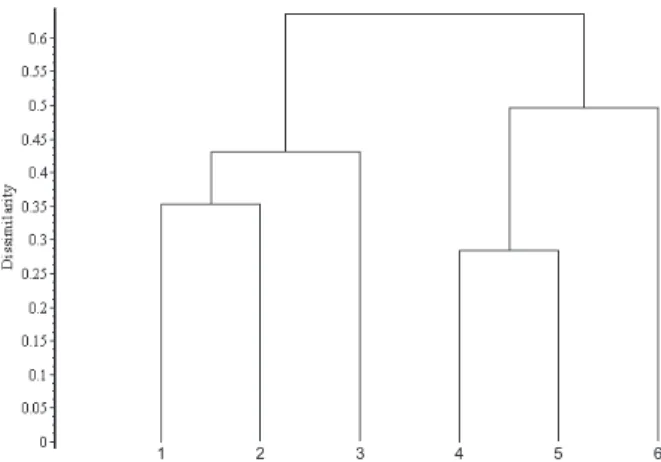
A comparison of both associations and their divi-sion into lower syntaxonomical units is presented in the synthetic table (Table 11). Divison of specific syntaxa (subassociations) into two independent as-sociations is presented by means of hierarchical classification (Figure 4).
A certain resemblance to the association
Om-phalodo-Aceretum is visible also in the syntaxon
Aceri-Fraxinetum typicum (Fukarek 1970), which occurs in
the montane belt in the region of the Peručica vir-gin forest reserve (BH). There are no differential species of the association Omphalodo-Aceretum in these stands, which is congruent with the findings of Surina (2002), who established in his study on the distribution of the Illyrian-Dinaric association
Omphalodo-Fagetum that the stands east of the river
Una (Grmeč, Igman, Peručica-BH) and the Piva valley (Montenegro) could be treated as a specific Figure 3: Relevé ordination of the association Chrysanthemo macrophylli-Aceretum in Slovenia (according to analytic ta-bles 8, 9 and 10). Legend: ■ – C.-A. scopolietosum carniolicae,
□ – C.-A. abietetosum albae, – C.-A. petasitetosum hybridi.
Slika 3: Ordinacija popisov asociacije Chrysanthemo macro-phylli-Aceretum v Sloveniji (po analitičnih tabelah 8, 9 in 10). Legenda: ■ – C.-A. scopolietosum carniolicae, □ – C.-A. abi-etetosum albae, – C.-A. petasitetosum hybridi.
Dinaric association. Noble hardwood forests which occur intrazonally within zonal Dinaric beech for-ests of the montane belt certainly differentiate in the same sense. The species of the alliance
Fraxino-Acerion are relatively well represented in the herb
layer of the stands of the syntaxon, most abundant being the growth of the species Lunaria rediviva. In the tree layer, however, except for one relevé dom-inated by Fraxinus excelsior, beech (Fagus moesiaca) is the dominant species of the stands. It is for this reason that the syntaxon was not treated in the framework of Illyrian noble hardwood forests, as those are possibly the stands of beech forest on moister sites. The stands will require further study in order to determine whether they can be classi-fied into the studied vegetation.
Noble hardwood forests in the Dinaric region of Slovenia were studied also by Piskernik (1954), who united the stands into the association
Acereto-Ulmetum. This is a heterogeneous relevé material.
The larger part could be classified within the asso-ciation Omphalodo-Aceretum, but some of the stands belong to the altimontane association Lamio
or-valae-Aceretum. Certain relevés have a transitional
character between both associations. In the stands, beech and fir are often represented with high cov-er values and even dominate the noble hardwoods in certain stands, which, however, is not in accord-ance with the definition of noble hardwood forests.
For all these reasons, we disregarded this relevé material in our analysis of the Illyrian maple forests of the montane belt.
The stands of the association Chrysanthemo
mac-rophylli-Aceretum were described in Slovenia as
Den-tario polyphyllae-Aceretum by P. Košir and Marinček
(1999). However, our comparison of relevés of Il-lyrian maple forests demonstrated that the stands described as the association Dentario
polyphyllae-Ac-eretum were similar to the stands described in
Croatia under the name of Aceri-Fraxinetum croati-cum or Aceri-Fraxinetum illyricum (Horvat 1938, Petračič and Anič 1952, Regula-Bevilacqua 1978). The association Aceri-Fraxinetum croaticum was later accurately renamed Chrysanthemo
macrophylli-Acere-tum.
The above-mentioned stands from Croatia, clas-sified into the association Chrysanthemo
macrophylli-Aceretum, were also joined to the table (Table 11).
They are most similar to the stands of the subasso-ciation C.-A. petasitetosum hybridi which covers the moistest sites within the association, whereas the tree layer is dominated by the species Fraxinus excel-sior (with the exception of a syntaxon 7 from Strahinjščica, where Acer pseudoplatanus occurs in a larger proportion). Three syntaxa from the terri-tory of Croatia are therefore presented in the syn-thetic table: a syntaxon with one relevé from the region of Lika (Horvat 1938), a syntaxon with five relevés from the region of Medvednica (Petračič and Anič 1952, relevés 1–5, relevé No. 6 is without the tree layer) and a syntaxon with three relevés from the region of Strahinščica in Hrvaško Zagorje (Regula-Bevilacqua 1978). Only relevés Nos. 1–3 in Table No. 39 were included into the synthetic table from the last-mentioned syntaxon (Aceri-Fraxinetum
illyricum, Regula-Bevilacqua 1978). This is due to
the fact that the differential species of the associa-tion are missing from relevés 4 and 5 and that no-ble hardwoods are only poorly represented. We therefore believe they do not belong within the studied association. In the future, the stands from Croatia will require a more thorough investigation as there was too little relevé material published so far, and even that was incomplete in certain cases (Petračić and Anić 1952). As a result, a thorough analysis of these stands is impossible and compari-son with other Illyrian stands remains difficult.
Ecological differences, and therefore also dif-ferences in the floristic composition, are presented not only in the synthetic table (Table 11), but also with the syntaxonomical spectrum of both associa-tions (Figure 5).
Figure 4: Hierarchical classification of the subassociations of the associations Omphalodo vernae-Aceretum (syntaxons 1, 2, 3) and Chrysanthemo macrophylli-Aceretum (syntaxons 4, 5, 6) in Slovenia (numbers of syntaxons correspond with numbers of syntaxons in Table 11).
Slika 4: Hierarhična klasifikacija subasociacij asociacij Om-phalodo vernae-Aceretum (sintaksoni 1, 2, 3) in Chrysan-themo macrophylli-Aceretum (sintaksoni 4, 5, 6) v Sloveniji (številke sintaksonov se ujemajo s številkami sintaksonov v tabeli 11).
Figure 5: Syntaxonomical spectrum of the associations Om-phalodo vernae-Aceretum (light grey) in Chrysanthemo mac-rophylli-Aceretum (dark grey)
Slika 5: Sintaksonomski spekter asociacij Omphalodo ver-nae-Aceretum (svetlo siva) in Chrysanthemo macrophylli-Ac-eretum (temno siva)
Consistent with the general character of the Di-naric world, which is stony and crisscrossed with sinkholes, the association Omphalodo-Aceretum cov-ers stonier and generally not as developed soils as the association Chrysanthemo macrophylli-Aceretum. A higher degree of stoniness of the association is demonstrated also by a stronger representation of mosses and the species of the class Asplenietea
tri-chomanis. The association occurs on smaller
sur-faces, fragmentarily, above all in sinkholes. Char-acteristic for the association is an abundant growth of ferns. Fraxinus excelsior, which is well represented in the association Chrysanthemo macrophylli-Acere-tum, occurs here only exceptionally.
The differential species of the association
Chry-santhemo macrophylli-AceretumImpatiens noli-tangere,
as well as a relatively higher proportion of the spe-cies of the alliance Alno-Ulmion compared to the association Omphalodo-Aceretum, indicate a higher degree of moisture in the soil (due to the generally deeper soil). Surface rockiness is lower, which is demonstrated in a poorer representation of moss-es and the specimoss-es of the class Asplenietea trichoma-nis. The presence of the tree species Acer
plata-noides, which was not detected in the association
Omphalodo-Aceretum, indicates generally warmer
site conditions. The differential species Dentaria
polyphylla and Dentaria trifolia are very indicative of
the geographical position of the association in the pre-Dinaric region of the Illyrian floral province in Slovenia. The stands of the association are gen-erally distributed on larger surfaces, while the as-sociation Omphalodo-Aceretum is found only frag-mentarily, on smaller surfaces. The association occurs on colluvial slopes, sinkholes, dales and ditches. In contrast to the association
Omphalodo-Aceretum which grows above all on limestone, this
association is found within the wider spectrum of parent material. It does occur mostly on calcare-ous soils, which are in places mixed with chert. The soil is generally deeper and more developed. The association is differentiated from the associa-tion Omphalodo-Aceretum by an abundant early-spring aspect of geophytes.
4. ConClUsIons
In central Europe, associations of maple forests within the alliance Tilio-Acerion are ecologically clearly defined regarding the various soil condi-tions, altitude and bedrock (Clot 1990, Müller 1992, Wallnöfer & al. 1993). The above-mentioned groups of differential species, however, do not manifest themselves well within the syntaxa, as no-ble hardwood forests often occur on sites with mo-saically intertwined different soil types, from skel-etal to deeper soils, in pockets between rocks. All this makes the syntaxonomical classification of the stands difficult. However, within the alliance
Frax-ino-Acerion, the associations are described not only
with consideration of different altitudes and types of bedrock, but also with regard to their phytogeo-graphical position in different phytogeophytogeo-graphical regions of the Illyrian floral province. As those are soil conditioned communities on small surfaces occurring in the distribution area of zonal com-munities, our description of the communities pro-ceeded from contact zonal communities. Two com-munities treated in this article, namely Omphalodo
vernae-Aceretum and Chrysanthemo
macrophylli-Acere-tum (syn.: Dentario polyphyllae-Aceretum), are also de-fined in this way. We are of the opinion that clas-sification based both on ecological as well as geo-graphical differential groups is more generally applicable than classification considering only ec-ological differences. Nevertheless, the differences in geographical position which result in different macroclimatic conditions, are therefore reflected together with the ecological.
5. POVZETEK
Javorjevi gozdovi montanskega pasu zahodnega dela ilirske florne province
Obravnavali smo javorjeve gozdove gorskega sveta v dinarskem območju in preddinarskem območju ilirske florne province v Sloveniji. Ugotovili smo dve asociaciji, ki se pojavljata intraconalno v okviru conalnih bukovih gozdov.
Popisovali smo po standardni srednjeevropski metodi, talne razmere pa smo proučili s pomočjo reprezentančnih talnih profilov.
Asociacija Omphalodo vernae-Aceretum
pseudopla-tani P. Košir et Marinček 1999 se pojavlja v
dinar-skem območju (Goteniška gora, Javorniki, Logaška planota, Krim, Kočevski Rog) ilirske florne provin-ce v Sloveniji. Uspeva v območju razširjenosti asoci-acije Omphalodo-Fagetum (Tregubov 1957) Marin-ček et al. 1993. Asociacijo najdemo predvsem v vr-tačah. Matična podlaga so jurski in kredni apnenci. V primerjavi z asociacijo Chrysanthemo
macrophylli-Aceretum porašča kamnitejša in v splošnem slabše
razvita tla. Prevladujejo rjava koluvialna pokarbo-natna tla. Pojavlja se na manjših površinah, le fra-gmentarno. Asociacijo označuje bujna razrast pra-proti. Asociacijo smo razčlenili na tri subasociacije: subasociacijo O.-A.dentarietosum pentaphylli subass. nova, ki porašča inicialnejša tla, subasociacijo O.-A.
petasitetosum albi subass. nova, ki jo najdemo na
glo-bljih, razvitejših tleh ter subasociacijo O.-A.typicum subass. novabrez razlikovalne skupine vrst. V okvi-ru subasociacije O.-A.dentarietosum pentaphylli smo ločili varianto z vrsto Lunaria rediviva in varianto
typica, v okviru subasociacije O.-A. petasitetosum albae
pa varianto z vrsto Matteuccia struthiopteris na vla-žnejših tleh in varianto typica.
Asociacija Chrysanthemo macrophylli-Aceretum (syn: Dentario polyphyllae-Aceretum pseudoplatani P. Košir et Marinček 1999) uspeva na koluvialnih po-bočjih, vrtačah, grabnih in jarkih v preddinarskem območju (Bohor, Podsreda, Uršna Sela, Gorjanci, Konjiška gora). Pojavlja se v širšem arealu asociacij
Lamio orvalae-Fagetum (I. Horvat 1938) Borhidi
1963 var. geogr. Dentaria polyphylla Ž. Košir 1962 ex Marinček 1994 in Cardamini savensi-Fagetum Ž. Ko-šir 1962. Asociacijo najdemo na Ko-širšem spektru ma-tičnih kamnin. Večinoma sicer uspeva na karbona-tnih tleh, ki pa jim je ponekod lahko primešan tudi roženec. Tla so v splošnem globlja, bolj razvita in imajo manjšo površinsko skalovitost. Prevladujejo rjava pokarbonatna koluvialna tla. Zaradi v splo-šnem globljih tal so ta rastišča vlažnejša. Asociacijo
ločujejo tudi vrste, ki nakazujejo relativno toplejše rastiščne razmere (preddinarsko območje). Sestoji so v splošnem razširjeni na večjih površinah. Znači-len je bogat zgodnjepomladanski aspekt geofitov. V okviru asociacije smo ločili tri subasociacije: C.-A.
scopolietosum carniolicae subass. nova, ki uspeva na
vlažnejših, bolj inicialnih tleh, subasociacijo C.-A.
abietetosumalbae subass. nova na globokih,
razvitej-ših tleh brez površinske skalovitosti in na v splo-šnem višjih nadmorskih višinah ter subasociacijo
C.-A. petasitetosum hybridi na nekamnitih in
najvla-žnejših tleh. V okviru subasociacije C.-A.
scopolieto-sum carniolicae smo ločili tri variante: varianto z
vr-sto Asarum europaeum na nižjih nadmorskih višinah,
varianto z vrsto Polystichum aculeatum na strmejših, vlažnejših pobočjih, in varianto typica. V okviru su-basociacije C.-A.abietetosum albae smo prav tako iz-ločili tri variante: varianto z vrsto Scopolia carniolica, varianto z vrsto Petasites albus in v okviru teh dveh še subvarianti z vrsto Fraxinus excelsior, ter varianto
typica. V okviru subasociacije C.-A. petasitetosum
hy-bridi smo ločili dve varianti: varianta typica in
varian-ta z vrsto Allium ursinum na najvlažnejših tleh v okviru te subasociacije. Obe asociaciji smo uvrstili v ilirsko zvezo gozdov plemenitih listavcev
Fraxino-Acerion Fukarek 1969 v okviru reda Fagetalia
sylva-ticae.
6. ACKNOWLEDGMENT
This article is part of a master of science thesis (P. Košir 2000) and partly of a doctorial dissertation (P. Košir 2004). I would like to thank my supervi-sors Dr. Lojze Marinček, Prof. Dr. Joso Vukelić, Prof. Dr. Tone Wraber and Asist. Prof. Dr. Andraž Čarni, for their valuable advice and help in devel-oping the thesis. I would also like to thank Tomaž Hrovat, B. eng., who helped with the field work. The soil profiles were described by Tomaž Prus, M. Sc., to whom I am most grateful. Finally, I would like to thank Marjan Jarnjak for his help in prepar-ing the map of the relevé locations.
7. REFERENCES
Accetto, M. 1991: Corydalido ochroleucae-Aceretum ass. nova v Sloveniji. Razprave IV. razr. SAZU 32 (3): 89–128.
Braun-Blanquet, J. 1964: Pflanzensoziologie. Grundzüge der Vegetationskunde. Wien, New York, 865pp.