R E S E A R C H
Open Access
The prevalence of
BRCA1/2
mutations of
triple-negative breast cancer patients in Xinjiang
multiple ethnic region of China
Yong Tao Li, Duo Ni, Liang Yang, Qian Zhao and Jiang Hua Ou
*Abstract
Background:The screening ofBRCA1andBRCA2mutations is now an established component of risk evaluation and management of familial breast cancer, early-onset breast cancer and bilateral breast cancer patients. There is still some controversy about whether this screening should be done in triple-negative breast cancers. Therefore, we evaluated theBRCAmutation prevalence in patients with triple-negative breast cancer in a multi-ethnic region of China.
Methods:A total 96 women who were diagnosed with triple-negative breast cancer in the Xinjiang region of China were enrolled in this study.BRCA1andBRCA2screening was performed by polymerase chain reaction-denaturing high-performance liquid chromatography (PCR-DHPLC) sequencing analysis. All mutations were confirmed with direct sequencing.
Results:The prevalence of aBRCA1/2germline mutation was about 25% (24/96) in the Xinjiang region of China. Among 35 selected cases with a family history and/or bilateral breast cancers, theBRCA1/2mutation prevalence was 25.7% (9/35). Of the remaining 61 patients with unselected triple-negative breast cancer, theBRCA1/2mutation prevalence was 24.6% (15/61), and all 15 individuals with these mutations were premenopausal patients.
Conclusions:These results suggest that premenopausal women with triple-negative breast cancer may be candidates for genetic testing for BRCA1/2 in the Xinjiang region of China, even in the absence of a family history or bilateral breast cancer.
Keywords: BRCA1/2, breast Cancer, triple-negative, genetic testing
Background
The two major contributors to hereditary breast cancer are the breast cancer susceptibility gene 1 (BRCA1) and
BRCA2[1]. Genetic testing for BRCA1and BRCA2 mu-tations has been established throughout North America and most of Europe. Not all women are candidates for testing; in general, testing is only necessary for women who have a familial breast cancer, early-onset breast can-cer or bilateral breast cancan-cer.
China is a multi-ethnic country, but the majority of the population belongs to the Han ethnic group. Chinese breast cancer patients on average were younger than pa-tients in America and Europe by about 10 years old, and
premenopausal patients accounted for the majority [2]. The prevalence ofBRCA1andBRCA2mutations among the Chinese Han population was less than 20%, mutation of BRCA2 gene was higher than that of BRCA1 [3,4], and this is significantly different than for America and Europe populations [5].
To date, only a few studies have been reported on
BRCA-associated breast cancer in China; all the studies involved mainly ethnic Han Chinese. Our previous study showed that the prevalence of the BRCA1/2 germline mutation was about 7.6% (6/79) in the Xinjiang multi-ethnic region of China. Among six of theseBRCA-related tumors, three BRCA1- and one BRCA2-associated tu-mors were in estrogen receptor (ER), progesterone re-ceptor (PR) and human epidermal growth factor rere-ceptor 2 (HER-2) triple-negative status [6].
* Correspondence:[email protected]
Department of Breast Surgery, Tumor Hospital, Xinjiang Medical University, 789 East Suzhou Street, Urumqi 830011, China
Triple-negative breast cancer (TNBC) describes a sub-group of tumors that lack expression of ER, PR and HER-2. Due to the lack of effective targets for endocrinal and molecular treatment, it is considered a type of high risk breast cancer, and the prognosis is poor. Overall, TNBC accounts for about 15% [7,8] of all breast cancers, but occurs more frequently in younger women and is the predominant subtype in individuals with a germline
BRCA1 mutation [9]. Therefore, we have evaluated the
BRCA mutation frequency and the implications for the clinical practice of undertaking genetic testing in women with TNBC.
Methods
Cases
All patient cases were recruited from Xinjiang, China. They had a definite pathological diagnosis of breast can-cer and received the standard treatment in our hospital during the period 2005 to 2013. At the beginning of this period, women diagnosed with breast cancer who had family history (FH), early onset, or bilateral breast cancer (BI-BC) were chosen for study. As the research developed, we found that the majority of patients with theBRCA1/2 germline mutation were in triple-negative status. There-fore, TNBC patients were included in our study. To date, a total of 214 patients were submitted for evaluation, of which 96 were TNBC.
The study was approved by the Ethics Committee (IRB approval number: XJYD1320) of the Cancer Hospital of Xinjiang Medical University, and informed consent was obtained from each participant.
Triple-negative breast cancer confirmed
ER, PR and HER-2 status were confirmed in a histopath-ology report of the tumor samples. HER-2 was regarded as negative when scored as 0 or 1 by immunohistochemis-try (IHC) and/or when there was non-amplification of HER-2 mRNA by fluorescentin situhybridization (FISH).
BRCA1/2 mutation analysis
Genomic DNA was isolated from 5 mL of peripheral blood and stored in 10 mM Tris (pH 8) EDTA at 4°C. Specific BRCA1 and BRCA2 coding regions and intron-exon boundaries, ranging from 206 to 639 bp in length, were amplified by polymerase chain reaction (PCR). Denaturing high-performance liquid chromatography (DHPLC) analysis was used to screen BRCA1 and BRCA2 mutations; all variants identified were confirmed by direct sequencing.
Statistical analysis
To compare the BRCA1/2 mutation in unselected and selected TNBC, chi-square analysis was performed. A
P value of <0.05 was considered statistically significant.
The SPSS statistical software system version 16.0 (SPSS Inc., Chicago, USA) was used.
Results
Patients’characteristics
A total of 96 women with TNBC were eligible for testing. Among them, 35 women were selected for study because they had FH and/or BI-BC (25 women had a FH of breast or ovarian cancer, 13 women were BI-BC, both a FH and BI-BC were identified in 3 women). The remaining 61 tients had unselected TNBC. The average age of the pa-tients was 39.7 years old (range 24 to 64 years old).
BRCA1/2mutations
The full results of all BRCA1/2 deleterious mutations are given in Additional file 1: Table S1, all mutations were protein-truncating. Both the BRCA1 and BRCA2 mutation was identified in one patient with a family his-tory, and she was 47 years old.BRCA1/2 mutations were present in 24 out of 96 individuals with TNBC. The preva-lence of theBRCA1/2 germline mutation was about 25% (24/96), 18 in BRCA1 and 7 in BRCA2 (Table 1). The prevalence ofBRCA1germline mutation was about 18.6% (18/96), and the prevalence ofBRCA2germline mutation was about 7.3% (7/96).
Eighty-one of the 96 women were premenopausal pa-tients, The BRCA1/2 mutation prevalence was about 27.2% (22/81); among them,BRCA1mutation prevalence was about 19.8% (16/81), andBRCA2mutation prevalence was about 8.6% (7/81). The remaining 15 cases were post-menopausal patients, the BRCA1/2 mutation prevalence was about 13.3% (2/15), the BRCA1mutation prevalence was about 13.3% (2/15), and BRCA2had no mutation. If we remove the 35 cases with family history and/or bilat-eral breast cancers from the analysis, a total of 15 (24.6%)
BRCA1/2 mutations were identified in the remaining 61 patients of unselected triple-negative breast cancer. All mutations in 15 individuals were premenopausal patients. Among the 15 patients, 11 (18%, 11/61) hadBRCA1 mu-tations, and 4 (6.6%, 4/61) hadBRCA2mutations. There-fore, the prevalence ofBRCA1 mutations is greater than the prevalence ofBRCA2in TNBC patients.
A total of 18BRCA1 mutations were identified; 13 of these mutations (72.2%) were in exons 10 and 11. Eight
BRCA2 mutations were identified; six mutations among them (75%) were in exons 10 and 11.
Comparison ofBRCA1/2mutation between unselected and selected triple-negative breast cancer
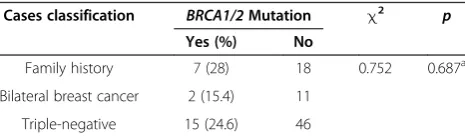
25 patients who had a family history, 2 (15.4%) muta-tions were identified in 13 patients who had bilateral breast cancer, and 15 (24.6) mutations were identified in 61 patients who had unselected TNBC (Table 2). A com-parison of the three kinds of patients by chi-square test showed no significant difference (P= 0.687).
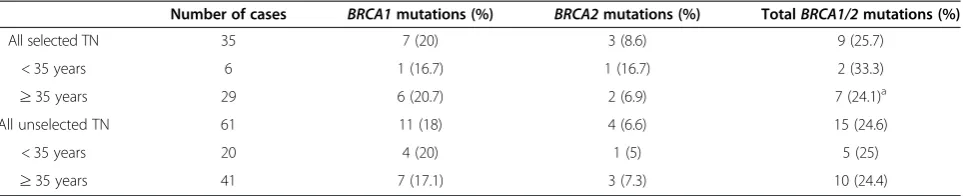
A total of 9 (25.7%) BRCA1 and BRCA2 mutations were identified in 35 selected patients, and 15 (24.65)
BRCA1 and BRCA2mutations were identified in the 61 unselected patients (Table 3). It makes no difference in the prevalence ofTNBC whether the BRCA1/2mutation is selected or not. When all 96 TNBC were broken down into different age groups,BRCA1 andBRCA2mutations were 25% (5/20) in unselected women with TNBC ≤35 years old and 33.3% (2/6) in women with a FH and/or BI-BC, TNBC and≤35 years old.
Discussion
These data support the position that premenopausal TNBC is an indicator that can be used to help to identify candidates for BRCA1/2 mutation testing. BRCA1/2 germline mutations are responsible for genetic predis-position and may increase the risk for breast and ovarian cancer [1]. The prevalence of BRCA mutations varies among different populations due to founder mutation ef-fects and environmental factors [10,11]. Genetic cancer risk assessment guideline and genetic testing for breast cancer have become standard clinical management for selected patients in Western populations. But the
situation in China is less managed. Only a few of studies reported BRCA mutations among breast can-cer patients in China; the subjects were mainly famil-ial breast cancer, early-onset breast cancer and bilateral breast cancer. Based on these studies, the
BRCA mutation rate is generally less than 20% in China [3,4,12]. Our data show the prevalence of the
BRCA1/2 mutation in 96 cases of TNBC was 25%,
close to the previous studies.
TNBC is a subgroup of breast tumors with poor prog-nosis. TNBCs are the predominant cancer subtype with a germlineBRCAmutation. The prevalence of theBRCA mutation was 10 to 30% [13-15]. A total of 15 (24.6%) mutations were identified in 61 patients who had unse-lected TNBC (Table 3). The frequency of unseunse-lected TNBC is similar to the frequency ofBRCA1/2mutations in individuals that were selected for inclusion because of a family history or bilateral breast cancer. Our study in-cluded samples of unselected TN cancers, which were primarily diagnosedin premenopause; only six cases were postmenopausal. All mutations were found in premeno-pausal patients. The prevalence of the BRCA1 germline mutation was about 18.6% (18/96), and the prevalence of theBRCA2germline mutation was about 6.3% (6/96). Prevalence of BRCA1 mutations is more common than
BRCA2 in TNBC patients, and BRCA1 mutation is
mainly associated with TNBC. All theBRCA1mutations are in TNBC cases with higher histological grades of in-vasive ductal carcinoma. These findings coincided with earlier findings for Asian populations, including Chinese [3,10-12], where BRCA1-mutated tumors conferred the following features: they were ER- or PR-negative and had a higher histological grade, but exhibited less medul-lary carcinoma compared to the Western population [16]. Whereas about 70% of the patients from this earlier study of TNBC in China were premenopausal [17], in our study, all BRCA mutations in TNBC were in pre-menopausal patients. TNBC with family history may in-fluence the BRCA mutation; when the 96 TNBCs were broken down into different age groups, BRCA1 and
BRCA2mutations were 25% (5/20) in unselected women (≤35 years old) with TNBC and 33.3% (2/6) were in
Table 1BRCA1andBRCA2mutation prevalence in premenopausal/postmenopausal triple-negative breast cancer (TNBC) patients
Number of cases BRCA1mutations (%) BRCA2mutations (%) TotalBRCA1/2mutations (%)
All 96 18 (18.6) 7 (7.3) 24 (25)a
Premenopausal 81 16 (19.8) 7 (8.6) 22 (27.2)a
Postmenopausal 15 2 (13.3) 0 2 (13.3)
All unselected TNBC 61 11 (18) 4 (6.6) 15 (24.6)
Premenopausal 55 11 (20) 4 (7.3) 15 (27.3)
Postmenopausal 6 0 0 0
a
BothBRCA1andBRCA2mutations were identified in one patient with family history, and she was 47 years old.
Table 2BRCA1/2mutation prevalence in the unselected and selected triple-negative breast cancer (TNBC) patients
Cases classification BRCA1/2Mutation χ2 p
Yes (%) No
Family history 7 (28) 18 0.752 0.687a
Bilateral breast cancer 2 (15.4) 11
Triple-negative 15 (24.6) 46
a
women (≤35 years old) with FH and/or BI-BC TNBC, respectively. These results are consistent with those re-ported in [18]. Although this study is not a large-scale investigation (only 96 patients), our results suggest that diagnosis of premenopausal TNBC would be a suitable threshold for BRCA testing. It is also consistent with simulation data, suggesting that this testing threshold would be a cost-effective strategy [19].
China is a developing country with multiple ethnic groups. Due to variations in the breast cancer prevalence, molecular subtypes and onset age among the different races and ethnicities, and because BRCA mutations are also different, caution must be exercised when following the clinical guidelines of the genetic and high familial risk assessment of breast cancer in the The National Compre-hensive Cancer Network (NCCN) data. Most of those data come from Western populations, and in China, genetic testing should be modified to better assess the Chinese population. Our study only provides some preliminary in-formation of BRCA mutation of TNBC in the multi-ethnic region of Xinjiang, China. Our dataset is relatively small, but we confirmed similar observations made by others. To date, no single study has been large or defini-tive in China for TNBC BRCA mutations, and therefore, it is important to consider the results of all studies in ag-gregate. More precise figures would be obtainable from larger, prospective studies. We also found a number of po-tential BRCA mutation hotspot regions in Xinjiang TNBC patients, such as the mutation mainly in exons 10 and 11, but our conclusions need further study and more data collection.
Conclusions
Premenopausal women with TNBC may be candidates for genetic testing forBRCA1/2in the Xinjiang region of China, even in the absence of a family history or bilateral breast cancer.
Additional file
Additional file 1: Table S1.BRCA1 and BRCA2 mutation in triple-negative breast cancer patients.
Abbreviations
BC:breast cancer; BI-BC: bilateral breast cancer;BRCA1: breast cancer susceptibility gene 1;BRCA2: breast cancer susceptibility gene 2; DHPLC: denaturing high-performance liquid chromatography; ER: estrogen receptor; FH: family history; FISH: fluorescentin situhybridization; HER-2: human epidermal growth factor receptor 2; IHC: immunohistochemistry; OC: ovarian cancer; PCR-DHPLC: polymerase chain reaction-denaturing high-performance liquid chromatography; PR: progesterone receptor; TNBC: triple-negative breast cancer.
Competing interests
The authors declare that they have no competing interests.
Authors' contributions
YTL, DN, JHO conceived and designed the study and analyzed the data. YTL, LY, QZ, wrote the paper. All authors read and approved the final manuscript.
Acknowledgements
This research was supported by the National Natural Science Foundation of China (Grant number: 81260390).
Received: 21 January 2014 Accepted: 12 June 2014 Published: 25 June 2014
References
1. Narod SA, Foulkes WD:BRCA1 and BRCA2: 1994 and beyond.Nat Rev Canc2004,4:665–676.
2. Zhang ML, Huang ZZ, Zheng Y:Estimates and prediction on incidence, mortality and prevalence of breast cancer in China, 2008 (in Chinese).
Zhonghua Liu Xing Bing Xue Za Zhi2012,33:1049–1051.
3. Zhang J, Pei R, Pang Z, Ouyang T, Li J, Wang T, Fan Z, Fan T, Lin B, Xie Y:
Prevalence and characterization of BRCA1 and BRCA2 germline mutations in Chinese women with familial breast cancer.Breast Canc ResTreat2012,132:421–428.
4. Cao AY, Hu Z, Shao ZM:Mutation screening of breast cancer susceptibility genes in Chinese high-risk families: the results will develop the genetic testing strategy in China.Breast Canc Res Treat2010,120:271–272. 5. Evans DG, Baildam AD, Anderson E, Brain A, Shenton A, Vasen HF, Eccles D,
Lucassen A, Pichert G, Hamed H, Moller P, Maehle L, Morrison PJ, Stoppat-Lyonnet D, Gregory H, Smyth E, Niederacher D, Nestle-Krämling C, Campbell J, Hopwood P, Lalloo F, Howell A:Risk reducing mastectomy:outcomes in 10 European centres.J Med Genet2009,46:254–258.
6. Jianghua O, Tao W, Sijmons R, Ni D, Wenting X, Upur H:Prevalence of BRCA1 and BRCA2 germline mutations in breast cancer Women of Multiple Ethnic Region in Northwest China.J Breast Canc2013,16:50–54. 7. Dent R, Trudeau M, Pritchard KI, Hanna WM, Kahn HK, Sawka CA, Lickley LA,
Rawlinson E, Sun P, Narod SA:Triple-negative breast cancer: clinical features and patterns of recurrence.Clin Canc Re2007,13:4429–4434. 8. Foulkes WD, Smith IE, Reis-Filho JS:Triple-negative breast cancer.N Engl J
Med2010,363:1938–1948.
9. Atchley DP, Albarracin CT, Lopez A, Valero V, Amos CI, Gonzalez-Angulo AM, Hortobagyi GN, Arun BK:Clinical and pathologic characteristics of patients with BRCA-positive and BRCA-negative breast cancer.J Clin Oncol2008,
26:4282–4288.
Table 3BRCA1/2mutation prevalence in unselected/selected triple-negative breast cancer (TNBC) patients
Number of cases BRCA1mutations (%) BRCA2mutations (%) TotalBRCA1/2mutations (%)
All selected TN 35 7 (20) 3 (8.6) 9 (25.7)
< 35 years 6 1 (16.7) 1 (16.7) 2 (33.3)
≥35 years 29 6 (20.7) 2 (6.9) 7 (24.1)a
All unselected TN 61 11 (18) 4 (6.6) 15 (24.6)
< 35 years 20 4 (20) 1 (5) 5 (25)
≥35 years 41 7 (17.1) 3 (7.3) 10 (24.4)
Selection criteria: Selected = bilateral breast cancer and/or family history of TNBC; Unselected = TNBC. a
10. Son BH, Ahn SH, Kim SW, Kang E, Park SK, Lee MH, Noh WC, Kim LS, Jung Y, Kim KS, Noh DY, Moon BI, Suh YJ, Lee JE, Choi DH, Kim SY, Jung SH, Yom CK, Lee H, Yang JH, KOHBRA Research Group and Korean Breast Cancer Society:Prevalence of BRCA1 and BRCA2 mutations in non-familial breast cancer patients with high risks in Korea: the Korean Hereditary Breast Cancer (KOHBRA) Study.Breast Canc Res Treat2012,133:1143–1152. 11. Thirthagiri E, Lee SY, Kang P, Lee DS, Toh GT, Selamat S, Yoon SY, Taib NA,
Thong MK, Yip CH, Teo SH:Evaluation of BRCA1 and BRCA2 mutations and risk-prediction models in a typical Asian country (Malaysia) with a relatively low incidence of breast cancer.Breast Canc Res2008,10:R59. 12. Song CG, Hu Z, Wu J, Luo JM, Shen ZZ, Huang W, Shao ZM:Te prevalence
of BRCA1 and BRCA2 mutations in eastern Chinese women with breast cancer.J Canc Res Clin Oncol2006,132:617–626.
13. Evans DG, Howell A, Ward D, Lalloo F, Jones JL, Eccles DM:Prevalence of BRCA1 and BRCA2 mutations in triple negative breast cancer.J Med Genet2011,48:520–522.
14. Comen E, Davids M, Kirchhoff T, Hudis C, Offit K, Robson M:Relative contributions of BRCA1 and BRCA2 mutations to‘triple-negative’breast cancer in Ashkenazi Women.Breast Canc Res Treat2011,129:185–190. 15. Gonzalez-Angulo AM, Timms KM, Liu S, Chen H, Litton JK, Potter J,
Lanchbury JS, Stemke-Hale K, Hennessy BT, Arun BK, Hortobagyi GN, Do KA, Mills GB, Meric-Bernstam F:Incidence and outcome of BRCA mutations in unselected patients with triple receptor-negative breast cancer.Clin Canc Res2011,17:1082–1089.
16. Foulkes WD, Metcalfe K, Sun P, Hanna WM, Lynch HT, Ghadirian P, Tung N, Olopade OI, Weber BL, McLennan J, Olivotto IA, Bégin LR, Narod SA:
Estrogen receptor status in BRCA1 and BRCA2-related breast cancer: the influence of age, grade, and histological type.Clin Canc Res2004,
10:2029–2034.
17. Yin WJ, Lu JS, Di GH, Lin YP, Zhou LH, Liu GY, Wu J, Shen KW, Han QX, Shen ZZ, Shao ZM:Clinicopathological features of the triple-negative tumors in Chinese breast cancer patients.Breast Canc Res Treat2009,115:325–333. 18. Phuah SY, Looi LM, Hassan N, Rhodes A, Dean S, Mohd Taib NA, Yip CH,
Teo SH:Triple negative breast cancer and phosphatase and tensin homolog loss are predictors of BRCA1 germline mutations in women with early onset and familial breast cancer, but not in women with isolated late-onset breast cancer.Breast Canc Res2012,14:R142. 19. Kwon JS, Gutierrez-Barrera AM, Young D, Sun CC, Daniels MS, Lu KH, Arun B:
Expanding the criteria for BRCA mutation testing in Breast cancer survivors.J Clin Oncol2010,28:4214–4220.
doi:10.1186/2047-783X-19-35
Cite this article as:Liet al.:The prevalence ofBRCA1/2mutations of triple-negative breast cancer patients in Xinjiang multiple ethnic region of China.European Journal of Medical Research201419:35.
Submit your next manuscript to BioMed Central and take full advantage of:
• Convenient online submission
• Thorough peer review
• No space constraints or color figure charges
• Immediate publication on acceptance
• Inclusion in PubMed, CAS, Scopus and Google Scholar
• Research which is freely available for redistribution