POLITECNICO DI TORINO
Repository ISTITUZIONALE
Rethinking Software Network Data Planes in the Era of Microservices / Miano, Sebastiano. - (2020 Jul 13), pp. 1-175. Original
Rethinking Software Network Data Planes in the Era of Microservices
Publisher:
Published DOI:
Terms of use: Altro tipo di accesso
Publisher copyright
(Article begins on next page)
This article is made available under terms and conditions as specified in the corresponding bibliographic description in the repository
Availability:
This version is available at: 11583/2841176 since: 2020-07-22T19:49:25Z Politecnico di Torino
Doctoral Dissertation
Doctoral Program in Computer and Control Enginering (32nd cycle)
Rethinking Software Network
Data Planes in the Era of
Microservices
Sebastiano Miano
* * * * * *Supervisor
Prof. Fulvio Risso
Doctoral examination committee
Prof. Antonio Barbalace, Referee, University of Edinburgh (UK) Prof. Costin Raiciu, Referee, Universitatea Politehnica Bucuresti (RO) Prof. Giuseppe Bianchi, University of Rome “Tor Vergata” (IT)
Prof. Marco Chiesa, KTH Royal Institute of Technology (SE) Prof. Riccardo Sisto, Polytechnic University of Turin (IT)
This thesis is licensed under a Creative Commons License, Attribution - Noncommercial-NoDerivative Works 4.0 International: see www.creativecommons.org. The text
may be reproduced for non-commercial purposes, provided that credit is given to the original author.
I hereby declare that, the contents and organisation of this dissertation constitute my own original work and does not compromise in any way the rights of third parties, including those relating to the security of personal data.
. . . . Sebastiano Miano
Summary
With the advent of Software Defined Networks (SDN) and Network Functions Virtualization (NFV), software started playing a crucial role in the computer net-work architectures, with the end-hosts representing natural enforcement points for core network functionalities that go beyond simple switching and routing. Recently, there has been a definite shift in the paradigms used to develop and deploy server applications in favor of microservices, which has also brought a visible change in the type and requirements of network functionalities deployed across the data center. Network applications should be able to continuously adapt to the runtime behav-ior of cloud-native applications, which might regularly change or be scheduled by an orchestrator, or easily interact with existing “native” applications by leveraging kernel functionalities - all of this without sacrificing performance or flexibility.
In this dissertation, we explore the design space of software packet processing applications within the new “cloud-native” era, and we propose a novel paradigm to design, run, and manage software network functions that follow the same approach of micro-services. We present Polycube, a software framework that enables the creation of efficient, modular, and dynamically reconfigurable in-kernel networking components available with vanilla Linux. Polycube exploits the extended Berkeley Packet Filter (eBPF) framework to execute the data plane of those network func-tions and introduces a set of additional components and common APIs that make it easier to develop and manage those services. We design and evaluate the use of this paradigm through bpf-iptables, a clone of iptables characterized by improved performance and scalability. Then, we explore the possibility of enhancing the ca-pabilities of end-hosts through the use of programmable network interface cards (SmartNICs) to offload partially (of fully) existing packet processing applications, in particular in the domain of DDoS Mitigation. In the last part of the dissertation, we present Kecleon, a compiler framework that can be used to dynamically opti-mize generic software data planes, taking into account the runtime characteristics and packet processing behavior of the original network function. We believe that the combination of these works can lay the foundation for a new model of packet processing applications that is better suited for modern cloud environments, hav-ing the capability to be dynamically re-combined, re-generated, and re-optimized without sacrificing programmability, extensibility and performance.
Acknowledgements
This Ph.D. has totally changed my personality and way of thinking, thanks to all the wonderful (and, sometimes bad) experiences that I got and the amazing people that I met and worked with. It was a journey that I would always remember and something that I will definitely start again if I could. Many people have assisted me during this journey and I would like to express my gratitude to all of them for helping me become a researcher and the person that I am today.
First of all, I would like to thanks my advisor, Prof. Fulvio Risso for all the lessons that I learned from him, for his patience, his immense love in the field, and his capacity to drive me in the right directions when it was necessary. I will be always grateful to him.
My colleagues and friends Matteo Bertrone and Mauricio Vasquez (the initial Polycube team), with whom I have shared all the years of my Ph.D. and who helped me to refine my research and provided invaluable help when I needed it most. It is also thanks to them that I was able to reach a certain level of maturity and robustness of the works presented in this thesis.
All the people and friends that I have met in Cambridge. Prof. Andrew Moore for giving me the chance to do this wonderful experience, and Christos, Hilda, Salvador, Yuta, and Marcin for all the interesting discussions that we had and for helping me (a poor Sicilian guy) to survive in the UK during the entire summer. A huge thanks go to Prof. Gianni Antichi, from having welcomed me in Cambridge and for teaching me a lot in the last year. He became a real role model for me and a great friend.
A great thanks to my parents that gave me the change to do a Ph.D. and bring me up to love school and science, and that always supported me during the entire Ph.D. A special thanks to my sister, Debora for all the suggestions and support that she gave me and for being always present when needed. She was the first person that I always called when, in panic, I was looking for advice.
Last but not least, my biggest thanks to Valentina. Although sometimes I neglected her to focus on the Ph.D., she has been always on my side and supported me in any choice I have made, even if this sometimes took me away from her.
Contents
List of Tables ix List of Figures x 1 Introduction 1 1.1 Summary of Contributions . . . 5 1.2 Outline. . . 81.3 Research Projects Not Included in This Dissertation . . . 8
2 Background and Motivations 10 2.1 Userspace vs. Kernelspace networking. . . 10
2.2 The extended Berkley Packet Filter (eBPF) . . . 12
2.2.1 eBPF for Network Functions . . . 14
3 Creating Network Service with eBPF: Experience and Lessons Learned 16 3.1 Introduction . . . 16
3.2 Experiences and Insights . . . 17
3.2.1 eBPF limitations . . . 17
3.2.2 Enabling more aggressive service optimization . . . 21
3.2.3 Data structures . . . 22
3.2.4 High performance processing with XDP. . . 24
3.2.5 Service function chaining . . . 26
3.3 Experimental Evaluation . . . 26
3.3.1 Test environment and evaluation metrics . . . 26
3.3.2 Overcoming eBPF limitations . . . 27
3.3.3 Enabling more aggressive service optimization . . . 29
3.3.4 High performance processing with XDP. . . 31
3.3.5 Service function chaining . . . 31
4 Polycube: A Framework for Flexible and Efficient In-Kernel
Net-work Services 34
4.1 Introduction . . . 34
4.2 Design Goals and Challenges . . . 36
4.3 Architecture Overview . . . 37
4.3.1 Unified Point of Control . . . 37
4.3.2 Structure of Polycube services . . . 37
4.3.3 Remote vs Local services . . . 40
4.4 APIs and Abstractions . . . 40
4.4.1 Transparent port handling . . . 41
4.4.2 Fast-slow path interaction . . . 42
4.4.3 Debug mechanism. . . 44
4.4.4 Table abstractions . . . 44
4.4.5 Transparent Support for Multiple Hook Points . . . 44
4.4.6 Transparent Services . . . 45
4.5 Service Chaining Design . . . 46
4.6 Management and Control Plane . . . 49
4.6.1 Model-driven service abstraction. . . 49
4.7 Implementation . . . 51 4.7.1 Polycube Core . . . 51 4.7.2 Polycube Services . . . 53 4.8 Evaluation . . . 57 4.8.1 Setup . . . 57 4.8.2 Test Applications . . . 58 4.8.3 Framework Overheads . . . 64
4.8.4 Polycube vs Userspace Frameworks . . . 65
4.9 Conclusions . . . 66
5 Accelerating Linux Security with eBPF iptables 67 5.1 Introduction . . . 67
5.2 Design Challenges and Assumptions . . . 69
5.2.1 Guaranteeing filtering semantic . . . 69
5.2.2 Efficient classification algorithm in eBPF . . . 70
5.2.3 Support for stateful filters (conntrack) . . . 71
5.2.4 Working with upstream Linux kernel . . . 71
5.3 Overall Architecture . . . 71 5.4 Data plane . . . 73 5.4.1 Header Parser . . . 73 5.4.2 Chain Selector . . . 73 5.4.3 Matching algorithm . . . 74 5.4.4 Classification Pipeline . . . 74 5.4.5 Connection Tracking . . . 79
5.5 Control plane . . . 83 5.6 Evaluation . . . 85 5.6.1 Test environment . . . 85 5.6.2 System benchmarking . . . 86 5.6.3 Realistic Scenarios . . . 91 5.6.4 Microbenchmarks . . . 95 5.7 Additional Discussion . . . 97 5.8 Conclusions . . . 98
6 Introducing SmartNICs in Server-based Data Plane Processing: the DDoS Mitigation Use Case 100 6.1 Introduction . . . 100
6.2 Background . . . 101
6.2.1 SmartNICs . . . 101
6.2.2 TC Flower . . . 102
6.3 DDoS Mitigation: Approaches . . . 102
6.4 Architecture and Implementation . . . 105
6.4.1 Mitigation . . . 105 6.4.2 Feature extraction . . . 107 6.4.3 Detection . . . 109 6.4.4 Rate Monitor . . . 109 6.5 Performance evaluation . . . 109 6.5.1 Test environment . . . 110 6.5.2 Mitigation performance . . . 110
6.5.3 Effect on legitimate traffic . . . 113
6.6 Related work . . . 114
6.7 Conclusions . . . 115
7 Kecleon: A Dynamic Compiler and Optimizer for Software Net-work Data Planes 116 7.1 Introduction . . . 116
7.2 The Case for Dynamic Network Function Optimizations. . . 118
7.3 Kecleon System Design . . . 122
7.3.1 Design Goal . . . 122
7.3.2 Design Challenges and Assumption . . . 122
7.3.3 Design Overview . . . 123
7.4 Kecleon Compilation Pipeline . . . 125
7.4.1 Packet Processing Logic Identification . . . 125
7.4.2 Runtime Statistics and Data Collection . . . 128
7.4.3 Kecleon Data Path Optimizations . . . 130
7.4.4 Kecleon Pipeline Update . . . 134
7.5.1 eBPF Plugin . . . 135 7.6 Evaluation . . . 135 7.6.1 Setup . . . 136 7.6.2 eBPF NFs (Polycube) . . . 136 7.6.3 eBPF-firewall (bpf-iptables) . . . 137 7.6.4 Microbenchmarks . . . 138
7.7 Conclusions and Future Works . . . 139
8 Concluding Remarks 141 A List of Publications 143
List of Tables
3.1 Reloading time of various eBPF services . . . 30 4.1 Helper functions provided by Polycube at different level of the NF. 41 4.2 A list of NF implemented with Polycube. . . 52 4.3 Comparison between vanilla-eBPF applications and a Polycube
net-work function. All throughput results are single-core. . . 64 5.1 Comparison of the time required to append the (n+1)thin the ruleset
List of Figures
2.1 eBPF overview. . . 13 2.2 (a) Forwarding performance comparison between XDP and DPDK
with small packets (64B) redirected between different NICs. DPDK uses one control thread, so only 5 to 6 are available for the forward-ing. (b) CPU usage differences between DPDK, XDP, and Linux when dropping packet with a variable offered load. The data were obtained from [75]. . . 14 3.1 Throughput (left) and latency (right) for the Bridge service when
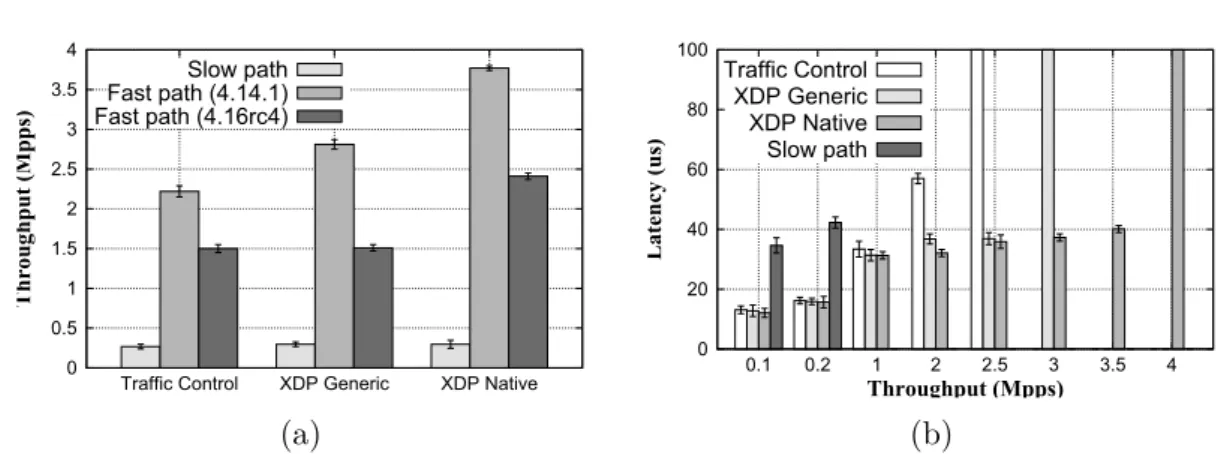
redirecting packets entirely in the fast path and when using the slow path. . . 28 3.2 Effect on the end-to-end throughput, using the code tailoring
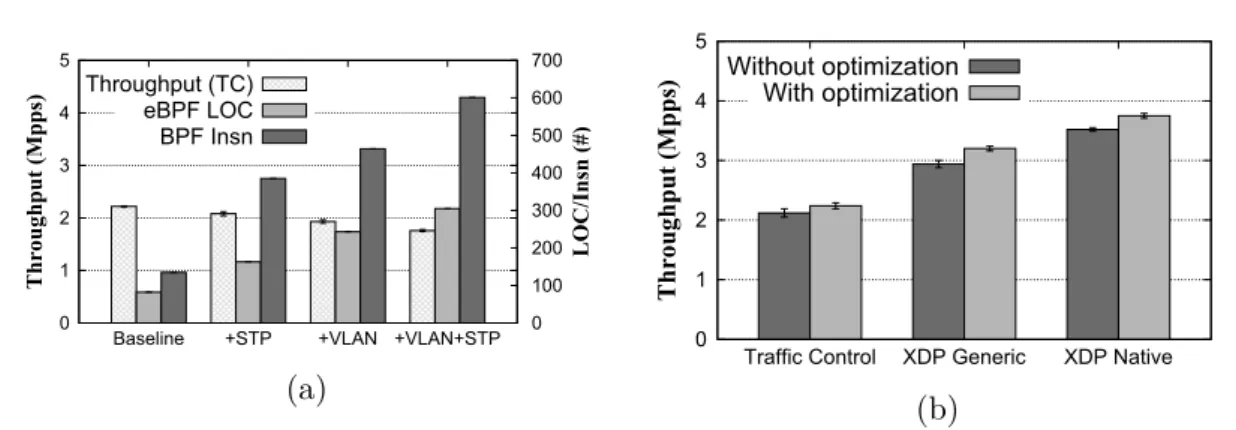
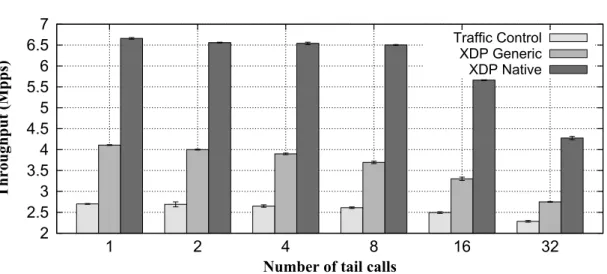
tech-nique (left) and the moving configuration from memory to code (right). 30 3.3 End-to-end throughput with an increasing number of tail calls. . . . 32 4.1 High-level architecture of the system . . . 38 4.2 Message flow for Encapsulator and Decapsulator . . . 43 4.3 (a) Transparent cubes attached to a port of the service. (b)
Trans-parent cube attached to netdev. . . 46 4.4 Internal details of the Polycube service chains . . . 47 4.5 YANG to REST/CLI service description . . . 51 4.6 Packet forwarding throughput comparison between Polycube
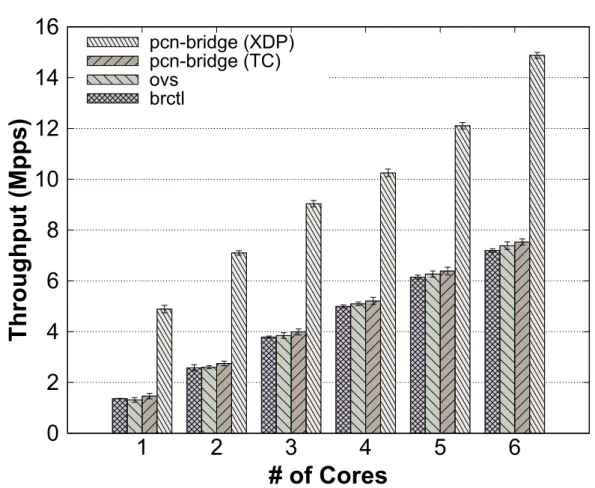
pcn-bridge NF (in both XDP and TC mode) and “standard” Linux im-plementation such as Linux bridge (btctl) and OpenvSwitch (ovs). . 58 4.7 Throughput performance between a Polycube load balancer NF (i.e.,
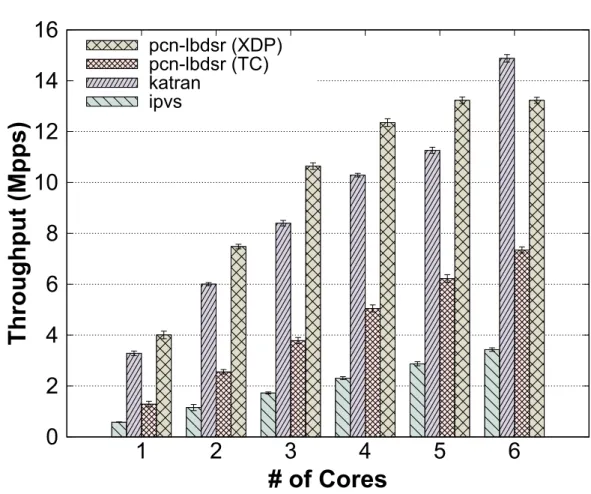
pcn-lbdsr), ipvs, the standard L4 load balancing software inside the Linux kernel and Katran, an XDP-based load balancer developed by Facebook. . . 59 4.8 Throughput performance comparing with 1000 rules between a
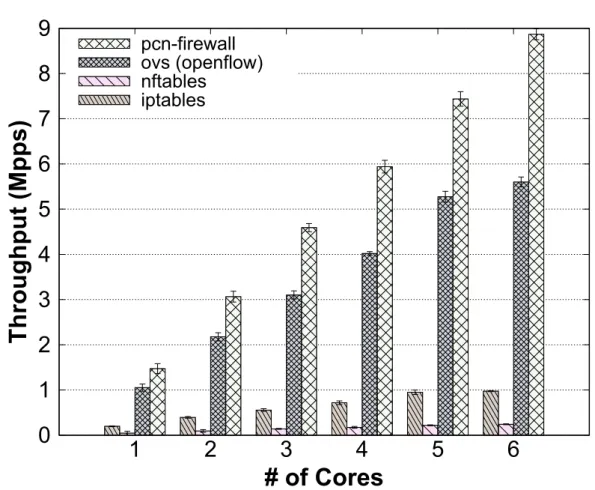
Poly-cube firewall NF (i.e., pcn-firewall),iptables and nftables, which are two commonly used Linux firewalls and OpenvSwitch (ovs) with OpenFlow rules. . . 61 4.9 Architecture of the Polycube K8s plugin. . . 62
4.10 Performance of different k8s network providers for direct Pod to Pod
communication. . . 63
4.11 Performance of different k8s network providers for Pod to ClusterIP communication. . . 63
4.12 Overhead of the Polycube service chain compared to the standard eBPF tail call mechanism. . . 65
5.1 Location of netfilter and eBPFhooks. . . 70
5.2 High-level architecture of bpf-iptables. . . 72
5.3 Linear Bit Vector Search . . . 75
5.4 bpf-iptables classification pipeline. . . 76
5.5 TCP state machine for bpf-iptables conntrack. Grey boxes in-dicate the states saved in the conntrack table; labels represent the value assigned by the first conntrack module before the packet enters the classification pipeline. . . 82
5.6 Single 5.6a and multi-core 5.6b comparison when increasing the num-ber of loaded rules. Generated traffic (64B UDP packets) is uni-formly distributed among all the rules. . . 87
5.7 Performance of the INPUT chain with an increasing number of rules. bpf-iptables runs on a single CPU core and iperf on another core. 88 5.8 Multi-core performance comparison when varying the number of fields in the rulesets. Generated traffic (64B UDP packets) is uni-formly distributed among all the rules. . . 89
5.9 Connection tracking with an increasing number of clients (number of successfully completed requests/s). . . 90
5.10 Throughput when protecting a variable number of services within a DMZ. Multi-core tests with UDP 64B packets, bidirectional flows. . 92
5.11 Multi-core performance under DDoS attack. Number of successful HTTP requests/s under different load rates. . . 93
5.12 Performance with single default ACCEPT rule (baseline). Left: UDP traffic, 64B packets matching the FORWARD chain. Right: number of HTTP requests/s (downloading a 1M B web page), TCP packets matching the INPUT chain. . . 94
5.13 TCP throughput when thebpf-iptablesingress pipeline (with zero rules) is executed on either XDP or TC ingress hook; bpf-iptables running on a single CPU core; iperf running on all the other cores. 97 6.1 High-level architecture of the system. . . 106
6.2 Dropping rate with an increasing number of attackers. (a): uni-formly distributed traffic;(b): traffic normally distributed among all sources. . . 111
6.3 Host CPU usage of the different mitigation approaches under a sim-ulated DDoS attack (uniform distribution). . . 112
6.4 Number of successfully completed HTTP requests/s under different load rates of a Distributed Denial of Service (DDoS) attack carried out by (a) 1K attackers and (b) 4K attackers. . . 114 7.1 Static vs. Dynamic generation. The static compiler generates a NF
agnostic data path while Kecleon takes into account runtime data, statistics, and behavior to generate the NF data path. . . 117 7.2 L2 bridge NF (eBPF-TC) performance with variable runtime
con-figuration settings between the original version and the one with the unused features compiled-out; traffic is always the same across the different runtime configurations. . . 119 7.3 (a) Overhead given by consecutive match-action empty table lookup
and (b) throughput with different map sizes and algorithms. . . 120 7.4 Throughput improvements when caching the computation of the
top-5 flows within a high-locality trace for the DPDK flow-classify sam-ple application. . . 121 7.5 Kecleon Architecture . . . 124 7.6 Single-core throughput for various Polycube eBPF-based NFs. We
report the average, maximum, and minimum throughput values un-der different configuration and traffic setup when using Kecleon to generate the optimized code. . . 137 7.7 Single-core throughput forbpf-iptables. We report the throughput
under three different Classbench generated traces with no locality (traffic is uniformly distributed) to high locality (few elephant flows). 138 7.8 Single-core throughput for bpf-iptables when only the Kecleon
instrumentation is applied, without any of the optimization passes to take effect. The first bar indicates the overhead of the implicit traffic-specific approach used by Kecleon, while the second indicates the overhead for the use of guards tables. . . 139
Chapter 1
Introduction
One of the main reasons behind the success of Internet and its widespread re-volves around the “end-to-end” principle [138, 15]. The general idea behind it is that, a network designed according to this principle should keep application-specific features on the end-hosts of the network while maintaining itscoresimple. Interme-diate nodes, such as switches and routers, are just “dumb” forwarding devices that send packets between one end-host to another, while more sophisticated features are implemented in the software running on the end-host devices.
During the years, this approach has been successfully applied to both wide area networks (WAN) and data center networks (DCN). The simplicity and stateless model of the core network have facilitated the implementation of fixed function-alities running on specialized network hardware processors or application-specific integrated circuit (ASIC), fostering the introduction of more network providers that led to the rapid growth of the Internet traffic. On the end-hosts, the increased flexi-bility and programmaflexi-bility of the software have encouraged the innovation resulting in the realization of ground-breaking applications such as the World Wide Web.
While the end-to-end principle still stands as a fundamental design framework in computer networking, in recent years, the distinction between the “dumb core” and the “smart edge” has gotten blurred, with different trends that tip the bal-ance more on a direction or the other. Modern network providers (ISPs) started running their networks as a business, relying on the provision of value-added ser-vices such as content distribution [137, 6, 122], safe browsing, or anti-malware, also rented to third-parties to provide more advanced features and increase their revenue [95]. Data center networks followed the same path; the growing need for security and reliability has caused the network to implement more sophisticated fea-tures such as proxies, intrusion detection and prevention systems, firewalls, caches and load-balancers, implemented within dedicated hardware network appliances (i.e., middleboxes) built for the specific application purposes [140].
On the other hand, motivated by the high infrastructure and management costs, which result from the complex and specialized processing of the above-mentioned
1 – Introduction
devices, the advent of “network softwarization” proposed traditional network ser-vice to be transformed into pure software images that can be executed on (cheap) general-purpose servers - running on VMs or cloud sites. Then, by using Software Defined Networking (SDN) [131], network traffic can be steered through a chain of Virtual Network Functions (VNFs) in order to provide aggregated services.
With the introduction of these concepts, it becomes more evident that soft-ware started playing a crucial role in the network dataplane architectures, with the end-hosts that increasingly became a natural enforcement point for core network functions such as load balancing [76,94,74,16], congestion control [3,89,119], and application-specific network workloads - thanks also to the development and avail-ability of programmable network devices (e.g., SmartNICs). The new requirements in terms of flexibility (software is intrinsically easier to program and to update compared to the hardware implementations), and the recent advances in terms of speed for the software packet processing have contributed to the proliferation of a myriad of VNFs frameworks that provide implementations of efficient and easily programmable software middleboxes [35, 90,169,86, 93, 100, 170, 123, 125].
Current solutions to implement the dataplane of thosesoftware packet processing applications rely mostly on kernel bypass approaches, for example by giving to the user-space direct access to the underlying hardware (e.g., DPDK [54], netmap [133], FD.io [83]) or by following aunikernel approach, where the only the minimal set of OS functionalities, required for the application to run, are built within the appli-cation itself (e.g., ClickOS [106, 66, 96]). These approaches have perfectly served their purposes, with efficient implementations of software network functions that have shown potential for processing 10-100Gbps on a single server [134, 105, 72].
Recently, the advent of new networking technologies such as 5G, edge com-puting, IoT, has brought a significant increase in the total number of connected devices and cloud service load, requiring network operators to change the previ-ously monolithic paradigm used to develop and deploy server applications in favor of micro-services. Cloud-native technologies are used to develop applications built with services packaged in containers, deployed as microservices, and managed on elastic infrastructure through agile DevOps processes and continuous delivery work-flows [87]. This paradigm shift has also brought a visible change in the type and requirements of network functionalities deployed across the data center, given the new workloads and applications running on the servers. For instance, cloud-native platforms, like Kubernetes [82], rely on different network providers (a.k.a., network plugins) to implement the underlying data plane functionalities and transparently steer packets between the micro-services.
Those new requirements can be summarized by the following points:
• Runtime flexibility: A single cloud-native application is composed of sev-eral services, each of which has thousands of instances that might constantly
1 – Introduction
change and be dynamically scheduled by a data center software called orches-trator. Within this world, the service communication is fundamental, and the network should follow the same behavior by continuously adapting to the runtime characteristics to ensure end-to-end performance and reliability [13]. • Low overhead: Networking components should handle the communication of each server in the cluster. As a consequence, the cost to be paid for running network functions, in terms of resource consumption, for each server becomes significant. This is even more evident within edge clouds, where the number of available resources is limited.
• Agile service development: One of the biggest advantages of the micro-service paradigm, together with the concept of building loosely-coupled, fine-grained services is the continuous delivery (CD) software development pro-cess; a small change to the application requires re-building and re-deploying only a small part of the entire service. Newer software data planes should follow the same approach, making it possible to easily update the existing application by providing a replacement that does not disrupt the typical ser-vice workflow [43].
• Automatic optimizations: From a developer’s point of view, writing an efficient and, at the same time, easy to maintain software data plane is a daunting task. Most of the time is just a matter of finding the right trade-off betweensimplicity (e.g., modularity, easy-to-read code) and theperformance. As a consequence, we often see application-specific, and ad-hoc techniques applied only to particular use-cases [72, 105], which do not perform well on other scenarios or for a broader spectrum of applications. To better adapt to this new “frenetic” environment, the network components should be able to automatically adapt themself to the runtime condition with the minimum amount of programming overhead.
• Work with vanilla Linux kernel: Applications are now running on the host operating system that is shared between the different components (e.g., containers), which in turn rely on existing kernel functionality to accomplish their tasks [9]. It is then crucial that network functions can easily interact with existing “native” applications and also leverage kernel functionalities (e.g., TSO, skb metadata, etc.), without sacrificing performance and flexibility. Unfortunately, the previously mentioned kernel-bypass approaches are at a stake when adopted in this new scenario, for different reasons [120]. First, they require the exclusive allocation of resources (i.e., CPU cores) to achieve good performance; this is perfectly fine when we have a single dedicated machine for the networking purposes but it becomes overwhelming when this cost has to be paid for every server in the cluster since they permanently steal precious CPU cycles to other application
1 – Introduction
tasks. Second, they require to re-implement the entire network stack in userspace, losing all the well-tested configuration, deployment and management tools devel-oped over the years within the operating system. Third, they rely on custom or modified versions of network drivers, which may not be available on on-demand cloud platforms, also requiring a non-negligible maintenance cost. Last but not least, they have difficulties (and poor performance) when dealing with existing ker-nel implementations or communicating with applications that are not implemented using the same approach, requiring them to adhere to custom-defined APIs (e.g., mTCP [88]) or to change the original application logic (e.g., StackMap [165]). As a consequence, most of the existing cloud-native network providers today still rely on functionalities and tools embedded into the operating system network stack (e.g., iptables, ipvs, linux bridge). Unfortunately, the drawbacks of this approach are also evident. First of all,fixed kernel network applications are notoriously slow and inef-ficient given their generality, which impairs the possibility to specialize the software network function depending on workloads or the type of application that is running on top of it. Secondly, software network functions that live in the kernel have also proven hard to evolve due the complexity of the code and the difficulties in maintain-ing, up-streaming or modifying the kernel code (or the respective kernel modules). In this dissertation, we present our steps towards the definition and realization of a novel class of software network applications that can fulfill those new require-ments, removing the limitation seen with the existing approaches. We first present Polycube, a framework that can be used to build flexible and efficient in-kernel software network functions that follow the same approach of “cloud-native” appli-cations, enabling the creation of efficient, modular and dynamically reconfigurable networking components, available with vanilla Linux. It exploits the recently added eBPF [107] subsystem to build the data plane of the network function. We will show how Polycube enables the writing of complex networking components that can be used to provide flexible and optimized replacements of existing (fixed) in-kernel im-plementations such asiptables, while keeping the same semantic and syntax of the original application, but with improved performance. Then, we move the focus to Kecleon, a compiler framework that can be used to dynamically optimize software data planes at run time by adopting a dynamic approach to the data path compi-lation, where not only the static features but also the runtime data of the original application are exploited to generate a custom version of the original data plane that would be optimal to the data plane semantic and the packet processing behavior at the same time. While the two systems focus on different layers, the combination of both can lay the foundation of a new paradigm in building software packet process-ing applications that can be dynamically re-combined, re-generated, re-compiled and re-optimized without sacrificing performance, programmability or extensibility.
1 – Introduction
1.1
Summary of Contributions
We start the first part of the dissertation (Chapter 3) by exploring the possibil-ity of using the extended Berkeley Packet Filter (eBPF) [107] as a base subsystem to buildcomplex software packet processing applications. So far, eBPF was mainly used for monitoring tasks such as memory, CPU, page faults, traffic, and more, with a few examples of traditional network services, e.g., that modify the data in transit. However, it also has some characteristics that make it the right candi-date for running data plane applications. First of all, eBPF can process a packet entirely in kernel space, without context switches or packet copies between kernel and user space. Second, it leverages a set of features that are already present in a modern Linux kernel, without requiring additional kernel modules that are difficult to create and maintain. Third, the possibility to compile and inject the code at runtime paves the way to context-based customization of each network function. Eventually, eBPF programs can cooperate with the kernel TCP/IP stack, possibly complementing existing networking features. We make the following contributions. We first analyze the possibility to create complex network functions that go beyond simple proof-of-concept data plane applications, and we present the most promising characteristics of this technology. Then, we indicate the main encountered limita-tions, and some solutions that can mitigate the latter. Second, we summarize the most important lessons and, finally, we provide a quantitative characterization of the most significant aspects of this technology.
The above findings made us reaching to the conclusion that creating network functions based entirely on eBPF is sometimes complicated given the lack of a com-mon framework that provides useful abstractions to developers to solve comcom-mon problems or known limitations. Even though eBPF allows complex and user-defined operations to be performed in the kernel, it is not Turing-complete. As a conse-quence, it cannot support truly arbitrary processing, making the implementation of some common functionalities (e.g., ARP handling in a router) challenging. Further-more, no abstractions current exist to implement the (complex) control plane of a service, hence forcing developers to dedicate a considerable amount of time to han-dle common control plane operations (e.g., user-kernel interaction). This motivated us to rethink how to enable a network function model where in-kernel network ap-plications can be adjusted, injected and modified in a simple and defined way, hence enabling the dynamicity and flexibility required by new data center workloads. We present Polycube (Chapter 4), an overarching coherent software architecture that allows in-kernel network services to be managed in a logically centralized manner. With Polycube, we make the following contributions. First, we make it possible to create complex network services that can overcome the eBPF limitations. We define a specific structure of a service where each function can include an efficient in-kernel data plane (based on eBPF) and a flexible user-space control plane. Then,
1 – Introduction
we handle through a specific programming API the interaction between the differ-ent compondiffer-ents, while keeping strong characteristics of isolation and composability. Second, we manage the creation of complex network applications by allowing the arbitrary construction and concatenation of different services to create arbitrary chains of in-kernel network functions. Third, we introduce a generic model for the control and management plane of each network function that simplifies manageabil-ity and accelerates the development of new network services. We make it possible to change the current version of a given Polycube service dynamically or to modify the service chain at runtime, hence achieving a new type of customizability and flexibility inside the Linux kernel. Finally, we identify and quantify the overhead introduced by the Polycube abstractions, and we show the design and the perfor-mance improvements that Polycube services can bring into the new cloud-native environment (e.g., by presenting an implementation of a k8s CNI plugin). In a nutshell, Polycube allows us to achieve the same modularity, flexibility, and devel-opment process that is possible with user-space Network Functions but inside the Linux kernel, with all the benefits that go with it.
To better present the advantages of this new model and the power of Polycube, in Chapter5we presentbpf-iptables, a fully-functional replacement of iptables that emulates its filtering semantic but exploiting a more efficient matching algo-rithm. We show how bpf-iptables achieves a notable boost in terms of perfor-mance compared to the current implementation of iptables, particularly when a high number of rules is involved, all of this within a vanilla Linux kernel. We make three main contributions in this work. Firstly, we present the design of bpf-iptables together with the main challenges and possible solutions to preserve the original iptables filtering semantic. To the best of our knowledge, bpf-iptables is the first solution that provides an implementation of theiptablesfiltering completely in eBPF. Secondly, we give a comprehensive analysis of the main limitations and challenges required to implement a fast matching algorithm in eBPF, keeping into account the current limitations of the above technology. Third, we show a set of data plane optimizations that are possible thanks to the flexibility and dynamic compilation (and injection) features of eBPF, allowing us to create at runtime an optimized data path that fits perfectly with the current ruleset being used.
To further enhance the capabilities of end hosts, while keeping the best possible trade-off between resource consumption and performance, we have evaluated the possibility to exploit programmable network interface cards (a.k.a., SmartNICs) to offload partially (or fully) existing packet processing functions. In particular, we took the DDoS mitigation as a use-case for this study. In Chapter6, we then present an architecture that can be used to transparently offload a portion of DDoS mitiga-tion rules into a SmartNIC, thus achieving a balanced combinamitiga-tion of the in-kernel packet processing flexibility with eBPF to operate traffic sampling and aggregation, with the performance of hardware-based filtering. We first analyze the various ap-proaches that can be used to design an efficient and cost-effective DDoS mitigation
1 – Introduction
solution. As generally expected, our results show that offloading the mitigation task to the programmable NIC yields significant performance improvements. How-ever, we also demonstrate that due to the memory and compute limitations of current SmartNIC technologies, a fully offloaded solution may lead to deleterious performance. Second, as a consequence of the previous findings, we propose the de-sign and implementation of a hybrid mitigation pipeline architecture that leverages the flexibility of eBPF/XDP to handle different types of traffic, and the efficiency of the hardware-based filtering in the SmartNIC to discard traffic from malicious sources. Third, we present a mechanism to transparently offload part of the DDoS mitigation rules into the SmartNIC, which takes into account the most aggressive sources, i.e., the ones that primarily impact on the mitigation effectiveness.
Starting from the experience gained in the design and implementation of this new type of in-kernel network services (e.g., bpf-iptables), we noticed that one of the most important characteristics that contributed to the better efficiency and performance of these applications is the possibility to specialize the corresponding network data plane at runtime, according to the specific application logic. For ex-ample, in bpf-iptables a lot of optimizations are applied at runtime according to the type of organization of the rules in the data set; this, combined with the dynamic injection of eBPF program in the kernel allowed us to notably outper-forming all the other existing kernel implementations. Motivated by this work, we then tried to answer the following question; “is it possible to perform these run-time optimizations outside of the application context?”. Taking a step back, we realized that traditional approaches to design and develop packet processing func-tions are based on a static compilation. The compiler’s input is a description of the forwarding plane semantic, and the output is a binary code that can accom-modate any pre-defined processing behavior. Although improving hot-code paths during the execution of a software program is nowadays possible with compilers that support Profile Guided Optimizations (PGO), Feedback Directed Optimiza-tions (FDO), those techniques have been architected to optimize generic computer programs. Therefore, they do not easily accommodate the requirements of network data planes programs that have packets as input. In the last part of this disser-tation, we then present Kecleon, a runtime compiler for generic packet processing applications that can dynamically generate an optimized version of the original application’s data plane depending on its runtime behavior. Kecleon is designed to be independent not only from the application itself but also from the technology on which the application is implemented. It applies several dynamic optimizations at the compiler’s Intermediate Representation (IR) level, to either be generic and to also transparently exploit existing compiler’s analysis techniques and optimizations. Kecleon takes into account (i) the network configuration, e.g., to prune branches and instructions that are considered unreachable at runtime,(ii)the run time table content, e.g., selecting the most appropriate data structure (hash-based versus tree) to store the current data can speed up the lookup process and(iii) traffic patterns,
1 – Introduction
e.g., detecting the most frequently accessed entries to create an optimized fast-path code for them. We illustrate the details of Kecleon in Chapter7.
1.2
Outline
The rest of this dissertation is organized as follows. Chapter3briefly introduces the eBPF subsystem and its main features, together with several insights and lim-itations we have found while implementing complex data plane applications with this technology. Chapter 4 presents Polycube, a software architecture that applies the micro-service paradigm to the world of in-kernel network functions. Chapter5 shows one of its applications, bpf-iptables; a more efficient and scalable clone of iptablesbuilt around eBPF. Then, Chapter6 focuses on the DDoS mitigation use case, and presents a study of the combination of the in-kernel packet processing flexibility performed with eBPF with the performance of programmable hardware-based filtering performed into a SmartNIC. In Chapter 7, we present Kecleon, a compiler framework that can be used to dynamically optimize software data planes at run time. Finally, Chapter8concludes this dissertation and discusses suggestions for future work.
Previously Published Work. This thesis includes previously published and co-authored works. In particular, Chapter 3 is adapted from [114], Chapter 4 from [108] and Chapter 5from [115, 22]. Chapter 6is adopted from [109], which is the result of a collaboration with the research center “Fondazione Bruno Kessler: FBK”. Finally, the work in Chapter 7, which is still in a preliminary phase, is the result of a collaboration with the University of Cambridge, UK, and it has not been published yet.
1.3
Research Projects Not Included in This
Dis-sertation
As part of the master course, the author worked on other topics that are not covered in this dissertation. However, they fall under the common goal of building more efficient and flexible networks at the edge of the network (e.g., on resource-contrained Customer Premise Equipment). Even though these topics were explored almost three years ago, their motivations and results achieved are still considered timely given the recent works that go on the same directions (e.g., [139], [62], [40]). • Transforming a Traditional Home Gateway into a Hardware accel-erated OpenFlow switch[112, 113]. Software Defined Networking (SDN) proposes a new paradigm that allows network administrators to manage net-work services from a centralized point of control through abstraction of lower
1 – Introduction
level functionality. The SDN innovation brought significant advancements to different areas, such as the administration of home networks. Traditional home gateways are, however, hard to manage as new application are intro-duced and moved at the customer premises; applying SDN to these devices would enable to program and control the home network from a centralize point of control, allowing users to manage and configure the behavior of their network via high-level applications.
In this work, we described our experience in porting OpenFlow on already existing hardware switch with no support for the OpenFlow standard. We presented our architecture that integrates a hybrid software and hardware pipeline and that is able to compensate the hardware limitations in terms of supported matches and actions, offloading only part of the OpenFlow rules, which are properly translated into the corresponding hardware related com-mands. We illustrated the design choices used to implement the functionali-ties required by the OpenFlow protocol (e.g., packet-in, packet-out messages) and finally, we evaluated the resulting architecture, showing the significant advantage in terms of performance that can be achieved by exploiting the underlying hardware, while maintaining an SDN-type ability to program and to instantiate desired network operations from a central controller.
• Enabling NFV Services of Resource-Constrained CPEs [27]. Vir-tual Network Functions (VNFs) are often implemented using virVir-tual machines (VMs), since they provide an isolated environment compatible with classical cloud computing technologies. Unfortunately, VMs are demanding in terms of required resources and therefore are not suitable for resource constrained devices such as residential CPEs. Such hardware often runs a Linux-based operating system that supports several software modules (e.g., iptables) that can be used to implement network functions (e.g., a firewall), which can be exploited to provide some of the services offered by simple VNFs, but with reduced overhead.
In this work, we proposed and validated an architecture that integrates native software components in a Network Function Virtualization (NFV) platform, making their use transparent from the user’s point of view. Our solution en-ables an NFV orchestrator to optimize the scheduling of the Network Func-tions (NFs) by initialing services that require to be close to end users such as IPsec terminators or low-latency services, directly on the user CPE, while other components of the same service (e.g., the NAT module) are executed in a remote data center.
Chapter 2
Background and Motivations
In this chapter, we explore the available alternative that we have today to build software packet processing applications, along with their motivations, implications, and challenges. First, we explore the most important characteristics of packet processing performed in kernel-space or user-space, showing the corresponding pro and cons of both approaches (section 2.1). Finally, we provide a brief overview of the extended Berkeley Packet Filter subsystem (section 2.2) and why we think it may be beneficial for networking applications (section2.2.1).
2.1
Userspace vs. Kernelspace networking
In recent years, thanks to the introduction and spread of Network Function Virtualization (NFV), software has gained a considerable importance, with a lot of network functionalities deployed at the end host that go beyond traditional switch-ing and routswitch-ing between VMs and containers. Current alternatives to buildswitch-ing such software network applications can be organized into two categories: user-level (or kernel-bypass) approaches, and kernel-level implementations, where we use func-tionalities embedded in the operating system networking stack.
Userspace networking. Moving functionalities from hardware to software has increased performance demands for software network applications, favoring the ap-pearance of specialized network facilities such as DPDK, netmap, and SRIOV. To avoid expensive user-kernel transitions, those systems directly access the network hardware from userspace, writing their network stack focused on performance and optimizations. As a results, they produce considerable benefits both in terms of throughput and latency. However, they have also some drawback, which we sum-marize within the following points:
• High resource consumption. Most of the kernel-bypass solutions require the exclusive allocations of one (or more) CPU cores to handle high-speed
2 – Background and Motivations
packet processing. This model works well for replicating in software a “mid-dlebox” approach, where a single machine is dedicated to networking purposes (e.g., routing, switching, or load-balancing). However, in a scenario (e.g., new cloud environments) where most of the machines (and CPUs) are dedicated to userspace applications (e.g., web servers), those approaches may result overwhelming.
• Difficult integration with “native” applications/environments. Ap-plications that are currently relying on kernel-level functionalities or using kernel (e.g., socket) APIs cannot be transparently used when the userspace application has direct access to the underlying network hardware. Several companies have debugging tools developed over the years that cannot be used with kernel-bypass approaches [104]; Kubernetes network providers still count on iptables, ipsets, ipvs to provide security or load-balancing between containers. Solutions exist to allow their co-existence. For instance, the Ker-nel Native Interface (KNI) in DPDK or Netmap allow passing packets between the userspace application to the kernel network stack, or StackMap [165] that allows using the kernel TCP/IP stack directly. Unfortunately, these solutions will either result in sub-optimal performance [101] or will require the use of custom drivers, custom kernel modules, or modified kernels, which are not always available in every environment.
• Security issues. Bypassing the Linux networking stack does not only im-plies an incompatibility with several applications but also may bring security issues [60]. The Linux TCP/IP stack has some non-trivial and incredibly powerful features that have been developed over the years and that are well-tested and quite reliable. Of course, re-writing all from scratch will have the advantage of better design and then better performance [88, 105], but it would still require a lot of time before having a stable userspace networking stack comparable, in terms of features and compatibility, to the Linux kernel one.
Kernelspace networking. The alternative to handling all packets from a userspace process is to perform the processing entirely in the kernel, reducing at minimum the number of kernel/userspace transitions, which are the primary source of overhead. Except for the evident advantages of compatibility with existing applications and tools, and the ability to run within a vanilla Linux kernel, this approach also has some drawbacks.
• Poor performance. The Linux TCP/IP stack is made of several layers and abstractions given by the generality of the design, which has to be valid for several types of hardware and architecture. On one side, this offers better compatibility between the different layers and a good level of abstraction from
2 – Background and Motivations
the underlying hardware, but on the other hand, it is also the main source of the poor performance of the system. A packet entering the Linux TCP/IP stack has to cross all the different layers, making it very hard to bypass or “jump” from one layer to another.
• Difficult development process. Adding kernel-level functionalities is a non-trivial and lengthy process. Writing custom kernel modules may require a non-negligible effort to keep compatibility across the different kernel versions, or it may incur reluctance from customers to include them in the production system (a crash in the kernel module will hurt the entire system). On the other hand, upstreaming functionalities into the mainline kernel requires to “convince” maintainers of their relevance for the whole of the community. It often results in either long delays before a feature is accepted and available in future kernel releases, and it would break up the innovation cycles for a company that wants to implement features that are useful only for their use cases.
Until a few years ago, the approaches mentioned above were the only alterna-tives available to develop kernel-level network functionalities. However, the recent introduction and evolution of the “classic” BPF [107] subsystem, called extended BPF, has introduced exciting features and concepts that make developing and run-ning kernel-level functionalities easier and more efficient.
2.2
The extended Berkley Packet Filter (eBPF)
The Berkeley Packet Filter (BPF) is an in-kernel virtual machine for packet filtering that has been deeply revisited starting from 2013 and is now known as extended BPF (eBPF). In addition to several architectural improvements, eBPF introduces the capability of handling generic event processing in the kernel, JIT compiling for increased performance, stateful processing using maps, and libraries (helpers) to handle more complex tasks, available within the kernel.eBPF allows a user-space application to inject code in the kernel at runtime, i.e., without recompiling the kernel or installing any optional kernel module. eBPF programs can be either written using eBPF assembly instructions and converted to bytecode using bpf_asmutility or in restricted C and compiled using the LLVM Clang compiler. The bytecode can then be loaded using thebpf()system call. For this process to succeed, the program has to get through a sanity-check from the eBPF verifier, that walks the control flow graph to ensure termination, simulates the execution to check that memory and registers are always in a valid state, and verifies that the calls to helper functions are allowed.
A loaded eBPF program follows an event-driven architecture and it is therefore hooked to a particular type of event (e.g., the arrival of a packet). Each occurrence
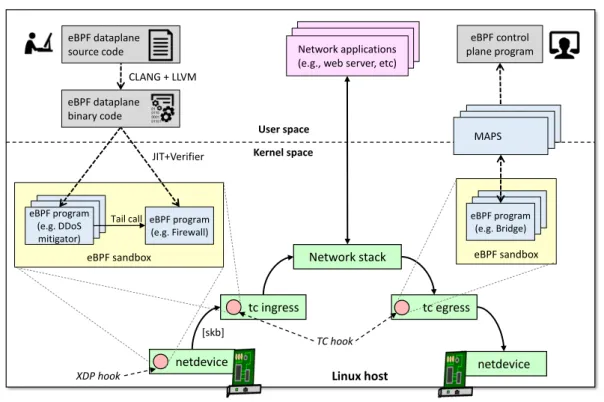
2 – Background and Motivations Linux host netdevice tc ingress netdevice tc egress eBPF sandbox [skb] XDP hook eBPF control plane program eBPF sandbox eBPF program (e.g. Bridge) Kernel space User space Network applications (e.g., web server, etc)
Network stack TC hook eBPF program (e.g. DDoS mitigator) eBPF program (e.g. Firewall) Tail call CLANG + LLVM JIT+Verifier eBPF dataplane source code eBPF dataplane binary code MAPS
Figure 2.1: eBPF overview.
of the event will trigger the eBPF program execution, and, based on the type of event, the program might be able to alter the event context1. Furthermore, pro-grams are stateless by their nature, as each run is independent of the others. For this reason, the eBPF providesmaps, data structures accessible using helper func-tions, needed to share information between (i) different runs of the same program, (ii) various programs, or (iii) a program and the userspace.
For networking purposes, program execution is triggered by the arrival of a packet. Two hooks are available to intercept packets and possibly mangle, forward or drop them: eXpress Data Path (XDP) and Traffic Control (TC). XDP programs intercept RX packets right out of the NIC driver, possibly before the allocation of the Linux socket buffer (skb), allowing, e.g., early packet drop. TC programs intercept data when it reaches the kernel traffic control function, either in RX or TX mode. Multiple eBPF programs can be instantiated at the same time, even attached to different hooks. Furthermore, eBPF programs can either operate in isolation (returning the packet to the hook they are attached to) or be chained, e.g., to create a more complex service, using a low-overhead linking primitive called
1For networking program, the event context is represented by the packet itself, while for eBPF program attached to generic kernel function, the context is represented by the function’s arguments.
2 – Background and Motivations 5 10 15 20 25 30 35 40 45 50 55 1 2 3 4 5 6 Throughput (Mpps) # of cores DPDK XDP (a) 0 20 40 60 80 100 0 5 10 15 20 25 CPU Usage (%) Offered load DPDK Linux XDP (b)
Figure 2.2: (a) Forwarding performance comparison between XDP and DPDK with small packets (64B) redirected between different NICs. DPDK uses one control thread, so only 5 to 6 are available for the forwarding. (b) CPU usage differences between DPDK, XDP, and Linux when dropping packet with a variable offered load. The data were obtained from [75].
tail call. Tail calls are a sort of long jump from one program to another; differently fromfunction calls, this primitive does not permit to return to the previous context. A high-level view of the eBPF architecture, including both code injection and run-time processing, is depicted in Figure2.1.
2.2.1
eBPF for Network Functions
The most attractive features that we have found in the eBPF subsystem can be summarized within the following points:
• Easy development process. eBPF programs follow the same development process of userspace applications. Custom applications can be developed independently from the kernel development process. They can be dynamically injected into the kernel using thebpf()system call, without having to install custom kernel modules or relying on modified kernels. This would also let the user defining the behavior of the program, making it specialized for the current applications and workloads, as opposed to fixed kernel implementations. • High-speed packet processing. eBPF programs are JIT-compiled into
na-tive machine code before being executed2, which provides more considerable advantages compared to an interpreted execution. Moreover, the execution
2This is valid only if the eBPF JIT flag is enabled in the kernel. However, latest kernel releases have this flag enabled by default.
2 – Background and Motivations
of these programs at the XDP [75] level enables a high-speed packet process-ing and forwardprocess-ing, with performance also close to user-level approaches, as shown in Figure 2.2a.
• Excellent performance/efficiency trade-off. As shown in Figure 2.2b, eBPF programs do not require polling to read network packets from the de-vice hardware; they are triggered only when a packet is received. As a con-sequence, if the machine running the eBPF application is not receiving any traffic, no CPU cycles will be consumed as opposed to DPDK, where the CPU usage is always 100% even if no packets are received.
• Integration with the Linux subsystems. eBPF programs cooperate with the kernel TCP/IP stack, interact with other kernel-level data structures (e.g., FIB or neighbor table), and leverage kernel functionalities (e.g., TSO, skb metadata, etc.), possibly complementing existing networking features. Legacy applications or debugging tools can continue to be used without any change to the existing applications.
• Security. As opposed to custom kernel modules, eBPF programs cannot crash the system. The in-kernel verifier ensures that all the operations per-formed inside the eBPF programs are correct and safe, discarding the injection of faulty programs3.
• Explicit structure of NF operations. Finally, eBPF programs have a clear distinction between stateless and stateful code; the operations outside the eBPF VM environment are carried out only through specific “helper” functions that have a well-defined syntax and construct. Multiple analysis frameworks developed over the years [166,153, 126] have forced this assump-tion to simplify the analysis of NF operaassump-tions to find buggy development semantic behavior (verifier safety does not imply “semantic safety”) or to an-alyze the performance of a NF [85,132]. eBPF programs have this assumption as part of the original design, making it easier to apply that type of analysis and concepts.
3Of course, a bug in the verifier [52,51] can reverse this assumption but this can be considered as a remote scenario.
Chapter 3
Creating Network Service with
eBPF: Experience and Lessons
Learned
3.1
Introduction
The extended Berkeley Packet Filter (eBPF) is a recent technology that enables flexible data processing thanks to the capability to inject new code into the Linux kernel at run-time, which is fired each time a given event occurs, e.g., a packet is received. While its ancestor, the Berkeley Packet Filter (BPF) was used mainly to create packet filtering programs, eBPF has been successfully used primarily in monitoring tasks [69, 45, 28, 70]. Surprisingly, its usage in traditional network applications, such as data plane services, has been less intense.
In fact, the creation of complex network functions that go beyond simple proof-of-concept data plane applications has proven to be challenging, due to the several limitations of this technology, although it is evolving fast, as shown by the signifi-cant number of patches and new features added almost daily in the Linux kernel. In addition, eBPF is not (yet) backed by a rich ecosystem of tools and libraries aimed at simplifying the life of potential developers; the BPF Compiler Collection (bcc) [17] is more oriented to tracing than packet manipulation.
However, eBPF is very promising due to some characteristics that can hardly be found all together, such as the capability to execute code directly in the vanilla Linux kernel, hence without the necessity to install any additional kernel module; the possibility to compile and inject dynamically the code; the capability to support arbitrary service chains; the integration with the Linux eXpress Data Path (XDP) for early (and efficient) access to incoming network packets. At the same time, eBPF is known for some limitations such as limited program size, limited support for loops, and more, which may impair its capacity to create powerful networking programs.
3 – Creating Network Service with eBPF: Experience and Lessons Learned
This chapter presents our experience in developing complex network services with eBPF and shows the most promising characteristics of this technology as well as the main encountered limitations, as they appear in everyday life of a typical developer. This chapter will discuss the actual importance of the above limita-tions with respect to the necessity to create complex network applicalimita-tions and the possible solutions (if any). Finally, it will also discuss some of the peculiar advan-tages of this platform, backed by experimental evidence taken from our services. At the end, we ponder advantages and limits of the eBPF technology, analyzing its suitability as a platform for the development of future complex network services targeting mainly virtualized environments.
This chapter is structured as follows. Section 3.2 represents the central part of the chapter, highlighting our experience when coping with different aspects of eBPF, and the main lessons learned. Finally, Section 3.3 provides the necessary evidence to the previous findings and Section 3.4 concludes the chapter.
3.2
Experiences and Insights
This section presents the main challenges encountered while implementing com-plex network functions with eBPF, together with different insights we adopted (or could be adopted) to accomplish this task.
3.2.1
eBPF limitations
eBPF suffers from some well-known limitations due to its restricted virtual machine, which are needed to guarantee the integrity of the system. This Section discusses the impact of the above limitations and highlights some other, less known issues that arise when creating network services.
3.2.1.1 Limited program size
eBPF programs are executed within the kernel context; for this reason, their size is limited to a maximum of 4096 assembly instructions to guarantee that any program will terminate within a bounded amount of time. This restriction may be limiting when creating network functions that perform complex actions in the data plane, considering that the BPF assembly instructions generated after the code compilation could be significantly higher than the number of lines of code of the C source file.
Learning 1: This limitation can be circumvented by partitioning the network function into multiple eBPF programs and jumping from one to another through tail calls. This technique enables the creation of network services as a collection of
3 – Creating Network Service with eBPF: Experience and Lessons Learned
loosely coupled modules, each one implementing a different function (e.g., packet parsing, classification, fields modification), with a very low overhead in jumping from a piece to another, as shown in Section 3.3.5. This attractive feature also comes with an upper bound limit of 32 nested jumps, which we found being more than enough to implement complex services.
3.2.1.2 Unbounded loops
Since eBPF applications can be loaded at runtime in the kernel, they are checked through an in-kernel verifier that ensures programs cannot harm the system. The verifier looks for multiple possible threats (e.g., state of BPF registers, type of values, etc.), rejecting the code in case backward jumps are detected, thus ensuring that all programs will terminate. We list some cases where this limitation may be a problem.
• Parsing nested headers: this is the case of IPv6, which requires to loop through all the extensions headers to find the last header indicating the type of the upper-layer protocol in the payload of the packet. A similar issue affects MPLS and VLAN headers, whose number of instances is not known a priori. Creating a network function that performs these actions in eBPF is not possible unless we introduce additional constraints, as described below. • Arbitrary processing of packet payloads: this is required for example
to check the presence of a signature in the payload. While there are cases in which this loop can be avoided thanks to the availability of specific helpers that perform the entire job (e.g., to recalculate the L3/L4 checksum), in general the necessity to perform a loop scanning the entire packet cannot be excluded a priori.
• Linear scanning of data structures: algorithms that require a linear scan of data structures (e.g., a map) may need to be adapted for the eBPF environment. A possible example is a firewall that looks for the rule that matches a given packet, which is usually performed through a linear scan across all the active policies.
Learning 2: Although the eBPF assembly does not support backward jumps, as far as bounded loop are concerned, we can exploit thepragma unroll directive of the LLVM compiler to rewrite the loop as a repeated sequence of similar indepen-dent statements. This can be achieved by imposing a constant upper bound limit to the loop, such as the maximum number of IPv6 headers, nested MPLS labels,
3 – Creating Network Service with eBPF: Experience and Lessons Learned
packet size1. This solution presents two limitations: (i) the size of the program increases, with the possible consequences (and solutions) shown in 3.2.1.1; (ii) we may not be able to guarantee that all cases are handled, e.g., in case of an excep-tional number of IPv6 headers is present. However, even if the lack of the support for unbounded loops seems to be an important limitation, we found it not so crit-ical in our programs, as it can be often circumvented by creating bounded loops, although this is left to the responsibility (and experience) of the developer.
3.2.1.3 Send the same packet on multiple ports
This is still a rather common operation even in modern local area networks, e.g., to handle broadcast frames (e.g., ARP requests), multicast, or flooding (e.g., in an 802.1D bridge). However, at least three issues can be encountered when implementing this feature. First, we may need to loop through all the interfaces to forward the packet the desired number of times; this can be implemented only if we are able to set an upper limit on the loop and unroll it (as discussed in Section 3.2.1.2). Second, the packet must be cloned before sending it on an additional interface; this can be done with the bpf_skb_clone_redirect() helper, which simultaneously duplicates and forwards the original packet to a target interface. However, this helper is available only when the program is attached to the TC hook, while an equivalent helper is not available for XDP programs2. Third, if the service is part of a virtual chain composed by multiple NFs connected through tail calls such as in [1], the aforementioned approach fails. In fact, the redirect function will be followed by a tail call, which never returns the control to the caller, hence preventing the caller code to send a packet to multiple ports.
3.2.1.4 Packet-driven processing
While the execution of an eBPF program is triggered by an event, the only event that is supported by TC/XDP programs is a frame traversing the selected kernel hook. This prevents the eBPF data plane to react to other events such a timeout that signals the necessity to periodically send a packet (e.g., neighbour greetings in routing protocols), or to refresh an expired entry in a table. The above events have to be handled elsewhere, such as in the slow path (Learning 3) or in the control plane (Section 3.2.1.6).
1A patch [50] that adds support for bounded loops without the necessity to use the
pragma unrolldirective has been recently proposed and it may be integrated in future kernel versions.
2For the sake of precision, XDP offers only thebpf_redirect_map()helper, which sends the packet to a port but does not clone it.
3 – Creating Network Service with eBPF: Experience and Lessons Learned
3.2.1.5 Putting packets on hold
In some cases, network functions may need to put the current frame on hold while waiting for another event to happen. This is the case of a router that holds a packet while waiting for an answer to its own ARP request aiming at discovering the MAC address of the next hop; the original packet should be released after receiving the ARP reply. Unfortunately, eBPF does not have a “steal” action such as in Netfilter, hence preventing this technology to take the ownership of the packet. Possible workarounds to this problem can be envisioned, such as copying the entire packet in a temporary memory, but they may not be suited for all cases (e.g., handling retransmissions, as the packet has to be released when a timeout occurs). Learning 3: Taken together, limitations 3.2.1.3-3.2.1.5 suggest the necessity to introduce a novel data plane component that is no longer limited by the eBPF virtual machine, which executes arbitrary code that can cope with the cases in which the current eBPF technology cannot be used. This brings to the evidence the necessity of a slow path module, executed in userspace, that receives packets from the eBPF program and reacts consequently with arbitrary processing defined by the developer; for example by modifying the packet and sending it back in the egress queue of a specific netdevice3. The necessity of this module is also highlighted in [157] where the authors use the OvS userspace module to process packets that do not match a flow in the OvS kernel eBPF data path.
3.2.1.6 No support for complex control planes
So far, eBPF has been used mostly for tracing applications, which feature a very simple control plane such as reading data from maps. As a consequence, existing eBPF software frameworks provide a nice set of abstractions that help developers to create data plane code (hook handling, maps, etc), while it is rather primitive with respect to the control plane, enabling userspace programs mainly to read/write data from maps. Networking services are rather different and often require a sophisti-cated control plane not just to read/write data from maps, but to create/handle special packets (e.g., routing protocols), to cope with special processing that may complicate (and slow down) the data plane if handled here (e.g., ARP handling; Section3.2.1.5), or to react to special events such as timeouts (Section 3.2.1.4). Learning 4: This results in non negligible difficulties when implementing the (complex) control plane of a service, as it forces developers to dedicate a consider-able amount of time to write the code that handles common control plane operations from scratch, without any help from existing software frameworks.