Children’s best interests between theory & practice
A discussion of commonly encountered tensions and possible solutions based on international best interests practices and policy strategies since 2004
A study of the Children’s Rights Knowledge Centre
Commissioned by the Division for Youth of the Flemish Government
Research Hanne Op de Beeck Katrien Herbots Sara Lembrechts Nele Willems Coordination Kathy Vlieghe
Children’s best interests between theory and practice
A discussion of commonly encountered tensions and possible solutions based on international best interests practices and policy strategies since 2004
This study was commissioned to the Children’s Rights Knowledge Center by the Division for Youth of the Flemish Government in light of the preparations of the European conference “best interests of the child” in light of the 25th anniversary of the United Nations
Administrative office
Children’s rights knowledge centre Kortrijksesteenweg 14
Groud floor room 0.11 9000 Ghent
Belgium
Phone: +32 (0)9 243 24 70 [email protected]– www.keki.be
Chair
Children’s rights knowledge centre Lange Steenstraat 31
9000 Gent Belgium
Board
Dr. Didier Reynaert (president) – University college Ghent Prof. dr. Johan Put (vice-president) – University of Leuven Prof. dr. Wouter Vandenhole – University of Antwerp Dr. Lieve Bradt – Ghent University
Prof. dr. Els Dumortier – University of Brussels
Staff
Ms. Kathy Vlieghe (coordinator) Dr. Hanne Op de Beeck Ms. Sara Lembrechts Ms. Nele Willems Ms. Katrien Herbots
0. TABLE OF CONTENT I. Introduction
1. Why this report?
2. The best interests of the child in international human rights law 3. What kind of ‘interests’ are at stake?
II. Methodology
1. Inventory of (international) ‘child best interests’ projects in policy and practice since 2004
2. Content analysis of inventoried projects
III. Description. Child best interests projects in policy and practice (2004-2014) 1. Problem statement
2. Transversal themes 3. Substantive themes
4. Recapitulation: a bird’s eye view on child’s best interests projects since 2004
IV. Analysis. Child best interests from theory to practice: tensions 1. Workability of a vague and generalist concept
1.1.Substantive and procedural elements of best interests determination 1.2.Substantive: explicating the basic perspective
1.3.Substantive: avoidance by negative elements, risk assessment and focus on procedural elements
1.4.Procedural: a clear decision-making structure
1.5.Procedural: the use of mediation mechanisms to create understanding for different perspectives and to ‘learn about’ what is best for the child
1.6.Procedural: the importance of multidisciplinary training, education and monitoring 2. Conflict of interests
2.1. Children and their parents
2.2.Children, the government and the broader society
3. Hearing children’s voices: ensuring a just and equal participation 3.1.Purpose
3.2.Context
Life changing vs. everyday decisions Micro vs. meso level
3.3.Stakeholders
3.4.Modes of participation and their relation with children’s evolving capacities Herbots & Put’s (2014) typology in the inventoried best interests projects Assessing the child’s maturity
Direct and indirect participation
4. Child rights impact assessments at the policy level
V. Conclusion
VI. References
VII. Annex. Overview of the screening of policy strategies and practice initiatives regarding the best interests of the child since 2004
1 | P a g e
I.
INTRODUCTION
1. Why this report?
The current report was written on behalf of the Division for Youth of the Flemish Government as part of the preparations for the European conference on the ‘best interests of the child’, which is organized by the Flemish, Walloon and Belgian (federal) government in light of the 25th anniversary of the United Nations Convention on the Rights of the Child. As the goal of this conference is to come to a dialogue between theory and practice regarding the best interests principle, this report aims to explore common tensions in this dialogue and to identify possible solutions to address these tensions, based on existing international practices and policy initiatives. Doing so, a number of discussion topics to feed the conference were identified, which can be consulted in the advice attached to this report.
2.
The best interests of the child in international human rights law
The most important legal basis for the child’s best interests is the Convention on the Rights of the Child (CRC). Art. 3.1 CRC expresses the right of children to have their best interests assessed and taken into account as a primary consideration in all actions or decisions that affect them. Public and private social welfare institutions, courts of law, administrative authorities and legislative bodies on both the national and local level are required to apply the best interests principle by systematically considering how children’s rights and interests are or will be affected, for example in present or future policies, laws, court decisions or administrative actions, even if such actions or decisions only indirectly affect children. Art. 18 CRC extends the principle to parents and legal guardians, stating that “[the] best interests of the child will be their basic concern” in their responsibility for the upbringing and development of the child. In addition, the Convention explicitly refers to the terminology of ‘best interests’ in specific family matters (Art. 9 on the right not to be separated from the parents; Art. 20 on the rights of children deprived of a family environment; and Art. 21 on adoption) and regarding children in conflict with the law (Art 37(c) on separation from adults in detention and Art. 40 §2 (b) (iii) on procedural guarantees for minors, including presence of parents at court hearings for criminal matters involving children in conflict with the law). As well, references to the child’s best interests are made in the Optional Protocol to the Convention on the sale of children, child prostitution and child pornography (preamble and Art. 8) and in the Optional Protocol to the Convention on a communications procedure (preamble and Art. 2 and 3).
Alongside Art. 2 (non-discrimination), Art. 6 (right to life and development) and Art. 12 CRC (respect for the views of the child), the Committee on the Rights of the Child (2003, §12) defined Art. 3.1 as one of the CRC’s four general principles. This means that the best interests principle supports and clarifies how to interpret and implement other rights of the Convention.
Other international instruments in which the best interests principle occurs include the 1985 Convention on the Elimination of All forms Discrimination Against Women (CEDAW) (Art. 5b and Art. 16d), the 1993 Hague Convention on Intercountry Adoption (Art. 4b), the 2006 Convention on the Rights of Persons with Disabilities (CRPD) (Art. 23§2), the African Charter (Art. 4), the 2009 European Union’s Charter of Fundamental Rights (Art. 24) and several European Directives on specific issues such as migration.
2 | P a g e
3.
What kind of ‘interests’ are at stake?
Despite all these references, neither the CRC nor the travaux préparatoires for this Convention clearly define or demarcate the ‘best interests’ principle. This limitation has been feeding recurrent discussions about the meaning and content of this concept, which was the underlying motivation that inspired this report.
For Zermatten (2010: 485-6), children’s interests are to be read in conjunction with the global spirit of the CRC. He acknowledges a difference between short-, medium- and long-term interests of the child as a developing human being (also see Freeman, 2007: 39). Eekelaar (1992: 234) refers to ‘basic interests’ (for example to physical, emotional and intellectual care), ‘developmental interests’ (to enter adulthood without disadvantage), and ‘autonomy interests’, (especially the freedom to choose a lifestyle of their own).
Furthermore, ‘current’ as well as ‘future’ interests are discussed. Freeman (2007:3) argues that actual interests may not only differ from future interests of children; they can even conflict with each other. According to the 1959 Children’s Rights Declaration, interests refer to all aspects of the child’s personality (physical, mental, moral, spiritual, social) to develop in a healthy, ‘normal’ manner, in conditions of freedom and dignity. The UNHCR Guidelines on Determining the Best Interests of the Child (May 2008, initiative nr. 1 under ‘Best interests determination’ in the matrix in annex) describe ‘best interests’ as broadly referring to the well-being of a child: “Such well-being is determined by a variety of individual circumstances, such as the age, the level of maturity of the child, the presence or absence of parents, the child's environment and experiences”.
In sum, the child best interests principle appears to be strongly embedded in international guidelines and legislation. As well, the elaborate descriptions by different authors offer an important framework for the interpretation of this concept. Nonetheless, a margin of appreciation remains – due to the indeterminate and vague nature of this concept as well as its dependency on culture and time-related contexts – raising a number of questions on how to apply this principle in practice (Freeman, 2007). How can ‘the best interests’ of an individual child be defined? Do different groups of children – for example, unaccompanied migrant minors (UMA’s) – have similar interests? To what extent does the child himself have a say and what is the role of adults in the process of defining a particular child’s interest? To address these questions, not only theory is important. Indeed, existing practices can also be utilized as a source of information, as they offer a bottom-up approach towards a more solid interpretation of the best interests principle.
Consequently, the legal consolidation of the child best interests concept is not scrutinized in this report. The current study on the contrary focuses on the dialogue between theory and practice in light of determining the ‘best interests of the child’ as defined by Art. 3 CRC. More specifically, the study aims to single out a number of frequently discussed ‘tensions’ in this dialogue and looks for possible solutions based on international child best interests practices.
II.
METHODOLOGY
For this study, a traditional ‘triangle-approach’ is maintained, starting from a broad inventory of child’s best interests discussions and practices, and working towards an in-depth content analysis of a handful of projects from this inventory. The analysis more specifically consists of the following two methodological parts: (1) an inventory of existing international child best interests projects at the
3 | P a g e
CONTENT ANALYSIS
policy and practice level since 2004, and (2) a content analysis of the projects in this inventory, focusing on the identification and/or approach of tensions regarding the translation of the best interests principle from theory to practice.
Figure 1. Inventory followed by a content analysis through a traditional triangle approach
Findings are complemented with additional theoretical insights from literature that was consulted during the preparatory work for this study. This theoretical information adds to the discussion by providing additional insights, background information and/or possible explanations for the findings.
1.
Inventory of (international) ‘child best interests’ projects in policy and practice since
2004
The methodology of this part of the study consists of an Internet search through online databases (more specifically the KeKi database, www.kekidatabank.be and the Children’s Rights Coalition database, www.kinderrechtencoalitie.be), as well as through the Google search engine.
The keywords used in this process are: ‘Belang van het kind’ (Dutch, as the Flemish Government commissioned this assignment), ‘child’s best interests’, ‘children’s best interests’ and ‘best interests of the child’ (English, in line with the international character of this assignment). The choice for these search terms implies that initiatives described in other languages than Dutch or English are excluded. For websites that do not offer a ‘search’ function, the sections ‘publications’, ‘projects’ and/or ‘advice’ are systematically browsed. If certain keywords bring up a large number (>1000) of ‘hits’, only the five first pages (sorted by relevance) are screened. If no saturation is reached after screening the first five pages, the following five pages are screened as well.
‘Child’s best interests’ is a broad concept. In fact, as the child’s best interests principle is strongly related to child well-being (cf. The 2008 UNHCR Guidelines on Determining the Best Interests of the Child), most child rights and/or child well-being initiatives are in children and youth’s best interests. The stipulations from the 2008 UNHRC Guidelines regarding the determination of children’s best interests and the Committee’s General Comment 14 (CRC/C/GC/14) could be used as directives in this case. However, in light of the limited time scope for this study as well as the large number of initiatives to be screened, it is not possible to evaluate the content of all initiatives based on these guidelines. Therefore, a pragmatic selection is maintained: only initiatives that are explicitly referred to by the author or project manager as projects relating to the best interests principle are integrated in the inventory, which is presented in a matrix (in annex to this report). The goal of this selection is to only list strategies that have the reinforcement of children’s best interests as a first and foremost consideration.
4 | P a g e
To reach this general target, the following specific selection criteria are maintained:
1. ‘Interests’ and ‘child’ (or a synonym) are mentioned in the title or abstract of the project or are strongly underlined throughout (the publication about) the project. Only projects that are explicitly focusing on children’s best interests are selected;
2. To select only the most recent initiatives, a ‘cut-off’ point of the last 10 years is maintained (cf. Op de Beeck, Put & Lembrechts, 2013). Only projects from 2004 onwards are selected; 3. Publications that do not lead to recommendations for policy or practice and/or that do not describe existing policies or practices are not selected for this inventory. As well, case law is excluded from this analysis.
An important limitation of this strategy is that projects relating to children’s best interests, but not explicating this relation, are missed in the selection. As well, as was mentioned before, initiatives that are not published online in Dutch or English are missing. The inventory is therefore an incomplete result of an explorative search methodology and should be interpreted as such: this report describes an analysis of ‘a tip of the iceberg of best interests initiatives’, to highlight some of the most visible tensions in the translation of the best interests principle from theory to practice.
Finally, the different projects are divided into categories that are created through a bottom-up methodology. After all projects were brought together, they were grouped and re-grouped until a concise overview in the format of a ‘matrix’ was developed. As some of the projects relate to both substantive and transversal themes (cf. § III.2 and § III.3 in this report), a number of projects are assigned to two different categories. Furthermore, since the impact of the different identified initiatives may occur – some initiatives hold concrete instruments or recommendations whereas others merely hold a plea for considering children’s best interests – the projects are assigned to two additional categories; ‘guideline/plan’ for more general arguments advocating children’s best interests, and ‘implementation’ for concrete recommendations, tools or actions towards the realization of children’s best interests. National or local policy plans that concretely outline how international legislation regarding best interests is to be transferred to practice, are classified under ‘implementation’ as well. Nonetheless, the demarcation between general arguments and concrete recommendations was found to be vague for a number of the initiatives. Consequently, the assignment to these categories is in some of the cases based on a judgment call which may have been different if other researchers would have performed the analysis.
2.
Content analysis of inventoried projects
Based on the general inventory, the identified projects are studied more in depth through a content analysis in which specific attention is paid to possible tensions or difficulties that can exist in the translation of the best interests concept from theory to practice. To do so, again an inductive or ‘bottom-up’ methodology is used. The documents are screened to find out whether tensions regarding the operationalization of the best interests principle are discussed or addressed. Based on this screening, the most prevalent tensions in the projects are thematized and main findings from the projects that relate to the identified themes are discussed.
5 | P a g e
III.
DESCRIPTION. CHILD BEST INTERESTS PROJECTS IN POLICY AND PRACTICE
(2004-2014)
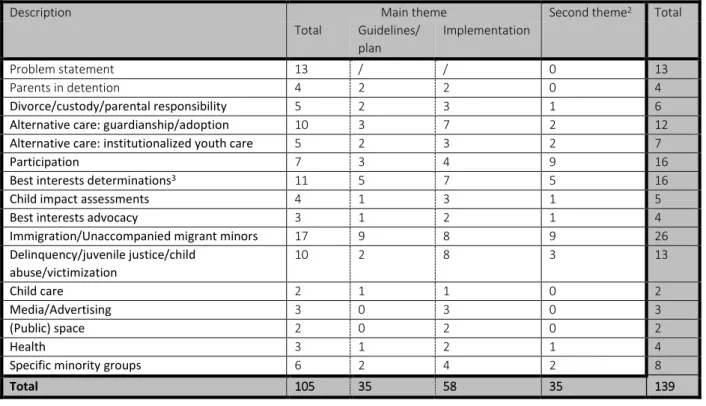
In the following paragraphs, a general description of the inventoried projects is provided. Table 1 portrays the number of projects that were identified within each theme or category in the matrix (for the complete matrix: see annex to this report). Overall, three different thematic groups can be observed in this table: ‘problem statement’, ‘substantive themes’ and ‘transversal themes’.
First of all, the thirteen sources that are classified under ‘problem statement’ refer to documents pointing out gaps in existing legislation, policy and/or practice regarding children’s best interests. Second, a distinction is made between ‘transversal themes’ and ‘substantive themes’. ‘Substantive themes’ consider different life domains of children and youth in which ‘best interests initiatives’ can be located. Most often, these substantive themes relate to groups of children and youth in society who are considered to be specifically vulnerable, which is why distinct ‘best interests initiatives’ are taken for these groups. Examples are children whose parents are imprisoned, immigrant children or unaccompanied migrant minors, children who come in contact with the law, children whose parents are divorcing. A number of specific minority groups for whom only a few best interests projects are identified, are classified in the matrix under the category ‘specific minority groups’. Examples in this category are children growing up in Lesbian, Gay, Bisexual or Transgender (LGBT) families, street children, working children and youth.
Table 1. Overview of inventoried projects (matrix)1
Description Main theme Second theme2 Total
Total Guidelines/ plan Implementation Problem statement 13 / / 0 13 Parents in detention 4 2 2 0 4 Divorce/custody/parental responsibility 5 2 3 1 6
Alternative care: guardianship/adoption 10 3 7 2 12
Alternative care: institutionalized youth care 5 2 3 2 7
Participation 7 3 4 9 16
Best interests determinations3 11 5 7 5 16
Child impact assessments 4 1 3 1 5
Best interests advocacy 3 1 2 1 4
Immigration/Unaccompanied migrant minors 17 9 8 9 26 Delinquency/juvenile justice/child abuse/victimization 10 2 8 3 13 Child care 2 1 1 0 2 Media/Advertising 3 0 3 0 3 (Public) space 2 0 2 0 2 Health 3 1 2 1 4
Specific minority groups 6 2 4 2 8
Total 105 35 58 35 139
1 This table is to be regarded as an approximate overview of the inventoried projects because differences in size, impact and status of the projects are not taken into account. As well, projects that closely relate to each other have been grouped together as one initiative in the matrix and are therefore just counted as ‘one’ project in this table.
2 Secondary themes of the projects that are classified under ‘problem statement’ are not included in this table, as the documents under ‘problem statement’ describe a gap, not an existing initiative.
3 One initiative of ‘Best interests determinations’ can be considered both a guideline/plan and an implementation, therefore the sum of the number of guidelines and implementations (12) is higher than the total (11).
6 | P a g e
Transversal themes, on the other hand, transcend these separate vulnerability issues, and include – for example – methodologies to identify children’s best interests at a conceptual or at a practical level. In table 1, the following transversal themes are included: ‘Participation’, ‘Best interests determinations’, ‘Child impact assessments’ and ‘Best interests advocacy’. The latter two exclusively relate to the best interests of groups of children.
1.
Problem statement
To find out more about the sources classified under ‘problem statement’, the matrix needs to be consulted (no detailed information is provided in table 1). Doing so, it can be observed that four of the sources under ‘problem statement’ are located in the category ‘Divorce/custody/parental responsibility’ (as a second theme). Different studies bring up difficulties to identify the best interests of a particular child in custody-related court cases, especially as children’s interests can be closely intertwined with parental interests and/or interests of other parties (see initiatives nr. 1, 2, 4 and 6 under ‘problem statement’ in the matrix). Subjectivity is an important issue in this case. For example: Skivenes (2010, initiative nr. 5 under ‘problem statement’ in the matrix) analyzed three cases regarding forced adoption in the highest Norwegian court of appeal and found that the determination of children’s best interests is most often performed in a subjective instead of a rational way. This finding suggests a need for tools to facilitate a more objective or neutral children’s best interests determination for juvenile and family judges. A similar concern exists regarding decisions about alternative care for children and youth: two studies suggest that judges need more instruments to rely on when identifying the child’s best interests (see initiatives nr. 3 and 5 under ‘problem statement’ in the matrix). Although this focus on difficulties in decision-making in care- and custody-related court cases could reflect a gap in reality, it is also possible that custody, guardianship and other family-matters are topics that are more often researched from a ‘best interests-perspective’, as is argued under initiative nr. 3 under ‘Divorce/custody/parental responsibility’ in the matrix. If a larger number of the child’s best interests debates focus on matters of custody and guardianship, it is not surprising that a more persistent perception of existing gaps regarding this topic would be created.
2.
Transversal themes
Nonetheless, as table 1 shows that a large number of ‘best interests projects’ (N=16) focus on the development of ‘best interests determinations’ (BID)4, the identified need for more instruments for judges to rely on is remarkable. Different researchers and policy makers did come up with standardized questionnaires and other methodologies in order to approximate or estimate particular children’s best interests (see for instance initiatives nr. 5, 6 and 8 under ‘Best interests determinations’ and nr. 7 under ‘Participation’ in the matrix). The matrix shows that six of the ‘best interests determinations projects’ are targeted at (unaccompanied) migrant minors: these projects are assigned to ‘immigration/unaccompanied migrant minors’ as a secondary category. This result, in combination with the finding that some domains – such as the judicial domain – are in need of reliable best interests instruments, suggests that instruments developed for decisions regarding unaccompanied migrant minors and other target groups may hold a potential to be transferred to other domains or used as inspiration to build new, adapted instruments to estimate children’s best interests.
4 The UNHCR differentiates in its ‘Guidelines on Determining the Best Interests of the Child’ (2008, initiative nr. 1 under ‘best interests determination’ in the matrix) between ‘best interests determinations’ (BID) and ‘best interests assessment’ (BIA) by defining a BID as a more formalized process whereas a BIA should be an informal reflex. However, in this report, both terms are used interchangeably, in the sense that they both refer to an estimation of what is in the best interests of the child.
7 | P a g e
In relation to this topic, the matrix portrays that the development of a variety of tools to take children’s best interests into account in policy decisions – in the shape of different child impact assessment instruments – has been receiving attention. Even though the number of projects in this area is limited to five (see table 1), it is to be noted that these projects consider four different types of impact assessments: the development of ‘child standards’ (by a civil society organization), the intention to investigate a ‘child check’ (at the policy level), the implementation of child budgeting programs (at the policy level) and the implementation of Child Rights Impact Assessments (CRIA) (also at the policy level).5 The latter two are implemented in different countries in a variety of shapes and formats (see initiatives nr. 3 and 4 under ‘child impact assessments’ in the matrix).
A third prevalent transversal theme in table 1 is participation, of which a total of 16 projects could be identified in the matrix. Generally, participation of children and youth to and/or hearing their voice throughout the decision-making process is considered an important part of the procedure or methodology to come to a best interests assessment (see for instance the Recommendation CM/Rec(2012)2 of the Committee of Ministers to member states on the participation of children and young people under the age of 18, initiative nr. 2 under ‘participation’ in the matrix, but also the Committee’s General Comment 14 as well as in the UNHCR’s (2008) ‘Guidelines on Determining the Best Interests of the Child’). As well, both the child’s best interests as participation are defined by the Committee as basic principles of the CRC, together with the right to life, survival and development and the non-discrimination principle (Committee on the Rights of the Child, General guidelines regarding the form and content of initial reports to be submitted by States Parties under Art. 44, paragraph 1 (a), of the Convention, CRC/C/5, 1991; Committee on the Rights of the Child, General guidelines regarding the form and content of periodic reports to be submitted by States Parties under Art. 44, paragraph 1 (b), of the Convention, CRC/C/58/Rev.1, 2005). Consequently, participation is important in best interests determination as a means to come to an adequate best interests assessment, but also as a goal in itself, as a concept that is intrinsically connected to the child’s best interests. Given this focus, the considerable number of projects attempting to bring this principle in the best interests practice is not surprising. The fact that participation more often appears as a second (N=9) than as a first (N=7) theme, underlines the transversal character of this topic: participation is most often adopted as a method to determine children’s best interests in different legal and life domains.
Despite this focus, it can be observed in the matrix that the concept of participation is operationalized in different ways throughout the identified projects. It can exist of direct or indirect communications procedures, the expression of the child’s opinion in decisions that apply to himself, peer-to-peer methodologies, youth conferences… Within this existing variety, it may be possible to summarize and categorize different types of child participation, in this way creating a connection between a thematic focus (e.g. justice procedures), the maturity of the child and the participation format, in order to come to a best interests determination based on needs and wishes as expressed by the child.
3.
Substantive themes
Regarding the substantive topics, it can be observed in table 1 that many of the ‘best interests initiatives’ focus on care for children, inside or outside of the family context. A total of six identified initiatives is classified under the category ‘divorce/custody/parental responsibility’, twelve projects are about guardianship and/or adoption and seven projects focus on the child’s best interests in
5 Although these projects use a different terminology (e.g. ‘child standards’ or ‘child check’) and methodology, their goals are similar: coming to legislation and policy guidelines that are in line with children’s rights standards.
8 | P a g e
institutionalized care. As well, a total of four identified projects are directed at care for children whose parents are imprisoned. In these projects, it is considered to be in the child’s best interests to avoid or reduce separation between the child and the parents, which is why a number of adaptations to sentencing procedures and practices as well as visitation rights are suggested and/or applied.
Furthermore, table 1 shows that 13 identified best interests initiatives relate to children who come in contact with delinquency and/or the justice system (‘Delinquency/juvenile justice/child abuse/victimization’). When the matrix is consulted, it can be observed that the majority of these projects focus on hearing the child’s voice and other procedural adaptations to raise the child-friendliness – or at least lower the ‘child-unchild-friendliness’ – of the justice system. In other words, these initiatives conceptualize the ‘best interests’ principle in the context of a child adapted justice system.
As well, table 1 reveals that a majority (N=26) of the identified projects are based on the best interests of immigrant children and/or unaccompanied migrant minors. As their situation is specifically precarious – and as this is a target group difficult to grasp – this large focus may not be surprising. Yet it is remarkable that – contrary to the other themes – this category holds more ‘guidelines or plans’ (N=9) than ‘implementations’ (N=8). This observation implies that much attention may be given to the best interests of (unaccompanied) migrant minors, resulting in different guidelines and calls for action, but that more efforts are necessary for the actual implementation of these guidelines in policy and practice. Moreover, a number of these guidelines are return directives or procedural safeguards for immigrant children and/or their parents, in which the best interests principle is mentioned ‘on the side’, e.g. in the stipulation that the child’s best interests should be the primary consideration in return decisions. Nonetheless, seven identified implementations do effectively hold ‘good practices’ – from Belgium, Sweden, the US, the Netherlands, France, Italy and Poland – that could be used as an inspiration in this case.
One final noteworthy observation in this first screening of the inventory comes up when taking a closer look at the projects classified under the themes of care, justice and (unaccompanied) migrant minors. More specifically, a possible dichotomy can be observed regarding the relation between the use of detention and the best interests of the child. It is, for example, remarkable how Pösö, Kitinoja & Kekoni (2010, initiative nr. 3 under ‘Delinquency/juvenile justice/child abuse/victimization’ in the matrix) consider locking up delinquent youth in a care context to be a restricting activity in their best interests, based on the argument that a period of detention may break a cycle of delinquency. Similarly, the projects described under the category ‘parents in detention’ underline that very young children should not be separated from their detained mother and recommend that prison accommodation should be adapted to include these young children. Nonetheless, in most other contexts – especially in the context of unaccompanied migrant minors – the majority of authors argue that detaining children is never in their best interests (see for instance the model Corlett, Mitchell, Van Hove, Bowring & Wright (2012) developed to prevent detention of unaccompanied migrant minors, initiative nr. 15 under ‘Immigration/unaccompanied migrant minors’ in the matrix). These differences clearly illustrate the difficulties that can develop when translating the best interests principle from theory to practice; an observation that crated the main inspiration for the current report.
4.
Recapitulation: a bird’s eye view on child’s best interests projects since 2004
As was mentioned before in the methodological overview in this report (see § II.1), a limited search strategy was used to create the inventory, which is why the focal themes in this inventory may reflect the search methodology rather than the reality. Nonetheless, it can be argued that, as these are the
9 | P a g e
projects captured by a narrow search strategy, they may be the most visible projects regarding the best interests principle and therefore portray general international tendencies regarding the translation of this principle in practice.
First of all, it was found that different projects in the matrix refer to a need or demand for more practical tools to determine children’s best interests in family cases. This perception could result from a true lack of instruments, but could also be based on a possibly larger focus on children’s best interests in family cases. After all, the matrix also highlights best interests projects about care for children – inside and outside the family sphere – as one of the themes that has been explored quite regularly. A number of possible explanations can be brought forward to clarify this emphasis on family cases. First of all, this focus may be due to the fact that both Art. 5 – regarding the evolving capacities of the child – and Art. 18 – about parental responsibilities – of the CRC explicitly refer to the best interests principle as defined in Art. 3 CRC, as well as the fact that the CRC clearly refers to the best interests principle in general family matters (see for example Art. 9, 20 and 21).
Second, recent legislation facilitating divorce, the growing diversity in family compositions (due to scientific progress, In Vitro Fertilization, anonymous donorship, adoption by gay couples…) as well as the growing tolerance of the public opinion for divorce and ‘new’ family constructions may add to a decline of ‘traditional’ families. This change could possibly have generated a higher number of family-related decisions that are to be taken, necessitating more instruments to determine children’s best interests as a basis for these decisions. Finally, the professionalization of youth care could play a role: due to this tendency, more ‘objective’ instruments to base decisions on may be in demand. The matrix indicates that this need is related to difficulties to separate children’s best interests from the needs and wishes of other parties. As children’s interests inevitably develop in a social context involving other parties, their interests inextricably (inter)relate with these other parties’ interests.6 This observation brings up a first tension, the possibility of conflicts of interests, which will be analyzed and discussed further in § IV.2 of this report.
Furthermore, it can be observed that different efforts have been developed to bring the best interests principle forward in decisions regarding immigration. These projects could serve as an inspiration for generalization to other domains, such as the family context. The fact that much work regarding this theme has been done for UMA’s could possibly be explained by the pressure that General Comment 6 (CRC/GC/2005/6)about the treatment of unaccompanied and separated children outside their country of origin, created, by stipulating that all decisions regarding unaccompanied migrant minors need to be supported by a best interests determination. After all, individuals who are traditionally concerned with protecting and guarding children’s best interests – such as parents, guardians or close family members – are not always present in this context, which may explain the development of different best interests initiatives for this group. Nonetheless, it could also be observed from the matrix that best interests projects for UMA’s do result in general guidelines and calls for action, but that more efforts are necessary for the actual implementation of these guidelines in policy and practice. This finding could indicate that a substantive determination of best interests in individual cases remains difficult, despite all the work that has been done in this field. Difficulties regarding the substantive implementation of best interests are therefore discussed more in depth in § IV.1 of this report.
6 According to Brems (2014), the involvement of at least three parties (child, caretaker, state) – to which she refers as the ‘triangular relationship’ – is typical for children’s rights issues. In more general human rights issues, there is no caretaker to take up a relevant role; in these cases the individual and the state are the most important stakeholders (Brems, 2014).
10 | P a g e
As well, it can be observed that a considerable number of projects focus on participation. ‘Participation’ is operationalized in different ways throughout the separate projects, indicating that a wide range of formats exists, which can serve as an inspiration for decision-makers who wish to start up a participatory trajectory in assessing one or more children’s best interests. Nevertheless, a concrete description of how the views of the child are to be balanced with the ideas of the adult who is guiding the process in such an assessment, remains under the surface. This and other difficulties regarding the practice of participation are explored more in depth in §IV.3 of this report.
Finally, it was found that in different countries or regions, initiatives have been developed to protect children’s interests at the macro-level, by shaping a child-friendly legislative framework through the application of child (rights) impact assessments, child standards, and other instruments that are directed at the maximization of positive and the minimization of negative consequences of new legislation or (policy) decisions for children and youth. Such child-friendly legislative structures serve as the framework based on which individual best interests assessments are developed and therefore indirectly affect the individual child. Consequently, these macro-level instruments and the way they relate to individual best interests assessments, are discussed in § IV.4 of this report.
IV.
ANALYSIS. CHILD BEST INTERESTS FROM THEORY TO PRACTICE: TENSIONS
The broad description of the different projects included in the inventory generally touched upon some noticeable discussion topics, such as participation, defining individual best interests in concrete (court) cases or decisions and apparent contradictions in ideas of what is in children’s best interests. These topics were explored more in depth based on a content analysis of the inventoried projects. Doing so, the following tensions arose: (1) the tension regarding the workability of a generalist concept, (2) the tension in the relation with other parties’ interests, (3) the tension regarding a just and equal participation of children in the determination of their interests, and (4) the relations between best interests determinations at the micro (individual) and macro (national policy) level.7
It is important to underline that the tensions described here are tensions that exclusively arose from the inventory of child’s best interests practices and therefore only relate to the translation of the best interests concept from theory to practice. Thus, tensions relating to theoretical discussions regarding the best interests principle – such as the tension between the general children’s rights framework and the best interests concept, as discussed by Freeman (2007:32) – are not addressed in this report.
1.
Workability of a vague and generalist concept
How to apply the best interests principle in individual situations is a challenge that has been addressed by a number of different ‘best interests determinations’ or ‘best interests assessments’ among the projects in the matrix. What are, for example, the best interests of a 12-year-old boy whose parents are discussing custody? And how can these interests be adequately assessed? Archard & Skivenes (2009, initiative nr. 7 under ‘participation’ in the matrix) differentiate in this case between elements that are clearly normative and therefore unambiguously defined by legislation, and elements that are left for reasonable agreement. It is specifically the latter part – coming to a ‘reasonable agreement’ – which leaves a ‘margin of appreciation’, providing State Parties but also decision-makers in practice
7 Best interests assessments can be held at the micro-level (assessment for one individual child), the meso-level (assessment for a specific group of children) and at the macro-level (assessment at the policy level). All three types are discussed throughout this report.
11 | P a g e
with a certain degree of discretion. This margin brings a number of benefits – for example, it enables cultural considerations to be accommodated within the best interests principle (Freeman, 2007: 35; Alston, 1994) – but it also impedes on an unambiguous realization of the best interests concept. Moreover, the content, meaning and practical application of the best interests principle is vague, which complicates its implementation in practice. What kind of framework can be developed to avoid that the concept becomes hollow and meaningless, or used in a tokenistic way (Wolfson, 1992; Freeman, 2007; Archard & Skivenes, 2010; Tobin, 2011; also see Cantwell (2014), initiative nr. 10 under ‘Alternative care: guardianship/adoption’ in the matrix)?
1.1.
Substantive and procedural elements of best interests determination
Archard & Skivenes (2009, initiative nr. 7 under ‘participation’ in the matrix) not only distinguish normative from interpretative elements in best interests determination; they also differentiate between substantive and procedural elements. Substantive elements relate to what is considered to be in the child’s best interests as defined by existing legislation or expressed in general assumptions (e.g. assumptions on the ‘ideal’ family constitution). Procedural elements include how the child’s best interests are determined in particular cases. This differentiation somewhat concurs with the distinction between ‘substantive’ and ‘transversal’ themes from the exploratory description of the projects included in the inventory (§ III in this report).
In line with this distinction between substantive and procedural elements, the Committee provides guidance through General Comment 14 by creating a ‘checklist’ of factors that are to be taken into account in the best interests assessment process. As for substantive elements, the Committee underlines the child’s views and identity, the preservation of the family environment and maintaining relations, care, protection and safety of the child, the child’s situation of vulnerability, the child’s right to health and the child’s right to education as central variables to consider. Regarding procedural safeguards, the Committee puts attention to the right of the child to express his or her own views (participation), a qualitative account of the facts, avoidance of delays in decision-making, involvement of qualified professionals, legal representation and legal reasoning, the presence of mechanisms to review or revise decisions and – more generally – the creation of sound Child Rights Impact Assessments to come to a child-friendly policy context in which the individual child’s best interests can be assessed. As this General Comment constitutes an important guideline towards best interests determination in practice, it is not surprising that a number of these elements will be reappearing in the discussion topics identified throughout the content analysis.
1.2.
Substantive: explicating the basic perspective
Providing a substantive and generally applicable definition of what is in children’s best interests, is difficult, as it is recognized that interests may differ based on variable situations, contexts, cultures (Thomson, 2005), historical periods and understandings of childhood (Freeman, 2007). Smeyers (2010) argues that an unambiguous interpretation of the best interests principle is therefore impossible. Despite these objections, Kalverboer & Zijlstra (2006, initiative nr. 8 under ‘best interests determination’ in the matrix) did develop an extensive interpretative model to ‘objectively’ implement the best interests principle in practice, based on a clear substantive perspective regarding this principle. Their operationalization is more specifically founded on a behavioral science paradigm, based on the CRC principle of the child’s right to development. The first seven conditions they recommend to take into account in a best interests assessment – based on their analysis – relate to the family situation: the availability of adequate physical care, a safe direct physical environment, an
12 | P a g e
affective atmosphere, a supportive, flexible childrearing structure, adequate examples by parents, interest, and continuity in upbringing conditions and future perspective.
The other conditions they bring forward refer to the broader society: respect, a social network, education, contact with peers, adequate examples in society, and stability in life circumstances. These themes indicate an interpretation of the best interests principle that includes both protection (e.g. ‘a safe physical environment’) and provision rights (e.g. ‘contact with peers’) of the child. Based on this operationalization, Kalverboer & Zijlstra (2006) developed a ‘Best Interests of the Child Questionnaire’ (BIC-Q) which can be used in decisions that strongly affect in the living situation of the child (for example, in the decision to place the child in a care institution). Even though Kalverboer & Zijlstra (2006) tested their instrument and concluded it to be a reliable tool to estimate the developmental situation of children, the weight of the different themes may socially, culturally and individually differ, and certain topics relating to children’s best interests may remain under the surface (such as mental health, self-determination, information… and how are the first seven conditions defined for children who grow up without a family?).
Nevertheless, Kalverboer & Zijlstra’s (2006) exercise proves that it is possible to come to a substantive operationalization based on a clear approach (in this case: the conceptualization of the child’s best interests as an expression of the right to development) and a systematic or scientific methodology, as long as the perspective the operationalization is based upon is clearly communicated to all the involved parties. Moreover, using this methodology, a culturally sensitive interpretation of the best interests principle can be developed by choosing a culturally adapted perspective as a starting point. Kalverboer & Zijlstra (2006) started from the children’s right to development, but other perspectives – for example, the ‘protection’, ‘provision’ and ‘participation’ principles behind the CRC – could also be used as a starting point. This cultural adaptability is in line with a.o. Thomson’s claim to acknowledge cultural considerations in defining children’s interests (also see Brems, 2001; Donelly, 2013).
1.3.
Substantive: avoidance by negative elements, risk assessment and focus on
procedural elements
Apart from Kalverboer & Zijlstra’s (2006) exercise, the content analysis uncovers that in practice, a substantive interpretation may be avoided by demarcating what is not in the child’s best interests. For example, Freeman (2007:51) argues that, in its concluding observations to State reports, the Committee puts focus on what is not in children’s best interests, hence opting for a negative instead of a positive definition of the concept. A similar approach consists of limiting ‘what is best for the child’ to ‘the protection of the child’. In the substantive elements that are put forward in General Comment 14, the balance between provision and protection is maintained: both the vision and identity of the child, as well as the protection and vulnerability of the child, are defined as elements to be acknowledged in best interests determinations. Nonetheless, it can be observed through the content analysis that children’s best interests are momentarily defined in terms of a risk assessment (also see Archard, 2006:v). An example can be found in the report ‘Returning Home From Care: What’s Best For Children’ which was drafted up in 2012 by the National Society for the Prevention of Cruelty to Children (NSPCC, UK, initiative nr. 3 under ‘problem statement’ in the matrix). This report generally focuses on facilitating “an effective decision-making about when it is in a child’s best interest to return home and to ensure that they are provided with high quality support to protect them from further harm” (Andrew Flanagan in NSPCC, 2012:3). In this report, specifically a framework for the assessment of the risk of neglect or abuse in the home situation is envisioned. This framework puts evidence for future abuse
13 | P a g e
or neglect and an assessment of the parental capacity to change at the heart of the determination whether reunification is in the child’s best interests.
Finally, it can be observed that different projects from the matrix address difficulties in substantively defining children’s best interests by suggesting stable procedural strategies to come to an identification of what is best for one particular child or one specific group of children. For example, the recommendations by the International Rescue Committee (2007, initiative nr. 5 under ‘best interests determinations in the matrix) regarding BID’s for UMA’s, based on experiences with Sierra Leonean children in Guinea, exclusively hold procedural suggestions, such as the installment of formal BID processes that fit in a broader programming strategy and start up as early as possible. Based on the idea that a clear methodology should secure considerations of children’s best interests as extensively as possible, even if a substantive definition is lacking, the following three strategies are highlighted throughout the content analysis: (1) to develop and clearly explicate a decision-making structure, (2) to provide decision-makers with adequate training and general background knowledge regarding child psychology and development, and (3) to use existing mediation mechanisms as innovative best interests techniques.
1.4.
Procedural: a clear decision-making structure
A strong procedural focus in detecting children’s best interests may adjust for difficulties in creating an unambiguous substantive definition that is applicable to a broad variety of individual situations. Skivenes (2010, initiative nr. 5 under ‘problem statement’ in the matrix) brings five suggestions forward to come to a rational basis for decision-making: (1) specification of which considerations are important in the determination of children’s best interests, (2) avoidance of unjustified assumptions regarding the best interests principle, (as an example, Skivenes refers to blood-tie presumptions as a social norm) (3) development of deliberative processes for decision-making, based on solid information regarding the situation of the involved individuals, a clear exploration of possible decisions and the different consequences as well as monitoring of the situation afterwards, internally but also by the broader public (Skivenes specifically puts attention to this monitoring function by underlining the importance of public control of court decisions), (4) recognition of the child’s perspective as the basis of the decision and (5) a close connection to new insights in relevant fields, such as children’s needs, attachment, etc. (Skivenes, 2010).
A number of these elements, such as the participation of the child and the importance of qualitative information are also reflected in the procedural safeguards expressed in General Comment 14. As well, the necessity to keep up to date with actual knowledge and to avoid prejudice could be considered rather self-evident. Skivenes’ (2010) suggestion to develop deliberative processes for decision-making, however, is outstanding in her article, as the development of clear decision-making structures has been more generally discussed as a necessary condition to come to consistent (group) decisions (Goodwin & Wright, 2009; Op de Beeck, Put, Tans, Pleysier & Hermans, 2014). It is understood that decision-making should occur through solid methodologies or procedures in order to avoid inconsistencies, arbitrariness or (too much) subjectivity. Goodwin & Wright (2009) refer to such methodologies or procedures as “a set of generally accepted propositions or a ‘formalization of common sense’”
(Goodwin & Wright, 2009: 31). Through formalization and the cautious performance of different decisive steps, reflections that usually remain subconscious are brought under the attention. Because these reflections are recognized through the structured process, the possibility of an intuitive – instead of a rational – decision decreases. As well, chances of prejudices influencing the decisions – for which
14 | P a g e
Skivenes (2010) is cautious in her second suggestion – reduce when using a clear decision-making procedure (Op de Beeck et al., 2014).
Traditionally, the following steps are defined as the basis for a decision-making procedure: (1) an exploratory phase in which the problem is defined, the decision context and goals are discussed and relevant data gathered; (2) a problem analysis and the development of different decision alternatives; (3) an evaluation of alternatives through assessment of the consequences; (4) weighing the different consequences and the selection of a decision alternative and (5) follow-up and monitoring (Byrd & Moore, 1982; Clemen, 1991; Op de Beeck et al., 2014). For example, Freeman (2007) refers to Parker (1994) to argue that in custody disputes, the decision-maker must at least know about all the options, the possible outcomes of each of them, as well as the probability and value of each outcome. In this case, similarities with the steps in the traditional decision-making procedure are noticeable. Nonetheless, especially in best interests determinations, other decision-making structures may also be possible.
1.5.
Procedural: The use of mediation mechanisms to create understanding for
different perspectives and to ‘learn about’ what is best for the child
In 2007, the T.M.C. Asser Institute for International and European Law drafted up a report explaining how financial sanctions towards parents who break their divorce agreements – such as lowering alimony for the parent who does not respect the visitation rights of the other parent – often conflict with the child’s best interests, as the financial repercussions may mostly harm the child (initiative nr. 1 under ‘problem statement’ in the matrix). More specifically, inadequacies in the current legal situation of the European member states are underlined in their report, including coercive measures against property in family law cases, which can be detrimental to the child's benefit. Furthermore, the disagreement between the parents alone, and the effects of an eventual court case, may affect the child as well. As a possible solution, the institute suggests to invest in the development of mediation mechanisms, based on the argument that mediation offers a viable way to grasp the child’s personal insights and interests regarding the situation. Mediation brings the involved parties to understand that the realization of their own personal wishes does not necessarily concur – or may even strongly conflict – with what is best for the concerned child(ren). In that sense, the institute does not suggest mediation to come to a clear agreement between the parties, but rather to create a mutual process of understanding between the participants and to come to a best interests assessment from the different perspectives involved. Similarly, mediation is recommended by van Rooijen (2007, initiative nr. 2 under ‘problem statement’ in the matrix) – who investigated the realization of children’s best interests in custody cases in the Netherlands – as a methodology to ensure children’s best interests in cases of divorce. To do so, she particularly recommends the foundation of Advice Centers for Divorce and Custody Mediation that focus on divorcing families and operate independently from more general Youth Care Organizations.
The T.M.C. Asser Institute’s (2007) and van Rooijen’s (2007) suggestion to use mediation8 mechanisms when assessing best interests, concurs with the suggestion that was brought forward earlier in this report to focus on procedural instead of substantive elements (§ IV.1). Furthermore, their suggestion concurs with the idea to encourage involved parties in the decision-making process to reflect on the cognitive influences that underlie their best interests determination and decision (cf. § IV.1.5). Through
8 In this case, ‘mediation’ is conceptualized as an instrument to come to a better understanding of the different involved perspectives, incl. the child’s perspective.
15 | P a g e
recommending the use of mediation techniques, the search for what is best for the child can inspire involved parties to learn how to look at the case from other parties’ perspectives including, most importantly, the perspective of the child. The T.M.C. Asser Institute’s (2007) and van Rooijen’s (2007) recommendation consequently triggers the question to what extent existing (mediation) methodologies from criminological, social and psychological disciplines can be transferred to a child best interests context. Obvious examples here would be individual deliberation methods (e.g. one-on-one mediation), group conferencing (such as family group conferencing, community boards…) or communicative course programs in which participants learn to empathize with other parties’ perspectives.
Two important remarks, however, are to be noticed in this light. First of all, a question that can be raised in this case relates to the actual involvement of the child in such mediation mechanisms. Is it better to directly include the child himself, or to empower the parents to advocate their child’s best interests through the mediation process (Herbots, Roevens & Put, 2011)? On the one hand, the situation may be somewhat determinative in this case. For example, if a child committed an offence, his direct involvement in the mediation process may be less debatable than in mediation directed at divorcing parents. On the other hand, based on the recommendations provided in General Comment 14 and the large focus on participation that was found in the inventory (§ III.2 in this report), it can be assumed that a ‘child-inclusive’ mediation is preferable over a ‘child-focused’ mediation, depending on the evolving capacities of the child. The questions related to such a child-inclusive mediation strongly connect to the tensions that more generally arise regarding hearing the child’s voice in the best interests assessment process, which are extensively discussed in § IV.3 of this report.
Secondly, on a side note, it can be noticed that mediation is not only brought forward as a methodology to determine what is best for the child, but also to realize children’s best interests in practice. Examples are Tomking’s (2009, initiative nr. 1 under ‘Parents in detention’ in the matrix) plea to extent creative, community-based and restorative sanctions for parents who committed a felony. This way, a regular contact between the parents and their children can be maintained, in the children’s best interests. As well, mediation is generally recommended in the best interests of children and youth who come in conflict with the law. Through mediation, children’s best interests are more adequately safeguarded because the children learn to take responsibility and to change their behavior; stigmatization as well as the harmful effects of liberty deprivation are avoided; and the child feels respected and heard throughout the process (SRSG on Violence against Children, 2013; Vanfraechem & Walgrave, 2004a; 2004b).
1.6.
Procedural: The importance of multidisciplinary training, education and
monitoring
One important procedural aspect of assessing children’s best interests, is the role and expertise of professionals who are called in to present their view on what is best for the child, usually based on interactions with the child and significant others from the child’s direct surroundings. In § IV.1.4 of this report, Skivenes (2010) was referred to: she underlines the importance of correct information in adequately assessing the child’s best interests. For this purpose, the expertise of social workers, psychologists and other professionals is often called upon. As well, both the Committee and the UNHCR accentuate the importance of education for professionals who work with children in their daily practice and/or who perform best interests determinations (Freeman, 2007; UNHCR, 2008). For that reason, the UNHCR – together with the International Rescue Committee – developed a handbook providing knowledge and expertise for an adequate best interests determination with UMA’s which
16 | P a g e
includes an extensive chapter on the communication with children (2011, initiative nr. 4 under ‘best interests determination’ in the matrix).
From the content analysis it appears that input from different disciplines is in this case desirable, as the competences that are necessary for an adequate best interests assessment may be multiple. For example, in care-related decisions not only psychological or mental health expertise is necessary; information about family dynamics or living situation may also be crucial to come to an adapted decision. This need for a holistic appraisal is, among others, underlined in the recommendations of the International Rescue Committee (2007, initiative nr. 5 under ‘Best interests determinations’ in the matrix) and in the NSPCC report ‘Returning Home From Care: What’s Best For Children’ (initiative nr. 3 under ‘problem statement’ in the matrix), which specifies that reunification of children in care with their parents should only take place when a comprehensive assessment of the child's needs has been performed. Such a comprehensive assessment, according to the NSPCC, necessitates input from professionals from different disciplines who are specifically trained to gather evidence to learn about children’s best interests. “The new Family Justice Service must ensure that members of the judiciary specializing in family law receive training in child development and the implications of returning home from care” (p.15). In line with this concern, NSPCC recommends improving evidence by creating assessment tools that are embedded in practice and to educate professionals on when and how to use these tools (p.14). In other words, not only the assessment tools, but especially the skills and competences of the individuals who are handling the tools, are deemed important in this case. Specific skills are, in other words, considered necessary to adequately gather information from – and learn about – children, their situation and what is best for them by taking their needs, wishes and context into account (also see initiatives nr. 3 and 4 under ‘problem statement’ in the matrix). Flemish research uncovered that judges and other professionals are aware of the importance and need for these skills, especially when it comes to adequately communicating with children (Herbots, Roevens and Put, 2011; 2012). Yet, a number of authors claim that the right competences are lacking among important decision-makers and/or consultative individuals throughout the best interests assessment process. Scott & Emery (2013, initiative nr. 4 under ‘problem statement’ in the matrix), for example, argue that neither judges nor mental health experts have the right qualifications to implement the best interests standard in individual cases. Knowledge about adequately interviewing children, weighing the insights and reflections of the child (also see § IV.3.4 in this report), etc., are no fundamental requirements in the expertise of the judge9 – who often takes decisions that may strongly impact the live of the child – nor the professional (social worker, psychologist, mental health expert…), who is called in to provide insights on the case from his specific expertise, but who may not be capable to provide an all-round interpretation of what is best for the child. Their arguments are in line with the results of Herbots et al. (2011), who found that a number of the Flemish divorce mediators who often work with children, do not know the CRC and/or do not understand its underlying vision regarding the position of children and youth in society. Although the majority of the questioned mediators in this investigation strongly considered the best interests principle as important in their work, their interpretation of this principle was often based on intuition, common sense, experience and pragmatic considerations (Herbots et al., 2011; 2012).
9 For example, youth or family judges may have followed a child-specific educational program, but immigration judges – who decide whether immigrant children are to be returned to their home-country – do not, which is why the child’s best interests are not always taken as the first consideration in these decisions, as is argued by Kalverboer & Zijlstra (2008, initiative nr. 16 under ‘immigration/unaccompanied migrant minors’ in the matrix).