
M. Kurosu (Ed.): Human Centered Design, HCII 2011, LNCS 6776, pp. 110–119, 2011. © Springer-Verlag Berlin Heidelberg 2011
Strategic Design Projects
André Liem1 and Elizabeth B.-N. Sanders2
1 Norwegian University of Science and Technology, Department of Product Design, 7491 Trondheim, Norway
2 MakeTools, LCC, Columbus, OH 43214, USA [email protected], [email protected]
Abstract. Implementation of Human-centred Design methods in the Fuzzy Front-End is not likely to lead to diversification in educational product planning exercises, where time lines are short and executors lack experience. Companies, interested to collaborate with M.Sc. students on strategic design projects, should have realistic ambitions with respect to innovation and value creation. Moreover, diversification is not the only generic growth strategy to gain competitive advantage. Value can also be created from developing new products for existing markets, or creating new markets for existing products. On the contrary, companies who aim for diversification in their generic growth strategies, may not always end up with a complementary “high valued” design outcome. From a learning perspective, the understanding of HCD methods created awareness among students and companies that respect and empathy for the end-user are important for enriching their design processes, as such increasing the chances for diversification in subsequent projects with clients.
Keywords: User-centred Design, Human-centred Design, Co-creation, Design-led Innovation, Front End of Innovation, Positioning Maps, Diversification.
1 Introduction
Design offers a potent way to position and differentiate products as competition intensifies, product complexity increases and technological differentiation becomes more difficult [1]. Within the context of integrated product development, formulating an effective product strategy and a design goal is one of the greatest challenges of the innovation process; however effective management of the Fuzzy Front End (FFE) may result in a sustainable competitive advantage [2].
A User-centred Design (UCD) approach, whereby the needs of potential end-users are assessed in the product development process, can then be important for achieving a company’s strategic and innovation goals. However, the main problem is that too many projects suffer from ‘insufficient market input, a failure to build in the voice of the customer, and a lack of understanding of the market place [3]. Furthermore, it has been noted that limited and inadequate market research, resulting in problematic translation of engineers’ wishes into customers’ needs, is a key factor of failure of innovations [4].
As a response, user involvement is seen as a way to obtain valuable input from end-users. According to Kujala [5], involving end-users in research and design activities can have diverse positive effects: on the quality or speed of the research and design process; on a better match between a product and end-users’ needs or preferences; and on end-users’ satisfaction.
2 Methods and Paradigms for Innovation
As the global environment is continuously changing, organizations and businesses are compelled to permanently seek the most efficient models to maximize their innovation management efforts through new methods and paradigms, which efficiently serve existing and new markets with new and/or modified products as well as services [6]. Hereby, Ansoff’s Product-Market matrix is a frequently used model to position generic innovation strategies [7].
Considering the four generic growth strategies [7], this article argues that the implementation of UCD methods in the Fuzzy Front-End (FFE) is not likely to lead to diversification in product planning exercises conducted in an educational setting, where time lines are short and executors lack experience, as exemplified in this 4th year collaborative product strategy project. However from a “Design Strategy” and “Value Creation” perspective, end-user and other stakeholder’s input can be valuable, if not decisive, in promoting a company’s products and services to the “Upper Right Quadrant” of the 3-D “Style” versus “Technology” positioning map [8].
3 The Concept of Value Creation in Products and Services
In their investigation of what it takes to create breakthrough products, Cagan and Vogel concluded that one of the key attributes that distinguishes breakthrough products from their closest followers is the significant value they provide for users [8]. Taking it one step further, the more value in a product, the higher price people are willing to pay, with the price increasing more rapidly than the costs, resulting in a profit margin, significantly higher for higher valued products. After all, as Drucker has pointed out,
"customers pay only for what is of use to them and gives them value" [9].
Boztepe has categorised user value according to utility, social significance, emotional and spiritual value [10]. Utility value refers to the utilitarian consequences of a product. Social significance value refers to the socially oriented benefits attained through ownership of and experience with a product. Emotional value refers to the affective benefits of a product for people who interact with it. Similarly, Sanders and Simons identified 3 types of values related to co-creation, which are inextricably linked. These values are monetary, use /experience and societal [11].
According to Dewey, experience is not something that is totally internal to the individual, but instead, "an experience is always what it is because of a transaction taking place between an individual and what, at the time, constitutes his environment" (p.43). [12]. Experiences are context- and situation-specific; which means they change from one set of immediate circumstances, time, and location to another. In a similar way, value changes as cultural values and norms, and external contextual factors, change [13].
In summary, consumers are willing to pay a higher price for product purchases that connect with their own personal values, although monetary value is important in determining market penetration strategies [8].
4 User-Centred versus Design-Driven Innovation
Significant efforts in this recent literature have been concentrated into investigating a specific approach to design, usually referred to as user-centred design [14, 15, 16]. This approach implies that product development should start from a deep analysis of user needs. In practice, researchers spend time in the field observing customers and their environment to acquire an in-depth understanding of customer’s lifestyles and cultures as a basis for better understanding their needs and problems [17].
Design-driven innovation, which plays such a crucial role in the innovation strategy of design intensive firms, has still remained largely unexplored [18]. One of explanations for why design-driven innovation has largely remained unexplored is that its processes are hard to detect when one applies the typical methods of scientific investigation in product development, such as analyses of phases, organizational structures, or problem-solving tools [19, 20]. Unlike user-centred processes, design-driven innovation is hardly based on formal roles and methods such as ethnographic research.
Design-driven innovation may be considered as a manifestation of a
reconstructionist [21] or social-constructionist [22] view of the market, where the market is not “given” a priori, but is the result of an interaction between consumers and firms. Hereby, users need to understand the radically new language and message, to find new connections to their socio-cultural context, and to explore new symbolic values and patterns of interaction with the product. In other words, radical innovations of meaning solicit profound changes in socio-cultural regimes in the same way as radical technological innovations, which solicit profound changes in technological regimes [23].
Currently, design-driven innovation is starting to be explored and discussed [24]. However, the industrial applications tend to be design-led innovation accomplished through user-centred design research methods. Besides this, design curricula are also in the midst of discussion and change. Although user-centred design methods are being taught, it is often difficult for students to bridge the gap between research and design. Students tend to take a design-driven innovation approach, because they find it difficult to extract and incorporate user involvement in the “later” designing stages.
5 Design-Driven Innovation vs. Innovation through Co-creation
A third perspective on non-technological push approaches to innovation is that of co-creation (sometimes referred to as co-designing). This perspective can also be considered to be co-design-led innovation [25].
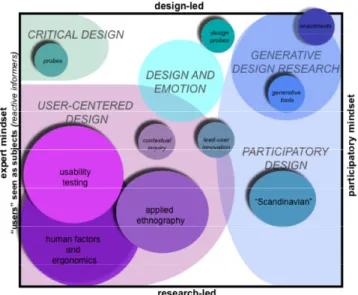
The map of design research and practice as shown in Figure 1 (updated from the map in Sanders, 2008) [26] can serve as a framework on which to compare the three perspectives: User-centred, design-led and co-creation. The map is defined and described by two intersecting dimensions: approach and mind-set. Approaches to
design research have come from research-led thinking (shown at the bottom of the map) and from design-led thinking (shown at the top of the map). The research-led perspective has the longest history and has been driven by applied psychologists, anthropologists, sociologists, and engineers. The design-led perspective, on the other hand, has come into view much more recently. There are also two opposing mind-sets evident in the practice of design research today. The left side of the map describes a culture characterized by an expert mind-set. Designers and researchers here are involved with designing for people. They consider themselves to be the experts, and they see and refer to people as “subjects,” “users,” “consumers,” etc. The right side of the map describes a culture characterized by a participatory mind-set. Designers and researchers on this side design with people. They see the people as the true experts in domains of experience such as living, learning, working, etc. Designers and researchers who have a participatory mindset value people as co-creators in the design process. It is difficult for many people to move from the left to the right side of the map (or vice versa), as this shift entails a significant cultural change.
Fig. 1. A map of Design Research and Practice
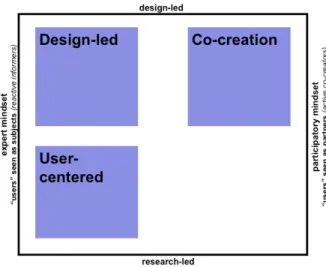
If we strip the map of the design research tools and methods it serves well as a framework for positioning the three perspectives on non-technologically driven product development processes (Figure 2). The user-centred perspective uses research-led approaches coming primarily from marketing and the social sciences to make incremental improvements to existing products or product lines. The design-led perspective uses design thinking and has the potential for significant innovation but it does not value the input of potential end-users as being participants in the early front end of the process. The co-creation perspective puts the tools and methods of design thinking into the hands of the people who will be the future end-users (and the other stakeholders) early in the front end of the product development process.
Fig. 2. Framework for positioning the three perspectives on non-technologically driven product development processes
6 Design and Research Approach
The strategic design reports were developed based on different collaborative projects with Industry, where 4th Year Industrial Design students acted as consultants and were
required to formulate a design strategy as well as materialise the strategy into a product and / or service. Students were subjected to a short but intensive hands-on workshop on co-creation methods, tools and techniques early in the semester. The students worked in groups of 2 or 3 in a design studio setting. In the initial stages of the project, students planned a series of participatory design sessions with various groups of stakeholders to support their strategic and industrial design process. UCD as well as co-creation methods, which were suggested and later on implemented included, for example: Observations, Function Mapping [27], Bulls Eye Collage, Participatory Design through Making and Acting [28], Storytelling [29], What-If Scenario Building, etc. Students were free to choose what kind of approach and what kinds of tools and methods made sense based on their client and the challenge they were faced with.
Sources of evidence were mainly based on the analysis of nine strategic design reports followed by interviews. A case study research approach was used to compare how various methods were instrumental in determining the level and type of innovation [30]. The analysis of the strategic design reports was carried out through a procedure of ”Explanation Building”.
7 Results and Analysis of Workshops
A detailed description of how the participatory workshops were managed and executed within each of the projects will be shown below. The workshop results were analysed based on the following criteria:
• Client criteria and constraints: This covers: nature, size and business activities of the client company, etc.
• Involvement of internal / external stakeholders and end-users
• Approach: Processes and methods used in the workshops
• Results: This mainly elaborates upon the insights gained during the workshops and how these have been implemented in the follow up product planning and designing activities.
Appendix A provides a comparative overview of the analysis of the workshop sessions.
8 Discussion
Even with the broadening of the approach to design, a fundamental tension between design-driven and user-centred driven innovation is prevalent [16, 18]. In 5 of the 9 projects, a “New Product – Existing Market” strategy was targeted, whereas 2 projects aimed at creating a new market for the companies’ based on existing products and technologies. In addition, two (2) companies adopted a “natural” diversification strategy, as they were contract manufacturers and do not have a history in developing their own products. The two (2) reports showed that end users were not very much involved in the product /service idea generation process with respect to these contract manufacturers. Establishment of design goals and generation of concepts mainly took place through discussions among company management and design students, based on a conjecture – analytical design approach [31].
As summarized and mapped onto Ansoff´s Product-Market matrix [7], overall results indicate that Human-centred Design (HCD) methods may not be directly applicable for establishing a diversification strategy in an educational setting, where 4th year design students were for the first time subjected to co-creation tools and
methods.
However, the design outcome of these industrial projects (see figures 3 and 4) suggest that students were capable of producing innovative design concepts by proposing products or services to be positioned in the ”Upper Left and Right Quadrants” challenging new technologies and style (= ergonomics and form).
Companies who have the interest to collaborate with students on design / product innovation projects should have realistic ambitions with respect to value creation. Instead of being fixated or aiming too hard for diversification, they should also consider that value can be derived from developing new products for existing markets, or creating new markets for existing products.
Fig. 4. Mapping of 9 design projects according to Cagan´s and Vogel´s Positioning Map [8]
In support of value creation, HCD can be considered a useful tool in educating companies and prospective design consultants about how end-users and other stakeholders are to be involved in certain aspects of the co-designing process. However, interviews with the students have surfaced the following limitations and opportunities for implementing HCD in search of a suitable generic growth and design strategy:
• Nature, history and pragmatic attitudes of some of the companies
• Most of the companies have unconsciously influenced the students to focus on the “new product / existing market” or “existing product / new market” strategies
• Although in some cases a radical product idea is “in the making”, very aggressive time frames for the projects as well as the lack of experience among students to frame and communicate, did not provide a convincing atmosphere for the company to pursue diversification
On the contrary, companies, who aim for diversification in their generic growth strategies may not always end up with a complementary “high valued” design outcome, as illustrated through the “Multi-functional Outdoor Fire Place” and “Load Crosser” projects.
From an educational perspective, this learning experience showed that Front-End of Innovation (FEI) processes, and HCD methods and tools should be taught to
students in conjunction with Ansoff’s Product-Market matrix [7], as well as the 3-D Positioning Maps [8]. This will then lead to the following thinking approaches:
• Diversification on its own is not the only generic growth strategy to gain significant competitive advantage
• Focusing on “Development of new products for existing markets” or “Creation of new markets for existing products” as generic growth strategies in combination with a design strategy targeted at the “Upper Right Quadrant” can also lead to a significant value creation for companies.
From a learning perspective, the understanding of HCD methods (both user-centred and co-creation) created an awareness among students and companies that respect and empathy for the end-user are important aspects to consider for enriching their design processes, as such increasing the chances for diversification in subsequent projects with clients.
References
1. Cova, B., Svanfeldt, C.: Societal Innovations and the Postmodern Aestheticization of Everyday Life. International Journal of Research in Marketing 10(3), 297–310 (1993) 2. Koen, P.A., Ajamian, G., Burkart, R., Clamen, A., Davidson, J., D’Amoe, R., Elkins, C.,
Herald, K., Incorvia, M., Johnson, A., Karol, R., Seibert, R., Slavejkov, A., Wagner, K.: New Concept Development Model: Providing Clarity and a Common Language to the ‘Fuzzy Front End’ of Innovation. Research Technology Management 44(2), 46–55 (2001) 3. Cooper, R.G.: The invisible success factors in product innovation. Journal of Product
Innovation Management 16(2), 115–133 (1999)
4. v. d. Panne, G., Beers, C.V., Kleinknecht, A.: Success and failure of innovation: A literature review. International Journal of Innovation Management 7(3), 309–338 (2003) 5. Kujala, S.: User involvement: a review of the benefits and challenges. Behaviour and
Information Technology 22(1), 1–17 (2003)
6. Christiansen, J.A.: Building the Innovative Organization. MacMillan Press, London (2000) 7. Ansoff, H.I.: Corporate Strategy: An Analytic Approach to Business Policy for Growth
and Expansion. Penguin, Harmondsworth (1968)
8. Cagan, J., Vogel, C.M.: Creating breakthrough products: Innovation from product planning to program approval. Prentice Hall, Upper Saddle River (2002)
9. Drucker, P.F.: The essential Drucker: The best of sixty years of Peter Drucker’s ideas on management. Harper Business, New York (2001)
10. Boztepe, S.: User Value: Competing Theories and Models. International Journal of Design 1(2) (2007)
11. Sanders, L., Simons, G.: A Social Vision for Value Co-creation in Design. Open Source Business Resource (December 2009),
http://www.osbr.ca/ojs/index.php/osbr/article/view/1012/973 12. Dewey, J.: Experience and education. Free Press, New York (1938)
13. Overby, J.W., Woodruff, R.B., Gardial, S.F.: The influence of culture upon consumers’ desired value perception: A research agenda. Marketing Theory 5(2), 139–163 (2005) 14. Chayutsahakij, P., Poggenpohl, S.: Centered Innovation: The Interplay between
User-Research and Design Innovation. In: Proceedings of the European Academy of Management 2nd Annual Conference on Innovative Research in Management (EURAM), Stockholm, Sweden (2002)
15. Vredenburg, K., Isensee, S., Righi, C.: User-Centered Design: An Integrated Approach. Prentice Hall, Upper Saddle River (2002)
16. Veryzer, R.W., Borja de Mozota, B.: The Impact of User-Oriented Design on New Product Development: An Examination of Fundamental Relationships. Journal of Product Innovation Management 22, 128–143 (2005)
17. Belliveau, P., Griffin, A., Somermeyer, S.M.: The PDMA Toolbook for New Product Development. Wiley, Hoboken (2004)
18. Verganti, R.: Design Driven Innovation. Harvard Business School Press, Boston (2008) 19. Brown, S.L., Eisenhardt, K.M.: Product Development: Past Research, Present Findings,
and Future Directions. Academy of Management Review 20(2), 343–378 (1995)
20. Shane, S.A., Ulrich, K.T.: Technological Innovation, Product Development, and Entrepreneurship in Management Science. Management Science 50(2), 133–144 (2004) 21. Kim, W.C., Mauborgne, R.: Blue Ocean Strategy: From Theory to Practice. California
Management Review 47(3), 105–121 (2005)
22. Prahalad, C.K., Ramaswamy, V.: Co-opting Customer Competence. Harvard Business Review, 79–87 (January-February 2000)
23. Geels, F.W.: From Sectoral Systems of Innovation to Socio-Technical Systems. Insights about Dynamics and Change from Sociology and Institutional Theory. Research Policy 33, 897–920 (2004)
24. Bucolo, S., Matthews, J.: Design led innovation: Exploring the synthesis of needs, technologies and business models. In: Participatory Innovation Conf., pp. 354–357 (2011) 25. Sanders, E.B.-N.: Sustainable innovation through participatory prototyping.
Formakademisk (2011) (in press)
26. Sanders, E.B.-N.: An Evolving Map of Design Practice and Design Research. Interactions (November/December 2008)
27. Moolenbeek, J.: Function Mapping: A Sound Practice for System Design. In: SysCon 2008 – IEEE International Systems Conference, Montreal, Canada (2008)
28. Sanders, E.B.-N., Stappers, P.J.: creation and the new landscapes of design. Co-design 4(1), 5–18 (2008)
29. Sametz, R., Maydoney, A.: Storytelling through Design. Design Management Journal (Fall 2003) (issue)
30. Yin, R.K.: Case Study Research: Design and Methods, 3rd edn. Sage Publ., Inc., Thousand Oaks (2003)
31. Bamfort, G.: From analysis/synthesis to conjecture/analysis: A review of Karl Popper’s influence on design methodology in architecture. Design Studies 23, 245–261 (2002) 32. Hekkert, P., Van Dijk, M.: Designing from context: Foundations and Applications of the
ViP approach. In: Lloyd, P., Christiaans, H. (eds.) Designing in Context: Proceedings of Design Thinking Research Symposium 5. DUP Science, Delft (2003)
![Fig. 3. Mapping of 9 design projects according onto Ansoff’s Product- Market matrix [7]](https://thumb-us.123doks.com/thumbv2/123dok_us/10667999.2954939/6.892.306.583.748.956/mapping-design-projects-according-ansoff-product-market-matrix.webp)
![Fig. 4. Mapping of 9 design projects according to Cagan´s and Vogel´s Positioning Map [8]](https://thumb-us.123doks.com/thumbv2/123dok_us/10667999.2954939/7.892.288.609.406.616/fig-mapping-design-projects-according-cagan-vogel-positioning.webp)
