Twenty-fourth Americas Conference on Information Systems, New Orleans, 2018 1
Students’ Learning Experience in Flipped
Classes Using Social Media
Completed Research
Amir Talaei-Khoei
University of Nevada Reno, USA
University of Technology Sydney, Australia
[email protected]
Jay Daniel
University of Derby, UK
[email protected]
Mohsen Dokhanchi
University of Queensland, Australia
[email protected]
Abstract
The current work aims at deploying Facebook as a social media site to improve students’ learning experience with the flipped learning materials through implementation of a socially enabled peer and self-learning environment. Provided the body of literature on poor students’ experience in flipped classes, the paper implements an experiment comparing the online quizzes and Facebook to improve students’ experience with the online materials in flipped classes. The study looks at the students’ perceptions. The paper provides recommendations to the instructors on how to use Facebook to improve students’ experience with the flipped materials. This study also motivates teaching practitioners in Information Systems to improve flipped learning by using social networking sites in their courses.
Keywords
Flipped Learning, Social Media, Learning Experience.
Introduction
In recent years, implementation of flipped learning strategies has become more prevalent. Missildine et al (2013) defines flipped learning as a hybrid method that uses interventions to interchange lecture time to “homework” and utilizes interactive learning for the face-to-face classroom time. Flipped classes encourage students to learn the contents of the course prior to coming to class and practice the materials with discussion or task-oriented exercises (Li et al. 2013). Flipped classrooms allocate more class time for in-class exercises. They also transform the focus of the theoretical learning to students at home by providing accessibility to advanced technologies in order to support a blended learning approach. Flipped learning models suggest leveraging the access of online video/materials to students prior to coming to classrooms, so that students are adequately supported and prepared to participate in more interactive activities, such as problem solving and discussions (Davies et al. 2013; Kim et al. 2014).
One of the advantages of flipped classrooms is the opportunity given to the students to study the online learning materials at their convenience and utilize their individual level of comprehension. In physical participation of students in classes, students will be provided more interactive and group discussions targeting the problem solving activities as opposed to listening to theoretical lectures. Therefore, teachers are able to monitor students in the class and provide feedbacks (Kim et al. 2014). There has been a body of
Twenty-fourth Americas Conference on Information Systems, New Orleans, 2018 2 literature that reveals various advantages of flipped classrooms (Bergmann et al. 2011; DeSantis et al. 2015; Herreid and Schiller 2013; Hughes 2012). However, some challenges have also been reported in their implementation of flipped classes.
Elliott (2014) introduces “front loading” challenge for the implementation of flipped classes. Flipped Learning requires a strong motivation enabling students to prepare the work in advance as compared to lectures where minimal effort is to be made before class time. In fact, due to more work preparation required for Flipped Learning, a survey done in a study by DeSantis, Van Curen, Putsch, & Metzger (2015) reveals that students are less satisfied with Flipped Learning versus traditional learning. This dissatisfaction basically leads to less students’ engagement with the materials. Missildine et al. (2013) believe the demotivation among students to engage with the flipped class materials is due to the lack of social context in learning contents before coming to the lectures. This is in agreement with what has been explored in peer tutoring by Talaei-Khoei and Daniel (2016). Topping (2005) believes that peer support can occur through tutoring process or a goal-oriented collaborative learning in a group. Peer tutoring looks at the interactions among students with the focus on the curriculum. While the peer tutoring has been shown in literature as an effective practice for improving students’ engagement (Ashwin 2003; Kuh 2009), Bishop & Verleger (2013) implement an online discussion board and highlight the role of collaborative tools to facilitate the peer tutoring and engaging students with flipped learning materials. The track history of Social Network Sites (SNS), as learning tools, goes back to the use of online discussion boards that organize online community conversations (Talaei-Khoei et al, 2009; Ghapanchi et al, 2013) along a thread of content or learning objectives (Greenlaw and Hepp 1998). Although discussion boards are powerful tools to handle content-related interactions (Sue et al, 2014), they lack a comprehensive social engagement and non-pedagogical relationships among students that required for an effective peer tutoring environment (Hrastinski 2008). Social engagement among learners can be boosted by social media sites such as Facebook (Abedin 2011). There are two main reasons for that. First, Facebook has been proven as a successful platform in terms of user engagement (Heiberger and Harper 2008). Second, students prefer Facebook for both socialize and facilitating peer learning. In a large-scale study (Kumpikaite et al. 2011), 91% of undergraduate students claimed that they hold and use a Facebook account. Among these, 54% of students utilize Facebook for their learning. Grosseck et al. (2011) state that students prefer Facebook over discussion boards in the learning management systems because of the rigid structure of the discussion boards and also social connections that Facebook provides.
The role of Facebook in facilitating peer learning practices to improve the students learning has been highlighted in the literature (Talaei Khoei and Talaei-Khoei 2015). While Li et al. (2013) in an experimental setting indicate that students’ engagement with flipped materials using Facebook is higher compared to traditional learning, a deep understanding the underlying relationship between using social networking sites like Facebook for flipped classes and the students’ engagement has not been addressed from the students’ perspective.
The current study looks at the implementation of Facebook to engage students with the flipped activities and accordingly to improve their learning experience. For this to happen, the present research studies the students’ perception on the use of Facebook in flipped classes. This article is an attempt to address the following research question (RQ):
Research Question: How does Facebook improve the students’ learning experience in flipped classes?
The learning experience is defined as the learning elements that engage students in the environment (Shea et al. 2012; Shea and Bidjerano 2010). This study understands the value that Facebook creates to the students’ learning in flipped classes. The current work also benefits teaching professionals with what students suggest for the design of the flipped classrooms to successfully improve their learning.
The rest of this article organized in the following way: Section 2 presents the research methods. Section 3 demonstrates the results. Finally section 4 summaries the paper and discusses the implications of the work for academics and teaching professionals. This section also points out the limitation of this article opening to future avenues of research.
Twenty-fourth Americas Conference on Information Systems, New Orleans, 2018 3
Methods
Research Context
Students in a second-year undergraduate course in Bachelor of Information Systems were invited to participate in the study. Only 11 students did not participate, which remained the experiment with 284 students (range 19 – 37 years; Mean = 22.1; SD = 2.3 ; 154 males).
The topic of the course was enterprise resource planning (ERP) from management perspective, but with some technical flavor such as introducing the technologies that can be used in ERPs. The course did not involve any hands on experience by students but focused more on managing an ERP system in an organization. For twelve weeks, the course had ninety minutes of lectures, ninety minutes of tutorial/workshop sessions weekly. The lectures were given by the course coordinator and the tutorials/workshops in classes of 24 students were managed by teacher assistants.
Research Design
The course offered four flipped classes; two at the earlier stage of the semester and two at the later stage. In all these four classes, the lecture materials were provided to students on the online learning management system to study prior to the class. Some extra videos were also provided. In the first flipped class in week 3 and the fourth flipped class in week 10, the students were asked to participate in a voluntary online quiz that included five discussion questions about the topic. In the second flipped class in week 5 and the third experiment in week 8, students were asked to voluntary discuss five discussion questions on the Facebook group of the course. Then, in all these four flipped classes in weeks 3, 5, 8 and 10, the students when physically were participating in the class were given five similar but not the same questions about the topic of the week in hardcopy. Students’ engagement in the online quizzes and Facebook group discussions, and their answers to provided five questions was recorded.
Following Facebook intervention (i.e. weeks 5 and 8), students were given a questionnaire that included three open ended questions asking the students’ opinion about the advantages and disadvantages of using Facebook and if they have any recommendations. The questionnaires in weeks 5 and 8 were identical, which enabled us to compare the results for the sake of reliability and to see if students’ opinion can be changed by getting more experiences about the intervention.
Analysis
The qualitative analysis aiming at coding the relevant categories of sentences has two steps; (1) Automated Detection of Categories, and (2) Manual Refinement of Results. The approach taken in this study to code the categories is similar to what was used in (Deng et al., 2016), however we used a different software package.
Step 1: Automated Detection of Categories of Sentences: The analysis of interviews was conducted using Alceste software (“Alceste software,” 1986). First, Alceste identified contextual units - equivalent to sentences, in the transcripts. Then, the software computed the data matrix including the words that recognized by the Alceste already-implemented ontology. The data matrix showed what words were present in each sentence. The words repeated less than four times were excluded (“Alceste software,” 1986). The final part of step 1 was to generate categories of sentences. Alceste uses Divisive Hierarchical Clustering (DHC) algorithm (Merten et al., 2012). This algorithm attempts to maximize the significant difference of each two categories by iteratively trying different sentences in different categories. The significant difference presented by X2 was calculated in Alceste using the Chi Square Test. Only the
categories that have (X2 >10.8, significant at the 0.1% level) were included. The percentage of contextual
units classified in the interviews was 67.1%, which means that 67.1% of the answers were somehow related to common topics. This was a good result for qualitative responses (Reinert 1998).
Twenty-fourth Americas Conference on Information Systems, New Orleans, 2018 4 Step 2: Manual Refinement of Results: This step included human intervention to refine the automated generated categories. First, authors merged the categories into one category if their sentences were similar. Then, they split the categories if their sentences were different. The relevant categories were grouped to make up a hierarchical structure including categories and sub-categories. This was iteratively repeated till no changes were desired.
Results
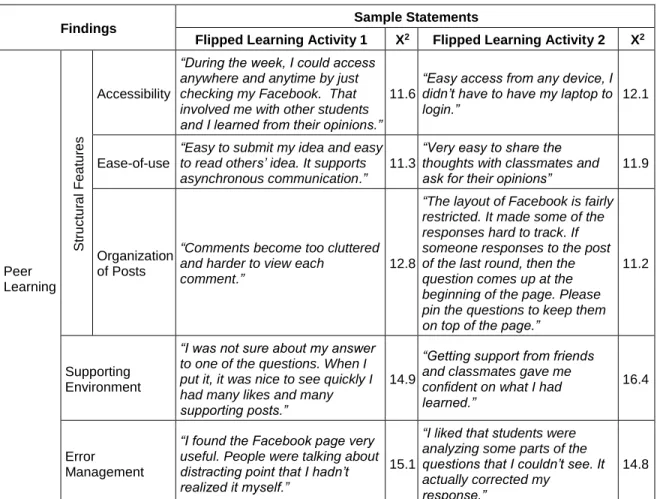
Our finding demonstrated (see Table 1) that implementing Facebook as a means of students’ engagement in flipped classes can contribute to both peer and self-learning experiences of students. Facebook provides desirable structural features such as accessibility and ease of use. However, in the original format, the organization and arrangement of posts on Facebook can be confusing for students. The instructors should pin the current posts to avoid this confusion. Providing a crowd, Facebook is a good environment to support learners and provides monitoring processes of error management. Some students including international students with English difficulties have expressed their satisfaction that it was easier to discuss on Facebook than in the class. While peer learning in Flipped classes is supported by the Facebook intervention, self-learning could also be facilitated via self-direction and self-reflection.
Table 1 Students’ Perception: Learning Experience
Findings Sample Statements
Flipped Learning Activity 1 X2 Flipped Learning Activity 2 X2
Peer Learning Stru c tu ra l F e a tu re s Accessibility
“During the week, I could access anywhere and anytime by just checking my Facebook. That involved me with other students and I learned from their opinions.”
11.6
“Easy access from any device, I didn’t have to have my laptop to login.”
12.1
Ease-of-use
“Easy to submit my idea and easy to read others’ idea. It supports asynchronous communication.”
11.3
“Very easy to share the thoughts with classmates and ask for their opinions”
11.9
Organization of Posts
“Comments become too cluttered and harder to view each
comment.”
12.8
“The layout of Facebook is fairly restricted. It made some of the responses hard to track. If someone responses to the post of the last round, then the question comes up at the beginning of the page. Please pin the questions to keep them on top of the page.”
11.2
Supporting Environment
“I was not sure about my answer to one of the questions. When I put it, it was nice to see quickly I had many likes and many supporting posts.”
14.9
“Getting support from friends and classmates gave me confident on what I had learned.”
16.4
Error Management
“I found the Facebook page very useful. People were talking about distracting point that I hadn’t realized it myself.”
15.1
“I liked that students were analyzing some parts of the questions that I couldn’t see. It actually corrected my
response.”
Twenty-fourth Americas Conference on Information Systems, New Orleans, 2018 5
Easier to Communicate
“I’m shy and I don’t think I would ever talk in a huge class like this. But, I could discuss the topic on Facebook.”
14.3
“I’m an international student with not good English. It’s very difficult to get involved in class discussions for me. Thanks for providing this opportunity, Now I could discuss and learn the topic.” 13.8 Self-Learning Self-directed Study
“I didn't really understand the topic at first, but then I read all the comments on Facebook and through that I did learn more about the topic.”
11.6
“The response given by other students drew my attentions to some points in the notes that ignored or didn’t study well. So, went back to the notes and tried to learn them more properly.”
17.1
Self-Reflection
“Looking at the comments and how deep some of the students could analyze the questions, I found that I need spend more time on the lecture notes.”
16.4
“There were few questions and I could understand most of the comments on all the questions unless one of them. Then I realized there must be something in the notes that I missed. I went back and there was.”
12.5
Discussion
In this research, an experiment has been reported on 284 second-year Information System students for an ERP undergraduate course. The experiment was a longitudinal study in four flipped classes on weeks 3, 5, 8 and 10. In these four classes, the students were given the materials prior to the class on the learning management system. While the first and the last class required students to participate in online quizzes including five discussion questions in advance to the physical presence in the class, the second and the third classes needed the students to participate in five discussion posts put by the course coordinator on the Facebook group. In what follows, the findings of this experiment will be discussed.
Implications
Facebook versus Online Discussion Boards in Flipped Classes: Comparison of Learning Outcomes
There has been a body of literature in the support of collaborative tools to improve the students’ engagement with the flipped class materials (Bishop and Verleger 2013). Although discussion boards in the online learning management systems are powerful tools to handle content-related collaborative interactions, they lack a comprehensive social engagement and non-pedagogical relationships among students which is required for an effective peer learning environment (Hrastinski 2008). Social engagement among learners can be boosted by social media sites such as Facebook (Amrollahi et al, 2014) resulting in better learning experience (Abedin 2011). Li et al. (2013) studied the acceptance of Facebook to provide social context in the online flipped materials and believed that students would engage with Facebook easier than other available alternatives, because they are already familiar with this platform.
Although the current study did not look at the casual relationships between the use of social media sites and learning experience and only investigated the qualitative students’ perception, it suggests the potentials for such learning practices on Facebook as a new delivery model to improve students’ experience by implementing online peer learning in flipped classes.
Twenty-fourth Americas Conference on Information Systems, New Orleans, 2018 6
Recommendations to Instructors for Implementation of Facebook in Flipped Classes
In regard to the learners’ experience, the instructors are recommended to facilitate both peer and self-learning experiences of students. In terms of peer self-learning, our findings are in agreement with Topping (2001). He defines the peer learning constructs as the interaction of four constructs; namely structural features of the learning environment (that is Facebook in this case), supportive environment, error management, easier communication. The Facebook page providing ubiquitous accessibility i.e. anytime, anywhere and on any device as well as the ease of use can promote the students’ engagement with the flipped materials. However, students expressed their concern about the organization and arrangement of the posts. Apparently, if a student mistakenly responses to the wrong question related to the previous flipped session, the question will automatically come as the most recent updated question. This can be confusing. It is recommended that the instructors pin the recent questions to keep them on the beginning of the page. The peer learning can also be empowered by the support that students receive against each of their inputs to the Facebook page. Error management is a monitoring mechanism that has been introduced in peer learning model of Topping (2001). Students mentioned that they were impressed with the fact that on Facebook people talk and discuss about some aspects of the flipped materials and the topic that they were not aware of it. Therefore, these points came to their attention without even asking them or thinking about them. This model of error management offered by the Facebook group of the course is an innovative intervention to the monitoring mechanism explained by Topping (2001). One of the drawbacks for the class-based discussions is the heavy demand on the students’ communication skills. This is clearly an optimization. Beside the variety and the differences of communication skills among students, not to say that we also have international students that may require extended time in delivering their opinions. This would be very hard in the context of face-to-face discussions in the class when many students feel shy of talking in front of others. The Facebook group gives all students this opportunity to relax from the face-to-face pressures that they may feel in communicating with their classmates. Therefore, the students have an extended opportunity to practice the flipped materials and be more confident to present it in the discussions when going to the flipped classrooms. In terms of self-learning, the instructors are recommended to implement strategies that support directed study and self-reflection. The questions posted on the Facebook page should point out particular details that may missed or ignored by students when reading the online materials. Therefore, by reflecting back their understanding of the topic, they would be motivated to restudy the materials to ensure that they have a clear understanding of the details.
Limitations and Future Work
The present work examined the students’ learning experience in online quizzes and Facebook-based discussions in flipped classes. The qualitative procedure used in this work does not evaluate possible casual relationships among the constructs of learning experience and use of Facebook in flipped classes. Therefore, due to the different objectives of this work, it cannot be concluded that deploying the Facebook groups are more effective flipped learning practice comparing to online quizzes. However, it opens an opportunity for future studies to investigate the causalities among these constructs.
The major limitation of observations in this study is the social complexity involved in the experiments. This makes it almost impossible to conduct complete cross analysis. A further limitation related to this study is that the experiments did not allow finely tuned analysis of individual differences in the outcomes of the study. Nakayama et al. (2015) believe that one consideration in the use of social media for flipped learning is that the personality differences of students impact their frequency of use of Social Network Sites. Thus, a new variable that affects the flipped learning strategy is introduced which has not been taken into the scope of the current work. Given the importance of individual differences on outcomes, further research should examine the relationship between antecedents such as gender, parental education level, etc. on student engagement with the flipped learning materials. This can serve as a future study.
Twenty-fourth Americas Conference on Information Systems, New Orleans, 2018 7
Conclusion
The present paper reports the results of a study in a course of ERP for undergraduate students in information systems. The experiment aimed to understand the students’ perception about their learning experience when deploying Facebook as a means of communication in flipped classes. The findings of this study showed that students’ learning experience improve in two aspects; namely from self-learning and from peer-learning perspectives.
Students believed that self-learning could be facilitated via self-direction and self-reflection. From peer learning perspective, Facebook provides desirable structural features such as accessibility and ease of use. The instructors should pin the current posts to avoid confusion made out of the change in sequence of posts. Facebook is a good environment to support learners and provides monitoring processes of error management.
REFERENCES
Abedin, B. 2011. “Web 2.0 and Online Learning and Teaching: A Preliminary Benchmarking Study,” Asian Social Science (7:11), p. p5.
Ashwin, P. 2003. “Peer Support: Relations between the Context, Process and Outcomes for the Students Who Are Supported,” Instructional Science (31:3), pp. 159–173.
Amrollahi, Alireza, Amir Hossein Ghapanchi, and Amir Talaei-Khoei. "Three Decades of Research on Strategic Information System Plan Development." Communications of Association of Information Systems 34 (2014): 84.
Bergmann, J., Overmyer, J., and Wilie, B. 2011. “The Flipped Class: Myths vs. Reality,” The Daily Riff, pp. 1–4.
Bishop, J. L., and Verleger, M. A. 2013. “The Flipped Classroom: A Survey of the Research,” in ASEE National Conference Proceedings, Atlanta, GA.
Davies, R. S., Dean, D. L., and Ball, N. 2013. “Flipping the Classroom and Instructional Technology Integration in a College-Level Information Systems Spreadsheet Course,” Educational Technology Research and Development (61:4), pp. 563–580.
DeSantis, J., Van Curen, R., Putsch, J., and Metzger, J. 2015. “Do Students Learn More From a Flip? An Exploration of the Efficacy of Flipped and Traditional Lessons,” Journal of Interactive Learning Research (26:1), pp. 39–63.
Elliott, R. 2014. “Do Students like the Flipped Classroom? An Investigation of Student Reaction to a Flipped Undergraduate IT Course,” in Frontiers in Education Conference (FIE), 2014 IEEE, IEEE, pp. 1–7.
Greenlaw, R., and Hepp, E. 1998. In-Line/on-Line: Fundamentals of the Internet and the World Wide Web, McGraw-Hill, Inc.
Grosseck, G., Bran, R., and Tiru, L. 2011. “Dear Teacher, What Should I Write on My Wall? A Case Study on Academic Uses of Facebook,” Procedia-Social and Behavioral Sciences (15), pp. 1425–1430. Heiberger, G., and Harper, R. 2008. “Have You Facebooked Astin Lately? Using Technology to Increase
Student Involvement,” New Directions for Student Services (2008:124), pp. 19–35.
Herreid, C. F., and Schiller, N. A. 2013. “Case Studies and the Flipped Classroom,” Journal of College Science Teaching (42:5), pp. 62–66.
Hrastinski, S. 2008. “Asynchronous and Synchronous E-Learning,” Educause Quarterly (31:4), pp. 51– 55.
Hughes, H. 2012. “Introduction to Flipping the College Classroom,” in World Conference on Educational Multimedia, Hypermedia and Telecommunications (Vol. 2012), pp. 2434–2438.
Kim, M. K., Kim, S. M., Khera, O., and Getman, J. 2014. “The Experience of Three Flipped Classrooms in an Urban University: An Exploration of Design Principles,” The Internet and Higher Education (22), pp. 37–50.
Kuh, G. D. 2009. “What Student Affairs Professionals Need to Know about Student Engagement,” Journal of College Student Development (50:6), pp. 683–706.
Twenty-fourth Americas Conference on Information Systems, New Orleans, 2018 8 Kumpikaite, V., Duoba, K., and Taraskevicius, A. 2011. “Will Such Information Technology as Facebook Become Regular Mean for Study Process?,” in 2011 3rd International Conference on Advanced Management Science (Vol. 19), pp. 36–40.
Li, K.-H., Lou, S.-J., Tseng, K.-H., and Huang, H.-C. 2013. “A Preliminary Study on the Facebook-Based Learning Platform Integrated with Blended Learning Model and Flip Learning for Online and Classroom Learning,” in Advances in Web-Based Learning–ICWL 2013, Springer, pp. 172–183. Missildine, K., Fountain, R., Summers, L., and Gosselin, K. 2013. “Flipping the Classroom to Improve
Student Performance and Satisfaction,” Journal of Nursing Education.
Nakayama, M., Leh, A., and Santiago, R. 2015. “Relationships of Student Experience and Student Characteristics in a Graduate-Level Flipped Classroom,” in Proceedings of the 2nd European Conference on Social Media 2015: ECSM 2015, Academic Conferences Limited, p. 348.
Reinert, M. 1998. “Quel Objet Pour Une Analyse Statistique Du Discours? Quelques Réflexions à Propos de La Réponse Alceste,” in JADT, pp. 557–569.
Shea, P., and Bidjerano, T. 2010. “Learning Presence: Towards a Theory of Self-Efficacy, Self-Regulation, and the Development of a Communities of Inquiry in Online and Blended Learning Environments,” Computers & Education (55:4), pp. 1721–1731.
Shea, P., Hayes, S., Smith, S. U., Vickers, J., Bidjerano, T., Pickett, A., Gozza-Cohen, M., Wilde, J., and Jian, S. 2012. “Learning Presence: Additional Research on a New Conceptual Element within the Community of Inquiry (CoI) Framework,” The Internet and Higher Education (15:2), pp. 89–95.
Sue, D., Ray, P., Talaei-Khoei, A., Jonnagaddala, J., & Vichitvanichphong, S. (2014). Assessing video games to improve driving skills: a literature review and observational study. JMIR serious games, 2(2).
Talaei-Khoei, A., & Daniel, J. (2016). Peer Tutoring on Facebook to Engage Students with Flipped Classes: A Correlational Experiment on Learning Outcomes. In Americas Conference on Information Systems (AMCIS).
Talaei Khoei, T., and Talaei-Khoei, A. 2015. “Peer Learning in the Class or on Facebook? A Correlational
Experiment on Learning Outcomes,” AMCIS 2015 Proceedings.
(http://aisel.aisnet.org/amcis2015/ISEdu/GeneralPresentations/7).
Talaei-Khoei, Amir, Pradeep Ray, and Nandan Parameswaran. "An awareness framework for agent-based mobile health monitoring." Next Generation Mobile Applications, Services and Technologies, 2009. NGMAST'09. Third International Conference on. IEEE, 2009.
Topping, K. J. 2005. “Trends in Peer Learning,” Educational Psychology (25:6), pp. 631–645. (https://doi.org/10.1080/01443410500345172).
Topping, K. J. E. S. W. 2001. “Peer Assisted Learning: A Framework for Consultation,” Journal of Educational & Psychological Consultation (12:2), pp. 113–132.