Construction Industry Business Environment
BIM – Implications for Government
Case Study No. 5 [2004-032-A + Case study no. 5]
Editor Kerry Brown
The research described in this case study was carried out by: Craig Furneaux and Robbie Kivits
Project Leader: Kerry Brown
Research Program: A
Program Name: Business and Industry Development Research Project No.: 2004-032-A
Project Name: Construction Industry Business Environment (CIBE) Date: 29 July 2008
2004-032-A – BIM – Implications for Government
[Inside cover]
Distribution List
Cooperative Research Centre for Construction Innovation Authors
Disclaimer
The Client makes use of this Case study or any information provided by the Cooperative Research Centre for Construction Innovation in relation to the Consultancy Services at its own risk. Construction Innovation will not be responsible for the results of any actions taken by the Client or third parties on the basis of the information in this Case study or other information provided by Construction Innovation nor for any errors or omissions that may be contained in this Case study. Construction Innovation expressly disclaims any liability or responsibility to any person in respect of any thing done or omitted to be done by any person in reliance on this Case study or any information provided.
© 2008 Icon.Net Pty Ltd
To the extent permitted by law, all rights are reserved and no part of this publication covered by copyright may be reproduced or copied in any form or by any means except with the written permission of Icon.Net Pty Ltd.
Please direct all enquiries to: Chief Executive Officer
Cooperative Research Centre for Construction Innovation 9th Floor, L Block, QUT, 2 George St
Brisbane Qld 4000 AUSTRALIA T: 61 7 3864 1393 F: 61 7 3864 9151 E: [email protected] W: www.construction-innovation.info
Table of Contents
Table of Contents ...1 List of Tables ...2 List of Figures ...2 EXECUTIVE SUMMARY ...3 1. An introduction to BIM...41.1 Application of BIM in the Phases of Construction ... 4
1.1.1 Phases of a built asset life cycle... 4
1.1.2 The utility of BIM in the design phase... 5
1.1.3 The utility of BIM in the construction phase... 6
1.1.4 The utility of BIM in the Operations / Maintenance phase... 7
1.1.5 The utility of BIM in the Decommissioning phase... 8
1.2 Summary of the implications of BIM for stages of construction... 9
2. Advantages, Enablers and Applications of BIM...10
2.1 Advantages of BIM for government... 10
2.1.1 Increased utility and speed ... 10
2.1.2 Better data quality ... 12
2.1.3 Visualisation of the data... 13
2.1.4 Enhanced fault finding (process and product)... 13
2.1.5 Enhanced collaborations across discipline and organisation ... 14
2.1.6 Summary of BIM advantages... 15
2.2 Enablers of BIM ... 15
2.2.1 Increase in computer technology and IT infrastructure... 15
2.2.2 The International Alliance for Interoperability ... 16
2.2.3 Increasing World Wide Support for BIM... 17
3. Disadvantages and barriers to implementing BIM ...19
3.1 Disadvantages of BIM for AEC/FM industry ... 19
3.1.1 A single detailed model... 19
3.1.2 Interoperability... 19
3.1.3 Added work for the designer ... 20
3.1.4 The size and complexity of BIM... 21
3.1.5 Trade Practices Implications ... 21
3.1.6 Summary of BIM disadvantages... 21
3.1.7 Addressing the disadvantages ... 22
3.2 Barriers to BIM... 23
3.2.1 Raft of legal issues – IP, liability and risk, contractual forms... 23
3.2.2 Authenticity of content authors... 25
3.2.3 Costs 26 3.2.4 Socio-technical issues ... 27
3.2.5 Skill issues 28 3.2.6 Summary of drawbacks ... 28
4. CONCLUSIONS AND RECOMMENDATIONS ...29
4.1.1 Recommendations... 30
5. LIMITATIONS OF THE STUDY...30
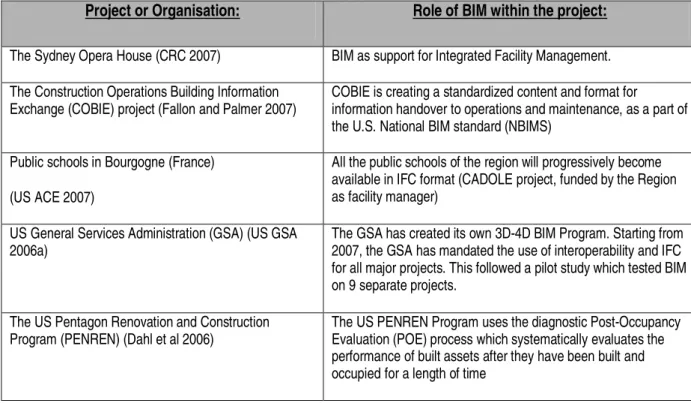
6. Appendix A – Applications of BIM – examples ...31
6.1 Application of BIM... 31
6.1.1 Applications of BIM in the past and present... 31
7. Appendix B – BIM Software applications developed by the CRC for Construction Innovation ...36
7.1.1 LCADesign 36 7.1.2 Design Check... 37
7.1.3 Automated Scheduler ... 37
7.1.4 Automated Estimator... 37
List of Tables
Table 1: The application of BIM to various Stages of Construction...9
Table 2: The benefits of using Business Information Modelling...15
Table 3: The disadvantages of Built asset Information Modelling...21
Table 4: The barriers to the implementation of Built asset Information Modelling...28
Table 5: Overview of applications of BIM in current and past projects...31
List of Figures Figure 1: Technology Adoption Life Cycle - adapted from Moore (1999) ...18
EXECUTIVE SUMMARY
As ‘The Architect’s Handbook of Professional Practice’ (cited by Riskus (2007) suggests, Building Information Modelling, or BIM, is “the use of virtual building information models to develop building design solutions, design documentation, and to analyse construction processes”. We would suggest such a definition, while useful, should be extended to include the operational phases of built assets (such as maintenance and decommissioning), and also be applied to the whole area of infrastructure. As a set of technologies, BIM holds promise to deliver benefits for the property, construction, and infrastructure management industries – particularly improved efficiencies and effectiveness through enhanced collaboration at all stages of the construction cycle. There are several important qualifiers, barriers, enablers, and some disadvantages with this suite of technologies. This report outlines the costs and benefits enablers and barriers associated with BIM, and makes suggestions about how these issues may be addressed.
BIM as a suite of technologies has been enabled by the significant improvements in IT infrastructure, the capabilities of computer hardware and software, the increasing adoption of BIM, and the development of Industry Foundation Classes (IFC) which facilitate the sharing of information between firms. The report highlights the advantages of BIM, particularly the increased utility and speed, better data quality and enhanced fault finding in all construction phases. Additionally BIM promotes enhanced collaborations and visualisation of data mainly in the design and construction phase.
There are a number of barriers to the effective implementation of BIM. These include, somewhat paradoxically, a single detailed model (which precludes scenarios and development of detailed alternative designs); the need for three different interoperability standards for effective implementation; added work for the designer which needs to be recognised and remunerated; the size and complexity of BIM, which requires significant investment in human capital to enable the realisation of its full potential.
There are also a number of challenges to implementing BIM. The report has identified these as a range of issues concerning: IP, liability, risks and contracts, and the authenticity of users. Additionally, implementing BIM requires investment in new technology, skills training and development of news ways of collaboration. Finally, there are likely to be Trade Practices concerns as requiring certain technology owned by relatively few firms may limit trade.
Recommendations:
The report recommends that the espoused benefits of BIM be trialled through a series of pilot projects, where the utility of the tools and the ways in which barriers can be addressed are systematically tested in order to demonstrate their benefits across a range of built assets. It is further recommended that such pilot projects should examine the range of technological issues identified in this report, but should also examine the organisational, legal and contractual issues which have also been flagged as important for successful implementation of BIM. Appendix A summarises several cases where BIM has been implemented, together with the lessons learned from these projects.
Additionally, the CRC for Construction Innovation has developed and is developing a suite of tools which can assist in the implementation of BIM by government. A summary of these tools and their applicability across the built asset life cycle is discussed in Appendix B.
1.
AN INTRODUCTION TO BIM
Building Information Management, or BIM, is “the use of virtual building information models to develop building design solutions, design documentation, and to analyse construction processes” (The Architect’s Handbook of Professional Practice’ cited by Riskus 2007). BIM has considerable potential for enhancing the efficiency and effectiveness of the Architectural/Engineering/Construction/Facilities Management (AEC/FM) Industry as it extends the functionality and application of existing Computer-aided-design (CAD) technologies. The main extension is by linking the 3D built asset model to a relational database that can carry all information related to the built asset. This added functionality provides a mechanism for extended collaborations between designers, engineers, constructors, and facility managers across the life cycle of built assets. Another aspect of BIM is that information which is created once, can be re-used many times, resulting in less errors, greater consistency, clarity, accuracy, and clear responsibility of authorship. This paper argues that BIM holds considerable promise for enhancing a range of activities for government, with leading authors suggesting 20-30% increase in productivity when using the technology (Hartman and Fischer 2008 p.80). Despite the prediction that the uptake of BIM in the AEC/FM will be slow but inevitable (Goldberg 2005), there are some real barriers which need to be addressed in order for this adoption to occur.
This paper outlines these costs, benefits, barriers and enablers of BIM, and makes recommendations as to how the shortfalls can be addressed. Additionally, while BIM has been primarily explored in relation to buildings, there is little reason why the technologies could not also be applied to other infrastructure projects – e.g. dams, bridges, and tunnels. In order to reflect the utility of BIM for a wider range of construction activities than just buildings, this report will discuss the use of BIM in relation to a range of built assets, not just buildings. Where possible, examples are included in text. A more detailed summary of Instances in which BIM has been implemented has provided in Appendix A.
From the outset, this report argues that BIM has the potential for improving all stages of construction. Accordingly, it is appropriate to firstly provide an overview of the various phases of construction and subsequently how BIM might be implemented in these phases.
1.1 Application of BIM in the Phases of Construction
The life cycle of built assets typically have a number of different distinct stages, notably, design, construction, maintenance and decommissioning. Section 1.1.1 summarises these phases, for those unfamiliar with construction phases. Sections 1.1.2 to 1.1.5 subsequently examine how BIM can be applied in these various stages.
1.1.1 Phases of a built asset life cycle
Pre-Design: For clients and owners who have large or complex facilities, a planning or pre-design phase may also be important. In this stage project parameters and requirements are set so as to guide the design and construction, together with criteria to assess the outcomes and building performance.
Design: In the first phase of the built asset life cycle, an architect will work with the client to identify the client’s needs and develop a written program, documenting those needs. The architect will then create a conceptual or schematic design. This early design, when approved, is then further developed and the architect will usually bring in other professionals, including mechanical, electrical, and plumbing engineers (MEP engineers), a structural engineer, sometimes a civil engineer and often a landscape architect to complete the design and the tender documents (drawings and specifications). Often these processes are coordinated by a Project Manager. These documents constitute the building design which are used in the second phase, that of construction.
Construct: In the second stage, the contractor sets out to construct the built asset according to the specifications set out in the design and documentation phase. Before construction starts, construction documents may be updated to incorporate addenda or changes. The contractor may have been appointed at an earlier design stage (e.g. a under managing contractor arrangement). The necessary approvals (such as the built asset permit) must be achieved from all jurisdictional authorities and the construction process can begin. In many instances, components of a project are supplied and installed by sub-contractors. The general contractor often provides work with its own workforces, but it is not uncommon for a general contractor to limit its role to management of the construction process and daily activity on a construction site. During the construction phase, the project manager and/or the architect acts as the owner's agent to review the progress of the work and to issue site
instructions, change orders or other documentation necessary to the construction process. The construction stage generally ends at the moment the built asset is delivered to the owner.
Maintain: The third phase is maintenance. During the operational life of the built asset, the built asset will need to be maintained, a process which has generally become known as facilities management. The services are sometimes considered to be divided into ‘hard services’ and ‘soft services’. Hard services include things as; ensuring that a built asset's air conditioning is operating efficiently, reliably, safely and legally. Soft services include things as; ensuring that the built asset is cleaned properly and regularly or monitoring the performance of contractors (e.g. builders, electricians). In some situations, the construction contractor provides the FM for a defined period of the life of the asset.
Renovation / Decommissioning: The fourth phase is either renovation or decommissioning. All built assets have a life cycle, and assessment needs to be made towards the end of the life cycles as to refurbishment, or decommissioning. Refurbishment has the potential of extending the usable life of a built asset. All built assets have finite life beyond which it is no longer economical to operate them. At this point they will be decommissioned; that is, they will be dismantled and their components disposed of either by sale or scrapping. In some cases the built assets may be put to other uses, or components of the built assets recycled for use in new built assets.
BIM has potential application for all of these phases, and is discussed in relation to each of these below.
1.1.2
The utility of BIM in the design phase
Historically, designing a built asset involved drawing a two dimensional (2D) image of the built asset on paper and making hard copies for other participants to use in the next phase - construction. In the early 1980’s, architects started using CAD, or computer aided design, which allowed designs to be created on a computer in a 2D format and copied more easily. In the evolution from paper-based drafting to 2D CAD, the relationship between designers and contractors remained stable, with little change noted in procedures (Emmit and Gorse 2003; Gibson and Davis-Blake 2001; Taylor and Levitt 2007). The reason for this is that while CAD improved processes for architects as they designed built assets, the end product – a 2D drawing – was effectively the same. As Finch argues:
CAD systems produced marginal benefits for many organisations over conventional drawing methods. This was because the electronic design invariably became committed to a hardcopy version at numerous stages. The electronic version was dispensed with and at each stage the drawing had to be recreated from scratch (Finch 2000).
While CAD enabled drawings to be created on a computer, in the end the drawings were converted to 2D hard copy, and handed over to the contractor. So up until the early 1990’s, innovations driven by ICT only affected the design stage of the construction process. The remainder of the construction process remained relatively unchanged.
The introduction of Object Oriented CAD (OOCAD) systems in the early 1990’s involved the replacement of 2D symbols in CAD drawings with built asset elements (objects) which were capable of representing the behaviour of common built asset elements. The key improvement of this technology was that these built asset elements could have non-graphic attributes assigned to them, and associations between the various elements of a built asset to be made (Batcheler and Howell 2005). Additionally, this new 3D computer technology enabled designers to better visualise a built asset, by being able to rotate the built asset and view it from multiple angles. The third, parallel development in the 1990’s was the increasing use of internet for digital data sharing (Domikis, Douglas and Bisson 2006; OECD 2005). This increased use of object oriented modelling in the design phase, and the capability of the Internet to enable information sharing between geographically and temporally distant firms, resulted in the emergence of BIM as a set of technologies. As Tse et al. note:
In line with the increasing computer hardware and software capability, most CAD vendors have launched more powerful object-based CAD software in recent years. These software programs are now commonly known as Building Information Modelling (BIM), Virtual Building, Parametric Modelling or Model-Based Design (Tse, Wong and K.W. 2005)
The latest developments in BIM technology mean that all of the 3D building objects created in the design phase, can coexist in a single ‘project database’, or ‘virtual building’, that captures everything known about the building. “A building information model (in theory) provides a single, logical, consistent source for all information associated with the building” (Batcheler and Howell 2005). Ibrahim et (2004) describe this process by stating;
Instead of representing a wall two-dimensionally with two parallel lines, the wall object has properties that describe geometrical dimensions such as length, width and height as well as materials, finishes, specifications, manufacturer and price which are also included. Doors, windows, slabs, structural members, and stairs can be objectified in the same way (Ibrahim et al. 2004).
Additionally, the location of an object within a built asset can be pinpointed using unique geospatial referencing (Dempsey 2006) which can be incorporated into the model. An example of these relations is the following strain of links from an object: “A duct, having an asset code of BSE-DU694 is installed on building storey Level 3 of the building named Block B situated on a land parcel with Lot No 1222546” (Dempsey 2006).
In BIM, the model comprises individual built assets, sites or geographic information system (i.e. precise geometric coordinates coupled with accurate geometry and represented visually), with attributes that define their detailed description, and relationships, that specify the nature of the context with other objects. Because all components within a BIM are objectified and have properties and relationships attached to them, BIM is called a ‘rich’ model. In this way BIM offers a variety of information that is generated automatically as the design model is created. In turn this information can be used for cost estimating, project planning and control, sustainability (such as Life Cycle Analysis and Life Cycle Costing), and eventually for management of the operation and maintenance of the built asset (Salazar, Mokbel and Aboulezz 2006).
For government, BIM offers a digital modelling technology that offers the potential to integrate design, engineering, construction maintenance and decommissioning information about a built asset project into a single ‘rich’ model. Further, BIM technology enables the use of 3D drawings to be moved beyond the design phase and into the construction, maintenance and decommissioning phases of the built asset although few projects have been able to demonstrate this level of functionality to date.
1.1.3
The utility of BIM in the construction phase
The application of BIM to the construction phase is possible because the underlying data of the BIM contains rich data concerning not just individual elements of the model, but also the relationships between these elements. Cyon Research (2003) provides an example: “although a door has an independent existence, it will move with a wall in which it has been inserted”1. For designers and builders this means that amendments to building designs
can be made rapidly, easily, and accurately as all of the related elements of a particular drawing are adjusted at the same time.
While the models created in BIM software, are detailed 3D representations of built assets, they are more than that. As Ashcraft (2006) argues, although BIM:
can create 3D visualization, the model is not constructed from simple graphical elements. Instead, it is generated from a relational database containing information regarding the elements of a structure and their relationships (Ashcraft 2006).
Cyon Research extends this by suggesting built asset elements can contain:
many non-geometric attributes, fire-resistance for example, or manufacturer’s name and model number. This … makes for a realistic model; one who’s every aspect is linked to every other aspect to reflect reality. A change made to any ‘view’ of the model, whether graphical or textual, is immediately reflected in every other view (Cyon 2003).
The elements of a built asset in a BIM model can include data concerning their composition, cost, manufacturer, relationship to other elements, and related properties such as dimensions, weight, fire-resistance or combustibility, etc. Such information becomes very useful for estimating costs and bills of quantity, etc.
An extra addition to this 3D parametric modelling is that it is also the basis for the possibility to apply 4D simulations. 4D is industry code for the addition of the element of time to a built asset model. A 4D simulation program is a software tool that automatically prepares construction schedules together to show a 3D simulation of the construction progress over time – which is where the idea of 4D originates. The process of assigning time to each of the elements of a 3D built asset model greatly reduces the chance of human errors in the construction process. Also the visualisation of the construction process enhances the understanding of the process involved, so that any issues can be identified by non-technical people and the visualisation may highlight constraints that had not been previously identified or made explicit (CRC for Construction Innovation 2005). 4D BIM can greatly enhance traditional project management software as the specific visual representation of construction elements are linked to specific points in time. A client and builder can see a visual representation of the state of the finalised building at any given point of time.
An example of this was given in the construction of a hospital, where the 4D model was shown to the clients (who worked for a large hospital) prior to construction (Fischer 2004).. The 4D model showed all the stages of the construction process, including the equipment needed to construct the built asset. When viewing the construction process, the gantries and large cranes planned to erect the building were also displayed. The hospital staff quickly pointed out that this equipment blocked the primary flight path of emergency helicopters to the helipad essential to the rest of the hospital; therefore such equipment could not be used. This had obvious implications for the construction planning process and considerable effort was required in order to resolve this issue. However, it was resolved prior to commencement of construction, thereby demonstrating the utility of BIM for not just the planning phase, but also the construction phase.
Williams (2008) provides a useful overview of how BIM has been used in the construction of a variety of transport infrastructure including bridges, viaducts and railway tunnels. 4D BIM is used in these applications to demonstrate not just the construction of the infrastructure itself, but also to show how traffic could keep flowing, although re-routed, at different stages of a sub way construction; how a section of a viaduct could be demolished and rebuilt in only 3 days, and what various construction options would look like if implemented. Examples of this are above ground versus underground highways and the impact this would have on a city’s foreshore; and what the construction of a high rise building would look like at different times of the year.
There are also advantages for sub-contractors involved in the construction phase as the detailed designs facilitate computer controlled manufacturing, automated estimated / quoting, accurate off-site manufacture resulting in improved coordination and reduced time, and less waste.
For government BIM provides a way to better engage with clients in the design phase, but can also result in significant productivity improvements in the delivery of the built asset. The ability to provide detailed model which contains detailed specification of a built asset in one place, which enables the rapid identification of errors and collaboration between various design professionals. The functionality goes beyond the specific sit of the built asset itself, and has also been applied to the access, egress, traffic, equipment and other elements essential to the effective running of the project.
Just as the introduction of BIM in the design phase, had indirect advantages for the government, so to does the introduction of BIM in the construction phase. BIM allows for better cost estimates of the project. As every phase of the construction is modelled, unforseen costs can be eliminated in the planning phase, instead of ‘fire fighting’ behaviour during the project, which in general costs more time and money than estimated. In addition it also leads to a better service quality delivery, increased consultation, reduced disputes and reduced lead time. These advantages of BIM to the government will be discussed in detail later.
1.1.4
The utility of BIM in the Operations / Maintenance phase
BIM also has applicability to the maintenance phase of built assets. Since all the specifications for a built asset, down to an individual component level are recorded, BIM provides a repository of detailed information about the built asset and its components that can be used after the completion of the built asset for Facility Management (FM). The FM has easy and quick access to important information during the maintenance phase, and moreover
can update this information over time, which can result in better management of the asset. This framework also means that the owner of the built asset can easily change from one facility manager to another, as only one single BIM file needs to be exchanged (Elliman and Pridmore 1999; NOIE 2001).
Facilities Management is “a business practice that optimises people, process, assets and the work environment to support delivery of the organisation’s business objectives” (FMA 1998). If maintained properly during construction, BIM can become a tool that can be used by the owner to manage and operate the structure or facility (Ashcraft 2006). According to the CRC Construction Innovation (2007), facilities management is one of Australia’s fastest growing industries which contributes significantly to the economy and employs a great number of people.
Recent statistics on the FM industry support this contention. According to Access Economics:
The combined direct and indirect contribution of the FM industry in 2002/2003 was AUS$12.2 billion of value added, AUS$12.4 billion in GDP terms, and (full time equivalent) employment of 172,000 persons. The combined contributions represented 1.8%, 1.65% and 2.1% share of the corresponding Australian GDP and employment totals (Ballesty 2006)
The addition of BIM in the maintenance phase has particular utility for governments in the maintenance of a built asset. As BIM can contain all of the data concerning the components of a built asset, the condition of these components can also be entered and audited. Given the typical longevity of government built assets, and the current regime of contacting-out asset management to private firms, any given asset may have multiple firms contracted to maintain them. This presents a challenge for effective asset management, as the change of firms often results in loss of local knowledge about the built asset itself. BIM provides a tool which can retain records of all the updated data of the built asset. Additionally, if a particular building element were to fail, then the constructor or supplier of that particular asset could be readily identified, and contacted to provide a replacement element.
As there is one knowledge base for a built asset, multiple firms can be used to manage the built asset, as every facility manager would update the BIM with additional information. Such a data base would also provide a basis for auditing the performance of the facilities manager as well as the performance of the built asset itself. Additionally, switching from one facility manager to another is simplified, as the BIM contains all the needed information for a new facility manager. Thus BIM has the potential to reduce opportunistic behaviour from the facility manager and creates incentives for the facility manager to perform as best as possible.
For government, there would appear to be great benefit in using BIM models for FM applications, as BIM can be used to integrate “a digital description of a built asset with all the elements that contribute to its ongoing function such as air conditioning, maintenance, cleaning or refurbishment and describe the relationship between each element” (CRC for Construction Innovation 2005). The Sydney Opera House FM Exemplar Project is an example of BIM used as a facilities maintenance tool (Akhurst and Gillespie 2006; Ballesty 2006; CRC for Construction Innovation 2005). There are advantages to a computer model which can be handed on from one contractor to another in contracting-out regimes, the primarily advantage being continuity of available information from one FM contractor to the next, thus enhancing the stewardship of such assets in contracting-out regimes.
1.1.5
The utility of BIM in the Decommissioning phase
At the end of the built asset life, when it is decommissioned, BIM is useful in supplying the information of the built asset construction, materials and the whole life history. From the BIM, information about hazardous built asset materials or elements was used in the built asset or in repair work can be identified and these can be extracted and stored as deemed appropriate. This readily availability of the data will increase the speed at which the built asset can be decommissioned and will also increase the safety of the decommissioning. As some built asset products are only deemed hazardous many years after construction (e.g. Asbestos), having a detailed database available of the built asset and the composition of its components greatly assists in the management of risk. Also BIM increases the overall sustainability of the built asset as it allows the identification of dangerous materials that require special handling and valuable materials that can be re-used. It also can assist possible future needs for dismantling built assets and reusing the entire built asset or components of a built asset, instead of simply demolishing the built asset.
For government, having a detailed model of a built ready that contains the composition of all elements of the structure, enables the identification of (potentially) hazardous materials like lead and asbestos. Some construction materials are recognised as being hazardous long after their incorporation into the built asset. Just like the evolution of asbestos from a renowned built asset material to a dangerous substance, currently used materials can in the future be classified as dangerous. The availability of a BIM can help in identifying where and how often these materials were used. Additionally, some components of a built asset could still hold considerable value, such as copper, and could be re-used in an economically viable manner.
1.2 Summary of the implications of BIM for stages of construction
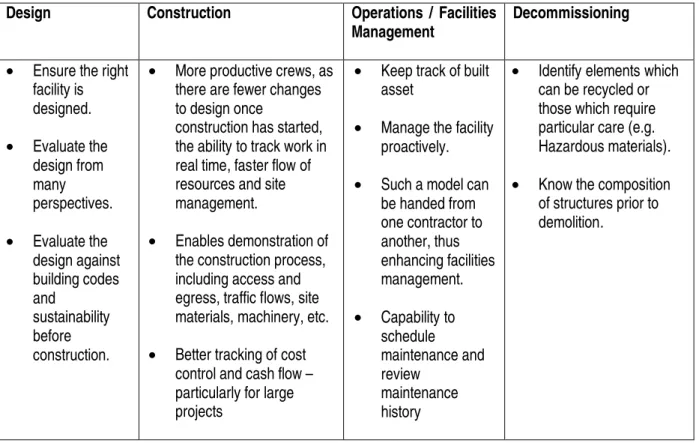
BIM holds the promise of being an important factor in the built asset industry in the future. As shown above, it can facilitate the users of all stages of the built asset life-cycle. It integrates design, engineering, construction maintenance and decommissioning information about a built asset project into a single ‘rich’ model. As such, BIM technology enables the use of 3D built asset models to move beyond the design phase, and into the construction and maintenance phase of the built asset as well as move the 3D model into a 4D simulation. Table 1 summarises these implications.
Table 1 – The application of BIM to various Stages of Construction (adapted and expanded from Hartman and Fischer (2008)2
Design Construction Operations / Facilities
Management
Decommissioning
• Ensure the right facility is designed. • Evaluate the design from many perspectives. • Evaluate the design against building codes and sustainability before construction.
• More productive crews, as there are fewer changes to design once
construction has started, the ability to track work in real time, faster flow of resources and site management.
• Enables demonstration of the construction process, including access and egress, traffic flows, site materials, machinery, etc.
• Better tracking of cost control and cash flow – particularly for large projects
• Keep track of built asset
• Manage the facility proactively.
• Such a model can be handed from one contractor to another, thus enhancing facilities management. • Capability to schedule maintenance and review maintenance history
• Identify elements which can be recycled or those which require particular care (e.g. Hazardous materials).
• Know the composition of structures prior to demolition.
For procurement, BIM offers the opportunity to develop better cost estimates based on actual elements of the built asset, better design and construction processes and methods, and a means to engage the client in the design phase of the built asset (Hartman and Fischer 2008)
Much of the potential for BIM has yet to be realised due to the current level of development. As Ashcraft comments:
2 Hartman and Fischer (2008) also argue that BIM can enhance procurement processes. However procurement could apply to any or all of the construction phases discussed here, so this is issue is addressed section xxx. Likewise Building Smart (2007) argued that BIM had application for increasing the speed of Development Assessment approvals through local councils.
In current practice, BIM is a hybrid, with several differing approaches being used. … Each approach seeks to tighten integration, but the single universal model and perfect interoperability are still aspirations, not achievements (Ashcraft 2006).
While not yet fully developed or applied to its full potential, there have already been instances where BIM or similar systems have been applied in the AEC/FM industry. The next section (Section 2) will deal with the advantages and enablers of BIM for government. This will be followed by Section 3 on the disadvantages and barriers of BIM for government. Section 4 provides a number of recommendations concerning the adoption of BIM by government. At the end of the report Appendix A provides a number of examples of how BIM has been applied in a variety of projects. Appendix B outlines a number of BIM applications developed by the CRC for
Construction Innovation.
2.
Advantages, Enablers and Applications of BIM
BIM is held to offer a range of advantages over hand-drawn or 2D models of built assets, which are discussed in the Section 2.1 below. As suggested in the introduction, BIM has emerged alongside a number of other technological and social accomplishments which have enabled BIM as a technology to be developed, which are discussed in Section 2.2 which follows.
2.1 Advantages of BIM for government
Using a BIM model has a number of advantages over traditional 2D approaches to design and construction. BIM models can enable collaboration between different professionals involved in the design and construction phase of the built asset, and can manage changes to the built asset design so that a change to any part of the built asset model is coordinated in all other parts of the model and underlying database, together with the capability of capturing and preserving information for reuse by additional industry-specific applications (Ashcraft 2006; Emmit and Gorse 2003; Gibson and Davis-Blake 2001; Taylor and Levitt 2007). BIM models can also offer a wealth of information that is generated automatically as the model is created. In turn this information can be used for cost estimating, project planning and control, and eventually for management of the operation and maintenance of the built asset (Salazar et al. 2006). The following benefits of BIM have been identified from the literature, which are explored in detail below:
- Increased utility and speed - Enhanced collaborations - Better data quality - Visualisation of data - Enhanced fault finding
2.1.1
Increased utility and speed
As noted in the introduction, the typical built asset lifecycle consists of four phases. These are the design phase, the construction phase, the management / maintenance phase and the decommissioning phase. In the current general practices, in each of these phases different programs are used. Architects use CAD programmes such as ArchiCAD, Revit , or Bentley Architecture. Engineers use various programs such as revit Structures or Tekla, and the construction sector and the built asset managers usually fall back to 2D blueprints of the built asset. These differences in approaches together with differences in jargon or terminology used can greatly hinder communications and unnecessary increase the time needed to finish the project. The CRC for Construction Innovation (2007) has calculated that the use of BIM can reduce the project time by at least 7%. This is achievable because BIM can offer all the stakeholders in the built asset lifecycle access to critical information, including schedule and budget information, materials quality and costing information, performance, utilization, and financial information (Dubois 2006; Evelyn and Fatt 2005), together with the benefits of off-site manufacture noted earlier.
Design phase
BIM is useful in the design phase where it gives support to the design, scheduling and budgeting of the built asset (Autodesk 2003). Safety and sustainability have become significant public policy issues facing the construction
industry over recent years. As built assets perform a broad social and economic role in our cities, designers are balancing form-making with built asset performance concerns to increase the utility of the built asset. These issues such as life safety, security and sustainability are becoming defining characteristics of quality design in this new realm of performative architecture (Dubois 2006; Evelyn and Fatt 2005). This change in thinking about built assets requires a change in thinking for the designer, and BIM provides a platform to help the designer make this evolution. This process of assistance is described by Ibrahim et al. (2004) as:
Architects do not need to acquire all the needed knowledge as a structural engineer to model the structural systems in a BIM based CAD system, nor all the technical knowledge to detail components that do not affect the final look of the built asset, on the contrary, architects tend to use catalogues of vendors to select components and use the offered details if it is suitable for the job (Ibrahim et al. 2004). The speed of the design phase can be increased using the ‘rich’ database as provided with the BIM as less communication with the engineers is required. It also increases the utility as more features such as safety, sustainability and security become part of the design phase.
Construction phase
BIM is also increasing speed and utility in the construction phase, where it can aid the quality of schedules and cost information (Autodesk 2003; Fallon and Palmer 2007). Using the ‘rich’ database, containing all the structural and information components of the BIM, can not only increase the efficient interaction between the architect and the engineer, but it also increases the interaction between the designers and the contractor. The contractor has access to all the critical information that is needed inside the BIM database. This decreases the time that is needed to get back to the designer on certain parts of the project. It also decreases the time budgets and schedules are re-calculated after changes in the project, allowing the contractor to continue working sooner after said changes. By combining mobile technologies with BIM models, faults and reworking time can be greatly enhanced. A site manager can identify a fault; notify project management of the specific nature and location of the fault, due to the GIS location in the model, which in turn reduces rework time.
Maintenance phase
BIM also increases performance, utilization and financial information (Autodesk 2003; Fallon and Palmer 2007) in the maintenance phase. As all the design and built asset information is still present in the single BIM model, the maintenance manager has easy and quick access to important information during the maintenance phase. For example, when a glass window needs to be replaced, the manager can simply locate the window in the model, read out the specifications of the window, and simply place the order without even having to come into the built asset to measure the window. For infrastructure assets the conditions of various parts of a bridge or tunnel can also be located in a bridge, so that condition monitoring of specific elements is recorded.
Other uses for which BIM could be used include security, emergency evacuation, fire simulation, space management, move management, energy use monitoring, condition monitoring, and comparison of actual building performance against performance predicted in the design phase.
The largest increase in utility and speed can however only be achieved if every link in the cycle cooperates in the process, but when that happens, the implementation of such an organizational boundary spanning information system, as numerous research investigations have proven, are the source for competitive advantage (Taylor and Levitt 2007).
Decommissioning phase
At the end of the built asset life, when it is decommissioned, BIM is useful in supplying the information of the built asset construction, materials and the whole life history. From the BIM dangerous built asset materials like asbestos can be identified, as can any valuable materials used. This readily availability of the data will increase the speed at which the built asset can be decommissioned and will also increase the safety of the decommissioning.
Summary
The advantages of the design and the construction phase indicate that BIM can reduce the start-up time of a project. For government this time saved in starting a new project, translates to reduced costs – both financial and in-kind. Such savings would enhance the ability of government to build sustainable assets and set a great example for industry. Once the BIM model is constructed, the speed and utility of maintaining a built asset is greatly increased. Governments will have to spend less time checking and securing maintenance, as repairs and maintenance are easier performed, and audited. Should maintenance firms be replaced, which often happens in the life time of a built asset, the change in contractors typically means the loss of data on the condition of the asset, particularly if the contractor had been in place for a significant period of time. Having a BIM model means that knowledge of the asset is kept by the client, and easily shared with new contractors or the actions of multiple contractors can be coordinated through the single rich data base model. At the end of life of the built asset the extra speed at which it can be decommissioned safes time, money and reduces environmental damage. There is a key opportunity for government to set a great example for industry and society by operating in an efficient and sustainable manner. The opportunity for increased utility and speed from BIM provides an opportunity for cost savings for government. In order to facilitate such activities policy changes would be needed which trial the implementation of BIM in a number of settings. If these tests validate the use of BIM then consideration concerning the use of BIM across the portfolio of government built assets could be considered.
2.1.2
Better data quality
BIM provides better data quality, guaranteeing a flexible documentation output and full exploitation of available ICT technology. This is possible because BIM data handling is based on three characteristics, namely;
1. To create and operate on digital databases for collaboration
2. To manage change throughout those databases so that a change to any part of the database is coordinated in all other parts
3. To capture and preserve information for reuse by additional industry-specific applications (AIA 1997; Autodesk 2002; CRC for Construction Innovation 2005).
Design phase & construction phase
Better data quality is realized through the underlying basis that BIM uses one singe file on a server. Every user has access to this server at the same time. This means that changes are automatically updated through the model and thereby ensures that every user is working on the latest version of the model. This reduces errors that are prone to arise while using several different versions of a design and trying to manage the updates of the design across multiple sites or copies.
As noted earlier, the 4D BIM models also allow for demonstration of how the construction project would affect traffic flows, access and egress, public transport, and storage of materials on site, and the scheduling of machinery and personnel. This better quality of data – particularly as the data is visual and can be viewed over time, enables better outcomes in the design and construction phase. This potential has been demonstrated in a number of projects. For sub-contractors, the better data quality results in improved off-site manufacturing and fabrication, co-ordination, clash detection, etc.
For example, an ‘Engineers Australia Queensland Division Task Force 2005’ report states that 60 to 90% of all project variations are the result of poor project design documentation. BIM provides a very effective way of significantly improving design and documentation quality (CRC for Construction Innovation 2007). Furthermore, the Stanford University Centre for Integrated Facility Engineering has calculated, based on 32 major projects using BIM, that the following benefits were achieved:
- A 40% elimination of unbudgeted change - Cost estimation accuracy within 3%
- An 80% reduction in the time taken to generate a cost estimate - A saving of 10% of the contract value through clash detection - A 7% reduction in project time
- A return on investment when using a 3D model of 5-10 times (SUCIFE 2007)
Thus, implementation of BIM in the design and construction phase is held to result in significant savings due to better quality data.
Maintenance phase
The additional design, construction and operational information contained in the BIM can be used after the construction in the Facility Management (FM) of the built asset. Having a complete 3D or 4D model of a built asset, which includes all of the elements of a building, their composition and condition, can lead to better management of the asset because all the data created while designing, constructing and maintaining the built asset will be stored in the same file. This also means that the owner of the built asset can easily change from one facility manager to another, as only the BIM needs to be exchanged. eBusiness technologies such as BIM, have the potential to transfer complex design information accurately (Elliman and Pridmore 1999), thereby eliminating data transfer error (NOIE 2001) as well as minimising delays as information is conveyed along the supply chain (Lee and Sexton 2007).
Better data quality in the design, construction and maintenance phase reduces the number of errors made in these phases, resulting in reduced working times, less cost and a higher efficiency. Some estimates suggest that Governments application of BIM in their built asset projects can ultimately achieve a return 5-10 times higher on the investment.
Decommissioning phase
Built assets typically last a significant length of time, and it is rare that the original designers and constructors are available to give advice on the composition of specific building elements – even assuming they could remember something that happened 50 years earlier. A 3D BIM model can serve as a long term repository of information which can greatly assist in the decommissioning phase – particularly the removal of some of the surprises and guess work which can be associated with certain types of asset.
2.1.3
Visualisation of the data
Design phase & construction phase
The 3D visualisation of the model as accomplished by the BIM is an added value for several stages of the built assets lifecycle. In the design phase the “3D visualization leaves little room for misinterpretation by all parties involved and it helps to realign their expectations as compared to what a bar chart schedule can do” (Salazar et al. 2006). An added feature of the BIM is that it can also progress the 3D model over time, creating a 4D simulation. A visualisation of the construction process as a 4D model greatly enhances the understanding of the process and identifies construction issues not only with technical persons, but also non-technical persons can in this way identify themselves with the built asset process and identify possible problems in the built asset process. This is possible because the visualisation may highlight constraints that the client had not made explicit earlier, or were misunderstood.
2.1.4
Enhanced fault finding – clash detection (process and product)
Design phase & construction phase
BIM enhances the fault finding capacity in the project immensely. Because all aspects of a project are driven from a single database or related databases, the project is always up to date. This helps in reducing issues regarding drawing coordination and conflict errors. The key benefit of the single integrated data environment is that integration of information from multiple disciplines creates an accurate geometrical representation of all parts of a built asset (CRC for Construction Innovation 2005).
BIM, as explained earlier, also supports project visualization, simulation and optimization and allows BIM to reduce design conflict issues by integrating all the key systems into the model. Design BIM systems can detect internal conflicts and model viewing systems can detect and highlight conflicts between the models and other information imported into the viewer. The solution can then be checked to ensure that it resolves the problem and to determine if it creates other, unintended, consequences (Ashcraft 2006).
Combined, the single BIM file, with the underlying continuously updated database containing parametric consistency, and the 3D and 4D visualisations, BIM is possible to greatly reduce the changes for errors in the design and construction phases of the built asset construction.
Such fault finding also carries through to the maintenance phase, as the condition of specific building elements can be assessed and recorded, and repairs initiated to specific elements at specific locations.
2.1.5
Enhanced collaborations across discipline and organisation
Design phase & construction phase
BIM helps in analysing built asset proposals, performance benchmarking and enabling improved and innovative solutions as well as quickly performing simulations. BIM is able to perform these functions across multiple stages of the built asset process and across disciplines and organisations. The rich database connected to the boundary objects of the model plays a mediating role to connect the disparate social worlds of the designers and contractors (Taylor and Levitt 2007). Because both designers and contractors use the same model, contractors can act swiftly on engineering problems faced by the designers, and visa versa. Construction firms are able to more clearly articulate their knowledge of constructability issues and request changes to the model that otherwise would have had to be worked out in the field during construction or later ‘with a hammer’ (Taylor and Levitt 2007). Because both designers and constructors have access to the model at the same time, this parallel process allows them to reduce lead times which normally occur in the sending back-and-forth of a paper plan between both groups. In other words, the application of BIM addresses and proposes a solution for the disputes that can arise between the design and construction phase, smoothing out these problems by creating a single digital environment in which both the designer and the constructor know their way around.
There are also certain advantages to a computer model which can be handed on from one contractor to another in contracting-out regimes, the primarily advantage being continuity of available information from one contractor to the next, for example:
In a typical scenario, the architect would extract information from the model for use in calculating a wide range performance characteristic, such as heat/loss gain, day lighting effects, air flow, and egress under emergency conditions, structural performance and financial feasibility. Specialized knowledge would no longer be needed for data input or interpreting of results, creating a closer linkage between analysis and design process (Autodesk 2003)
BIM enables easier calculation of performance characteristics using the built in software and specialised personnel are no longer needed to perform these calculations independent from the design drawings.
A secondary benefit from the implementation of these design programmes is that firms that successfully implemented 3D CAD programmes, have improved collaboration, develop partnerships, or move beyond partnerships to understanding each other’s shared interests as described by Taylor and Levitt: “Finally they [the design and engineering firms] even redistribute work among firms, developed standards for interaction, and developed a system of understanding of the project” (Taylor and Levitt 2007). More design iterations are also possible for comparison, as they provide more feedback and better design solutions to achieve higher performance and conformity to the design brief. For example, improved energy usage, sustainability options and star rating can be enhanced through developing a series of iteration of the building design, which are sequentially tested for performance.
2.1.6
Summary of BIM advantages
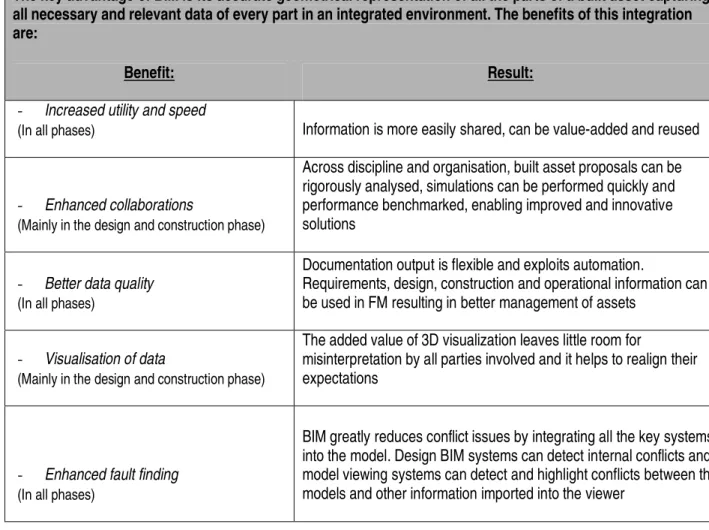
As discussed in the previous section, BIM has several benefits. These benefits are not achieved in all phases of the built asset life-cycle. Although all benefits are applicable for the design and construction phase, the maintenance and decommissioning phase benefit most from the increased speed and utility, better data quality and the visualisation of the data. In table 1 these benefits have been summarised:
Table 2: The benefits of using Business Information Modelling
The key advantage of BIM is its accurate geometrical representation of all the parts of a built asset capturing all necessary and relevant data of every part in an integrated environment. The benefits of this integration are:
Benefit: Result:
- Increased utility and speed
(In all phases) Information is more easily shared, can be value-added and reused
- Enhanced collaborations
(Mainly in the design and construction phase)
Across discipline and organisation, built asset proposals can be rigorously analysed, simulations can be performed quickly and performance benchmarked, enabling improved and innovative solutions
- Better data quality
(In all phases)
Documentation output is flexible and exploits automation.
Requirements, design, construction and operational information can be used in FM resulting in better management of assets
- Visualisation of data
(Mainly in the design and construction phase)
The added value of 3D visualization leaves little room for
misinterpretation by all parties involved and it helps to realign their expectations
- Enhanced fault finding
(In all phases)
BIM greatly reduces conflict issues by integrating all the key systems into the model. Design BIM systems can detect internal conflicts and model viewing systems can detect and highlight conflicts between the models and other information imported into the viewer
Having reviewed the benefits of BIM across the project life cycle, it is appropriate to note some of the factors which are enabling the growth and uptake of the technology.
While some governments have mandated the adoption of BIM, this has been following extensive use of pilot studies which have trialled a number of BIM applications in a number of settings (e.g. GSA in the USA (Dakan 2006). Demonstration projects are likely to be necessary prior to use of other policy instruments such as education, regulation and policy.
2.2 Enablers of BIM
For the implementation of BIM there are have been three major enablers. The first is the advent of enhanced IT infrastructure and capability of computers to develop and display 3D models with underlying large databases. The second enabler is the creation of the Industry Foundation Classes (IFC) by the International Alliance for Interoperability (IAI). The third the increasing world wide support for BIM. These enablers will be explained in detail below.
2.2.1
Increase in computer technology and IT infrastructure
The internet, as a global self-regulated and interconnected network of institutions driven by educational and subsequently commercial priorities, has evolved into an element within a broader "global information society"
(Christopher 2008). The internet is one of the driving forces of globalization, and there is a strong correlation between exporting products and services and internet access at the enterprise level (Clarke 2008). At a practical level, the internet and roll out of high speed broadband across OECD countries has facilitated the exchange and sharing of large files across time and space. This has meant that firms can be separated geographically and operate in separate time zones, and yet the Internet enables these firms to collaborate on major projects. Continuous innovations in internet technology and IT infrastructure have inturn increased the performance of BIM. Additionally enhanced computer capacity in processing power and graphics, storage and memory (Brodlie et al 2005) not to mention better compression algorithms, have meant that larger, more resource intensive files can be created and shared. This enhanced capacity of computers is one of the enablers for BIM technology. The current trend in IT infrastructure, with the latest innovation of fibre optic cables, gives rise to the possibility of sharing ever larger data files among users all over the world. BIM is heavily reliant on this infrastructure, since BIM files are large and need to be accessible at all times. Thus the internet, IT infrastructure and enhanced capacity of computers have all served as enablers of the creation of large, graphical models with huge databases embedded in the models.
The current development of eGovernment systems, can lead to a new organisational architecture and new ways of doing business and delivering services. In the built asset management sector of the government BIM can enhance the facility management for the government. Harris described that the need to deliver services differently the government needs to change the organisation:
In order to deliver a service differently there is often a need to restructure the organisation and to engage in dialogue within the organisation and between organisations. This contact and ‘opening up’ of communication channels and developing co-operative arrangements in itself can lead to further synergies in terms of more information sharing, collaboration and examining new ways to effectively deliver services (Harris and Cornelius 2003).
The widespread adoption of BIM for AEC/FM industry could possibly be the catalyst to speed up this process, as BIM requires the development of new communication channels and co-operative agreements. The OECD sets out its case for eGovernment in terms of efficiency gains (savings in data collection, information provision, communications with clients and transaction costs) and service improvements (improved customer focus for service delivery and increased accessibility to services) (OECD 2003).
Enhanced capability is not enough however. There needs to be specific protocols which enable the sharing of information between firms and software packages. This is discussed next.
2.2.2
buildingSMART (International Alliance for Interoperability)
Interoperability can be described as “the sharing and exchanging of information via integrated technological solutions, no matter what project phase, discipline or participant role in the built asset life cycle” (AIA 1997). Although BIM may be considered as an independent concept, in practice, the business benefits of BIM are dependent on the shared utilisation and value-added creation of integrated model data across multiple firms. To access model data therefore requires an information protocol, and although several vendors have their own proprietary database formats, the only open global standard is that published by buildingSMART called the Industry Foundation Classes (IFC).
There are several reasons for the buildingSMARTto create a global standard for the built asset sector. One of those is the huge added cost of coordination errors. “Effectively, the historic inefficiencies of the built asset process have driven the industry to look at a new approach to the built asset process. According to the Construction Users Roundtable member companies in the US, it is generally accepted that as much as 30% of the cost of construction is wasted in the field due to coordination errors, wasted materials, labour inefficiencies, and other problems” (AGC 2006; CURT 2004).
In addition to that, in 2004, the National Institute of Standards and Technology (NIST) conducted a study on the cost of inadequate interoperability in the United States’ Capital Facilities Industry. The NIST study involved “design, engineering, facilities management, business processes software systems, and redundant paper records management across all facility life-cycle phases. It estimated the cost of inadequate interoperability to be roughly
$15.8 billion per year, and of these costs, two-thirds are borne by owners and operators” (Gallaher, O'Conner, Dettbarn and Gilday 2004).
In order to address this waste of resources, money and time, the IAI is most responsible for promoting interoperability to the AEC/FM industry. buildingSMART is a global, industry-based consortium for AEC and FM. It was formed in 1994 and their mission is “to enable interoperability among industry processes of all different professional domains in AEC/FM projects by allowing the computer applications used by all project participants to share and exchange project information” (Froese and Yu 1999). Originally, buildingSMART’s main objective was to “define, publish and promote specifications for IFC as a basis for project information sharing in the built asset industry” (Bazjanac 2002). buildingSMART currently has more than 400 members in 24 countries and is the leading interoperability organization (Ashcraft 2006).
The integration of the AEC industry and the interoperability of the hundreds of software applications supporting the design and construction of the built environment have been providing one of the most challenging environments for the application of information and communication technologies (Turk, Dolenc, Nabrzyski, Katranuschkov, Balaton, Balder and Hannus 2004 ).
buildingSMART’s stimulus in developing the IFC protocol was the recognition that the greatest problem in the construction industry today is the management of information about the built environment. Although every other business sector has embraced IT and adopted industry specific standards, the construction industry worldwide has stuck to its trade-based roots and dependence on drawings, with a continuing record of poor quality, low investment value and poor financial rewards. (CRC for Construction Innovation 2007)
The Industry Foundation Classes (IFC) are a set of rules and protocols that describe and store built asset information. According to Howell and Batcheler (2005), the “effort to define a single built asset model as one authoritative semantic definition of built asset elements, their properties and inter-relationships” has been largely successful. Bazjanac (2004) describes IFC as “the first open object oriented comprehensive data model of built asset that provides rules and protocols for definitions that span the entire life of a built asset”. IFC are also the only such model that is an international standard (ISO/PAS 16739). Presently IFC are the only non-proprietary intelligent, comprehensive and universal data model of built assets (Bazjanac 2004).
The creation and existence of these Industry Foundation Classes, and the increasingly wide spread use of them throughout the industry enable the implementation of BIM in the built asset sector. When all the sectors of the built asset industry are using IFCs as the standard protocol, the sharing of data, as required by BIM is increasingly easier and barriers due to incompatibility of standards and protocols are reduced.
Capability of software and hardware to undertake a specific task, to a certain level of performance, is important. Demand for hardware and software that can perform these tasks is what will ensure there is continued investment in the hardware and software which make this possible. Some government organisations have mandated the use of IFCs, such as Finland and the United States of America.
2.2.3
Increasing World Wide Support for BIM
There is an increasing world wide support for BIM. According to a 2006 survey conducted by the American Institute of Architects (AIA), 16% of AIA member-owned architecture firms have acquired BIM software, and 64% of these firms are using BIM for billable work (Riskus 2007). The same survey found that “35% of the AIA member-owned firms with an international scope of practice have acquired BIM software, which may be at least partially due to the fact that firms with an international scope tend to be large in terms of staff and billings, and may also be working on large projects. But BIM may also simplify overseas projects, as it allows for easy transmission of detailed information quickly over long distances” (Riskus 2007). As more and more companies start using BIM as the built asset designing and modelling standard, other companies will be forced to follow, to keep a competitive advantage and to remain interesting as partners for larger firms that require their sub-contractors to use BIM as well.
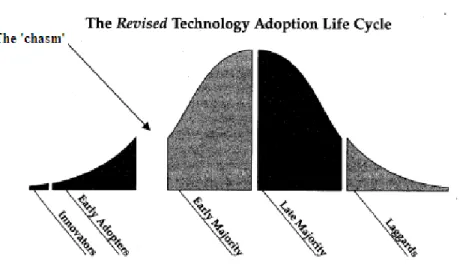
Pragmatically, the number of firms using BIM is quite low, and this may have to do with the adoption cycle of any new technology. Moore (1999) provides a useful insight into this by arguing that there is a gap between the early adopters of a new technology and the adoption by the majority of the field. It is in this gap that many innovations fail or falter.