R E S E A R C H
Open Access
Synchronization of fractional chaotic
systems based on a simple Lyapunov function
Tianzeng Li
1,2*, Yu Wang
1,3and Chao Zhao
4*Correspondence: [email protected] 1School of Mathematics and Statistics, Sichuan University of Science and Engineering, Zigong, 643000, China
2Artificial Intelligence Key Laboratory of Sichuan Province, Zigong, 643000, China Full list of author information is available at the end of the article
Abstract
In this paper the synchronization of fractional-order chaotic systems and a new property of fractional derivatives are studied. Then we propose a new fractional-order extension of Lyapunov direct method to control the fractional-order chaotic systems. A new synchronization method and a linear feedback controller are given to achieve the synchronization of fractional-order chaotic systems based on a simple Lyapunov candidate function. The proposed synchronization method can be applied to the synchronization of an arbitrary fractional-order chaotic system. This method is universal, simple, and theoretically rigorous. Numerical simulations of three
fractional-order chaotic systems to verify the effectiveness and the universality of the proposed method.
Keywords: Lyapunov function; fractional order; synchronization; chaos
1 Introduction
Fractional calculus is a topic of more than years old. The idea of fractional calculus has been known since the regular calculus, with the first reference probably being asso-ciated with Leibniz and L’Hospital in where a half-order derivative was mentioned. As the generalization of integer-order dynamic systems, the fractional-order dynamic tems provide better mathematical models for some actual physical and engineering sys-tems [, ]. The fractional-order nonlinear dynamic syssys-tems have many dynamic behaviors which are similar to the integer-order systems, such as chaos, bifurcation, and attractor [–]. The fractional-order chaotic systems are extensively studied due to their poten-tial applications in biology, information, chemistry, physics, and other fields [–]. We can find numerous applications in electrochemistry, viscoelasticity, porous media, con-trol, and electromagnetics [–].
As is well known, synchronization control of chaos is very important but also very difficult for the chaotic systems. There are some methods which are proposed to con-trol fractional-order chaotic systems [, –], such as backstepping concon-troller [], lin-ear feedback controller [], the Lyapunov equation-based method [, ], sliding mode method [], the iterative learning control method [–] and the monotone iterative method [, ]. In most of these cases, the stability of the whole controlled system has to be analyzed using the fractional-order techniques as well. For the fractional-order lin-ear time invariant systems, the stability can easily be proved using the method proposed by Matignon []. The stability of a fractional-order nonlinear time varying system was
proposed by Diethelm [], but the result is valid only for scalar fractional-order systems. Hence, in order to prove the stability of fractional-order nonlinear and time varying sys-tems, some other methods must be applied. The important one of these methods is the fractional-order extension of the Lyapunov direct method, which was proposed by Liet al.[]. And in [] the authors proposed the Lyapunov direct method to prove the sta-bility of fractional-order nonlinear system with time delay. As is well known, it is difficult to find a suitable Lyapunov candidate function to prove the stability of fractional systems. Some authors have presented Lyapunov functions to prove the stability of fractional-order systems [, ]. And some Lyapunov functions have been proposed related to fractional-order sliding mode control []. However, we find that the Lyapunov functions which were proposed in these papers are not simple, and they are valid for fractional-order system with specific characteristics.
In this paper, we first propose a new property of fractional-order derivatives which can help us find a simple Lyapunov function. Then we propose a new fractional-order ex-tension of Lyapunov direct method and a control method for synchronizing an arbitrary fractional-order chaotic system. Some sufficient conditions of synchronization for the fractional-order chaotic systems are proposed based on a simple Lyapunov function. The proposed approach is simple, universal and theoretically rigorous. Numerical simulation results of the synchronization of the fractional-order unified system, the fractional-order Liu’s system, and the fractional-order Lorenz system demonstrate the effectiveness and the universality of the proposed method.
This paper is organized in the following manner: In Section the preliminaries and some definitions are presented. Some synchronization criteria of fractional-order chaotic systems are proposed in Section . In Section , numerical simulation of three fractional chaotic systems shows the effectiveness and the universality of the control method. Finally, conclusions are in Section .
2 Preliminaries and definitions
2.1 Fractional derivative and numerical solution of differential equation
In the last decades, fractional calculus has been the subject of worldwide attention due to its broad range of applications in many fields, which indicates that it is an important role in modern science [, ]. Some definitions for fractional derivatives were studied in recent years. In this paper, two commonly used definitions of fractional derivatives, the Riemann-Liouville (RL) and the Caputo definition (C), are given as follows.
Definition ([, ]) The fractional integralaD–αt of the functionf(t) is given as follows:
aD–αt f(t) =
(α)
t
a
(t–τ)α–f(τ)dτ, ()
where the fractional orderα> and(z) =∞tz–e–tdtis the gamma function.
Definition ([, ]) The Caputo derivative of the functionf(t) with orderαis defined as
C aD
α
tf(t) =aD–(t n–α)
dn dtnf(t) =
(n–α)
t
a
(t–τ)n–α–f(n)(τ)dτ, ()
Definition ([, ]) The Riemann-Liouville derivative of the functionf(t) with orderα
As is well known, various numerical methods have been applied to solve the fractional-order equation, such as the power series method [], the Millin transform method [], and the GMMP scheme (Gorenflo-Mainardi-Moretti-Paradisi) []. In this section, we adopt the improved version of Adams-Bashforth-Moulton algorithm [, ] to numerically solve the fractional differential equations, which is proposed based on the predictor-correctors scheme. For explaining this method, the following differential equation is considered:
Dαty(t) =f
t denotes the fractional derivative of the Caputo (or Riemann-Liouville)
defini-tion. Equation () is equivalent to the Volterra integral equation:
y(t) =
The error of this approximation is given as follows:
2.2 Some properties of the fractional derivative
In this paper we mainly consider the fractional order of the chaotic system to be <α< . Then some general properties of the fractional-order derivativeaDαt (Riemann-Liouville
and Caputo definition) are described as follows [, ].
Property (Leibniz rule for fractional differentiation [, ]) The Leibniz rule for fractional differentiation is defined by
aDαt
iff(t) andϕ(t) and all their derivatives are continuous in the interval [a,t].
In the following, two new properties of fractional-order derivatives is proposed, which can help us find a simple Lyapunov function.
Property (Caputo definition C
aDαt) Letx(t) = (x(t), . . . ,xn(t))T ∈Rnhave continuous
derivatives in [a,t], for any positive definite matrixP, then
C
aDαt denotes the Caputo fractional derivative.
Proof Firstly, let
then proving that equation () is true is equivalent to proving that
f(t) =
Due to the Caputo definition (), the function () can be written as
Let us integrate by parts equation (), the functionf(t) can be rewritten as Let us check the first term of equation (), which has an indetermination atτ=t, then we can analyze the corresponding limitation by the L’Hopital rule. We have
lim
And the matrixPis positive definite, then
yT(a)Py(a)
Property (Riemann-Liouville definitionRaDα
t) Letx(t) = (x(t), . . . ,xn(t))T∈Rnhave a
continuous derivatives in [a,t], for any positive definite matrixP, then
R
aDαt denotes the Riemann-Liouville fractional derivative.
Proof Firstly, let
then proving that equation () is true is equivalent to proving that
f(t) =
Due to the Riemann-Liouville definition (), the function () can be written as
Let
Let us integrate by parts equation (), the functiong(t) can be rewritten as
g(t) = Let us check the first term of equation (), which has an indetermination atτ=t, then we can analyze the corresponding limitation by the L’Hopital rule:
lim
And the matrixPis positive definite, then
xT(a)Px(a)
2.3 Stability of fractional-order system
The fractional-order nonlinear system is given as
Dαtx(t) =ft,x(t), x() =c, ()
wheref= (f,f, . . . ,fn)T is a vector function andfi(i= , , . . . ,n) is continuous
differen-tial nonlinear functions;αis the fractional order of the derivative;x(t) = (x(t),x(t), . . . , xn(t))T ∈ Rn; x() = (c,c, . . . ,cn)T is the initial value; Dαt denotes the Caputo (or
Riemann-Liouville) fractional-order derivative operator. The equilibrium points of this system are calculated by solvingf(x∗) = . For this fractional-order nonlinear system, the fractional-order extension of Lyapunov direct method has been proposed, which is ob-tained as follows [].
Theorem Letx= be an equilibrium point for the nonautonomous fractional-order system().Assume that there exists a Lyapunov function V(t,x(t))and class-K functions
αi(i= , , )satisfying
αx(t)≤V
t,x(t)≤αx(t), ()
DβtV
t,x(t)≤–αx(t), ()
whereβ∈(, ).Then the equilibrium point of system()is asymptotically stable. In the following, based on the fractional-order extension of the Lyapunov direct method and the new property of fractional derivatives, we will find a suitable Lyapunov function and propose the stability condition of the fractional chaotic system.
Theorem Take the fractional-order system
Dαtx(t) =fx(t), ()
whereα∈(, )andDαt denotes the Caputo(or Riemann-Liouville)derivative.Without loss of generality,letx∗= be the equilibrium point andx(t)∈Rn.If there exists a positive
definite matrix P,which satisfies
xT(t)Pfx(t)≤, ()
then the origin of the system()is asymptotically stable.
Proof SincePis a positive definite matrix, we introduce a Lyapunov function
Vx(t)= x
T(t)Px(t). ()
It follows from Property and Property that
And sincexT(t)Pf(x(t))≤, the fractional-order derivative of the Lyapunov function is
negative definite. Using the relation between positive definite functions and class-K func-tions in [], it follows from Theorem that the origin of the system () is asymptotically
stable.
3 Synchronization of fractional-order chaotic system
In the following, we would give the synchronization criterion of the fractional-order chaotic system. Firstly we rewrite the fractional-order chaotic system () as follows:
Dαtx(t) =fx(t)=Ax(t) +gx(t)x(t), ()
whereAx(t) is the linear part of system (),g(x(t))x(t) is the nonlinear part of system (). This way of writing is very general and almost all fractional-order chaotic system can be written in the form (). We consider the system () as the drive system, then the response system is given as
Dαty(t) =fy(t)=Ay(t) +gy(t)y(t). ()
To realize the synchronization of two system () and (), we add a linear feedback control input to the response system (). It is well known that the linear controller has many advantages: () it is very simple; () it is easily realized experimentally; () it is more suitable for engineering applications than other controllers.
Hence the controlled response system () with the linear feedback control input is given as
Dαty(t) =Ay(t) +gy(t)y(t) –Ky(t) –x(t), ()
where K(y(t) –x(t)) is the linear feedback control input, and the feedback gain matrix K∈Rn×nneeds to be determined.
Let the synchronization errore(t) =y(t) –x(t), the error system from () and () is obtained:
Dαte(t) =fy(t)–fx(t)=Ae(t) +Bx,ye(t) –Ke(t), ()
whereBx,yis a bounded matrix with its elements depending onxandy.
Then we can easily see that systems () and () are synchronized if and only if the error system () is asymptotically stable at the origin. Therefore, our aim is to design a suitable feedback gain matrixKsuch that the error system () is asymptotically stable.
Theorem The controlled fractional-order error system()is asymptotically stable at the origin,i.e. the systems()and()are asymptotically synchronized,if the feedback gain matrix K makes the symmetric matrix
S=(PA+PBx,y–PK)
T+ (PA+PB
x,y–PK)
()
Proof For the controlled error system (), we introduce the Lyapunov function
V(e) = e
T(t)Pe(t), ()
wherePis a positive definite matrix. It follows from Properties , that
DαtV(e) =
D
α
t
eT(t)Pe(t)
≤eT(t)PDαte(t)
=eT(t)PAe(t) +Bx,ye(t) –Kx(t)
=eT(t)(PA+PBx,y–PK)e(t)
=xT(t)Sx(t), ()
where
S=(PA+PBx,y–PK)
T+ (PA+PB
x,y–PK)
()
is a symmetric matrix. IfSis negative definite for allx(t) andy(t), we have
DαtV(e)≤eT(t)Se(t) < . ()
It follows from Theorem that the controller can make the error system asymptotically stable at the origin,i.e.the systems () and () are asymptotically synchronized.
In this paper, we mainly consider the synchronization of fractional-order chaotic system. It is well known thatx(t) is bounded for the fractional-order chaotic system (). It implies that there is a constant matrixC, satisfying
eT(t)Bx,ye(t)≤eT(t)Ce(t). ()
Hence, we can give some corollaries which are simpler than Theorem .
Corollary The controlled fractional-order error system()is asymptotically stable at the origin,i.e. the systems()and()are asymptotically synchronized,if the feedback gain matrix K makes the matrix
S=(PA+PC–PK)
T+ (PA+PC–PK)
()
negative definite,where P is a positive definite and C is defined as().
This corollary can easily be proved by Theorem and inequality ().
If the positive definite matrix isP=I, the constant matrixC=cIand the feedback gain matrixK=kI, whereIis identity matrix, the following corollary can be obtained.
gain matrix K=kI makes the matrix
S=A
T+A
+ (c–k)I ()
negative definite.Particularly,letλmaxbe the maximal eigenvalue of the matrix A
T+A
,if K=kI satisfies
λmax+c–k< , ()
the controlled error system()is asymptotically stable at the origin.
Remark In these corollaries, these synchronization criteria are sufficient conditions for the synchronization of the fractional chaotic system. In the application, we only choose the feedback gain matrixK=kI, which satisfiesk>λmax+c, then the controller can make
the error system () asymptotically stable at the origin,i.e.it makes the systems () and () synchronize. This method is simple and universal.
Remark In Corollary , we suppose that the constant matrix isC=cIand the feedback gain matrix isK=kI, then the conclusion is obtained. If we suppose thatCandK are diagonal matrices,i.e. C=diag(c,c,c) andK=diag(k,k,k). According to Theorem and Corollary , we must find a suitablekiwhich satisfies the condition. In many cases,
somekiandciare equal to zero, which makes the linear controller simpler.
4 Simulation and analysis
In this section, three D fractional-order chaotic systems are used as examples to show the validity and effectiveness of the synchronization criterion. For the fractional-order error system in the form (), by adding a linear controller and letting the feedback gain matrix satisfy the conditions of Corollary , the error system can be stabilized to the equilibrium point,i.e.the drive system and response system are asymptotically synchronized.
4.1 Synchronization of the fractional-order unified system
Lüet al.introduced the unified system [] in , which can unify the Chen, Lü and Lorenz system. Its fractional expression is given as follows [, ]:
Dαtx= (a+ )(x–x),
Dαtx= ( – a)x+ (a– )x–xx,
Dαtx=xx– (a+ )/x,
()
F
igur
e
1
C
haotic
attr
ac
to
rs
in
the
fr
a
c
tional-or
der
u
nified
sy
st
e
m
w
ith
α
=0
.9
.
The
p
anels
(a)
,
(b
)
,
(c)
and
(d)
show
the
x2
–
x1
,
x3
–
x1
,
x3
–
x2
and
3
D
views
,r
espec
tiv
ely
The fractional-order chaotic system () can be rewritten in the form of () as a drive system
Dαtx(t) =Ax(t) +gx(t)x(t), ()
where
A=
⎛ ⎜ ⎝
–
–
⎞ ⎟
⎠, gx(t)=
⎛ ⎜ ⎝
–x x
⎞ ⎟
⎠. ()
The controlled response system () can be rewritten in the form ()
Dαty(t) =Ay(t) +gy(t)y(t) –Ky(t) –x(t). ()
According to systems () and (), the controlled error system is obtained
Dαte(t) =Ae(t) +Bx,ye(t) –Ke(t), ()
whereBx,yis a bounded matrix with its elements depending onxandy.
Since the fractional system is chaotic, x(t) is bounded. Then we can easily obtain
eT(t)B
x,ye(t) =xee–xee< eT(t)e(t) by calculating the eigenvalue of maximum,
which impliesc≈. According to Corollary , if the matrixS=AT+A+ (c–k)Iis nega-tive posinega-tive, the error system () is asymptotically stable,i.e.the systems () and () are asymptotically synchronized. And we can easily see that the maximal eigenvalue of matrix AT+A isλmax≈. So if the feedback gain matrixK=kIsatisfiesk> , the error
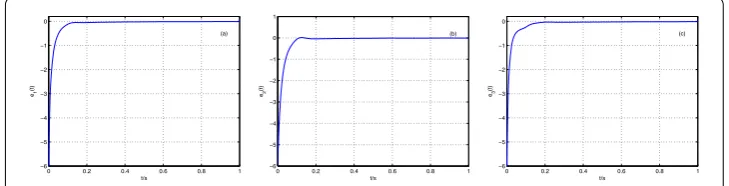
system is asymptotically stable at the origin. When selectingk= , the numerical results, illustrated in Figure , show that the fractional-order error system () is driven to its equi-librium point (, , ) asymptotically ast→ ∞, which implies that the drive system () and response system () are synchronized.
4.2 Synchronization of the fractional-order Liu system
Liuet al.introduced a three dimensional chaotic system in , which is called Liu’s system []. Gejji and Bhalekar [] studied the fractional-order chaotic Liu system, which
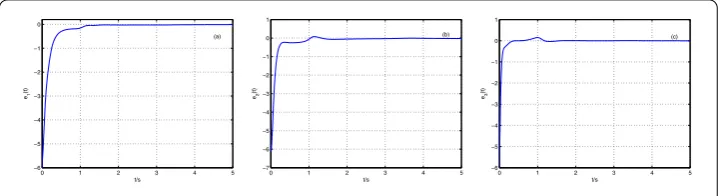
Figure 2 Time waveforms of synchronization errorse1(a),e2(b) ande3(c) between two
is described as
Dαtx(t) = –ax–ex,
Dαtx(t) =bx–kxx,
Dαtx(t) = –cx+mxx,
()
where a,b,c,e,k,m∈ R. Its parameters are chosen as a=e = , b = ., k=m= , c= , the system has five equilibrium points. Two of them are complex and three are real equilibriums (, , ), (–., ., –.) and (–., –., –.). On selecting the orderα= . and initial value (, , ), the system () has chaotic behaviors, which is shown in Figure .
The fractional-order chaotic Liu’s system () can be rewritten in the form of () as a drive system
Dαtx(t) =Ax(t) +gx(t)x(t), ()
where
A=
⎛ ⎜ ⎝
–a
b
–c
⎞ ⎟
⎠, gx(t)=
⎛ ⎜ ⎝
–ex
–kx
mx
⎞ ⎟
⎠. ()
The controlled response system () can be rewritten in the form ()
Dαty(t) =Ay(t) +gy(t)y(t) –Ky(t) –x(t). ()
According to the systems () and (), the controlled error system is obtained:
Dαte(t) =Ae(t) +Bx,ye(t) –Ke(t), ()
whereBx,yis a bounded matrix with its elements depending onxandy.
Since the fractional system is chaotic, x(t) is bounded. Then we can easily obtain
eT(t)Bx,ye(t) = –(x+x+y)ee+xee< .eT(t)e(t) by calculating the eigenvalue of
maximum. It impliesc= .. According to Corollary , if the matrixS=AT+A+ (c–k)Iis negative positive, the error system () is asymptotically stable,i.e.the systems () and () are asymptotically synchronized. And we can easily see that the maximal eigenvalue of matrix AT+Aisλmax= .. Hence, if the feedback gain matrixK=kIsatisfiesk> , the
F
igur
e
3
C
haotic
attr
ac
to
rs
in
the
fr
a
c
tional-or
der
L
iu
’s
sy
st
em
with
α
=0
.9
4
.
The
p
anels
(a)
,
(b
)
,
(c)
and
(d)
show
the
x2
–
x1
,
x3
–
x1
,
x3
–
x2
and
3
D
views
,r
espec
tiv
ely
Figure 4 Time waveforms of synchronization errorse1(a),e2(b) ande3(c) between two
fractional-order Liu systems.
4.3 Synchronization of the fractional-order Lorenz system
Lorenz introduced an integer-order dynamical system in , which is call Lorenz system. It can be described as follows []:
˙
x=a(x–x),
˙
x=cx–xx–x,
˙
x=xx–bx.
()
When the parameters are chosen asa= ,b= / andc= , this system () exhibits a chaotic behavior. Grigorenko and Grigorenko [] studied the fractional version of this system which is given by
Dαtx=a(x–x),
Dαtx=cx–xx–x,
Dαtx=xx–bx,
()
whereα is the order of fractional derivative. With the orderα= . and initial value (., ., .), the system can generate chaotic behavior, as shown in Figure .
The fractional-order chaotic system () can be rewritten in the form of () as a drive system
Dαtx(t) =Ax(t) +gx(t)x(t), ()
where
A=
⎛ ⎜ ⎝
–a a
c –
–b
⎞ ⎟
⎠, gx(t)=
⎛ ⎜ ⎝
–x x
⎞ ⎟
⎠. ()
The controlled response system () can be rewritten in the form of ()
Dαty(t) =Ay(t) +gy(t)y(t) –Ky(t) –x(t). ()
According to systems () and (), the controlled error system is obtained
F
igur
e
5
C
haotic
attr
ac
to
rs
in
the
fr
a
c
tional-or
der
L
or
enz
sy
st
e
m
w
ith
α
=
0
.995
.
The
p
anels
(a)
,
(b
)
,
(c)
and
(d)
show
the
x2
–
x1
,
x3
–
x1
,
x3
–
x2
and
3
D
views
,r
espec
tiv
ely
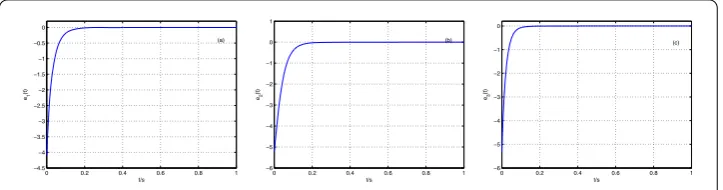
Figure 6 Time waveforms of synchronization errorse1(a),e2(b) ande3(c) between two
fractional-order Lorenz systems.
whereBx,yis a bounded matrix with its elements depending onxandy.
Since the fractional system is chaotic, x(t) is bounded. Then we can easily obtain
eT(t)B
x,ye(t) = –xee+xee≤eT(t)e(t) by numerical simulation,i.e. c≈. Hence,
according to Corollary , if the matrixS= AT+A+ (c–k)Iis negative positive, the error system () is asymptotically stable,i.e.the systems () and () are asymptotically syn-chronized. And we can easily see that the maximal eigenvalue of matrixAT+Aisλmax≈.
So if the feedback gain matrixK=kIsatisfiesk> , the system is asymptotically stable at the origin. When selectingk= , the numerical results, illustrated in Figure , show that the fractional-order unified system is driven to its equilibrium point (, , ) asymp-totically ast→ ∞, which implies that the drive system () and response system () are synchronized.
5 Conclusion
In this letter we proposed a new synchronization method for fractional-order chaotic sys-tems based on a simple Lyapunov function. We also proposed some sufficient conditions of synchronization for the fractional-order chaotic systems. The proposed method is simple, universal and theoretically rigorous. Furthermore, we have implemented and verified our method for other fractional-order chaotic systems [, –], namely the Lü chaotic sys-tem, the fractional-order Newton-Leipnik syssys-tem, the Rössler syssys-tem, financial systems, etc. The numerical simulation results also indicate that the proposed controller can effec-tively make the fractional-order chaotic systems synchronized, and the proposed method provides a theoretical basis for the applications of synchronization method in fractional-order dynamic systems. In future work as regards this topic, we will consider whether the proposed synchronization method can be extended to control other complex chaotic sys-tems, such as the networked fractional chaotic systems [, ] and fractional multi-scroll chaotic systems [].
Acknowledgements
This work is partly supported by Natural Science Foundation of China (No. 11501390, 61573010), Sichuan Youth Science & Technology Foundation (No. 2016JQ0046), Artificial Intelligence Key Laboratory of Sichuan Province (No. 2016RYJ06), Found of Sichuan University of Science and Engineering (No. 2016RCL33, 2015RC10), the Opening Project of Sichuan Province University Key Laboratory of Bridge Non-destruction Detecting and Engineering Computing (No. 2015QYY01), Opening Project of Key Laboratory of Higher Education of Sichuan Province for Enterprise Informationalization and Internet of Things (No. 2016WYJ04).
Competing interests
The authors declare that they have no competing interests.
Authors’ contributions
Author details
1School of Mathematics and Statistics, Sichuan University of Science and Engineering, Zigong, 643000, China.2Artificial Intelligence Key Laboratory of Sichuan Province, Zigong, 643000, China. 3Key Laboratory of Higher Education of Sichuan Province for Enterprise Informationalization and Internet of Things, Zigong, 643000, China.4Sichuan Province University Key Laboratory of Bridge Non-destruction Detecting and Engineering Computing, Zigong, 643000, China.
Publisher’s Note
Springer Nature remains neutral with regard to jurisdictional claims in published maps and institutional affiliations.
Received: 26 April 2017 Accepted: 10 August 2017
References
1. Podlubny, I: Fractional Differential Equations. Academic Press, New York (1999)
2. Petras, I: Fractional-Order Nonlinear Systems: Modeling, Analysis and Simulation. Higher Education Press, Beijing (2011)
3. Ahn, HS, Chen, YQ: Necessary and sufficient stability condition of fractional-order interval linear systems. Automatica
44, 2985-2988 (2008)
4. Liu, CX, Liu, L: A novel four-dimensional autonomous hyperchaotic system. Chin. Phys. B18, 2188-2193 (2009) 5. Li, CG, Chen, GR: Chaos in the fractional order Chen system and its control. Chaos Solitons Fractals22, 549-554 (2004) 6. Yang, NN, Liu, CX, Wu, CJ: A hyperchaotic system stabilization via inverse optimal control and experimental research.
Chin. Phys. B19, 1005021-1005028 (2010)
7. Ge, ZM, Jhuang, WR: Chaos control and synchronization of a fractional order rotational mechanical system with a centrifugal governor. Chaos Solitons Fractals33, 270-289 (2007)
8. Zhong, QS: Impulsive control for fractional-order chaotic systems. Chin. Phys. Lett.25, 2812-2815 (2008)
9. Huang, LL, He, SJ: Stability of fractional state space system and its application to fractional order chaotic system. Acta Phys. Sin.60, 0447031 (2011)
10. Bai, ZB, Dong, XY, Yin, C: Existence results for impulsive nonlinear fractional differential equation with mixed boundary conditions. Bound. Value Probl.2016, 63 (2016)
11. Bai, ZB: Solvability for a class of fractional m-point boundary value problem at resonance. Comput. Math. Appl.62, 1292-1302 (2011)
12. Bai, ZB, Zhang, YH: The existence of solutions for a fractional multi-point boundary value problem. Comput. Math. Appl.60, 2364-2372 (2010)
13. Bai, ZB, Qiu, TT: Existence of positive solution for singular fractional differential equation. Appl. Math. Comput.215, 2761-2767 (2009)
14. Bai, ZB: On solutions of some fractional m-point boundary value problems at resonance. Electron. J. Qual. Theory Differ. Equ.2010, 37 (2010)
15. Ahmad, WM, El-Khazali, R, Al-Assaf, Y: Stabilization of generalized fractional order chaotic systems using state feedback control. Chaos Solitons Fractals22, 141-150 (2004)
16. Li, CG, Chen, GR: Chaos in the fractional order Chen system and its control. Chaos Solitons Fractals22, 549-554 (2004) 17. Zhang, RX, Yang, SP: Chaos in the fractional-order conjugate Chen system and its circuit emulation. Acta Phys. Sin.58,
29571-29576 (2009)
18. Li, XP, Lin, XY, Lin, YQ: Lyapunov-type conditions and stochastic differential equations driven by G-Brownian motion. J. Math. Anal. Appl.439, 235-255 (2016)
19. Wang, JR, Zhou, Y: Analysis of nonlinear fractional control systems in Banach spaces. Nonlinear Anal., Theory Methods Appl.74, 5929-5942 (2011)
20. Yu, XL, Debbouche, A, Wang, JR: On the iterative learning control of fractional impulsive evolution equations in Banach spaces. Math. Methods Appl. Sci.38, 3726 (2015)
21. Liu, SD, Debbouche, A, Wang, JR: On the iterative learning control for stochastic impulsive differential equations with randomly varying trial lengths. J. Comput. Appl. Math.312, 47-57 (2017)
22. Bai, ZB, Zhang, S, Sun, SJ, Yin, C: Monotone iterative method for a class of fractional differential equations. Electron. J. Differ. Equ.2016, 1 (2016)
23. Bai, ZB: Eigenvalue intervals for a class of fractional boundary value problem. Comput. Math. Appl.64, 3253-3257 (2012)
24. Matignon, D: Représentations en variables détat de modéles de guides dondes avec dérivation fractionnaire. Ph.D. thesis, Université Paris (1994)
25. Diethelm, K: The Analysis of Fractional Differential Equations. Springer, Berlin (2004)
26. Li, Y, Chen, Y, Podlubny, I: Stability of fractional-order nonlinear dynamic systems: Lyapunov direct method and generalized Mittag Leffler stability. Comput. Math. Appl.59, 1810-1821 (2010)
27. Wang, Y, Li, TZ: Stability analysis of fractional-order nonlinear systems with delay. Math. Probl. Eng.2014, 3012351-3012359 (2014)
28. Lakshmikantham, V, Leela, S, Sambandham, M: Lyapunov theory for fractional differential equations. Commun. Appl. Anal.12, 365-376 (2008)
29. Lakshmikantham, V, Leela, S, Vasundara Devi, SJ: Theory of Fractional Dynamic Systems. Cambridge Scientific Publishers, Cambridge (2009)
30. Burton, TA: Fractional differential equations and Lyapunov functionals. Nonlinear Anal., Theory Methods Appl.74, 5648-5662 (2011)
31. Gorenflo, R, Mainardi, F, Moretti, D, et al.: Time fractional diffusion: a discrete random walk approach. Nonlinear Dyn.
29, 129-143 (2002)
32. Tavazoei, MS, Haeri, M: A necessary condition for double scroll attractor existence in fractional-order systems. Phys. Lett. A367, 102-113 (2007)
34. Lü, JH, Chen, GR: A new chaotic attractor coined. Int. J. Bifurc. Chaos12, 659-662 (2002)
35. Wang, XJ, Li, J, Chen, GR: Chaos in the fractional order unified system and its synchronization. J. Franklin Inst.345, 392-401 (2008)
36. Li, TZ, Wang, Y, Luo, MK: Control of chaotic and hyperchaotic systems based on a fractional order controller. Chin. Phys. B23, 0805011 (2014)
37. Liu, C, Liu, L, Liu, T: A novel three-dimensional autonomous chaos system. Chaos Solitons Fractals39, 1950-1958 (2009)
38. Gejji, VD, Ou, CY: Chaos in a fractional order modified Duffing system. Chaos Solitons Fractals34, 262-291 (2007) 39. Lorenz, EN: Deterministic nonperiodic flow. J. Atmos. Sci.20, 130-141 (1963)
40. Grigorenko, I, Grigorenko, E: Chaotic dynamics of the fractional Lorenz system. Phys. Rev. Lett.91(3), 0341011 (2003) 41. Rössler, OE: An equation for hyperchaos. Phys. Lett. A71, 155-157 (1979)
42. Oustaloup, A, Sabatier, J, Lanusse, P: From fractal robustness to the CRONE control. Fract. Calc. Appl. Anal.2, 1-30 (1999)
43. Li, TZ, Wang, Y, Yong, Y: Designing synchronization schemes for fractional-order chaotic system via a single state fractional-order controller. Optik125, 6700-6705 (2014)
44. Wang, Z, Huang, X, Shi, GD: Analysis of nonlinear dynamics and chaos in a fractional order financial system with time delay. Comput. Math. Appl.62, 1531-1539 (2011)
45. Chen, Y, Lü, JH, Lin, ZL: Consensus of discrete-time multi-agent systems with transmission nonlinearity. Automatica
49, 1768-1775 (2013)
46. Wang, Y, Li, TZ: Synchronization of fractional order complex dynamical networks. Physica A428, 1-12 (2015) 47. Lü, JH, Chen, GR: Generating multiscroll chaotic attractors: theories, methods and applications. Int. J. Bifurc. Chaos16,