Any correspondence concerning this service should be sent to the repository administrator:
[email protected]
To link to this article
: DOI:
10.2514/6.2016-3052
URL :
https://doi.org/10.2514/6.2016-3052
This is an author-deposited version published in:
http://oatao.univ-toulouse.fr/
Eprints ID: 18308
To cite this version: Ansaldi, Tobias
and Airiau, Christophe
and
Pérez Arroyo, Carlos and Puigt, Guillaume
PSE-based sensitivity analysis
of turbulent and supersonic single stream jet.
(2016) In: 22nd
AIAA/CEAS Aeroacoustics Conference, 30 May 2016 - 1 June 2016
(Lyon, France)
O
pen
A
rchive
T
oulouse
A
rchive
O
uverte (
OATAO
)
OATAO is an open access repository that collects the work of Toulouse
researchers and makes it freely available over the web where possible.
PSE-based sensitivity analysis of turbulent and
supersonic single stream jet
Tobias Ansaldi
∗∗and Christophe Airiau
†,
Institut de M´ecanique des Fluides de Toulouse, UMR 5502 CNRS/INPT-UPS,
Universit´e de Toulouse, All´ee du Professeur Camille Soula, F31400 Toulouse, France
Carlos P´
erez Arroyo
‡and Guillaume Puigt
CERFACS, Computational Fluid Dynamics, 42 avenue Coriolis, F31057 Toulouse CEDEX, France.
Reducing noise emission from jet is a major topics of aeroacoustics. Recently, it has been shown that the large coherent structures of a turbulent single-stream jet, which are parts of the noise generation mechanisms, can be interpreted as instability of the mean turbulent flow, especially in the region of the potential core. Reducing noise will be probably only achieved with some new control strategy on the underlying physics of the acoustic wave generation. The present work deals with the last investigations associated to the sensitivity analysis of the single and dual-stream jet instability to any local forcing. Sensitivity is a first step of any aeroacoustic or flow control approach and it is performed by the Parabolized Stability Equations and their adjoint counter part. Validation is first made on a simple semi-analytical supersonic jet. Then sensitivity functions to a source of momentum, mass or energy forcing are given in a supersonic single (M = 1.15) and dual-stream jets (Mp= 0.89andMs= 1.20). The base-flow is obtained from accurate Large Eddy
Simulations and included some shock cells. Highest sensitivities are found inside the shear layer close to the external boundary of the potential core and close to the jet inlet, similar to the previous results found in incompressible single stream jet. The growth rate and wave number of the Kelvin-Helmhotz instability and the acoustic (pressure) perturbation are strongly influenced by the shock cell positions.
I.
Introduction
The study of the sensitivity of the flow and of its disturbances to any external localized or global forcing, is crucial for a better understanding of the physics or aeroacoustic control in jets. It can be remembered that the role of coherent structures in the production of turbulent jet noise, especially for compressible flow, has been demonstrated by experimental, computational and theoretical results.1–9 It is also concluded that these
large-scale coherent structures are the instability waves of the jet. Several methods are explored to compute the turbulent mixing noise from supersonic jets. In this work assuming that the large-scale structures can be modelled as the flow field generated by the evolution of instability waves in a given turbulent jet, the mean flows are obtained by solving Large Eddy Simulations (LES). The growth rate and the streamwise wavenumber of a disturbance with a fixed frequency and azimuthal wavenumber are obtained by solving the non-local approach called Parabolized Stability Equations (PSE). The PSE equations are solved by a space marching procedure with a remarkable reduction of computational time if compared with other methods like RANS, LES or Direct Numerical Simulation (DNS).
A first sensitivity analysis of jet instabilities associated to compressible jets at low Mach number has been performed and validated recently by coupling the PSE and the Adjoint-PSE method.12, 17 In parallel,
Tissot et al.19 proposed, using some PSE-4D-Var approach to investigate the role of the critical layer of a
∗PhD student, Marie Curie Fellow, [email protected] †Professor, University of Toulouse, [email protected] ‡PhD student, Marie Curie Fellow
jet in the presence of non–linear wave interactions. Precisely, They are looking for an optimal forcing that might improve the match between wavepaket solutions and measurements.
The main objective of this work is to investigate flow sensitivities to any disturbance in order to define some advanced noise control strategies. To the best of our knowledge, the sensitivity analysis in the frame-work of Adjoint Parabolized Stability Equations (APSE) of supersonic or dual-stream jets in relation with aeroacoustic has never been done before.
Following previous works,17 an extension of the compressible laminar flow to turbulent and supersonic
flow is made in this paper and reminded in section II. The supersonic flow is based on a semi-analytical formulation.8 The new implementation is validated and sensitivities are performed in section III. In section
IV are found the sensitivity analysis for two different supersonic under-expanded jet configurations where the baseflow is determined by time-average of Large Eddy Simulation (LES) profiles. The first configuration is a supersonic under-expanded single jet and the second one is a dual stream jet where the secondary stream is under-expanded and supersonic and the primary one is subsonic. Finally, the most sensitive zones related to some local forcing in the conservation stability equations are identified and discussed.
II.
PSE and Adjoint-PSE in jet stability and sensitivity analysis
The Parabolized Stability Equations (PSE)15 approach used in this work consists on solving a set of
Partial Differential Equations (PDE) mostly parabolic in the streamwise direction. PSE approach is now well known and applied in various stability problems. Several advantages can be shed on light. Indeed, contrary to the Linear Stability Theory (LST) where local parallel flow is assumed, they take into account the small streamwise variations of the base-flow and of the disturbances directly in the formulation. Since PSE are mathematically PDE, it is simple to solve them by adding various boundary conditions and source terms. This leads to use them for receptivity and sensitivity analysis,14in optimal flow control approaches13 and for weakly nonlinear stability studies.15
In the following, all the variables are made non-dimensional. The characteristic length is based on the nozzle diameter and the characteristic flow properties are chosen to be those of the flow on the axis at the nozzle exit.4 The current study considers the total flow field vector written in cylindrical coordinates ˜
q(x, r, θ, t) as a superposition of the mean steady flow ¯q(x, r, θ) and the perturbationq0(x, r, θ, t):
˜ q= ¯q+q0 or ˜ ux ˜ ur ˜ uθ ˜ ρ ˜ p = ¯ ux ¯ ur ¯ uθ ¯ ρ ¯ p + u0x u0r u0θ ρ0 p0 , (1)
where the nomenclature is defined as follows: ux is the axial velocity, ur is the radial velocity, uθ is the azimuthal velocity,ρis the density and pis the pressure.
Any perturbation q0 is assumed to have a wave-like exponential term χ(x) exp(i(mθ −ωt)) and an amplitude functionq(x, r) that varies slowly withxas:
q0 =q(x, r)χ(x) exp (i (mθ−ωt)), with χ(x) = exp
i Z x x0 α(ξ)dξ , (2)
where istands for the square root of −1,α(x) is the complex axial wavenumber,m is the fixed integer azimuthal wavenumber,ω is the fixed angular frequency of the disturbance,x0is the inlet of the
computa-tional domain andt is the time. The imaginary part,αi(x), can be defined as a growth rate and 2π/αr(x) corresponds to a spatial wavelength.
The decomposition is introduced into the Linearized Euler Equations (LEE) and the PSE are derived using the assumption of small streamwise variations ofα, of qand of the based flow quantities:
LP SE q=0, with LP SE =iαA1+imA2−iωA3+B+A1
∂ ∂x +A0
∂
∂r, (3)
where A0, A1,A2, A3,B arematrixoperatorsdefined bythemean-flowproperties andtheyaredescribed
by Ansaldi and Airiau (2015).17 From equation (2) it can be noticed that the streamwise change of the
ambiguity must be resolved by the introduction of an additional equation, called normalization or closure relationship, which imposes that the growth of the disturbance is absorbed by the wave function part of the decomposition ofχ(x), making sure that the shape function q(x, r) stays with a slowl variation inx.15 We
set: N(q, x) = Z ∞ 0 qh∂q ∂x r dr= 0, (4)
where the superscript h denotes the transpose conjugate. Equations (3) and (4) are solved using a streamwise marching solution starting from the initial condition atx=x0which is the solution of the local
approach (LST). A compressible PSE solver designed by Leon and Brazier2has been used to get perturbation
growth rate, wave number and shape function of the perturbation field.
As an initial step to further new noise control strategie research, the adjoint of PSE has been written specifically to investigate flow sensitivities to any disturbances of non-viscous jets. Sensitivity is mathemat-ically equivalent to a gradient of any functional or quadratic integral.11 This functional calledE is closely
related to the physical energy associated to the perturbed velocity, temperature and pressure and is defined as follows,
E=
Z
Ω
q0hMq0rdr,
whereM is a definite positive matrix, set here to identity and Ω refers to the computational domain. A small local source forcing, ˆf(x, r), is applied as source term of the PSE. The sensitivity Sfˆ
k with
k= 1, ...,5 is therefore the gradient ofE with respect to any component of the vector ˆf, noted as ˆfk: Sfˆk=∇Efˆk( ˆfk= 0) = ∂E ∂fˆk ˆ fk=0 (5) This relationship can be as well written in term of the variation as:
δEfˆk =E( ˆfk)−E(0) =
Z
Ω
SfˆkδfˆkdΩ. (6)
Here in the linear theory framework the small forcing is set by is own variation as δfˆk = ˆfk, since the initial forcing is null. Depending on the value ofkthe forcing is acting respectively in the continuity, radial, azimuthal and axial momentum and in the energy equation.
An Adjoint-Lagrangian approach12 is introduced to determine the sensitivity coefficients:
L(q,ˆf, α,qˆ∗, n∗) =E− Z Ω ˆ q∗h(χLP SEq−ˆf)dΩ− Z xf x0 ¯ n∗ Z ∞ 0 qh∂q ∂xr dr dx+c.c., (7) where the complex vector ˆq∗(x, r) and the complex functionn∗are the Lagrange multipliers for the problem and they are respectively the dual variables ofχqandα. Finally c.c. denotes the complex conjugate. This new real functional takes directly into account of the PSE equations and the related closing equation. There is no need to include in equation 7 the boundary and initial condition of the stability equations because they are always kept constant.
The different directional derivatives must vanish with the exception of those relative to the sensitivity termSfk.
17 Imposing this constraint and using the definitions of Eq. 5 and Eq. 6 the sensitivity function is
the real part of an adjoint function:
Sfˆk=Re(ˆq∗k) (8)
The Lagrange multiplier ˆq∗ is solution of the adjoint PSE equations which are similar to the PSE
formulation but with a right-hand-side term: L∗P SEq∗= 1 ¯ χf (n∗−¯n∗)∂q ∂x+ ∂n∗ ∂x +χχ¯ q , (9) with L∗P SE=−1 rA0 h+Ah+Bh−∂Ah1 ∂x − ∂Ah 0 ∂r −A h 1 ∂ ∂x−A h 0 ∂ ∂r.
For adjoint PSE, an additional closure relation is also found (Eq. 10) from the gradient ofLwith respect toα: Z ∞ 0 (χq)hχqr dr+ Z ∞ 0 χf ∂ q∗hA 1q ∂x ! r dr+c.c.= 0 (10)
Boundary and terminal conditions of the adjoint state are obtained after some calculations and integration by part, as explained in details in Ansaldi and Airiau.17
Similar to the direct PSE, the full adjoint PSE system (9, 10 and boundary and terminal conditions) is solved using an iterative Newton-Raphson method. The adjoint PSE are discretized with a second order finite difference scheme in the streamwise direction and a sixth order compact difference scheme in the radial direction. An upwind marching procedure from the final xlocation xf towards x0. The adjoint PSE has
been validated in the case of subsonic single stream jets excited with a number of different external (source) forcing.17
In this paper the validation and analysis on different supersonic base-flow is provided. In addition, following a similar approach, adjoint PSE have been extended to study sensitivity of any parameter as for instance the frequency wave18 .
III.
Supersonic semi-analytical jet
The base-flow refers to a semi-empirical supersonic experimentation introduced by Tam et al (1982)1
and often used in literature2, 8, 10 for stability studies. In this work, the computations of this base-flow are
performed for a perfectly expanded jet at Mach number M = 2.1. As depicted by Tam et al,1 the flow is
divided into three regions as following: 1. Region I (or core region): 0< x < xt
¯ ux= 1 r < h exp " −ln 2 r−h(x) b(x) 2# r≥h (11)
2. Region II (or transitional region): xt≤x < xd
¯ ux= uc(x) r < h uc(x) exp " −ln 2 r−h(x) b(x) 2# r≥h (12)
3. Region III (or fully developed region): x≥xd ¯ ux=uc(x) exp −ln(2) r b(x) 2 (13)
Here, h(x) is the radius of the uniform core and b(x) is the distance from the half velocity location to the edge of the core. uc is the velocity centerline. The function b is determined by a cubic spline from the experimental results of McLaughlin (1980).5 From McLaughlin (1980) work it is also found that the
core region extends up to five diameters xt = 5, and the fully developed region starts at eight diameters from the end of the nozzle xd = 8. The value of hin the core region and uc in the fully developed region are obtained imposing the conservation of axial momentum flow. In region II h and b are determined by a cubic interpolation. The coefficients of the cubic polynomial are chosen such that h and uc and their first derivatives inxare continuous. The normalized density distribution ¯ρis obtained by solving Crocco-Busemann equations: ¯ ρ=−C1u¯x2+C3u¯x+C2 C1 = γ−1 2 M 2, C 2= Ta Tr (1 +γ−1 2 M 2) C3=C1−C2+ 1. (14)
Where M is the Mach jet number (M = 2.1), Ta the plenum temperature and Tb the ambient tem-perature, in this paper Ta =Tb. The validity of the Crocco-Busemann law in jet plume has been checked computationally in the past.23 In summary, for given Mach number, plenum and ambient temperatures, the
density profile at a given axial station is uniquely dependent on the parameterb, the mixing layer half width. Finally, the radial velocity ¯uris obtained by integrating the continuity equation along the radial direction. Figure 1 shows the computed axial velocity. The edge of the potential core and of the shear layer can be clearly identified by the two dash-dot lines.
This base-flow profiles have been validated with the results from Yen and Messersmith8and Balakumar.10
First the PSEequations are solved in order to determine theevolution of the instabilitywaves inside the jet. Theresultsarepresentedonlyfor aStrouhalnumber St=0.48 andforanaxisymmetric perturbation
(m=0).
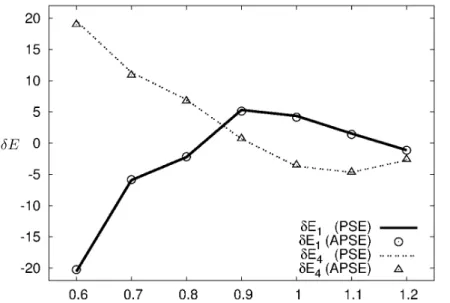
The adjoint PSEhave been validated bysolving directly computingthe variation given in equation 6. The PSE equations (Eqs. 3-4) are therefore solved with and without a small amplitude forcing and the difference of the energyfunction is calculatedat eachstreamwise location. The small variationsare then comparedwiththeintegralterminEq. 6obtainedbysolvingtheadjointPSEequations(Eqs.9-10). Several forcings with Gaussiandistributionacting as a sourceterm in one ofthe conservationequation have been tested in different regions of thebase-flow. Because of the arbitrarinessof this forcing, wekeep the same forcingfunctionsusedtovalidatethesubsonicjet.17 ThesmallvariationofthequantityEareshowninFig. 2. Theyaredeterminedfrombothapproacheswithaverygoodagreement. Theextensionofthesensitivity analysistosupersonicflowisthereforevalidated.
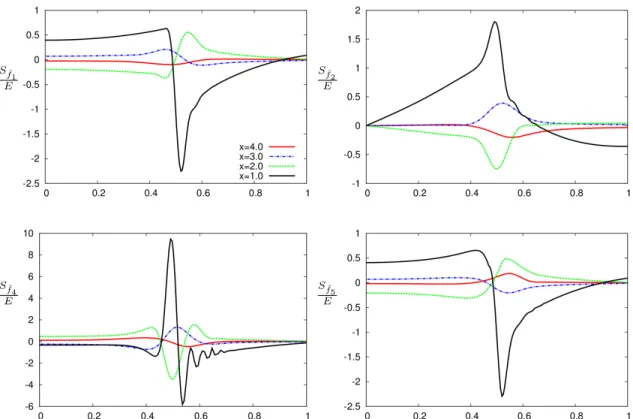
ThenormalizedsensitivitycoefficientswithrespecttoconservationequationforcingareshowninFig. 3. Theyarestronglydependentonthespatialcoordinatesxandr.
As expected, thesensitivity coefficients grow at thepositions in the streamwise direction closerto the exit nozzle at x0. The maximumis reached closeto the potential corein the shear layerof the jetin the
range x∈[0.45,0.55] approximately. These conclusions are verysimilar to theones found in thelaminar subsonicjet. Theresultsarewellcorrelatedwiththelocationofthesoundgenerationmechanismasseenin previousworks.1,2
IV.
Supersonic
under-expanded
single
and
dual-stream
jet
Thissectionshowshowstabilityanalysisisappliedtoaturbulentsupersonicunder-expandedsingleand dual-streamjet. Themaincharacteristicof under-expandedjetsistheformationofa systemofshock-cells at theexit of thenozzlethat allows thejet to progressivelyexpandto ambient conditions. Thissystemis formedbyaseriesofexpansionandcompressionwavesthatbounceinsidethepotentialcoreofthejet. The LESsimulationshave beencarriedoutwith theFiniteVolumemulti-blockstructured solverelsA (Onera’s software21)andperformed bytheCERFACS.
IV.A. Turbulent single jet
The jetis under-expanded and at a perfectly expanded Machnumber M =1.15. Its Reynoldsnumber is Re=1×10⁶. ThisconfigurationhasbeentestedexperimentallybyAndr´e.20 Theshock-cellsmanifestedin thecoreoftheflow, asseeninFig. 4,interactwiththeinstabilitiesaroundthepotentialcoreproducingan intensenoise asexplainedinRay(2007).16
Pressure perturbationsare propagated to the farfield by means of theFfowcs Williams and Hawkings (FW-H)24analogyusingthedataonatopologicalsurfacelocatedatr/D=3. TheresultsareshowninFig.
5(a)atdifferentanglesandcomparedwiththeexperimentaldataofAndr´e.20
The Sound Pressure Level (SPL) is in good agreement up to the mesh cut-off Strouhal. The Overall SoundPressure Level(OASPL) iscomputedand comparedwith theexperimental datain Fig. 5 (b). The simulation,beingabletocapture themain noisecontributionsof anunder-expandedsinglejet, isa perfect base-flowto computethestabilityandsensibilityanalysis.
From the LES data, temporal and azimuthal means have been done in order to produce the steady base-flow(Fig.4)onwhichthestabilityandsensitivityanalysesareperformed.
Thestabilityresultspresentedhererefertotheaxisymmetricinstabilitieswithm=0. ThePSE compu-tationhasbeeninitializedatthestreamwisepositionx=x0andforaStrouhalnumberofSt=0.890using
Figure 6 shows the spatial distribution of the pressure perturbation p0 at the nondimensional time
t = n/St, where n is an integer number. The perturbation increases in the unstable regions of the flow (Im(α(x))<0)andaredampeddownwhentheflowbecomesstable. Thespatialwavelengthλ=2π/Re(α) canalsobe guessedinthefigure.
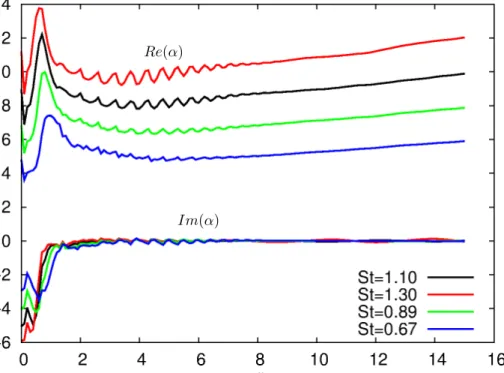
The influence of the frequency or Strouhal variations has to be study sincethe Andr´e’s experimental spectrum(Fig 5)exhibitstwo screechnoise frequencies.20 Therealandimaginarypart ofαareplotted on Fig. 7. Thefrequency dependence on the real wavenumber is obvious, and the shock cells locationsare visible in therangeof x=2 to x=8. It isnatural sincethe stabilityproperties arevery sensitiveto any meanflowvariations. ThevariationofthefrequencyonthegrowthrateIm(α)arequiteimportantcloseto thenozzleexit. Then,itseemsthatthegrowthrateisgovernedbytheshockcellsandnotbythefrequency. Downstream,whenshockcells areweaker,thegrowth ratetendstobefrequencyindependent(intherange ofstudy).
Figure 8provides thenondimensionalsensitivity functionsbyforcing successivelyto everyconservation equation and is expressed as a function of the adjoint state. It is equivalent to a local (Dirac) forcing. The maximumamplitude are weaker compared to the previous supersonictest case. Thelocation of this maximumis stronglydependent on thestreamwise coordinates andthe highestsensitivityis closed to the nozzleexit.
Thedensityandenergyforcingarequiteequivalent,similarlytotheothersubsonicandsupersoniccases. Forallthefourdifferentforcingthesensitivityislocalizedinsidetheshearlayerandquicklydecayalongthe streamwisedirection. Thisresultssuggestthataflowcontrolmechanismshouldbeappliedclosetotheexit nozzle, definitely beforetheend of thepotential core, andin the shearlayer region in order toobtain the highestresponse oftheflow.
IV.B. Turbulent dual-streamjet
Thecaseofstudyisaco-axialjetwheretheprimaryflowiscoldandsubsonicwithanexitMachnumberof Mp =0.89(CN P R=1.675)andthesecondarystreamisoperatedatsupersonicunder-expandedconditions witha perfectlyexitMachnumber ofMs=1.20(F N P R=2.45). Here, CNPRand FNPRstandforCore and Fan Nozzle to Pressure Ratio respectively. The jets are established from two concentric convergent nozzles with primary and secondary diameters of Dp = 23.4mm and Ds = 55.0mm respectively. The thicknessesofthenozzlesat theexit areof0.5mm. TheReynoldsnumbersbasedonthejetexitdiameters areRep=0.57×10⁶ and Res=1.66×10⁶. Thelengthsare non-dimensionalizedbytheinternaldiameter Dp. Asin thepreviouscaseatemporalandazimuthalintegral averagehave beendoneinorderto produce the steady base-flow on which the stability analysis is performed and the PSE computation is initialized bya LST analysis. Inthe configurationof St=1.0 two very distinctunstable modes areobserved in the stabilityspectrum,Fig. 9. ThesetwomodesarethehydrodynamicKelvin-Helmholtzmodes(referredtoas ”KH modes”)ofthetwomixing layer,KH1 andKH2 referringrespectively totheinnerandoutermixing
regions.
The local growth of the KH2 mode is larger than its related to KH1 mode, which suggest a local
dominanceof theinstabilitywave developingin thesecondary jet. This firstresultsis in according to the locationoftheproductionofnoisefoundin.22 Clearly,thisfirsttrendfoundbythelocalstabilitytheoryhas tobeconfirmedbythePSEnonlocalapproachtoshowtheaxialevolutionofthedisturbance. Thepressure perturbationassociatedto thesecondarymodes KH2 obtained bysolvingthePSEequationsareshown in
fig 10. Theinstability, as expected, grows in the secondary shear layer aroundthe radial valuer/Dp =1 andslowlydecayswhentheflowbecomesstable.
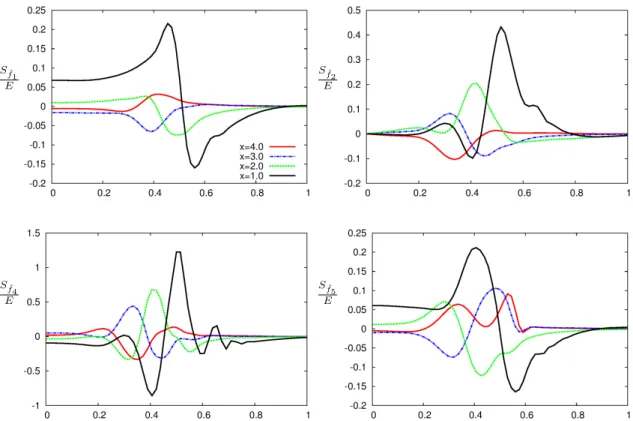
Resultsforsensitivityanalysisatthisconfigurationareshowninfig11and12.Thesensitivityissolvedfor thebothunstablemodes,KH1andKH2.Forbothcasesthesensitivityisspreadalongthetwoshearlayers
andgoestozeroforgreatervaluesofr.Thefirstimportantresultisthatthesensitivityisgreaterintheshear layerrelatedtotheunstablemodeswhichinitializesthePSE,butthesecondaryflowhasthehighestvaluefor anyforcing actingin the system.This result emphasizetherole of the secondary jet in this configuration. However,wecanclearlyobservetwodistinct”zones”relatedtotheprimaryandsecondaryshearlayers.Inthe dualstreamjet,andasitwasfoundinthesinglestreamjet,thedensityandenergysensitivityseemstoexhibit a similarresponse alongr. Westill havea strongdependencyin ther-direction andthelocalpeak ofthese sensitivities are located at the primary and secondary shear layer radius. The maximum of amplitude are highercomparedtothesinglejetcase,suggestingastrongerresponsetotheflowtoexternalforcing.6of13
V.
Conclusion
In the present study the sensitivity analysis based on adjoint PSE of supersonic single-stream jet flow has been validated. The sensitivity with respect to underexpanded supersonic single and dual-stream jets has been considered. First configuration outlines a localized region where the response of the flow to external forcing is higher. This region has been identify close to the exit nozzle into the shear-layer in the external boundary of the potential core of the jet. The second configuration present two unstable Kelvin-Helmholtz modes one for each shear-layer. The PSE and Adjoint-PSE computations show the central role of the secondary shear-layer, where the flow is more unstable and the sensitivity is higher. The local peaks of the sensitivity are located at the primary and secondary shear-layer radius highlighting the results of the single-stream jet case. However, to implement a new noise control strategy, for both cases, the strong dependence of the sensitivity to the spatial coordinates of the system suggest a very careful analysis of the interaction flow/actuator. This results have been obtained for both stability and sensitivity analysis, thanks to accurate LES computations from CERFACS.
Additional post-processing will be considered in further work, focus our attention on the physical expla-nation of the highest sensitivity location, exploiting the different locations of the critical layer, the inflection point, the shock-cell positions and the stability property (growth rate, wavenumber etc.).
Acknowledgments
This work has been supported by the European Community as part of the FP7-PEOPLE-2012-ITN AeroTraNet 2. We would like to thanks J.P. Brazier and O. L´eon from ONERA Toulouse for having provided the PSE code ’Pasteq’. This work was performed using HPC resources from CALMIP (grant 2014-24).
References
1Tam, C. K. W. & Burton, D. E.,Sound generated by instability waves of supersonic flows. Part 2. Axisymmetric jets., J.
Fluid. Mech. Vol. 138, pp. 273-295, 1982.
2L´eon, O. & Brazier, J-P.Application of Linear Parabolized Stability Equations to a Subsonic Coaxial Jet. AIAA/CEAS,
32nd Aeroacoustics Conference, 2011-2839, 2011.
3Ray, P. K., Lawrence, C., Cheung, C. & Lele, S. K. Onthe growth and propagation of linear instability waves in compressible turbulent jets. Phys. Fluids Vol. 21, 2009.
4Piot, E., Casalis, G., Muller, F. & Bailly, C. Investigation of the PSE approach for subsonic and supersonic hot jets.
Detailed comparison with LES and Linearized Euler Equations results. Aeroacoustic volume 5. 4, 361-393, 2006.
5McLaughlin, D. K., Seiner, J. M. and Liu, H.On the noise generated by large scale instabilities in supersonic jets. AIAA
80-0964, 1980.
6Yen, C. C. & Messersmith, N. L.Application of Parabolized Stability Equations To the Prediction of jet Instabilities.
AIAA 98-16227, 1998.
7Ladeinde, F., Alabi, K., Colonius, T., Gudmundsson, K., Schlinker, R., and Reba, R.,An integrated RANS-PSE-wave packet tool for the prediction of subsonic and supersonic jet noise. AIAA Paper 20104021, 2010.
8Yen, C. C. & Messersmith, N. L.The use of Compressible Parabolized Stability Equations for Predicition of jet Instabilities and Noise. AIAA 99-1859, 1999.
9Tam, C. K. W.Directional acoustic radiation from a supersonic jet generated by shear layer instability. J. Fluid Mech.
46 (4), 757-768, 1971.
10Balakumar, P.Prediction of supersonic jet noise. AIAA 98-1057, 1998.
11Pralits J., Airiau C., Hanifi A. and Henningson D.S.,Sensitivity analysis using adjoint parabolized stability equations for compressible flows, Flow, Turbulence and Combustion,
12Walther, S., Airiau, C. & Bottaro, A.Optimal control of Tollmien-Schlichting waves in a developing bounday layer. Phys.
Fluids Vol. 13, 2001.
13Airiau, C. and Bottaro, A. and Walther,S. and Legendre, D.A Methodology for Optimal Laminar Flow Control: Appli-cation to the Damping of Tollmien-Schlichting Waves in a Boundary Layer. Phys. Fluids, vol. 15, (5), 1131-1145, 2003.
14Airiau C., Walther S. and Bottaro A.,Boundary layer sensitivity and receptivity, C.R. Mecanique, vol. 330, 259265,2002. 15Herbert, T.Parabolized Stability Equations, Annual Rev. Fluid. Mech. vol. 29, pp. 245-83, 1997.
16Ray, P.K and Lele, S.,Sound generated by instability wave/shock-cell interaction in supersonic jets. J. Fluid Mechanics,
Vol.587,pp.173215,2007.
17Ansaldi,T.and Airiau, C., Sensitivityanalysis forsubsonic jetusing adjoint of nonlocal stabilityequations,AIAA
Paper2015-2219,2015.
18Ansaldi,T., GranadosOrtiz, F.-G.,Airiau, C.,Lai, C.-H.,Sensitivityand UncertaintyQuantificationforjet stability analysis.Congr`esFran¸caisdeM`ecanique74031Lyon,2015.
19Tissot,G.,Zang,M.,Laj´usJr.,F.C.,Cavalieri,A.V.G.,Jordan,PandColonius,T.,Sensitivityofwavepacketsinjetsto non-lineareffects:tehroleofthecriticallayer.AIA5-2218,2015.
20Andr´e, B., Castelain, T., and Bailly, C.,Broadband Shock-Associated Noise in Screeching and Non-Screeching Underex-panded Supersonic Jets. AIAA J. Vol 51 (3), 665-673, 2013.
21Cambier, L., Heib, S., and Plot, S., the Onera elsA CFD software: input from research and feedback from industry.
Mechanics and Industry, Vol 14 (3), pp. 159-174, 2013
22P´erez, C., Puigt, G., Airiau, C. and Boussuge, J. F.,Large Eddy Simulation of Shock-Cell Noise From a Dual Stream Jet. AIAA 2016.
23Dahl, M. D.,The Aeroacoustics of Supersonic Coaxial Jets. Ph. D. thesis, The Pennsylvania State University, 1994. 24Ffowks Williams, J. E., and Hawkings, D. L.,Sound generetion by turbulence and surfaces in arbitrary motion.
Philo-sophical Transactions of the Royal Society of London. Series A, Mathematical and Physical Sciences, 264, 321-342, 1969.
x r
¯ ux
Figure 1. Spatial distribution of the mean axial velocity M=2.1. In dash-dot lines we have respectively the potential
core and the boundary of the shear layer.
x δE
Figure 2. Comparison between results from PSE equations (lines) and from adjoint PSE equations (symbols) is made
r r Sfˆ1 E Sfˆ2 E Sfˆ4 E Sfˆ5 E
Figure 3. Sensitivity of the semi-analytical supersonic jet. From top the bottom we have respectively, the gradient
ofEwith respect to the forcing acting in the continuity,r-momentum,x-momentum and energy equation at different
fixed position in the stream-wise direction (x= 4.0,2.0,1.0,0.5).
x r
¯ ux
Figure 4. Spatial distribution of the mean axial velocity computed by LES. We can clearly observe the shock-cell
(a) (b)
Figure 5. Acoustic spectrum in the farfield (50 diameters) for a Mj = 1.15under-expanded jet. θis measured with
respect to the jet axis, (a) SPL, (b) OASPL.
x r
p0
Figure 6. Spatial distribution of the perturbation p0 for the Strouhal numberSt= 0.89, the pressure growth in the
unstable regions of the jet and fall-down for high values of the streamwise coordinates where the flow is stable.
x Re(α)
Im(α)
Figure 7. Axial distribution of the streamwise wave-numberαfor different values of the Strouhal number, respectively
r r Sfˆ1 E Sfˆ2 E Sfˆ4 E Sfˆ5 E
Figure 8. From top the bottom we have respectively, the sensitivitySfˆcomputed for the underexpanded supersonic
single jet with respect to the forcing acting in the continuity, r-momentum, x-momentum and energy equation at
different fixed position in the stream-wise direction (x= 4.0,2.0,1.0,0.5).
Im(α)
Re(α)
KH1
KH2
Figure 9. Stability spectrum of the turbulent dual-stream jet at the axial positionx=x0for Strouhal numberSt= 1.0
and for azimuthal wavenumberm= 0. In full circle the2unstable modes related to Kelvin-Helmholtz instability in the
x r
p0
Figure 10. Spatial distribution of the perturbationp0 for the Strouhal numberSt= 1.0for the turbulent dual-stram
jet initialized with the unstable modeKH2, the pressure growth in the secondary shear layer jet and fall-down for high
values of the streamwise coordinates where the flow becomes stable.
r r Sfˆ1 E Sfˆ2 E Sfˆ4 E Sfˆ5 E
Figure 11. The results refer to the turbulent dual-stream jet initialized with the unstable modeKH1. From top the
bottom we have respectively, the sensitivitySfˆcomputed for the underexpanded supersonic dual-stream jet with respect
to the forcing acting in the continuity,r-momentum, x-momentum and energy equation at different fixed position in
r r Sfˆ1 E Sfˆ2 E Sfˆ4 E Sfˆ5 E
Figure 12. The results refer to the turbulent dual-stream jet initialized with the unstable modeKH2. From top the
bottom we have respectively, the sensitivitySfˆcomputed for the underexpanded supersonic dual-stream jet with respect
to the forcing acting in the continuity,r-momentum, x-momentum and energy equation at different fixed position in