International Journal of Emerging Technology and Advanced Engineering
Website: www.ijetae.com (ISSN 2250-2459, ISO 9001:2008 Certified Journal, Volume 4, Issue 2, February2013)
7
A Study on the Effect of Antimicrobial Agent from Aloe Vera
Gel on Bleached Cotton Fabric
Nan Thazin Hein
1, Dr. Swe Swe Hnin
2, Daw Htay Htay
31Researcher, Master of Textile Engineering, Department of Textile Engineering, Yangon Technological University, Insein,
Yangon, Myanmar
2Associate Professor, Department of Textile Engineering, Yangon Technological University, Insein, Yangon, Myanmar
3
Lecturer, Department of Textile Engineering, Yangon Technological University, Insein, Yangon, Myanmar
Abstract— The objectives of this study are to extract the antimicrobial agent from Aloe Vera gel with methanol and to investigate the effect of antimicrobial activity of Aloe Vera gel extract on bleached cotton fabric. It is also intended to produce Eco-friendly antimicrobial cotton fabric from Aloe Vera gel extract and to protect the consumer from micro-organisms contamination. Qualitative analysis is carried out to measure the antimicrobial activity against Gram-positive (S. aureus, B. subtilis, B. pumilus) and Gram-negative (Pseudo, Candida, E. coli) bacteria. And then, the physical textile properties of treated and untreated cotton fabrics such as sample width, fabric weight, fabric thickness, fabric count, yarn number, absorbency, abrasion, crease recovery, fabric stiffness and strength are analysed. The results show that the antimicrobial activity of Aloe Vera gel treated fabric is excellent for Pseudo and E-coli, good for B.subtilis and B.pumilus bacteria. But, this antimicrobial agent could not inhibit the growth of S.aureus and Candi. The results also reveal that the antimicrobial Aloe Vera gel treatment does not affect on the properties of bleached cotton fabric.
Keywords— Aloe Vera, Antimicrobial agent, Cotton woven fabric, Gram-positive, Gram-negative.
I. INTRODUCTION
Textile materials are of interest to everyone, for they play a most important part in civilized life. Textiles go to war, go to space, become roof, imitate a heart, hold you safely in your seat, and diaper babies. Textile materials are used in day-to-day life. Apart from clothing and human body, textiles have a wide variety of engineering applications such as protech, indutech, buildtech, mobiltech, geotech, medtech, and so on.
In textile manufacturing, finishing refers to the processes that convert the woven or knitted cloth into a usable material and more specifically to any process performed after dyeing the yarn or fabric to improve the look, performance, on hand (feel) of the finished textile or clothing. Some finishing techniques such as bleaching and dyeing are applied to yarn before it is woven while others
are applied to the grey cloth directly after it is woven or knitted. Some popular finishing techniques are: bio-polishing, mercerization, raising, peach finish, fulling, decatising, calendaring, sanforizing, crease-resist finish, and antimicrobial finish [4].
The consumers are now increasingly aware of the hygienic life style and there is a necessity and expectation for a wide range of cotton fabric treated with anti-microbial finish. The antimicrobial finishes are applied to textile materials for two purposes as to protect the wearer and the cotton fabric itself. The antimicrobial finish is applied in such a way that appearance and feel of the fabric is not changed and no chemical odour remains. Clothing and textile materials are not only the carriers of micro-organisms such as pathogenic bacteria, odour generating bacteria and mould fungi, but also good media for the growth of the micro-organisms. These micro-organisms create problems in textile, including discolouration, stains and fibre damage, unpleasant odour and a slick, slimy feel. When fabric is worn next to skin, infestation by microbes causes cross infection by pathogens and development odours. The performance properties of cotton fabric are lost as a result of microbial attack. Antimicrobial fabric can be beneficial to a wide variety of people. Antimicrobial agent destroys the growth of micro-organisms and their negative effects of odour, staining, and deterioration. Moreover, anti-microbial agents are used on fabric to control bacteria, fungi, mould, mildew and algae. According to White and Monticello (2005), the term “anti-microbial” means protection against micro-organism [8].
Textile materials (woven, nonwoven, knitted, and composites) have found different end-uses in medical and healthcare applications. Depending on the specific end-use, different products have to meet the demands for the specific end-use performances [7]. Nowadays, the people prefer to live in an eco-friendly environment with the use of anti-bacterial textile materials. Most of us are very conscious about our hygiene and cleanliness.
International Journal of Emerging Technology and Advanced Engineering
Website: www.ijetae.com (ISSN 2250-2459, ISO 9001:2008 Certified Journal, Volume 4, Issue 2, February2013)
8
Natural herbal products such as tea tree oil, Aloe Vera, and Eucalyptus oil extracts can be used for anti-microbial finishes since there is a tremendous source of medical plants with anti-microbial composition to be effective in bringing out herbal textiles. Additionally, Chitosan is an effective natural antimicrobial agent derived from Chitin, a major component in crustacean shells such as crabs etc. Aloe Vera is a natural plant that has anti-microbial activity against various micro-organisms. External application of Aloe Vera gel penetrates the skin directly and produces a soothing, pain-relieving and anti-inflammatory effect on arthritic joints and tendonitis. Moreover, it is also used in cosmetic preparations like moisturizing and smoothing agent. In addition, it can be found that Aloe Vera gel is used to provide anti-bacterial effects when it is applied on bandages, surgical masks, gowns, apparel, nappies, and tampons and so on [6].
In this study, Aloe Vera is chosen as raw material to extract the antimicrobial agent for producing the anti-microbial treated fabric.
II. MATERIALS AND METHODS
A. Collection of Sample
The leaves of Aloe Vera plants were collected from the market, Yangon Division in Myanmar.
B. Extraction of Aloe Vera Antimicrobial Agent
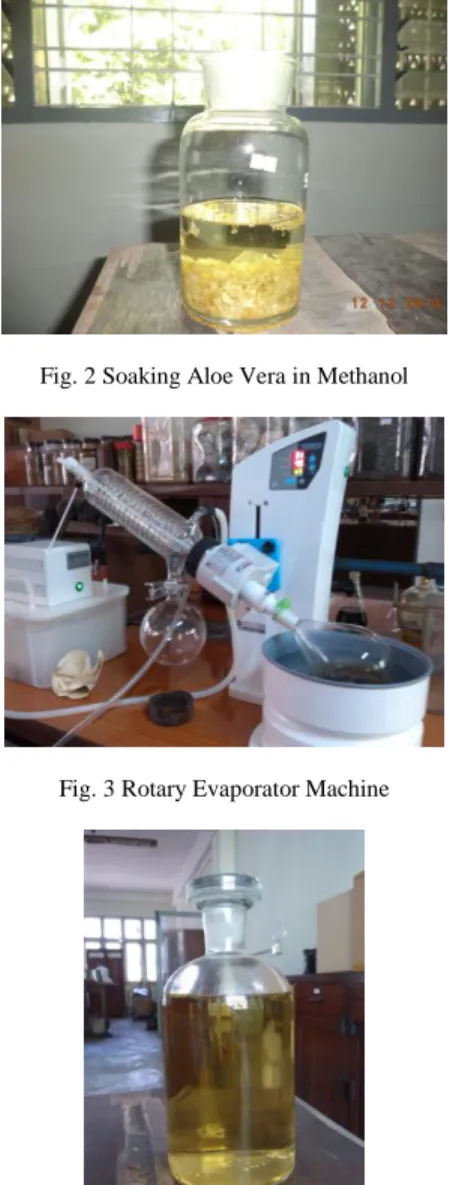
Aloe Vera leaves were cut and washed with distilled water. The gel was taken out from them and dried in the air-dry machine at temperature 50°C for three hours. The dried gel was soaked with methanol for one week. Then it was filtrated through filter paper. The methanol was then distilled by using rotary evaporator machine. And then, the extracted solution of Aloe Vera gel was obtained.
Fig. 1 Aloe Vera Gel
Fig. 2 Soaking Aloe Vera in Methanol
Fig. 3 Rotary Evaporator Machine
Fig. 4 Methanol Extract Aloe Vera Gel
C. Application of Extracted Solution
This extracted solution was applied on bleached cotton fabric. This process was carried out on Thermosol Range at Tatmadaw Textile Mills (Thamaing). The bleached cotton fabrics was immersed in the extracted solution for five minutes and padded. Citric acid was added to maintain the level of pH at 5.5. The fabric was dried at 80°C for three minutes and cured at 110°C for two minutes. Finally, the antimicrobial treated cotton fabrics were obtained.
International Journal of Emerging Technology and Advanced Engineering
Website: www.ijetae.com (ISSN 2250-2459, ISO 9001:2008 Certified Journal, Volume 4, Issue 2, February2013)
9 D. Comparison of Physical Textile Properties of Aloe Vera
Treated and Untreated Cotton Fabric
The fabric analysis tests and physical properties of fabric were performed according to the respective ASTM Standards and AATCC Test Methods. All the tests were carried out at standard atmospheric condition (20° 2°C, 65 2% RH) in the Laboratory of Textile Testing and Quality Control of Department of Textile Engineering, Yangon Technological University.
Fabric Weight
The fabric weight test was determined in accordance with ASTM D 39-59 T. The fabric weight of the treated cotton fabric (3.7673 oz./yd²) was heavier than that of the untreated cotton fabric (3.405 oz./yd²).
Fabric Thickness
The fabric thickness was determined according to ASTM D 1777- 60 T by using thickness gauge. The fabric thickness of the treated cotton fabric (0.322mm) was thicker than that of the untreated cotton fabric (0.2935mm). It was due to fabric shrinkage caused by antimicrobial treatment.
Fabric Count
The fabric count was determined in accordance with ASTM D 39-59 T. In comparing the fabric counts of treated fabric to untreated fabric, the treated fabric slightly increased in ends/in and decreased in picks/in after being treated with Aloe Vera gel. It was seen that the bleached cotton fabric shrinks in weft direction due to antimicrobial treatment. But the changes of fabric counts were not significant.
Yarn Number
The yarn number of the treated cotton fabric was similar to that of the untreated cotton fabric. The warp yarn number was 30ʼs and the filling yarn number was 40ʼs.
Absorbency
The fabric absorbency was analysed according to the Principle of Textile Testing. The fabric absorbency of the treated cotton fabric (230%) was more absorbent than that of the untreated cotton fabric (206%).
Abrasion
The abrasion was tested in accordance with ASTM D 4966-98 by using Martindale Abrasion Tester. In both treated and untreated cotton fabric, the breakage of threads was seen at 10,000 rubs per cycles. It was shown that antimicrobial finish did not affect on abrasion of cotton fabric.
Crease Recovery
The fabric crease recovery was determined according to the procedure described in AATCC 66-1990 by using Shirley Crease Recovery Tester (M 003A). It was found that the treated cotton fabric showed more recovery angle as compared to the untreated cotton fabric.
Fabric Stiffness
The stiffness of a fabric was defined as its resistance to bending. Stiffness of the sample fabric was determined in accordance with ASTM D 1388-55 T. The treated fabric was stiffer than the untreated cotton fabric. It was due to the antimicrobial agent coated on the surface of fabric.
Breaking Strength
In order to study the effect of antimicrobial agent extracted from Aloe Vera on the strength of cotton fabric, grab test method was used to determine the breaking strength of treated and untreated cotton fabrics. Breaking strength was determined in accordance with ASTM D 1682-59 T. The test result showed that fabric breaking strength in both warp and weft directions were decreased from that of the untreated fabric.
The test results of physical textile properties between treated and untreated cotton fabrics were shown in Table I.
TABLEI
COMPARISON OF PHYSICAL PROPERTIES BETWEEN TREATED AND
International Journal of Emerging Technology and Advanced Engineering
Website: www.ijetae.com (ISSN 2250-2459, ISO 9001:2008 Certified Journal, Volume 4, Issue 2, February2013)
10 E. Preparation of Plates for Antimicrobial Activity Test
The study of antimicrobial activities was performed by the agar diffusion plate method. Nutrient agar was prepared according to method described by Cruickshank, R., 1975.
Nutrient agar was boiled and 20-25 ml of the medium was poured into a test tube and plugged with cotton wool and autoclaved at 121°C for 15 minutes. Then the tubes were cooled down to 30-35°C and poured into sterilized pertridishes and 0.02 ml of spore suspension was also added into the dishes. After that, the fabric was cut 6.25mm in diameter and placed into the agar solution. There was incubated at 37°C for 24-48 hours. The inhibition zone (clear zone) appeared around the disc indicating the presence of antimicrobial activity. The extent of antimicrobial activity was measured from the zone of inhibition diameter [3].
III. RESULTS AND DISCUSSIONS
A. Test Results of Antimicrobial Activity
In order to evaluate the antimicrobial performance for treated cotton fabric, the assessment tests were carried out according to the method described in ISO 20645 [5].
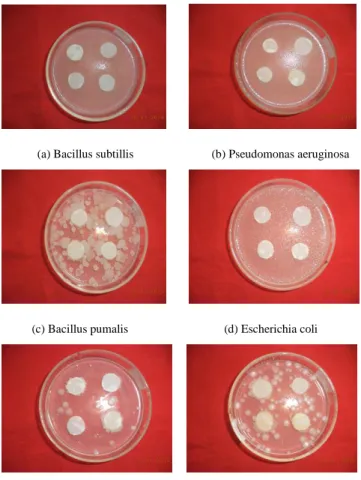
Table II and figure 5 showed the antimicrobial activity of Aloe Vera gel extract against selected pathogens. From figure 5, it was seen that antimicrobial Aloe Vera gel treated fabric gave the maximum antimicrobial activity for Pseudo and E-coli, and moderate activity for B.subtilis and B.pumilus while no activity was observed for S.aureus and Candi.
TABLEII
TEST RESULTS OF ANTIMICROBIAL ACTIVITY ON TREATED AND
UNTREATED COTTON FABRIC
Antimicrobial Activity
+++ = Maximum antimicrobial activity ++ = Moderate antimicrobial activity _ = No activity
(a) Bacillus subtillis (b) Pseudomonas aeruginosa
(c) Bacillus pumalis (d) Escherichia coli
(e) Staphylococcus aureus (f) Candida albican Fig. 5 Antimicrobial Activity Test Results of Treated and Untreated
Cotton Fabrics
IV. CONCLUSION
In the test results, no bacteria can be found on the surface of the fabric concerning four microbes (B. subtilis, Pseudo, B. pumilus and E. coli) among six microbes. In addition, there is no significant difference between the treated and untreated cotton fabric in the comparison of the test results of physical textile properties although there are slight differences. Therefore, the antimicrobial finish did not affect on the physical properties of bleached cotton fabric.
International Journal of Emerging Technology and Advanced Engineering
Website: www.ijetae.com (ISSN 2250-2459, ISO 9001:2008 Certified Journal, Volume 4, Issue 2, February2013)
11
ACKNOWLEDGEMENT
The author would like to express her sincere thanks to Daw Oo Oo Khin, Associate Professor and Head of Department of Textile Engineering, Yangon Technological University. And the author is gratefully thanks to Dr. Swe Swe Hnin and Daw Htay Htay for their valuable help, advice and encouragement throughout preparation of this paper. The author is very grateful to her beloved parents who bring her up with tender care and give constant support and encouragement. Finally, the author would also like to thank the entire person who helps in doing this research.
REFERENCES
[1] AATCC TECHNICAL MANUAL, American Association of Textile Chemists and Colourists: hptt://www.aatcc.org Volume 74, 1999.
[2] ASTM Committee D-13 on Textile Material, Oct, 1961. Annual Book of ASTM Standards. Volume 07.02. U.S.A. American Society for Testing Materials.
[3] Cruickshank, R.(1975), Medicinal Microbiology, 11Edition, E & S living stone, Ediburge and London.
[4] Finishing (textiles) – Wikipedia, the free encyclopedia en.wikipedia.org/wiki/Finishing – (textiles)
[5] ISO 20645, Determination of Antibacterial Activity- Agar Diffusion Plate Test Method
[6] M Joshi, S Wazed Ali & R Purwar, Indian Journal of Fibre and Textile Research Vol.34, September 2009, Pg. 295-304
“Ecofriendly Antimicrobial Finishing of Textiles using Bioactive Agents based on natural Products”
[7] Science against microbial pathogens: communicating current research and technological advances, A.Mendez – Vilas (Ed.) “Antimicrobial Efficiency of Functionalized Cellulose Fibres as Potential Medical Textiles”
[8] Sci.Int. (Lahore), 24 (3), 293-297, 2012. ISSN 1013-5316; CODEN: SINTE 8. Shama Sadaf, Government of college of Home Economics, Gulberg, Lahore, Pakistan.
“Comparison of Treated and Untreated Cotton Fabric with Antimicrobial Finish”