TQM Implementation in Al Ain Municipality, UAE
Dr. Bakhit Al AmeriSupport Services Director
Al Ain Municipality, Al Ain, Abu Dhabi, United Arab Emirates Dr. Hamad Al Ameri
Business Solutions & Pathways to Success, Khalifa City-A, P.O.Box 965005 Abu Dhabi, United Arab Emirates
Abstract
The great optimism and passion for quality improvement in the UAE had created the imperative for all government entities to deliver quality services to the community. At the frontline of this endeavor are the municipalities which serve as important channels of the federal government in ensuring that this mandate is attained. Since municipalities are still prone to retain many of the bureaucratic characteristics where services are characteristically delivered in an administrative and legalistic manner, implementing total quality management continues to be a challenge. To understand this challenge, this quantitative study looked into the TQM thinking orientation of the internal stakeholders of Al Ain Municipality in Abu Dhabi, UAE and assessed their views on TQM execution in the municipality. A questionnaire was used to gather data from a quota sample of 345 respondents. The study found that considerable aspects of the quality thinking orientation of employees and managers in the municipality still remain deficient. To help address this deficiency, the researchers formulated a framework for the development of functional TQM-based strategies in municipalities.
Keywords: Total quality management, municipality, quality thinking orientation, TQM execution 1. Introduction
Municipalities are at the frontline of public service delivery that serve as initial touchpoints in availing of various services provided by the government (Masejane, 2012). With the increasing momentum of globalization, municipalities are faced with the challenge of developing the right approaches that will enhance the performance of their administration (Al Nasser, Yusoff & Islam., 2013). This challenge is also driven by the increasing demands and expectations from citizens for municipalities to be responsive and performance-oriented. Citizens have become increasingly discerning and discriminating in the services provided to them and they continue to seek options that are more in tune with their basic needs, requirements and self-esteem (Anantharaman et al., 2001). This calls for decision makers in municipalities to look at total quality as a way of continually addressing the needs of the local communities (Burksiene, 2014).
One of the approaches that seem to provide the solution to challenges faced by the public sector is the management philosophy of TQM (Masejane, 2012). It was also suggested that TQM is an effective way of promoting and sustaining organizational renewal because it is a pothis paperrful strategy for quality improvement and organizational change. Other than the challenge of implementing TQM in the public sector (Bvuma and Russel,2001), research on TQM for the past 25 years further pointed to the fact that the TQM philosophy had evolved together with the need to provide customers with high value products and services (Tasie, 2016). TQM as a construct is variable, adaptable, and contingent to time and context (Hashmi, 2016). Currently, the implementation of TQM practices continues to be a challenge to both practitioners and researchers (Fetemi et al.,2016). Research can help address this challenge by using customer perceptions that focus more on TQM thinking orientation and execution (Kim, 2016).
The total quality concept was transferred from the private to the public sector services in the late 80s where customer satisfaction became the measure of the degree of quality services provided to the public (Masejane, 2012). As a result, government units from the federal to the local levels sought TQM as a panacea for problems faced (Tasie, 2016). Al Hakim (2007) earlier commented that the implementation of TQM in the public sector remains to be under-researched hence the further expansion of TQM to the public sector was seen as both a challenge (Bovaird and Loeffler, 2008) and an opportunity (Symonds, 2009). The product of research for the past tthis papernty five years shows that TQM is variable and adaptable (Hashmi, 2016). TQM is contingent on how employees and managers enact the strategy which can vary from one organization to the other. In this regard, the appraisal of critical success factors for successful TQM implementation also varied according to organization. It is therefore essential for each organization to identify the most critical factors for TQM implementation that affect their organizations (Fetemi, et al., 2016). All these indicate that the implementation of TQM practices continue to be a challenge to organizations and remains a relevant field of study.
It had been observed that although local governments such as municipalities are making good progress and are working on innovative solutions to address the most pressing problems of their citizens, the functioning of
some municipalities as administrative systems make them still retain many of the bureaucratic characteristics where services are characteristically delivered in an operational and legalistic manner (Ayton, 2013). According to Bvuma and Russel (2001: 241),
Municipalities still exhibited many features of traditional bureaucracy, including hierarchical structures, low levels of training, a poor work culture and an overall orientation towards inputs and process rather than meeting the basic needs of all citizens.
Furthermore, Bvuma and Russel (2001) pointed out that the mind-set and attitudes of public servants that are influenced by the bureaucratic system make them resistant to change. It had also been noted that the lack of knowledge about TQM can make public servants resist the initiative (Shameer & Sing, 2013). On the other hand, it can also happen that a quality initiative is accepted but there is no consensus among the employees affected on how to implement the process (Atieno, et al., 2014). In some cases, the perceptions of public servants that the implementation of TQM is a complicated and long process is influenced by cultural attitudes leading to partial or limited implementation of the strategy (Ngwenya, Sibanda, & Matunzeni, 2016).
This paper noted that the situations described by Bvuma and Russel (2001), and Ayton (2013) on the traditional structure, mindset and attitudes of employees equally applied to the study context The influence of a host of barriers related to people, finances, processes, environment, and technology (Dahiya & Bhatia, 2013;Suleman & Gul, 2015; Majumdar, 2016) were likewise found in the municipalities. Accordingly, this paper observed that many existing policies for service delivery in the municipality are redundant and there are inadequate standards for policy implementation relative to TQM. These constraints had also been identified by Ngwenya et al. (2016); Suleman & Gul (2015); and Dahiya & Bhatia (2016) in their respective studies. The inadequate integration of processes had resulted in wastage and other inefficiencies. The areas that need improvement are the business processes and the interaction between the municipality and its customers (Majumdar,2016). On the whole, municipalities need to provide effective services that are of the quality defined by the consumers of the services. This requires a change in the processes as well as organizational structure, culture and leadership (Kim,2016).
2, Purpose of the Paper
Based on the foregoing observations, this paper assessed the implementation of TQM in a municipality to identify strengths and weaknesses in its implementation and further understand the underlying dynamics of the process. The UAE is currently one of the countries that demonstrate great optimism and passion in continuously improving productivity, quality, customer experience, and competitiveness as a vital aspect of nation building (Thawani, 2014). Delivering quality services by government entities is not only expected but an imperative and mandate as well. This makes TQM is a state-sponsored initiative in the country. The quality movement in the UAE had made positive contributions but according to Al Ali (2012), there is a dearth of evidence to confirm the effects or success factors of TQM implementation. The American Standard for Quality noted that the implementation of TQM in the UAE is usually done through the use specific quality tools that deal with specific areas of the management process. However, focusing on specific tools alone lacks the total character in implementing TQM. Furthermore, the emphasis on the use of specific tools alone eclipses the importance of other critical success factors (Thawani, 2014). An overall assessment on TQM implementation in the UAE showed that scientific or empirical evidence on the success of TQM implementation is still wanting (Thawani, 2014). In consideration of the foregoing premises, this paper chose Al Ain Municipality in Abu Dhabi, UAE, as the research context.
To contribute to enhancing the services provided by the municipality, this paper explored the TQM thinking orientation of internal stakeholders of the municipality and how they perceived TQM execution by the municipality. This was with the end-view of understanding the dynamics of factors that either facilitated or constrained the delivery of quality services to the community. The findings of the study can contribute knowledge and empirical evidence relative to the total quality initiative of the country and at the same time help bridge the knowledge gap on TQM implementation in municipalities. Particularly, the findings can provide leaders and decision-makers with evidence-based knowledge on the current state of quality initiatives implemented in the municipality of Al Ain and hence provide a tangible basis for evaluating the extent of attainment of the municipality’s vision. Midstream, the results of the study can provide the different service areas of the municipality with an evidence-based assessment of their performance and so that they can institute corrective actions to close service quality gaps in their respective departments. Downstream, the results of the study can contribute in fostering greater customer satisfaction and community satisfaction relative to the services that they avail of in Al Ain Municipality.
3. Methodology
This paper chose to anchor the study on positivism. Positivism is associated with empirical inquiry, hypothesis testing, the scientific method, and numerals as units of analysis (Aliyu et al., 2014). In this regard, positivism
was chosen because of the following reasons that make the study compatible with the philosophy. First, the nature of the research questions entailed measurement and quantification; second, the investigation determined how the variables behaved relative to the constructs investigated through hypothesis; third, the whole process involved in the investigation is consistent with the systematic procedures of the scientific method; lastly, the units of analysis of the study are numeric data. All of these considerations point to positivism as the most suitable philosophy for the study.
In consonance with the foregoing philosophy, this paper used the quantitative method of research. First, it is compatible with the general intention of the research that involved measurements using statistical tools. Second, the qualitative method is compatible with the philosophy of positivism because it operationalizes the major tenets of the positivist philosophy. Third, the study tested hypotheses hence the use of quantitative measures and statistical tools. Fourth, the method is useful in obtaining data that allowed quantitative predictions to be made. Fifth, the use of the quantitative method provided precise quantitative, numeric data which strengthened the generalizability of the findings. Sixth, the study made use of a large sample and the most suitable method in the selection of the sample, collection of data, and analysis of data is the quantitative method.
This study is descriptive as the research questions called for the portrayal of the characteristics of the population. On the other hand, the study is also exploratory as the study attempted to discover a phenomenon to disclose its nature. The population of the research consisted of all of the employees of Al Ain Municipality at the time of the study. Since it was not possible to include with all of the elements in the population due to its size and dispersal, the researchers used non-probability sampling in determining the study sample. This paper opted to use this sampling technique due to three factors: (a) the sectors was spatially dispersed throughout a wide geographic area of the municipality, (b) some of the respondents were mobile due to their work in the field, and (c) the respondents have just finished doing a number of surveys given by the government. To ensure that the variables were well represented in the study, quota sampling was used. Quota sampling method is a non-probability sampling of gathering representative data from a group. Application of quota sampling ensures that sample group represents certain characteristics of the population chosen by the researchers (Saunders et al., 2009). The key idea in using quota sampling is to produce a sample matching the target population on certain characteristics. In implementing this technique, the sample size was determined using the Slovin’s formula. Accordingly, a total 345 respondents participated in the study.
This paper used a questionnaire that was generated based on the items in the instruments used in the studies of Youssef et al., (2006); Masejane, (2012); Talib et al., (2013); and Al Nabhani (2007). The wordings of the items were modified to suit the context of the investigation. In wording the questionnaire items, the researchers ensured that no question was stated that does not fall within the objective of the study; no use of complex language; no ambiguous concepts; no leading or embarrassing questions; no biases in stating the questions; no lengthy questions; no double negatives; no calculations involved; no vague questions; and no reference to previous questions (Atcharya, 2010). The questionnaire was first worded in English and later translated into Arabic by an expert and reliable translator.
The initial draft of the questionnaire was presented to expert academic authorities and practitioners for their comments and was pilot tested to thirty (30) municipal employees in the municipality of Abu Dhabi. Cronbach’s Alpha was used to test the reliability of the questionnaire along the following dimensions: implementation of TQM (α=0.981); challenges to TQM (α=0.945); and views and perceptions of the TQM strategy (α=0.953). These results attest to the reliability of the instrument. The results of reliability testing as well as the comments given by the respondents and the experts were duly considered in fine tuning the final questionnaire.
Finally, the questionnaires were administered to the target sample. .
The descriptive statistics used to characterise the population included frequency counts, percentages, ranks, and weighted means. The hypotheses were tested using Chi-square, ANOVA, Whitney Manning, and Kruskal-Wallis tests. Correlations were determined using Pearson r. The statistical processing and analysis were supported by the use of SPSS.
4. Results and Discussion
4.1. Results
On the familiarity of the respondents with TQM, it was found that seventy seven percent of the respondents were familiar with TQM and twenty three percent were not.. The latter group of respondents claimed that they just heard of the term or that they were totally unaware of it. Sex differences in awareness were noted with males having greater familiarity with TQM compared to females. Also, older respondents were more familiar with TQM compared to the younger respondents and it also followed that the more experienced respondents had greater familiarity compared to those with lesser years of work experience. The proportion of respondents who were familiar with TQM was higher among heads and directors compared to employees. On the whole, the familiarity with TQM was dependent on the sex, age, job position, and work experience of the respondents but not on sectors where they worked.
There appeared to be a consensus among the respondents regarding their understanding of quality. The findings showed that regardless of sex, age, job position, work sector, or work experience, the respondents predominantly understood quality in terms of satisfying external and internal customers and teamwork. Quality means working in teams to achieve goals that translate to both the satisfaction of external and internal customers. Similarly, the respondents regardless of sex, age, job position, sector, or experience, did not significantly vary in the perception of the challenges in the implementation of TQM in Al Ain Municipality. There was also consistency in the barriers perceived across demographic variables. Similarly, the test of significance showed that regardless of sex, age, job position, sector, or experience, the perceptions of the respondents did not significantly vary regarding the challenges they perceived in the implementation of TQM in Al Ain Municipality.
In terms of critical success factors, the overall result of hypothesis testing using Kruskal-Wallis showed that the ranking of critical success factors only varied among males and females with respect to employee encouragement, employee involvement, and team work. In terms of the age of the respondents, the ranking of critical success factors only varied among the different age groups with respect to product and service design and training and education. There was significant difference in the ranking of the critical success by respondents with different positions with respect to benchmarking, employee encouragement, focus on internal stakeholders, human resource management, information and analysis, process management, product and service design, and quality culture. There was no significant difference in the ranking of the critical success factors by the respondents according to work sector and experience.
On the views of TQM, the findings revealed that the respondents did not significantly vary according to sex, age, job position, sector, and work experience. This indicated that they held similar views regarding the importance of culture, leadership, communication, commitment towards TQM, stakeholder-focus, continuous Improvement, Involvement and empowerment, training and education, tools and techniques, and rewards in the implementation of TQM in Al Ain Municipality. Using the typology of Mosadeghrad (2014) and Catalin et al.(2014), their views cut across strategic, structural, human resource, contextual, and procedural elements of TQM. Furthermore, hard and soft elements (Imeri and Kekale, 2013) of TQM this were likewise viewed with equal significance. Likewise, the results also showed that their views embodied the importance of the tools, values, and methodologies (Eriksson, 2002) essential to TQM implementation.
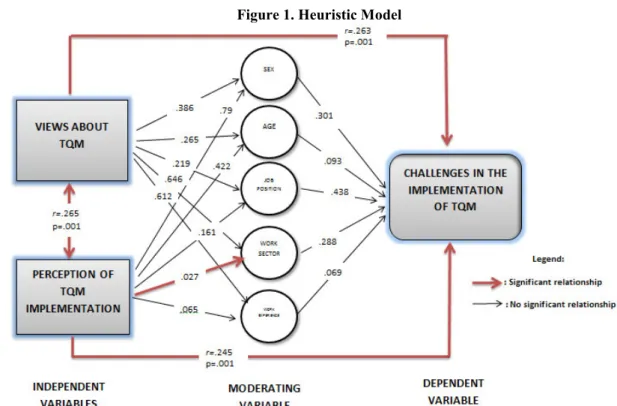
The results of the Pearson Product Moment Coefficient of Correlation showed that the respondents’ views on TQM had a positive significant correlation with how they perceived its implementation r=.265, p=.015 <p= 0.05. The correlation was, however, weak, r=.265. This means that some of the scores of the respondents were more dispersed than the others. Since the correlation is positive, this indicated that an improvement of the views of the respondents will also improve their perception of the implementation of TQM. The views of the respondents that were significantly correlated to overall implementation included communication, r=.157, p=.049 <p= 0.05; commitment of top management, r=.293, p=.000 <p= 0.05; stakeholder focus r=.268, p=.001 <p= 0.05; continuous improvement, r=.294, p=.000 <p= 0.05; involvement and empowerment, r=.258, p=.000 <p= 0.05; training and education, r=.234, p=.000 <p= 0.05; tools and techniques, r=.314, p=.000 <p= 0.05; r=.2i7, p=.006 <p= 0.05.
The results further showed that the respondents views’ on TQM had a positive significant correlation with how they perceive challenges in its implementation r=.263, p=.015 <p= 0.05. The correlation was, however, weak, r=.263. Again, the scores of some of the respondents were more dispersed that the others. Lastly, the respondents perception of TQM implementation showed a positive significant correlation with how they perceive the challenges in its implementation r=.245, p=.015 <p= 0.05. The correlation is, however, weak, r=.245. The table also shows that the relationship of all of the factors perceived in the implementation of TQM and the challenges perceived were statistically significant. The overall result of hypothesis testing is reflected in the following heuristic model:
Figure 1. Heuristic Model
On the whole, the results revealed that sex, age, job position, sector of work, and work experience did not statistically influence the perceptions of the respondents regarding their views of TQM, the implementation of TQM in Al Ain Municipality, and the perceived challenges in the implementation of TQM in the municipality. The views of the respondents were positively and significantly correlated with the implementation of TQM and the challenges to the implementation of TQM. Lastly, the implementation of TQM was positively and significantly correlated with the challenges to TQM implementation. It can be noted that only the variable, work sector, influenced the perception of the respondents regarding the implementation of TQM.
4.2. Discussion
The evidence which showed the lack of familiarity of about one third of the respondents needs to be taken seriously by the municipality and a wake-up call for the municipal government to address .The total attribute of TQM had not been attained despite the adoption of TQM in the municipality. Authors then and now have cited that low awareness and lack of quality orientation are some of the reasons why TQM fails (Miller & Cangemi, 1993; Mosadeghrad, 2014 ).
Gender differences in the familiarity of the respondents with TQM was also explored in the study of Kenneth (2012) but was treated in a descriptive manner hence the statistical difference between males and females was not measured. In the studies of Altunay (2016) and Priya & Maheshwari (2015) however, males were found to be more familiar with the principles of TQM as compared to females. Their finding is consistent with the results of this study. The study of Al Shdaifat (2015) on the other hand gives contrary evidence as he found that sex did not significantly influence the awareness or familiarity with TQM. The difference in the results noted above may be on account of the different contexts in which the studies were conducted, among others. The familiarity with TQM of the older and more experienced respondents is consistent with the study of Altunay (2016) which pointed out that awareness of TQM principles this were more positively associated with age and experience. The findings of Priya & Maheshwari (2015) and Al Shdaifat (2015) however, gave contrary evidence. While the former found that knowledge of TQM did not significantly vary with age, the latter found that familiarity did not vary significantly with age and experience. In this regard, the relationship of age and experience with the familiarity with TQM continues to show mixed results.
On the whole, the respondents’ familiarity with TQM and their views on quality is a concrete indicator of the municipal government’s response to the quality initiatives undertaken in the government sector in the UAE. The relative percentages of response to these aspects of quality management, however, revealed that these are far from the ideal. Being familiar with the concept is a pre-requisite to understanding one’s role in implementing the process hence the municipal government needs to exert more effort in improving the quality thinking and employee orientation towards total understanding of the quality concept to attain consistency between thought and action in the delivery of TQM-based services. This can be attained with greater chance of success as the respondents did not significantly vary in their perception of the implementation of TQM in Al Ain Municipality
according to sex, age, position, and experience but significant variations occurred with regards to work sectors. The findings had similarities with findings of other studies on specific variables concerned. In terms of sex, there is consistency of findings with that of Toremen & Karakus (2009). In terms of age, the findings are similar to that of Aswini & Kumar (2016) and Priya & Maheshwari (2016). In terms of experience, the findings of the study support that of Priya & Maheshwari (2016). The study of Altunay (2016) presented contrary evidence on all variables investigated. Differences with the results of the study were also noted in terms of sex (Priya & Maheshwari, 2016); position (Deepika, et al., 2016; Aswini &Kumar, 2016); and experience (Deepika, et al., 2016; Toreman & Karakus, 2009). These differences may be on account of the context in which the investigation was undertaken and the nature of the respondents. The cited comparison of results this were undertaken in the private sector such as healthcare facilities, business, and schools hence the difference in the nature of the respondents. The findings of this study are therefore relevant in serving as baseline information for public sector TQM implementation considering that most of the themes in the literature on TQM in the public sector generally pointed to its applicability (Milakovich,1990); visibility (Van Seaton, 2010); success (Walters, 1992); appeal (Kanji & Wallace (2000); approach (Evans & Dean, 2003); evolution from the private sector (Bertram, 1993); conceptualization (Hassan & Kerr, 2003); difficulties (Swiss, 1992); and benefits (Rago,1996), among others.
The results indicate that the adoption and implementation of TQM in Al Ain Municipality can be potentially derailed by a number of perceived barriers that cut across the organization. This need to be addressed to optimize the potentials of TQM in providing quality services in the municipality which requires the adoption of pro-active approaches in addressing these barriers through continuous improvement because simply navigating through these rough roads would not suffice to break down the barriers. Based on the typology of barriers (Mosadeghrad, 2014; Catalin, et al., 2014)), the challenges can either be a mix of strategic, structural, human resources, contextual, or procedural barriers. Strategic barriers are related mainly to the management and leadership of the organization. Human resource barriers pertain to those related to human factors in the organization. Structural barriers relate to the structure, systems and physical resources required for implementing TQM. Contextual barriers pertain to the underdevelopment of the context and culture to optimize the potential of TQM implementation. Procedural barriers are obstacles encountered during the implementation of TQM (Mosadeghrad, 2014:164).
The critical success factors perceived by the respondents combined both soft and hard elements of TQM. In contrast to other findings which have identified top management commitment, continuous improvement and communication among the highly ranked success factors (Salahedin, 2008; Valmohammadi, 2011; Sharma et al.,2014,Al-Marri et al.,2007;Talib et al.,2012), this paper found that these factors were ranked least. It has to be noted that these factors ranked high in terms of implementation hence the respondents ranked the factors that would have a greater benefit for them in terms of their role in implementing TQM. It has also to be taken into consideration that twenty three percent of the respondent have low familiarity of TQM and that the predominant notion of quality held by the respondents is customer satisfaction hence the greater importance given to process management, training and education, and quality culture. The hard and soft elements (Imeri & Kekale, 2013) of TQM viewed with equal significance which embodies the tools, values, and methodologies (Eriksson, 2002) essential to TQM implementation. This signals the expectations of the respondents on how TQM should be implemented in the municipality and serves as a relevant piece of information to the decision-makers, the quality department, and the training departments of the municipality.
The theoretical model shows that the personal-related and work- related variables did not discriminate the perceptions of the respondents. This means that despite the diversity of respondent attributes, they had homogeneous perception of TQM implementation in Al Ain Municipality as well as the challenges that they perceived in its implementation. The positive correlations between the variables and constructs indicate that addressing the challenges faced in the municipality would likely improve the views of the employees and managers on TQM and improve its implementation. This also means that enhancing the views of the employees on TQM would likely improve implementation and become more critical of the challenges faced.
When seen with reference to the descriptive data, the emerging picture is that regardless of personal or work attributes, the respondents homogeneously agree with the different views of TQM and confirmed that indeed TQM is being implemented in Al Ain Municipality but there are serious barriers operating that can hinder effective TQM implementation.
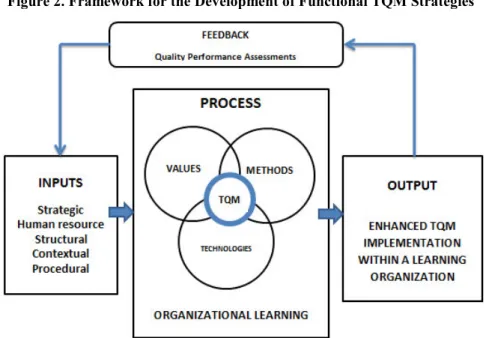
These generally signals (a) the need for strategies to address the challenges which are already endemic in the municipality and (b) the need for organizational interventions to enhance and sustain TQM thinking orientation and TQM execution. These needs became the basis of the building blocks of edifying the TQM framework shown in the following. The positive relationship between the independent variables and the dependent variable is a good indicator that the implementation of the framework would have a total effect on the overall improvement of service quality.
Figure 2. Framework for the Development of Functional TQM Strategies
The inputs consist of strategic, human resource, structural, contextual, and procedural factors essential in building, supporting, and enhancing the TQM strategy. TQM values, methods, and technologies are embedded in the organizational learning process to create the necessary environment for the confluence of people, process, policies, and technology in implementing TQM. The output expected is an enhanced implementation of the TQM strategy which will be subject to periodic quality performance monitoring and evaluation. In the study context, this model is addressed primarily to the decision-makers of the municipality on whose shoulders fall the development of organizational strategy; the quality department to support the development of the strategy; and the human resource department for the system-wide implementation of the necessary learning and development programs for the success of the strategy.
On the whole, novel and bold strategies have to be developed to enhance the structural, strategic, human resource, contextual, and procedural dimensions of TQM implementation (inputs). These have to be sustained in an environment of continuous learning characteristic of a learning organization which will create an atmosphere where the values, methods, and technologies of TQM would be continuously enhanced (process) to bring about improved service delivery to the community (output). All efforts to improved quality need to be monitored and documented to have a feedback of TQM execution and a basis for continuous quality improvement.
5. Conclusions and Recommendation
5.1. Conclusions
Based on the findings of the study, this paper concluded the following. First, the very essence of TQM lies in its attribute of totality which means all must embrace the philosophy. The familiarity with TQM among of the managers and employees in the study had not reached the level of totality which is a weakness in implementation but can be an opportunity for further improvement through proper education and training. This is based on theory that TQM is supposed to both a philosophy and a set of guiding principles that represents the foundation of a continuously improving organization by integrating fundamental management techniques, existing improvement efforts and technical tools under a disciplined approach. Similarly, the thinking orientation of the respondents found in the study implies that the operational conceptualization used in the study which purports TQM as a philosophy behind the practice of continuously improving the quality of goods and services delivered through the participation of ‘all’ levels and functions of the organizations using proper tools, technology and training to meet customer’s expectations on a continuous basis is still a potential area for improvement in the municipality.
Secondly, the success in implementing TQM in the municipality is potentially constrained by strategic, structural, human resource, contextual, and procedural barriers. These barriers reflects on the management and leadership of the organization; structure, systems and physical resources required for implementing TQM; and underdevelopment of the context and culture to optimize the potential of TQM implementation. All of these, however, can be addressed by improving the TQM thinking orientation of the human resourced and enabling them to continuously improve TQM execution.
Third, the successful implementation of TQM in the municipality can be potentially driven by the right environment for the adoption, internalization, and institutionalization of quality principles and sustaining the promotion, development, and enhancement of the values, technologies, and methodologies of TQM. This
highlights the role of enablers in the institutionalization of quality values, establishment of quality processes, and implementation of the right quality results
Lastly, an essential consideration in the implementation of TQM in the municipality is to pay heed to the views and perceptions of the human elements. These can serve as critical feedbacks for the continuous improvement initiatives and these can also be leveraged to engage internal stakeholders to obtain the potential optimal benefits of TQM. This relates to the ultimate realization is that organizations mean people.
5.2. Recommendations.
Based on the findings of the study, the following were recommended to enhance the implementation of TQM in the municipality.
1. Create an information-rich environment backstopped by multimedia communication and deliberately designed contents that would initiate conversation on TQM along all levels of the organization.
2. Expand the function of the quality department beyond its current functions that are external-stakeholder focused to one that gives due attention to internal external-stakeholders of the organization.
3. Make learning and development be a norm in the organizational culture by creating a strategic space where the TQM philosophy becomes embedded in the lived experiences of managers and employees. 4. Expand the function of training and development to include enhancing of the values of TQM; developing the capabilities in implementing the methods of TQM and employing the latest technologies of TQM.
5. Adoption of the appropriate state-of-the-art technologies to support the delivery of quality services in the municipality. This entails a thorough assessment of the technologies that are compatible with the values and methods of TQM that promotes efficiency, effectiveness, and excellence in service delivery. 6. Engage employee participation in setting quality objectives and goals at all levels in order to foster greater ownership, involvement, commitment, and corporate citizenship.
7. Document best practices and success stories that will not only inspire and motivate the internal stakeholders’ commitment to quality but will also serve as benchmarks in the quest of continuously improving the ways of doing work. .
8. Develop a strategic TQM plan that would promote key TQM practices for the organization and create a dynamic quality-oriented environment for implementation.
9. Transform all work teams to decentralized quality improvement teams that are empowered with the capability to solve quality- related issues in quick time without delay and to communicate all the relevant activities, progress and result to the team members and management.
10. Sustain the processes by developing internal monitoring mechanisms and control processes that would allow managers and employees to respond to feedback in real time. There should be a component of the process that would frequently review and improve the quality plans and measure performance.
5.3. Implications for Future Research
It has been recognised that there is limited TQM research in municipalities in both developing and developed countries. In this regard, other researchers can build from our findings or the whole research experience this paper this went through in the conduct of this study. The following further research areas, could be considered:
1) Developing a TQM model, and exploring the relationships among the various variables (TQM
components and outcomes, controlling variables) by collecting data from various organizations that have already implemented TQM concepts and practices.
2) Exploring the idea of knowledge sharing and how it can be used to improve the quality of services delivered by municipalities.
3) A replication of this study in similar service organizations in the UAE.
4) Conducting a TQM study using mixed methods combining both quantitative and qualitative instruments to collect data would be interesting.
5) A parallel study in different contexts using the constructs and variables tested in this study. From the literature, this paper identified the research gap in contextual, conceptual, substantive, and methodological terms. This study can contribute knowledge to help bridge these gaps. Specifically, it expands the knowledge base on TQM in the regional, local, and municipality contexts. The theoretical model and the framework developed can serve as a guide to address the operational issues on the applicability of TQM in the public sector. Finally, the results of the study provide empirical evidence on how TQM works and gives a better picture of the dynamics of TQM implementation in municipalities.
References
Al Ali, E. (2012). Total Quality Management: A Study of Critical Success Factors and Continuous improvement of UAE Organizations. Unpublished Thesis, British University of Dubai.
Al Hakim, L..(2007). Information Quality Management: Theory and Applications. Hershey PA: Idea Group Publishing.
Aliyu, A., Bello, M., Kasin, R. & Martin, D. (2014). Positivist and non-positivist paradigm in social science research: conflicting paradigms or perfect partners?. Journal of Management and Sustainability, 4(3), 80-95. Al Nabhani, M. (2007). Developing the Educational System in the Sultanate of Oman Through Implementing
TQM: the Ministry of Education Central Headquarters, A Case Study. Unpublished Thesis, University of Glasgow.
Al Nasser, A., Yusoff, R., & Islam, R. (2013). Relationship betthis paperen hard total management prectices and organizational performance in municipalities. American Journal of Applied Science, 10(10), 1214-1223. Al Shdaifat, E. (2015). Implementation of total quality management in hospitals. Journal of Taibah University
Medical Sciences, 10(4), 461-466.
Alsughayir, A. (2016). Regulatory role of TQM betthis paperen the marketing orientation, entrepreneurial orientation and organizational performance and competitiveness. American Journal of Industrial and Business Management, 6(1), 655-664.
Al-Tamimi, H., & Al-Amiri, A. (2003). Analysing service quality in the UAE Islamic banks. Journal of Financial Services Marketing, 2, 119-132.
Altunay, E. (2016). The effect of training with TQM on the perceptions of teachers about the quality of schools. Universal Journal of Educational Research, 4(9), 2126-2133.
Anantharaman, R., Chandrasekharan, R. and Sureshchander, R. ( 2001). A conceptual model for TQM in service organisations. Total Quality Management, 12(3),343-363.
ASQ. (2015). The Certified Manager of Quality/Organizational Excellence Handbook. Retrieved from
https://asq.org/quality-press/display-item?item=H1447
ASQ. (2016). Total Quality Management Implementation and Systems. Retrieved from http://asq.org/learn-about-quality/total-quality-management/overview/tqm-gets-results.html
Aswini, P. & Kumar, S. (2016). Demographic factors' role on total quality services among employees of SMEs in Tiruchirappalli District. International Journal of Advanced Engineering Technology, 7(2), 5-9.
Atcharya, B. (2010). Questionnaire Design. Pulchok,Lalitpur,Nepal: University grants Commission, Nepal. Atieno, O., Patrick, O., & Ogthis paperno, K. (2014). Obstacles to the implementation of TQM and
organizational performance in private higher learning institutions. IOSR Journal of Business and Management, 16(5), 0-17.
Ayton, S. (2013). Sense ofPlace. Exploring the Roles of Local Government. Discussion Paper.Tasmania: Tasmanian Government.
Badri, M., Addulla, M. and Al MAdani, A. (2005). IT centre service quality: An assessment and application of the SERVQUAL. International Journal of Quality and Reliability, 22(8), 819-849.
Bertram, D. (1993). The Role of Junior and Middle Level Management in TQM. Letchworth: Technical
Communications Publishing.
Bergquist, B., Fredrikson, M., & Svensson, M. (2005). TQM: terrific quality marvel or tragic quality malpractice? The TQM Magazine, 17(4), 309-321.
Bovaird, T. and Loffler, E. (2009). Public Management and Governance. New York: Routeledge.
Boyne, G. (2002). Public and private management: what's the difference? Journal of Management Studies, 39(1), 97-122.
Burksiene, V. (2014). Total quality manaegment in municipalities of the Klaipeda region. Social Research,
3(36),134-141.
Bvuma, D. and Russel, E., 2001. Alternative service delivery and public service transformation in South Africa. The International Journal of Public Sector Management, 14 (3), 241-265
Caddy, J., & Vintar, M. (2004). Building quality in public administration. In Caddy,J.,Vintar,,M. (eds) Buiiding better quality administration for the public: Case studies from central and eastern Europe. Slovakia: NISPAcee.
Carr, D., & Littman, I. (1991). Excellence in Government TQM in the 1990s. Arlington: Coopers and Lybrand. Catalin, S., Bogdan, B. & Dimitrie, G.( 2014). ).The Existing Barriers in Implementing Total Quality
Management. Annals of the University of Oradea, Economic Science Series. 23, 1234-1240.
Chaudron, D. (2008). Re-engineering and TQM: Approaches to organizational change. Retrieved from
Available at:http://www.organizedchange.com/village.htm
Choppins, J. (2005). Total quality management: what isn't management service. Quality, 5(1).
Cohen, S. and Brand, R. (1993). Total Quality Management in Government. San Francisco: Jossey-Bass.
Dahiya, M., & Bhatia, D. (2013). Challenges in implementing TQM. International Journal of Engineering Research, 2(3),1-3.
Daru, M. (2016). Total quality management (TQM): A strategy for competitive advantage. International journal of Research and IT Management, 6(9), 51-55.
Deepika, S., Anandakumar, S., & Krishnamoorthy, V. (2016). Study of factors influencing TQM practices and its consequences. Bonfiring International Journal of Industrial Engineering and Management Science, 6(2),48-52
Department of Municipal affairs, (2014). Abu Dhabi City Municipality. [Online] Available at: http://www.adm.gov.ae/en/home/index.aspx#[Accessed 11 May 2014].
Djerjouri, M. and Aleter, A. (2007). TQM readiness assessment in the public sector in the United Arab Emirates: The case of the Ministry of Environment and Water, the Ministry of Finance and Industry, and the Ministry of Public works. International Journal of Excellence in Public Sector Management, 1(2),36-44.
Dell, G., Oppenheimer, G., & Kittredge, A. (2008). Saying the right word at the right time: syntagmatic and paradigmatic interference in sentence production. Language and Cognitive Processes, 23(4), 583-608. Evans, J. and Dean, J.(2003). Total Quality Management Organization and Strategy. United states: Thomson
Learning.
Farazmand, A. (2005). Role of government in an era of TQM and globalization: Challenges and opportunities. Public Organization Review, 5(3)201-217.
Fetemi, S., This paperi, C., & Moayerfard, H. (2016). CSFs for TQM in service organizations:review. International Journal in business and Social Sciences, 6(1), 69-90.
Hashmi, K. (2016). Introduction and implementation of total quality management. Retrieved November 10, 2016,
from
https://www.isixsigma.com/methodology/total-quality-management-tqm/introduction-and-implementation-total-quality-management-tqm/
Hassan, M., & Kerr, R. (2003). The relationship betthis paperen TQM practices and organizational performance in service organizations. The TQM Magazine, 15(4), 286-291.
Hunter, W., O'Neill, J., & Wallen, C. (1987). Doing more with less in the public sector. Quality Progress, 20(7),19-26.
Imeri, S., & Kekale, T. (2013). Towards an understanding of the impact of tqm in firms in South East Europe. Business Excellence and Management, 3(3), 5-21.
Jabnoun, N. and Al Rasasi, A.(2005). Transformational leadership and service quality in UAE hospitals. Managing Service Quality, 15(1), 70-81.
Jabnoun, N. and Al Tamimi, H.(2003). Measuring perceived service quality at UAE commercial banks. International Journal of Quality and reliability Management,2(4), 458-472.
Jabnoun, N. and Chaker, M. (2003). Comparing the quality of private and public hospitals. Managing Service
Quality, 13(4), 290-299.
Jabnoun, N. & Khalifa, A. (2005). A customized service measure in the UAE. Managing Service Quality, 15(4), 374-388.
Kanji, G. & Wallace, W. (2000). Business excellence through customer satisfaction. Total Quality Management, 11(7), pp. 797-998.
Keller,G..(2006). The relationship betthis paperen continuous improvement and strategic planning. Innovation insight. Series Number 13
Kim, G. (2016). The effect of TQM on customer satisfaction. International Journal of Engineering Sciences and Research Technology, 5(6), 507-514.
Lakhe, R., & Mohanty, R. (1994). Total quality concepts, evolution and acceptability in developing economies. International Journal of Quality and Reliability Management, 11((9), 9-33
Lawal, A. (2006). Making Quality Work: A Leadership Guide for the Results Driven Manager. New York. Loffler, E. (2012). Defining Quality in Public Administration. NISPAcee Conference. Riga, Latvia.
Madsen, O., (1995). Public enterpreise and total quality management. Total Quality Management, 6(2). 233-261.. Majumdar, J. (2016). Causes of reluctance of Indian manufacturing SMEs to implement TQM. International
Journal of Applied Research, 2(2), 126-134.
Masejane, T.(2012). TQM and Organizational Performance in Maluti-A-Phofung Municipality in the Free State Province. Unpublished Thesis, University of South Africa.
Milakovich, M. (1990). TQM for public sector quality improvement. Public Productivity and Managemnt Review, 19:1, 19-32.
Miller, R. & Cangemi, J., 1993. Why Total Quality Management fails: perspectives of top management. Journal of Management Development, 12(7), pp. 46-60.
Mohanty, R., & Lakhe, R. (2002). TQM in the Service Sector. Mumbai: Jaico Publication.
Mosadeghrad, A. (2014). Why TQM programmes fail? A pathological approach. The TQM Journal, 36(2),
160-187.
Ngthis papernya, B., Sibanda, V., & Matunzeni, T. (2016). Challenges and benefits of TQM implementation in
manufacturing companies: A case study of delta beverages in Zimbabthis paper. International Journal of
Original Research, 2(6),296-307
Palo, S., & Padhi, N. (2005). How HR professionals drive TQM:a case study in the Indian organization. The TQM Magazine, 17(5), 467-485.
Priya, B., & Maheshwari, M. (2016). Consciousness of employees towards total quality management-A rational erudition. International Journal of Research in Engineering and Applied Sciences, 6(7), 133-141.
Rago, W., (1994). Adapting TQM to government: Another point of view. Public Administration Review, 54(1), 61-64..
Rago, W., (1996). struggles in transformation: A study in TQM, leadership and organizational culture in a government agency. Public administration Review, 56(3), 227-234.
Ramseook-Munhurran, P., Lukea-Bhiwajee, S. and Naidoo, P., (2010). Service quality in public service. International Journal of Management and Marketing Research, 3(1), 37-40.
Rosenhoover, D., & Kuhn, H. (1996). Total quality management in the public sector. Public Administration Quarterly. Randallstown
Salaheldin, I. (2009). Critical success factors for TQM implementation and their impact on the performance of SMEs. International Journal of Productivity and Performance Management, 58(3),215-237.
Santos-Vijande, M. and Alvarez-Gonzales, L.(2007). TQM and firm performance: An EFQM excellence model. Journal of Business Science and Applied Management. 2 (2),22-41.
Saunders, M., Lewis, P. and Thornhill, A..(2009). Research Methods for Business Students. Harlow, England: Pearson.
Scharitzer, D. and Korunka, C., (2000). New public management: Evaluating the success of TQM and change management interventions in public services from the employees and customers perspectives. Total Quality Management, 11(7), 941-953.
Shameer, D., & Sing, c. (2013). Barriers to TQM implementation in the Mauritanian food industry. 11th International Conference on Manufacturing Research. Cranfield: Cranfield University.
Sharma, S., Gupta, S., & Singh, R. (2014). Implementation of TQM for improving organizational effectiveness. International Journal of Application or Innovation in Engineering and Management, 3(9),105-110.
Skthis paperyiya, Z.,1997. White Paper on Transforming Public Service Delivery. Department of Public Service and Administration, South Africa.
Soliman, M. (2013). A Study of TQM Implementtion in a UAE Public Sector Organization in theContext of HRM. Unpublished Thesis, The British University in Dubai, Dubai.
Suleman, Q., & Gul, R. (2015). Challenges fo successful TQM implementation in public secondary schools: A case study of Kohat District, Pakistan. Journal of Education and Practice, 6(15), 123-134.
Swiss, J., (1992). Adapting TQM to government. Public Administration Review,52(4), 356-360.
Symonds, J. (2009). Getting the navy on board with continuous improvement . ASQ Six Sigma Forum Magazine,
8(2),6-7.
Taji, M., Siadat, S., & Hoveida, R. (2016). Identification and reanking of key factors influencing organizational agility implementation on TQM in universities. Journal of International Business Management, 10(15), 2814-2822.
Talib, F., Rahman, Z., & Quareshi, M. (2012). Impact of TQM and service quality in the banking sector. Journal of Telecommunications Systems Management, 1(1),1-5.
Tasie, G. (2016). An exploratory review of total quality management and organizational performance. International Journal of Business and Law Research, 4(1), 39-45.
Tinuke, F. (2012). Correlates of total quality management and employee performance: An empirical study of a manufacturing company in Nigeria. International Journal of Academic Research in Business and Social Sciences, 2(6),1-13.
Toremen, F. & Karakus, M. (2009). Total quality management practices in Turkish primary schools. Quality Assurance in Education, 17(1), 30-44.
Valmohammadi, C.( 2011). The impact of TQM on organizational performance of iranian manufacturing SMEs. The TQM Journal, 5(496), 495-509.
Van Seaton, H. (2010). The organizational cultural perceptions of implementing six sigma in government enterprises. The Innovation Congress, 3(2), 71-94.
Vinni, R. (2007). Total quality management and paradigms of public administration. International Public Management Review, 8(1),103-126.
Walters, J. (1992). The cult of TQM . Governing, 5 (8), 38-42.
Yong, J. and Wilkenson, A., 2001. Re-thinking total quality management. Total Quality Management, 12(2), 247-258.
Yusof, A. and Aspinwall, E., 2000. TQM implementaion issues: review and case study. International Journal of
Operations and Production Management, 18 (7), 634-653.
Youssef, S. (2006). Total quality management framework for Libyan process and manufacturing industry. Unpublished Thesis, Cranfield University.