POUR L'OBTENTION DU GRADE DE DOCTEUR ÈS SCIENCES
acceptée sur proposition du jury: Dr J.-M. Vesin, président du jury
Prof. H. Bourlard, Dr D. Gatica-Perez, directeurs de thèse Prof. D. Ellis, rapporteur
Prof. S. King, rapporteur Prof. J.-Ph. Thiran, rapporteur
Privacy-Sensitive Audio Features for Conversational Speech
Processing
THÈSE N
O5234 (2011)
ÉCOLE POLYTECHNIQUE FÉDÉRALE DE LAUSANNE
PRÉSENTÉE LE 6 DÉCEMBRE 2011
À LA FACULTÉ DES SCIENCES ET TECHNIQUES DE L'INGÉNIEUR LABORATOIRE DE L'IDIAP
PROGRAMME DOCTORAL EN GÉNIE ÉLECTRIQUE
Suisse 2011 PAR
i
R ´esum ´e
Le contexte de cette th`ese est l’analyse des interactions sociales `a partir de signaux audio de la vie de tous les jours. Pour atteindre cet objectif, nous souhaitons capturer des sons ambiants et conversationnels `a l’aide d’un magn´etophone portable. L’analyse de ces donn´ees peut s’appuyer sur une mod´elisation des tours de parole et leur r´epartition pour chaque locuteur. Toutefois, ces t ˆaches se heurtent `a des questions de respect de la vie priv´ee d`es lors que l’application finale se destine au grand public. Notamment, il est n´ecessaire d’obtenir le consentement explicite de chaque personne locuteur ne serait-ce que pour enregistrer ou stocker des donn´ees audio brutes.
Dans cette th`ese, nous proposons d’utiliser des param`etres audio sp´ecifiques qui, `a la fois, respectent la vie priv´ee en minimisant la quantit´e d’informations lexicales extraites du signal et permettent d’atteindre des performances de l’´etat de l’art pour certaines t ˆaches de traitement de la parole. Plus pr´ecis´ement, nos principales contributions sont d’atteindre, `a l’aide de ces param`etres audio, des performances dignes l’´etat de l’art pour les t ˆaches ded´etection de la parole(c’est- `a-dire la segmentation en zones de parole) et de regroupement en locuteurs. En compl´ement, nous ´etudions le comportement de ces param´etres pour chacune de ces t ˆaches dans des conditions variables : en int´erieur (prin-cipalement) et en ext´erieur. Pour ´evaluer objectivement le concept de respect de la vie priv´ee, nous proposons de faire transcrire le signal audio reconstruit par un syst`eme de reconnaissance automatique de la parole et par des individus, des taux de reconnais-sance ´elev´es signifiant que le respect de la vie priv´ee est faible.
Concernant la t ˆache de d´etection de la parole fond´ee sur les param´etres respectueux de la vie priv´ee, cette th`ese ´etudie trois approches : (i) les m´ethodes d’extraction de caract´eristiques simple et instantan´ee ; (ii) les m´ethodes d’extraction ≪d’excitation
source≫; et (iii) les m´ethodes de≪obfuscation≫de l’audio. Ces approches ont ´et´e
com-par´ees aux coefficients PLP (Prediction Lin´eaire et Perceptuelle) dans de nombreuses conditions sur une grande base de donn´ees. En outre, nos ´etudes de reconnaissance automatique de la parole (phon`emes) sur la base de donn´ees TIMIT ont montr´e que les param´etres propos´es conduisent `a un respect de la vie priv´ee plus ´elev´e que les param`etres PLP.
Pour la t ˆache de regroupement en locuteurs, nous interpr´etons l’extraction des param`etres qui respectent la vie priv´ee comme la recherche de l’ensemble optimal de param`etres qui, d’une part, maximise l’information mutuelle (IM) avec les locuteurs et, d’autre part, minimise l’IM avec les phon`emes. Le mod`ele≪source-filtre≫r´esulte
na-turellement de cette formulation. Ensuite, nous ´etudions deux approches diff´erentes pour l’extraction des param`etres audio. Ces approches sont fond´ees sur le r´esidu de la Pr´ediction Lin´eaire (PL) et sur les r´eseaux de neurones profonds. `A travers des exp´eriences pour la t ˆache de regroupement en locuteurs faˆıtes `a partir de donn´ees au-dio captur´ees par des microphones distants (isol´es ou multiples), nous montrons que les param`etres propos´es fournissent des performances proches des coefficients MFCC (Mel Frequency Cepstral Coefficients). D’autres r´esultats montrent que ces mˆemes param`etres conduisent par ailleurs `a des taux de reconnaissance moindres des transcriptions hu-maines en comparaison aux coefficients MFCC.
La derni`ere partie de la th`ese ´etudie l’application de nos m´ethodes (d´etection de la parole et regroupement en locuteurs) `a de l’audio enregistr´e en ext´erieur. Alors que notre ´etude du regroupement en locuteurs n’est qu’une ´etude pr´eliminaire, nos r´esultats pour la d´etection de la parole am`enent la conclusion selon laquelle les param`etres respectueux la vie priv´ee fournissent des performances comparables aux param`etres PLP. Finale-ment, nous explorons la pertinence d’utiliser des mod`eles entraˆın´es sur les conditions int´erieures pour traiter de l’audio captur´e en ext´erieur. Nous obtenons une large chute des performances que nous ne pouvons pas compenser, mˆeme en combinant les mod`eles appris pour l’int´erieur.
Mots Cl ´es : Audio respectueux de la vie priv´ee, d´etection de la parole, regroupement de locuteurs, prediction lin´eaire, r´esidu, r´eseaux de neurones profonds, reconnaissance automatique de la parole, test d’intelligibilit´e.
iii
Abstract
The work described in this thesis takes place in the context of capturing real-life au-dio for the analysis of spontaneous social interactions. Towards this goal, we wish to capture conversational and ambient sounds using portable audio recorders. Analysis of conversations can then proceed by modeling the speaker turns and durations produced by speaker diarization. However, a key factor against the ubiquitous capture of real-life audio is privacy. Particularly, recording and storing raw audio would breach the privacy of people whose consent has not been explicitly obtained.
In this thesis, we study audio features instead – for recording and storage – that can respect privacy by minimizing the amount of linguistic information, while achiev-ing state-of-the-art performance in conversational speech processachiev-ing tasks. Indeed, the main contributions of this thesis are the achievement of state-of-the-art performances in
speech/nonspeech detectionandspeaker diarizationtasks using such features, which we refer to, as privacy-sensitive. Besides this, we provide a comprehensive analysis of these features for the two tasks in a variety of conditions, such as indoor (predominantly) and outdoor audio. To objectively evaluate the notion of privacy, we propose the use of human and automatic speech recognition tests, with higher accuracy in either being interpreted as yielding lower privacy.
For the speech/nonspeech detection (SND) task, this thesis investigates three differ-ent approaches to privacy-sensitive features. These approaches are based on simple, in-stantaneous, feature extraction methods, excitation source information based methods, and feature obfuscation methods. These approaches are benchmarked against Percep-tual Linear Prediction (PLP) features under many conditions on a large meeting dataset of nearly 450 hours. Additionally, automatic speech (phoneme) recognition studies on TIMIT showed that the proposed features yield low phoneme recognition accuracies, im-plying higher privacy.
For the speaker diarization task, we interpret the extraction of privacy-sensitive fea-tures as an objective that maximizes the mutual information (MI) with speakers while minimizing the MI with phonemes. The source-filter model arises naturally out of this formulation. We then investigate two different approaches for extracting excitation
source based features, namelyLinear Prediction (LP) residualanddeep neural networks. Diarization experiments on the single and multiple distant microphone scenarios from the NIST rich text evaluation datasets show that these features yield a performance close to the Mel Frequency Cepstral coefficients (MFCC) features. Furthermore, lis-tening tests support the proposed approaches in terms of yielding low intelligibility in comparison with MFCC features.
The last part of the thesis studies the application of our methods to SND and diariza-tion in outdoor settings. While our diarizadiariza-tion study was more preliminary in nature, our study on SND brings about the conclusion that privacy-sensitive features trained on outdoor audio yield performance comparable to that of PLP features trained on out-door audio. Lastly, we explored the suitability of using SND models trained on inout-door conditions for the outdoor audio. Such an acoustic mismatch caused a large drop in performance, which could not be compensated even by combining indoor models.
Keywords: Privacy-sensitive audio, speech/nonspeech detection, speaker diarization, linear prediction, residual, deep neural networks, speech recognition, listening tests.
Acknowledgements
It sounds almost clich´ed to say that my PhD has been a long journey. But looking back over these four memorable years, pockmarked with unending deadlines, spent working at Idiap and housed in the most laid-back of places, time never felt a linear sensation – flying by at times, and standing still at others; a long journey it has been, but clich´ed it never felt. Over this journey, from the first day of introductions to the day of my thesis defense, I am indebted to a number of people, both professionally and personally. A few, I am grateful to, even before it all began. It is both my duty and my pleasure to thank everybody involved in this personal journey.
Foremost, I am thankful to my thesis directors – Dr. Daniel Gatica-Perez and Prof. Herv´e Bourlard. From Daniel, I have hopefully learnt not just research methodology, but also a profes-sional outlook. I admire his approach to the creation of research problems. Gracias Daniel! With Herv´e, I have always appreciated not only the independence that he gives his students, but also how he keenly critical he is. I admire his ability to abstract the essentials. Merci Herv´e!
Over these years, as is natural in a PhD, I have had a number of interesting, technical discus-sions with many people – specifically, I am thankful to Mathew and Phil. I wish to acknowledge and appreciate Mathew’s time and comments during the early part of my PhD. Thanks Mathew. With Phil, the discussions have been a bit more informal and a little less technical; but these discussions are now part of my system. “Mercios” Phil!
It was a real pleasure working with several researchers at Idiap. I value the interactions with Deepu, Fabio, Joel, and Sivaram – for their comments, scripts, and sometimes plain philosophy! I thank Gw´enol´e for correcting the abstract that I wrote in French (and later rewriting it almost completely!), and Harsha for proof-reading several parts of this thesis. Several colleagues from Idiap made it a happy workplace for me – Petr, Ferran, Sriram, Mike, Sarah, Ganga, Paco, Dayra,
Jagan, George, Zoltan, R´emi, Riwal, Thomas, Stefan, and Danil. There must surely exist a re-lationship between the Friday beer (and the group thereof) and a general reduction in the stress levels. Correlation may not amount to causation, but a “danke” to this group would not go amiss!
A big thanks to Idiap; specifically, I appreciate the great facilities. In this regard, I wish to thank the System Admin group for maintaining the computing grid, and also for addressing little problems such as providing laptops or printing posters. Merci Frank, Cedric, Bastien, Norbert, Tristan et Louis-Marie! I also wish to thank the secretariat and the finance group for helping me with several problems – be it preparing my residence permits or handling my apartments. Merci Sylvie, Nadine et Christophe! From a personal side, I am greatly indebted to Ed for his spontaneous help during a very difficult time in 2010. Thank you very much, Ed.
I would be terribly remiss if I did not acknowledge my appreciation to Prof. King, Prof. Ellis, Prof. Thiran, and Dr. Vesin for agreeing to be on my defense committee. I appreciate your time, and your positive comments motivate me! Thanks also to Swiss National Science Foundation for supporting this research through the MULTI and ICS projects. I also appreciate EPFL and its administrative group (Ms. Degott, Ms. Schneeberger, and Ms. Maier) for their support during (and especially the last part of) my PhD.
Two families have made me feel at home in Switzerland: my special thanks to Phil & Yoko and Hugues, Thomas, & their parents. I sincerely cherish your warmth and friendship. During the latter part of my stay here, I came to know Alex and I truly value our friendship. There are many locals/Valaisans with whom I have had interactions varying from “mild” to “intense”. Some of these were truly game-changing moments: every time I think of them, I think ofLe petit prince.
Finally, a big thank you to my family for their unconditional support. This thesis would not have been possible without you, and I dedicate this thesis to you. I also wish to thank my close friends (easy to forget the earlier era) for the many happy moments of gossip over the years. I invoke “privacy” to protect the gossip and the bearers!
Contents
1 Introduction 3
1.1 Overview of This Thesis . . . 4
1.2 Motivations . . . 5
1.3 Objectives . . . 6
1.4 Contributions . . . 6
1.5 Organization . . . 9
2 Privacy: A Survey of Related Work 11 2.1 What is Privacy and Who Cares About It? . . . 11
2.1.1 Legal Viewpoints . . . 12
2.1.2 Survey based Viewpoints . . . 13
2.2 Fair Information Principles . . . 13
2.3 Computational Methods to Preserve Privacy . . . 14
2.3.1 Ubiquitous Computing . . . 15
2.3.2 Distributed Data Mining . . . 15
2.4 Privacy in Speech and Audio Processing . . . 16
2.4.1 Scene Analysis in Long Duration Personal Audio Logs . . . 16
2.4.2 Conversation Analysis . . . 17
2.4.3 Distributed Data Mining based Methods . . . 18
2.5 Context of This Thesis . . . 18
3 Speech/nonspeech Detection 21
3.1 Motivation and Preliminary Work . . . 22
3.1.1 Preliminary Work on Simple Features . . . 22
3.1.2 Motivation for Linear Prediction Residual . . . 23
3.1.3 Obfuscation Methods . . . 24
3.2 Our Approach to This Chapter . . . 25
3.3 SND Dataset . . . 26
3.3.1 Dataset and Annotations . . . 26
3.3.2 Dataset Protocol . . . 28
3.4 SND System . . . 28
3.4.1 Features . . . 28
3.4.2 MLP based SND Classifier . . . 31
3.4.3 Classifier and Feature Combinations . . . 31
3.4.4 SND Evaluation Measure . . . 31
3.4.5 Notation . . . 32
3.5 Parameter Selection for LP Residual Features . . . 32
3.5.1 Representation of LP Residual . . . 33
3.5.2 Prediction Order . . . 33
3.5.3 Temporal Context . . . 34
3.5.4 Selected Parameters . . . 35
3.6 SND Performance Results . . . 35
3.6.1 Analysis on Matched Conditions . . . 36
3.6.2 Analysis on Mismatched Conditions . . . 38
3.6.3 Analysis on Close-talking and Far-field Microphones . . . 39
3.7 Revisiting Privacy . . . 41
3.7.1 Dataset for Phoneme Recognition . . . 41
3.7.2 Phoneme Recognition System . . . 41
3.7.3 Privacy as Phoneme Error Rate . . . 42
3.7.4 Enforcing Stricter Privacy Requirements . . . 43 3.7.5 Analysis of SND Performance for Obfuscation Methods in Matched Condition . 44 3.7.6 Analysis of SND Performance for Obfuscation Methods in Mismatched Condition 44
CONTENTS ix
3.8 Final Discussion and Conclusion . . . 46
4 Speaker Change Detection 51 4.1 Motivation and Prior Work . . . 52
4.1.1 LP Residual . . . 52
4.1.2 Characterizing Subband Information . . . 53
4.1.3 Characterizing Spectral Shape . . . 53
4.2 Experimental Setup . . . 53 4.2.1 Dataset . . . 54 4.2.2 SCD System . . . 54 4.2.3 Baseline Features . . . 54 4.2.4 Proposed Features . . . 54 4.2.5 Evaluation Measure . . . 55 4.3 Results . . . 55
4.3.1 Performance of Privacy-Sensitive Features . . . 56
4.3.2 Representing Subband Information . . . 56
4.3.3 Effect of LP Order . . . 57 4.4 Discussion . . . 58 4.5 Conclusions . . . 59 5 Speaker Diarization 61 5.1 Related Work . . . 62 5.2 Our Methodology . . . 64 5.3 Privacy-Sensitive Features . . . 65
5.3.1 LP residual based Features . . . 65
5.3.2 Deep Neural Network based Features . . . 66
5.3.3 Mutual Information based Analysis . . . 69
5.4 Diarization Setup . . . 74
5.4.1 Baseline Diarization System . . . 74
5.4.2 Privacy-Sensitive Features . . . 74
5.4.4 Baseline Performance . . . 75
5.5 Parameter Selection on RTeval06 . . . 76
5.5.1 LP Residual based Features . . . 76
5.5.2 Deep Neural Network Architecture . . . 79
5.6 Diarization Results on RTeval07 . . . 82
5.6.1 Baseline MFCC . . . 82 5.6.2 Comparison with MFCC on RT07 MDM . . . 83 5.6.3 Comparison with MFCC on RT07 SDM . . . 83 5.6.4 Meetingwise Comparison . . . 84 5.6.5 Obfuscation Method . . . 86 5.7 Privacy Analysis . . . 86
5.7.1 Analysis using Human Speech Recognition . . . 86
5.7.2 Analysis using Automatic Phoneme Recognition . . . 90
5.8 Summary and Conclusion . . . 92
6 Outdoor Conditions 95 6.1 Outdoor Dataset . . . 96 6.2 Speech/nonspeech Detection . . . 97 6.2.1 Classifier Combination . . . 98 6.2.2 Experimental Setup . . . 100 6.2.3 SND Results . . . 101 6.3 Speaker Diarization . . . 105 6.3.1 Experimental Setup . . . 105 6.3.2 Diarization Results . . . 106
6.4 Conclusions and Future Work . . . 106
7 Summary and Conclusions 109 7.1 Quantitative Privacy Assessment . . . 110
7.2 Speech/nonspeech Detection . . . 110
7.3 Speaker Diarization . . . 112
CONTENTS xi
7.5 Future Directions . . . 114 7.6 Conclusions . . . 115
List of Figures
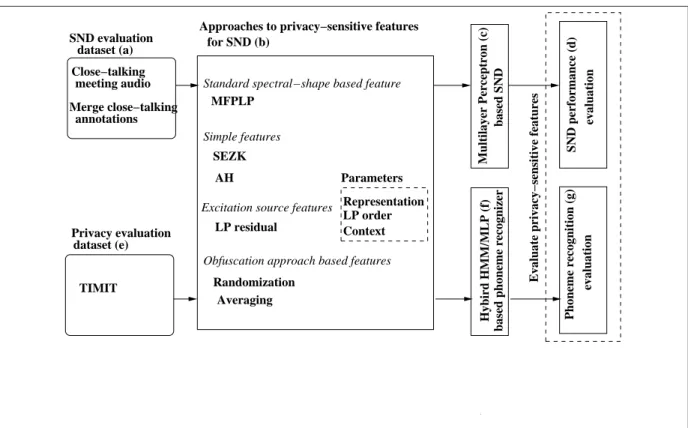
3.1 Block diagram of our approach. A detailed discussion of the figure is provided in Section 3.2. . . 25
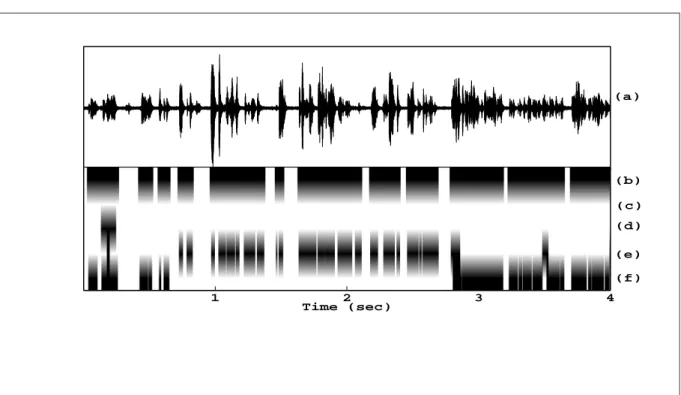
3.2 A close-talking microphone recording of a meeting segment with the speech/nonspeech annotations on the four close-talking microphone channels and their merged annotation. Dark regions indicate speech segments and light regions indicate nonspeech segments. (a) close-talking microphone recording (b) merged annotation using the annotations from all the channels (c) Speaker 1’s annotation - appears to be silent in this segment (d) Speaker 2’s annotation for the same meeting segment with respect to her microphone recording (e) Speaker 3’s annotation for the same meeting segment with respect to her microphone recording -in this case, the signal -in Fig. 3.2(a) was used to produce this annotation (f) Speaker 4’s annotation for the same meeting segment with respect to her microphone recording. 27
3.3 Choice of representation of linear prediction residual on AI23 dataset. The two repre-sentations of the residual studied are cepstrum and MFPLP. The x-axis is the linear prediction order and y-axis is the SND performance in area under the receiver op-erating curve (AROC). This figure also compares the two representations with two different temporal contexts - no context and 51 frame context. . . 33
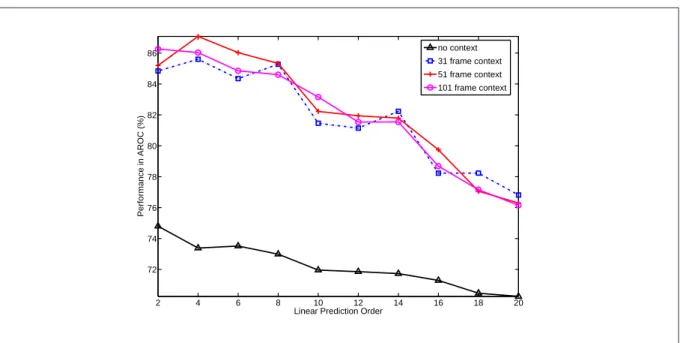
3.4 Effect of temporal context on the MFPLP representation of linear prediction residual on AI23 dataset. This plot shows four different temporal contexts - no context, 31 frame context, 51 frame context, and 101 frame context. The x-axis is the linear pre-diction order and y-axis is the SND performance in area under the receiver operating curve (AROC). . . 34 3.5 Phoneme recognition accuracy for the residual based features various LP orders on
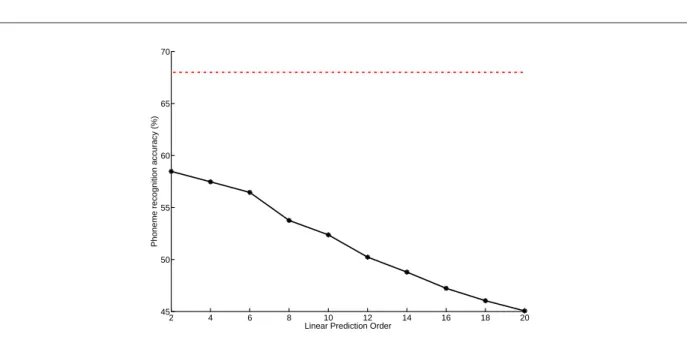
TIMIT. The x-axis shows the LP order while the y-axis shows the phoneme accuracy in (%). Phoneme recognition accuracy of reference MFPLP features is shown as a red dotted line. . . 42
5.1 Block diagram of our approach. A detailed discussion of the figure is provided in Section 5.2. . . 64 5.2 5-layer deep neural network with bottleneck architecture. (a) 5-layer phoneme MLP
is trained with phoneme targets using cross entropy criterion (b) Keeping weights for the first 2 layers fixed, and removing last 2 layers, a reconstruction MLP is trained for the last two layers with squared error criterion. . . 67 5.3 Example steps in neural network filtering for an input frame that is /iy/: (a) Input to
phoneme MLP (logarithm of DFT square magnitude vector) (b) Output from recon-struction MLP (logarithm of DFT square magnitude vector) (c) Filtered spectrum. . . 68 5.4 Plot showing mutual information between the features and phonemes versus mutual
information between the features and speakers. LPRx denotes residual features with LP order x. SEZK and AH denote the features from (Parthasarathi et al., 2010) and (Wyatt et al., 2007a) respectively. Deepxy refer to deep neural network based features with bottleneck sizes corresponding toxy. . . 73 5.5 Comparison between MFCC and real-cepstrum representations of the LP residual on
the development dataset (RT06). . . 77 5.6 Using MFCC representation of LP residual, prediction order vs speaker error is
illus-trated on MDM and SDM conditions of the development dataset (RT06). . . 78 5.7 Combination of LP residual (MFCC representation) with slope and subband on the
LIST OF FIGURES xv
5.8 Performance of the deep neural network on the development data (RT06). Bottleneck size (B - in terms of number of units) versus speaker error rates (%) for 5 different reconstruction layer sizes (H3). The input features are squared magnitude vectors. . . 80 5.9 With input features as MFCC, performance of the deep neural network features on
the development data (RT06). Bottleneck size (B - in terms of number of units) versus speaker error rates (%) for 5 different reconstruction layer sizes (H3). . . 81 5.10 Meetingwise analysis of the 9 meetings in the RT07 evaluation dataset. The upper
plot shows the comparison on the MDM audio while the lower plot shows the compar-ison the SDM audio. The meeting numbers correspond to the first column in Table 5.4. 85 5.11 Phoneme recognition accuracy for the residual based features various LP orders on
TIMIT. The x-axis shows the LP order while the y-axis shows the phoneme accuracy in (%). . . 91
List of Tables
3.1 Train and test datasets for matched, mismatched and cross-validation experiments. Numbers in the brackets denote the number of hours and the numbers outside denote the notation for that dataset. . . 28
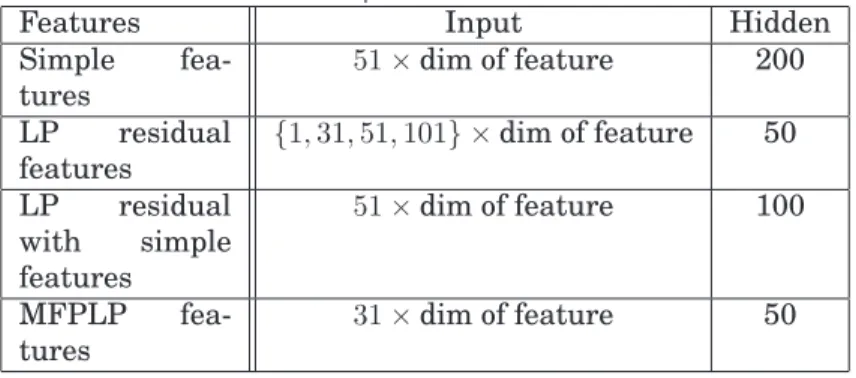
3.2 Number of input and hidden units for each MLP. . . 30
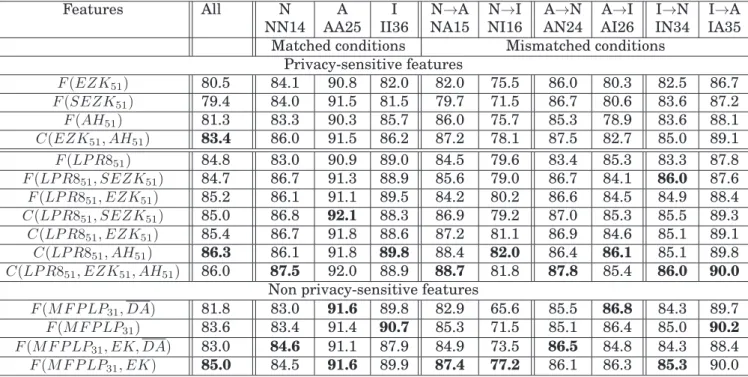
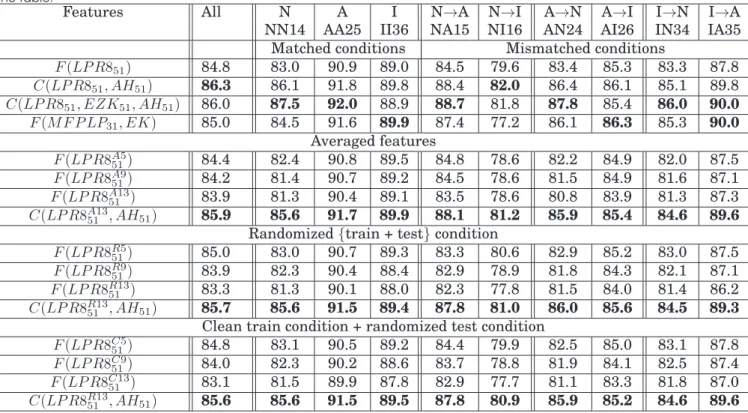
3.3 Performance of features (in percentage of area under ROC) with a context of 51 frames, in matched and mismatched conditions. The second column lists the over-all performance of each system. N, A, and I refer to NIST, AMI, and ICSI datasets.
A→Brefers to the system being trained on a dataset A and being tested on a dataset B. The table is grouped into blocks of privacy-sensitive and non privacy-sensitive fea-tures. For each column and for each block, the best performance is highlighted in bold. The dataset protocol, mentioned in Section 3.3.2, is also mentioned for the respective columns in the table. . . 35
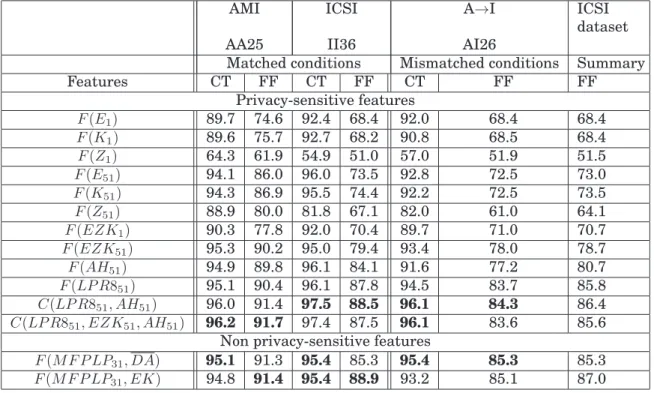
3.4 SND performance analysis (in percentage of area under ROC) in matched and matched conditions (AA25, II36). The table is grouped into blocks of privacy-sensitive and non privacy-sensitive features. For each column and for each block, the best per-formance is highlighted in bold. The dataset protocol, mentioned in Section 3.3.2, is also mentioned for the respective columns in the table. CT and FF refer to close-talking and far-field microphone scenarios. . . 37
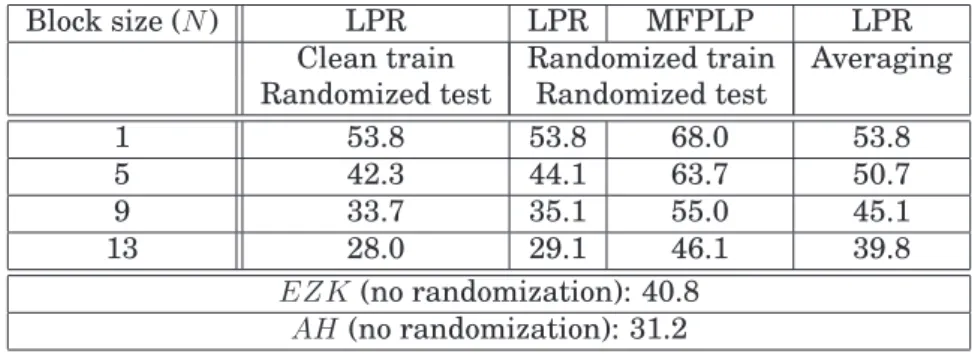
3.5 Phoneme recognition accuracy(%) for MFPLP and LP residual of order 8 for different randomization and averaging block sizes. Linear prediction residual is shown as LPR. Randomization can be performed for (a) only test data - second column or (b) both train and test data with different seeds - next two columns. . . 43 3.6 Performance of averaged/randomized test features (in percentage of area under ROC)
with a context of 51 frames, in mismatched conditions. The second column lists the overall performance of each system. N, A, and I refer to NIST, AMI, and ICSI datasets.
A→Brefers to the system being trained on a dataset A and being tested on a dataset B. Rx denotes randomization with a block size N = x. The table is grouped into blocks of reference, averaged, and randomized (both train and test or test alone) fea-tures. For each column and for each block, the best performance is highlighted in bold. The dataset protocol, mentioned in Section 3.3.2, is also mentioned for the respective columns in the table. . . 45 3.7 Summary of this chapter in terms of (a) SND performance over all the data measured
using AROC (%) and (b) privacy assessment over TIMIT using phoneme recognition accuracy (%). . . 46 3.8 Glossary of notation and their definitions . . . 48
4.1 Complementarity of information in LPR, SS and FB: LPR-x denotes the real cepstrum of LP residual of order x, SS denotes spectral slope, and MFCC(a - b) denotes MFCC values from a kHz to b kHz. The best performance by MFCC baseline is highlighted in bold and italics while the best performances by privacy-sensitive features are high-lighted in bold. The dimensions of the 4 feature vectors are 12, 17, 18, 20 and 21 respectively. . . 56 4.2 Representing subband information: LPR-x denotes the real cepstrum of the LP
resid-ual of order x, SS denotes spectral slope, MFCC(a - b) denotes MFCC values from a kHz to b kHz, and E(a - b) denotes log-energy values from a kHz to b kHz. The first 3 feature vectors have a dimensionality of 21 while the next 3 have a dimensionality of 19. . . 57
LIST OF TABLES xix
4.3 Effect of LP order in LPR: LPR-x denotes the real cepstrum of the LP residual of order x, SS denotes spectral slope, and MFCC(a - b) denotes MFCC values from a kHz to b kHz. All feature vectors have a dimensionality of 21. . . 58
5.1 RT06 evaluation data: The first 3 columns list the performance of the speech/nonspeech detection while the next 2 columns report performance of baseline MFCC features for MDM and SDM. . . 76 5.2 RT07 evaluation data: The first 3 columns list the performance of the
speech/nonspeech detection while the next 2 columns report the performance of base-line MFCC features for MDM and SDM. . . 82 5.3 RT07 evaluation data: Performance of8thorder LP residual and deep neural network
based features. LPR8 denotes LP residual represented using MFCC. SB denotes sub-band information from 2.5 kHz to 3.5 kHz, while SS denotes spectral slope. . . 83 5.4 Statistics of the RT07 evaluation dataset. . . 84 5.5 Effect of randomization on MFCC and LPR8 on the RT07 MDM dataset. Randx is
used to denote randomization with block size of x frames. . . 86 5.6 20 semantically unpredictable sentences in the dataset. . . 88 5.7 HSR performance, in terms of word accuracy, of the 4 systems over all the listeners or
over the top 10 best performing listeners. The four columns indicating performance correspond to raw waveform, reconstruction from MFCC, from MFCC representation of8thorder LP residual, and from MFCC representation of DeepNN features,
respec-tively. . . 89 5.8 Summary of this chapter in terms of (a) Diarization performance on SDM data using
speaker errors (%) and (b) privacy assessment – using automatic phoneme recognition accuracy (%) and human word recognition accuracy from synthesized speech (%). . . . 92
6.1 Performance on close-talking and far-field COSINE data by speech detectors trained on indoor conditions. The combined performance (over close-talking and far-field au-dio) of LP residual and MFPLP based detectors are marked with italics and bold respectively. . . 102
6.2 Performance of combinations of indoor SND detectors on close-talking and far-field COSINE data. As part of additional notation, the subscriptAINorAI denote a
combi-nation of the systems trained on AMI, ICSI, and NIST or AMI and ICSI. Combicombi-nations of detectors achieved by averaging, inverse entropy, and ML schemes are denoted by
Cm,Ce, andCmlrespectively. . . 104
6.3 Performance of SND detectors trained on COSINE data, and tested on close-talking and far-field COSINE data. Combinations of detectors achieved by averaging and inverse entropy schemes are denoted byCmandCerespectively. Bold and italics refer
to the best performances achieved by the residual features and the MFPLP features, respectively. . . 105
Acronyms
Acronyms Definition
AH Features derived from non-initial maximum of the normalized autocorrelation, the number of autocorrelation peaks and the rel-ative spectral entropy.
AMI Augmented Multiparty Interaction.
AMIDA Augmented Multiparty Interaction with Distance Access.
DCT Discrete Cosine Transform.
DFT Discrete Fourier Transform.
EZK Features derived from energy, zero-crossing rate, and kurtosis.
FFT Fast Fourier Transform.
GMM Gaussian mixture model.
HMM Hidden Markov model.
ICSI International Computer Science Institute.
LP Linear prediction.
LPR Linear prediction residual.
LPRx Features derived from linear prediction residual for a prediction order x.
MFCC Mel frequency cepstral coefficients.
MFPLP Mel frequency perceptual linear prediction.
MI Mutual information.
MLP Multilayer perceptron.
NIST National Institute of Standards and Technology.
PCA Principal Component Analysis.
PLP Perceptual linear prediction.
RT Rich Transcription.
SCD Speaker change detection.
SEZK Features derived from spectral flatness, energy, zero-crossing rate, and kurtosis.
SND Speech/nonspeech detection.
SUS Semantically unpredictable sentences.
Chapter 1
Introduction
Notwithstanding other forms of communication, speech is one of the most important channels of human interaction. On one hand, it is perhaps the most personal form of communication, providing a source of rich information, such as the message conveyed by the speaker, the identity of the speaker, and the emotion with which the words were said. On the other hand, it also allows us to infer higher levels of social interaction, such as the type of conversation (monologue, dyadic, or multiparty), the roles that people play, and the behavior that people exhibit.
In this context, there has recently been tremendous interest in capturing and analyzing sponta-neous conversations using wearable devices. Besides increases in network bandwidth, this is due as much to the advances in the sensing technology as it is to the emergence of mobile phones and other devices as viable computing platforms. It is in this larger context that the work reported in this thesis takes place, with the aim of modeling face-to-face interaction patterns using audio collected with a portable recorder (Choudhury and Pentland, 2003; Gatica-Perez, 2006, 2009).
Although a number of interesting computational problems arise out of such a setting, for exam-ple, (a) computational complexity of algorithms for efficient utilization of battery; (b) unsupervised methods for handling large unlabeled data; and (c) analysis of social interactions using such audio data, this thesis limits itself to one of the principal issues in such ubiquitous data collection, namely privacy – of which more will be said subsequently. In this thesis, we mainly approach this problem from a speech processing viewpoint.
1.1
Overview of This Thesis
As discussed before, we wish to capture real-life audio using a portable recorder for the analysis of spontaneous social interactions. Analysis of conversations can then proceed, for instance, by modeling speaker turns using a speaker diarization system. However, without explicit consent from all people present, recording and storing spontaneous conversations leads to a breach in the privacy of people and it is usually unethical; sometimes this could even be illegal – but the exact legal terms are sometimes vague and are difficult to adjudicate, as it depends on many factors such as the laws of the country, sensitivity of the spoken information, etc. Among the earliest works that grappled with such a problem in the speech processing literature is Ellis and Lee (2004a,b), where the authors investigated the idea of using audio logs as a memory prosthetic. Much of the past work had assumed that audio (e.g. in dictation systems or personal recorders) was meant to be private, ie., produced and consumed at the individual level. This obviously changes in multiparty settings.
One way to address this issue of privacy is to store audio features instead of raw audio, such that neither intelligible speech nor linguistic content can be reconstructed (Ellis and Lee, 2004a; Wyatt et al., 2007a). While such audio features may appear to be restrictive, there are different applications that with success use only the nonverbal cues in speech for the study of social behav-ior (Choudhury and Basu, 2004). Analysis of conversations using such features can then proceed by modeling the speaker turns and durations produced by speaker diarization. These features are referred to as privacy-sensitive (or privacy-preserving) features. The term “privacy-sensitive” can have different connotations in different areas of computing. Instead of coining a new term, this thesis decides to follow its use as originally proposed in the speech processing community by Wyatt
et al.(2007a).
As an alternative to storing such audio features, one can implement a speech/nonspeech detec-tion (SND) and a speaker diarizadetec-tion system on the portable device and store informadetec-tion based on the output. A caveat of this method though is that the set of possible tasks using such a high-level information is then limited by the output of the diarization system. For example, other sources of information, not including the verbal information, such as emotion, language, and the background acoustic scene information are inevitably lost. Another challenge concomitant with such a design choice is the computational limitations imposed by the portable device. Towards this end, sound
1.2. MOTIVATIONS 5
sensing frameworks have begun to be proposed for the limited resources available on platforms like the Apple iPhone (Luet al., 2009).
This thesis considers the former approach to the problem, i.e., to capture and store audio fea-tures that respect privacy. Towards this, it studies audio feafea-tures that can achieve state-of-the-art performance in speech/nonspeech detectionandspeaker diarizationwhile minimizing the amount of linguistic information. A comprehensive analysis of various features for these tasks is performed in predominantly indoor conditions but also in outdoor conditions. This thesis then proposes meth-ods to quantitatively assess privacy. In the next sections of this chapter, we will briefly discuss the motivations, objectives, contributions, and the organization of this thesis.
1.2
Motivations
Earlier works on privacy-sensitive features have studied applications of speech processing tasks such as scene analysis in indexing large, personal audio logs (Ellis and Lee, 2006) and multiparty conversation detection and modeling (Wyattet al., 2007a). One of the questions that arises natu-rally from these works for further investigation is the relative ability of different features to pre-serve privacy. Another motivation of this thesis is to systematically study such features for speech processing tasks and benchmark the features against standard features such as Mel Frequency Cepstral coefficients (MFCC).
The notion of privacy in audio is difficult to quantify and evaluate. Measures of usability of corrupted speech segments (Yantorno, 2000) could be interpreted as means to evaluate privacy, with high usability corresponding to low privacy. More recently, studies such as (Ellis and Lee, 2004a; Wyattet al., 2007a,b) indicate that the main privacy concern in audio is the reconstructibility of the linguistic information or of intelligible speech. For features such as MFCC, a potential issue is that both an intelligible speech signal and the linguistic content can be reconstructed.
In terms of spontaneous speech, meeting room recordings provide a challenging environment for many speech processing tasks (Garofoloet al., 2004; Carlettaet al., 2006; Burgeret al., 2002; Janin
et al., 2003). State-of-the-art systems for such tasks use features based on spectral-shape based features. As examples, the ICSI meeting room diarization system (Wooters and Huijbregts, 2008) and the AMIDA 2009 meeting transcription system (Hain et al., 2010) use features such as Mel
Frequency Cepstral coefficients (MFCC) and Mel Frequency Perceptual Linear Prediction (MFPLP) features (Dineset al., 2006). While such features have been shown to be robust, as discussed earlier, they are not necessarily privacy-preserving.
In contrast to the audio recorded for conventional speech processing tasks, the audio from portable recorders present a different challenge; considering the portability of the recorders and the mobility that it provides the wearer, the features also need to be robust to changes in the ambient environment. Therefore, speech processing techniques, including feature extraction methods, need to be robust to a variety of conditions, such as indoor versus outdoor, matched versus mismatched, near-field versus far-field, and single versus multiple distant microphones.
1.3
Objectives
The ultimate aim of this work is to investigate privacy-sensitive features for tasks such as speech/nonspeech detection (SND), speaker change detection (SCD) and speaker diarization (SD) towards enabling the development of systems for conversation and acoustic scene analysis. This thesis has four specific objectives: (a) to investigate privacy-sensitive audio features for SND and benchmark them with respect to MFCC or PLP features; (b) to study state-of-the-art and privacy-sensitive features for speaker diarization exploring the tradeoff between task performance and privacy; (c) to propose an objective evaluation of the abstract notion of privacy; and (d) to assess the features in a variety of conditions – indoor and outdoor conditions.
1.4
Contributions
The main contributions of this thesis can be summarized as follows:
(1) State-of-the-art speech/nonspeech detection using privacy-sensitive features. This thesis investigates three approaches based on: (a) simple, instantaneous feature extraction methods; (b) excitation source information based methods; and (c) feature obfuscation meth-ods such as local (within 130 ms) temporal averaging and randomization applied on excitation source information. To evaluate these approaches for SND, a multiparty conversational meeting data of nearly 450 hours is used. On this dataset, these features are benchmarked
1.4. CONTRIBUTIONS 7
against standard spectral shape based features such as Mel Frequency Perceptual Linear Prediction (MFPLP). Fusion strategies combining excitation source with simple features show that comparable performance can be obtained in both close-talking and far-field microphone scenarios. As ways to evaluate privacy in audio, phoneme recognition studies are proposed, with higher recognition accuracy being interpreted as lower privacy. While excitation source features yield phoneme recognition accuracies in between the simple features and the MFPLP features, obfuscation methods applied on the excitation features yield low phoneme accuracies in conjunction with SND performance comparable to that of MFPLP features. This work was published by Parthasarathiet al.(2009a, 2010), and a detailed journal version was published by Parthasarathiet al.(2011b).
(2) Nearly state-of-the-art speaker diarization using privacy-sensitive features. We present an in-depth study of speaker diarization using privacy-sensitive features. Motivated by the source-filter model, Linear Prediction (LP) residual for speaker change detection is explored by Parthasarathi et al. (2009b). This was later extended to speaker diarization by (Parthasarathiet al., 2011a). Issues such as prediction order and choice of representation of LP residual are studied. Additionally, the combination of LP residual with subband infor-mation and spectral slope is investigated. Subsequently, data-driven ways of estimating the excitation source are explored. In this regard, this thesis proposes a supervised framework using a deep neural network architecture for deriving privacy-sensitive audio features. These approaches are benchmarked against the traditional Mel Frequency Cepstral Coefficients (MFCC) features for speaker diarization in single and multiple distant microphone scenarios. Experiments on the NIST Rich Transcription Spring 2007 (RT07) evaluation dataset show that the proposed approaches yield diarization performance close to the MFCC features on the single distant microphone dataset. Human and automatic speech recognition tests are performed, showing that the proposed approaches to privacy-sensitive audio features yield much lower recognition accuracies compared to MFCC features. A detailed version of this work was submitted as a journal and is currently being revised (Parthasarathiet al., 2011c).
(3) Mutual information framework. Extraction of privacy-sensitive features is interpreted as an objective that maximizes the Mutual Information (MI) with speakers while minimizing the MI with phonemes. The source-filter model arises naturally out of this formulation. Issues
regarding estimation of MI, and an analysis with respect to different features were presented and published in (Parthasarathiet al., 2011a).
(4) Outdoor conditions. The last contribution of this thesis is the validation of our approaches in outdoor conditions. While the diarization study in outdoor audio was more preliminary in nature, our study on SND confirms the conclusion that privacy-sensitive features trained on outdoor audio yield performance comparable to that of PLP features trained on outdoor audio. We also explored the suitability of using, and then combining SND models trained on indoor conditions for the outdoor audio. In this regard, we propose a maximum likelihood based unsupervised method to combine the SND models. Chapter 6 summarizes the results in outdoor conditions.
This thesis is based on the publications listed below. Journals:
1. Parthasarathi et al. 2011b: Sree Hari Krishnan Parthasarathi, Daniel Gatica-Perez, Herv´e Bourlard, and Mathew Magimai.-Doss, “Privacy-Sensitive Audio Features for Speech/Nonspeech Detection”,IEEE Transactions on Audio, Speech and Language Process-ing, 2011.
2. Parthasarathi et al. 2012: Sree Hari Krishnan Parthasarathi, Herv´e Bourlard, and Daniel Gatica-Perez, “Wordless Sounds: Robust Speaker Diarization using Privacy-Preserving Audio Representations”, Under revision, IEEE Transactions on Audio, Speech and Language Pro-cessing.
Conferences:
1. Parthasarathi et al. 2011a: Sree Hari Krishnan Parthasarathi, Herv´e Bourlard, and Daniel Gatica-Perez, “LP Residual Features for Robust, Privacy-Sensitive Speaker Diarization”,Proc. of Interspeech 2011.
2. Parthasarathi et al. 2010: Sree Hari Krishnan Parthasarathi, Mathew Magimai.-Doss, Herv´e Bourlard and Daniel Gatica-Perez, “Evaluating the Robustness of Privacy-Sensitive Audio Features for Speech Detection in Personal Audio Log Scenarios”,Proc. of ICASSP 2010. 3. Parthasarathi et al. 2009b: Sree Hari Krishnan Parthasarathi, Mathew Magimai.-Doss,
1.5. ORGANIZATION 9
audio cues”,Proc. of ICMI-MLMI 2009.
4. Parthasarathi et al. 2009a: Sree Hari Krishnan Parthasarathi, Mathew Magimai.-Doss, Herv´e Bourlard and Daniel Gatica-Perez, “Investigating privacy-sensitive features for speech detection in multiparty conversations”,Proc. of Interspeech 2009.
5. Parthasarathi et al. 2008: Sree Hari Krishnan Parthasarathi, Petr Motlicek, and Hynek Hermansky, “Exploiting contextual information for speech/non-speech detection ”, Proc. of TSD 2008, LNCS/LNAI series, Springer-Verlag, 2008.
1.5
Organization
This thesis is organized as follows:
– Chapter 2 is an overview of the relevant literature on privacy. We start with a historical and legal perspective on privacy and then present a brief review of the existing literature on com-putational methods to preserve privacy in the ubiquitous computing and the distributed data mining communities. Relevant literature on privacy from speech processing is then surveyed. – In Chapter 3, we present our study on speech/nonspeech detection using privacy-sensitive features. These features are benchmarked against the MFPLP features in terms of phoneme recognition on the TIMIT dataset and SND performance on the meeting room dataset. – Before proceeding to speaker diarization, Chapter 4 presents an exploration of linear
predic-tion (LP) residual features for the problem of speaker change detecpredic-tion on the HUB 4 dataset. – In Chapter 5, we study the feature extraction as a process that seeks to maximize mutual in-formation with speakers, while minimizing mutual inin-formation with phonemes. The source-filter model arises naturally out of this. We then view linear prediction (LP) residual in this light and then discuss the proposed deep neural network based features as another way to estimate the excitation source. Diarization experiments on single and multiple distant micro-phones are performed to compare proposed features with the standard MFCC features. – Chapter 6 validates the proposed approaches to SND and speaker diarization on outdoor
con-ditions. For SND, it proposes a maximum likelihood combination of privacy-sensitive detectors using the models trained on indoor conditions.
Chapter 2
Privacy: A Survey of Related Work
Among the many forms of privacy, this thesis is most concerned with information privacy. The intention of this chapter is by no means to provide a comprehensive review of information privacy and the methods to address it. Rather, it aims to portray the relevant literature in privacy-sensitive speech and audio processing within the larger fabric of legal and scientific ideas on privacy.
We start with some historical and legal interpretations of information privacy. Then we briefly look at guidelines for designing privacy enhancing techniques. Next, we review relevant literature on computational methods to preserve privacy. Specifically, we present interpretations and solu-tions drawn from the domains of ubiquitous computing and distributed data mining. Lastly, we turn to prior works from the field of speech processing. Here, we discuss the work on personal audio logs by Lee and Ellis. This is followed by the work done on conversation modeling using spontaneous speech by Choudhury, Wyatt, and others. Before concluding this chapter, we present a summary of recent work based on approaches from distributed data mining by Pathak and Raj.
2.1
What is Privacy and Who Cares About It?
Information privacy is not a recent phenomenon, and in one of the classic papers in the legal liter-ature, Samuel Warren and Louis Brandeis (Warren and Brandeis, 1890), describe privacy as a “the right to be let alone”. With advances in technology since then, the idea of privacy has evolved, but the basic notion of privacy now is as relevant as it was then. The following excerpt from Warren
and Brandeis (1890) illustrates this point: “Instantaneous photographs and newspaper enterprise have invaded the sacred precincts of private and domestic life; and numerous mechanical devices threaten to make good the prediction that what is whispered in the closet shall be proclaimed from the house-tops.”
Subsequent to the publication of Warren and Brandeis (1890), there was considerable debate in the courtrooms over the question of whether the right of privacy existed at all (Prosser, 1960). Inquiry into the nature of interests that were being protected by privacy was still nascent.
2.1.1
Legal Viewpoints
Several decades later William Prosser expanded this idea based on torts. For this he synthesized various cases that emerged from Warren and Brandeis (1890) and listed four types of activities that are redressed under the rubric of privacy (Prosser, 1960):
– Intrusion upon the plaintiff ’s seclusion or solitude, or into her private affairs. – Public disclosure of embarrassing private facts about the plaintiff.
– Publicity which places the plaintiff in a false light in the public eye.
– Appropriation, for the defendants advantage, of the plaintiffs name or likeness.
This torts view of privacy, applicable between private parties, does not cover many of the subtle is-sues created by the capture of multimodal sensory data by organizations in ordinary social settings. In a recent article for the Pennsylvania Law Review, Daniel Solove (Solove, 2006) addresses this by claiming that in order to understand privacy, one needs to identify how it is violated. He proposes a taxonomy of how an individual’s privacy can be violated. It starts with information collection, where various entities collect information about data subjects. Although Solove (2006) focuses mainly on surveillance and interrogation, this is relevant in the context of this thesis, as our focus is on the ubiquitous capture of audio. In the next stage of the taxonomy,information process-ing, some form of processing is done on the collected data. Briefly, this consists of five forms, namely aggregation, identification, insecurity, secondary use, and exclusion. The third is theinformation disseminationstage, which refers to outward propagation of the collected and processed informa-tion. The activities at this stage could range from breach of confidentiality to blackmail. The last stage is invasion. This stage does not involve information, as it mainly is related to what Solove refers to as intrusion and decisional interference. Out of the four stages, information collection and
2.2. FAIR INFORMATION PRINCIPLES 13
information processing are the stages for which privacy is incorporated commonly by design; and these form the focus of the rest of this chapter. It is in this context that the thesis is written.
2.1.2
Survey based Viewpoints
Such an analysis would be largely academic if people did not care sufficiently about privacy. In this regard, Alan Westin (Westinet al., 2003) conducted about 30 surveys between 1978 and 2004, on a number of topics ranging from consumer privacy surveys to health information surveys and e-commerce. A summary of his conclusions is presented by Kumaraguru and Cranor (2005). In these surveys, based on their replies, Westin classified the people he surveyed into three categories. The first category are thefundamentalists, so called as they are “generally distrustful of organizations that ask for their personal information, worried about the accuracy of computerized information and additional uses made of it, and are in favor of new laws and regulatory actions to spell out pri-vacy rights and provide enforceable remedies.” The second class of people are thepragmatists, who “weigh the benefits to them of various consumer opportunities and services, protections of public safety or enforcement of personal morality against the degree of intrusiveness of personal informa-tion sought and the increase in government power involved.” The last class are theunconcerned, who are “generally trustful of organizations collecting their personal information, comfortable with existing organizational procedures and uses, and ready to forego privacy claims to secure consumer-service benefits or public-order values.”
Roughly 25%of the surveyed people were fundamentalists, and about 55%fall under the prag-matic category, while about 20%are unconcerned. This implies that a large majority of the people are concerned about privacy. This leads to a question of whether privacy can be factored into the de-sign. To this end, we will look at Fair Information Principles (FIP). While the FIPs are not binding, they offer guidelines regarding data privacy.
2.2
Fair Information Principles
Langheinrich (Langheinrich, 2009b), in his article on privacy for ubiquitous computing, motivates the design of privacy-sensitive methods in ubiquitous computing from the Organization for Eco-nomic Cooperation and Development’s (OECD) FIP. We take a similar approach and paraphrase
the 8 principles; detailed information can be obtained from (OECD, 2011).
1. Collection Limitation Principle: There should be limits to the collection of personal data and any such data should be obtained with the knowledge or consent of the subject.
2. Data Quality Principle: Personal data should be relevant to the purposes for which they are to be used, and to the extent necessary for those purposes.
3. Purpose Specification Principle: The purposes for which personal data are collected should be specified before the time of data collection.
4. Use Limitation Principle: Personal data should not be disclosed, made available or otherwise used for purposes other than those specified in accordance with the Purpose Specification principle except with the consent of the data subject.
5. Security Safeguards Principle: Personal data should be protected by security safeguards against unauthorized access or disclosure of data.
6. Openness Principle: There should be a general policy of openness about developments, prac-tices, and policies with respect to personal data.
7. Individual Participation Principle: An individual should have the right to obtain her data from the data controller within a reasonable time at a reasonable charge.
8. Accountability Principle: A data controller should be accountable for complying with the prin-ciple stated above.
Of course once can interpret the FIPs as one way to address the four stages of privacy violation of Solove (2006), and therefore provide a reasonable way to implement privacy. While many of these principles relate to policies, computational approaches have focused on the first, second, and fifth (security safeguards) principles. These form the topic of our next section.
2.3
Computational Methods to Preserve Privacy
Computational solutions to address privacy focus on the time of acquisition or on the time of pro-cessing. Due to the pervasive nature of data acquisition in ubiquitous computing, most prior work focus on acquisition; although some such as Hong and Landay (2004) do it at both stages. In contrast, in the field of distributed data mining, the focus has primarily been on the latter stage, through the use of secure multiparty computation. We will look at these approaches in some detail.
2.3. COMPUTATIONAL METHODS TO PRESERVE PRIVACY 15
2.3.1
Ubiquitous Computing
Most prior work in ubiquitous computing has focused on data items such as location, Radio Fre-quency Identification (RFID), and smartspaces (Langheinrich, 2009b). Building smartspaces in-volves a fully privacy-sensitive infrastructure involving privacy beacons, privacy-sensitive database access, and privacy proxies. As this is beyond the scope of this thesis, we do not discuss smartspaces here. Details can be obtained from Hong and Landay (2004).
Location information is typically used by wearable devices (or mobile phones) or by web-based applications. In all these cases, the key questions are “Who? Where? When?”. Knowing the an-swers to only one of these questions might not compromise the privacy so much. Computational methods to handle, exploit and eitherobfuscatethe location (i.e., degrading the quality of location measurements) oranonymize(i.e., formally known as k-anonymity) the identity of the person have been proposed. A detailed survey of location privacy is provided in Krumm (2009).
Among the various technologies in ubiquitous computing, RFIDs are the most prominent in terms of privacy issues (Langheinrich, 2009a). The typical scenario is that of an RFID tag attached to a consumer item that is being tagged. The tag is typically passive, meaning that it receives power from a reader. The literature on RFIDs is more involved, as they tend to reveal location traces as well as other personal data (depending on the item). Privacy of the data is ensured not only by an encrypted communication but also by an authentication mechanism, the latter of which requires a shared secret – also known as pass key – to be selected and exchanged between the tag and the reader. Two important challenges posed by passive RFIDs are the limited computational resources of the tag and the selection/exchange of pass key. A common response to this is to use a powerful proxy device that would locally manage one’s tagged items. By incorporating an RFID reader into a device such as a mobile phone, the device could act as a proxy for all interactions: blocking or allowing access to the tagged items (Langheinrich, 2009a).
2.3.2
Distributed Data Mining
Privacy in distributed data mining investigates secure information processing over distributed data. A scenario considered commonly is that of two independent agents, with one agent requiring access to some private data, with the other securing all the access to it. The basis of all methods in
this case is the classical Secure Multiparty Computation (SMC) protocol introduced by (Yao, 1986). This is usually illustrated through the Millionaires’ problem: suppose two people want to find out who is worth more, but neither want to reveal their worth. (Yao, 1986) presented a solution to this problem for two parties, and it has since been extended to the multiparty case (Goldreich et al., 1987).
Formally in a multiparty case, the goal is to compute a global function, without any party know-ing anythknow-ing except their own input and the global value. For instance, if the global function is a computation of the sum of the values, then every party should not be able to know more than the sum of the inputs of the other parties. If all parties can be assumed to be honest, a simple solution is: the first person adds a random value to her input and passes it to the second, who adds his input to this and so on until it cycles back to the first person, who subtracts the random value to yield a “secure sum”. This algorithm is popular in data mining and has been applied for many machine learning algorithms such as large margin training for SVMs (Vaidyaet al., 2008) and clustering (Lin
et al., 2005), among others.
2.4
Privacy in Speech and Audio Processing
In the previous section, while surveying privacy from two fields of research, we categorized the literature into three privacy enhancing techniques, namely anonymization, obfuscation, and cryp-tographic methods. In the field of speech processing, apart from this thesis, there are three lines of work on privacy. In this section, we will give a brief outline of these works.
2.4.1
Scene Analysis in Long Duration Personal Audio Logs
Although the idea of using wearable devices to capture real-life audio has been explored be-fore (Clarkson et al., 1998), to our knowledge the earliest works on privacy in audio emerged from Ellis and Lee (2004b). In this work, inspired by Vannevar Bush’s vision of memex, the au-thors used audio to record the daily experience. Features derived from a long-term average (of the order of a minute) of standard short-term spectral features are used in conjunction with the Bayesian Information Criterion (BIC) to segment locations.
2.4. PRIVACY IN SPEECH AND AUDIO PROCESSING 17
is perhaps the richest and the more interesting content, storing raw recordings inevitably leads to privacy concerns. (Ellis and Lee, 2004a) then goes on to define a notion of privacy-sensitivity based on the linguistic message, “Given a reliable method for speech segment identification, we propose to have our systems default behavior be to scramble such segments to render the words unintelligible.” To this end, in Lee and Ellis (2006) short-term features based on autocorrelation were proposed for robust speech/nonspeech segmentation. These features are meant to be used for detecting speech segments and making them unintelligible before storage.
2.4.2
Conversation Analysis
In the field of automatic conversation analysis, (Basu, 2002) is probably among the earliest work on audio features. Here a dyadic conversation analysis – conversation detection, segmentation, and classification – is performed using a series of detectors (e.g., voicing detectors) based on au-dio features derived from short-term autocorrelation and relative spectral entropy. These auau-dio features were studied for robustness to noise, robustness to microphone distance, and robustness to environment. This study was done using raw audio, and no explicit privacy constraints were included.
Choudhury (2004) is, to our knowledge, the first work on sensor-based data-driven methods for modeling face-to-face interactions. Here, a “sociometer” was equipped to collect the following in-formation for each individual: (a) identity of the people in an interaction, as obtained by using an infrared transceiver sending/receiving a unique ID; (b) speech information sampled at 8 KHz; and (c) motion information captured using an accelerometer. Although raw audio was recorded and stored, it was agreed with the participants that only speech features proposed by Basu (2002) would be extracted; the underlying social network structure was then learned from these features (Choud-huryet al., 2003; Choudhury and Pentland, 2003).
The next generation of sociometers (Olguin-Olguin, 2007) did not store raw audio, and instead, stored energy values from four frequency bands. These frequency bands were, 85 to 222 Hz, 222 to 583 Hz, 583 to 1527 Hz, and 1527 to 4000 Hz. Offline analysis of these values was done to extract higher-level cues such as, speech activity, consistency of speech, and the amount of speaking time per minute. These and other face-to-face interaction cues were studied by Olguin-Olguin and Pentland (2010) in three separate case studies of “organizational design and engineering”.
In an attempt at explicitly addressing privacy, Wyattet al.(2007a,b) reinterpreted (Basu, 2002)’s features – derived from short-term autocorrelation and relative spectral entropy – for privacy-sensitive, multiparty conversation detection and modeling. These works lend support to the no-tion expressed earlier in (Ellis and Lee, 2004a), of privacy in audio as a constraint on the features such that neither intelligible speech nor linguistic content be reconstructible (Wyattet al., 2007a). Furthermore, these features were recorded for a social network analysis on 4,400 hours of privacy-sensitive audio data captured from real world interactions, in completely unconstrained and natural conditions, between 24 subjects over a period of 9 months.
2.4.3
Distributed Data Mining based Methods
In the field of distributed data mining, one assumes the existence of a computational agent who acts independently of the distributed data. The idea behind this is expressed thus (Pathak and Raj, 2011): “Alice has some data for which she wishes to do some inference, while Bob possesses a model for this; The constraint is that while Alice wants the data to remain private, Bob wants the model parameters to remain private.” Drawing upon methods from distributed data mining, (Pathaket al., 2010) investigate methods for privacy of the the independent agent as well as the distributed data. For example (Linet al., 2005), shows how expectation maximization (EM) for training GMMs (Lin
et al., 2005) is done.
In particular, (Pathak and Raj, 2011; Pathaket al., 2010) study these methods for problems such as keyword spotting, speaker identification, speaker verification, and speech recognition. They have extended (Linet al., 2005) to Hidden Markov Models (HMM).
2.5
Context of This Thesis
The following are some aspects which connect this thesis to the work presented in this chapter. – Although earlier works such as Ellis and Lee (2004a); Wyattet al.(2007a) indicate that the
lin-guistic message is the privacy-sensitive information, a question that arises from these works for further investigation is the assessment of the relative privacy of different features. In this context, this thesis proposes speech recognition and intelligibility studies to benchmark pri-vacy in features against MFCC and raw audio. In addition, since most face-to-face interaction
2.5. CONTEXT OF THIS THESIS 19
tasks exploit SND and speaker diarization (Gatica-Perez, 2009), we also use MFCC/PLP as a yardstick to assess how the proposed features, as well as those by Wyattet al.(2007a); Ellis and Lee (2004a) compare.
– Linear prediction has a long history in speech processing, with applications not only in speech coding and synthesis, but even in speech recognition. The source-filter model assumed by lin-ear prediction provides a natural framework for exploring privacy concerns. As an extension, data-driven models assuming the source-filter model (not including linear prediction) could also be explored, as we have done with deep neural networks. This approach contrasts with those taken by Ellis and Lee (2004a) and Wyattet al.(2007a). Additionally, one of the issues we investigate in this thesis is the choice of representation of the linear prediction residual for tasks such as SND and diarization.
– We explore privacy-sensitive methods based on obfuscation, thereby providing a link to the privacy preserving approaches in ubiquitous computing (Krumm, 2009) and those in speech processing (Ellis and Lee, 2004a).
– As a formal result of our study on SND, we formulated a model for privacy preserving methods using mutual information. To our knowledge, this framework has not been studied before.
Chapter 3
Speech/nonspeech Detection
The overall objective of this thesis is to study privacy-sensitive features for speech/nonspeech detec-tion and speaker diarizadetec-tion. This chapter restricts itself to the first aspect; i.e., privacy-sensitive features for speech/nonspeech detection (SND). Towards this, we present a comprehensive study of privacy-sensitive features for SND in indoor meetings.
This work investigates three different approaches based on: (a) simple, instantaneous feature extraction methods; (b) excitation source information based methods; and (c) feature obfuscation methods such as local temporal averaging and randomization applied on excitation source infor-mation. To evaluate these approaches for SND, we use multiparty conversational meeting data of nearly 450 hours. On this dataset, we evaluate these features and benchmark them against stan-dard spectral shape based features such as Mel Frequency Perceptual Linear Prediction (MFPLP). Fusion strategies combining excitation source with simple features show that a performance com-parable to MFPLP can be obtained in both close-talking and far-field microphone scenarios. As one way to objectively evaluate the notion of privacy, we conduct phoneme recognition studies on TIMIT. While excitation source features yield phoneme recognition accuracies in between the simple fea-tures and the MFPLP feafea-tures, obfuscation methods applied on the excitation feafea-tures yield low phoneme accuracies in conjunction with SND performance comparable to that of MFPLP features. This work was originally published in Parthasarathiet al.(2009a, 2010, 2011b).
The rest of the chapter is organized as follows. Section 3.1 motivates our features. Section 3.2 provides an overview of our approach. The dataset definition and the annotations, including the
dataset protocol involving various experimental setups are provided in Section 3.3. Section 3.4 dis-cusses the implementation and the notational details of the SND system, comprising the features, the classifier, and the combination techniques. Parameter selection experiments are discussed in Section 3.5. We discuss the SND performance and revisit the privacy-sensitive aspects of the fea-tures in Sections 3.6 and 3.7. Finally, we draw some conclusions in Section 3.8.
3.1
Motivation and Preliminary Work
In this section, we motivate our three approaches, namely, (a) simple, instantaneous features, (b)
linear prediction residual, and (c)feature obfuscation methodssuch as local (within 130 ms) tempo-ral averaging and randomization.
3.1.1
Preliminary Work on Simple Features
Motivated by Wyattet al. (2007a), we began our study into privacy-sensitive features for speech detection (Parthasarathi et al., 2009a), by exploring four different, classical short-term features obtained by temporal processing of the audio signal (i.e., without estimating the spectrum). These features are energy, zero crossing rate, spectral flatness, and kurtosis. In addition to these four features, we also systematically studied the features proposed earlier by (Wyattet al., 2007a). A brief summary of the features and the conclusions of the study is now presented.
1. Short-term energy (E): Studies have shown that short-term energy has been one of the most important features for speech detection (Atal and Rabiner, 1976; Wrigleyet al., 2005). Fur-thermore, studies have shown that long-term information in energy can be exploited for speech detection (Parthasarathiet al., 2008).
2. Short-term zero crossing rate (Z): The zero crossing rate at a frame-level has been a popular feature for voiced/unvoiced/nonspeech classification (Atal and Rabiner, 1976; Wrigleyet al., 2005).
3. Short-term spectral flatness measure (S): The short-term spectrum of the nonspeech signal such as wideband noise can be expected to be flatter than the short-term spectrum of the speech signal. Thus a measure of spectral flatness can be useful for SND. By normalizing the
3.1. MOTIVATION AND PRELIMINARY WORK 23
spectrum, and viewing it as a probability mass function, entropy can be used as a measure of the flatness of spectrum. Linear prediction analysis can also be used to derive an efficient flatness measure of speech without explicitly estimating the spectrum (Makhoul, 1975). The flatness measure is derived as the ratio of the energy in the model error (residual) to the energy in the original signal. We investigate the measure of spectral flatness obtained using the latter approach.
4. Short-term kurtosis (K): Kurtosis is derived from the fourth order moment of a distribution and it measures its “peakedness”. Speech samples have been shown to have a flatter distri-bution than noise samples, and kurtosis has been shown to be useful in this regard (Wrigley
et al., 2005).
5. Features proposed in (Basu, 2002; Wyattet al., 2007a) for privacy-sensitive speech detection (AH) are the non-initial maximum of the normalized autocorrelation, the number of autocor-relation peaks and the relative spectral entropy.
Benchmarking the two sets of simple features, proposed by (Parthasarathi et al., 2009a) and (Wyatt et al., 2007a), revealed that the performance of these privacy-sensitive features with ex-plicit temporal modeling is comparable to the standard spectral features such as MFPLP, that do not have the privacy constraint. Our subsequent study focusing on the robustness of these fea-tures, (Parthasarathiet al., 2010), however found that there could be a small gap in performance between the privacy-sensitive and the non privacy constrained features inmismatchedconditions.
3.1.2
Motivation for Linear Prediction Residual
It is generally known that at least two or three formants are required to synthesize intelligible speech or to reconstruct the linguistic information (Donovan, 1996). Our approach to preserving privacy is based on adaptively filtering out information about these spectral peaks. This approach is motivated by the source-filter model (Fant, 1960).
Linear prediction (LP) analysis of speech (Makhoul, 1975) assumes the source-filter model and it estimates