Outer Hebrides Migration Study
Final Report
Table of contents
1 Executive summary 1
1.1 Background 1
1.2 Population trends and their causes 1
1.3 Drivers of change in population 2
1.4 Population projections and their impacts 2 1.5 A sustainable population for the Western Isles 3 1.6 Factors needed for sustainable communities 4
1.7 Key policy priorities 7
2 Introduction 10
2.1 Background 10
2.2 Evidence gaps 10
2.3 Methods 11
3 Trends in migration and their causes 12
3.1 Historic trends in population change 12
3.2 Recent trends in population change 13
3.3 Current and emerging trends 18
3.4 Chapter summary 24
4 Drivers of change in population 25
4.1 Key drivers of population change 25
4.2 Declining employment in traditional sectors 25
4.3 Limited job opportunities 26
4.4 Educational opportunities 27
4.5 Transport 29
4.6 Housing 29
4.7 Community confidence 32
4.8 Cultural cohesion versus cultural conservatism 32
4.9 Chapter summary 33
5 Population projections and their impacts 34
5.1 Population modelling 34
5.2 Social & economic impacts of population change 37
5.3 Chapter summary 48
6 A sustainable population for the Outer Hebrides 50 6.1 A sustainable population in 10 to 15 years 50
6.2 The impacts of different approaches 51
6.3 Key motivations within target groups 52
6.4 The sustainable approach 53
6.5 Chapter summary 54
7 Real life experiences 56
7.1 Characteristics of stayers, out-migrants, in-migrants and returners 56
7.2 Stayers’ motivations and experiences 59
7.3 Leavers’ motivations and experiences 61
7.4 Leavers: openness to returning 66
7.5 Lifestyle in-migrants’ motivations and experiences 66 7.6 Lifestyle in-migrants: motivations to move to the Outer Hebrides 68 7.7 International economic in-migrants’ motivations and experiences 73
7.8 Returners’ motivations and experiences 82
8 Factors needed for sustainable communities 85
8.1 Scenario planning 85
8.2 A sustainable future in 10 to 15 years 89
8.4 Training and education 90
8.5 Housing 91
8.6 Transport 92
8.7 Health and care 92
8.8 Confidence and self-determination 93
8.9 Integrating in-migrant population 93
8.10 ICT/ Broadband 94
8.11 Leisure and culture facilities 94
8.12 Environment and quality of life 95
9 Policies required for a sustainable population 96
9.1 Overall aims 96
9.2 The policy context 97
9.3 Key policy priorities 110
Appendix A - References 113 Appendix B - Some examples of experience elsewhere 116 Different policy and practice approaches 116 Ireland 118 Germany 119 Canada 120 Contact details 121
1 Executive summary
1.1 Background
In 2005, Comhairle nan Eilean Siar, in partnership with Western Isles Enterprise and Communities Scotland commissioned Hall Aitken and Ionad Nàiseanta na h-Imrich to carry out in-depth research into the issues around migration in and out of the Outer Hebrides. The Outer Hebrides have seen the biggest population decline proportionally of any Scottish Local Authority Area over recent years. Young people from the Islands do well at school and often leave the Islands to study at University and College. Many stay on the mainland to access a wider range of economic and social opportunities. Consequently the area has an increasingly ageing population profile with the highest proportion of elderly people in Scotland.
The Partners have identified a series of challenging evidence gaps which, if filled with scientific research findings, will move understanding of population change forward significantly. The evidence gaps identified in the brief can be summarised as:
| Predicting population change based on present trends and identifying social and
economic impacts and policy implications.
| Gaining a better understanding of the causes and effects of population
movements over the past 30 years.
| To set the Outer Hebrides within a wider context by looking at comparable areas
which have experienced rural depopulation, and to identify successful measures used.
| To gain insights into the factors that influence out/in-migration of different groups
of people and communities.
| To identify what is needed for demographic, social, economic and cultural
sustainability.
| Carrying out projections of population movements, and assessing their social
and economic impacts.
| Identifying potential policies and practices that can address out-migration and
encourage in-migration.
The research has involved a wide range of approaches including desk research; interviews with service-providers and stakeholders; an internet survey with around 1,500 responses from current and past residents of the Outer Hebrides; a survey of employers; a series of focus groups across the Outer Hebrides and on the mainland; interviews with employers and international in-migrants; and a scenario-planning workshop with key agencies tasked with taking forward policies.
1.2 Population trends and their causes
There has been a long-term population decline of about 40% between 1901 and 2001. This decline has been steepest in Harris, the Uists and Barra. However after a long period of population decline there has been a recent upturn in the population.
Out-migration is still a major factor in population change; particularly among younger age groups. Out-migration is much higher among women and 71% of in-migrants are males. This is leading to a widening gender imbalance in the population.
School rolls have declined significantly since 1975 across the Outer Hebrides. However there have been growing primary school rolls in some Island communities since 2002, including Harris, Balivanich and the North and East of Lewis.
Other recent population trends include:
| A shift in population towards larger settlements; and particularly Stornoway; | An upturn in people choosing to live in the Outer Hebrides because of quality of
life reasons;
| Employers increasingly turning to overseas migrant workers to address labour
shortages;
| More short-stay and ‘commuting’ workers who leave partners or spouses on the
mainland.
1.3 Drivers of change in population
The key drivers of population change are the limited job opportunities available in the Outer Hebrides; and particularly the lack of skilled jobs with progression opportunities, and the limited range of training and education opportunities. Coupled with this is a continued expectation that young people need to leave the islands to pursue education and job opportunities on the mainland. The limited opportunities for women have been widely identified as contributing to the gender imbalance in the population.
The unique nature of the Outer Hebrides housing market makes it difficult for young people to access affordable housing. This may also be a contributing factor in population decline as young people leave to become independent.
The strong sense of community that attracts many people to the Outer Hebrides can also be viewed as ‘suffocating and excluding’ by some; particularly by individuals who consider themselves to be different. This issue can be a factor in contributing to out-migration. The general confidence and optimism of the community is also seen as a factor influencing out-migration. The role of public agencies and the island media in promoting a pessimistic outlook has fuelled an almost exclusively negative portrayal of the Outer Hebrides in the national media.
1.4 Population projections and their impacts
By modelling current population trends we have developed a model to explore some of the likely implications of population change. This is based on 2004 population estimates, current birth rates and recent migration figures from the General Register Office for Scotland. GROS.
This model predicts population increasing to 2014 and then declining. Although it predicts a higher population in 2019 than in 2004, there will be fewer school age children, working age people and women of child-bearing age. It also predicts:
| A long-term decline in the number of women of child-bearing age from around
4,500 in 2004 to around 3,500 in 2019;
| A drop in primary school age children from 2,100 to 1,800 by 2019;
| A drop in the secondary school age population from 2,100 to 1,900 by 2019; | A small drop in the working age population of around 300 people by 2019 –
although a much older age profile in the workforce.
| Average age of the population increasing from 42.4 to 45.3 between 2004 and
2019.
The projected drop of 23% in the number of women of child-bearing age is of most concern and would result in a significant decline in the number of births.
The projected population changes will have numerous linked social and economic impacts and will also affect service provision. The ageing population will have greater needs for health and social services while there will be fewer workers to provide them. In some communities the ageing population is being exacerbated by older people moving in.
There are acknowledged labour shortages in several employment sectors including professional posts in education and health, and in semi-skilled jobs in food production and hospitality.
Declining populations in some communities will threaten the viability of services such as schools, post offices and police stations. More than one in five businesses surveyed identify a negative effect on their business related to population change.
1.5 A sustainable population for the Western Isles
Our consultations and population research suggests that the overall size of the population is less important than achieving a healthier balance in terms of age and gender. Increasing the number of younger workers and women in the population will improve the balance of the community, helping to reduce the average working age and contribute to natural population growth (by increasing the population of child-bearing age).
Re-balancing the population profile will require radical changes in the numbers of in-migrants combined with reductions in out-migration. Because of the impact of past change, the population will continue to show an ageing profile. However in order to stabilise the number of women of child-bearing age and the primary school roll by 2019, the model suggests the need to increase in-migration among under 45s by 40% on 2004-05 levels. This would equate to an additional 185 people each year. At the same time the numbers of 16 to 24 year olds leaving the Islands should be reduced by around a third. This would mean trying to retain 40 females and 20 males from this age group who currently leave the Islands each year.. This suggests that the total population will need to increase to almost 30,000 before it starts to become sustainable in terms of the gender and age balance.
The focus for interventions should therefore be on:
| Retaining more young people in the local population;
| Increasing the number of younger women and younger couples in the
population;
| Stabilising the number of primary school age children in the local population.
For those currently living away from the Islands, work is the most important factor. This is less important to those who have never lived away from the Outer Hebrides who only rank work as the sixth most important factor in their choice to stay. For stayers and returners, family, community and a safe environment are key considerations. For in-migrants the natural environment is the most important factor that attracted them to the Outer Hebrides.
So to achieve a sustainable population this would require policies that focus on:
| Widening employment opportunities for skilled workers, and particularly for
women;
| Providing a greater number and range of vocational training opportunities and
apprenticeships that will allow more young people to stay in the Outer Hebrides;
| Providing housing options that are desirable, accessible and affordable to people
in the early stages of their careers; and
| Ensuring a quality range of social and leisure facilities that are attractive to
women and younger children.
Underpinning all of these is the need to retain and market the environmental and quality of life assets that are one of the key attractions to in-migrants.
1.6 Factors needed for sustainable communities
The scenario planning exercise concluded that the key ‘essentials’ in terms of policy going forward are:
| Sustainable employment;
| Private-sector led economic diversity; | Housing provision;
| Clean energy.
Based on the scenario planning exercise and the level of consensus highlighted in our research we have set out the desirable situation for the Outer Hebrides in ten to fifteen years time across a number of themes. We have then set out some of the key current issues that local agencies and communities need to address to fulfil these scenarios.
1.6.1
Jobs and economy
A stable and growing economy based around a skilled workforce adding value to the wealth of natural resources (food production, energy, crafts). An economy that gives graduates and skilled workers opportunities; and choices for employment or business start-up.
1.6.2 Education
&
training
A strong and dynamic University that plays a wider role in the Outer Hebrides community than simply providing education. A prestigious research centre with acknowledged specialisms attracting highly qualified post-graduate researchers, academics and entrepreneurs from across the UK and overseas.
A joined up programme of vocational training opportunities that reflects and prioritises the needs of the local labour market. Flexible English and Gaelic language courses are available for the growing in-migrant members of the community.
Continuing high quality schools that provide the best modern facilities and teaching standards. Gaelic medium teaching is at the heart of a growing Gaelic language revival.
1.6.3 Housing
A strong, flexible and sustainable housing market that provides affordable opportunities for people at all stages in household formation to access suitable housing. A bold housing strategy that reflects the role of Stornoway and Balivanich as the key focus for the growing Hebridean economy and balances it with the need to regenerate remote rural communities.
1.6.4 Transport
An integrated and affordable transport network between and to the Islands which maximises opportunities and minimises barriers to economic growth. Subsidies are deployed fairly across transport modes to address issues of peripherality and market failure in existing services.
1.6.5
Health & care
A high quality community-focused health and social care service that is recognised as leading good practice in rural health-care. A flexible and skilled workforce in the health and care sector who feel challenged and rewarded.
1.6.6
Confidence & self-determination
Proud, confident and forward-looking communities strive for a continuing high quality of life and want to play a greater part in shaping their own future. Communities recognise that change and diversity are essential but want to retain those defining features which make the Outer Hebrides unique: landscape, religion, Gaelic language and heritage.
1.6.7 Integrating
migrants
There is a coordinated programme of support measures for employers and in-migrants that recognises the basic needs of these workers and their wider value to the economy and to sustaining services and communities. The Outer Hebrides communities welcome and support in-migrants and the skills and diversity they bring. In-migrants recognise that they are part of a unique culture and feel able to play a part in it.
1.6.8 Broadband
Information and Communication Technology is at the heart of a strong knowledge-based sector. The Outer Hebrides is recognised as a location with state of the art ICT that is accessible, reliable and affordable.
1.6.9
Leisure & culture
Cultural facilities and events provide residents and visitors with unique opportunities to widen their perspectives and exchange experiences. Leisure and recreation facilities promote enjoyment, health and well-being, and support sporting excellence among all sections of the Outer Hebrides community.
1.6.10
Environment & quality of life
An unrivalled clean and attractive natural environment continues to attract both visitors and new residents to the Outer Hebrides. The beauty of the natural landscape is protected from damaging development.
1.7 Key policy priorities
Clearly there are limited resources to take action to support population sustainability so it will be important to prioritise actions.
1.7.1
Multi-agency Working Group
The first action should be the formation of a multi-agency working group (possibly a sub-group reporting to the Community Planning Partners). This group should initially look to:
| conduct a review of current (high level) strategies / policies, noting where there
is alignment to sustainable population objectives; and identifying potential areas for joint working
| develop an action plan on migration and
| investigate ways of migration proofing policies in the future.
And all the priority actions should be taken forward through meaningful joint working, where each agency adds value to the project.
The initial priorities of these agencies should be:
Developing enterprise
Promoting wider job opportunities through developing enterprise. This should involve proactive work with existing self-employed, bringing in enterprising role models and developing generous incentives to promote enterprise as an option. There should be a specific project targeting women into enterprise.
Key policy recommendations are:
} Carrying out a survey of sole traders and lifestyle entrepreneurs to assess
their potential for growth and joint working
} Identifying, and developing a network among, successful entrepreneurs with
a local connection to involve in enterprise education
} Developing and seeking funding for a specific programme to get women to
start their own businesses
Supporting housing requirements
Supporting the housing requirements of in-migrants and returners through the existing housing strategy and taking forward related construction sector training and growth initiatives. This provides a potential win-win scenario of increasing housing choice as well as providing employment opportunities for stayers and growing the economy.
Key policy recommendations are:
} Developing a construction sector apprenticeship programme linked to the
Housing Strategy
} Carrying out research into the growth potential of the indigenous construction
} Developing a schools project to promote the construction sector as a
potential business opportunity or career
Supporting growth at UHI
Developing and supporting the growth of UHI at Lews Castle. UHI provides an opportunity to attract back young graduates and professionals to postgraduate research and jobs outside the public sector. At the same time specialist courses can attract students from across the UK. Research projects linked to the environment, energy and health can also create spin-off opportunities for business growth.
Key policy recommendations are:
} Developing a joint programme of research studentships linked to key
economic growth sectors
} Promoting secondment opportunities to staff in the key public sector agencies } Providing practical and in-kind support to assist research projects
Integrating in-migrants
In-migrants will be the mainstay of population and workforce growth in the short to medium term. It will be important that they continue to view the Outer Hebrides as a welcoming place with future potential. Agencies will need to develop joint support services to help in-migrants to integrate effectively into their jobs and communities. These measures should also include awareness raising, capacity building and support for existing communities to help them with the process of integration.
Key policy recommendations are:
} Developing a welcome pack for migrants in web-based and hard copy format
that provides information and orientation on employment and welfare issues
} Recruiting migrant outreach workers to act as intermediaries between
workers and agencies
} Assessing the current and future training needs of migrant workers, including
ESOL, ICT and vocational training needs
Engaging young people and out-migrants
Engaging young people and out-migrants will be key to either retaining them or attracting them back. Hebrideans have a strong emotional bond with ‘home’ and agencies need to make sure that they are able to get involved in decision-making and wider community life. Giving young people a stake in local decision-making will increase their sense of connection to the Islands and make it more likely that they will return after their education. Developing facilities that are attractive to women and young families will also be important in retaining young people and families with children. Out-migrants also need to access practical information on jobs, housing, transport, events and other news. The internet provides clear opportunities to improve connections between the community on and off the Islands.
Key policy recommendations are:
} Improving access to information on the islands and job opportunities for those
who have left through developing an online website such as www.workhebrides.com
} Investigating the feasibility of providing graduates with incentives to take up
jobs in key sectors or start up businesses. These might include subsidised housing, help with student loan repayment and direct grants
} Increasing civic engagement with young people before they leave by building
on existing initiatives such as the Hebrides Youth Parliament
} Engaging with local media and developing methods for promote positive
2 Introduction
2.1 Background
In 2005, Comhairle nan Eilean Siar, in partnership with Western Isles Enterprise and Communities Scotland commissioned Hall Aitken and Ionad Nàiseanta na h-Imrich to carry out in-depth research into the issues around migration in and out of the Outer Hebrides. The Outer Hebrides have seen the biggest population decline proportionally of any Scottish Local Authority Area over recent years. Young people from the Islands do well at school and often leave the Islands to study at University and College. Many stay on the mainland to access a wider range of economic and social opportunities. Consequently the area has an increasingly ageing population profile with the highest proportion of elderly people in Scotland.
Nationally, the Government is promoting initiatives such as Fresh Talent to boost in-migration. And the expansion of the EU has led to some inward movement of citizens from Eastern Europe. However, despite a recent increase in the Outer Hebrides population estimates between 2003 and 2004, the impacts of these factors are not yet known.
Previous research has examined specific aspects of the issues around population change. However the Partners required a comprehensive analysis of all elements that contribute to demographic change and how they interact.
2.2 Evidence gaps
The key overall goal of the research is to provide policy-makers and service providers with clear and robust findings on the implications of population change. The work will also identify policy decisions that are most likely to impact on demographic sustainability in the future.
The Partners have identified a series of challenging evidence gaps which, if filled with scientific research findings, will move understanding of population change forward significantly. The evidence gaps identified in the brief can be summarised as:
| Predicting population change based on present trends and identifying social and
economic impacts and policy implications.
| Gaining a better understanding of the causes and effects of population
movements over the past 30 years.
| To set the Outer Hebrides within a wider context by looking at comparable areas
which have experienced rural depopulation, and to identify successful measures used.
| To gain insights into the factors that influence out/in-migration of different groups
of people and communities.
| To identify what is needed for demographic, social, economic and cultural
| Carrying out projections of population movements, and assessing their social
and economic impacts.
| Identifying potential policies and practices that can address out-migration and
encourage in-migration.
2.3 Methods
The research has involved a wide range of approaches including:
| Interviews with around twenty service-providers and stakeholders;
| An internet survey with around 1,500 responses from current and past residents
of the Outer Hebrides;
| A survey of employers; | A literature review;
| Focus groups with Lews Castle students and graduate returners in Stornoway; | Focus groups with stayers, returners and in-migrants in Lewis, Harris, Benbecula
and Barra;
| Focus groups with leavers in Glasgow and Aberdeen; | Interviews with employers and international in-migrants; and
| A scenario-planning workshop with key agencies tasked with taking forward
3 Trends in migration and their causes
This section outlines some of the key trends in population change and identifies longer-term trends and more recent trends for the Outer Hebrides. It then looks at some of the key drivers of change and how they influence population change.
3.1 Historic trends in population change
Population change has been a feature of the Outer Hebrides throughout history. In the past, population change has been strongly influenced by wider social, economic and political change. Major influences in the past have included:
| Clearances and land reform; | Agricultural changes;
| Economic changes; | Cultural changes and
| Changes in aspirations and expectations.
More recently the changes in population can be linked to specific economic and social events. For example Local Government re-organisation in the 1970’s that led to the formation of the (then) Western Isles Council created a lot of new employment opportunities within the Outer Hebrides.
There was also an upturn in the Outer Hebrides population at the time of the oil boom in Scotland when the Arnish fabrication yard was providing well-paid job opportunities. The employment in Arnish increased the expectations in terms of skilled job opportunities and earnings which have subsequently not been sustained.
3.1.1 Population
change
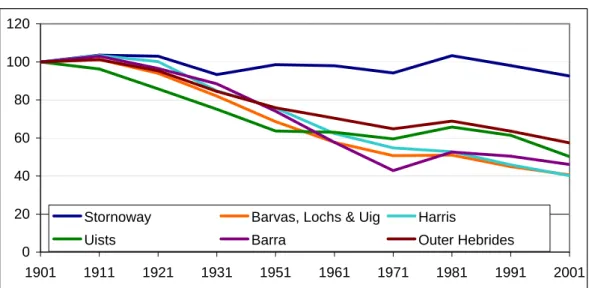
The historic trends in population are outlined in Figure 1 and Figure 2. These show a long-term decline of about 40% in the population over the century from 1901 to 2001 and a population shift between different parts of the Outer Hebrides.
Figure 1 Population change by parish 1901 to 2001
Parish 1901 1911 1921 1931 1951 1961 1971 1981 1991 2001 Change Barra 2545 2620 2456 2250 1884 1467 1090 1339 1282 1172 -54% Barvas 6736 6953 6660 5876 5111 4331 3983 3994 3550 3133 -53% Harris 5271 5449 5276 4468 3991 3284 2885 2780 2418 2120 -60% Lochs 4733 4750 4396 3849 3111 2456 2167 2319 1957 1814 -62% North Uist 3891 3677 3223 2827 2221 1925 1722 1727 1649 1521 -61% South Uist 5516 5383 4844 4236 3764 3997 3871 4451 4120 3200 -42% Stornoway 12983 13438 13366 12116 12791 12717 12232 13409 12733 12015 -7% Uig 4497 4462 3956 3364 2718 2430 1947 1824 1661 1527 -66% Outer Hebrides 46172 46700 44000 39000 35000 32500 29900 31800 29330 26502 -43% Source: GROS 2001
The population decline over this period was steepest in the parishes of Harris, rural parts of Lewis and on Barra, as Figure 2 shows. The population decline in the Uists has followed a similar pattern to the Outer Hebrides population as a whole, although the decline is slightly greater than the total for the Islands. However the population of the parish of Stornoway has remained relatively stable over this longer time period. This highlights the movement of population away from more rural communities towards the Broadbay area as a long-standing trend.
Figure 2 Population change 1901 to 2001, indexed at 1901 levels
0 20 40 60 80 100 120 1901 1911 1921 1931 1951 1961 1971 1981 1991 2001 Stornoway Barvas, Lochs & Uig Harris
Uists Barra Outer Hebrides
Source: GROS 2001
3.2 Recent trends in population change
3.2.1 Population
change
As Figure 3 shows, the Outer Hebrides (Eilean Siar) experienced the biggest population decline of any Scottish Local Authority area between 1995 and 2005. During this decade the overall population dropped by 8.5%.
However this figure masks a more recent upturn in total population. In both 2004 and 2005 the General Registrar Office reported small increases in the population. Since 2003 there has been a 1% increase in the total population in the Outer Hebrides. However the biggest increase was among those aged 55 to 59, which grew by 10% between 2003 and 2005. Over the same time the number of children under 15 continued to decline.
Figure 3 Percentage change in total population by Council area 1995 to 2005 -13 -8 -3 2 7 12 E ilean S iar A ber deen Cit y In v e rc ly d e Dundee Cit y W es t Du nbar tons hir e S he tland I s la nds G las gow Cit y R enf rews hir e E as t Dun bar tons h ir e E a st Ayrs h ire A n gus S o ut h A y rs hir e No rt h Ayrs h ire Ar g y ll & Bu te O rk ney I s la nds SC O T L A N D Dum fr ie s & G allo way Nor th Lanar k s hir e Clac k m annans hir e Mo ra y M idlot h ian S out h Lanar k s hir e Fi fe E as t R enf rews hir e High land E dinb ur gh, Cit y of S c otti s h B o rd e rs Pe rt h & Ki n ro ss A b er deens hir e F a lk ir k S tir ling E as t Lot h ian W es t Lot h ian P e rc e nt a ge cha nge Source: GROS 2006
3.2.2 Household
numbers
Figure 4 shows that the number of households in the Outer Hebrides has grown by around 5% between 1991 and 2005. This is around half the rate of growth experienced nationally and in Dumfries and Galloway; which we have used as a rural comparison. As Figure 4 shows the number of households across the Highland Council area grew by almost 20% over this time period.
Figure 4 Change in number of households 1992 to 2004
0% 5% 10% 15% 20% 25% 1992 1994 1996 1998 2000 2002 2004 % c h a nge in hous e h o lds
Eilean Siar Highland Dumfries & Galloway Scotland
The rate of household growth in the Outer Hebrides was negligible between 1995 and 2001. However since 2002 there has been a much stronger and more consistent period of growth.
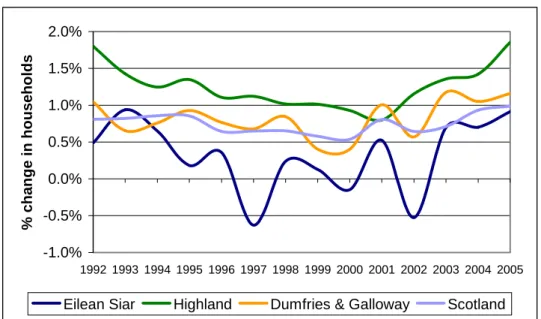
The annual rates of change in household numbers in Figure 5 show a changing picture with a downward trend from 1993 to 1997. This is followed by fluctuations in household numbers between 1997 and 2002. However since 2002 there are more positive signs for the Outer Hebrides with growth rates similar to the national level. This recent upturn backs up findings from other elements of our research that suggest a growing population over the past three or four years.
Figure 5 Yearly changes in number of households 1992 to 2005
-1.0% -0.5% 0.0% 0.5% 1.0% 1.5% 2.0% 1992 1993 1994 1995 1996 1997 1998 1999 2000 2001 2002 2003 2004 2005 % c ha nge i n hous e h ol ds
Eilean Siar Highland Dumfries & Galloway Scotland
Source: GROS Household Estimates 2006
3.2.3
Official migration data
The most recent migration data available (2004-2005) from the General Registrars Office is outlined in Figure 6 below. The overall impact is a net in-migration figure of 245 people; this is a change in the long term migration trends which showed net out migration from the Outer Hebrides. The chart shows net in-migration among all age groups apart from the 16 to 24 age group.
Figure 6 Net Migration by age and gender 2004 to 2005 -100 -80 -60 -40 -20 0 20 40 60 80 0-15 16-24 25-34 35-44 45-54 55-64 65+ Females Males Source: GROS 2006
The majority of the net in-migration is accounted for by males who make up 71% of the figure from 2004 to 2005.
3.2.4
Primary school rolls
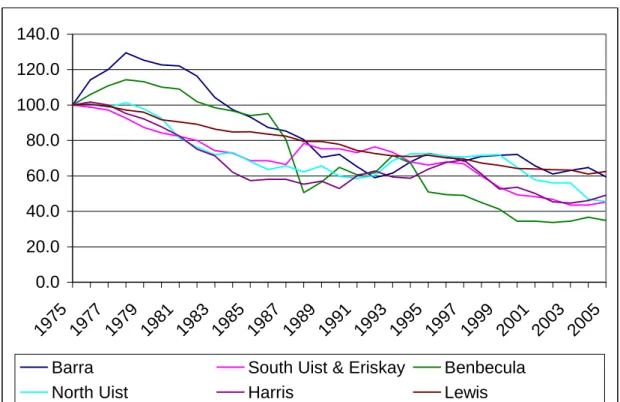
An analysis of the number of school-age children provides a useful indicator of how population numbers and patterns have changed over the past 30 years. Primary school rolls provide a more accurate picture than secondary rolls as they are more closely linked with local communities. Figure 7 shows a fairly steady decline in all areas apart from Barra since the late 1970’s. Barra showed an initial increase in the roll during the 1970’s with a slightly later decline than elsewhere in the early 1980’s. These declines continued into the 1980’s and were steepest in Harris and North Uist.
Between 1997 and 2001 there have been particularly steep declines in the Primary school rolls in Harris, North and South Uist and Benbecula. Since 2001 these declines seem to have levelled out for South Uist and Benbecula, and in Harris there has been a slight increase over recent years. However the declining trend on North Uist appears to be continuing and the long term trends still show a declining roll across the Uists.
The trends in Barra and Lewis show a more stable situation during the 1990’s. The Barra roll is at the same level as in the early 1990’s, while the rate of decline in the Lewis roll has levelled off since 2001.
Figure 7 Changes in Primary School Rolls by Island 1975 to 2005 (indexed at 1975)
0.0
20.0
40.0
60.0
80.0
100.0
120.0
140.0
19
75
19
77
19
79
19
81
19
83
19
85
19
87
19
89
19
91
19
93
19
95
19
97
19
99
20
01
20
03
20
05
Barra
South Uist & Eriskay
Benbecula
North Uist
Harris
Lewis
Source: Comhairle nan Eilean Siar Education Services 2006
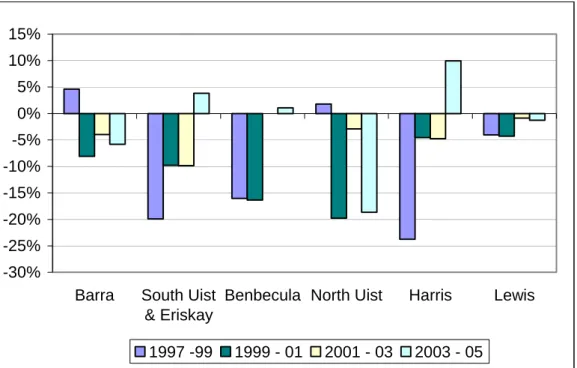
There have been different patterns at local area level, with the impacts of causeways, school rationalisation and the provision of new schools such as Lionacleit and Lochs. As Figure 8 shows, there are slightly different trends in different Island communities. Barra shows a moderate but ongoing decline since 1999 and North Uist has also seen a significant ongoing decline over the same period. However Harris and South Uist have both seen a reversal of the declining trend since 2003. Harris has seen an increase of 10% in its primary school roll between 2003 and 2005, while South Uist (+4%) and Benbecula (+1%) have seen small increases. It is too early to say whether these recent upturns are temporary blips due to localised factors or whether they reflect a change in the overall downward trend. While the primary school roll in Lewis has continued to decline, this decline has slowed down since 2001. Overall, primary 1 rolls are currently 38% lower than Primary 7 rolls, suggesting a continued decline in the foreseeable future.
Figure 8 Changes in primary school rolls by Island and time period (1997 – 2005) -30% -25% -20% -15% -10% -5% 0% 5% 10% 15%
Barra South Uist & Eriskay
Benbecula North Uist Harris Lewis
1997 -99 1999 - 01 2001 - 03 2003 - 05
Source: Comhairle nan Eilean Siar Education Services 2006
Our more detailed analysis of primary school rolls between 2002 and 2005 shows different trends within these Islands:
| Growing primary school rolls since 2002 in most parts of North and East Lewis,
particularly Tolsta, Lochs, Pairc (Stornoway), Lionel (Ness) and Laxdale;
| Declining rolls in Sandwick and Aird (Point);
| Declining rolls in all primary schools on the Westside of Lewis apart from Bragar; | Growing primary school rolls in Scalpay, and Seilebost and Leverburgh on
Harris;
| No primary schools on Harris with declining rolls since 2002;
| Growing primary rolls in Paible (North Uist); Balivanich (Benbecula) and Eriskay;
and declining rolls in other parts of the Uists;
| In Barra, a growing roll in Eoligarry and a declining roll in Craigston.
3.3 Current and emerging trends
Our research has identified several trends that have only recently started to make a significant impact on population change. These include:
| A shift of population towards larger centres (and particularly Stornoway);
| Lifestyle-based in-migration often to more remote and scenic parts of the
| Employers bringing in workers from abroad to fill gaps in the workforce; | More short-stay and ‘commuting’ professional workers;
| An increasing gender imbalance in the population, with more women leaving and
fewer returning; and
| More native Islanders returning to the Hebrides to look for job opportunities.
3.3.1 Population
shift
There is very strong evidence from housing demand patterns, planning applications and school roll changes of a shift of population towards larger centres within the Islands. This is particularly evident in the Greater Stornoway area but also noticeable around Balivanich in the Southern Isles. This has been due to a greater demand for proximity to services, transport links, as well as wider housing and employment opportunities available in Stornoway and Balivanich.
Meanwhile in-migrants have tended to move to more rural areas to take advantage of landscape and a perceived higher quality of life. Most recent housing development has focused on Ness, Laxdale, Point and Lochs; all areas that are relatively accessible to Stornoway.
Council planning policy and the housing strategy have promoted a strong Stornoway as the basis of economic development; and this policy appears to be succeeding. Planning applications across the Outer Hebrides have surged from 450 per year in 2000 to around 700 in 2003/04. This suggests that the Comhairle’s approach has succeeded in stimulating investment.
There has been a particular surge in applications for single detached houses and this is strongest on Harris. This demand on Harris has been linked with the positive coverage of the Outer Hebrides through the ‘Castaway’ TV series and the withdrawal of the Lingerbay Super-quarry planning application in 2004.
3.3.2 Lifestyle
in-migration
There has been a clear increase in in-migration to the Outer Hebrides over the past four or five years among households looking for a better quality of life. While in-migration is happening in many parts of the Isles, there is clearly a phenomenon whereby in-migrants are buying up property in more remote parts of the Islands and particularly those in the National Scenic areas of Harris, South Lochs, Uig and Bernera.
However many of the in-migrants in these areas are from older age groups aged 45 and over. Many have either older children or are ‘empty nesters’ whose offspring have left home. There is strong anecdotal evidence from our interviews and focus groups to suggest that older people are moving to the area because of the perception that health and social care services are better than many parts of the mainland.
There is mixed evidence on how long lifestyle in-migrants remain in the Islands for. Our focus group research, and stakeholder interviews, suggest that most are fairly happy and intend to stay indefinitely. However several people and evidence from literature (McPherson 2005) points to a minority of in-migrants who leave after a couple of years.
3.3.3
Economic in-migration from abroad
One recent trend which is evident across the Highlands and Islands is the recruitment of workers from overseas to address specific problems with the local labour market. The recent enlargement of the European Union has meant that residents of these Accession countries can now legally work in the UK. However overseas workers in the Outer Hebrides are also coming from other parts of eastern Europe and from developing countries such as Sri Lanka. There is no firm data available on the numbers of in-migrants at any given time because there is no formal process for recording their departure. Evidence from WIE and from our employer survey suggests that somewhere between 200 and 300 overseas nationals were working in the Outer Hebrides during spring 2006.
The pattern of National Insurance Number (NINo) registrations of overseas nationals in the Outer Hebrides from tax year 2001/02 to 2003/04, broadly reflects the wider trends for the Highlands and Islands overall. Over the four-year period, from tax year 2001/02 to 2004/05, there were 150 NINo registrations of overseas nationals in the Outer Hebrides accounting for 3% of the Highlands and Islands total. The registration rate was relatively low over the first three years, increasing from about 10 individuals in 2001/02 to around 30 in 2003/04. However NINo registrations increased three-fold in 2004/05, with a total of 85 registrations. This increase corresponds with a rise in numbers of NINo registrations in all Local Authority areas (except Orkney Islands) in the Highlands and Islands area in 2004/05.
From 2001/02 to 2004/05, the majority (about three-quarters) of NINo registrations of overseas nationals in the Outer Hebrides were from the 18 to 34 age group, with just under half of them being aged under 24. This age profile is broadly similar to that for the Highlands and Islands as a whole, with relatively few registrations from the 45+ age categories.
Figure 9 NINo Registrations of Overseas Nationals in the Outer Hebrides 2001/02 to 2004/05 by age-group 0 10 20 30 40 50 60 70 80 90 2001/02 2002/03 2003/04 2004/05 num ber of indiv iduals 18-24 25-34 35-44 45-54
Over the four-year period slightly more females were registered for NINos in the Outer Hebrides than males. Approximately 80 women were registered compared with about 70 men. For the Highlands and Islands overall the number of females registered exceeded that of males from 2001/02 to 2003/04.
Figure 10 NINoRegistrations of Overseas Nationals in the Outer Hebrides 2001/02 to 2004/05 by Gender 0 5 10 15 20 25 30 35 40 45 50 2001/02 2002/03 2003/04 2004/05 num ber of i ndi v idual s Male Female
Source: Department for Work and Pensions National Insurance Number Registrations 2006
3.3.4 Short-stay
professionals a growing phenomenon
One relatively recent phenomenon is professional workers making short-term moves to the Islands to pursue a career opportunity while leaving their families on the mainland. This may be caused by several inter-related factors:
| Shortages in certain job sectors lead to employers carrying out wider recruitment
searches (e.g. social workers and maths teachers);
| Employees unfamiliar with the Islands do not want to make the long-term
commitment of moving their families;
| Some employers (e.g. Northern Constabulary) require employees to relocate
several times during their service, perhaps making it impractical to relocate the whole family;
| Some new recruits have problems securing suitable housing;
| It is often difficult to source jobs for both partners at the same time; so one
partner retains their job on the mainland.
This phenomenon is likely to have mixed impacts on communities. On the one hand there is a need to bring in new skills and to fill acknowledged skills gaps in certain sectors. On the other hand, leaving families on the mainland may undermine community services and some of the money paid in salary will leak out of the local economy.
3.3.5
Gender issues in migration patterns
Our population model based on available population, migration and natural change information backs up other findings that suggest there are significant gender components to population change. This leads to more women leaving the Islands because of education and employment opportunities, and fewer returning. Latest migration data from GROS shows that twice as many women aged 16 to 24 leave the Islands as males; and that net female in-migration is lower among all age groups up to 55. This trend has also been highlighted through interviews, focus groups and in the employer survey. This perhaps also reflects the phenomenon outlined above of males moving to the Islands and leaving female partners on the mainland (we found no evidence of the opposite). One employer states that:
‘… in the Uig area it is mainly young girls who leave while many young men stay if at all possible. This will become harder when one of the fish farms closes in a couple of months. Women leave young because there is no suitable work for women although a hardy few have worked on fish farms.’
However longer life expectancy among females means that women currently outnumber men significantly among older age groups; and that the average age of a female in the Outer Hebrides is 44 compared to 41 among men. By 2019 the average age will be 47.5 for women and 43 for men. However our population model suggests that if the current trends continue there will be more males than females by 2009.
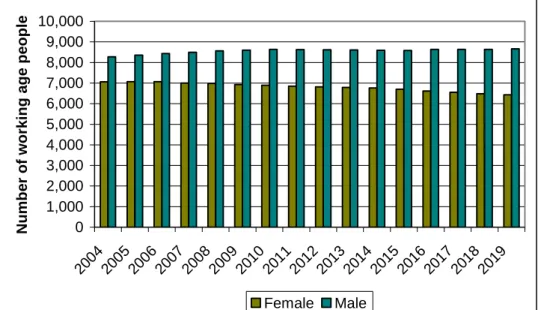
And these gender differences become more marked among the working age population because of the different retirement ages and the out-migration of younger women. As Figure 11 shows, there are currently 1,200 fewer working age women than men, and this is forecast to increase to around 2,200 by 2019. This is likely to have implications for the labour market, but also for population sustainability and the social structure of communities.
Figure 11 Projected working age population by gender 2004 to 2019
0 1,000 2,000 3,000 4,000 5,000 6,000 7,000 8,000 9,000 10,000 200 4 200 5 2006200 7 200 8 2009201 0 201 1 201 2 201 3 201 4 201 5 201 6 2017201 8 201 9 Numbe r of work ing a g e pe ople Female Male
Our interviews and focus groups suggest a number of factors that might contribute to the out-migration of females.
| The economic and social expectations of women have changed more quickly
over the past ten or so years than among men;
| The types of jobs available in traditional sectors such as fishing, agriculture and
construction tend to be more suited to males;
| Several stakeholders identify that social and leisure facilities have in the past
been more focused towards males (i.e. football pitches); and
| Much of the sector skills training is also inherently focused towards males.
Figure 12 Females as % of 20 to 34 year old population
40% 42% 48% 53% 49% 48% 0% 10% 20% 30% 40% 50% 60%
Barra Eriskay South Uist Benbecula North Uist Lewis & Harris
Source: Census 2001
The one community that appears to differ in this trend is Benbecula, where there are slightly more females than males aged under 35 as Figure 12 shows. This is perhaps linked to the housing and employment opportunities, with perhaps the school and education centre at Lionacleit and the hospital in Balivanich providing more opportunities for women to remain on the Island. Interestingly, Benbecula also has the highest economic activity rate of any of the islands which may be another factor behind the retention of the female population.
3.3.6
Recent upturn in returners
There is growing evidence (both anecdotal and from GROS data) that more Islanders are returning to the Outer Hebrides, (and particularly to the Greater Stornoway area) over the past couple of years after completing their study on the mainland. There has been increasing demand for post-graduate study opportunities at Lews Castle College and the number of applicants for Comhairle summer placements has also increased. The M-ploy project that seeks to help graduates to
access employment opportunities also notices increased demand. Several focus group participants have also highlighted this trend.
This appears to be caused by several push and pull factors including:
| The lack of affordable housing options on the mainland; | The need to pay off student debt;
| The perception of change in facilities within the Islands, with more things to do
for young people through the Lewis Sports centre, An Lanntair; Taigh Chearsabhagh in North Uist; Kildonan in South Uist and the Youth Café in Barra;
| A revival in interest in Gaelic culture and language.
However there is a need to ensure that these returners are able to access housing and employment opportunities that will enable them to stay in the longer term.
3.4 Chapter summary
There has been a long-term population decline of approximately 40% between 1901 and 2001 in the Outer Hebrides. This decline has been steepest in Harris, the Uists and Barra. This trend has continued until very recently with an 8.5% drop in total population between 1995 and 2005. However there is more recent evidence from population and household data of an increase since 2003.
Out-migration is still a major factor in population change; particularly among younger age groups. Out-migration is much higher among women and 71% of in-migrants are males. This is leading to a widening gender imbalance in the population.
School rolls have declined significantly since 1975 across the Outer Hebrides. However there have been growing primary school rolls in some Island communities since 2002, including Harris, Balivanich and the North and East of Lewis.
Other recent population trends include:
| A shift in population towards larger settlements; and particularly Stornoway; | An upturn in people choosing to live in the Outer Hebrides because of quality of
life reasons;
| Employers increasingly turning to overseas migrant workers to address labour
shortages;
| More short-stay and ‘commuting’ workers who leave partners or spouses on the
4 Drivers of change in population
This section explores some of the drivers behind population change. It highlights the important role of job opportunities, educational aspirations and the housing market in influencing migration.
4.1 Key drivers of population change
The drivers of change in population are complex and often inter-connected. While migration decisions are complex, existing literature has highlighted in particular education, employment and housing as drivers of migration.
In the Outer Hebrides changes in migration patterns are closely linked with changes to the economy at a national and local level. Most stakeholders and researchers agree that the key drivers of out-migration over the past 20 to 30 years have been:
| Declining employment in traditional industries; | Limited local employment opportunities;
| Increasing numbers of young people going into Further and Higher Education;
and
| Limited range of training and education opportunities in the Islands.
To a certain extent these trends are being experienced in many rural areas. However the peripherality of the Outer Hebrides means that these factors are impacting more severely and rapidly than in less isolated communities. Because of this there is also less of a corollary effect of counter-urbanisation; where wealthier urban households move into rural areas, which is a feature of more accessible rural communities.
Other factors that influence population change include:
| The cost and availability of transport; | The availability of suitable housing;
| The general ‘confidence’ of the community; and
| The perception among some individuals of ‘conservative’ attitudes of some
community leaders.
4.2 Declining employment in traditional sectors
There have been well-documented long-term declines in many of the traditional employment sectors in the Outer Hebrides. Employment in the Harris Tweed industry has declined over a long period of time. There has also been a continuing decline in employment in the fishing industry exacerbated by cuts in quotas over recent years. And the changes to EU subsidies have meant an ongoing decline in farming/ crofting.
There is also evidence that a combination of the lack of opportunities to gain qualifications and vocational experience, and the nature of industries found in rural
areas, has led to the creation of a group of young people who are disadvantaged by their decision to remain in rural areas. The predominance of temporary or seasonal employment may be preventing young people from developing ‘sustainable careers’ (Cartmel and Furlong 2000).
A further barrier to sustainable careers may be the cost of accessing transport in remote areas, which may exclude less affluent individuals from accessing the widest range of employment opportunities (Jones 1992). The high cost of living in rural areas is but one aspect contributing towards rural poverty (Shucksmith and Philip 2000). Stayers in rural areas have been found to be less likely to have received vocational training. Employment opportunities in rural areas tend to require low skills levels, pay low wages, and do not offer progression towards a career. The skills that can be acquired through this employment may not be transferable to other work, and some have reported that there is a risk of becoming ‘trapped’ in this situation (Jones and Jamieson 1997).
4.3 Limited job opportunities
4.3.1 Hidden
unemployed
Unemployment rates in rural areas vary quite widely, and in some instances can be significantly higher than the national average. It is likely that the true scale of the problem is greater but is masked by out-migration of rural unemployed (Jones 1992, Cartmel and Furlong 2000). Across Europe there is a trend for young people to experience unemployment at rates of twice the national average (Cartmel and Furlong 2000). In the Outer Hebrides, one stakeholder has pointed to the significant potential workforce which lives off-island, but which can be accessed when opportunities arise.
4.3.2
Available jobs do not match expectations
In contrast to issues of hidden unemployment, some areas of rural Scotland appear to experience labour shortages. Industries such as aquaculture, food processing, agriculture, and hospitality have had sufficient difficulties in recruiting from the local labour market that they have made widespread use of migrant workers from overseas to fill the gap (see, amongst others, HIE 2005, SER 2006). Whilst some areas of rural Scotland therefore appear to have more than enough jobs to meet the demand of the local labour market, it is clear that simply securing employment may be insufficient to prevent out-migration. In Lewis, many people have left the area despite having been able to find local employment (Stockdale 2004); clearly, there are other factors at work than simply the number of jobs available.
In many parts of rural Scotland, it would appear that the employment opportunities for stayers are mostly within traditional industries, often with low wages and, in some cases, seasonal work. The quality of such jobs may fail to meet aspirations, being low-skilled and lacking in opportunities for progression (Pavis et al 2000, Cartmel and Furlong 2000, Shucksmith and Philip 2000). The lack of security of temporary or seasonal work may be particularly important for those with families, who fear ‘the prospect of unemployment’ (Stockdale, undated). Qualified migrants who return to rural areas tend to find better quality employment, often in the public sector (Stockdale 2004).
4.3.3
Public sector employment is the ambition
There is a strong view from stakeholders and research participants that much of the employment opportunities are either directly or indirectly provided through the main public sector agencies – the Comhairle, WIE and NHS Board. Many younger people aspire to work in these sectors because they know that jobs are relatively well-paid, secure and have good conditions. This contrasts with the perception of the public sector in many other areas, and perhaps reflects an acceptance that other opportunities for well-paid professional jobs are limited. This is backed up by many instances of graduates taking lower level jobs in the public sector to allow them to return to the Isles.
There is also some suspicion (highlighted in the mainland focus groups) that many public sector jobs are given to people with connections in the agencies.
There is also the perception amongst some rural dwellers that ‘incomers get all the best jobs’ (Henderson and Shucksmith 1997). A recent survey of home-buyers in the Outer Hebrides found that in-migrants did indeed have a higher average household income than locals (MacPherson 2005).
4.3.4
A fragile private sector
The private sector in the Outer Hebrides is widely considered to be fragile and there are few sectors that are not currently vulnerable to some extent. It relies strongly on local services and small-scale tourism.
Although self-employment is higher than the national average on most Islands this is not contributing significantly to GVA. There is a strong link between in-migration and self-employment in insular areas (Munro, 2004; Nightingale, 2002; Nordregio, 2006). This perhaps reflects the experience of Skye, where self-employment is being pursued by in-migrants as part of their lifestyle choice. These types of ‘entrepreneur’ appear to have little interest in growing their business, employing other people or collaborating with other businesses. Agencies such as WIE have little contact with these types of businesses who do not tend to look for grants and loans to help with business development.
4.4 Educational opportunities
4.4.1
High levels of attainment
The educational attainment levels in the Outer Hebrides have been historically high and continued to improve over recent years. Coupled with this there appears to be an inherent expectation among Hebridean communities that young people must leave the Islands to succeed. Several interviewees and focus group participants have identified a strong positive pressure to go to college or university on the mainland.
It has been suggested that there is a ‘stereotype that achievers leave and the rest stay’ (Jones and Jamieson 1997). If achievement is measured in terms of income and qualifications, then there is certainly some evidence to support this view. For example, 78% of those who left Lewis had gained university or college qualifications, compared to 29% of those who had stayed (Stockdale 2004).
4.4.2
Limited opportunities locally
The education opportunities available in rural Scotland are often limited; whilst some local institutions offer higher education courses, these are usually by-passed in favour of further education opportunities available in the larger urban centres (Jones and Jamieson 1997). Stakeholders have identified that young people now have to go to the mainland to get vocational training in some of the skills traditionally provided by Island based FE colleges such as hair-dressing and car mechanics. And one focus group participant felt that a locally gained qualification was viewed as inferior to the same qualification gained at a mainland institution.
For many parts of rural Scotland, education has been recognised as a key driver of out-migration, affecting the younger age groups in particular (Stockdale 2004; Jones and Jamieson 1997). In a study in Lewis, it was found that 79% of out-migrants were motivated principally by education, coinciding with the finding that 70% of the out-migrants from this area were school leavers (Stockdale 2004). Young people in rural areas have been found to be significantly more likely to move away from home than those in urban areas (Jones 1992).
For those who leave rural areas for the purpose of education, many appear to choose to study as close to home as is possible. For example leavers from Lewis were most likely to choose Aberdeen (34%) or Glasgow (25%). Many tend to follow siblings or friends in their location choices. In total, 91% of those who left Lewis remained within Scotland (Stockdale 2004). These findings suggest that leavers have an attachment to their area of origin; some argue that young people are often forced to move away from rural areas by lack of choice (Jones 1992).
It might therefore be expected that regional education institutions would be successful in retaining young people seeking to further their education. However, in a study of education-motivated out-migration in Argyll, it has been suggested that ‘young people regard higher education as the most effective way of leaving the area’ (Cartmel and Furlong 2000). This suggests that there is an underlying desire to leave the area anyway. It has also been suggested that women may be more likely to follow this path than men, in part because less suitable local employment opportunities cause both a greater desire for women to leave, and can distract men from pursuing academic achievements as local employment is available to them (Jones 1992).
4.4.3
Expectations of out-migration
Given the lack of rural opportunities, and thus the apparent need for ‘achievers’ to leave, it would appear that in at least some parts of rural Scotland there is an acceptance of out-migration. Some leavers have reported that teachers and family expected them to leave, and that to do so was ‘a natural next step on completing school’ (Stockdale 2004, p175). This is certainly identified as being the case in our stakeholder interviews and focus groups in the Outer Hebrides.
Encouragement to leave is a product not only of social expectations, but also of government policy; the target of 50% of young people entering further or higher education (DfES 2004) is, in the absence of regional educational institutions, effectively encouraging rural out-migration (Stockdale 2004). The idea that to return was in some way ‘failure’ was cited regularly (Stockdale 2004). This ‘failure’ is on the one hand a subjective view, but on the other hand can often be measured in terms of employment opportunities, status, and income (Jones and Jamieson 1997;
Stockdale 2004). Moreover, it has been suggested that ‘self-transformation’ can occur following migration, whereby an individual’s values and ambitions may change to reflect the society into which they have migrated (Fine 1999). As a consequence of this process, returning home is seen as ‘a backward step’ (Stockdale 2004, p190).
4.4.4 Returning
after
study
After completing their studies, many young people move back to their parental home. However research suggests that these people may end up migrating for a second time. Young leavers may return to live in the parental home for a short period; this may be driven by financial reasons, and in particular the burden of student debt (Pavis et al 2000). Over a longer period of time, however, this second move tends to take leavers further from their area of origin, with greater numbers moving south of the border (Stockdale 2004).
4.5 Transport
Stakeholders and interviewees frequently identify transport as a key factor in decisions around leaving or returning to the Outer Hebrides. Improvements in communications have increased the expectations of young people to travel; and most agree that the ability to travel and widen social and cultural perspectives can strengthen communities. However the high cost of ferry and air travel makes travel more difficult and exacerbates the isolation that many younger islanders feel.
Most people accept that public transport within the Isles has improved significantly since the mid nineties; although the programme of causeways has not stemmed declining school rolls in some of the smaller Islands. The level of bus services available within the Isles are seen as good compared to other remote parts of the UK.
4.6 Housing
4.6.1
The Outer Hebrides housing market
Issues around the housing market are frequently identified as a contributing factor to out-migration among younger age groups in the Outer Hebrides and in the literature (Bevan and Rhodes 2005, Hope et al 2004). The housing ‘market’ in the Outer Hebrides is fairly unique in the way it has traditionally operated. Some key factors include:
| A high proportion of detached houses; | A high proportion of self-build;
| A high proportion of ownership;
| An expectation of a house as a home for life; | Low turnover of rented accommodation; and
| High levels of second and holiday homes in some areas.
The housing market in the Outer Hebrides has until recently operated largely as a localised internal market with only limited influence from the wider market. There
has always been a strong link between crofting and self-build with most Hebrideans aspiring to build themselves a home that will meet their household’s long-term housing aspirations. There has therefore not traditionally been a property ladder as such in the Outer Hebrides housing market with few smaller starter homes available. The rented sector provided access to housing for those with no access to crofting land or lacking the resources to purchase.
In some of the smaller island communities such as Barra the housing market is even more constrained. Most houses are passed on through families and there are very few houses in walk-in condition that become available on the market.
4.6.2
Recent housing trends
With an increase in the number of households, including increased demand from people moving from the mainland, house prices have started to increase at similar rates to nationally. While the actual prices are still low compared to national figures, the rate of increase has been relatively sharp. There is some evidence that in-migrants have been taking advantage of the comparatively cheap house prices in the Outer Hebrides by selling homes in areas where property prices have increased by far higher levels, which places them in a strong position to compete with locals in the housing market.
4.6.3
Access to affordable housing
Young people returning to live in the Isles are often unable to enter the housing market unless their family have available land. They are often forced to stay with their family until they can afford to enter the housing market. Leavers have identified housing problems as one of their reasons for not returning to Lewis (Stockdale undated), and it is thought that ‘the supply of low-cost housing is a critical issue in retaining population’ (Hope et al 2004 p3). The evidence from a relatively strong supply of low-cost housing in Balivanich after the MOD moved out is that this has helped to sustain a more balanced population. In particular the proportions of women aged under 35 are similar to the proportion of males in contrast to other communities.
The housing market situation in the Outer Hebrides reflects a wider situation across Scotland, and mirrors the experiences of the housing market in Skye. The key difference with the Outer Hebrides housing market and other parts of Scotland is the lack of an established rented housing market for single people and smaller households.
There is currently a record level of investment in affordable housing in the Outer Hebrides from communities Scotland’s affordable housing investment programme, facilitating increased levels of development by Western Isles Housing Associations, private developers and individual households. However, at the same time, the turnover within the stock of social rented housing has declined markedly to around 10% per year. And a significant proportion of the available housing is allocated to those requiring housing through homelessness legislation. This puts a further strain on the property market.
The role of right-to-buy schemes in restricting access to housing for those on low incomes may be a matter of some debate. Previous research has found that right-to-buy housing stock was primarily purchased by local residents and was not of
interest to more affluent in-migrants (Henderson and Shucksmith 1997). However it has clearly taken housing out of the rented sector and reduced opportunities to access social rented housing for younger and less affluent households.
Another issue is the link between housing costs and income. As house prices catch up with those on the mainland, income levels remain relatively depressed, leading to housing becoming less affordable for average workers.
4.6.4
Local Housing Strategy
The connection between housing availability and sustainable communities is recognised by the public agencies, and is strongly reflected by the Comhairle’s Local Housing Strategy (LHS) published in 2004. The LHS proposes that the housing stock should be increased significantly, including social rented housing to replace local authority homes purchased through the ‘right to buy’ scheme. At present new homes are being built at a relatively high rate. Many are individual private developments (self-builds) and are not contributing to the low-cost housing sector (Western Isles Local Housing Strategy 2004-2009). However, there is also currently a high level of investment in affordable housing. There are currently ambitious plans, following the successful transfer of the Comhairle’s housing stock, to develop additional new housing to address these issues through additional funding to the Hebridean Housing Partnership (HHP).
The LHS contains ambitious targets to improve the function of the Housing system in the Western Isles, These include measures designed to improve housing supply, facilitate inward migration and regenerate local communities. The Comhairle, with its partners, is making good progress towards these goals, and is on target to increase the supply of affordable housing by at least 300 units by 2009. The LHS also contains measures to support training and job opportunities through housing development activity and to target the availability of private rented accommodation for younger people in the greater Stornoway area.
4.6.5
Second and holiday homes
In the Outer Hebrides, Second and holiday homes (SAHH) account for 7.2% of total housing stock, and this represents almost 1,000 houses. Other sources also identify an additional 500 to 850 vacant houses across the Outer Hebrides (CNES, ACTISH, GROS, 2005). However in some areas such as Uig, Paible, Harris West, and Barra and Vatersay SAHH represent more than 17% of the housing stock. By comparison the Scottish average is 1.3%. Another recent survey of the Outer Hebrides housing market found that up to 20% of property sales to in-migrants were as SAHH (MacPherson 2005).
A recent Communities Scotland report (Bevan and Rhodes 2005) on the impact of Second and Holiday Home (SAHH) ownership recognised that demand for SAHH has contributed to high property prices in certain parts of rural Scotland. And there is an apparent correlation between the proportions of SAHH and social rented housing in some areas. These SAHH ‘hotspots’ are linked to areas with an older demographic profile and greater numbers in the over 45 age groups. However many second and holiday homes are owned by people with a strong local connection and leasing out these properties can bring income into the area.