ON THE ELASTO-PLASTIC STABILITY ANALYSIS OF CIRCULAR
CYLINDRICAL SHELLS
Rabee Shamassa, Giulio Alfanoa, Federico Guarracinob a
College of Engineering, Design and Physical Sciences, Brunel University, UK b
Department of Structural Engineering, University of Naples “FedericoII”, ITALY
Abstract: The stability of thin circular shells under proportional and non-proportional load-ing, i.e. axial tensile stress and external pressure is extensively investigated. Two plasticity theories are considered; the flow and the deformation theory of plasticity. The results obtained confirm that under over-constrained kinematic assumptions the deformation theory tends to provides lower values of buckling pressure and the discrepancies in the results from the two plasticity theories increase with increasing thickness ratios, tensile stresses, boundary clamp-ing and E/σy ratio.
1.
Introduction
Plastic buckling of circular cylindrical shells has been the subject of active research for many decades due to its importance to the design of aerospace, submarine, offshore and civil engi-neering structures. It typically occurs in the case of moderately thick cylinders subjected to axial compression, external pressure, torsion or combinations of such loads.
Generally speaking, the plasticity models that have been proposed for metals in the strain hardening range can be divided into two groups: the ‘deformation theory’ of plasticity and the ‘flow theory’ of plasticity. In both of these theories the plastic deformations do not allow vol-ume changes as plastic yielding is governed by the second invariant J2 of the deviatoric part of the stress tensor, whereby in this respect they are both so-called J2theories. However, the deformation theory of plasticity is based on the assumption that for continued loading the state of stress is uniquely determined by the state of strain and, therefore, it is a special class of path-independent non-linear elasticity constitutive laws. According to this assumption, af-ter a strain reversal, rather than recovering the initial elastic stiffness, as is found in physical tests, the initial loading curve is followed. On the other hand, the flow theory of plasticity
as-sumes that an (infinitesimal) increment of stress is uniquely determined by the existing strain and its increment. This leads to a path-dependent relationship in which the current stress de-pends not only on the value of the current total strain but also on how the actual strain value has been reached, thus making the constitutive relationship path dependent.
There is a general agreement among engineers and researchers that the deformation theo-ry of plasticity lacks physical rigour in comparison to the flow theotheo-ry. However, use of the deformation theory predicts buckling loads that are less than corresponding loads obtained with the incremental theory, and evidence of comparison between measured and calculated buckling loads points in favour of deformation theory results. This is generally known as the “plate buckling paradox”.
Onat and Drucker [1] first pointed out through an approximate analysis that buckling dictions based on the flow theory for long plates supported on three sides tend to those pre-dicted by the deformation theory if small but unavoidable imperfections are taken into ac-count. Restricting attention to the plastic buckling of circular cylindrical shells, Mao and Lu [2] analytically examined simply supported cylinders made of aluminium alloy subjected to axial compression load. They compared the buckling stresses predicted by their analytical formula with the experimental results conducted by Lee [3] and found that the deformation theory provides closer results with the tests while the flow theory significantly over-predicts the critical loads.
Blachut et al. [4] conducted experimental and numerical analyses of 30 mild-steel ma-chined cylinders, of different dimensions, subject to axial tension and increasing external pressure. They showed that agreement between the buckling stresses calculated using the two theories was strongly dependent on the ratio of the length L of the cylindrical shell to its outer diameter D. For short cylinders (L/D≤1) the plastic buckling pressure predicted by flow or deformation theory coincided only when the tensile axial load vanished. By increasing the axial tensile load, the plastic buckling pressure calculated using the flow theory of plasticity quickly diverged from corresponding values calculated using the deformation theory, which were closer to the experimental values. For specimens with L/D ranging from 1.5 to 2 the re-sults predicted by both theories were very similar for a certain range of combined loading, beyond which the values calculated using the flow theory began to deviate from the corre-sponding results using the deformation theory and became unrealistic in correspondence of large plastic strains.
Bardi and Kyriakides [5] tested fifteen cylindrical stainless steel tubes, with D⁄t ranging between 23 and 52, under axial compression and determined the critical stresses and strains at the onset of wrinkling. They reported the buckling modes, including the number and the size of waves. They also calculated the same quantities analytically using the deformation or the flow plasticity theory. The calculations included the effects of assuming both isotropic and anisotropic material behaviour. Bardi and Kyriakides concluded that the flow theory signifi-cantly over-predicts the critical stresses and strains while the deformation theory leads to crit-ical stress and strain in better agreement with the experimental results. Moreover, the flow theory grossly over-predicted the wavelength of wrinkles while the deformation theory was in better agreement with the wavelengths measured in the tests.
On the basis of previous investigations led by the present authors [6-9], it is shown that the implicit kinematic constraint in assuming a certain buckling shape as the basis of the anal-ysis seems to be the main reason for the discrepancy between the results from the flow and deformation theory of plasticity – a fact which has suggested the existence of a plastic buck-ling paradox – and from carefully validated geometrically nonlinear finite element (FE) mod-elling. In fact, it is shown that with an accurate modelling a very good agreement between numerical and experimental results can be obtained in the case of the physically sound flow theory of plasticity.
2.
Constitutive relationships based on the deformation theory of plasticity
The deformation theory of plasticity is based on the assumption that for continued loading the state of stress is uniquely determined by the state of strain and, therefore, it is a special class of path-independent non-linear elasticity constitutive laws.The deformation theory of plasticity is obtained by extending the Ramberg-Osgood law to the case of a multi-axial stress state using the von Mises formulation (J2 theory) and re-sults in the following path-independent relationship
(
)
(
)
1 3 3 2 1 1 2 2 n y dev dev sph dev n n α σ − = + − − + σ ε σ σ σ (1)where ε and σ denote the strain and stress tensors, while dev σand sph σdenote the devia-toric and spherical parts of the stress tensor, respectively. n is a constant that depends on the material being considered.
3.
Constitutive relationships based on the flow theory of plasticity
The classical J2 flow theory of plasticity, with nonlinear isotropic hardening and in the small-strain regime [14] is based on the additive decomposition of the spatial rate of the deformation tensor εinto its elastic and plastic parts ε e andεp, respectively:
e p = +
ε ε ε (2)
The remaining well-known governing equations are as follows:
σ =2Gεe +λ tr ε Ie (3) p s dev f s η = ∂ = ∂ σ ε (4)
(
)
2( )
, dev 3 eq eq p p f σ ε = σ− σ ε (5)(
)
(
)
0, f , eqp 0, ,f eqp 0 η≥ σ ε ≤ η σ ε = (6)where G and λ denote the Lamé’s elastic constants, I is the (rank-2) identity tensor, f is the yield function according to von Mises’ yield criterion, η is a hardening parameter. As-suming nonlinear isotropic hardening, the current yield strength, σ is an increasing function of the equivalent plastic strain eeqp :
( )
t( )
eq p t p τ dτ ∞ e − =∫
ε (7) .4.
Stability analyses
4.1 Bifurcation analysisThe bifurcation analysis has been conducted by means of an analytical treatment developed ad hoc on the basis of the approach presented in Chakrabarty [10], by the program BOSOR5 [11] and by the application of the Differential Quadrature Method [12]. The employment of these different approaches has allowed to cover a number of loading conditions, cylinder geometry and boundary conditions. All the treatments have been extended, when necessary, to cover both the use of deformation and flow theory of plasticity.
The bifurcation load in the plastic range and the corresponding buckling mode for ax-isymmetrically loaded shells is determined in BOSOR5 through a sequence of two consecu-tive analyses [11]. The first one is a nonlinear pre-buckling analysis which is valid for small strains and moderately large rotations and accounts for material nonlinearity. This nonlinear problem is solved using a strategy in which nested iteration loop are applied at each load lev-el. The inner loop is used to analyse the nonlinear behaviour caused by the moderately large displacements using the Newton-Raphson method. The outer loop is used to evaluate the con-stitutive matrix and the plastic strain components, and to test loading and unloading condition in the material by means of a sub-incremental strategy. The results from this analysis are used in the subsequent analysis, which is an eigenvalue analysis which yields the bifurcation load and the corresponding axisymmetric or non-symmetric buckling mode, respectively. At the bifurcation load the infinitesimal displacement field, has components in the axial, circumfer-ential and radial direction denoted as δu,δv and δw. They are assumed to vary harmonically around the circumference. It is important to notice that the discretisation in BOSOR5 is only performed in the meridian direction because the resulting displacements are axisymmetric in the pre-buckling phase and the buckling mode is assumed to vary harmonically in the circum-ferential direction in the bifurcation buckling analysis. BOSOR5, moreover, cannot handle any kind of boundary condition.
Since there are many practical cases of buckling of shells having various combinations of boundary conditions the Differential Quadrature Method (DQM) may offer some advantages over the analytical and BOSOR5 approaches and at the same time a clearer insight into the mechanics of the problem under analysis. In fact, the DQM leaves a certain freedom in deal-ing with the boundary conditions of the problem. The DQM is routinely employed to provide solutions to partial differential equations arising in various simplified models of fluid flow, diffusion of neutrons through homogeneous media and one-dimensional nonlinear transient heat diffusion and conduction problems. The DQM is an approximation method to calculate the kth-order derivative of the solution function f(x) at a grid point i. Consider firstly one di-mensional problem. The kth-order derivative of the function f(x) is given by a linear weighting of the function values in the domain.
4.2 Nonlinear stability analysis
The nonlinear stability analysis of imperfect cylinders has been numerically simulated by means of the non-linear FE commercial package ABAQUS, version 6.11-1 [13] using both the flow and deformation theories of plasticity. Specific attention has been paid to adopt
model parameters which, in the case of proportional monotonic (increasing) loading, result in the same stress-strain curve in both theories, to within a negligible numerical error.
The cylindrical specimens were modelled using a general purpose 4-noded shell element which has six degrees of freedom at each node. This element is named “S4” in the commer-cial software ABAQUS and is based on a thick shell theory. The shell formulation accounts for finite membrane strains, therefore this element can be used to perform large strain anal-yses. The element is widely used for industrial applications because it is suitable for both thin and thick shells. The S4 element uses a normal integration rule with four integration points. The enhanced-strains approach is employed to prevent shear and membrane locking. Among the ABAQUS elements, S4 outperforms S4R as the former evaluates more accurately the membrane strains, which plays a key role in the problem at hand.
4.3 Experimental data
As stated in the Introduction, Blachut et al. [4] conducted tests on 30 machined cylinders made of mild steel with outer diameter 34 mm and length-diameter ratio (L/D) of 1.0, 1.5 and 2.0. In the experimental setting, one flange of the specimen was rigidly attached to the end flange of the pressure chamber and the other flange was bolted to a coupling device which in turn was bolted to the load cell, see Fig. 1.
In order to prevent any eccentricity of the axial load exerted on the specimen, the load cell was cantered with respect to the test chamber. The authors pointed out that the maximum ini-tial radial imperfections measured at the mid-length of the specimens were about 1% of the thickness.
Giezen et al. [14] tested cylindrical specimens of aluminium alloy 6061-T4. Two sets of specimens were tested, namely Set A and Set B. The average wall-thickness values of the first and second set were 0.76 and 0.71 mm, respectively, and the length-diameter ratio (L/D) was equal to one. The maximum initial imperfection was found to be about 0.076mm (10% of the thickness).
Fig. 1: Experimental setting by Blachut et al. [4].
5.
Results and discussion
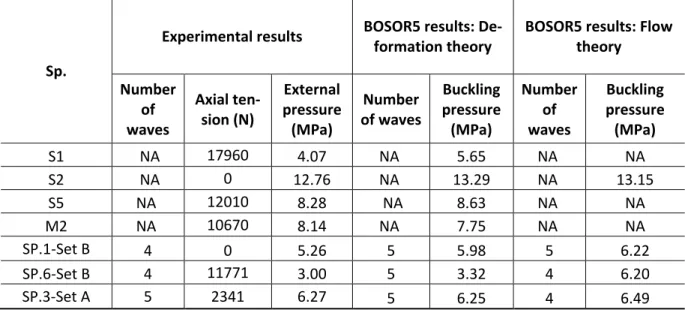
Table 1 collects the results from experimental tests and BOSOR5 numerical analyses. The results have been chosen to represent cases in which the flow theory of plasticity, according to BOSOR5, does not provide a buckling load or strongly overestimates the ones from tests, and cases in which there is agreement between the flow and deformation theory of plasticity.
Table 2, along with the analytical results, shows the results from non-linear FE analyses ob-tained by means of the commercial package ABAQUS.
Table 1: Experimental vs BOSOR5 results (NA=Not Available)
Sp.
Experimental results BOSOR5 results: De-formation theory BOSOR5 results: Flow theory Number of waves Axial ten-sion (N) External pressure (MPa) Number of waves Buckling pressure (MPa) Number of waves Buckling pressure (MPa) S1 NA 17960 4.07 NA 5.65 NA NA S2 NA 0 12.76 NA 13.29 NA 13.15 S5 NA 12010 8.28 NA 8.63 NA NA M2 NA 10670 8.14 NA 7.75 NA NA SP.1-Set B 4 0 5.26 5 5.98 5 6.22 SP.6-Set B 4 11771 3.00 5 3.32 4 6.20 SP.3-Set A 5 2341 6.27 5 6.25 4 6.49
Table 2: Numerical vs analytical results.
Sp. Numerical results (ABAQUS): Defor-mation theory Numerical results (ABAQUS): Flow theory Analytical results: Deformation Theo-ry Analytical results: Flow Theory Number of waves Buckling pressure (MPa) Number of waves Buckling pressure (MPa) Number of waves Buckling pressure (MPa) Number of waves Buckling pressure (MPa) S1 4 5.53 4 5.64 4 5.29 2 16.24 S2 6 13.14 6 13.15 4 13.24 4 13.28 S5 4 8.73 4 8.83 4 8.56 2 11.02 M2 3 7.84 3 7.87 4 7.75 4 7.91 SP.1-Set B 4 5.09 4 5.15 5 5.32 5 5.44 SP.6-Set B 4 2.91 4 3.22 4 2.75 3 5.36 SP.3-Set A 5 5.25 5 5.28 4 6.00 4 6.27
The analytical treatment, differently from BOSOR5, always provides a value of the buck-ling pressure, albeit sometimes very different from the experimental results. In fact, BOSOR5 routines do not point to a buckling load in the cases of specimens S1, S2, S5 and M2 tested by Blachut et al. [4].
The numerical analyses conducted by means of the non-linear FE code ABAQUS, instead, lead to the correct determination of the buckling loads, in accordance with the experimental results, both for the deformation and the flow theory of plasticity.
The main finding is that when the buckling modes coincide using either the deformation or the flow theory, i.e. in the case of specimens S2, M2, SP1-Set B and SP3-Set A, the buckling loads result the same and in line with the experimental and FE results. When the buckling modes do not coincide in the case of the deformation or of the flow theory of plasticity, then
the buckling loads provided by the flow theory of plasticity result much higher than those provided by the deformation theory, see specimens S1, S5 and SP6-Set B.
By means of the DQM analyses it has also been possible to draw some deductions about the influence of the boundary conditions. It is concluded that, in presence of an overcostrained kinematics, the existence of axial, circumferential and rotational restrains at the edges of the cylinders with increasing the axial tensile stresses can significantly increase the discrepancies between the flow and deformation theories’ results in the range 8%-260%.
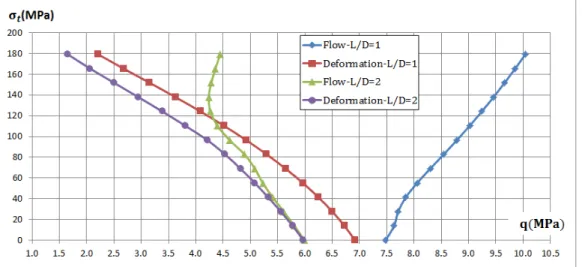
Finally, in presence of an overcostrained kinematics Fig.3 shows the Influence of L/D ratio on the lateral buckling pressure q according both to the flow and the deformation theory of plas-ticity. σt is the tensile axial load.
Fig. 3: Influence of L/D ratio on the lateral buckling pressure q according both to the flow and the deformation theory of plasticity. σt is the tensile axial load.
6.
Conclusions
The main findings of the study are:
1. the root of the apparent plastic buckling paradox in the elasto-plastic analysis of cir-cular cylindrical shells is due to over-constrained kinematic assumptions. This fact leads to overestimate the buckling pressures when the flow theory of plasticity is used, while the deformation theory counterbalances the excessive kinematic stiffness and provides results which are much lower that the flow theory findings [6-9];
2. by conducting geometrically nonlinear finite-element analyses, the flow theory pro-vides physically reliable results, which are in accordance with the deformation theory ones and with the experimental results;
3. implementing the flow theory of plasticity in the elastic-plastic bifurcation analysis may lead to overestimate the buckling pressures. The large discrepancies between flow and deformation theories results observed analytically vanish when using the flow theory in non-linear incremental analysis.
In conclusion, it is recommended to use a geometrically nonlinear finite-element formula-tion for imperfect shells with carefully determined and validated constitutive laws to avoid the
discrepancies between two plasticity theories and to track accurate post-buckling curve in the case of the physically more sound flow theory of plasticity.
References
[1] Onat ET, Drucker DC. “ Inelastic instability and incremental theories of plasticity”, Journal of the Aeronautical Sciences, 20, 181-186, 1953.
[2] Mao R, Lu G. “ A study of the plastic buckling of axially compressed cylindrical shells with a thick-shell theory”, International Journal of Mechanical Sciences, 43(10), 2319-2330, 2010.
[3] Lee L. “Inelastic buckling of initially imperfect cylindrical shells subjected to axial compression”, Journal of Aerospace Science, 29, 87-95, 1962.
[4] Blachut J, Galletly GD, James S. “On the plastic buckling paradox for cylindrical shells”, Proceedings of the Institution of Mechanical Engineers, Part C, 210(5), 477-488, 1996.
[5] Bardi FC, Kyriakides S. “Plastic buckling of circular tubes under axial compression - Part I: Experiments”, International Journal of Mechanical Sciences, 48(8), 830-841, 2006.
[6] Shamass R, Alfano G, Guarracino F. “A numerical investigation into the plastic buck-ling of circular cylinders”, Shell Structures: Theory and Applications, Vol.3 - Proceed-ings of the 10th SSTA Conference (Eds.: W. Pietraszkiewicz, J. Gòrski), Taylor & Fran-cis, 441-444, 2014.
[7] Shamass R, Alfano G, Guarracino F. “A numerical investigation into the plastic buck-ling paradox for circular cylindrical shells under axial compression”, Engineering Struc-tures, 75, 429-447, 2014.
[8] Shamass R, Alfano G, Guarracino F. “An analytical insight into the buckling paradox for circular cylindrical shells under axial and lateral loading”, Mathematical Problems in Engineering, 514267, 1-11, 2015.
[9] Shamass R, Alfano G, Guarracino F. “An investigation into the plastic buckling paradox for circular cylindrical shells under non-proportional loading”, Thin-Walled Structures, 95, 347-362, 2015.
[10] Chakrabarty J. Applied Plasticity, 2nd edition, New York: Springer, 2010..
[11] Bushnell D. “BOSOR5 – Program for Buckling of Complex, Branched Shells of Revo-lution Including Large Deflections, Plasticity and Creep”, in Structural Analysis Sys-tems – Vol. 2 (Ed.: Niku-Lari A.), Pergamon, 25-54, 1986..
[12] Bert CW, Malik M. “Differential quadrature method in computational mechanics: a re-view”, Applied Mechanics Reviews, 49(1), 1-28, 1996).
[13] Simulia, “ABAQUS Theory Manual.Version 6.11-1”, Dassault Systems, Waltham, MA, USA, 2011.
[14] Giezen JJ, Babcock CD and Singer J. “Plastic buckling of cylindrical shells under biaxi-al loading”, Experimental Mechanics,. 31 (4), 337-343, 1991.
![Fig. 1: Experimental setting by Blachut et al. [4].](https://thumb-us.123doks.com/thumbv2/123dok_us/11032581.2990518/5.893.253.651.742.896/fig-experimental-setting-by-blachut-et-al.webp)