TRANSFORMATION OF HISTORIC OBJECTS TO HOSPICE AND ITS RELATION TO LANDSCAPE
Nadezda Malkovska
Department of Social Sciences, Faculty of Civil Engineering Czech Technical University in Prague, Thakurova 7, Prague 6, Czech Republic
Abstract. One of several levels of the urban revitalization is a reviving of existing physic building structures. The purpose of these activities is a re-usage of such objects and thereby the regenera-tion of a funcregenera-tional complexity of an area usage in the city organism. One of the many possible functions, which is serving collective benefit of city inhabitants, is the change of low-used areas into hospice houses.
Key words: hospice house, quality of environment, historic objects reconstruction INTRODUCTION
In this text, I would like to look at revitalization, which means in other words: renewal or revival of damaged, functionless entity [Zeman], from more points of view: a) from the architectural view (a certain architectural object), b) from the urban view (a particular site with broader context), c) from the natural view (a context of natural environment) and in the end d) from the socio-cultural view (a particular unit of society).
Phot. 1. St. Jan Neumann Hospice, Prachatice, reconstruction and annex in 2005, the location is in the historical center of the town
Fot. 1. Hospicjum św. Jana Neumanna, Prachatice, rekonstrukcja i rozbudowa w 2005 r., usytuowanie w historycznym centrum miasta
The reusing of existing urban structures is one of several levels of city and landscape revitalization. The purpose of these activities is a new usage of such objects, and thus the regeneration of an entirety of area functional usage in the city organism. These structural acts are often followed by the modification and the recultivation of the building site or the nearest natural landscape environ-ment.
THE TRANSFORMATION OF OLDER BUILDINGS
By the transformation of older buildings, we preserve certain historical valu-es. Such activities can also influence the public relation to mentioned historical values as well as contemporary social meanings. Reused and cultivated natural environment of old or historical buildings can offer to its users or the nearest public a pleasant place to stay in natural environment, or even a place for relaxa-tion and sport.
One of the many possible functions, which are contributing to welfare of pu-blic in a city or a region, is the transformation of underused structures to hospi-ces.
Phot. 2. St. Stepan Hospice in Litomerice, reconstruction and annex; hospice since 2001, maternal home before Fot. 2. Hospicjum św. Szczepana w Litomericach, rekonstrukcja i dobudówka; hospicjum od 2001,
wcześniej – dom dziecka
The first hospice in the Czech Republic was opened in 1996. The hospice ho-use is a facility, which guarantees to the patient, that he or she will not suffer from unbearable pain and will not stay in his or her last minutes alone. Hospice house is also a healthcare facility with social care, where is provided palliative care for incurable and seriously ill. The goal is a quality of patient life. Hospice services are multilevel: provided care is concerned on physic, social, psycholo-gical and spiritual aspects of human needs [Svatošová 1999]. These buildings have their specific demands on inner and outer environment.
Phot. 3. St. Jan Neumann Hospice, Prachatice, reconstruction and annex, hospice since 2005, retirements house before
Fot. 3. Hospicjum św. Jana Neumanna, Prachatice, rekonstrukcja i dobudówka; hospicjum od 2005 r., wcześniej – dom spokojnej starości
There is a short statistic for illustration too [Hospicové domy]. Now (Octo-ber, 2005), there are 11 free standing hospice houses in the Czech Republic. Nine hospices are in reconstructed objects and just two were newly built. Ten hospices are placed in the cities (in a centre or suburb) and only one is placed in a village (anyway, this village is closed to bigger city). Eight hospices are in site with park or garden and just two have winter garden or terrace at least1.
Phot. 4. St. Jan Neumann Hospice, Prachatice, reconstruction and annex, hospice since 2005, retirements house before
Fot. 4. Hospicjum św. Jana Neumanna, Prachatice, rekonstrukcja wraz z dobudówką; hospicjum od 2005 r., wcześniej – dom spokojnej starości
1 In the one case, Hospice in Malenovice, I am not sure, because I do not visited it. That is why I left it out of the summary
Phot. 5. Hospice Strasburk, Prague, reconstruction and annex, hospice since 1998, inn, hostel before Fot. 5. Hospicjum Strasburk, Praga, rekonstrucja, hospicjum od 1998 r.; wcześniej – zajazd i schronisko
Phot. 6. St. Alzbeta Hospice, Brno, reconstruction and annex, hospice since 1998, that part, where hospice is now (two tracts at first floor) was convent house before
Fot. 6. Hospicjum św. ElŜbiety, Brno, rekonstrucja, hospicjum od 1998; wcześniej – klasztor
RESULTS
In view of the topic of this conference, I would like to review the influence of free standing hospice houses on the urban environment. In Czech Republic, the-se facilities are mainly founded in objects, that are connected to wider natural environment. This fact, although it could be only a coincidence, has its justness in the hospice program, that tries to include the environment positively affecting its client in the spectrum of its services. There exist several researches suppor-ting the idea that the environment, the natural one or the one created by us, has some influence to our behaviour, physical and psychical health. As an explanato-ry example we can consider the work of Roger S. Ulrich, who investigates in 70s and 80s, whether the view through a window may influence patient recovery
from surgery. Ulrich’s research brought the finding that the time of patient con-valescence with the view through a window to the greenery was on average shorter then the time of patient with the view to the brick wall [Ulrich 1984].
Phot. 7. St. Josef in Rajhrad, Brno, reconstruction, hospice since 1999, military hostel before, a board on the right shows which donor have paid for specific tree placed in the hospice park
Fot. 7. Hospicjum św. Józefa z Rajhrad, Brno, rekonstrukcja, hospicjum od 1999 r., wcześniej koszary; tablica na zdjęciu po prawej informuje o fundatorach poszczególnych drzew w szpitalnym parku
Phot. 8. Hospice Citadela, example of a new building, built in 2004, the park is important part of a composition Fot. 8. Hospicjum Cytadela, przykład nowego budynku z 2004 r., park jest tu istotną częścią kompozycji
Freestanding hospices try to keep a good quality of an environment. For this purpose, natural elements as parks or gardens are very important. Where is no possibility to have such natural elements in site or its neighbourhood, or as addi-tion there are built winter gardens or terraces at least. Possibility, it could free somebody’s mind, to relax, to be hidden or to have some privacy. Hospice parks or gardens are sometimes public semi-accesible too.
CONCLUSIONS
These particular hospice activities can be viewed as partial revitalization, which is done at the local level. As a plan, there is just general concept of Mini-stry of health, which supports the idea to set up 5 hospice beds per 100 000 peo-ple [Ministerstvo] in region.
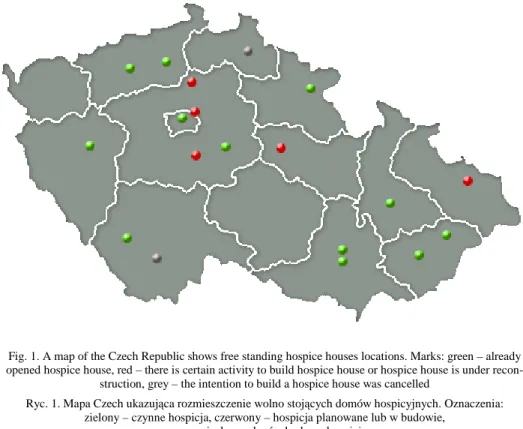
Fig. 1. A map of the Czech Republic shows free standing hospice houses locations. Marks: green – already opened hospice house, red – there is certain activity to build hospice house or hospice house is under
recon-struction, grey – the intention to build a hospice house was cancelled
Ryc. 1. Mapa Czech ukazująca rozmieszczenie wolno stojących domów hospicyjnych. Oznaczenia: zielony – czynne hospicja, czerwony – hospicja planowane lub w budowie,
szary – zaniechano planów budowy hospicjum
Free standing hospices are mainly placed in cities, because of possible profit of specific public facilities proximity (these facilities are e.g. hospital or public transportation) and they are founded not directly by state, but mainly by non profit organizations (e.g. foundation, civic movement or diocesan charity), with certain financial state support.
It is very hard to obtain some money for these non profit organizations, so that is why they usually reconstruct old or historic buildings, which they more likely get as a gift of some donor. These objects are mainly unused and someti-mes in very bad conditions.
Generally, the hospices as the free standing buildings in the Czech Republic have more meanings: a) There is a support for social integration and re-socialization of ill, b) it brings new functions for old buildings, so they are
prese-rved, c) it also brings new work possibilities for the region, d) in the case of bigger site it means another cultivated green place in a city, e) there is a possibi-lity to provide palliative care in specialized facipossibi-lity and possible centre of home care and the other care for seniors, handicapped or ill too.
The topic – hospice houses – in the relation of city-revitalization, solve not just questions of sustainable development, in the view of existing sources prese-rvation, but even the question of future sustainable development of ageing Euro-pe population, cultural and humane inter-generation relationship and environ-ment quality improveenviron-ment.
REFERENCES
Hospicové domy (hospice houses) http://humanita.fsv.cvut.cz/hospice/index.php
Ministerstvo zdravotnictví ČR, Program podpory občanských sdružení a humanitárních organizací, 2006, http://www.mzcr.cz/data/c1616/lib/OSHS2006METODIKA.rtf
Svatošová M. 1999. Hospice a umění doprovázet, Ecce Homo, Červený Kostelec.
Ulrich R. S., 1984. View through a window may influence recovery from surgery, American As-sociation for the Advancement of Science
Zeman T. Současné procesy změn v rozmístění obyvatelstva, jeho demografických charakteristik a v morfologii města Českých Budějovic, http://www.natur.cuni.cz/~sykora/sp/gm99_2/ze-man.htm
PRZEKSZTAŁCANIE OBIEKTÓW ZABYTKOWYCH W HOSPICJA I ICH ZWIĄZEK Z KRAJOBRAZEM
Streszczenie. Jedną z kilku odmian rewitalizacji miast jest oŜywianie istniejących fizycznie struk-tur budynków. Celem tych działań jest ponowne wykorzystanie tych obiektów, a przez to regene-racja złoŜonej struktury funkcjonalnej otoczenia w organizmie miejskim. Jedną z wielu moŜliwych funkcji, która przynosi zbiorową korzyść mieszkańcom miasta, jest zmiana sposobu uŜytkowania niskostandardowych budynków na domy hospicyjne. W pracy przedstawiono kilka konkretnych realizacji tego typu.