Feature Selection for Classification under
Anonymity Constraint
Baichuan Zhang
∗, Noman Mohammed
∗∗, Vachik S. Dave
∗,
Mohammad Al Hasan
∗∗Department of Computer and Information Science,
Indiana University Purdue University Indianapolis, IN, USA, 46202 ∗∗Department of Computer Science, Manitoba University, Canada E-mail:[email protected],[email protected],
[email protected],[email protected]
Received 30 August 2016; received in revised form 20 December 2016; accepted 31 January 2017
Abstract. Over the last decade, proliferation of various online platforms and their increasing adop-tion by billions of users have heightened the privacy risk of a user enormously. In fact, security researchers have shown that sparse microdata containing information about online activities of a user although anonymous, can still be used to disclose the identity of the user by cross-referencing the data with other data sources. To preserve the privacy of a user, in existing works several methods (k-anonymity,`-diversity, differential privacy) are proposed for ensuring that a dataset bears small identity disclosure risk. However, the majority of these methods modify the data in isolation, with-out considering their utility in subsequent knowledge discovery tasks, which makes these datasets less informative. In this work, we consider labeled data that are generally used for classification, and propose two methods for feature selection considering two goals: first, on the reduced feature set the data has small disclosure risk, and second, the utility of the data is preserved for performing a clas-sification task. Experimental results on various real-world datasets show that the method is effective and useful in practice.
Keywords. Privacy Preserving Feature Selection, k-anonymity by containment, Maximal Itemset Mining, Greedy Algorithm, Binary Classification
1
Introduction
Over the last decade, with the proliferation of various online platforms, such as web search, eCommerce, social networking, micro-messaging, streaming entertainment and cloud stor-age, the digital footprint of today’s Internet user has grown at an unprecedented rate. At the same time, the availability of sophisticated computing paradigm and advanced ma-chine learning algorithms have enabled the platform owners to mine and analyze tera-bytes of digital footprint data for building various predictive analytics and personalization products. For example, search engines and social network platforms use search keywords for providing sponsored advertisements that are personalized for a user’s information
___________________________________________________________________
This is the author's manuscript of the article published in final edited form as:
need; e-commerce platforms use visitor’s search history for bolstering their merchandis-ing effort; streammerchandis-ing entertainment providers use people’s ratmerchandis-ing data for buildmerchandis-ing future product or service recommendation. However, the impressive personalization of services of various online platforms enlighten us as much, as they do make us feel insecure, which stems from knowing the fact that individual’s online behaviors are stored within these companies, and an individual, more often, is not aware of the specific information about themselves that is being stored.
The key reason for a web user’s insecurity over the digital footprint data (also known as microdata) is that such data contain sensitive information. For instance, a person’s online search about a disease medication may insinuate that she may be suffering from that dis-ease; a fact that she rather not want to disclose. Similarly, people’s choice of movies, their recent purchases, etc. reveal enormous information regarding their background, prefer-ence and lifestyle. Arguably microdata exclude biographical information, but due to the sheer size of our digital footprint the identity of a person can still be recovered from these data by cross-correlation with other data sources or by using publicly available background information. In this sense, these apparently non-sensitive attributes can serve as a quasi-identifier. For an example, Narayanan et al. [33] have identified a Netflix subscriber from his anonymous movie rating by using Internet Movie Database (IMDB) as the source of background information. For the case of Netflix, anonymous microdata was released pub-licly for facilitating Netflix prize competition, however even if the data is not released, there is always a concern that people’s digital footprint data can be abused within the company by employees or by external hackers, who have malicious intents.
For the case of microdata, the identity disclosure risk is high due to some key properties of such a dataset—high-dimensionality and sparsity. Sparsity stands for the fact that for a given record there is rarely any record that is similar to the given record considering full multi-dimensional space. It is also shown that in high-dimensional data, the ratio of dis-tance to the nearest neighbor and the farthest neighbor is almost one, i.e., all the points are far from each other [1]. Due to this fact, privacy is difficult to achieve on such datasets. A widely used privacy metric that quantifies the disclosure risk of a given data instance is
k-anonymity [39], which requires that for any data instance in a dataset, there are at least
k−1distinct data instances sharing the same feature vector—thus ensuring that unwanted personal information cannot be disclosed merely through the feature vector. However, for high dimensional data,k-anonymization is difficult to achieve even for a reasonable value ofk(say 5); typically, value based generalization or attribute based generalization is ap-plied so that k-anonymity is achieved, but Aggrawal has proved both theoretically and experimentally that for high dimensional datak-anonymity is not a viable solution even for akvalue of 2 [1]. He has also shown that as data dimensionality increases, entire dis-criminatory information in the data is lost during the process ofk-anonymization, which severely limits the data utility. Evidently, finding a good balance between a user’s pri-vacy and the utility of high dimensional microdata is an unsolved problem—which is the primary focus of this paper.
A key observation of a real-life high dimensional dataset is that it exhibits high clustering tendency in many sub-spaces of the data, even though over the full dimension the dataset is very sparse. Thus an alternative technique for protecting identity disclosure on such data can be finding a subset of features, such that when projecting on these set of features an acceptable level of anonymity can be achieved. One can view this as column suppression instead of more commonly used row suppression for achievingk-anonymity [39]. Now for the case of feature selection for a givenk, there may exist many sub-spaces for which a given dataset satisfiesk-anonymity, but our objective is to obtain a set of features such
that projecting on this set offers the maximum utility of the dataset in terms of a supervised classification task.
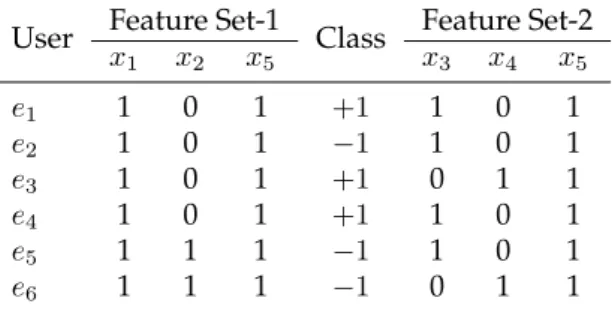
Consider the toy dataset that is shown in Table 1. Each row represents a person, and each column (except the first and the last) represents a keyword. If a cell entry is ‘1’ then the keyword at the corresponding column is associated with the person at the corresponding row. Reader may think this table as a tabular representation of search log of an eCommerce platform, where the ‘1’ undereicolumn stands for the fact that the corresponding user has
searched using the keywordxjwithin a given period of time, and ‘0’ represents otherwise.
The last column represents whether this user has made a purchase over the same time period. The platform owner wants to solve a classification problem to predict which of the users are more likely to make a purchase.
Say, the platform owner wants to protect the identity of its site visitor by making the datasetk-anonymous. Now, for this toy dataset, if he choosesk= 2, this dataset is notk -anonymous. For instance, the feature vector ofe3,10011is unique in this dataset. However,
the dataset isk-anonymous for the samekunder the subspace spanned by{x3, x4, x5}. It is
alsok-anonymous (again for the samek) under the subspace spanned by{x1, x2, x5}(See
Table 2). Among these two choices, the latter subspace is probably a better choice, as the features in this set are better discriminator than the features in the former set with respect to the class-label. For feature set{x1, x2, x5}, if we associate the value ‘101’ with the +1
label, and the value ‘111’ with the -1 label, we make only 1 mistake out of 6. On the other hand for feature set{x3, x4, x5}, no good correlation exists between the feature values and
the class labels.
Research problem in the above task is the selection of optimal binary feature set for util-ity preserving entutil-ity anonymization, where the utilutil-ity is considered with respect to the classification performance and the privacy is guaranteed by enforcing ak-anonymity like constraint [41]. In existing works, k-anonymity is achieved by suppression or general-ization of cell values, whereas in this work we consider to achieve the same by selecting an optimal subset of features that maximizes the classification utility of the dataset. Note that, maximizing the utility of the dataset is the main objective of this task, privacy is sim-ply a constraint which a user enforces by setting the value of a privacy parameter based on the application domain and the user’s judgment. For the privacy model, we choose
k-anonymity by containment in short,k-AC (definition forthcoming), wherekis the user-defined privacy parameter, which has similar meaning as it has in traditionalk-anonymity. Our choice ofk-anonymity like metric over more theoretical counterparts, such as, dif-ferential privacy (DP) is due to the pragmatic reason that all existing privacy laws and regulations, such as, HIPAA (Health Information Portability and Accountability Act) and PHIPA (Personal Health Information Protection Act) usek-anonymity. Also,k-anonymity is flexible and simple, thus enabling people to understand and apply it for almost any real-life privacy preserving needs; on the contrary, DP based methods use a privacy parameter (), which has no obvious interpretation and even by the admission of original author of DP, choosing an appropriate value for this parameter is difficult [12]. Moreover, differen-tial privacy based methods add noise to the data entities, but the decision makers in many application domains (such as, health care), where privacy is an important issue, are quite uncomfortable to the idea of noise imputation [11]. Finally, authors in [17] state that differ-ential privacy is not suitable for protecting large sparse tables produced by statistics agen-cies and sampling organizations—this disqualifies differential privacy as a privacy model for protecting sparse and very high dimensional user’s microdata from the e-commerce and Internet search engines.
1.1
Our Contributions
In this work, we consider the task of feature selection under privacy constraint. This is a challenging task, as it is well-known that privacy is always at odds with the utility of a knowledge-based system, and finding the right balance is a difficult task [22, 23]. Be-sides, feature selection itself, without considering the privacy constraint, is anN P-Hard problem [18, 25, 26].
Given a classification dataset with binary features and an integerk, our proposed solu-tions find a subset of features such that after projecting each instance on these subsets each entity in the dataset satisfies a privacy constraint, calledk-anonymous by containment (k -AC). Our proposed privacy constraintk-AC is an adapted version ofk-anonymity, which strikes the correct balance between disclosure risk and dataset utility, and it is particularly suitable for high dimensional binary data. We also propose two algorithms:Maximaland Greedy. The first is a maximal itemset mining based method and the second is a greedy incremental approach, both respecting the user-defined AC constraints.
The algorithms that we propose are particularly intended for high dimensional sparse mi-crodata where the features are binary. The nature of such data is different from a typical dataset that is considered in many of the existing works on privacy preserving data disclo-sure mechanism. The first difference is that existing works consider two kinds of attributes, sensitive and nonsensitive, whereas for our dataset all attributes are considered to be sensi-tive, and any subset of published attributes can be used by an attacker to de-anonymize one or more entities in the dataset using probabilistic inference methodologies. On the other hand, the unselected attributes are not published so they cannot be used by an attacker to de-anonymize an entity. Second, we only consider binary attributes, which enable us to provide efficient algorithms and an interesting anonymization model. Considering only binary attributes may sound an undue restriction, but in reality binary attributes are ade-quate (and often preferred) when modeling online behavior of a person, such as ‘like’ in Facebook, ‘bought’ in Amazon, and ‘click’ in Google advertisement. Also, collecting ex-plicit user feedback in terms of frequency data (say, the number of times a search keyword is used ) may be costly in many online platforms. Nevertheless, as shown in [33], binary attributes are sufficient for an attacker to de-anonymize a person using high dimensional microdata, so safeguarding user privacy before disclosing such dataset is important.
The contributions of our work are outlined below:
1. We propose a novel method for entity anonymization using feature selection over a set of binary attributes from a two-class classification dataset. For this, we design a new anonymization model, namedk-anonymity by containment (k-AC), which is par-ticularly suitable for high-dimensional binary microdata.
2. We propose two methods for solving the above task and show experimental results to validate the effectiveness of these methods.
3. We show the utility of the proposed methods with three real-life applications; specif-ically, we show how the privacy-aware feature selection affects their performance.
2
Privacy Basics
Given a datasetD, where each row corresponds to a person, and each column contains non-public information about that person; examples include disease, medication, sexual
orientation, etc. In the context of online behavior, the search keywords, or purchase history of a person may be such information. Privacy preserving data publishing methodologies make it difficult for an attacker to de-anonymize the identity of a person who is in the dataset. For de-anonymization, an attacker generally uses a set of attributes that act almost like a key and it uniquely identifies some individual in the datasets. These attributes are calledquasi-identifiers.k-anonymityis a well-known privacy metric defined as below.
Definition 1(k-anonymity). A datasetDsatisfiesk-anonymity if for any row entitye∈Dthere
exist at leastk−1other entities that have the same values asefor every possible quasi-identifiers.
The database in Table 1 is not2-anonymous, as the row entitye3 is unique considering
the entire attribute-set {x1, x2, x3, x4, x5} as quasi-identifier. On the other hand, It is2
-anonymous for both the datasets (one with Feature Set-1 and the other with Feature Set-2) in Table 2. For numerical or categorical attributes, a process, calledgeneralizationand/or suppression (row or cell value) are used for achievingk-anonymity. Generalization parti-tions the values of an attribute into disjoint buckets and identifies each bucket with a value. Suppression either hides the entire row or some of its cell values, so that the anonymity of that entity can be maintained. Generalization and suppression make anonymous group, where all the entities in that group have the same value for every possible quasi-identifier, and for a dataset to bek-anonymous, the size of each of such groups is at least k. In this work we consider binary attributes; each such attribute has only two values, 0 and 1. For binary attributes, value based generalization relegates to the process of column sup-pression, which incurs a loss of data utility. In fact, any form of generalization basedk -anonymization incurs a loss in data utility due to the decrement of data variance or due to the loss of discernibility. Suppression of a row is also a loss as in this case the entire row entity is not discernible for any of the remaining entities in the dataset. Unfortunately, most of existing methods for achievingk-anonymity using both generalization and suppression operations do not consider an utility measure targeting supervised classification task.
There are some security attacks against whichk-anonymity is vulnerable. For example,k -anonymity is susceptible to both homogeneity and background knowledge based attacks. More importantly, k-anonymity does not provide statistical guaranty about anonymity which can be obtained by using-differential privacy [12]—a method which provides strong privacy guarantees independent of an adversary’s background knowledge. There are exist-ing methods that adopt differential privacy principle for data publishexist-ing. Authors in [3,13] propose Laplace mechanism to publish the contingency tables by adding noise generated from a Laplace distribution. However, such methods suffer from the utility loss due to the large amount of added noise during the sanitization process. To resolve this issue, [30] pro-poses to utilize exponential mechanism for maximizing the trade-off between differential privacy and data utility. However, the selection of utility function used in the exponen-tial mechanism based approach strongly affects the data utility in subsequent data analysis task. In this work, we compare the performance of our proposed privacy model, namely
k-AC, with both Laplace and exponential based differential privacy frameworks (See Sec-tion 5.2) to show thatk-AC better preserves the data utility than the differential privacy based methods.
A few works [19, 36] exist which consider classification utility together withk-anonymity based privacy model, but none of them consider feature selection which is the main focus of this work. In one of the earliest works, Iyengar [19] solvesk-anonymization through gen-eralization and suppression while minimizing a proposed utility metric calledCM (Classi-fication Metric) using a genetic algorithm which provides no optimality guaranty. The CM is defined as below:
User x1 x2 x3 x4 x5 Class e1 1 0 1 0 1 +1 e2 1 0 1 0 1 −1 e3 1 0 0 1 1 +1 e4 1 0 1 0 1 +1 e5 1 1 1 0 1 −1 e6 1 1 0 1 1 −1
Table 1: A toy 2-class dataset with binary feature-set
User Feature Set-1 Class Feature Set-2
x1 x2 x5 x3 x4 x5 e1 1 0 1 +1 1 0 1 e2 1 0 1 −1 1 0 1 e3 1 0 1 +1 0 1 1 e4 1 0 1 +1 1 0 1 e5 1 1 1 −1 1 0 1 e6 1 1 1 −1 0 1 1
Table 2: Projections of the dataset in Table 1 on two feature-sets (Feature Set-1 and Feature Set-2)
Definition 2(Classification Metric [19]). Classification metric (CM) is a utility metric for
classification dataset, which assigns a penalty of 1 for each suppressed entity, and for each non-suppressed entity it assigns a penalty of 1 if those entities belong to the minority class within its anonymous group.CMvalue is equal to the sum of penalties over all the entities.
In this work, we compare the performance of our work with CM based privacy-aware utillty metric.
3
Problem Statement
Given a classification dataset with binary attributes, our objective is to find a subset of attributes which increase the non-disclosure protection of the row entities, and at the same time maintain the classification utility of the dataset without suppressing any of the row entities. In this section we will provide a formal definition of the problem.
We define a databaseD(E, I)as a binary relation between a set of entities (E) and a set of features (I); thus,D ⊆E×I, whereE ={e1, e2,· · · , en}andI ={x1, x2,· · ·, xd};nand
dare the number of entities and the number of features, respectively. The databaseDcan also be represented as an×dbinary data matrix, where the rows correspond to the entities, and the columns correspond to the features. For an entityei ∈E, and a featurexj ∈ I, if
hei, xji ∈D, the corresponding data matrix entryD(ei, xj) = 1, otherwiseD(ei, xj) = 0.
Thus each row ofDis a binary vector of sizedin which the1entries correspond to the set of features with which the corresponding row entity is associated. In a classification dataset, besides the attributes, the entities are also associated to a class label which is a category value. In this task we assume a binary class label{C1, C2}. A typical supervised learning
We say that an entityei∈Econtains a set of featuresX ={xi1, xi2,· · ·, xil}, ifD(ei, xik) =
1for allk= 1,2,· · ·, l; setX is also calledcontainment setof the entityei.
Definition 3(Containment Set). Given a binary dataset,D(E, I), the containment set of a row
entitye∈E, represented asCSD(e), is the set of attributesX ⊆Isuch that∀x∈X, D(e, x) = 1,
and∀y∈I−X,D(e, y) = 0.
When the datasetDis clear from the context we will simply writeCS(e)instead ofCSD(e)
to represent the containment set ofe.
Definition 4(k-anonymity by containment). In a binary datasetD(E, I)and for a given
posi-tive integerk, an entitye∈Esatisfiesk-anonymity by containment if there exists a set of entities
F⊆E, such thate /∈F∧ |F| ≥k−1∧ ∀f ∈F, CSD(f)⊇CSD(e). In other words, their exist at
leastk−1other entities inDsuch that their containment set is the same or a superset ofCSD(e).
By definition, if an entity satisfiesk-anonymity by containment, it satisfies the same for all integer values from 1 uptok. We use the termAC(e)to denote the largestkfor which the entityesatisfiesk-anonymity by containment.
Definition 5(k-anonymous by Containment Group). For a binary datasetD(E, I), ife∈E
satisfies thek-anonymity by containment,k-anonymous by containment group with respect to e
exists and this isF∪ {e}, whereF is the largest possible set as is defined in Definition 4.
Definition 6(k-anonymous by Containment Dataset). A binary datasetD(E, I)isk-anonymous
by containment if every entitye∈Esatisfiesk-anonymity by containment.
We extend the termACover a dataset as well, thusAC(D)is the smallestkfor which the datasetDis anonymous.
Example:For the dataset in Table 1,CS(e1) ={x1, x3, x5}. Entitye1satisfies4-anonymity
by containment, because for each of the following three entitiese2, e4, ande5, their
contain-ment sets are the same or supersets ofCS(e1). But, the entitye6only satisfies1-anonymity
by containment, as besides itself no other entity containsCS(e6) = {x1, x2, x4, x5}. 4
-anonymous by containment group ofe2exists, and it is{e1, e2, e4, e5}, but5-anonymous by
selection group for the same entity does not exist. The dataset in Table 1 is1-anonymous by containment because there exists one entity, namelye6such that the highestk-value for
whiche6satisfiesk-anonymity by containment is 1; alternativelyAC(D) = 1
k-anonymity by containment (k-AC) is the privacy metric that we use in this work. The argument for this metric is that if a large number of other entities contain the same or super feature subset which an entityecontains, the disclosure protection of the entityeis strong, and vice versa. Thus a higher value ofkstands for a higher level of privacy fore.
k-anonymity by containment (k-AC) is similar tok-anonymity for binary feature set except that fork-AConly the ‘1’ value of feature set is considered as a privacy risk. It is easy to see thatk-anonymity by containment (k-AC) is a relaxation ofk-anonymity. In fact, the following lemma holds.
Lemma 1. If a dataset satisfiesk-anonymity for akvalue, it also satisfiesk-AC for the same
k-value, but the reverse does not hold necessarily.
Proof. Say, the datasetDsatisfiesk-anonymity; then for any row entitye∈D, there exists at leastk−1other row entities with identical row vector ase. Containment set of all these
k−1entities is identical toe, soesatisfiesk-AC. Since this holds for alle∈D, the dataset
To prove that the reverse does not hold, we will give a counter-example. AssumeDhas three entities and two features with the following feature values,D={(1,1),(1,0),(1,1)}.
Dsatisfies2-AC because the smallest anonymity by containment value of the entities in the dataset is 2. But, the dataset does not satisfy 2-anonymity because the entity(1,0)is unique
in the dataset.
However, the relaxed privacy thatk-AC provides is adequate for disclosure protection in a high dimensional sparse microdata with binary attributes, becausek-AC conceals the list of the attributes in a containment set of an entity, which could reveal sensitive information about the entity. For example, if the dataset is about the search keywords that a set of users have used over a given time, for a person having a 1 value under a keyword potentially reveals sensitive information about the behavior or preference of that person. Having a value of 0 for a collection of features merely reveals the knowledge that the entity isnot as-sociatedwith that attribute. In the online microdata domain, due to the high dimensionality of the data, non-association with a set of attributes is not a potential privacy risk. Also note that, in traditional datasets, only a few attributes which belong to non-sensitive group are assumed to be quasi-identifier, so a privacy metric, likek-anonymity works well for such dataset. But, for high-dimensional dataset,k-anonymity is severely restrictive and utility loss of data by column suppression is substantial because feature subsets containing very small number of features passk-anonymity criteria. On the other hand,k-AC based pri-vacy metric enables selection of sufficient number of features for retaining the classification utility of the dataset. In short,k-AC retains the classification utility substantially, whereas
k-anonymity fails to do so for most high dimensional data.
Feature selection [18] for a classification task is to select a subset of highly predictive vari-ables so that classification accuracy possibly improves which happens due to the fact that contradictory or noisy attributes are generally ignored during the feature selection step. For a datasetD(E, I), and a feature-setS ⊆ I, following relational algebra notations, we useΠS(D)to denote the projection of database D over the feature set S. Now, given a
user-defined integer numberk, our goal is to perform an optimal feature selection on the datasetDto obtainΠS(D)which satisfies two objectives: first,ΠS(D)isk-anonymous by
containment, i.e.,AC(ΠS(D)) ≥ k; second,ΠS(D)maintains the predictive performance
of the classification task as much as possible. Selecting a subset of features is similar to the task of column suppression based privacy protection, but the challenge in our task is that we want to suppress column that are risk to privacy, and at the same time we want to retain columns that have good predictive performance for a downstream supervised clas-sification task using the sanitized dataset. For denoting the predictive performance of a dataset (or a projected dataset) we define a classification utility functionf. The higher the value off, the better the dataset for the classification. We considerf to be a filter based feature selection criteria which is independent of the classification model that we use.
The formal research task of this work is as below. Given a binary datasetD(E, I), and an integer numberk, findS ⊆Iso thatf(ΠS(D))is maximized under the constraint that
AC(ΠS(D))≥k. Mathematically,
maximize
S⊆I f(ΠS(D))
subject to AC(ΠS(D))≥k
(1) Due to the fact that the problem 1 is a combinatorial optimization problem (optimizing over the space of feature subsets) which is NP-Hard, here we propose two effective local optimal solutions for this problem.
4
Methods
In this section, we describe two algorithms, namelyMaximalandGreedythat we propose for the task of feature selection under privacy constraint. Maximalis a maximal itemset mining based feature selection method, andGreedyis a greedy method with privacy con-straint based filtering. In the following subsections, we discuss them in details.
4.1
Maximal Itemset based Approach
A key observation regardingk-anonymity by containment (AC) of a dataset is that this criteria satisfies the downward-closure property under feature selection. The following lemma holds:
Lemma 2. SayD(E, I)is a binary dataset andX ⊆IandY ⊆Iare two feature subsets. If
X⊆Y, thenAC(ΠX(D))≥AC(ΠY(D)).
PROOF: Let’s prove by contradiction. SupposeX ⊆ Y and AC(ΠX(D)) < AC(ΠY(D)).
Then from the definition ofAC, there exists at least one entitye∈Efor whichAC(ΠX(e))<
AC(ΠY(e)). Now, let’s assumeAX andAY are the set of entities which make the
anony-mous by containment group for the entitye in ΠX(D) and ΠY(D), respectively. Since
AC(ΠX(e))< AC(ΠY(e)),|AX| <|AY|; so there exists an entityp∈ AY \AX, for which
CSΠY(D)(p)⊇CSΠY(D)(e)andCSΠX(D)(p)6⊇CSΠX(D)(e); But this is impossible, because
X ⊆Y, ifCSΠY(D)(p) ⊇CSΠY(D)(e)holds, thenCSΠX(D)(p)⊇CSΠXD(e)must be true.
Thus, the lemma is proved by contradiction. .
Let’s call the collection of feature subsets which satisfy theAC threshold for a givenk, the feasible set and represent it withFk. Thus,Fk ={X |X ⊆I∧AC(ΠX(D))≥k}. A
subset of featuresX ∈ Fk is called maximal if it has no supersets which is feasible. Let
Mk be the set of all maximal subset of features. ThenMk = {X | X ∈ Fk∧ 6 ∃Y ⊃
X,such that Y ∈ Fk}. As we can observe given an integerk, if there exists a maximal
feature setZ that satisfies theACconstraint, then any feature setX ⊆Z, also satisfies the sameAC constraint, i.e.,k ≤ AC(ΠZ(D)) ≤ AC(ΠX(D))ifX ⊆ Z ∈ Mk based on the
Lemma 2.
Example: For the dataset in Table 1, the2-anonymous by containment feasible feature set1
F2={x1, x2, x3, x4, x5, x1x2, x1x3, x1x4, x1x5, x2x5, x3x5, x4x5, x1x2x5, x1x3x5, x1x4x5}and
M2 = {x1x2x5, x1x3x5, x1x4x5}. In this dataset, the feature-set x2x3 ∈ F/ 2 because in
Πx2x3(D), CS(e5) = {x2, x3} and the size of the k-anonymous by containment group ofe5 is 1; thusAC(Πx2x3(D)) = 1 < 2. On the other hand for feature-setx1x2x5, the projected datasetΠx1x2x5(D) has two k-anonymous by containment groups, which are {e1, e2, e3, e4, e5, e6}and{e5, e6}; since each group contains at least two entities,
AC(Πx1x2x5(D)) = 2
Lemma 3. Say,D(E, I)is a binary dataset, andT is its transaction representation where
each entitye ∈ E is a transaction consisting of the containment set CSD(e). Frequent
itemset of the datasetT with minimum support thresholdkare the feasible feature setFk
for the optimization problem 1.
PROOF: Say,X is a frequent itemset in the transactionT for support threshold k. Then, the support-set ofXinTare the transactions (or entities) which containX. Since,Xis fre-quent, the support-set ofXconsists of at leastkentities. In the projected datasetΠX(D), all
1To enhance the readability, we write the feature set as string; for example, the set{x
these entities make ak-anonymous by containment group, thus satisfyingk-anonymity by containment. For each of the remaining entities (say,e),e’s containment set contains some subset ofX (sayY) inΠX(D). Since,X is a frequent itemset andY ⊂ X,Y is also
fre-quent with a support-set that has at leastkentities. Thenealso belongs to ak-anonymous by containment group. Thus, each of the entities inD belongs to somek-anonymous by containment group(s) which yields:Xis frequent⇒X∈ Fk. Hence proved.
A consequence of Lemma 2 is that for a given datasetD, an integerk, and a feature setS, ifAC(ΠS(D))≥k, any subset ofS(say,R) satisfiesAC(ΠR(D))≥k. This is identical to
the downward closure property of frequent itemset mining. Also, Lemma 3 confirms that any itemset that is frequent in the transaction representation ofDfor a minimum support thresholdkis a feasible solution for problem 1. Hence, Apriori like algorithm for itemset mining can be used for effectively enumerating all the feature subsets ofDwhich satisfies the requiredk-anonymity by containment constraint.
4.1.1 Maximal Feasible Feature Set Generation
For large datasets, the feasible feature setFk which consists of feasible solutions for the
optimization problem 1 can be very large. One way to control its size is by choosing ap-propriatek; ifkincreases,|Fk|decreases, and vice-versa, but choosing a largeknegatively
impacts the classification utility of the dataset, thus reducing the optimal value of problem (1). A brute force method for finding the optimal feature setSis to enumerate all the fea-ture subset inF and find the one that is the best given the utility criteriaf. However, this can be very slow. So,Maximalgenerates all possible maximal feature setsMkinstead of
generatingFk and search for the best feature subset withinMk. The idea of enumerating
Mk instead ofFk comes from the assumption that with more features the classification
performance will increase; thus, the size of the feature set is its utility function value; i.e.,
f(ΠS(D)) =|S|, and in that case the largest set inMkis the solution to the problem 1.
An obvious advantage of working only with the maximal feature set is that for many datasets, |Mk| << |Fk|, thus finding solution withinMk instead ofFk leads to
signifi-cant savings in computation time. Just like the case for frequent itemset mining, maximal frequent itemset mining algorithm can also be used for findingMk. Any off-the-shelf
soft-ware can be used for this. InMaximalalgorithm we use the LCM-Miner package provided in2which, at present, is the fastest method for finding maximal frequent itemsets.
4.1.2 Classification Utility Function
The simple utility functionf(ΠS(D)) = |S|has a few limitations. First, the ties are very
commonplace, as there are many maximal feature sets that have the same size. Second, and more importantly, this function does not take into account the class labels of the instances so it cannot find a feature set that maximizes the separation between the positive and negative instances. So, we consider another utility function, named asHamDist, which does not succumb much to the tie situation. It also considers the class label for choosing features that provide good separation between the positive and negative classes.
2
Definition 7(Hamming Distance). For a given binary databaseD(E, I), and a subset of features,
S⊆I, the Hamming distance betweenΠS(a)andΠS(b)is defined as below:
dH(ΠS(a),ΠS(b)) =
|S| X
j=1
1{asj 6=bsj,∀sj∈S} (2)
where1{X} is the indicator function, andasj and bsj are thesjth feature value underS for the
entitiesaandb, respectively.
We can partition the entities inD(E, I)into two disjoint subsets,E1andE2; entities inE1
have a class label value ofC1, and entities inE2have a class label value ofC2.
Definition 8(HamDist). Given a datasetD(E=E1∪E2, I)where the partitionsE1andE2are
based on class labels, the classification utility functionHamDistfor a feature subsetS ⊆Iis the average Hamming distance between all pair of entitiesaandbsuch thata∈E1andb∈E2.
HamDist(S) = 1
|E1||E2| X
a∈E1,b∈E2
dH(ΠS(a),ΠS(b)) (3)
Example:For the dataset in Table 1, for its projection onx1x2x5(see, Table 2), distance of
e1from the negative entities are0 + 1 + 1 = 2, and the same for the other positive entities,
e3ande4also. So,HamDist(x1x2x5) = ((0 + 1 + 1) + (0 + 1 + 1) + (0 + 1 + 1))/9 = 6/9.
From the same table we can also see thatHamDist(x3x4x5) = 8/9.
As we can observe from Equations 2 and 3, the utility functionHamDist(S)reflects the discriminative power between classes given the feature set S. The larger the value of
HamDist(S), the better the quality of selected feature setSto distinguish between classes. Another separation metric similar toHamDistisDistCnt (Distinguish Count), which is defined below.
Definition 9(DistCnt). ForD(E1∪E2, I), andS⊆I,DistCntis the number of pairs fromE1
andE2which can be distinguished using at least one feature inS. Mathematically,
DistCnt(S) = 1
|E1||E2| X
a∈E1,b∈E2
1{ΠS(a)6= ΠS(b)} (4)
DistCntcan also be used instead ofHamDistin theMaximalalgorithm. Note that, we can also useCM criterion (see Definition 2) instead ofHamDist; however, experimental results show thatCM performs much poorer in terms of AUC. Besides, bothHamDistand
DistCntfunctions have some good properties (will be discussed in Section 4.2) whichCM
does not have.
TheMaximalalgorithm utilizes classification utility metrics (HamDistorDistCnt) for selecting the best feature set from the maximal setMk. For some datasets, the size ofMk
can be large and selecting the best feature set by applying the utility metric on each element ofMk can be time-consuming. Then, we can find the best feature set among the largest
sized element inMk. Another option is to consider the maximal feature sets inMkin the
decreasing order of their size in such a way that at mostrof the maximal feature sets from setMk are chosen as candidate for which the utility metric computation is performed. In
Algorithm 1Maximal Itemset Mining Based Feature Selection Method
Input: D(E, I),k,r
Output: S
1: Calculate maximal feature setMk which contains the feature-sets satisfyingk-AC for
the givenk
2: Select best feature-setS based on theHamDistcriteria by consideringrlargest-sized feature set inMk.
3: returnS
4.1.3 Maximal Itemset based Method (Pseudo-code)
The pseudo-code forMaximalis given in Algorithms 1.Maximaltakes integer numberk
and the number of maximal patternsras input and returns the final feature setSwhich sat-isfiesk-anonymity by containment. Line 1 uses the LCM-Miner to generate all the maximal feature sets that satisfyk-anonymity by containment for the givenkvalue. Line 2 groups maximal feasible feature sets according to its size and selects toprmaximal feature sets with the largest size and builds the candidate feature sets. Then the algorithm computes the feature selection criteriaHamDistof each feature set in the candidate feature sets and returns the best feature set that has the maximum value for this criteria.
The complexity of the above algorithm predominantly depends on the complexity of the maximal itemset mining step (Line 1), which depends on the input valuek. For largerk, the privacy is stronger and it reducesMkmaking the algorithm run faster, but the classification
utility of the dataset may suffer. On the other hand, for smallerk,Mkcan be large making
the algorithm slower, but it better retains the classification utility of the dataset.
4.2
Greedy with Modular and Sub-Modular Objective Functions
A potential limitation ofMaximalis that for dense datasets this method can be slow. So, we propose a second method, calledGreedywhich runs much faster as it greedily adds a new feature to an existing feasible feature-set. For greedy criteria,Greedycan use dif-ferent separation functions which discriminate between positive and negative instances. In this work we useHamDist(See Definition 8) and DistCnt (See Definition 9). Thus Greedysolves the Problem (1) by replacingf by either of the two functions. Because of the monotone property of these functions,Greedyensures that as we add more features, the objective function value of (1) monotonically increases. The process stops once no more features are available to add to the existing feature set while ensuring the desiredACvalue of the projected dataset.
4.2.1 Submodularity, and Modularity
Definition 10(Submodular Set Function). Given a finite ground setU, a monotone functionf
that maps subsets ofU to a real numberf : 2U →Ris called submodular if f(S∪ {u})−f(S)≥f(T∪ {u})−f(T),∀S⊆T ⊆U, u∈U
If the above condition is satisfied with equality, the function is called modular.
Proof. For a datasetD(E, I), S ⊆ I, andT ⊆ I are two arbitrary feature-sets, such that
S⊆T.E=E1∪E2, where the partition is based on class label. Consider the pair(a, b), such
thata∈ E1andb∈ E2. Let,w(·)be a function that sums the Hamming distance over all
such pairs(a, b)for a given feature subsetS. Thus,w(S) = P
a∈E1,b∈E2dH(ΠS(a),ΠS(b)), where the functiondHis the Hamming distance betweenaandbas defined in Equation 2.
Similarly we can definew(T), for the feature subsetT. Using Equation 2,dH(ΠS(a),ΠS(b))
is the summation over each of the features inS. SinceS⊆T,dH(ΠT(a),ΠT(b))includes the
sum values for the variables inSand possibly includes the sum value of other variables, which is non-negative. Summing over all (a, b) pairs yieldsw(S)≤w(T). So,HamDistis monotone. Now, for a featureu /∈T,
w(S∪ {u}) = X a∈E1,b∈E2 dH ΠS∪{u}(a),ΠS∪{u}(b) = X a∈E1,b∈E2 X sj∈S∪{u} 1{asj 6=bsj}(using Eq. 2) = X a∈E1,b∈E2 X sj∈S 1{asj 6=bsj}+ 1{au6=bu} =w(S) +w({u})
Similarly,w(T ∪ {u}) = w(T) +w({u}). Then, we havew({u}) =w(S∪ {u})−w(S) = w(T ∪ {u})−w(T). Dividing both sides by1/(|E1| · |E2|) yieldsHamDist(S ∪ {u})−
HamDist(S) =HamDist(T∪ {u})−HamDist(T). Hence proved with the equality.
Theorem 2. DistCntis monotone, and submodular.
Proof. Given a datasetD(E, I)whereEis partitioned asE1∪E2based on class label. Now,
consider a bipartite graph, where vertices in one partition (say,V1) correspond to features
inI, and the vertices of other partition (say, V2) correspond to a distinct pair of entities
(a, b)such thata∈E1, andb∈E2; thus,|V2|=|E1| · |E2|. If for a featurex∈V1, we have
ax 6= bx, an edge exists between the corresponding verticesx ∈ V1and (a, b) ∈ V2. Say,
S ⊆ V1andT ⊆ V1 andS ⊆ T. For a set of vertices,Γ(·)represents their neighbor-list.
Since, the size of neighbor-list of a vertex-set is monotone and submodular, foru /∈T, we have|Γ(S)| ≤ |Γ(T)|, and|Γ(S∪ {u})| − |Γ(S)| ≥ |Γ(T∪ {u})| − |Γ(T)|. By construction, for a feature set,S,Γ(S)contains the entity-pairs for which at least one feature-value out ofS
is different. Thus,DistCntfunction is|Γ(|V2·)||and it is submodular.
Theorem 3. For monotone submodular functionf, letS be a set of sizekobtained by selecting
elements one at a time, each time choosing an element provides the largest marginal increase in the function value. LetS∗ be a set that maximizes the value off over allk-element sets. Then
f(S) ≥(1−1
e)f(S
∗); in other words,S provides(1−1
e)-approximation. For modular function
f(S) =f(S∗)[10].
4.2.2 Greedy Method (Pseudo-code)
Using the above theorems we can design two greedy algorithms, one for modular function
HamDist, and the other for submodular functionDistCnt. The pseudo-codes of these algorithms are shown in Algorithm 2 and Algorithm 3. Both the methods take binary
Algorithm 2Greedy Algorithm forHamDist
Input: D(E, I),k
Output: S
1: Sort the features in non-increasing order based on theirhamDist, denoted asFsorted
2: S=∅
3: foreach featurex∈Fsorteddo
4: ifAC(ΠS∪{x}(D))≥kthen 5: S=S∪ {x} 6: else 7: break 8: end if 9: end for 10: returnS
datasetDand integer valuekas input and generate the selected feature setS as output. InitiallyS =∅. For modular function, the marginal gain of an added feature can be pre-computed, so Algorithm 2 first sorts the features in non-increasing order of theirHamDist
values, and greedily adds features until it encounters a feature such that its addition does not satisfy theAC constraint. For submodular functionDistCnt, margin gain cannot be pre-computed, so Algorithm 3 selects the new feature by iterating over all the features and finding the best one (Line 5 -11). The terminating condition of this method is also identical to the Algorithm 2. Since the number of features is finite, both the methods always terminate with a validSwhich satisfiesAC(ΠS(D))≥k.
Compared toMaximal, both greedy methods are faster. With respect to number of fea-tures (d), Algorithm 2 runs inO(dlgd) time and Algorithm 3 runs inO(d2)time. Also,
using Theorem 3, Algorithm 2 returns the optimal size|S|featuset, and Algorithm 3 re-turnsS, for which the objective function value is(1−1/e)optimal over all possible size-|S| feature sets.
Algorithm 3Greedy Algorithm forDistCnt
Input: D(E, I),k Output: S 1: T =∅ 2: repeat 3: S=T 4: ∆Hmax= 0.0 5: foru∈I\Sdo
6: Compute∆H =DistCnt(S∪ {u})−DistCnt(S) 7: if∆H >∆Hmaxthen 8: ∆Hmax= ∆H 9: um=u 10: end if 11: end for 12: T =S∪ {um} 13: untilAC(ΠT(D))≥k 14: returnS
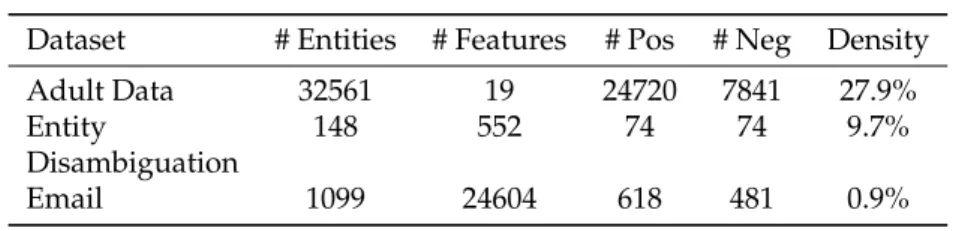
Dataset # Entities # Features # Pos # Neg Density
Adult Data 32561 19 24720 7841 27.9%
Entity 148 552 74 74 9.7%
Disambiguation
Email 1099 24604 618 481 0.9%
Table 3: Statistics of Real-World Datasets
5
Experiments and Results
In order to evaluate our proposed methods we perform various experiments. Our main objective in these experiments is to validate how the performance of the proposed pri-vacy preserving classification varies as we change the value ofAC—user-defined privacy threshold metric. We also compare the performance of our proposed utility preserving anonymization methods with other existing anonymization methods such ask-anonymity and differential privacy. It is important to note that we do not claim that our methods provide a better utility with identical privacy protection as other methods, rather we claim that our methods provide adequate privacy protection which is suitable for high dimen-sional sparse microdata with a much superior AUC value—a classification utility metric which we want to maximize in our problem setup. We use three real-world datasets for our experiments. All three datasets consist of entities that are labeled with 2 classes. The number of entities, the number of features, the distribution of the two classes (#postive and #negative), and the dataset density (fraction of non-zero cell values) are shown in Table 3.
5.1
Privacy Preserving Classification Tasks
Below, we discuss the datasets and the privacy preserving classification tasks that we solve using our proposed methods.
Entity Disambiguation (ED) [44]. The objective of this classification task is to identify
whether the name reference at a row in the data matrix maps to multiple real-life persons or not. Such an exercise is quite common in the Homeland Security for disambiguating multiple suspects from their digital footprints [38, 45]. Privacy of the people in such a dataset is important as many innocent persons can also be listed as a suspect. Given a set of keywords that are associated with a name reference, we build a binary data matrix for solving the ED task. We use Arnetminer3academic publication data. In this dataset,
each row is a name reference of one or multiple researchers, and each column is a research keyword within the computer science research umbrella. A ‘1’ entry represents that the name reference in the corresponding row has used the keyword in her (or their) published works. In our dataset, there are 148 rows which are labeled such that half of the people in this dataset are pure entity (a negative case), and the rest of them are multi-entity (a positive case). The dataset contains 552 attributes (keywords).
To solve the entity disambiguation problem we first perform topic modeling over the key-words and then compute the distribution of entityu’s keywords across different topics. Our hypothesis is that for a pure entity the topic distribution will be concentrated on a few related topics, but for an impure entity (which is composed of multiple real-life persons)
the topic distribution will be distributed over many non-related topics. We use this idea to build a simple classifier which uses an entropy-based scoreE(u)for an entityuas below:
E(u) =−
|T| X
k=1
P(u|Tk) logP(u|Tk) (5)
whereP(u|Tk)is the probability ofubelonging to topicTk, and|T|represents the
pre-defined number of topics for topic modeling. Clearly, for a pure entity the entropy-based scoreE(u)is relatively smaller than the same for a non-pure entity. We use this score as our predicted value and compute AUC (area under ROC curve) to report the performance of the classifier.
Adult. The Adult dataset 4 is based on census data and has been widely used in
ear-lier works onk-anonymization [19]. For our experiments, we use eight of the original attributes; these are age, work class, education, marital status, occupation, race, gender, and hours-per-week. The classification task is to determine whether a person earns over 50K a year or not. Among all of the attributes, gender is originally binary. For the other attributes, we make them as binary for our purpose. For example, for marital attribute, we consider never-married (1) versus others (0). For race attribute, we consider white (1) versus others (0). For the numerical attributes, we cut them into different categories and consider a binary attribute for each category. For instance, we partition age value in five non-overlapping intervals: [0,25],(25,35],(35,45],(45,55], and(55,∞], and then each of the five intervals becomes a binary attribute. Similarly, education attribute is divided into
4intervals and hour/week attribute is divided into5interval. In this way, we have a total of19attributes for the Adult dataset. As we can see privacy of the individuals in such a dataset is quite important as many people consider their personal data, such as race, gen-der, marital status and so on as sensitive attributes and they are not willing to release them to public.
EmailThe last dataset, namely Email dataset5 is a collection of approximately 1099
per-sonal email messages distributed in 10 different directories. Each directory contains both legitimate and spam messages. To respect the privacy issue, each token including word, number, and punctuation symbol is encrypted by a unique number. The classification task is to distinguish the spam email with nonspam email. We use this data to mimic micro-data (such as twitter or Facebook messages) classification. Privacy is important in such a dataset as keyword based features in a micro-message can potentially identify a person. In the dataset, each row is an email message, and each column denotes a token. A ‘1’ in a cell represents that the row reference contains the token in the email message.
5.2
Experimental Setting
For our experiments, we vary thekvalue of the proposedk-anonymity by selection (AC) metric and runMaximaland different variants ofGreedyindependently for building pro-jected classification datasets for whichACvalue is at leastk. We use the namesHamDist
andDistCntfor the two variants ofGreedy(Algorithm 2 and 3), which optimize Ham-ming distance and Distinguish count greedy criteria, respectively. As we mentioned ear-lier,k-anonymity based method imposes strong restriction which severely affects the util-ity of the dataset. To demonstrate that, instead of usingAC, we utilizek-anonymity as
4https://archive.ics.uci.edu/ml/datasets/Adult
our privacy criteria for different variants ofGreedy. We call these competing methods
k-anonymityHamDist, andk-anonymityDistCnt. It is important to note that, in our ex-periments under the sameksetting, thek-anonymity based competing methods may not provide the same level of privacy. For instance, for the samekvalue, privacy protection of our proposed methodHamDistis not the same as that of thek-anonymityHamDist, simply becausek-AC is a relaxation ofk-anonymity.
We also use four other methods for comparing their performance with the performance of our proposed methods. We call these competing methods RF [7],CMGreedy [19], Laplace-DP, and Exponential-DP. We discuss these methods below.
RF is a Randomization Flipping basedk-anonymization technique presented in [7], which randomly flips the feature value such that each instance in the dataset satisfies the k -anonymity privacy constraint. RF uses clustering such that after random flipping oper-ation, each cluster has at leastkentities with the same feature values with respect to the entire feature set.
CM greedy represents another greedy based method which uses Classification Metric util-ity criterion proposed in [19] as utilutil-ity metric (See definition 2). It assigns a generalization penalty over the rows of the dataset and uses a genetic algorithm for the classification task, but for a fair comparison we use CM criterion in theGreedyalgorithm and with the se-lected features we use identical setup for classification.
Laplace-DP [21] is a method to use feature selection for-differential private data publish-ing. Authors in [21] utilize Laplace mechanism [13] for-differential privacy guarantee. To compare with their method, we first compute the utility of each featurexi ∈ Ias its true
output usingHamDistfunction in Definition 8 denoted asH(xi). Then we add
indepen-dently generated noise according to a Laplace distribution withLap(∆H)to each of the|I| outputs, and the noisy output for each featurexiis defined asH(ˆxi) =H(xi) +Lap(∆H),
where∆H is the sensitivity ofHamDistfunction. After that we select top-N features by consideringN largest noisy outputs. On the reduced dataset, we apply a private data re-lease method which provides-differential privacy guaranty. The general philosophy of this method is to first derive a frequency matrix of the reduced dataset over the feature do-main and add Laplace noise withLap(1)to each count (known as marginal) to satisfy the
-differential privacy. Then the method adds additional data instances to match the above count. Such an approach is discussed in [12] as a private data release mechanism.
Exponential-DP is another -differential privacy aware feature selection method. Com-pared to the work presented in [21], we use exponential mechanism [30] based-differential privacy to select features. In particular, we choose each featurexi∈Iwith probability
pro-portional toexp(2∆HH(xi)). That is, the feature with a higher utility score in terms of
HamDistfunction is exponentially more likely to be chosen. The private data release stage of Exponential-DP is as same as the one in Laplace-DP. Note that, for both Laplace-DP and Exponential-DP, prior feature selection is essential for such methods to reduce the data dimensionality, otherwise the number of marginals is an intractable number (2|F |, for a bi-nary dataset withF features) and adding instances to match count for each such instance is practically impossible.
For all the algorithms and all the datasets (except ED) we use the LibSVM to perform SVM classification using L2 loss with 5-fold cross validation. The only parameter for libSVM is regularization-loss trade-offCwhich we tune using a small validation set. For each of the algorithms, we report AUC and the selected feature count (SFC). For RF method, it selects all the features, so for this method we report the percentage of cell values for which the bit is flipped. We use differentk-anonymity by containment (AC) values in our experiments. For
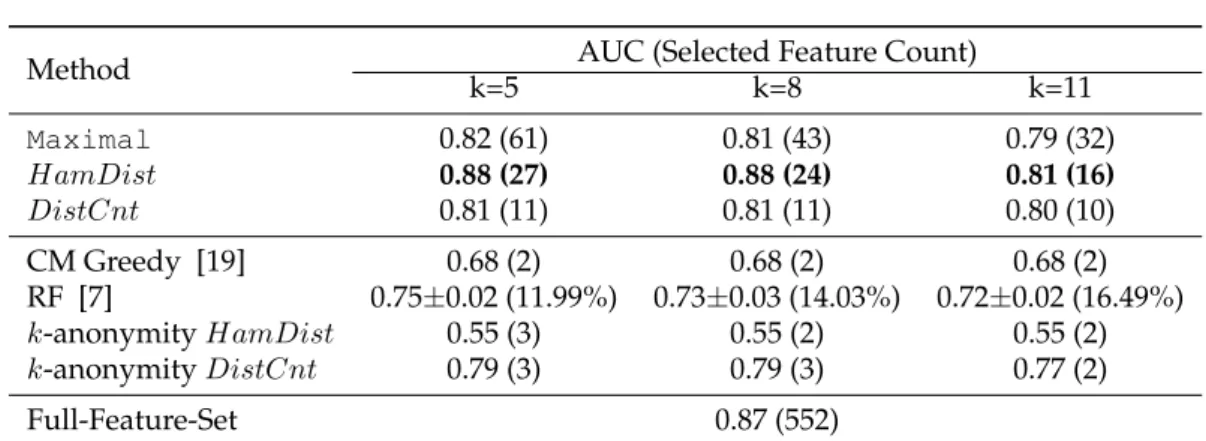
Method AUC (Selected Feature Count) k=5 k=8 k=11 Maximal 0.82 (61) 0.81 (43) 0.79 (32) HamDist 0.88 (27) 0.88 (24) 0.81 (16) DistCnt 0.81 (11) 0.81 (11) 0.80 (10) CM Greedy [19] 0.68 (2) 0.68 (2) 0.68 (2) RF [7] 0.75±0.02 (11.99%) 0.73±0.03 (14.03%) 0.72±0.02 (16.49%) k-anonymityHamDist 0.55 (3) 0.55 (2) 0.55 (2) k-anonymityDistCnt 0.79 (3) 0.79 (3) 0.77 (2) Full-Feature-Set 0.87 (552)
Table 4: AUC Comparison among different privacy methods for the name entity disam-biguation task
practicalk-anonymization,kvalue between 5 and 10 is suggested in the earlier work [41]; we use three differentk values, which are5,8 and 11. For a fair comparison, for both Laplace and Exponential DP, we use the same number of features as is obtained for the case ofHamDist Greedy underk = 5. Since k-anonymity and differential privacy use totally different parameter setting mechanisms (one based onk, and the other based on
), it is not easy to understand what value ofin DP will make a fair comparison for ak
value of 5 ink-AC. So, for both Laplace-DP and exponential-DP, we show the differential privacy results for differentvalues:0.5,1.0,1.5, and2.0. Note that the original work [12] has suggested to use a value of 1.0 for. While using DP based methods, we distribute half of the privacy budget for the feature selection step and the remaining half to add noise into marginals in the private data release step. Moreover, in the feature selection procedure, we further equally divide the budget for the selection of each feature.
RF, Laplace-DP, and Exponential-DP are randomized methods, so for each dataset we run all of them10times and report the average AUC and standard deviation. For each result table in the following sections, we also highlight the best results in terms of AUC among all methods under sameksetting. We run all the experiments on a 2.1 GHz Machine with 4GB memory running Linux operating system.
5.3
Name Entity Disambiguation
In Table 4 we report the AUC value of anonymized name entity disambiguation task using various privacy methods (in rows) for differentkvalues (in columns). For better compari-son, our proposed methods, competing methods, and non-private methods are grouped by the horizontal lines: our proposed methods are in the top group, the competing methods are in the middle group, and non-private methods are in the bottom group. For differential privacy comparison, we show the AUC result in Figure 1(a) 1(b). For each method, we also report the count of selected features (SFC). Since RF method uses the full set of features; for this method the value in the parenthesis is the percent of cell values that have been flipped. We also report the AUC performance using full feature set (last row). As non-private method in bottom group has no privacy restriction, thus the result is independent ofk.
For most of the methods increasing kdecreases the number of selected features, which translates to poorer classification performance; this validates the privacy-utility trade-off.
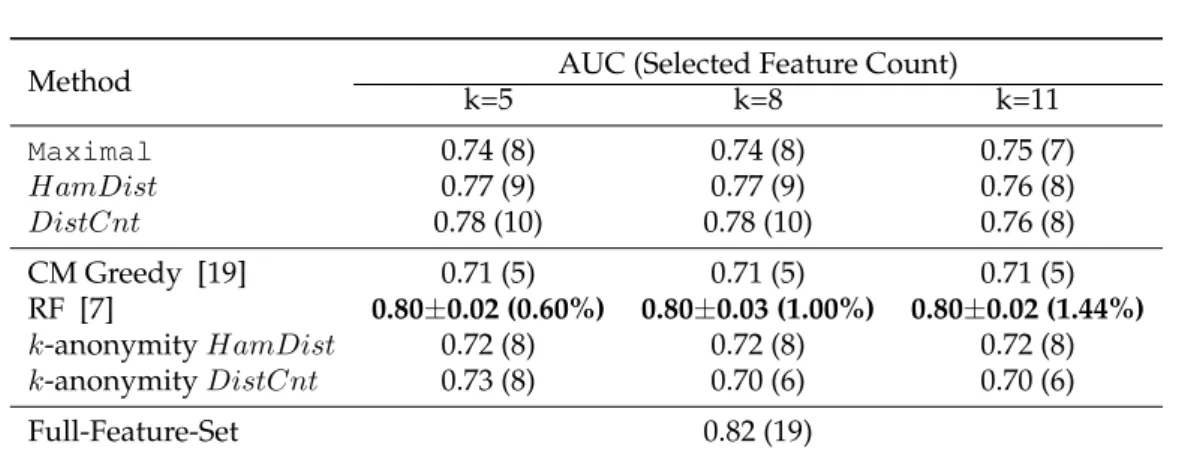
Method AUC (Selected Feature Count) k=5 k=8 k=11 Maximal 0.74 (8) 0.74 (8) 0.75 (7) HamDist 0.77 (9) 0.77 (9) 0.76 (8) DistCnt 0.78 (10) 0.78 (10) 0.76 (8) CM Greedy [19] 0.71 (5) 0.71 (5) 0.71 (5) RF [7] 0.80±0.02 (0.60%) 0.80±0.03 (1.00%) 0.80±0.02 (1.44%) k-anonymityHamDist 0.72 (8) 0.72 (8) 0.72 (8) k-anonymityDistCnt 0.73 (8) 0.70 (6) 0.70 (6) Full-Feature-Set 0.82 (19)
Table 5: Comparison among different privacy methods for Adult dataset using AUC
However, for a givenk, our proposed methods perform better than the competing methods in terms of AUC metric for all differentkvalues. For instance, fork = 5, the AUC result of RF and CM Greedy are only0.75and 0.68respectively, whereas different versions of proposedGreedyobtain AUC values between0.81and0.88. Among the competing meth-ods, both Laplace-DP and Exponential-DP perform the worst (0.51AUC under= 1.0) as shown in the first group of bars in Figure 1(a) & 1(b), andk-anonymityDistCntperforms the best (0.79 fork=5); yet all completing methods perform much poorer than our proposed methods. A reason for this may be most of the competing methods are too restrictive, as we can see that they are able to select only 2 to 3 features for variouskvalues. In compar-ison, our proposed methods are able to select between 11 and 61 features, which help our methods to retain classification utility. The bad performance of differential privacy based methods is due to the fact that in such a setting, the added noise is too large in both feature selection and private data release steps. In general, the smaller the, the stronger privacy guarantee the differential privacy provides. However, stronger privacy protection in terms ofalways leads to worse data utility in terms of AUC as shown in Figure 1(a) 1(b). There-fore, even though differential privacy provides stronger privacy guarantee, the utility of data targeting supervised classification task is significantly destroyed. For this dataset, we observe that the performance of RF is largely dependent on the percentage of flips in the cell-value; if this percentage is large, the performance is poor. Askincreases, with more privacy requirement, the percentage of flips increases, and the AUC drops.
For a sparse dataset like the one that we use for entity disambiguation, feature selection helps classification performance. In this dataset, using full set of features (no privacy), we obtain only 0.87 AUC value, whereas using less than 10% of features we can achieve comparable or better AUC using our proposed methods (whenk=5). Even fork= 11, our methods retain substantial part of the classification utility of the dataset and obtain AUC value of 0.81 (see second row). Also, note that underk= 5and8, ourHamDistperforms better than using full feature set, which demonstrates our proposed privacy-aware feature selection methods not only have the competitive AUC performance, but provide strong privacy guarantees as well.
5.4
Adult Data
The performance of various methods for the Adult dataset is shown in Table 5, where the rows and columns are organized identically as in the previous table. Adult dataset is
low-Method AUC (Selected Feature Count) k=5 k=8 k=11 Maximal 0.94 (121) 0.92 (66) 0.90 (58) HamDist 0.91 (11) 0.91 (11) 0.91 (11) DistCnt 0.95 (11) 0.93 (7) 0.93 (7) CM Greedy [19] 0.86 (3) 0.86 (3) 0.86 (3) RF [7] 0.87±0.02 (1.30%) 0.86±0.01 (1.73%) 0.87±0.03 (2.03%) k-anonymityHamDist 0.84 (4) 0.84 (4) 0.84 (4) k-anonymityDistCnt 0.81 (4) 0.81 (4) 0.81 (4) Full-Feature-Set 0.95 (24604)
Table 6: Comparison among different privacy methods for Email dataset using AUC
ED Adult Email 0.0 0.1 0.2 0.3 0.4 0.5 0.6 0.7 0.8 A U C epsilon = 0.5 epsilon = 1.0 epsilon = 1.5 epsilon = 2.0
(a) Laplace Mechanism based Differential Privacy
ED Adult Email 0.0 0.1 0.2 0.3 0.4 0.5 0.6 0.7 0.8 A U C epsilon = 0.5 epsilon = 1.0 epsilon = 1.5 epsilon = 2.0
(b) Exponential Mechanism based Differential Privacy
Figure 1: Classification Performance of differential privacy based methods for different
values on three datasets. Laplace mechanism is on the left and Exponential mechanism is on the right. Each group of bars belong to one specific dataset, and within a group different bars represent differentvalues.
dimensional and dense (27.9% values are non-zero). Achieving privacy on such a dataset is comparatively easier, so existing methods for anonymization work fairly well on this. As we can observe, RF performs the best among all the methods. The good performance of RF is owing to the very small percentage of flips which ranges from 0.60% to 1.50% for variousk values. Basically, RF can achievek-anonymity on this dataset with very small number of flips, which helps it maintain the classification utility of the dataset. For the same reason,k-anonymityHamDistandk-anonymityDistCnt methods are also able to retain many dimensions (8 out of 19 fork=5) of this dataset, and perform fairly well. On the other hand, different versions ofGreedyandMaximalretain between 8 and 10 dimen-sions and achieve an AUC between 0.74 and 0.78, which are close to 0.80 (the AUC value for RF). Also, note that, the AUC using the full set of features (no privacy) is0.82, so the utility loss due to the privacy is not substantial for this dataset. As a remark, our method is particularly suitable for high dimensional sparse data for which anonymization using traditional methods is difficult.
5.5
Spam Email Filtering
In Table 6, we compare AUC value of different methods for spam email filtering task. This is a very high dimensional data with24604 features. As we can observe, our proposed methods, especiallyDistCntandHamDistperform better than the competing methods. For example, fork= 5, the classification AUC of RF is0.87with flip rate1.30%, but using less than0.045%of featuresDistCntobtains an AUC value of0.95, which is equal to the AUC value using the full feature set. Again,k-anonymity based methods show worse per-formance as they select less number of features due to stronger restriction of this privacy metric. For instance, fork = 5,HamDistselects11features, butk-anonymityHamDist
selects only 4 features. Due to this, classification results usingk-anonymity constraint are worse compared to those using our proposedAC as privacy metric. As shown in Fig-ure 1(a) 1(b), both Laplace-DP and Exponential-DP with various privacy budgetsetups perform much worse than all the competing methods in Table 6, which demonstrates that the significant amount of added noise during the sanitization process deteriorates the data utility and leads to bad classification performance. Among our methods, bothDistCnt
andMaximalare the best as they consistently hold the classification performance for all differentksettings.
6
Related Work
We discuss the related work under the following two categories.
6.1
Privacy-Preserving Data Mining
In terms of privacy model, several privacy metrics have been widely used in order to quan-tify the privacy risk of published data instances, such ask-anonymity [41],t-closeness [27],
`-diversity [28], and differential privacy [14]. Existing works on privacy preserving data mining solve a specific data mining problem given a privacy constraint over the data in-stances, such as classification [43], regression [16], clustering [42] and frequent pattern min-ing [15]. However the solutions proposed in these works are strongly influenced by the specific data mining task and also by the specific privacy model. In fact, the majority of the above works consider distributed privacy where the dataset is partitioned among multiple participants owning different portions of the data, and the goal is to mine shared insights over the global data without compromising the privacy of the local portions. A few other works [5,6] consider output privacy by ensuring that the output of a data mining task does not reveal sensitive information.
k-anonymity privacy metric, due to its simplicity and flexibility, has been studied exten-sively over the years. Authors in [2] presents thek-anonymity patterns for the application of association rule mining. Samarati [39] proposes formal methods ofk-anonymity using suppression and generalization techniques. She also introduced the concept of minimal generalization. Meyerson et al. [31] prove that two definitions ofk-optimality are N P -hard: first, to find the minimum number of cell values that need to be suppressed; second, to find the minimum number of attributes that need to be suppressed. Henceforth, a large number of works have explored the approximation of anonymization [4, 31]. However, none of these works consider the utility of the dataset along with the privacy requirements. Kifer et al. [22] propose methods that inject utility in the form of data distribution informa-tion intok-anonymous and`-diverse tables. However, the above work does not consider a
classification dataset. Iyengar [19] proposes a utility metric calledCM which is explicitly designed for a classification dataset. However, It assigns a generalization penalty over the rows of the dataset, but its performance is poor as we have shown in this work.
In recent years differential privacy [12, 24, 34] has attracted much attention in privacy re-search literatures. Authors in [9] propose a sampling based method for releasing high dimensional data with differential privacy guarantees. [37] proposes a method of pub-lishing differential private low order marginals for high dimensional data. Even though authors in [9, 37] claim that they deal with high dimensional data, the dimensionality of data is at most60from the experiments in their works. [40] makes use ofk-anonymity to enhance data utility in differential privacy. An interesting observation of this work is that differential privacy based method, by itself, is not a good privacy mechanism, in regards to maintaining data utility. [8] proposes a probabilistic top-down partitioning algorithm to publish the set-valued data via differential privacy. Authors of [32] propose to utilize exponential mechanism to release a decision tree based classifier that satisfies-differential privacy. However in their work, privacy is embedded in the data mining process, hence they are not suitable as a data release mechanism, and more importantly they can only be used along with the specific classification model within which the privacy mechanism is built-in.
6.2
Privacy-Aware Feature Selection
Empirical study for the use of feature selection in Privacy Preserving Data Publishing has been proposed in [20] [21]. However, in their work, they use feature selection as an add-on tool prior to data anonymization and do not consider privacy during the feature selection process. For our work, we consider privacy-aware feature selection with a twin objective of privacy preservation and utility maintenance. To the best of our knowledge, the most similar works to ours for the use of feature selection in Privacy Preserving Data Publishing are presented in [29, 35] recently. [35] considers privacy as a cost metric in a dynamic fea-ture selection process and proposes a greedy based iterative approach for solving the task, where the data releaser requests information about one feature at a time until a predefined privacy budget is exhausted. However the entropy based privacy metric presented in this work is strongly influenced by the specific classifier. [29] presents a genetic approach for achievingk-anonymity by partitioning the original dataset into several projections such that each one of them adheres tok-anonymity. But the proposed method does not provide optimality guaranty.
7
Conclusion and Future Work
In this paper, we propose a novel method for entity anonymization using feature selec-tion. We define a new anonymity metric calledk-anonymity by containment which is par-ticularly suitable for high dimensional microdata. We also propose two feature selection methods along with two classification utility metrics. These metrics satisfy submodular properties, thus they enable effective greedy algorithms. In experiment section we show that both proposed methods select good quality features on a variety of datasets for retain-ing the classification utility yet they satisfy the user defined anonymity constraint.
In this work, we consider binary features. We also show experimental results using cat-egorical features by making them binary, so the work can easily be extended for datasets with categorical features. An immediate future work is to extend this work on datasets