Best Practices and Barriers:
An Update for Ontario
Best Practices and Barriers:
An Update for Ontario
Needle Exchange Programs
Carol Strike, Centre for Addiction and Mental Health
Tara Marie Watson, Centre for Addiction and Mental Health Shaun Hopkins, The Works, Toronto Public Health
Paul Lavigne, Ottawa Public Health
Don Young, Superior Points, Thunder Bay District Health Unit Ron Shore, Street Health Centre
Lynne Leonard, University of Ottawa Peggy Millson, University of Toronto
PROJECT TEAM
Using a community based research approach, a team of academic researchers and NEP managers in Ontario developed and conducted this study. Carol Strike, Senior Scientist at the Centre for Addiction and Mental Health (CAMH), and Shaun Hopkins, manager of The Works in Toronto, led the team. Other team members include: Tara Marie Watson, project coordinator; Paul Lavigne, Harm Reduction Project Officer, Ottawa Public Health; Don Young, program coordinator of Superior Points Harm Reduction Program for the Thunder Bay District Health Unit; Ron Shore, program manager of the Street Health Centre in Kingston; Lynne Leonard, Assistant Professor and Research Scientist in the Department of Epidemiology and Community Medicine at the University of Ottawa; and Peggy Millson, Associate Professor at the Dalla Lana School of Public Health, University of Toronto.
ACKNOWLEDGEMENTS
We are very grateful for the time and effort of many individuals who helped us to complete this project. When we first began planning this project, the team was very grateful to receive assistance from Robb Travers and Colleen McKay. Our online survey was greatly improved by the efforts and feedback of three pilot testers: Suzanne Newmark from The Van and Street Health Program, Hamilton Public Health; Beth Whalen from Project X Change, John Howard Society of Durham; Lori Brooks from Northern Points Exchange, North Bay Parry Sound District Health Unit. We would also like to extend our thanks to Cathy Cleary at the Ontario Harm Reduction Distribution Program (OHRDP) for helping us with some issues of interpretation. This project was funded by the Ontario HIV Treatment Network (OHTN). Salary and infrastructure support for Dr. Carol Strike were provided by the Ontario Ministry of Health and Long Term Care. The views expressed in this report do not necessarily reflect those of the Ministry.
SUGGESTED REFERENCE
Strike C, Watson TM, Hopkins S, Lavigne P, Young D, Shore R, Leonard L, Millson P. Best Practices and Barriers: An Update for Ontario Needle Exchange Programs. Toronto: Ontario Needle Exchange Coordinating Committee, 2009.
TABLE OF CONTENTS
LIST OF TABLES ... 1
EXECUTIVE SUMMARY... 2
INTRODUCTION AND PURPOSE... 4
DEFINITIONS... 5
METHODS ... 6
SAMPLING FOR THE ONLINE SURVEY... 6
PILOT TEST... 6
RECRUITMENT FOR THE ONLINE SURVEY... 7
SURVEY ANALYSIS... 7
SAMPLING AND RECRUITMENT FOR THE KEY INFORMANT INTERVIEWS... 7
MOH INTERVIEW ANALYSIS... 8
RESULTS... 9
SURVEY RESPONSE RATES... 9
NEEDLE AND SYRINGE EXCHANGE... 9
COOKERS... 10 FILTERS... 11 ACIDIFIERS ... 12 STERILE WATER... 13 ALCOHOL SWABS... 14 TOURNIQUETS... 15
GLASS STEMS, MOUTH PIECES, AND BRASS SCREENS... 16
PROGRAM MODELS... 18
PRIMARY CARE... 20
TYPE OF TESTING... 21
LAW ENFORCEMENT... 22
USE OF THE BEST PRACTICE RECOMMENDATIONS... 24
MEDICAL OFFICERS OF HEALTH AND NEP DECISION MAKING... 25
DISCUSSION AND INTERPRETATION ... 29
SUCCESSES AND FACILITATORS... 29
ISSUES AND BARRIERS... 30
RECOMMENDATIONS ... 32
LIST OF TABLES
Table 1: Uptake of needle and syringe exchange recommendations Table 2:Uptake of cooker recommendations
Table 3: Uptake of filter recommendations Table 4: Uptake of acidifier recommendations Table 5: Uptake of sterile water recommendations Table 6: Uptake of alcohol swab recommendations Table 7: Uptake of tourniquet recommendations
Table 8: Uptake of glass stem, mouth piece, and brass screen recommendations Table 9: Uptake of program model recommendations
Table 10: Uptake of program design, planning, and delivery recommendations
Table 11: Uptake of vaccination and testing recommendations – direct program delivery Table 12: Uptake of vaccination and testing recommendations - by referral
Table 13: Relationships with law enforcement Table 14: NEP agreements with law enforcement Table 15: Use of the Best Practice Recommendations
Table 16: Requests for future Best Practice Recommendations
EXECUTIVE SUMMARY
Published in 2006, the Ontario Needle Exchange Programs: Best Practice Recommendations (Strike et al., 2006) contains 103 recommendations for the operational and practice challenges faced by needle exchange programs (NEPs). The project on which this report is based aimed to assess the extent to which the Best Practice Recommendations have been implemented, identify implementation barriers, and advance our knowledge transfer skills to improve uptake.
We surveyed 32 core NEP managers (100% response rate) and 62 satellite NEP managers (63% response rate) and asked them about their practices and policies before (2006) and two years after (2008) the release of the Best Practice Recommendations. To complement our survey findings, we also conducted 5 key informant interviews with Medical Officers of Health (MOHs) in Ontario.
The majority of NEPs we surveyed reported following best practices with their needle distribution policies. Only a single satellite program reported following a 1-for-1 exchange policy today. Most programs distributed injection-related equipment according to best practices. By 2008, 88% (n=28) of core NEPs and 84% (n=52) of satellite NEPs distributed cookers, and all core NEPs (100%, n=32) and nearly all satellite NEPs (97%, n=60) distributed sterile water. Commonly cited reasons for change behind NEP equipment distribution practices included the Best Practice Recommendations and the Ontario Harm Reduction Distribution Program (OHRDP). Implementation barriers included funding, senior management and political decision-making.
While more programs reported distributing safer inhalation equipment in 2008 than did so in 2006, the majority of NEPs do not distribute these items (e.g., glass stems). In 2008, more satellite NEPs (44%, n=27) reported distributing glass stems than the core NEPs (16%, n=5). According to both NEP managers and MOHs, the distribution of safer inhalation equipment has and continues to face a number of political barriers.
From the perspective of the MOHs interviewed, funding and scientific evidence are key considerations when they make decisions about the amount and types of equipment NEPs will distribute. Our sample of MOHs reported that in the past consideration of legal and policing issues was more important than now, but acknowledged that such issues may arise in the future and pose significant barriers for NEP operations. MOHs suggested that political barriers to program changes could sometimes be overcome by keeping NEPs ‘under the radar.’ Though best practice documents are regarded as useful in that they help set standards to follow, such documents might not always reach MOHs or they might not have the time to review them.
As well as asking about equipment distribution and related policies, we asked NEP managers a series of questions pertaining to program models, primary care services, law enforcement, and use of the Best Practice Recommendations. Between 2006 and 2008, there were fewer changes in these areas relative to equipment-related practices. Nonetheless, some evidence of important trends emerged. For example, more core NEPs and satellite NEPs involved drug users in program development in 2008 compared to 2006, though these changes were not statistically significant. Higher numbers of core NEPs provided direct vaccination and
testing services today than two years ago. Despite reports of positive relationships with the police, few NEPs followed recommendations such as providing police training and
establishing protocols to resolve conflicts. When asked about suggestions for improving the best practice document, a majority of survey respondents reported that they would like to see other best practice recommendations developed and were most interested in
recommendations for methamphetamine and Oxycontin™.
Our findings are very encouraging and identify barriers to overcome to increase uptake and implementation of the Best Practice Recommendations. To reduce risk and disease
transmission, ensuring that NEP clients receive enough injection equipment as well as safer inhalation equipment is important. This report concludes with a number of recommendations based on our findings, including the development of a funding mechanism to ensure that the OHRDP can distribute safer inhalation equipment.
INTRODUCTION AND PURPOSE
Evidence demonstrates that needle exchange programs (NEPs) reduce HIV transmission among injection drug users (IDUs) and are cost effective public health programs (Wodak and Cooney, 2005). However, until the release of Ontario Needle Exchange Programs: Best Practice Recommendations (Strike et al., 2006), best practices had yet to be established. The Best Practice Recommendations document filled this void by providing concrete recommendations for the operational, controversial, and practical challenges faced by NEPs. In 2006, the document was disseminated to all NEPs, Medical Officers of Health (MOHs), and many other service providers in Ontario and other places. As well, the project team made numerous presentations to stakeholders, including NEP frontline workers and senior decision makers within the Ontario Ministry of Health, Public Health Agency of Canada, Canadian Drug Strategy, community members and researchers.
In March 2007, our team consulted with the Ontario NEP managers who spoke about their successes and challenges implementing the Best Practice Recommendations. Comments from the managers reflected that, overall, the document had been well received on the frontlines and by most senior managers (e.g., MOHs and Executive Directors). Nevertheless, there has been some resistance to full implementation. This resistance was linked with several factors including:
• Legal and financial concerns (e.g., human resources, supply and disposal costs);
• Lack of understanding or acceptance of the value of harm reduction;
• Concern that further implementation of the recommendations might increase the ‘power’ of harm reduction and influence other aspects of the organization;
• Philosophical opposition to the distribution of glass stems.
Using the information collected during this consultation, we developed an evaluation plan and the results of this are presented below. The findings in this report pertain to NEPs that were operational in 2008. An important consideration for the reader to keep in mind is that there are still some areas of the province that do not have active NEPs and, therefore, represent areas where IDUs lack access to the sterile injection equipment and other services that NEPs provide.
The goals of our project were to assess the extent to which the Best Practice Recommendations have been implemented, identify implementation barriers, and advance our knowledge transfer skills to improve uptake. Using survey data collected from Ontario NEPs and their satellite programs, as well as key informant interviews with MOHs, in this report we:
1. Evaluate the uptake and implementation of the recommendations; 2. Identify barriers to implementation;
3. Identify successful strategies that have led to implementation; 4. Identify strategies to increase or improve implementation;
5. Identify emerging issues for NEPs that may require the development of further best practice recommendations.
DEFINITIONS
Needle exchange versus distribution – The term NEP (needle exchange program) is used
throughout this document to refer to programs that provide injection drug users and other drug users with access to sterile injection and other drug use equipment, health education, referrals, counselling and other services. In other parts of the world, these programs are also known as syringe exchange programs (SEP). The term needle and syringe programs (NSP) is also used to reflect the move of many programs away from the ‘exchange’ of equipment to the ‘distribution’ of equipment with or without the return of used equipment. In Ontario, these programs have been known as NEPs since their inception, when they were labelled as such by the Mandatory Programs and Services Guidelines for Ontario (Minister of Health and Long Term Care, 1997). In 2008, the Ontario Ministry of Health and Long Term Care released a new set of public health standards and now use the term ‘provision’ of needles and syringes instead of ‘exchange’, as well as referring to the programs as harm reduction services (Minister of Health and Long Term Care, 2008). Since our project was conducted before these changes in terminology, we use the term NEP throughout the report. However, as the reader will see in the section on needle and syringe exchange, many programs in Ontario have indeed moved away from ‘exchange’ in favour of ‘distribution’.
Core versus satellite NEP - Needle exchange is a required public health service in Ontario.
Boards of Health, through their Public Health Units, are required to either operate NEPs or ensure that these services are provided in every health unit’s jurisdiction. ‘Core’ or ‘parent’ NEPs are either directly operated by the health unit or operated by another local agency contracted by the health unit to provide needle exchange services. Many core NEPs in Ontario have agreements with local community agencies and organizations (e.g.,
AIDS-service organizations, community health centres, youth AIDS-services, pharmacies) to provide NEP services, thereby extending the accessibility of NEP services. Core NEPs provide training, equipment and supplies, and sometimes onsite service at these ‘satellite’ sites. Typically, core NEPs determine the exchange policies to be followed by their satellites.
Ontario Harm Reduction Distribution Program (OHRDP) – Launched in 2006, the OHRDP
provides injection-related and drug preparation materials, as well as knowledge and support, to Ontario’s needle exchange and harm reduction programs. The development of the OHRDP was influenced by the evidence contained in the Ontario Needle Exchange Programs: Best Practice Recommendations. The OHRDP is managed through Street Health, a part of Kingston Community Health Centres, and is funded by the Hepatitis C Secretariat, Ontario Ministry of Health and Long-Term Care (OMHLTC). The OHRDP provides injection-related materials free of charge to participating programs to reduce the transmission of infectious disease. These injection-related materials include: sterile water, alcohol prep pads,
tourniquets, filters, vitamin C (acidifier), and cookers.
METHODS
For this project, we adopted a mixed methods approach that combined a report card-like online survey evaluation with key informant interviews to gather more in-depth information. The Ontario Needle Exchange Programs: Best Practice Recommendations includes 103 recommendations covering issues ranging from needle distribution to first aid to program evaluation. These recommendations are divided into nine subject areas (e.g., needle distribution and disposal; other injection-related equipment distribution and disposal; education; primary care; relationships with law enforcement). All of the recommendations are directed at improving the overall health and social functioning of drug users accessing NEPs. However, the project team decided to focus on six of the nine subject areas: needle distribution and disposal; other injection-related equipment distribution; distribution of glass stems; program models; primary care; and relationships with law enforcement. The team chose these six subject areas because they relate to the primary function of NEPs and have the most impact on a needle exchange program’s ability to meet their mandate of reducing disease transmission. Included within the selected subject areas are recommendations that were identified as likely to be the most controversial and least likely to have been implemented (e.g., distribution of glass stems), but highly important for prevention of disease transmission.
For the online survey, we abstracted from each of the selected six areas the relevant policies, activities, supplies, and other materials to develop a series of questions. Our informal discussion with the NEP managers, in team meetings, and during pilot testing greatly assisted in developing the sections and questions for the survey.
Sampling for the online survey
As the unit of analysis for this project is the needle exchange program, NEP managers were asked to report on the policies and practices in place in their NEP programs. The NEP managers are responsible for policy and procedure development and are, therefore, most knowledgeable about the reasons behind the implementation of the Best Practice Recommendations or lack thereof.
When the online survey was opened, there were 32 core NEPs and 99 active satellite NEPs in Ontario. Managers at all of the core NEP sites agreed to participate in the online survey. The core NEP managers also agreed to help us contact their satellite sites and encouraged participation by providing e-mail addresses for satellite NEP managers and sending reminders to their satellites about completing the survey.
Pilot test
To ensure flow and comprehensibility, the online survey was pilot tested prior to launching full data collection. Three core NEP managers completed the online survey. Each of the pilot testers was then contacted by telephone to discuss their experiences, solicit their recommendations, and clarify any inconsistencies in their answers. Based on feedback from the pilot testers, answer choices were further refined.
Recruitment for the online survey
Following the pilot test, invitations were sent by e-mail to all core NEP (N=32) and satellite NEP (N=99) managers on our contact list. Two weeks after these initial invitations were sent, a reminder invitation was sent by e-mail to all managers who had not yet started or completed the survey. Two weeks after the reminder, core NEP managers were asked to follow up with their satellites that had not yet responded. The survey was open for 12 weeks, from February 28th, 2008 until May 22nd, 2008.
Survey analysis
Our survey was developed using SurveyMonkey online survey software (please see http://www.surveymonkey.com). After the survey was conducted, the data was downloaded and entered into SPSS. The dataset was assessed for completeness, and inconsistent responses were corrected where possible. As well, we identified and corrected where possible responses to ‘other’ and ‘please specify’ options that were redundant or suggested a need to create additional variable categories. The data were then analysed using bivariate statistics (e.g., McNemar χ2 tests) to make before-and-after comparisons. The main purpose of the analyses was to assess the implementation of the Best Practice Recommendations and the major reasons for lack of implementation.
Sampling and recruitment for the key informant interviews
Using data collected from the online survey, we identified issues highly relevant to the implementation or lack thereof of the recommendations. Subsequently, we designed key informant interviews to better understand the role of MOHs in decision-making about NEPs, to identify facilitators and barriers to best practice implementation from a policy-maker perspective, and to obtain suggestions for strategies to improve implementation and knowledge transfer to this audience. To complement our survey findings, we conducted 5 key informant interviews with MOHs in Ontario.
After the survey data collection was complete, our project team discussed selection for the interviews. Due to recent controversy surrounding distribution of safer crack use kits that include glass stems and our findings that the recommendations regarding this equipment have not been extensively implemented by NEPs, we decided to consider this issue within the sampling decision. In particular, we decided to select a combination of MOHs associated with core NEPs that currently distribute glass stems and MOHs associated with core NEPs that do not. For additional variation, we targeted both programs run by public health units and those outsourced to another agency (e.g., an AIDS-service organization), as well as programs that serve larger and smaller populations. Our MOH sample targets were the following:
• 1 MOH associated with a public health unit program that distributes glass stems
• 1 MOH associated with a public health unit program that does not distribute glass stems
• 1 MOH associated with an outsourced program that distributes glass stems
• 2 MOH associated with outsourced programs that do not distribute glass stems
The managers of the selected core NEPs were asked to approach their local MOH about participating in our study. Upon receiving consent, the project coordinator conducted all key
informant interviews over the telephone. The interviews took place between August 29th and October 28th, 2008.
MOH interview analysis
All key informant interviews were tape recorded and transcribed. Transcripts were managed using word processing software. One of the principal investigators and the project coordinator read all of the transcripts to extract and analyze the major facilitators and barriers to implementation, and related themes.
RESULTS
Survey response rates
We achieved a 100% response rate (32 of 32) for the core NEPs and a 67% response rate (66 of 99) for the satellite NEPs. Combined, the total response rate was 75% (98 of 131 Ontario NEPs). Of those who responded, 5 surveys from satellite NEPs were incomplete. Of these 5 surveys, 4 did not contain enough usable data and were removed from the analyses. Therefore, the summaries that follow reflect the findings from the survey data of 94 respondents - 32 core NEP managers and 62 satellite NEP managers.
Needle and syringe exchange
To prevent the transmission of HIV, Hepatitis B (HBV), Hepatits C (HCV) and other bloodborne pathogens from injection with non-sterile needles and syringes, the Ontario Needle Exchange Programs: Best Practice Recommendations advises NEPs to provide sterile needles in the quantities requested by clients:
• without requiring clients to return used needles • with no limit on the number of needles provided • with encouragement to return used needles
Needle sharing carries a high risk of transmission of bloodborne pathogens such as HIV, HBV and HCV. Injecting with used needles also puts IDUs at risk for other types of infections, skin and vein problems. The Best Practice Recommendations were designed to improve access to sterile needles for NEP clients to reduce needle-sharing practices and to reduce risk.
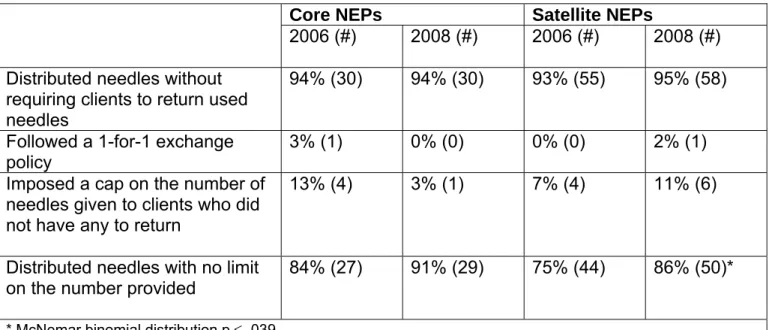
From our survey of 94 managers from Ontario NEPs, we learned that most programs distributed needles without requiring clients to return used needles and this practice did not change over time (see Table 1).
Our data show that in 2008 none of the core NEPs had a 1-for-1 exchange policy and that only one satellite program reported using a 1-for-1 exchange policy. More NEPs were distributing needles in 2008 with no limit on the number provided than was the case in 2006. Interestingly, while fewer core NEPs now impose a cap on the number of needles given out to clients, more satellite NEPs implemented a cap on the number of needles given to clients who did not have any to return, though these changes were not statistically significant. In addition, all core NEPs and all satellite NEPs that responded to the survey indicated that in 2008 they were disposing of used injection equipment, sharps, and sharps containers in accordance with local regulations for biomedical waste (data not shown).
Table 1: Uptake of needle and syringe exchange recommendations
Core NEPs Satellite NEPs
2006 (#) 2008 (#) 2006 (#) 2008 (#) Distributed needles without
requiring clients to return used needles
94% (30) 94% (30) 93% (55) 95% (58) Followed a 1-for-1 exchange
policy
3% (1) 0% (0) 0% (0) 2% (1) Imposed a cap on the number of
needles given to clients who did not have any to return
13% (4) 3% (1) 7% (4) 11% (6)
Distributed needles with no limit on the number provided
84% (27) 91% (29) 75% (44) 86% (50)*
* McNemar binomial distribution p ≤ .039
For the programs reporting a change in needle exchange policy, the most commonly reported reasons were the Best Practice Recommendations (75%, n=9), changes in the approach of staff members (75%, n=9), changes in client demand (55%, n=6), and decisions by NEP managers (50%, n=6).
Cookers
The sharing of injection equipment also carries a risk of transmitting bloodborne pathogens such as HIV and HCV. The term ‘cooker’ refers to the containers used for mixing and preparing drugs. Often, spoons and bottle caps are used for this purpose. Studies have shown that sharing cookers is common among IDUs, creating opportunities for contamination and potential disease transmission (Clatts et al., 1999; Leonard et al., 2005).
The Best Practice Recommendations advise NEPs to reduce the risks associated with the re-use of cookers by:
• distributing single-use cookers in the quantities requested by clients with no limit on the number of cookers provided
• offering a cooker with every needle provided
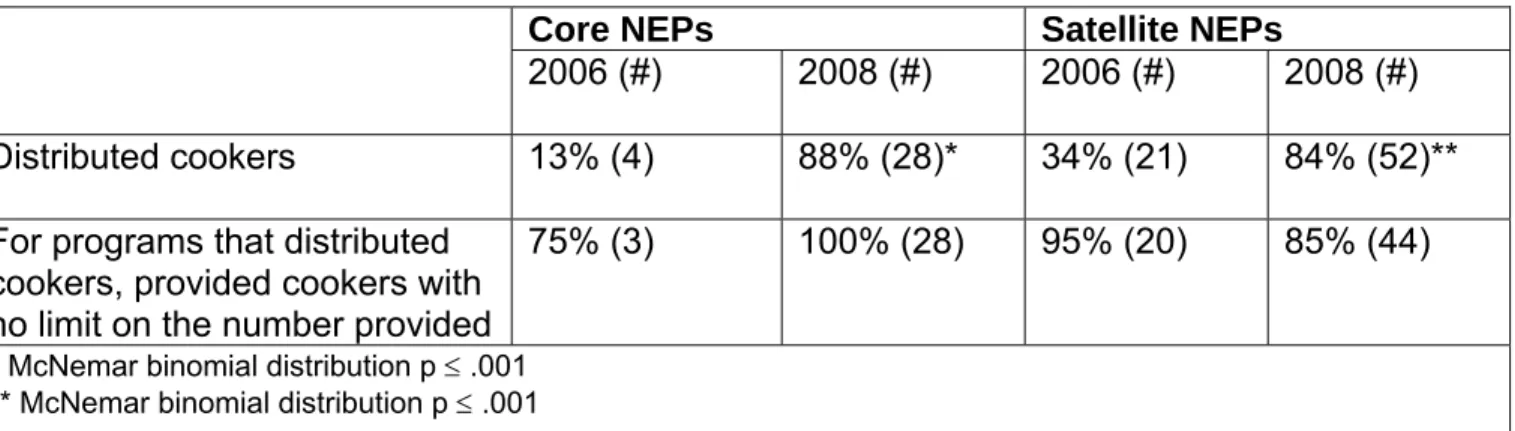
Our data show a significant increase in the number of NEPs distributing cookers in 2008 when compared to 2006 (see Table 2). In line with the Best Practice Recommendations, all core NEPs that distribute cookers were doing so without limits on the number they provide to their clients. While many more satellite NEPs now distribute cookers, a smaller proportion distribute with no limit, but this difference was not statistically significant.
Table 2: Uptake of cooker recommendations
Core NEPs Satellite NEPs
2006 (#) 2008 (#) 2006 (#) 2008 (#) Distributed cookers 13% (4) 88% (28)* 34% (21) 84% (52)** For programs that distributed
cookers, provided cookers with no limit on the number provided
75% (3) 100% (28) 95% (20) 85% (44)
* McNemar binomial distribution p ≤ .001 ** McNemar binomial distribution p ≤ .001
For those programs reporting a change in cooker distribution practices over the two-year period, the most commonly reported reasons were the availability of the OHRDP (92%, n=35), the Best Practice Recommendations (67%, n=24), decisions by NEP managers (49%, n=16), and decisions by the local MOH/Executive Director (46%, n=15).
Among the few core programs that did not distribute cookers in 2008, decisions by the local MOH/Executive Director were the most common reasons reported for lack of implementation (75%, n=3). For the satellite programs that did not distribute cookers, (56%, n=5) of NEP managers stated that they did not know why they did not distribute these items. Our data highlight this as an area worth exploring with the remaining Ontario NEPs that do not currently distribute cookers.
Filters
After a drug solution is prepared in a cooker, a filter is placed in the cooker and the drug solution is drawn up through the filter. This process helps to prevent undissolved drug particles, other debris, and bacteria from being drawn up into an injectable solution. The sharing of filters and ‘washes’ made from used filters is common among IDUs, and these practices have the potential to spread bloodborne pathogens such as HIV and HCV (Bourgois and Pearson, 1998; Leonard et al., 2005). Using a proper filter is important because the materials commonly used as filters (e.g., cigarette filters) do not prevent bacteria from being drawn up into the drug solution and may contain other contaminants that can become mixed into the solution and injected into the body. Many IDUs experience a condition called ‘cotton fever,’ believed to be linked to the use of cotton filters that are not tightly bound (Harrison and Walls, 1990). Research has found that filters with a pore width of 0.22 μm are significantly more effective in preventing bacterial contamination compared to cigarette filters and 20 μm filters (Caflisch et al., 1999).
The Best Practice Recommendations suggest that NEPs can decrease the risks associated with filters by:
• distributing filters with a pore width of 0.22 μm in the quantities requested by clients with no limit on the number of filters provided
• offering a 0.22 μm filter with every needle provided
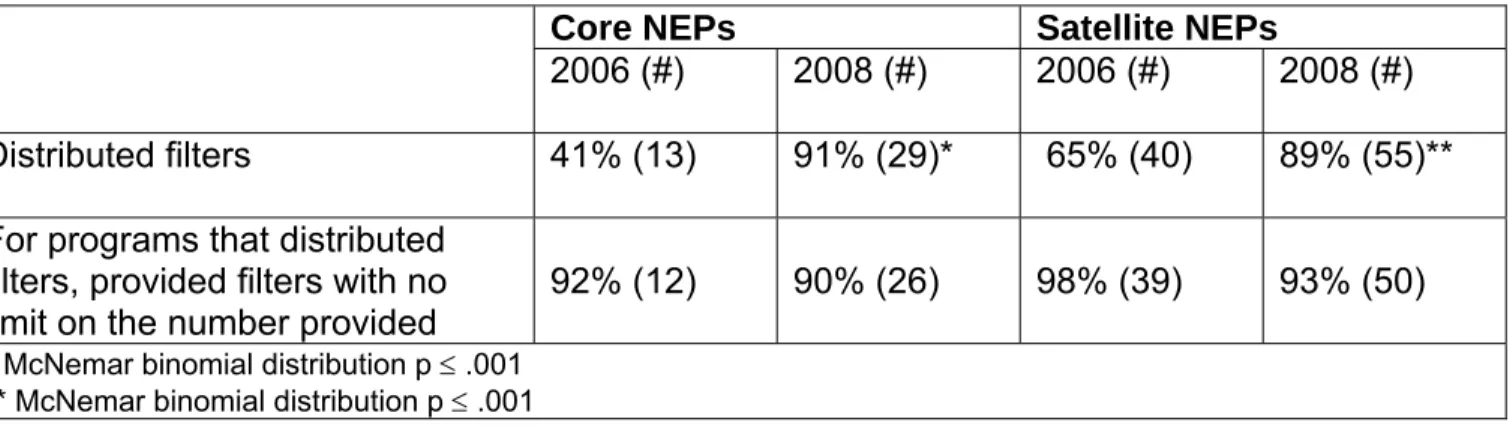
NEP managers reported changes over time (see Table 3). In 2008, more NEPs distributed filters compared to two years earlier. Among these programs, the majority followed the Best Practice Recommendations by distributing filters without limits on the number provided to their clients.
Table 3: Uptake of filter recommendations
Core NEPs Satellite NEPs
2006 (#) 2008 (#) 2006 (#) 2008 (#) Distributed filters 41% (13) 91% (29)* 65% (40) 89% (55)** For programs that distributed
filters, provided filters with no limit on the number provided
92% (12) 90% (26) 98% (39) 93% (50)
* McNemar binomial distribution p ≤ .001 ** McNemar binomial distribution p ≤ .001
For those programs reporting a change in filter distribution practices, the most commonly reported reasons were the availability of the OHRDP (83%, n=25), the Best Practice Recommendations (66%, n=19), decisions by NEP managers (43%, n=12), and decisions by the local MOH/Executive Director (39%, n=11).
Acidifiers
Acidifiers are used to convert insoluble drugs into water-soluble form and are often used to prepare drugs for injection. Lemon juice and vinegar are acids that are commonly used by IDUs for this purpose. However, both of these acids can be growth mediums for some bacteria and fungi leading to infections if injected (Garden et al., 2004). Also, sharing acidifier sources carries the potential for HIV and HCV transmission.
The Best Practice Recommendations advise NEPs to reduce these risks by:
• distributing use, airtight and waterproof 100 mg sachets of citric acid or single-use, airtight and waterproof 300 mg sachets of ascorbic acid in the quantities requested by clients with no limit on the number of sachets provided
• offering a single-use sachet with every needle provided
Our data show that more NEPs distributed the recommended acidifiers in 2008 than was the case in 2006 (see Table 4). Fewer programs, and none of the core NEPs, distributed acidifiers in different packaging or volumes. Most programs that distribute acidifiers did so without limits on the number of sachets provided to their clients.
Table 4: Uptake of acidifier recommendations
Core NEPs Satellite NEPs
2006 (#) 2008 (#) 2006 (#) 2008 (#) Acidifiers: a) Distributed the recommended type(s) b) Distributed in different packaging or in different volumes
c) Did not distribute
13% (4) 16% (5) 72% (23) 84% (27) 0% (0) 16% (5)* 31% (19) 18% (11) 52% (32) 76% (47) 10% (6) 15% (9)** For programs that distributed
acidifiers, provided acidifiers with no limit on the number provided
100% (9) 96% (26) 83% (25) 87% (46)
* McNemar Bowker χ2 = 23; df = 2; p ≤ .001
** McNemar-Bowker χ2 = 29.4; df = 3; p ≤ .001
For those programs reporting a change in acidifier distribution practices during the past two years, the most commonly reported reasons were the availability of the OHRDP (80%, n=36), the Best Practice Recommendations (70%, n=28), decisions by NEP managers (46%, n=18), and decisions by the local MOH/Executive Director (36%, n=14).
Sterile water
To create a drug solution, water is used to mix and dissolve drugs prior to injection. As well, water may be used to rinse needles between injections. This water may become contaminated with bacteria and bloodborne pathogens such as HCV and HIV. Studies have shown that the re-use and sharing of mixing and rinse water, particularly non-sterile water, can lead to several health problems and infections (Thorpe et al., 2000; Ross and Shamsuddin, 2004). Providing a sterile water ampoule equivalent to the amount of water necessary for a single injection can reduce the possibility of sharing water and the risk of disease transmission.
The Best Practice Recommendations advise NEPs to reduce the risks associated with the re-use of water by:
• distributing single-use 2 mL sterile water ampoules in the quantities requested by clients with no limit on the number of sterile water ampoules provided
• offering a single-use 2 mL sterile water ampoule with every needle provided
Following the Best Practice Recommendations, all core NEPs and nearly all satellite NEPs that responded to our survey distributed sterile water in 2008 (see Table 5). The majority did so without limits on the number of sterile water ampoules they provided to their clients.
Table 5: Uptake of sterile water recommendations
Core NEPs Satellite NEPs
2006 (#) 2008 (#) 2006 (#) 2008 (#) Distributed sterile water 66% (21) 100% (32)* 84% (52) 97% (60)** For programs that distributed
sterile water, provided ampoules with no limit on the number provided
86% (18) 94% (30) 87% (45) 92% (54)
* McNemar binomial distribution p ≤ .001 ** McNemar binomial distribution p ≤ .008
For NEPs reporting a change in sterile water distribution practices, the most commonly reported reasons were the availability of the OHRDP (73%, n=27), the Best Practice Recommendations (70%, n=23), decisions by NEP managers (45%, n=14), and decision by the OMHLTC (30%, n=9).
To prevent the multi-person use of sterile water, the Best Practice Recommendations advise NEPs to distribute 2 mL ampoules, but do not recommend a particular grade of sterile water to be distributed. At the time of writing, only 3 mL and 10 mL sterile ampoules are available to Ontario NEPs. In our survey, we asked respondents if their program distributed 2 mL or another volume of sterile water. While our data demonstrate that nearly 100% of responding NEPs currently distribute sterile water, we cannot determine the proportion of programs that distribute 10 mL versus 3 mL. We do know from the OHRDP that some NEPs have elected to distribute the 10 mL ampoule, which is a higher grade of sterile water, whereas others have elected to distribute the 3 mL, which is less likely to be shared (C. Cleary, OHRDP, personal communication August 2008).
Alcohol swabs
Cleaning the injection site with sterile alcohol swabs prior to injection helps prevent abscesses and other bacterial infections. However, sharing swabs is common among IDUs and carries the risk of transmitting Hepatitis C (Crofts et al., 1999).
As such, the Best Practice Recommendations advise NEPs to reduce risk by:
• distributing sterile alcohol swabs in the quantities requested by clients with no limit on the number of swabs provided
• offering a sterile alcohol swab with every needle provided
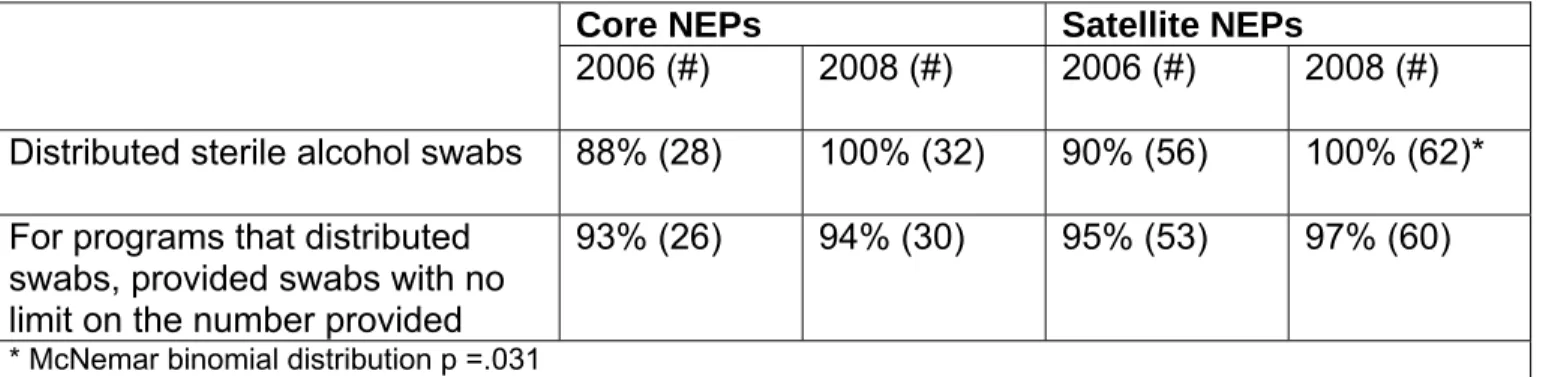
Table 6: Uptake of alcohol swab recommendations
Core NEPs Satellite NEPs
2006 (#) 2008 (#) 2006 (#) 2008 (#) Distributed sterile alcohol swabs 88% (28) 100% (32) 90% (56) 100% (62)* For programs that distributed
swabs, provided swabs with no limit on the number provided
93% (26) 94% (30) 95% (53) 97% (60)
* McNemar binomial distribution p =.031
Our data show that the vast majority of programs distributed sterile alcohol swabs in 2006 and 2008 (see Table 6). For the small number of programs reporting a change in sterile alcohol swab distribution practices, the two most common reasons reported were the Best Practice Recommendations (75%, n=6) and the availability of the OHRDP (67%, n=6).
Tourniquets
Tourniquets are used to make the vein used for injecting drugs more accesible. When thin, stretchy tourniquets are unavailable, IDUs will sometimes use other items (e.g., bandanas, belts) that are not elastic enough for quick release. This can lead to skin and blood circulation damage. Furthermore, tourniquets may become contaminated with bacteria and bloodborne pathogens (Golder et al., 2000; Rouke et al., 2001). Sharing tourniquets thus has the potential to spread infection, including HCV and HIV.
The Best Practice Recommendations advise NEPs to reduce tourniquet-related risks by: • distributing thin, pliable, easy-to-release tourniquets with non-porous surfaces in the
quantities requested by clients with no limit on the number of tourniquets provided • offering a clean, quick-release tourniquet with every needle provided
Our data show that more NEPs distributed the recommended tourniquets in 2008 than was the case two years earlier (see Table 7). Fewer programs, and none of the core NEPs, distributed a different type of tourniquet. Importantly, the majority of programs that distributed tourniquets did so without limits on the number provided to their clients.
For those programs reporting a change in tourniquet distribution practices over the two-year period, the most commonly reported reasons were the availability of the OHRDP (82%, n=23), the Best Practice Recommendations (70%, n=19), decisions by NEP managers (44%, n=11), and removal of limits because tourniquets provided for free from the OHRDP (40%, n=10).
Table 7: Uptake of tourniquet recommendations
Core NEPs Satellite NEPs
2006 (#) 2008 (#) 2006 (#) 2008 (#) Tourniquets:
a) Distributed recommended type(s)
b) Distributed other type(s) c) Did not distribute
47% (15) 3% (1) 50% (16) 94% (30) 0% (0) 6% (2)* 52% (32) 16% (10) 32% (20) 89% (55) 5% (3) 7% (4)** For programs that distributed
tourniquets, provided tourniquets with no limit on the number provided
75% (12) 90% (27) 98% (41) 95% (55)
* McNemar-Bowker χ2 = 153; df = 2; p ≤ .001
** McNemar-Bowker χ2 = 23; df = 2; p ≤ .001
Glass stems, mouth pieces, and brass screens
Sharing equipment used to smoke crack and other ‘rock-type’ drugs has the potential to transmit HIV and HCV. Pipes are often crudely constructed from metal (such as pop cans) and from glass materials that can lead to cuts from sharp edges and lip burns (Haydon and Fischer, 2005). Plastic bottles and inhalers are also often used (Queen West CHC Harm Reduction Team, 2005). Cuts and burns around the mouth, lips, and hands can contaminate inhalation equipment with blood and potentially lead to transmission. When proper screens are not available, people who smoke crack will make screens for their smoking devices out of materials (e.g., brass wool cleaning pads) that tend to break apart and can cause respiratory damage (The Safer Crack Use Coalition of Toronto, 2003).
The Best Practice Recommendations encourage NEPs to expand their product services and reduce the health risks associated with smoking drugs by:
• distributing individual glass stems, mouth pieces, and brass screens in the quantities requested by clients with no limit on the number of items provided
• educating clients about the HIV- and HCV-related risks associated with sharing glass stems and other devices for inhaling and smoking drugs
In 2008, more programs reported distributing safer inhalation devices than in 2006 (see Table 8). It is also clear that many programs educated their clients about the risks associated with sharing these items. However, most programs do not distribute these supplies.
Table 8: Uptake of glass stem, mouth piece, and brass screen recommendations
Core NEPs Satellite NEPs
2006 (#) 2008 (#) 2006 (#) 2008 (#) Distributed glass stems 3% (1) 16% (5) 33% (20) 44% (27)* Distributed mouth pieces 3% (1) 16% (5) 25% (15) 38% (23)** Distributed brass screens 3% (1) 13% (4) 28% (17) 41% (25)*** Educated clients about the HIV
and HCV-related risks associated with sharing drug inhalation equipment
Not asked 81% (25) Not asked 72% (43)
* McNemar binomial distribution p ≤ .039 ** McNemar binomial distribution p ≤ .021 *** McNemar binomial distribution p ≤ .021
Commonly reported reasons for not distributing glass stems, mouth pieces, or brass screens include decisions by the local MOH/Executive Director (46%, n=23) and decisions by the Board of Health/Board of Directors/City Council (27%, n=13). Managers also noted that they did not distribute these supplies because they did not receive these supplies from their health unit or the OHRDP and because there was an unfavourable political climate. For example, one core manager wrote, “Safer inhalation equipment is only distributed when we can obtain kits from outside sources. We do not currently have money in our NEP budget to purchase these items.” Similarly, a satellite manager indicated: “There is no available funding for crack kits for our local Needle Exchange Program. We are hoping that this will change as there is a lot of crack use in [the town] and folks are using very unsafe materials to create makeshift crack pipes.”
Just over one quarter of both core and satellite managers who answered the question reported decisions by the Board of Health/Board of Directors/City Council as reasons for not distributing safer inhalation equipment. Lack of approval or support also emerged as another reason behind not distributing these items. As an example, a satellite manager reported, “[The] shelter board will not permit safe crack pipe kits.” Caution regarding the political effects of distributing glass stems was also suggested by a few respondents. Some NEPs reported opposition from law enforcement as a reason for not distributing glass stems (21%, n=5 of core managers and 15%, n=4 of satellite managers). In relation to the issue of glass stem distribution, one core manager wrote, “[The] police rep on the Advisory Committee has a high degree of certainty that the Chief of Police will not support this, although it is unclear if they would actively oppose or interfere.” A core manager stated, “At the moment, we do not want to jeopardize the current harm reduction program by distributing safer inhalation equipment.” Further, a satellite manager indicated, “Small town mentality/I’ve had to give my word that I would not distribute glass stems behind their backs.” Of all of the recommendations, NEPs are least likely to follow the recommendations regarding the distribution of glass stems, mouthpieces and screens. This issue is deserving of further exploration.
Program models
The model of service delivery is an important component of NEP effectiveness because it can impact whom the program reaches and whom it does not. While some clients will access drop-ins, others may prefer street outreach or mobile services. Attracting and retaining clients is vital to encourage behavioural change and provide materials and education. Improving accessibility is challenging because of the wide diversity among drug users in terms of characteristics (e.g., gender, culture and age), needs, and preferences.
The Best Practice Recommendations directs NEPs toward combining multiple models of service delivery to better reach and serve their clients. Specifically, the recommendations include:
• providing NEP services using a delivery model(s) that maximizes accessibility for clients
• tailoring NEP services to meet the needs of sub-populations of drug users • involving drug users in the design and delivery of services
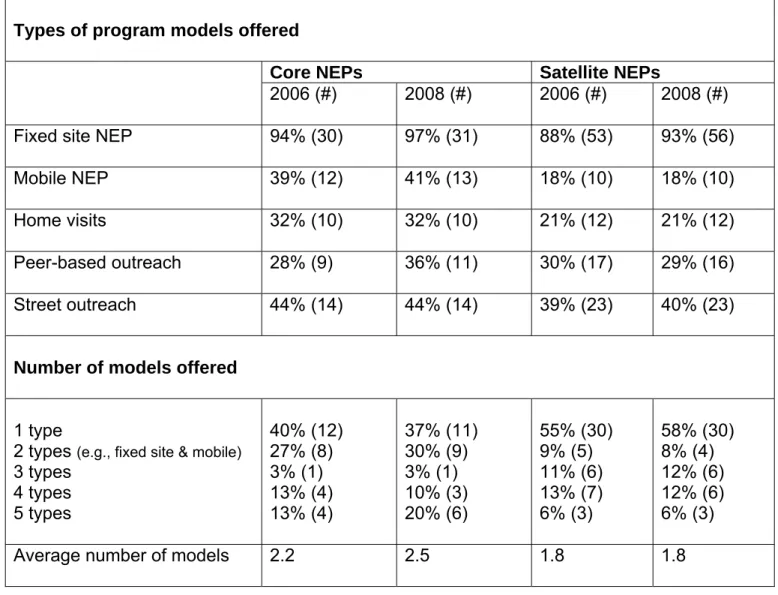
The majority of NEPs offered service from a fixed location (see Table 9). In 2008, 63% (n=19) of core programs reported that they provide multi-model service delivery (i.e., 2 models or more). The model of service delivery did not change much except that more core NEPs now offer peer-based outreach today than in 2006. This type of model, as well as street outreach, is key complements to fixed sites because of IDU reluctance to go to other service providers for assistance.
We also asked NEP managers about their practice of tailoring services to meet the specific needs of four diverse sub-populations of drug users. In 2008, 25% (n=8) of core NEPs reported that they tailored programs to meet the needs of youth and 25% (n=8) also tailored service to meet the needs of women. Somewhat fewer tailored their services to meet the needs of ethno-cultural groups (22%, n=7) or lesbian, gay, bisexual, transgender, and queer clients (13%, n=4). In 2008, more satellite NEPs tailored services to meet the needs of particular client groups: youth (43%, n=26), women (43%, n=26), ethno-cultural groups (39%, n=23), and lesbian, gay, bisexual, transgender, and queer clients (36%, n=20). The differences between core and satellite NEPs may reflect the attempts of core NEPs to partner with agencies serving diverse populations. Between 2006 and 2008, there were few changes in terms of tailoring services. Among the few programs that changed their practice of tailoring services during the past two years, the most common reason reported was more need or demand from specific client groups (86%, n=6).
Table 9: Uptake of program model recommendations
Types of program models offered
Core NEPs Satellite NEPs
2006 (#) 2008 (#) 2006 (#) 2008 (#) Fixed site NEP 94% (30) 97% (31) 88% (53) 93% (56) Mobile NEP 39% (12) 41% (13) 18% (10) 18% (10) Home visits 32% (10) 32% (10) 21% (12) 21% (12) Peer-based outreach 28% (9) 36% (11) 30% (17) 29% (16) Street outreach 44% (14) 44% (14) 39% (23) 40% (23)
Number of models offered
1 type
2 types (e.g., fixed site & mobile)
3 types 4 types 5 types 40% (12) 27% (8) 3% (1) 13% (4) 13% (4) 37% (11) 30% (9) 3% (1) 10% (3) 20% (6) 55% (30) 9% (5) 11% (6) 13% (7) 6% (3) 58% (30) 8% (4) 12% (6) 12% (6) 6% (3)
Average number of models 2.2 2.5 1.8 1.8
Table 10: Uptake of program design, planning, and delivery recommendations
Core NEPs Satellite NEPs
2006 (#) 2008 (#) 2006 (#) 2008 (#) OInvolved users in program
design
31% (10) 39% (12) 38% (22) 45% (26) Involved users in program
planning
34% (11) 44% (14) 42% (25) 47% (27) Involved users in program
delivery
38% (12) 45% (14) 39% (22) 48% (28)
Finally, we asked managers about the involvement of drug users in program design, planning, and delivery (see Table 10). Our data show that more NEPs involved drug users in program development in 2008 than did so in 2006, though these changes were not statistically significant. According to managers who answered the question, these changes were mainly attributed to having more drug users voice suggestions for their programs (75%, n=12) and change in the approach of staff members (59%, n=10).
Primary care
IDUs are at increased risk of exposure to bloodborne pathogens such as HIV and Hepatitis C, and many other health concerns such as respiratory diseases, other sexually transmitted infections (STI), and skin conditions. However, many IDUs do not have a regular source of primary care and are reluctant to access health service providers for assistance. NEPs located within public health units are well placed to provide immunization, testing, and first aid services to their clients. NEPs that do not offer primary care services within their organization need to refer clients to these services.
The Best Practice Recommendations identify the importance for NEPs to find a balance between providing direct primary care services and helping their clients access services elsewhere in the community. NEPs are encouraged to achieve this by:
• providing services in keeping with the health needs of clients and alternative resources available in the community, including vaccination, testing, and first aid
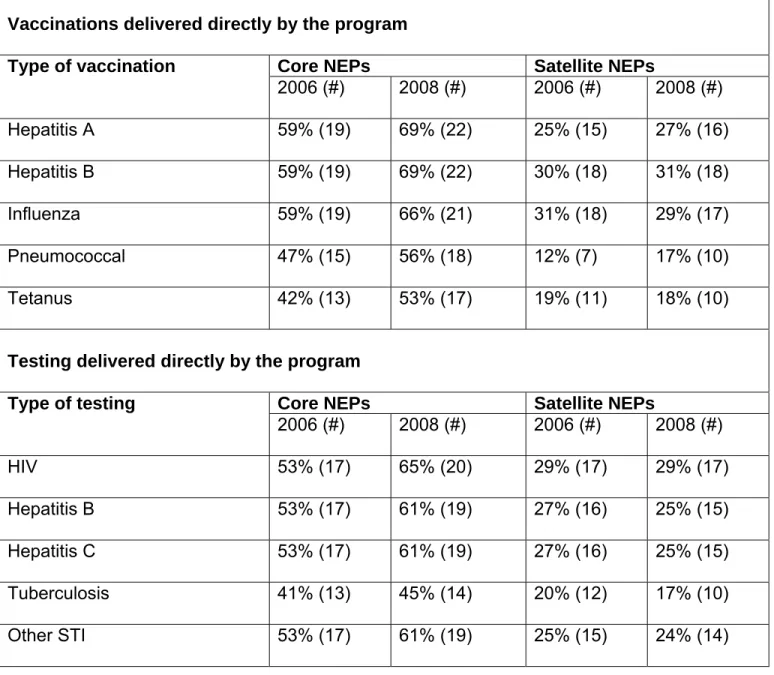
Our data show that more core NEPs provided direct vaccination and testing services in 2008 than did so in 2006, though these changes were not statistically significant (see Table 11). We also asked NEP managers about referral to another agency for vaccination and testing.
Table 11: Uptake of vaccination and testing recommendations – direct program delivery
Vaccinations delivered directly by the program
Core NEPs Satellite NEPs
Type of vaccination 2006 (#) 2008 (#) 2006 (#) 2008 (#) Hepatitis A 59% (19) 69% (22) 25% (15) 27% (16) Hepatitis B 59% (19) 69% (22) 30% (18) 31% (18) Influenza 59% (19) 66% (21) 31% (18) 29% (17) Pneumococcal 47% (15) 56% (18) 12% (7) 17% (10) Tetanus 42% (13) 53% (17) 19% (11) 18% (10)
Testing delivered directly by the program
Core NEPs Satellite NEPs
Type of testing 2006 (#) 2008 (#) 2006 (#) 2008 (#) HIV 53% (17) 65% (20) 29% (17) 29% (17) Hepatitis B 53% (17) 61% (19) 27% (16) 25% (15) Hepatitis C 53% (17) 61% (19) 27% (16) 25% (15) Tuberculosis 41% (13) 45% (14) 20% (12) 17% (10) Other STI 53% (17) 61% (19) 25% (15) 24% (14) Though fewer satellite NEPs provided direct vaccination and testing compared to the core NEPs, our data show that many satellites provided these services by referral to another agency (see Table 12). It is important to recognize, however, that not all core NEPs or their satellites have an agency mandate or the professional staff to provide testing and vaccination services. In 2008, 41% (n=13) of the core NEPs and 59% (n=35) of the satellites also reported that they had an established referral relationship with a primary care provider willing to work with drug users. This type of relationship is key to connecting IDUs, particularly those who are poor, homeless, or marginally housed, with the medical care they need.
Finally, 31% (n=10) of core NEPs and 32% (n=19) of satellite NEPs reported that they provided first aid for abscesses and skin problems.
Table 12: Uptake of vaccination and testing recommendations - by referral Vaccinations and testing by referral to another agency (2008 only)
Core NEPs Satellite NEPs
Core NEPs Satellite NEPs Type of vaccination 2008 (#) 2008 (#) Type of testing 2008 (#) 2008 (#) Hepatitis A 31% (10) 68% (39) HIV 44% (14) 67% (39) Hepatitis B 31% (10) 67% (38) Hepatitis B 44% (14) 66% (38) Influenza 34% (11) 64% (37) Hepatitis C 44% (14) 67% (39) Pneumococcal 39% (12) 59% (33) Tuberculosis 50% (16) 64% (37) Tetanus 38% (12) 58% (33) Other STI 44% (14) 67% (38)
Law enforcement
The mandates and underlying philosophies of NEPs and law enforcement agencies differ and this difference may be a source of conflict and have a negative impact on NEP efforts to reach clients, provide equipment, and reduce risk. For example, police have been known to harass and confiscate injection equipment from clients leaving NEP sites (Leonard et al., 2008). These actions may discourage future client attendance at the NEP. For IDUs who use drugs in public locations, fear of arrest can lead to rushed injections and skipping safer injection techniques which can increase the risk for infection, skin and vein damage, and overdose.
The Best Practice Recommendations direct NEPs to:
• develop and establish collaborative relationships with law enforcement which may include negotiating agreements, establishing protocol to resolve conflicts, and providing in-service training to law enforcement agents
Our data show that more NEPs had established working relationships with their local law enforcement in 2008 than in 2006 (see Table 13). It is also encouraging that very few programs reported having a mostly negative relationship with their local law enforcement and none reported a negative relationship. The most common reason reported for change in NEP relationships with law enforcement was more efforts being made to establish a relationship (71%, n=10).
Table 13: Relationships with law enforcement
Core NEPs Satellite NEPs
2006 (#) 2008 (#) 2006 (#) 2008 (#) Program had established working
relationship with the local law enforcement
53% (17) 63% (20) 40% (24) 45% (27) Program’s relationship with the
local law enforcement characterized as: Positive
Mostly positive
Neither positive nor negative Mostly negative Negative 29% (5) 35% (6) 35% (6) 0% (0) 0% (0) 25% (5) 40% (8) 30% (6) 5% (1) 0% (0) 17% (4) 63% (15) 17% (4) 4% (1) 0% (0) 19% (5) 63% (17) 19% (5) 0% (0) 0% (0) We also asked NEP managers about some types of agreements they may have negotiated with their local law enforcement agencies (see Table 14). In most settings, agreements with the police are negotiated by the core NEP to cover itself and its satellites (Strike, 2001). Our findings reflect this situation because compared to the satellite NEPs, a higher proportion of core NEPs had negotiated agreements to prevent police interference with NEP activities. It is interesting to note that only 9% (n=3) of core programs and 12% (n=7) of satellites reported having an established protocol to resolve conflicts between NEP staff and law enforcement agents.
Table 14: NEP agreements with law enforcement – 2008 Program has negotiated
agreements with law enforcement to ensure that:
Core NEPs % (#)
Satellite NEPs % (#)
Clients are not harassed while entering or leaving NEP sites and vehicles
53% (16) 20% (11) NEP equipment is not destroyed or
confiscated from clients 35% (10) 17% (9) NEP sites are not used for
surveillance purposes 47% (14) 20% (11) NEP staff will not interfere with law
enforcement activities
47% (14) 28% (15)
When asked about in-service training to law enforcement agents, 41% (n=13) of the core programs reported providing such training versus 10% (n=6) of the satellite NEPs. All managers that addressed these questions indicated that in-service training focuses on the purpose and goals of NEPs as well as the health and social concerns of drug users.
Use of the Best Practice Recommendations
The Ontario Needle Exchange Programs: Best Practice Recommendations document was developed to assist NEPs with providing evidence-based service, to aid program development, and to help programs defend their policies and practices. Since this document was the first of its kind, we were interested to know how the document has been used and to identify areas for future improvement.
Table 15: Use of the Best Practice Recommendations Program has used the Best Practice
Recommendations to:
Core NEPs
% (#) Satellite NEPs % (#) Make planning decisions about program practices
and policies
97% (30) 59% (32) Make changes to program practices and policies 94% (29) 54% (29) Advocate to change program practices and policies 97% (30) 46% (25) Defend the program in the community 80% (24) 59% (32) Explain the program to outsiders 87% (26) 67% (37) Evaluate the program 63% (19) 42% (23) Train with new staff 90% (27) 67% (36) Train with staff at other agencies 80% (24) 47% (26) The Best Practice Recommendations were used for a variety of purposes including planning, policy change, advocacy, and training (see Table 15). While the majority of core NEPs used the document for many purposes, a smaller proportion of satellite NEPs reported using the document. Fewer satellite NEP managers (76%, n=44) reported having read the Best Practice Recommendations compared to the core managers (94%, n=30). Further, while 90% (n=28) of the core NEP managers rated the document as ‘very helpful’ overall, 58% (n=29) of the satellite managers gave the same rating. The remaining satellites rated the Best Practice Recommendations as either ‘somewhat helpful’ (24%, n=12) or ‘neither helpful nor unhelpful’ (18%, n=9). None of the programs provided negative ratings of the document. Our data highlights the need to better understand why fewer satellite NEPs have read or used the Best Practice Recommendations.
The suggestions for improving the Best Practice Recommendations we received included obtaining approval/endorsement from the government, particularly the OMHLTC, adding and updating the evidence, and creating a shorter or quick-reference version.
Table 16: Requests for future Best Practice Recommendations Would like to see a Best
Practices document for:
Core NEPs % (#) Satellite NEPs % (#) Methamphetamine 97% (28) 94% (51) Oxycontin™ 97% (28) 94% (51) Buprenorphine 79% (22) 84% (42) Heroin substitution 86% (24) 89% (47) Safer injecting facilities 89% (25) 86% (42) Prison-based NEPs 89% (23) 80% (40)
Finally, we asked NEP managers whether they would like to see a Best Practice Recommendations document for other types of substances and harm reduction programs (see Table 16). Most respondents reported a need for other best practice recommendations and were most interested in recommendations for methamphetamine and Oxycontin™.
Medical Officers of Health and NEP decision making
When asked to identify factors that influence decision-making, NEP managers consistently identified the importance of their local MOHs. Given this finding, we interviewed a purposive sample of MOHs to better understand their perceptions of their roles and decision-making regarding NEPs.
For the most part, the MOHs described an arm’s-length relationship with their local NEPs. From the MOH perspective, day-to-day operations are the responsibility of the NEP managers and their staff at the public health unit or outside agency, while MOHs are involved with major decisions regarding policy and significant changes to NEP service delivery. For example, MOHs perceived their responsibilities to include advocating for and defending policy change, deciding whether to add new NEP sites and reviewing program budgets. Controversial matters, such as decisions about offering safer inhalation equipment, were also noted to be within the realm of MOH responsibilities. To illustrate, one Associate MOH told us:
Essentially anything that could potentially cause community response or media response or cause some political unrest, I want to be involved in, and that’s so that we make sure…we follow the proper process and we involve who we need to involve. (Interview 5)
When asked about the role of the Board of Health in decision-making, MOHs noted that Boards tended to be involved at the policy level, but not operations. Overall, MOHs expressed satisfaction with the extent to which they are involved in NEP decision-making.
When asked to identify factors that they would take into consideration when making decisions about their NEPs, participants identified a similar range of factors and external actors. All MOHs reported that funding was an important consideration when making decisions. In particular, decisions about the quantity of supplies to offer are contingent on available funding. In some cases, funding was noted to have increased in importance over time as the number of clients and their demand for supplies has increased. MOHs noted that budgets, including overall public health unit budgets, have constrained the expansion of NEP services. Scientific evidence was identified as a very important factor that is considered during decision-making processes. The availability of accessible and high-quality evidence that demonstrates the public health benefits of NEP services was noted to be a key factor in helping garner support for new policies and practices, including the distribution of injection-related items. According to the MOHs interviewed, questions about scientific evidence have and continue to serve as barriers to the implementation of safer inhalation equipment distribution.
What I found persuasive when I made the argument for [safer inhalation equipment] here in [the city] was not to rely excessively on the relatively weak evidence around communicable disease transmission, but rather on the role of crack use supplies in establishing relationships with a highly marginalized population to draw them in for other services which could be beneficial. (Interview 2)
Yeah, [scientific evidence] to me, is probably the most important and quite lacking and so challenging… I need to convince my Medical Officer of Health that we need to move in certain directions and I can’t do that if there isn’t evidence. Yeah, it needs to be evidence based. (Interview 4)
Several MOHs also reported that lack of or weak scientific evidence would be a consideration that might prevent them from approving certain types of equipment for NEP distribution.
With one exception, most of our key informants did not identify legal and policing issues as major factors considered in the decision-making process. A few reported that legal and policing issues had arisen from time to time and had been more important in the past. An Associate MOH provided an example:
Like the cooker issue, that was an issue. But they don’t really pop up. I think we’ve ironed those out. We ironed them out many years ago and the relationship with the police, and that sort of thing. (Interview 1)
While perhaps not important considerations at the present time, participants acknowledged that legal and policing issues could certainly be potential barriers for NEPs. Another Associate MOH stated, “It hasn’t been an issue to date, but I think potentially it could be a huge issue depending on who your police are.” (Interview 5) Some Ontario NEPs noted that policing issues are crucial when making decisions. These NEPs described difficulties with their local law enforcement regarding NEP policies and procedures. Most of the MOHs we interviewed were aware of these difficulties and expressed a desire to avoid similar problems.
At the time of the interviews, the above considerations appeared to be particularly important with respect to decisions surrounding safer inhalation equipment. MOHs reported that the issue of crack pipes received considerable political attention that has served as a major barrier to distribution in some jurisdictions. In other areas of Ontario, the issue has not triggered such strong political opposition. Several MOHs suggested that strategies involving ‘flying under the radar’ help to successfully overcome such political barriers, even in conservative regions. That is, reducing the visibility of changes to NEP policies and practices can help prevent controversy. An Associate MOH advised:
[T]hat has always been our motto, is to keep the needle exchange under the radar screen, like try not to let it hit public attention or not public, but the media or, well, I mean if it has to, it does, the political. Like keep it off the political radar screen so that it doesn’t cause people to grab at the issues and for conservative views to come out and to question harm reduction strategies and those sorts of things. (Interview 1)
To further attenuate potential political backlash around safer inhalation equipment and other emerging issues for NEPs, MOHs suggested consensus building with community partners and stakeholders, including the police, and embedding the issues within a regional drug strategy. They noted that efforts such as these sometimes require a willingness to be innovative, try new approaches, and take on opposing political views.
Key informants were also asked about the usefulness of documents like the Best Practice Recommendations to their work and how to effectively communicate scientific knowledge to MOHs. Some indicated that having such documents is very useful because the documents set a standard and rationale for practice and accountability. According to an Associate MOH, best practices are valuable when controversial issues arise as they provide a norm to be followed and evidence to defend and answer questions about what programs are doing. Another Associate MOH associated with an outsourced NEP reported that the Best Practice Recommendations document was very helpful when, “we wanted to clean up and clarify our relationship with the agency that was delivering the program.” (Interview 4) MOHs also reported the utility of having evidence presented in a single, comprehensive and convenient document.
Nevertheless, we also heard from MOHs that there are times when best practice documents might not have much impact on their work. When asked about the usefulness of such documents, one MOH reported that that depends on compliance and current practice, especially where the best practices recommend something that is not being practiced or is different from current practice. Coming from an organization with its own capacity to develop policy and examine research, the same MOH stated, “We certainly look at [best practice recommendations] when we use them, but we don’t usually wait for them.” (Interview 2) Furthermore, MOHs may not always have the time to read large documents. Preferring executive summaries to “weighty tomes,” another MOH explained:
So I think the audience is more geared towards the program implementers rather than the program decision makers. But you can rely on a document like that to bolster your own kind of positions at a high level, should the need arise. (Interview 3)
Finally, MOHs reported that scientific research findings are best communicated to them via credible and expert sources. In particular, having other physicians, the Ministry, and the wider public health community involved in such communications is beneficial because they represent “people that we deal with and see as legitimate.” (Interview 5) Potentially effective communication strategies that were reported included the dissemination of research findings via teleconferences, face-to-face meetings, and presentations. A few key informants discussed having research presentations added to provincial MOH meetings and incorporated into their continuing education curriculum. E-mail or other types of mail-out communications were regarded by MOHs as ineffective strategies because they may get filed away and not read.
DISCUSSION AND INTERPRETATION
Our findings demonstrate that the Best Practice Recommendations have been widely implemented by NEPs across Ontario. As a result, NEPs are now better able to respond to the health and social needs of their clients than they were two years ago. Nevertheless, there remain some important challenges for full implementation. What follows below is a more contextualized summary of this project’s findings that distinguishes between the successes, barriers, and suggestions for the future.
Successes and facilitators
The results from our survey confirm that needle and syringe exchange policies in Ontario have moved in the direction of distribution as opposed to one-for-one exchange. This is evident as the majority of needle exchange programs reported distributing needles without requiring returns. As well, more programs now distribute needles without limits. Our survey data also appear to support the claims of NEP managers and frontline workers that one-for-one exchange is an outdated policy and practice.
The biggest changes in Best Practice Recommendations uptake that our survey revealed are with respect to the other types of injection equipment. Considerably more NEPs in Ontario are distributing cookers, filters, acidifiers, sterile water, alcohol swabs, and tourniquets to their clients today compared to just two years ago. The majority distribute without placing limits on the number of items provided. According to NEP managers, the OHRDP and Best Practice Recommendations have been significant catalysts behind these positive findings, as they were the most commonly reported reasons for changes in other injection-related equipment distribution. The OHRDP appears to be an especially important source of change because this program provides equipment to participating NEPs at no cost, thus partially resolving the ongoing funding issues that confront Ontario NEPs. As one core manager reported, “[F]unding/supplies through the OHRDP was a huge driving factor and the best practice guidelines provided much needed evidence for us.” All of the MOHs we interviewed considered funding to be an important consideration when making decisions about NEPs, especially with respect to decisions about equipment supplies.
Some programs reported that decisions by NEP managers and decisions by the local MOH/Executive Director were reasons for change in equipment distribution practices. These findings suggest that even with the availability of free supplies from the OHRDP, support and approval from management and policy makers remains an important ingredient to ensure that NEPs distribute a variety of harm reduction materials. These views were corroborated by MOHs who spoke about their involvement in major changes to NEP policies and practices. Between 2006 and 2008, there was stability in the type and number of program models offered by NEPs. Program stability is important because it signals to clients that they can trust that their local NEP will provide the services they have come to rely upon. However, stability may also reflect that NEPs have not received additional funding needed to expand their service complements. Nonetheless, a substantial minority of NEPs, particularly among the satellites, reported tailoring services to address the needs of specific sub-populations of drug users such as women and youth. Although the changes were not statistically significant, more programs began to involve drug users in program design, planning, and delivery over