Study of the effect of process parameters
on the production of a non-simmetric
low pressure die casting part
A. Pola, R. Roberti
Low pressure die-casting is a "near net shape" foundry process that offers a good compromise between
economical aspects, production rate and casting quality. Because of the constrained position of the gating
system, the application of traditional LPDC process is generally limited to axis-symmetric or symmetric
geometries. The aim of this work was to investigate the low pressure die-casting process in order to define the
effect of various system settings on the production of a sound non-conventional cast component. The research
was supported by the modelling of mould filling and casting solidification, in order to evaluate both the
influence of process parameters and the reliability of the modelling software in the prediction of flow pattern
and thermal history of casting as well as defects formation.
The results were compared with those obtained on an experimental die, completely instrumented, to better
understand the process, validate the calculation procedure and make more confident the use of this tool for
complex parts. Metallographic analyses were also carried out to compare the quality of simulated and real
castings, with particular reference to shrinkage and gas porosity.
KEYWORDS:
LPDC, simulation, filling, pressure influence, AlSi7Mg
Annalisa Pola, Roberto Roberti Universitá degli Studi di Brescia, Dipartimento di Ingegneria
Meccania e Industriale [email protected], [email protected]
INTRODUCTION
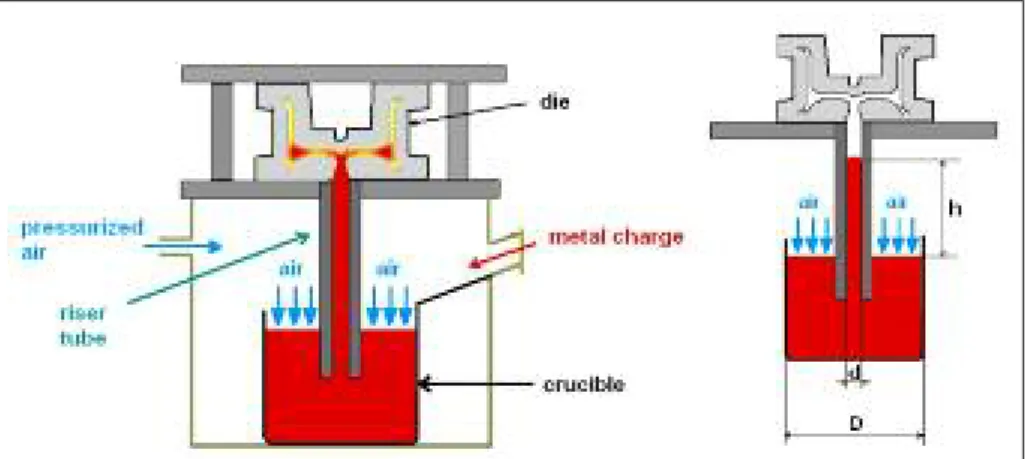
Low pressure die-casting (LPDC) is a "near net shape" foundry pro-cess in which the molten alloy is poured into a holding pressurized furnace located below the die table. A feeding tube, called riser or stalk tube, runs from the furnace to the bottom of the die, as shown in Fig. 1.
The surface of metal bath in the crucible is pressed by a dry air at relatively low-pressure (typically in the range of 0.1-1bar) in order to overcome the difference of metallic pressure between the die and the surface of the liquid alloy. The molten metal is, therefore, forced through the stalk tube, feeding the die cavity with low tur-bulence, also because of the use of a metal filter.
The pressure ramp is increased in order to pressurize the casting during the solidification, strongly reducing shrinkage porosity. Once the casting is completely solidified and sufficiently cooled, the external pressure is released, the molten metal in the riser tube
FIG. 1
Low pressure die-casting process.
Processo di colata in bassa pressione.
flows back down into the crucible by gravity action and the casting is ejected to allow the next cycle. Compared with other permanent mould processes LPDC provides low levels of scrap (no risers), high mechanical, metallurgical and te-chnological properties (thanks to low porosity level), dimensional ac-curacy, feasibility in using sand core, etc… together with limited
equipment costs.
The gating system is usually positioned in the middle of the ca-sting, correspondent to the centre of the crucible, in order to gua-rantee uniform pressure and, therefore, flow distribution. This constrained arrangement imposes the use of traditional LPDC pro-cess just for axis-symmetric or symmetric geometries.
Furthermore, the low pressure die-casting subject seems to be not widely discussed in literature.
For these reasons the present study was aimed to analyse the LPDC of a non symmetric casting, in order to improve process perfor-mance and productivity, investigating the effect of various system settings (pressure curve, alloy composition within the standard to-lerance, melt temperature, etc...) on the production of a sound non-conventional cast component.
To verify whether LPDC may be suitable for manufacturing com-plex geometries, a good knowledge of metal fluid-dynamic
beha-viour into the die cavity is fundamental. The simulation of mould filling and casting solidification provides a highly useful and re-liable tool to rapidly investigate the flow pattern or to easily modify geometries and process parameters, evaluating their effect on ca-stings quality.
The study was carried out by means of a commercial software (Pro-cast ), considering a standard foundry aluminum-silicon alloy (AlSi7Mg0.3) whose thermo-fluid dynamics properties needed for simulation are well known for average chemical composition. The results were compared with those obtained on an experimen-tal die, available at LKR Laboratory, completely instrumented by newly developed metal front and temperature sensors to validate the calculation procedure. Deviations between trials and simula-tions were analysed, making more confident the use of this tool for complex parts in the future.
Metallographic analyses were finally carried out to verify the ac-curacy of the simulation, with particular reference to shrinkage and gas porosity.
EXPERIMENTAL PROCEDURE
The LPDC machine used for the samples production was a Kurtz AK92 equipped with a crucible furnace of 125kg capacity (Fig. 2). Before each tests series 2 samples for emission spectroscopy inve-stigation were taken from the melt to verify the bath composition and the H2 content.
The die was pre-heated by means of a gas-powered burner for 1-2 hours, in order to reach a sufficiently uniform temperature of
ne-FIG. 2
LPDC machine and the experimental die (cooling channels).
Macchina LPDC e stampo sperimentale (canali di raffreddamento).
FIG. 3 Mobile half mould geometry and thermocouples position.
Geometria del semi-stampo mobile e posizione delle termocoppie.
arly 180°C.
The casting geometry consists in a plate characterized by 6 diffe-rent thicknesses (3 mm, 10 mm, 20 mm, 25 mm, 15 mm and 5 mm) with a not symmetric cavity with respect to the stalk tube, placed in the middle of the crucible (Fig. 2). This simple configu-ration allowed to investigate the use of LPDC for the production of non conventional components and to verify the thermal behaviour of the die, equipped with an ad hoc designed cooling system con-sisting in channels flowed with compressed air (pressure of ap-proximately 5,5 bar).
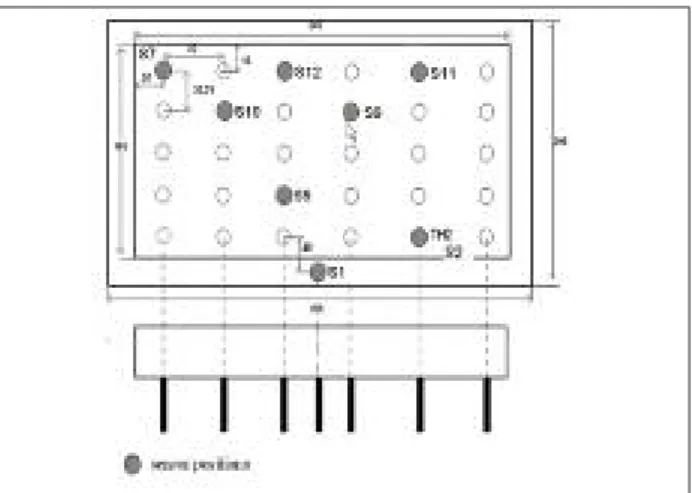
The experimental trials were continuously monitored by means of 6 K-type thermocouples placed inside the mobile half die, 5 mm be-neath the surface cavity (Fig. 3), and 8 metal front sensors placed exactly on the surface of the fixed half mould (Fig. 4) in order to as-sess the metal flow pattern and to compare this with the simula-ted one.
At the casting ejection, the surface temperature of casting and die cavity were also measured by a contact thermocouple.
The investigated process parameters were: − melt temperature, between 700°C and 740°C;
− alloy composition, changing the elements percentage within standard tolerance and also considering the effect of modifier (Sr) and grain refiner (Ti-B) additions on metal fluidity and ca-sting quality;
− pressure curve, in terms of different profiles, as reported in Fig. 5, according to the machine features.
Each trial was named as reported in Table I.
FIG. 4 Sensor distribution inside the half fixed mould.
Distribuzione dei sensori all’interno del semi-stampo fisso.
Samples
Chemical composition
Casting T°
Pressure
A
Si7.11%, Mg0.4%, Sr, TiB
2740 °C
0.4-0.8 bar
B
Si7.11%, Mg0.4%, Sr, TiB
2700 °C
0.4-0.8 bar
C
Si7.13%, Mg0.4%, Sr, TiB
2720 °C
0.4-0.8 bar
D
Si7.13%, Mg0.4%, Sr, TiB
2720 °C
0.4-0.8 or 0.4-0.5 bar
E
Si7.07%, Mg0.4%, Sr, TiB
2720 °C
0.4-0.5 bar
F
Si7.07%, Mg0.4%, Sr, TiB
2700 °C
0.5-0.6 or 0.6-0.7 bar
G
Si6.5%, Mg0.2%, Sr, TiB
2720 °C
combinations of 0.4-0.5, 0.6-0.8 bar
H
Si7.5%, Mg0.2%
720 °C
0.6-0.8 bar higher holding time
TAB. I Investigated process parameters during casting trials.
Parametri di processo indagati durante le prove di colata.
MODEL
The simulation tool used in this study to evaluate the feasibility of the non symmetric cavity die design is represented by the finite element ProCast® software, developed by ESI Group.
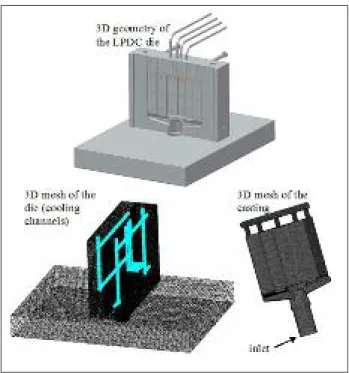
A FE mesh was created using tetrahedral elements; Fig. 6 shows shape and mesh of the component.
Temperature dependent thermo-dynamic properties of the casting alloy (A356) and mould material (H13 steel) used in the analyses were available in the software database.
Initially the temperature was set to 180°C for all nodes of the die, according to the data measured by the thermocouples at the end of the pre-heating period, and equal to 720°C for the liquid alloy, as detected by the thermocouple dipped into the melt (Table I for the H family of samples).
The boundary conditions for the calculations were set as follows: − a heat transfer coefficient, h, equal to 10 W/m2K on all the
ex-ternal surfaces of the die in contact with ambient air;
− a heat exchange coefficient on the air cooling channels walls, calculated by the well known equation:
Nu = 0.023.Re0.88.Pr0.33 if Re > 6000, Pr > 0.7 [1]
where Re, Pr e Nu are respectively the Reynolds, Prandtl and Nus-selt numbers;
− pressure ramp, called inlet boundary condition, at the bottom of the ingate cylinder, established on the basis of the experimen-tal pressure curves and in particular the pressure curve used for samples H production (Fig. 5), which resulted to be the best con-dition during casting trials. It must be noticed that, since the bottom of the ingate cylinder does not correspond to the liquid surface in the furnace, the pressure ramp measured in the real process should be shifted of a∆P value (Fig. 1), according to the following equation:
[2]
ture. Notwithstanding the almost complete filling, the A family samples showed surface defects associated to shrinkage pheno-mena (piping in the thicker sections) as well as some distortions, both due to the high melt temperature. Therefore, the A trials set revealed that, in these working conditions, care must be taken to whereρis the liquid metal density,∆h is the height of the metal
into the riser tube with respect to the bath surface, and D and d are respectively the crucible and riser tube diameter.
EXPERIMENTAL RESULTS
Real steady state thermal conditions were reached after some in-jections with air cooling enabled; no complete castings were pro-duced in the warm-up period, until steady state conditions were achieved. In Fig. 7 the warm-up phase of the C production is shown as an example.
The samples cast at higher melting temperature (A) were comple-tely filled (Fig. 8A), thanks to the increased fluidity with
tempera-FIG. 5 Experimental pressure profiles.
Profili di pressione sperimentali.
FIG. 6 3D geometry and mesh.
obtain sound castings and to preserve the mould.
On the contrary, with a bath temperature of 700°C (B samples) the reduced fluidity, the lower die temperature and the limited su-perheating (above Tliquidus) together with the absence of proper vents could not allow a complete filling of the cavity; particularly, the thinner section was always partially empty (Fig. 8B). It must be noticed that the B samples were cast after to the A family, the-refore the metal level within the crucible was strongly decreased
FIG. 7 Measured temperatures during the pre-heating period.
Temperatura misurata durante la fase di preriscaldo dello stampo.
and, consequently, experiments should have been carried our with a new pressure curve.
Based on the previous results, the melt temperature was fixed at 720°C, in order to avoid hot tearing and large shrinkage porosities as well as early die damage.
The effect of a lower pressure was tested for the production of sam-ples D and E, which resulted uncompleted. The surface of the thin-ner section (Fig. 9, left side) showed an extended cold wave; the metal, in fact, seems to divide into two veins that are not perfec-tly welded, parperfec-tly because of air entrapment and parperfec-tly because of early solidification, probably due to the slow filling associated to the not proper pressure used.
The F set of samples was cast at a temperature of 700°C, to re-duce shrinkage porosity and hot cracks. With this low melting temperature the previously adopted pressure was absolutely not suitable to fill the cavity; different pressure curves were then at-tempted in order to obtain sound castings, notwithstanding the low melting temperature (i.e. low fluidity) imposed. The samples F obtained with higher cast pressure showed a quite complete fil-ling (Fig. 9, right side), according to the not optimized die design, and a quite good surface appearance (very small cracks). In the last trials, the effect of chemical composition variation on die filling was investigated.
As well known, silicon is the main aluminum alloying element, added to improve fluidity, castability and hot tearing resistance as well as to reduce thermal shrinkage. During the previous tests the Si content was always fixed at the standard tolerance average value. For the sixth family of samples (G series) the Si percentage was
FIG. 8
Superficial appearance of first series of tests,
A (left) and B (right).
Aspetto superficiale della prima serie di getti prodotti,
A (sinistra) e B (destra).
FIG. 9
Superficial appearance of sample D (left) and F (right).
Aspetto superficiale del campione D (sinistra) e F (destra).
FIG. 10 Complete casting, family H.
Getto completo, famiglia H.
maintained at the lower limit acceptable in the standard tolerance. Notwithstanding the good process control no sound neither com-plete castings were obtained, revealing the importance of the pro-per Si level content.
Based on these findings, the last series of tests (H family) were fi-nally cast using the higher Si percentage together with the lower level of Mg, which can reduce alloy fluidity due to oxidation; mo-reover, no modifier or grain refiner were added, in order to gua-rantee a high fluidity. With the imposed pressure curves completely filled parts were obtained, as shown in Fig. 10. The results of these experimental trials on a non symmetric are here summarized:
− steady state thermal conditions are fundamental to guarantee good quality castings;
− chemical composition must be strictly controlled in order to ob-tain a high enough fluidity;
− high pressures and/or long holding times allow a complete fil-ling, also when the melt temperature is low or the composition not strictly controlled. An optimized curve can, therefore, be found as a function of the other casting parameters, but attention must be paid at the die closing force in order to avoid excessive flashes production or, even, dangerous outflow of liquid metal. Obviously, a compromise between all these parameters must be defined, depending on the specific working conditions.
SIMULATIONS VS SENSORS RESULTS
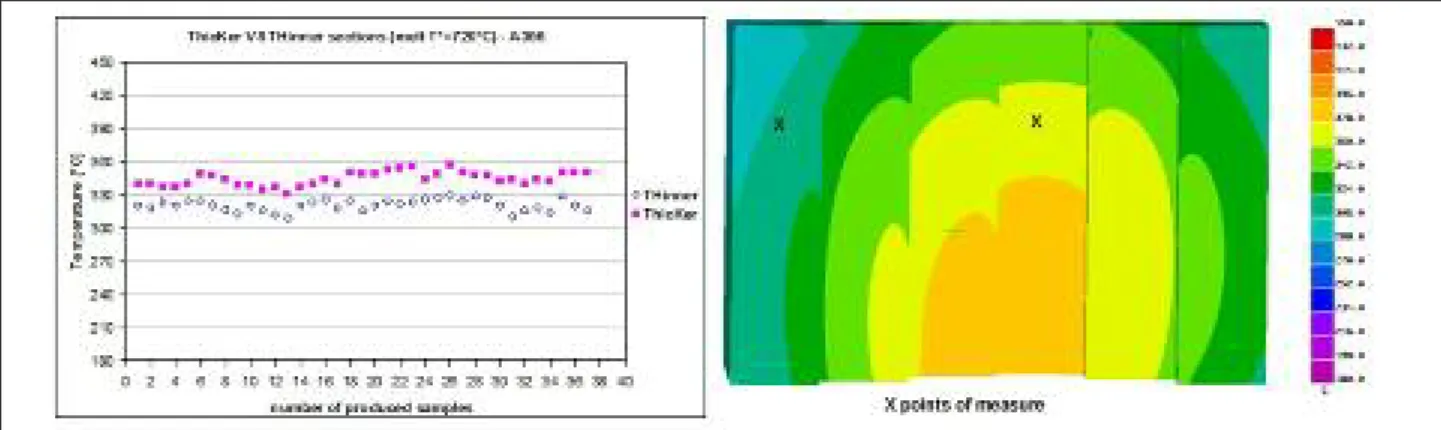
The thermal steady state conditions were reached after 12thcycles,
as shown in Fig. 11 on the left where the calculated temperature profile in the thermocouple positions (5 mm behind the surface cavity) is compared to that measured by the thermocouples. It can be noticed that measured and simulated temperatures differ by roughly 25°C/6%, except TC1 in correspondence of the thin-nest section (85°C). This difference is due to the fact that the cy-cling modelling considers the mould cavity completely filled by the alloy which releases latent heat of solidification, consequently in-creasing the die temperature. In the real warm up period the thin-ner section was not interested by the metal flow, because of the combination of thin section and cold wall; therefore, this area of mould was not interested by the metal during filling and solidifi-cation, explaining the gap between simulation and experimental trials.
For the same reason the temperatures measured by the thermo-couples, positioned exactly on the mobile die surface, and those si-mulated after the cycling period show a difference of very few Celsius degrees (Fig. 12); the good correspondence of results de-monstrate the proper description of material thermodynamic data and correct choice of interfaces and boundary conditions parame-ters.
Fig. 13 shows the filling patterns obtained numerically at subse-quent times. According to the simulation, the alloy enters the ca-vity through the gate forming a vein which mainly spreads along the wall of the fixed mobile die filling in the central thicker sections (25 mm and 20mm). The liquid metal reaches the thinner section just at the end of the cavity filling; it is divided in two arms, one
FIG. 11 Calculated die temperatures.
Temperature dello stampo calcolate.
FIG. 12 Measured and simulated temperature on the surfaces of the mobile die (H family).
FIG. 13
Simulated fluid flow.
Flusso del metallo simulato.
from top the and one from the bottom, that weld around the cen-tre of the thinner section.
These results match well with the experimental data; as shown in Fig. 14, in fact, there is a close agreement in the fluid flow pattern. As confirmed by the obtainment of un-complete castings, which present cavity in the centre of the thinner section area (Fig. 8 – 10) depending on the maximum applied pressure, the simulation predicts almost correctly also the mould filling.
METALLOGRAPHIC INVESTIGATIONS
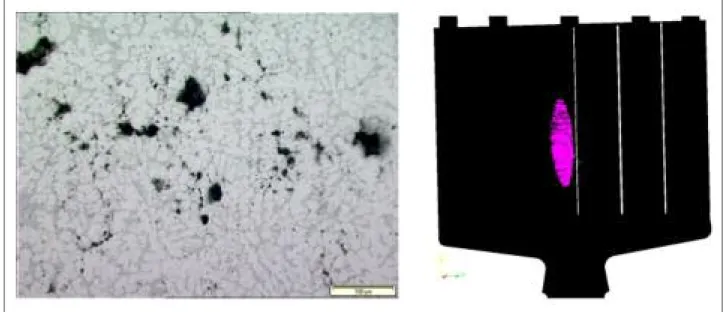
The quality of the produced casting was analysed by means of me-tallographic investigation; particularly, the shrinkage porosity as well as the microstructure, in terms of secondary dendrite arms spacing (SDAS), were analysed. The samples were cut according to the scheme showed in Fig. 10.
In the thicker section (area 8) some shrinkage porosity were de-tected, as already predictable observing the surface depression of
FIG. 14 Recorded fluid flow.
Flusso del metallo registrato dai sensori.
FIG. 15 Microstructure of the casting, family H area 8.
FIG. 16 Calculated Secondary Dendrite Arms Spacing.
Spazio fra I rami secondary delle dendriti calcolato.
all the samples, as a consequence of an insufficient imposed pres-sure as well as very high temperature that induces a slow solidifi-cation. As an example, in Fig. 15 the microstructure of a sample of the H family is reported.
The same defect was revealed by the simulation software, demon-strating the good correspondence between calculation and pro-duction, also during solidification.
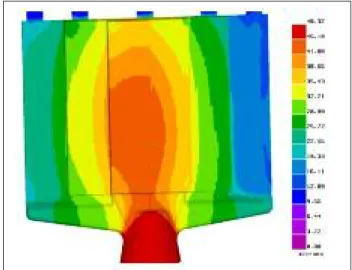
Quantitative metallography measurements resulted in a SDAS of 11.7 m in the thinner section and of 36µm in the thicker section for the real cast sample (sections 15 and 8 Fig. 10); as shown in Fig. 16 the calculated SDAS was very similar to the observed one (nearly 14µm and 42µm respectively).
CONCLUSIONS
The production of a non symmetric component cast by low pres-sure die-casting process was investigated in order to define the in-fluence of various system settings on the casting quality.
Eight set of samples were produced under different process con-ditions (melt temperature, pressure ramp and chemical composi-tion within the standard tolerance range) and the process was continuously monitored by means of thermocouples and pressure sensors placed inside the mould.
A finite elements model was also developed for the simulation of die filling and casting solidification.
A good correspondence between simulation and experimental trials was observed, in terms of die temperature, mould filling and casting quality.
The results of this study can be summarized as follows:
− simulation is in general a good tool for predicting low pressure foundry processes,
− temperature and metal front sensors help to understand die fil-ling and validate the simulation procedure, as well as to define optimum casting conditions;
− thick sections behaviour can be well predicted by simulation software, but additional phenomena occur at thin sections; − accurate definition of cycling simulation are needed for thin section; − small variations in chemical composition can create problems
in thin sections filling;
− LPDC thin parts can be more easily produced provided that no modifier or grain refiner are added.
ACKNOWLEDGMENTS
The authors gratefully acknowledge the help and the suggestions by Prof. Helmut Kaufmann and Dr. Werner Fragner, Leichtmetal-lkompetenzzentrum Ranshofen GmbH (LKR).
REFERENCES
1) JER-HAUR K., FENG-LIN H.and WENG-SING H., Development of an in-teractive simulation system for the determination of the pressure-time relationship during the filling in a low pressure casting process, Science and Technology of Advanced Materials 2, (2001), p.131. 2) HINES J., Determination of interfacial heat-transfer boundary
condi-tions in an Aluminum low-pressure permanent mould test casting, Me-tallurgical and Material Transactions B, (2003), p 299.
3) MANILAL P.I., SINGH D.P.K. and CHEN Z. W., Computer modelling and experimentation for thermal control of dies in permanent mold ca-sting, AFS Transactions (2003).
Abstract
Studio dell'effetto dei parametri di processo sulla produzione
di un getto non simmetrico colato in bassa pressione
Parole chiave:
colata in bassa pressione, simulazione, riempimento, AlSi7Mg
Il processo di colata in bassa pressione (o LPDC) è una tecnologia di fonderia cosiddetta “near net shape”, ovvero tale da consentire l’ottenimento di un pezzo di geometria “prossima alla forma finita” e che richiede un numero limitato di operazioni di finitura; esso rappresenta un buon compromesso fra aspetti economici, velocità di produzione e qualità del getto. A causa della posizione del sistema di alimentazione dello stampo, che risulta costruttivamente vincolata, l’applicazione del processo tradizionale LPDC è solitamente limitato a geometrie assial-simmetriche o comunque simmetriche; tipicamente si producono cerchi in lega. Lo scopo del presente lavoro è stato quello di studiare il processo di colata in bassa pressione al fine di definire l’effetto dei vari parametri di produzione (pressione, temperatura del metallo, ecc..) sulla qualità di un getto non convenzionale. La ricerca è stata supportata dalla simulazione del riempimento dello stampo e della solidificazione del getto, così da valutare sia l’influenza dei parametri di processo sia la validità della modellazione numerica nella previsione della fluidodinamica di riempimento e della storia termica di getto e stampo, nonché della formazione di difetti.
I risultati della simulazione sono stati confrontati con quelli ottenuti utilizzando uno stampo sperimentale, completamente stru-mentato, al fine di comprendere meglio il processo, validare la procedura di calcolo impostata e rendere l’utente più sicuro nel-l’uso di questo strumento anche per componenti dalla geometria più complessa.
Infine, sono state condotte anche delle indagine metallografiche per confrontare la qualità del getto simulato con quella del pro-dotto, facendo riferimento in particolare alla porosità da gas e da ritiro.