Calhoun: The NPS Institutional Archive
Theses and Dissertations Thesis Collection
2007-12
Information operations, an evolutionary step for the
Mexican Armed Forces
Schulz, David Vargas
Monterey, California. Naval Postgraduate School
NAVAL
POSTGRADUATE
SCHOOL
MONTEREY, CALIFORNIA
THESIS
Approved for public release; distribution is unlimited INFORMATION OPERATIONS, AN EVOLUTIONARY
STEP FOR THE MEXICAN ARMED FORCES by
Saul Hiram Bandala-Garza David Vargas Schulz
December 2007
Thesis Advisor: Hy Rothstein
REPORT DOCUMENTATION PAGE Form Approved OMB No. 0704-0188
Public reporting burden for this collection of information is estimated to average 1 hour per response, including the time for reviewing instruction, searching existing data sources, gathering and maintaining the data needed, and completing and reviewing the collection of information. Send comments regarding this burden estimate or any other aspect of this collection of information, including suggestions for reducing this burden, to Washington headquarters Services, Directorate for Information Operations and Reports, 1215 Jefferson Davis Highway, Suite 1204, Arlington, VA 22202-4302, and to the Office of Management and Budget, Paperwork Reduction Project (0704-0188) Washington DC 20503.
1. AGENCY USE ONLY (Leave blank) 2. REPORT DATE December 2007
3. REPORT TYPE AND DATES COVERED
Master’s Thesis
4. TITLE AND SUBTITLE Information Operations, an Evolutionary Step for the Mexican Armed Forces
6. AUTHOR(S) Saul Hiram Bandala-Garza and David Vargas Schulz
5. FUNDING NUMBERS
7. PERFORMING ORGANIZATION NAME(S) AND ADDRESS(ES)
Naval Postgraduate School Monterey, CA 93943-5000
8. PERFORMING ORGANIZATION REPORT NUMBER
9. SPONSORING /MONITORING AGENCY NAME(S) AND ADDRESS(ES)
N/A
10. SPONSORING/MONITORING AGENCY REPORT NUMBER 11. SUPPLEMENTARY NOTES The views expressed in this thesis are those of the author and do not reflect the official policy or position of the Department of Defense or the U.S. Government.
12a. DISTRIBUTION / AVAILABILITY STATEMENT
Approved for public release; distribution is unlimited 12b. DISTRIBUTION CODE
13. ABSTRACT (maximum 200 words)
This thesis will focus on the Mexican Armed Force’s ability to deal with existing and future unconventional threats and insurgencies. The modern Mexican Armed Forces are the result of an enduring evolutionary process, which has made the necessary changes to deal with the emerging threats against the state. Mexico’s criminal threat has evolved because of 9/11 and because of the U.S.-led crackdown on Colombian drug cartels. Mexico's modern adversary is well versed in waging mass media campaigns and uses terrorist tactics to instill fear in Mexico’s population. Mexico’s current threats consist of drug trafficking, which has resulted in increased levels of violence and rebel insurgencies that have also transitioned from revolutionary nationalists to violent criminals.
Therefore, to positively counter the rise of social and political violence, Mexico's government needs to carefully plan its response to insurgencies. Mexico must develop alternate and unconventional remedies to preserve its national security. Current Mexican military strategies rely on the mass mobilization of ground and air troops for mainly search and destroy operations. Although, the evolving threat warrants an unorthodox military strategy, this thesis will only focus on the Mexican Navy’s ability to take the lead in dealing with the nation’s rising unconventional threats.
This thesis uses both the insurgency and counterinsurgency model developed by Gordon H. McCormick, known as the “Mystic Diamond,” and Information Operations to frame the unconventional state strategy. This analytical tool offers a better understanding of how an insurgency works, as well as the interaction and relations among the different actors involved. The study presents an in depth case study of Colombia and the development of Information Operation capabilities to support its policies and objectives. Furthermore, this study also presents a concise case study of Mexico and describes how the country has managed its challenges without an Information Operations capability.
Using McCormick's Model of Counterinsurgency, this thesis proposes that the development of an Information Operations capability within the Mexican Armed Forces will increase operational effectiveness against internal and external threats, influence public opinion to support government actions, preserve tranquility, and ensure national stability during crises. States in general and Mexico in particular, should continue to use Information Operations and Psychological Operations in order to deal with the enemy of tomorrow while maintaining popular support.
15. NUMBER OF PAGES
143
14. SUBJECT TERMS Information Operations; Mexican Navy; Mexican Armed Forces; FARC; ELN; AUC; EZLN; EPR, Colombia, Mexico, Mystic Diamond
16. PRICE CODE 17. SECURITY CLASSIFICATION OF REPORT Unclassified 18. SECURITY CLASSIFICATION OF THIS PAGE Unclassified 19. SECURITY CLASSIFICATION OF ABSTRACT Unclassified 20. LIMITATION OF ABSTRACT UU
Standard Form 298 (Rev. 8-98) Prescribed by ANSI Std. Z39.18
Approved for public release; distribution is unlimited
INFORMATION OPERATIONS, AN EVOLUTIONARY STEP FOR THE MEXICAN ARMED FORCES
Saúl Hiram Bandala-Garza Lieutenant Commander, Mexican Navy B.S., Heroica Escuela Naval Militar (Mexico), 1990
David Vargas Schulz Captain, United States Army
B.A., University of California Los Angeles, 2003 Submitted in partial fulfillment of the
requirements for the degree of
MASTER OF SCIENCE IN DEFENSE ANALYSIS from the
NAVAL POSTGRADUATE SCHOOL December 2007
Author: Saul H. Bandala-Garza
David Vargas Schulz
Approved by: Hy Rothstein Thesis Advisor Mark. T. Berger Second Reader Gordon McCormick
ABSTRACT
This thesis will focus on the Mexican Armed Force’s ability to deal with existing and future unconventional threats and insurgencies. The modern Mexican Armed Forces are the result of an enduring evolutionary process, which has made the necessary changes to deal with the emerging threats against the state. Mexico’s criminal threat has evolved because of 9/11 and because of the U.S.-led crackdown on Colombian drug cartels. Mexico's modern adversary is well versed in waging mass media campaigns and uses terrorist tactics to instill fear in Mexico’s population. Mexico’s current threats consist of drug trafficking, which has resulted in increased levels of violence and rebel insurgencies that have also transitioned from revolutionary nationalists to violent criminals.
Therefore, to positively counter the rise of social and political violence, Mexico's government needs to carefully plan its response to insurgencies. Mexico must develop alternate and unconventional remedies to preserve its national security. Current Mexican military strategies rely on the mass mobilization of ground and air troops for mainly search and destroy operations. Although, the evolving threat warrants an unorthodox military strategy, this thesis will only focus on the Mexican Navy’s ability to take the lead in dealing with the nation’s rising unconventional threats.
This thesis uses both the insurgency and counterinsurgency model developed by Gordon H. McCormick, known as the “Mystic Diamond,” and Information Operations to frame the unconventional state strategy. This analytical tool offers a better understanding of how an insurgency works, as well as the interaction and relations among the different actors involved. The study presents an in depth case study of Colombia and the development of Information Operation capabilities to support its policies and objectives. Furthermore, this study also presents a concise case study of Mexico and describes how the country has managed its challenges without an Information Operations capability.
Using McCormick's Model of Counterinsurgency, this thesis proposes that the development of an Information Operations capability within the Mexican Armed Forces will increase operational effectiveness against internal and external threats, influence public opinion to support government actions, preserve tranquility, and ensure national stability during crises. States in general and Mexico in particular, should continue to use Information Operations and Psychological Operations in order to deal with the enemy of tomorrow while maintaining popular support.
TABLE OF CONTENTS
I. INTRODUCTION AND OVERVIEW... 1
A. BACKGROUND ... 1
B. PURPOSE... 4
C. HYPOTHESIS AND RESEARCH QUESTIONS ... 5
D. THE MEXICAN AUTHORITIES ... 5
E. MILITARY REGULATIONS RELEVANT TO INFORMATION OPERATIONS... 9
F. MEXICO'S POLITICAL SYSTEM ... 10
1. As it Relates to the Mexican Navy... 15
II. THEORETICAL FRAMEWORK... 17
A. METHODOLOGY AND ORGANIZATION... 18
1. McCormick's Model of Insurgency and Counterinsurgency... 19
a. Operational Strategies for Both Players ... 22
B. ALLISON AND ZELIKOW'S CONCEPTUAL MODELS AND GROUPTHINK FRAMEWORK ... 25
1. Framework Analysis... 31
C. IMPORTANCE OF INFORMATION OPERATIONS AS AN INSTRUMENT OF POLICY... 33
D. CONCLUSION ... 36
III. INFORMATION OPERATIONS IN LATIN AMERICA ... 37
A. CASE STUDY: COLOMBIA... 38
1. Drug Trafficking ... 40
2. Plan Colombia... 45
3. Insurgent and Paramilitary Groups... 49
a. Fuerzas Armadas Revolucionarias de Colombia-Ejercito del Pueblo (FARC-EP) ... 51
b. Ejército de Liberación Nacional (ELN) ... 58
c. Autodefensas Unidas de Colombia (AUC)... 61
4. Colombian Government Response ... 64
a. Plan of Action... 65
b. Results ... 71
B. CASE STUDY: MEXICO ... 77
1. Drug Trafficking ... 78
2. Insurgent and Paramilitary Groups... 83
a. Ejercito Zapatista de Liberación Nacional (EZLN) ... 85
b. Ejercito Popular Revolucionario (EPR) ... 88
3. Mexican Government Response ... 89
C. CONCLUSION ... 92
A. MEXICO’S INDIRECT APPROACH TO INSURGENCIES ... 93
1. Mexico's Current Threat... 94
2. Mexico's Diamond ... 100
3. Information Operations Benefits for the Mexican Navy ... 106
a. Protecting Strategic Installations in the Sound of Campeche in the Southern Gulf of Mexico ... 106
b. Applying the Rule of Law within Mexican Maritime Spaces ... 107
c. Interdicting Drug Trafficking and Production Activities ... 108
B. SUMMARY AND CONCLUSIONS... 109
LIST OF REFERENCES... 113
LIST OF FIGURES
Figure 1. McCormick's model of insurgency. ... 21
Figure 2. Physical-political map of Colombia. ... 39
Figure 3. Coca cultivation density in Colombia, 2006. ... 42
Figure 4. Illegal armed groups and coca cultivation in Colombia, 2006... 50
Figure 5. Former Distention Zone and current Rehabilitation Zones. ... 54
Figure 6. Colombian Military Forces and National Police, 1998-2007. ... 67
Figure 7. McCormick's model of insurgency applied to Colombia. ... 72
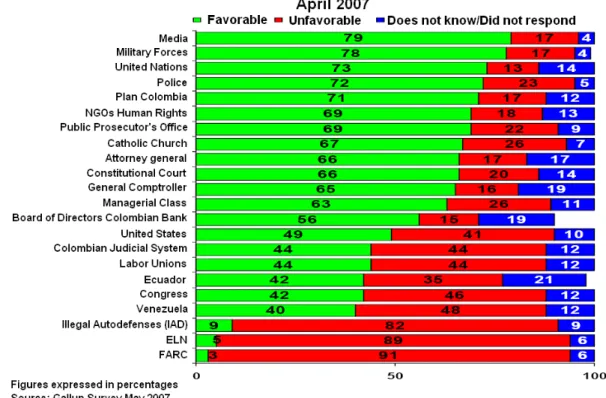
Figure 8. Colombian population's perception of groups and institutions. ... 73
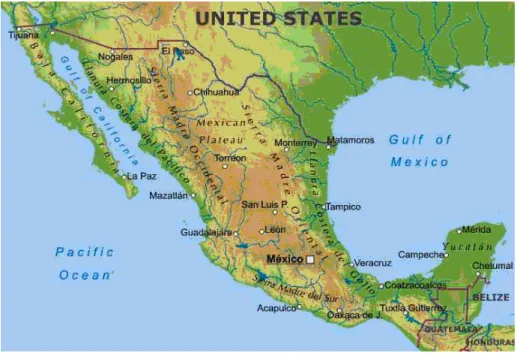
Figure 9. Physical map of Mexico... 78
Figure 10. Mexico’s anticrime sweeps by state. ... 91
Figure 11. Unofficial swearing-in ceremony of defeated left-wing candidate in Mexico's 2006 presidential election, Andres Manuel Lopez Obrador. 95 Figure 12. Map of Southern Mexico, depicting grey area. ... 99
Figure 13. McCormick's model of insurgency applied to Mexico. ... 101
LIST OF TABLES
Table 1. U.S. Assistance for Plan Colombia, FY2000-FY2006... 47 Table 2. Estimated Amounts of Illicit Drugs Transiting Mexico, Produced in
Mexico, and Seized in Mexico and along the U.S.-Mexico Border, Calendar years 2000-2006. ... 80 Table 3. U.S. Agencies’ Support for Mexican Counternarcotics Activities,
ACKNOWLEDGMENTS
Saul Hiram Bandala-Garza
I would like to thank the faculty and staff of the Naval Postgraduate School’s Defense Analysis department. Their hard work and dedication educating military leaders made my past eighteen months a remarkable experience. The learning experience was further enhanced by the opportunity to interact with other militaries and learn from their knowledge. I especially thank my thesis advisors Dr. Hy Rothstein and Dr. Marcos Berger, for their mentorship and guidance in putting together this thesis. Their guidance and accurate intervention has been invaluable. To them I express my full recognition and unconditional gratitude. Mrs. Barbara Young also provided constant help and tireless support reviewing my writings.
My special recognition to the Mexican Navy and particularly its leadership for the unique opportunity they gave me to study abroad at the Naval Postgraduate School.
I would like to express my deepest gratitude to my family who has always supported me. My wife Maria del Rosario for her love, patience, and comprehension; my children, Saul Hiram Jr. and Maria del Rosario Jr., for encouraging me to succeed in this learning experience. I would also like to thank my parents for their consciousness and support. I cannot thank my family enough for their love and support -- not only throughout my thesis process, but also throughout my studies in the Naval Postgraduate School.
David Vargas Schulz
First, to the faculty and staff of the Naval Postgraduate School’s Defense Analysis department, who inspire intellectual freedom and offer objective guidance. The quality of professors that enhances their ability to challenge military leaders to think “outside the box” has prepared me for our nation’s future challenges. The wealth of military and international student experience has provided a one-of-a kind education environment. I especially thank our thesis advisor Colonel Hy Rothstein for his support and guidance throughout our research and investigations. To our reader, Dr. Marcos Berger, for his guidance in finalizing this thesis. I would also like to thank Dr. William Arrocha for generously offering his expertise, writings, and guidance to our topic.
I would also like to thank my family for their continued support throughout my graduate education. Especially, to my younger brother and best friend, Bobby, who helped me immensely throughout my travels and late nights. I will definitely miss our time together in Monterey.
Lastly, to my friends and DA-cohort that encouraged me to pursue this dual-degree and welcomed me with open arms, enabling me to receive an education truly necessary for conventional leaders in an asymmetric and unconventional era. Thank you to all!
I.
INTRODUCTION AND OVERVIEW
A. BACKGROUND
Warfare has always sponsored and driven the development of technology. Consequently, warfare has evolved and adapted whenever new technologies become available. A significant part of technology is designed to gain insight into the intentions of potential adversaries. Such insight encourages or discourages actors before they engage in action. Diplomatic and military actions are always supported by information and intelligence to maximize an edge over adversaries. Therefore, the goal for any military -- to defeat an enemy with minimal costs -- has resulted in new techniques that ideally deter the enemy from the fight. These types of operations are sometimes referred to as “Information Operations.”
Contemporary United States military doctrine recognizes five components of Information Operations: psychological operations (PSYOP), military deception (MILDEC), operations security (OPSEC), electronic warfare (EW), and computer network operations (CNO). The PSYOP, MILDEC and OPSEC are the oldest and most traditional of these components; EW and CNO are the result of technological developments that date back to World War II. Additionally, efficiency and affordability make this type of operations ideal for insurgencies to fight against the state.
These components have mostly been used by countries that have the technological means, resources, and human expertise to use them. Following the Cold War, the United States boasted the largest military organization dedicated to Information Operations. The American need to protect its interests and conduct military operations throughout the world against a wide variety of potential enemies has caused its military to develop its Information Operations capability. Using the U.S.'s military Information Operations doctrine as a base,
this thesis will analyze Information Operations as they relate to Colombia and specifically Mexico. The U.S. Department of Defense Joint Publication 3-13 defines Information Operations:
As the integrated employment of electronic warfare (EW), computer network operations (CNO), psychological operations (PSYOP), military deception (MILDEC), and operations security (OPSEC), in concert with specified supporting and related capabilities, to influence, disrupt, corrupt, or usurp adversarial human and automated decision making while protecting our own.1
This definition encompasses the various U.S. military capabilities and essential components to support its military operations. Each branch of the U.S. Armed Forces has its own definition of Information Operations. The Air Force Defense Doctrine, Document 2-5, integrates only three of the five previously mentioned components of Information Operations.2 Despite the difference, both
publications recognize the essential focus of Information Operations: to psychologically affect the adversary to reduce the value of his information systems and to increase the value of one's own information capabilities. To influence an adversary, every available opportunity must be exhausted to gain the information advantage. Ideally, the winner wins without firing a single shot or shedding any blood. Nevertheless, throughout history Information Operations has mostly been used as a tool in support of combat operations or as a combat multiplier. This was the case during the Second World War when the Germans used components of Information Operations to conceal their preparations for Operation Barbarossa. To accomplish this, the Germans “launched what they themselves called the ‘greatest deception operation in the history of war’ to mislead their enemies about their intention to invade Russia, and conceal the
1 Joint Chiefs of Staff, "Information Operations: Joint Publication 3-13," 13 February 2006
[web site]; available from http://www.dtic.mil/doctrine/jel/new_pubs/jp3_13.pdf; Internet; accessed 9 October 2007, ix.
2 United States Air Force, "Information Operations: Air Force Doctrine Document 2-5," 11
January 2005 [web site]; available from http://www.doctrine.af.mil/Library/Doctrine/afdd2-5.pdf; Internet; accessed 9 October 2007, 51.
time, direction, and strength of the blow.”3 Afterwards, the Allies took Information
Operations to an unprecedented level: they designed “Operation Bodyguard” that deceived German forces about the landing of allied forces in Normandy.4 Today,
the development of technology and mass communications has enabled Information Operations to broaden and transform warfare in unprecedented ways. The evolution of the information age conflict spectrum is illustrated by Arquilla and Ronfeldt’s proposition. This now considers Cyberwar and Netwar as an integral part of war.5
This thesis will focus on the psychological operations component of Information Operations; specifically, how its establishment within the Mexican Navy would influence foreign and domestic public opinion to support government actions, preserve tranquility, and to ensure stability during crises.6 Since the
Mexican Navy is always concerned with optimizing its resources while fulfilling its mission, Information Operations could be a useful tool. The concept of information operations that best defines this technique for the purpose of this research is the one presented by William M. Darley:
Information Operations, as the name implies, is an evolutionary permutation of operational culture, emphasizing control over elements of information rather than so-called kinetic weapons systems. It is essentially a doctrinal paradigm that seeks to cohesively link active information measures, both defensive and offensive, to enable the operational commander to manipulate information activities to achieve objectives. It appropriately includes measures specifically designed to both confuse and deceive, and to manipulate, persuade or psychologically coerce targeted audiences.7
3 Roy Godson and James J. Wirtz, eds., Strategic Denial and Deception: The Twenty-First
Century Challenge, 5th ed.(New Brunswick: Transaction Publishers, 2006), 81.
4 Jon Latimer, Deception in War (Woodstock and New York: Overlook Press, 2003), 205. 5 David Ronfeldt and others, The Zapatista ‘Social Netwar’ in Mexico (Santa Monica: RAND,
1998), 8.
6 Unlike in the United States, the Mexican government does not forbid military Psychological
Operations against the domestic audience.
7 William M. Darley, Why Public Affairs Is Not Information Operations, Army, Vol. 55, Iss. 1.
The information age has made technology more readily available to anyone who can afford it. To compensate for their limited resources, some actors, who act against the state, have distinguished themselves by their use of Information Operations. This was the case with the Zapatista uprising in the southern Mexican state of Chiapas. Zapatista leadership used the media and the internet to gain local and international support for its cause.
Some sectors of the population are afraid that the use of Information Operations by the state will hinder their privacy and endanger democracy. However, all Information Operations carried out by the state is governed by law. It is necessary for the state and the military to develop Information Operation capabilities to dominate the information age battle space.
B. PURPOSE
The purpose of this research is to examine the principles of Information Operations that if properly implemented within the Mexican Navy would enable it to improve the way in which the Institution accomplishes its mission and attains its objectives. Mexico's Secretariat of National Defense, which encompasses the Army and the Air Force, plays an essential part within the Mexican Armed Forces. However, this research will focus only on the Secretariat of the Navy and the Mexican Navy. The modern Mexican Navy is the result of an evolutionary process as a result of dealing with emerging threats and optimizing its resources. Currently, the Mexican Navy does not have a specialized staff dedicated to Information Operations. Although the Mexican Navy has a public relations unit, the expanded use of the I.O. principles might prove useful to maximize the Navy’s overall performance.
C. HYPOTHESIS AND RESEARCH QUESTIONS
An Information Operations capability in the Mexican Navy would increase operational effectiveness against internal and external threats, influence public opinion to support government actions, preserve tranquility, and ensure national stability during crises.
The Mexican Navy’s mission is to employ the nation's naval power against Mexico's external and internal threats. One of the functions of the Mexican Navy is to protect the country’s strategic facilities within the Navy’s jurisdiction and wherever the president orders. Another responsibility is to guarantee legal order in the Mexican maritime zones by countering terrorism, smuggling, piracy at sea, trafficking of people, weapons, and drugs. To fulfill these responsibilities, the Navy’s tasks consist of prevention, deterrence, and sea control. Information Operations can play a significant role in supporting the prevention and deterrence aspects of this naval responsibility.
To explore this hypothesis, the following questions must be answered:
1. Why does the Mexican Navy not possess an Information
Operations' capability to support its operations?
2. Is it desirable for the Mexican Navy to develop an Information Operations capability?
3. What lessons can be learned from Information Operations used in other Latin American countries that would benefit the Mexican Navy?
4. What are the principles of Information Operations that, if properly implemented within the Mexican Navy, would enable it to improve the way in which the Institution accomplishes its mission and attains its objectives?
D. THE MEXICAN AUTHORITIES
Currently in Mexico, there is no evidence of a direct relationship between drug trafficking activities and insurgencies. However, this is not the case in other Latin American countries were drug money is used to fund insurgencies. The most relevant example of this is in Colombia: the Fuerzas Armadas
Revolucionarias de Colombia (FARC) and the Ejército de Liberación Nacional (ELN) initially became involved in narco-trafficking activities by providing protection; eventually, they “adopted narco-trafficking themselves, becoming stronger financially, and independent of outside support.”8 In Mexico, despite the
lack of connection between both activities, the Mexican military and police force are responsible for countering both as separate entities.
In 1988, President Miguel de la Madrid Hurtado declared drug trafficking a threat to national security. This served as the tipping point for the involvement of the military in the fight against drugs.9 Subsequent federal administrations also
made the fight against drugs a priority for the Mexican government. As a result, the military has increased its cooperation with civil authorities and acquired equipment for counter-narcotics operations. In accordance with the Mexican Constitution and the National Security Law,10 military expansion has been
justified by the need to respond corruption and law-breaking that has undermined police authority and credibility.11 As a result of the large amounts of money from
drug trafficking, government corruption has increased. According to the Corruption Perception Index of 2006 by Transparency International, Mexico was ranked seventieth among countries with corruption. In 2001, it ranked fifty-first.12
This increase in corruption is indicative of the dire need for the Mexican
8 Myles R. R. Frechette, Colombia and the United States—the Partnership: but What is the
Endgame? Book online. Strategic Studies Institute, January 2007. Available from
http://www.strategicstudiesinstitute.army.mil/pdffiles/PUB762.pdf; Internet; accessed 28 May 2007, 3.
9 Peter Reuter and David Ronfeldt, Quest for Integrity: The Mexican-US Drug Issue in the
1980s (Santa Monica: RAND, 1992), 22.
10 H. Congreso de la Unión, “Constitución Política de los Estados Unidos Mexicanos
[Political Constitution of the United Mexican States],” Article 89, fraction VI [web site]; available from http://www.diputados.gob.mx/LeyesBiblio/pdf/1.pdf; Internet; accessed 11 October 2007.
11 Aleida Ferreyra and Renata Segura, "Examining the military in the local sphere: Colombia
and Mexico," Latin American Perspectives 27, (March 2000) 18.
12 Transparency International, “Corruption Perceptions Index 2006,” 24 September 2007
[web site]; available from http://www.transparency.org/policy_research/surveys_indices/cpi/2006; Internet; accessed 10 October 2007.
government to use a holistic and unconventional approach: incorporate Information Operations to counter drug trafficking and, indirectly, counter government corruption.
The lack of legitimate economic resources has enabled organized criminals to bribe police and other government authorities. Of course, this leads to corruption. The scale of the illicit trade in drugs, and the related amounts of money, was recently unveiled. On March 16, 2007, the General Attorney’s Office and the Mexican Federal Police made the largest confiscation of illegal drug earnings in Mexican history: they confiscated over 200 million dollars, 200,000 euros and 157,500 pesos from a drug-trafficking organization related to methamphetamine production in Mexico City.13 Although no government officials
were directly linked to that drug-trafficking organization, this case clearly illustrates the large amounts of money involved in illicit narcotic activities. As Laurie Freeman mentions:
The drug trade did not create the institutional problems that have long plagued Mexico, such as widespread corruption, ineffective and abusive police forces and prosecutors’ offices, and a weak judiciary. But the drug trade does feed upon, magnify, and exacerbate these problems.14
In 1999, in an effort to counter the existing corruption among the police, the Mexican government created the Federal Preventive Police. This police force integrated members of the Army, Navy, Federal Highway Police, Fiscal Police, and the Interior Ministry's Center for Research and National Security. Initially, controversy surfaced about the legality of this decision because it seemed to contravene Article 129 of the Mexican Constitution. This specifies:
13 Hector Tobar and Carlos Martinez, “Mexico Meth Raid Yields $205 million in U.S. Cash,”
Los Angeles Times, 17 March 2007, Home Edition, [journal online]; available from
http://proquest.umi.com/
pqdweb?did=1235302401&sid=4&Fmt=3&clientId=11969&RQT=309&VName=PQD; Internet; accessed 5 May 2007.
14 Laurie Freeman, “State of Siege: Drug-Related Violence and Corruption in Mexico,”
Washington Office on Latin America, June 1996 [web site]; available from
http://www.wola.org/media/publications/english/mexico/mexico_state_of_siege_06.06.pdf; Internet; accessed 23 May 2007, 2.
In time of peace, no military authority may exercise more functions than those that have an exact connection with military discipline. There will only be fixed and permanent military commands in the forts, bases, and depots on which the Government of the Union depends, or in camps, quarters, or barracks established outside populated areas for the stationing of troops.15
Despite questioning the constitutional validity of assigning military units to work with the Federal Preventive Police, the Supreme Court ruled: “while the authorities require the support of the Army, and considering that the armed forces are at the order of the president, its participation in assignments dealing with public security are not in violation of constitutional provisions.”16
The outcome of this policy, however, has had dichotomous implications. The Mexican government has been accused of militarizing public security forces and criticized for the increased roles the military has assumed. Because of the populations’ negative experiences with military and police, these fears perpetuate. Nevertheless, the Mexican government has attempted to change its public security institutions and the negative perception of the population. The Federal Preventive Police is viewed as being more credible by infusing it with members of the military. Further, it does not hire from other police corporations that have been exposed to corruption. In 2001, the Mexican government took more measures to clean and strengthen the criminal justice system by creating the Federal Investigations Agency. This agency was created to replace the Federal Judicial Police who had a reputation for poor professionalism, illegal procedures, and corruption. The creation of this new police force is seen as a move toward creating a multi-skilled, investigative police force. It also avoids
15 H. Congreso de la Unión, “Constitución Política de los Estados Unidos Mexicanos
[Political Constitution of the United Mexican States],” Article 129, fraction VI [Web site]; available from http://www.diputados.gob.mx/LeyesBiblio/pdf/1.pdf; Internet; accessed 11 October 2007.
16 Jordi Diez and Ian Nicholls, The Mexican Armed Forces in Transition [book online.]
(Carlisle: Strategic Studies Institute, 2006); available from
http://www.strategicstudiesinstitute.army.mil/pdffiles/PUB638.pdf; Internet; cited 21 March 2007, 39.
possible contamination from other corrupt government organizations.17 In
December 2005, the Mexican government’s success in developing a professionally reliable police force was tarnished: the Office of the Attorney General published a report confirming that “1,493 AFI agents (out of approximately 7,000) were under investigation for possible criminal activity and 457 were facing prosecution.”18 This type of information reinforces the negative
public perception of government institutions. It is in the best interest of criminal organizations to undermine credibility and to foster a negative image of law enforcement and judicial institutions.19 There is only one way to definitively
change the image of the military and the police force involved in counter drug trafficking operations: change the way the police and the military operate vis-à-vis the general population. Therefore, the Mexican Armed Forces must be cognizant of human rights’ issues to gain popular support. This theme is reinforced in Mexico's military: “virtually every [military] course, whether for privates or generals, includes a human rights component.”20 Clearly, the
Mexican Armed Forces is aware of the public perception of Information Operations and human rights' violations.
E. MILITARY REGULATIONS RELEVANT TO INFORMATION OPERATIONS
The existence of Mexico's Armed Forces is rooted in Mexico's Constitution. Article 73 explicitly gives the Mexican Congress the power to raise and sustain the armed institutions of the Union -- Army, Navy, and Air force.21
This article also enables Congress to regulate the organization and service of the
17 Graham H. Turbiville Jr. “Mexico Replaces Federal Judicial Police.” Special Warfare 14
(2001): 56.
18 Freeman, 15. 19 Freeman, 16.
20 Diez and Nicholls, 26.
21 H. Congreso de la Unión, “Constitución Política de los Estados Unidos Mexicanos
[Political Constitution of the United Mexican States],” Article 73, fraction XIV [Web site]; available from http://www.diputados.gob.mx/LeyesBiblio/pdf/1.pdf; Internet; accessed 11 October 2007.
country's military institutions. Additionally, Article 89 authorizes the President of the Republic to use all the country’s Armed Forces to guarantee internal safety and exterior defense of the Federation.22 Therefore, Mexico's Executive and
Congressional powers have the inherent right to use the Armed Forces domestically. Still, public discourse often criticizes the government for abusing this power. Finally, in March 1996, the Supreme Court ended the controversy about the legality of the military's participation in internal matters: it ruled that "the law and the constitution were not violated when the Army was used for public safety purposes."23
F. MEXICO'S POLITICAL SYSTEM
Perhaps the main reason why the Mexican military establishment does not have an Information Operations capability is the nature of Mexico's political system. The system derived out of the Mexican Revolution: after the end of the Porfirio Diaz era in 1911, it was common for groups to fight for control of the government. Not until 1929 did the different forces of the revolution consolidate under one political institution -- the founding of the Partido Nacional Revolucionario (PNR) by Plutarco Elías Calles. The PNR evolved into the Partido Revolucionario Institucional (PRI). It became Mexico's "official" party which operated as a "true hegemonic party in the sense that, having itself achieved a de facto monopoly over the country's political life, opposition parties were always legally recognized."24 The recognition of other political institutions
as part of a multi-party political model is important in establishing a democratic state. In reality, the concentration of power in the "official" party allowed it to establish institutions and to develop procedures that permeated almost every
22 H. Congreso de la Unión, “Constitución Política de los Estados Unidos Mexicanos
[Political Constitution of the United Mexican States]," Article 89, fraction VI; available from
http://www.diputados.gob.mx/LeyesBiblio/pdf/1.pdf; Internet; accessed 11 October 2007.
23 Angel Gustavo Lopez-Montiel. "The Military, Political Power, and Police Relations in
Mexico City," Latin American Perspectives 27 (2000): 83.
24 Kevin J. Middlebrook, ed., Dilemmas of political change in Mexico. (London: Institute of
aspect of Mexican society. This omnipresent dynamic of the "official" political party allowed it to rule the country for seventy-one years.25 According to Dr.
George Philip, Professor of Comparative and Latin American Politics at the London School of Economics and Political Science, this system also allowed "the political authorities to combine arbitrariness with the principle of representation and to manoeuvre [sic] with flexibility without compromising the reality of concentrated power."26 The dynamic of a hegemonic political party allowed the
government to achieve control "through subtle political strategies emphasizing co-optation and mollification."27 According to Martin Needler, the system ran in
part:
On the basis of rewards and punishments…..[and] through the manipulation of the symbols of legitimacy by means of indoctrination and propaganda directed at the population as a whole; and through securing the loyalty of the natural constituency of the ruling class…by means of co-optation, through recruitment, into the ruling group itself.28
The government’s new structure and the president’s ability to select the members of his cabinet created the basis for a tight-working group. Most of the time, it relied on personal relationships. This gave rise to the propensity of corruption.
In the 1980s, the country and the Mexican party system began experiencing significant changes when opposition parties emerged. According to Mónica Serrano, the significance of this transformation is "while in the past the main function of opposition [political] parties was to legitimise [sic] the regime and contain conflict, they gradually emerged as key channels for 'expressing public
25 In 2000, the Partido Revolucionario Institucional (PRI) at the end of President Ernesto
Zedillo's administration handed power to Vicente Fox from the Partido Acción Nacional (PAN).
26 George Philip, ed., Politics in Mexico. (Beckenham: Croom Helm, 1985), 54. 27 Dale Story, The Mexican Ruling Party. (New York: Praeger, 1986), 6.
28 Martin C. Needler, Mexican Politics: The Containment of Conflict. (New York: Praeger,
discontent with economic policy and political performance'".29 The relevance of
these democratic channels became evident in 2001, when Vicente Fox Quesada of the Partido Acción Nacional (PAN) won the presidential election breaking the seventy-one year and eleven-term political barrier.
The most significant legacy of the Mexican Revolution is Mexico's 1917 Constitution. Today it remains the country's Magna Carta. Not until the late 1920s did the government implement many of the revolutionary ideals outlined in the Constitution. As the government redistributed land to peasants and farmers, nationalized the oil industry, established the Social Security Institute, favored labor unions, and protected national industries, it gradually began to restrict the action of the military. Even though the military remained the armed pillar of the government, Mexico was not besieged with threats or reasons to invest significant resources that into supporting its social projects. Since Mexico declared war against the Axis Powers during the Second World War, it saw the need to strengthen its military power.30 After this conflict, the position of Mexico's
government towards its military was dominated by adherence to the Estrada Doctrine. Its principles were based on non-intervention and self-determination of the people. This "golden rule" doctrine ensured national stability by non- interference with other countries' internal issues and by the hope that other countries would reciprocate. Until 1994, this seemed to work. Then the administration of Carlos Salinas de Gortari signed the North American Free Trade Agreement (NAFTA) with the Unites States and Canada. NAFTA symbolized the opportunity for Mexico to leave the Third World and enter the First World of international economic stability. President Vicente Fox furthered the globalization process by saying that "the integration process should not be
29 Mónica Serrano, ed., Governing Mexico: Political Parties and Elections. (London: Institute
of Latin American Studies, 1998), 7.
30 On May 22, 1942, President Manuel Ávila Camacho declared war against the Axis of
Power after German submarines attacked the Mexican ships Potrero del Llano and Faja de Oro in the Gulf of Mexico.
restricted to the economy; it should also include politics and, most importantly, international security, an area where states can show commitment."31
The Mexican political system was founded by radical military leaders who fought in the Mexican Revolution and created the Partido Nacional Revolucionario (PNR). This allowed the Mexican military to play a prominent role in the incipient political life of the country.32 Until the 1940s, it also continued the
pattern of civil-military-political relationships established during the government of Porfirio Díaz.33 In Mexico, the hegemonic nature of the political regime gave
place to atypical linkage between the country's main political actor and the military. As Roderic Camp describes it:
Given the monopoly of a one-party system, the Mexican military's only ally was the Mexican state or the Institutional Revolutionary Party (PRI) that had dominated the state since 1929. The military was never drawn into political conflicts with other parties, for either personal or ideological reasons…34
After the end of the revolution, the government stabilized the country and ended internal conflicts by using its essential tool -- the military. Furthermore, to govern, the government needed the support of the military. In the organization of the Partido Revolucionario Mexicano (PRM) during the administration of Lázaro Cárdenas del Río when the PNR was transformed into a "corporatist structure organized around four functional sectors -- the afore-mentioned labor, peasants, popular sectors, and the military," the relevance of the military became evident.35
According to Camp, Cárdenas' intention was to "balance the military against the agrarian and labor sectors within the party and thus lessen its overall political
31 Ernesto Encinas Valenzuela, “'Hacer o no hacer' [To do or not to do] Mexican Foreign
Policy and UN Peacekeeping Operations in the 21st Century,” (Master’s Thesis, Naval Postgraduate School, 2006), 4.
32 Except for the provisional presidency of Emilio Portes Gil from 1928 to 1930, after the
assassination of president elect Álvaro Obregón, it was not until 1946 that Mexico elected a president, Miguel Aleman, with no military background.
33 Roderic Ai Camp, Politics in Mexico. (New York: Oxford University Press, 1996), 37. 34 Middlebrook, Dilemmas of political change in Mexico, 367.
influence."36 To prevent the military from gaining relevance in national politics,
he also purged the Army of its most politicized elements and created two separate ministries in 1939. This split the National Defense: it combined the Army and Air force and, on the other hand, the Navy.37 However, the successor
of Cárdenas, Manuel Ávila Camacho, went even further to separate the military from policy: he rescinded the inclusion of the military as a sector of the PRM. He made this decision despite being the last Army general elected president of Mexico.38 According to Dr. Dale Story, Professor of Political Science at the
University of Texas, Ávila Camacho "was aware of the controversy surrounding the military's role in the party, wanted to emphasize the apolitical status of the armed forces, and believed that the political activities of individual soldiers would harm military cohesion."39
It is essential to highlight that gradually "the role of the armed forces in politics had visibly diminished … presidents, state governors, and cabinet members frequently used to be military officers."40 Needler identifies the reasons
for this dynamic as diminishing the prospects of a successful military revolt, to professionalize the military, and to facilitate economic development. However, because the military assumed the mission of drug interception and eradication, the participation of the military in civil-police matters increased during the administrations of Miguel de la Madrid Hurtado and Carlos Salinas de Gortari. However, during the administration of Ernesto Zedillo Ponce de León, the involvement of the military in civil-police matters increased most significantly.
As a result, when the Armed Forces were assigned to civil authorities, public discourse about the Forces’ mission and degree of domestic participation spiked. The participation of the military in civil-police matters had the adverse 36 Camp, 128. 37 Story, 99. 38 Needler, 27-28. 39 Story, 28. 40 Needler, 5.
consequence of exposing the military to criticism. This damaged the military’s image.41 In In response to this unforeseen consequence, Mexican Armed
Forces emphasized human rights’ training and established rules of engagement. Despite isolated cases of corruption and excessive use of force, most Mexicans consider the Mexican Armed Forces as an honorable and trustworthy institution. As Jordi Diez describes it:
In Mexico the military is one of the most respected of national institutions among the population, and one on which many Mexicans depend, especially in rural [and costal] areas, for help such as the delivery of medical services and natural disaster relief.42
1. As it Relates to the Mexican Navy
The Mexican Navy as well as the rest of the Mexican military establishment has focused on what Jordi Diez call an "inward orientation," focusing almost entirely on internal matters such as drug trafficking and crime.43
The evolution of the Mexican Armed Forces was assisted by the fact that interstate warfare is hardly a realistic probability in the region.44 Nevertheless,
after the terrorist attacks perpetrated on September 11, 2001 against the United States, it became evident that terrorist organizations could attack anywhere to disrupt the economy and politics of the United States.45 Mexico was among the
many countries affected by these terrorist actions. It realized its delicate position as a commercial partner and oil provider to the United States and, hence, its potential as a target for terrorist actions. In July 2007, according to data from the Energy Information Administration, Mexico was the second-largest supplier of
41 For more information about this, see: Angel Gustavo Lopez-Montiel. "The Military, Political
Power, and Police Relations in Mexico City," Latin American Perspectives 27, (2000).
42 Diez and Nicholls, 3. 43 Diez and Nicholls, 20. 44 Needler, 79.
45 Subsequent terrorist attacks were conducted in Madrid, Spain on March 11, 2004; and in
crude oil to the United States, behind Canada.46 Three-quarters of Mexico's oil
now comes from offshore sites in Campeche Sound in the Gulf of Mexico – the responsibility of the Mexican Navy.47
In response to these terrorist activities, the Mexican Navy increased its operational tempo to protect strategic installations. Additionally, the operating expenses of the Mexican Navy increased significantly: it has acquired new equipment and technology for its operations. The Mexican Government spends significant money to meet international anti-terrorist security standards and measures -- especially those established by the United Nations’ (UN) International Conventions, the International Maritime Organization (OMI), and the United States of America. An unintended benefit of the increase in security and surveillance was that the Navy made more drug seizures. Additionally, the augmented surveillance by the Mexican Navy has reduced illegal immigration into Mexico.48
46 Energy Information Administration, "U.S. imports by country of origins," 28 September 2007 [web site], available from
http://tonto.eia.doe.gov/dnav/pet/pet_move_impcus_a2_nus_ep00_im0_mbbl_m.htm; Internet; accessed 10 October 2007.
47 José N. Iturriaga, “Oil rigs in Campeche Sound,” México desconocido, Autumn 1998. [journal online]; available from
http://www.mexicodesconocido.com.mx/english/cultura_y_sociedad/actividades_economicas/det alle.cfm?idsec=17&idsub=85&idpag=1305; Internet; accessed 27 July 2006.
48 During 2006, the Mexican Navy worked with the National Migration Institute detaining 263
illegal aliens. For more information see: Secretaría de Marina-Armada de México, Consejo del Almirantazgo, “Informe de labores 2006," [web site]; available from
http://www.semar.gob.mx/transparencia/informe_labores_2006.pdf; Internet; accessed 20 August 2007, 33.
II. THEORETICAL FRAMEWORK
Deception and Psychological Operations have always been used to deceive an enemy and to influence him to take certain actions that favor the deceiver. When supported by additional measures to keep the enemy from gaining information about the forces or intentions of its rival, The chances of success for these operations are significantly increased. Despite its common use against enemies from other states, the principles and components of Information Operations can be used within a state to optimize limited capabilities. In 1930, Mexico adopted the Estrada Doctrine to guide its foreign policy based on principles of non-intervention and self-determination of the people.49
According to Martin C. Needler:
The Estrada Doctrine stipulates that countries should extend diplomatic recognition to all de facto governments of other countries, without concerning themselves about whether such governments have the [lawful] status.50
The adherence to these principles has prevented Mexico from becoming involved in disputes with other countries. The geo-strategic location of Mexico automatically places it under the de facto umbrella of U.S. protection "causing the Mexican military to focus on internal defense."51 The Mexican Navy identifies the
need to defend national sovereignty, protect strategic installations, control maritime traffic, protect national resources, maintain the state of law, protect life at sea, and sponsor national maritime development. The most significant challenges for the Mexican military are those related to counter drug trafficking and revolutionary insurgencies capable of conducting acts of terrorism. Both
49 Named after the Mexican Secretary of Foreign Affairs in 1930, Genaro Estrada. 50 Needler, 117.
challenges present opportunities for the implementation of Information Operations strategies to optimize the use of untraditional resources to support military objectives.
This chapter presents the organization of this investigation, describes the theories used to study insurgencies and counterinsurgencies, as well as the theories used to understand the response of the Mexican Navy. This chapter also highlights the relevance of Information Operations as an instrument of policy.
A. METHODOLOGY AND ORGANIZATION
Since the end of the Second World War, there have been many studies of how adversaries have used different types of deception, denial, and counter deception against each other. The concept of Information Operations, as it exists, is the result of practical lessons learned in combat and subsequent studies and theories. This study uses historical data and contemporary information to investigate Information Operations, focusing on its psychological operations component and its use to support government actions, as well as military and political objectives.
This thesis focuses on Mexico’s military ability to deal with future irregular threats. Since it is a Latin American country with similar military capabilities, we have selected Colombia as a case study. Colombia also shares many of the same national security concerns as Mexico and uses its military to counter such threats. For instance, the Zapatista rebellion in Chiapas is an assertion of pre-Colombian ideas and practices filtered through a complex history of uneven capitalist development. Furthermore, the drug cartels and insurgent movements have also paralleled each other. However, this thesis does not necessarily advocate the Colombian counterinsurgency model and agrees that Colombia and Mexico are not entirely parallel comparisons.
Chapter I introduces the overall study and describes the Mexican Armed Forces, and particularly the role of the Mexican Navy. This chapter also presents a concise history of the Mexican political system, as well as the opportunities and challenges for the Mexican Armed Forces.
Chapter II presents the insurgency and counterinsurgency model developed by Dr. Gordon H. McCormick as the theoretical framework to understand the interaction of the state, the counter-state or insurgency, the population, and the external actors. It also uses Irving Janis’ conceptual models of groupthink to identify the reasons why the creation of an Information Operations capability has not been considered. Finally, it shows the importance of Information Operations as an instrument of policy.
Chapter III presents an in depth case study of Colombia in relation to the development of Information Operation capabilities. It also illustrates how it is used to support its policies and attain its desired objectives. Further, this chapter presents a concise case study of Mexico and describes how the country has managed its challenges without an established Information Operations capability.
Chapter IV makes recommendations derived from the McCormick Model of Counterinsurgency for implementation in Mexico. This chapter also offers Information Operations propositions relevant to Mexico’s Armed Forces and outlines the reasons of why Mexico’s Navy should take the lead in implementing these types of operations. Finally, this chapter highlights the main points of this thesis and summarizes the recommendations that will assist Mexico in dealing with the nation’s rising unconventional threats.
1. McCormick's Model of Insurgency and Counterinsurgency
This thesis uses the insurgency and counterinsurgency model developed by Gordon H. McCormick52 to frame the unconventional strategy and the use of
52 Dr. McCormick, Chair, Naval Postgraduate School Defense Analysis Department,
Information Operations by the state. This model offers a better understanding of how an insurgency works, as well as the interaction and relations among the different actors involved.
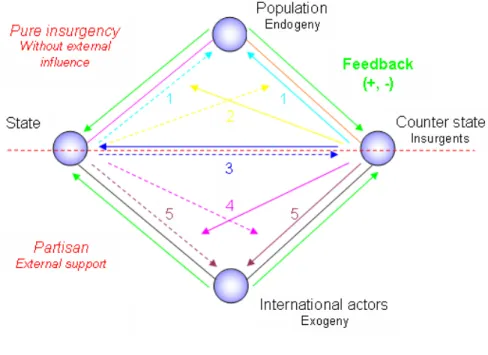
McCormick's Model of Insurgency and Counterinsurgency, also known as the Mystic Diamond, is an analytical tool that models the struggle of the state versus the counter state. This model considers four different actors: the state, the counter state or insurgency, the population (endogeny), and international actors (exogeny). The first actor, the state, is understood as the current government or occupying force in a certain country or region that is forced to deal with the insurgency. The second actor, the counter state or insurgency, essentially consists of those members of an insurgent guerrilla movement or group that challenges the status quo of the state. It also consists of those individuals, groups or organizations that passively or actively support the insurgent force and obstruct the action of the state. The main objective of the counter state is to overthrow the current government or occupying forces by any means available to establish a new government. The third actor, the population, consists of all non-combatant and neutral individuals within a disputed territory that have the capability to support either the state or counter state. The last actor, the international actors, are those external nation states, international organizations, or Non-Governmental (NGO's) actors, capable of taking sides or already involved in the struggle between the state and the counter state. In this era of global communications and transnational economic interests, the state and the insurgency usually receive support from international actors who are protecting their particular interests.
The versatility of McCormick's model allows it to be subdivided into two variants. The first variant is when the insurgency happens within a state and does not have any support from an external actor. In this case, the state deals with the pure insurgency since there are no external sources of influence involved in the struggle. The second variant of the Mystic Diamond appears when the insurgency receives support from an external actor in its struggle
against the state. In this case, insurgents become partisans supported by an external actor. This thesis uses the Model of Insurgency and Counterinsurgency in its most complete form, using both variants to analyze the interaction of populations and external actors as they relate to the insurgency and the state.
Figure 1. McCormick's model of insurgency.
From: Gordon H. McCormick, Seminar in Guerrilla Warfare Lecture Notes, (Monterey, CA: Naval Postgraduate School, Summer Quarter 2006).
The model developed by McCormick visualizes the insurgency problem as integrated by two dynamic interdependent systems -- one represented by the state and the other by the insurgents or counter state -- that interact in a zero-sum game to control the population and the political space. According to this model, both actors compete to gain the support and control of the population while depriving the adversary of the same benefit. The competition between the state and the insurgency is a dynamic process that takes place within existing geo-political, economic, social, and cultural conditions. Nevertheless, the conditions that govern this asymmetric fight between the state and the guerrillas
are: the government begins the struggle with a significant force advantage over the guerrillas; the guerrillas have an indubitable information advantage over most governments. The advantage of the latter rests on its capability of constantly gathering information about the government and using it as propaganda. Essentially, while the guerrilla can easily see the government, it is almost impossible for the government to see the guerrilla. The guerrilla can easily level the force disadvantage by exploiting its information warfare capabilities. Therefore, the challenge to the government is to transcend its force advantage into an information advantage. Nevertheless, the guerrilla is in a better position to control the assisted preferences of the population because they are embedded among them and know them better than the government. Rather than the impersonal level of communications that most governments aspire to have, specifically Mexico, embedding allows the guerrillas to establish better communication with the people.
a. Operational Strategies for Both Players
According to McCormick's insurgency model, the interaction of different actors is such that "individual actions [taken by any one of them] can have multiple effects"53 on each other. This will be described in depth later in
this chapter. As a result, several strategies can be derived from the Diamond Model structure. The arrows and numbers on McCormick's model of insurgency (figure 1) represent the different operational strategies.
According to McCormick's Model, the state and the insurgent have the same five strategies available. This will be explained in detail later in this chapter. Usually the fight begins with the strategy of gaining support of the population (strategy 1), gradually evolving to the strategy of disrupting the control of the opponent over the population (strategy 2), and, ultimately, taking direct action against the adversary (strategy 3). Nevertheless, these three strategies
53 Gordon McCormick, Seminar in Guerrilla Warfare class notes (Naval Postgraduate
are usually complemented by simultaneously working on gaining the favor of the international community (strategy 4), and, once achieved, disrupting the support of the international community for the opponent (strategy 5).
(1) Gain the Support of the Population. The support of the population is a fundamental feature in the struggle against an adversary. In the case of the state, it is the support of the population that enables the state to gain insight and information about the insurgency and its activities. When a population does not assist the government with information about the insurgency, it inadvertently supports the insurgency. The lack of sufficient and appropriate information about the insurgency directly affects the capability of the state to respond to the insurgent threat. However, when a population cooperates with the government by providing information about the insurgency, the government is better equipped to deal with the insurgency. Therefore, it is in the government’s best interest to obtain the population’s support to effectively counter an insurgency. According to Dr. McCormick, "no matter how weak the state is, with appropriate information it can destroy the insurgency."54 Meanwhile, for the
insurgency, the population also represents a valuable asset since it can provide information about the activities of the state, and supply the insurgency with weapons and economic resources to support the cause. Most significantly, the population provides the insurgency with an active environment that gives insurgents the opportunity to blend with the population and to hide from the actions of the state. The relationship of the counter state and the population is so personal that any part of the population not controlled by the government is likely to be controlled by insurgents. The insurgency expects to gain force multipliers, while the state looks to gain popular support. Vital is the fact that the behavior of both actors towards the population is subject to constant change based on the feedback obtained from the interaction with the population.
54 Gordon McCormick, Seminar in Guerrilla Warfare class notes (Naval Postgraduate
Ultimately for both actors, obtaining the support of the population is the most significant and decisive factor to win. Finally, the use of mass media is a significant tool in achieving this step.
(2) Disrupt the Control of the Opponent over the Population. Since the population's support is significant in overcoming an adversary, afflicting the relationship of the opponent with the populace constitutes an essential objective in the struggle between the state and the counter state. To achieve this, both adversaries constantly try to damage the opponent's relationship with the population and, thus, to delegitimize its authority. Therefore, it is essential for both sides to maintain legitimacy to be able to control and gain the sympathy of the population.
(3) Direct Action. Eventually, as the two adversaries gain strength, gather support from the population and information about each other, they are able to launch direct attacks against one another. These actions aim to disrupt the enemy's operations, destroy, or capture forces, and weaken the resolution to continue fighting. Nevertheless, the support of the population remains essential for success.
(4) Compete for the Favor of the International Community. In this dynamic struggle between the state and the insurgency, it is essential for both adversaries to have the support of an external actor. As a consequence, both actors are constantly trying to legitimize their positions to gain and maintain the support from external actors. The strategy of competing for the favor of the international community is also subject to constant change based on the feedback obtained from the interaction with the external actors.
(5) Disrupt the Support from the International Community to the Opponent. When an external actor is involved in the struggle between the state and the insurgency, it is essential for both opponents to delegitimize their respective enemy in the eyes of the international community to deprive it from its support. In this zero-sum game, the support of an external actor is a very
significant factor for the state and the insurgency: it directly affects the outcome. The strategy of disrupting support from the international community constantly changes and is dependent on the feedback obtained from the interaction with external actors.
B. ALLISON AND ZELIKOW'S CONCEPTUAL MODELS AND GROUPTHINK FRAMEWORK
The concept of “Information Operations” has evolved within the military as a result of the need to optimize the use of human and material resources to indirectly influence the enemy. This type of operation is mostly used by the military establishments of those countries that have developed the technological resources and expertise to integrate efforts to influence an adversary. Previously, these were carried out almost in an independent manner, but now operations encompass a diversity of operations that have been integrated with new developments in information technology. Despite the proven success of Information Operations, many countries have not tried to develop such capabilities. In some cases, the reason for not developing this capability is budgetary; in others it rests on a lack of understating of its advantages. In the case of the Mexican Navy, the development of an Information Operations capability has been constrained by both factors. Currently, the Mexican Navy does not have a specialized unit capable of conducting Information Operations. If the Mexican Navy were to develop such a capability, it could further strengthen its cooperation with other government agencies.
To understand the reasons why the Mexican Navy has not developed an Information Operations capability, we use the concepts presented by Graham Allison and Phillip Zelikow in their book Essence of Decision: Explaining the Cuban Missile Crisis. The authors present three different conceptual models to try to understand how, at the different levels of government, decisions are made and who is involved. These conceptual models are: Rational Actor Model, Organizational Behavior Model, and Governmental Politics Model. The rigor of