EMU ACCESSION ISSUES
IN BALTIC COUNTRIES
Raoul Lättemäe
Ezoneplus Working Paper No. 17A:
Regional Input on Monetary and Fiscal Policies
Supplement to Working Paper No. 17
May 2003
FIFTH FRAMEWORK PROGRAMME
Ezoneplus
The Eastward Enlargement of the Eurozone Research Project HPSE-CT-2001-00084 Fifth Framework Programme 2001-2004
European Commission www.ezoneplus.org
Jean Monnet Centre of Excellence
Freie Universität Berlin Ihnestr. 22, 14195 Berlin, Germany
Phone: +49 (30) 838 – 54966 Fax: +49 (30) 838 – 52357 Email: [email protected]
May 2003
EMU ACCESSION ISSUES
IN BALTIC COUNTRIES
Abstract
After joining EU, the accession countries are expected to join the EMU and the area. This cannot take place immediately after EU enlargement, as prior joining euro-area the accession countries should apply to the European Commission for entering EMU stage three and fulfil Maastricht convergence criteria’s. There is no deadline, when accession countries should make the decision to join euro-area. However, there is no opt-out clause for accession countries either, like there was for Denmark and UK in 1999. All accession countries are expected to join the monetary union in some stage.
This paper analyses briefly the EMU accession issues in Baltic countries. In addition, a formal inspection of the OCA criteria in Baltic countries is carried out, using the structural VAR methodology. The results of Baltic countries are compared with the results of other accession countries and EU countries.
Keywords: Regional Input, Optimum Currency Area, VAR Corresponding author:
Raoul Lättemäe [email protected]
This paper has been prepared as a part of a broader Ezoneplus project that evaluates European Monetary Union (EMU) and its enlargement to prospective
University of Tartu
Faculty of Economics and Business Administration
Institute of Economics
EMU accession issues in Baltic Countries
Raoul Lättemäe
Ezoneplus Working Paper No. 17A
Regional Input on Monetary and Fiscal Policies
Contents
1 Introduction ... 5
2 The debate about joining with EMU... 5
3 What about those issues in Baltic countries?... 7
4 OCA theory -- a formal inspection in Baltics and CEECs ... 10
5 Summary ... 16
1 Introduction
The political and economic objective in most Central- and Eastern-European countries (CEEC) is to join the European Union (EU). This goal will be fulfilled soon – the first wave of European enlargement should take place already in 2004. The Baltic countries will be among the joiners with EU in 20041.
After joining EU, the accession countries are expected to join the EMU and the euro-area. This cannot take place immediately after EU enlargement, as prior joining euro-area the accession countries should apply to the European Commission for entering EMU stage three and fulfil Maastricht convergence criteria’s. There is no deadline, when accession countries should make the decision to join euro-area. However, there is no opt-out clause for accession countries either, like there was for Denmark and UK in 1999. All accession countries are expected to join the monetary union in some stage.
This paper analyses briefly the EMU accession issues in Baltic countries. In addition, a formal inspection of the OCA criteria in Baltic countries is carried out, using the structural VAR methodology. The results of Baltic countries are compared with the results of other accession countries and EU countries.
2 The debate about joining with EMU
The political set-up of EU enlargement commits accession countries to join EMU at some stage after EU accession. This has yielded into lively debate about the EMU enlargement issues among academics and politics.
Much of the debate around EMU enlargement is focused on the two general, not to say practical, aspects. One of them is the question about the choice of appropriate monetary regime in accession countries prior EU accession. This kind of literature seeks to identify “the best” strategy for accession countries in their road to EMU under potential pressure of large capital flows in globalized world. In this literature, the main conclusion seems to be that the plurality of approaches is feasible thus there is no “best” strategy that is suitable for all. (see for example: Buter & Grafe 2001, Wolf 2001, Begg et. al. 2001, Orlowsky 2001)
1 The invitation to join EU in 2004 is admitted to Estonia, Cyprus, Lithuania, Latvia, Malta, Poland, Slovakia,
The second branch of academic literature addresses the question, how and when the accession countries are able to fulfil the Maastricht convergence criteria’s. Among this literature, the most discussed subject is the conflict between the inflation criteria and the real convergence. Namely, due to the Balassa-Samuelson effect, the higher productivity growth in tradable sector leads to the higher inflation in non-tradable sector (Balassa 1962, Samuelson 1964). This makes more difficult to fulfil inflation criteria and exchange rate stability criteria in accession countries, as accession countries are expected to grow more rapidly than current EMU members do. In this regard, accession countries would like to see alleviation of Maastricht inflation criteria, to enable joining with EMU more rapidly. As an opposite, some authors believe, that accession countries should join euro-area at the latter stages, when they are able to meet all the necessarily criteria’s (as measured by Maastricht) for successful monetary union (See for example: Wagner 2001, Begg. et. al. 2001).
During the last couple of years, there has been growing strand of academic literature, which try to assess the optimum currency area (OCA) theory in accession countries. This kind of work concentrates on the aspect that the members of monetary union will give up their monetary independence. According to OCA theory (pioneered by Mundell (1961), McKinnon (1963), Kenen (1969)), the independent monetary policy and the exchange rate instrument are necessary stabilization tools for alleviating the impact of asymmetric shocks for the region. Therefore, giving up monetary independence may be costly for the regions, that are hit by asymmetric shocks and that cannot substitute monetary policy with some alternative stabilizing mechanisms. Vice versa – if the shocks are symmetric and/or the alternative stabilizing mechanisms are in place, the costs of giving up the monetary independence are relatively smaller.
This strand of literature among accession countries is still relatively small. One of the reasons may relay on the shortage and instability of economic data-series in accession countries. Also, according to Lucas (1976) critique, changes in economic policy will lead to changes in economic structure, which hinder the possibility of analysing ex ante policies, based on ex post data. In addition, in the context of OCA theory, it is not clear, whether the OCA criteria’s may be endogenous, as was claimed by Frankel and Rose (1996). Moreover, one may understand the pragmatism of the debate, as joining the euro-area is the ultimate goal for the countries that join the EU in spite of the question of its economic or political. Therefore, the question of fulfilment of OCA criteria’s in accession countries may seem less relevant.
3 What about those issues in Baltic countries?
All Baltic countries have chosen rather rigidly fixed exchange rate regime, with the Estonia and Lithuania following the currency board regime with EUR and Latvia following the so-called quasi currency board with SDR. In this regard, the Baltic countries are rather similar to each other but differ from most other CEECs, that have chosen to adopt more active monetary policy regime and are using floating or at least managed floating exchange rate regime2.
In Estonia the currency board was introduced along with the monetary reform in July 1992 and the Estonian kroon was pegged to the German Mark. This monetary regime has remained unchanged since then. Since 1999 the Estonian kroon has been pegged with the European euro.
In Latvia the fixed exchange rate regime was adopted in February 1994, when the Latvian lat was de facto pegged to the SDR basket of currencies. The fixed peg has remained unchanged since then. Until the end of the 1990s, inflation was higher in Latvia than in the industrialised countries, raising concerns that the appreciation of the real exchange rate in Latvia hurt exporters and might, in fact, dampen the country's long-term growth prospects. Besides, in the light of the appreciation of the real exchange rate, there have been some speculations that the fixed exchange rate regime is not sustainable in the long run (Bitans 2003).
In Lithuania the currency board was introduced in 1994, but differently from Estonia, the US dollar was chosen as an anchor currency. The initial choice for USD was motivated from different factors, such as the importance of oil products in Lithuanian export structure. However, at the second half of 90ies, Lithuania started to seek closer financial integration with the European Union. In 1997, the three-step approach of exiting currency board was introduced to the public. This plan foresaw shift from USD peg towards the currency basket and finally towards narrow fluctuation band against the basket or against the single currency. This three-step plan was however abandoned after the Asian and Russian crisis. The Lithuanian currency board was re-pegged from the USD to the EUR on February 2002. Considering the first question in accession debate -- the appropriate choice of monetary regime in Baltic’s prior accession -- then it seems probable that all the three countries will
2 Czech, Poland, Romania, Slovakia, Slovenia are using managed float and Cyprus and Hungary are following
central parity with euro with a wide fluctuation band. Malta is using pegged exchange rate system to the trade-weighted basket and Bulgaria is using currency board arrangement against euro as an exchange rate arrangement.
keep their regimes broadly unchanged upon EU accession. There are no explicit regime changes foreseen in the three countries’ Pre-Accession Economic Programmes (Enlargement Papers, November 2002) prior the EU accession and all three central banks have stated this also explicitly.
In regard of participating in exchange rate mechanism ERM-II after the EU accession, the Estonia and Lithuania seem to be inspired by the affirmation of ECB and European Commission – the latter institutions declared in 2000 that although the euro-based currency boards does not substitute the requirement to participate in exchange rate mechanism ERM-II, they may be regarded on case-by-case basis as one sided commitment within the framework of ERM-II (Padoa-Schioppa 2000). This may mean that those two countries do not necessarily have to go trough the double-shift in their monetary regime and may reside with their currency boards up to the introduction of the euro.
The case for Latvia is a bit different, as the SDR-peg is not directly feasible in the framework of ERM-II. Therefore, the Bank of Latvia foresees increasing relevance of active monetary policy, using the short-term interest rate management in order to ensure Latvia’s compliance with the Maastricht criteria – especially those concerning inflation control. During this period, the Bank of Latvia foresees full convergence with the ECB in the questions concerning monetary policy instruments, in order to avoid excessive shocks in the financial sector after joining the EMU and giving over the implementation of the monetary policy to the ECB (Latvian Pre-Accession Program 2001).
Considering the Maastricht criteria’s then the fulfilment of fiscal criteria – the level of public debt cannot exceed 60% of GDP and general government debt has to remain below 3% of GDP – most probably do not cause problems for Baltic countries. The government debt level has been low in all three countries, partly because those countries did not attained any public debt from former Soviet Union. In addition, the government expenditures have been kept under control in all three countries during the last decade.
The fulfilment of interest rate criteria may be technically more difficult to measure due to the lack of government bond market in Estonia and the shortage of relevant maturities and currency compositions in government bond markets in Lithuania and Latvia. However, the domestic long-term interest rates in real sector are sufficiently low in all three countries, thus the real fulfilment of the criteria is most probable not obstacle for Baltic countries.
Similarly to other CEECs, the most fundamental obstacle with Maastricht criteria in Baltics is the question of fundamental trade-off between real convergence and inflation criteria. More specifically, due to the higher productivity gains, the real effective exchange rate should follow some appreciating trend in accession countries. To achieve this either nominal exchange rate should appreciate or domestic inflation should be higher relative to Eurozone. As the Baltic countries are using fixed exchange rate regimes, the inflation rate should be somewhat higher than in Euro-area. According to historical data, the Latvian and Lithuanian inflation rates have been however smaller than in Estonia during last couple of years (see figure 1). The main reason has been that the US dollar has been appreciating from the introduction of the Euro to the beginning of 2002. This has alleviated some inflationary pressures in both Latvia and Lithuania.
-10% 0% 10% 20% 30% 40% 50% 60% 01. 95 07. 95 01. 96 07. 96 01. 97 07. 97 01. 98 07. 98 01. 99 07. 99 01. 00 07. 00 01. 01 07. 01 01. 02 07. 02 01. 03
Estonia Latvia Lithuania
Figure 1. CPI inflation in Baltic countries
One of debated issue among Baltic countries is the question of operational convergence of the monetary framework. This debate stems from the fact, that on operational level the currency board regime (or pegged exchange rate system in Latvia) is rather different form the monetary policy framework in Eurosystem, which uses much wider set of monetary instruments, such as open market operations (OMO). OMOs are the most relevant instruments in Eurosystem, whereas in Baltics the most relevant monetary instrument (in addition to the exchange rate link) is reserve requirement. Moreover, the purpose of monetary instruments may differ – whereas in Baltic countries the instrument reserve requirement is mainly seen as liquidity buffer, which should substitute the lack of other monetary instrument, then in Eurosystem the reserve requirement is an instrument for creating structural shortage of liquidity in banking sector. This structural shortage of liquidity is then
fulfilled by the central bank open market operations – in a way the central bank “creates market” for its open market operations by reserve requirements. As in Estonia, there are no open market operations, and in Latvia and Lithuania such activities have been kept under small volumes, this goal cannot be the main purpose of rather high reserve requirements in Baltics.
4 OCA theory -- a formal inspection in Baltics and CEECs
The Optimum Currency Area (OCA) theory analyses the aspect that the members of monetary union will give up their monetary independence. According to OCA theory, the independent monetary policy and the exchange rate instrument are necessary stabilization tools for alleviating the impact of asymmetric shocks for the region. Giving up the monetary independence may be costly if the shocks, hitting the region are region-specific and the role of stabilizing monetary policy is not substitutable with some alternative mechanism (for. ex. flexible labour market). Therefore, assessment of possible asymmetries in structural shocks has become popular method for analysing OCA criteria in different regions of world (most notably in EMU). The structural VAR models are mostly used for such purpose.
Similarly to other CEECs the OCA theory has attained less attraction in Baltic countries. One obvious reason is that all the three countries have adopted fixed exchange rate system. Therefore, the monetary policy is already surrendered to the monetary policy of anchor currency and the question about the costs and benefits of giving up monetary independence in currency union is less relevant. However, the OCA criteria may be helpful to identify possible negative impacts and threats of euro-area enlargement or using the fixed exchange rate regime. In addition, it is of interest to compare, whether fixed exchange rate countries -- such as Baltic countries -- have attained greater similarity with anchor currency than floating exchange rate countries or not.
This paper uses structural VAR (sVAR) framework to analyse possible asymmetries among the accession countries and present EU members, based on the OCA theory. The sVAR methodology was pioneered by Bayoumi and Eichengreen (1993) in the context of assessing OCA theory. They used Blanchard and Quah (1989) identification scheme in bi-variable structural VAR. Later authors have extended the structural VAR model to three or four variables, as the identification only AS and AD shocks is not sufficient for assessing possible asymmetries in demand shocks (See Buiter 1995 and Ricci 1997).
The goal is to analyse whether the asymmetries among accession countries and EU members are comparable to the present EMU members or not. The main difference between the current study and previous similar studies is that three kind of structural disturbances – AS, IS and LM shocks – are separated. All previous studies about accession countries have used the methodology of Bayoumi and Eichengreen (1992) and analysed aggregate supply and aggregate demand shocks only. (See Frenkel et. al. 1999, Boone et. al. 2002, Frãţilã 2000, Fidmruc & Korhonen 2001, Weimann 2002).
The structural VAR model, which was used for the exercise, consisted from three variables – industrial production index, real effective exchange rate and CPI inflation. Following the identification scheme of Clarida & Gali (1994), Chadha & Hudson (1998), Funke (2000) and Zhang et. al. (2002), the structural shocks are identified as follows:
- Only supply shocks εAS affect the long-run level of output y (industrial production);
- Nominal demand shocks εLM do not affect the long-run level of real effective exchange rate q.
- All shocks – nominal and real demand shocks (εIS and εLM) and supply shocks (εAS) may have short-run effects on output y, REER q and inflation p.
The assumptions, used for identification of sVAR are summarized in equation (1):
(1) = ∆ ∆ ∆ LM IS AS t t t A A A A A A p q y ε ε ε ) 1 ( ) 1 ( ) 1 ( ) 1 ( ) 1 ( ) 1 ( 33 32 31 22 21 11 0 0 0 ,
where Aij(1) denotes the long-run impact of relevant shock on relevant variable.
The VARs were estimated, using monthly data and about six lags in most cases in initial VAR (the lag length was chosen based on LR test and on comparability of chosen lag lengths among all countries). Before estimation the data was seasonally adjusted where appropriate. The used time series of EU members started from 1990, in accession countries mostly from 1994-96 and ended at mid-2002. In EMU countries the dummy variable was used to separate the periods before and after the introduction of euro in the beginning of 1999. In accession countries similar dummy variable was used for separating periods prior and after 1997. In addition, the IMF commodities price index with six lags was used in estimation as exogenous
variable.
After estimating initial VARs, structural shocks were separated using above-described identification scheme. In addition to the identification restrictions, the impulse response functions were studied in order to distinguish sensible structural VARs for ten candidate countries and EU countries – according to economic theory, the long-run impulse response of output level on supply shock should be positive and on price level it should be negative. Both demand shocks should yield into temporary increase of output and accelerating inflation. In addition, the nominal demand shock should yield into temporary depreciation of the real exchange rate.
Whereas in most cases the sVAR gave sensible results, there were also “unreasonable” reactions to structural shocks in some countries. The prize-puzzle – result where positive demand shock yields into decrease in inflation rate and positive supply shock yields into increase in inflation rate – was found in some countries (Denmark, Cyprus, Finland, Sweden, Slovenia and also Latvia), making the results of analysis (at least for those countries) less reliable. UK SE DK PT NL IT IE GR FR FI ES BE AU GE LV SI SK HU PL LT EE CY CZ -0,10 -0,05 0,00 0,05 0,10 0,15 0,20 -0,3 -0,2 -0,1 0 0,1 0,2 0,3
Real demand shock (IS shock)
Supply Shoc k EU members Accession countries UK SE DK PT NL IT IE GR FR FI ES BE AU GE LV SI SK HU PL LT EE CY CZ -0,10 -0,05 0,00 0,05 0,10 0,15 0,20 -0,3 -0,2 -0,1 0 0,1 0,2 0,3
Real demand shock (IS shock)
Supply Shoc
k
EU members Accession countries
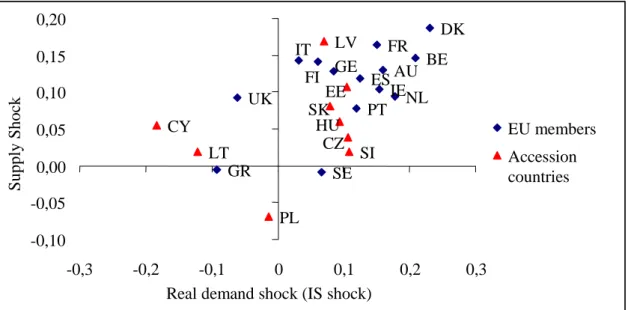
Figure 2. Average correlation of supply and real demand shocks in Baltic countries and other accession countries against supply and real demand shocks in all EMU countries. The main findings of correlation analysis of structural shocks can be summarized as follows. Similarly to the previous similar studies (see Frenkel et. al. 1999, Boone et. al. 2002, Frãţilã 2000, Fidmruc & Korhonen 2001, Weimann 2002) and not surprisingly, the structural shocks (both supply and real demand shocks) are more asymmetric in candidate countries than in current EMU members (See figure 2). Therefore the flexibility of real sector and labour
markets is essential for sustainability of monetary union with EMU or for sustainability of current fixed exchange rates.
Maybe surprisingly, the results indicate that in spite of the geographical proximity and similarities in monetary regime, the results for all three Baltic countries are rather different from each other. Whereas in Estonia and Latvia the structural shocks seem to be symmetric with EMU countries, the demand shocks in Lithuania are asymmetric rather than symmetric with EMU countries. Somewhat similar results emerge also from Fidmruc & Korhonen (2001), who found that both Lithuania and Latvia exercise substantial asymmetric shocks vis-à-vis EMU countries.
This result indicates, that the export products and markets may differ among Baltic countries. In Lithuania the oil products and CIS markets have higher relevance than in other Baltic countries and the exchange rate was fixed with US dollar for a long period. This might be one reason, why in the results the demand shocks in Lithuania may show less coherence with EU than in Latvia or in Estonia. In comparison of structural shocks of Baltic countries and other CEECs vis-à-vis EMU countries, no very obvious differences emerge. There is no clear-cut distinction of existing symmetries in countries that use fixed exchange rate and in countries that use floating exchange rate. The asymmetric real demand and/or real supply shocks dominate in Poland, Lithuania and Cyprus. At the same time, the real shocks’ symmetries in Latvia, Estonia, Slovakia and Hungary are comparable to the EMU “periphery”. In the existing EMU members, only the shocks in Greece are asymmetric compared to other EMU members.
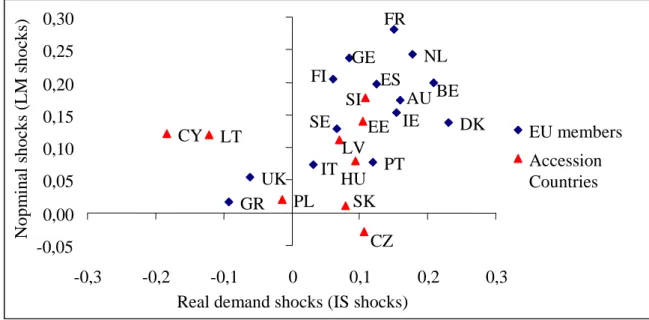
Some interesting results emerge also from the analysis of symmetries in nominal shocks (monetary shocks) (see figure 3). It seems that monetary shocks in most candidate countries are more correlated with EMU countries than supply shocks or real demand shocks. More interestingly, the correlations vis-à-vis euro-area monetary shocks in Baltic countries are rather similar to each other. Whereas the anchor currencies have been different in all three countries for most of the sample period this might indicate that the financial integration between those three countries may be still rather high.
GE AU BE ES FI FR GR IE IT NL PT DK SE UK CZ CY LT EE PL HU SK SI LV -0,05 0,00 0,05 0,10 0,15 0,20 0,25 0,30 -0,3 -0,2 -0,1 0 0,1 0,2 0,3
Real demand shocks (IS shocks)
N opm in al s h o cks (L M s h o cks) EU members Accession Countries GE AU BE ES FI FR GR IE IT NL PT DK SE UK CZ CY LT EE PL HU SK SI LV -0,05 0,00 0,05 0,10 0,15 0,20 0,25 0,30 -0,3 -0,2 -0,1 0 0,1 0,2 0,3
Real demand shocks (IS shocks)
N opm in al s h o cks (L M s h o cks) EU members Accession Countries
Figure 3. Average correlation of nominal and real demand shocks in Baltic countries and other accession countries against nominal and real demand shocks in all EMU countries. The noted positive (although small) correlation between monetary shocks in CEECs and EMU countries is relevant also in the context of OCA theory. Firstly, it shows that the monetary policies in accession countries may be already surrendered to the monetary policy in Euro-area. If this is the case, then joining euro-area does not necessary mean giving up monetary independence, as the latter is already given up. Secondly, according to the theoretical analysis of Ricci (1997), it gives empirical support to the idea, that joining EMU is more beneficial for accession countries than for current EMU members3. Due to the joining
of EMU the accession countries may enjoy the monetary credibility of currency union. At the same time the trade activity with accession countries constitute relatively small share of EMU foreign trade (around 10%), thus the benefits from the current members point of view may be relatively smaller.
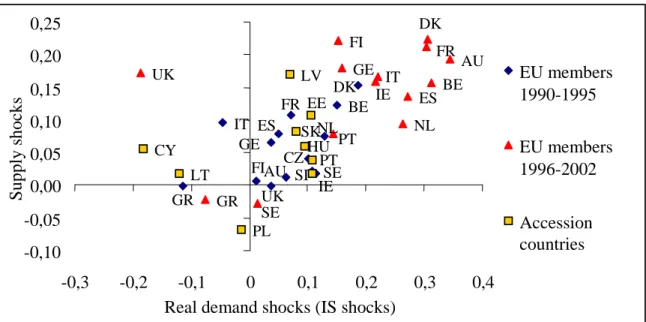
Finally, as we know, the OCA criteria may be endogenous. Estimating separate symmetries for the EMU member in the first and second half of 90ies gives indeed support to this proposal – the symmetries have increased among current EMU members during the 90ies. In fact, the level of existing asymmetries and symmetries among EMU members in the first half of 90ies is comparable to the existing asymmetries in current candidate countries. Assuming that the integration between candidate countries and EMU is increasing, this result shows, that there is no reason to believe that existing symmetries in candidate countries in 2006-2007
will be smaller than were existent at the moment of introduction of euro in 1999. UK SE DK PT NL IT IE GR FR FI ES BE AU GE UK SE DK PT NL IT IE GR FR FI ES BE AU GE LV SI SK HU PL LT EE CY CZ -0,10 -0,05 0,00 0,05 0,10 0,15 0,20 0,25 -0,3 -0,2 -0,1 0 0,1 0,2 0,3 0,4
Real demand shocks (IS shocks)
S u pp ly s h o cks EU members 1990-1995 EU members 1996-2002 Accession countries UK SE DK PT NL IT IE GR FR FI ES BE AU GE UK SE DK PT NL IT IE GR FR FI ES BE AU GE LV SI SK HU PL LT EE CY CZ -0,10 -0,05 0,00 0,05 0,10 0,15 0,20 0,25 -0,3 -0,2 -0,1 0 0,1 0,2 0,3 0,4
Real demand shocks (IS shocks)
S u pp ly s h o cks EU members 1990-1995 EU members 1996-2002 Accession countries
Figure 5. Average correlation of supply and real demand shocks in CEECs against supply and real demand shocks in all EU countries (EU members in 1990-95 and in 1996-2002).
5 Summary
The political set-up of EU enlargement commits accession countries to join EMU at some stage after EU accession. This has yielded into lively debate about the EMU enlargement issues among academics and politics. The Baltic countries are not exemption in this debate. The most prominent issues about EMU enlargement in accession countries seem to be the question of appropriate exchange rate regime prior EU accession, the possible setbacks in real and nominal convergence vs. Maastricht criteria, pros and cons of rapid accession to Euro-zone and the existence of optimum currency area between accession counties and Euro-Euro-zone. In Baltic countries the existing monetary regimes will most probably remain unchanged until ERM-II. Estonia and Lithuania might want to keep their currency boards even within ERM-II as unilateral commitment, whereas Latvia sees increased activism in monetary policy during the ERM-II period.
The question of optimum currency area criteria might be inappropriate in the context of Baltic countries. Under currency board arrangements in Estonia and Lithuania or currency board like arrangement in Latvia the monetary independence is already rather small in Baltic countries. However, assessing OCA criteria’s might be relevant for assessing the need for flexibility in real sector and labour markets, as these should compensate the lack of active monetary policy.
In current paper the OCA criteria in Baltic countries as well as other Central and Eastern European countries is assessed using structural VAR methodology. Similarly to the previous studies the existing symmetries in structural shocks are smaller in accession countries than in current EMU members according to structural VAR estimates. The asymmetric of real shocks are dominant in Poland, Lithuania and Cyprus. At the same time, the real shocks’ symmetries in Latvia, Estonia, Slovakia and Hungary are comparable to the EMU “periphery”. In the existing EMU members, only the shocks in Greece are asymmetric compared to other EMU members. Therefore the flexibility of real sector and labour markets is essential for sustainability of monetary union with EMU or for sustainability of current fixed exchange rates both in Baltic countries as well as in other CEECs.
According to the estimates, the existing symmetries in EMU members at the first half of 90ies were reasonably smaller than at the second half on 90ies. Assuming that the integration
believe that structural shocks symmetries in accession countries in 2006-2007 will not be comparable with the conditions among current member states at the moment of introduction of euro in 1999.
6 References
Bayoumi, T., Eichengreen, B. Shocking Aspects of European Monetary Unification. – New York, Cambridge University Press, The Transition to Economic and Monetary Union in Europe (Giavazzi, F. & Torres, F. eds.), 1993, pp. 193-220.
Balassa, P. The purchasing power parity doctrine: a reappraisal. – Journal of Political Economy, 1962, Vol. 72., pp. 584-596.
Begg, D., Eichengreen, B., Halpern, L., Hagen, von J., Wyplosz, C. Sustainable Regimes of Capital Movements in Accession Countries.- Centre for Economic Policy Research, Policy Paper No. 10, January 2003.
Bitāns, M. (2002) Real Exchange Rate in Latvia (1994–2001). - Riga, Bank of Latvia, 33 pp.
Blanchard, O. J., Quah, D. The Dynamic Effects of Aggregate Demand and Supply Disturbances. – The American Economic Review, Vol. 79, No. 4, September 1989, pp. 655-673.
Boone, L., Maurel, M., Babetski, J. Does EU enlarged towards Eastern countries constitute an OCA? - 2002, 38 pp.
Buiter, W. H., Grafe, C. Central Banking and the Choice of Currency Regime in Accession Countries. – Vienna, SUERF Studies No. 11, 2001, 47 pp.
Buiter, W. Macroeconomic Policy during a Transition to Monetary Union. – London, Centre for Economic Policy Research, Discussion Paper No 1222, 1995, 56 pp.
Chadha, J. S., Hudson, S. L. The Optimum Currency Area Case for EMU: A Structural VAR Approach. – Southampton, University of Southampton, Discussion Paper No. 9815, 1998, 40 pp. Chamie, N., DeSerres, A., Lalonde, R. Optimum currency areas and shock asymmetry: A Comparison of Europe and the United States. – Bank of Canada, Working Paper 94-1, 1994, 39 pp.
Clarida, R., Gali, J. Sources of Real Exchange Rate Fluctuations: How Important are Nominal Shocks?- NBER Working Paper No 5658, 1994, 81 pp.
European Commission. Evaluation of the 2002 pre-accession economic programs of candidate countries. – Brussels, Enlargement Papers, No 14, November, 2002d, 162 pp.
Fidrmuc, J., Korhonen, I. Similarity of supply and demand shocks between th euro area and the CEECs. – Bank of Finland, BOFIT Discussion Papers, 2001, No. 14, 40 pp.
Frankel, J.A., Rose, A. K. The Endogeneity of the Optimum Currency Area Criteria. – London, Centre for Economic Policy Research, Discussion Paper No. 1473, September 1996, 33 pp.
Frãţilã, A. Asymmetric shocks: an European experience. – Professional Program in Applied
Economics, Academia Istropolitana Nova, June 2000, 34 pp.
Frenkel, M., Nickel, C., Schmidt, G. Some Shocking Aspects of EMU Enlargement. – Deutche Bank Research, 1999, Research Note RN 99-4, 28 pp.
Funke, M. Macroeconomic Shocks in Euroland vs. The UK: Supply, Demand, or Nominal? - Hamburg, Hamburg University, July 2000, 19 pp.
pp. 188-224.
Kenen, P. The Theory of Optimum Currency Areas. An Eclectic View. – Chicago, University of Chicago Press, Monetary Problems in the International Economy (ed. Mundell, R. A., ja Swoboda, A. K), 1969, pp. 41-60.
Lucas, R. E. Jr. Econometric Policy Evaluation: A Critique. – Amsterdam, North-Holland, Carnegie-Rochester Conference Series on Public Policy: The Phillips Curve and Labour Markets (eds. Bunner, K., Meltzer, A. H.), 1976, pp. 19-46.
McKinnon, R. I. Optimum Currency Area. – The American Economic Review, September 1963, pp. 717-725.
Mundell, R. A. A Theory of Optimum Currency Areas. – The American Economic Review, Vol 51, 4, 1961, pp. 657-665.
Orlowski, L. T. Monetary Convergence of the EU Candidates to the Euro: A Theoretical Framework and Policy Implications.- Paper to the conference “How to Pave the Road to E(M)U: The Monetary Side of the Enlargement Process and Its Fiscal Support” organized by the Deutsche Bundesbank, the National Bank of Hungary and the Center for Financial Studies, Eltville, Germany, October 26-27, 2001.
Padoa-Schioppa, T. High-level seminar with the EU-candidate countries. - Remarks delivered by Tommaso Padoa-Schioppa, European Central Bank, Paris, 21 December 2000.
[http://www.ecb.int/key/00/sp001221.htm] 20.02.2003.
Ricci, L. A. A Model of an Optimum Currency Area. – Washington DC, International Monetary Fund, Working Paper No 76, June 1997, 41 pp.
Samuelson, P. Theoretical notes on trade problems. – Review of Economics and Statistics, 1964, Vol. 46, pp. 145-164.
Wagner, H. Pitfalls in the European Enlargement Process – Challenges for Monetary Policy.- University of Hagen, 2001.
Weimann, M. OCA theory and EMU Eastern enlargement – An empirical application. – Dresden, Dresden University of Technology, 2002, 32 pp.
Wolf, H. Exchange Rate Regime Choice and Consequences.- GWU and NBER, October 2001. [http://www.bundesbank.de/vo/download/konferenzen/konf_011026_27.pdf] (20.12.2002) Zhang, Z., Satu, K., McAleer, M. Is East Asia An Optimum Currency Area?- IEMS Online Proceedings, 2002, pp. 568-573. [http://www.iemss.org/iemss2002/proceedings/pdf/volume due/438_zhang.pdf] (11.10.2002)