Boilerplates for reconfigurable systems:
a language and its semantics
Alexandre Madeira1,2,3, Manuel A. Martins2, Lu´ıs S. Barbosa2
1
HASLab - INESC TEC and Universidade do Minho, Portugal 2
CIDMA-Dep. of Mathematics, Universidade de Aveiro, Portugal 3 Critical Software S.A., Portugal
Abstract. Boilerplates are simplified, normative English texts, intended
to capture software requirements in a controlled way. This paper proposes a pallet of boilerplates as a requirements modelling language for recon-figurable systems, i.e., systems structured in different modes of execution among which they can dynamically commute. The language semantics is given as an hybrid logic, in an institutional setting. The mild use made of the theory of institutions, which, to a large extent, may be hidden from the working software engineer, not only provides a rigorous and generic semantics, but also paves the way to tool-supported validation.
1
Motivation and overview
Requirements Engineering [9] is the branch of software engineering concerned with the precise identification of goals and constraints of the services provided by systems. Typically, this involves understanding, modelling and documenting not only the needs of potential users or customers, but also the deployment contexts in which such systems under development will be used. The deliverable of this stage in the software development process must be expressed in a form that is amenable to analysis, communication, and subsequent implementation.
In practice requirements engineers start with ill-defined, often conflicting, ideas of what the new system is expected to do. They are supposed to make progress towards a detailed, technical specification of the system. This entails the need for suitable support methodologies to record and structure the relevant information, as well as to express it in a clear, easy to understand notation.
The notion of aboilerplate, first introduced in [9], is a step in this direction: for each class of requirements, within a specific domain, a generic template is de-fined so that capturing requirements amounts to instantiated well-characterized textual schemes written in simplified, normative English. Informally, a boiler-plate is a standardized scheme that can be reused over and over again, and is amenable to some form of computer-based simulation. The term derives from steel manufacturing, where it refers to steel rolled into large plates for use in steam boilers. The intuition is that a boilerplate has been time-tested and is ‘strong as steel’ suitable for repeated reuse. The use of ‘controlled natural lan-guage’ for requirements elicitation is a successful practice in industry and, despite
of its informal character, does provide an interesting starting point towards more formal approaches.
Boilerplates are usually developed for specific business areas, classes of sys-tems or typical design stages.This paper focus in reconfigurable systems. Those are systems whose form (i.e. resources involved, network topology, etc) changes along the computational process in response to varying context conditions.
The behavior of this kind of systems is indexed to a set of different run-time
configurations between which the system commutes dynamically. Therefore, a specification takes the form of astructured transition system: transitions capture the evolution from one configuration to another, whereas each state corresponds to the full specification of data and services available at a particular configura-tion. Such local configurations can be described in different languages, ranging from, equational to first order logic or even to less conventional formalisms, e.g., fuzzy or multivalued logics. In the sequel we will refer to the logic used at the local level of configurations as thebase logic.
If the base logic provides a language to express requirements relative to each configuration of the system, describing the reconfiguration dynamics itself re-quires a modal logic to express transition and change. Actually, we adopt an extension of ordinary modal logic in which dedicated propositional symbols, callednominals, each being true at exactly one possible state, are used toname
states, i.e., the system’s individual configurations. This extension is known as
hybrid logic, whose roots go back Arthur N. Prior’s work in the 1960s; see [1] for a detailed account and historic perspective. Along with nominals, it also intro-ducessatisfaction operators @iφ, which formalise a statementφbeing true at a specific configuration namedi.
In such a context, the paper’s contribution is twofold:
– first it introduces a collection of boilerplates for capturing typical require-ments of reconfigurable systems;
– then, it takes seriously the challenge of providing a proper, unambiguous semantics for them.
Our perspective is that the methodological advantages of boilerplates, i.e. their conciseness and genericity, depends on the existence of a rigorous formal seman-tics for them, amenable to formal transformation and verification. On the other hand, the distinguishing feature of our approach is that boilerplates are paramet-ric on whatever (base) logic is chosen for specifying the system’s configurations. The methodology proposed proceeds as follows: first a suitable base logic to express the properties of (local) configurations is chosen. Then, the requirements are collected into specific boilerplates which structure information on the rele-vant vocabulary, available configurations, events triggering reconfiguration and both local and global properties. Once instantiated, boilerplates are translated into specifications in (a suitable version of) hybrid logic (e.g. [2]) providing a formal description of requirements amenable to tool-supported validation. By the expression ’(suitable version of ) hybrid logic’ we mean a language with enriches the base logic specific to each application with modalities and hybrid features to express reconfiguration and evolution. Such a language is derived in
a formal and systematic way — the so-calledhybridisation processwhose theory was developed by the authors in [13,4].
Going generic entails a price to pay: to seek for a suitably generic notion of logical system encompassing syntax, semantics and satisfaction. Fortunately the concept is already well-established in the so-called theory of institutions of Goguen and Burstall [6,3]. At expenses of some extra (and a bit heavy) notation, institutions offer an abstract representation of a logic, and their theory provides modular structuring and parameterization mechanisms which are defined ‘once and for all’, abstracting from the concrete particularities of the each specification logic [5]. The formal semantics for boilerplates proposed in this paper is framed in this setting: each logic (base and hybridised) is regarded as aninstitution.
Another advantage of the institutional framework is its ability to relate logics and transport results from one to another [14], which means that a theorem prover for the latter can be used to reason about specifications written in the former. Our approach takes advantage of this to provide ‘for free’ suitable tool support through a translation of collections of boilerplates to first-order logic and their validation in theHets [16] tool.
The paper is organized as follows: Section 2 introduces a pallet of boilerplates for reconfigurable systems and illustrates their use through a small example. A formal semantics for this pallet of boilerplates is addressed in Section 3. Finally, Section 4 proposes a methodology for engineering requirements of reconfigurable systems, from their elicitation and expression in boilerplates until their validation and prototyping within theHetsframework.
The semantic framework used in the sequel is based on the theory of institu-tions and a method to generate hybrid from arbitrary logics. Part of it, namely the background formalism and notation, can be skipped at first reading without compromising a broader understanding of the paper’s ideas. For the interested reader, details and examples are given in the Appendix.
2
A language of boilerplates for reconfigurability
As sketched in the previous section, requirements for reconfigurable systems are captured in a collection of boilerplates which, taken jointly, specify a structured transition system. Its states, corresponding to differentconfigurations, ormodes of execution, are endowed with a specific description of the functionality available locally. The boilerplates proposed below define globally the relevant modes of execution and the transition structure, as well as, at the local level of each mode, the interface of services available and their properties.
Basic boilerplates
Five classes of boilerplates are introduced to register requirements, structur-ing them as a (structured) transition system. The choice of the base logic I is made within the boilerplates concerned with the system’s interface. A con-crete instantiation of these boilerplates requires such a choice: notationBP(I)
stands therefore, for the set of boilerplates in which the requirements for local configurations are given inI. The basic boilerplates proposed are as follows:
1. Identification of the relevant configurations: System plays the configurations<set of configurations> <Mode>is a execution mode
2. Definition of event sets able to trigger a mode transition, i.e., a system’s reconfiguration:
System has events<set of Event> <Event>is an event
3. Definition of the basic transition structure:
System changes from<Mode>to<Mode>through the event <Event> System may change from<Mode>to <Mode>through the event <Event>
4. Definition of the system’s interface: System interface is defined by<InterfaceExp>
5. Local specification, i.e., relative to the system’s functionality at each config-uration (stated in the chosenbaselogic):
Property<Prop>holds in all modes Property<Prop>holds in <Mode>
6. Definition of possible transitions (i.e., reconfigurations) emerging from local properties (e.g., a certain limit value for a parameter is achieved).
<Event>changes modes satisfying<Prop>into modes satisfying<Prop> <Event>changes <Mode>to modes satisfying<Prop>
An example
For example let us consider a small, self-contained example. Other examples appeared in the first author’s PhD thesis [10]. For the moment, consider the following requirements for a quite peculiar, ‘plastic’ buffering structure:
A ‘plastic’ buffer is a versatile data structure with two distinct modes of execution: in one of them it behaves as a stack; in the other as a queue. The reconfiguration is triggered by by an external event ‘shift’.
We start fixing the transition structure between the buffer’s (two) modes of execution.
Modes and events:
– fifois a mode
– lifois a mode
– Shiftis an event
System changes from <lifo>to <fifo>through the event<shift> System changes from <fifo>to <lifo>through the event<shift>
For the specification of each execution mode, or configuration, one may resort to propositional logic PL, the buffer requirements are expressed in BP(PL). The following boilerplate fixes the local behaviour: the proposition stack bh is to hold in configurations in which the buffer behaves like a stack; proposition queu bhwhen it behaves as a queue.
System interface is defined by<{stack bh,queu bh}>
Hence,
– Propertyqueu bhholds in fifo – Propertystack bhholds in lifo
In practice, however, the propositional setting may not be enough: most properties are better expressed inequational logicEQ. Thus, one my state
System interface is defined by<ΣPbuffer>
where ΣPbuffer is the classical first-order signature of a stack/queue data type
withwrite,readanddeloperations together with a constantnewto denote the empty buffer. Hence, local properties are expressed by
– Propertyread(write(m,e)) =eholds in lifo
– Propertym=new⇒read(write(m,e)) =eholds in fifo
– Property¬(m=new)⇒read(write(m,e)) =read(m)holds in fifo – Propertydel(write(m,e)) =mholds in lifo
– Property¬(m=new)⇒del(write(m,e)) =write(del(m),e)holds in fifo – Propertym=new⇒del(write(m,e)) =newholds in lifo, fifo
A precise semantics for this sort of boilerplates is given in the following section by their transformation into a proper formal specifications in suitable hybrid logics.
3
A formal semantics for
BP
(I)
If the collection of boilerplates proposed here for reconfigurable systems leads naturally to models based on structured transition systems, the choice of (a vari-ant of) hybrid logic for their semvari-antics comes as no surprise. Reactive systems are classically expressed in modal languages; on the other hand, a naming mech-anism for states makes easier to distinguish between properties valid in some, but not all, configurations.
The semantic framework is as follows: Once the system’s requirements are captured in a collectionBP(I) of boilerplates instantiated over a base logicI, its semantics is given by a systematic translation to a hybrid logic overI. I.e, a logic whose language extends that of I with a setΛ ofmodalities, the corre-spondingeventually (hλi) and henceforth ([λ]) operators, for eachλ∈Λ, a set N omofnominals to name configurations, and, for eachi∈N oma satisfaction operator @i enforcing the validity of its argument in configurationi. Formally, the collection of boilerplates gives rise to a proper specification in the hybrid
logicHI corresponding toI. The generation ofHI fromI, i.e., the hybridisa-tionofI, is also a systematic process whose technical details are summarised in the Appendix.
For the moment we shall concentrate in the process of generating a HI -specification from a collection of boilerplates. Note the introduction of nominals to refer to local configurations and of modalities to state properties of the overall transition structure. This is better illustrated through an example. Let us, thus, revisit the buffer example.
In Section 2 two collections of boilerplates were considered for this example. The first one resorted to propositional logic PL. Its semantics is, therefore, a generated specification in hybrid propositional logicHPL:
spec ReconfBuffer1=
nominalfifo,lifo
modalitiesshift
propositionsstack bh,queue bh
•@f if ostack bh
•@lif oqueue bh
•@lif o< shif t > f if o
•@f if o< shif t > lif o
The models M for this specification are standard Kripke structures. For in-stance, the structure defined over a set of two states{slif o, sf if o}and whose ac-cessibility relation isWshif t ={(slif o, sf if o),(sf if o, slif o)}. The value of propo-sitions stack bh and queue bh is each state is as follows: Mslif o(stack bh) =
Msf if o(queue bh) =>andMslif o(queue bh) =Msf if o(stack bh) =⊥.
The second, richer set of boilerplates resorted toequational logicEQto cap-ture local requirements equationally. The resulting specification is now expressed in hybrid equational logicHEQ, as follows.
spec ReconfBuffer2=
nominalfifo,lifo
modalitiesshift
sorts mem,item
op new:mem; write:mem×item→mem; del:mem→mem;read :mem→item
∀m:mem;e:item; •read(write(new,e)) =e
•del(write(new,e)) =new
•@lif oread(write(m,e)) =e
•@f if o(m=new)⇒read(write(m,e)) =e
•@f if o¬(m=new)⇒read(write(m,e)) =read(m)
•@lif odel(write(m,e)) =m
•@f if o(m=new)⇒del(write(m,e)) =new
•@f if o¬(m=new)⇒del(write(m,e)) =write(del(m),e)
•@lif o< shif t > f if o
•@f if o< shif t > lif o
A model M for this second specification is given by a Kripke structure as above but realising, in each state, Mslif o and Msf if o as the classical (initial)
Boilerplates for LTS components specification:
•System has modes <set of Mode> •Nom := Nom] set of Mode
•<Mode>is a mode •Nom := Nom] {Mode}
•System has events<set of Event> •Λ:=Λ] set of Event
•<Event>is an event •Λ:=Λ] {Event}
•System’s interface is defined by<InterfaceExp> •Σ:= InterfaceExp
Boilerplates for simple transitions:
•System changes from <Mode1> to <Mode2> through event <Event>
•@Mode1hEventiMode2
• System may change from <Mode1> to <Mode2> through event<Event>
•@Mode1[Event]Mode2
•<Event>changes system to <Mode> •[Event]M ode
•There are no transitions into<Mode>through<Event> • ¬hEventiM ode
Boilerplates for transitions tagged by properties:
•<Event>changes modes satisfying <Prop1>into modes sat-isfying<Prop2>
•Prop1⇒[Event]Prop2
•<Event>changes <Mode>to modes satisfying<Prop> •Mode⇒[Event]Prop
•<Event>changes modes satisfying<Prop>to mode<Mode>•Prop⇒[Event] Mode
Boilerplates for properties:
•Property<Prop>holds in all modes •Prop
•Property<Prop>holds in <Mode> •@ModeProp
•There is no mode satisfying<Prop> • ¬Prop
•There is at least one mode satisfying<Prop> •EwProp
•There is exactly one mode satisfying<Prop> • ∀w, v∈W[@vProp∧@wProp]
⇒v=w
4
The specification process
We have seen how to go from a collection of boilerplates to a formal specification in a suitable hybrid logic. The latter not only provides a precise semantics to the requirements gathered, but also paves the way to their validation. Actually, a central ingredient for the successful integration of a formal methodology in the industrial practice is the existence of effective tool support.
In order to prototype requirements captured by a collection of boilerplates or to validate their internal consistency, the hybrid specifications are translated into first-order logic (FOL), so that the software engineer can take advantage of several provers already available forFOL.
The institution-based framework underlying the hybridisation process, which provides a whole pallet of (hybrid) logics for translating requirements, also
of-fers for free the conceptual machinery for this translation to FOL, whenever it exists. Then, the prover toolsetHets [16], a framework specifically designed
to support specifications expressed in different institutions, offers suitable tool support. Using a metaphor of [15],Hetsmay be seen as a “motherboard” where
different “expansion cards” can be plugged. These pieces are individual logics (with their particular analysers and proof tools) as well as logic translations, suitably encoded in the theory of institutions.
Hetsalready integrates parsers, static analyzers and provers for a wide set
of individual logics and manages heterogeneous proofs resorting to the so-called graphs of logics, i.e., graphs whose nodes are logics and, whose edges, are comor-phisms between them. Note that hybrid logic, namely its propositional variant, has already a number of implementations (see e.g. HTab [8], HyLoTab [19]
andSpartacus[7]). Our approach, however, provides a uniform first order
log-ical framework for analysis and verification supporting the whole methodology. Moreover, to the best of our knowledge, richer versions of hybrid logic do lack effective tool support, which makes our approach by translation the only option available.
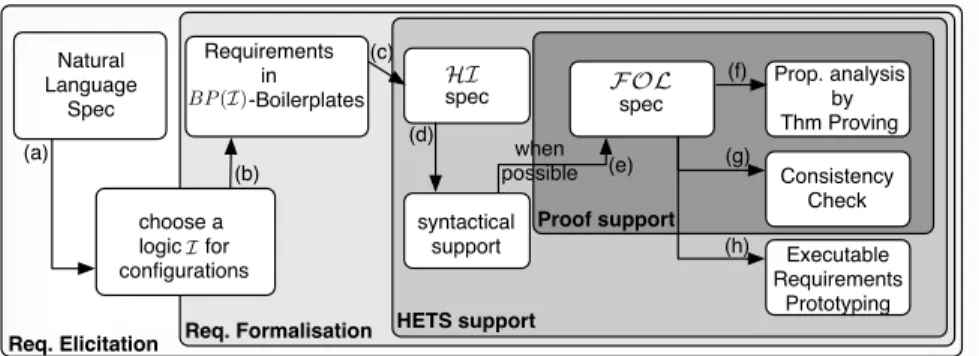
We can now explain, step-by-step, the overall methodology for requirements elicitation and validation, as depicted in Fig. 1.
HI
spec FOLspec
Consistency Check Prop. analysis by Thm Proving Executable Requirements Prototyping Requirements in -Boilerplates (f) (g) (h)
Req. Formalisation HETS support
choose a logic for configurations syntactical support Natural Language Spec Req. Elicitation (a) (b) when possible (c) Proof support (d) I BP(I) (e)
Fig. 1.Tool support
(a),(b) As usual, requirements start from a set of basic facts about what is perceived as the system’s goals and constraints. Typically, this determines the choice of abaselogicI for expressing properties of local configurations. Examples in propositional and equational logic were discussed above. Often, however, more complex languages are required. One can, for example, spec-ify configurations asmultialgebras to cope with non determinism, in which
case a multi-valued logic would be the obvious choice. Another possibility to explore is resorts topartial equational logic to deal with exceptions, or obser-vational logics to specify systems whose configurations encapsulate hidden state-spaces. Finally, if each configuration is itself presented as a transition system, one may choose amodal logic as a base, ending up with a (global) modal language to express evolution of modal (local) specifications. This freedom of choosing a base logic for each application is in line with a ba-sic engineering concern which recommends that the choice of a specification framework depends on the nature of the requirements one has to deal with. OnceI is fixed, the systems requirements are captured in BP(I) instanti-ation of boilerplates. Note that the set of boilerplates proposed enforces a specification organised in terms of a structured transition system.
(c),(d) The next stage is the translation of the collection of boilerplatesBP(I) into a specification in the corresponding hybrid logicHI according to Boil-erplates Table. This specification can be recognized as aHetsspecification
using the HCASL package recently introduced by the authors in [17].
(e) The existence of a suitable translation, technically a comorphism [3], from
HI to FOL gives, for free, access to a number of provers integrated in
Hets in which requirements can be validated. Such a translation, as
no-ticed above, is not available for all logics. References [13,4], however, do provide a roadmap for addressing this issue: [13] shows that the hybridis-ation of an institution with a comorphism toFOL also has a comorphism toFOL. Then reference [4] extends this result and characterizes conserva-tivity of those translations to define in which cases it is possible to borrow, in an effective way, proof support from FOL. Note that the proof of this result is is constructive, offering a method to implement such translations. In practice, this is a very general, broadly applicable result since several speci-fication logics do have a comorphism toFOL. Such is the case, for example, of propositional, equational, first-order, modal or even hybrid logic among many others.
Once framed in Hets, the requirement specifications can be validated
re-sorting to several provers forFOL already “plugged” intoHets [15], e.g.,
SoftFOL, Spass and MathServe Broker, among others. Additionally,
one may also to take advantage of a number of other provers borrowed from other institutions through comorphisms with source inFOL.
(f ),(g) Several other features of Hets can be explored in the context of the
methodology proposed here. For instance, the model finder of Darwin, which is already integrated in the platform, may be used as a consistency checker for specifications derived from requirements. On the other hand, encodings of
FOLintoHasCASL[18], a specification language for functional programs,
open new perspectives for prototypingBP(I) generated specifications in a standard programming language asHaskell.
5
Concluding
The paper proposes a pallet of boilerplates requirements elicitation of reconfig-urable systems, as a first step to the definition of adomain specific language for this domain of software technology. The pallet is, obviously, not closed, provided that every extension comes equipped with a translation scheme. The combi-nation of different sets of requirements expressed in hybridised versions HI of different base logicsI is also an interesting strategy to take.
The hybridisation method introduced in [13], which, underlies the construc-tion of suitable specificaconstruc-tion languages is also able to cope with quantificaconstruc-tion modalities (i.e., the system’s events), a feature which may lead to an enrichment of the boilerplates pallet available at the time of writing. This may provide se-mantics for boilerplates able to express deadlock situations or to specify more than one-step (ir)-reversibility transition properties. Unfortunately the introduc-tion of nominal quantificaintroduc-tion rules out the possibility of a suitable first order encoding for the logic, thus reducing the method tool support. Encodings to second-order-logic are, however, being developed.
A known limitation of the method proposed in this paper concerns interface reconfiguration. Technically, service functionality and behaviour exhibited in all system’s configurations need to be specified over a common first-order signature. This difficulty was overcome, to a large extent, in a recent publication [12].
Acknowledgements. This work is funded by ERDF - European Regional De-velopment Fund through the COMPETE Programme and by National Funds through FCT, the Portuguese Foundation for Science and Technology, project FCOMP-01- 0124-FEDER-028923.
References
1. P. Blackburn. Arthur Prior and hybrid logic. Synthese, 150(3):329–372, 2006. 2. T. Brauner. Hybrid Logic and its Proof-Theory. Applied Logic Series. Springer,
2010.
3. R. Diaconescu. Institution-independent Model Theory. Studies in Universal Logic. Birkh¨auser Basel, 2008.
4. R. Diaconescu and A. Madeira. Encoding hybridized institutions into first order logic. (Submited), 2013.
5. R. Diaconescu and I. Tutu. On the algebra of structured specifications. Theor. Comput. Sci., 412(28):3145–3174, 2011.
6. J. A. Goguen and R. M. Burstall. Institutions: Abstract model theory for specifi-cation and programming. J. ACM, 39(1):95–146, 1992.
7. D. G¨otzmann, M. Kaminski, and G. Smolka. Spartacus: A tableau prover for hybrid logic. Electr. Notes Theor. Comput. Sci., 262:127–139, 2010.
8. G. Hoffmann and C. Areces. Htab: a terminating tableaux system for hybrid logic.
Electr. Notes Theor. Comput. Sci., 231:3–19, 2009.
9. M. E. C. Hull, K. Jackson, and J. Dick. Requirements engineering (2nd ed.). Springer Verlag, 2005.
10. A. Madeira.Foundations and techniques for software reconfigurability. PhD thesis, University of Minho, Portugal (Joint MAP-i Doctoral Program), 2013.
11. A. Madeira, J. M. Faria, M. A. Martins, and L. S. Barbosa. Hybrid specifica-tion of reactive systems: An instituspecifica-tional approach. In G. Barthe, A. Pardo, and G. Schneider, editors, Software Engineering and Formal Methods (SEFM 2011, Montevideo, Uruguay, November 14-18, 2011), volume 7041 of Lecture Notes in Computer Science, pages 269–285. Springer, 2011.
12. A. Madeira, R. Neves, M. A. Martins, and L. S. Barbosa. When even the interface evolves ... In H. Wang and R. Banach, editors, Proceedings of TASE (7th IEEE Symp. on Theoretical Aspects of Software Engineering, Birmingham, July, 2003.), pages 79–82. IEEE Computer Society, 2013.
13. M. A. Martins, A. Madeira, R. Diaconescu, and L. S. Barbosa. Hybridization of in-stitutions. In A. Corradini, B. Klin, and C. Cˆırstea, editors,Algebra and Coalgebra in Computer Science (CALCO 2011, Winchester, UK, August 30 - September 2, 2011), volume 6859 ofLecture Notes in Computer Science, pages 283–297. Springer, 2011.
14. T. Mossakowski. Foundations of heterogeneous specification. In M. Wirsing, D.Pattinson, and R. Hennicker, editors,Recent Trends in Algebraic Development Techniques (Revised Selected Papers of WADT 2002, Frauenchiemsee, Germany, September 24-27, 2002), volume 2755 ofLecture Notes in Computer Science, pages 359–375. Springer, 2003.
15. T. Mossakowski, C. Maeder, M. Codescu, and D. Lucke. HETS User Guide -Version 0.99. Technical report, DFKI Lab Bremen, April 2013.
16. T. Mossakowski, C. Maeder, and K. L¨uttich. The heterogeneous tool set, Hets. In O. Grumberg and M. Huth, editors,Tools and Algorithms for the Construction and Analysis of Systems (TACAS 2007 - Braga, Portugal, March 24 - April 1, 2007), volume 4424 ofLecture Notes in Computer Science, pages 519–522. Springer, 2007. 17. R. Neves, A. Madeira, M. A. Martins, and L. S. Barbosa. Hybridisation at work. In CALCO TOOLS, volume (to appear) of Lecture Notes in Computer Science. Springer, 2013.
18. L. Schr¨oder and T. Mossakowski. Hascasl: Towards integrated specification and development of functional programs. In H. Kirchner and C. Ringeissen, edi-tors,AMAST, volume 2422 ofLecture Notes in Computer Science, pages 99–116. Springer, 2002.
19. J. van Eijck. Hylotab-tableau-based theorem proving for hybrid logics. Technical report, CWI, Amsterdam, 2002.
Appendix: the hybridisation process
This appendix provides a brief overview of the hybridisation method which allows for the systematic construction of hybrid languages from arbitrary logics. The method is framed in the theory of institutions whose basic definitions are recalled.
Institutions
Aninstitution is a category theoretic formalisation of a logical system, encom-passing syntax, semantics and satisfaction. The concept was put forward by Goguen and Burstall, in the end of the seventies, in order to“formalise the for-mal notion of logical systems”, in response to the “population explosion among the logical systems used in Computing Science” [6]. Formally,
– a category SignI ofsignatures andsignature morphisms,
– a functor SenI: SignI→Setgiving for each signature a set whose elements
are calledsentences over that signature,
– a functor ModI: (SignI)op
→CAT, giving for each signatureΣ a category
whose objects are calledΣ-models, and whose arrows are calledΣ-(model) homomorphisms, and
– a relation |=I
Σ⊆ |Mod
I
(Σ)| ×SenI(Σ) for each Σ ∈ |SignI|, called the
satisfaction relation,
such that for each morphism ϕ: Σ→Σ0∈SignI, the satisfaction condition
M0|=IΣ0 SenI(ϕ)(ρ) if and only if ModI(ϕ)(M0)|=IΣ ρ (1)
holds for eachM0∈ |ModI
(Σ0)|andρ∈SenI
(Σ).
Example 1 (Propositional Logic).
A signatureP rop∈ |SignPL
| is a set of propositional variables symbols and a signature morphism is just a function ϕ: P rop→ P rop0 Therefore, SignPL coincides with the categorySet.
Functor Mod maps each signatureP ropto the category ModPL(P rop) and each signature morphism ϕto the reduct functor ModPL(ϕ). Objects of ModPL(P rop) are functionsM :P rop→ {>,⊥} and, its morphisms, functions h : P rop → P rop such that M(p) = M0(h(p)). Given a signature morphism
ϕ : P rop → P rop0, the reduct of a model M0 ∈ |ModPL
(P rop0)|, say M =
ModPL(ϕ)(M0) is defined, for eachp∈P rop, asM(p) =M0(ϕ(p)).
The sentences functor maps each signatureP ropto the set of propositional sentences SenPL(P rop) and each morphismϕ:P rop→P rop0 to the sentences’
translation SenPL(ϕ) : SenPL(P rop)→SenPL(P rop0). The set SenPL
(P rop) is the usual set of propositional formulae defined by the grammar
ρ::=p|ρ∨ρ|ρ∧ρ|ρ⇒ρ| ¬ρ
forp∈P rop. The translation of a sentence SenPL(ϕ)(ρ) is obtained by replacing each proposition ofρby the respectiveϕ-image. Finally, for eachP rop∈SenPL, the satisfaction relation|=PL
P rop is defined as usual: – M |=PL
P roppiffM(p) =>, for any p∈P rop; – M |=PL P ropρ∨ρ0 iffM |= PL P ropρorM |= PL P ropρ0, and similarly for the other connectives.
Example 2 (Equational logic).
Signatures in the institution EQ of equational logic are pairs (S, F) where S is a set of sort symbols andF ={Far→s|ar∈S∗, s∈S} is a family of sets of operation symbols indexed by arities ar (for the arguments) and sorts s(for the results). Signature morphisms map both components in a compatible way: they consist of pairsϕ= (ϕst, ϕop) : (S, F)
→(S0, F0), whereϕst: S
function, andϕop=
{ϕop
ar→s: Far→s→Fϕ0st(ar)→ϕst(s)|ar∈S∗, s∈S}a family of functions mapping operations symbols respecting arities.
A modelM for a signature (S, F) is an algebra interpreting each sort symbol s as a carrier set Ms and each operation symbol σ ∈ Far → s as a function
Mσ : Mar → Ms, where Mar is the product of the arguments’ carriers. Model
morphism are homomorphisms of algebras, i.e., S-indexed families of functions
{hs: Ms→M0
s |s∈S} such that for anym∈Mar, and for each σ∈Far→s, hs(Mσ(m)) = M0
σ(har(m)). For each signature morphism ϕ, the reduct of a
model M0, say M = ModEQ(ϕ)(M0) is defined by (M)
x=Mϕ0(x)for each sort and function symbolxfrom the domain signature ofϕ. The models functor maps signatures to categories of algebras and signature morphisms to the respective reduct functors.
Sentences are universal quantified equations (∀X)t = t0. Sentence
trans-lations along a signature morphism ϕ : (S, F) → (S0, F0), i.e., SenEQ (ϕ) : SenEQ(S, F) → SenEQ(S0, F0), replace symbols of (S, F) by the respective ϕ
-images in (S0, F0). The sentences functor maps each signature to the set of
first-order sentences and each signature morphism to the respective sentences translation. The satisfaction relation is the usual Tarskian satisfaction defined recursively on the structure of the sentences as follows:
– M |=(S,F)t=t0 whenMt=Mt0, whereMtdenotes the interpretation of the
(S, F)-termt inM defined recursively byMσ(t1,...,tn)=Mσ(Mt1, . . . , Mtn).
– M |=(S,F)(∀X)ρwhenM0 |=(S,F+X)ρfor any (S, F+X)-expansionM0 of
M.
The hybridisation method
Having recalled the notion of an institution, we shall now briefly review the core of thehybridisation method proposed in [13,4]. For the sake of brevity, we shall restrict ourselves to a simplified (quantifier-free and non-constrained) version of the general method.
As explained in the paper, the method enriches a base (arbitrary) institu-tionI = (SignI,SenI,ModI,(|=I
Σ)Σ∈|SignI|) with hybrid logic features and the
corresponding Kripke semantics. The result is still an institution,HI, called the
hybridisation ofI.
The category of HI-signatures. The base signature is enriched with nominals and polyadic modalities. Therefore, the category ofI-hybrid signatures, denoted by SignHI, is defined as the direct (cartesian) product of categories:
SignHI = SignI×SignREL.
Thus, signatures are triples (Σ,Nom, Λ), where Σ ∈ |SignI| and, in the REL -signature (Nom, Λ), Nom is a set of constants called nominals and Λ is a set of relational symbols called modalities; Λn stands for the set of modalities of arity n. Morphisms ϕ ∈ SignHI((Σ,Nom, Λ),(Σ0,Nom0, Λ0)) are triples ϕ =
and ϕMS = (ϕn :Λn →Λ0n)n∈N aN-family of functions mapping nominals and
n−ary-modality symbols, respectively.
HI-sentences functor.The second step is to enrich the base sentences accord-ingly. The sentences of the base institution and the nominals are taken as atoms and composed with the boolean connectives, modalities, and satisfaction opera-tors as follows: SenHI(Σ,Nom, Λ) is the least set such that
– Nom⊆SenHI(∆);
– SenI(Σ)⊆SenHI(∆);
– ρ ? ρ0
∈SenHI(∆) for anyρ, ρ0
∈SenHI(∆) and any?∈ {∨,∧,⇒},
– ¬ρ∈SenHI(∆), for anyρ∈SenHI(∆),
– @iρ∈SenHI(∆) for anyρ∈SenHI(∆) andi∈Nom;
– [λ](ρ1, . . . , ρn),hλi(ρ1, . . . , ρn)∈SenHI(∆), for anyλ∈Λn+1, ρi∈SenHI(∆),
i∈ {1, . . . , n}.
Given a morphism ϕ= (ϕSig, ϕNom, ϕMS) : (Σ,Nom, Λ)→(Σ0,Nom0, Λ0), the
translation of sentences SenHI(ϕ) is defined as follows:
– SenHI(ϕ)(ρ) = SenI(ϕSig)(ρ) for anyρ∈SenI(Σ); – SenHI(ϕ)(i) =ϕNom(i);
– SenHI(ϕ)(¬ρ) =¬SenHI(ϕ)(ρ);
– SenHI(ϕ)(ρ ? ρ0) = SenHI(ϕ)(ρ)?SenHI(ϕ)(ρ0),?
∈ {∨,∧,⇒};
– SenHI(ϕ)(@iρ) = @ϕNom(i)Sen HI(ρ);
– SenHI(ϕ)([λ](ρ1, . . . , ρn)) = [ϕMS(λ)](SenHI(ρ1), . . . ,SenHI(ρn)); – SenHI(ϕ)(hλi(ρ1, . . . , ρn)) =hϕMS(λ)i(SenHI(ρ1), . . . ,SenHI(ρn)).
HI-models functor.Models of the hybridised logic HI can be regarded as (Λ-)Kripke structures whose worlds areI-models. Formally (Σ,Nom, Λ)-models
are pairs (M, W) where
– W is a (Nom, Λ)-model inREL;
– M is a function|W| → |ModI(Σ)|.
In each world (M, W), {Wn |n ∈Nom} provides interpretations fornominals
in Nom, whereas relations {Wλ | λ ∈ Λn, n ∈ ω} interprete modalities in Λ. We denote M(w) simply by Mw. The reduct definition is lifted from the base institution: the reduct of a∆0-model (M0, W0) along a signature morphismϕ=
(ϕSig, ϕNom, ϕMS) : ∆ → ∆0, denoted by ModHI(ϕ)(M0, W0), is the ∆-model
(M, W) such that
– W is the (ϕNom, ϕMS)-reduct ofW0; i.e.
• |W|=|W0|;
• for anyn∈Nom, Wn=W0
ϕNom(n);
• for anyλ∈Λ, Wλ=W0
ϕMS(λ); and
– for anyw∈ |W|,Mw= ModI(ϕSig)(Mw0).
Satisfaction. Let (Σ,Nom, Λ) ∈ |SignHI| and (M, W) ∈ |ModHI(Σ,Nom, Λ)|. For anyw∈ |W|we define:
– (M, W)|=wρiffMw |=Iρ; whenρ ∈SenI(Σ), – (M, W)|=wiiffWi=w; wheni ∈Nom, – (M, W)|=wρ ∨ρ0 iff (M, W) |=wρor (M, W) |=wρ0, – (M, W)|=wρ ∧ρ0 iff (M, W) |=wρand (M, W) |=wρ0, – (M, W)|=wρ
⇒ρ0 iff (M, W)|=wρimplies that (M, W)
|=wρ0, – (M, W)|=w
¬ρiff (M, W)6 |=wρ,
– (M, W) |=w [λ](ξ
1, . . . , ξn) iff for any (w, w1, . . . , wn) ∈ Wλ we have that
(M, W)|=wi ξi for some 1≤i≤n.
– (M, W) |=w
hλi(ξ1, . . . , ξn) iff there exists (w, w1, . . . , wn)∈ Wλ such that
and (M, W)|=wi ξi for any 1≤i≤n.
– (M, W)|=w@jρiff (M, W)
|=Wj ρ,
We write (M, W)|=ρiff (M, W)|=wρfor anyw
∈ |W|.
Theorem 1 ([13]). Let ∆= (Σ,Nom, Λ) and∆0= (Σ0,Nom0, Λ0)be two
HI -signatures and ϕ: ∆→∆0 a morphism of signatures. For any ρ
∈SenHI(∆), (M0, W0) ∈ |ModC(∆0) |, andw∈ |W|, ModHI(ϕ)(M0, W0) |=wρiff(M0, W0) |=wSenHI(ϕ)(ρ).
The method can be illustrated through its application to the two institutions described above and used in the paper: those of propositional and equational logics.
Example 3 (HPL). The hybridisation of the propositional logic institution PL
is an institution where signatures are triples (P rop,Nom, Λ) and sentences are generated by
ρ::=ρ0|i|@iρ|ρρ| ¬ρ| hλi(ρ, . . . , ρ)|[λ](ρ, . . . , ρ) (2)
where ρ0 ∈SenP L(P rop), i∈ Nom, λ∈Λn and ={∨,∧,⇒}. Note there is
a double level of connectives in the sentences: the one coming from base PL -sentences and another introduced by the hybridisation process. However, they “semantically collapse” and, hence, no distinction between them needs to be done (see [4] for details). A (P rop,Nom, Λ)-model is a pair (M, W), where W is a transition structure with a set of worlds|W|. Constants Wi, i∈Nom stand for the named worlds and (n+ 1)-ary relationsWλ,λ∈Λn are the accessibility relations characterising the structure. For each worldw∈ |W|,M(w) is a (local)
PL-model, assigning propositions inP ropto the worldw.
Restricting the signatures to those with just a single unary modality (i.e., where Λ1 = {λ} and Λn = ∅ for the remaining n 6= 1), results in the usual
institution for classical hybrid propositional logic [2].
Example 4 (HEQ ).Signatures ofHEQare triples ((S, F),Nom, Λ) and the sen-tences defined as in (2), but taking (S, F)-equations (∀X)t=t0 as atomic base
sentences. Models are Kripke structures with a (local)-(S, F)-algebra per state. Distinct configurations are therefore modeled by distinct algebras and reconfig-urations expressed by transitions over a graph of algebras (cf., [11,10]).