EUROPEAN COMMITTEE FOR STANDARDIZATION C O M I T É E U R O P É E N D E N O R M A L I S A T I O N E U R O P Ä I S C H E S K O M I T E E FÜ R N O R M U N G
CEN-CENELECManagement Centre: Avenue Marnix 17, B-1000 Brussels
© 2014 CEN All rights of exploitation in any form and by any means reserved worldwide for CEN national Members.
WORKSHOP
AGREEMENT
April 2014
ICS 35.240.40; 35.240.60
English version
Improving transparency in financial and business reporting -
Harmonisation topics - Part 5: Mapping between DPM and MDM
This CEN Workshop Agreement has been drafted and approved by a Workshop of representatives of interested parties, the constitution of which is indicated in the foreword of this Workshop Agreement.
The formal process followed by the Workshop in the development of this Workshop Agreement has been endorsed by the National Members of CEN but neither the National Members of CEN nor the CEN-CENELEC Management Centre can be held accountable for the technical content of this CEN Workshop Agreement or possible conflicts with standards or legislation.
This CEN Workshop Agreement can in no way be held as being an official standard developed by CEN and its Members. This CEN Workshop Agreement is publicly available as a reference document from the CEN Members National Standard Bodies. CEN members are the national standards bodies of Austria, Belgium, Bulgaria, Croatia, Cyprus, Czech Republic, Denmark, Estonia, Finland, Former Yugoslav Republic of Macedonia, France, Germany, Greece, Hungary, Iceland, Ireland, Italy, Latvia, Lithuania,
Luxembourg, Malta, Netherlands, Norway, Poland, Portugal, Romania, Slovakia, Slovenia, Spain, Sweden, Switzerland, Turkey and United Kingdom.
Contents
Page Foreword ...3 0 Introduction ...5 0.1 General ...5 0.2 Objective ...5 0.3 Target Audience ...50.4 Relationship to Other Work ...5
1 Scope ...6
2 Terms and definitions ...6
3 Introduction to the Multidimensional Data Model ...6
4 Preconditions on mapping ...6
4.1 Types of Database Management Sytems (DBMSs) ...6
4.2 Fundamental choices ...7
4.3 Fact definitions: presentation vs DPM ... 10
4.4 Storing native XBRL facts ... 11
4.5 Dimension/defaultMember ... 13
4.6 Options ... 13
4.7 Versioning ... 13
4.8 Changes on fact values ... 13
5 Definitions ... 14
6 Mapping from Data Point Model to Multidimensional Data Model ... 15
6.1 General ... 15 6.2 Introduction ... 15 6.3 Framework... 16 6.4 Taxonomy ... 18 6.5 Dimensions ... 20 6.6 Context ... 25 6.7 Primary Items ... 27
6.8 Fact table or Data Points ... 29
6.9 Summary ... 30
7 Metamodel defined by the EBA (FINREP and COREP) mapped to MDM ... 33
7.1 Introduction ... 33
7.2 Creation of the structure and load of the DPM from the EBA in a RDBMS ... 33
7.3 Loading DPM_ROLAP from DPM_EBA ... 34
8 Implementation of the DPM in the MDM using the design ROLAP ... 41
8.1 Introduction ... 41
8.2 Structure ROLAP ... 41
8.3 Creation of the infrastructure through MS SQL Server ... 42
9 DPM of FINREP 2012 in the MDM using the design ROLAP ... 46
9.1 Introduction ... 46
9.2 DPM of FINREP 2012 ... 46
10 DPM of the first prototype of Solvency II in the MDM using the design ROLAP ... 56
10.1Introduction ... 56
10.2DPM of the prototype ... 56
Bibliography ... 60
Foreword
This CEN Workshop Agreement has been drafted and approved by a Workshop of representatives of interested parties on 2013-12-11, the constitution of which was supported by CEN following the public call for participation made on 2012-04-19.
The individuals and organizations which supported the technical consensus represented by the CEN Workshop Agreement are:
Name Organization
Aftab Ahmad Finanstilsynet (The Financial Supervisory Authority Of Norway) Aitor Azcoaga European Insurance and Occupational Pensions Authority (EIOPA) Andreas Weller European Banking Authority
Anna-Maria Weber Deutsche Bundesbank Anne Leslie-Bini Invoke
Bartosz Ochocki Business Reporting - Advisory Group Carlos Fernández Pazos Atos
Daniel Balsa Atos Consulting Spain Daniel Eidelman Atos
Derek De Brandt XBRL EUROPE
Eduardo Alejandro González Blanco Gonblan Consultores, S.L.P. Elina Koskentalo TIEKE
Emile Bartole CSSF
ERIC JARRY BANQUE DE FRANCE
Eugeniusz Tomaszewski FQS Poland Sp. z o.o., Fujitsu Group Herm Fischer Mark V Systems Limited
Hugh Wallis IBM Canada Ignacio Boixo Banco de España Ignacio Santos Banco de España Istvan Fabian Central bank of Hungary Javi Mora Gonzálbez XBRL Spain
Jeff Smith HM Revenue & Customs
John Dill The Bermuda Monetary Authority Jürgen Diehl Deutsche Bundesbank
Katrin Schmehl Deutsche Bundesbank Lourdes Martínez Sánchez-Redondo Atos
Maarten Peelen NEN
Maciej Piechocki BearingPoint Maria Mora CDP
Mark Creemers National Bank of Belgium Martin DeVille UBPartner
Masatomo Goto Fujitsu
Michal Piechocki Business Reporting – Advisory Group Michał Skopowski Business Reporting – Advisory Group Moira Lorenzo Varela Atos
Pablo Navarro Atos
Paul Snijders Semansys Technologies BV Paul van der Ark ECB
Pierre HAMON Etxetera, XBRL France Pieter Maillard Aguilonius
Piotr MADZIAR European Commission Piotr Malczak GPM SYSTEMY sp. Roland Homes Rhocon
Slawomir Skrzypek Fujitsu
Thierry Declerck DFKI GmbH Thomas VERDIN THEIA Partners
Tom Staneke De Nederlandsche Bank Vasilis Dimopoulos Central Bank of Cyprus Venkatasubramani Sambandan Deloitte Netherlands Victoria Morante de Dios Atos
Wouter Braem National Bank of Belgium
This CWA is one of a series of related deliverables. The following deliverables have been produced in this series:
CWA 16744 consists of the following parts, under the general title Improving transparency in financial and business reporting — Harmonisation topics:
Part 1: European Data Point Methodology for supervisory reporting.
Part 2: Guidelines for Data Point Modelling
Part 3: European XBRL Taxonomy Architecture
Part 4: European Filing Rules
Part 5: Mapping between DPM and MDM
CWA 16745, Improving transparency in financial and business reporting — Metadata container
CWA 16746-1, Improving transparency in financial and business reporting — Standard regulatory roll-out package for better adoption — Part 1: XBRL Supervisory Roll-out Guide
CWA 16747-2, Improving transparency in financial and business reporting — Standard regulatory roll-out package for better adoption — Part 2: XBRL Handbook for Declarers
The formal process followed by the Workshop in the development of the CEN Workshop Agreement has been endorsed by the National Members of CEN but neither the National Members of CEN nor the CEN-CENELEC Management Centre can be held accountable for the technical content of the CEN Workshop Agreement or possible conflict with standards or legislation. This CEN Workshop Agreement can in no way be held as being an official standard developed by CEN and its members.
The final review/endorsement for this CWA was started on 07-05 and was successfully closed on 2013-10-05. The final text of this CWA was submitted to CEN for publication on 2013-03-05.
Comments or suggestions from the users of the CEN Workshop Agreement are welcome and should be addressed to the CEN-CENELEC Management Centre.
0 Introduction
0.1 General
This CWA aims to provide an introduction to the topic of creating a conceptual model for storing multidimensional data which is received as XBRL instances that follow the rules defined by European taxonomies published by the European Banking Authority (EBA) or by the European Insurance and Occupational Pensions Authority (EIOPA).
Disclaimer: The Multidimensional Data Model (MDM) presented in this document is intended to be a starting point for a subsequent modelling process to be adjusted and extended to specific analytical or transactional needs. It solely refers to the concepts of Data Point Model (DPM) and European XBRL Taxonomy Architecture (EXTA), which build the basis of European supervisory reporting.
The structure of the data model is based on meta classes, introduced in CWA 16744-1 and CWA 16744-4 [26]. The data model represents a relational model using Relational Online Analytical Processing (ROLAP). In this document UML data structures of a DPM are used because its comprehension will be easier. With the UML class model representing the description of the European filing rules, the present document visualises the mapping between UML meta classes and their correspondence in the form of database tables in the MDM.
This document consists of eight sections, save the bibliography. Section one explains working with a Multidimensional Data Model as a step towards working with the Relational Data Model. Section two makes a study of the architecture of XBRL, the databases and their aims, requirements and preconditions in catering for XBRL. Section three defines the conditions used for mapping from DPM to MDM. Section four is detailing point by point the mapping. Section five shows the metamodel defined by the European Banking Authority (EBA) through the FINREP (Financial Report) and COREP (Common Solvency Report) taxonomies and its mapping into MDM. Section six displays the MDM implemented in a relational database. Sections seven and eight show two implementation examples.
0.2 Objective
The objective of this sample MDM is to provide a starting point into the topic of mapping DPM and XBRL instance structures into a multidimensional database. Based on an easily comprehensible example, more complex issues are addressed that would need to be taken into account by defining an MDM for production use.
0.3 Target Audience
This document is aimed at users of European supervisory taxonomies that have the need to store reporting data based on these data definitions and to retrieve them for analytical or transactional purposes. Database experts should get detailed information about the specifics to be taken into account when modelling multidimensional database structures for storing supervisory data based on XBRL. Therefore, the audience of this document might be financial or economic institutions, agencies or universities with the intention to provide micro or macro prudential analysis on supervisory data.
0.4 Relationship to Other Work
The reader of this document is expected to be familiar with the principles of data modelling, having a thorough understanding of the concept of DPM as well as basic knowledge of XBRL. The reader is also expected to have knowledge in creating conceptual models for relational and multidimensional databases.
1 Scope
This CWA aims to provide an introduction to the topic of creating a conceptual model for storing multidimensional data which is received as XBRL instances that follow the rules defined by European taxonomies published by the European Banking Authority (EBA) or by the European Insurance and Occupational Pensions Authority (EIOPA).
2 Terms and definitions
The terms and definitions used in the mapping with Data Point Model (CWA 16744-5) are inspired by vocabulary already known from their use for describing multidimensional databases and Data Warehouses.
3 Introduction to the Multidimensional Data Model
The multidimensional database is primarily used to create OLAP (Online Analytical Process) applications and their databases using a fact table and set of dimensions. A multidimensional structure stores multidimensional data, that is to say, cubes. A cell or fact is an intersection consisting of elements that form the dimension(s) which in turn form a cube. A cell can have zero or more measures, but in this document only one measure is taken into account.
The Multidimensional Data Model (MDM) is used instead of the Relational Model, because the European architecture of economic-financial reports is relying on dimensions heavily, which makes implementation in MDM the logical choice. Moreover, the performance of queries is better in this type of database.
The goal of this document is to store the Data Point Model in a database, in an efficient, easy way.
4 Preconditions on mapping
4.1 Types of Database Management Sytems (DBMSs)
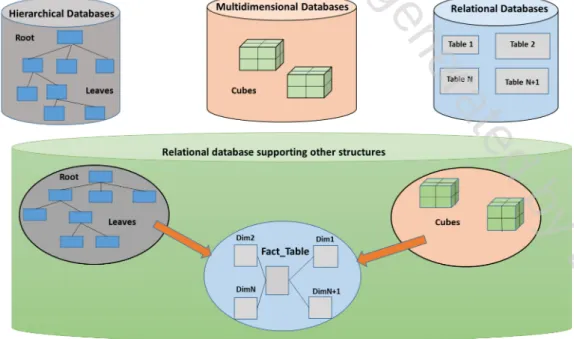
In this section some types of DBMS's are analysed that appear suitable for storing DPM and XBRL documents. Only those databases are considered where, in a previous study, it seemed possible to store the DPM and to extend XML or XBRL documents.
Figure 1 — Different types of DBMS's