Modernization Solution for Legacy Banking System
Using an Open Architecture
Constantin Marian MATEI
Faculty of Economic Cybernetics, Statistics and Informatics Academy of Economic Studies, Bucharest, Romania
Banks are still using legacy systems as the core of their business is comprised within such sys-tems. Since the technology and client demands are changing rapidly, the banks have to adapt their systems in order to be competitive. The issue is to identify correctly what are the bank users preferences in terms of software reliability and how modern is the system For instance, there are users who enjoy working using the old screen format, and there are users who enjoy working with newer layouts, Web interfaces, and so on. We need also to know the constraints generated by the usage of legacy systems, and how these systems can be improved or re-placed. The scope of the article is to present a solution of modernizing a legacy banking sys-tem by using a SOA approach. The research is based on the modernization of a legacy syssys-tem developed in COBOL/400 under IBM iSeries. The modernization process uses a SOA ap-proach using JAVA technologies.
Keywords: Legacy Systems, Architecture, Services, Front Office, Back Office, Server,
Mes-sage Queue, SOA
Introduction
One of the big dilemmas of the banking CIOs is “Are we going to change the existing systems with more scalable ones?” If yes, are we able to cover the costs?”
This dilemma it has another constraint relat-ed to the fact that new players in the banking world have already new opened platforms which permits applications for 24 hours online banking, internet banking, mobile banking and so on.
The reason why the legacy systems are sur-viving is that the costs and risks to replace them are high enough and a system proprie-tary can run into a bankruptcy if the change will occur. There is also another reason relat-ed to the business logic. The applications were developed started with the 70’s and were progressively adapted to the business demand. Thus, the business logic coded into the systems is very complex and can lead to a high risk of failure in case of replacement. In 2008 a TowerGroup analyst said that there is a pressure coming not only from the tech-nology itself, but also from the business point of view. [1] Competitors are using new open architectures capable to do smart reports, da-ta mining, and, why not, to integrate with
platforms like tablets, notebooks and smart phones. This increases the speed of conclud-ing a business and also offers a better system for decision making process.
Since these issues were raised by the busi-ness and technical communities, large com-panies have developed open architecture based on services, like SOA. Moreover, these providers are offering solutions based on cloud computing.
The question now is if the banks have to cre-ate from scratch new systems, to buy prod-ucts from various vendors or to modernize existing legacy systems.
To be able to respond to this question we need to know the constraints generated by the use of the legacy systems [2]:
- legacy systems were designed for the im-mediate needs and they weren’t planned to be active for too many years (more than 15 years);
- these systems were built under some con-straints (for instance low cost, resource availability, and so on);
- existing systems attributes such as: com-plexity, commercial components, business objectives [3].
Rewriting the application is expensive (time
consuming), and also risky (a lot of defects may appear during acceptance testing, and more important, the business might change during development). The advantage consists in the fact that the bank can have a software application built to meet its specific require-ments. [4]
Second option consists in the acquisition of commercial off-the-shelf (COTS) systems, which are ready to use and need to be cus-tomized for the bank own business. The risks consist in the maintenance of such products, as the costs for modification are usually at higher rates. The advantages consist in the fact that the software is immediately ready to be used, SLA’s (Service Level Agreements) can be established for support services. Usu-ally SLA’s are response time (the third party support team is bound to respond in a certain amount of time to the banks requirement) and resolution time (the support team has to solve the incidents or tickets in a fixed period of time). If SLA’s are not respected then fines are perceived from the software provider. For COTS there is a risk of implementing the
software package. In [5] there are identified two major risks of replacing existing system with COTS: the maintenance of the new sys-tem won’t be as familiar as the old syssys-tem; there is no guarantee that the new system will work the same as the old one.
The last approach supposes the migration of the legacy system to a SOA environment which is more flexible. Moreover the origi-nal’s system data and functionality will be kept. There are multiple choices to do this migration, out of which we mention the au-tomatic transformation with tools like IBM Rational HATS (Host Access Transformation Services), the usage of Model View Control-ler (MVC) patterns like SPRING, JSF (Java Server Faces), or new approaches like Model View Presenter (MVP) patterns (C#, Vaadin – open source framework with Apache li-cense).
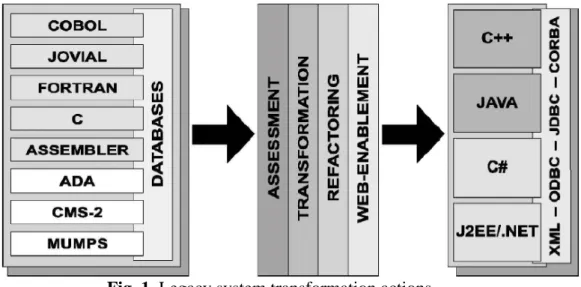
The common point of these approaches is that each time a legacy system is changed the following actions are taken into considera-tion: assessment, transformation, refactoring, web-enablement [6]:
Fig. 1. Legacy system transformation actions The present article scope is to present a
mod-ernization solution based on an open archi-tecture, using SOA principles and MVC pat-terns.
2 Define the problem
In the process used to define the problem we considered the following working configura-tion: the legacy system is a core-banking
sys-tem developed on IBM iSeries (in COBOL language); there is already a middle tier sys-tem used to connect the core-banking to dif-ferent front-offices based on specific web services developed using J2EE technology. We will use a Cash Deposit creation type of transaction. This type of transaction supposes that a bank operator based on specific data will create a cash deposit for a certain entity
(legal person or physical person).
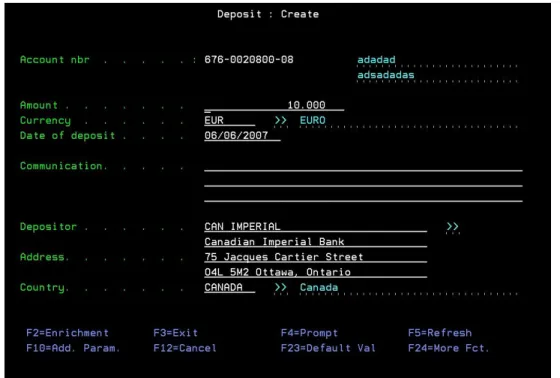
The below picture displays the actual iSeries
screen for the Create Cash Deposit option:
Fig. 2. Create Cash Deposit screen This is a simple screen, but still it has the
disadvantage of the limited display options. The middle tier system mentioned before it has an architecture which permits the con-nectivity of various extern platforms to the
back-office system. For instance SWIFT platforms or specific Online Banking appli-cations are using the middle tier to send business requests to the back office.
Middle Tier System on Websphere Application Server 6.1 or 7.0 . . . . . . . . . . Web Service 1 (example: Cash Deposit creation) Web Service n
Back-office system on iSeries
. . . . . . . . . . COBOL batch program 1 (example: Cash Deposit management) COBOL batch program n PCML file PCML file COBOL Interactive program 1 COBOL Interactive program n Is derived from Is derived from External data received through MQ Series, JMS , SWIFT plug-in
Fig. 3. Existing legacy system architecture The main disadvantage of this kind of
archi-tecture is that the presentation layer of the back-office is still a 5250 screen for iSeries or a 3270 for Mainframe, with the same func-tionalities and rigid display. This type of dis-play is no longer attractive for the clients, as
we have to take in account that there is a new generation of end-users with more technolog-ical knowledge and abilities.
There are some problems of costs as well. As described in [7] we can calculate the com-plexity of a system based on the number of
interfaces used in building that system and the number of transactions processed. The complexity of this system would be around 166.7%, which is higher comparing to anoth-er type of architecture based on direct call to the iSeries DB2 embedded database.
There is also an advantage point of view which must be considered: the business logic of the COBOL programs is kept. The cost will be translated as the amount of time of converting an existing interactive screen into a batch one. For instance, for a screen having six input fields (like the one in Fig.1) the conversion time is one man-day. This time comprises activities such as: delete the links to the screen file; suppress the field indica-tors and function keys usual behaviors.
Based on above information the issue is that the system has an old display which is inflex-ible and is not attractive for new clients. 3 Describe the solution and the results ob-tained
The solution proposed further is based on a function by which we measure the perfor-mance of the system and the marketability factors.
System performance function: is a derived function from the complexity indicator [7]
and the number of business transactions pro-cessed in the same amount of time and for the same technical architecture. In our case, the WebSphere 6.1 server was running on a Windows 2003 Server machine with 2 GB RAM dedicated for the application server. We will use the notations: CP for Complexi-ty, tcreate_transaction for time to complete a
trans-action, Tx for number of transactions and tload_system
The function is described below as:
for time to load the application on the server.
System performance (SP) = CP * Tx * t
This means that for a system with a high complexity and a large number of transac-tions processed in a constant time, the per-formance is also high.
create_transaction/tload_system
Marketability factors take in account attrib-utes of the solution such as:
How much flexible is the new screen in terms of introducing data, field validations and error message display?
What is the possibility to connect other ap-plications to the system?
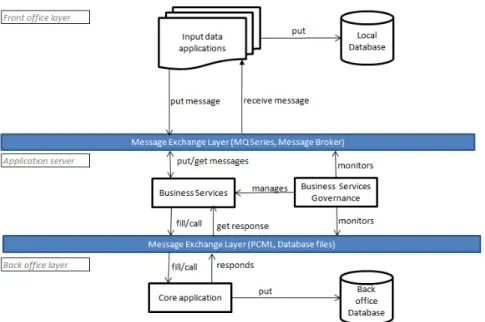
To what extent the new interface is easy to learn compared with the existing interface? The solution proposed hereunder is based on the following schema:
Fig. 4. Solution architecture Each layer in the picture above has its own
scope in the system:
Front office layer purpose is to collect the da-ta
Application server layer has the services dis-patcher role
Back office layer has the business logic man-agement role.
Beside the layers presented above we have 2 message layers. These layers are used for the exchange of messages between all other business layers.
From a technical point of view the technolo-gies involved in this solution varies based on each layer:
- front office: Java Server Faces (JSF), Ja-va Server Pages (JSP);
- first message layer: Java Message Ser-vice architecture managed through Spring framework;
- application services layer: Java Enter-prise Edition (JEE), EnterEnter-prise Service Bus (ESB), Web Services;
- second message layer: Program Call Markup Language (PCML), Program Call Beans;
- back office layer: COBOL batch pro-grams derived from interactive screens. Below there are presented in several images the results of implementing the solution de-scribed above. We will present the screens with the most importance in the application. The front-office layer is actually a GUI ap-plication able to load data into the message layer and to transport them further to the back-office (via the application services lay-er). It has usual functionalities like: login page, authentication, transaction creation and visualization. The technology used to build the GUI is mainly based on JSF:
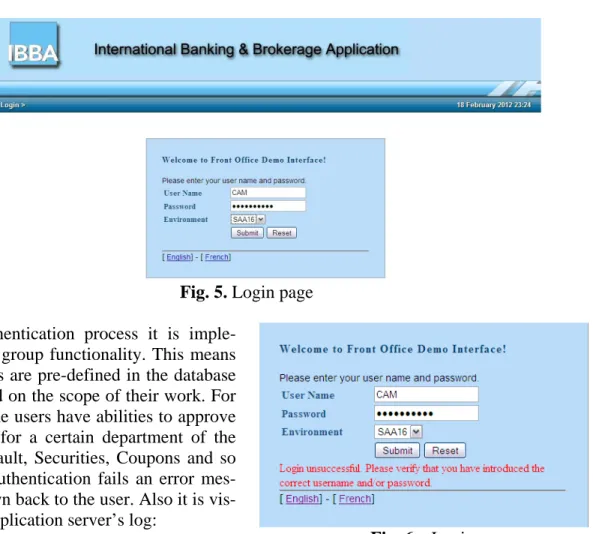
Fig. 5. Login page For the authentication process it is
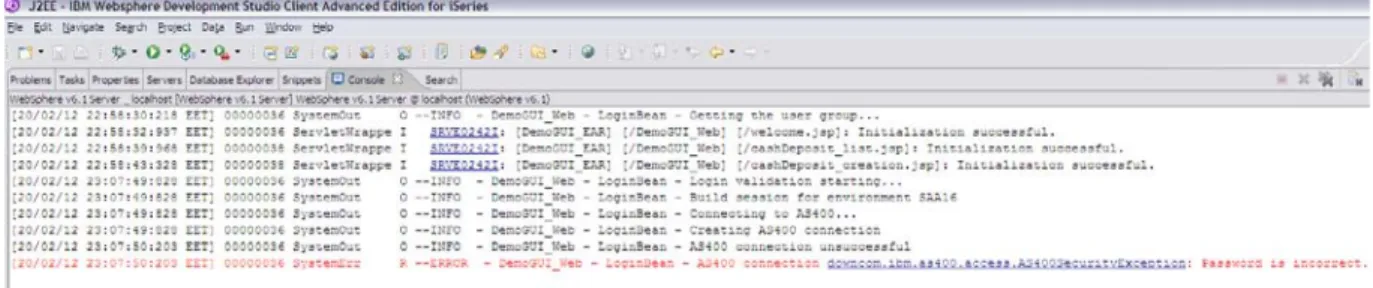
imple-mented user group functionality. This means that the users are pre-defined in the database system based on the scope of their work. For instance some users have abilities to approve transactions for a certain department of the bank (i.e. Vault, Securities, Coupons and so on). If the authentication fails an error mes-sage is thrown back to the user. Also it is vis-ible in the application server’s log:
Fig. 6b. Error management on the server side After the login succeeds, a welcome page is
loaded. From the menu in the left side we can choose either to close the session or to go to
the transactions directory. The user who logged in the system can access only the transaction he/she owns.
Fig. 7. Welcome page The transaction directory contains valuable
information, not only related to the business data (id, accounts, amounts, currency, de-positors, creation date), but also to the tech-nical data (status, author). All these data can
be sorted. The Status column is very im-portant at it is showing the actual processing of the transaction. For instance “Sent to JMS” means that the transaction is in the Message Queue but still not processed.
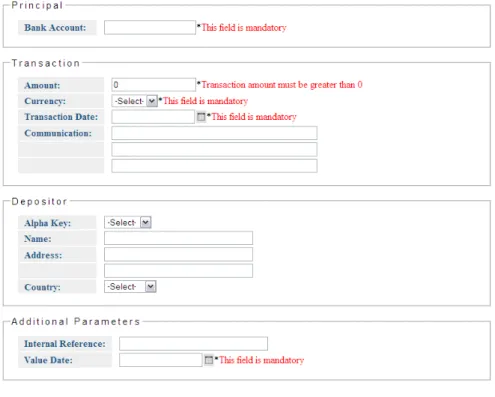
Fig. 8. Transactions directory During the creation process the validation is
made only for the fields (GUI validation). The business validation is made by the
COBOL programs called by the server layer in a asynchronous mode.
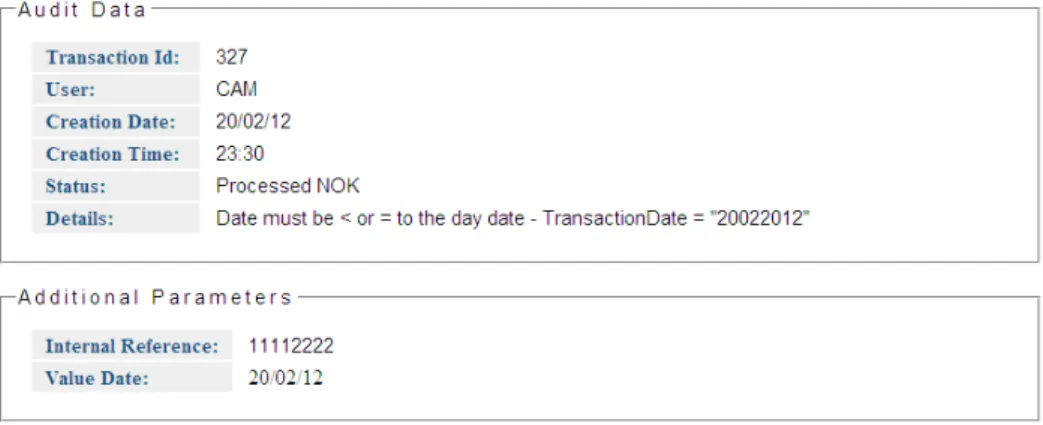
Fig. 9. GUI validation If we introduce the data displayed below, we
will obtain a business error message saying
that the date should be less or equal with the back-office date:
Fig. 10b. Audit data for the transaction launched in creation process The server response contains XML messages
which actually will be displayed into the GUI application. The results of the transaction creation process are to be found on the iSeries machine. For the transaction created
above, below there are the correspondence within the system developed in COBOL on iSeries. Figure 11 is showing the directory of all transactions new created or already exist-ing.
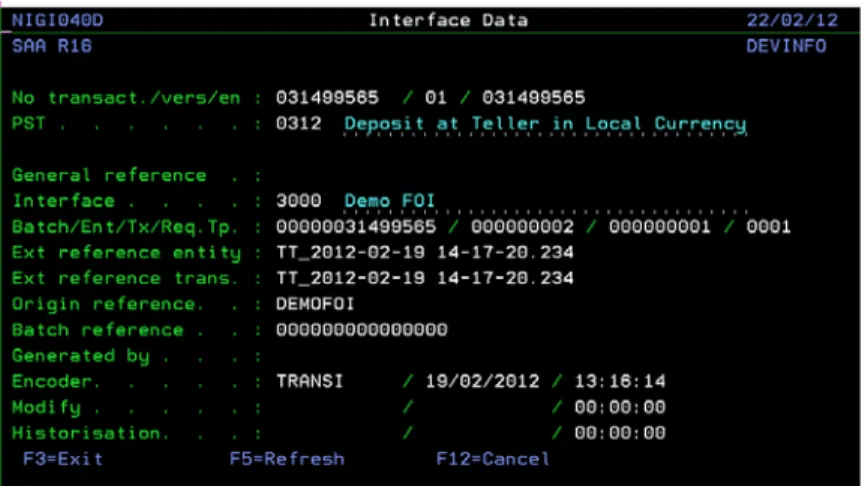
Fig. 11. Transaction directory The Figures 12 and 13 are displaying the
transaction’s technical details, respectively
the interface details (contains information re-lated to the data received from Java).
Fig. 14. Interface details When calculating the System performance
(SP) indicator we took in consideration the time used to create one transaction (from the moment the transaction was confirmed and the status changed from “Sent to JMS” into “Processed OK”). This lead to around 30 se-conds duration. For the Cash Deposit product there will be only one transaction created at a time. The time to load the system is around 10 minutes for the iSeries session and the ap-plication server (alone 7 minutes to load). All these data are leading to an SP off 8,3%. This poor compared with the same indicator cal-culated for a system having only the iSeries display. It takes around 2 minutes to load the iSeries interface. The time to create a trans-action is similar when using the JAVA inter-face. This leads to an SP off 33%. Out of cal-culation it seems that a wise idea is to keep the old interface.
Then we have to answer the question: what are other particularities which will require a change of the existing interface? The answer would be the marketability gain. As men-tioned before we identified three attributes of a banking system which make it more attrac-tive for the business: flexibility, connectivity and learning ability.
The three layers solution compared with the old interface is more flexible. For instance we are able to have more fields in one screen, while on the iSeries interface you are limited to maximum 27 rows per screen. On the GUI application we are able to add CSS (Cascad-ing Style Sheets) in order to improve the
vis-ual effect of the application, while the COBOL screens have mostly the same for-mats.
From the connectivity point of view the GUI application is a Web application. Thus, it can be accessed from anywhere within the Inter-net (of course based on credentials managed within the Login module). The iSeries appli-cation can be accessed only from the iSeries server and using specific tools for connectivi-ty securiconnectivi-ty clearance (like TOX and SOCKS clients).
Since the Internet developed so rapidly, the Web applications are used at a large scale. This makes more easy the job for the solution we proposed, as it is developed taking in ac-count the current technological features and tendencies.
4 Conclusions
Due to the rapid development of software and hardware technology the banking busi-ness tries to be in line with the new tenden-cies. Banks focuses on changing the legacy applications with newer software products. But how much will this process cost the banks?
The present article proposes a solution based on interconnecting legacy system with new interfaces through Web Services. Of course, we have to keep in mind the performance of the new system and also the marketability factors. These aspects influence the decision making process of the banks.
As we saw in the article, from the perfor-mance point of view a modernization solu-tion can be slower than an old interface. But how long can we consider this aspect as an advantage? In banks the end-users are either people who worked for decades on legacy platforms, or employees with junior skills who are more used with new interfaces (like Web applications, even more with socializa-tion networks). From this point of view a modern application has more value added for the bank business. Moreover, using the mod-ern technologies we are able to do baking by Internet, Cloud computing or even more from a tablet PC or a smart phone. The presenta-tion layer is such important as it never had been before the years 2000.
The solution proposed is based on an open architecture which makes the application to be scalable, flexible, easy to maintain. The business logic is maintained within the lega-cy system and only the presentation layer is changed. Thinking on a long term basis, the presented approach is helpful as the mainte-nance effort is lower due to the fact that the business logic is separated from the presenta-tion layer. The presentapresenta-tion layer is enough flexible, thus, if we want to change the page style in order to look more attractive, it would be easier to do it. In this manner we don’t have to change the business logic. The reverse is also true, meaning that when we change the business logic, we don’t have to change the presentation layer.
The research will continue in the idea of modernizing legacy systems, by involving specific tools capable to do transformations of iSeries screens into Web pages. The result will be compared with the solution presented within this article in order to establish if we can use a combined architecture of these, or to use a single solution to do a generic mod-ernization.
References
[1] J. Goldsmith, Bank CIOs face legacy
systems dilemma, June 2007
http://www.silicon.com/management/cio- insights/2007/06/06/bank-cios-face-legacy-systems-dilemma-39167376/. [2] M. W. Chowdhury and M. Z. Iqbal,
“In-tegration of Legacy Systems in Software Architecture,” SAVCBS 2004 Specifica-tion and VerificaSpecifica-tion of Component-Based Systems,
http://www.eecs.ucf.edu/SAVCBS/2004/ . [3] R. C. Seacord, D. Plakosh and G. A. Lewis, “Modernizing Legacy Systems: Software Technologies, Engineering Pro-cesses, and Business Practices,” Carnegie Mellon Software Engineering Institute, ISBN 0-321-11884-7, February 2003. [4] A. A. Almonaies, J. R. Cordy, T. R.
Dean, Legacy System Evolution towards Service-Oriented Architecture, http://research.cs.queensu.ca/home/cordy/ Papers/ACD_MigToSOA_SOAME10.pdf .
[5] S. C. Dorda, K.C. Wallnau, R.C. Seacord and J.E. Robert, “A Survey of Black-Box Modernization Approaches for Infor-mation Systems,” Proceeding ICSM '00 Proceedings of the International Confer-ence on Software Maintenance (ICSM'00), IEEE Computer Society Washington, DC, USA ©2000, ISBN:0-7695-0753-0
[6] P. Newcomb and R. A. Doblar, “Auto-mated Transformation of Legacy Sys-tems,” CrossTalk: The Journal of Defense Software Engineering, December 2001, https://www.softwarerevolution.com/v2/fy les
[7] C. M. Matei, “Services Used to Integrate Banking Front Office Applications,” Open Source Science Journal, Vol. 2, No. 3, 2010 http://opensourcejournal.ro/2010-
Volume02/number03/paper002-fullpaper.pdf
Constantin Marian MATEI has graduated the Faculty of Cybernetics, Sta-tistics and Economic Informatics in 2005. He holds a Masters degree in IT Systems for Managing Economy Process (SIMPRE). He held positions as technical team leader, software configuration controller and software devel-oper. Currently, he is project manager in banking field and Mainframe
Prac-tice Area Leader within IBM Romania. Also, he is PhD student enrolled in a PhD programme on Computer Science in Economics. His key skills refer to the following: project manage-ment, leadership, business managemanage-ment, banking, coaching and mentoring, IT&C specialist in business oriented software development and maintenance.