Grappling with the oral skills:
The learning and teaching of the
low-literate adult second language learner
Published by
LOT phone: +31 30 253 6111
Trans 10
3512 JK Utrecht e-mail: [email protected]
The Netherlands http://www.lotschool.nl
Lay-out: Carolus Grütters, Nijmegen Cover illustration: Susanna Strube, Leiden
ISBN: 978-94-6093-146-8 NUR 616
Grappling with the oral skills:
The learning and teaching of the
low-literate adult second language learner
Proefschrift
ter verkrijging van de graad van doctor
aan de Radboud Universiteit Nijmegen
op gezag van de rector magnificus prof. mr. S.C.J.J. Kortmann,
volgens besluit van het college van decanen
in het openbaar te verdedigen op woensdag 27 augustus 2014
om 14.30 uur precies
door
Susanna Maria Petronella Strube
geboren op 24 februari 1946
Prof. dr. R.W.N.H. van Hout
Copromotor
:
Dr. C.D. van de Craats
Manuscriptcommissie
:
Prof. dr. P.A.J.M. Coppen (voorzitter)
Dr. J.J.H. Kurvers (Universiteit van Tilburg)
Preface
When I started teaching Dutch as a second language in 1993 to immigrants from Turkey and Morocco, the school of adult education where I taught was very active in training its teachers on the cultural differences of our learners and their learning difficulties. As I knew little of the target group and even less about their learning, all this new information enthralled me, particularly works by Geert Hofstede of 1991 (Allemaal andersdenkenden: Omgaan met cultuurverschillen [All kinds of thinkers: Dealing with cultural differences]), Sanneke Bolhuis, 1995 (Leren en veranderen bij volwassenen: Een nieuwe benadering, [Learning and changing in adults: A new approach], 1995) about the influences of cultural differences on learning, and in the field of learning to read the somewhat controversial book by Frank Smith of 1985, Reading. These were exciting times. Materials development was at its beginning stages and government policies to promote learning were just emerging. Soon I was given the opportunity to develop a Dutch as a second language course for the low-educated learner (Het Begin: Een introductie-cursus Nederlands als tweede taal voor gealfabetiseerde beginners [The beginning: An introduction course Dutch as a second language for literate beginners],1999.) The new immigration law of 1998 was on its way and the urgency to learn Dutch was becoming a fact. Not long after the publication of Het begin, my fellow literacy colleagues were also requesting a communicative and functionally based course book for their students. In 1998 Van Start [At the start] was completed.National developments continued in the field of Dutch as a second language. In spite of the fact that government regulations were prescribing course contents, and would continue to do so in an even more stringent fashion in the future, teaching of Dutch as a second language was not officially recognized as a profession with legal rights and privileges, as was teaching of English or French in the secondary schools. A puzzling stand to take when hundreds, even thousands of immigrants were, and would be, required by law to learn Dutch. To bridge this gap in government policy an association for the profession of teachers of Dutch as a second language was created in 2004. Within this organization several committees were established, each with specific tasks. Seeing that literacy was strongly neglected in policy, I soon set up the second language literacy committee within the association. Yearly or bi-yearly study days were organized to fulfil teachers’ hunger for information and knowledge. The themes of these study days transformed from a positive attitude of ‘sorely needed’ to one of
‘dropping in or dropping out’ and then “a search for justification’ and finally, with the hope of still being able to answer to the requirements of the government ‘making the best of it’. The law of 2007 with new additions in 2013 has made it virtually impossible for non-literates to attain a recognized level in Dutch as a second language. It was during these last years that I was encouraged to commence on a journey into the learning of the non-literate in the classroom. That journey now has culminated in the dissertation before you. As some have said, perhaps a step too late. Perhaps for these students and teachers it was, but nevertheless I hope worthwhile insights have been gained. These insights can contribute to knowledge about second language learning in general and in particular that of the non-literate learner. Another encouraging development that took place shortly after the founding of the second language teachers association was the founding of LESLLA, an international network of all those who are professionally interested in Low-Educated and Second Language and Literacy Acquisition. The goal of the LESLLA is to share research findings and teaching experiences on second language and literacy acquisition of the low-literate and low-educated adult population. This exchange in information will in turn hopefully provide guidance for the development of a sound educational policy in all those countries in which these immigrants settle. Within this organization, meeting yearly alternately in Europe and outside of Europe, I was able to vent my ideas regarding my classroom research.
A project such as this would never have been possible without the knowledge, support, understanding, and friendship of many around me. In the first place I must thank Ineke van de Craats. It was Ineke who installed in me the very idea of doing a doctoral research project. Without her belief in my capabilities and scholarship I would never even have considered it. Then, returning to my alma mater, Radboud University, it was Roeland van Hout who steered me through to the end. His acute perception of the subject matter, patience, and above all, support in guiding me have been tremendous. I have thoroughly enjoyed, though sometimes at my wits’ end, our regular (almost every six weeks) tripartite sessions. I am grateful to have been given this opportunity.
This research project would never have started if I had no classes to study. The students followed their literacy trajectory at departments for adult education located in schools for secondary vocational education, in Dutch the ROCs. It was in these schools that this research project unfolded. The various schools I have visited and the many teachers I have exchanged ideas with were most stimulating. I was very fortunate to have been welcomed into numerous literacy classes and in particular the final six selected classes. I particularly admire these teachers for their far reaching enthusiasm and interest in teaching their literacy students. Even in view of obstacles as
mixed level classes, continuous registration, stringent regulations, and insufficient educational support, these teachers continued to adapt, construct, and again reconstruct a positive learning environment. In sharing with me their insights, teaching objectives, and concerns my knowledge and understanding of these students have grown enormously. Thank you so much Stance Beelen, Khadjia Bekkali, Loes van den Bergh, Liesbeth Blokker, Martha Heinrichs, and Bette Kaspers. This thank you is also extended to all the students who have without reserve participated in the assessments and have allowed me to sit in during the lessons to listen and observe classroom happenings. At the same time I extend my thanks to the schools of adult education where all of this took place. They were most hospitable in allowing me to approach the teachers for this research and giving me access to administrative records of the students enrolled. Thank you ROC Amsterdam, ROC de Leijgraaf, ROC Midden Nederland, ROC Nova College, and ROC Rijn IJssel. Now, at the close of this research in 2014, literacy courses might even move to the open market, as has been the case for the literate L2 students. Schooling for the low-literate adult L2 learner has become a commercial commodity. Nevertheless, teachers still have to teach and learners still have to learn.
I was fortunate to have been admitted to the LOT publications. Their guidance has relieved me of a lot of hassle connected with publication. Nevertheless, I am especially indebted to Carolus Grütters for the making of the index and creating the lay-out as well as to my son, Derk Venema, for his advice and encouraging words.
As every researcher will say, research means investing time, a lot of time. This time cannot be invested if the home front is not there to give the necessary support – support in the mundane, as well as in the spiritual. A mere thank you is not enough. I had to cut corners when there was a need for a helping hand. And even at Christmas time when a pork roast had to substitute the traditional turkey, I was forgiven. A special thank you is extended to my two paranymphs Marjolijn Venema and Marja Venema-Walraven. Both have contributed by performing as proof readers for the Dutch text, a B&B, and as a sounding board for all my silly ideas. These additions have enriched my journey to completion. And last, but certainly not least there is my husband Dick. He is the one who was stuck with most of the cooking and grocery shopping these past few years, and he even found time to proofread the whole dissertation. He has been my pillar of support.
Table of Contents
Preface ... i
List of Tables ... ix
List of Figures ... xiii
Abbreviations and transcription codes ... xv
CHAT transcription codes ... xvi
Chapter 1 Setting the scene ... 1
1.1 Defining the problem ... 2
1.2 Outline of the study ... 7
Chapter 2 Historical and theoretical framework ... 11
2.1 A look into the past ... 11
2.2 Highlights in literacy development ... 23
2.3 LESLLA research ... 25
2.4 Classroom research ... 27
2.4.1 Classroom observation ... 28
2.4.2 The IRF exchange structure ... 33
2.4.3 Communicative competence and the COLT observation scheme ... 35
2.4.4 Corrective feedback ... 38
2.5 Classroom pedagogical practices ... 42
2.6 Summary ... 43
Chapter 3 Selection process ... 45
3.1 Survey ... 45
3.1.1 Distribution of the survey and the response ... 45
3.1.2 Results ... 46
3.1.2.1 Student intake ... 46
3.1.2.2 The pre-program ... 48
3.1.2.3 The literacy curriculum ... 48
3.1.2.4 Testing practices ... 54
3.1.2.5 Class size and distribution ... 55
3.1.2.6 The literacy teacher ... 57
3.2 Selection criteria ... 58
3.3 Selected schools and classes ... 58
4.1 The setting ... 61
4.2 The curriculum ... 64
4.2.1 School records ... 64
4.2.2 Student placement ... 68
4.2.3 Classroom program organization ... 68
4.2.4 Instructional materials ... 70
4.3 The literacy students ... 71
4.3.1 Class 1 ... 72
4.3.2 Class 2 ... 73 4.3.3 Class 3 ... 75 4.3.4 Class 4 ... 77 4.3.5 Class 5 ... 79 4.3.6 Class 6 ... 814.4 The literacy teacher ... 82
4.5 Characterizing the classes ... 83
Chapter 5 Classroom data ... 91
5.1 Data collection ... 92
5.1.1 The classes and the teachers ... 92
5.1.2 Observation Scheme A ... 93
5.1.3 Observation Schemes B and C ... 93
5.2 Observation procedure ... 96
5.3 Transcription process ... 97
5.4 Observation Scheme A: Classroom instructional organization ... 98
5.4.1 Content focus ... 99
5.4.2 Participant interaction ... 100
5.4.3 Participant organization ... 100
5.4.4 Materials ... 101
5.5 Observation Scheme B: Classroom instructional interaction ... 101
5.6 Observation Scheme C: Classroom corrective feedback ... 104
Chapter 6 Learner data ... 109
6.1 Development of the pre- and post-assessments ... 110
6.2 Testing procedure ... 113
6.3 The assessment tasks ... 114
6.3.1 Vocabulary tasks ... 114
6.3.2 Picture description tasks ... 115
6.3.3 Picture story tasks ... 116
6.4 Evaluation criteria vocabulary ... 117
6.4.1 Specific vocabulary ... 118
6.4.2 Word count ... 118
6.5.1 Evaluation criteria of the syntax ... 121
6.5.2 Evaluation criteria of the verbal morphology ... 124
6.6 Discourse ... 126
6.6.1 Evaluation criteria of picture relevance ... 127
6.6.1.1 Defining relevance ... 127
6.6.1.2 Measuring relevance ... 130
6.6.2 Criteria of coherence ... 135
6.6.2.1 Defining coherence ... 135
6.6.2.2 Measuring coherence ... 137
Chapter 7 Results classroom data ... 141
7.1 Observation scheme A: Classroom instructional organization ... 141
7.1.1 Time management ... 142
7.1.2 Content focus ... 147
7.1.3 Participant interaction ... 154
7.1.4 Participant organization ... 157
7.1.5 Materials ... 160
7.1.6 Comparing the classes ... 162
7.1.7 Observations on classroom organization ... 165
7.2 Observation scheme B: Classroom instructional interaction ... 167
7.2.1 Teacher initiation ... 167
7.2.2 Student responses ... 173
7.2.3 Teacher feedback ... 177
7.2.4 Restricted discourse practice ... 184
7.2.5 Student initiation and feedback ... 190
7.2.6 Comparing the classes ... 194
7.2.7 Observations on classroom interaction ... 197
7.3 Observation scheme C: Corrective feedback ... 197
7.3.1 Student trigger ... 198
7.3.2 Teacher corrective feedback ... 201
7.3.3 Student uptake ... 209
7.3.4 Comparing the classes ... 215
7.3.5 Observations on correction feedback ... 217
7.4 Classroom didactic framework ... 218
7.5 Conclusions ... 222
Chapter 8 Results learner data ... 227
8.1 Vocabulary ... 227
8.1.1 Specific vocabulary ... 227
8.1.2 Word count ... 230
8.1.2.1 Tokens ... 230
8.2 Morphosyntax ... 234
8.2.1 Syntax ... 234 8.2.1.1 Constituents ... 235 8.2.1.2 Verb presence ... 237 8.2.1.3 Verb position ... 239 8.2.1.4 Agent present ... 240 8.2.2 Verbal morphology ... 241 8.3 Discourse ... 243 8.3.1 Picture relevance ... 2448.3.1.1 Picture description tasks ... 244
8.3.1.2 Picture story tasks ... 247
8.3.2 Coherence ... 249
8.4 Underlying competences ... 251
8.5 Learner characteristics ... 258
8.6 Classroom characteristics ... 260
8.7 Conclusion ... 262
Chapter 9 Conclusions and discussion ... 265
9.1 Research question 1 ... 266
9.1.1 Program type ... 266
9.1.2 Allocation of classroom time ... 269
9.1.3 Participant organization ... 270
9.1.4 Conclusions ... 271
9.2 Research question 2 ... 271
9.2.1 IRF exchange structure ... 271
9.2.2 Corrective feedback ... 273
9.2.3 Didactic framework ... 275
9.2.4 Conclusions ... 276
9.3 Focus on the LESLLA classroom ... 276
9.4 Conclusions ... 277
References ... 279
&ited course materials, tests, and textbooks ... 297
Consulted internet sources ... 299
Picture credits ... 299
Appendix 1:Assessment tasks ... 301
Appendix 2: Minimal distinctive elements ... 307
Dutch summary ... 311
Index ... 323
List of Tables
Table 2:1 Illiteracy in Turkey and Morocco in 1971 (in
percentages) ... 15
Table 2:2 Literacy rates in the country of origin in 1971 and 2011a ... 21
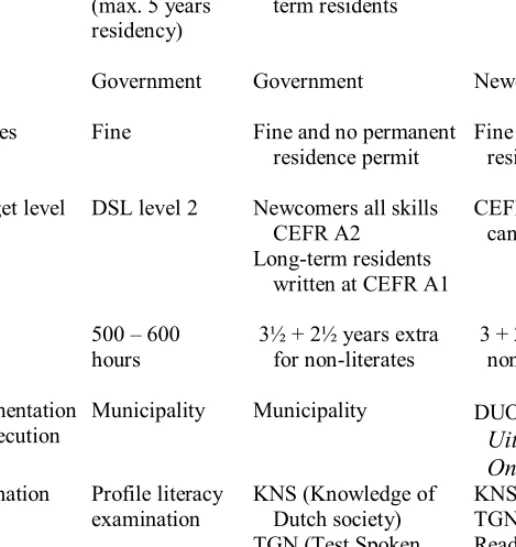
Table 2:3 The three integrations acts compared. ... 23
Table 2:4 Overview of types and aims of corrective feedback ... 40
Table 3:1 Authorities and duties in student registration ... 47
Table 3:2 Frequency of placement in literacy classes ... 48
Table 3:3 Programs offered for literacy students ... 49
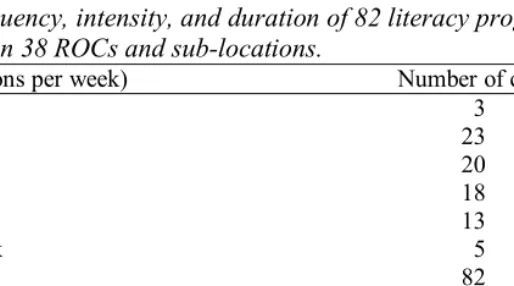
Table 3:4 Frequency, intensity, and duration of literacy programs ... 50
Table 3:5 Implementation of oral skills courses and NCB materials ... 53
Table 3:6 Use of extra materials ... 54
Table 3:7 Testing practices ... 54
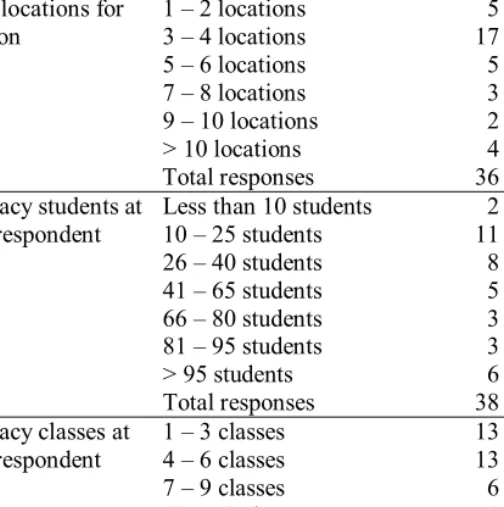
Table 3:8 Size and distribution of literacy classes ... 56
Table 3:9 Teacher profile in L2 literacy education ... 57
Table 3:10 Overview of the selected classes ... 59
Table 4:1 Factors noted in the school records ... 64
Table 4:2 Literacy curriculum for the six classes ... 70
Table 4:3 Student characteristics for Class 1 ... 72
Table 4:4 Student DSL schooling history for Class 1 ... 73
Table 4:5 Student characteristics for Class 2 ... 74
Table 4:6 Student DSL schooling history for Class 2 ... 74
Table 4:7 Student characteristics for Class 3 ... 76
Table 4:8 Student DSL schooling history for Class 3 ... 76
Table 4:9 Student characteristics for Class 4 ... 78
Table 4:10 Student DSL schooling history for Class 4 ... 78
Table 4:11 Student characteristics for Class 5 ... 80
Table 4:12 Student DSL schooling history for Class 5 ... 81
Table 4:13 Student characteristics for Class 6 ... 81
Table 4:14 Student DSL schooling history for Class 6 ... 82
Table 4:15 Teacher profile ... 83
Table 4:16 Characteristics of the 41 assessed students ... 85
Table 4:17 Class composition in terms of length of residence, student age, and type of placement criteria ... 86
Table 4:18 Location and classroom facilities per class ... 87
Table 4:19 Scheduled classroom hours and attendance ... 88
Table 5:1 Number of lessons and hours observed and transcribed ... 92
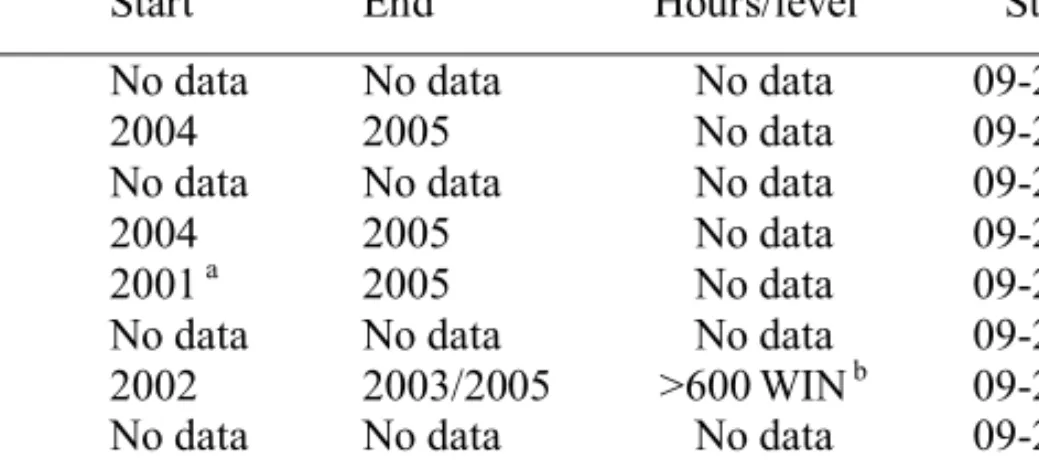
Table 5:2 Dates and time spans of lesson fragments analysed for Observation Schemes B and C ... 95
Table 5:3 Question types illustrated ... 103
Table 5:4 Types of triggers defined and illustrated ... 105
Table 5:5 Corrective feedback, defined and illustrated ... 106
Table 6:1 Relevance scores and minimal distinctive elements ... 131
Table 6:2 Relevance scores for entities and activates/properties. ... 132
Table 7:1 Allocated time in relation to lost time and instructional time ... 143
Table 7:2 Classroom time for content focus ... 147
Table 7:3 Classroom time for participant interaction ... 155
Table 7:4 Classroom time for participant organization ... 158
Table 7:5 Classroom time for use of educational materials ... 160
Table 7:6 The classes compared for time management and classroom organization. ... 163
Table 7:7 IRF exchanges and question types ... 168
Table 7:8 Total number of student responses ... 174
Table 7:9 Number of student responses during vocabulary, grammar, and URD practice. ... 175
Table 7:10 Total number of types of teacher feedbacks ... 179
Table 7:11 Overview of the types of RD practice. ... 185
Table 7:12 Total number of L2 student initiations and L1 responses during vocabulary, grammar, RD, and URD practice. ... 191
Table 7:13 Total number of student feedbacks during vocabulary, grammar, RD, and URD practice. ... 193
Table 7:14 The classes compared for classroom instructional interaction. ... 195
Table 7:15 The number of student triggers for phonology, lexicon, and grammar ... 199
Table 7:16 Frequencies of corrective feedback types ... 203
Table 7:17 Distribution corrective feedback types across error focus ... 208
Table 7:18 Distribution error focus corrective across feedback types ... 209
Table 7:19 Total distribution of student uptake ... 212
Table 7:20 Distribution of error type over uptake ... 214
Table 7:21 Distribution of corrective feedback types of across uptake ... 214
Table 7:22 The classes compared for corrective feedback.. ... 216
Table 7:23 ABCD-steps during the practice of vocabulary, grammar, and RD. ... 221
Table 7:24 Salient characteristics for classroom organization, interaction, corrective feedback, and the didactic framework. ... 223
Table 8:1 Mean number of correct responses for the vocabulary tasks. ... 228
Table 8:2 Number of correct responses for the vocabulary tasks by
class ... 229
Table 8:3 Number of tokens for picture description and picture story tasks by class ... 231
Table 8:4 Number of types for picture description and picture story tasks by class ... 233
Table 8:5 Number of constituents and verbs present ... 235
Table 8:6 Number of constituents in the picture tasks by class ... 236
Table 8:7 Mean percentages for verbs present in the picture description and picture story tasks ... 237
Table 8:8 Mean percentages for verbs present for the picture tasks by class ... 238
Table 8:9 Mean percentages for verbs in correct position by class ... 239
Table 8:10 Mean percentages for agent present in the picture task by class ... 241
Table 8:11 Distribution of finite and non-finite verbs ... 242
Table 8:12 Finiteness index and standard deviations by class ... 243
Table 8:13 Maximum scores for entities and activities/properties ... 244
Table 8:14 Mean scores for relevant entities and activities/properties for the picture description tasks. ... 245
Table 8:15 Mean scores for picture relevance for the picture description tasks by class ... 246
Table 8:16 Mean scores for relevant entities and activities/properties for the picture story tasks ... 247
Table 8:17 Mean scores for picture relevance for the picture story tasks by class ... 247
Table 8:18 Mean scores for horizontal and vertical coherence ... 249
Table 8:19 Mean scores for total coherence for the picture story tasks by class ... 250
Table 8:20 PCA factor matrices for eleven variables ... 253
Table 8:21 Z-score for lexical competence by class ... 254
Table 8:22 Z-score and standard deviation for syntagmatic competence by class ... 255
Table 8:23 Z-score and standard deviation for morphosyntactic competence by class ... 255
Table 8:24 Z-scores for lexical, syntagmatic, and morphosyntactic competence and the gain scores by class. ... 256
List of Figures
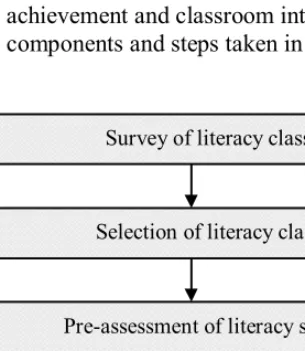
Figure 1:1 Components and steps of the present research project. ... 7
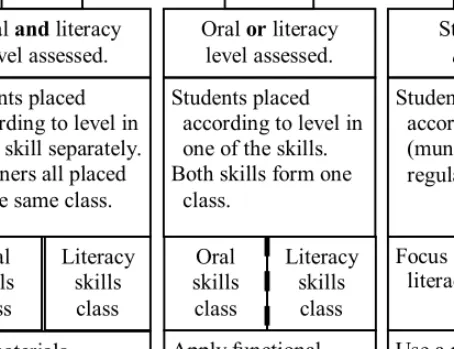
Figure 3:1 Program organization for the oral and literacy skills. ... 51
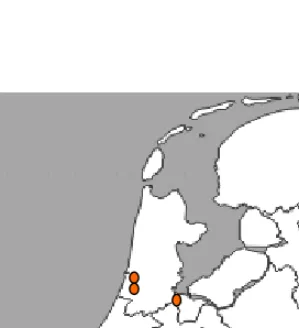
Figure 3:2 Map of the Netherlands with the six selected ROCs. ... 59
Figure 5:1 Observation Scheme A ... 98
Figure 5:2 Observation Scheme B ... 102
Figure 5:3 Observation Scheme C ... 104
Figure 6:1 Components and features analyzed in the pre– and post– assessments. ... 109
Figure 6:2 Pictures showing a detailed and a dimmed background ... 112
Figure 6:3 Pictures from the picture vocabulary task at two levels. ... 115
Figure 6:4 Three pictures from the picture description tasks 6, 7, and 8. ... 116
Figure 6:5 The three picture story tasks. ... 117
Figure 6:6 Three pictures from the picture description tasks 7 and 8. .... 125
Figure 6:7 Relevance illustrated in three pictures from description tasks ... 134
Figure 6:8 Relevance, and horizontal and vertical coherence, for picture story 1 ... 139
Figure 7:1 Categories of time management ... 142
Figure 7:2 Four types of classroom time in relation to total allocated time. ... 144
Figure 7:3 Five categories of content focus in relation to total engaged classroom time. ... 148
Figure 7:4 Four categories of participant interaction in relation to total engaged classroom time. ... 155
Figure 7:5 Three categories of participant organization in relation to the total engaged classroom time. ... 158
Figure 7:6 A pictograph taken from PICTO ... 159
Figure 7:7 The four categories of educational materials in relation to total engaged classroom time. ... 161
Figure 7:8 Distribution of question types during vocabulary practice .... 169
Figure 7:9 Distribution of question types during grammar practice ... 169
Figure 7:10 Distribution of question types during URD ... 169
Figure 7:11 Student responses for vocabulary ... 176
Figure 7:12 Student responses for grammar ... 176
Figure 7:13 Student responses for URD ... 176
Figure 7:14 Distribution of the eight categories of teacher feedback for vocabulary ... 181
Figure 7:15 Distribution of the eight categories of teacher feedback
for grammar ... 181
Figure 7:16 Distribution of the eight categories of teacher feedback for URD ... 181
Figure 7:17 Types of errors corrected for phonology, lexicon, grammar, and language use during vocabulary practice ... 200
Figure 7:18 Types of errors corrected for phonology, lexicon, grammar, and language use during grammar practice ... 200
Figure 7:19 Types of errors corrected for phonology, lexicon, grammar, and language use during URD ... 201
Figure 7:20 Distribution of five categories of corrective feedback for vocabulary. ... 204
Figure 7:21 Distribution of five categories of corrective feedback for grammar . ... 204
Figure 7:22 Distribution of five categories of corrective feedback for URD. ... 204
Figure 7:23 Distribution for uptake for corrective feedback during vocabulary practice ... 212
Figure 7:24 Distribution for uptake for corrective feedback during grammar practice. ... 212
Figure 7:25 Distribution for uptake for corrective feedback during URD by class. ... 213
Figure 7:26 Distribution of student uptake over the type of corrective ... 215
Figure 8:1 Box plot for vocabulary scores ... 230
Figure 8:2 Box plot for tokens ... 232
Figure 8:3 Box plot for types ... 234
Figure 8:4 Box plot for number of constituents ... 236
Figure 8:5 Box plot for verb presence ... 238
Figure 8:6 Box plot for correct verb position ... 240
Figure 8:7 Box plot for agent present ... 241
Figure 8:8 Box plot of verb inflection ... 243
Figure 8:9 Box plot for picture relevance for the picture description tasks ... 246
Figure 8:10 Box plot for picture relevance for the picture story tasks ... 249
Figure 8:11 Box plot for coherence for the picture story tasks ... 251
Figure 8:12 Pre- and post-assessment scores for lexical, syntagmatic, and morphosyntactic competence for each class. ... 257
Figure 8:13 Scatter gram of age of entry and lexical competence for recent and long- term residents. ... 260
Abbreviations and
transcription codes
Dutch English
A1 CEFR level Breakthrough
A2 CEFR level Waystage
ABCD-model
model for sequencing of classroom practices
CALL Computer-Assisted Language
Learning
CEFR Common European
Framework of Reference for Languages
CLT Communicative Language
Teaching
COLT Communicative Orientation
of Language Teaching
DSL Dutch as a second language
ENV En nu verder And now further
ESOL English for Speakers of Other
Languages
HBO Hoger Beroepsonderwijs Higher Professional Education
IAV Instaptoets Anderstalige
Volwassenen Entry test for speakers of other languages ICE Bureau Interculturele
Evaluatie
Bureau Intercultural Evaluation
IRF initiation-response-feedback
L1 first language
L2 second or foreign language
LESLLA Low-educated Second
Language and Literacy Acquisition for Adults
LOR length of residence
LSK life skills knowledge
MBO Middelbaar Beroepsonderwijs Secondary Vocational Education
NCB Nederlands Centrum
Buitenlanders
Dutch English
NT2 Nederlands als Tweede Taal Dutch as a second language
PCA Principal Component
Analysis OGO Portfolio Opvoeding,
Gezondheid, Onderwijs
Portfolio Childcare, Health, Education
OLC open learning center
RD restricted discourse
ROC Regionaal Opleidingscentrum Regional [educational] Training Center
SA Spreek actief! Speak actively!
SLA Second Language Acquisition
TPR Total Physical Response
UNESCO United Nations Educational,
Scientific and Cultural Organization
URD unrestricted discourse
VUT Vooruitkijken, Uitvoeren, Terugkijken
Looking ahead, Practicing, Looking back
WI Wet Inburgering Civic Integration Act
WIB Wet Inburgering Buitenland Civics Act Abroad
WIN Wet Inburgering
Nieuwkomers
Civics Integration Act for Newcomers
WRR Wetenschappelijke Raad voor het Regeringsbeleid
Scientific Council for Government Policy
CHAT transcription codes
+... trailing off
+..? trailing off of a question
+/. interruption
+/? interruption of a question
+//. self-interruption
+//? self-interruption of a question
[/] repetition
[/-] false start without repetition
INF infinitive
1SG first person singular 3SG third person singular
Chapter 1
Setting the scene
This book concerns the learning and teaching of the oral skills in Dutch as a second language (DSL). The learners involved are low-literate and non-educated adults in the Netherlands. Many of these adults were immigrants who came in the early years of the 1960s, and are now long-term residents1.Others, having entered not more than five years previous to this study, are recent arrivals. Some of these learners are already grandparents while others are young adults. What all of these learners have in common is their lack of schooling. Most of them have never been to school before entering the Netherlands. This means that they have not learned to read and write in their mother tongue. Normally, this would not affect their daily lives, were it not that in their new country of residence literacy is a normal phenomenon. For a learner with little or no formal education and no literacy skills in the L1, becoming literate in an L2 context is not a task to be taken lightly. The same applies to the teachers of such learners. The learning problems they encounter are numerous. In this sense, both parties grapple with either the learning or teaching of the L2. It is on this group of learners and teachers that the study presented in this book focuses.
Before continuing, a clarification of terminology is necessary. Foremost stand the terms illiterate, non-literate, literate, and low-educated. Although this study does not concern learning to read and write in the L2, being illiterate in the L1 does function as a key factor. In the proceedings of the LESLLA (Low-Educated Second Language and Literacy Acquisition for Adults) inaugural symposium of 2005, these terms are defined as follows:
Non-literate (or illiterate): an adult who never went to school and cannot read and write, neither in his/her first language, the standard language of the country of origin or the second language. Low-literate: an adult who has attended school, but who has a reading level below the average primary school level. Low-educated: an adult who has at most ten years of education in the country of origin. For many adult immigrants and refugees, this means at most primary education. (Van de Craats, Kurvers, and Young-Scholten, 2006, p. 8)
1 According to the European Union a long-term resident status is after five years of continuous legal residence. (http://europa.eu).
In the present study, these definitions are followed and, in referring to these learners, the acronym ‘LESLLA’ is used.
The second group of terms includes oracy and oral skills. Since this study focuses on oracy and the oral skills, a clarification of these terms is essential. Tarone, Bigelow, and Hansen (2009, p.7) define oracy as “the individual’s ability to use a set of oral language processing and production skills in communication.” In the present study, oracy is the ability to perform while the oral skills are the expression of that ability.
1.1 Defining the problem
In studies on the learning of the LESLLA learner in the classroom, the importance of the oral skills has been underfocused, but not undervalued. For these learners, arriving in the Netherlands with only an L1 oracy, the written word is not only unavailable as a support in their learning, but their command of the L2 oral skills is often very restricted. This means that their vocabulary and the intrinsic knowledge of sounds, words, and sentences are hardly adequate. Consequently, literacy students have a double handicap: learning to read and write while at the same time working on the oral skills in the same target language. Research, as well as teachers’ observations, has shown that, for the development of literacy skills, the oral skills must also be advanced (Lesaux & Geva, 2006). Bigelow, Delmas, Hansen, and Tarone (2006) asserted, “Lack of L1 literacy may affect not just the acquisition of L2 literacy, but also the use and acquisition of L2 oral skills” (p. 666). Kurvers and Van der Zouw (1990) stressed in their study on the development of literacy skills in intensive and non-intensive classes the importance of a strong oral language base for developing literacy skills. In a situation where the target language and the medium of instruction are the same, as in the Netherlands, a basic knowledge of the L2 is essential for two reasons. The first reason is to be able to comprehend classroom instruction and learning goals. With an inadequate knowledge of the language, giving instructions for exercises, and explaining vocabulary and grammar can be easily misconstrued or even not comprehended at all (Van de Craats, 2000). The second reason, particularly in the beginning stages, is the necessity of a basic lexicon to support learning to read and write. A limited vocabulary, in view of an understanding of the letter-to-sound correspondences, can function as a learning-retardant (Kurvers & Van der Zouw, 1990; Kurvers, 1996, 2003). At a later stage of literacy learning, limited vocabulary co-occurring with a restricted knowledge of the world, continues to hamper L2 development, as Geva (2006) confirms in her overview of L2 oral proficiency and L2 literacy studies, “oral language proficiency is consistently implicated when larger chunks of text are involved, whether in
reading comprehension or writing” (p. 139). Van de Craats, et al. (2006) argue that the oral skills form the basis for the learning of the written skills, in which vocabulary as well as syntax forms the primary determinants for successful literacy education – a stand also endorsed by Young-Scholten and Strom (2006). Van de Craats, et al. (2006) conclude that “low-educated learners have, for instance, more troubles in attaining a reasonable level of oral proficiency in L2 classes, their learning process is much slower and they seem to run the risk of fossilizing at an earlier stage of development” (p. 10). Simpson (2007) asserts that progress for literacy students with “no skills to transfer” (p. 209) is much slower than for students with literacy skills.
Such views were also voiced by literacy teachers. In the Dutch journal for literacy teachers, ALFA-nieuws, Van de Guchte (1997) 2
expressed the necessity of an intensive focus on the oral skills that runs parallel to the written skills program from the beginning (p. 9). The literacy teacher Van der Loop, Mi. (1998), endorsing the necessity of an oral skills base, explains that, with continuous enrollment, a program is needed with which the teacher can differentiate. When students are added to the class at irregular intervals, a learning gap in skill levels occurs. To compensate for this gap, her classes began with oral exercises based on the TPR3 concept.
She comments that even with oral skills support, the learning process of these students in the oral as well as the literacy skills are noticeably slow. Veth (2002) reports that Moroccan illiterate mothers of elementary school children in a special language program have a great desire to learn to speak Dutch, but their progression is slow. In response to a similar situation in Antwerp, Belgium, a special program was also developed for non-literate migrant mothers in which extra consideration was given for the learners’ very slow progress (Schuurmans, 2002). In 2004, a project group on stagnating learners published a report advocating that to enhance learning, more material geared toward low-literates for practising the oral and literacy skills is needed (Breed, 2004).
These observations show that the orals skills are not undervalued. Indeed, even materials developers have not underfocused the oral skills in their textbooks. In one of the first handbooks for teachers of L2 Dutch, the authors (Coumou, Jansen, & Oosterling, 1980) strongly advocated a focus on the oral skills in literacy courses, explaining that this is essential for forming a basis on which literacy training can be built, and moreover, for building 2 Van de Guchte (1996) is author of the popular reader for adolescent literacy
students Lezen doe je overal [Reading you do everywhere].
3 TPR (Total Physical Response) practice became known in the Netherlands through the publication of De Ru (1991) Nederlandse taal in actie: TPR werkboek [Dutch language in action: TPR workbook]. Her book was based on Asher’s work on total physical response (Asher, 1977).
basic communication skills, the latter being essential for social and economic integration. Soon the first comprehensive literacy course for the learning of the literacy skills was developed by the NCB.4 In this course, the oral skills
form an integral part. The course opens with an oral skills module, Een zekere woordenschat (A certain vocabulary) laying a foundation of 700 words for the literacy course to follow. This first module of oral skills, is followed by a second one named De kop erop (Heads on) which runs thematically parallel to the literacy course. Nevertheless, the oral skills part of the course did not get the focus it deserved. In an interview with Tholen (1996), chief editor of the above material, she expressed that literacy education as she had experienced, was distressing – partly due to incomplete implementation of the comprehensive literacy material. She noticed that in the classroom, the literacy and the orals skills were practiced separately, not complementary. Her criticism was not unjustified. As Kurvers (1996, 2003) says, if a foundation in the orals skills is not sufficiently laid, it can delay literacy skills development. Reports show that in practice, the comprehensive literacy course did not cater well to mixed level classes, and, in addition, the oral skills module focused insufficiently on the communicative skills (cf. Van der Loop, Ma. & Strube, 1998). In response to this problem, the first communicative based oral skills course was produced, Van start: Een beginners cursus voor de mondelinge vaardigheden in de alfabetisering [At the start: A beginners program for the oral skills in a literacy trajectory] (Van der Loop, Ma. and Strube, 1998). A few years later, 2004, two more oral skills courses entered the market: Spreek actief! (Speak actively!) and En nu verder (And now further). The latter was a continuation of the Van start course. The comprehensive literacy course is still frequently used, but from the survey for this present research (discussed in chapter 3) it appears that the choice for an integrated approach using the NCB literacy material occurs much less often than the separate use of the oral and literacy skills materials of that course.
These research and educational stands advocating oral skills practice are reasons enough for a research focusing on the oral skills practice in the classroom, but not the only reasons. Another reason is the requirements of the national integration examination in the Netherlands. In January 2007, the
4 This material became known as the “literacy method for non-literate speakers of other languages”, published by the NCB, Nederlands Centrum Buitenlanders
[Dutch Center for Foreigners]. It comprises two oral skills manuals for the teacher, one as a preparation for the literacy skills and the second to expand oral skills; seven student workbooks for the literacy skills, and three student workbooks for the low-literate reader. This material is often referred to as the NCB literacy material, after the name of the publisher.
Civic Integration Act5 was enacted. This law stipulated that newcomers to
the Netherlands are required to take a language test. A CEFR6 level A2 for
the oral and written skills must be attained within three and a half years, with a possible extension of two and a half years for non-literates. As of January 2013 the integration period has been shortened to three years with a possible extension of two years for non-literates. In a later study on learning load and success factors, Kurvers and Stockmann (2009) indicated that learning to read is a time-consuming process. Literacy trajectories are long and often not successful. For a small group of students (5%) literacy can be attained within 800 hours (equal to two years schooling, based on an average class meeting of ten hours per week and a school year of 40 weeks). Most seem to need at least 1000 hours (two and a half years). At this point, the student has mastered the decoding and encoding skills in reading, but does not have the fluency of his7 literate and school educated counterparts. The question that subsequently arises is if a CEFR A2 level is a realistic demand for LESLLA learners, particularly if so little is known about their learning processes.
To conclude, literature on the LESLLA learner makes clear that the educational process for these non-literates is long and time-consuming. The oral skills are fundamental to learning to read and write, and for communication. In the LESLLA classroom, the target language and the medium of instruction are the same, compromising understanding and learning. In spite of this, for many of these LESLLA learners, classroom education is their main source for developing the necessary oral and literacy skills, and if, for whatever reason, their access to the L2 is restricted, the classroom is their only source. Consequently, knowing how teaching and learning practices are expressed in the LESLLA classroom is of the utmost importance. It is essential to understand how these practices are realized during the teaching of the oral skills. These considerations have led to the following research questions.
5 This is a translation of the Dutch: Wet Inburgering.
6 CEFR is the abbreviation for the Common European Framework of References for Languages (Council of Europe, 2001).There are three main CEFR levels, each subdivided into two sublevels: A=Basic user (A1=Breakthrough and A2= Waystage); B=Independent user (B1=Threshold and B2= Vantage); C=Proficient user (C1= Effective Operational Proficiency and C2= Mastery). 7 In this book “he” and “his” are used as gender neutral pronouns, except in those
cases that the pronoun refers to a specific male person. In the description of the research project the gender specific “she” or “her” are used for the teachers and the students if they were female.
Research question 1
1a. How is education in the LESLLA classroom organized for the oral skills?
1b. What is the relationship between types of organization, learner characteristics, and learning achievement?
In order to understand the learning of the LESLLA learner during the practice of the oral skills, it is necessary to explore the educational situation in which this learning occurs. First, this may concern external factors such as governmental and/or municipal rules and regulations, as well as internal ones imposed by the school. Although the teacher, in forming his educational program, often has no control over such factors, they do form a framework within which he has to teach. Thus, it is crucial to see if such a framework exists, and if so, what constraints are put on the LESLLA classroom by this framework. Secondly, the classroom organization itself must be investigated. This involves identifying types of classroom organization during the practice of the oral skills as well as time management during classroom practice. Thirdly, in order to be able to determine if there is a relationship between classroom organization and learning achievement, it is necessary to ascertain learner progress during the observation period of the research project. This leads to the following research questions:
Research question 2
2a. How is interaction structured in the LESLLA classroom during the practice of the oral skills?
2b. What is the relationship between types of classroom interaction, learner characteristics, and learning achievement?
In order to develop an understanding of the events in a classroom, it is necessary to observe them in progress. Only then can an attempt be made to answer questions concerning if, and which classroom events facilitate or even hamper language learning. Even though research has indicated that instructed language learning does not alter the route or developmental stages of acquisition, it does have a positive effect on vocabulary learning, the rate of learning, and to some extent, the accuracy of production (e.g., Chaudron, 1988; Ellis, 1990; Mackey, 2007). In addition, second language acquisition research has shown that classroom interaction contributes to language learning (e.g., Adams, 2007; Chaudron, 1988; Doughty, 2003; Gass, 1997; Long, 1996; Pica, 1994). Certain kinds of interaction promote comprehension, such as real and natural communication and topic control by the learner (e.g. Ellis, 1990, 1999; Van Lier, 1988). If this is so, then language learning in the classroom should be characterized by ample
interaction. To discover if this is also the case in the LESLLA classroom, it is necessary to know what types of classroom interaction occur in the LESLLA classroom and how they are expressed. Finally, in order to be able to determine if there is a relationship between interaction and learning achievement, it is also necessary to ascertain the learner’s progress during the observation period of the research project.
1.2 Outline of the study
This research project involved data from two main areas: on the one hand learner achievement and on the other hand the role of classroom organization and interaction through observation. Learner achievement was determined by an oral assessment, administered at the beginning and at the end of the observation period. The data for classroom organization and interaction was collected by using observation schemes: one for classroom organization and two for classroom interaction (one focusing on the structure of interaction and the other on corrective feedback). Subsequently, a relationship was sought between learner achievement and classroom organization on the one hand, and learner achievement and classroom interaction on the other. Figure 1:1 visualizes the components and steps taken in the present study.
Figure 1:1 Components and steps of the present research project. Selection of literacy classes
Final analysis of literacy students andclasses Observation of literacy classes Pre-assessment of literacy students
Survey of literacy classes
Chapter 2 presents a historical and theoretical framework around which this study is constructed. The chapter presents a sketch of past events that have led up to the present situation of L2 illiterates, focusing on educational developments. The chapter continues with a look at research on the LESLLA learner. Since research in this area is relatively limited, knowledge from various perspectives is essential. Therefore, this chapter deals with LESLLA research investigating the classroom as well as experimental research. It also involves areas in second language research that pertain to classroom observation and classroom interaction, in particular corrective feedback. These areas were of importance for two reasons: (1) the observation schemes that were developed for classroom and L2 learning formed a base for the development of the observation schemes applied in this study, and (2) such research forms a knowledge base with which the LESLLA classroom learning could be compared, in particular that concerning interaction. The chapter closes with a look into pedagogical practices which were prominent in L2 teacher training in the Netherlands. In order to understand the teaching structure used in the observed classes, it is necessary to know which pedagogical practices played a prominent role.
Chapter 3 describes the selection process of the six classrooms observed in the present study. This selection was based on a survey of literacy programs in departments of adult education at schools for secondary vocational education in the Netherlands. The aim of the survey was: (1) to map out the external characteristics of the literacy programs such as location, size, and enrollment criteria; and (2) to map out the internal factors of organization such as curriculum, testing, resources, and teacher characteristics; and finally (3) to function as a database for the selection criteria. The chapter closes with a description of the six selected classes in terms of the selection criteria.
The six selected classes for this research project are described in chapter 4. The chapter gives a characterization of each class from three perspectives: physical factors (setting and resources), educational factors (curriculum, placement, and materials), and classroom specific factors (student composition and teacher qualities). The chapter closes with an overall description of the classes. From this description an overview of elements of similarities and differences is derived.
Chapter 5 describes the data collected from the classrooms and the observation procedures that were involved. The classroom data was compiled from direct observation and audio recordings of teacher-student interactions in the six classrooms. To facilitate the analysis of the classroom organization and interaction, three observation schemes were constructed: observation schemes A, B, and C. For each scheme, a selection of lessons from each class was coded. This selection, the coding criteria, and coding
procedures are described. In addition, the approach used in transcribing the lessons as well as in the translation of examples of the interactions is explained.
Chapter 6 focuses on the learner data. Learner data is operationalized by the results on the pre- and assessments. The aim of the pre- and post-assessments was to get a better understanding of the spoken language achievement of the LESLLA learners during the observation period. The chapter begins with a description of the development process of the assessment and the testing procedure. The assessment focused on three components: vocabulary, morphosyntax, and relevance and coherence in discourse. The evaluation criteria are described for each of the three components of the assessment.
In chapter 7, the results from the classroom data are presented and interpreted. For each of the three observation schemes discussed in chapter 5, the results are presented. These results are then compared with related factors from second language learning. In addition, the chapter also investigates the pedagogical practices in the classes.
The results on the learner data as seen through the pre- and post- assessments are presented in chapter 8. For each of the three assessment components (vocabulary, morphosyntax, and relevance and coherence in discourse), the results are presented and described. In the final section, patterns of similarity and difference between the classes that resulted from the assessments are examined.
In chapter 9 we return to the research questions and investigate if answers were obtained to these questions, and consider what might be learned from the results for classroom learning as well as for policy making.
Chapter 2
Historical and
theoretical framework
Second language acquisition research is largely based on literate learners, either adults or children. The low-literate L2 adult was not an isolated factor of concern for a long time. Only recently did SLA research view literacy as a factor which should be taken seriously (Dörnyei, 2005, 2006; Sparks & Ganschow, 1991, 2001; Tarone, Bigelow, & Hansen, 2009; Van de Craats, et al., 2006; Warren & Young, 2013). An important development in bringing the low-literate L2 learner into the spotlight was with the establishment of LESLLA (Low-Educated Second Language and Literacy Acquisition), an interdisciplinary and international forum of researchers and practitioners, in 2005 (www.leslla.org). Since the publication of the first proceedings in 2006, studies on the LESLLA learner have proliferated (Warren & Young, 2013). In reviewing the contributions in the proceedings from 2006 to 2013, it is clear that the majority of these studies focus on the factor L2 literacy. Few are focused on the classroom practice of the oral skills. Of the 23 studies Warren and Young (2013) investigated, six were classroom studies. The following sections report on those historical and theoretical aspects that form a framework for this study. Section 2.1 takes a look into the past of the LESLLA learner from the beginning years as an immigrant, and shows how he had to cope in his new L2 environment and how L2 teachers responded to his need. Section 2.2 highlights valuable developments in the LESLLA field of education in the Netherlands. Section 2.3 describes relevant classroom and experimental LESLLA research. The observation schemes developed for this study are based on research in classroom observation and on relevant second language interaction research. Those aspects of classroom research on which this study is based are explained in section 2.4. Section 2.5 takes a look at those pedagogical practices which were prominent in L2 teacher training in the Netherlands during the time of this research. The chapter closes with a short summary in section 2.6.2.1 A look into the past
Since the arrival of the first migrant workers in the 1960s the teaching of DSL has taken enormous strides. It has progressed from a situation of “kitchen table” education with socially motivated volunteers to one with
professionally organised programs and trained teachers. Educational materials have had a comparable development. Insights into language learning were more often used in teaching and the syllabi focused on more functional and communicative language use. Aspects such as realistic tasks and practical language practice outside the classroom became more common. Nationally developed tests for DSL entered the scene. Soon scales for five levels of competence for each of the four skills were defined. On an international European level, the Common European Framework of Reference for Languages, commonly known as the CEFR levels, was introduced (Council of Europe, 2001). In the Netherlands, since literacy was an assumed skill in the CEFR, literacy levels were added a few years later.
A large number of these migrant workers who came to the Netherlands in the 1960s were non-literate or had had very little education. For them the development of appropriate programs for learning the written as well as the oral skills lagged behind those for literates. Programs that were set up for non-literates often took advantage of the materials designed for literates (Coumou, Fontein, & Van Soest, 1976). Much of that material assumed a certain level of literacy on the part of its learners. The early programs for literacy were often on either reading or speaking. Other learning difficulties, such as a lack of basic (school) learning skills, were overlooked. Eventually, more professional learning materials were developed. Later, just as for the literate learner of DSL, a national test for was constructed for the non-literate learner, but only for the written skills.
The stand of the Dutch government toward the position of the migrant worker within Dutch society has also evolved over the years. It has adjusted its policy to one of “laissez faire” in the beginning years to one with strict immigration regulations. These increasingly stringent measures have resulted from an ever increasing disappointment with the effect of previously undertaken steps for enhancing integration. The learning of the Dutch language was seen to be the key step to integration. But even the increasing knowledge of DSL and the multitude of improved language programs did not result in the level of integration and participation that was hoped for. The conclusion was drawn that the current legislation was not realistic and repeatedly new legislation was made. The first was the Newcomers Integration Act of 1998, followed by the requirement of a language entrance exam, the WIB8, in the country of origin in 2006. These steps culminated in
the Wet Inburgering (Integration Act) of 2007 – just at the time this research project was getting underway. Looking back, it can be seen that progress has been made in the field of teaching DSL. The government has also become more concerned and involved in the integration process of the immigrant in
Dutch society. Nevertheless, integration and language learning remain problematic. The recurring theme in research is the slow progress in language proficiency of the non-literate immigrant. A look into the past puts these developments into perspective.
Developments 1945 – 1960
World War II had left the Netherlands in shambles. Factories had been dismantled, the infrastructure was heavily damaged and housing shortage through destruction was acute. Nevertheless, with the financial injection of the Marshall Plan, economic recovery was developing successfully. In the postwar period of 1945 to 1960 the focus was primarily on reconstruction. All efforts were geared to using all available Dutch manpower in the reconstruction industry, predominately the steel, mining and textile industry. It did not take long to realize that in order to keep the factories running the available labor in the Netherlands would not be sufficient and additional laborers from abroad would be necessary.
In 1949 the Dutch government made its first agreement with a European country to recruit laborers. This was with Italy. The country, ravaged by the war, had high unemployment and Italian workers swarmed to neighboring countries for work. These workers were specifically recruited for the coal mines in the province of Limburg and for the steel industry of Hoogovens IJmuiden near Amsterdam. At that time the Italians received working permits valid for only a period of two years. The selections were strict and based on personal characteristics such as being single, in the age group 19-30 years, literate, politically trustworthy and medically sound (Tinnemans, 1994, p. 17). During this period any type of assistance for housing or arbitration in employment disputes was nonexistent. Because the workers were admitted on a temporary basis, these matters were thought to be the responsibility of the employers and not of the government (Krijnen, 1997, p. 9).
In this early period of migration, the learning and the teaching of DSL did not concern policy makers and was left to individual initiatives. Moreover, the migrant worker was seen as a temporary phenomenon. The Dutch-Indonesians from the former Dutch East Indies normally spoke excellent Dutch and were already schooled in reading and writing. Their assimilation process into Dutch society normally did not attract much attention. On the other hand the Moluccan population, still aspiring for a free Moluccas and consequently upholding a strong group identity, held firmly to the use of their mother tongue. Many of the older generation who came in the fifties had only had elementary schooling and spoke little Dutch. Of these 80% was non-literate or semi-literate (Veringa & Roesingh, 1979, p. 18, 22).
Developments 1960 – 1975
From 1960 to 1975 the trend started in the previous decade continued. The Netherlands was transforming from a nation with migrant workers to one with immigrants. In the 1960s the Dutch government actively recruited laborers from several Mediterranean countries – Italy, Spain, Portugal, Turkey, Malta, Greece, Morocco, Yugoslavia, and Tunisia (Krijnen, 1997, p. 10). The recruitment selection was again based on aspects of health, suitability, skill, and age. At first, the influx of migrant workers was sparse. The WRR report 17 (1979a),9Ethnic minorities, mentions that, in 1960, 719
foreigners were registered with a residence permit, the majority coming from Greece and Spain. In 1961, 1623 workers were recruited from the so-called wervingslanden (recruitment countries) Spain, Portugal, Greece, Turkey, Morocco and Yugoslavia. Fourteen years later, in the last year of official recruitment (1975), the number of recruited laborers had decreased to 920. In that same year, 153,120 (men, women and children) were legally registered with a residence permit, particularly from Turkey and Morocco (WRR, 1979a, p. 95). The apparent inconsistency shows that recruitment was not the only means of coming. Van der Staay (1971) reports only a minority of Turkish and Moroccan workers, 33% and 2% respectively were recruited. Most came with the help of family and friends who were already in the Netherlands (p. 142). This informal network often helped the compatriot in finding work. A working permit, and eventually a residence permit, was then easily obtained (Tinnemans, 1994, p. 95).
Van der Staay (1971) reports that in 1971 that 88% of the Turkish workers and 13% of the Moroccans came as unskilled laborers. Of these, 74% of the Turks and 68% Moroccans also worked in unskilled jobs, mostly as factory workers, 88% and 76% respectively (Van der Staay, 1971, p. 152). In comparing these statistics with the level of literacy in the country of origin it is not surprising that such a high number of migrated laborers were unskilled. Table 2:1 shows the illiteracy levels in Turkey and Morocco in 1971.
9 WRR is the acronym for Wetenschappelijke Raad voor het Regeringsbeleid
(Scientific Council for Government Policy). This council is an independent advisory body for the Dutch government (www.wrr.nl).
Table 2:1 Illiteracy in Turkey and Morocco in 1971(in percentages)a
Country Average Men Women
Turkey 48.7 30.9 66.4
Morocco 78.6 66.4 90.2
a These statistics are taken from a Unesco publication of 1971 and reported in Veringa & Roesingh (1979, p. 65).
At first, the migrant workers were mostly male and single. But soon, wives with their children reunited with their husbands. This reunification process, although not overtly stimulated, was supported by the Dutch government in their recruitment contracts which stated that workers had the right to stay, and after a period of two years, could be legally reunited in the Netherlands with their families (Stads, Spapens, & Doremalen, 2004, p. 92). This was even shortened to one year with the stipulation of having obtained suitable housing. Many workers took advantage of this lawful possibility. As early as the end of the 1960s, the temporary character of migrant workers was evolving into one of immigrant workers who stayed (Krijnen, 1997, p. 14). Even though these developments were taking place, the government still emphasized in the policy document on immigrant workers (Nota Buitenlandse Werknemers) of January 1970 that the Netherlands was not an immigration country saying:
Nederland is beslist geen immigratieland. Met alle begrip voor de menselijke aspecten, kan men niet anders dan vaststellen, dat ons land behoefte heeft aan nieuwe arbeidskrachten en niet aan nieuwe gezinsvestigingen vanuit het buitenland. (quoted in Tinnemans, 1994, p. 100)
The Netherlands is definitely not an immigration country. With all due respect for the human aspects, one can only ascertain that our country is in need of new labor and not the settling of new families from abroad.
(translation mine)
Even though the government initially did not foresee the impact that such large numbers of foreigners could have within Dutch society, Entzinger (1984, pp. 79-80) notes that the government could have discouraged further settlement of foreign workers through strict enforcement of the recruitment contracts, but social pressure was great. Various organisations had committed themselves to improving the welfare of migrant workers and industry was thriving with this foreign labor. With the oil crisis at the end of 1973, there was a short economic recession directly affecting employment. As jobs were momentarily scarcer, the migrant worker, now a more permanent phenomenon, became a competitor for the Dutch workers. The
initial economic stimulus to earn a lot (and fast) was past. The migrant worker was staying. In 1975, when active recruitment was discontinued, the Turkish population had grown from less than 100 in 1960 to 62,600 in 1975. In the Moroccan sector there was a comparative increase, from 100 in 1960 to 33,200 in 1975.10 The immigration from these two countries would remain
the largest to the present day. Moreover, it was from Turkey and Morocco that most of the non-literates came.
Although the migrant worker was still seen as a temporary phenomenon during this period, and education, particularly that of the Dutch language, was still not a concern for policy makers, many initiatives for the learning of DSL were launched. In the 1970s, community centers and organizations for ethnic minority groups were beginning to organize language classes for adults. Many interest groups were locally active in organizing these classes (Krijnen, 1997; Stads et al., 2004; Tinnemans, 1994). Initially, they were mainly for women – the men were, after all, at work. The schooling process often began in a neighborly fashion – assisting with visits to the doctor, going to the supermarket or helping to fill in official forms. Teachers were mainly volunteers working at home (kitchen table education) or at community centers or club houses. The materials were self-constructed or taken from elementary school course materials. These lessons were often just a few hours per week.
In her study of the Rotterdam area, Krijnen (1997) sketches how lessons for the non-literate came into being. Around 1971 language lessons, especially for the non-literate, were set up for various language groups (Krijnen, 1997, p. 35). In the beginning the focus was on migrant women. At first, it was problematic for them to get their husband’s permission. At registration, the husband would talk for his wife, with the excuse that she doesn’t know the language and is too dumb to understand what she has to do (Van der Erve, et al., 1981, p. 44). In order to gain the husband’s approval, arguments were brought up such as not having to accompany the wife for all kind of errands if she can speak a little Dutch, and, if the lessons would take place in the home, the wife doesn’t even have to leave the premises. Classes were often initiated under the pretext of sewing lessons. During these lessons certain skills, such as using a measuring tape, was used as a link to literacy and language learning (Krijnen, 1997, p. 111). These classes usually took place during the day. Soon, the men were also requesting language lessons, and evening classes were organized. When sewing lessons for Turkish women were set up in 1974, within a year there were approximately 500 women enrolled. Moroccan women followed suit in 1979. At the end of the seventies, numerous organizations were active in teaching Dutch. Literacy
and DSL were quickly put on the educational agenda. In the 1980s this process was professionalizing, and special materials were being developed.
Although many sources mention the existence of languages courses, little was said about the materials and the actual teaching practices. One of the earliest inventories was made in 1970, and expanded in 1976 by Coumou, Fontein, & Van Soest, 1976. Although no publishing dates were given in this survey, it can be assumed that the materials were in use in the second half of the 1970s and some even earlier. The purpose of the survey, as Coumou, et al. (1976, p. 4) state in the introduction, was to assist the language teacher of DSL in choosing the most suitable classroom materials. For each of the materials cited a short description is given of the course aims or objectives, target group, and approach. The materials are categorized in four groups: language courses, grammar books, exercise books and language guide books for tourists. The category language courses is subdivided in general courses (mainly for literate learners with more than basic education) and courses for the migrant worker (including literacy materials). Putting the literacy materials in the category ‘courses for the migrant worker’, Coumou, et al. (1976) presuppose that this target group foremost encompasses the non-literates. Looking at the statistics, this was most probably the case. Fourteen titles are listed in this category. Most of these were the cooperative endeavour of local organizations supporting the migrant worker. A few were products of individuals or non-profit organizations. According to Coumou, et al. (1976) the quality of the materials varies greatly – from worthwhile to almost useless. Almost half of the materials have no teacher’s manual or suggestions, putting a heavy reliance on the expertise of the teacher who, in the beginning years, was often untrained.
Another inventory was published by the Dutch Society for Applied Linguistics in 1978 (Van Egmond-Van Helten, Hulstijn, & Janssen-van Dieten, 1978). In this survey, the authors also concluded that immigration was not a temporary phenomenon, and that eventually education for non-native speakers would have a permanent position within the educational system (p. 5). The study recommended that for the non-literate learner special attention be given to the cultural background and the L1. This would mean forming separate classes for men and women (Van Egmond-Van Helten, et al., 1978, p. 8). The report ends with the recommendation that teaching materials of good quality should be developed, and that teachers should be specially trained in literacy education.